
Outline of Financial Results for Q2 FY26 (Semi-annual Period)
Takuya Kawasawa (hereinafter, Kawasawa): I am Takuya Kawasawa, CFO, Director (Board Member), Corporate Officer of SIGMAXYZ Holdings Inc. Today, I will explain the financial results for the second quarter (semi-annual period) of the fiscal year ending March 2027, using selected excerpts from the supplementary materials.
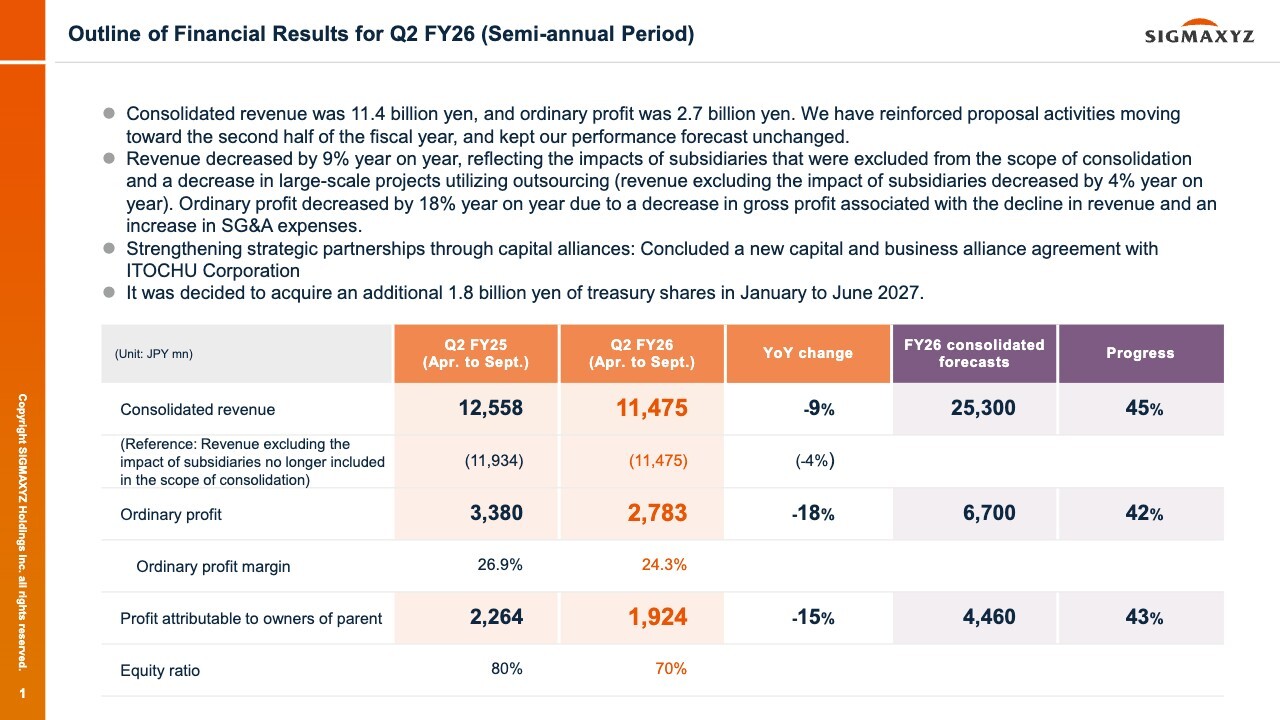
First, an overview of the financial results. During the first half, consolidated revenue decreased 9% year on year to 11,475 million yen, while ordinary profit decreased 18% year on year to 2,783 million yen. The decline in revenue reflected the impact of subsidiaries no longer included in the scope of consolidation and a decrease in large-scale projects utilizing outsourcing.
Excluding the impact of those subsidiaries, revenue declined by only 4% year on year. On a standalone quarterly basis, both revenue and ordinary profit in Q2 exceeded their Q1 levels. Today, we decided on a new capital and business alliance with ITOCHU Corporation and a share repurchase of 1.8 billion yen. I will provide details in the latter part of the presentation.
FY26 Consolidated Earnings Forecasts and Dividend Forecasts
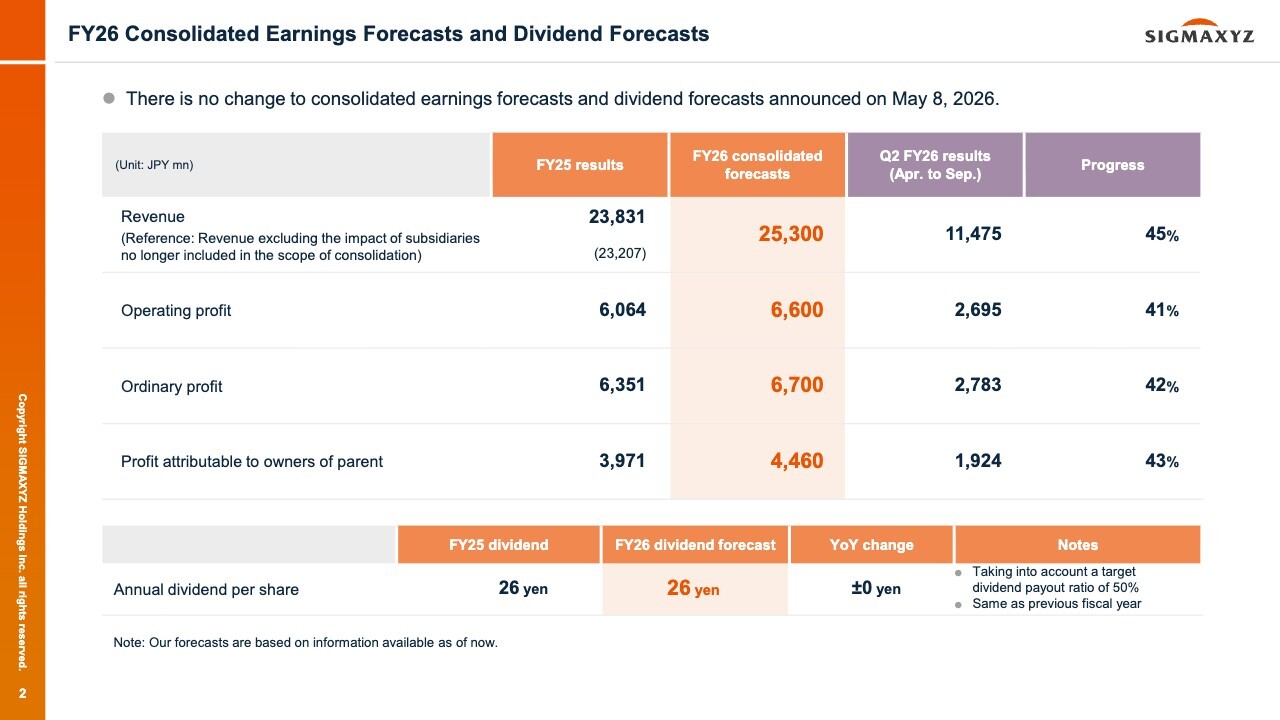
Progress against the full-year forecasts stands at 45% for revenue and 42% for ordinary profit. We are strengthening our proposal activities toward the second half of the fiscal year and have left unchanged both the full-year earnings forecasts announced in May and the dividend forecast of 26 yen per share.
Consolidated Statement of Income for Q2 FY26 (Semi-annual Period)
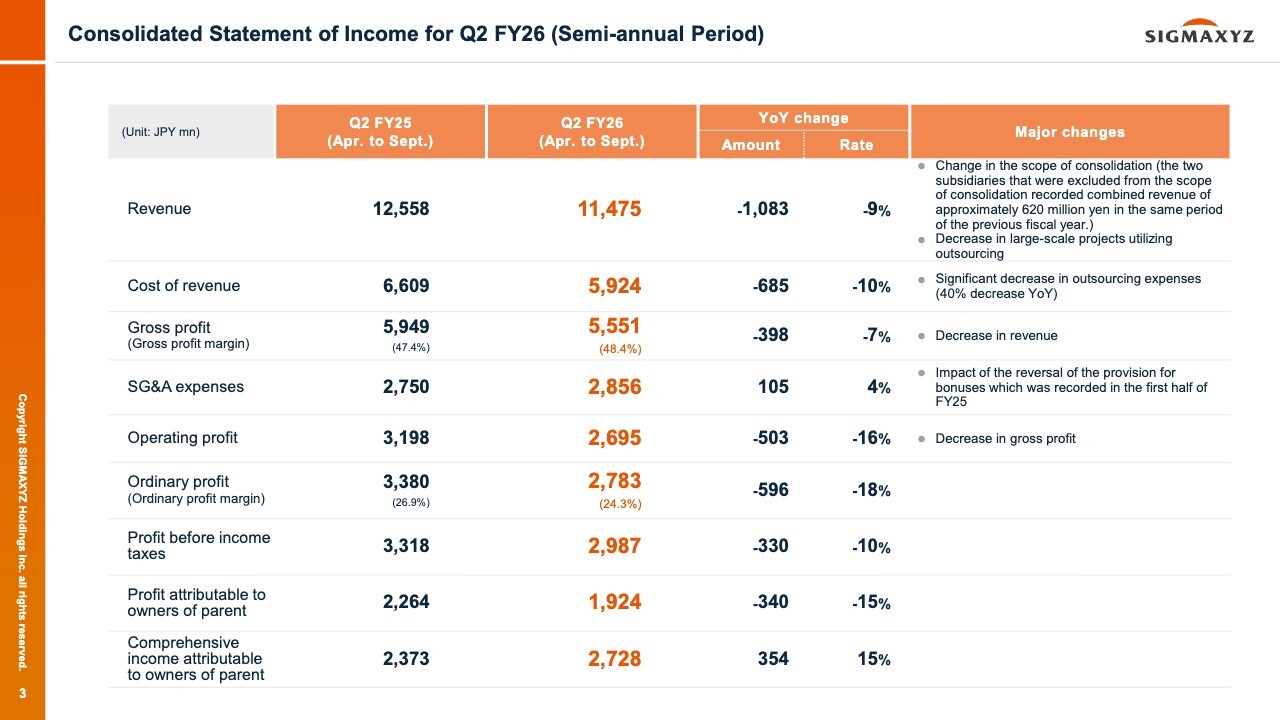
This is the consolidated statement of income. Outsourcing expenses decreased by 40% year on year, bringing cost of revenue down 10%, while the gross profit margin improved by one percentage point to 48.4%. On the other hand, gross profit declined 7% in line with the decrease in revenue. SG&A expenses increased, reflecting the reversal of a provision for bonuses in Q1 of the previous fiscal year, and operating profit fell 16% year on year to 2,695 million yen.
Business Performance Highlights: Consulting Services
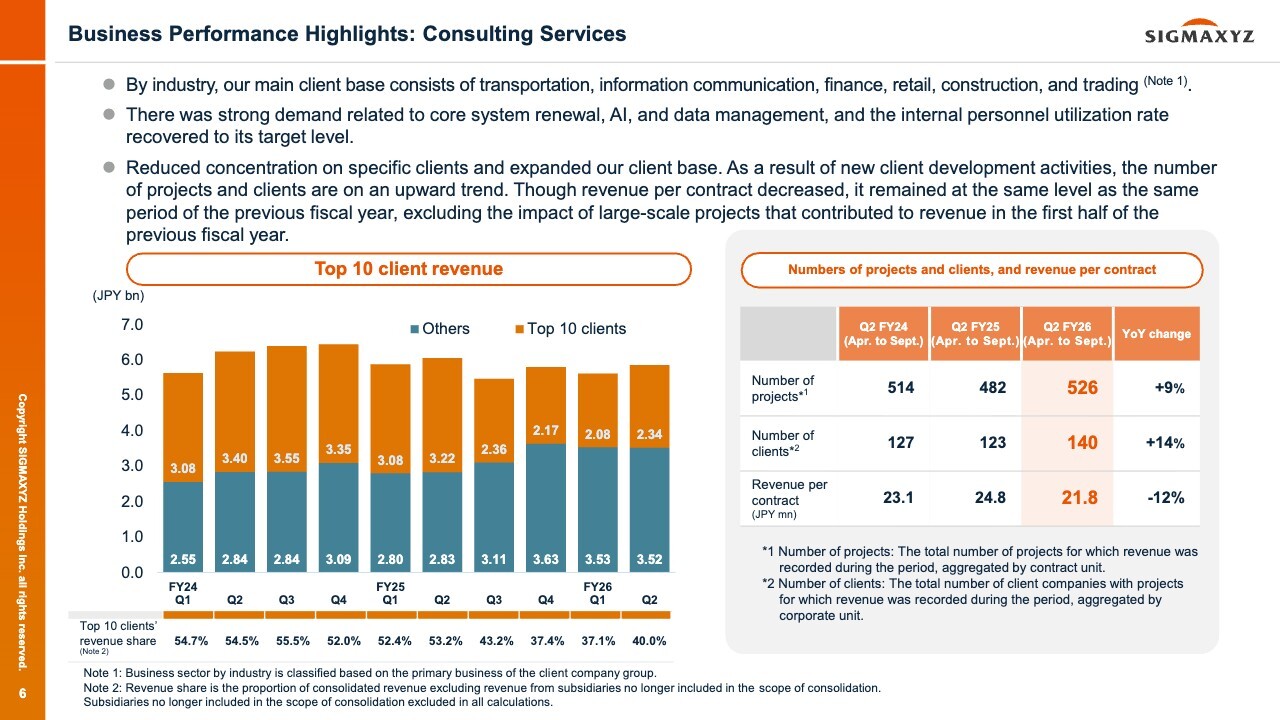
These are our business performance highlights. Demand related to core system renewal, AI and data management remained steady, and our internal personnel utilization rate recovered to its target level. As a result of reducing our concentration on specific clients and developing new clients, the number of projects increased 9% year on year to 526 and the number of clients rose 14% to 140.
Revenue per contract declined 12% year on year, but excluding the impact of large-scale projects that contributed to revenue in the first half of the previous fiscal year, it was at the same level as a year earlier.
Key Performance Indicators (KPIs)
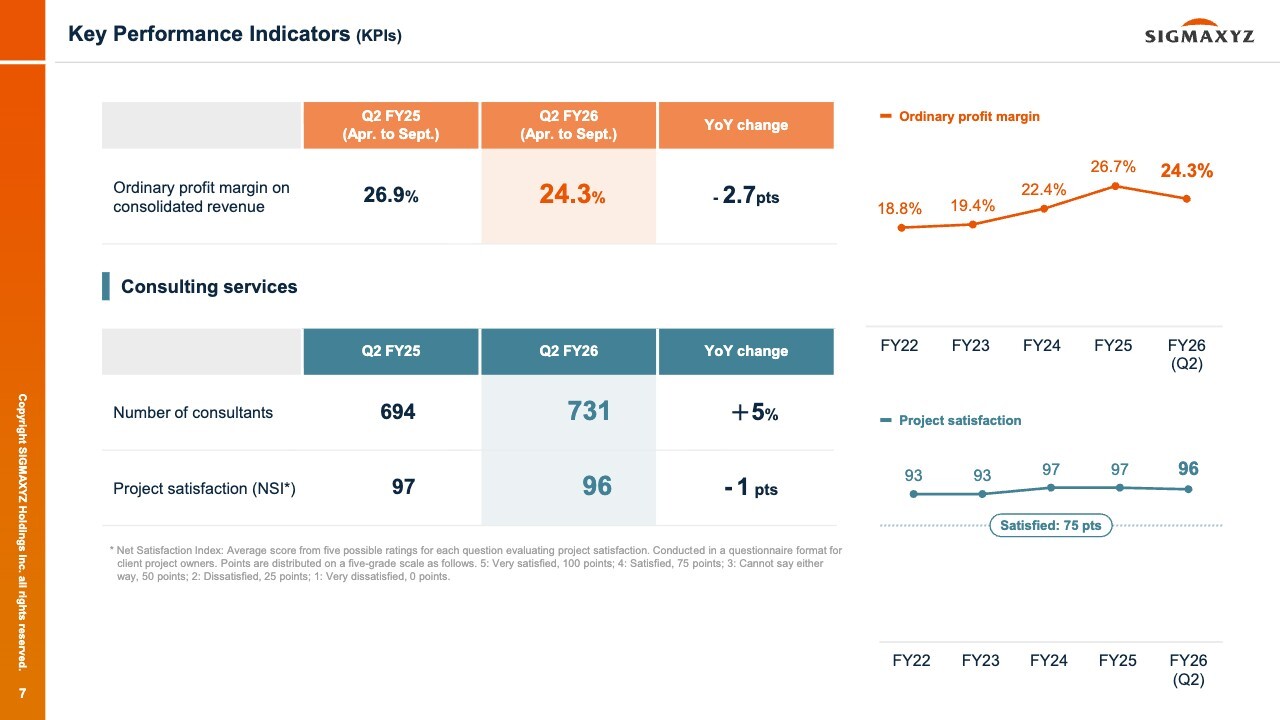
These are our key performance indicators. The ordinary profit margin on consolidated revenue was 24.3%. The number of consultants reached 731 at the end of September, up 5% year on year. Project satisfaction, an indicator of delivery quality, remained high at 96 points.
FY26 Business Policy
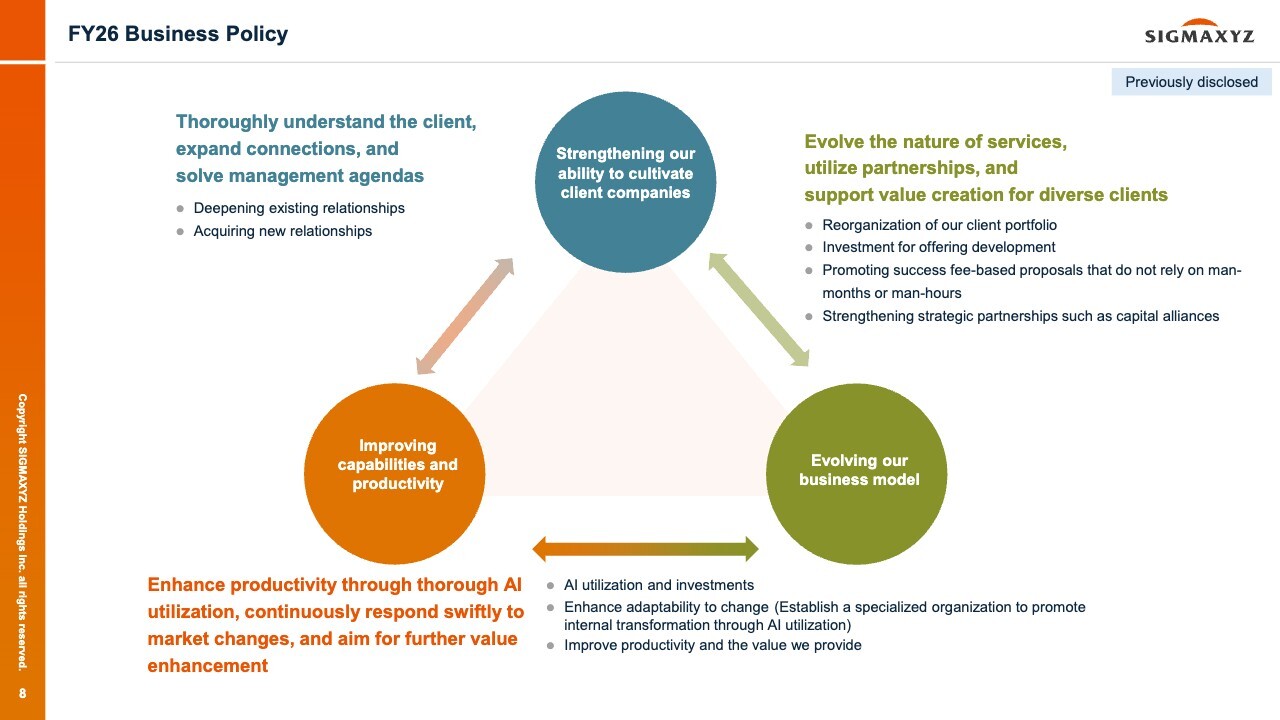
Let me once again go over our business policy for the current fiscal year. We are working on three pillars: strengthening our ability to cultivate client companies, evolving our business model, and improving capabilities and productivity.
Under the second pillar, evolving our business model, we aim to leverage partnerships to support value creation for diverse clients. One of the measures toward this goal is to strengthen strategic partnerships through capital alliances and other means. I will explain the initiatives we are undertaking as part of this effort.
Strengthening Strategic Partnerships Through Capital Alliances: ITOCHU Corporation
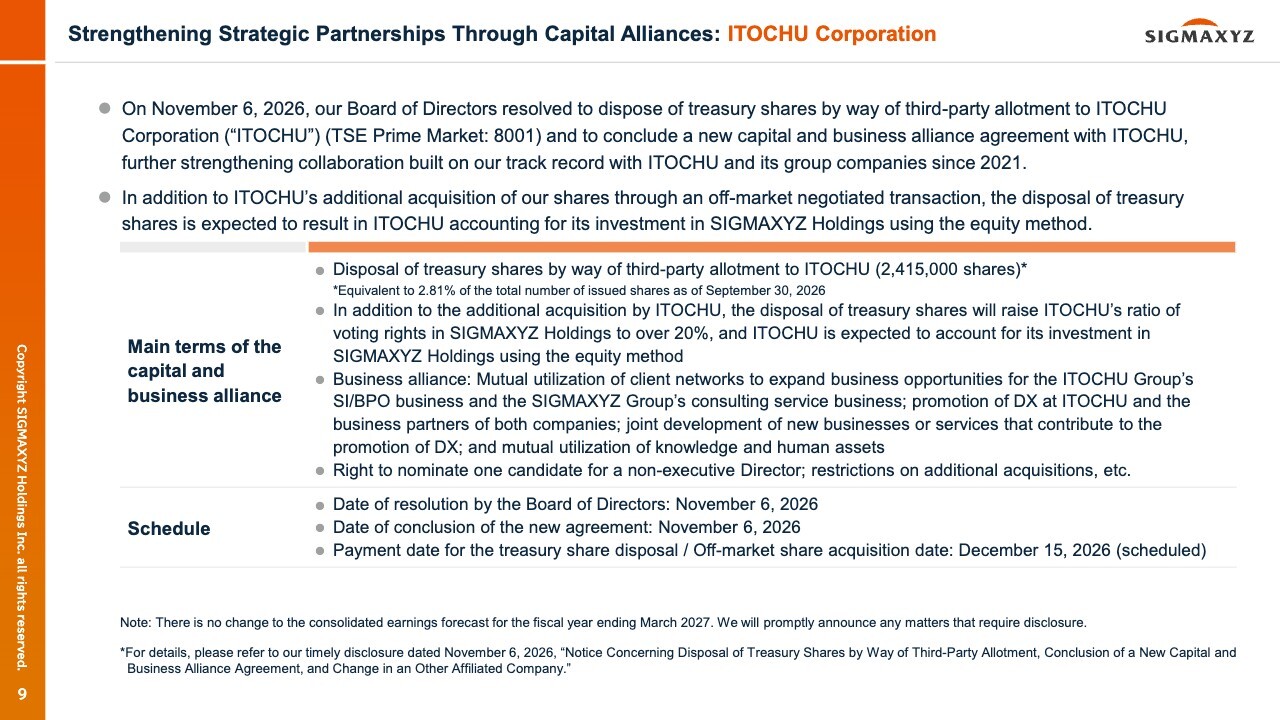
At its meeting today, November 6, our Board of Directors resolved to dispose of treasury shares by way of third-party allotment to ITOCHU Corporation and to conclude a new capital and business alliance agreement with the company.
Building on our collaboration with the ITOCHU Group since 2021, we will further strengthen our partnership through mutual use of client networks in the Group’s SI/BPO business and our business consulting business, promotion of DX at ITOCHU and the business partners of both companies, joint development of new businesses or services, and mutual use of knowledge and human assets.
Through ITOCHU’s additional acquisition of our shares in an off-market transaction and the present disposal of treasury shares, its voting rights ratio is expected to exceed 20%, and ITOCHU is expected to account for its investment in SIGMAXYZ Holdings using the equity method. Completion is scheduled for December 15, 2026.
Strengthening Strategic Partnerships Through Capital Alliances: Core Concept Technologies Inc.
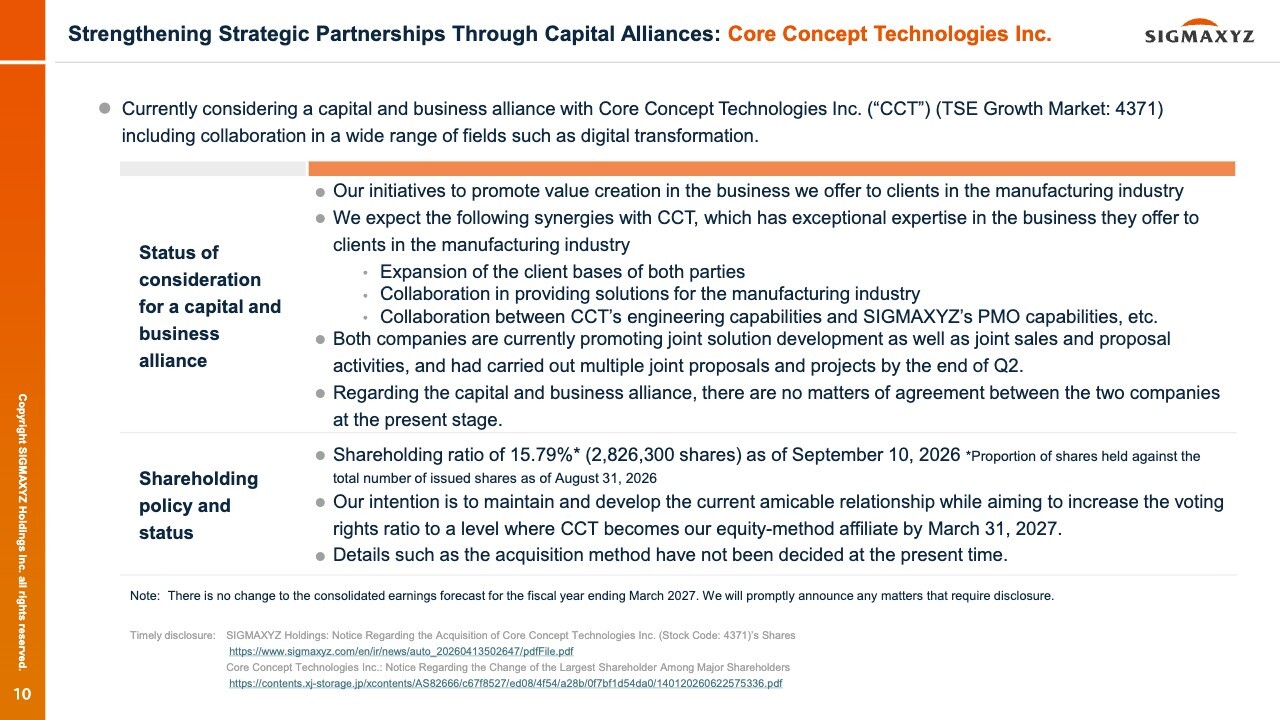
We are considering a capital and business alliance with Core Concept Technologies Inc., which has outstanding expertise in the manufacturing sector. By the end of Q2, we had undertaken several joint proposals and projects. Our shareholding ratio in Core Concept Technologies was 15.79% as of September 10, 2026.
No agreement on the capital and business alliance has been reached between the companies at this stage. However, our intention remains to increase our voting rights holding to a level at which Core Concept Technologies would become our equity-method affiliate by the end of March 2027.
By leveraging strategic partnerships with companies including ITOCHU and Core Concept Technologies, we intend to expand our capabilities, strengthen proposal activities and enhance our ability to deliver transformation, thereby advancing our business toward medium- to long-term growth.
Hiring Activities
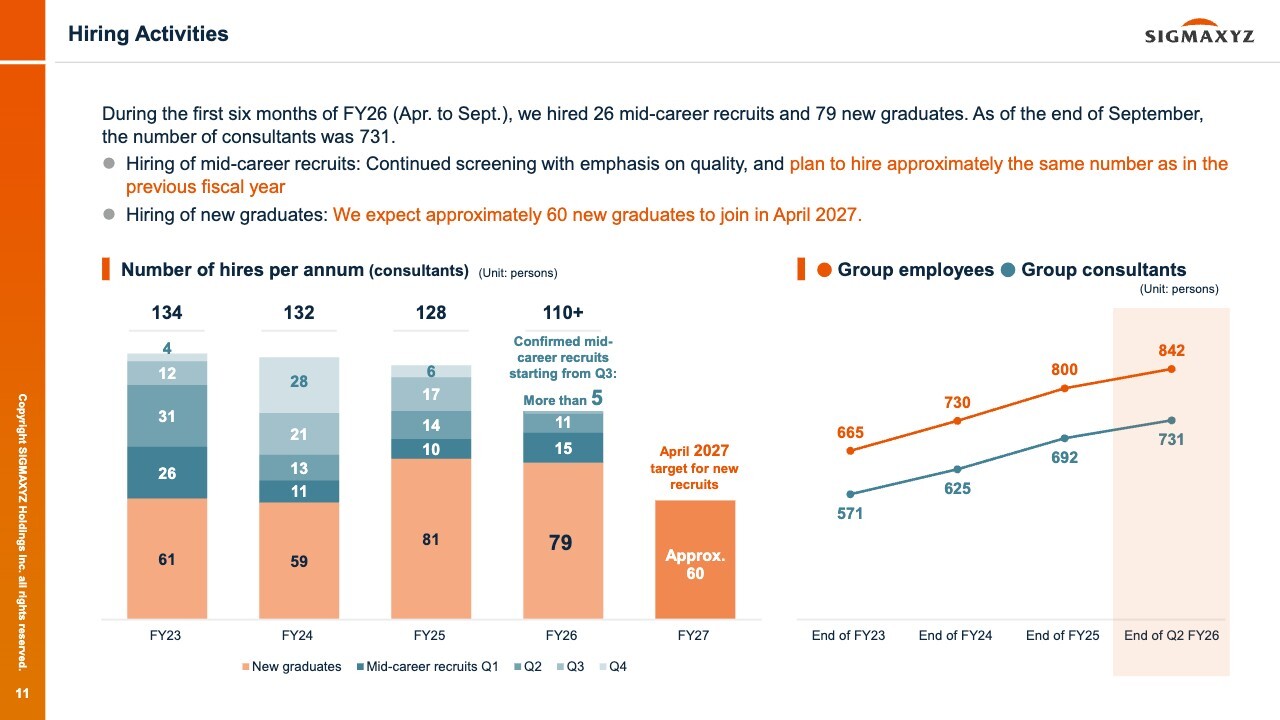
Turning to hiring activities, 26 mid-career recruits and 79 new graduates joined us during the first half. We will continue to select mid-career hires carefully, placing emphasis on quality, and expect to hire approximately the same number as in the previous fiscal year. We plan to hire around 60 new graduates joining in April 2027.
Status of Inherited Assets
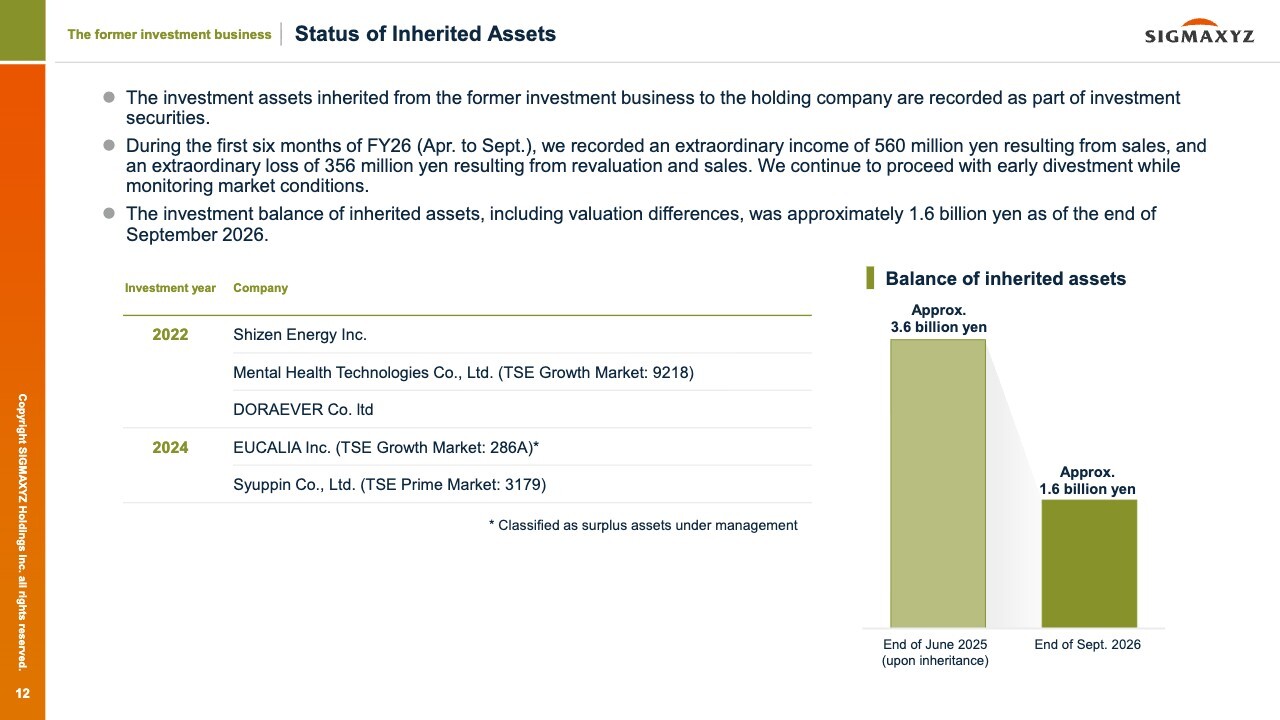
For assets inherited from the former investment business, we recorded extraordinary income of 560 million yen on sales and extraordinary losses of 356 million yen on revaluation and sales. The balance of these inherited assets declined to approximately 1.6 billion yen at the end of Q2. We will continue to pursue their early sale while monitoring market conditions.
Strengthening Shareholder Return Measures
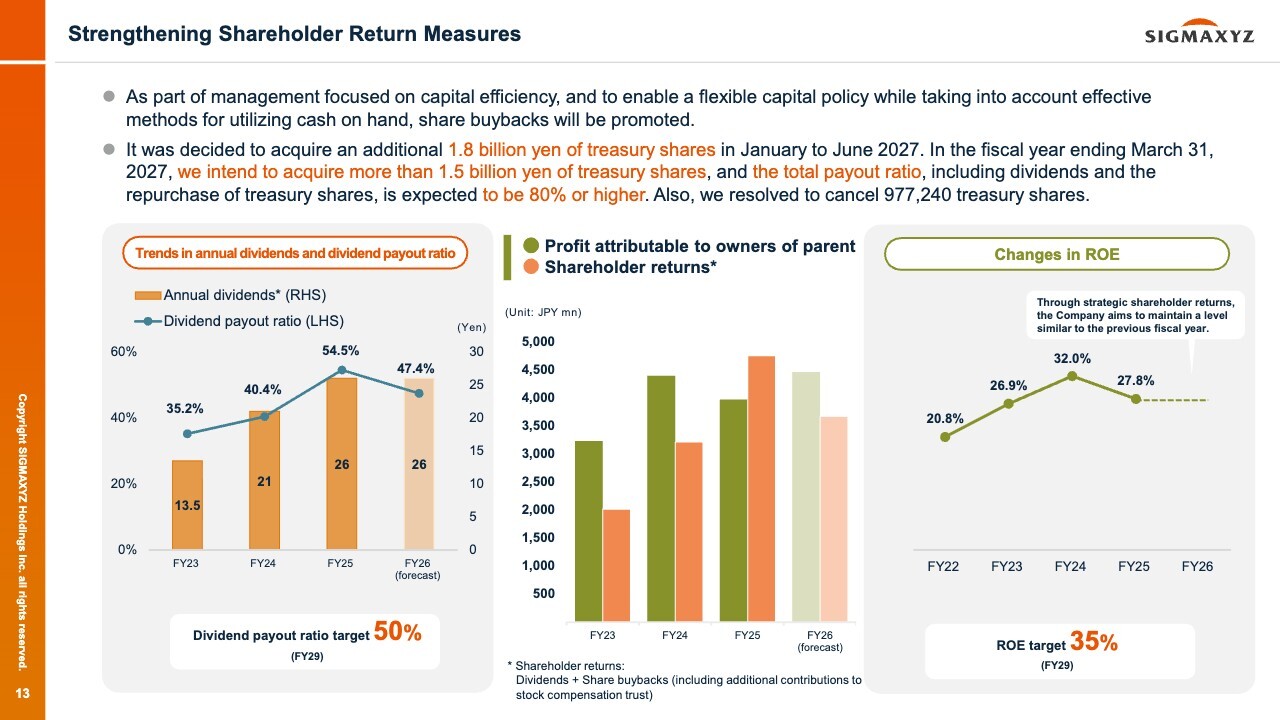
I will now explain our shareholder return measures. As part of management focused on capital efficiency, we decided to repurchase an additional 1.8 billion yen of our shares between January and June 2027. As a result, we plan to repurchase more than 1.5 billion yen of treasury shares during the current fiscal year, and expect the total payout ratio, including dividends, to be at least 80%.
If we repurchase shares up to the maximum amount, the number of issued shares excluding treasury shares will be below the level at the time the disposal of treasury shares to ITOCHU was resolved. We therefore believe the dilutive effect of the treasury share disposal will be mitigated to some extent.
Main Publicized Project Case Studies
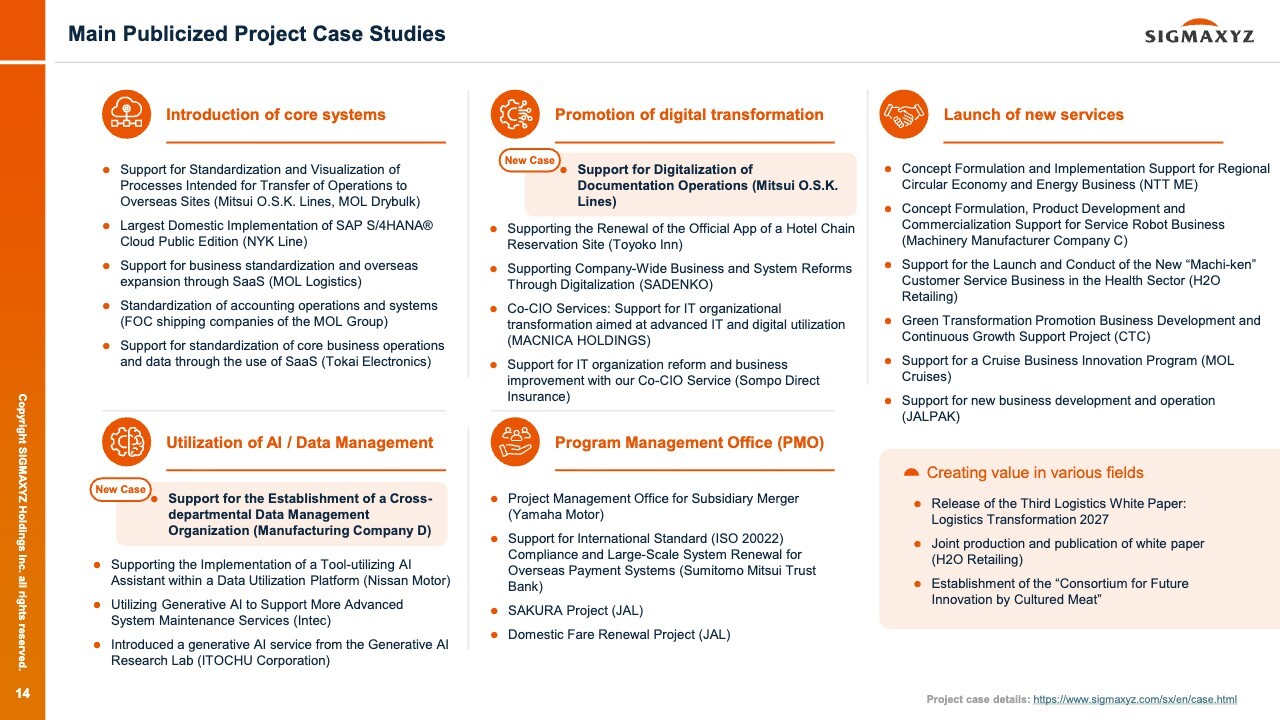
The latter part of the slides introduces case studies disclosed with our clients’ consent, as well as our information-sharing initiatives.
Support for Digitalization of Documentation Operations
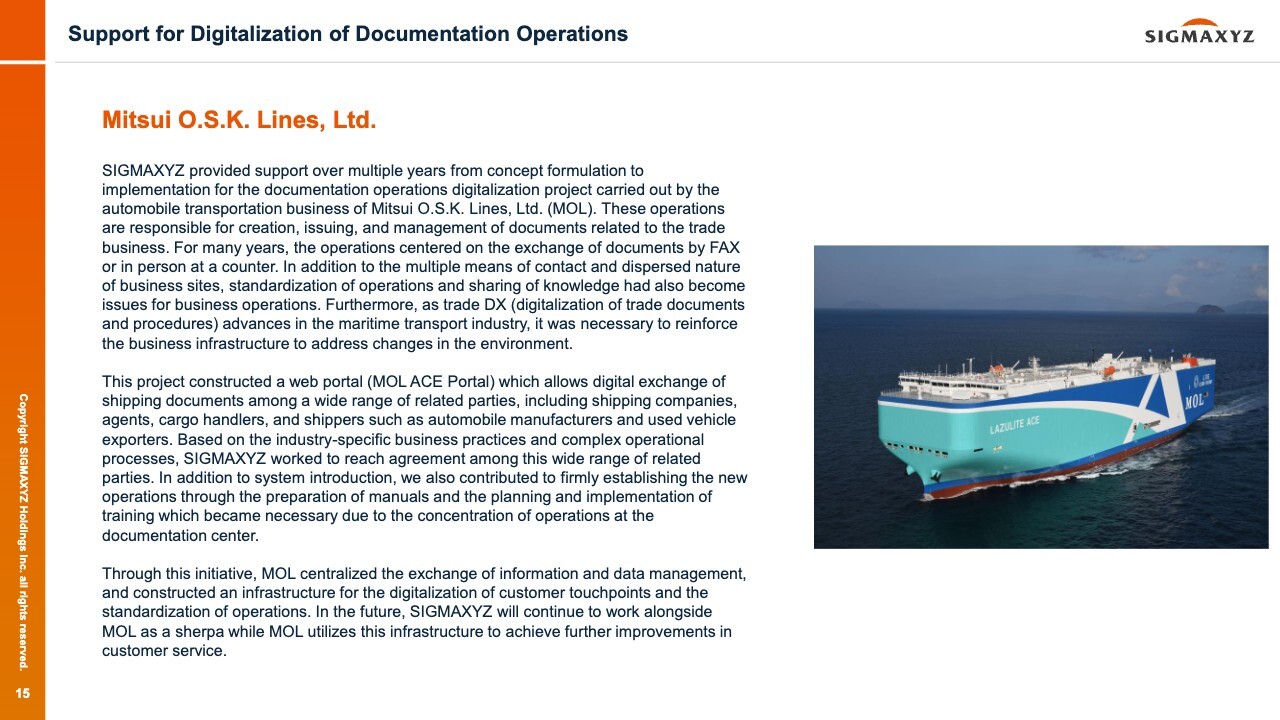
We present a case study of our support for digitalization of documentation operations at Mitsui O.S.K. Lines.
Support for the Establishment of a Cross-departmental Data Management Organization
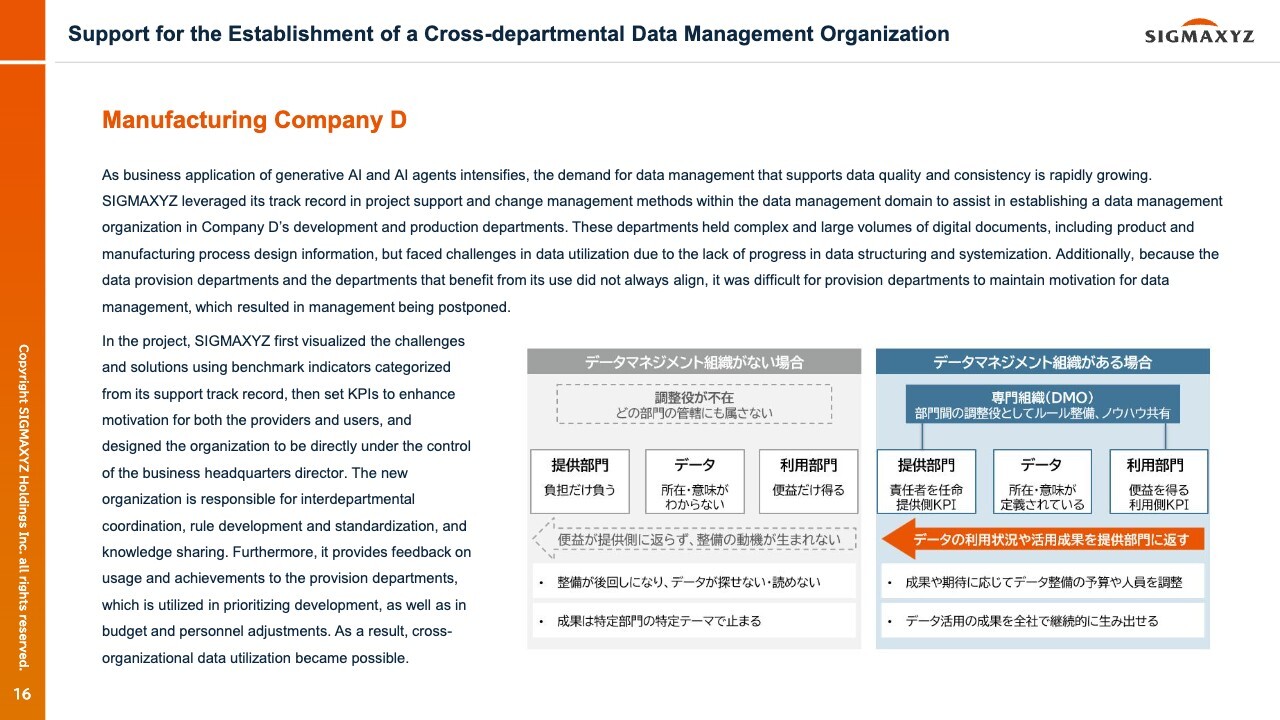
We provide an overview of a project supporting the launch of a cross-departmental data management organization at Company D in the manufacturing sector.
Release of the Third Logistics White Paper: Logistics Transformation 2027
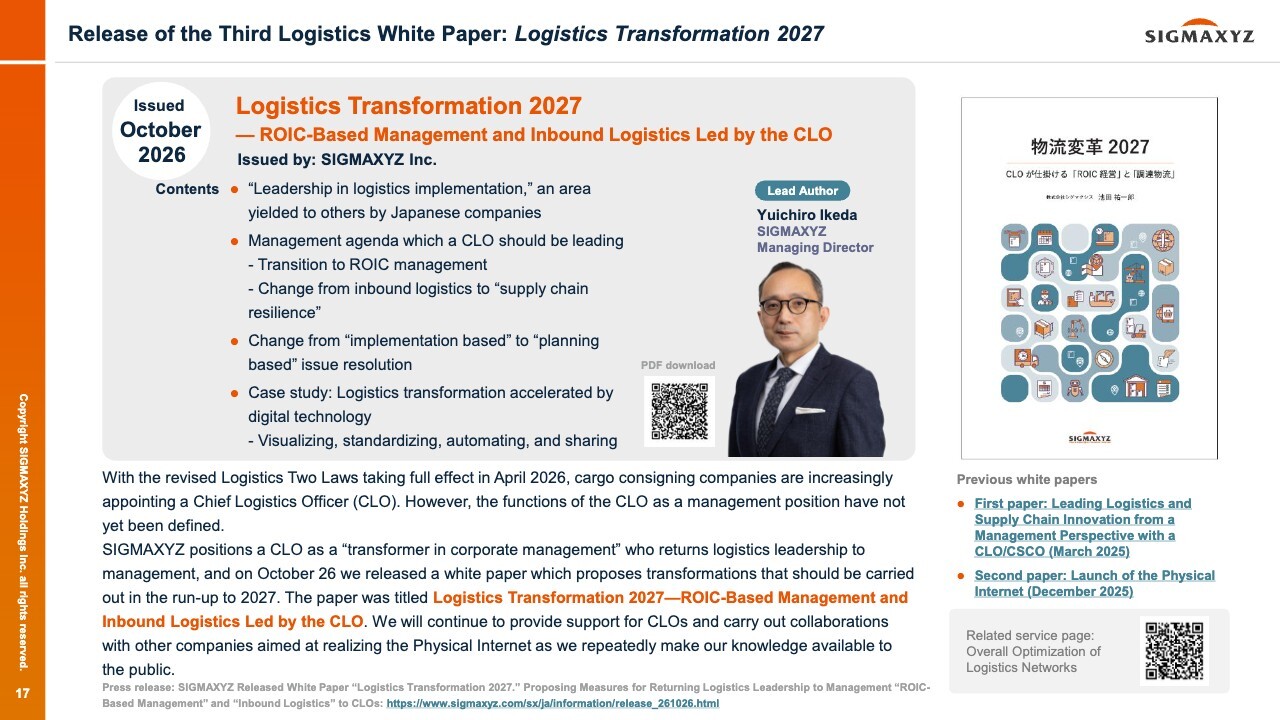
We introduce the third installment of our logistics white paper, “Logistics Transformation 2027,” published in October 2026.
Start of Offering the Management Team Superhuman Development Program
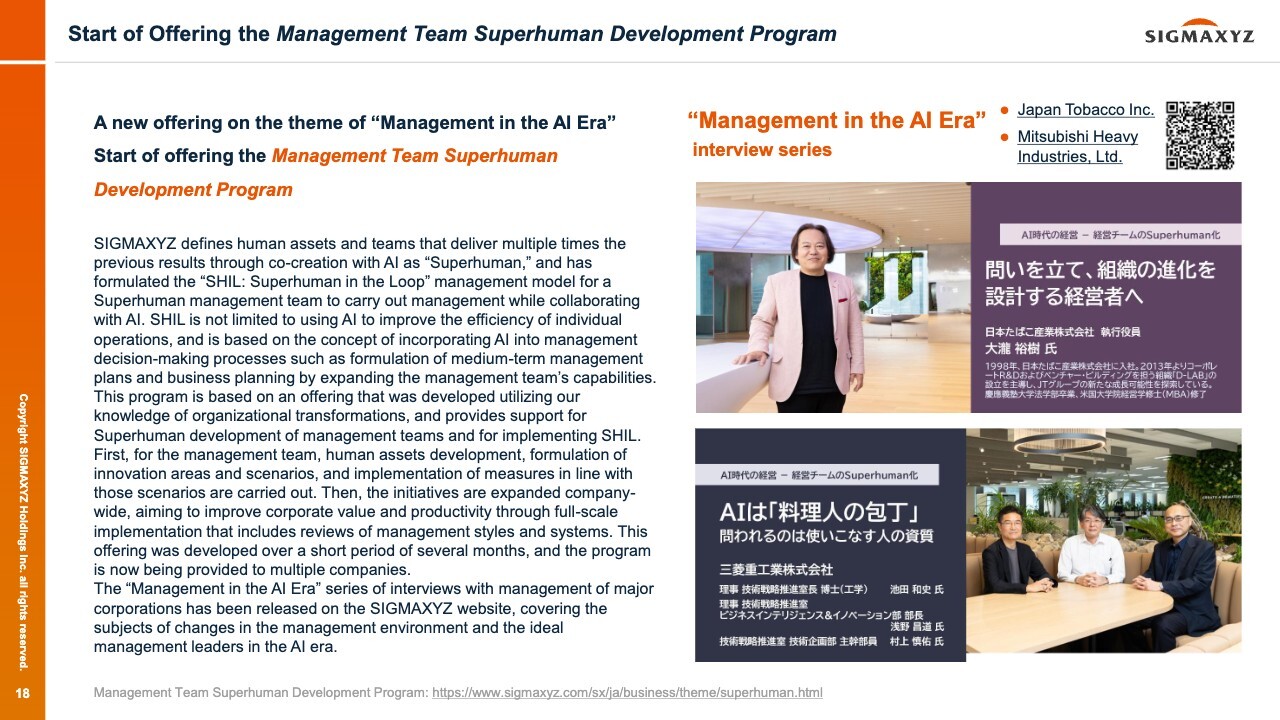
We introduce the Management Team Superhuman Development Program, a new offering on the theme of “Management in the AI Era,” along with interviews with Japan Tobacco Inc. and Mitsubishi Heavy Industries, Ltd.
Information Dissemination Activities Conducted by Professionals in Various Fields
(Main Seminar Presentations and Contributions in 1H FY26)
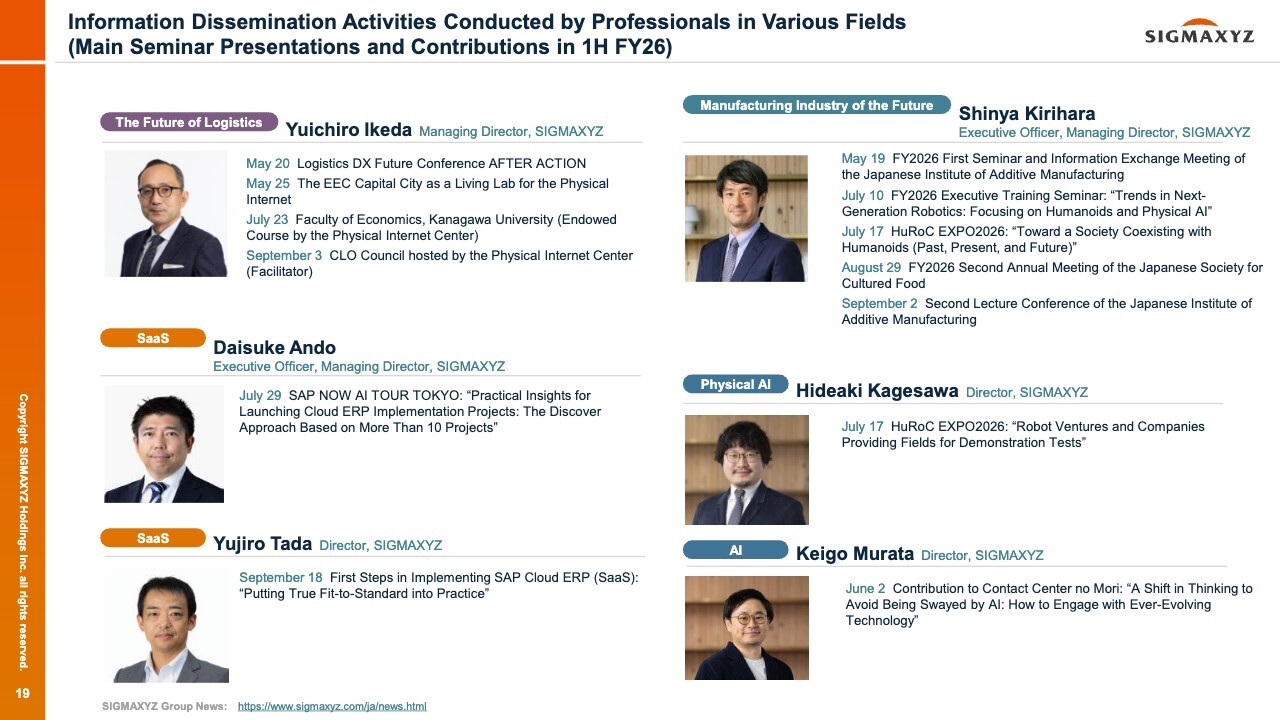
We introduce our main seminar presentations and written contributions during the first half of FY26. Please take a look.
That concludes my presentation. Thank you for your attention.
Q&A: Rationale for Maintaining the Full-Year Earnings Forecasts
Moderator: “First-half progress was lower than usual, at 41% for operating profit and 42% for ordinary profit, and revenue needs to grow by more than 20% year on year in the second half. What is the rationale for keeping the forecasts unchanged?”
Kawasawa: First-half progress remained somewhat low, partly because the utilization rate was weak in Q1. However, both revenue and profit recovered in Q2 compared with Q1 on a standalone quarterly basis. Our internal personnel utilization rate also recovered to our target level of 70%.
In the second half, we will further strengthen proposal activities through measures such as expanding delivery capacity as new graduates begin working in earnest, strengthening strategic partnerships, growing AI- and data management-related projects, and moving medium-sized core system renewal projects into the full-scale delivery phase.
Our business normally has a revenue structure in which revenue and utilization build toward the second half of the fiscal year. However, last year, large-scale projects boosted first-half figures, and second-half figures were lower as a result of their subsequent decline. We would therefore ask you to take into account that the first-half progress rate last year appeared exceptionally high.
Q&A: Synergies from the Capital and Business Alliance with ITOCHU
Moderator: “Is there any impact on revenue or any quantitative targets associated with the alliance with ITOCHU? How will it affect this fiscal year’s earnings forecasts?”
Kawasawa: We have had a capital and business alliance with ITOCHU since 2021 and have built a solid record of synergies between the two companies over these five years. We expect these synergies to expand further. We are not announcing numerical targets today, but our earnings forecasts for this fiscal year remain unchanged. We intend to make further efforts to maximize synergies between the two companies.
Q&A: Reasons for the Change in the Number of New Graduate Hires
Moderator: “Regarding your hiring policy, you plan to recruit around 60 new graduates joining in April 2027, down from 79 this fiscal year. Has there been a change in your hiring policy?”
Sono Uchiyama (hereinafter, Uchiyama): Our strategy of enhancing project value through collaboration among human assets has not changed. Accordingly, our policy of carefully recruiting both new graduates and mid-career professionals with an emphasis on quality also remains unchanged.
However, as you know, AI use is expanding, giving us more ways to improve our own productivity. In addition, as exemplified by the strengthened collaboration under our new alliance with ITOCHU, we want to pursue a strategy of increasing agility by strengthening external partnerships and actively making use of capabilities outside the company, rather than relying solely on internal capabilities.
In light of these circumstances, we want to increase headcount carefully while avoiding hiring too many people, so that we can respond flexibly to changing conditions. This is why we have set the number of new graduate hires at around 60 this time.
Q&A: Background to the Change in the Capital and Business Alliance
Moderator: “Please explain the background to the change in the capital and business alliance with ITOCHU.”
Kawasawa: Rather than a change to the capital and business alliance, we have concluded a new alliance agreement. This was prompted by one of our existing shareholders expressing a desire to sell its shares in our company following changes to its capital policy and other factors.
As a result, in addition to ITOCHU acquiring shares, we decided to dispose of some of our treasury shares. We concluded that this opportunity for ITOCHU to hold our shares would enable us to deepen the capital and business alliance that has been in place since 2021, which led to the new agreement.
Q&A: Views on the Full-Year Earnings Outlook
Moderator: “Based on your pipeline, are you in a position to achieve the company’s plan in the second half?”
Kawasawa: It is not necessarily the case that every project is already in our pipeline at this point. However, we are proceeding with the measures I mentioned for the second half, and that is why we have not changed our full-year outlook.
Q&A: Impact of ITOCHU’s Tender Offer for Dentsu Soken
Moderator: “What impact will ITOCHU’s tender offer for Dentsu Soken have on your company? Will there be more group-wide collaboration, including with ITOCHU Techno-Solutions, or will things remain largely unchanged?”
Kawasawa: ITOCHU’s tender offer for Dentsu Soken has already been announced, but it has not yet been completed, so I would prefer not to comment on specifics here. That said, we have built relationships through group-wide collaboration, including with ITOCHU Techno-Solutions, over the past five years, and these relationships have produced substantial synergies.
We therefore believe that ITOCHU’s new initiatives in IT will have a positive impact on us as well, not only those involving Dentsu Soken.
Q&A: Hiring Status and Employee Turnover Rate
Moderator: “Could you discuss your second-half hiring outlook, your expectations for the year-end headcount and the current turnover rate?”
Uchiyama: We hired 79 new graduates in April, and they have now started working. For mid-career hiring, our policy this fiscal year has been to replace around 60% of the employees leaving, assuming a turnover rate of 10% to 12%, through mid-career recruitment. We are currently on track, so I expect mid-career hiring to finish at or slightly above our target.
On the other hand, amid changes in the market, project sizes and client needs, we have also replaced some personnel this fiscal year whose skills no longer match requirements or who have become difficult to deploy. We therefore believe the turnover rate may be higher than usual.
As a result, our final headcount may be somewhat lower than initially expected. However, we are also developing alliances, including stronger ties with ITOCHU and our investment in Core Concept Technologies, so we intend to proceed while considering both recruitment and the use of external capabilities.
Q&A: Possibility of Accelerating Mid-Career Hiring
Moderator: “As you reduce new graduate hiring, could you accelerate mid-career recruitment depending on demand?”
Uchiyama: With new graduate hires, we need time to recruit and train younger employees until they become fully capable professionals. By contrast, mid-career hires can contribute immediately. In terms of obtaining immediately deployable capabilities, drawing on diverse capabilities outside the company is also one strategy we are considering.
Accordingly, rather than offsetting the reduction in new graduate hires simply by increasing mid-career recruitment, we would like to adjust our approach after considering the portfolio of capabilities, including external resources, with which we will develop our business.
Q&A: Impact of Recent Security Issues
Moderator: “Security issues are becoming a concern worldwide. What impact are they having on your company?”
Kawasawa: I think your question has two aspects. One concerns our own security measures, namely how we would respond if we ourselves came under a cyberattack. The other, I believe, concerns the business opportunities presented by security needs in the market.
On the first point, one difference from other companies is that we do not operate a B2C business and do not handle consumer data. We also have certain security measures in place for what we do handle.
On the other aspect, security as a market opportunity, we are not a company that sells security technology. However, security measures and responses are not merely technology issues; they also extend to organizational and governance issues.
In that regard, we see room for our project management professionals to contribute.
Q&A: Number of Mid-Sized Clients
Moderator: “Your number of clients is increasing steadily, but are you seeing growth among mid-sized clients?”
Kawasawa: The term “mid-sized” can be difficult to define, but we do undertake a certain amount of business with mid-sized clients, including subsidiaries of large corporations, and we believe that the number of such clients is growing.
Q&A: Outsourcing in Q2
Moderator: “Could you tell us about the outsourcing situation in Q2?”
Kawasawa: I assume you are asking specifically about outsourcing in Q2. The level was almost the same in Q1 and Q2, with an outsourcing ratio of around 11%.
Q&A: Utilization Rate Target for the Second Half
Moderator: “You mentioned that the utilization rate is back on track. What is your target for the second half?”
Kawasawa: We continue to set our utilization rate target at 70% and are working toward it.
Q&A: Impact of Issues in the Middle East and Current Conditions
Moderator: “I believe the impact of issues in the Middle East was felt in Q1. Has the situation changed?”
Kawasawa: When the issues in the Middle East emerged this spring, some clients temporarily froze projects they had planned. Subsequently, in light of the prolonged situation in the Middle East, some of those projects were started after their scope and other aspects had been reviewed.
In terms of what has changed, I would like you to understand that some projects are now under way.
Q&A: Progress in Revenue and Ordinary Profit
Moderator: “Is it fair to understand that current progress in both revenue and profit is slightly behind the company’s plan?”
Kawasawa: As explained today, progress is 45% for revenue and 42% for ordinary profit. Based on these figures, we recognize that we are currently behind plan. We intend to address this by strengthening proposal activities toward the second half.
Q&A: Impact of Clients Bringing Work In-House
Moderator: “You mentioned project scope reductions due to the Middle East situation. Are you seeing reductions in project size because clients are bringing work in-house?”
Kawasawa: I think there are two aspects to that question. For clients affected by the Middle East situation, it was simply a review of project scope for the current fiscal year, not a move to bring work in-house. In other words, for those particular clients, no insourcing occurred; rather, the overall project scope was reviewed and reduced, and we won and are delivering those smaller projects.
More generally, we certainly recognize that clients bringing work in-house can have an impact. However, even when clients attempt to do so, they often lack the necessary human assets. As a result, there are also cases where they try insourcing but ultimately ask us to provide services.
Therefore, while we do not deny that insourcing has an impact in general, we have not yet seen a clear trend toward actual reductions in project sizes.
Q&A: Growth in AI-Related Projects and Future Outlook
Moderator: “You mentioned that AI-related projects are growing. What kinds of projects are increasing, and do you expect further growth in this area?”
Kawasawa: What we call AI-related projects includes, in a broad sense, not only AI itself but also the data environments and data management infrastructure needed to use generative AI effectively. Thus, in addition to projects that simply implement AI, business related to the data management infrastructure supporting that implementation is also growing.
Looking ahead, we expect further growth in this area, particularly in projects to implement environments in which clients can use generative AI.
Q&A: Trends in Client Demand
Moderator: “Have you observed any trends or changes in the demand environment among your clients?”
Kawasawa: That is a broad question and difficult to answer, but I imagine you may be referring to the impact of AI and similar developments. I think this is less a major change in trends than a shift in what clients regard as their most important priorities.
In our interactions with clients, what we sense is that what is necessary remains necessary. When implementing AI, clients may initially try to do the work in-house but find that they cannot handle everything themselves and need support. In that sense, I believe demand for the supply of human assets remains high. This could be described as a trend, but we recognize it as an issue that continually arises as technology evolves.
Q&A: Scale of Business Collaboration with ITOCHU
Moderator: “Regarding your alliance with ITOCHU, the numerical impact has not appeared particularly large so far. How substantial has the effect been quantitatively?”
Kawasawa: We do not disclose details of our business with individual clients. As a result, some aspects may not be apparent from the disclosed figures alone.
However, beyond ITOCHU itself, we conduct a certain scale of business within the ITOCHU economic sphere, including with its operating companies such as ITOCHU Techno-Solutions and BELLSYSTEM24. I will refrain from giving specific figures, but I can say that the scale is sufficient to rank among our top 10 clients.
Uchiyama: As for the results of our collaboration with ITOCHU, the companies we work with are those involved in ITOCHU’s digital businesses.
Therefore, since 2021, we have been generating results not only from business for ITOCHU and collaboration with ITOCHU itself, but also from providing services through joint proposals to clients with these group companies.
This time, we strengthened our business collaboration in order to reinforce efforts to work more closely together in approaching clients and provide new services.
Q&A: Outlook for ITOCHU’s Ownership Interest
Moderator: “Will ITOCHU’s ownership interest continue to increase?”
Kawasawa: Its ownership interest will exceed 20% upon completion of this transaction, and we do not expect an immediate further increase. As stated in our timely disclosure, increases beyond a certain level require our consent. Accordingly, we believe its interest will not increase further without our agreement.
Q&A: Outlook for Revenue per Contract
Moderator: “Revenue per contract has recently declined as large-scale projects have rolled off. When might it stabilize or start rising? Or will it continue declining as you expand your client base?”
Kawasawa: As explained earlier, Q2 results appear to show a decrease in revenue per contract compared with the previous fiscal year, but as you say, this reflects the impact of large-scale projects. Excluding those projects, the level is almost unchanged.
Fundamentally, we regard the decline caused by those projects rolling off as temporary and do not believe underlying contract pricing has fallen. Therefore, “flat” may not be quite the right term, but we expect this underlying pattern to continue.
Revenue per contract could rise if we begin large-scale projects involving a certain amount of outsourcing. However, that is not a situation we are specifically aiming to create.
It is true that we sometimes offer strategic discounts as we broaden our client base. However, as the Q1 and Q2 results show, revenue per contract itself has not fallen substantially. We therefore do not expect the downward trend to continue.
Q&A: Status of Winning Large-Scale Projects
Moderator: “What is the status of your efforts to win large-scale projects?”
Kawasawa: As I believe we explained at the start of this fiscal year, our plan does not depend on large-scale projects. However, if there is news regarding such projects, we will disclose it in a timely manner.
Business opportunities have not disappeared altogether, but the larger a project becomes, the more coordination is needed among the client’s various stakeholders, which can make forecasts difficult. We would like to make an announcement when we have won a project and achieved certain results.