One of Japan's largest diversified REIT investing in real estate properties serving as a foundation of the metropolitan life (live, work and consume)
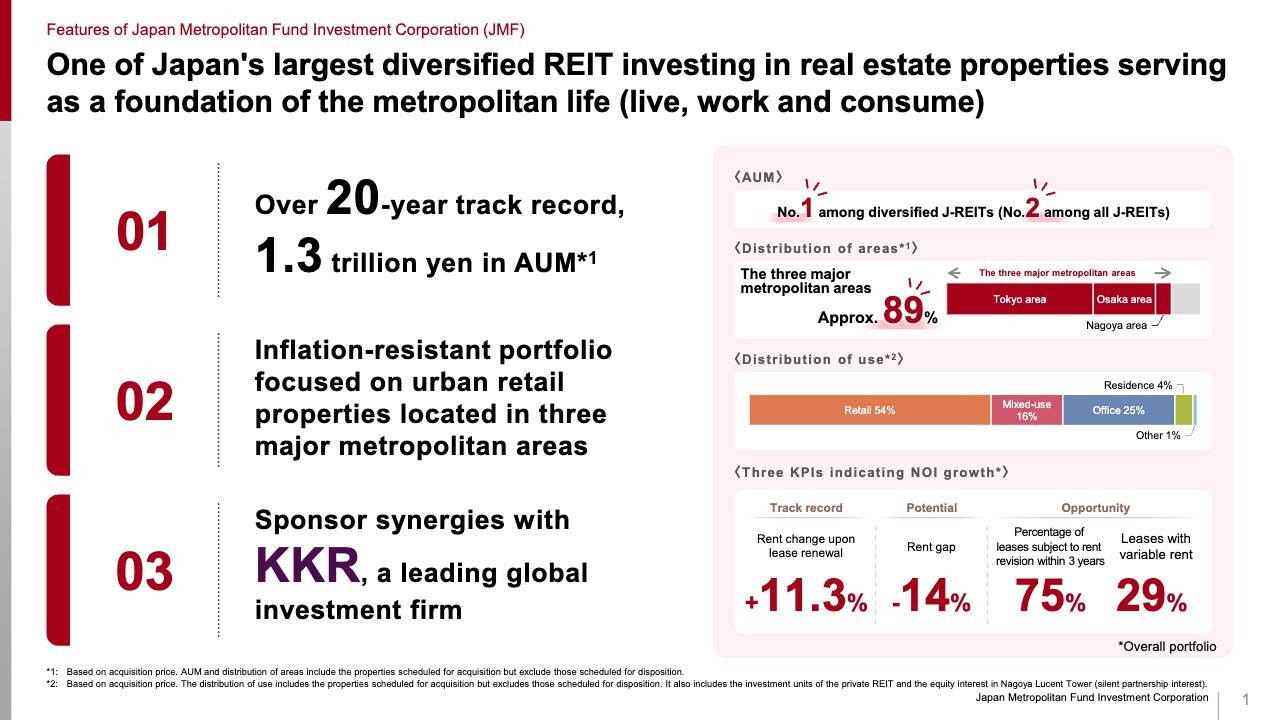
Mr. Takuya Machida (hereinafter, “Machida”): I am Takuya Machida of KJR Management, the asset manager of Japan Metropolitan Fund Investment Corporation. Today, I will discuss JMF's financial results for the 49th fiscal period.
There are three main points I would like to highlight in these results.
First, we expect underlying EPU to continue growing despite rising interest rates and to reach the 2,600-yen range in our forecast for the 51st fiscal period. Second, rent increases and the introduction of inflation-linked clauses are progressing not only at urban retail and office properties but also at large shopping centers (SCs). Building on these achievements, we are raising our medium-term underlying EPU target from 2,700 yen to 2,800 yen.
Growth cycle driven by “Internal growth” & “Return of gains on sale”
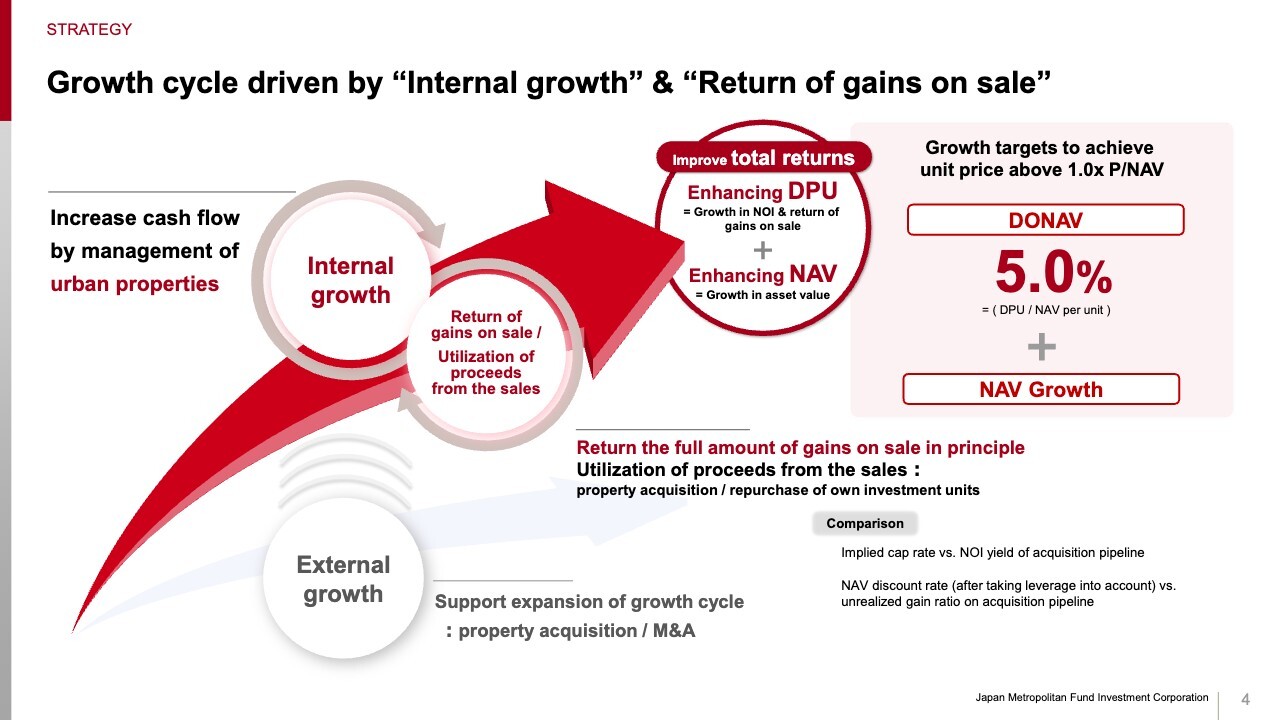
This slide outlines JMF's current growth strategy and quantitative targets. There has been no change in the basic direction of our growth strategy.
DPU remains above 3,000 yen through internal growth and return of gains on sale Underlying EPU grew by approx.+3%, and total return for the 49th FP is 10.7%
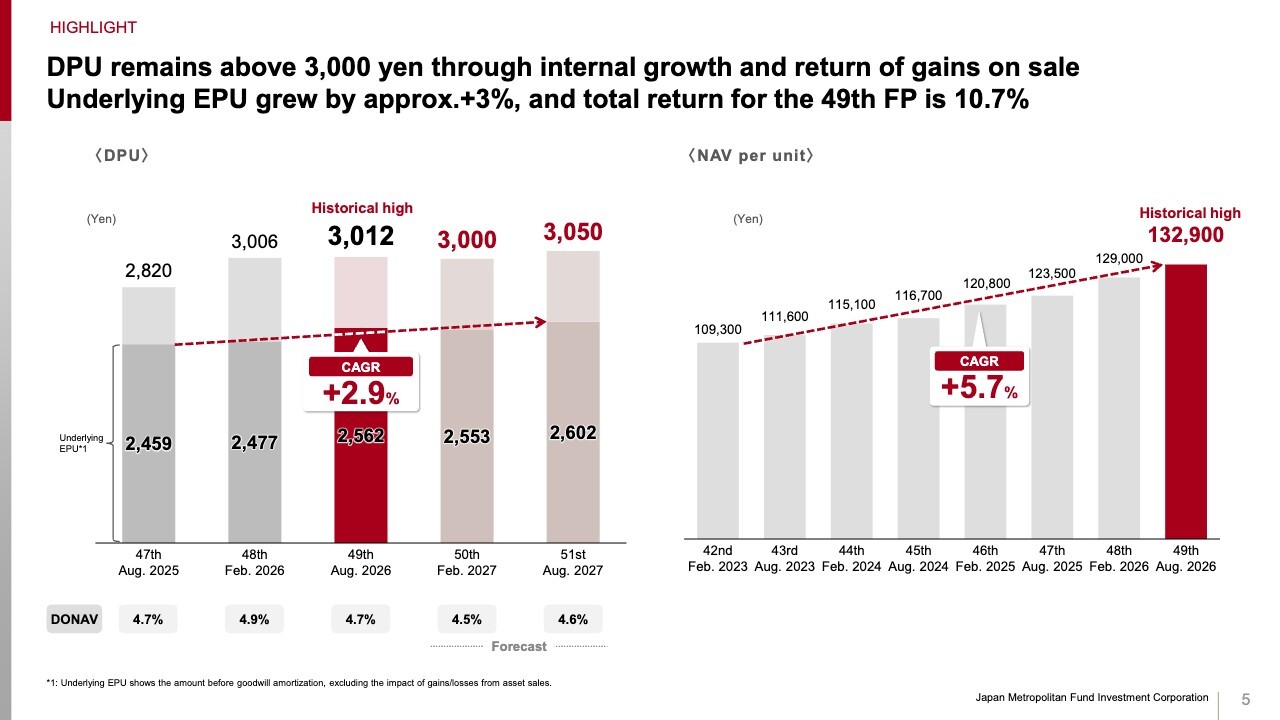
Let me begin with our financial results and earnings forecasts. DPU for the 49th fiscal period rose 0.2% from the previous period to 3,012 yen. It exceeded 3,000 yen for the second consecutive period and reached a new record high.
We are raising our DPU forecast for the 50th fiscal period from the previously announced 2,900 yen to 3,000 yen. For the 51st fiscal period, we forecast DPU of 3,050 yen, which would set another record high.
Underlying EPU, which excludes the effects of goodwill amortization and gains/losses on sale from net income, is expected to grow by approximately 3% annually, mainly driven by higher NOI, even after factoring in further interest rate increases. We expect it to rise from the 2,400-yen range recorded in the 47th fiscal period to approximately 2,600 yen in our forecast for the 51st fiscal period.
NAV per unit increased by approximately 3% from the previous period to 132,900 yen, as higher earnings from retail, office and residential properties lifted appraisal values, even while we returned unrealized gains through asset sales. This also marked a new record high.
Medium-term targets raised; DPU expected to reach 3,200-3,300 yen within 3 years
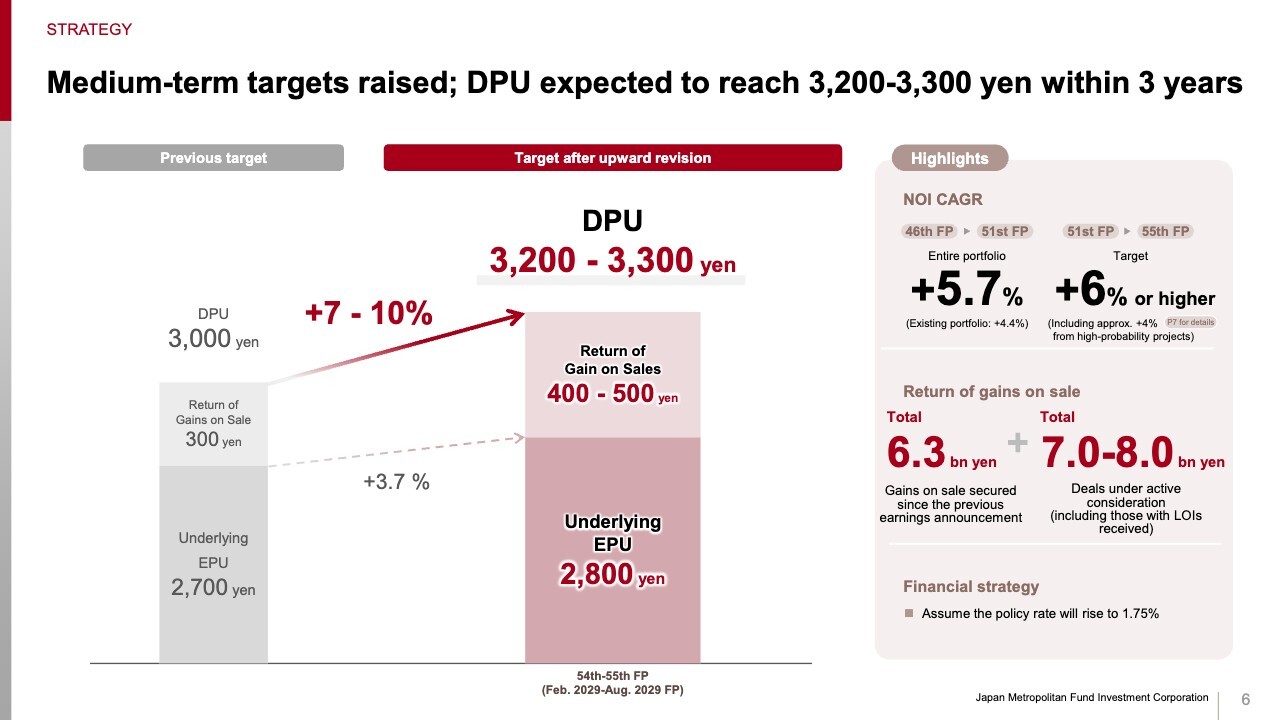
I will now explain the increase in our medium-term targets. Our previous targets, announced at the financial results briefing for the fiscal period ended February 2025, were underlying EPU of 2,700 yen, distributions of gains on sale of 300 yen per unit and DPU of 3,000 yen.
Although interest rates have risen more than we assumed when setting those targets, internal growth has outpaced that increase. We now expect to achieve our previous targets and have room for further growth, so we are raising our targets.
We are raising the underlying EPU target by approximately 4% to 2,800 yen. We are also increasing our target for distributions of gains on sale by 100 to 200 yen, to 400 to 500 yen per unit.
As a result, we are raising our DPU target by 7% to 10%, from 3,000 yen to a range of 3,200 to 3,300 yen. We aim to achieve this target in the 54th to 55th fiscal periods, and I will explain the details on the following pages.
Underlying EPU expected to reach 2,800 yen and grow further, as internal growth significantly outpaces the impact of higher interest rates
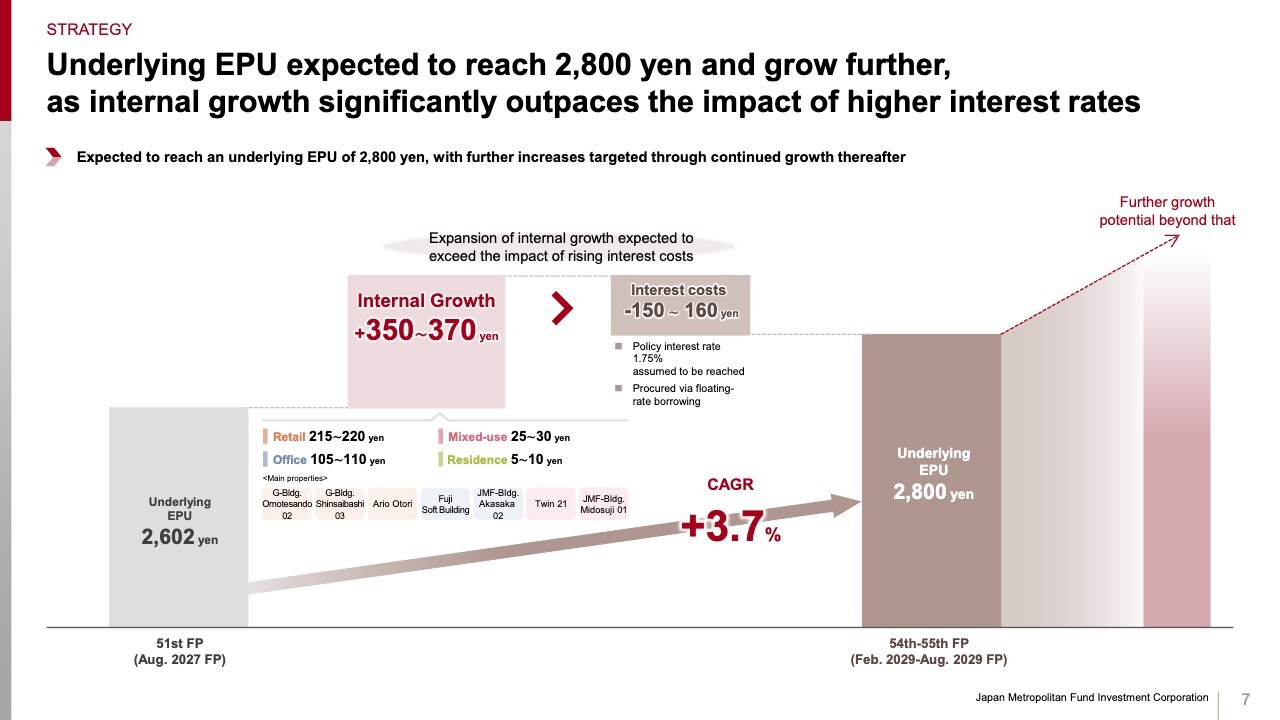
I will now walk you through our roadmap to underlying EPU of 2,800 yen, starting from the forecast for the 51st fiscal period. By the 54th to 55th fiscal periods, we expect internal growth that is already secured or highly probable to increase underlying EPU by 350 to 370 yen compared with the 51st fiscal period.
In retail, negotiations for rent increases are progressing steadily at high-street properties such as G-Bldg. Omotesando 02, G-Bldg. Shinsaibashi 03 and G-Bldg. Shinsaibashi 05.
We also expect revenue growth at large properties under master leases, such as Ario Otori, and at large shopping centers, including unimo chiharadai and Oyama Yuen Harvest Walk. These increases are expected to add approximately 220 yen to underlying EPU.
In the office and mixed-use sectors, we expect underlying EPU to increase by approximately 110 yen, reflecting automatic rent revision clauses in the FUJISOFT office portfolio, the expiry of rent-free periods and rent increases at JMF-Bldg. Akasaka 02, and rent increases at Twin 21.
We expect to reach underlying EPU of 2,800 yen even on the assumption that the policy rate rises to 1.75% by the 55th fiscal period, reducing underlying EPU by 150 to 160 yen through higher interest costs. Beyond the internal growth incorporated into this outlook, substantial rent gaps remain across the portfolio.
As we are also introducing automatic rent revision clauses and turnover-based rents, and can expect additional revenue from external growth, there is scope for underlying EPU to grow beyond 2,800 yen.
Near-term rent revision opportunities and variable rents support continued portfolio growth potential
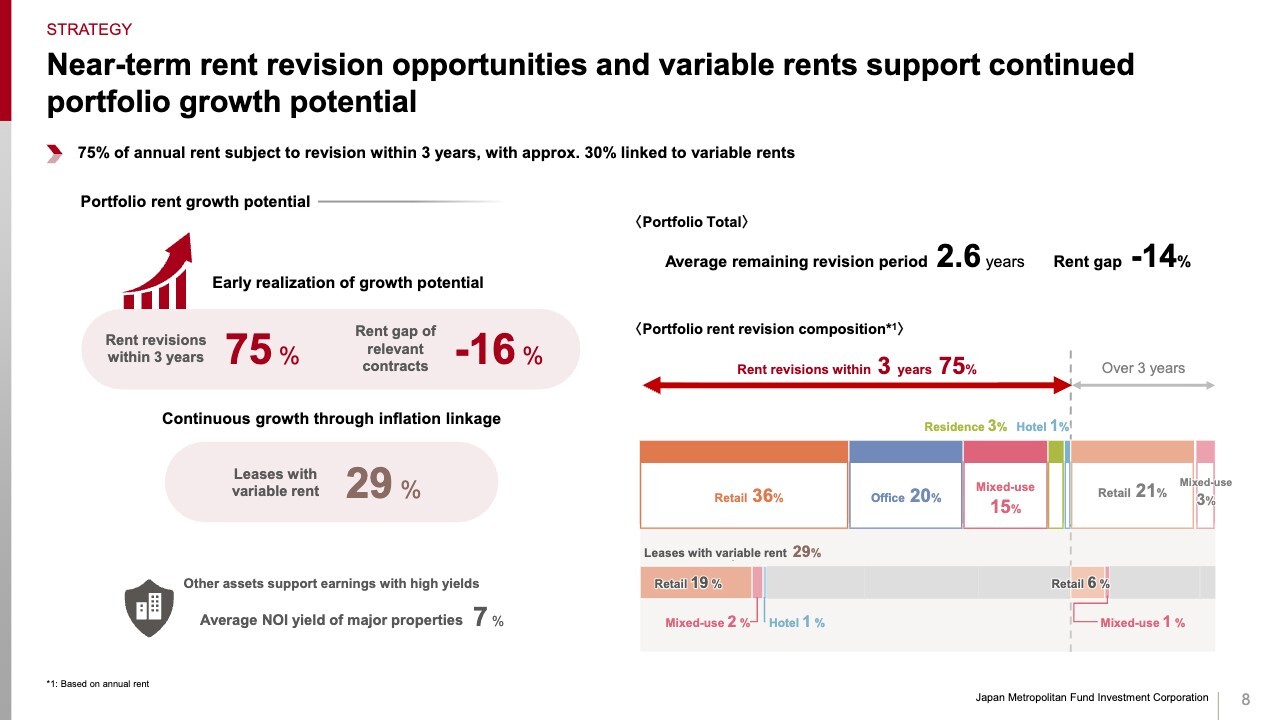
Let me discuss the growth potential of JMF's portfolio.
The average remaining time until the next rent revision is 2.6 years, and the portfolio rent gap is 14%, putting us in a position to translate potential rent increases into earnings. Rent revisions are scheduled within three years for 75% of the portfolio, and the rent gap for these leases is 16%. This gives us ample opportunities for rent growth in the near future.
The remaining 25%, primarily retail properties, has more than three years until the next rent revision. Variable rent or other inflation-linked clauses apply to 7% of the portfolio, allowing us to capture revenue growth from higher tenant sales and other factors.
The other 18% includes many properties where we have already achieved rent increases, and their average NOI yield is 7%, well above the portfolio average. Alongside near-term rent revision opportunities, these high-yielding assets support our underlying EPU and DPU levels.
On track to maintain returns of gains on sales at 400-500 yen/unit in future periods
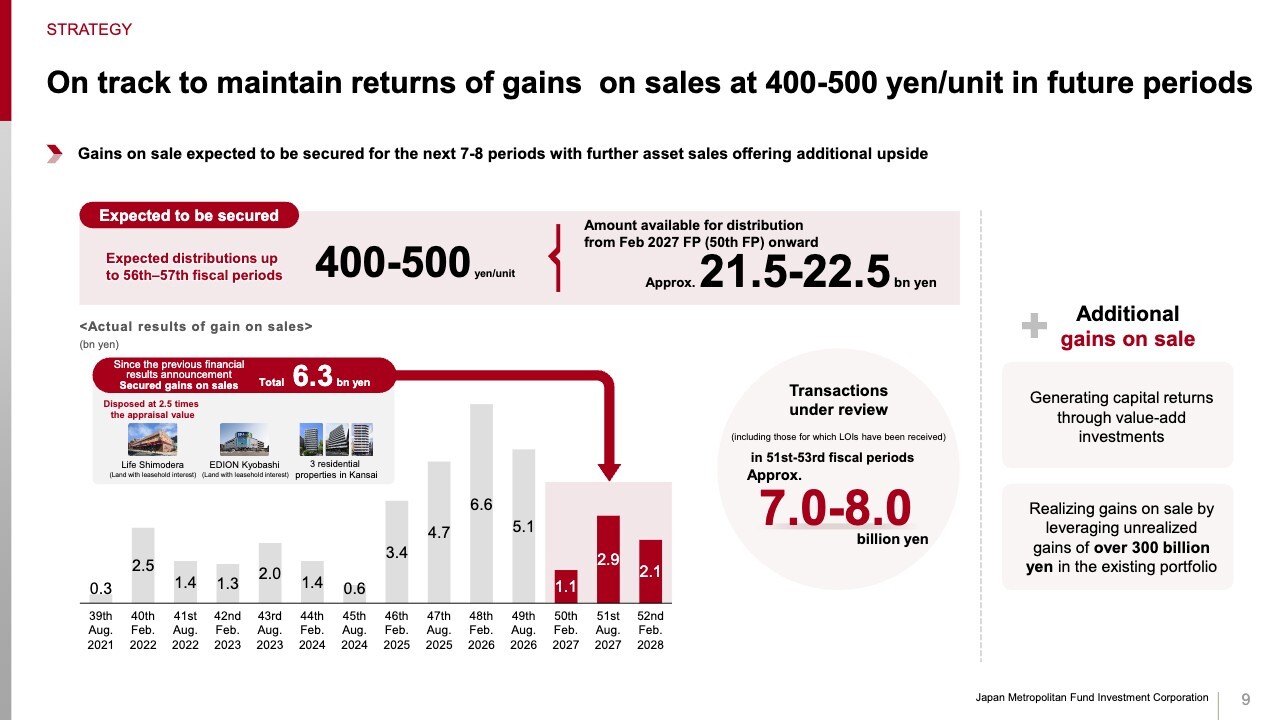
I will now explain our policy on distributing gains on sale.
Since the merger that created JMF, we have recorded gains on sale in each of the past 11 fiscal periods, and have already secured 6.3 billion yen in gains on sale for the 50th fiscal period onward. Notably, we sold Life Shimodera (land with leasehold interest) at 2.5 times its appraisal value, realizing gains substantially exceeding the previously recorded unrealized gains.
We also aim to generate an additional 7 billion to 8 billion yen in gains on sale from the 51st through the 53rd fiscal periods. We have received letters of intent (LOIs) for some transactions and are engaged in specific negotiations toward completion.
In light of the gains already secured and the prospect of further gains, we intend to raise distributions of gains on sale from the previous target of 300 yen to the revised target of 400 to 500 yen per unit per fiscal period. We aim to increase DPU over the medium term by consistently generating and distributing gains on sale.
Driving growth through property-specific strategies and disciplined investment
Let me turn to external growth.
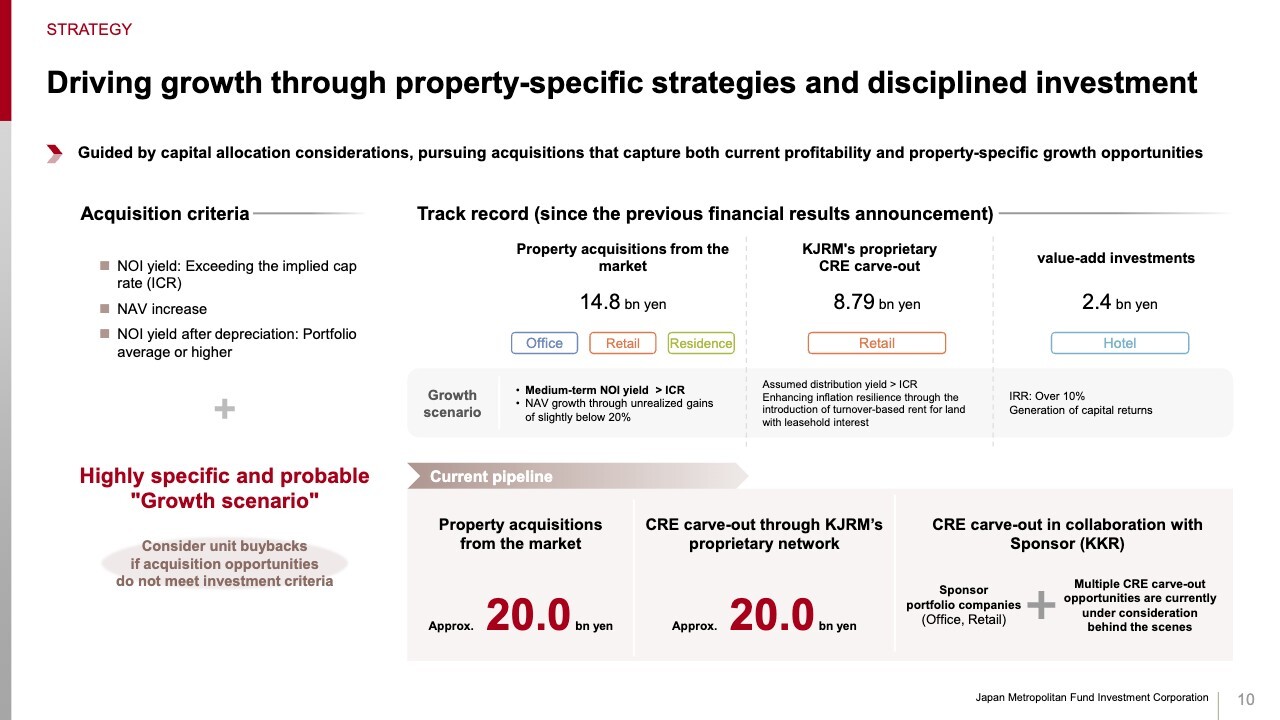
When making acquisitions, we take the cost of capital into account. Our criteria are that the NOI yield must exceed the implied cap rate, the acquisition must contribute to NAV growth, and the NOI yield after depreciation must exceed the portfolio average.
We also emphasize the importance of having a specific growth scenario for each investment.
If it is difficult to identify acquisitions that meet these criteria, our policy is to consider repurchasing our own investment units. The acquisitions announced since our previous financial results announcement have also been made with discipline, following these criteria and based on growth scenarios for the individual properties.
For the approximately 15 billion yen of office, retail and residential properties acquired from the market, we plan to increase the NOI yield above the implied cap rate over the medium term. These properties also have unrealized gains of slightly less than 20%, contributing to NAV growth.
Our silent partnership (TK) investment in the SEIYU land portfolio, sourced through KJRM's proprietary CRE carve-out platform, has an all-equity structure in which the fund does not borrow. Its expected distribution yield exceeds the implied cap rate. We will also introduce turnover-based rent for the land with leasehold interest, providing a mechanism to capture growth in tenant sales.
For JMF's first value-add investment, we will invest in an asset that has been converted from residential use to short-stay accommodation in anticipation of a future recovery in inbound tourism demand. We are targeting an IRR of more than 10% over a three-year investment period, based on an exit scenario that factors in cap rate expansion due to rising interest rates.
We are also selectively building our acquisition pipeline. It includes approximately 20 billion yen of opportunities sourced from the market and approximately 20 billion yen of potential future direct acquisitions from the SEIYU land portfolio. We have also accumulated a pipeline of CRE carve-out opportunities with KKR, although we cannot disclose the amount.
We will continue to expand the pipeline steadily while maintaining our disciplined investment criteria.
Adapting financing strategy as the portfolio becomes more inflation-resilient
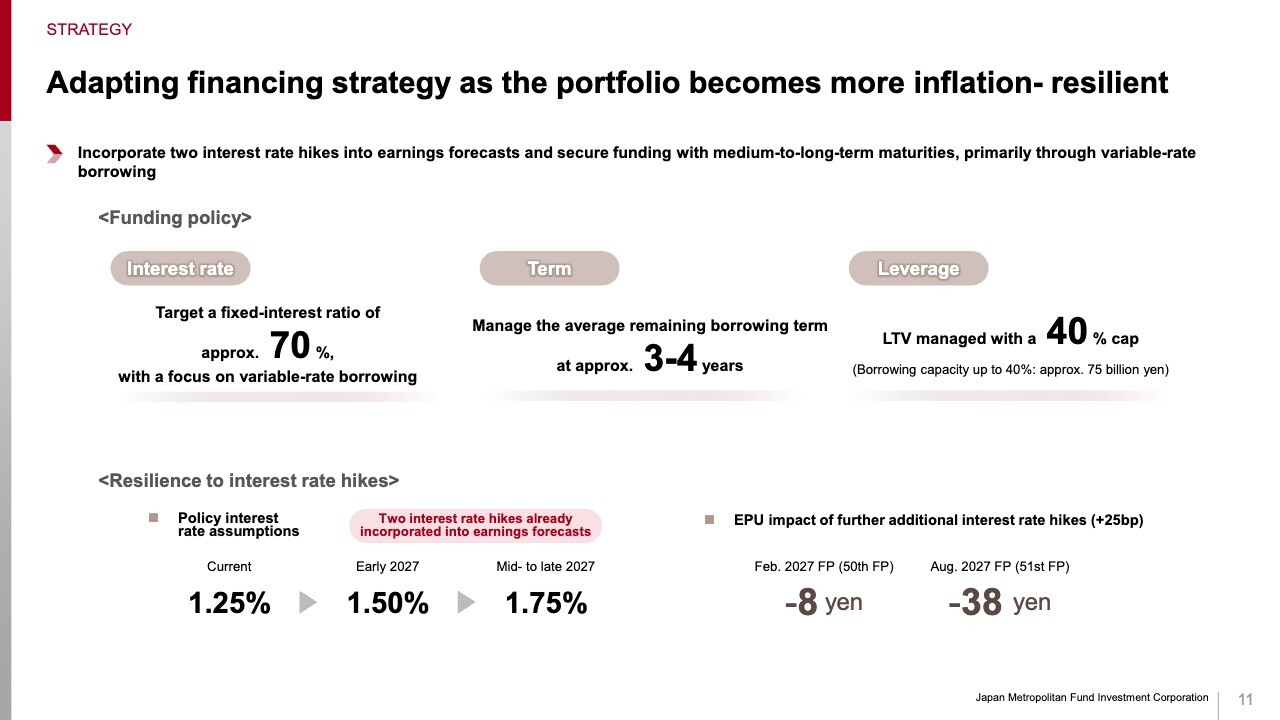
Let me explain our financial strategy. JMF has historically raised funds primarily through long-term, fixed-rate borrowing, maintaining a fixed-rate debt ratio of over 90%.
However, given the shortening of average rent revision periods across our portfolio and the growing adoption of leases with turnover-based rent, we intend to focus mainly on floating-rate funding from an asset-liability management (ALM) perspective, targeting a fixed-rate debt ratio of approximately 70%.
At the same time, we will continue to favor long-term funding to prepare for possible increases in credit spreads and refinancing risk. We will also manage LTV with a guideline of 40%.
Our budgeted refinancing plan likewise assumes mainly long-term, floating-rate borrowing. It also assumes two policy rate hikes, taking the policy rate to 1.75%.
If the policy rate rises by a further 0.25 percentage points above our assumption, the negative impact on underlying EPU in the 51st fiscal period would be approximately 38 yen.
Continuing to capture growth opportunities through JMF’s unique “diversified REIT premium”
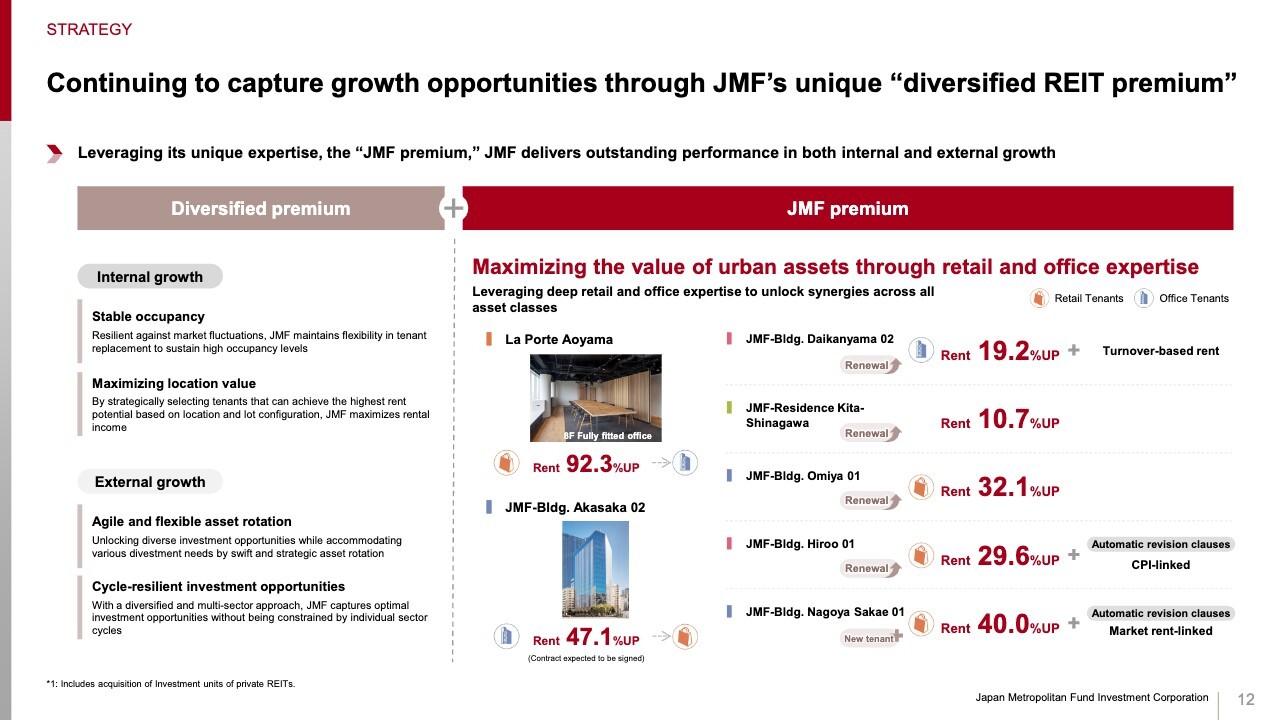
The “diversified REIT premium” and the “JMF premium” continued to deliver tangible results this period.
For example, at the urban retail property La Porte Aoyama, we have made further progress in converting space into fully fitted offices, building on the achievements presented last period, and have secured a rent increase of 92% over the previous level. We intend to undertake similar initiatives at other properties in the Jingumae area to generate further revenue growth.
At JMF-Bldg. Nagoya Sakae 01, we attracted a retail tenant to a basement floor that was difficult to use as office space, increasing revenue by 40% compared with the previous level.
At JMF-Bldg. Daikanyama 02, we permitted an office tenant to use the premises for pop-up events, securing a 19% increase in fixed rent and introducing turnover-based rent. We have also increased revenue at many other properties, including JMF-Bldg. Omiya 01, by leveraging the “JMF premium.”
We will continue to enhance our value as a diversified REIT by promoting internal and external growth through asset management that extends across property types and our acquisition capabilities across a wide range of investment opportunities.
Driving further growth - Sustaining DPU growth through both rent income and gains on sale
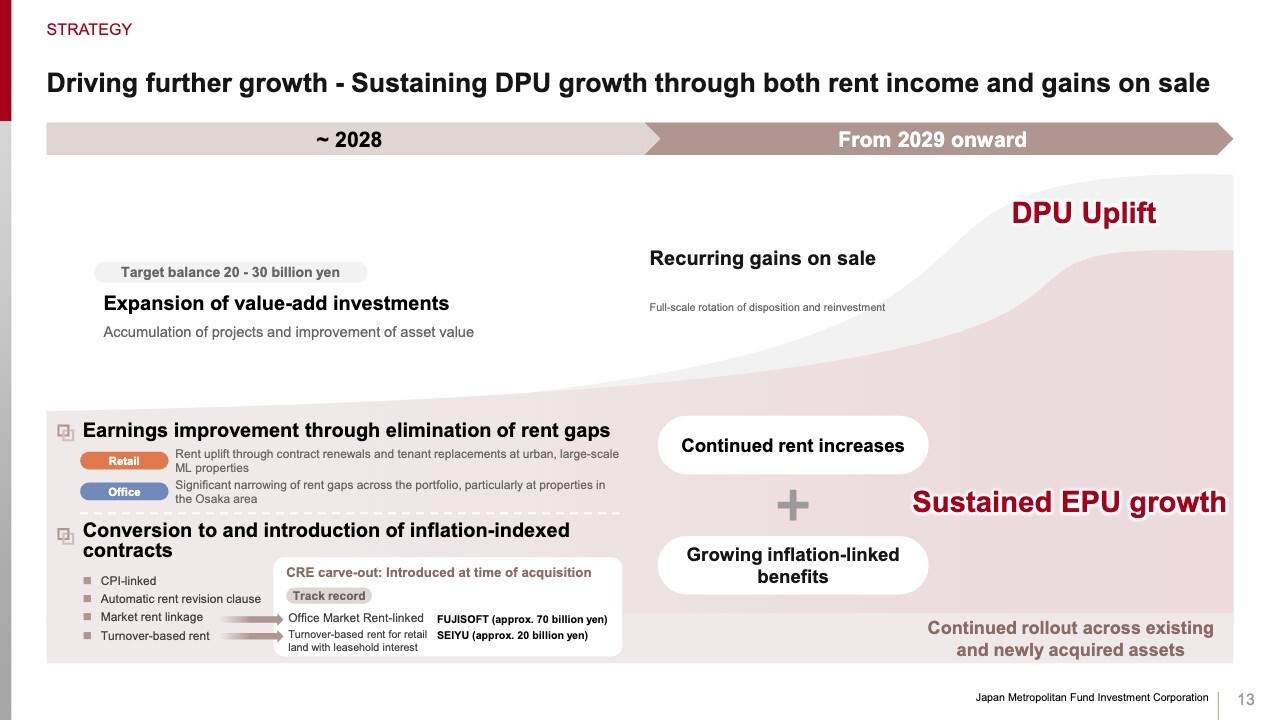
Looking ahead, we will sustain distribution growth through both rent increases and gains on sale.
Through 2028, we will steadily translate rent gaps into earnings through rent revisions and tenant replacements at urban retail properties and large shopping centers, as well as rent increases at offices, particularly in Osaka. Alongside higher fixed rents, we will also introduce inflation-linked clauses, including turnover-based and market-linked rents.
For CRE carve-outs, we will also seek to incorporate inflation-linked clauses at the time of acquisition, as we have done with market-linked rents in the FUJISOFT portfolio and turnover-based rents in the SEIYU land portfolio.
From 2029 onward, we will continue to raise rents and add rental growth from inflation-linked clauses introduced to date, with the aim of achieving further growth in underlying EPU.
We will also build our portfolio of value-add investments toward a target balance of 20 billion to 30 billion yen, while working to enhance their value. From 2029 onward, we plan to move into a more active phase of asset sales and reinvestment to generate recurring gains on sale. By combining growth in rental income with distributions of gains on sale, we aim to raise the level of DPU.
Factors affecting DPU
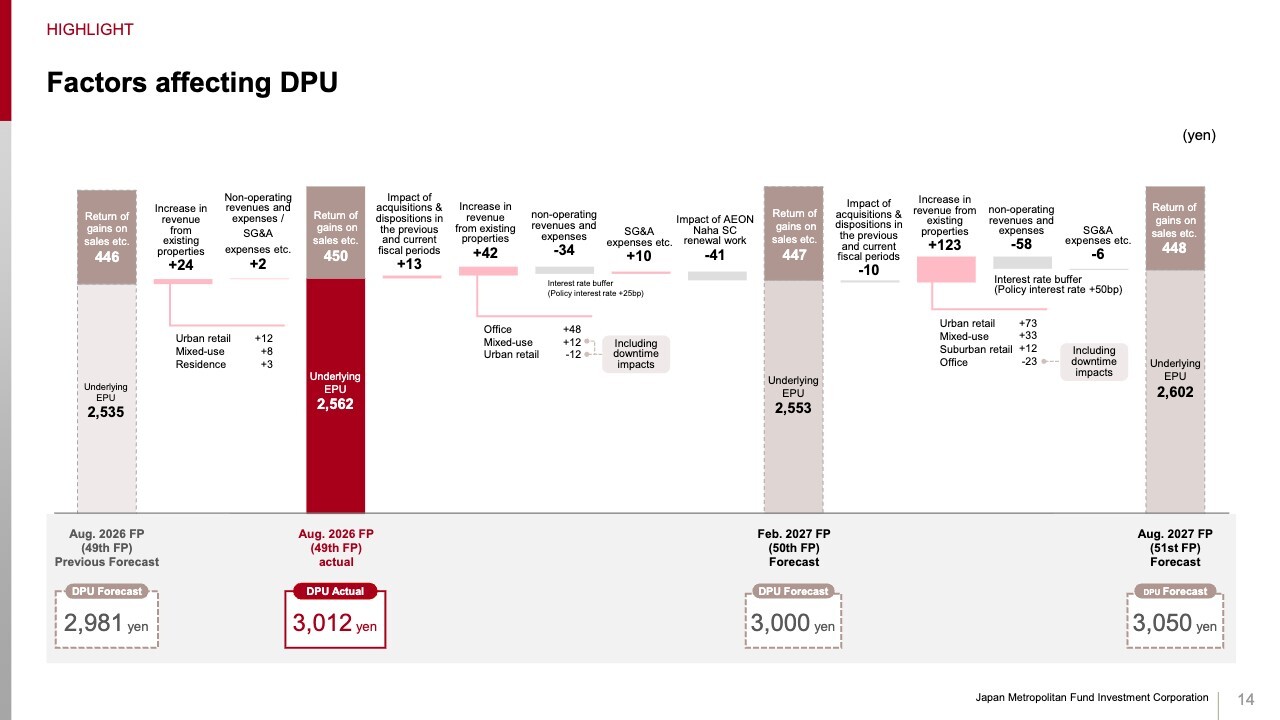
I will outline the main factors behind changes in DPU for the 49th fiscal period results and our forecasts for the 50th and 51st fiscal periods.
In the 49th fiscal period, DPU came in at 3,012 yen, 31 yen above the forecast of 2,981 yen announced last period. The main factor driving underlying EPU higher was revenue growth from existing properties, particularly urban retail and mixed-use properties.
For the 50th fiscal period, we forecast DPU of 3,000 yen, down 12 yen from the previous period, and underlying EPU of 2,553 yen, down 9 yen from the previous period.
As for the main drivers, higher revenue from existing properties, primarily through lease renewals and lease-up at office and mixed-use properties, more than offsets the deterioration in net non-operating income and expenses due to the assumed rate hikes, making a positive contribution to underlying EPU.
Acquisitions and dispositions in the previous and current periods, together with lower selling, general and administrative expenses, also support EPU. With these positive drivers in place, we will carry out refurbishment work at AEON Naha Shopping Center at this time to generate future rent increases.
The resulting increase in repair expenses will reduce underlying EPU compared with the previous period. Excluding this impact, however, underlying earnings continue to grow steadily.
Our newly announced forecast for the 51st fiscal period is DPU of 3,050 yen, up 50 yen from the previous period, and underlying EPU of 2,602 yen, up 49 yen. Both figures are expected to set new record highs.
We expect higher revenue from existing properties to more than offset the approximately 300 million yen negative impact of rent-free periods granted at JMF-Bldg. Akasaka 02 and the deterioration in net non-operating income and expenses due to further rate hikes.
Internal growth is accelerating as revenue-enhancing measures, including upward rent revisions, build up not only at urban retail and mixed-use properties but also at suburban retail properties.
That concludes my explanation of the main factors behind DPU changes in the 49th fiscal period results and the forecasts for the 50th and 51st fiscal periods.
Existing portfolio NOI growth of +4.4%, targeting further growth by closing rent gaps
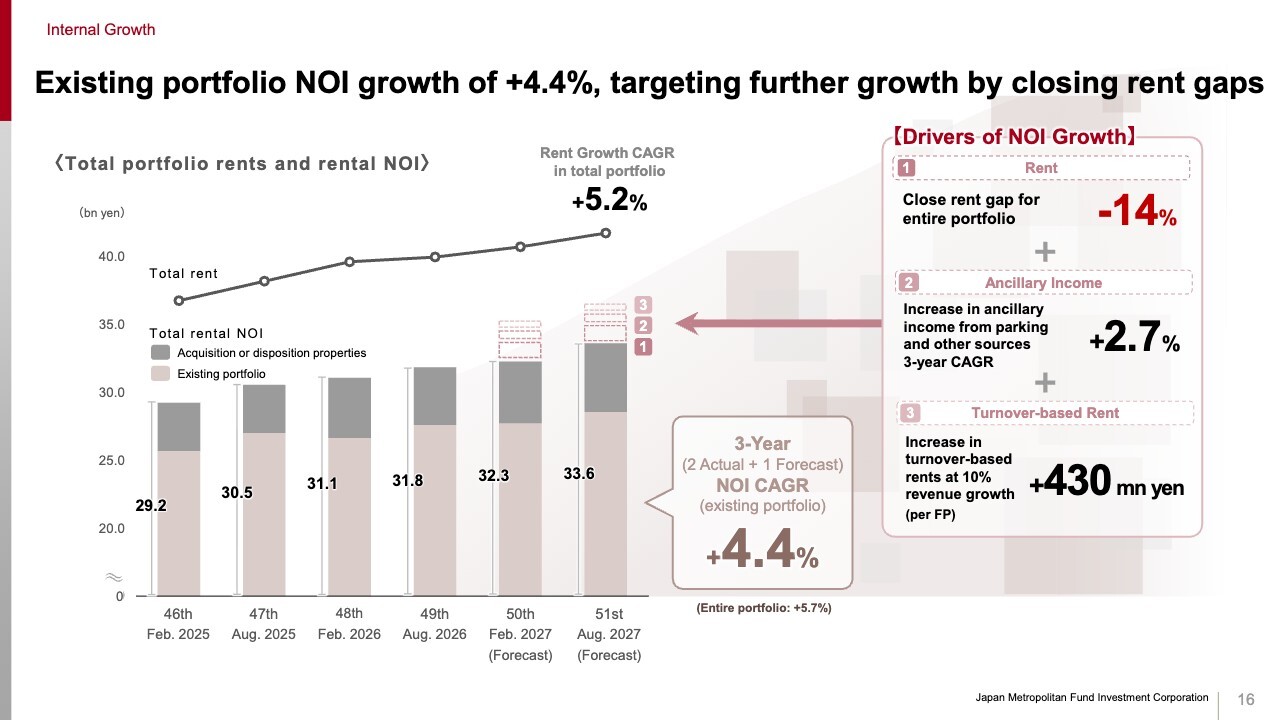
Let me provide an overview of internal growth, the main driver of our growth strategy.
Over the three-year period comprising the past two years and the coming year, NOI from the existing portfolio is expected to grow at an average annual rate of 4.4%. This is a further upward revision from the 3.5% presented last period. Rents are rising steadily across all property types: retail, office, residential and hotel.
We will continue to pursue sustained NOI growth by increasing fixed rents as we close the portfolio-wide rent gap of 14%, increasing turnover-based rents in line with tenant sales growth, and generating other income.
Contract renewals and tenant replacements achievement in the August 2026 FP (49th FP)
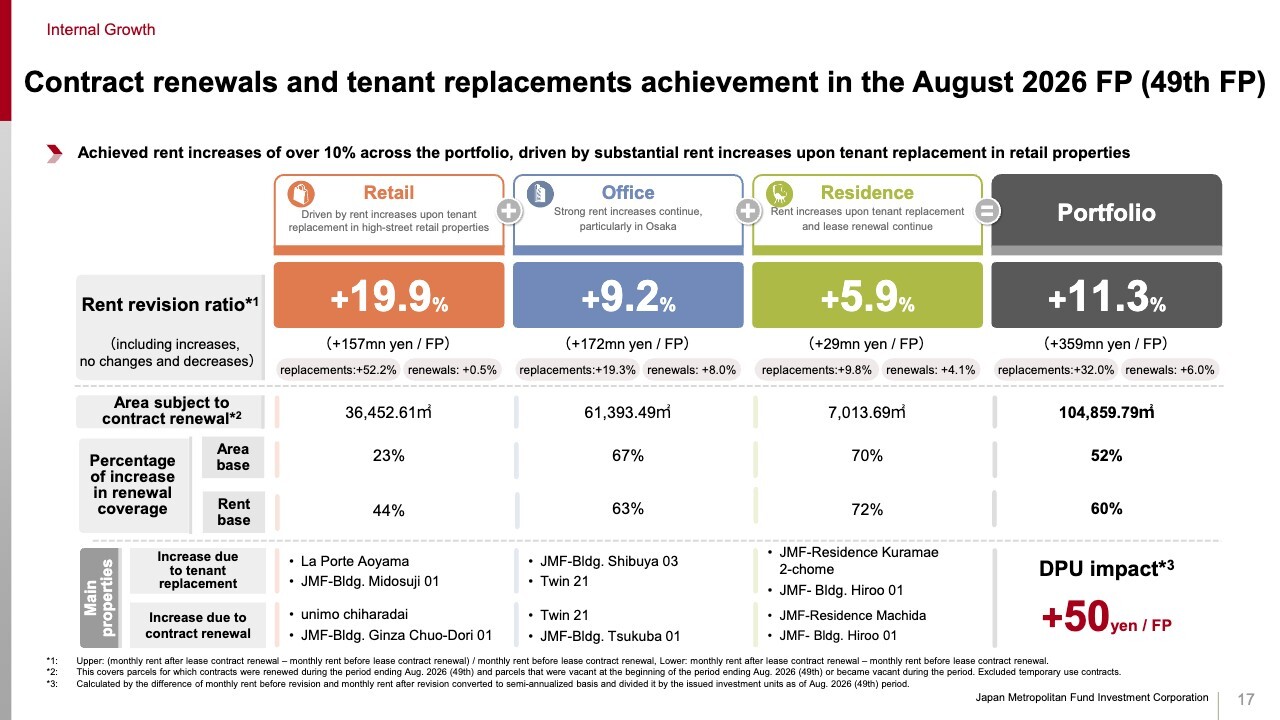
Let me explain some specific results of our internal growth initiatives. Lease renewals this period produced strong rent increases across all sectors, with an overall portfolio rent increase of 11.3%, contributing 50 yen to DPU per fiscal period.
In retail, rents increased by approximately 20%, substantially exceeding the previous record high. The main driver was the rent increase upon tenant replacement at JMF-Bldg. Midosuji 01, which we highlighted as an upside opportunity last period and which contributed to the 49th fiscal period.
Rent increases have already been secured at several properties for the 50th fiscal period onward, so we expect strong upward rent revisions to continue.
The proportion of rent revisions with no change was approximately 50%, higher than in other sectors. This was partly because we kept rents unchanged this time for tenants that had accepted substantial increases at their previous revisions, and partly because we extended leases with existing tenants for short periods after prospective new tenants canceled plans to open stores in the Shinsaibashi area.
At the same time, the rate of rent increases upon tenant replacement was the highest of all sectors, and the retail leasing market remains very strong.
Turning to the office sector in the 49th fiscal period, the large floor area subject to rent revision helped drive rent increases across the portfolio.
One major tenant is currently classified as having no change in rent because discussions over the size of the increase are ongoing, although the rent increase itself has already been agreed. If this tenant were counted among the upward revisions, the effective rate of agreement on rent increases would approach 80%.
JMF’s Unique Retail Management Capabilities
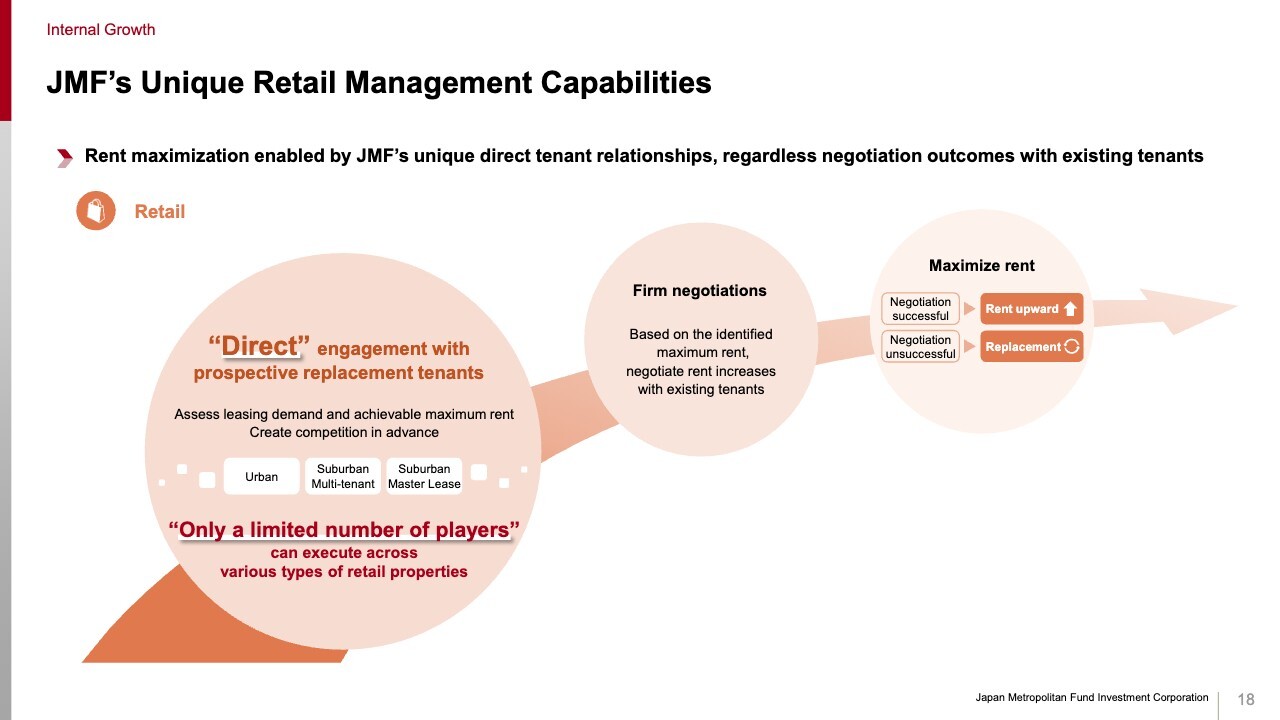
I will now review current conditions in each asset class, starting with retail properties.
Over more than 20 years of retail property management, JMF has built direct relationships with tenants. Our ability to maximize rents by leveraging these direct tenant relationships is a distinctive strength of JMF.
Retail rents growing at 3% CAGR, with rent gaps widening amid strong market conditions
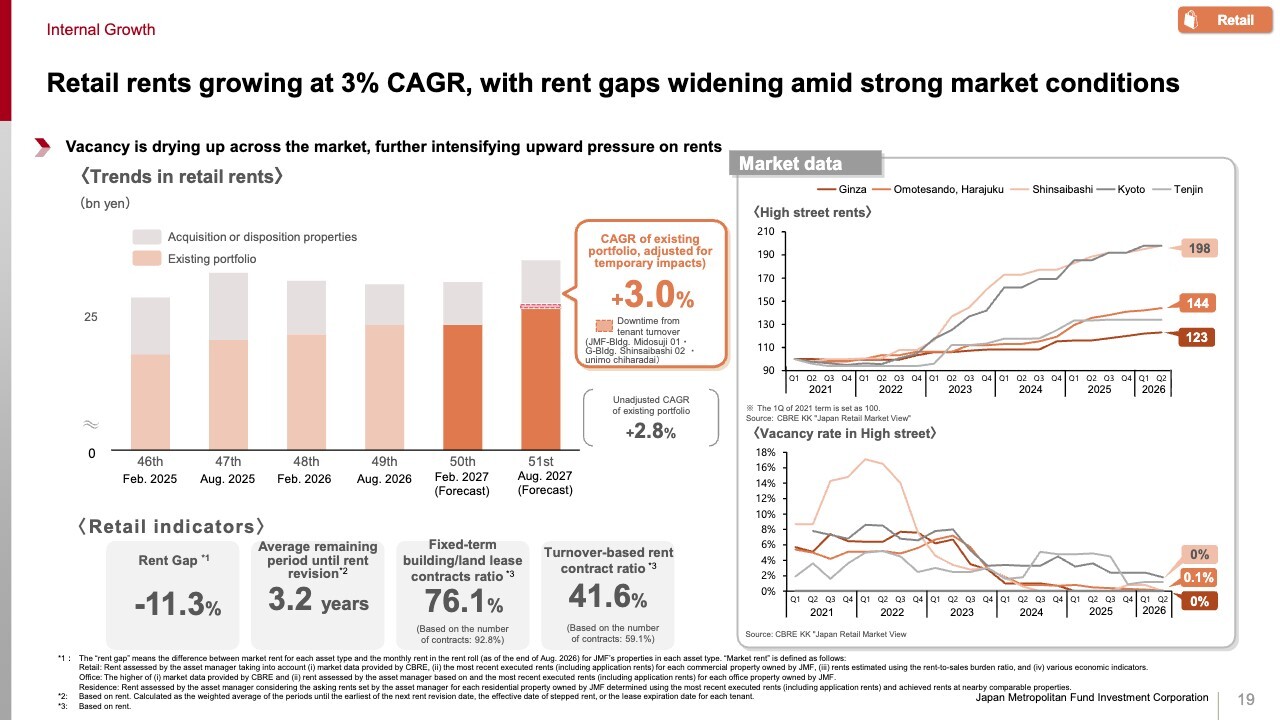
Rents in the existing retail portfolio are increasing at an average annual rate of 3%. The rent gap is 11.3%, more than 75% of tenants have fixed-term leases, and tenants with turnover-based rent arrangements account for approximately 42% on a rental income basis.
We therefore expect growth in both fixed rents through lease revisions and turnover-based rents as tenant sales increase. In the retail leasing market, top rents are rising along Ginza Chuo-dori and Omotesando.
With no vacancies on these prime retail streets, market rents in surrounding areas are also rising sharply. In the Omotesando area, for example, this includes Cat Street, Aoyama-dori and Meiji-dori.
High turnover-based rent structure: “More Sales, More Rents”
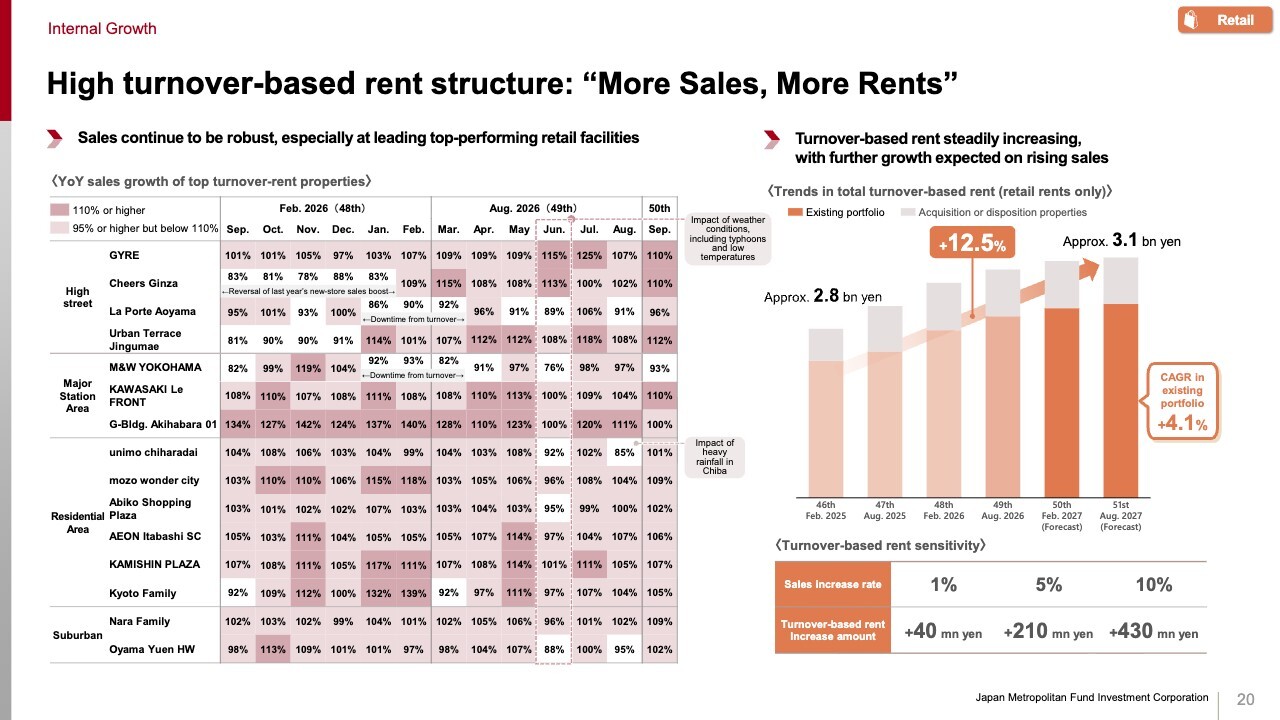
Retail tenant sales were somewhat weak in June this year due to several typhoons and a slower-than-usual rise in temperatures. In other months, however, sales continued to perform strongly, supported by higher prices, the wealth effect from rising stock prices and the weaker yen.
High-street properties performed steadily throughout the fiscal period, except for La Porte Aoyama, where the conversion of space into fully fitted offices has reduced the retail floor area.
Among properties near major terminal stations, G-Bldg. Akihabara 01, which houses a game arcade tenant, performed particularly well. We also succeeded in securing a rent increase during the existing lease term.
Properties near stations in residential areas maintained sales above 100% of the prior-year level, except in June due to the adverse weather mentioned earlier and at unimo chiharadai in August, when sales were affected by damage from heavy rain.
Turnover-based rents in the existing portfolio are growing at an average annual rate of 4.1%, supported by higher tenant sales, and we expect further growth as sales continue to increase.
Significant rent increases and the introduction of turnover-based rents are steadily progressing at large-scale shopping centers
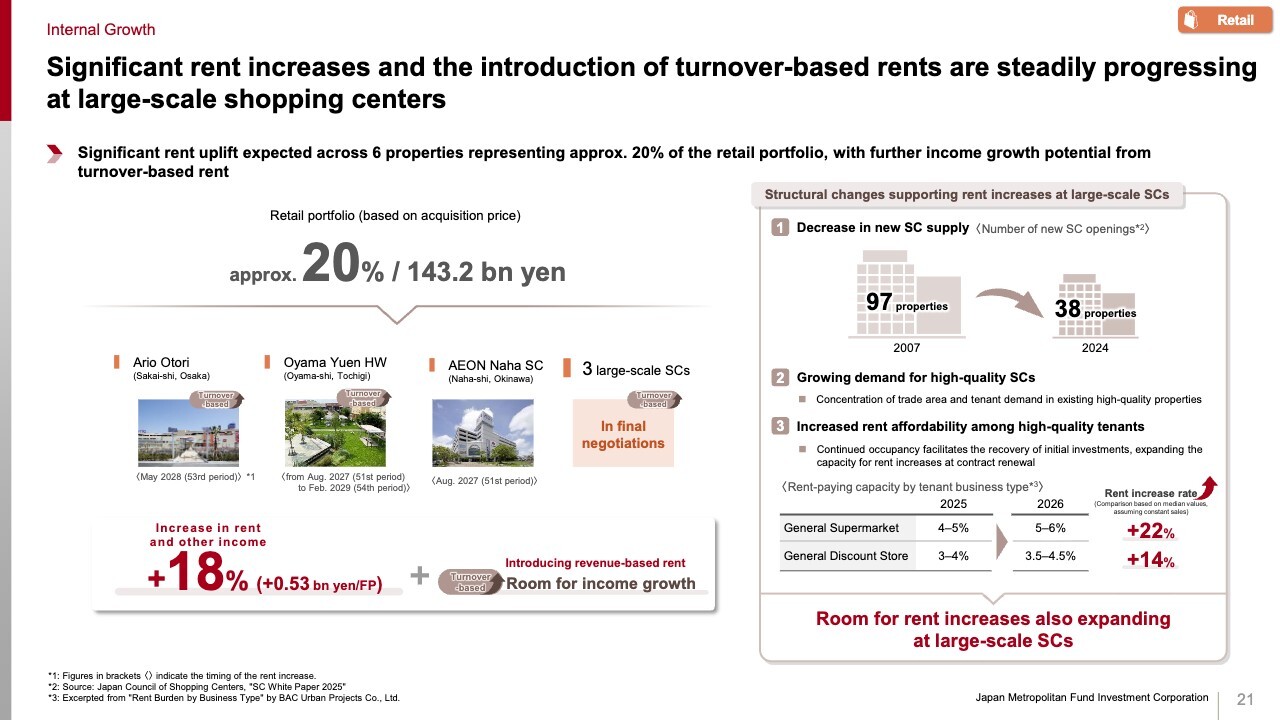
Our rent revisions at large shopping centers are producing substantial results, following careful preparations and persistent negotiations leveraging JMF's direct tenant relationships.
Across six properties—three where rent increases have been finalized and another three where tenants have agreed in principle and final approval is pending—we expect average fixed-rent increases of 18%. We have also succeeded in introducing turnover-based rent at five of these properties.
These properties account for 20% of the retail portfolio, and we expect substantial fixed-rent increases and the introduction of turnover-based rent to progress across this portion of the portfolio.
Large shopping centers are generally considered to have limited upside. However, our results demonstrate that rent increases are possible at well-performing properties when we leverage JMF's negotiation capabilities.
Several factors lie behind these results. With new retail development constrained, existing stores have become more important. In addition, higher sales and improvements in the profitability of individual properties have increased tenants' ability to pay higher rents.
Strong rent increases progressing across multiple areas in urban retail properties
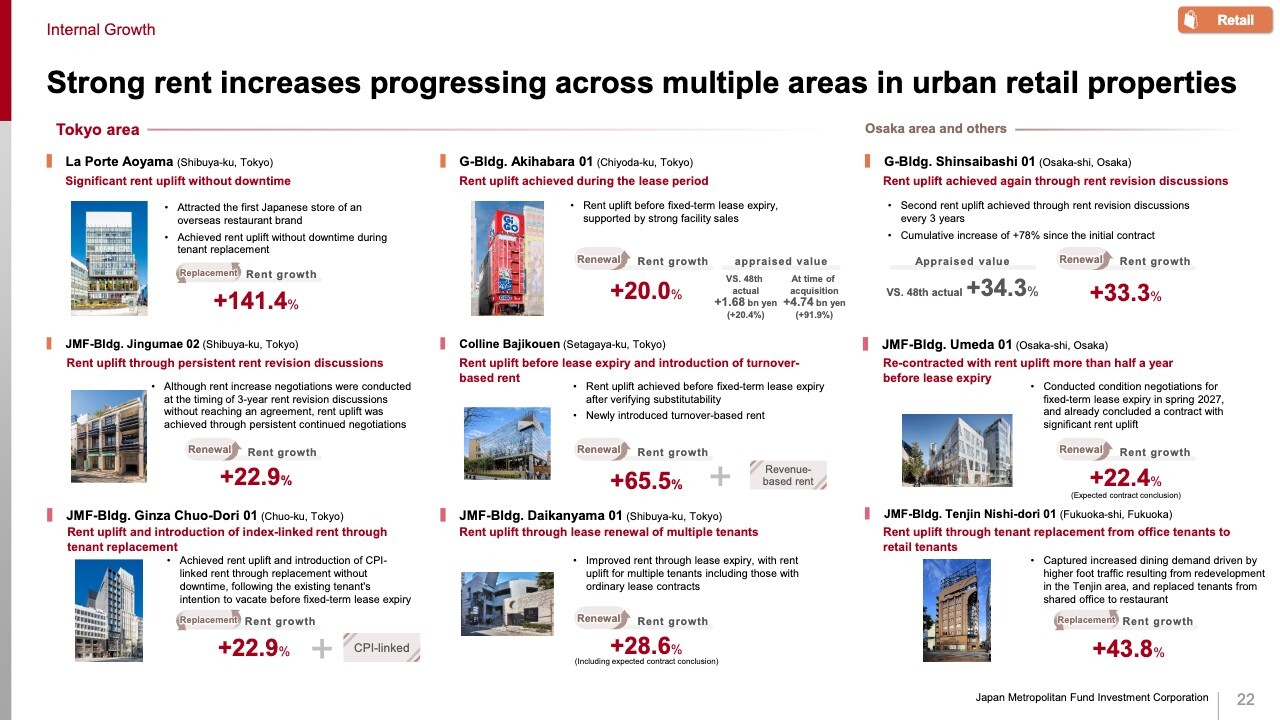
This slide shows several examples of rent increases at urban retail properties. With market rents rising, we believe it illustrates how rents are increasing across a wide range of locations.
At G-Bldg. Shinsaibashi 01, we achieved a further rent increase of more than 30%, despite having implemented a substantial upward revision three years ago. This demonstrates the strength of rental demand in the Shinsaibashi area.
The fixed-term leases at G-Bldg. Shinsaibashi 03 and G-Bldg. Shinsaibashi 05 in the same area are also approaching expiry, and negotiations for substantial rent increases are in their final stages.
At La Porte Aoyama, we are converting the upper floors into fully fitted offices, while the retail space on the lower floors is also performing well. We have secured a new tenant at approximately 2.5 times the rent paid by the previous tenant.
Osaka area drives growth through unique asset management capabilities supported by the Asset Manager’s Kansai Office
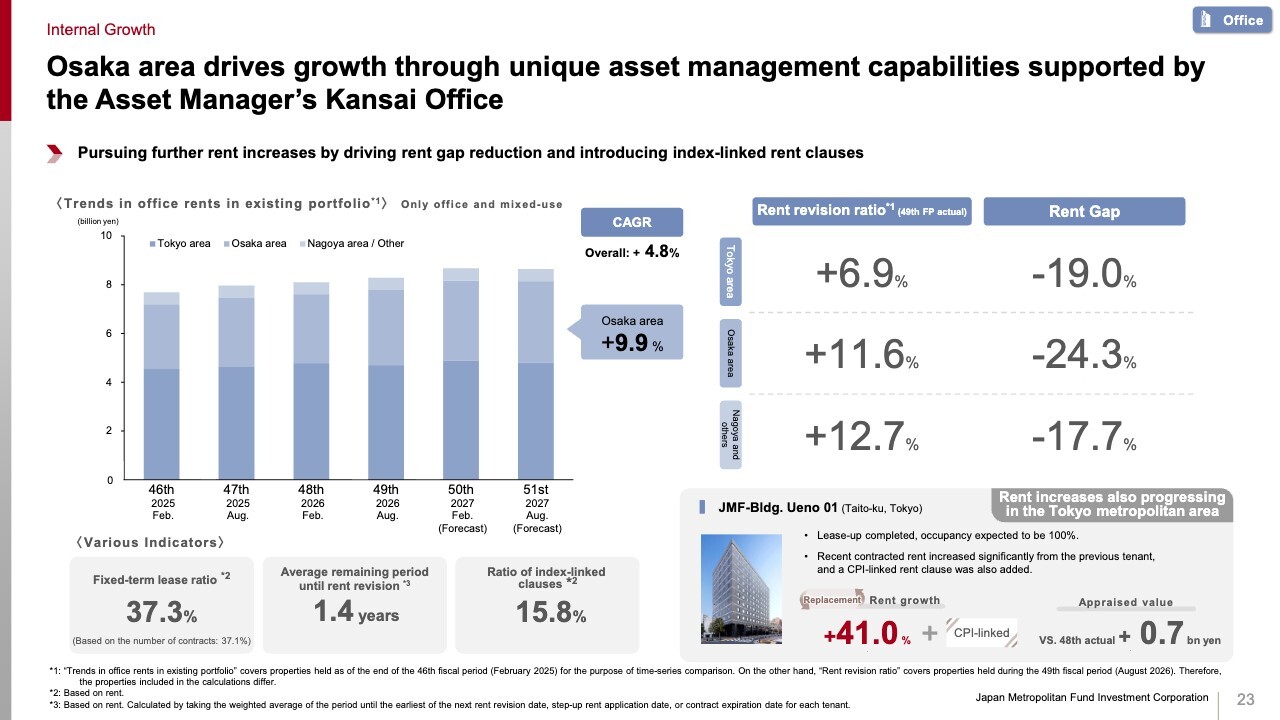
Let me turn to the office sector. Rents in the existing portfolio are growing at an average annual rate of 4.8%. Osaka office properties, led by Twin 21, have substantial rent gaps and are driving overall growth, with average annual rent growth of 9.9%.
These results reflect the way we conduct asset management close to the properties. We are the only J-REIT asset manager with a branch office in Kansai, allowing us to remain deeply involved in on-the-ground operations.
Our Tokyo office properties previously had smaller rent gaps and lower growth rates than those in Osaka. More recently, however, rent gaps have widened, creating scope for faster growth going forward.
The adoption rate of index-linked rent revision clauses, which we began introducing last period, has now reached 16%. We will continue to promote their adoption as we build a portfolio that can benefit from inflation.
Residential rents continue to rise by nearly 10% on tenant turnover, with further upside from narrowing rent gaps
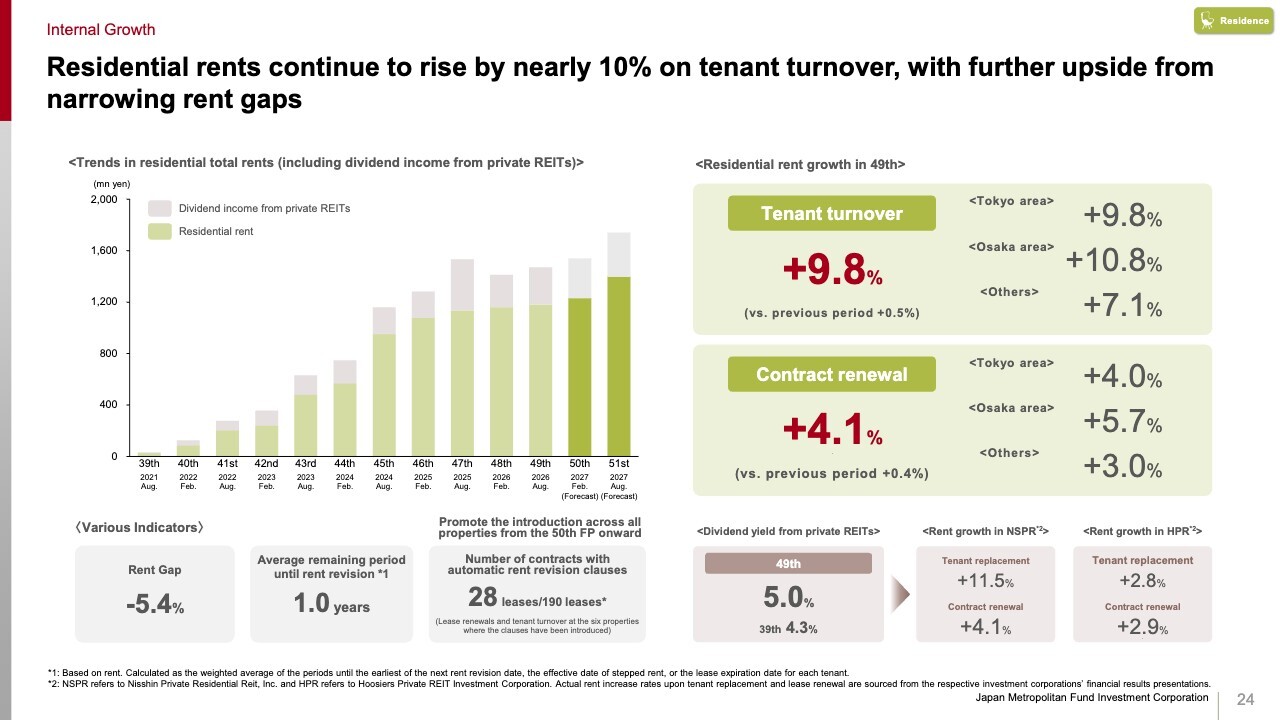
Residential rent increases continued this period, at 9.8% upon tenant replacement and 4.1% upon lease renewal, with both rates exceeding those achieved in the previous period.
In the Nagoya area, where abundant new supply had previously constrained rent growth, we achieved increases of approximately 6% upon tenant replacement and approximately 4% upon lease renewal, making the recovery trend clear.
We are also seeing some properties offered for sale at high yields in this area. We will therefore consider acquisitions at attractive prices before stronger rental growth is fully recognized in the transaction market.
Beyond rent increases: Initiatives to drive NOI growth
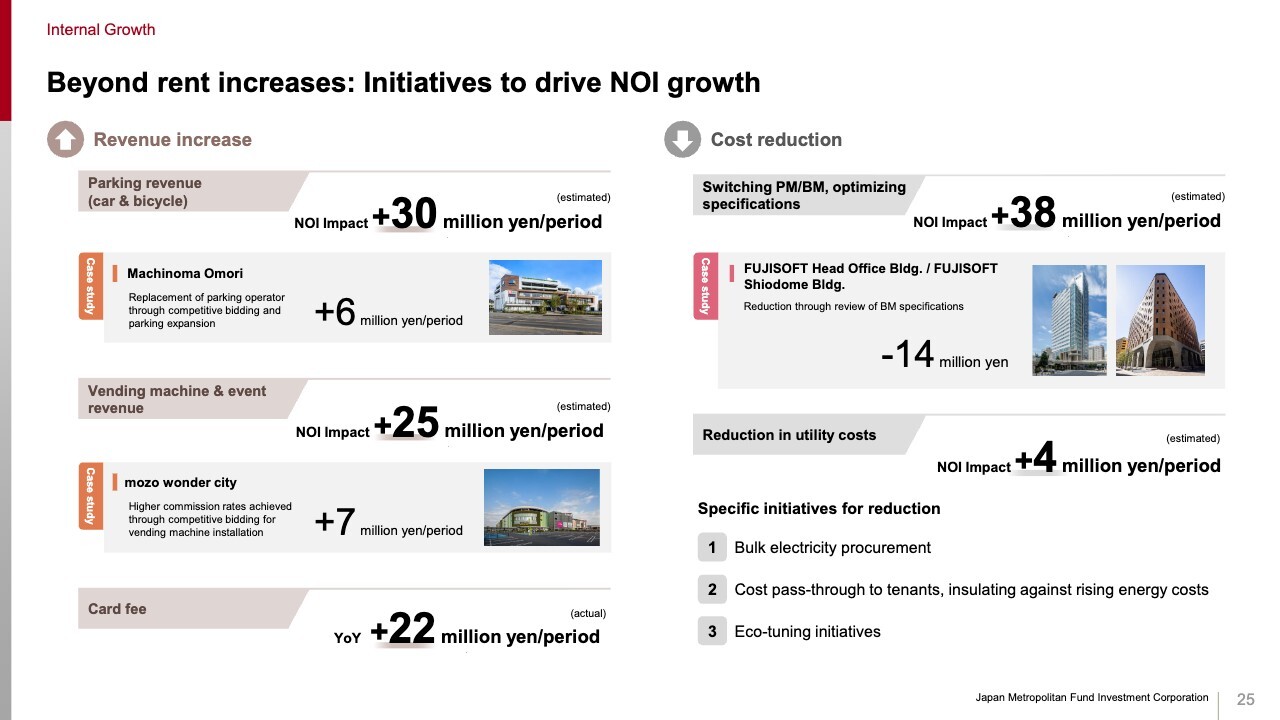
In addition to rent increases, we continue to build up measures to improve NOI each fiscal period. On the revenue side, we are generating additional income from car and bicycle parking, vending machines and card transaction fees at our properties. We expect these initiatives to contribute approximately 80 million yen to NOI per fiscal period.
For vending machines, in addition to product sales, the commission rate received by the property owner differs by operator. JMF regularly conducts tenders for individual properties or groups of properties to secure higher commission rates.
On the cost side, we focused on reducing property management (PM) and building management (BM) costs this period. We also achieved reductions in BM costs at the recently acquired FUJISOFT office portfolio.
Enhancing asset competitiveness and medium-to-long-term NOI growth through strategic capital expenditure
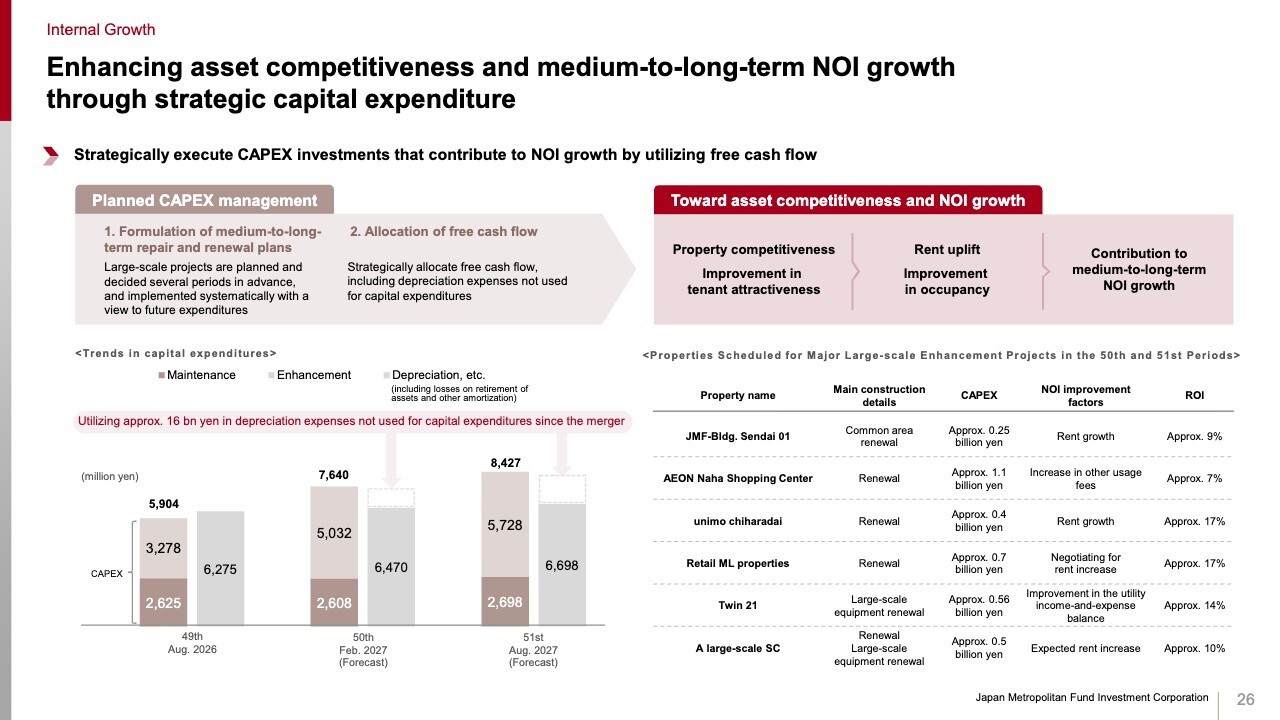
Let me explain how we are using capital expenditure to drive internal growth.
Capital expenditure will be elevated in the 50th and 51st fiscal periods, but more than half of this spending is investment aimed at enhancing property functionality. We will use approximately 16 billion yen in free cash flow, accumulated from the merger period (39th) through the 47th fiscal period as the difference between depreciation and capital expenditure, to fund capital expenditure over the next several periods.
In response to rising energy costs, we have brought forward plans to replace air-conditioning and power receiving and transformation equipment, and are carrying out these replacements to support higher rents and improve net utility income. We are also investing in refurbishments at retail properties to raise rents.
Property-specific growth strategies driving acquisitions and strategic dispositions (1) and (2)
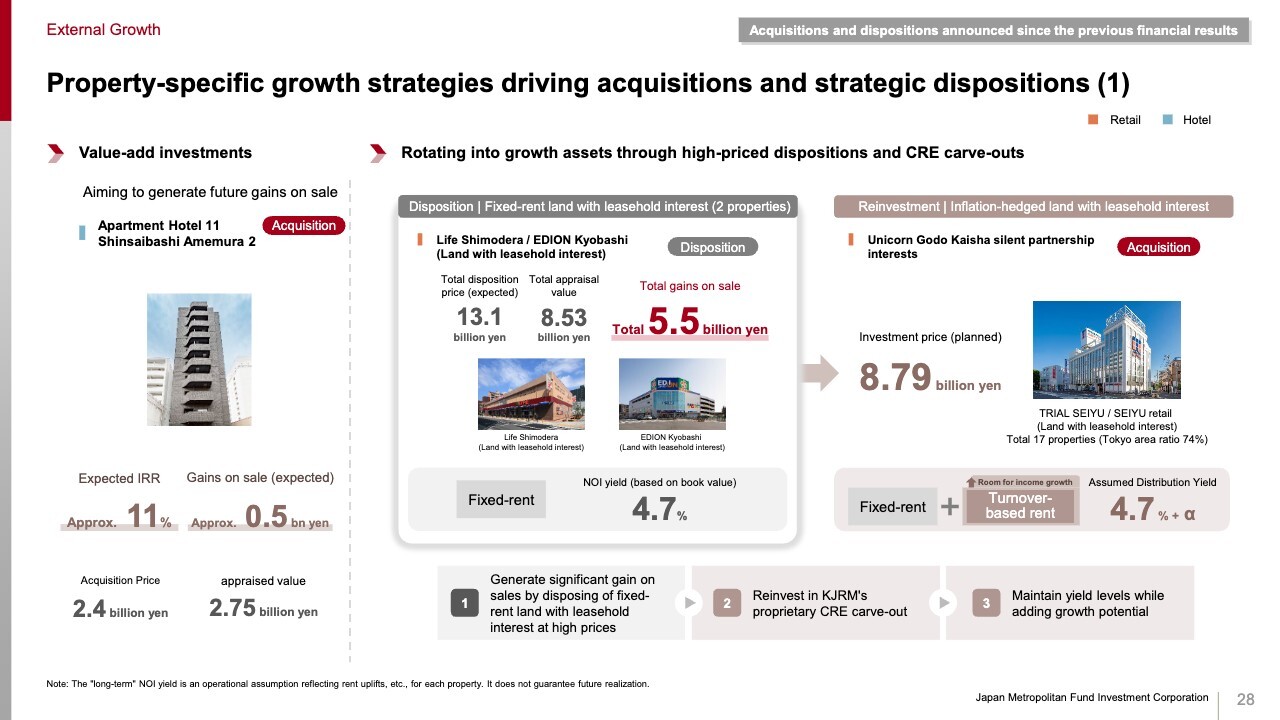
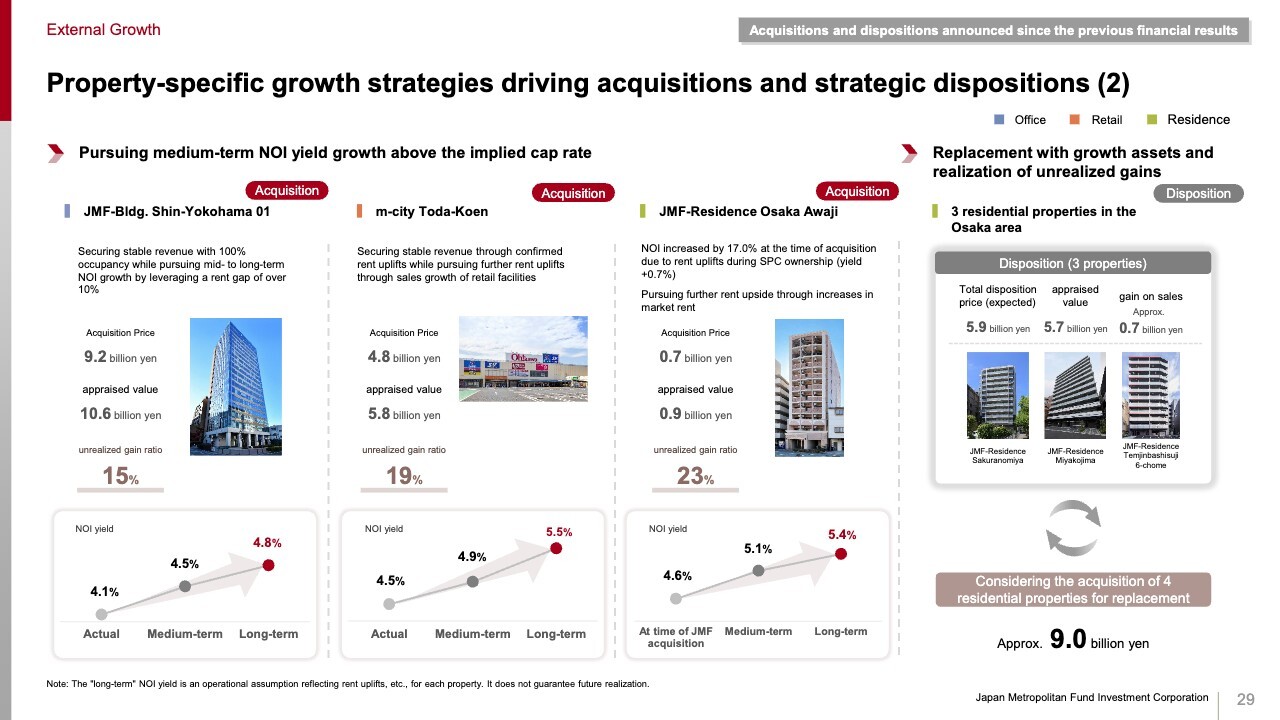
These slides show properties whose acquisitions and dispositions were announced since the previous financial results announcement. I will omit the details, but all of these transactions represent steady progress in evolving the portfolio toward one that can benefit from inflation.
Stable financial foundation
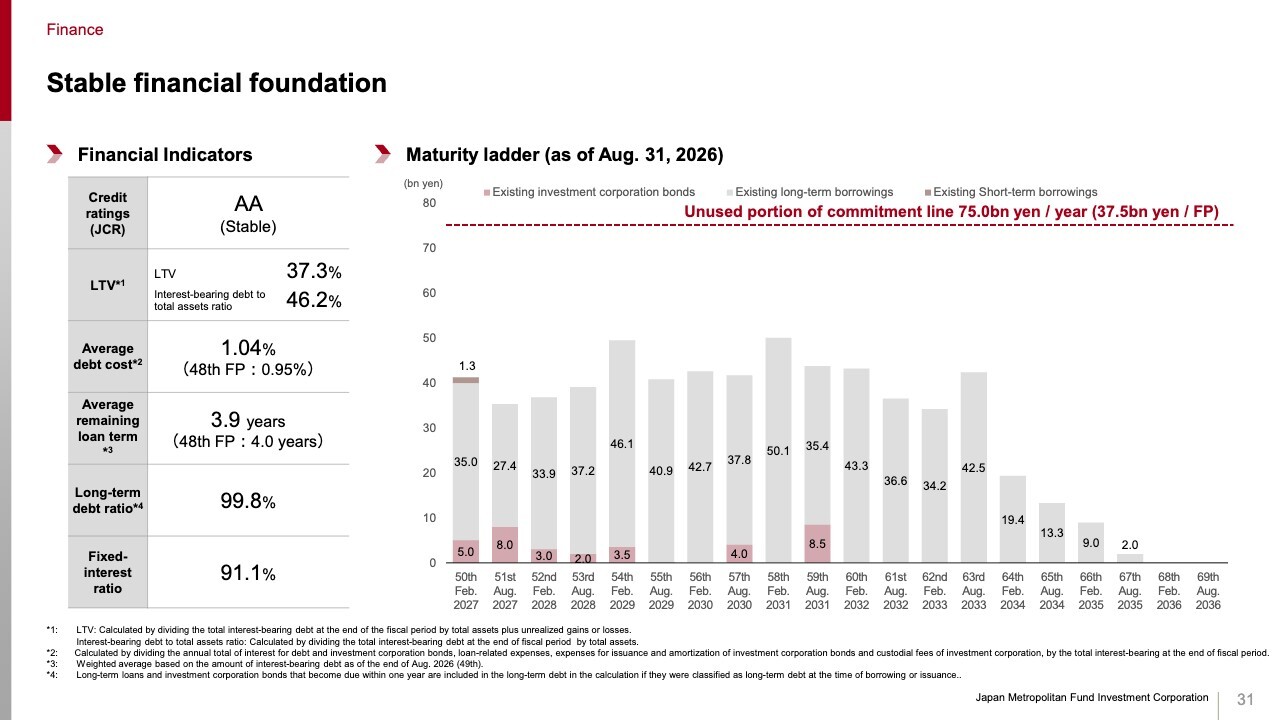
Let me discuss our financial position. Our financial policy is as explained earlier. At the end of the 49th fiscal period, our fixed-rate debt ratio was 91.1%, while our long-term debt ratio was 99.8%.
Sustainability Initiatives
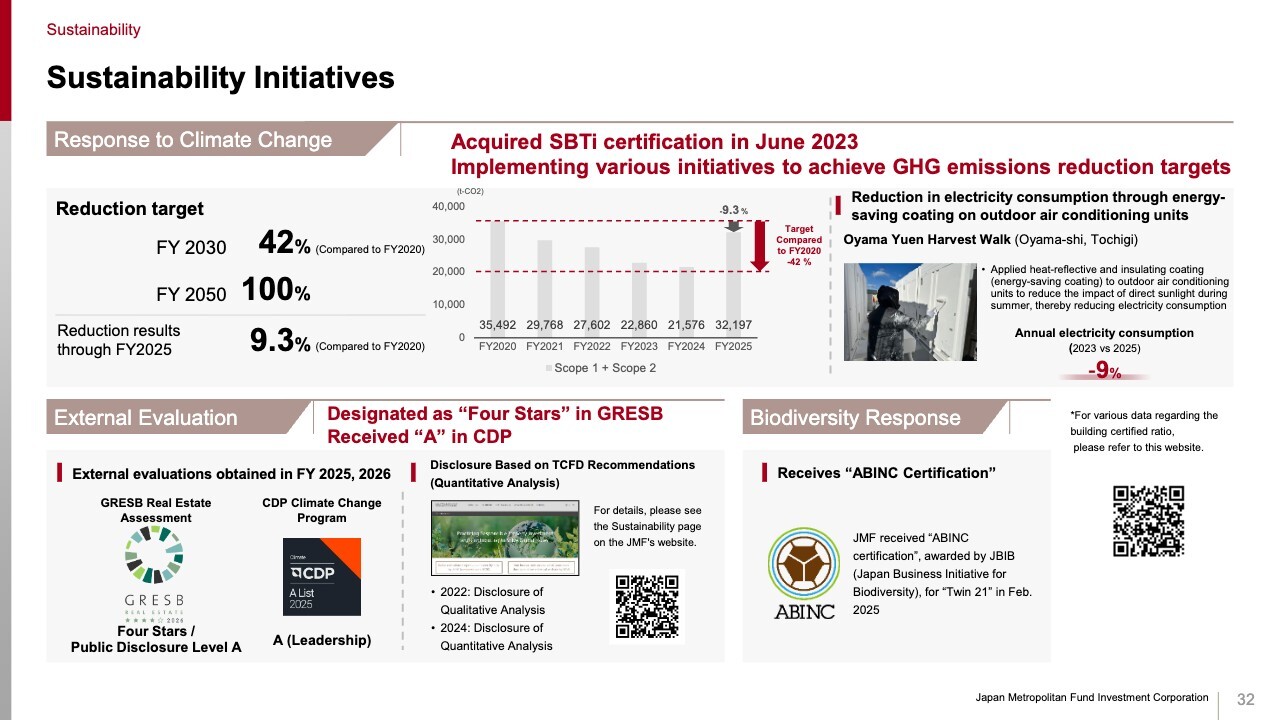
As part of our sustainability initiatives, we applied an energy-saving coating with heat-shielding properties to the outdoor air-conditioning units at Oyama Yuen Harvest Walk.
This coating reduces the load on outdoor units from direct sunlight during summer, lowering electricity consumption and improving NOI. We will continue to pursue sustainability initiatives that also contribute to NOI growth.
Finally, I will discuss our priorities going forward. Although both the real estate leasing and transaction markets remain strong, the J-REIT market continues to be weak, reflecting concerns that rising interest rates may reduce EPU and DPU and that higher cap rates may lower NAV.
In this environment, we believe J-REITs need to steadily capture earnings from the strong real estate market and continue demonstrating growth that exceeds the impact of rising interest rates.
At JMF, we intend to deliver internal growth that more than offsets the impact of higher interest rates. We will also actively introduce turnover-based rents and index-linked leases to strengthen the portfolio's resilience to inflation.
In addition, we will step up asset sales and raise DPU through ongoing distributions of gains on sale, with the aim of maximizing total returns for our unitholders.
That concludes my presentation.
Q&A: Rental conditions at urban retail properties
Questioner: Urban retail properties have achieved strong rent growth. Would it be fair to say that market conditions for these properties are currently stronger than for offices?
There have also been some declines in inbound visitor numbers. Have there been any changes over roughly the past six months, including whether those declines have had any impact?
Machida: Conditions differ by area, but broadly speaking, we believe the urban retail market is stronger than the office market. Previously, the strongest locations were largely limited to Omotesando itself in the Omotesando area and Chuo-dori in Ginza.
Now, however, that strength is spreading to surrounding areas. I apologize that I cannot provide supporting data here, but rent growth is actually stronger in some of those surrounding areas. We therefore see the urban retail market as considerably stronger than the office market.
Q&A: Factors behind rent revisions at shopping centers
Questioner: Were the rent increases and inflation-linked lease terms you secured at large shopping centers primarily the result of JMF's strong efforts to negotiate them?
Or, given the current inflationary environment, have tenants generally become more willing to accept these types of lease terms? I would like to understand whether this is something specific to JMF or whether similar opportunities may exist elsewhere.
Machida: First, retail property sales must be sufficiently strong; otherwise, tenants may not be in a position to agree to rent increases. On top of that, our persistent efforts to negotiate were a major factor. I believe these results reflect a combination of the two.
Even if sales at a retail property are strong, I do not think rent revisions of this kind can be achieved without negotiating strength. I hope that conveys why both factors are necessary.
Q&A: Property acquisition opportunities
Questioner: You have been actively pursuing CRE carve-out transactions, but you also mentioned an acquisition pipeline of approximately 20 billion yen from the market.
Are acquisition opportunities from the market currently increasing? Are more properties being offered for sale, or are there opportunities to acquire certain types of properties at favorable prices? I would appreciate your perspective on current market conditions.
Machida: My impression is that more properties are being offered for sale in the market. Many of the additional listings appear to involve assets where rent growth is difficult, as owners seek to dispose of them early in response to rising interest rates.
However, some sellers are not under any particular pressure to sell. Instead, they may be marketing their properties on the assumption that they can obtain a higher price by selling now. As a result, prices have not necessarily declined.
Even among these properties, however, there are some where we believe JMF's unique strengths could enable us to capture significant upside. We hope to acquire such properties at attractive prices.
Q&A: Value-add investment opportunities
Questioner: You mentioned a target balance of 20 billion to 30 billion yen as you build up your value-add investments. Is it fair to understand that there are ample opportunities to invest in value-add properties as well, along the lines you described earlier?
Machida: It depends on what we classify as a value-add investment. Because many of the properties coming onto the market have fixed-rent structures, I think opportunities for value-add investments are relatively limited. That said, such properties are not entirely absent, and we intend to build up our investments steadily.
In our case, rather than focusing on value-add investments in office or residential properties, we intend to concentrate on arrangements involving partnerships with emerging operators, like the short-stay accommodation transaction we completed previously, as well as value-add investments in retail properties.
Q&A: Prospects for achieving the 5% DONAV target
Questioner: I have a question about your DONAV target and your DPU target. You have raised DPU through internal growth and distributions of gains on sale, but NAV has also been growing steadily. As I understand it, DONAV has not quite reached your 5% target.
If NAV continues to grow, you would presumably need to raise DPU further to achieve 5%. How do you view the relationship between the 5% DONAV target and your DPU target?
Machida: There are cases where NAV rises even faster than distributions. However, the current increase in NAV is not being driven by declining cap rates. Rather, NAV is rising because future cash flows are increasing.
The growth in future cash flows is inevitably reflected first in appraisals, with distributions—or, in other words, NOI—rising later. That timing difference can push back the point at which we achieve the target.
Nevertheless, because NAV growth is primarily driven by increasing cash flows, we are managing the portfolio on the expectation that DONAV will eventually catch up to 5%.
Although the newly set DPU target of 3,200 to 3,300 yen would still leave us somewhat short of the 5% DONAV target, we do not see that level as our final destination. We believe there is room for further upside.
We therefore expect to be able to achieve 5% eventually and intend to continue managing the portfolio with that goal in mind.
Q&A: Introducing turnover-based rent for land with leasehold interest
Questioner: My question concerns the introduction of turnover-based rent for land with leasehold interest. Looking at different asset classes, land with leasehold interest and logistics properties are relatively less able to benefit from inflation, so I found the addition of this mechanism interesting.
Since the buildings on such land are often retail properties, does the turnover-based rent generally move in line with the sales of the retail businesses operating in those buildings? Or, from a stability perspective, should we expect the fluctuations to be relatively limited? I would appreciate a little more detail.
Machida: As you suggest, the structure is basically linked to sales at the buildings on the land. In that respect, we have established a meaningful turnover-based rent component, just as we do for properties comprising both land and buildings.
In fact, one of the land-with-leasehold-interest properties already in our portfolio has turnover-based rent. We used that as a reference when introducing turnover-based rent to the SEIYU land portfolio this time.
Some leases for land with leasehold interest are linked to the CPI, and in our case some are linked to the long-term prime rate. If the rent is locked into a long-term fixed contract, it cannot respond to inflation, although there is the advantage of having no associated expenses.
By introducing inflation-linked clauses into the rent terms, on the other hand, we believe that land with leasehold interest can become even more responsive to inflation than properties comprising both land and buildings.
Q&A: Upside potential from fully fitted offices
Questioner: You discussed fully fitted offices at La Porte Aoyama. I remember visiting the building when it was completed, so the example brought back fond memories.
While increases in rents for street-level retail stores have attracted attention in prime shopping locations, this example reminded me that there may also be untapped value-add potential in office space at such locations.
Could you explain whether there are other office areas within retail-oriented locations in your current portfolio that still offer this kind of upside?
Machida: We have other properties under consideration. In particular, we are currently pursuing these initiatives in Jingumae, Aoyama and Daikanyama, where fully fitted offices are especially effective. We have also included an upper-floor example from one of our properties along Ginza Chuo-dori in this presentation.
At the bottom left of the slide is the example of JMF-Bldg. Ginza Chuo-Dori 01. This involves upper floors, where we have increased rents by attracting office-related and service-sector tenants. As a result, upper-floor rents at properties along Chuo-dori have risen substantially.
More specifically, on upper floors along Chuo-dori, rents that had previously been around 30,000 yen have risen to levels approaching the mid-40,000-yen range, and contracts can now be concluded above 40,000 yen.
Q&A: Rent increases at large shopping centers
Questioner: I had assumed rents at large shopping centers were fixed, so I was somewhat surprised to hear that they are being increased. You provided several examples on the slide, but is this approach applicable more broadly?
Could you explain in a little more detail whether there is potential to improve profitability at other properties as well?
Machida: We have already begun negotiations at some other properties in our portfolio. In principle, we believe the approach is broadly applicable.
Of course, it is partly limited to properties that are performing strongly. However, among the properties being offered for sale in the market, there are retail properties generally regarded as having fixed rents that we believe could offer upside from our perspective.
I hope this helps explain why we believe the approach can be applied more broadly, including to such properties.
Q&A: NOI growth outlook
Questioner: The three-year average NOI growth rate has increased substantially to 4.4%, from the 3.5% presented previously.
It seems reasonable to expect further strong rent increases. Could you share your outlook for how much further rents might rise, and what level you believe they could reach?
Machida: The 6% annual average NOI growth rate shown in the medium-term forecast at the top right of the slide refers to growth in existing properties and does not assume any contribution from new acquisitions. We believe this pace can be maintained through the 55th fiscal period.