
Contents
Mr. Yoshiki Hirabayashi (“Hirabayashi”): Hello, everyone. I am Hirabayashi, Representative Director, Chief Executive Officer & President. Thank you for joining us today. I will present our financial results for the first half of FY2027. Before going into the details, let me give you a brief summary.
The agenda for today is shown on the slide.
On 28 August, we revised our earnings forecast for the first half downward. We believe the main factor was the extremely unfavorable weather in June, the final period of the spring/summer full-price sales season. Rainfall was the third highest since records began, and the average temperature was 3 degrees Celsius lower than a year earlier. As a result, we missed opportunities to sell summer products at full price.
Meanwhile, to address the weak business performance and deterioration in various KPIs that had continued since the previous fiscal year, we controlled excessive discounting and the awarding of loyalty points, and strengthened full-price sales. As a result, full-price sales recovered to 107% of the previous year’s level in July and 109% in August. They recovered further to 116% in September, contributing to improved KPIs. We believe we can achieve the full-year forecast by sustaining this trend. These are the highlights of the first part of today’s presentation.
As economic uncertainty persists, prices continue to rise while real wages remain sluggish, and consumers are increasingly focused on protecting their household budgets. At the same time, the wealth effect is stimulating spending on high-priced products among affluent consumers. This is leading to a growing polarization in consumption. We recognize that this trend is also emerging among upper-middle-income consumers who have long been our main target.
In response, we are rapidly diversifying our sales channels. We are also developing product and brand strategies suited to each channel. These are the highlights of the second part of today’s presentation.
I will conclude the presentation with a discussion of our capital strategy, followed by a Q&A session.
Consolidated PL: Semi-Annual Accounting Period
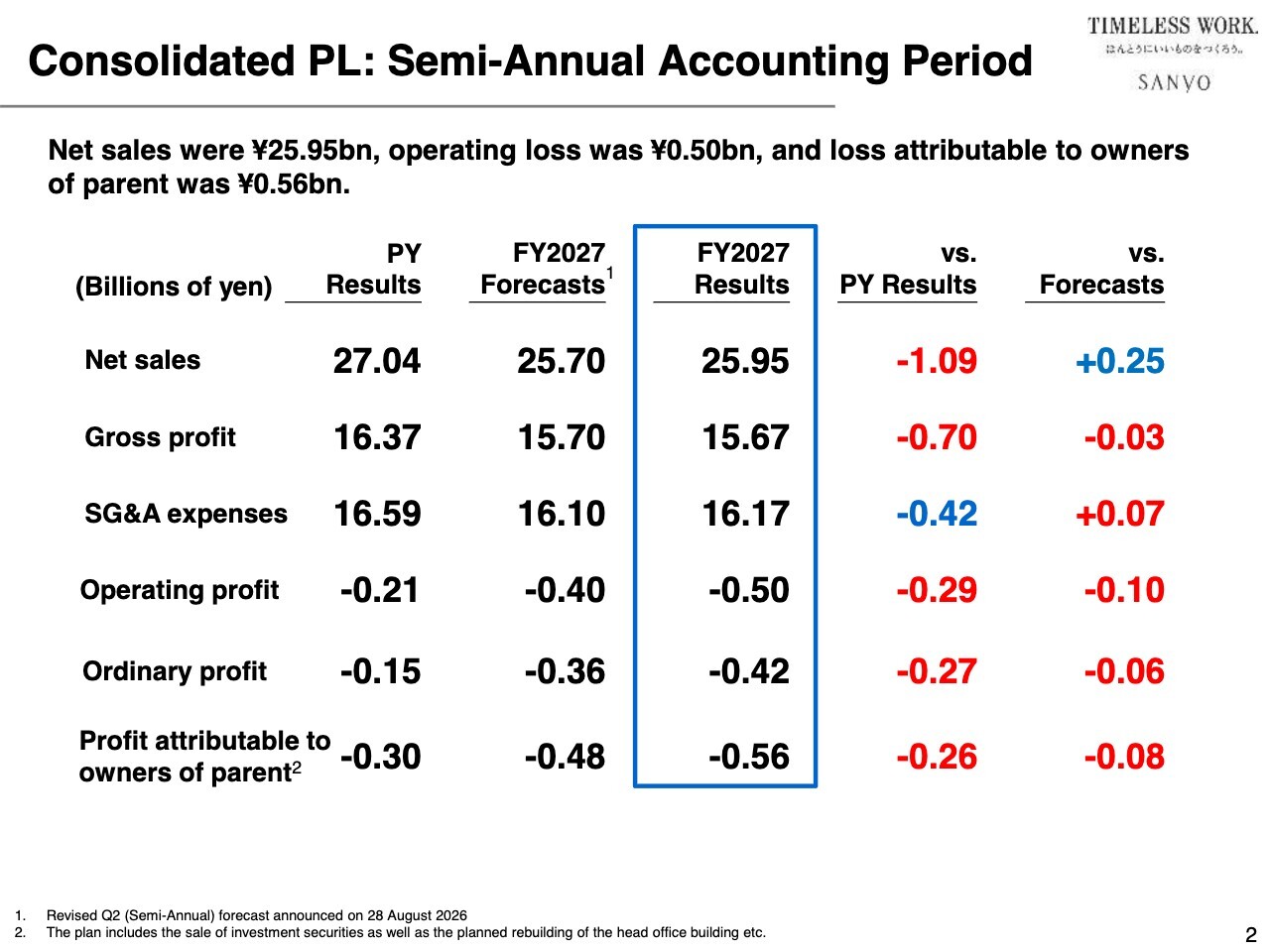
Let me now explain our results for the first half.
On 28 August, we revised our forecast from net sales of ¥27.6 billion, operating profit of ¥0.10 billion, ordinary profit of ¥50 million, and profit attributable to owners of parent of ¥40 million, to net sales of ¥25.7 billion, an operating loss of ¥0.40 billion, an ordinary loss of ¥0.36 billion, and a loss attributable to owners of parent of ¥0.48 billion. Actual results were broadly in line with the revised forecast.
Net sales decreased by nearly ¥1.1 billion YoY, and gross profit declined by nearly ¥0.7 billion. We believe this was due to the unfavorable weather in June, the final period of the full-price sales season, when the full-price sales ratio is high.
In July and August, net sales declined as markdown sales decreased. However, we curbed discounting and the awarding of loyalty points, while lower sales commissions linked to sales helped control SG&A expenses. Operating profit therefore remained at a level comparable to that of typical years.
Consolidated PL: KPIs
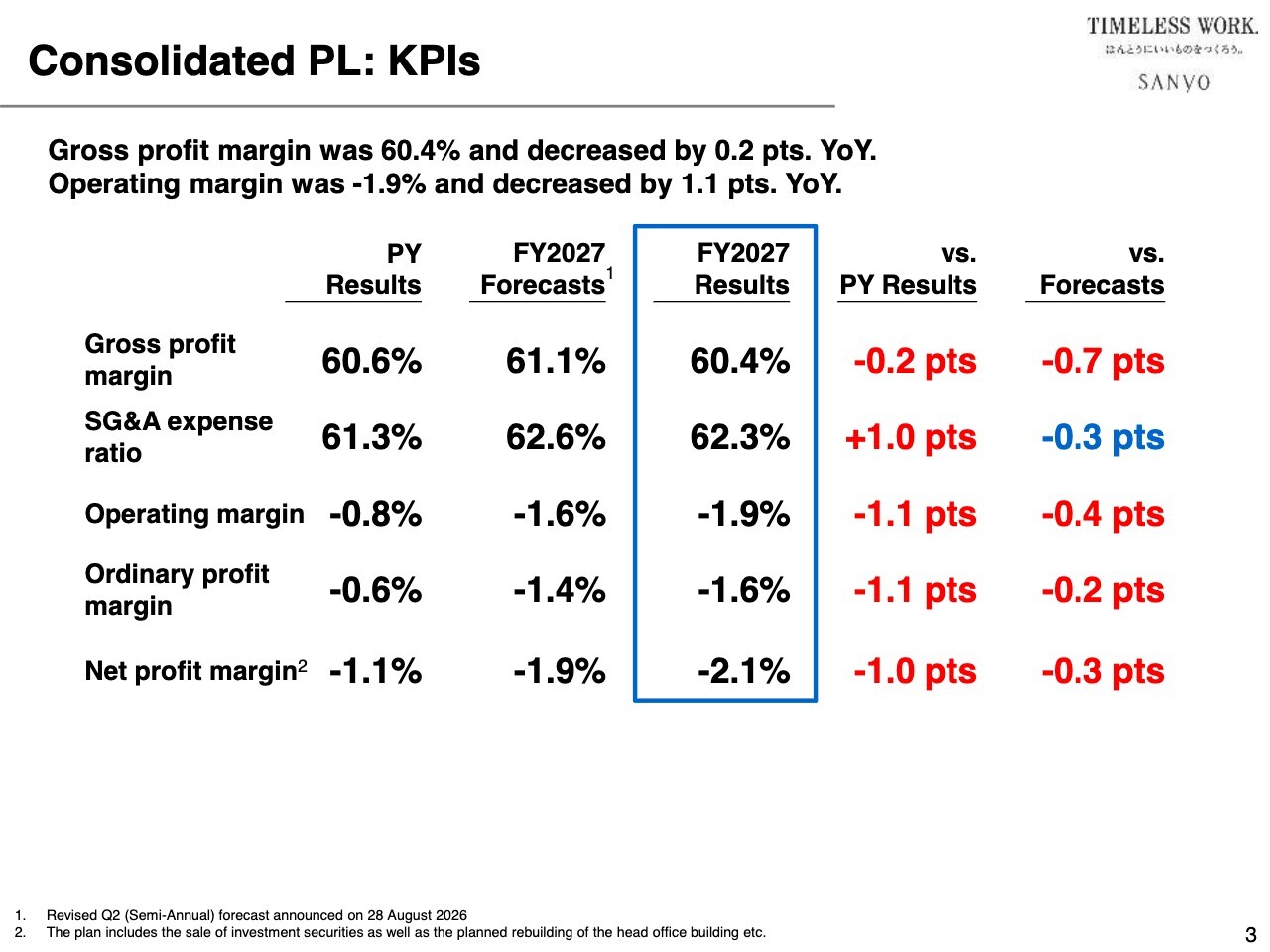
Our main KPIs are shown on this slide.
Profitability was below both the previous year’s level and the forecast. Although SG&A expenses decreased in absolute terms, the SG&A expense ratio increased YoY because net sales, the denominator, declined.
The results on slides 2 and 3 do not show the improvement I mentioned at the beginning. The next slide shows the monthly trends, which make the recent improvement clearer.
Monthly Results
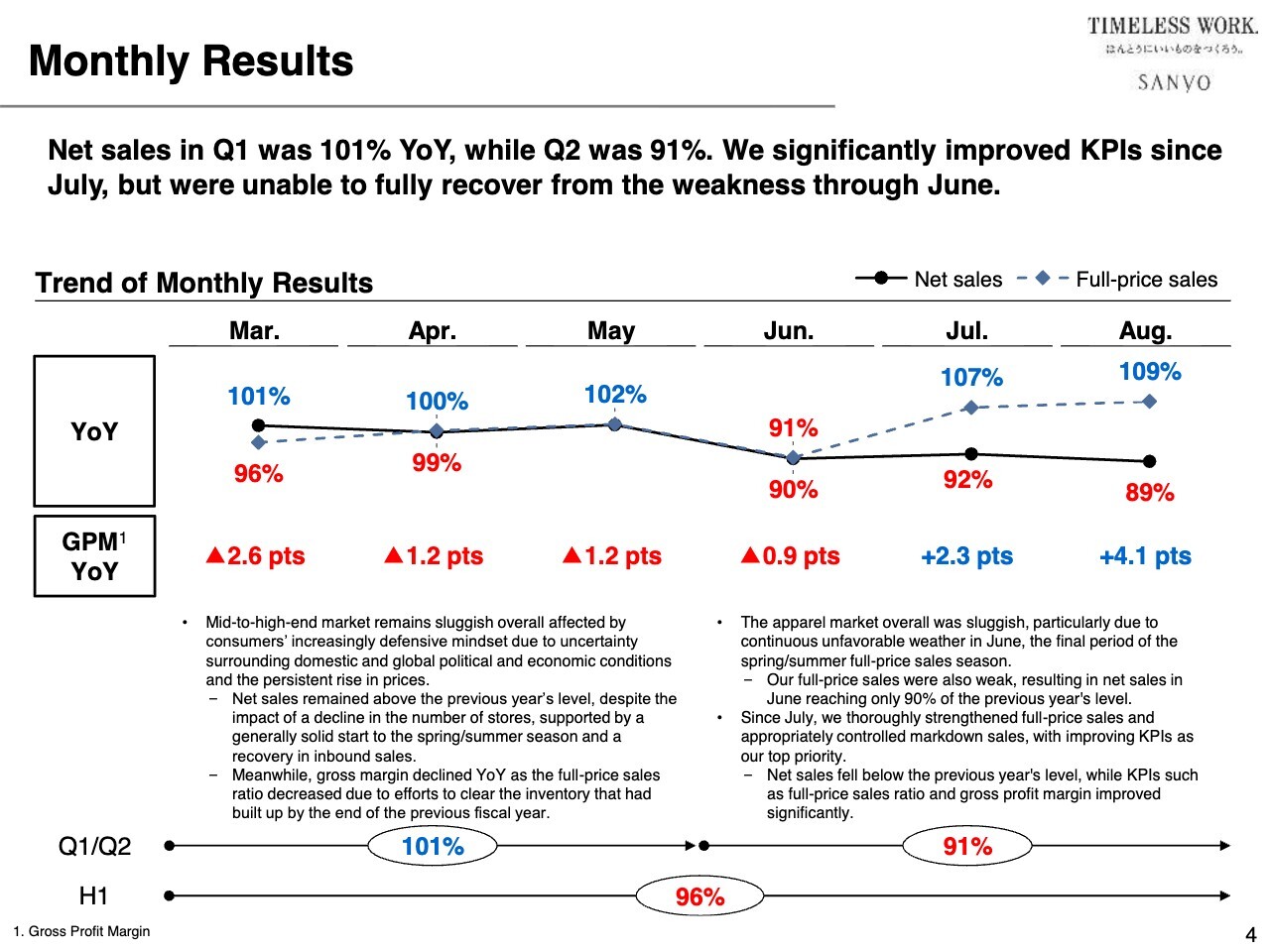
This line chart shows monthly net sales and full-price sales from March through August as percentages of the previous year’s levels.
In Q1, we maintained net sales at around the previous year’s level. However, gross profit margin, a profitability indicator, declined by 1.2 to 2.6 percentage points YoY. Improving this was therefore a priority for Q2.
Gross profit margin has been declining since FY2026. Full-price sales have fallen short of plan, leading to greater discounting and more loyalty points being awarded, which in turn has lowered gross profit margin. We have recognized this as an issue for some time and have begun reviewing our products.
Alongside research into the prices of competing brands, we reviewed the value and pricing of our products. We have also worked to restore the distinctive character of each brand in product planning, which tends to become conservative. We have carefully considered how to help consumers see that our products offer value beyond their price, and have revised prices for some products.
Meanwhile, we aim to bring promotional discounting and the awarding of loyalty points back to FY2025 levels through appropriate control. We are also holding sales competitions to encourage creativity and initiative among sales staff. In addition, we are pursuing initiatives such as “Voice of Customer,” through which sales staff provide feedback to the product planning team on why sales opportunities were missed.
We are also allocating the funds freed up by reducing discounting and the awarding of loyalty points to marketing. All brands are using performance-based advertising to strengthen full-price sales. We are also promoting the appeal of our products through consistent visual advertising across both online and offline channels.
As a result, full-price sales improved in July and August, with a more pronounced improvement in September. We believe these measures are contributing to a sustained improvement in gross profit margin.
Reference: Breakdown of SG&A Expenses
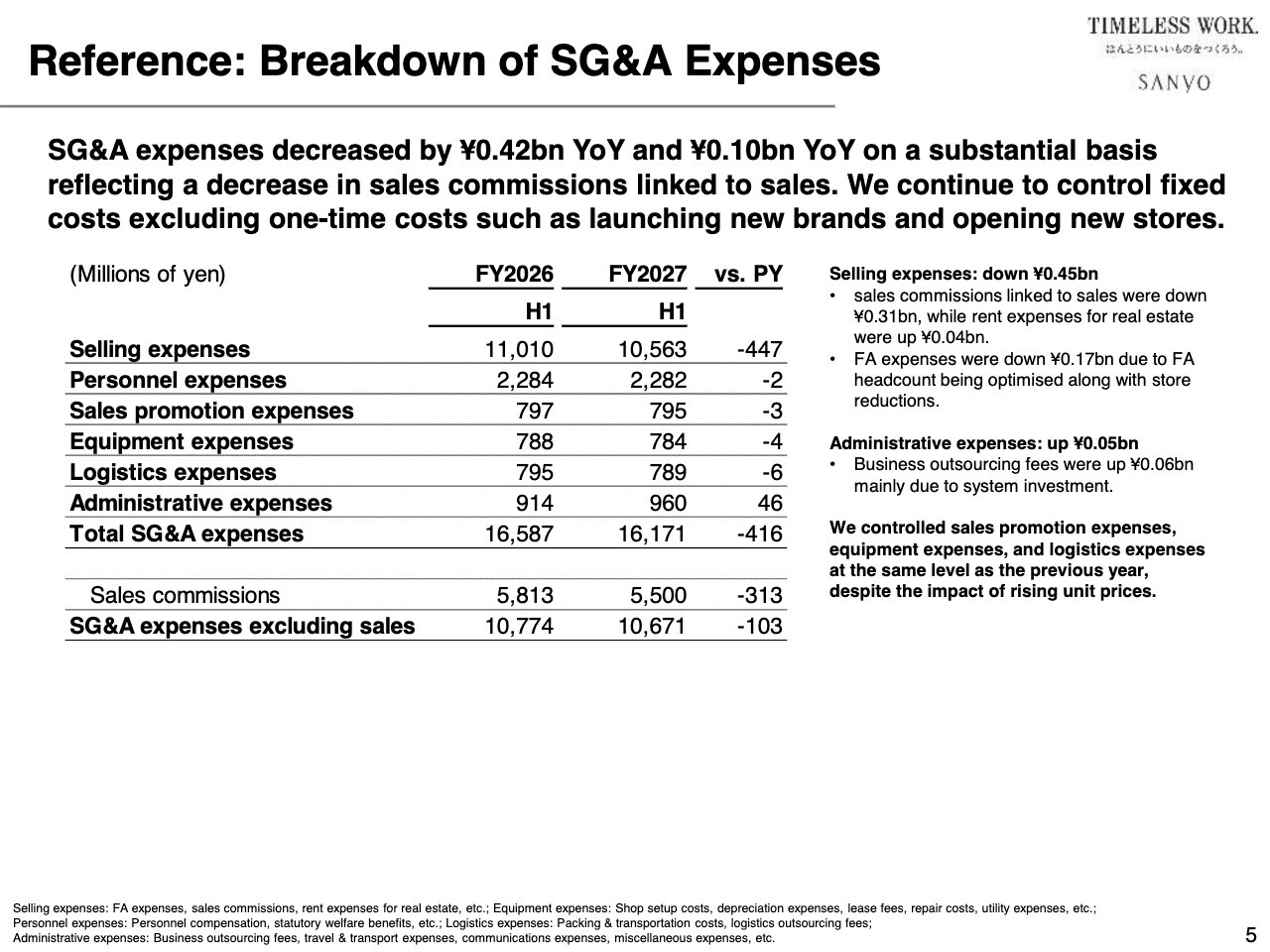
This slide shows the breakdown of SG&A expenses. They decreased by JPY0.42 billion YoY, mainly reflecting lower sales commissions linked to sales. For reference, discounts and the redemption of loyalty points are recorded as reductions in net sales, so they are not included in expenses.
Consolidated BS: Semi-Annual Accounting Period
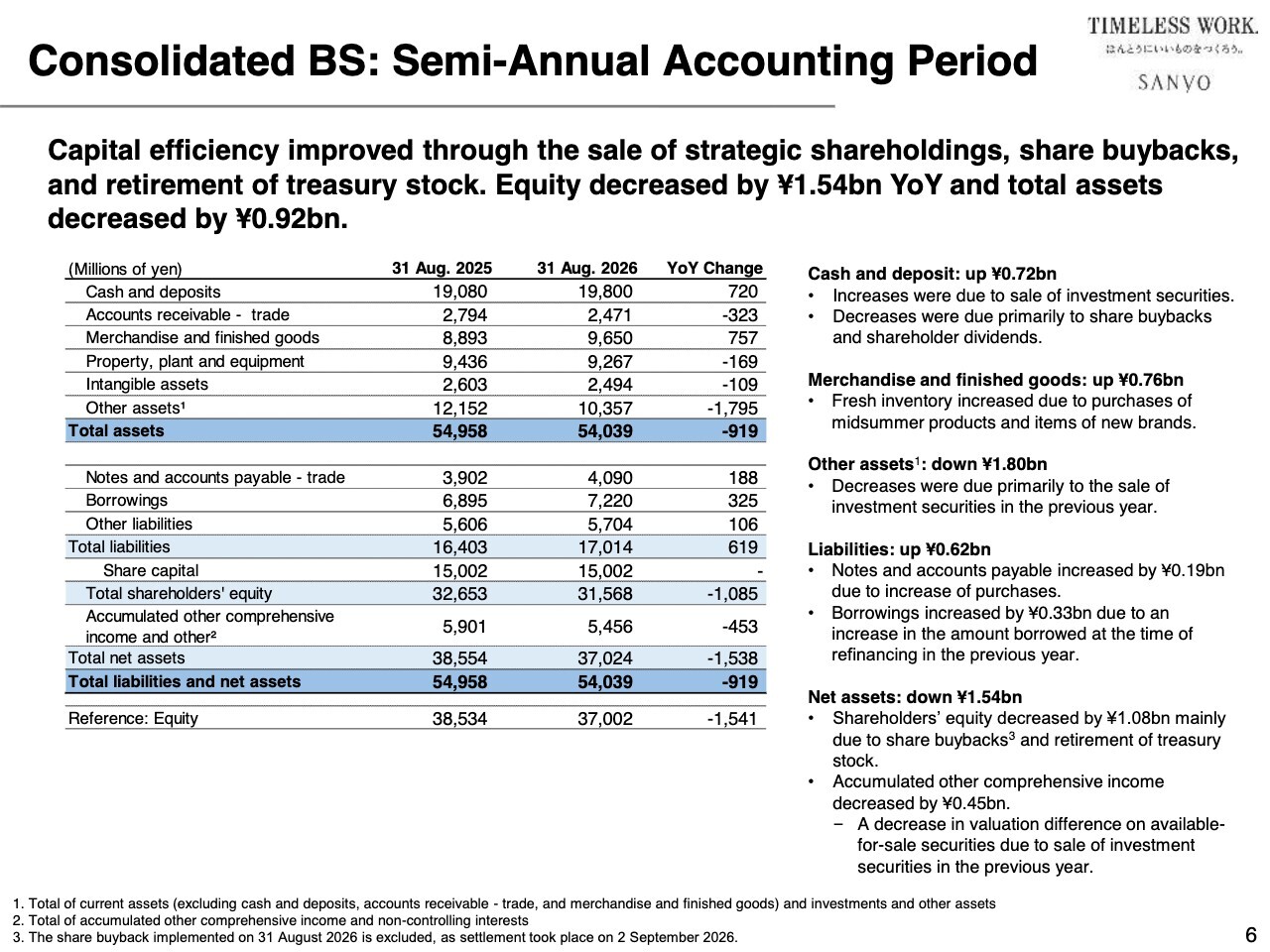
This is the balance sheet, compared with the end of August in the previous year. The sale of strategic shareholdings reduced “Other assets” by ¥1.8 billion and increased cash.
Meanwhile, share buybacks and retirement of treasury stock are reflected in decreases in cash and net assets.
Progress and Evaluation of Priority Measures
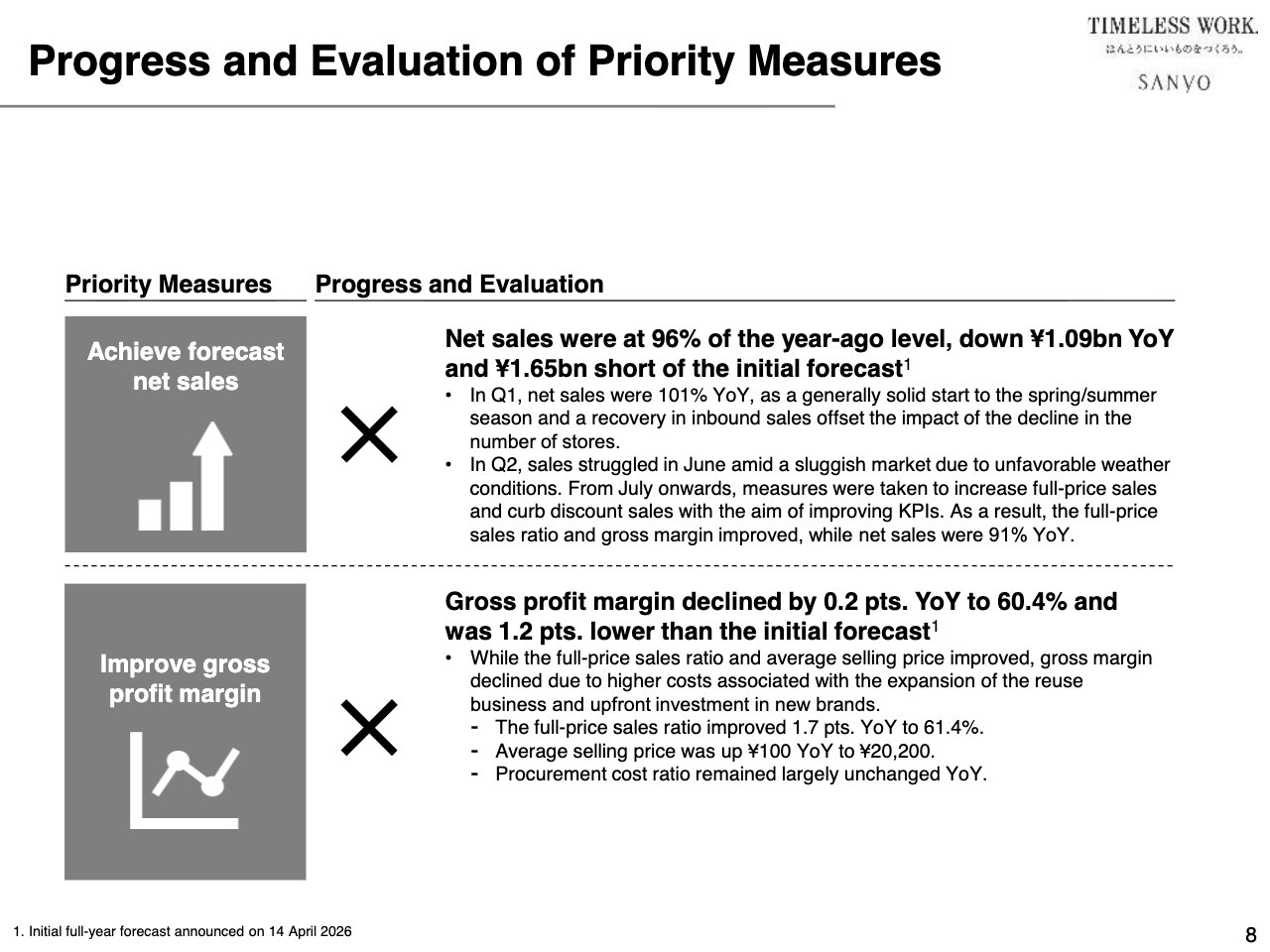
Next, I will move on to the second item on the agenda, our review of the first half.
Unfortunately, we were unable to improve net sales and gross profit. I have already explained the reasons for this.
Progress and Evaluation of Priority Measures
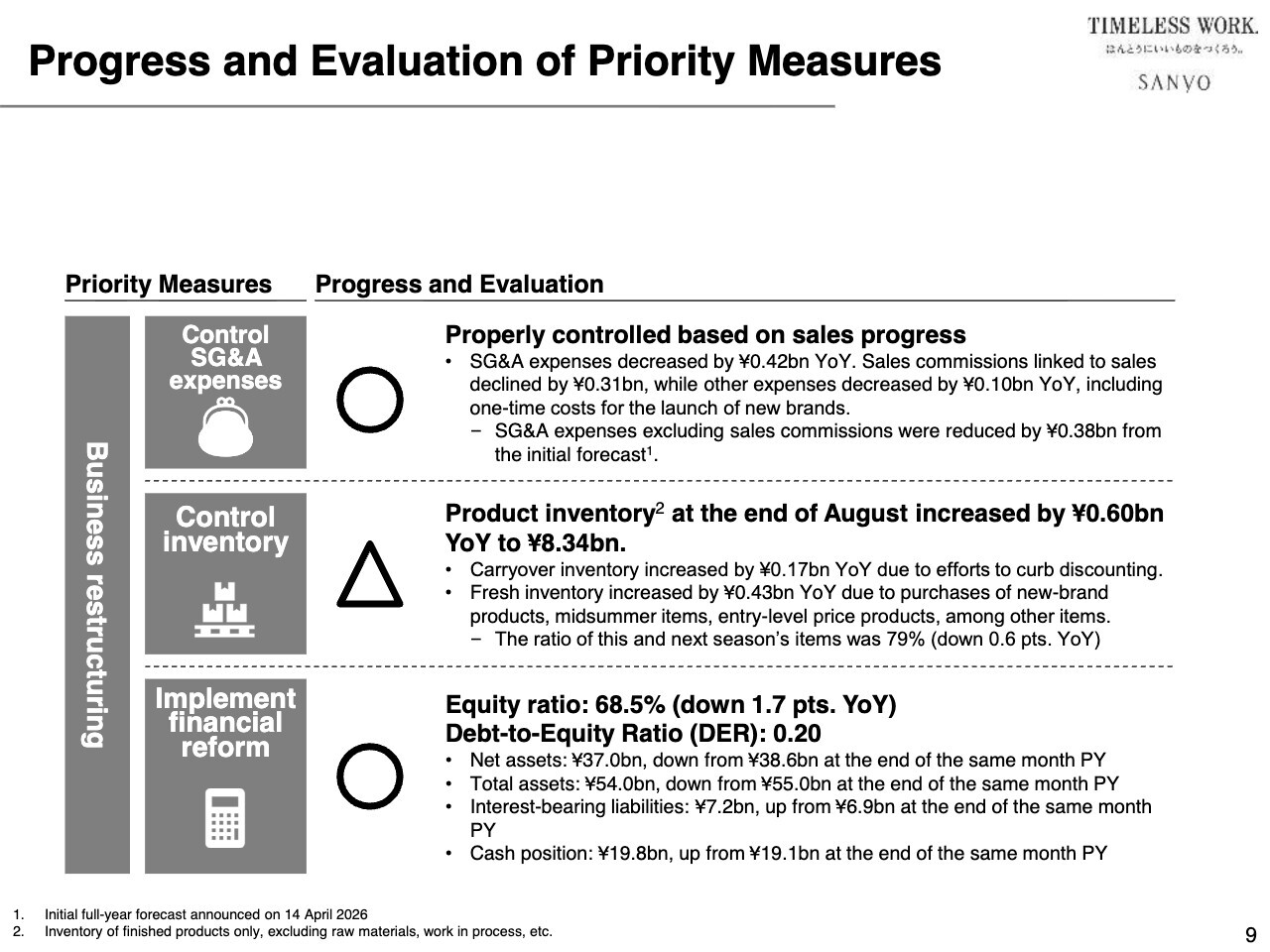
We made progress in reducing SG&A expenses and implementing financial reform.
Carryover inventory increased by ¥0.17 billion at the end of August. Following last September's shortage of spring/summer products, we prepared more inventory this year. In September, persistent rain and lower temperatures supported a strong start to autumn/winter sales. At the same time, we worked to reduce spring/summer inventory toward the end of September.
As a result of these initiatives, the value of current season’s items in inventory increased. We have therefore given inventory control a mixed assessment (△) on the slide.
Background to Maintaining the Full-Year Forecast
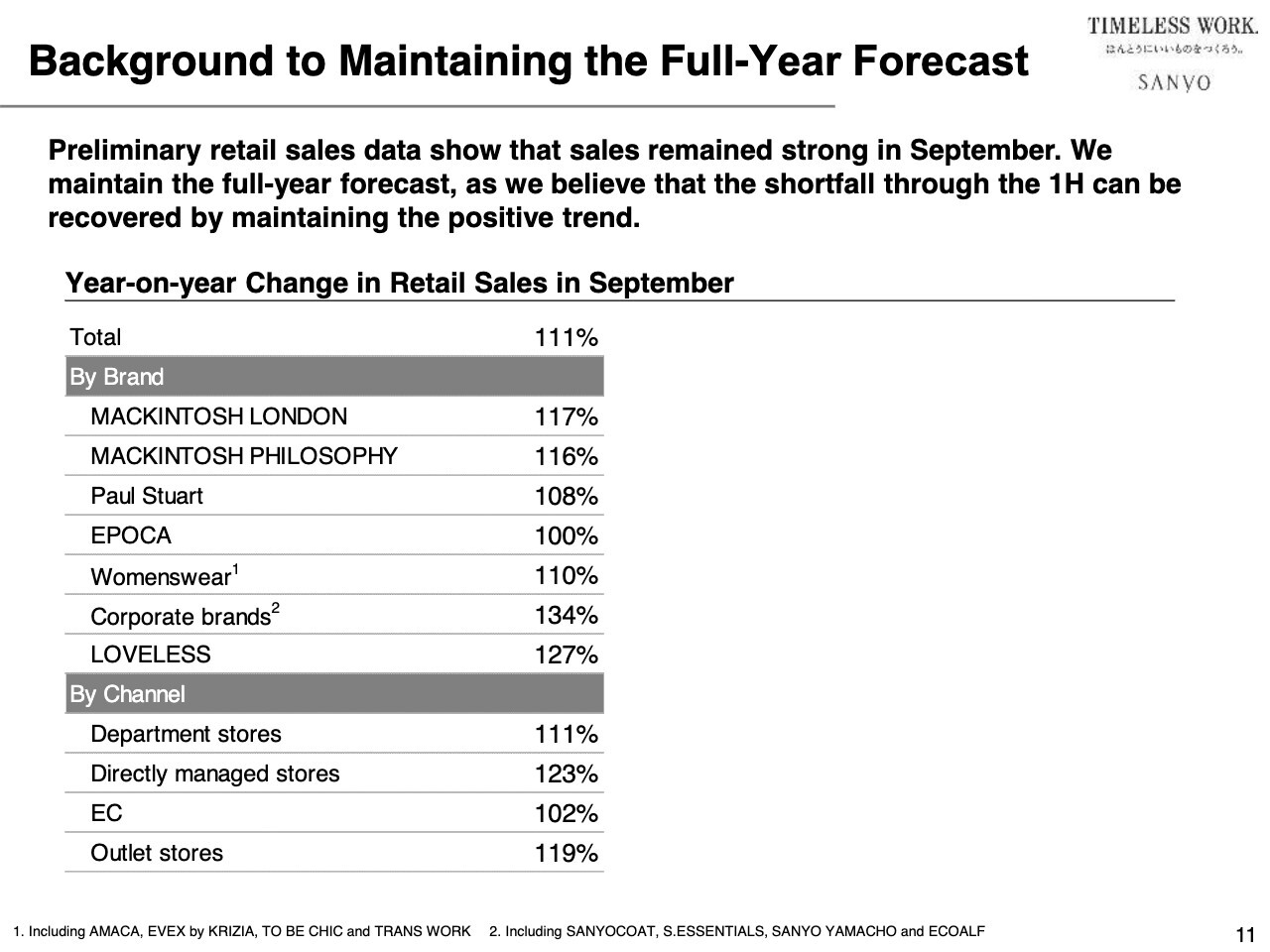
Next, I will explain the third item on the agenda, our full-year forecast for FY2027.
As I mentioned earlier, full-price sales recovered in July and August, and this trend became more pronounced in September.
As shown on this slide, retail sales in September improved to 111% of the previous year’s level. The main factor was an increase in the full-price sales ratio.
The full-price sales ratio was 74.2%, an improvement of 3 percentage points compared with the previous fiscal year. Full-price sales also improved to 116% of the previous year’s level.
Some adjustments depend on balance-sheet figures, so the gross profit figure is not yet available. However, judging from the preliminary September figures, we believe our measures to improve gross profit margin are working. We have therefore decided to maintain the full-year forecast.
FY2027 Projections: Consolidated PL
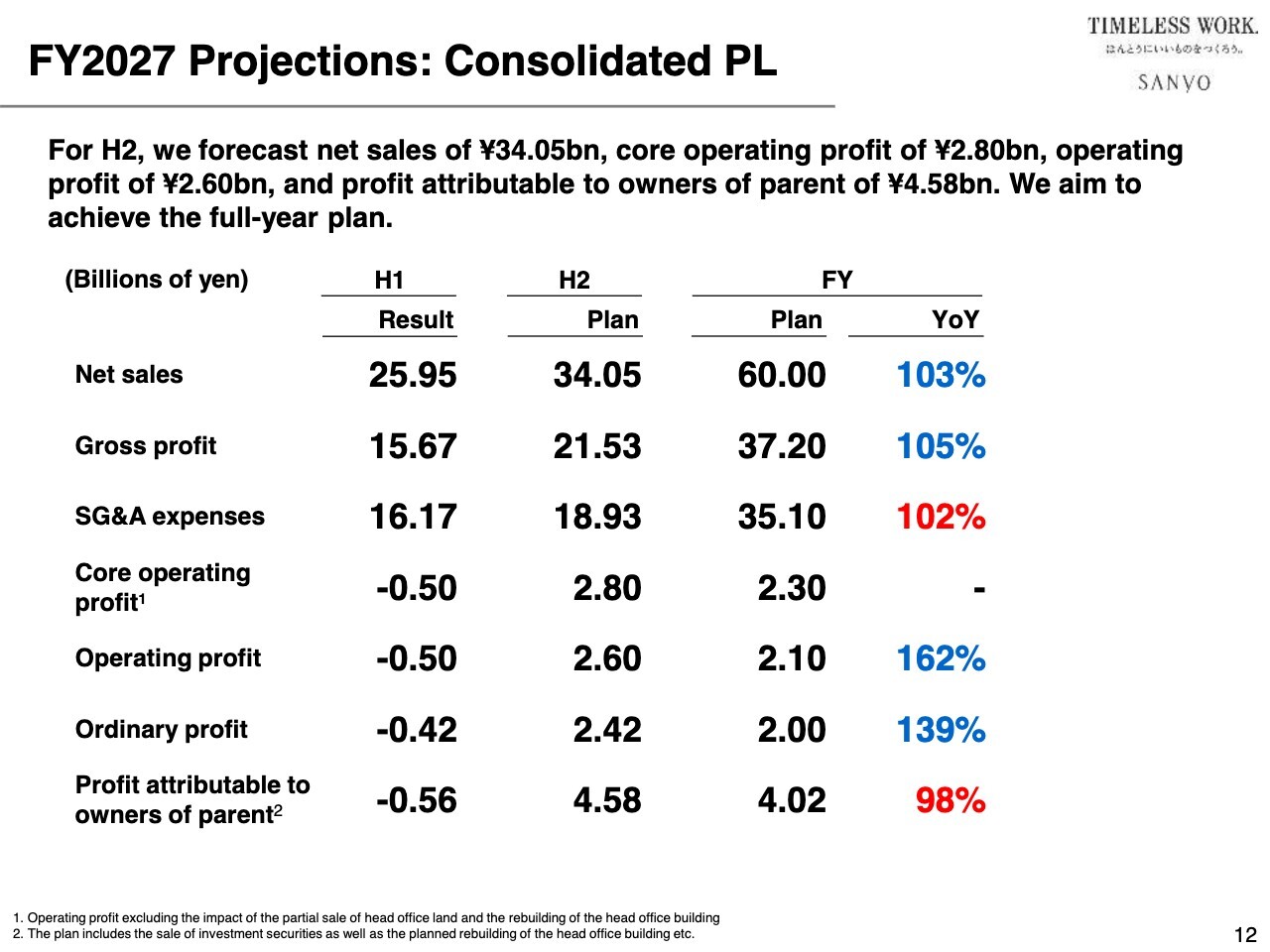
This slide brings together our H1 results and H2 forecast to show the full-year forecast for FY2027. For H2, we forecast net sales of JPY34.0 billion and operating profit of JPY2.6 billion.
We recognize that the H2 plan is challenging. However, we believe we can achieve the full-year forecast by strengthening full-price sales and implementing the measures shown on the slide. The entire Company will work together toward this goal.
As for profit attributable to owners of parent, we expect to achieve the plan regardless of operating profit, as we plan to sell strategic shareholdings in H2.
FY2027 Projections: KPIs
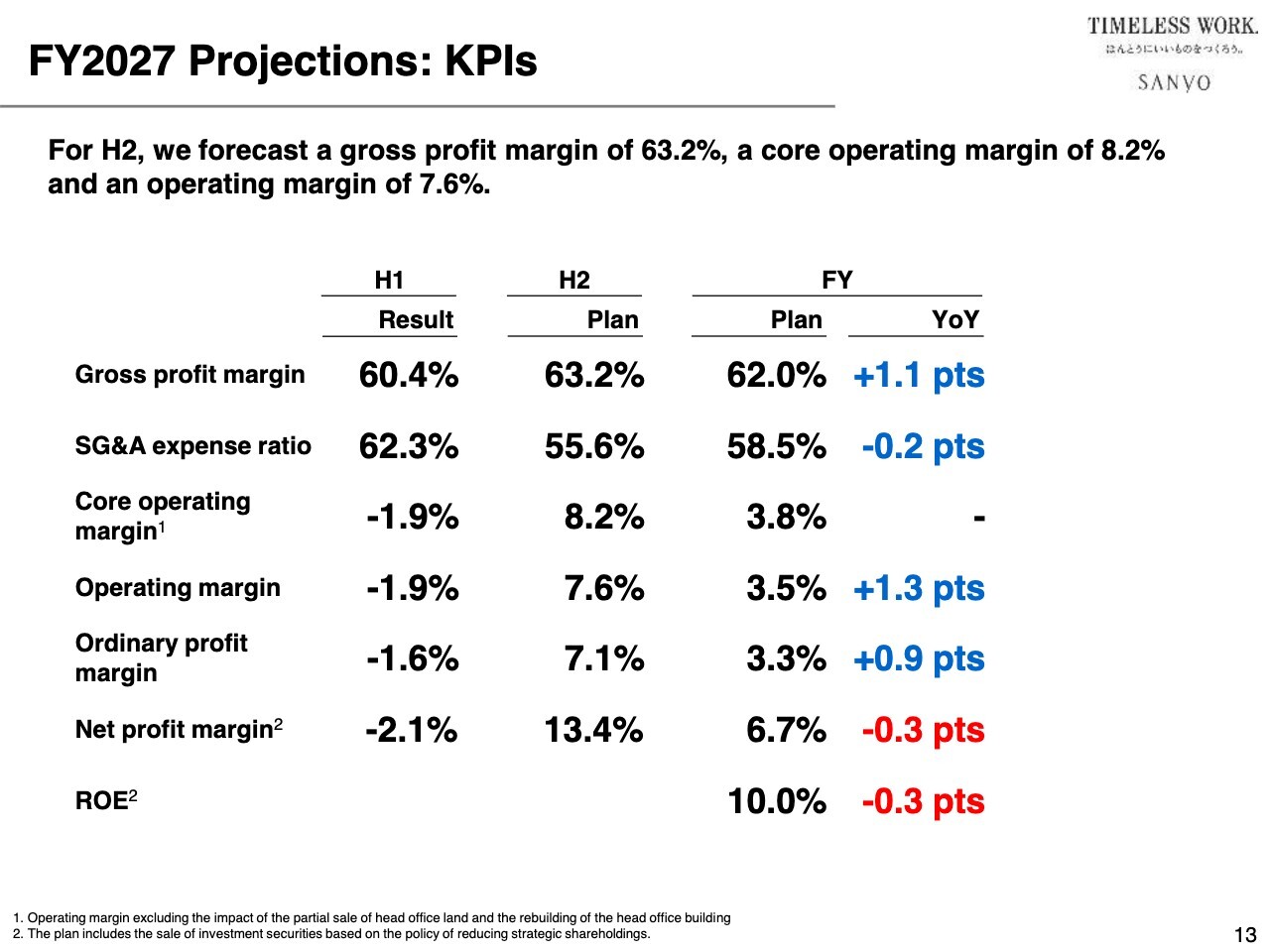
These are our KPIs for H2. We forecast a gross profit margin of 63.2% and an operating margin of 7.6%. As I mentioned earlier, we aim to improve gross profit margin and achieve our KPI targets by strengthening full-price sales and implementing the measures shown on the next slide.
FY2027 Projections: Improve Gross Profit Margin
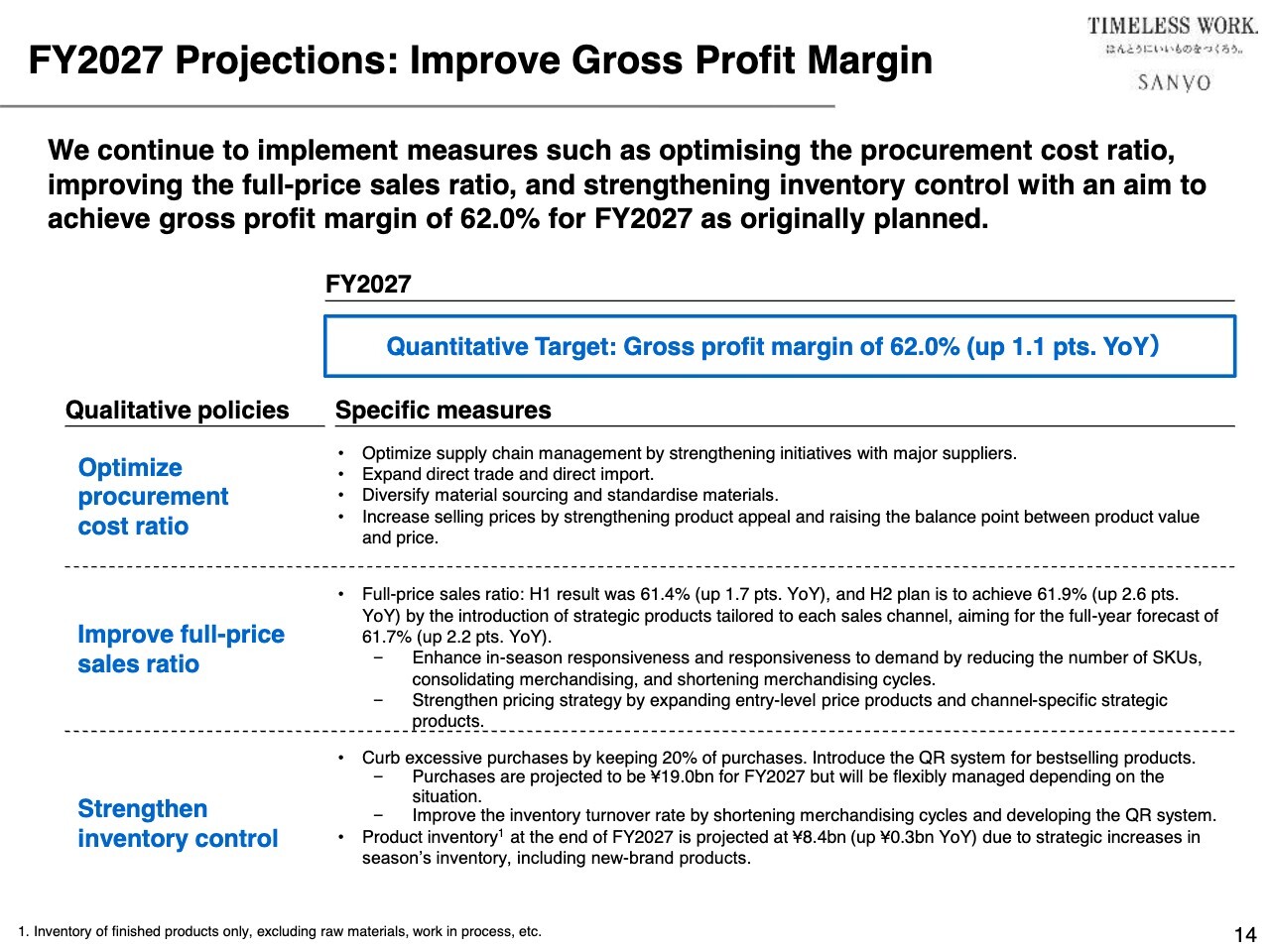
This slide outlines our measures to improve gross profit margin. I have already explained our initiatives to improve the full-price sales ratio.
Optimizing the procurement cost ratio and controlling inventory have long been part of our routine operations. We will continue to implement these measures rigorously, without letting up, and aim to achieve a full-year gross profit margin of 62.0%.
Basis for the Qualitative Plan
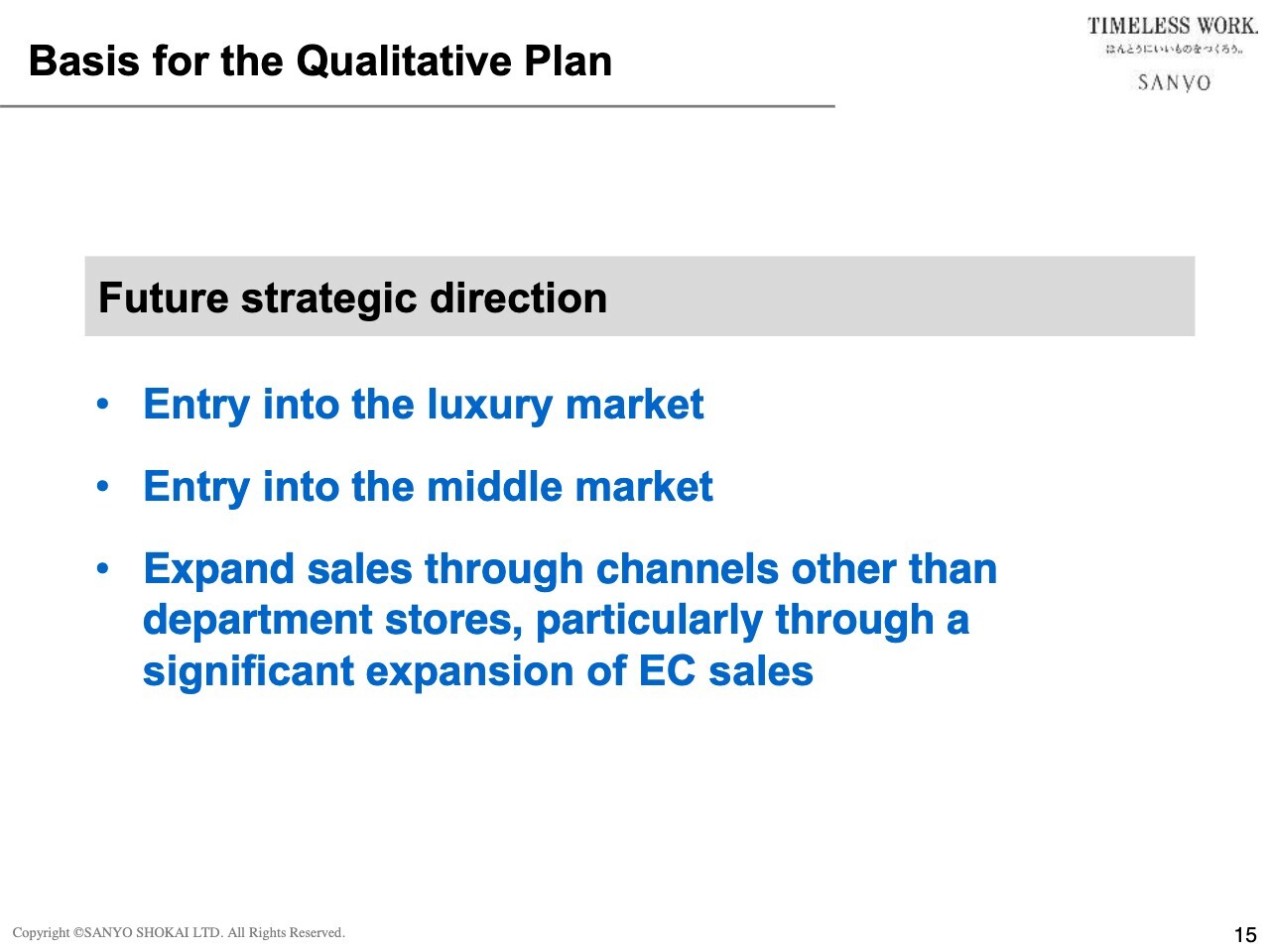
From slide 15 onward, I will explain our strategic direction. As I mentioned at the beginning, consumption is becoming increasingly polarized in Japan, and this trend is also evident among the upper-middle-income consumers who have been our main focus.
People who have built wealth through IT and web businesses, as well as the newly affluent whose wealth has grown with the recent rise in stock prices and asset values such as real estate, are actively buying luxury products, much like inbound customers.
We believe we need to make a renewed effort to reach newly affluent and inbound customers through “Japan Luxury” products made in Japan or carefully crafted by Japanese artisans.
Meanwhile, some upper-middle-income consumers are becoming more focused on saving as persistent inflation reduces their real incomes.
The population of newly affluent consumers is growing mainly in major metropolitan areas where the wealth effect is strong. Meanwhile, many consumers who are more focused on saving are shifting their purchases to local shopping centres, partly due to the closure of regional department stores. We believe we need to respond to this trend as well.
E-commerce, or EC, is a channel that can reach both groups. Department stores, fashion retail buildings, and shopping centres remain important touchpoints where customers can see and feel products, and their value has not changed. However, once customers have checked the fit and feel of a product, many choose to buy it through EC. As OMO, or Online Merges with Offline, evolves, services such as trying on and collecting products in stores are becoming even more convenient.
We believe our EC sales still have room to grow and need to be strengthened further. I will explain the details on the following slides.
Brand Positioning
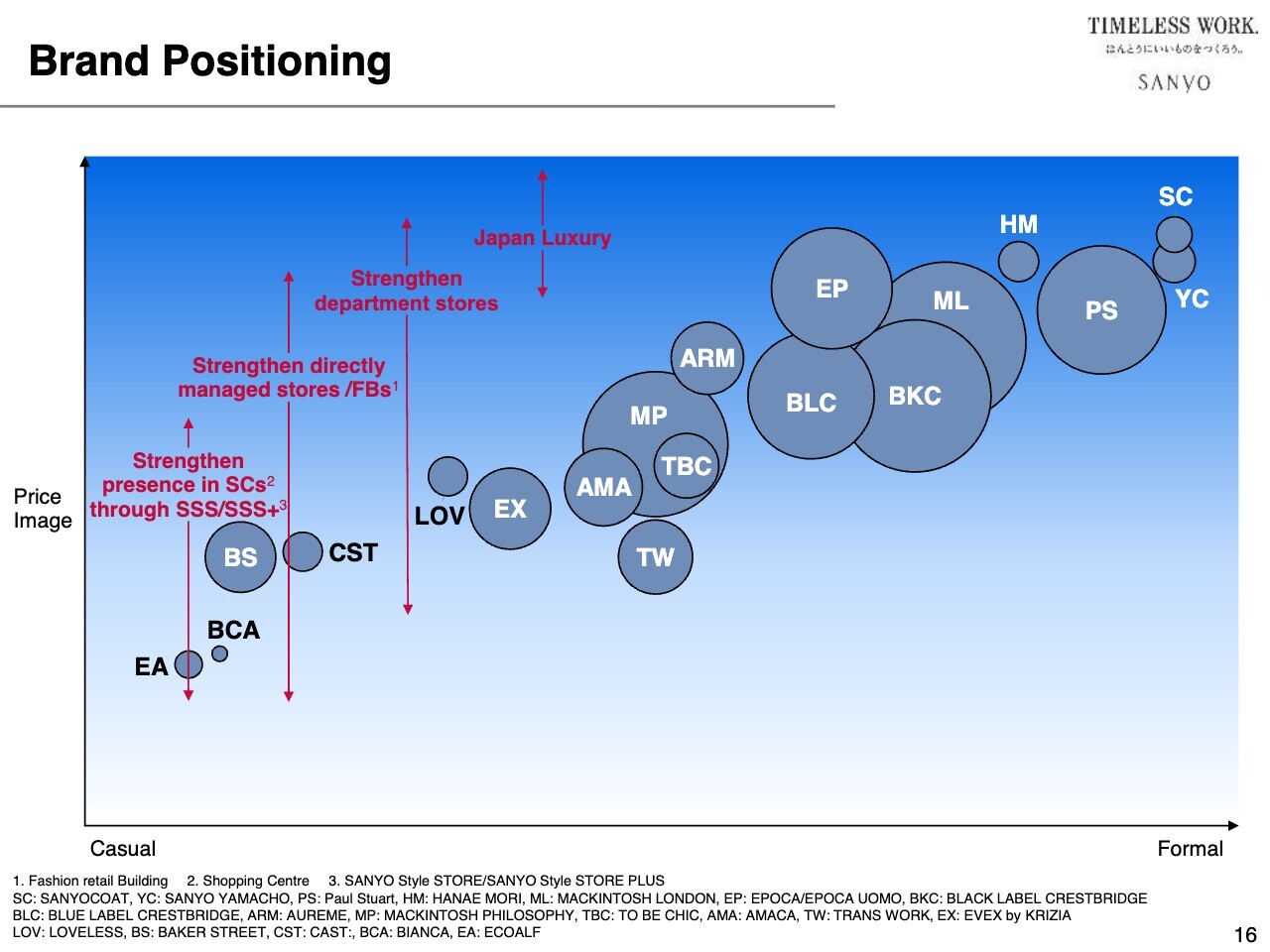
This slide shows the positioning of our brands and the sales channels each brand is intended to target. The vertical axis shows price image, while the horizontal axis runs from casual on the left to formal on the right. Strictly speaking, the horizontal axis should use different measures for menswear and womenswear, but we have simplified it for this chart.
The red arrows on the left indicate our intended sales channels and strategic priorities. These include Japan Luxury and strengthening our presence in department stores, directly managed stores, fashion retail buildings, and shopping centres.
As a manufacturer, we have strengths in craftsmanship. However, we have not been particularly strong at offering products tailored to the different customers served by each sales channel or location. To address the areas I have just described, we need to offer products suited to the customers in each channel and the area where each store is located.
For example, Japan Luxury includes brands such as SANYOCOAT, SANYO YAMACHO, and HANAE MORI, while SANYO Style STORE PLUS is a retail format for shopping centres.
Reference: Sales Results by Channel
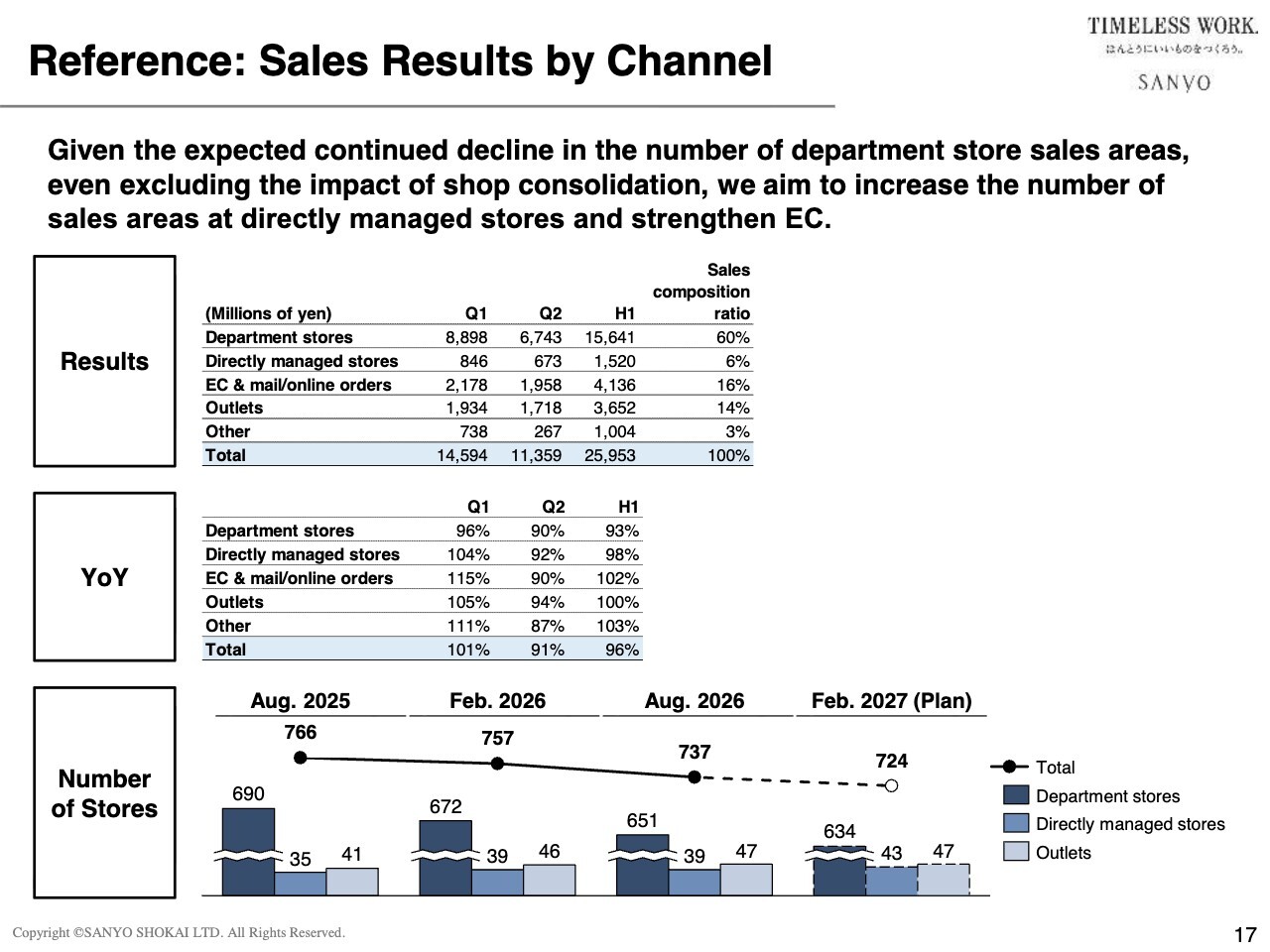
This slide shows our current performance by sales channel. Department stores account for 60% of sales, but the number of sales areas is clearly declining. This reflects the closure of regional department stores and the conversion of menswear and womenswear sales areas into luxury sales areas at city-centre department stores.
To strengthen sales at comparable stores, we are expanding the SANYO Style STORE format and bringing menswear and womenswear together in multi-brand stores within department stores. This helps mitigate the impact of declining sales areas. We are also working with department stores to strengthen sales through their services for private clients. At the same time, we recognize that diversifying and strengthening our sales channels is an urgent priority. These conditions underpin our strategic direction.
Japan Luxury
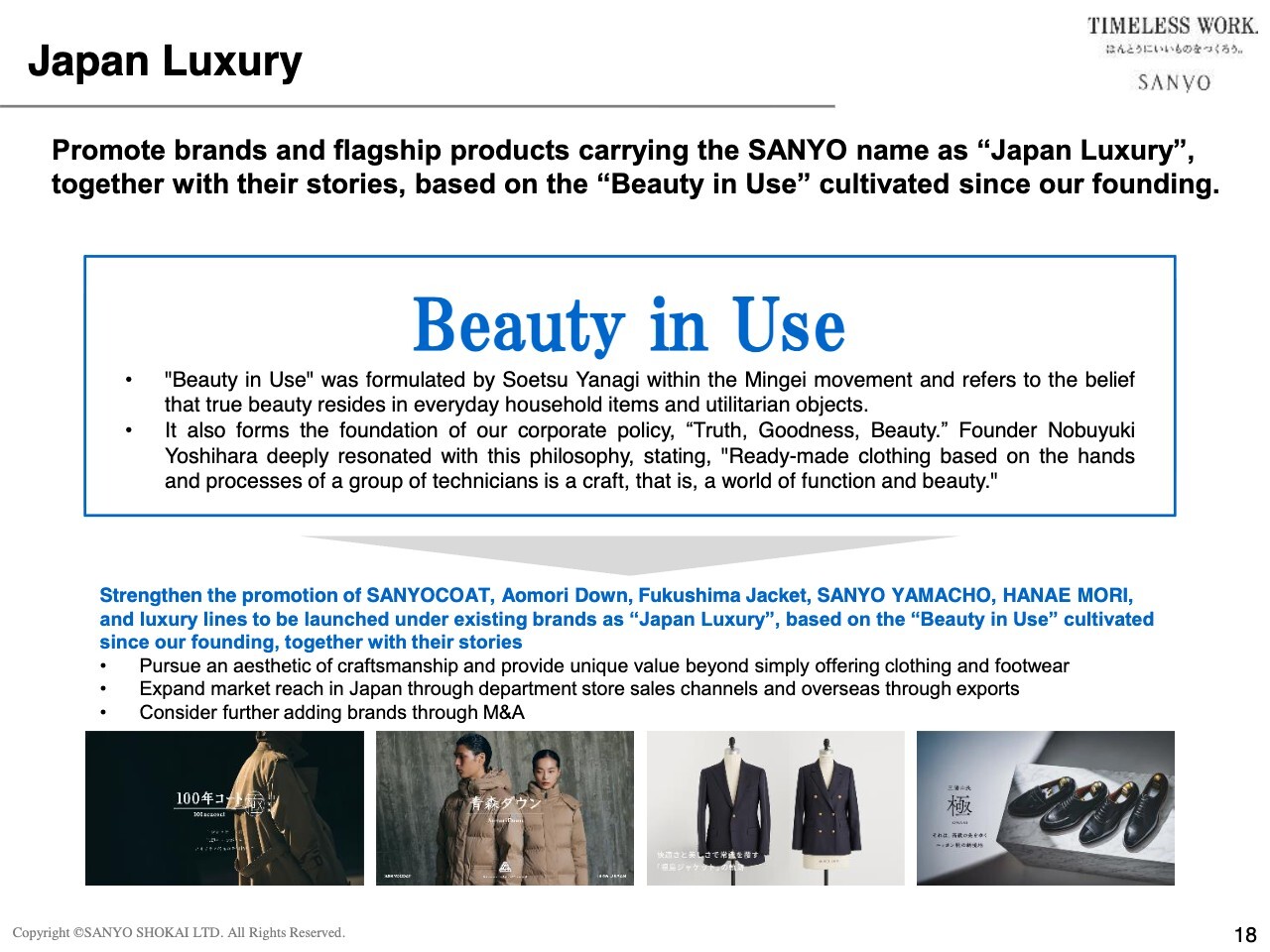
First, let me explain Japan Luxury. As we pursue this strategy, I would like to revisit the values we have cherished since our founding.
Since our founding, we have valued “Beauty in Use.” We believe that an object naturally possesses beauty when it uses the right materials for its purpose and provides the necessary functions. This also allows it to be used for a long time.
Fashion appeal and a sense of modernity are naturally expected, but this value underpins our craftsmanship, and we believe it is a strength unique to our Company. This spirit is embodied in our Japan Luxury products and in every other product we make, regardless of price.
Returning to the main point, we believe the products made by our skilled craftspeople embody Beauty in Use. We can proudly recommend these made-in-Japan products to customers in Japan and overseas for their materials, craftsmanship, a sense of modernity, and the stories behind them.
SANYOCOAT, SANYO YAMACHO, HANAE MORI, and Paul Stuart are such brands. SANYOCOAT, in particular, has already gained recognition at Pitti Immagine Uomo, an international menswear trade fair. It is steadily building a sales track record through wholesale and direct sales in Japan and overseas, as well as through department stores' private client services. This is an area we intend to focus on.
Strengthen Directly Managed Stores/FBs
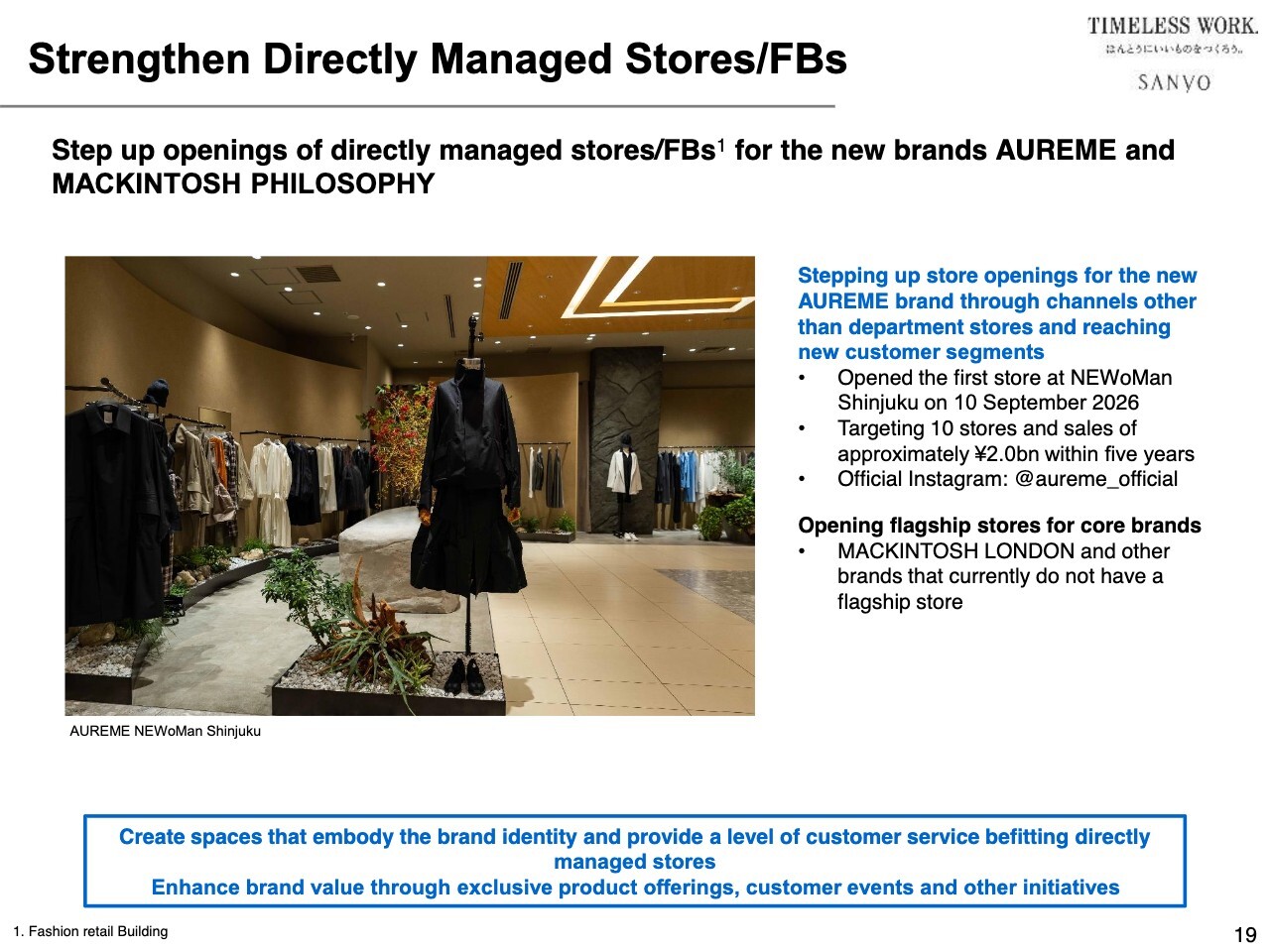
Next, I will explain our initiatives to strengthen sales through fashion retail buildings, or FBs, and directly managed stores. Let me introduce AUREME, the brand we launched in September.
As you know, we have opened stores in fashion retail buildings with diffusion lines of brands such as MACKINTOSH PHILOSOPHY, which we have traditionally offered through department stores. We will continue this approach.
However, we have had relatively few brands, like AUREME, developed specifically for fashion retail buildings. We believe that entering this channel requires a thoroughly developed product offering, so we appointed Ms. Misako Kushibe to oversee planning, design, and direction. The brand concept is “Daily wear for the future that wraps you in air and caresses your skin.”
We aim to clearly convey the brand identity in physical stores and also reach customers who shop in fashion retail buildings effectively online.
Strengthen Presence in SCs Through SSS/SSS+
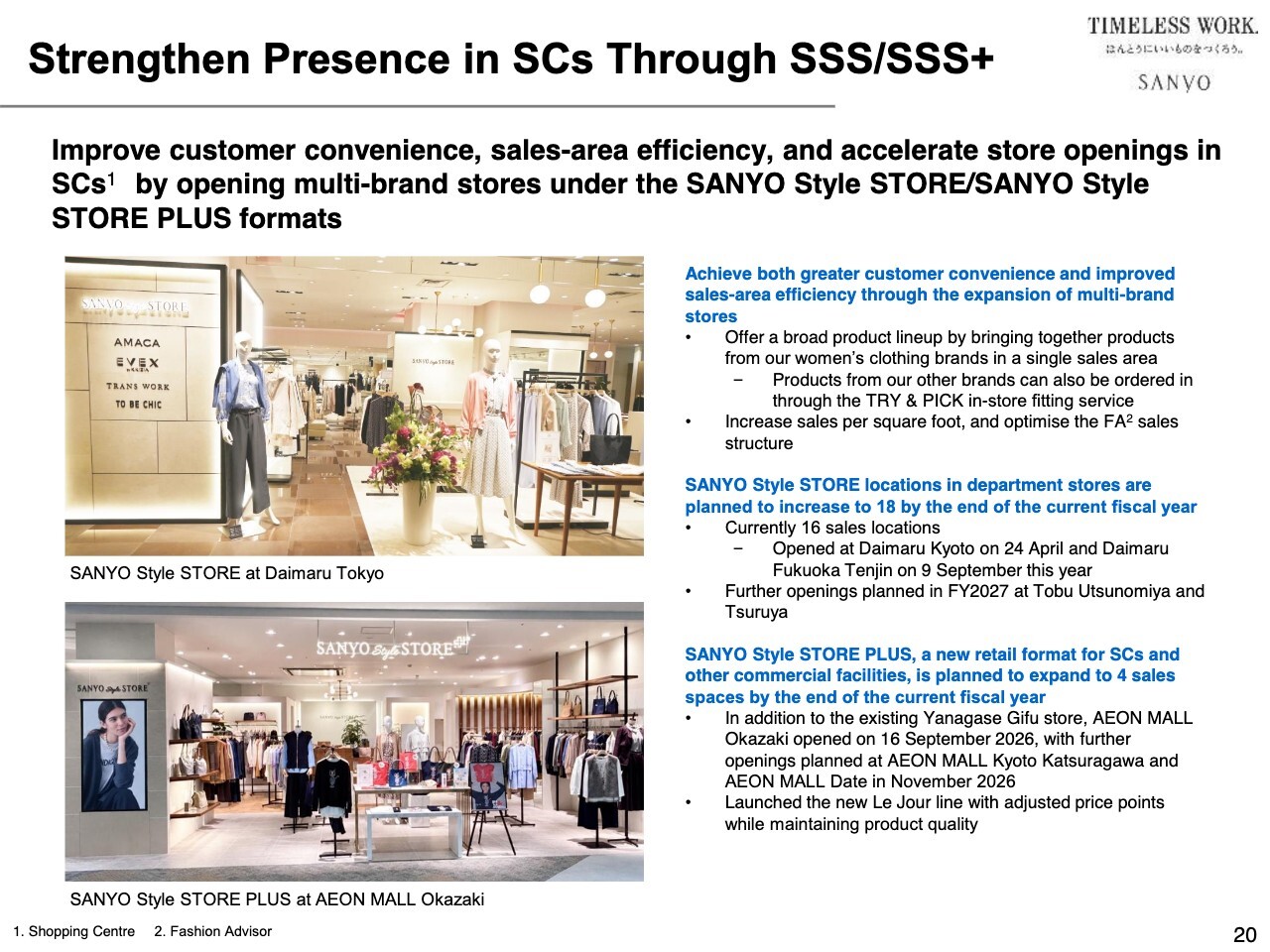
Let me explain our initiatives to strengthen our presence in shopping centres, or SCs.
We have long operated SANYO Style STORE, or SSS, as multi-brand stores within department stores, and now have 16 locations. Department stores have rated this initiative highly because it broadens customer choice and improves sales-area efficiency.
SANYO Style STORE PLUS, or SSS+, is a new retail format launched for customers of our brands after Gifu Takashimaya closed. The second store opened at AEON MALL Okazaki on 16 September. A Seibu department store was previously located on the site of AEON MALL Okazaki.
The product lineup includes Le Jour, a new line of our womenswear brand AMACA, offering an assortment at more accessible price points.
We plan to open further stores at AEON MALL Kyoto Katsuragawa and AEON MALL Date, with assortments tailored to each location.
Beyond these locations, we will focus on areas affected by regional department store closures and on upper-middle-income consumers who are becoming more focused on saving. We will continue opening stores with assortments suited to each location.
Strengthen EC
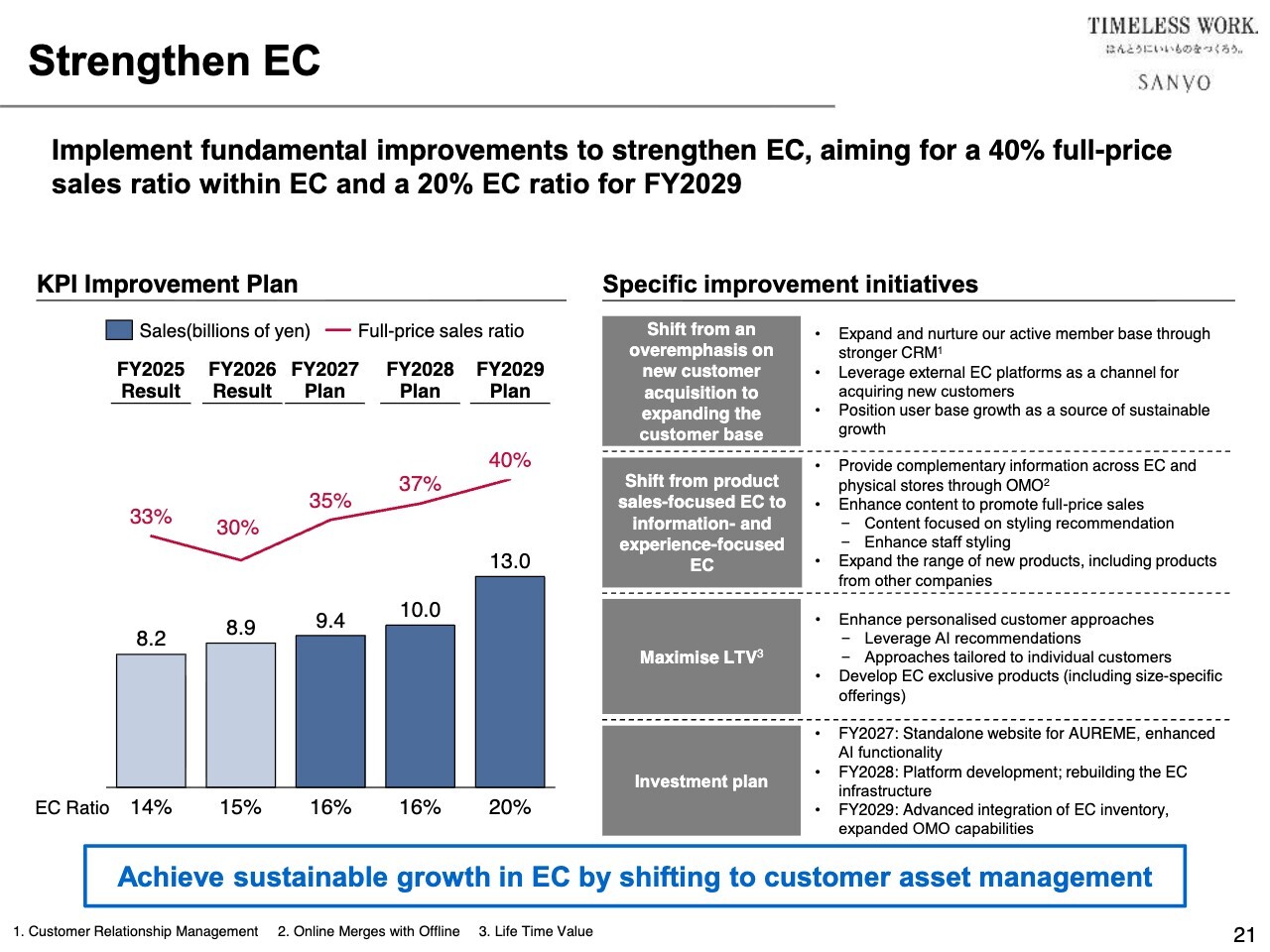
Next is EC. We were a late entrant, starting in 2008. In 2023, we relaunched our EC site, changing it from SANYO iStore to the current SANYO ONLINE STORE. By integrating the previously separate brand websites and EC functions, we have developed a modern OMO site that makes it easier to shop across brands and book in-store fittings.
Our EC business has continued to grow toward annual sales of JPY10.0 billion. In FY2026, EC sales reached JPY8.9 billion, accounting for 15% of the Company’s total sales.
Beyond our annual sales target of JPY10.0 billion, our next goal is an EC ratio of 20% of Company sales. Specific measures include developing BIANCA, our EC-exclusive brand, strengthening customer relationship management, or CRM, enhancing OMO, and maximising lifetime value.
Progress on Other Priority Growth Strategies in the Medium-Term Business Plan
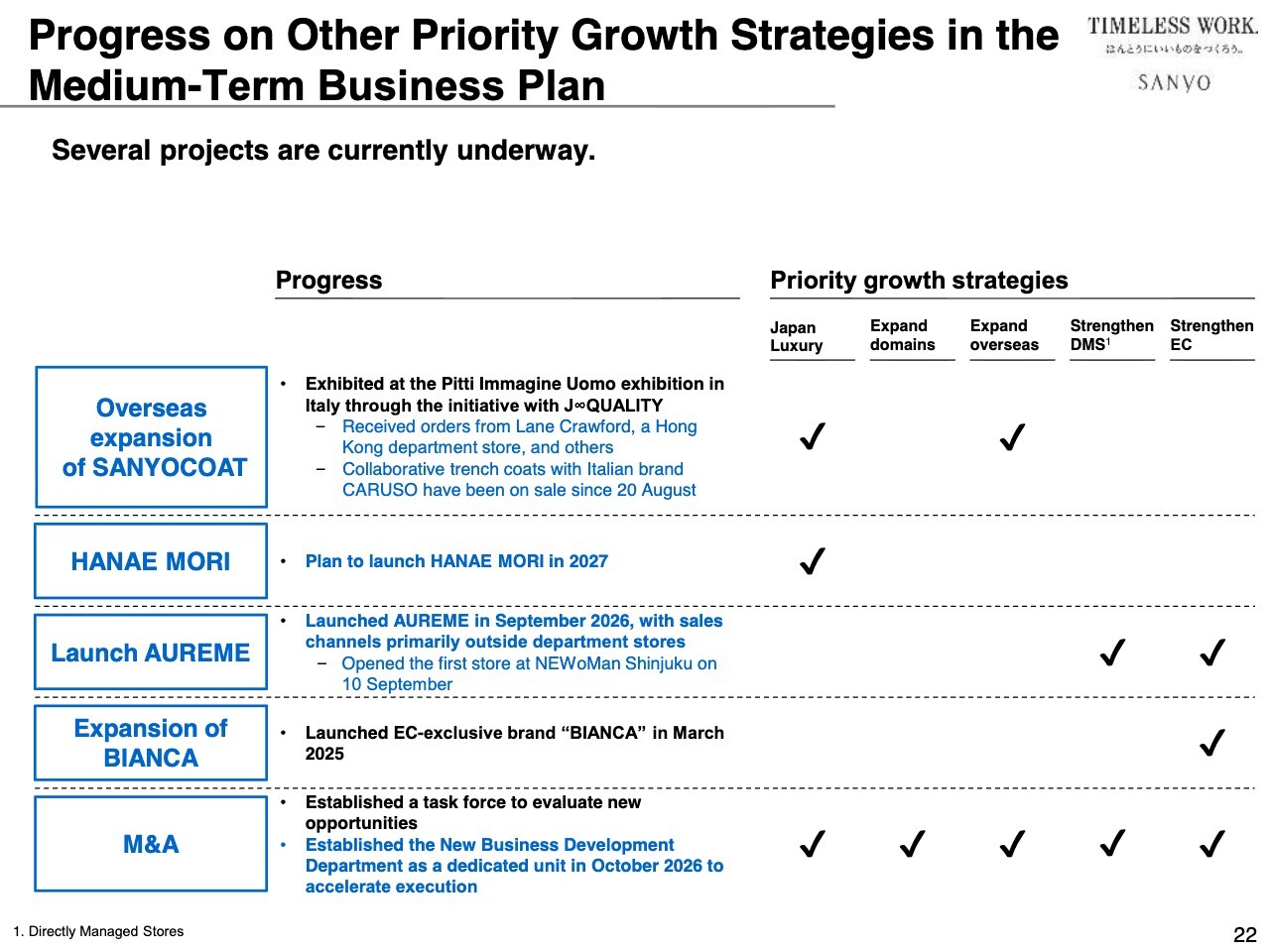
This slide summarizes the progress of other priority growth strategies in the Medium-Term Business Plan in a table.
PBR Improvement Plan: Analysis of Current Status, Issues, and Solutions
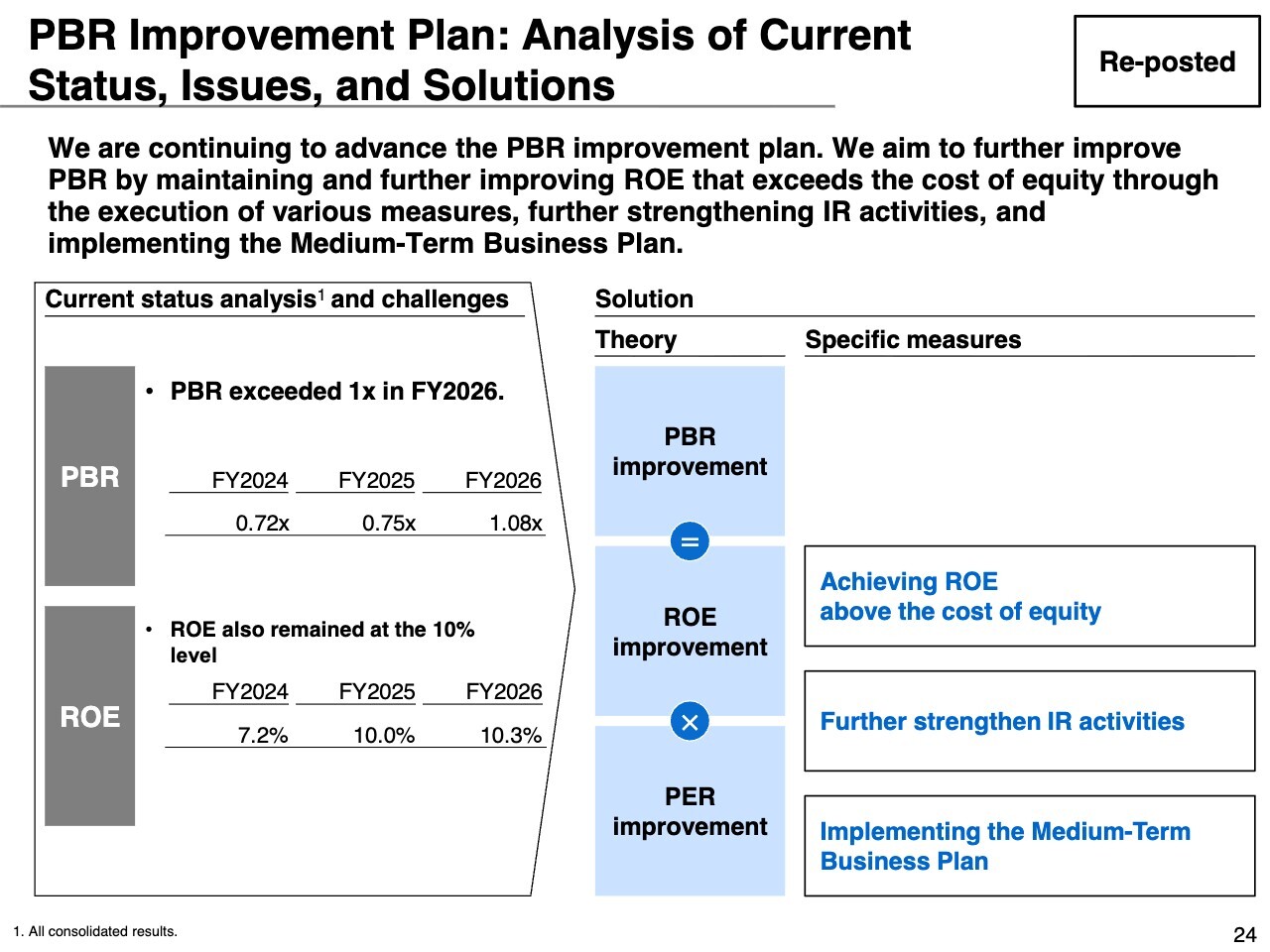
From slide 23 onward, we explain our capital strategy. The analysis of current status, issues, and solutions on slide 23 is unchanged and is re-posted here.
PBR Improvement Plan: Increasing ROE
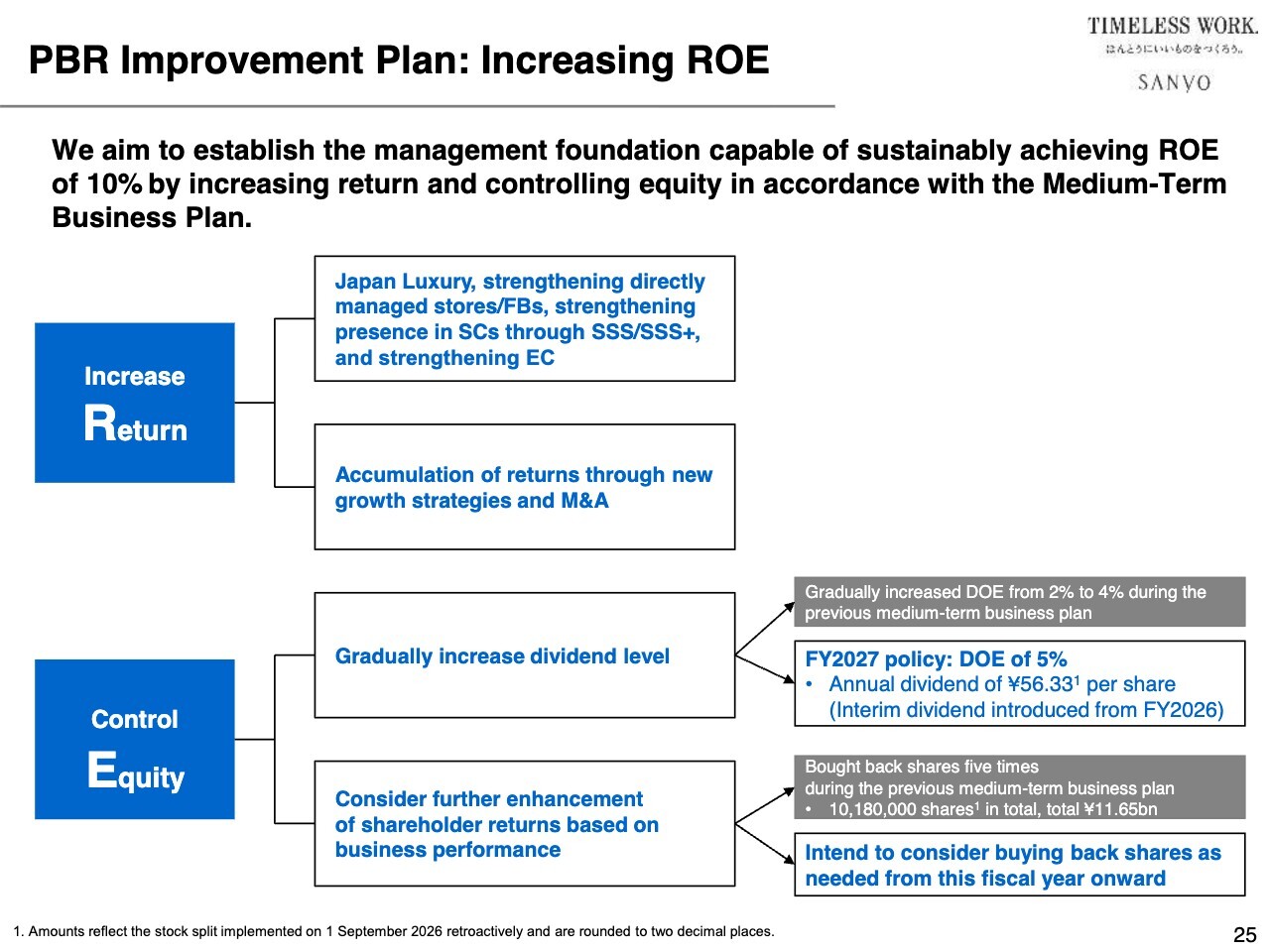
Let me explain our initiatives to improve ROE. We continue to evaluate specific M&A opportunities, which remains a priority. With a view to executing transactions, we established the New Business Development Department within Corporate Management HQ on 1 October.
To control equity, we have gradually increased dividend levels. On 30 June, we raised the dividend policy for the remaining period of the Medium-Term Business Plan from a DOE of 4% to 5%.
As a further measure to strengthen shareholder returns, we have conducted five share buybacks since the previous Medium-Term Business Plan period. We repurchased a total of 10,180,000 shares for JPY11.65 billion. The share count has been adjusted to reflect the three-for-one stock split.
PBR Improvement Plan: Other PBR Improvement Measures
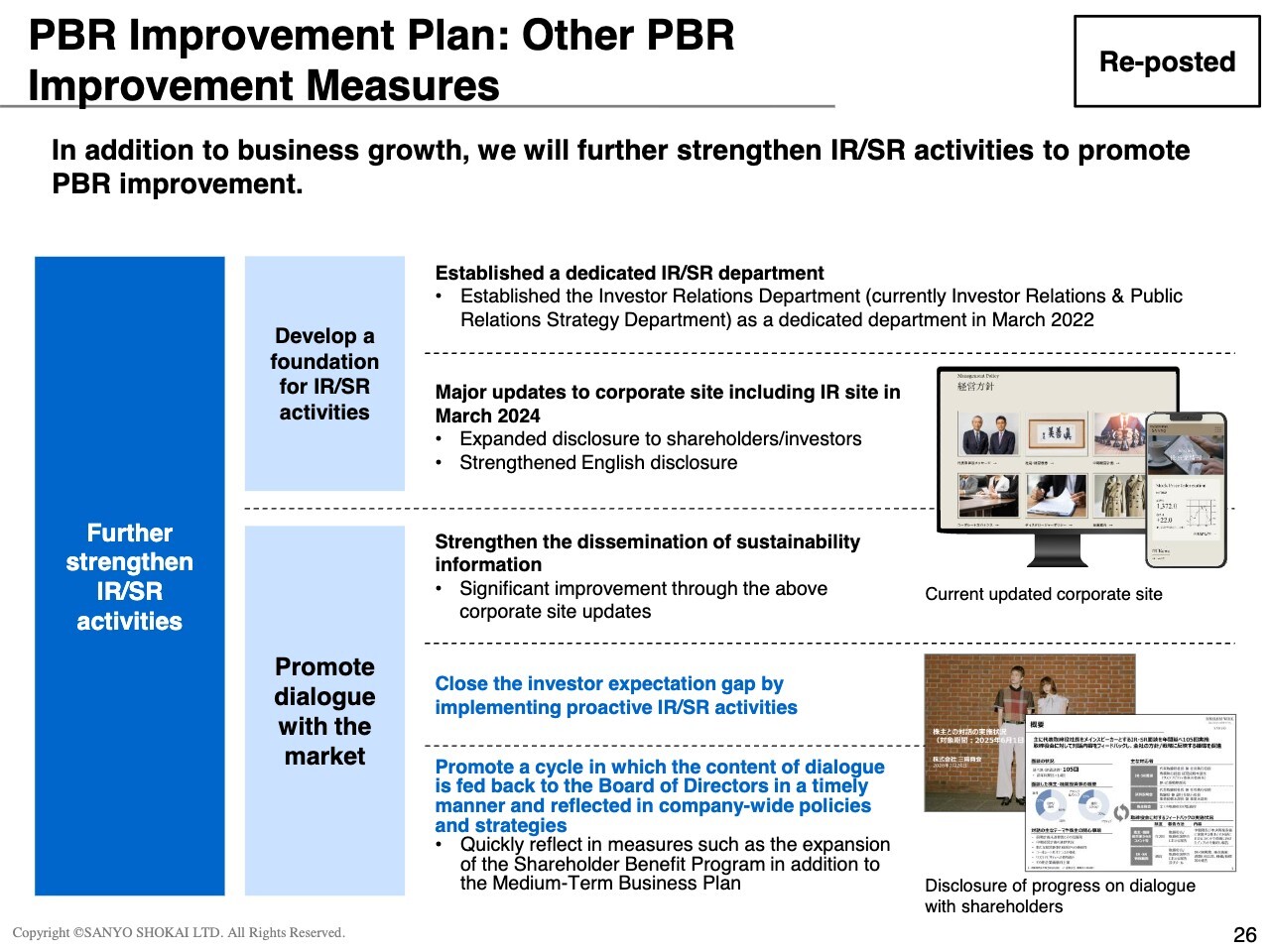
This slide is re-posted.
Net Cash Allocation: Plan through FY2028
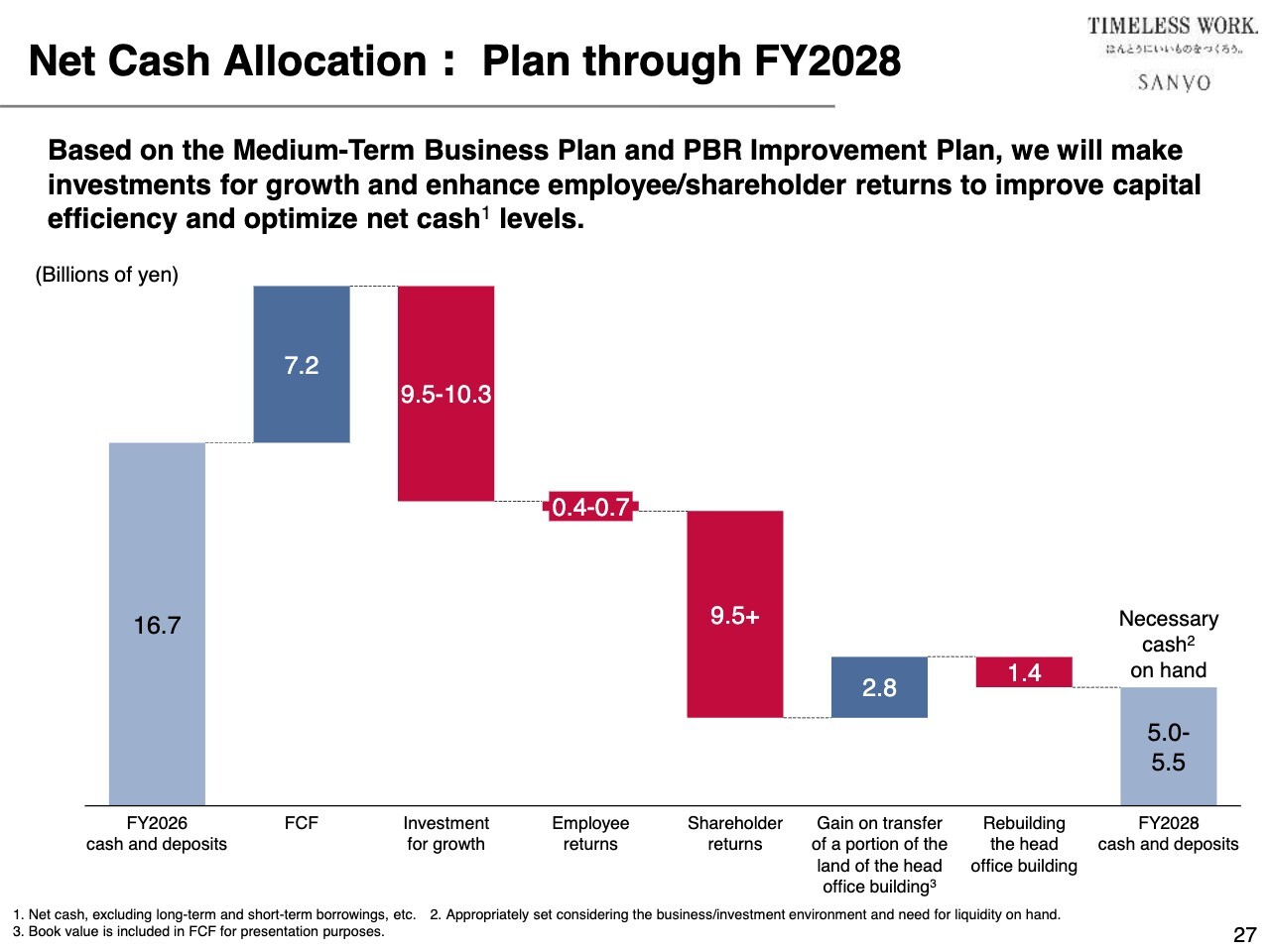
Let me explain our net cash allocation. This covers the use of cash over the two years through FY2028, when the Medium-Term Business Plan ends.
We aim to optimize net cash levels and improve capital efficiency through growth investments, including M&A, as well as returns to employees and shareholders. We are aware of the feedback that our growth investments have been slow to progress. We will keep you updated as soon as there are any developments.
Use of Cash
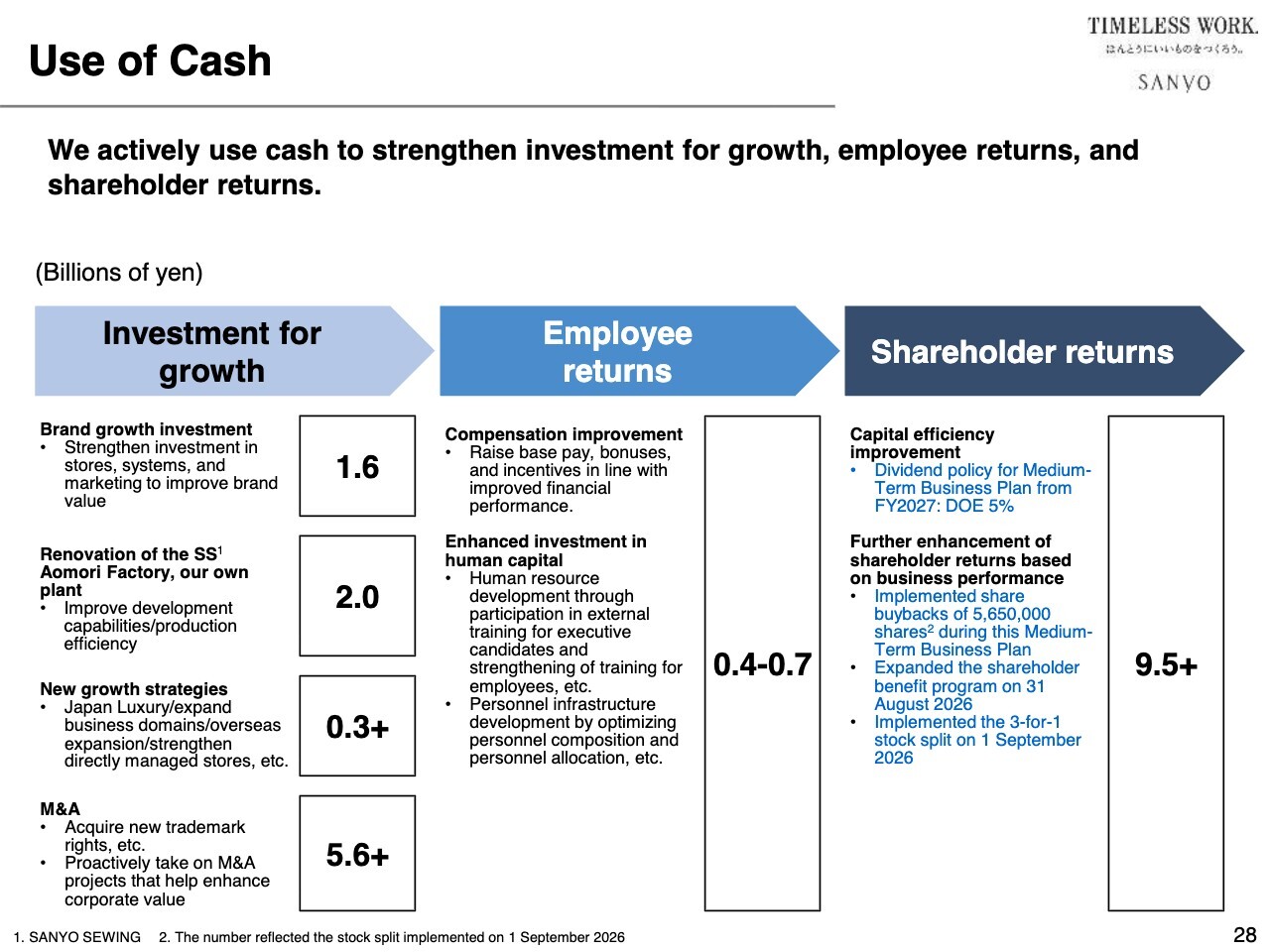
This slide provides details of the use of cash, including the measures we have taken to strengthen shareholder returns.
Dividend Forecast
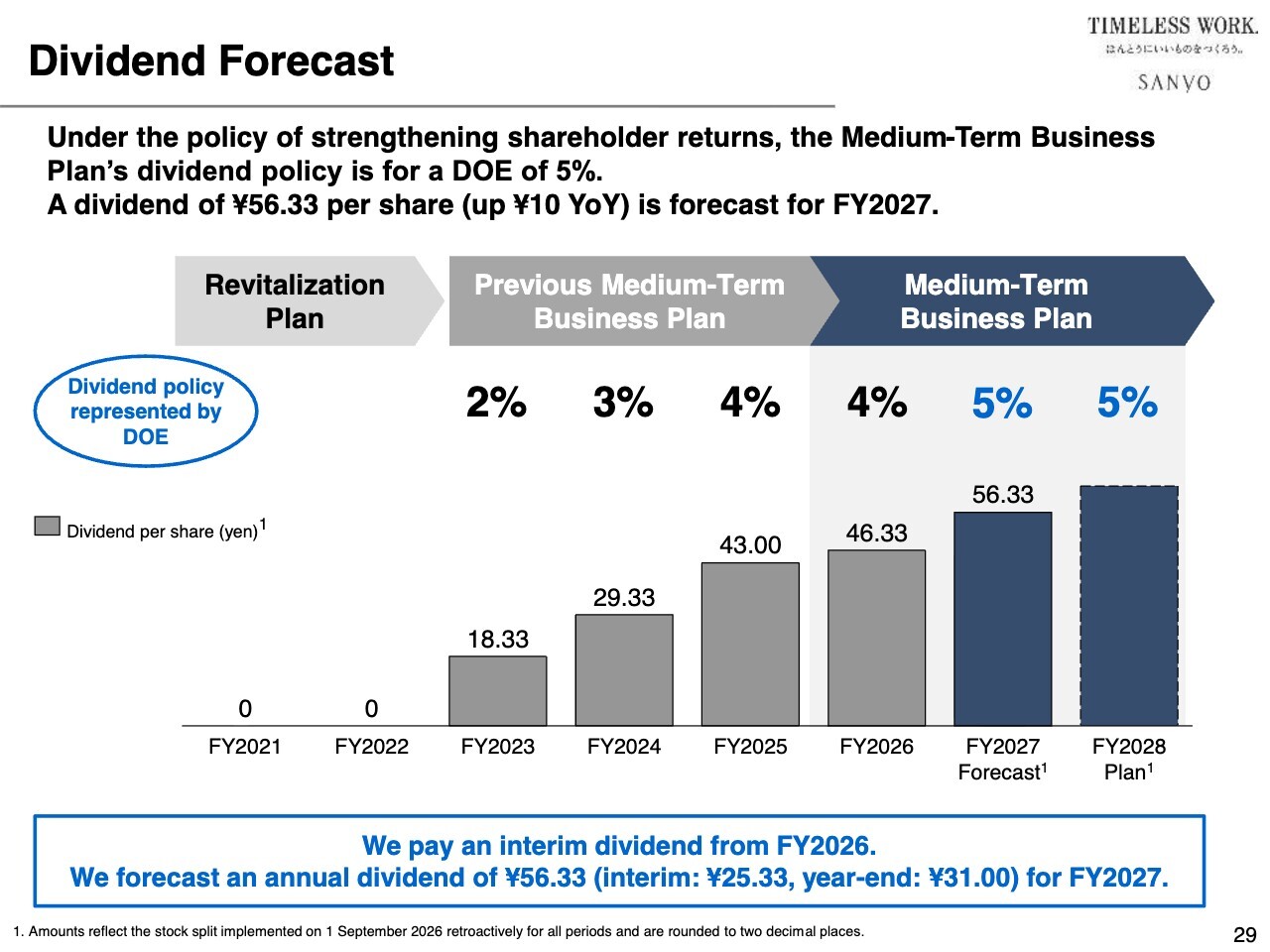
Finally, let me explain our dividend forecast. Our dividend policy is based on DOE, so the plan is very straightforward. However, share buybacks conducted as a shareholder return measure reduced shareholders’ equity, the basis for DOE, and consequently reduced the total dividend amount.
At the same time, share buybacks improve ROE and earnings per share, or EPS, so we believe they will contribute to a higher share price over the medium term.
As shareholders’ equity is expected to decrease at the end of February 2027, we released a “Notice Concerning Revision of Dividend Forecasts” today. I would appreciate it if you could take a look.
Q&A: Building a Business Model Less Dependent on Weather
Participant: Looking at the results from June through August, I was reminded of the importance of developing a business model and products that are not affected by the weather. What measures do you plan to take in these areas?
Hirabayashi: I had similar thoughts about a business model unaffected by the weather before joining SANYO SHOKAI. Since joining, however, I have come to feel that achieving complete independence from the weather is very difficult. Some impact is unavoidable, particularly on a monthly basis. Over a full year, though, I believe the effects tend to be mitigated to some extent.
The impact can be visible on a monthly basis and sometimes even over a quarter. We therefore believe it is appropriate to assess our financial results over the full year.
Mr. Shinji Oe (“Oe”): Let me add a few comments on how we are responding to unstable weather conditions.
Traditionally, seasonal merchandising was broadly divided into spring, summer, autumn, and winter products. As you may know, two fiscal years ago we began dividing the year into five seasons and shortening our merchandising cycles to respond more effectively.
Let me explain the effects of this approach using the current spring/summer selling period as an example.
As President Hirabayashi explained earlier, our net sales were weak for H1 as a whole. However, full-price sales have significantly exceeded the previous year’s levels from July onward. Specifically, they reached 107% of the previous year’s level in July, 109% in August, and 116% in September, showing marked growth.
Previously, we secured sales through spring/summer markdown sales from the start of clearance sales in July through the end of August. We believe the growth in full-price sales reflects the introduction of a new merchandising approach tailored to actual demand during the midsummer months of July and August.
Q&A: Japan Luxury Strategy
Participant: I would like to ask about Japan Luxury. Beyond strengthening promotion by communicating the stories behind the products, what specific steps do you plan to take to increase touchpoints with newly affluent and inbound customers? Please share anything you can tell us at this stage.
Hirabayashi: For Japan Luxury, we are working to reach newly affluent and inbound customers.
Inbound sales currently account for just over 5% of our total sales, amounting to around JPY1.4 billion to JPY1.5 billion in H1. Going forward, we are considering more visible promotion in high-visibility locations for visitors to Japan.
We also believe our retail locations are very important. For example, Yaesu and Shinjuku have bus terminals, and many inbound customers visit the surrounding areas. We believe we need to secure locations like these when opening stores.
As you know, online media such as social media are now the main sources of information for inbound and newly affluent customers. It is therefore important to promote our products effectively through steady efforts, including greater online exposure and performance-based advertising.
For Japan Luxury sales channels, we consider collaboration with department stores' private client services a very important initiative. We are also considering approaches that include industrial tourism. We intend to focus on this as we develop various initiatives going forward.
Q&A: H2 Priority Measures and Progress Toward Net Sales of ¥34.0 Billion
Participant: You are implementing various measures to achieve the challenging H2 net sales plan of ¥34.0 billion. What will be your particular priorities in achieving this target?
Hirabayashi: As I have said, I believe it comes down to selling our full-price products as planned. The fundamental prerequisite is that the products themselves have strong appeal.
Companies naturally tend to follow the previous year’s successes to some extent. However, rather than being tied to the past, our brand directors will refine the distinctive character each brand originally had. This will enable them to develop products appropriate to each brand’s positioning and create offerings that clearly appeal to customers.
Of course, that alone may not always be enough, so we are also focusing on marketing and promotion. This has not traditionally been a particular strength of ours, but we will make full use of performance-based advertising to strengthen our promotional efforts.
Oe: The H2 net sales plan of JPY34.0 billion represents 108% of the previous year’s level. As the president explained earlier, sales in September were at 111% of the previous year’s level. H2 has therefore started with sales growth running ahead of plan.
This is my seventh fiscal year here. Over the past two years or so, the intense heat continued through September, and autumn sales were disappointing. This year, however, lower temperatures in September have allowed us to have a full autumn selling season for the first time in a while.
Sales are being driven by autumn items such as medium-weight outerwear, rather than mainly cold-weather clothing. Products that should sell at this time of year are selling well.
The situation is therefore quite different from the past two years. We still have stocks of cold-weather clothing in reserve, and for the first time in a while, we are well prepared for the winter selling period in October and November. We believe we can achieve our sales target by maintaining the current trend.
In Q2, we thoroughly strengthened full-price sales and curbed markdown sales, which clearly improved KPIs. We therefore believe both the recovery in the top line and the improvement in KPIs will contribute to our performance in H2.
Taking these factors into account, we believe we have a good chance of achieving our H2 sales plan of 108% of the previous year’s level, although it is challenging.