Agenda
Toshiaki Ujiie (hereinafter "Ujiie"): Good morning, everyone. I am Toshiaki Ujiie, President and CEO of Tadano Ltd. Thank you very much for taking the time to join us here today despite the hot weather.
I would also like to thank those of you joining us online for taking time out of your busy schedules. We will now begin our FY2026 1st Half (Jan–Jun) Financial Explanatory Briefing.
Today, I will walk you through our FY2026 1st half results and FY2026 forecast, as well as progress on the Mid-Term Management Plan (24–26).
FY2026 1st Half Results and FY2026 Forecast
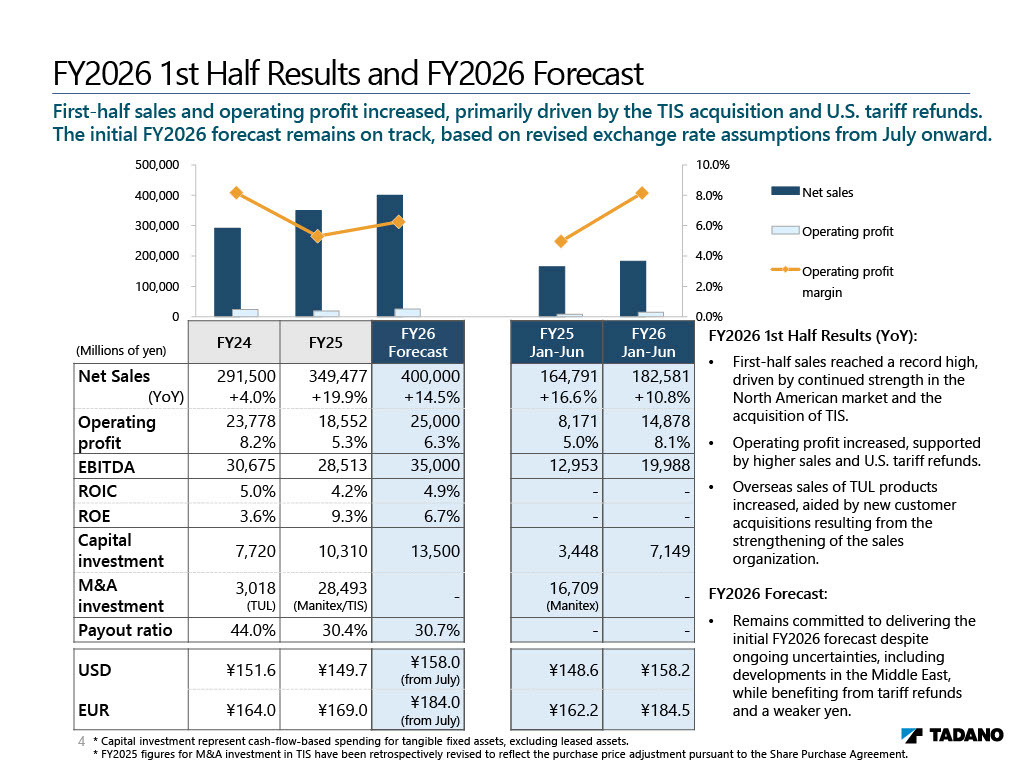
First, I will discuss our 1st half results. As shown on the slide, sales and operating profit increased in the 1st half, primarily driven by the acquisition of Tadano Infrastructure Solutions Ltd. (TIS; formerly IHI Transport Machinery Co., Ltd.) and U.S. tariff refunds.
Because we acquired TIS on July 1 of last year, its results are included in our first-half consolidated results for the first time. As for our full-year FY2026 forecast, we have decided to leave our initial forecast unchanged.
Let me go over three specific points regarding our FY2026 1st half results. The two bar graphs on the right side of the slide show FY2026 and FY2025 1st half results. The first point, as those graphs show, is that 1st-half sales reached a record high, driven by continued strength in the North American market and the acquisition of TIS.
The second point is that operating profit increased, supported by higher sales and U.S. tariff refunds.
I would like to explain the tariff refunds in a little more detail. When we receive a refund, part is returned to customers to reimburse the amounts they had borne through our price adjustments, while the remainder is recognized in our earnings. The split is roughly even. The portion returned to customers is recorded as a reduction in net sales, while the portion recognized in our earnings is included in operating profit.
The third point is that strengthening our sales organization has enabled us to acquire new customers, and overseas sales of Self-Propelled Aerial Work Platforms manufactured by TUL (Tadano Utilities Ltd., formerly Nagano Industry Co., Ltd.) in Nagano Prefecture are growing steadily.
Turning to the full-year FY2026 forecast, although we are benefiting from tariff refunds and a weaker yen, the outlook remains uncertain due to factors including developments in the Middle East. We have therefore left our initial forecast unchanged and remain committed to achieving it.
FY2026 Business Environment Outlook
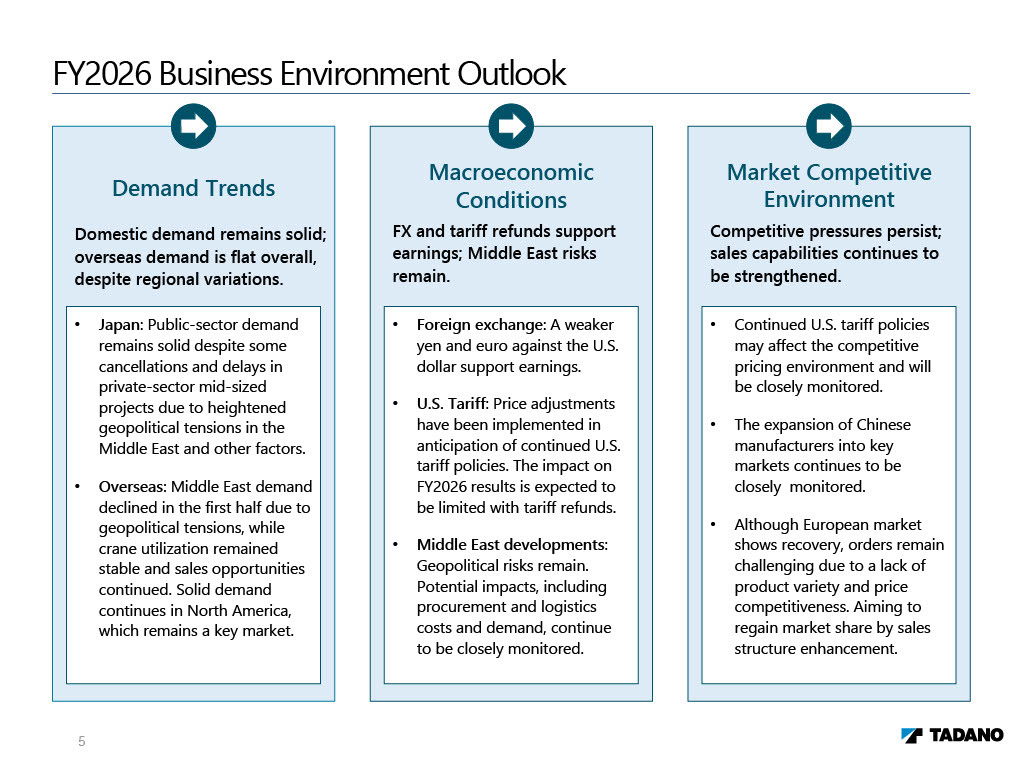
Next, I will discuss our outlook for the business environment. I will start with demand trends, shown on the left side of the slide. In Japan, we are seeing slight delays in private-sector mid-sized projects due to factors such as developments in the Middle East, while public-sector construction is progressing steadily.
Overseas, the situation in the Middle East remains unclear, and we have no firm view of the outlook. Demand in the Middle East declined in the 1st half, and in some cases shipping has been difficult.
However, sales inquiries are continuing and cranes are still being used as intensively as ever in that region. We therefore believe that demand will recover once transport routes can be secured.
As for the volume that could not be shipped in the 1st half, shipments via other routes began in the 2nd half. On this basis, we do not see any major problems in the Middle East market. Demand in North America, meanwhile, has remained solid.
Turning to the macro environment. On foreign exchange, the euro was weak and the dollar strong when these materials were prepared, but the dollar has recently been softening. This is not a particularly favorable development for us. However, given that products made in Japan account for the largest share of our sales, a weaker yen and stronger dollar can be described as a tailwind.
On U.S. tariffs, the outlook remains uncertain, but we expect tariff refunds to provide a tailwind at least in the current fiscal year.
The outlook for the situation in the Middle East and geopolitical risks remains uncertain. With many of our customers in the oil and gas industry in North America and the Middle East, however, the current rise in oil prices is actually having a slightly positive effect rather than a negative one.
Finally, I will discuss the competitive environment. The United States relies heavily on imports for Mobile Cranes. Accordingly, we believe the competitive environment will not change significantly unless Japan or Germany alone is subjected to unfair tariff measures.
If tariffs become excessive, however, we would expect crane rental companies and other buyers to hold back on purchases, which could soften demand. That could have a negative impact on us, but we see no particular problems at this point.
We are also very concerned about moves by Chinese manufacturers to enter our key markets—that is, the developed markets of the West. We will continue to monitor this closely.
Demand in Europe is recovering, but it will take time to close the gaps in our product lineup, and this is making sales difficult. We aim to regain market share by strengthening our sales organization.
Middle East Developments & U.S. Tariff Impact
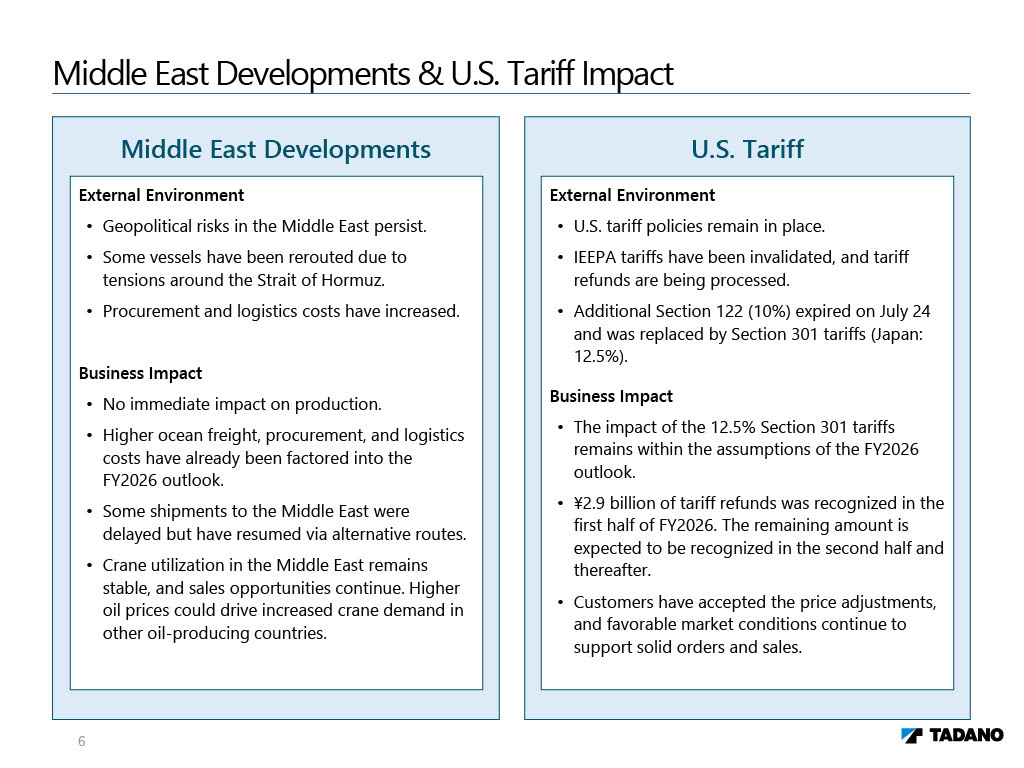
First, regarding the external environment, geopolitical risks in the Middle East persist. Tensions around the Strait of Hormuz have caused some vessels to switch to alternative routes, resulting in higher procurement and logistics costs.
Turning to the business impact, we see no immediate impact on our production at this point. Higher ocean freight and procurement and logistics costs have already been factored into the FY2026 outlook.
As I mentioned earlier, some shipments to the Middle East were delayed, but have resumed via alternative routes.
Crane utilization in the Middle East also remains stable. Higher oil prices are currently driving increased crane demand in other oil-producing countries, including the United States.
Next, I will discuss the external environment surrounding U.S. tariffs. Refunds are continuing. In addition, following the invalidation of the International Emergency Economic Powers Act (IEEPA), refunds are being processed. We expect them to be paid in two portions, one in the 1st half and the other in the 2nd half.
Furthermore, the 10% additional tariff under Section 122 expired on July 24 and has been replaced by additional tariffs under Section 301. Under Section 301, the additional tariff rate applicable to Japan is 12.5%.
The current Section 301 tariffs are framed as sanctions imposed on grounds such as forced labor, but it is hardly conceivable that forced labor exists in Japan. On this point, the Japanese government has not voiced any strong objection.
For our part, we have concluded that the impact will be limited because Japan is subject to the same conditions as other countries. On that basis, we have reached agreements with customers to share the tariff costs equally, with the understanding that we will return the relevant amounts when the tariffs are refunded. We therefore do not intend to raise strong objections ourselves.
As for the impact on our performance, the 12.5% additional tariff under Section 301 has already been factored into our assumptions. I would add that we recorded ¥2.9 billion in tariff refunds in the 1st half of FY2026.
Moreover, customers have accepted the price adjustment and favorable market conditions continue to support solid orders and sales. We therefore believe there is no cause for concern, at least for the current fiscal year.
Demand Trends for Mobile Cranes (RT, AT, TC)
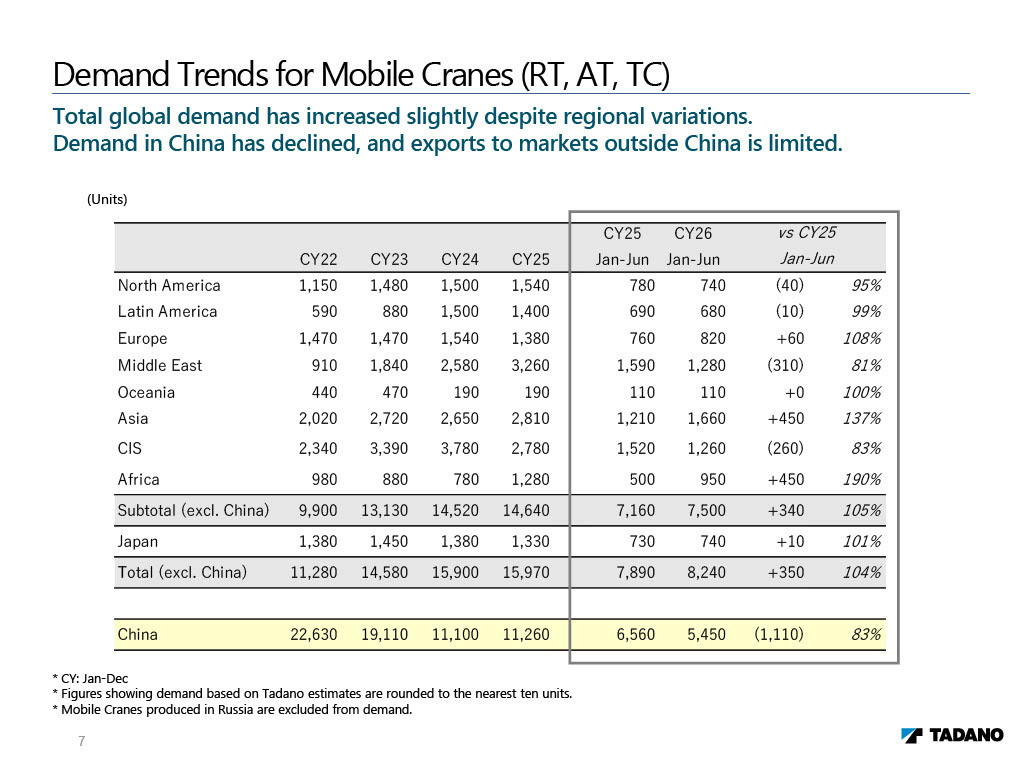
This slide shows demand trends for Mobile Cranes. The top row of the table shows calendar year 2022 through 2025, along with figures comparing the 1st half of 2026 with the 1st half of 2025.
As you can see, North America has held steady at around 1,500 units. Comparing the 1st half of this year with last year, last year was slightly higher, but the trend has been broadly stable.
I would add that in the United States, we are seeing a marked shift toward larger models, in addition to the change in unit volumes. We therefore do not expect sales to decline.
In Latin America, as in other regions, we saw substantial growth from 2022 through 2024. This kind of sharp increase typically occurs when Chinese manufacturers aggressively expand sales in particular countries.
Europe has been stable, running at around 1,500 units. The figure for 2025 was about 1,400 units, and this period is already up by just under 10%. We therefore expect this year to come in above last year, at a level of around 1,500 units.
The Middle East likewise saw a significant increase from 2022 through 2024. Sales by Chinese manufacturers contributed to this increase.
On the other hand, demand is down this period. One factor, we suspect, may be that Chinese companies face the same situation we do: having to change their shipping routes. Even so, we believe the Middle East as a whole can be regarded as solid.
In Oceania, demand fell sharply from 2023 to 2024. For those two years, the number of machines exported by Chinese companies could not be verified through our distributors, so we do not have accurate figures.
In any case, our impression is that Oceania was sluggish from 2024 into 2025. We still do not see much of a recovery in the actual numbers, but we do have a sense that the Oceania market is coming back somewhat.
Turning to Asia, we see a sharp jump from 2022 to 2023. This resulted from Chinese companies releasing large volumes of machines from inventory, and we see a similar jump in the 1st half of this year. We believe another contributing factor is that machines that can no longer be shipped to the Middle East are being diverted to Asia.
Next, the CIS. There is still considerable debate over which countries should be defined as the CIS, but the region showed temporary growth from 2022 to 2023.
Frankly, in the 2010s the figure did not even reach 1,000 units. The reason, we understand, is that Russia has its own domestically produced cranes, which meant that imports were limited.
Once the war in Ukraine began, however, domestic crane production appears to have stopped in Russia. As a result, large volumes of cranes from China have been flowing in.
That said, even Chinese-made cranes have a service life of 10 to 20 years, which led to a decrease in demand from 2024 into 2025. Our cranes can remain in service for 30 years. As durable machines like these become widespread, the market eventually reaches saturation.
Demand consequently fell from 2024 into 2025, and it is down significantly again in the 1st half of 2026. This, we believe, is the current state of the CIS, centered on Russia.
In Africa, by contrast, demand surged from 2024 into 2025 and is up sharply year on year. Our view is that Chinese companies are deploying substantial numbers of machines in connection with Chinese investment projects there.
Demand in Japan has held steady at around 1,400 units, with the current period tracking broadly in line with the same period last year.
To sum up, the world excluding China is currently a market of roughly 16,000 units. These trends are likely driven by an increase in machinery exports from China to Russia and growing demand for Chinese-made machinery in Asia and elsewhere.
Turning to demand in China, the figure was 50,000 units before 2022, then fell to 20,000 units and now stands at around 11,000 units. The downward trend appears to be continuing. However, some Chinese statistics indicate that demand is higher this year than last year, so the precise picture remains unclear. In any case, domestic demand in China has fallen from the earlier 50,000 units to around 11,000. Over the long term, a recovery to somewhere in the range of 20,000 to 25,000 units is possible, but a return to 50,000 units would, in our view, be difficult.
The reason is this: when cranes are introduced rapidly into a country that previously had none, and those machines are then used for 20 to 30 years, a market that has grown on new demand can be expected to shift to replacement demand.
Accordingly, once China moves to a market centered on replacement demand, as in Europe, North America, and Japan, we do not expect demand to stage any dramatic recovery.
For a typical Western manufacturer, meanwhile, a market contraction from 50,000 units to around 10,000 units would ordinarily make it difficult to remain in business.
Even if the surplus of 40,000 units were directed to other regions, demand in the rest of the world amounts to no more than about 15,000 units. That leaves a surplus of 40,000 units.
This raises questions about where the 40,000 surplus units go and how these companies remain viable. We cannot tell whether their land costs are considerably lower than ours or whether depreciation charges on their capital investment are negligible.
There are only three major Chinese manufacturers. One is state-owned, and the other two are listed companies. Those two companies could rapidly redirect capital into AI and robotics, leaving considerable uncertainty.
For now, our policy is to watch and wait, while monitoring how Chinese products may expand into Europe, the Americas, and other regions going forward. As of today, we see no cases of Chinese-made cranes entering European or North American markets on a large scale.
Demand Trends for Mobile Cranes (RT, AT)
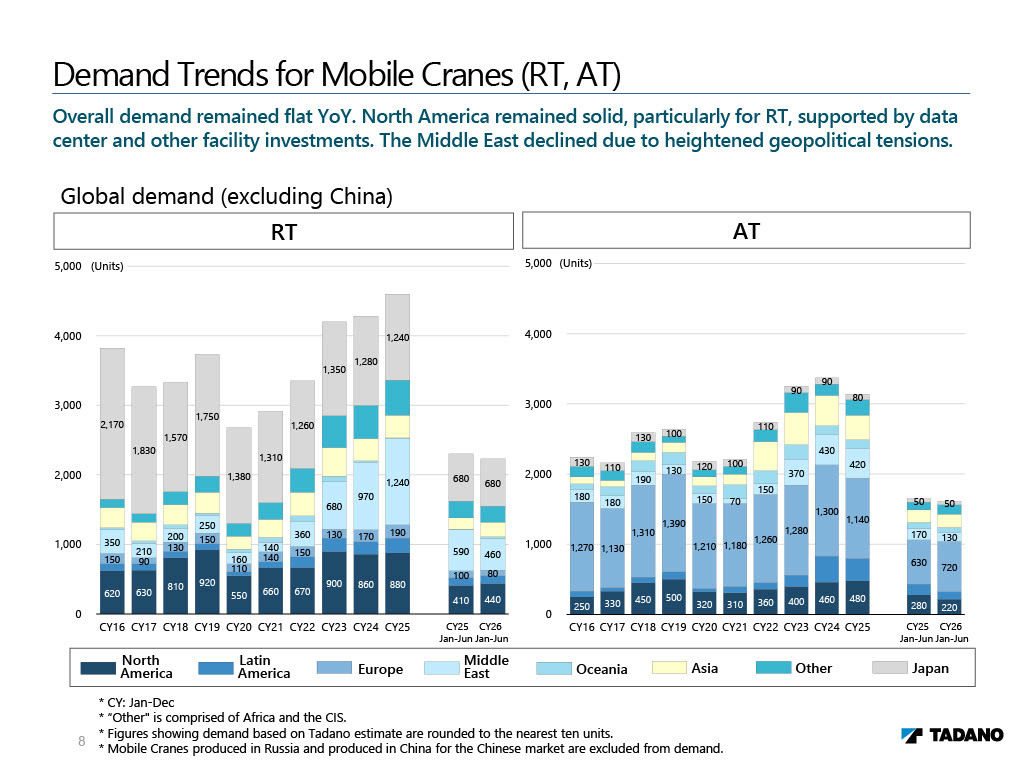
This slide shows demand trends for Mobile Cranes by model. For rough terrain cranes (“RT”), you can see that 2025 was at a very high level.
As you can see from the graphs for 2025 and the 1st half of 2026, the figures for the current period are slightly lower than those for the same period last year, but they remain high.
All Terrain Crane demand has likewise remained at a very high level since 2023. Although the figure appears to be slightly lower than in the same period last year, we believe this high level can be maintained.
For the regional breakdown, please refer to the graphs. Europe is an AT market, while North America is a market for both RT and AT.
Order Backlog Trends for Mobile Cranes (RT, AT)
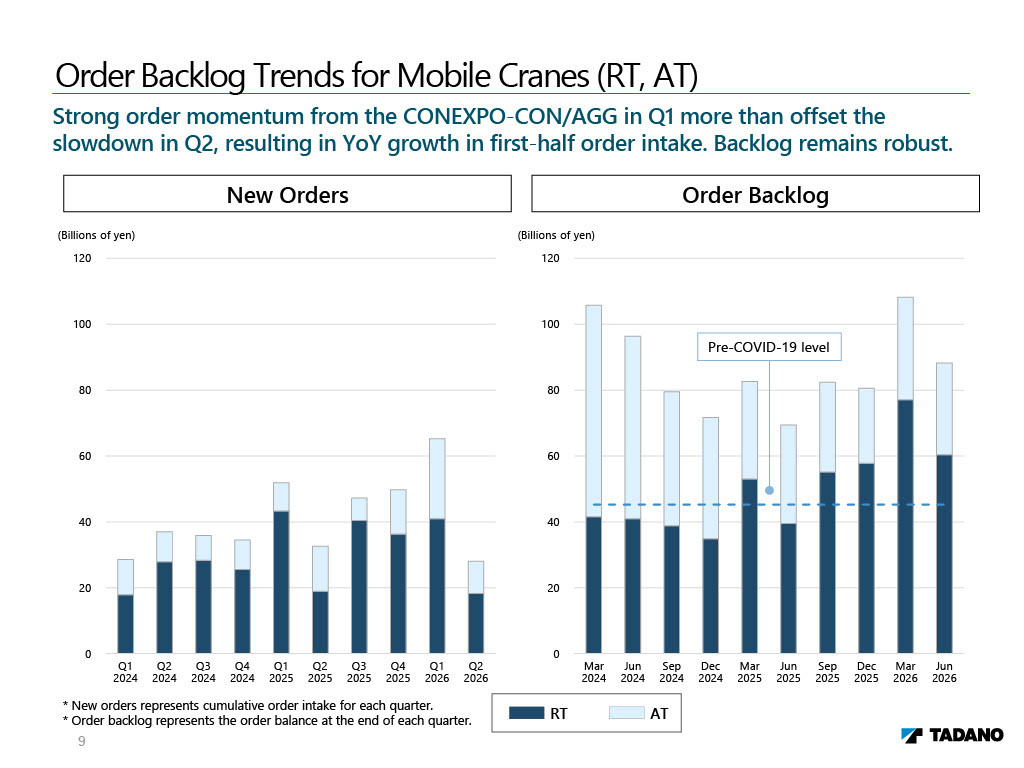
This slide shows our order backlog trends. The chart on the right shows the order backlog, and the one on the left shows new orders.
The second bar from the right on the left-hand chart is Q1 of FY2026, and you can see that it grew substantially. This reflects CONEXPO, a trade show held in North America. CONEXPO tends to generate a relatively large volume of orders, and we regard it as a show that gives us considerable opportunity to win business.
Orders rose sharply in Q1, so Q2 came down, but this is not a concern at all.
On the other hand, when you look at the order backlog, the dashed line indicates the level prior to the COVID-19 pandemic. Compared to this, the current backlog is at a very high level.
The leftmost bar on the backlog chart remained elevated because production constraints in Europe prevented us from supplying products. Those constraints have now been resolved, while our order backlog remains at a very high level.
That concludes my explanation of FY2026 1st half.
Global Promotion of Aerial Work Platforms and Truck Loader Cranes
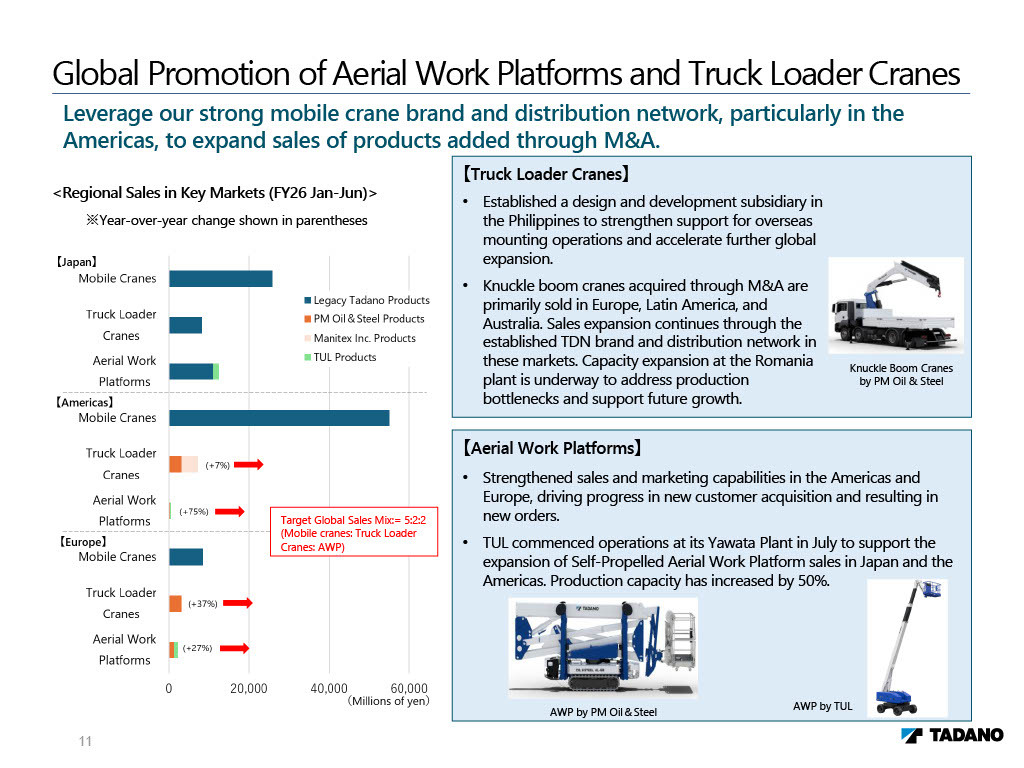
Now I will turn to progress on the Mid-Term Management Plan (24–26), which reaches its final year this year.
The graphs on the left side of the slide show Mobile Cranes and Truck Loader Cranes.
In the Japan market, our share of the Truck Loader Crane market is approximately 50%. These are primarily cargo-handling cranes mounted on trucks.
In Japan, sales of our Mobile Cranes, Truck Loader Cranes, and Aerial Work Platforms are in a ratio of 5:2:2. The graph on the left shows the 1st half of FY2026, when Mobile Crane sales were approximately ¥25.0 billion. Sales of Truck Loader Cranes and Aerial Work Platforms were each approximately ¥10.0 billion.
In the Americas, you can see that Mobile Cranes are on a far larger scale than in Japan. Sales of Truck Loader Cranes and Aerial Work Platforms, however, were minimal. The thinking behind this Mid-Term Management Plan, then, was to build up Truck Loader Cranes and Aerial Work Platforms through acquisitions, on the view that we should be able to reach the same 5:2:2 ratio.
The same applied to Europe. We believed we could achieve a sales ratio of 5:2:2 for Mobile Cranes, Truck Loader Cranes, and Aerial Work Platforms, respectively, and planned to do so through acquisitions.
In the end, the acquisition of Manitex International, Inc. gave us Truck Loader Cranes and Aerial Work Platforms in both Europe and the Americas, and that is the first step we have taken.
Development of Transport Machinery Business - TIS
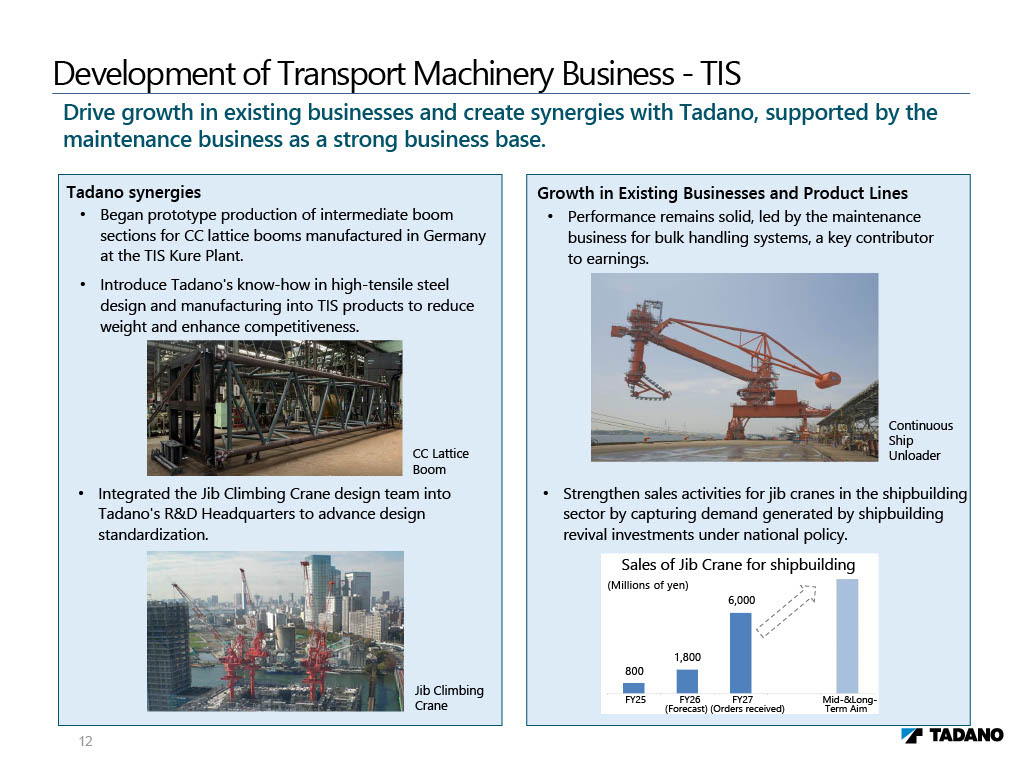
TIS is the company we formed by acquiring the business of IHI Transport Machinery Co., Ltd. (IHI Transport Machinery), a subsidiary of IHI Corporation, and subsequently renaming it Tadano Infrastructure Solutions Ltd. (TIS), its current name.
One of the main products IHI Transport Machinery manufactured is the Continuous Ship Unloader shown at the top right of the slide. This machine scoops coal out of the holds of coal carriers. After scooping up the coal, it moves the coal by conveyor and stacks it at storage yards on shore—that is what the Continuous Ship Unloader does.
Continuous Ship Unloaders remain one of TIS's main product lines, but we generally do not expect the number of new coal-fired power plants to increase in Japan or elsewhere in the world. Accordingly, one direction for the business is to focus on maintenance.
Similar systems are also used for bulk foodstuffs such as wheat and animal feed, and we expect these to stay on an upward trend.
New installations for food and feed applications are thus expected to increase, whereas for coal applications we see no prospect of growth whatsoever.
In Japan, nuclear power plants were shut down after the Great East Japan Earthquake, and coal-fired power generation was the means chosen to fill that gap. A number of small-scale coal-fired plants were built—small enough to be constructed without going through environmental assessment.
One important point here is that coal-fired power generation today has improved in terms of emissions compared with the past.
Another is that coal-fired power is expected to be kept in service for the next 20 to 30 years in order to support growing electricity demand.
Various approaches to keeping these plants running are under consideration, including biomass co-firing. What matters is not new construction but life-extension maintenance, and that will continue to be required for the next 20 to 30 years.
At the same time, when coal-fired plants were being built one after another, the number of domestic suppliers in Japan was limited. TIS was the leading company, with only about two others, and those three could not cover demand on their own, so Chinese- and Korean-made products were brought in. However, the foreign companies have withdrawn from the market.
Because we also provide maintenance services for products made by other companies, we continue to receive maintenance requests even though those overseas suppliers are no longer present.
For this reason, we do not see maintenance demand trending downward, even with no new coal-fired plants.
That said, a decline in new installation projects would inevitably mean the business gradually contracting, so we recognize that we need to take some action on how we develop it going forward. I will cover this in more detail on a later page.
Next is the Jib Climbing Crane shown at the bottom left of the slide, which we abbreviate internally as JCC. Internationally, these machines are classified as tower cranes. For example, all the cranes in use at the nearby TOKYO TORCH site are our products.
A striking example from the past is Tokyo Skytree, where our products were likewise used throughout.
Although we were the leader in this field, TIS worked almost entirely on a build-to-order basis, on the premise of building to what the customer asked for. Up to now, therefore, TIS has emphasized building products to customer requirements rather than driving costs down.
In recent years, however, rental companies became owners of these cranes, and TIS found it difficult to meet customer requirements.
Because Tadano is a manufacturer with strengths in volume production, we set out to reduce costs and improve both the products and their performance by integrating the two operations. As part of this effort, we integrated TIS's Jib Climbing Crane design team into Tadano's R&D Headquarters. The team members are currently assigned to Tadano Ltd. on secondment.
This has led us to review how the machines are built and what they cost. One area of focus is the Crawler Cranes we manufacture in Germany. Tadano manufactures Crawler Cranes with lifting capacities of 400 tons or more in Germany.
There are two other Crawler Crane manufacturers in Japan. They mainly build cranes with lifting capacities of up to 400 tons; cranes with capacities of 400 tons or more are extremely large machines.
Manufacturers of extremely large cranes with lifting capacities of 400 tons or more are located overseas, in countries such as Germany, the United States, and China.
The upper structure of a Crawler Crane, including the booms, is made using pipes formed from high-tensile steel.
Without high-tensile steel, weight increases and performance suffers as a result. With a crane, the closer to the tip, the lighter it needs to be. A heavy tip severely limits lifting performance.
In Germany, welding techniques for high-tensile steel are widely used, and the material itself is in plentiful supply.
In Japan, by contrast, efforts to reduce weight have not advanced very far. It is not that companies such as NIPPON STEEL CORPORATION are unable to produce high-tensile steel; rather, limited demand means that very little is produced. We therefore brought high-tensile steel from Germany to the TIS Kure Plant and carried out the welding there.
However, welding the high-tensile steel presents challenges—such as cracking if preheating is not applied—making it a very difficult process. We are currently working to address this issue.
If we can establish this technology in Japan, we will be able to reduce the cost of supplying the same products within Japan and shipping them to destinations such as Australia and the U.S. West Coast.
Moreover, this technology can also improve machine performance. If we can develop design and welding capabilities using high-tensile steel that our competitors lack, we believe we can secure a competitive advantage.
Technical validation at the plant is already complete, so the present challenge is how to reflect this in new models.
Japan's Crawler Crane market is effectively closed, and no manufacturer, including us, exports from Japan. Even so, Japan has many cranes with this type of configuration. Tokyo Skytree withstood the Great East Japan Earthquake without any problems, despite Japan's high seismic activity. The earthquake must have been frightening for those involved, but the structure remained sound.
Products from other countries have not necessarily demonstrated this level of performance. By transforming our design and welding processes using high-tensile steel, we aim to expand into global markets.
We regard this as one of the major benefits of acquiring TIS and integrating it with Tadano Ltd.
The other is cranes for shipbuilding. Shipbuilding is one of the 17 strategic fields the current Japanese administration has designated. We are working to raise our production capacity for shipbuilding cranes.
Opportunities in Japan’s Shipbuilding Revival
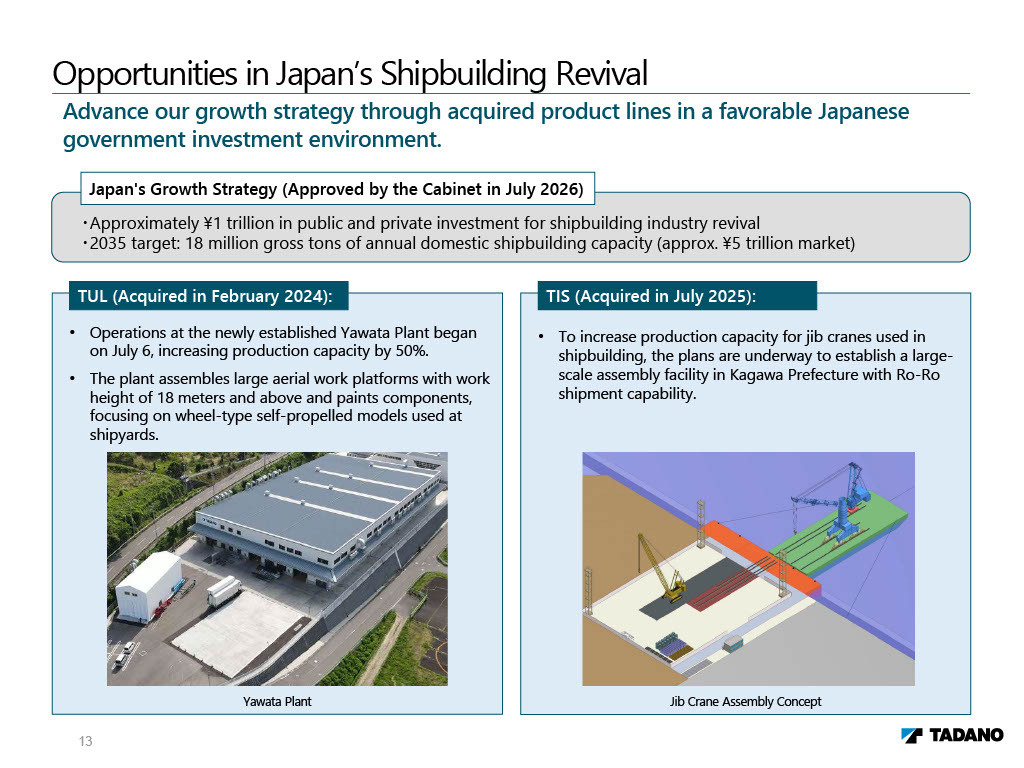
On August 25, Tadano Ltd. announced that it had purchased approximately 100,000 square meters of waterfront land in Kagawa Prefecture. The concept drawing is shown on the right side of the slide. We plan to use part of the site for semi-final assembly of dedicated Jib Cranes for shipbuilding.
The site also has approximately 200 meters of frontage along a major arterial road. We are considering building our new head office there.
Our current head office in Takamatsu City was built 65 years ago, and this will be our first relocation of the head office. We plan to build a new head office building while also preparing an assembly site for shipbuilding cranes. Many of Japan's shipbuilding companies are concentrated in the Shikoku region.
Shipbuilding cranes can reach 70 to 80 meters in height, so semi-assembly is more practical than full assembly. We plan to assemble them into two sections, below and above the slewing ring, and then transport them by barge.
There are two manufacturers of shipbuilding cranes in Japan, including us. A few other companies produce them on a small scale, but that capacity is far from sufficient to achieve the government’s plan to double shipbuilding capacity.
Until now, TIS has rented available shipyard space for production. We have now decided to build our own assembly facility at this site. We believe this represents a major step forward.
The government’s plan is to double capacity by 2035, which means cranes will be needed through 2035. We intend to make every effort to meet that demand.
Beyond 2035, however, shipbuilding cranes are typically used for 30 to 40 years, so we expect demand after that point to fall close to zero.
We had originally considered acquiring this site for the production of self-propelled cranes, so it could be converted to other uses in the future. However, we plan to install dedicated loading facilities and other infrastructure, which will require a substantial investment. If subsidies or other support are available, we would like to use them as we move forward.
On the left side of the slide is TUL in Nagano Prefecture, formerly Nagano Industry Co., Ltd. TUL already had an Aerial Work Platform plant in the area, and we acquired a nearby plant to increase production capacity to about 1.5 times the previous level. With volumes for markets outside Japan also increasing, securing sufficient production capacity was extremely important.
Progress on European Operations Revitalization (AT, CC)
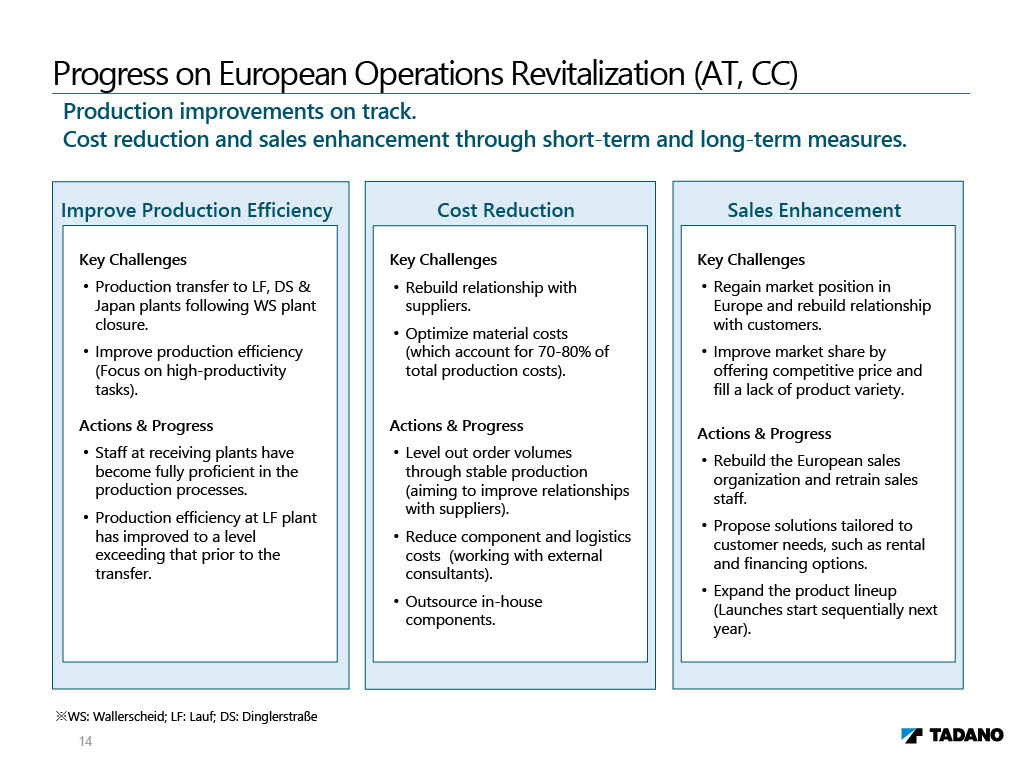
I will now discuss our European All Terrain Crane and Crawler Crane operations, which remain one of our most important challenges. The business is still struggling.
As shown on the left of the slide, we believe productivity has improved significantly.
As a further measure, employees at the plants in Japan and at the Lauf Plant in Germany must become fully proficient in the transferred production processes. Productivity at the Lauf Plant has already improved to a level above that achieved before the production transfer.
Another critical issue is reviewing what we produce in-house and what we outsource. The Dinglerstraße Plant in Germany produces a very high proportion of components in-house and operates numerous large pieces of equipment, resulting in very high maintenance costs.
Germany has many subcontractors capable of welding and fabricating components, so we believe greater outsourcing could stabilize production costs. We also need to consider the impact of volatility. From this perspective, we are working to break out of the current high-maintenance-cost structure.
Cost reduction also remains a challenge.
Strengthening sales is one of our most important initiatives. Previously, low productivity led to high costs, high prices, and late deliveries, making it difficult for the sales organization to gain traction. Now that production conditions are improving, we are optimizing personnel allocation and taking other steps to accelerate sales.
However, our product lineup remains an issue. All Terrain Cranes range in lifting capacity from about 40 tons to around 1,000 tons. Several models are especially important, and we currently lack 100-ton and 200-ton models.
Large rental companies want a single operator to be able to run many different machines. When there are gaps in the product lineup, they may decide they cannot buy from a company that does not offer a complete range. That is the situation we currently face.
Recovering will not be easy. Under our current outlook, it could take until 2030 to launch all the missing models. We are working to bring that schedule forward as much as possible.
We do not expect a complete lineup of new models to be available next year or the year after. Rather than focusing only on very large customers that will not buy unless we offer a full range, we are therefore making the extra effort to sell to small and midsize customers that need only particular capacity ranges.
North American Market: Strengthening Our Core Market
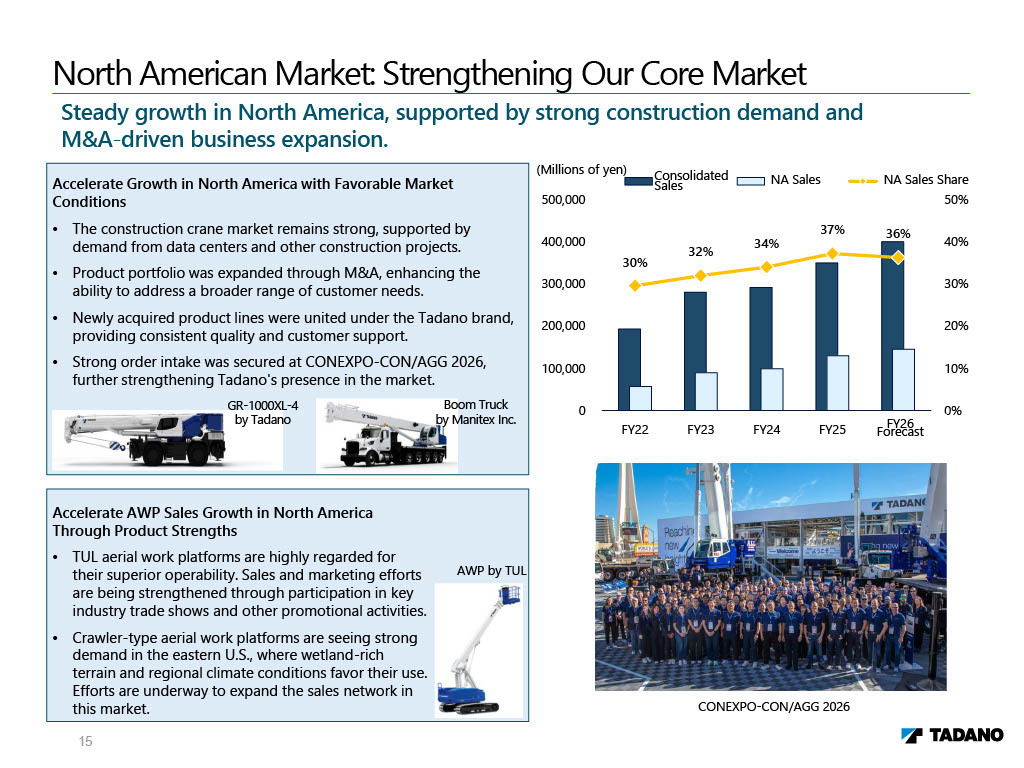
I will now discuss North America. In the upper-right chart, the light blue bars show North American sales and the dark blue bars show consolidated sales. Our FY2026 forecast targets consolidated sales of ¥400 billion, including approximately ¥110 billion in North America. At an exchange rate of around ¥160 to the U.S. dollar, US$1 billion in sales would equal approximately ¥160 billion.
Our North American team is highly motivated to build a US$1 billion business. With the addition of sales from the acquired Manitex business and other factors, we believe this is achievable. We aim to reach that goal during the period covered by the next Mid-Term Management Plan.
In Europe, Demag, which we acquired, will celebrate its 200th anniversary next year. To boost morale in our European operations, which are currently facing challenges, and raise our profile among customers, we plan to hold a major event next year.
That concludes my presentation. Thank you very much.
Q&A: Assessment of First-Half Results and Variances from Expectations
Questioner: How do you assess the first-half results? The first-half outcome, particularly the progress in operating profit, appeared very strong. You did not disclose a first-half plan, but were the results considerably better than your initial expectations?
You also discussed tariff refunds. Could you explain the main areas that were better and worse than your initial expectations?
Ujiie: First, on the positive side, it is true that the external environment helped us considerably. Foreign exchange moved in our favor, and tariff refunds were also a major factor.
Sales are below half of the full-year plan, but the portion of U.S. tariff refunds returned to customers is recorded as a reduction in sales. Taking that into account, we believe our FY2026 consolidated sales target of ¥400 billion is achievable.
However, one issue is whether shipments can proceed smoothly amid developments in the Middle East. Vessel availability and routing are changing not only in the Middle East but around the world, and one challenge is whether shipments will proceed as planned during the fiscal year.
On the negative side, one issue was Manitex, which we acquired in the United States. We identified issues in some designs developed before the acquisition that did not meet our standards.
Although there was no major accident, an issue did arise. We treated it as a serious matter and stopped sales of certain models in early April. As a result, Manitex sales declined significantly in the first half.
To address the issue, our design engineers in Japan made design changes.
During that period, we did not manufacture or sell any new units of the affected models. Once we had a clear path to resolving the issue, we resumed sales from late July into August.
We received some harsh feedback from customers. At the same time, many customers appreciated Tadano’s response and thanked us for taking these measures.
We were also able to speak with the customer we expected would be the most difficult. After we explained our response going forward, the customer told us that our decision had been the right one. We therefore expect sales to recover in the second half.
Although the decline in Manitex sales in the first half was disappointing, the issue has already been brought under control, and we believe the situation is ultimately moving in a positive direction.
I will also discuss PM in Europe, a manufacturer of Knuckle Boom Cranes, a type of Truck Loader Crane, which we acquired together with Manitex. Transactions in South America had been delayed by payment and shipping issues, but we expect these to recover in the second half. PM’s first-half results were below the prior-year level, but we expect a recovery in the second half and full-year performance roughly in line with last year.
At PM, expanding production capacity is now the most important challenge. We are investing in an indirect subsidiary in Romania that operates as a subcontracting plant, and work has begun on expanding the plant and ordering production equipment. We believe this will support PM's growth.
Next, I will discuss Europe. Production capacity in Europe is recovering, but gaps in the product lineup cannot be resolved quickly. We also need to optimize personnel allocation in the sales organization, where motivation has declined. Without these changes, it will be difficult to expand sales.
We first changed the head of the sales organization, and the new leader has significantly improved morale. As a result, orders from some of Europe’s largest customers have resumed.
We therefore expect some recovery in the 2nd half, but it is taking longer than we initially expected.
We plan to provide more details on our approach in the next Mid-Term Management Plan. At this point, I cannot provide many specifics.
Questioner: To summarize, external factors such as foreign exchange and tariff refunds contributed positively in the first half, but excluding those factors, is it fair to say that Manitex, PM, and Europe were effectively weaker than expected?
Ujiie: Yes, that is correct. I would add that we have made solid progress in improving selling prices, so it is not that we made no efforts of our own. However, it is true that foreign exchange and tariff refunds were the largest factors.
Q&A: Measures to Improve Profitability in European Operations and the Outlook for the Second Half and Next Fiscal Year
Questioner: You said that Europe’s first-half recovery was slower than expected, while productivity and proficiency improved significantly.
According to the Summary of Financial Results, the European business is still posting a loss of more than ¥1 billion. Could you discuss, to the extent possible, the outlook for the 2nd half, the measures you are taking to improve profitability toward next year, and your earnings target?
Ujiie: It is true that our European business is struggling. However, productivity has improved significantly.
For the two-axle and three-axle models whose production was transferred to Japan, the two-axle model is already on sale. The three-axle model can be sold outside Europe, but we have not yet been able to launch it in the European market, which is a key market for us.
Exporting products made in Japan to Europe requires considerable time for homologation, or regulatory certification. The original design was created in Germany, so in principle there should be no reason why it cannot be certified, but plant certification and several other factors are taking time.
Once this is resolved, we will first be able to introduce competitively priced small models made in Japan, which we believe will be a major positive.
Another issue, as I mentioned earlier, is the absence of the important 100-ton and 200-ton models from our lineup.
We have not yet decided how quickly to restore these models, including whether to restart older models or accelerate new models currently under development. Until we resolve this issue and restore a complete product lineup, it will be very difficult to compete fully with our rivals.
Also, Crawler Cranes are extremely expensive, with even relatively inexpensive models costing around ¥1 billion each. Overall sales can therefore fluctuate significantly depending on when these sales are recognized.
Compared with the first half of last year, a larger amount of Crawler Crane sales was recognized in the prior-year first half. This year, some Crawler Crane sales will be recognized in the second half, but that alone will not be enough for us to say the business will turn profitable.
For this fiscal year, we currently expect the European business to post roughly the same bottom line as last fiscal year. However, we now have a better understanding of the initiatives underway and the current situation, so we believe we can present a somewhat better outlook for next fiscal year. Please wait for the announcement of our next Mid-Term Management Plan for details.
Questioner: Understood. Is it correct to assume that earnings may improve somewhat next year, but that reaching break-even or profitability will take a little longer?
Ujiie: Yes. We do not expect a sharp V-shaped recovery after a large loss, as is sometimes seen. We will take the necessary time and proceed carefully.
Q&A: Outlook for Next Year’s Performance
Questioner: It may be a little early, but could you give us a sense of your outlook for next year’s performance?
I assume the tariff refunds received this year will not recur next year. On the other hand, North America has a substantial order backlog, and crane sales for data centers and other projects appear likely to grow. In Japan, the earlier chart also showed shipbuilding-related sales increasing considerably next year.
Europe is improving gradually, although external factors still create uncertainty. Could you comment on the outlook for next year, including both positive and negative factors?
Ujiie: First, North America has the greatest impact on our business of any market, and sales discussions remain very active.
We have observed that business activity tends to slow in the 2nd half of the year preceding a U.S. presidential election. The 2nd half of next year falls into that period, so we are concerned that the number of sales discussions could decline as the election approaches.
However, we believe sales opportunities will remain very solid through the first half of next year. We therefore do not expect a major negative impact on North American sales next year.
For TIS Jib Cranes in shipbuilding, the figure for 2027 is shown at the lower right of the slide. Sales from new installations are expected to increase from 2025 through 2027, reaching more than three times this year’s level in 2027.
However, as I mentioned earlier, assembly at our own plant will not begin until 2029.
For 2027 and 2028, we are therefore assuming that we will find a way to manufacture the cranes at another location. Even on that basis, the outlook is as shown. The 2027 figure represents orders already received, as indicated on the slide, so that amount is highly certain.
In addition, if we receive new orders, TIS recognizes sales based on the percentage-of-completion method, so we expect further upside. We see substantial room for TIS to grow.
That relates to the crane business, but shipbuilding also requires Aerial Work Platforms. Self-Propelled Aerial Work Platforms are very important for shipyards, and we are currently developing new systems and others . We also plan to introduce new products next year.
In this way, we intend to steadily capture demand from the shipbuilding sector. We clearly see this as an area with strong potential.
Q&A: Competition with Liebherr and Market Share Strategy
Questioner: How do you compete with Liebherr in Europe, and what is the situation in terms of market share and price competition? Is Liebherr having any impact in North America? If it is more useful to separate RT and AT, could you explain the competitive situation for each?
Ujiie: Liebherr is a diversified construction equipment manufacturer with a particularly strong crane business.
Our current market share in Europe is about 5% to 6%. When we acquired Demag in 2019, the combined share was around 20%, but it has declined since then.
Our share has fallen to around 6% for various reasons, but I believe we can recover to at least 25%. As I mentioned earlier, one factor behind the decline has been the strategic choice of where to compete within the product range.
Under the plan we developed around 2019, we focused on the high-volume small-crane segment and expanded the model lineup. That approach was not necessarily wrong, but manufacturing in Germany inevitably results in higher prices.
We are therefore shifting production to Japan. This allows us to reduce production costs substantially and shorten lead times. By leveraging production in Japan, which is difficult for competitors to replicate, we aim to regain ground.
On the other hand, the main purpose of acquiring Demag was to obtain machines with lifting capacities above 450 tons.
Demag had 500-ton, 700-ton, and 1,000-ton models above the 450-ton class. However, due to factors such as the discontinuation of diesel engines, the 700-ton and 1,000-ton models have already been discontinued, while the 500-ton model remains in production.
We will fill the gaps at 100 tons and 200 tons. For smaller models, we reconsidered the policy adopted around 2019 of concentrating production in Germany and transferred production to Japan. This is a major turning point.
The 40-ton model is now being produced in Japan, and we expect to launch the 60-ton model sometime next year. By rationalizing and integrating the lineup in this way, we believe we can restore our competitiveness in Europe.
For Rough Terrain Cranes in the Americas, our market share is around 50%. One important point is to carefully consider the impact of tariffs and other factors.
By continuing to introduce new models, we aim to remain the market leader in Rough Terrain Cranes in both North America and Japan.
For All Terrain Cranes in North America, unlike in Europe, we maintain a market share of around 25% to 30%.
There are several competitors in North America, but our position is considerably stronger than in Europe. One reason is that when our costs were high, we increased allocations to the higher-margin North American market. Costs remain high today, but those efforts have contributed to our current results.
Improving our market share in Europe is also extremely important. We are confident that we can achieve a market share of around 25%.