Financial Results for the First Quarter of Fiscal Year Ending March 31, 2027 (FY2026 1Q)
Shinji Inoue (hereinafter, Inoue): I am Member of the Board and Managing Director. Before I begin the financial results presentation, I would like to take a moment to say a few words.
On July 14, an accident occurred during testing for a new product under development at our Himeji Plant. We sincerely apologize for causing concern to all stakeholders.
We are currently conducting a detailed investigation into the cause of the accident and measures to prevent a recurrence, under the guidance of the relevant authorities. The cause has not yet been identified, but we will take the necessary measures with safety as our highest priority.
We would also like to clarify that the product under development involved in this incident is separate from automotive safety devices. We will thoroughly investigate the cause and reliably implement the necessary measures as part of our efforts to further strengthen our safety culture.
Our Main Messages for Today
There are two main points I would like to share with you today.
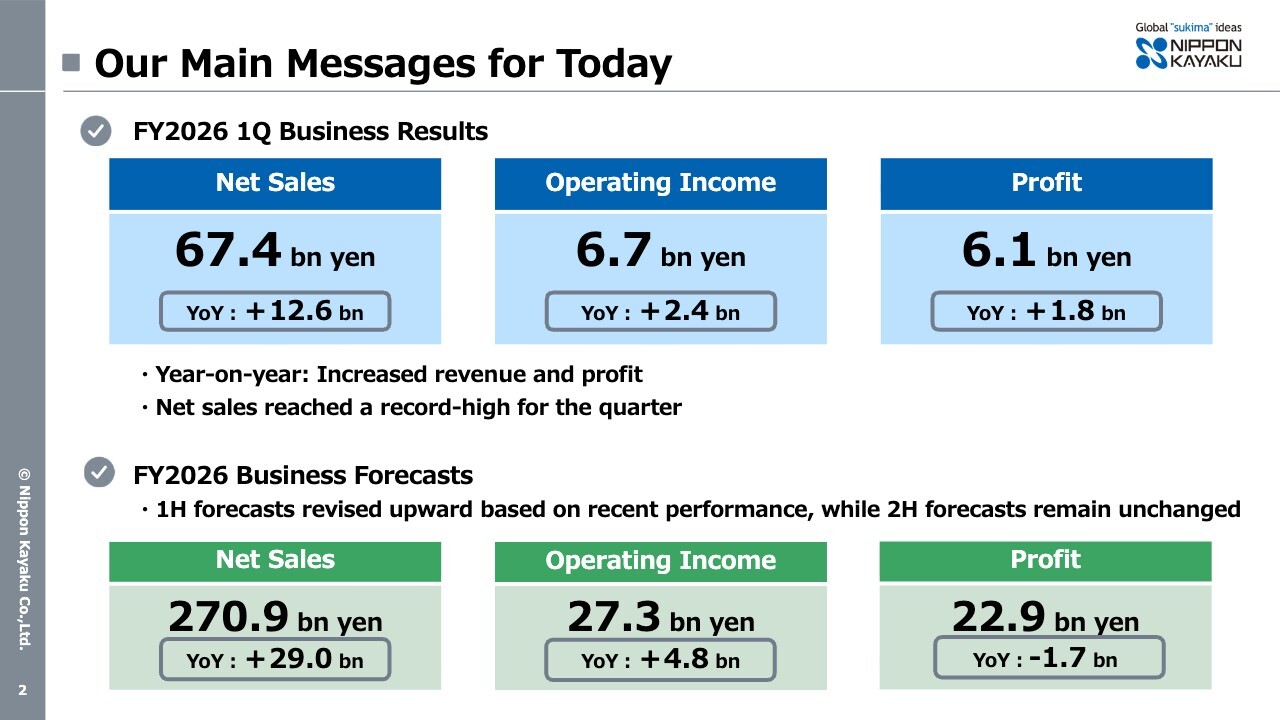
The first is our FY2026 first-quarter business results. Net sales were 67.4 billion yen, up 12.6 billion yen year on year; operating income was 6.7 billion yen, up 2.4 billion yen; and quarterly profit attributable to owners of parent was 6.1 billion yen, up 1.8 billion yen. Net sales reached a record high on a quarterly basis.
The second is that, based on first-quarter performance, we have revised our first-half forecasts upward. At the same time, considering uncertainty in the external environment, we are keeping our second-half forecasts unchanged at this point. This does not reflect any change in business momentum. Recent conditions in each business unit have generally remained solid, and at present we do not expect any major changes in the business environment in the second half.
However, because we need to assess the impact of external factors beyond our control, including foreign exchange rates and geopolitical factors, we decided to keep our second-half forecasts unchanged at this time.
On that basis, we revised our full-year business forecasts upward. Net sales are forecast at 270.9 billion yen, up 29.0 billion yen year on year. Operating income is forecast at 27.3 billion yen, up 4.8 billion yen year on year. Profit attributable to owners of parent is forecast to decrease by 1.7 billion yen year on year, but we have revised the forecast upward by 0.6 billion yen to 22.9 billion yen.
FY2026 1Q Business Results
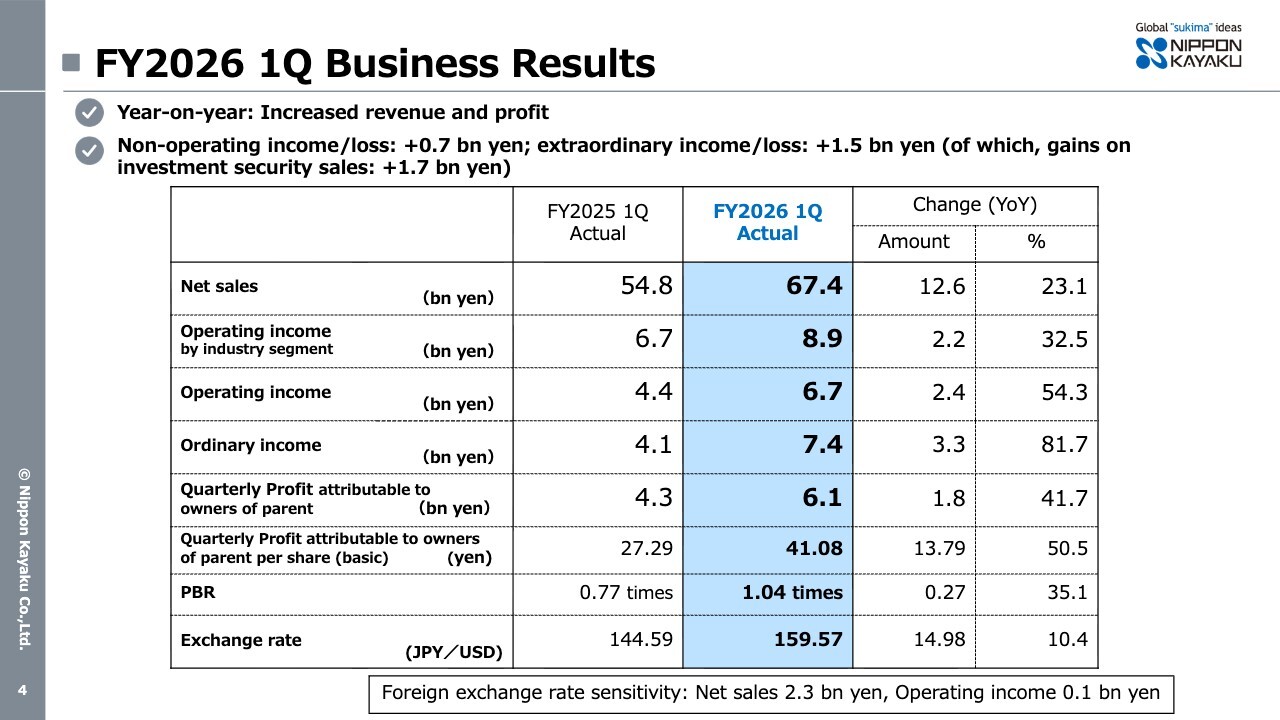
I will now explain the details. The FY2026 first-quarter figures are as I just described, but I would like to provide some supplementary information.
Quarterly profit attributable to owners of parent per share was 41.08 yen. PBR was 0.77 times a year earlier and 1.04 times in the first quarter.
The exchange rate was 159.57 yen to the U.S. dollar in the first quarter, compared with 144.59 yen a year earlier. The weaker yen had the effect of boosting first-quarter net sales by 3.3 billion yen and profit by 0.13 billion yen.
FY2026 1Q Business Results by Segments
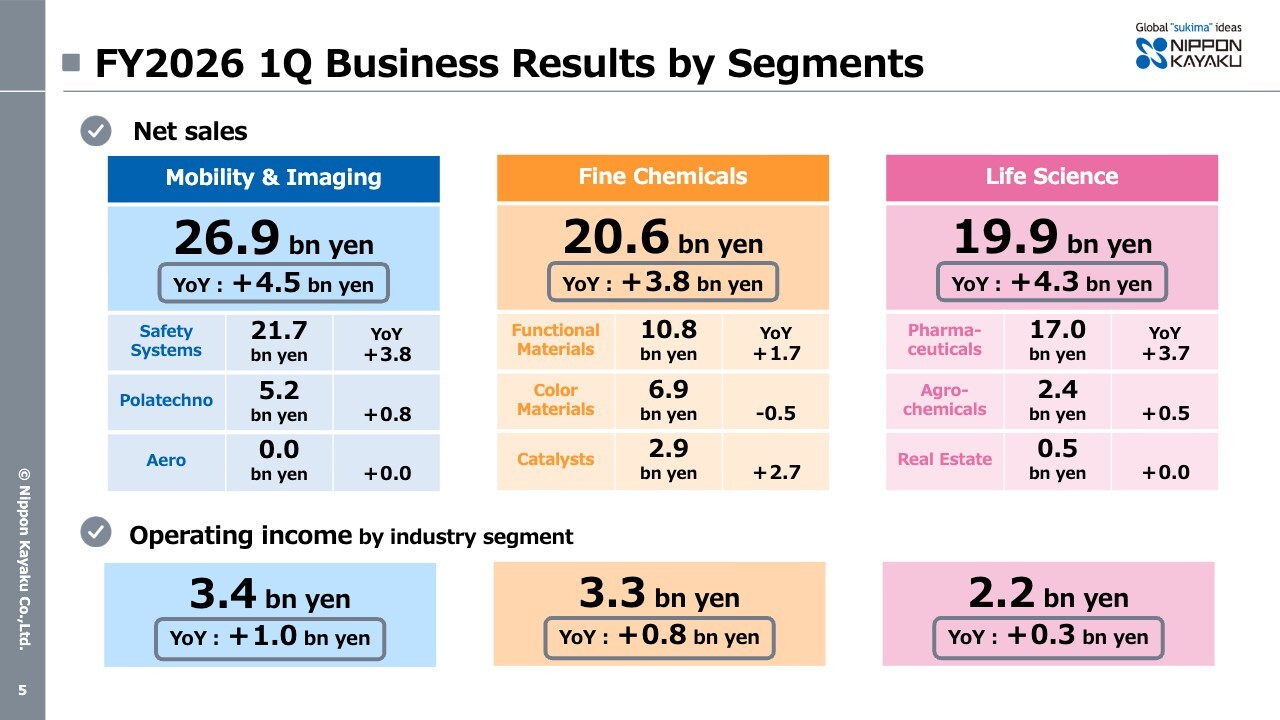
Looking at results by segment, net sales in the Mobility & Imaging Business Unit were 26.9 billion yen in the first quarter, up 4.5 billion yen year on year. Within this, Safety Systems increased by 3.8 billion yen to 21.7 billion yen, while Polatechno increased by 0.8 billion yen to 5.2 billion yen.
Net sales in the Fine Chemicals Business Unit increased by 3.8 billion yen year on year to 20.6 billion yen. Within this, Functional Materials increased by 1.7 billion yen to 10.8 billion yen, Color Materials decreased by 0.5 billion yen to 6.9 billion yen, and Catalysts increased by 2.7 billion yen to 2.9 billion yen.
Net sales in the Life Science Business Unit increased by 4.3 billion yen year on year to 19.9 billion yen. Within this, Pharmaceuticals increased by 3.7 billion yen to 17.0 billion yen, while Agrochemicals increased by 0.5 billion yen to 2.4 billion yen.
As a result of factors including higher net sales, operating income by industry segment also increased year on year in each business unit. Mobility & Imaging increased by 1.0 billion yen to 3.4 billion yen, Fine Chemicals increased by 0.8 billion yen to 3.3 billion yen, and Life Science increased by 0.3 billion yen to 2.2 billion yen.
FY2026 1Q Business Results by Sub-segments
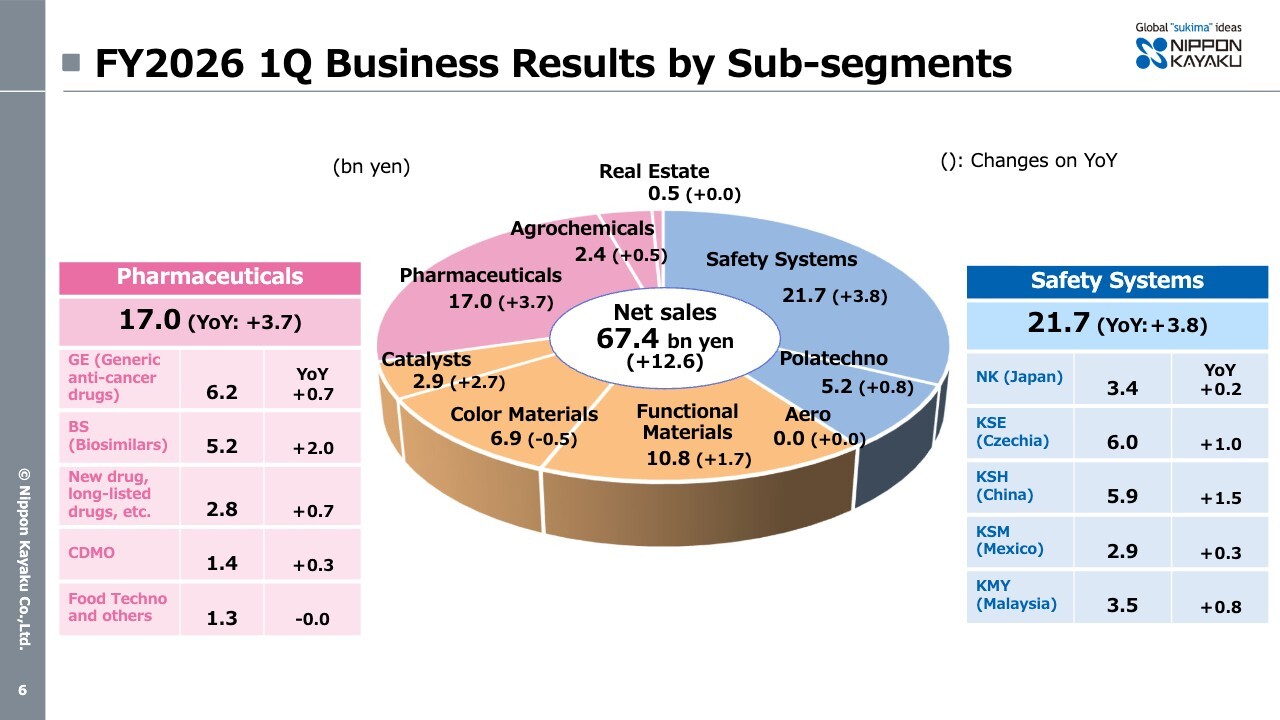
I will now explain the results by sub-segment.
Within Pharmaceuticals, BS (Biosimilars) increased by 2.0 billion yen year on year to 5.2 billion yen, while New drug, long-listed drugs, etc. increased by 0.7 billion yen to 2.8 billion yen, reflecting contributions from new drugs.
Safety Systems also recorded higher net sales at all sites. Among the sites with particularly large increases, KSE (Czechia) increased by 1.0 billion yen to 6.0 billion yen, KSH (China) increased by 1.5 billion yen to 5.9 billion yen, and KMY (Malaysia) increased by 0.8 billion yen to 3.5 billion yen.
FY2026 Business Forecasts
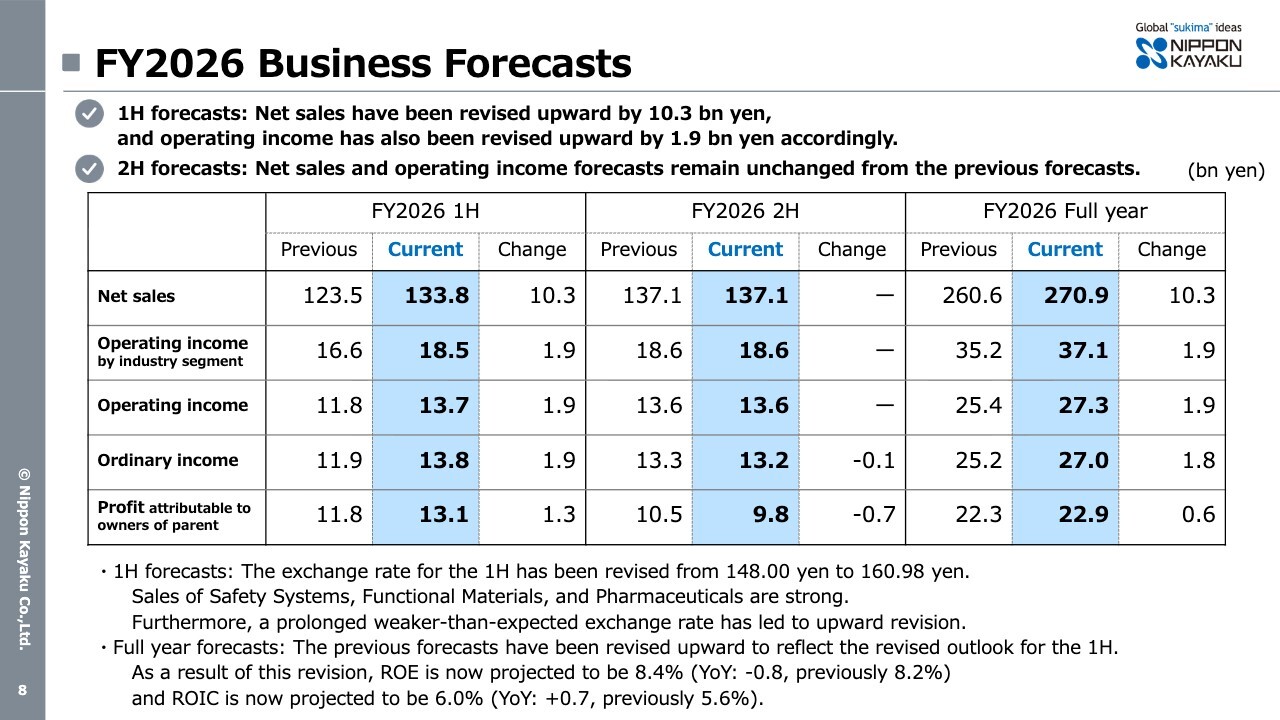
I will now discuss the FY2026 business forecasts. As I mentioned earlier, we have revised our first-half forecasts upward. At the same time, we are keeping our second-half forecasts unchanged from the levels set at the beginning of the fiscal year.
As a result, for FY2026 as a whole, net sales are forecast at 270.9 billion yen, 10.3 billion yen above the forecast announced in May. Operating income is forecast at 27.3 billion yen, 1.9 billion yen above the May forecast, and profit attributable to owners of parent is forecast at 22.9 billion yen, 0.6 billion yen above the May forecast.
For the first half, we revised our exchange-rate assumption from 148.00 yen at the beginning of the fiscal year to 160.98 yen. More recently, partly due to foreign exchange intervention, the yen strengthened rapidly to around 156 yen, but our first-half calculations use 160.98 yen.
However, second-half sales plans and other assumptions remain as set at the beginning of the fiscal year, including an exchange-rate assumption of 148.00 yen. Following this revision, we now project ROE of 8.4%, up from 8.2%, and ROIC of 6.0%, up from 5.6%.
FY2026 Business Forecasts by Segments
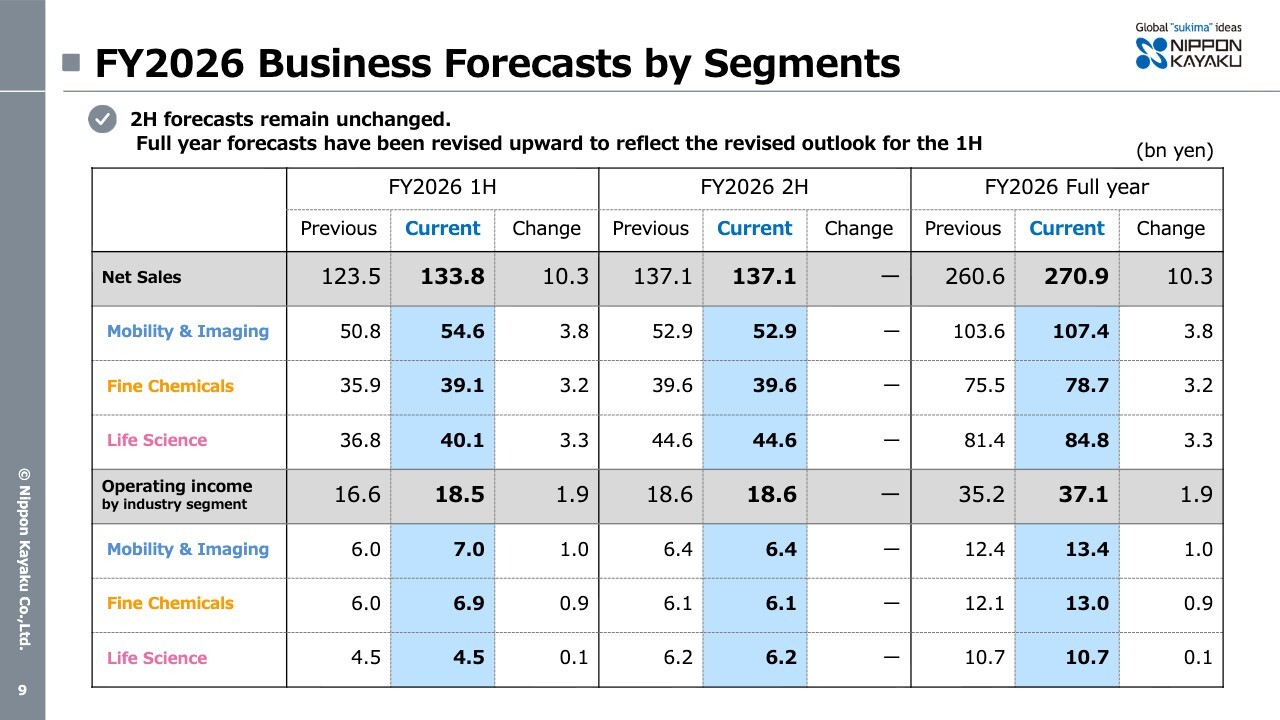
These are the FY2026 forecasts by segment. Here as well, we have revised the first-half forecasts, while maintaining the second-half plans set at the beginning of the fiscal year.
As a result, full-year net sales in the Mobility & Imaging Business Unit are forecast at 107.4 billion yen, up 3.8 billion yen from the May forecast. Fine Chemicals is forecast at 78.7 billion yen, up 3.2 billion yen, and Life Science at 84.8 billion yen, up 3.3 billion yen.
For operating income by industry segment, we expect upward revisions of 1.0 billion yen, 0.9 billion yen, and 0.1 billion yen, respectively, for the three business units, bringing the total to 37.1 billion yen.
FY2026 Net Sales Forecasts by Sub-segments
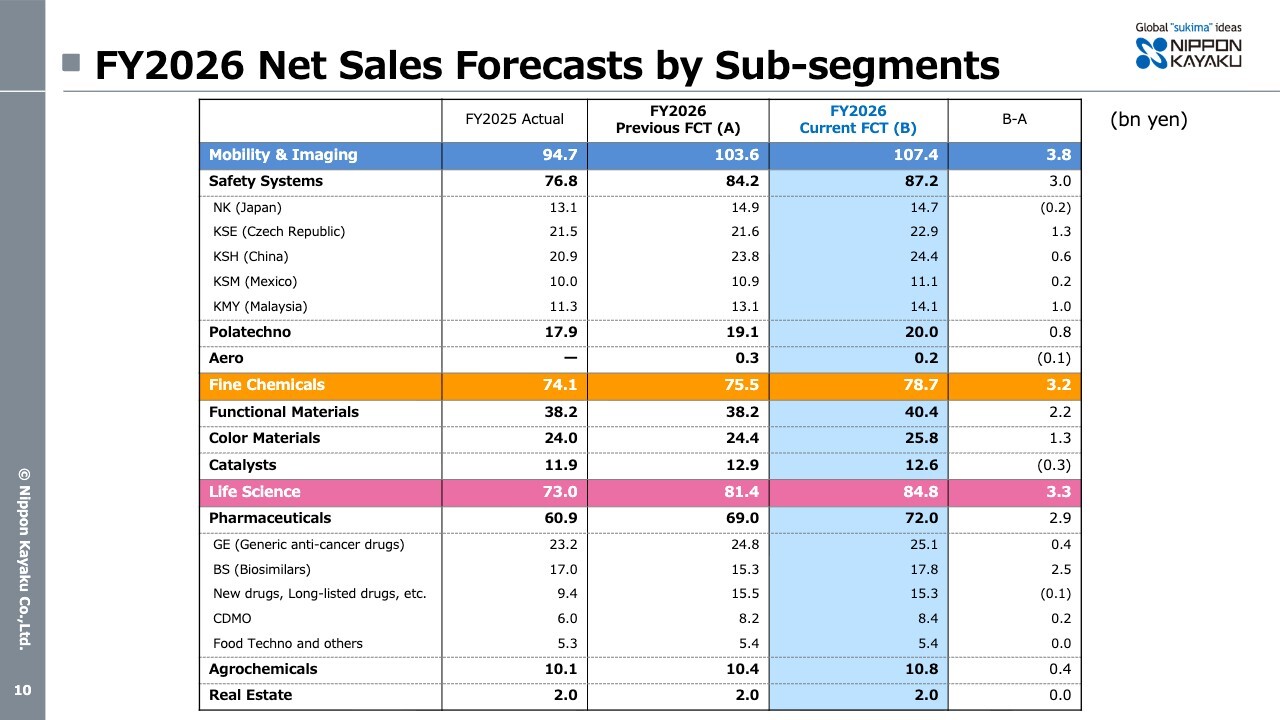
These are the full-year forecasts by sub-segment. One key point is that KSE (Czechia) in Safety Systems is 1.3 billion yen above the forecast announced in May.
KMY (Malaysia) is 1.0 billion yen above the previous forecast at 14.1 billion yen. Functional Materials is approximately 2.2 billion yen above the previous forecast at 40.4 billion yen, and Color Materials is 1.3 billion yen above the previous forecast at 25.8 billion yen.
In Pharmaceuticals, the forecast has been revised upward by 2.9 billion yen, partly reflecting a 2.5 billion yen increase in Biosimilars.
Mobility & Imaging Business Unit
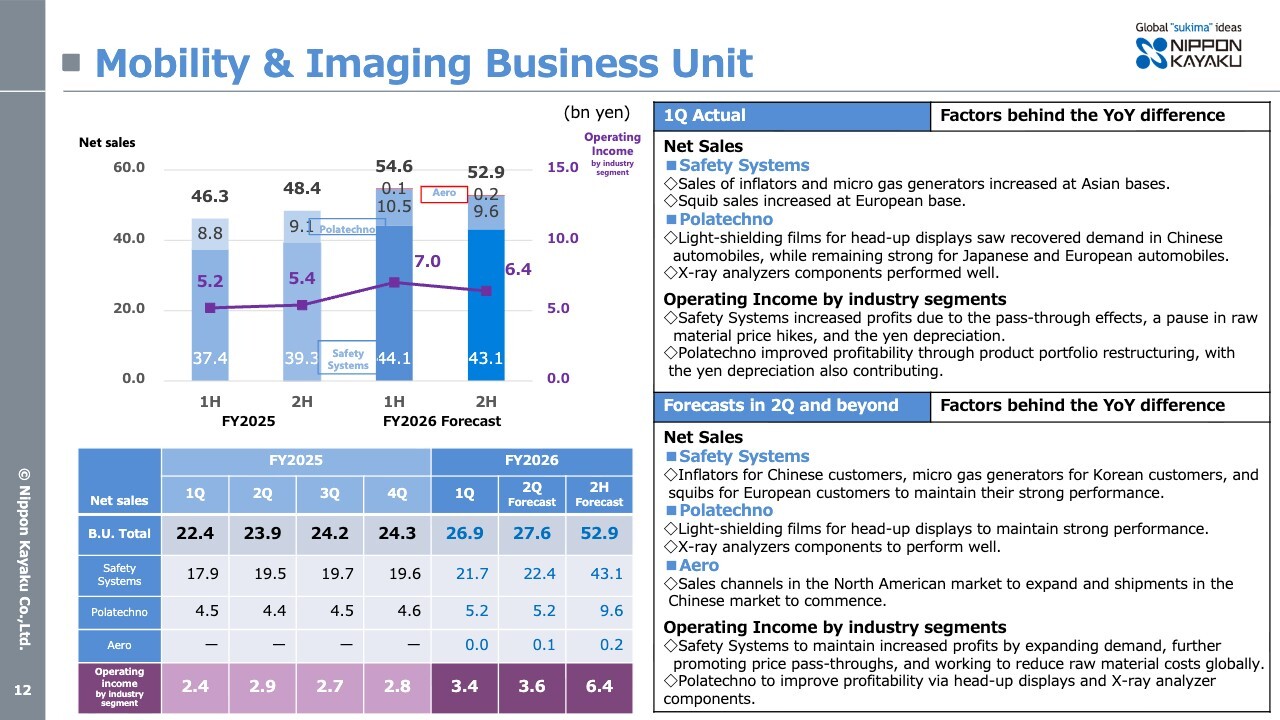
I will now explain the performance overview for each business unit.
The bar chart in the upper left of the slide shows the first and second halves of FY2025 and the first-half forecast and second-half data for FY2026. The line graph shows profit, and the table below provides quarterly data.
For the first quarter of FY2026, Safety Systems recorded higher sales volumes of inflators and micro gas generators at Asian production sites. Squib sales volumes also increased at the European production site.
Turning to Polatechno, demand for light-shielding films for head-up displays recovered for Chinese automobiles. Demand for Japanese and European automobiles also continued to grow steadily.
X-ray analyzer components also performed well. In first-quarter operating income by industry segment, Safety Systems benefited from price pass-throughs. The continued rise in raw material prices has begun to ease, and the weaker yen also contributed, resulting in higher profit.
At Polatechno, profitability improved through product portfolio restructuring. The weaker yen also contributed, resulting in higher profit.
For the outlook from the second quarter onward, the overall picture is not expected to change materially from the first quarter. We expect inflators for Chinese customers, micro gas generators for Korean customers, and squibs for European customers all to maintain their strong performance.
We also expect Polatechno's light-shielding films for head-up displays and X-ray analyzer components to remain strong. In the Aero business, which includes parachutes for drones, we plan to expand sales channels in the North American market and begin shipments to the Chinese market.
For operating income by industry segment, we expect performance to remain solid, reflecting steady net sales, further progress in price pass-throughs in Safety Systems following the first quarter, and progress in global initiatives to reduce raw material costs.
For Polatechno, we expect head-up displays and X-ray analyzer components to continue performing well.
Fine Chemicals Business Unit
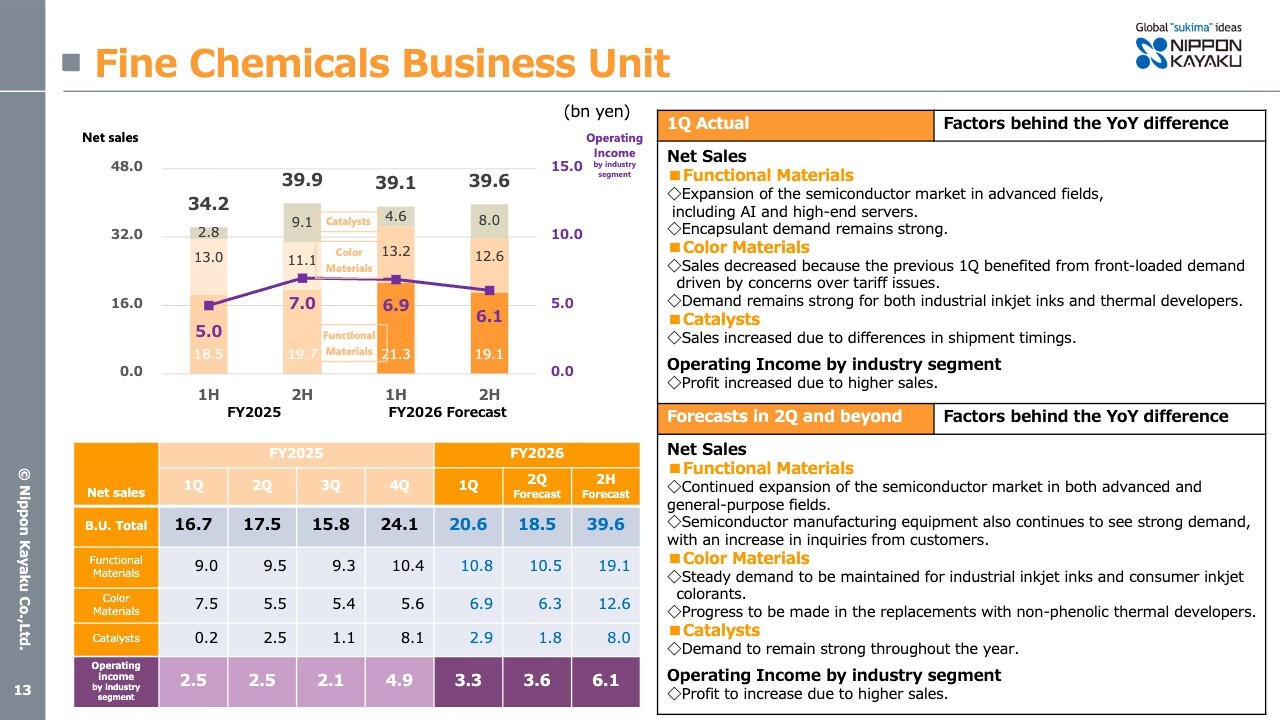
Next, I will discuss the Fine Chemicals Business Unit.
In Functional Materials, the semiconductor market in advanced fields such as AI and high-end servers expanded in the first quarter, and demand for various materials is on an upward trend. The market for encapsulants, a major area for Functional Materials, also remains very strong.
Turning to Color Materials, the first quarter of the previous fiscal year benefited from front-loaded demand driven by concerns over tariff issues, resulting in unusually high net sales of 7.5 billion yen. This contributed to a year-on-year decline in the current first quarter, because the prior-year level was temporarily elevated by special demand.
Demand for both industrial inkjet inks and thermal developers remains very strong. Catalysts recorded higher net sales due to differences in shipment timing.
Overall, profit increased in the first quarter along with higher net sales. I will omit the details, but we expect the second quarter to be broadly similar to the first quarter.
Life Science Business Unit
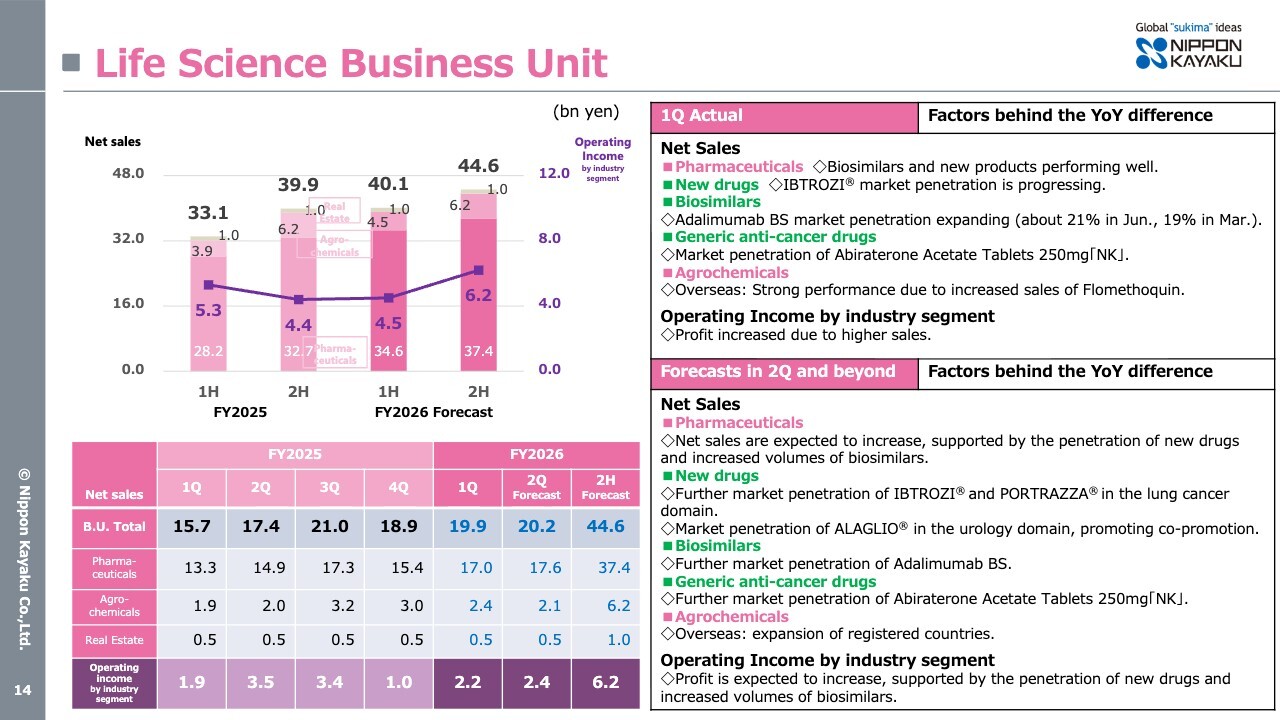
I will now discuss the Life Science Business Unit. In Pharmaceuticals, biosimilars and new products performed well in the first quarter. Among new drugs, IBTROZI® is continuing to gain market penetration.
For biosimilars, we had reported a 19% market share for Adalimumab BS as of March. As of June, the share had increased by 2 percentage points to 21%.
Market penetration of the generic anti-cancer drug Abiraterone Acetate Tablets 250mg "NK" is also progressing. Agrochemicals is performing well, driven by increased sales of Flomethoquin.
Across the business unit, first-quarter profit increased broadly in line with higher net sales. From the second quarter onward, we expect net sales to increase as new drugs gain market penetration and biosimilar volumes rise.
Among new drugs, we expect further market penetration of the two lung-cancer drugs IBTROZI® and PORTRAZZA®. We also expect market penetration of ALAGLIO® in the urology domain and the promotion of co-promotion activities to contribute to higher profit.
For profit as well, we expect an increase supported by further market penetration of new drugs and higher biosimilar volumes.
Status of the New Pharmaceuticals Pipeline (as of August 3, 2026)
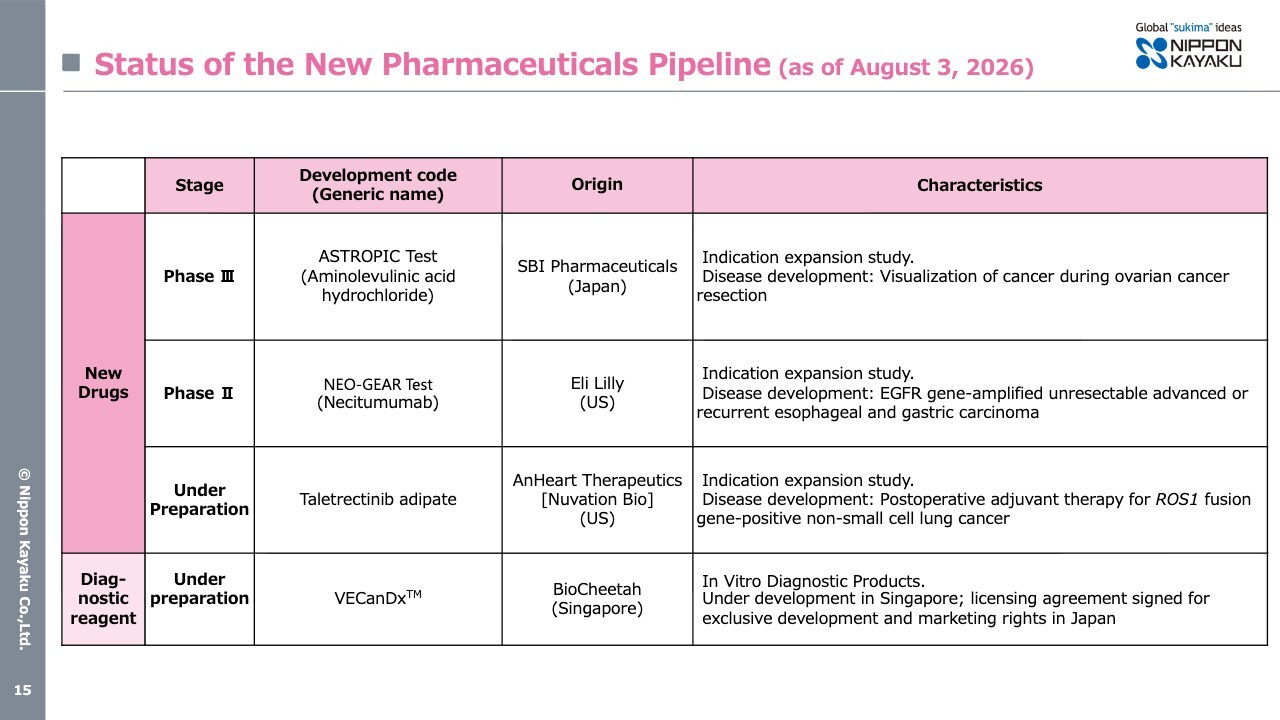
This is the status of the Pharmaceuticals pipeline. There have been no major changes from what we announced in May, but development is making steady progress.
The Impact of the Middle East Situation
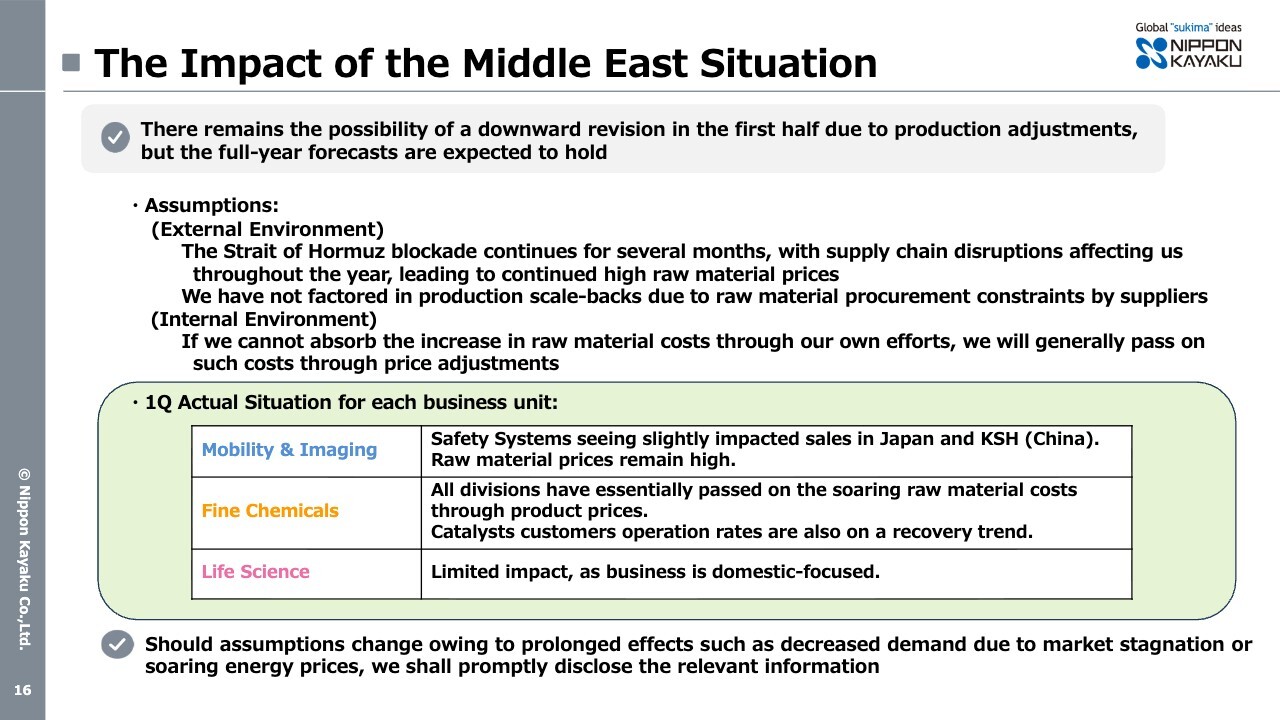
I will discuss the impact of the situation in the Middle East. As we also announced in May, while there has been an impact from factors such as higher raw material prices, there has been no major impact on production or other operations.
Our basic policy is to absorb higher raw material costs through our own efforts and, where that is not possible, to pass the increases on through prices. There has been no major change in this approach over the past three months.
More recently, there was a major earthquake in Kumamoto Prefecture, but we sustained no direct damage. Some customers experienced an impact on production and other operations, but we expect the impact on us to be very limited.
If the situation changes over time, we plan to disclose the relevant information promptly. That concludes my presentation.
Q&A: Drivers of Increased Sales in Safety Systems
QUESTION: I have a question about Safety Systems within the Mobility & Imaging Business Unit. Sales appear to have increased substantially. Is it correct to understand that this is mainly due to a significant increase in volume?
Also, regarding the growth in China, is new equipment contributing, and could you explain the background? In addition, regarding the increase in squib sales in Europe, could you explain why volumes are growing?
Naoki Izaki (hereinafter, Izaki): I am General Manager of Planning & Coordination Division, Mobility & Imaging Business Unit. Regarding the overall figures you asked about, volumes have increased, and foreign exchange has also had an effect, so the figures are up considerably from the previous year.
Looking at the overall picture, inflators for China are performing well. In addition to the China site, the Himeji site in Japan and KMY (Malaysia) are providing backup production for inflators, and volumes have increased from last year as a result.
For a European customer, there is a plan to bring production of micro gas generators in-house. This is a plan being implemented by the customer, and because it has been delayed somewhat, we are seeing upside versus our assumptions.
Also for a European customer, we supply the GTMS squib used in inflators. Those inflators are selling very well, and demand is strong.
Regarding the question of whether capacity expansion in China is contributing, disc-type inflators have increased significantly. Rather than adding capacity, the existing facilities are operating at very high utilization rates, and we are handling the increase through backup production from Japan and Malaysia.
QUESTION: One follow-up question. Is the increase in disc-type inflators in China being driven not by an increase in total market production volumes, but rather by an increase in your market share?
Izaki: That is correct. Our market share is increasing.
QUESTION: What factors are behind the increase in market share?
Izaki: Domestic sales in the Chinese automotive market are currently weak, but exports are making up for this, bringing the overall level to almost 100%. Within that market, one factor is the increasing share of Chinese Tier 1 suppliers.
KSH (China) has a very strong presence among Chinese Tier 1 suppliers, and this is resulting in higher volumes.
Q&A: Drivers of Strong Performance in Fine Chemicals and the Second-Quarter Outlook
QUESTION: I have a question about Functional Materials in Fine Chemicals. Performance is very strong. It was also strong from January through March, and my impression is that momentum has strengthened further recently. Is it correct to understand that demand related to AI and high-end servers is having a significant impact?
Also, it seems possible that the second quarter could come in somewhat above the forecast. Could you share your view on that?
Hirokazu Kitayama (hereinafter, Kitayama): I am General Manager of Planning & Coordination Division, Fine Chemicals Business Unit. Regarding your first question about whether AI-related demand is having an impact, as stated in the current presentation, demand for encapsulants has strengthened further this fiscal year, particularly since April.
For encapsulants, the major factors are solid demand for AI-related high-end servers, continued solid conditions in the Chinese market, and a recovery in automotive demand. Demand for substrates also remains solid.
For the second half, as Inoue explained at the outset, we have not revised the plan at this time for a variety of reasons. However, in terms of market conditions, WSTS has also revised its semiconductor forecast substantially upward, and current conditions are very strong.
QUESTION: My impression is that the second quarter could also come in above the forecast. Is that your current outlook for the second quarter?
Kitayama: For the second quarter, we expect some customers in the substrate business to make slight adjustments to general-purpose servers. As a result, the forecast is quite conservative and is somewhat lower than the first-quarter result.
Q&A: Capital Investment and Production Plans in Mobility & Imaging
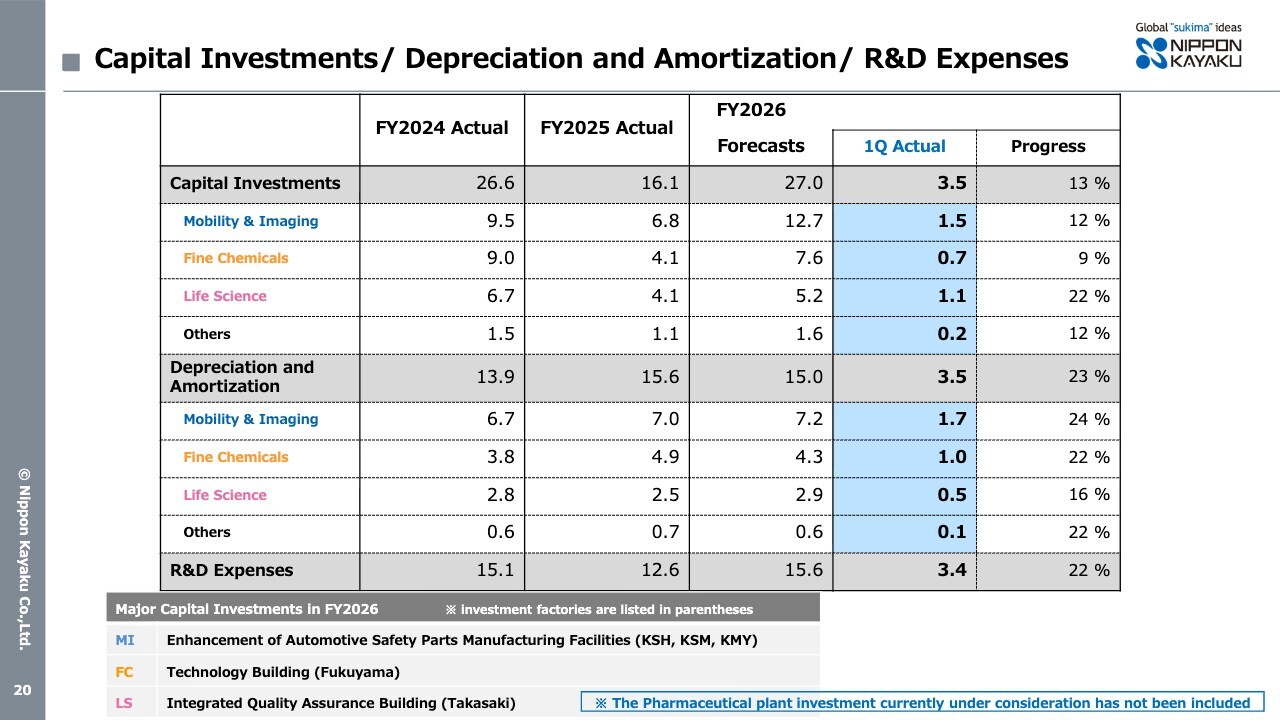
QUESTION: I have a question about the Mobility & Imaging Business Unit. Regarding capital investment, the slide refers to "enhancement in China, Mexico, and Malaysia." Are the items being expanded mainly cylinder-type inflators?
Also, you mentioned growing demand for squibs at KSE (Czechia). Could you discuss the status and outlook for increased squib production in Czechia?
Izaki: Regarding your question about capital investment, KSH (China) and KMY (Malaysia) both made capital investments in equipment for new cylinder-type inflators during the previous and current fiscal years, and the lines are scheduled to reach SOP, or start of production.
KSH is also proceeding with capital investment in squib equipment, which is scheduled to start up next fiscal year. KSM (Mexico) is planning capital investment in a new dual-type inflator.
Regarding strong squib demand at KSE, we can meet the required production volume with our existing capacity and production setup, so we are not considering new investment at this time.
Q&A: Product Trends and the Shift in Key Products at Polatechno
QUESTION: I have a question about the Polatechno business. You mentioned that head-up displays and X-ray analyzers are growing. What is the situation for existing automotive polarizing films?
Also, is it correct to understand that existing polarizing films are declining, while products for head-up displays and X-ray analyzers are becoming new key products, or pillars of the business?
Izaki: Broadly speaking, that is correct. In particular, light-shielding films for head-up displays are performing well in China, Japan, and Europe, and are expanding mainly for higher-grade vehicles. X-ray analyzers are also maintaining strong performance, as you indicated.
QUESTION: Is it correct to understand that the existing products are not performing well? I believe you have handled products such as automotive polarizing films. What is the current situation?
Izaki: I would not describe the existing products as strong, but we are making up for that with the head-up display and X-ray analyzer products I just mentioned.
Q&A: Replacement of Thermal Developers with Non-phenolic Products
QUESTION: I have a question about the Fine Chemicals Business Unit. Regarding thermal developers, you mentioned that replacement with non-phenolic products has progressed. Is it correct to understand that existing phenolic products have declined, while non-phenolic products have increased by more than that decline?
Kitayama: That is correct. Non-phenolic products are growing, while conventional phenolic products are declining correspondingly.
Q&A: Special Demand for Epoxy Resins in Fine Chemicals
QUESTION: The previous questioner touched on this as well, but Functional Materials appears to be performing very strongly. If my understanding is correct, I recall that there were pull-forward shipments of epoxy resins in the fourth quarter of the previous fiscal year. Could you tell us whether there was a similar situation in the current quarter?
Kitayama: In the fourth quarter of the previous fiscal year, there was special demand from some substrate-related customers, which led to higher volumes. In the current first quarter, however, there was no such special demand at all. Even excluding the special demand, first-quarter sales increased, including for epoxy resins.
QUESTION: You commented that there was special demand in the fourth quarter. Is it correct to understand that we do not need to be concerned about a drop-off from that demand as a risk heading into the second quarter or the second half?
Kitayama: Yes. It was a one-off event limited to the fourth quarter of the previous fiscal year, so there will be no such impact in the second quarter or the second half.
Q&A: Changes in Fine Chemicals Market Share
QUESTION: I have a question about changes in market share in the Fine Chemicals Business Unit. I believe you have a very high share in epoxy resins. Are these results simply due to higher demand, or are they also the result of a further increase in your market share? Could you tell us whether there have been any changes in share?
Kitayama: Regarding market share, Nippon Kayaku's epoxy resins are highly specialized products. They are also focused on encapsulants and substrates, which makes this a difficult area for direct comparison.
However, based on what we have been able to ascertain, we do not believe Nippon Kayaku is underperforming competitors, and I would like to note that point.
Q&A: Consideration of Epoxy Resin Price Increases and the Current Policy
QUESTION: I have another question about materials regarding your approach to future price increases for epoxy resins. You supply very large volumes for encapsulants, and demand related to AI and servers is also expected to remain strong for substrates.
At the same time, looking at the market as a whole, capacity expansion has been limited, so utilization rates may gradually rise and supply may tighten. Against that backdrop, how are you thinking at this point about price increases beyond the pass-through of higher raw material costs - in other words, price increases intended to improve your profitability?
Kitayama: We implement necessary price increases as needed. For long-established products, such as brominated epoxies, where demand is declining rapidly, we raise prices in order to continue the business. Taking these circumstances into account, Nippon Kayaku plans to implement price increases as necessary.
QUESTION: Is it correct to understand that, at this point, you are not considering any further price increases for semiconductor-related products?
Kitayama: That is correct. In response to the situation in the Middle East, we made announcements, including through newspapers, in April and May. We have completed the adjustments for those two rounds of pricing, so at this point we are not considering additional price increases.
Q&A: Capital Investment Plan and Progress for the Formulation Plant in Life Science
QUESTION: I have a question about the capital investments shown on page 20 of the presentation. Within Life Science, I would like to ask about the formulation plant currently under consideration and the capital investment in biopharmaceuticals shown at the bottom of the section.
Could you comment on the current progress and on whether the partnership with Celltrion Healthcare Japan K.K. (hereinafter, “Celltrion”), announced in July, will affect the decision on this capital investment?
Yoshinori Hozumi (hereafter, Hozumi): I am Hozumi, General Manager of Planning & Coordination Division, Life Science Business Unit. Thank you for having me.
First, regarding the Takasaki Plant 4 formulation plant, we initially planned it as a fourth plant that would also handle high-potency pharmaceuticals. However, following the decision at the end of March this year to acquire Fuji Yakuhin's Toyama Plant 2, we are also considering partial changes to the design.
Because the fourth plant would be a large-scale construction project, we are actively reviewing the plan, including whether the investment can be recouped, and will move forward with a decision.
Next, regarding our comprehensive partnership with Celltrion. To help ensure a stable domestic supply of biopharmaceuticals, we intend to strengthen the partnership over the medium to long term by combining the strengths of Celltrion with the technologies, stable supply framework, testing, packaging, and other capabilities our group has developed over the years.
Specific products are currently under consideration. Taking this into account together with the review of the fourth plant, we will consider the appropriate future structure.
QUESTION: Do you have in mind, for example, reaching a conclusion on the investment decision during the current fiscal year?
Hozumi: This is a very difficult issue, but even if we spend time making the capital investment, including during the current fiscal year, we currently expect completion to be around 2030 to 2031. For that reason, we would like to make the decision during the first half of Phase 1, which begins in 2026.
QUESTION: One follow-up question. I understand that the Integrated Quality Assurance Building is scheduled for completion in October. Is it on schedule?
Hozumi: Yes. The exterior is nearly complete, so if you drive around the Takasaki Plant, I think you will be able to see the large building under construction. We are proceeding with plans to hold the completion ceremony in October or November.
Q&A: Growth Drivers of Biosimilars and the FY2026 Outlook
QUESTION: What surprised me most was the substantial growth in biosimilars. Could you explain the background to this strong growth and the breakdown of the 2.5 billion yen upward revision for the current fiscal year?
Also, first-quarter net sales exceeded 5.0 billion yen. Given the full-year forecast of 17.8 billion yen, could you also explain whether you expect net sales to decline in the latter part of the year?
Hozumi: As you noted, biosimilars are performing well. One factor is the medical fee revision in June and the introduction of prescribing biosimilars by generic name, which we believe served as a catalyst and provided additional support.
Adalimumab BS is available in pen and syringe formulations for patients to self-inject. The number of dispensing pharmacies handling these products increased substantially in June. In this respect, government policy and direction are also providing support, so we believe we must make further efforts to ensure a stable supply.
We expect this trend to continue through the second and third quarters, but in the final fourth quarter we will need to take into account the impact of the annual NHI drug pricing revision and other factors.
Also, as Inoue explained earlier, we have not changed the second-half forecasts, which is why the forecasts remain as presented this time. However, based on sales trends in the second quarter, I believe we will review the outlook again.
Other biosimilars besides self-injectable Adalimumab BS are also progressing relatively well, and we believe the medical fee revision is having an impact here as well. Within the mechanism under which hospitals receive additional reimbursement related to biosimilars, there was a minor change so that the calculation is made on the final day, and we believe this may also be providing some support.
During the second quarter, through discussions with hospitals, we would like to make sure that we ourselves clearly confirm solid evidence of growth.
Closing Remarks from Mr. Inoue
Inoue: Thank you very much for taking time out of your busy schedules to attend our financial results briefing today. We appreciate your continued support.