
Q1 Results for FY2027/3 and Future Management Policies
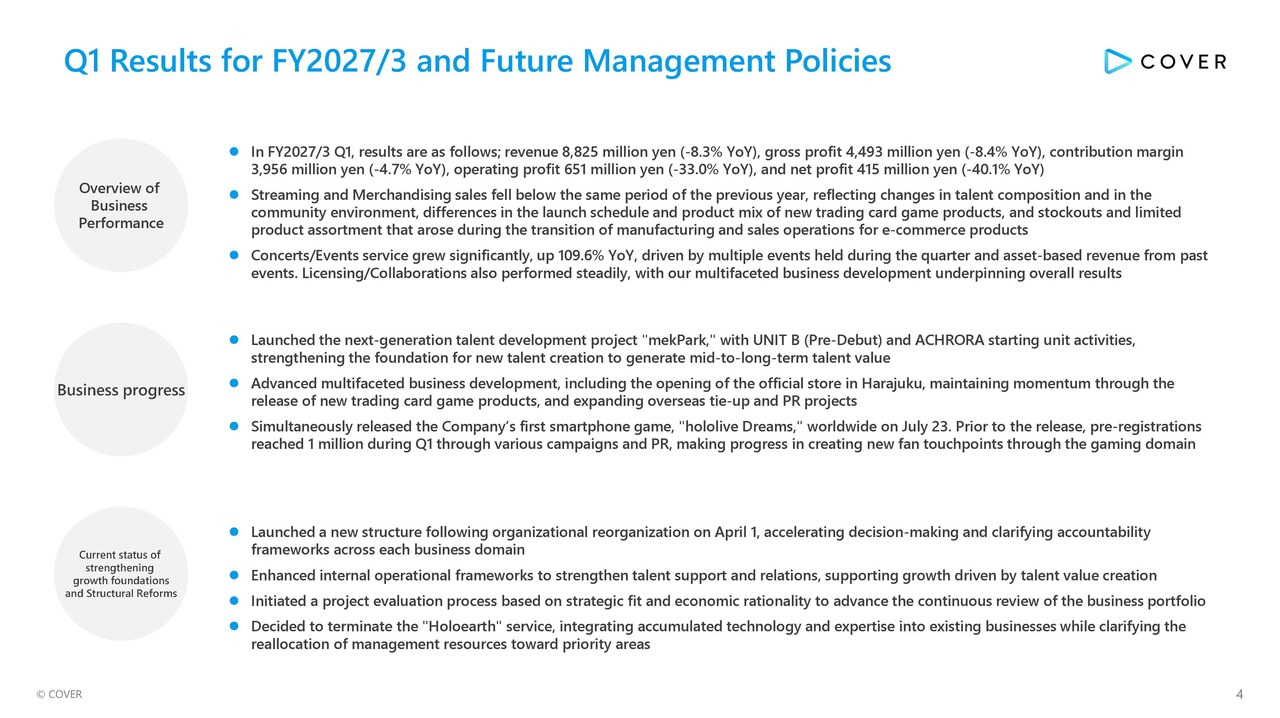
Motoaki Tanigo (hereinafter “Tanigo”): I am Motoaki Tanigo, President and CEO. I will now explain our Q1 results for FY2027/3 and provide a management update. First, an overview of business performance. In Q1, revenue was 8,825 million yen, down 8.3% YoY, while operating profit was 651 million yen, down 33.0% YoY.
Streaming and Merchandising revenue declined YoY, reflecting changes in talent composition, differences in the sales schedule for trading card games, and temporary stockouts and limited product availability during the transition of manufacturing and sales operations for e-commerce products.
Meanwhile, Concerts/Events grew significantly, up 109.6% YoY. Licensing/Collaborations also performed steadily, providing solid support for overall results.
Next, business progress. Looking toward medium- to long-term growth, we launched “mekPark,” a next-generation talent development project, and strengthened our foundation for creating new talents. We also advanced multifaceted initiatives, including the opening of the official Harajuku store and the worldwide release of the smartphone game “hololive Dreams.”
In particular, pre-registrations for the game reached 1 million during Q1, successfully creating a new fan touchpoint.
Finally, I will discuss the strengthening of our growth foundations and structural reforms. Under the new organizational structure launched in April, we are accelerating decision-making and evaluating projects based on strategic fit and economic rationality. As part of these efforts, we decided to terminate the “Holoearth” service. We will integrate the technology and expertise developed through the project into existing businesses and concentrate management resources on priority areas to achieve sustainable growth.
Financial Highlights | Summary for FY2027/3 Q1
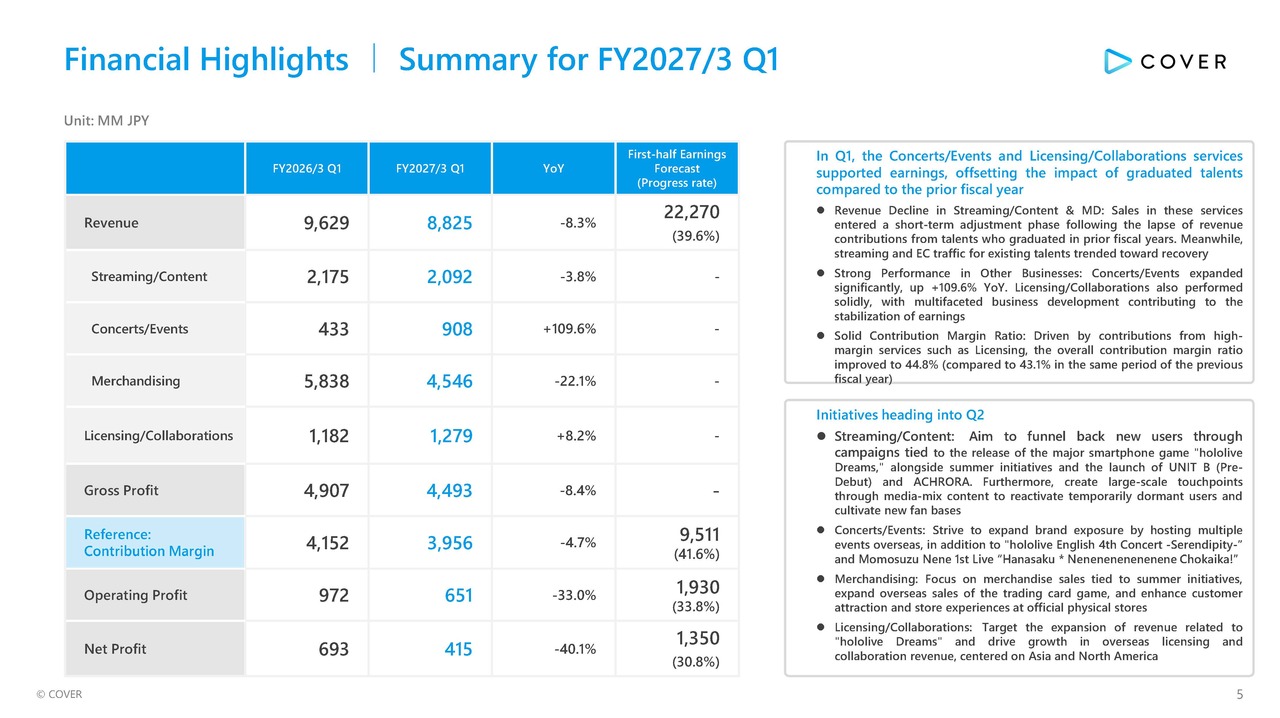
Yosuke Kaneko (hereinafter “Kaneko”): I am Yosuke Kaneko, Director and CFO. Turning to progress against forecasts, Q1 revenue was 8,825 million yen, representing 39.6% of the first-half earnings forecast. Streaming/Content and Merchandising entered a temporary adjustment phase, although traffic for existing talents is trending toward recovery. In Merchandising, inventory adjustments in prior fiscal years and tighter production controls led to product shortages and lost sales opportunities. We will make improvements toward the second half of the fiscal year.
The declines in Streaming/Content and Merchandising revenue were offset by Concerts/Events, which grew sharply by 109.6% YoY, and Licensing/Collaborations, which posted solid growth of 8.2%. Contributions from Licensing/Collaborations lifted the contribution margin ratio from 43.1% in the same period of the previous year to 44.8%, with our multifaceted business development underpinning the overall earnings structure.
Next, I will explain our initiatives heading into Q2. In Streaming/Content, in addition to various summer initiatives, we are moving forward with the full-scale launch of UNIT B (Pre-Debut) and ACHRORA from “mekPark,” our next-generation talent development project.
We are also rolling out initiatives tied to the release of the major smartphone game “hololive Dreams” and aim to funnel users from the game back to our other content. Furthermore, by creating large-scale touchpoints through media-mix content, we will work to reactivate temporarily dormant users and actively cultivate new fan bases.
Next, in Concerts/Events, we held the major overseas concert “hololive English 4th Concert -Serendipity-.” In Japan, we also held Momosuzu Nene 1st Live “Hanasaku * Nenenenenenenene Chokaika!”
In addition, we will hold multiple events overseas to further expand global brand exposure.
Turning to Merchandising, we will vigorously promote merchandise sales linked to summer initiatives and overseas sales of the trading card game. At the same time, by attracting more customers to our official physical stores and enhancing the in-store experience, we aim to expand purchasing opportunities and grow revenue.
Finally, Licensing/Collaborations.
Alongside the rollout of the major smartphone game “hololive Dreams,” we will expand related revenue and drive growth in overseas Licensing/Collaborations revenue, particularly in Asia and North America. Through these proactive initiatives across all business domains, we aim to expand overall results.
Historical Trends in Revenue and Gross Profit
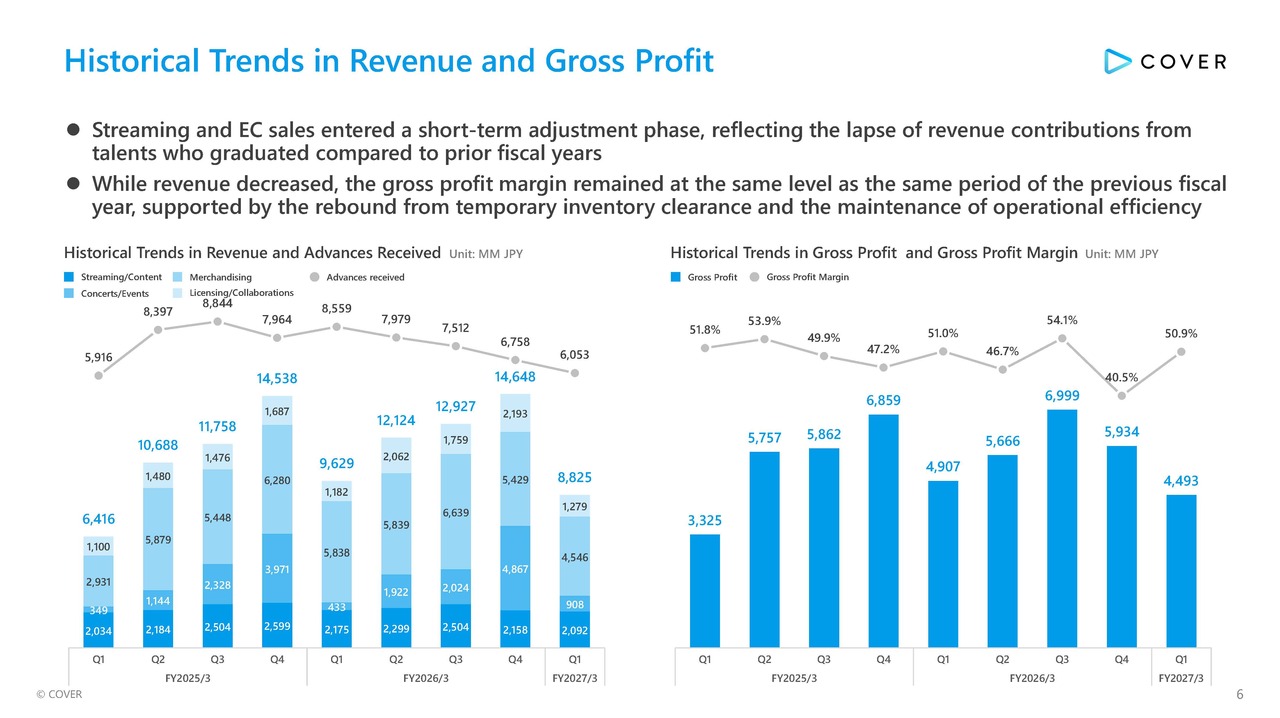
This slide shows historical trends in revenue and gross profit. Streaming and e-commerce sales entered a short-term adjustment phase due to the lapse of revenue contributions from graduated talents relative to prior fiscal years and shortages of certain products.
Although revenue decreased, the gross profit margin remained at approximately the same level as in the same period of the previous fiscal year, supported by the rebound from the one-time inventory clearance conducted in Q4 and the maintenance of operational efficiency.
Historical Trends in Cost of Sales and SG&A Expenses
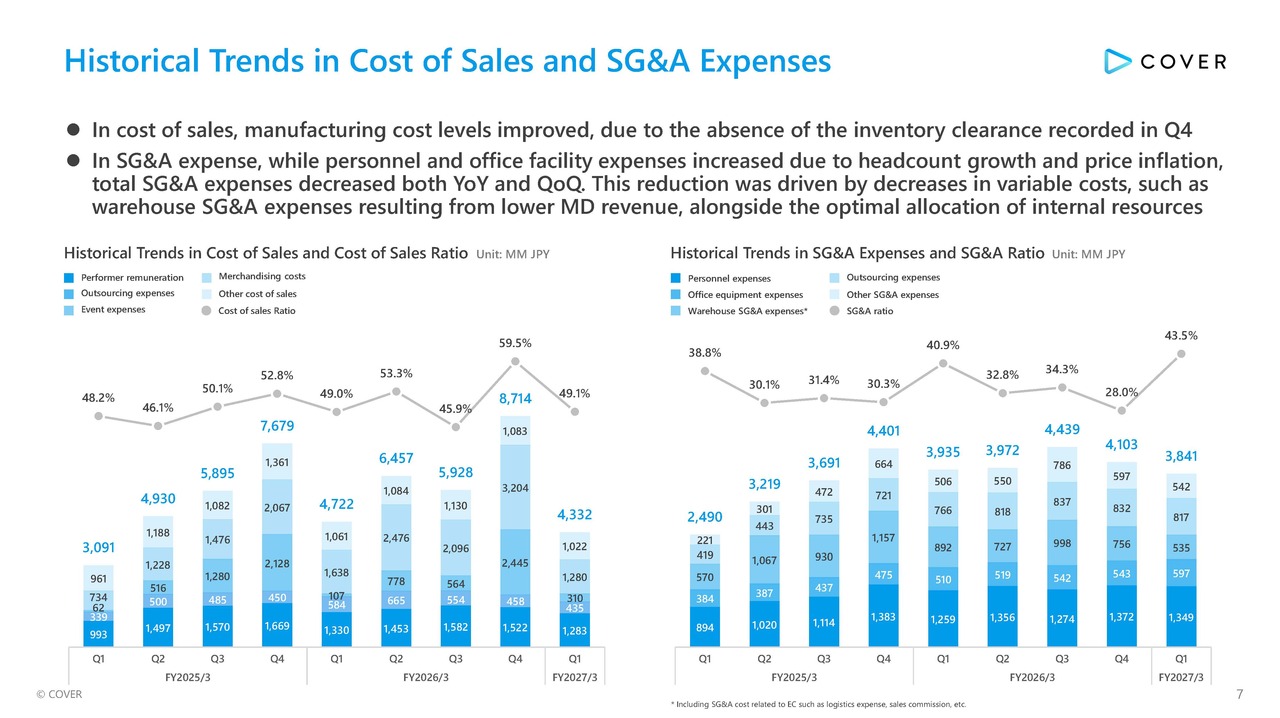
This slide shows historical trends in cost of sales and SG&A expenses. Within cost of sales, manufacturing cost levels improved due to the absence of the inventory clearance of legacy products recorded in Q4. Within SG&A expenses, personnel and office facility expenses increased due to headcount growth and price inflation. However, total SG&A expenses decreased both YoY and QoQ, driven by lower variable costs, including warehouse-related SG&A expenses resulting from the decline in Merchandising revenue, as well as the reallocation of internal resources.
Historical Trends in Contribution Margin and Operating Profit
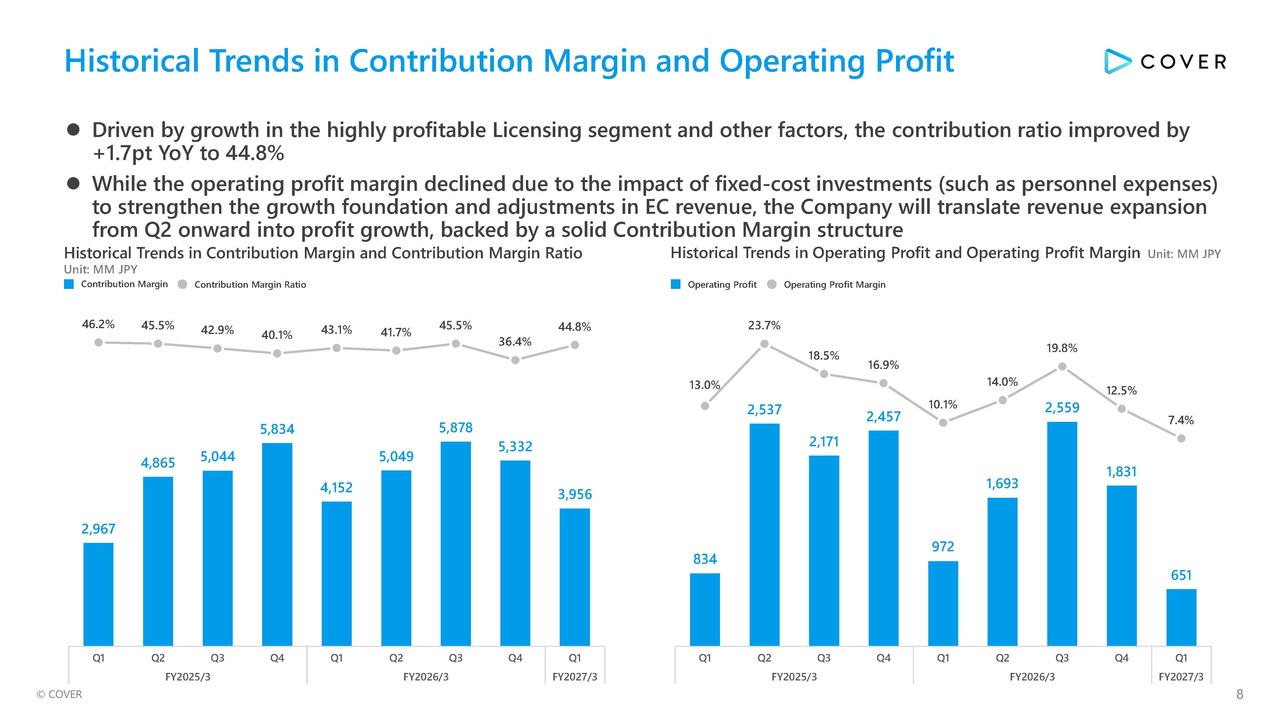
I will now explain historical trends in contribution margin and operating profit. Driven by growth in the highly profitable Licensing service, the contribution margin ratio rose 1.7 percentage points YoY to 44.8%. Meanwhile, the operating profit margin declined due to fixed-cost investments, including personnel expenses, to strengthen our growth foundations and the adjustment in e-commerce revenue. From Q2 onward, however, we will translate revenue growth into profit growth, supported by our solid contribution margin structure and the evolving revenue mix driven in part by the gaming business.
Business Development by Service | Streaming/Content
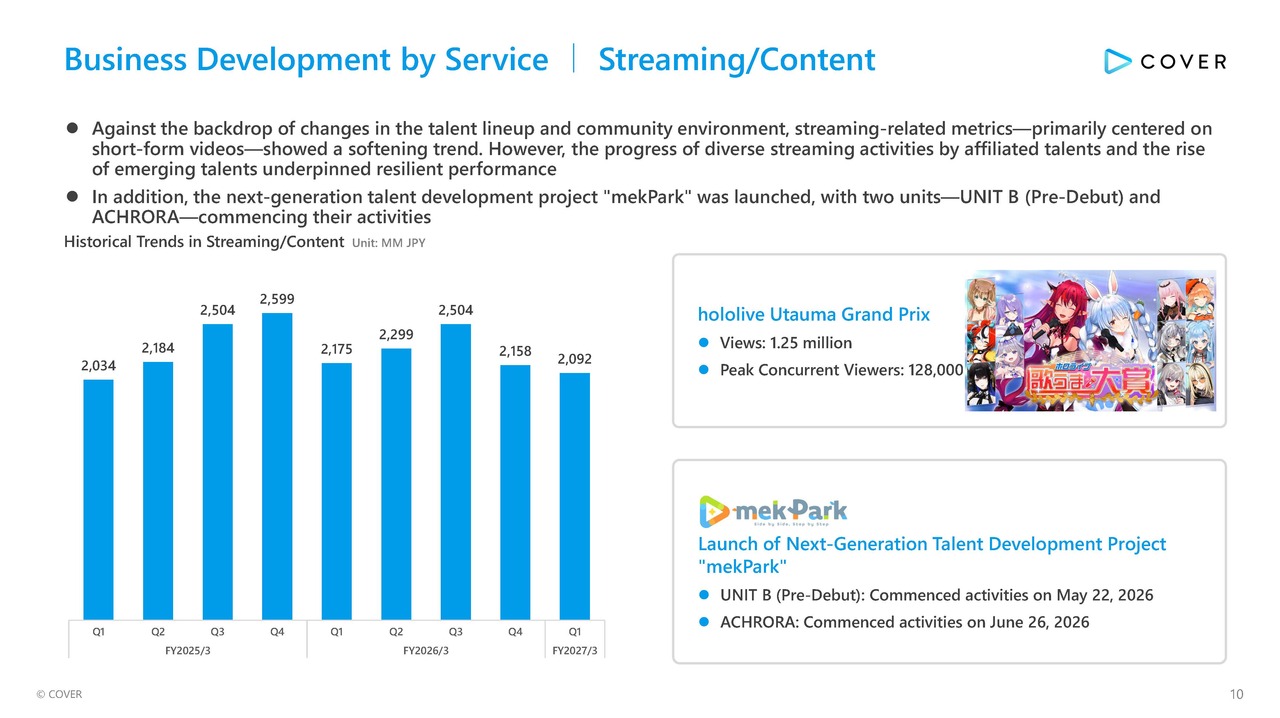
Tanigo: I will now explain business development by service.
First, Streaming/Content. Against the backdrop of changes in the talent lineup and community environment, streaming-related metrics, particularly for short-form videos, showed some softness. However, the progress of diverse streaming activities by our talents and the rise of emerging talents supported resilient performance.
In addition, we launched the next-generation talent development project “mekPark,” with two units, UNIT B (Pre-Debut) and ACHRORA, commencing activities. UNIT B (Pre-Debut) has already surpassed 100,000 YouTube channel subscribers, demonstrating that new talents are steadily gaining acceptance among fans.
Business Development by Service | Concerts/Events
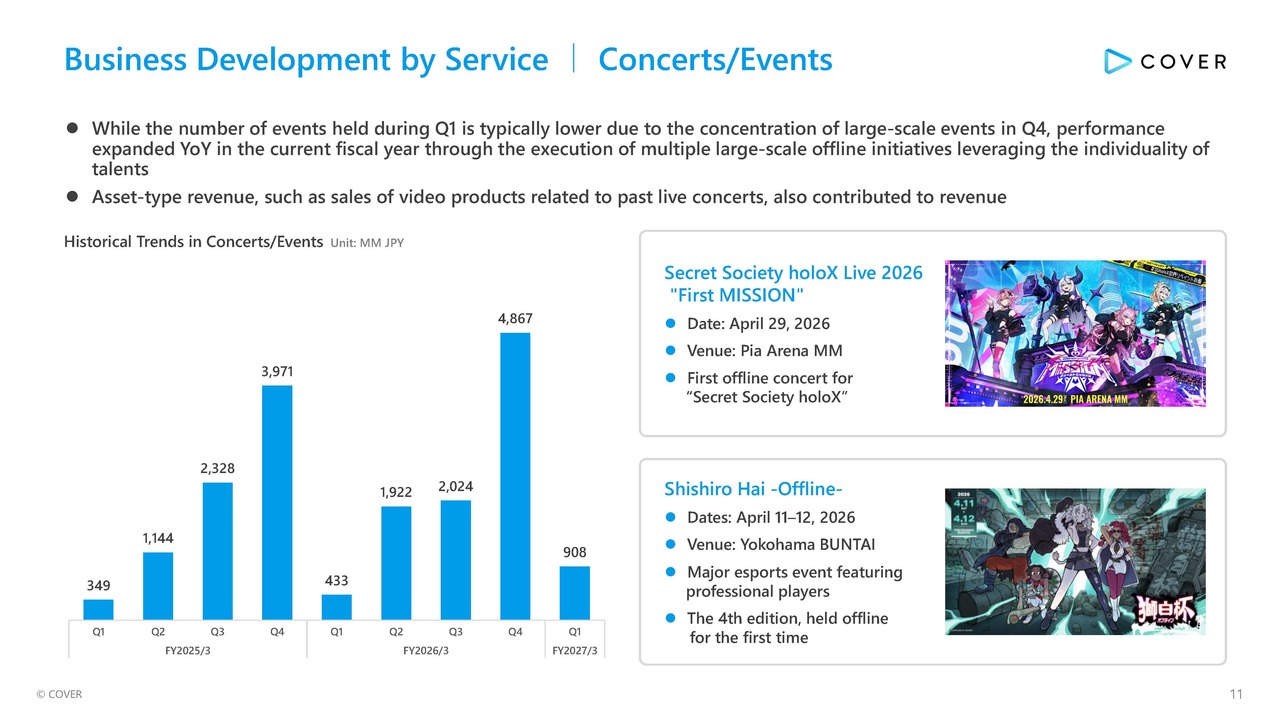
Next, Concerts/Events. Q1 typically has fewer events following the concentration of large-scale event production in Q4. This fiscal year, however, performance expanded YoY through multiple large-scale offline initiatives that leveraged the individuality of our talents.
Asset-type revenue, including sales of video products related to past live concerts, also contributed to revenue. The fourth edition of the major esports event “Shishiro Hai -Offline-,” featuring professional players, was the first to be held offline. The event enabled us to share the excitement of a large-scale offline gathering with fans in an area beyond music and concerts.
Business Development by Service | Merchandising
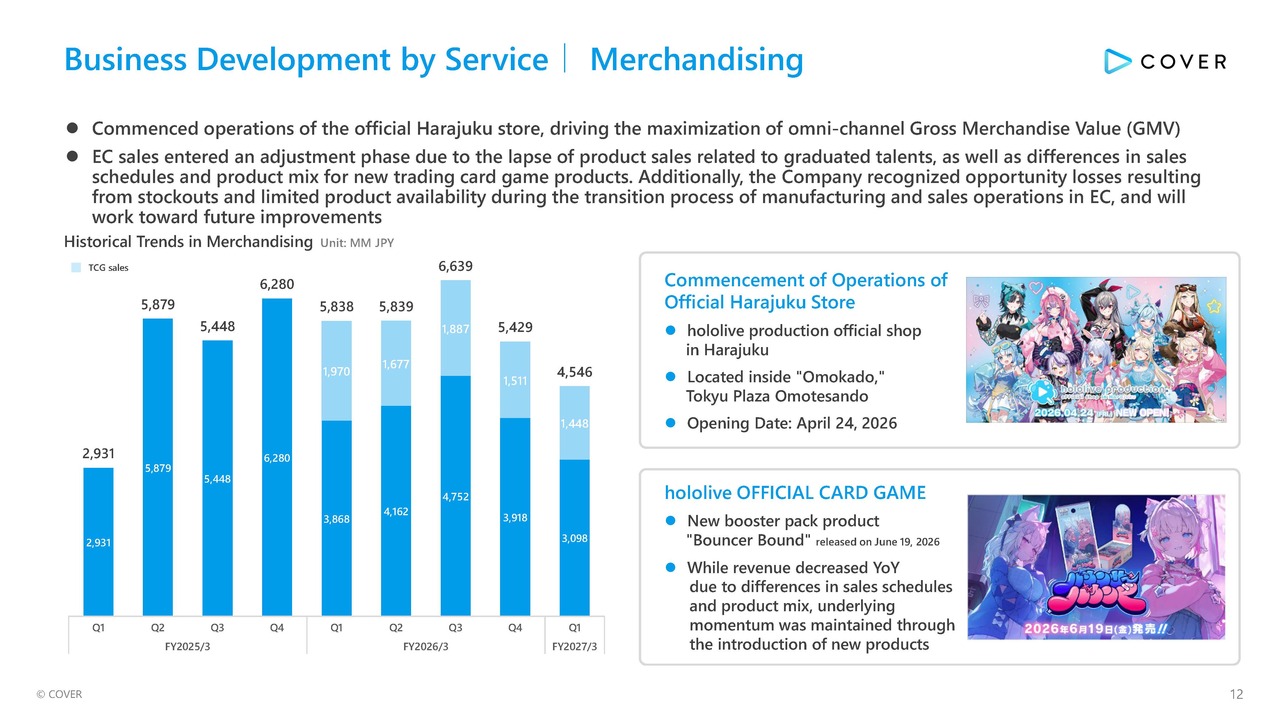
Next, Merchandising. We commenced operations at our official Harajuku store and are working to maximize omnichannel gross merchandise value, or GMV.
Meanwhile, Merchandising revenue decreased YoY due to differences in the sales schedule and product mix for new trading card game products, as well as lower sales of products related to graduated talents. We also recognize that stockouts and limited product availability during the transition of manufacturing and sales operations caused lost sales opportunities, and we will work to improve the situation.
Business Development by Service | Licensing/Collaborations
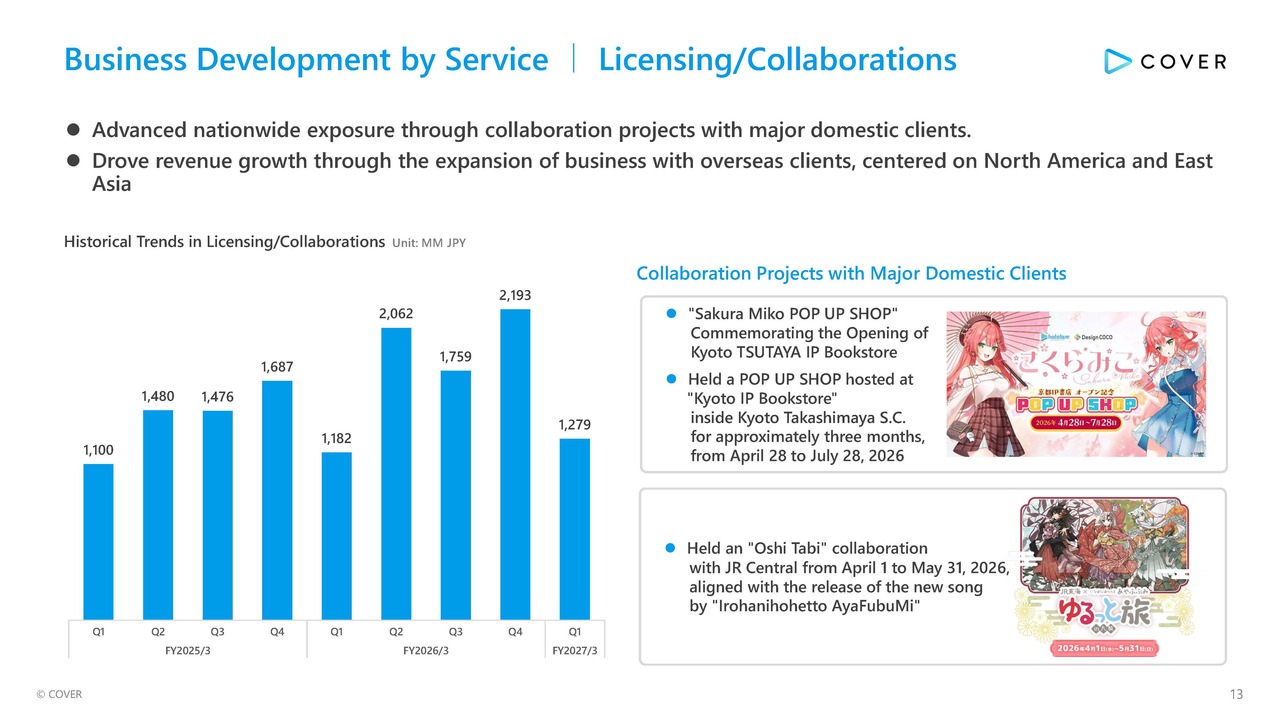
Next, Licensing/Collaborations. Collaboration projects with major domestic clients expanded our nationwide exposure and contributed to increasing our brand influence. In addition, the expansion of our sales and business development capabilities increased the scale of business with overseas clients, particularly in North America and East Asia, while also making a greater contribution from a marketing perspective.
Progress of Priority Initiatives for Strengthening Growth Foundations and Structural Reforms
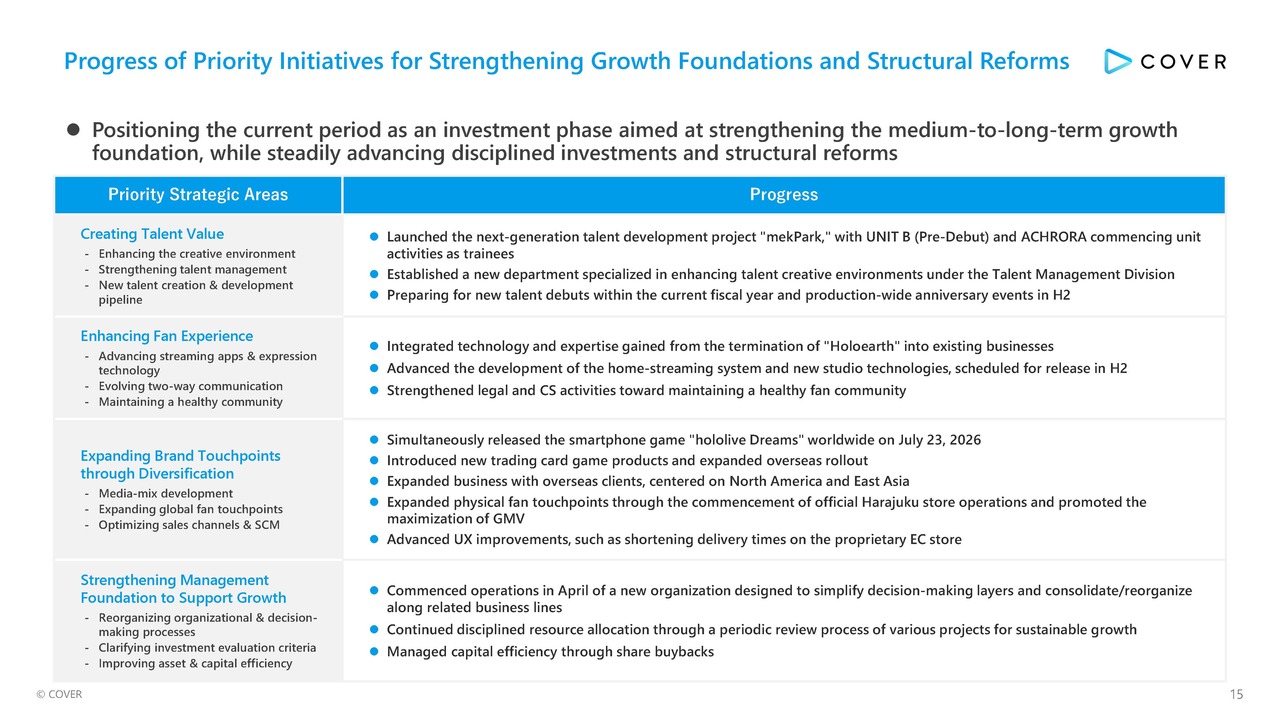
I will explain our progress in strengthening growth foundations and implementing structural reforms. We view the current period as an important investment phase for strengthening our medium- to long-term growth foundations and are steadily advancing disciplined investments and structural reforms.
The first priority strategic area is creating talent value. We launched the next-generation talent development project “mekPark,” with UNIT B (Pre-Debut) and ACHRORA commencing unit activities as trainees.
We also established a new department specializing in enhancing the creative environment for talents within the Talent Management Division. Preparations are progressing smoothly for new talent debuts during the current fiscal year and production-wide anniversary events in the second half.
The second area is enhancing the fan experience. We are integrating the technology and expertise gained from “Holoearth” into existing businesses and developing a home-streaming system and new studio technologies for release in the second half. We are also strengthening legal and customer support activities to maintain a healthy fan community.
The third area is expanding brand touchpoints through business diversification. On July 23, we simultaneously released the smartphone game “hololive Dreams” worldwide. We are also launching new trading card game products and expanding overseas rollout.
In addition, we are expanding business with overseas clients, particularly in North America and East Asia; increasing physical fan touchpoints and maximizing GMV through the opening of the official Harajuku store; and improving the user experience, or UX, by shortening delivery times on our proprietary e-commerce store.
Finally, strengthening the management foundation that supports growth. We simplified decision-making layers and consolidated and reorganized units along related business lines, with the new organization commencing operations in April. We are also continuing disciplined resource allocation through periodic reviews of projects and managing capital efficiency through share buybacks. In this way, we will vigorously advance investments and reforms in each area to achieve sustainable medium- to long-term growth and enhance corporate value.
Launch of New Trainee Project
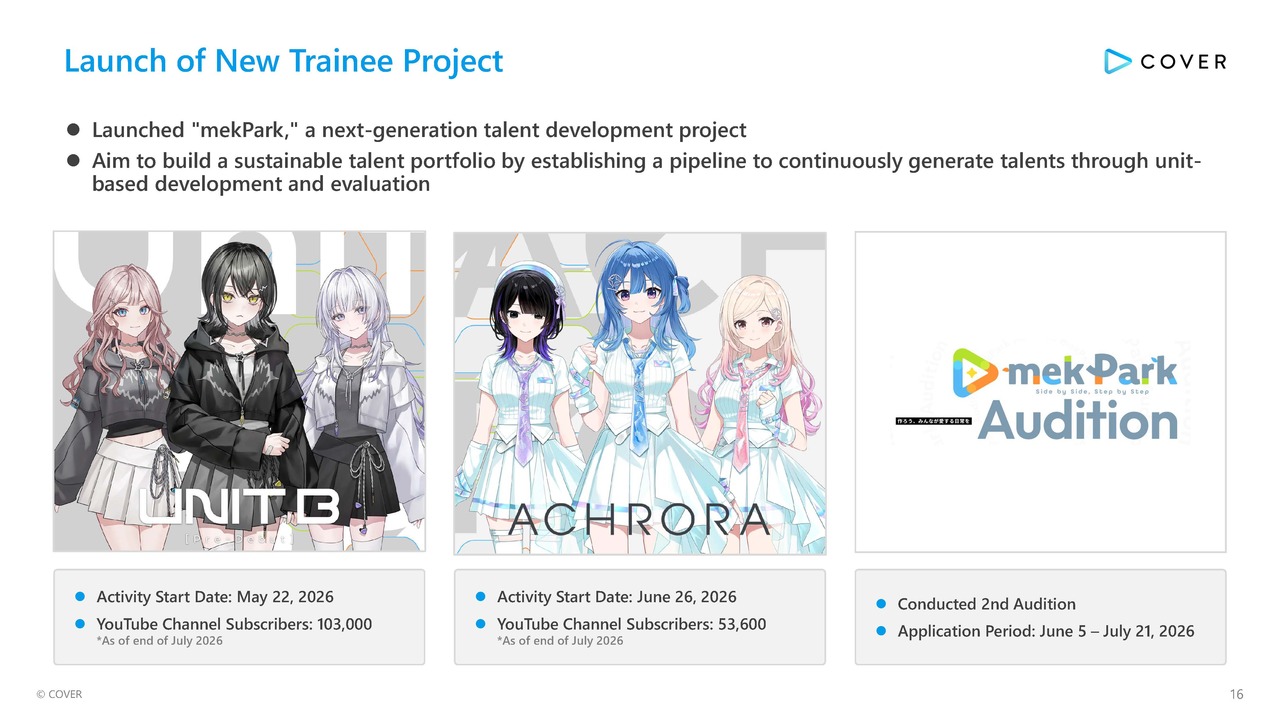
I will now provide more detail on “mekPark,” which I mentioned earlier.
Through unit-based development and evaluation, this project aims to build a sustainable talent portfolio. As of the end of July, UNIT B (Pre-Debut) had 103,000 YouTube channel subscribers and ACHRORA had 53,600. We are also steadily strengthening our talent development pipeline, including by conducting the second audition from June to July.
Business Expansion of Trading Card Game (TCG)
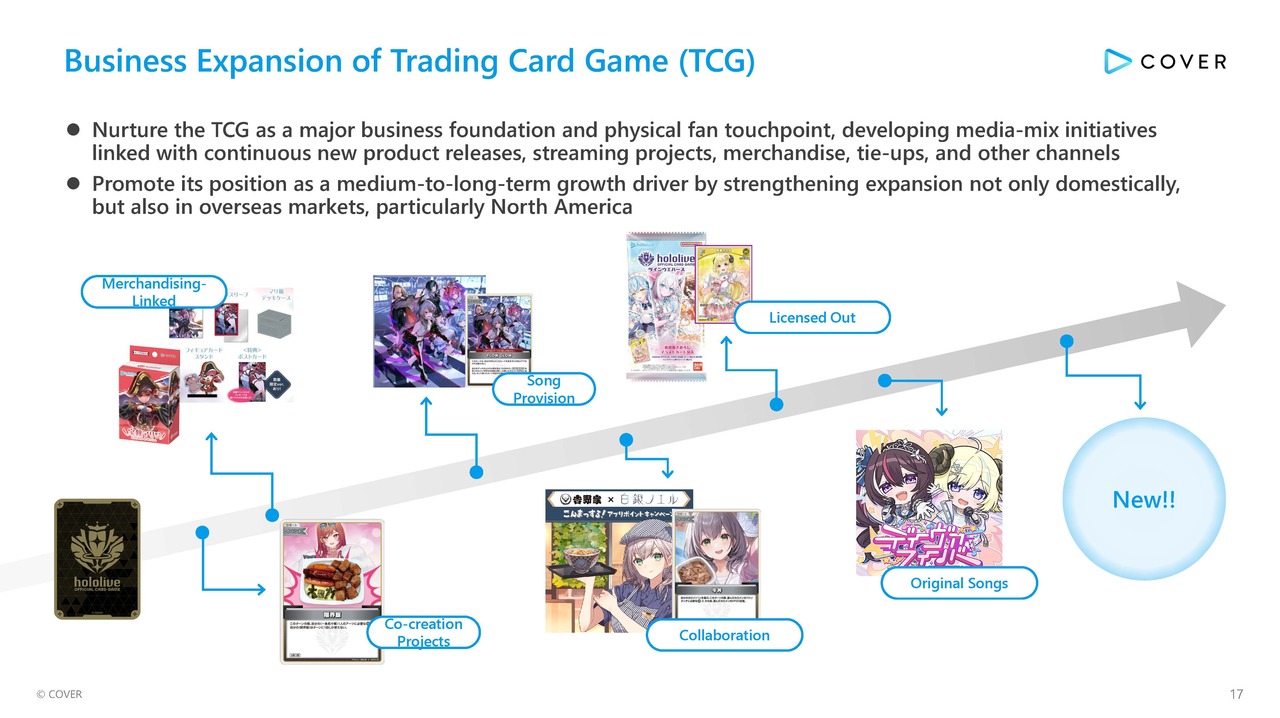
Next, the business expansion of our trading card game. We are developing the trading card game as an important physical fan touchpoint and a major pillar of our business. We are also pursuing a wide range of media-mix initiatives, including co-creation projects with talents, licensing agreements and tie-ups with other companies, and initiatives linked to music.
As a priority for this fiscal year, we will strengthen expansion not only in Japan but also in overseas markets, particularly North America, and develop the trading card game into a medium- to long-term growth driver.
Official Service Launch of Smartphone Game “hololive Dreams”
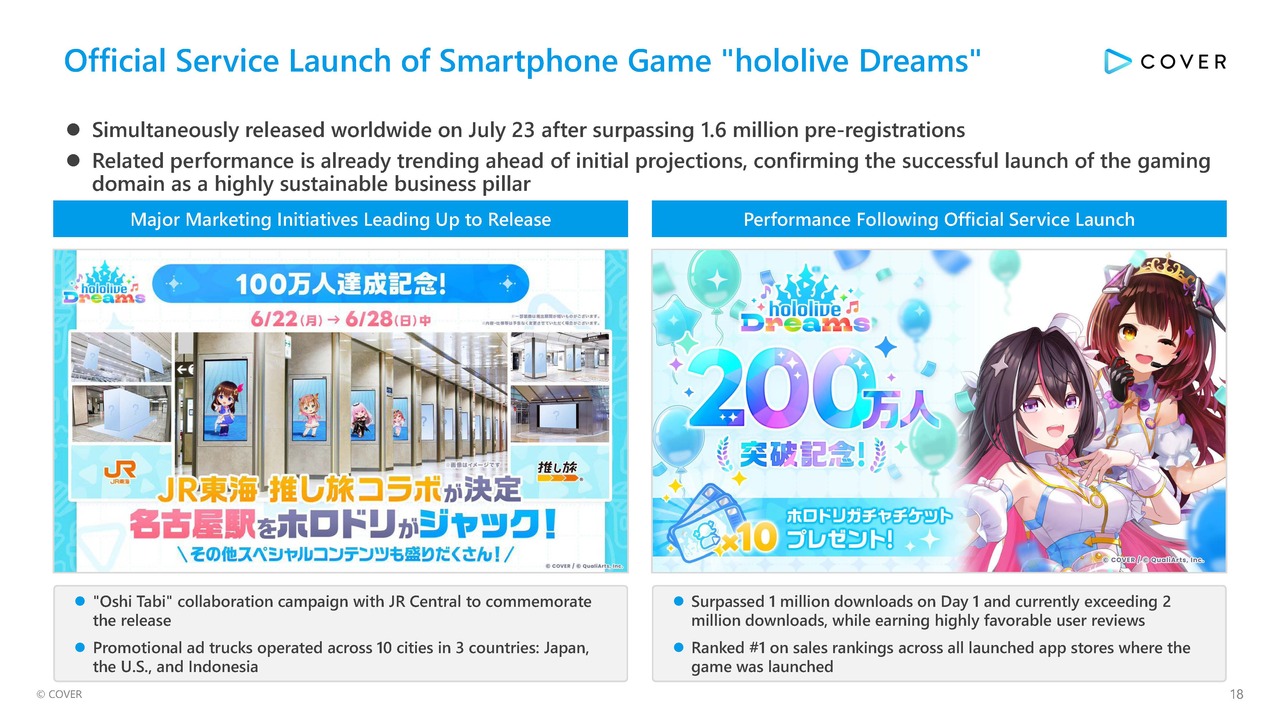
I will now discuss the official service launch of the smartphone game “hololive Dreams.” Through major marketing initiatives, including a collaboration with JR Central and promotional ad trucks operating across 10 cities in Japan, the United States, and Indonesia, we generated substantial exposure and are translating this into the reactivation of dormant fans and the acquisition of new fans.
After surpassing 1.6 million pre-registrations, the game was simultaneously released worldwide on July 23 and made a very strong start. On the first day, it ranked first in the app download rankings on both the App Store and Google Play, and it continues to rank highly in sales across platforms, including Steam.
We also view the game as an opportunity to continuously showcase the appeal of our talents through a medium other than video streaming. It reached 1 million downloads on the first day and has now surpassed 2 million. Performance is already exceeding our initial assumptions, confirming that the gaming business is off to a solid start as a highly sustainable pillar of our business.
This concludes my presentation.
Q&A: Merchandising Revenue
Questioner: I have a question about Merchandising revenue. Revenue appears to have continued declining compared with both Q1 of the previous fiscal year and the most recent Q4.
You explained that stockouts and limited product availability arose during the transition of sales operations. If I remember correctly, revenue also declined in the first half of the previous fiscal year because demand shifted between the e-commerce and retail sales channels. Is the same situation occurring again this time?
Or are different factors at work? Please provide more detail and explain when you expect the situation to improve.
Kaneko: Several factors are involved. From a channel perspective, one reason for the delayed recovery in e-commerce revenue is that production volume controls have been tightened in response to inventory adjustments, and production overall has remained conservative.
At the same time, operations for reallocating inventory across retail, e-commerce, and other sales channels have not yet been streamlined. We also need to optimize production volumes by talent. In particular, the supply of products for top talents has not kept pace with demand on our e-commerce store.
As a result, products for certain talents are in short supply, and we are seeing fans purchase alternative merchandise because the items they originally intended to buy are unavailable. The relevant departments are therefore coordinating to optimize supply chain management from the customer perspective and across channel-specific product manufacturing and sales operations.
Tanigo: In addition, we had no talent debuts in the previous fiscal year, while some talents graduated. As a result, there is currently no revenue contribution from new talents to offset the decline associated with graduated talents. I believe we need to be patient until new talents debut this fiscal year.
Kaneko: Taking these factors into account, the decline in revenue was anticipated in our plan. We expect the situation to be optimized gradually through the measures I have just described.
Q&A: Timing of Improvements in Product Supply
Questioner: You mentioned that product supply has been somewhat constrained by inventory adjustments. Is it reasonable to expect supply to return to normal levels from Q2?
Kaneko: We are rapidly improving our production operations, but there is a lag of several months from product planning and production until products actually reach stores and customers. We therefore expect the effects of these operational reforms to become gradually visible from around the midpoint of the fiscal year and into the second half.
Tanigo: That said, unlike birthday merchandise sold on a made-to-order basis, some company-led merchandise for talents with predictable demand is licensed out. One example shown on the slide is the Sakura Miko pop-up shop at TSUTAYA.
Our product sales span not only Merchandising but also Licensing/Collaborations. We therefore believe that optimizing and improving the overall product supply system will require a carefully developed strategy over time.
Q&A: Spillover Effects of “hololive Dreams” on Other Businesses
Questioner: Could you discuss the spillover effects of “hololive Dreams” on your other businesses? I think it is an excellent game that deepens fans’ understanding of the talents and their music and increases fan enthusiasm. What positive effects do you expect on fan growth and merchandise sales?
Also, hololive English -Advent- held its third anniversary concert three days ago, and it attracted a very large number of viewers. Are you beginning to see momentum from this expansion in concerts, including in terms of financial performance?
Tanigo: Regarding the viewing experience for streaming and video content, platform algorithms made it difficult over the past six months to surface short-form videos to new users. Since the release of “hololive Dreams,” however, we have seen previously buried content, particularly music videos, resurface and gain views.
I believe this effect could continue. Fans who currently support a single talent may also begin supporting multiple talents or the entire group. We will need to continue monitoring the data and analyzing these trends.
Kaneko: As Tanigo noted, some of you may be following third-party sales rankings, and we believe the impact on our results is turning positive. More importantly, views of our music videos are increasing, and we are beginning to see clear signs that actual customer demand, which was difficult to identify before the release, is flowing back to our core content.
Accordingly, although this remains a forecast at the time of our Q1 results announcement, we believe we can expect a positive impact.
Q&A: Growth of the VTuber Market and Next Initiatives
Questioner: This may be somewhat premature, but I would like to ask about the initiatives that will follow “hololive Dreams.” The success of the game is very reassuring, but I believe the equity market is particularly interested in where your next growth opportunities may lie.
The presentation mentions new talent debuts, new studio technologies, growth investments, and various other initiatives. Mr. Tanigo, could you tell us which areas you are particularly optimistic about?
Tanigo: It is difficult to choose just one, but if I had to, I would point to the VTuber market itself. To date, we and our peers have primarily developed what might be called streamer-style VTubers. We are now seeing very strong growth in PLAVE, a K-pop-style, artist-focused VTuber group developed by VLAST.
We believe artist-focused VTubers have characteristics that make them well suited to expanding globally across borders. The VTuber market itself is thus expanding in ways that go beyond a simple extension of past trends, and we expect this to create significant business opportunities.
We also believe games and media mix are areas in which we have particular strengths. This game title has been developed over the past three and a half to four years with an internal producer leading the project. Typically, a game of this kind would have a producer only on the external development partner’s side. For this project, however, COVER also appointed an experienced internal producer, who worked in close communication with the producer at QualiArts, the game developer.
VTubers have often been viewed as live, constantly evolving entertainment that is difficult to develop into enduring IP. We have also seen anime-related projects at other companies stall. Through careful communication, however, we have demonstrated that we can bring these initiatives to fruition one by one. I continue to see considerable potential in this area.
Furthermore, we believe North America and East Asia still offer substantial room for growth. HYBE has also shown signs of exploring the VTuber business in North America. At COVER, meanwhile, there remains significant untapped potential in Merchandising and Licensing in these regions. We expect these areas to offer considerable opportunities for expansion.
Q&A: Impact of Merchandising Stockouts
Questioner: Could you provide a quantitative estimate of the impact of stockouts in Merchandising?
Kaneko: It is difficult to estimate the impact precisely. However, based on fan behavior, there are clearly cases in which latent demand is concentrated on merchandise for top talents but no products are available for fans to purchase.
As for whether the impact of graduated talents has spread to demand for other talents, our analysis of the impact relative to prior fiscal years indicates that the lost demand has been limited to merchandise for the graduated talents themselves.
Accordingly, if we had been able to offset the impact of graduated talents and capture these lost sales opportunities, I believe it would have been entirely possible to maintain Merchandising revenue at a level comparable to prior fiscal years.
Q&A: Revenue Contribution from “hololive Dreams”
Questioner: “hololive Dreams” appears to be a much larger hit than expected. To the extent possible, could you quantify its revenue contribution, the degree to which it is exceeding the plan, and the respective performance in Japan and overseas?
Kaneko: This project is being jointly developed with a partner company, so it is difficult for us to disclose unilaterally the extent of the upside. However, revenue is significantly exceeding the conservative assumptions for the game in our initial plan.
Regarding the breakdown between Japan and overseas, these are preliminary figures, so it is difficult to comment on the precise full-year picture. At present, however, we understand that approximately 30% of demand for the game is coming from overseas. We consider that a reasonably favorable figure for the initial stage.
Q&A: Initial Assessment of the “mekPark” Trainee Project
Questioner: You have launched the “mekPark” trainee project. How do you assess its initial performance? You will presumably implement various initiatives going forward. To the extent possible, could you describe the planned development of the project, including the timeline?
Tanigo: It is very difficult to assess the initial response. The important premise is that even if “mekPark” performs well at the outset, that does not necessarily tell us how the talents will perform after their full debut.
For us, general auditions are somewhat analogous to recruiting new graduates. At the same time, we have also recruited talents through a more conventional process comparable to mid-career hiring, and we intend to continue using this approach.
When operating a unit, we need to develop not only the talents but also directors who can reliably manage the unit. Experienced directors are difficult to recruit externally, so we need to develop qualified directors in-house.
We believe initiatives of this kind are necessary to make the VTuber business sustainable as an industry, and this is why we are pursuing the project.
Within the UNIT B (Pre-Debut) and ACHRORA projects, each unit has its own director. The directors and talents are building strong relationships as they work together. Although we did not set particularly high expectations for channel subscriber numbers, I believe the results have exceeded our expectations.
As we identify the talent units best suited for full debut, we intend to monitor customer response and develop their activities with a view to full debut and beyond.
In addition, given the degree of success achieved by “hololive Dreams,” we believe the game could serve as a launchpad for debuting new talents and units.
At present, talents such as FLOW GLOW have not yet appeared in “hololive Dreams.” Adding talents who have not yet been featured will make it easier for existing fans to discover them, providing us with more ways to build their popularity.
Q&A: Q1 SG&A Expense Progress
Questioner: I would like to confirm the progress of SG&A expenses. Were Q1 SG&A expenses in line with the plan, or were they lower than planned? Also, how sustainable do you expect the restraint in SG&A expenses to be from Q2 onward?
Kaneko: We believe SG&A expenses are trending below the plan. We have not specifically curtailed proactive investments. Rather, we are actively redeploying employees internally based on their areas of expertise. By assigning the right people to the right roles, we have reduced the need for new hires, and we believe this is having a positive effect.
Turning from SG&A expenses to cost of sales, at the beginning of the fiscal year and during budget formulation, we noted the risk that merchandise procurement costs could rise due to global inflation and foreign exchange movements. Improvements in the procurement process have produced results, and even amid macroeconomic upward pressure, we have been able to keep the cost of sales ratio approximately flat.
Q&A: Sustainability and Growth Outlook for “hololive Dreams”
Questioner: “hololive Dreams” appears to be performing extremely well, and I would like to ask about its sustainability. Smartphone games tend to perform strongly at launch and then gradually decline.
Do you expect “hololive Dreams” to decline slowly over time, or do you view it as a game in which constraints such as the number of available characters could lead active users to consume the content relatively quickly? I would appreciate your perspective.
Tanigo: We believe it is the former. Some talents have not yet debuted, and whenever talents create new songs in the future, we expect to be able to add those songs to the game.
In addition, although we did not debut any talents in the previous fiscal year, future debuts will allow us to add both the talents and the songs they create as new content.
Another reason for the very strong launch is that our talents are streaming the game, and I believe we saw the same dynamic with the trading card game. The ability to add new content and the promotional effect of talent streams are both important, and we expect “hololive Dreams” to be played relatively consistently over time.
Questioner: I have watched streams by Usada Pekora and other talents. Given the potential to add content, is it correct to understand that you expect the game to expand slowly and steadily?
Tanigo: That is correct. As our first game title, it was designed for long-term operation with the aim of becoming an enduring flagship for COVER.
Q&A: Progress and Impact of Organizational Reforms
Questioner: I believe I asked about this previously, but what progress or traction have you seen from the organizational reforms implemented through this summer?
Previously, you mentioned criticism of the Company on online message boards as an issue. What changes have resulted from the organizational response?
Kaneko: The changes are wide-ranging. From the perspectives of crisis management and reputation management, we have clearly strengthened our initial response capabilities and enhanced our public relations structure. As a result, we believe derisive commentary about the Company’s structure and talent activities is beginning to subside.
The opening section of the slide states that we established a new department specializing in enhancing the creative environment for talents under the Talent Management Division. To improve operations, we have created a cross-functional organization that considers not only efficiency from a business perspective but also whether the environment is genuinely conducive to talents’ work and creative activities. This organization is reviewing unresolved issues raised by many talents and addressing them one by one.
As employees see the Company making steady improvements, I sense that optimism about a brighter outlook is beginning to grow internally.
Q&A: Q1 Performance of the Trading Card Game Business
Questioner: I have a question about the trading card game business. I believe Q1 revenue was the lowest quarterly figure to date. Could you provide more detail on the differences in sales schedules and product mix?
Are sales of the booster packs and other products that were released continuing to perform steadily, and should we expect a recovery in Q2 based on the sales schedule?
Kaneko: First, regarding the YoY comparison for Q1, trading card game revenue was just under 2 billion yen in Q1 of the previous fiscal year, which was an exceptionally high level. Reprints of previously released card packs were concentrated in that quarter, substantially boosting revenue. We therefore believe the YoY decline in Q1 of the current fiscal year largely reflects this high comparison base.
Sales of new booster packs also remained solid, although they may not have reached an explosive level in this particular quarter. The packs featured talents who are particularly popular overseas, but because our overseas market development was still at an early stage, supply-demand imbalances may also have affected sales.
As a catalyst for the trading card game business this fiscal year, we are focusing on tournaments that can stimulate player demand, with an increasing number of initiatives designed to engage overseas participants.
We are also expanding marketing initiatives for the trading card game in coordination with the other business lines shown on the slide. At a measured pace that avoids disrupting the market, we are steadily implementing initiatives to broaden underlying demand on multiple fronts.
Q&A: Potential Cannibalization from “hololive Dreams”
Questioner: Following the release of the mobile game “hololive Dreams,” you discussed positive traffic flowing back to music videos and other content. Now that about three weeks have passed since the release, how do you view the possibility of cannibalization as users allocate their wallet share across products and services, including music videos and streams?
Kaneko: At least at this point, we do not believe any negative impact from cannibalization has become apparent. The business division’s view is that spending on games and digital content does not substantially cannibalize spending on physical items such as plush toys.
That said, this remains only a preliminary estimate. We will continue to monitor the situation closely and work to prevent demand cannibalization. At the same time, we want to proactively create cross-functional synergies that stimulate demand among both new and existing users, expand exposure through the game, and further grow the market.
Q&A: Confidence in the First-Half Earnings Forecast
Questioner: Could you revisit your current confidence in the first-half earnings forecast? I believe Q1 operating profit represented progress of 34% against the first-half forecast. Q2 was originally expected to be larger due to the release of “hololive Dreams,” and, as you explained, the game’s initial performance is exceeding your plan.
Although there has been no change to the first-half earnings forecast, I would appreciate any comments on your confidence in achieving it and, if there is potential upside, how much we might reasonably expect.
Kaneko: Q2 results tend to be larger than Q1 each year due to seasonality, as the summer holiday period makes it easier to capture customer demand. The same applies this fiscal year. Given that “hololive Dreams” is performing significantly above our assumptions, we do not see substantial downside risk to the first-half operating profit forecast.
However, as we are still partway through Q2, it is too early to determine the extent of any upside.
Q&A: Mr. Tanigo’s Assessment of Talent Management
Questioner: I have a question about Mr. Tanigo’s assessment of talent management. I understand that you now directly oversee the talent management function. Has this improved communication with talents, and could it reduce future graduations or potentially lead former talents to return?
Tanigo: Please understand that I oversee not only the Talent Management Division but also Streaming/Content, and that I am the executive responsible for oversight rather than the manager responsible for day-to-day operations.
I also met with talents last year, but those discussions were limited to one-on-one communication. While I could understand individual needs, it was difficult to build consensus that also took other talents into account.
Since the start of this fiscal year, together with the head of the Talent Management Division, I have been communicating with talents on a unit-by-unit basis and extending this approach across other units. I feel this has made it much easier for the Company and the talents to align their perspectives.
This helps prevent misunderstandings. By establishing this foundation, we also believe that the various divisions can work more smoothly with each talent.
That said, I honestly cannot say whether this will reduce the number of graduations or lead former talents to return.
For talents who have been active for a long time, changes in their stage of life may also affect their career choices. We want to respond flexibly to such changes, but we cannot say with certainty whether doing so will lead to fewer graduations or the return of former talents.
Q&A: Initial Overseas Assumptions for “hololive Dreams”
Questioner: I have a follow-up question about “hololive Dreams.” You said that performance is significantly exceeding the initial forecast and that roughly 30% is coming from overseas. Is it correct to understand that overseas performance is also above the initial forecast? Could you discuss the results and recent trends relative to your initial overseas assumptions?
Kaneko: Overall volume is exceeding the initial forecast. The 30% overseas share also appears reasonable when compared with other Japanese games and with the proportion of overseas viewers for streams by our talents. We therefore believe it is fair to say that overseas performance is also exceeding our assumptions in proportion to the outperformance in overall volume.