Contents
Hidenori Kobuchi (hereinafter “Kobuchi”): My name is Hidenori Kobuchi, President and Representative Director of Toagosei Co., Ltd. Thank you very much for taking time out of your busy schedules to attend our financial results briefing for 1H FY2026 today.
This year, we launched a new medium-term management plan, but shortly after its launch, we faced the closure of the Strait of Hormuz. Today, I will explain how the Group has responded so far and the results of those efforts, as well as how we intend to move forward. Although our time is limited today, I hope this will be an opportunity for you to deepen your understanding of and trust in the Group.
As shown in the table of contents, I will cover our results for 1H FY2026, our full-year results forecast for FY2026, and topics from the medium-term management plan, in that order.
Summary of Financial Results for 1H FY2026
I will begin by explaining our results for 1H FY2026.
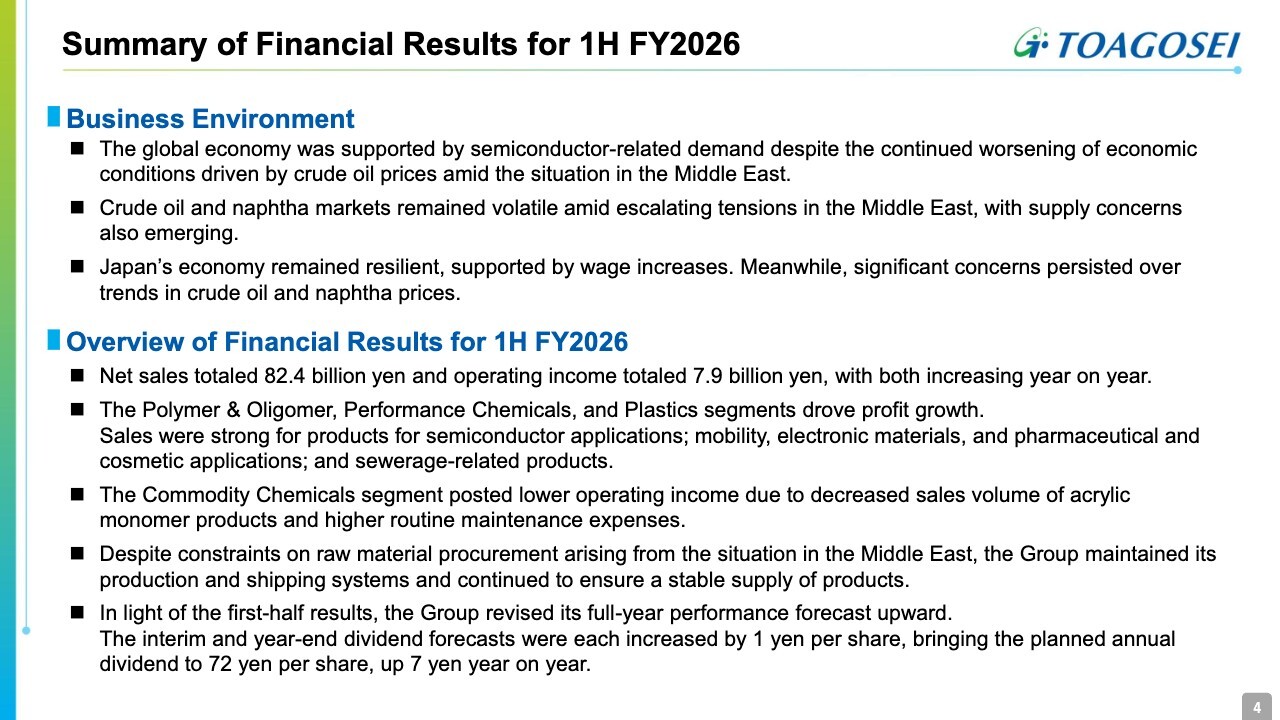
First, the business environment. The global economy continued to face worsening economic conditions driven by crude oil prices amid the situation in the Middle East, while semiconductor-related demand, supported by expanding AI demand, provided support. Crude oil and naphtha markets also remained volatile amid escalating tensions in the Middle East, and supply concerns emerged.
Japan’s economy remained resilient, supported by wage increases. Meanwhile, significant concerns persisted over trends in crude oil and naphtha prices. Against this backdrop, net sales for the first half were ¥82.4 billion and operating income was ¥7.9 billion, with both increasing year on year.
By segment, Polymer & Oligomer, Performance Chemicals, and Plastics drove profit growth. Looking at these areas, sales were strong in our key focus areas of semiconductors, mobility, electronic materials, sewerage-related products, and products for pharmaceutical and cosmetic applications. Meanwhile, operating income in Commodity Chemicals declined due to lower sales volume of acrylic monomers and higher routine maintenance expenses.
Overall, despite raw material procurement constraints arising from the situation in the Middle East, we maintained our production and shipping systems and continued to ensure a stable supply. In light of the first-half results, we also revised our full-year performance forecast upward. As a result, we raised both the interim and year-end dividend forecasts by ¥1 per share and now plan an annual dividend of ¥72 per share.
Overview of Semi-annual Results for FY2026
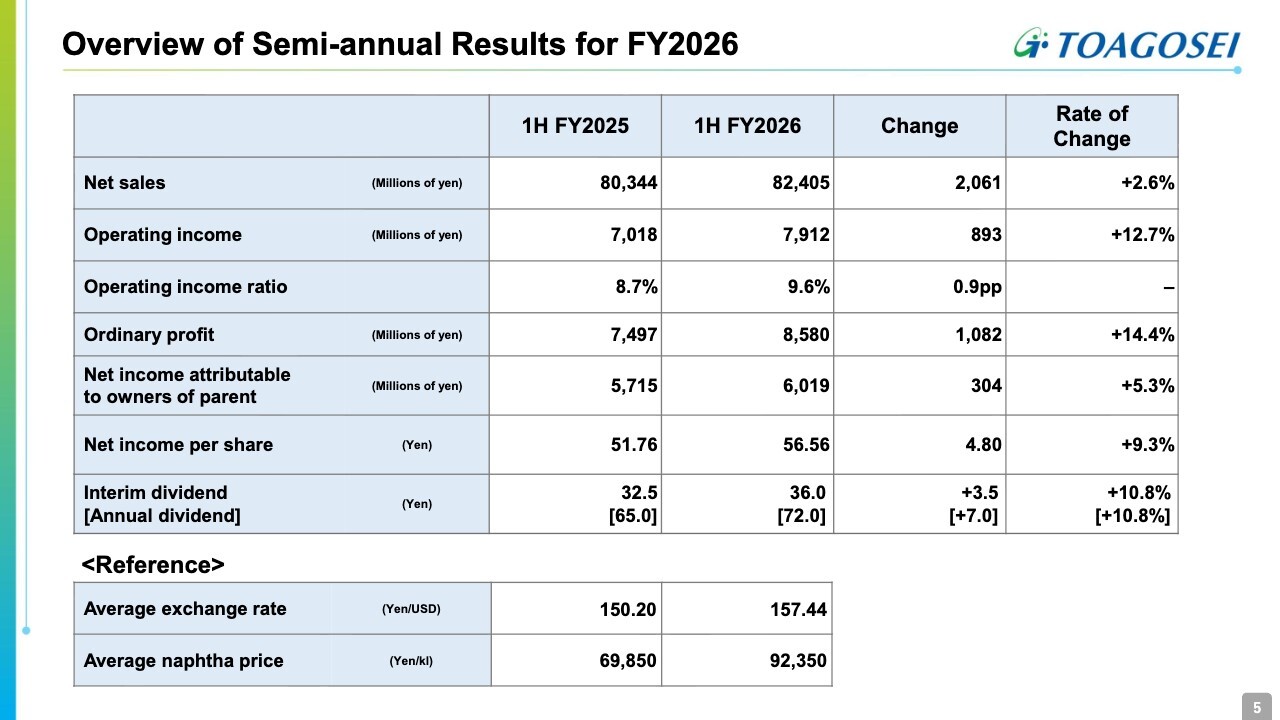
This is an overview of our first-half results. Net sales were ¥82,405 million and operating income was ¥7,912 million, with both increasing year on year.
In response to escalating tensions in the Middle East, we maintained our production and shipping systems and continued to ensure a stable supply, except for certain products. Another factor was strong sales of product groups in our four key focus areas, led by products for semiconductor applications.
Net income attributable to owners of parent increased by ¥304 million year on year to ¥6,019 million, as the increase in ordinary profit more than offset lower gains on sales of investment securities.
Regarding dividends, in line with the policy of our medium-term management plan, we raised the interim dividend forecast by ¥1 to ¥36 per share and also raised the year-end dividend forecast to ¥36 per share. This brings the annual dividend to ¥72 per share, an increase of ¥7 year on year.
Analysis of Changes in Operating Income
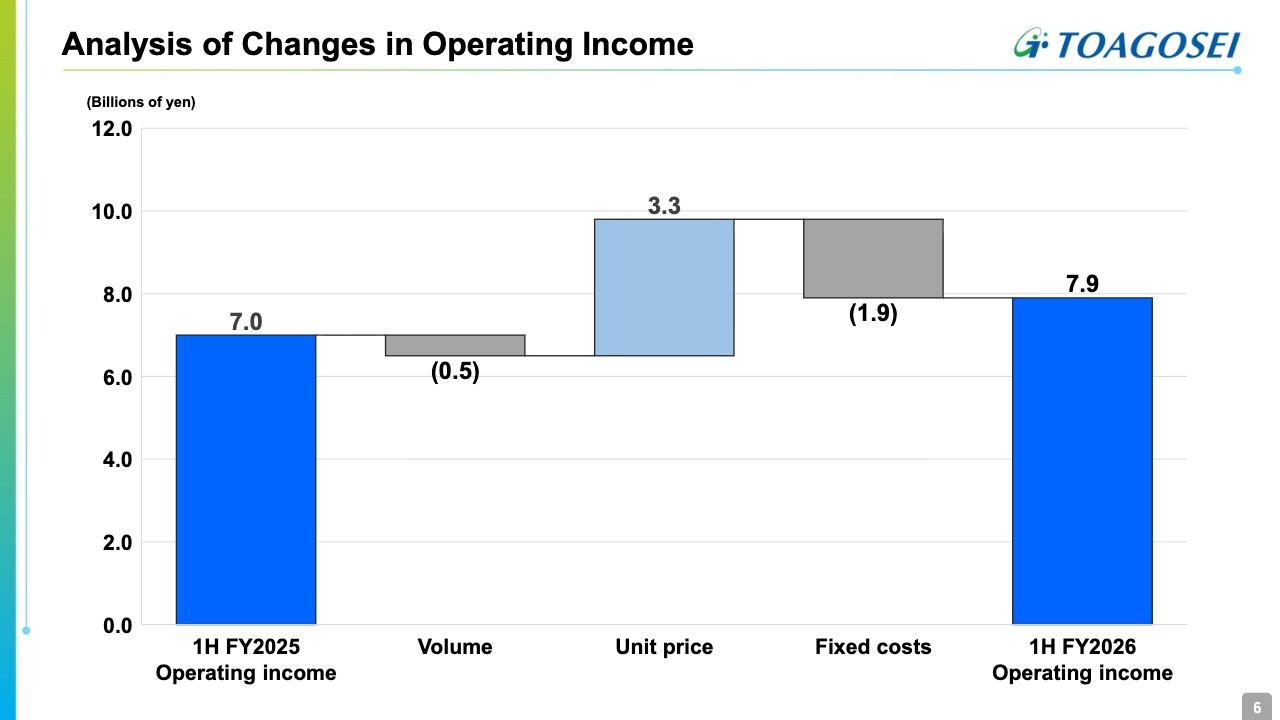
This slide analyzes changes in operating income. Fixed costs increased due to factors including higher labor costs resulting from proactive wage increases and higher depreciation expenses associated with capital investment. However, through appropriate price revisions and profitability improvements, operating income increased by approximately ¥0.9 billion year on year.
The volume impact was negative ¥0.5 billion. However, this included a ¥1.3 billion negative impact from our withdrawal from the polyvinyl chloride business and the end of contract manufacturing for certain products as part of last year’s portfolio review, so the underlying volume impact was positive ¥0.8 billion. Shipment volumes were solid, particularly for high-function products.
Consolidated Results (by Segment) 1H
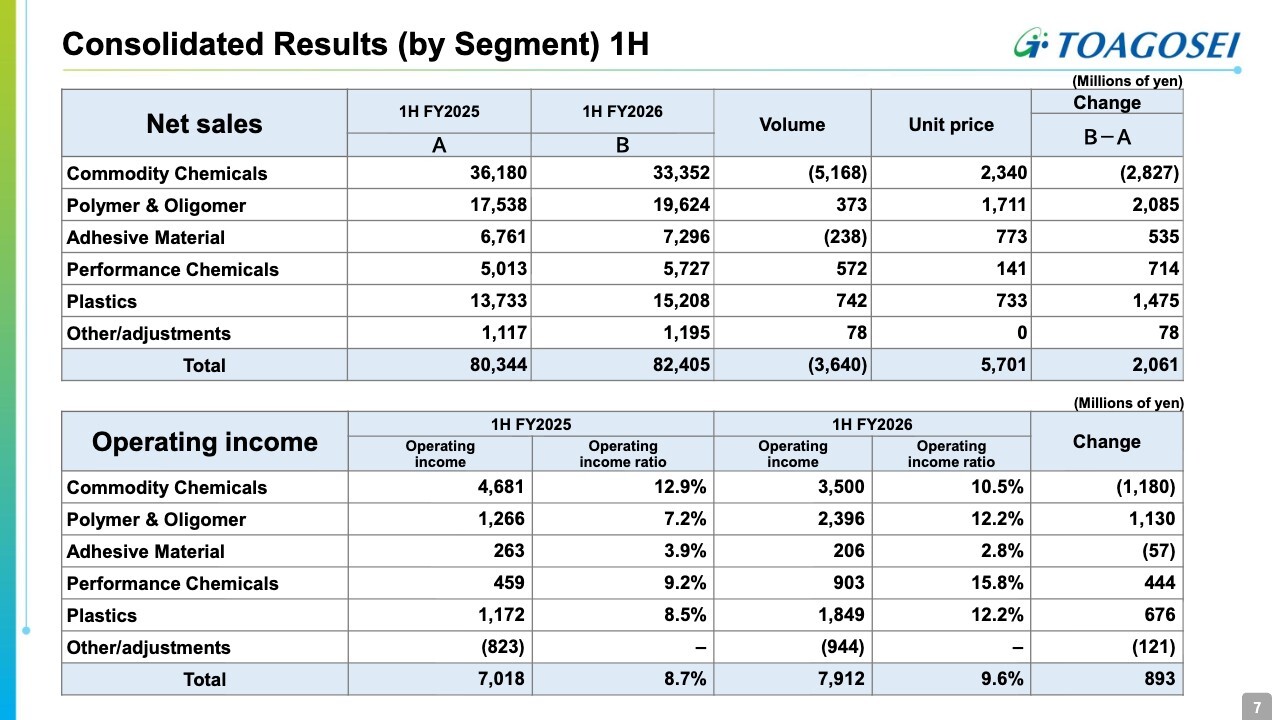
These are our consolidated results by segment. In Commodity Chemicals, both net sales and operating income decreased year on year, mainly reflecting our withdrawal from the polyvinyl chloride business as part of the portfolio review and lower monomer sales due to shipment restrictions imposed because of naphtha shortages.
Meanwhile, Polymer & Oligomer, Performance Chemicals, and Plastics performed strongly, resulting in higher net sales and operating income overall.
Polymer & Oligomer benefited from increased sales volumes in semiconductors, electronic materials, mobility, and materials for pharmaceuticals and cosmetics, as well as profitability improvements. In Performance Chemicals, high-purity inorganic chemicals for semiconductor applications performed strongly, while Plastics posted higher net sales and operating income due to increased sales volumes of sewerage-related products and profitability improvements.
Consolidated Statement of Income (Non-operating Income/Expenses and Extraordinary Income/Losses)
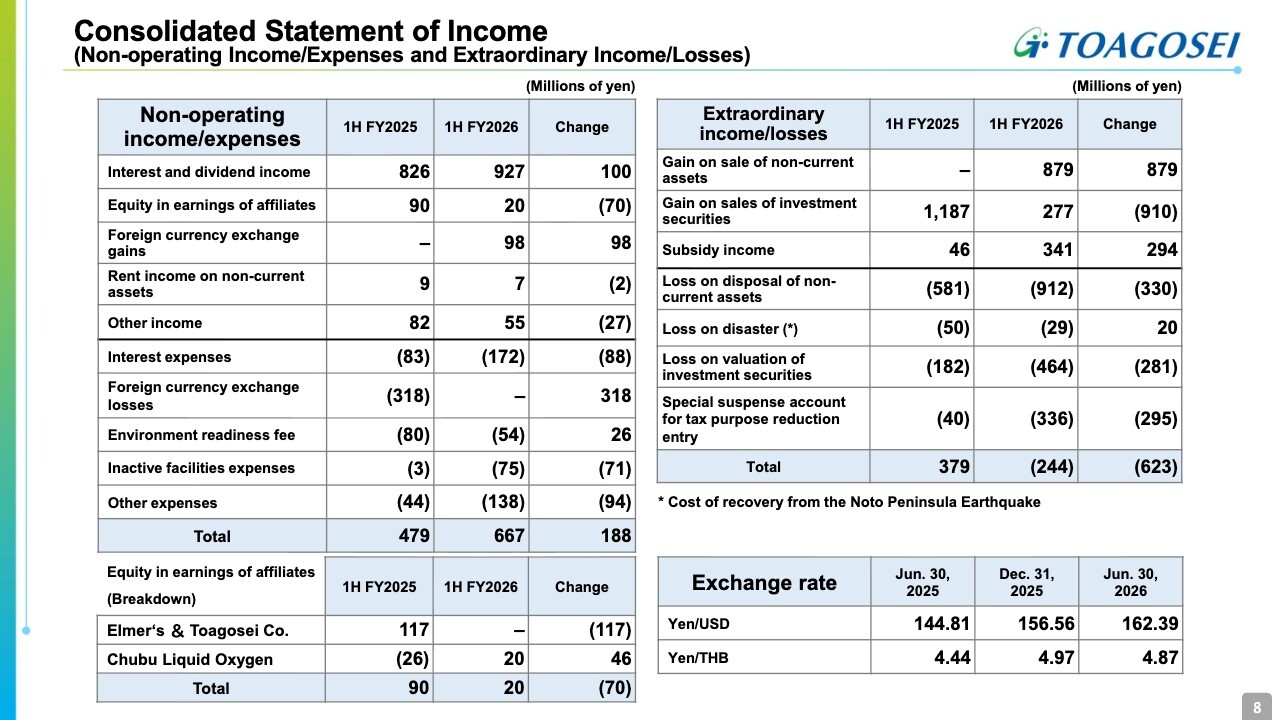
This slide presents non-operating income/expenses and extraordinary income/losses. In non-operating items, we recorded foreign exchange losses of approximately ¥0.3 billion last year due to the stronger yen, whereas this year the weaker yen resulted in foreign exchange gains of approximately ¥0.1 billion. The combined year-on-year impact of foreign exchange was therefore positive by approximately ¥0.4 billion.
Equity in earnings of affiliates decreased by ¥70 million, and interest expenses increased by ¥88 million, mainly due to interest payments on bonds. Even so, non-operating income/expenses improved by ¥188 million overall.
As for extraordinary income/losses, we recorded gains on the sale of non-current assets of approximately ¥0.9 billion, while gains on sales of investment securities decreased by approximately ¥0.9 billion. In addition, we recorded approximately ¥0.3 billion in losses on disposal of non-current assets associated with the removal of unnecessary equipment at plants and approximately ¥0.3 billion in valuation losses on investment securities, including those related to venture companies. As a result, extraordinary income/losses deteriorated by approximately ¥0.6 billion year on year.
Consolidated Balance Sheet
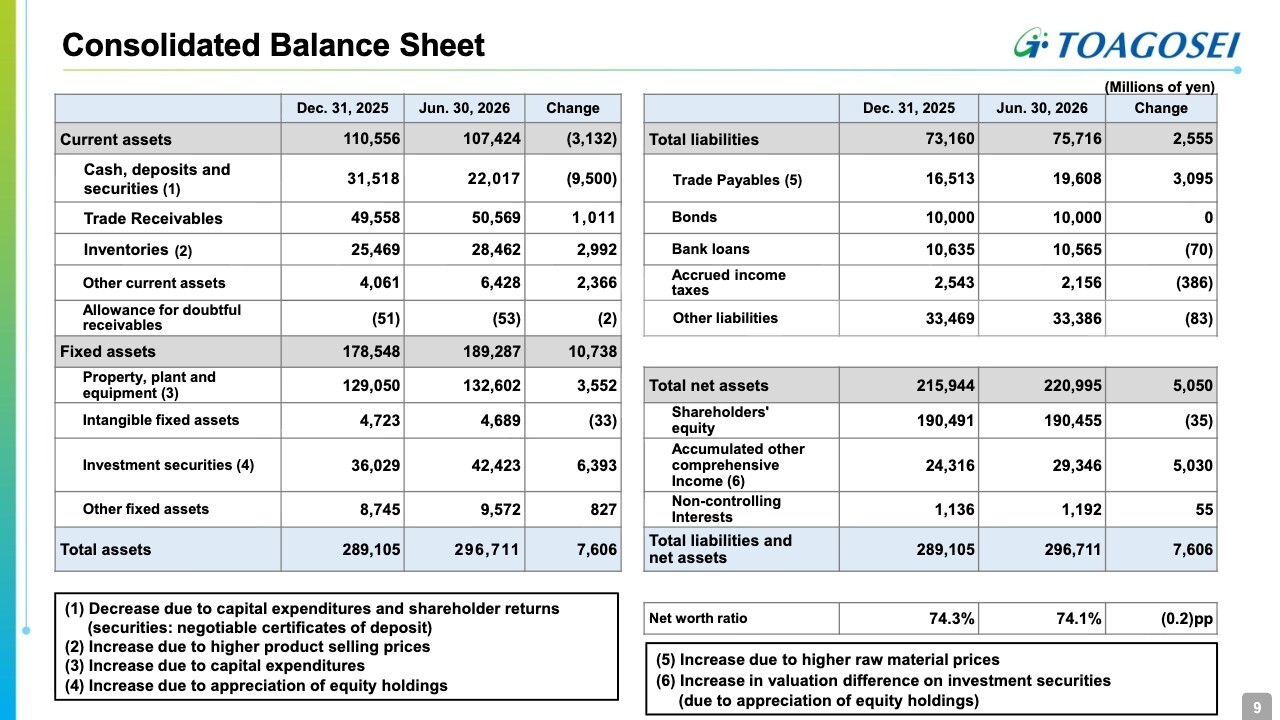
This is our consolidated balance sheet. On the asset side, cash and deposits decreased as a result of proactive capital investment and shareholder returns, while property, plant and equipment increased. In addition, a significant rise in the share prices of cross-held shares contributed to an increase in total assets of approximately ¥7.6 billion from the end of the previous fiscal year.
Liabilities increased by approximately ¥2.5 billion, mainly because trade payables rose with higher raw material prices. Net assets increased by approximately ¥5.0 billion from the end of the previous fiscal year. Shareholders’ equity did not increase due to proactive shareholder returns, but the rise in the share prices of equity holdings boosted net assets. The net worth ratio decreased by 0.2 percentage points to 74.1%.
Cash Allocation (1H FY2026)
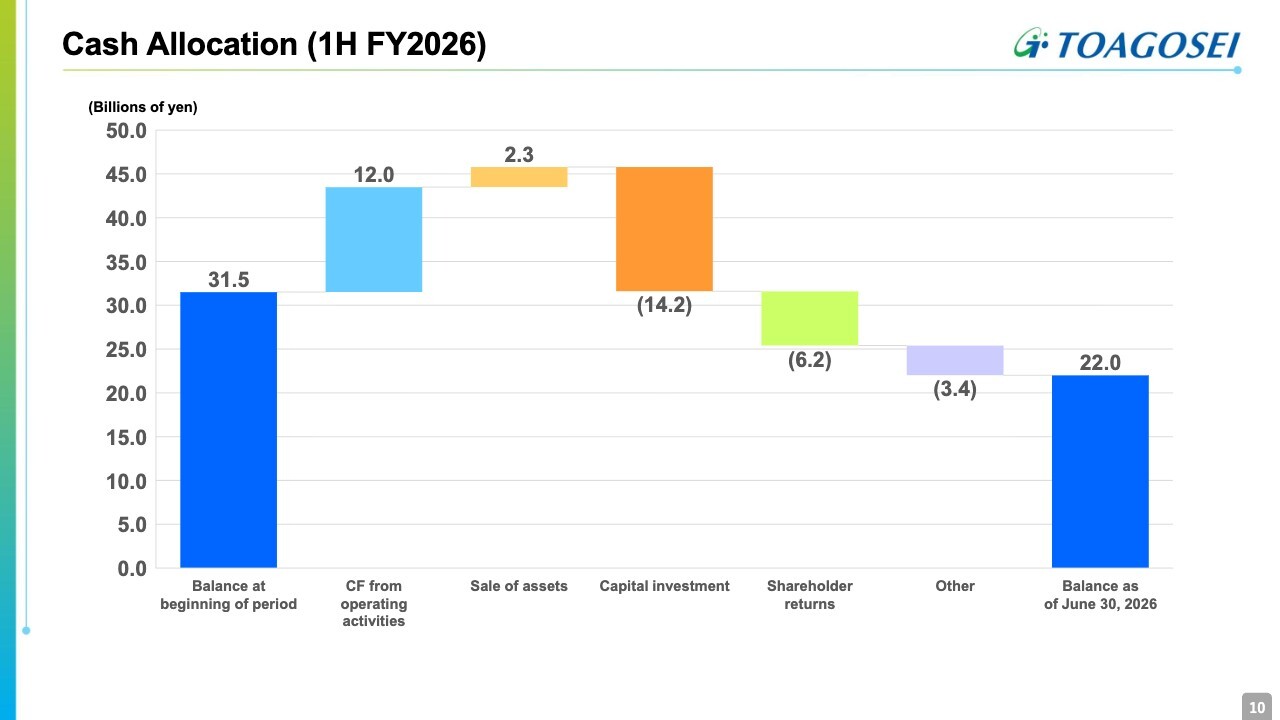
I will now explain our cash allocation. Cash flow from operating activities totaled ¥12.0 billion, comprising ¥6.0 billion in net income and ¥6.0 billion in depreciation expenses.
After addressing increases in R&D expenses and labor costs, we made proactive capital investments of ¥14.2 billion, mainly in growth areas, and returned ¥6.2 billion to shareholders. As of June 30, 2026, cash and deposits stood at ¥22.0 billion.
We will continue to maintain financial soundness while making use of external funding as needed, with the aim of achieving sustainable growth and maximizing corporate value.
Challenges in 2H FY2026
Next, I will explain our full-year results forecast for FY2026.
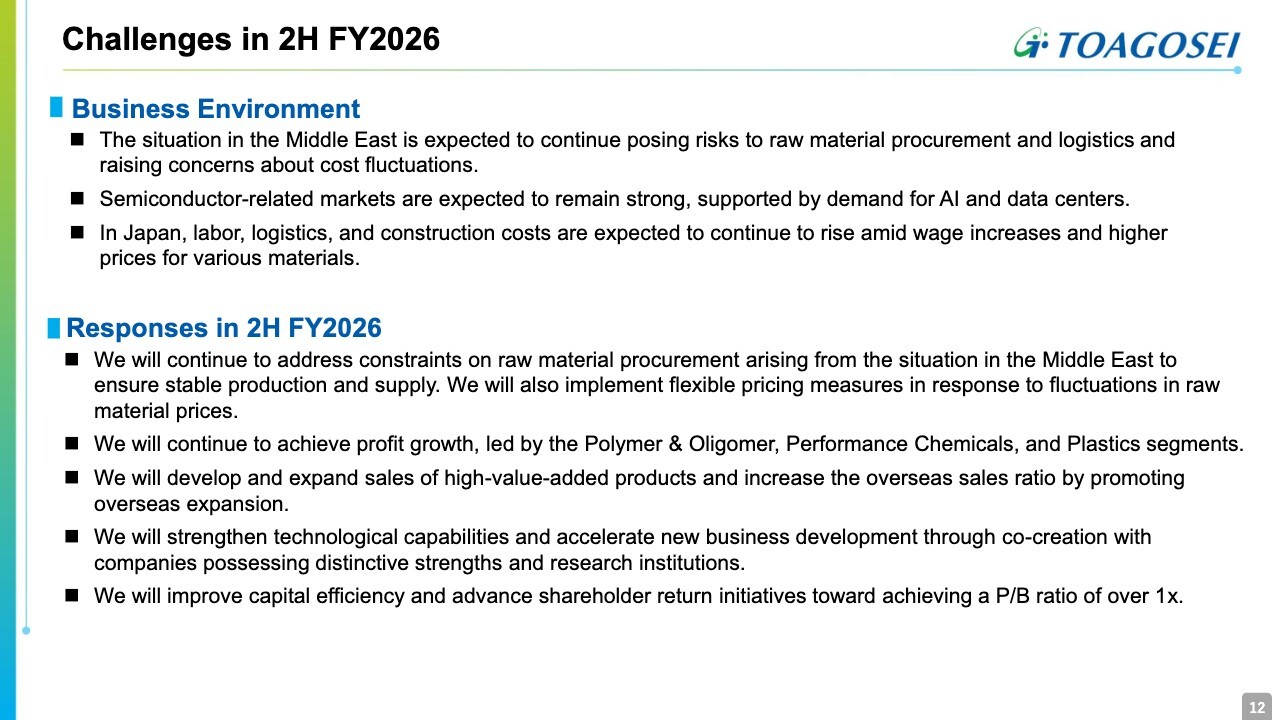
In the business environment, concerns persist over raw material procurement and logistics risks, as well as cost fluctuations, due to the situation in the Middle East. Meanwhile, semiconductor-related markets continue to perform strongly, supported by demand for AI and data centers. In Japan, labor, logistics, and construction costs continue to rise amid wage increases and higher prices for various materials.
Under these conditions, our key challenges and responses for 2H FY2026 are to continue addressing raw material procurement constraints arising from the situation in the Middle East in order to ensure stable production and supply, while also implementing flexible pricing measures in response to fluctuations in raw material prices. At the same time, we aim to sustain profit growth in product groups led by the strongly performing Polymer & Oligomer, Performance Chemicals, and Plastics segments.
Overall, we will advance the medium-term management plan initiatives of developing and expanding sales of high-function products, increasing the overseas net sales ratio by promoting overseas expansion, and strengthening technological capabilities and accelerating new business development through co-creation with companies possessing distinctive strengths and research institutions. Through these efforts, we aim to achieve a P/B ratio of over 1x by expanding profit, improving capital efficiency, and advancing shareholder return initiatives.
Full-year Consolidated Results Forecast for FY2026 (Year-on-year Comparison)
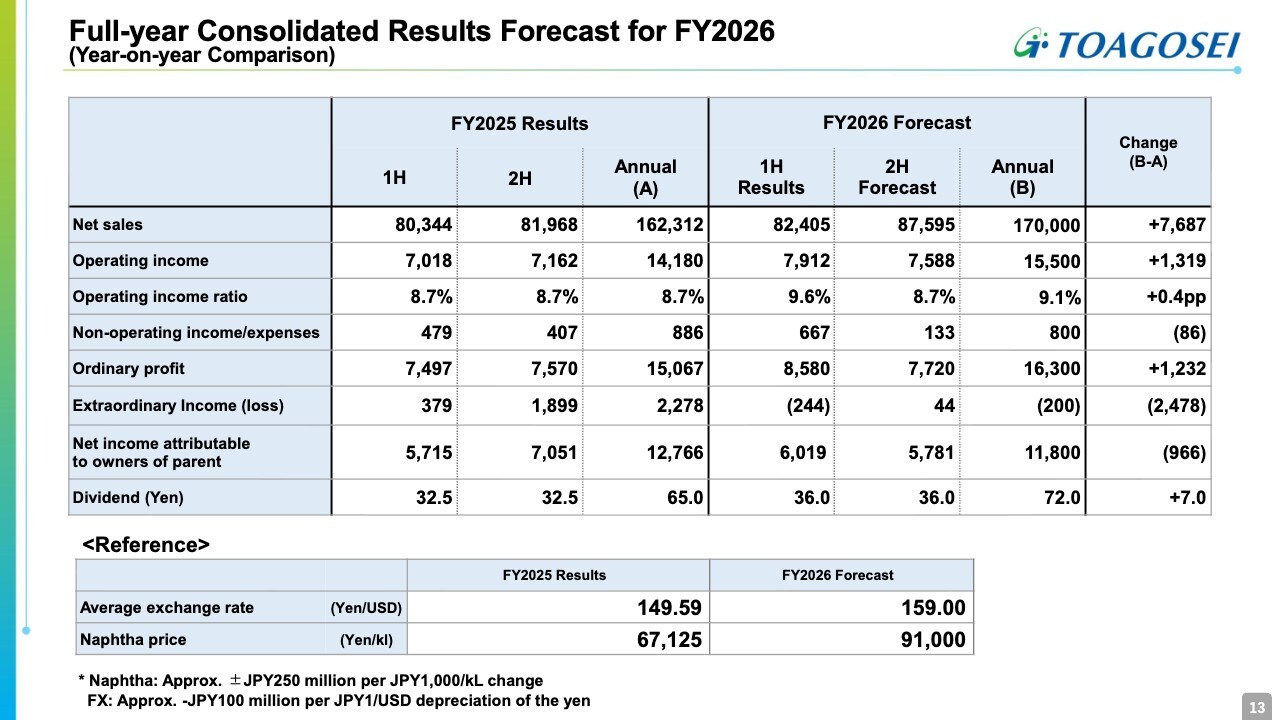
In the first half, in response to disruption arising from the situation in the Middle East, we worked to secure raw materials and fuel, maintain supply, and adjust prices, thereby limiting the impact. Operating income increased year on year, supported by strong sales of high-function products.
In the second half, we expect sales of high-function products, particularly semiconductor-related products, to remain solid. However, given the continuing uncertainty surrounding the situation in the Middle East, as well as the possibility of a pullback following some front-loaded shipments and price adjustments, we forecast second-half operating income of ¥7,588 million, up approximately ¥0.4 billion year on year, based on the latest business environment.
As a result, for FY2026 we forecast consolidated net sales of ¥170.0 billion and operating income of ¥15.5 billion, representing 105% and 109% of FY2025 levels, respectively.
As for extraordinary income/losses, because gains on sales of cross-held shares are expected to decline significantly year on year, we forecast net income attributable to owners of parent of ¥11.8 billion, down approximately ¥1.0 billion year on year.
Analysis of the Forecasted Changes in Operating Income
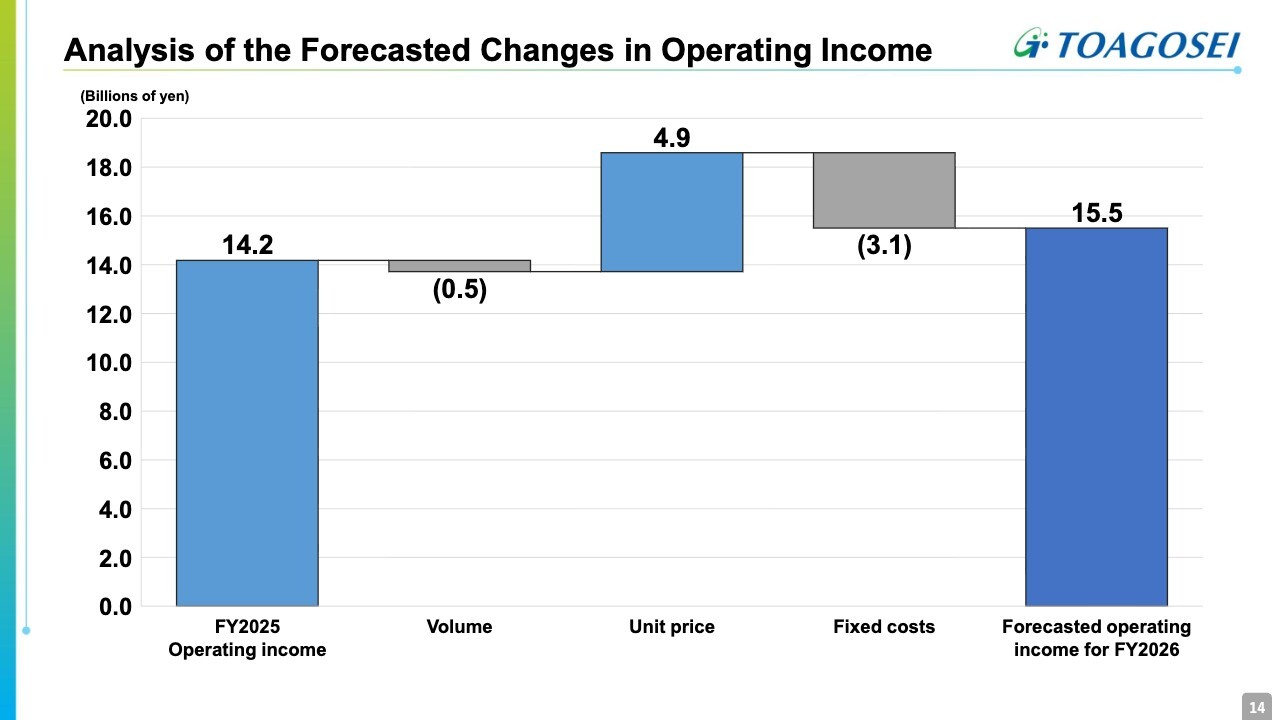
This slide analyzes the forecasted changes in operating income. We expect a negative fixed cost impact of ¥3.1 billion due to factors including higher labor costs resulting from proactive wage increases and higher depreciation expenses associated with capital investment. However, this will be covered by a positive unit price impact of ¥4.9 billion, and we forecast FY2026 operating income of ¥15.5 billion, up ¥1.3 billion year on year.
For the unit price impact, we are factoring in price adjustments and settlements, with a positive impact of ¥3.3 billion in the first half and ¥1.6 billion in the second half.
The volume impact is negative ¥0.5 billion. However, this includes a ¥2.2 billion negative impact from our withdrawal from the polyvinyl chloride business and the end of contract manufacturing for certain products as part of last year’s portfolio review, so we forecast an underlying positive volume impact of ¥1.7 billion. We expect higher sales led by high-function products.
Full-year Consolidated Results Forecast for FY2026 (Year-on-year Comparison by Segment)
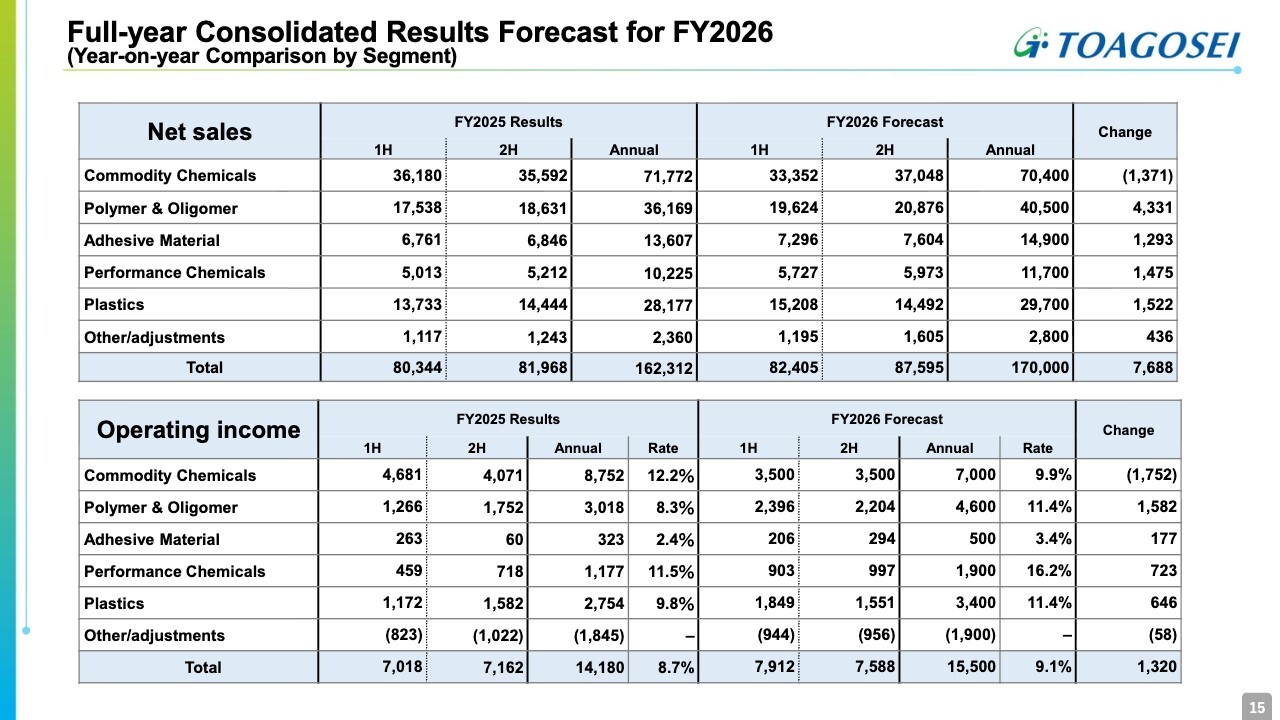
This is our consolidated results forecast by segment. In Commodity Chemicals, we expect a significant benefit in the second half from the lifting of shipment restrictions on monomers, but not enough to offset the decline in profit in the first half. In addition, the full-year impact of our withdrawal from the polyvinyl chloride business and other products last year will remain significant, so we forecast year-on-year decreases in both net sales and operating income.
In Polymer & Oligomer, sales of products for semiconductors, electronic materials, mobility, and materials for pharmaceuticals and cosmetics are expected to remain strong in the second half, and we forecast higher net sales and operating income for the full year. Similarly, in Performance Chemicals, high-purity inorganic chemicals for semiconductor applications are expected to remain strong in the second half, and we forecast higher net sales and operating income for the full year.
In Plastics, we expect lower net sales and operating income in the second half compared with the first half due to a pullback following front-loaded shipments in the first half and higher raw material prices. For the full year, however, we forecast higher net sales and operating income year on year.
On a consolidated basis, although we expect some price adjustments in the second half, shipments are generally expected to remain solid. We forecast full-year operating income of ¥15.5 billion, an increase of approximately ¥1.3 billion year on year.
Trends in Consolidated Results
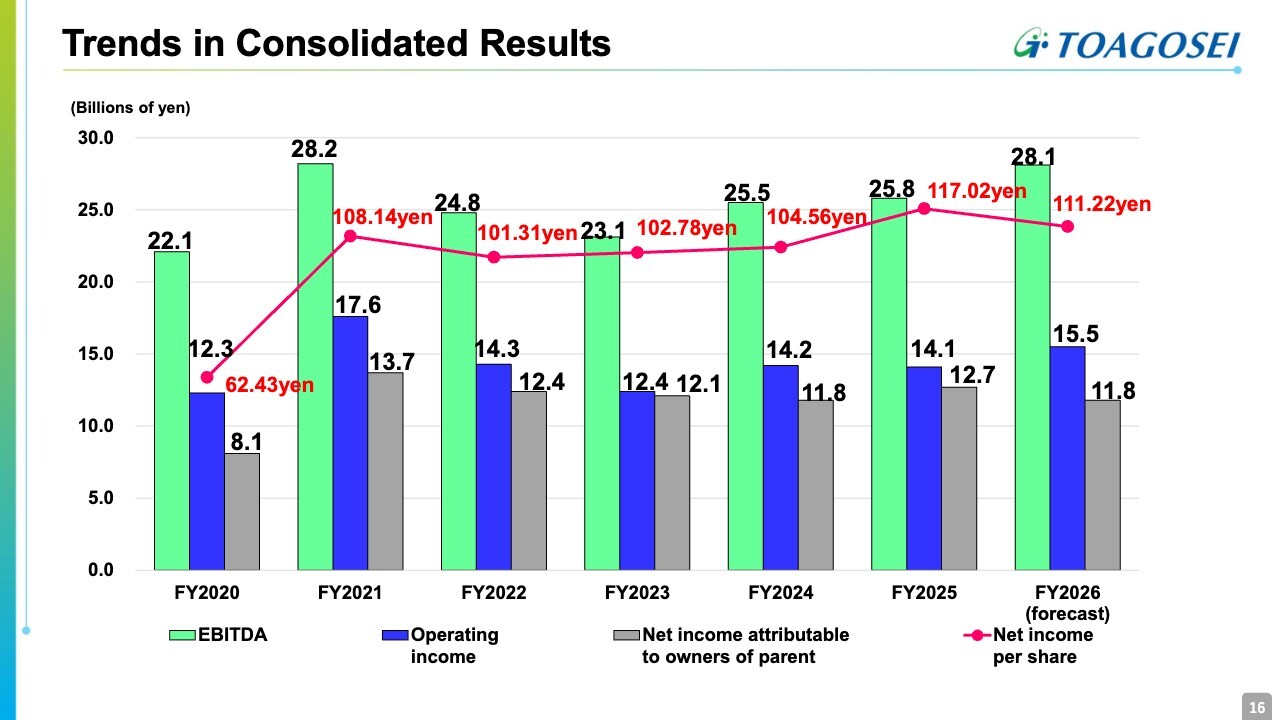
The graph on this slide shows trends in EBITDA, operating income, net income attributable to owners of parent, and net income per share. Broadly, all indicators weakened in FY2022 and FY2023 following the surge in demand related to COVID-19 in FY2021, but have been on a recovery trend since FY2024.
We raised our FY2026 operating income forecast from ¥14.5 billion to ¥15.5 billion. We continue to make growth investments with an eye to the future and also expect EBITDA to increase.
Shareholder Return Trends
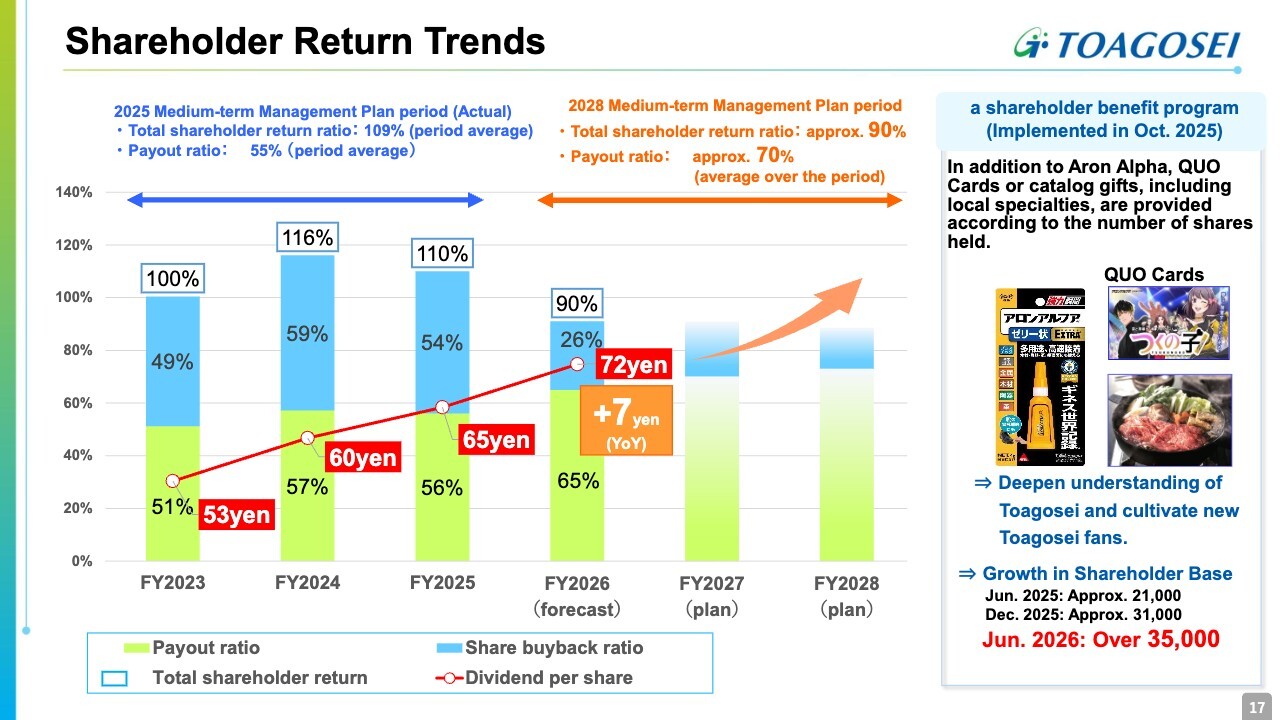
This slide shows trends in shareholder returns since FY2023.
The green bars show the payout ratio, the blue bars show the share buyback ratio, and the chart also shows the total shareholder return ratio and dividend per share.
Under the previous medium-term management plan, we set the total shareholder return ratio at 100% or higher. Under the 2028 Medium-Term Management Plan, taking into account the appropriate reduction in cash and deposits and the need to secure funds for future investments, we set the total shareholder return ratio at approximately 90%.
We also reviewed the balance between dividends and share buybacks. Our policy is to raise the payout ratio to approximately 70% while conducting share buybacks flexibly.
In line with this policy, the annual dividend per share for FY2026 is expected to be ¥72, an increase of ¥7 year on year. We have already completed a ¥3.0 billion share buyback in FY2026, and the total shareholder return ratio is expected to be approximately 90%.
In addition, we introduced a shareholder benefit program last October. In addition to Aron Alpha products, shareholders receive QUO Cards or catalog gifts based on the number of shares held. The aim is to deepen their understanding of Toagosei and cultivate new Toagosei fans. The number of individual shareholders has in fact increased, rising by 14,000 compared with one year earlier. We will continue working to improve our P/B ratio through shareholder-focused initiatives and measures to expand profit.
Topics from the 2026–2028 Medium-Term Management Plan
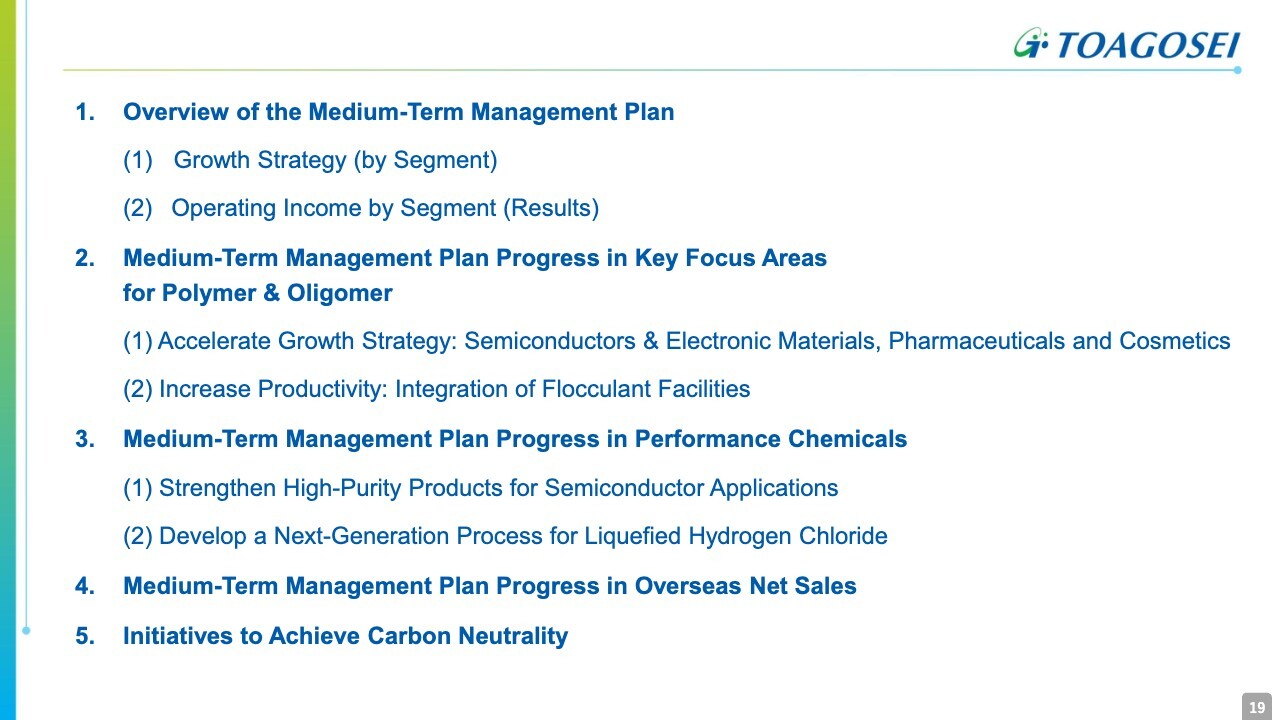
I will now discuss topics from the medium-term management plan that began this year.
Following the agenda shown on the slide, I will first give an overview of the medium-term management plan, then discuss progress under the plan in the two segments that made particularly large profit contributions in the first half, progress in overseas net sales, and finally our initiatives to achieve carbon neutrality, where we have several updates.
1. Overview of the Medium-Term Management Plan
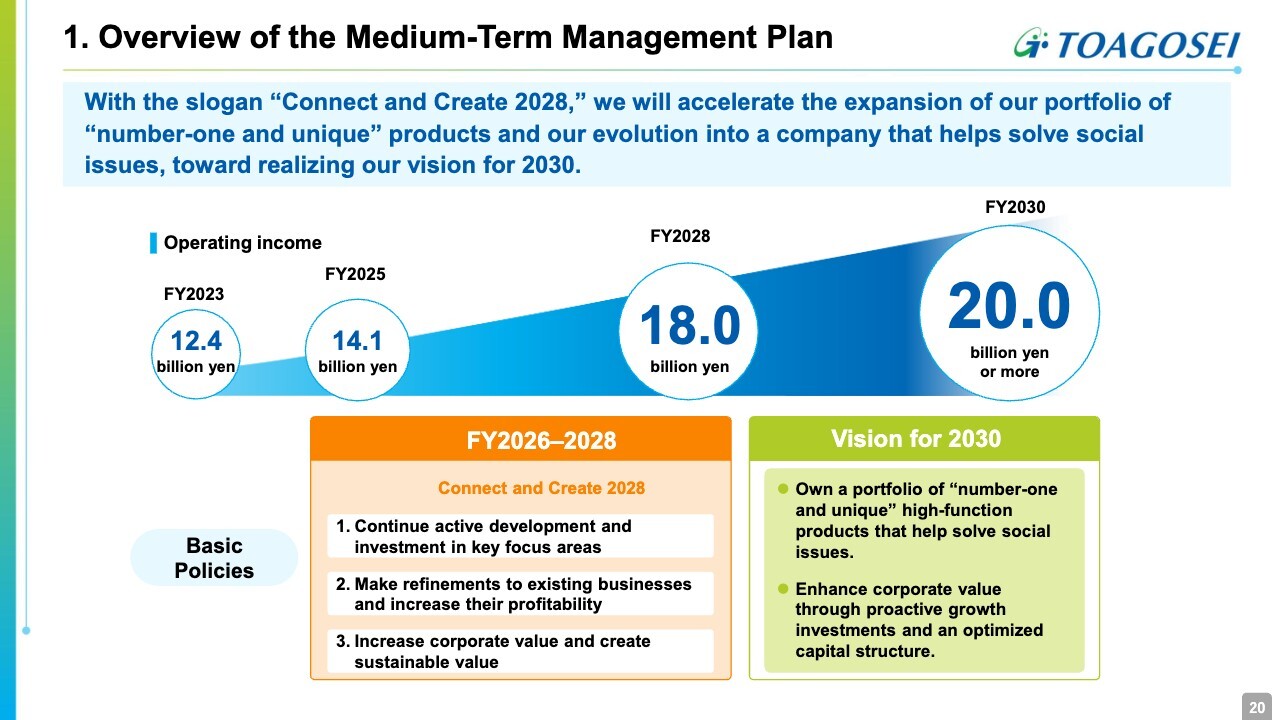
First, I will briefly review the medium-term management plan. Under the slogan “Connect and Create 2028,” we have positioned it as both important and necessary to accelerate the expansion of our portfolio of “number-one and unique” products and our evolution into a company that helps solve social issues, toward realizing our vision for 2030.
The keys to achieving the medium-term management plan are, in particular, expanding high-function products and promoting overseas expansion.
1. Overview of the Medium-Term Management Plan
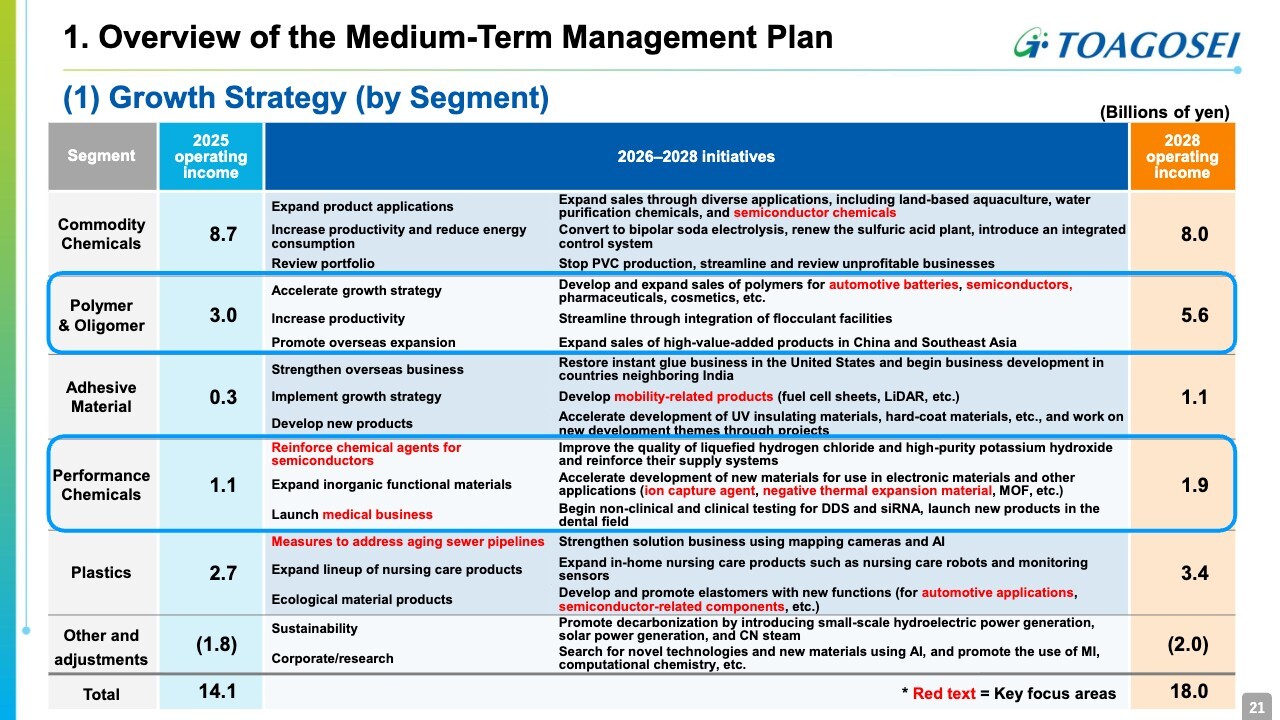
This slide shows the initiatives by segment and the FY2028 operating income targets under the medium-term management plan announced in February.
To steadily expand our portfolio of high-function products, we will focus particularly on the four areas shown in red—semiconductors, mobility, medical, and environmental infrastructure—and aim for total operating income of ¥18.0 billion.
1. Overview of the Medium-Term Management Plan
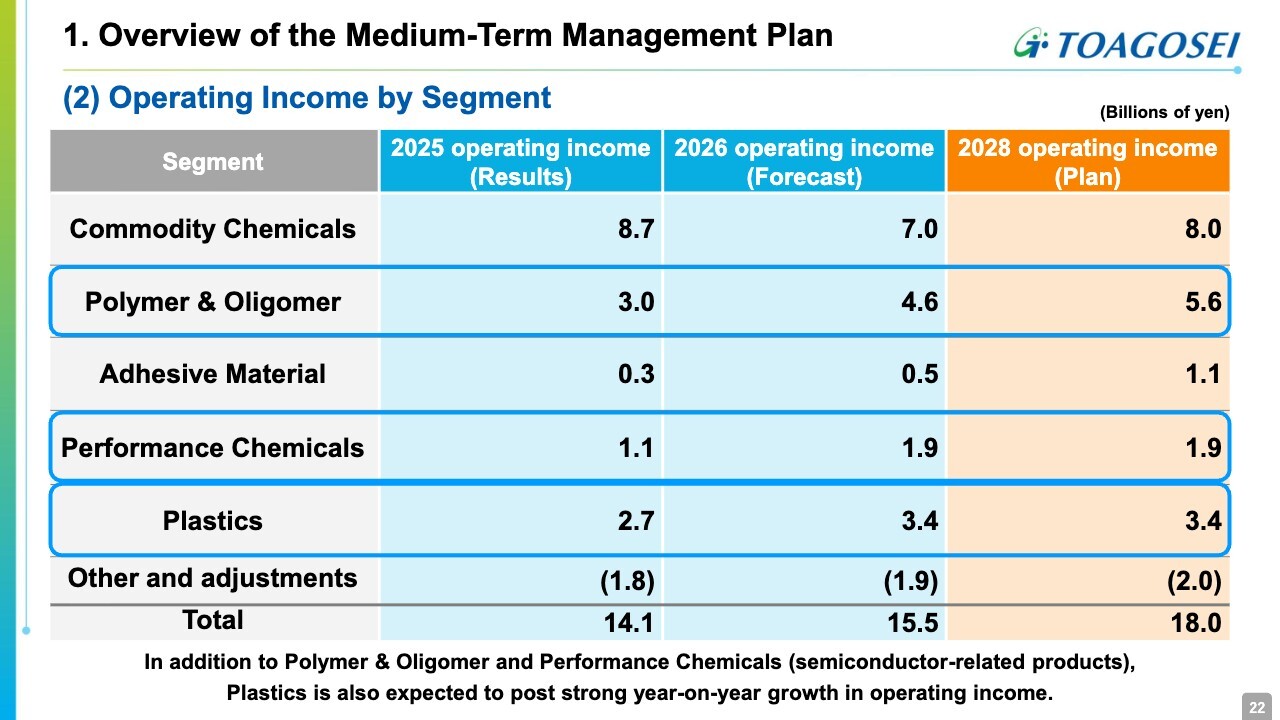
This slide shows operating income by segment, including FY2025 results, the FY2026 forecast, and the FY2028 targets under the medium-term management plan.
Compared with FY2025, we forecast a significant increase in operating income in FY2026, particularly an increase of ¥1.6 billion in Polymer & Oligomer, ¥0.8 billion in Performance Chemicals, and ¥0.7 billion in Plastics.
Of these, Performance Chemicals and Plastics are expected to reach their FY2028 medium-term management plan targets in the first year of the plan.
From the next slide onward, I will explain the background to the expansion and the outlook for the Polymer & Oligomer and Performance Chemicals segments, which are expected to post particularly large increases in profit.
2. Medium-Term Management Plan Progress in Key Focus Areas for Polymer & Oligomer
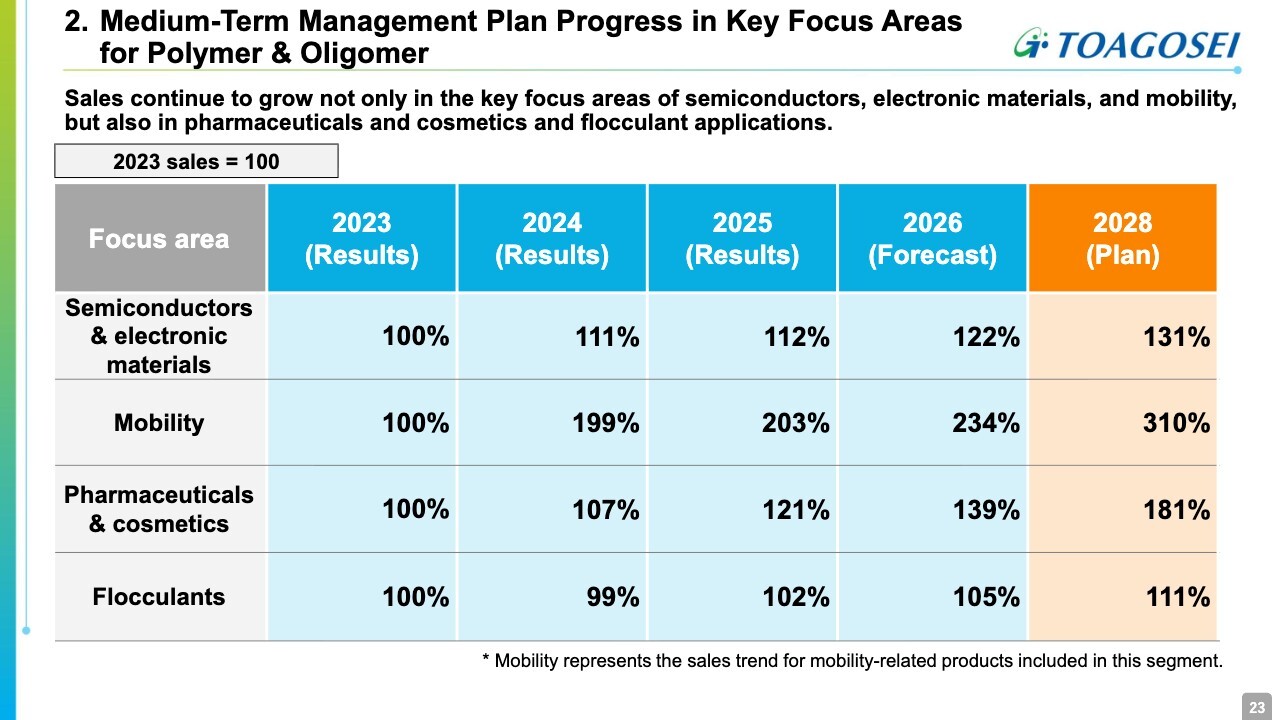
Polymer & Oligomer products address a wide variety of needs based on our diverse proprietary technologies and are used in many applications. Sales continue to expand not only in our key focus areas of semiconductors, electronic materials, and mobility, but also in pharmaceuticals and cosmetics and flocculant applications, and we believe further growth can be expected.
The table on the slide shows the sales index for each product field, with FY2023 sales set at 100. In FY2026, sales are projected to reach 122% for semiconductors & electronic materials, 234% for mobility, 139% for pharmaceuticals & cosmetics, and 105% for flocculants, relative to FY2023. We will continue to strengthen development and sales expansion toward the FY2028 targets in the medium-term management plan.
From the next slide onward, I will focus on semiconductors and electronic materials, pharmaceuticals and cosmetics, and flocculants.
2. Medium-Term Management Plan Progress in Polymer & Oligomer
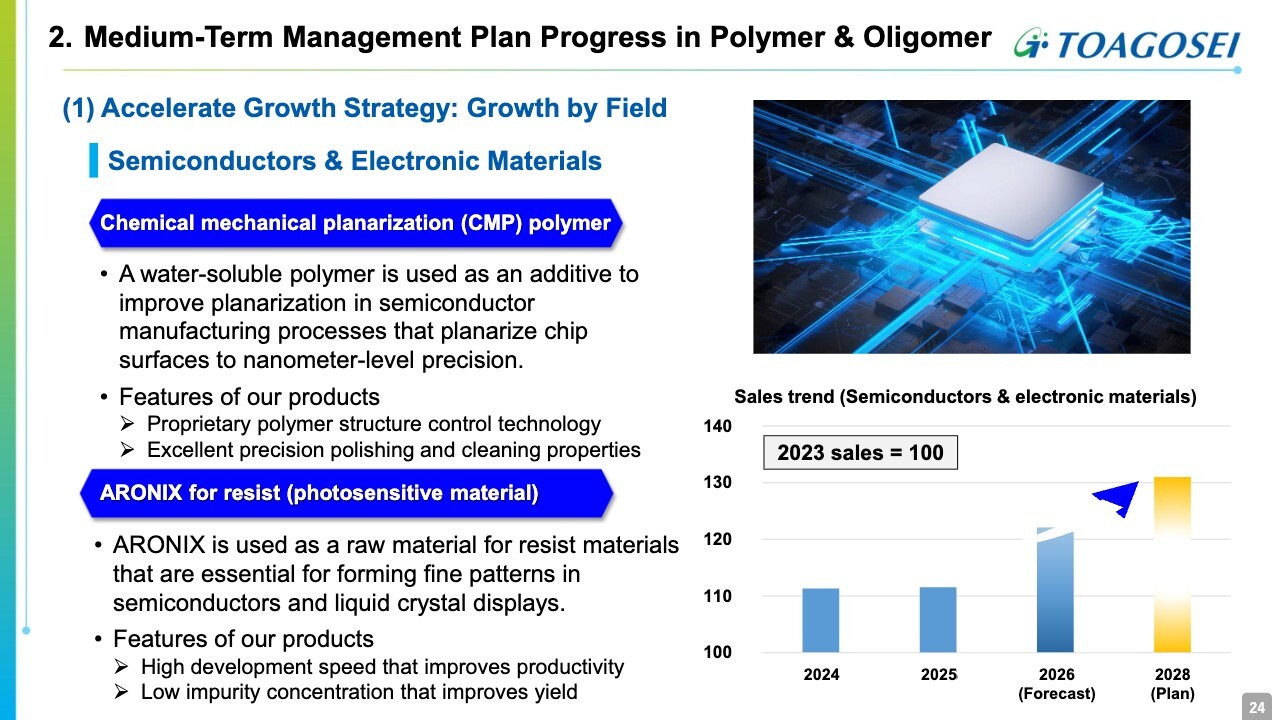
I will first discuss semiconductors and electronic materials in the Polymer & Oligomer segment.
A representative polymer product in this field is our CMP (chemical mechanical planarization) polymer. This product leverages our proprietary structure control technology and offers excellent precision polishing performance. It also supports high-mix, low-volume requirements, enabling us to respond to a wide range of customer needs. We expect the market to expand further as semiconductor multilayering processes increase.
We are also jointly developing multiple semiconductor materials with leading global manufacturers, and we see significant potential for future expansion.
For oligomers, a representative product is ARONIX for resist (photosensitive material). This is an essential material for forming fine patterns in semiconductors and liquid crystal displays. We leverage our strengths through development and production in Japan, Taiwan, and China. In addition, inquiries surged as the situation in the Middle East worsened, once again highlighting that this is a critical material for which substitutes are difficult to find.
2. Medium-Term Management Plan Progress in Polymer & Oligomer
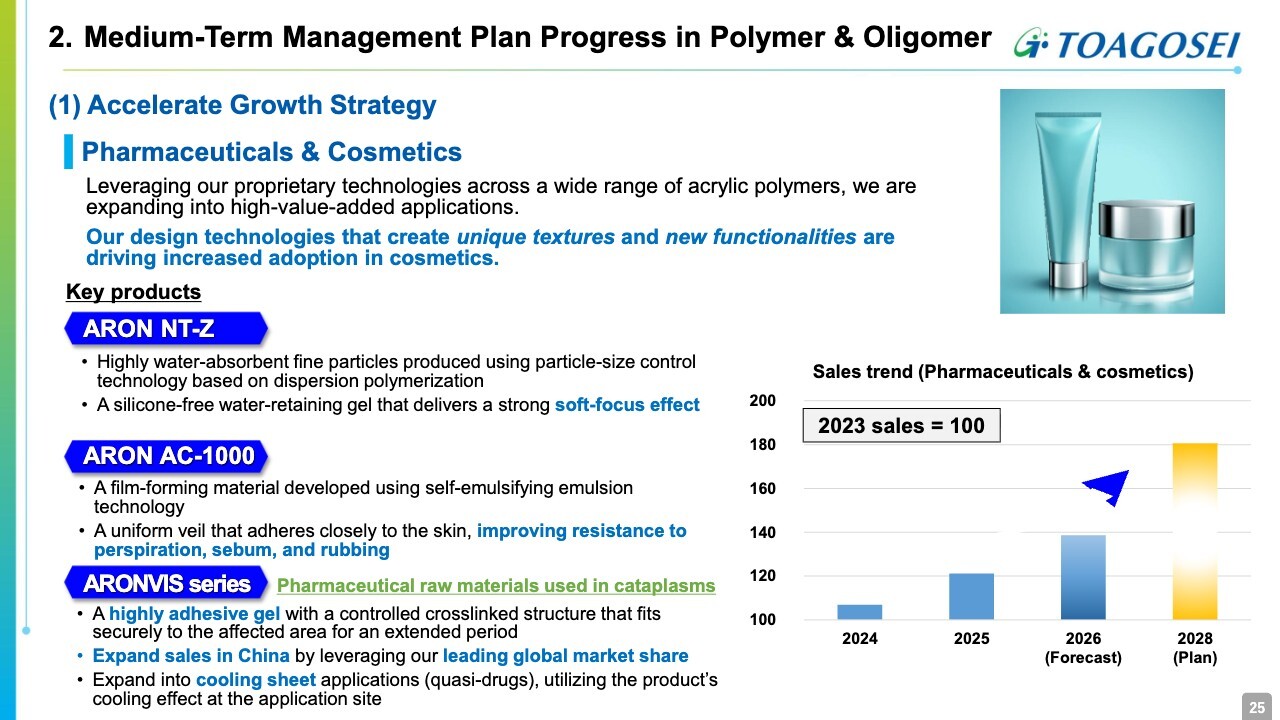
I will now discuss materials for pharmaceuticals and cosmetics in the Polymer & Oligomer segment.
Leveraging our proprietary technologies across a wide range of acrylic polymers, applications in cosmetics are expanding through design technologies that create new functionalities sought by customers, including “unique textures.”
Representative products include ARON NT-Z, highly water-absorbent fine particles produced using particle-size control technology, and ARON AC-1000, a high-performance film-forming material developed using self-emulsifying emulsion technology. Each product embodies special functionalities sought by cosmetics manufacturers, and sales are expanding.
ARONVIS is a pharmaceutical raw material used in cataplasms. It is a highly adhesive polymer gelling agent with a controlled crosslinked structure and boasts the No. 1 global market share. Sales are currently expanding, mainly in China.
2. Medium-Term Management Plan Progress in Polymer & Oligomer
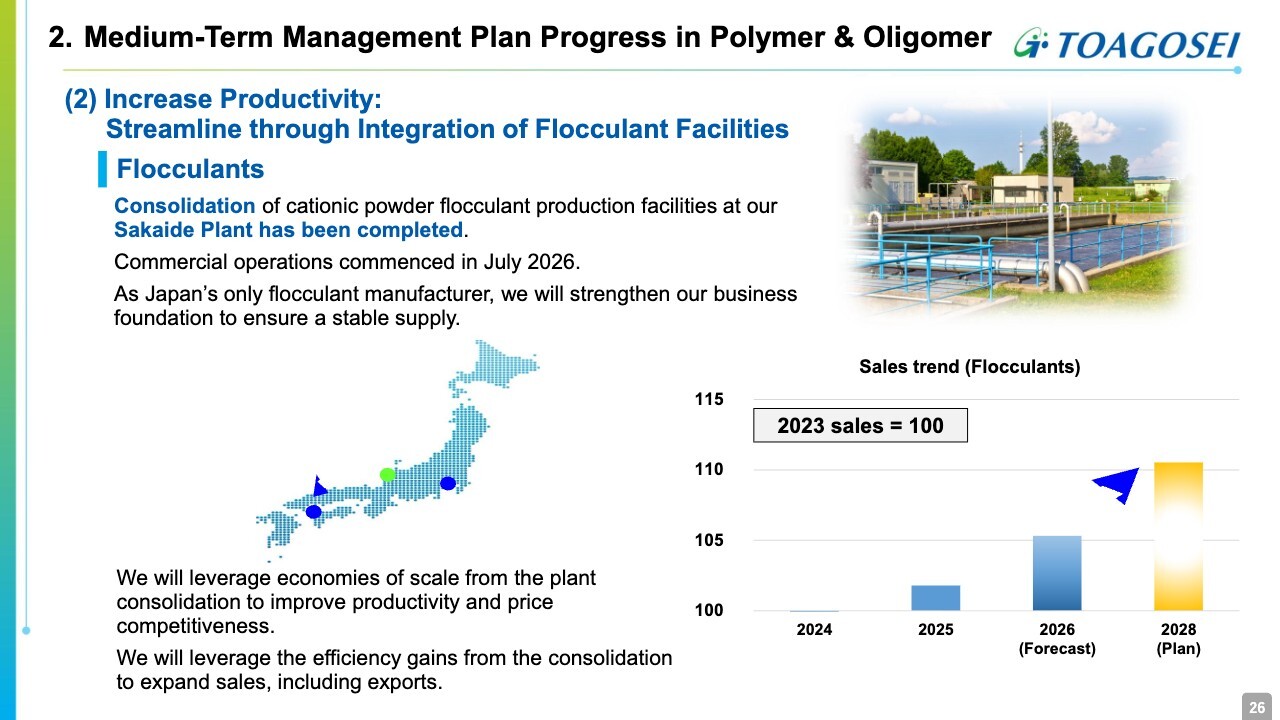
Next is the flocculant business operated by MT AquaPolymer, Inc. These polymer materials are used for sewage and wastewater treatment, and the company is currently Japan’s only manufacturer. The products are important from the standpoint of Japan’s economic security, and the company is pursuing rationalization and new product development under the slogan “Protecting Japan’s Infrastructure.”
As part of its rationalization efforts, the company is improving productivity by consolidating facilities. In July this year, it completed the consolidation of cationic powder flocculant production facilities at our Sakaide Plant. This strengthened the business foundation for ensuring a stable supply. Going forward, the company plans to leverage the benefits of this rationalization to expand sales, including exports.
3. Medium-Term Management Plan Progress in Performance Chemicals
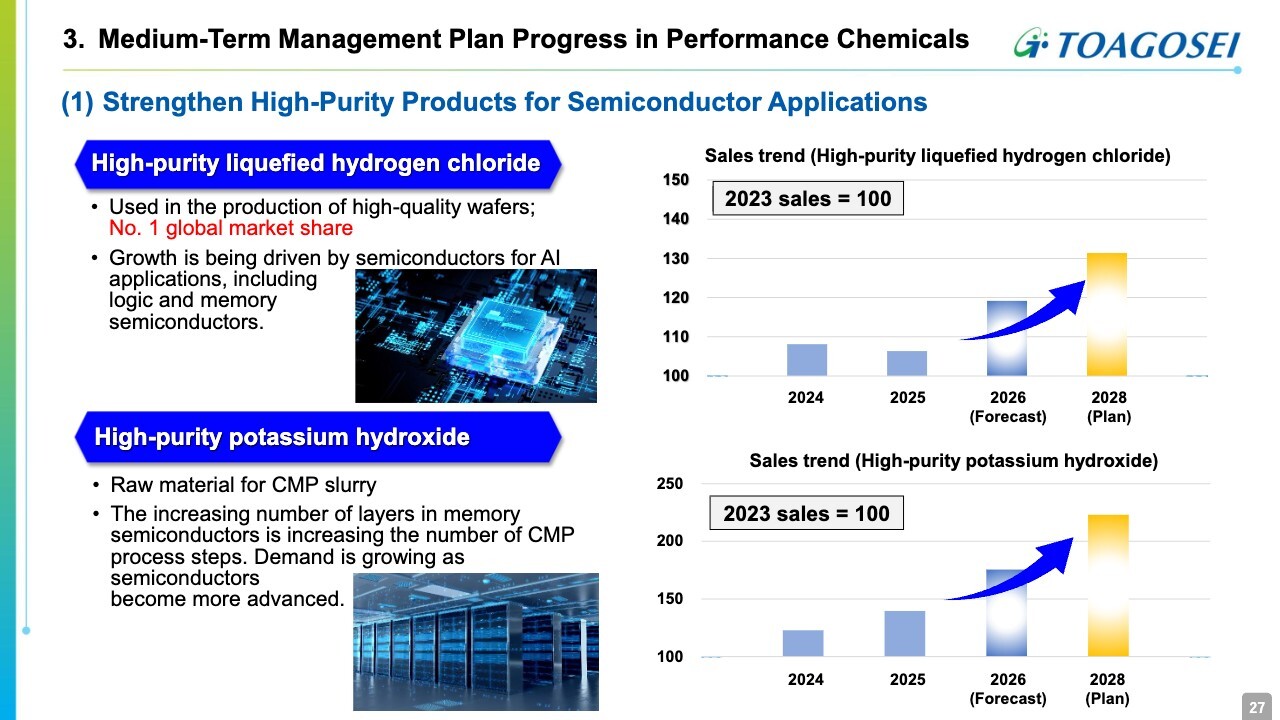
I will now discuss the Performance Chemicals segment. The expansion in sales has been driven by increased demand for high-purity products for semiconductor applications as AI demand expands. Among these, high-purity liquefied hydrogen chloride has the No. 1 global market share for use in the production of high-quality wafers. Demand for semiconductors for AI applications has been the main driver, and shipments have increased sharply since the end of last year.
High-purity potassium hydroxide is used as a raw material for CMP slurry. As AI demand expands and multilayering of semiconductors advances, the number of CMP process steps is increasing, and demand is consequently growing rapidly.
3. Medium-Term Management Plan Progress in Performance Chemicals
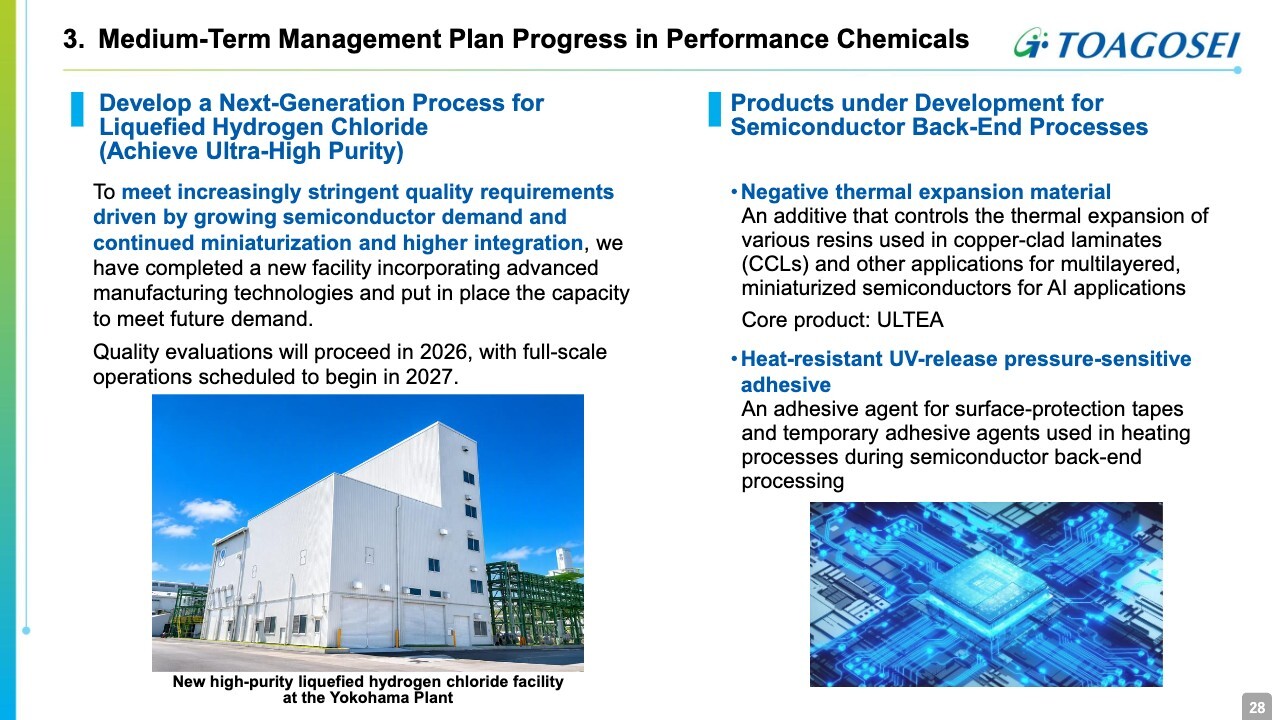
High-purity liquefied hydrogen chloride is currently produced at our Tokushima Plant and Yokohama Plant. We have expanded capacity in stages ahead of demand and continuously work to ensure a robust supply system and improve quality.
At the end of last year, the Yokohama Plant completed a new facility incorporating advanced manufacturing technologies to meet increasingly stringent requirements for ultra-high purity arising from growing semiconductor demand and continued miniaturization and higher integration. This has put in place the capacity to meet future demand. Quality evaluations will proceed in 2026, with full-scale operations scheduled to begin in 2027.
We are also developing new products for semiconductor back-end processes. Two representative examples are shown on the right side of the slide.
The negative thermal expansion material is being developed based on our proprietary technology through co-creation with a venture company. It is a material that controls thermal expansion and is expected to become indispensable as semiconductors become increasingly multilayered and miniaturized.
The heat-resistant UV-release pressure-sensitive adhesive has differentiated functionality, and its potential applications are expanding as an adhesive for surface-protection tapes and temporary fixing tapes used in heating processes during semiconductor back-end processing.
4. Medium-Term Management Plan Progress in Overseas Net Sales
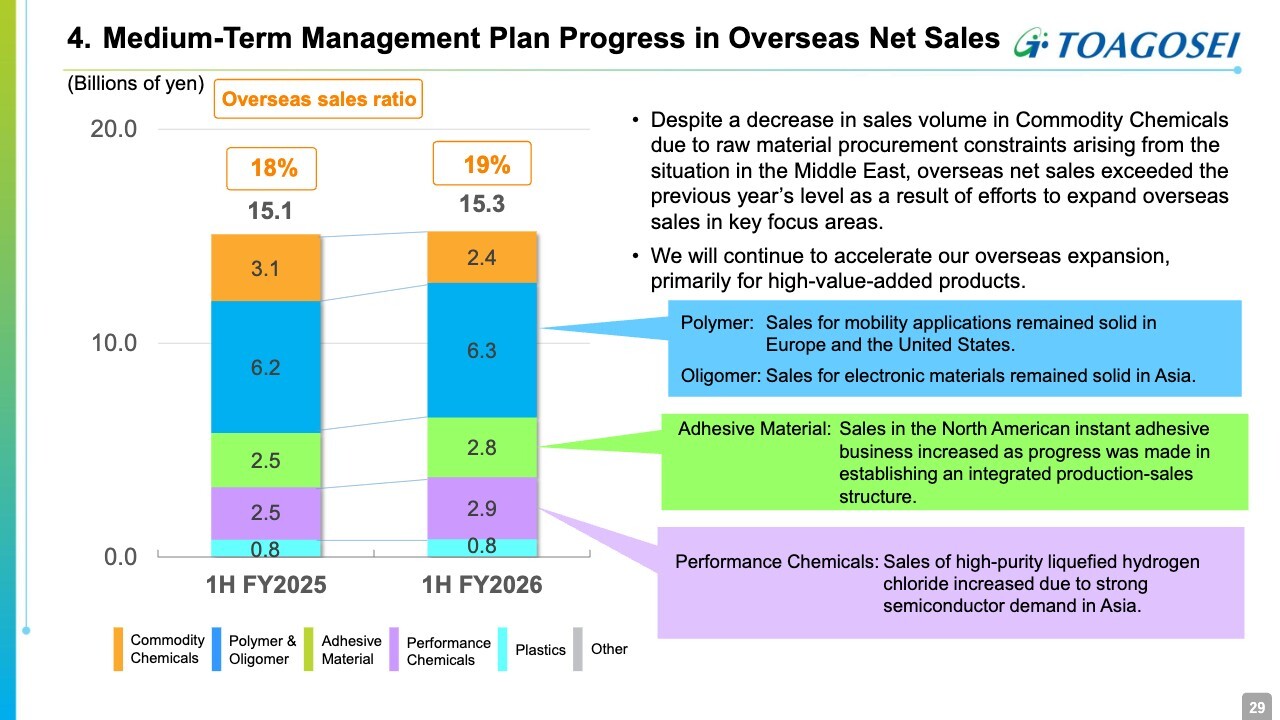
I will now discuss progress in overseas net sales, another pillar of the medium-term management plan. We aim to raise the overseas net sales ratio from 18% in FY2025 to 20% in FY2026 by effectively leveraging our 13 bases in eight countries.
This slide shows overseas net sales and the overseas net sales ratio for 1H FY2025 and 1H FY2026. In 1H FY2026, sales volume in Commodity Chemicals decreased due to raw material procurement constraints arising from the situation in the Middle East. Meanwhile, efforts to expand overseas sales in our key focus areas resulted in overseas net sales exceeding the previous year’s level.
Sales were strong in mobility applications for polymers, electronic materials for oligomers, and semiconductor applications for Performance Chemicals. Adhesive Material also contributed to sales growth as progress was made in establishing an integrated production-sales structure in the North American instant adhesive business. We will continue to accelerate overseas expansion, primarily for high-function products.
5. Initiatives to Achieve Carbon Neutrality
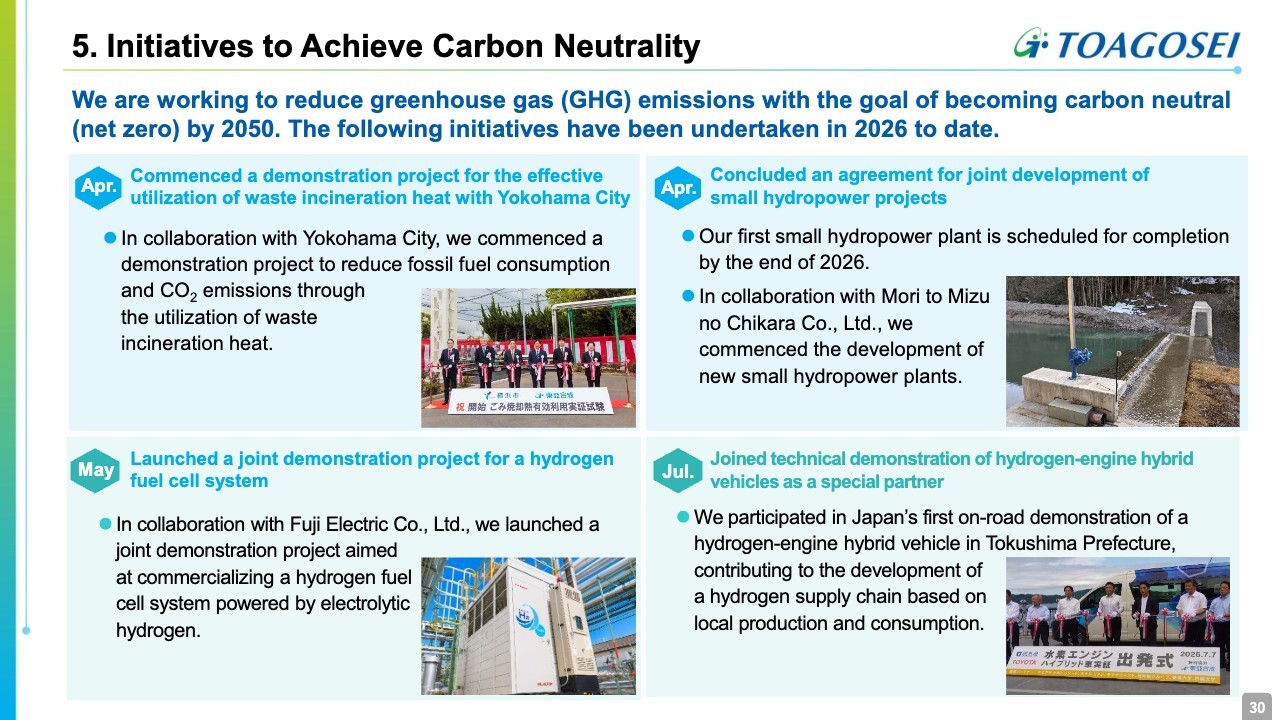
Finally, I will discuss our initiatives to achieve carbon neutrality.
We aim to become carbon neutral by 2050 and reduce greenhouse gas emissions by 50% from the FY2013 level by 2030. To date, we have installed solar power generation facilities at our plants and progressively begun operations.
In addition, we are advancing the four new initiatives shown on the slide in 2026. The first is the commencement of a demonstration project for the effective utilization of waste incineration heat with Yokohama City. The second is the strengthening of our small hydropower initiatives, with our first small hydropower plant scheduled for completion by the end of this year.
The third is the launch of a joint demonstration project for a hydrogen fuel cell system using electrolytic hydrogen. The fourth is our participation in a technical demonstration involving Japan’s first “hydrogen-engine hybrid vehicle.”
We will continue to advance initiatives toward achieving carbon neutrality.
Question: Review of the Medium-Term Management Plan in Light of Expected Achievement of Plan Targets
Moderator: The question is as follows: “The FY2026 operating income forecasts for the Performance Chemicals and Plastics segments have already reached the operating income targets for FY2028, the final year of the medium-term management plan. Do you intend to review the medium-term management plan?”
Kobuchi: Based on volume trends in the previous period, that may be a possibility. However, only six months have passed since the medium-term management plan began. In particular, there may have been some front-loading, and price adjustments are also possible, so at this point we are taking a cautious view.
As you noted, we are currently at a level where the medium-term management plan targets are being met, but we do not intend to ease up. First, we want to carefully assess how much we can grow sales this year. We will make a decision after that, but for now we will continue to steadily advance development and sales expansion in line with our current policy.
Question: Alternative Procurement and Inventory Levels Following the Closure of the Strait of Hormuz
Moderator: The question is as follows: “Please tell us about progress in exploring alternative procurement routes and the status of inventory buildup in light of the closure of the Strait of Hormuz and related developments.”
Kobuchi: First, the products most affected by the situation in the Middle East were acrylic monomers. In the upstream process, petrochemical manufacturers procure naphtha and produce propylene, which we then use at our Oita Plant to produce acrylic acid. Acrylic acid and its derivatives, acrylic esters, were therefore significantly affected. Petrochemical manufacturers faced extremely difficult conditions from April through June this year. However, they diversified their naphtha procurement, and there are currently no procurement issues.
We cannot yet be complacent about other raw materials either, but at present we are procuring them stably. We will continue to monitor the situation closely and respond as needed.
Regarding inventories, acrylic monomers, which I mentioned earlier, were the most affected. During certain periods between March and June, we continued to maintain supply.
Thereafter, from May–June onward, we also moved ahead with pricing measures, placing emphasis on both supply and pricing. At present, while continuing to prioritize supply, we are carefully managing inventories so that we do not accumulate products made using high-priced raw materials, and we are monitoring the situation closely as we respond.
In other words, we aim to secure sales volumes while having customers consistently accept the revised higher prices. By sharing information closely, we carry out the necessary production, secure the required product volumes, and manage inventories. We are taking care to avoid excessive inventories, and at present this is progressing appropriately.
Question: Main Drivers of the Volume Impact in the Analysis of Changes in Operating Income
Moderator: The question is as follows: “Regarding the volume impact in the analysis of changes in operating income, excluding the impact of discontinuing polyvinyl chloride and other products, the volume impact is significantly positive not only in the first half but also on a full-year basis. Which products are the main contributors?”
Kobuchi: For that point, please refer to page 7 of the materials. You can see that the three segments of Polymer & Oligomer, Performance Chemicals, and Plastics are making particularly large contributions to increases in both net sales and operating income.
This also relates to the medium-term management plan topics I discussed today. Price revisions have also contributed in each segment, but the main drivers are volume growth in semiconductor and electronic materials, mobility, and materials for pharmaceuticals and cosmetics in Polymer & Oligomer; semiconductors in Performance Chemicals; and sewerage-related products in Plastics. These product areas are growing very strongly.
Message from Mr. Kobuchi
I would like to express my sincere appreciation to everyone who joined us today.
Following the tariff issues last year, the closure of the Strait of Hormuz became a reality this year, and the world has entered a period of heightened uncertainty. Even under these conditions, I feel that domestic manufacturers, including Toagosei, are demonstrating resilience and overcoming crises. I also feel that whenever a crisis arises, all of our employees do their utmost and respond flexibly to the circumstances.
While maintaining this basic stance, we will protect our core businesses and aim to achieve our profit targets by expanding high-function products and promoting overseas expansion, which are the pillars of our medium-term management plan.
In addition, through proactive shareholder returns and by demonstrating and delivering on Toagosei’s strength as a technology company, we aim to achieve a P/B ratio of 1x or higher. We appreciate your continued support and guidance. Thank you very much for your time today.