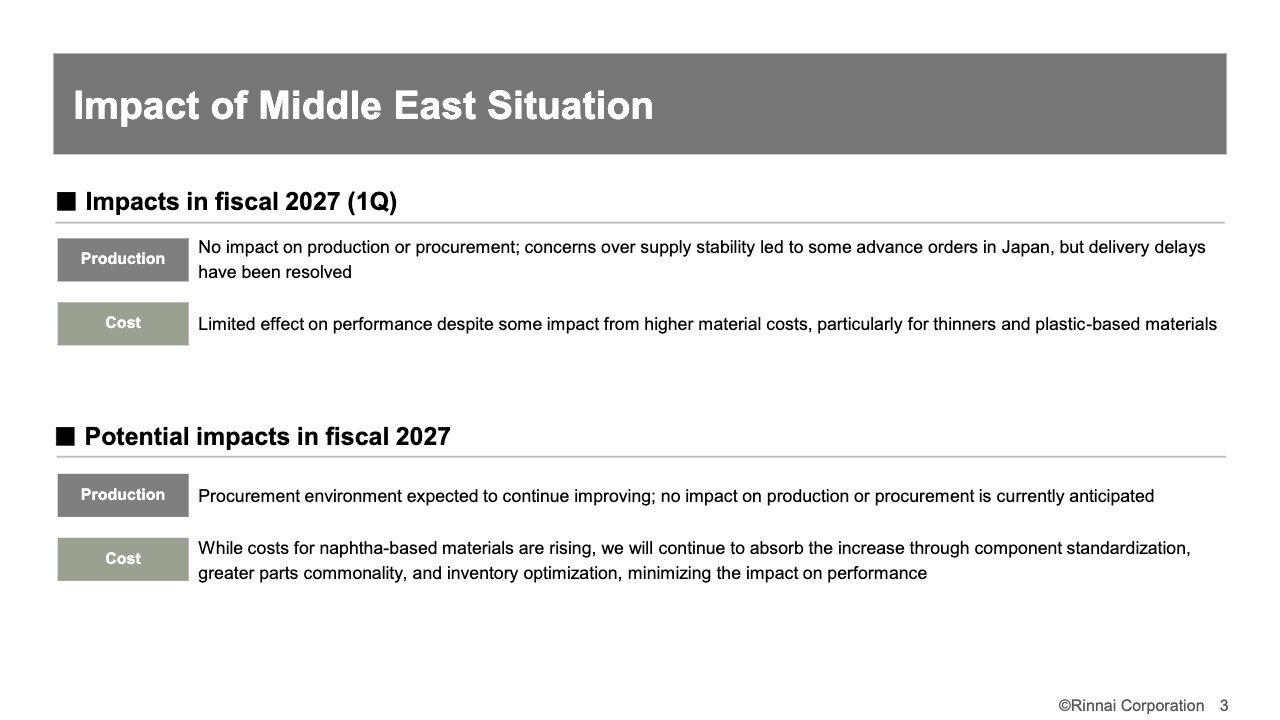
Impact of Middle East Situation
Takuya Ogawa (hereinafter "Ogawa"): My name is Takuya Ogawa, Managing Executive Officer, Chief of Corporate Administration Headquarters. I will now explain our financial results for the first quarter of fiscal 2027.
First, I will discuss the impact of the situation in the Middle East. At the time of our year-end earnings announcement in May, the outlook was unclear, and we entered the fiscal year with a number of concerns. Now that the first quarter has ended, however, we have confirmed that there was no impact on production.
On the cost side as well, there was little impact, aside from some minor price increases.
Looking ahead to production through fiscal year-end, visibility has improved considerably, and at this point we have no major concerns. We expect no impact on procurement or production.
On the cost side, however, costs for naphtha-based materials are expected to rise. We intend to take various internal measures to keep the impact on performance as small as possible.
Although this is not shown in the presentation, with regard to the earthquake in Kumamoto, our business sites are operating normally, and we have confirmed that suppliers are continuing to supply without any particular issues. We therefore believe there is no impact.
Fiscal 2027 (1Q): Consolidated Performance Overview
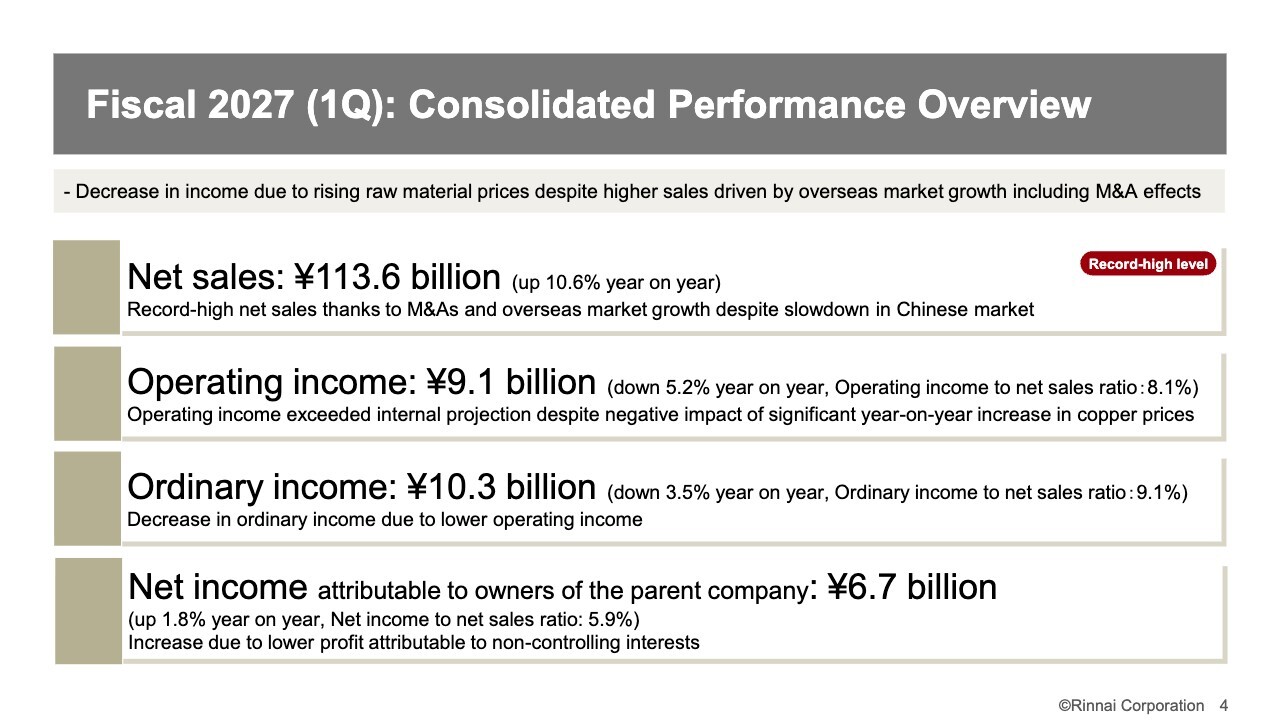
I will now explain our consolidated results for the first quarter. Net sales reached a record high, while operating income and ordinary income declined. Net income for the first quarter, meanwhile, increased.
Please refer to the slide for the year-on-year figures and comments. By way of additional context, our internal assessment is that, in the earnings forecast announced in May, we projected lower income for the first half.
That reflects the challenging business environment, including higher material costs, built into our plan for this fiscal year. Even so, we assess first-quarter results as having come in slightly above plan.
Fiscal 2027 (1Q) : Consolidated Financial Results
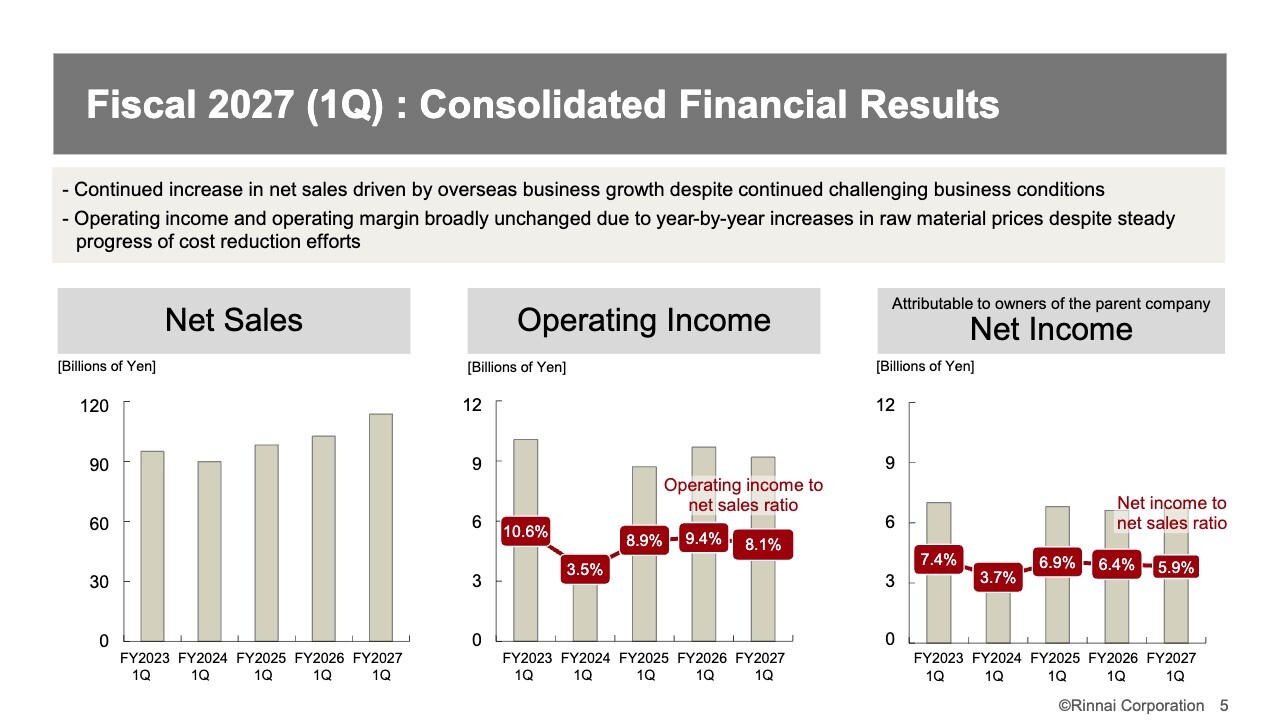
Next, here is the trend over the past five years. Net sales have increased for four consecutive years, supported in part by foreign exchange tailwinds. Operating income and net income, on the other hand, have remained essentially flat over the past three years amid a challenging environment. Higher raw material costs are one factor behind this.
Fiscal 2027 (1Q): Net Sales by Product
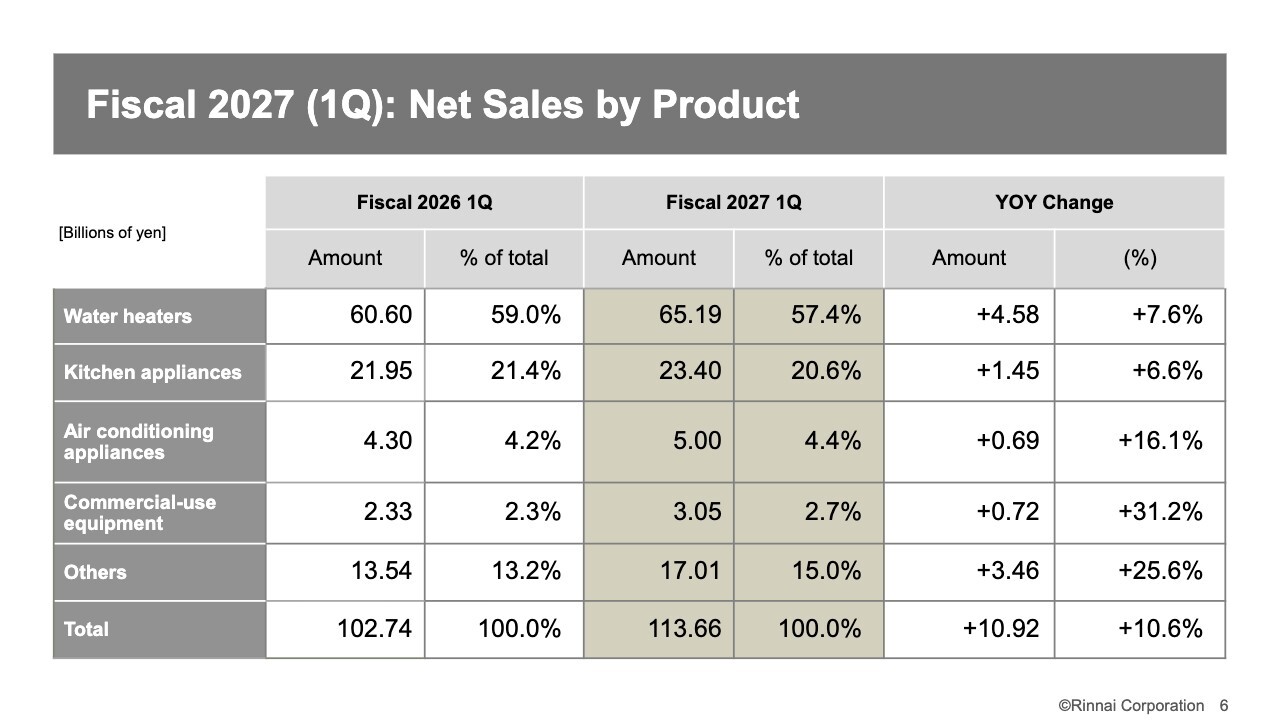
These are sales by product. Looking at the changes on the right side of the slide, every product category recorded higher sales. In particular, under the medium-term business plan, we expect our business portfolio to evolve as we expand beyond our traditional core gas appliances to address electrification and new energy sources.
Against this backdrop, I think we can see particularly large increases in the Commercial-use equipment and Others categories.
Fiscal 2027 (1Q): Consolidated Sales/Income Results
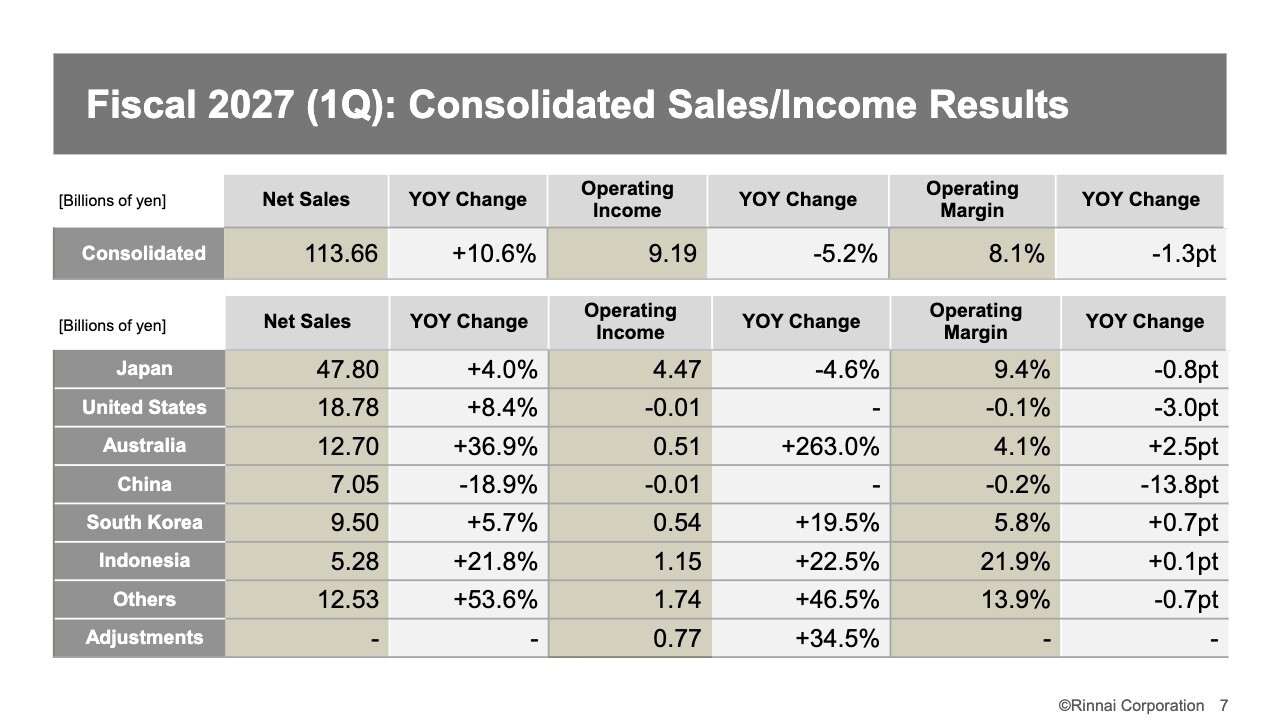
Here is the breakdown of consolidated sales and income by segment. I will discuss the major countries in more detail later. The figures are as shown on the slide. As an additional point, Adjustments include unrealized profit, which had a positive year-on-year impact of approximately ¥360 million.
Fiscal 2027 (1Q): Consolidated Operating Income Analysis
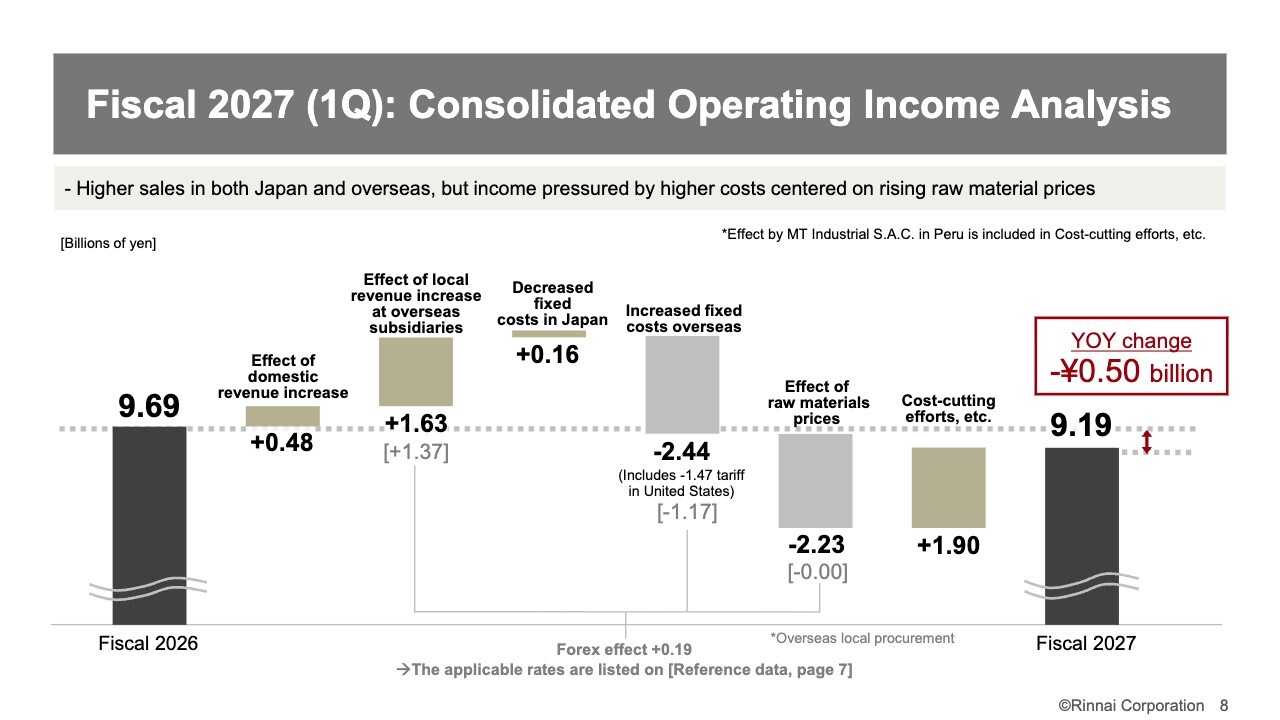
This is the analysis of changes in consolidated operating income for the first quarter. Starting with sales, net sales increased both in Japan and overseas, contributing positively to income. At overseas subsidiaries, the foreign exchange effect was approximately ¥1.37 billion, and even excluding this, we believe there was some benefit from higher sales.
Turning to fixed costs, fixed costs in Japan declined, partly due to lower labor costs, particularly retirement benefit expenses, and this contributed positively to income.
Overseas, however, fixed costs increased. Factors included higher costs due to foreign exchange effects and approximately ¥1.47 billion in U.S. tariffs.
Next, regarding raw material costs, the copper price we had been concerned about remained above our assumed price of ¥2,100 per kilogram.
However, across materials as a whole, some came in above assumptions and others below, so the ¥2.23 billion figure was broadly in line with our assumptions.
For the full year, our plan assumes a negative impact of ¥9.0 billion.
Cost-cutting efforts contributed ¥1.9 billion. We have set a fairly ambitious full-year target of ¥8.2 billion, and we believe ¥1.9 billion in the first quarter represents a reasonable start.
Japan Fiscal 2027 (1Q) Results
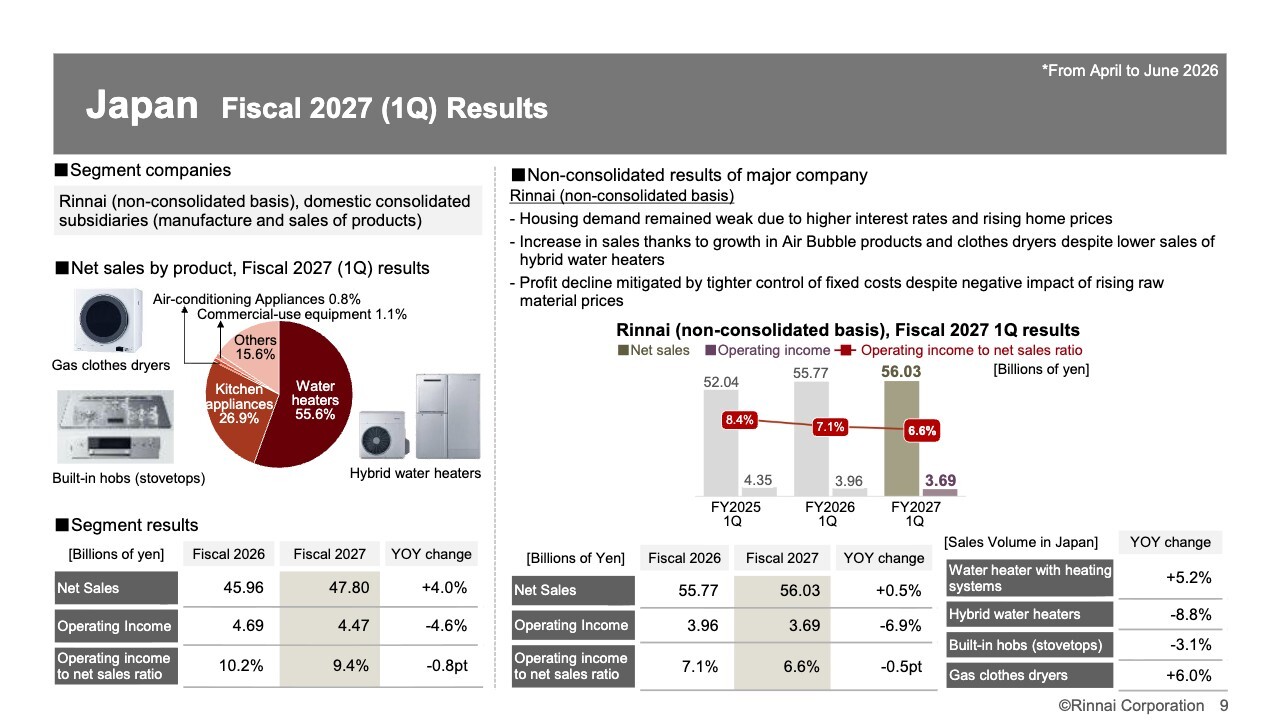
From here, I will discuss the regional segments, starting with Japan. The figures are as shown. Results were a slight increase in sales and a decrease in income. However, Japan was affected most significantly by raw material prices, and although income declined, we assess that we were still able to maintain a certain level of income.
Sales were essentially flat overall, but looking at the changes in major products, hybrid water heaters are particularly notable, down 8.8% year on year.
We launched the world’s first hybrid water heater in 2010. More than a decade has passed since then, during which we have developed the market for high-efficiency water heaters.
Competitors subsequently entered the market, but we differentiated ourselves through overwhelmingly superior performance and efficiency as well as a broad product lineup, maintaining a market share of more than 80%.
Last year, a new competitor entered the market and existing competitors launched new products. As a result, the competitive environment has gradually shifted to one in which there is little difference between our products and competitors’ products in terms of specifications.
Taking a clear-eyed view of the hybrid water heater market, the market we built has now moved beyond the introduction stage and, as more players enter, into a full-fledged growth stage under what is known as product life cycle theory.
Accordingly, it is no longer realistic to maintain a market share above 80%. We need a strategy that takes competition into account, including launching new products with specifications that can compete with rival offerings and preparing for the possibility of lower prices.
For our high-margin hybrid water heaters, I believe our strategy going forward must be to hold firm on pricing and protect those high margins.
As for the decline in unit sales of hybrid water heaters, we are prepared for this situation to continue until the impact of competitors entering the market last year has run its course.
Japan Topics: New Kitchen Appliances and Clothes Dryers
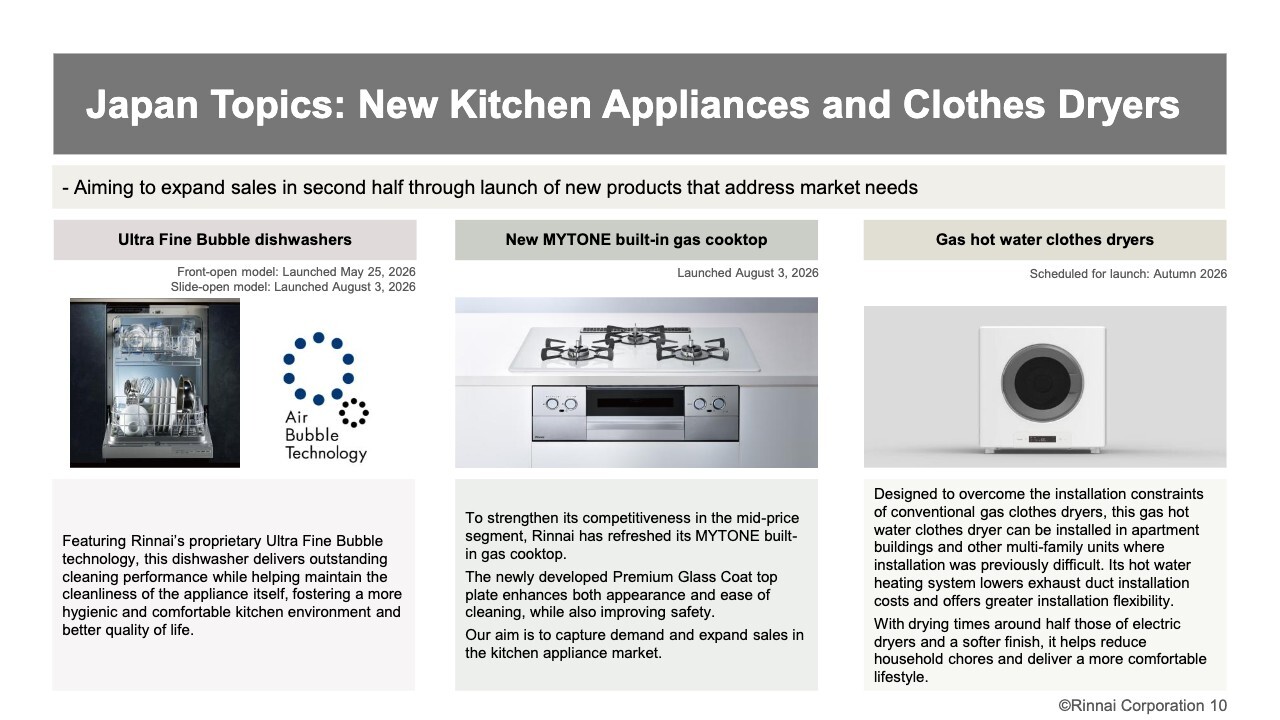
Turning to topics in the Japan market, we are approaching the autumn-to-winter demand season. This slide shows new products being launched in Japan from this summer through autumn. On the far left is a dishwasher that uses our Ultra Fine Bubble technology, which has very high cleaning performance, to enhance cleaning power. It has already been launched.
In the center is a built-in gas cooktop. It is a MYTONE model in the mid-price segment and was launched on August 3.
On the right is a gas hot water clothes dryer, a new product following our gas clothes dryers. Conventional gas combustion models have installation constraints, but the hot-water system is expected to significantly alleviate those issues, and we have high expectations for the product. It is scheduled for launch in autumn.
United States Fiscal 2027 (1Q) Results
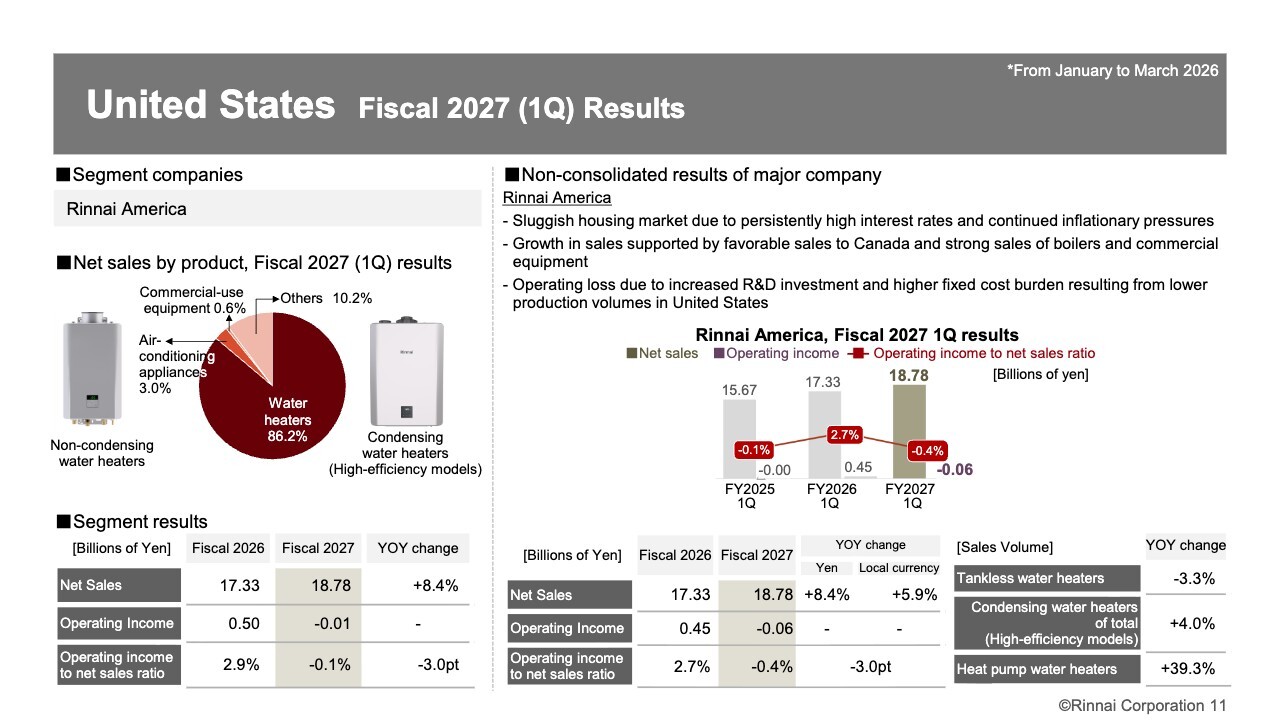
From here, I will discuss overseas operations. The comments and figures are as shown on the slide. The United States recorded higher sales, but unfortunately posted an operating loss. Unit sales of tankless water heaters, including condensing and non-condensing models, were down 3.3% year on year.
This was well below our expectations. However, because sales increased, there were factors other than tankless water heaters supporting revenue growth.
Regarding income, one factor behind the operating loss, on top of the already low margin, was an approximately 11% decline in unit sales of non-condensing water heaters. These non-condensing water heaters are produced locally, so the lower production volume meant fixed costs could not be absorbed sufficiently, which was the main cause of the operating loss.
The United States got off to a negative start versus plan in the first quarter, particularly on the income side. The “plan” referred to here requires some explanation: the reporting periods for overseas subsidiaries are offset by three months, and their local plans are finalized each December.
To clarify whether first-quarter results were above or below the plan set in December, the United States was below plan.
United States Topics: Tariff Impact
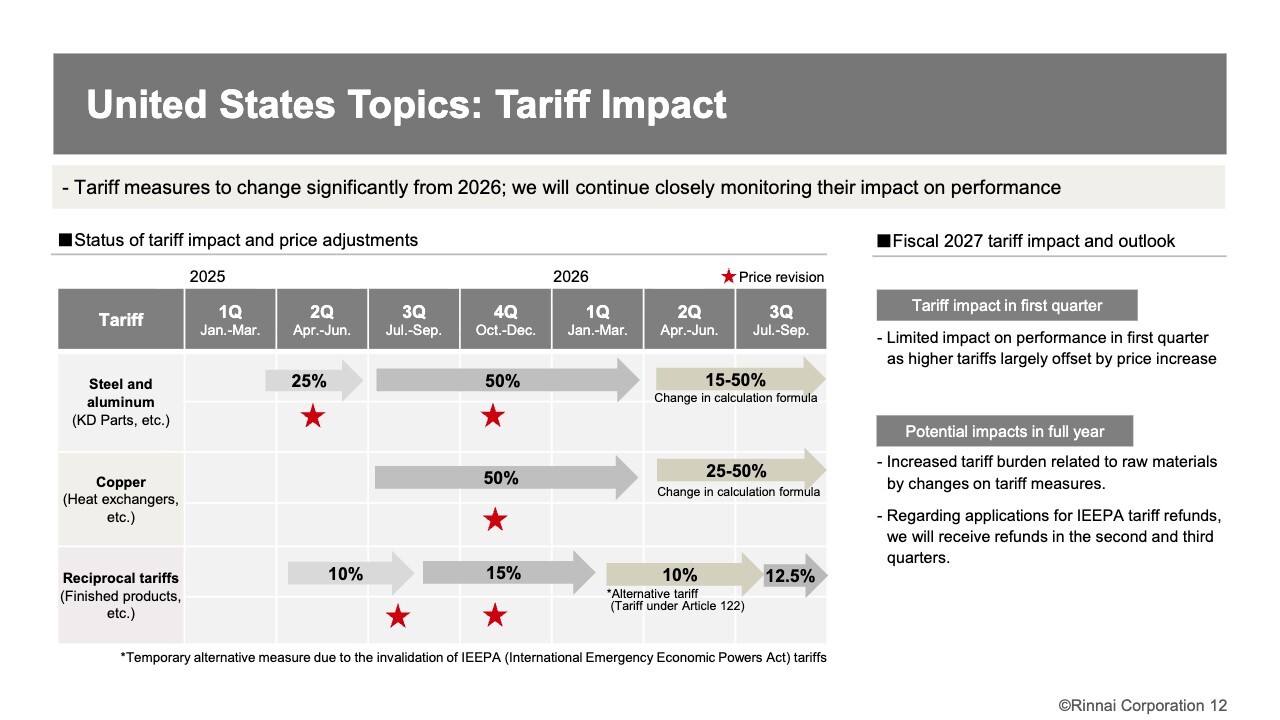
Here is another topic related to the United States. Last fiscal year, we were significantly affected by the so-called “Trump tariffs” and had to respond accordingly. The slide shows the changes in tariffs over time.
Through the fourth quarter of last fiscal year, tariffs were imposed as shown on the slide. The red stars on the slide indicate price revisions, showing that we passed the increases on through higher prices.
Since the start of 2026, the tariff situation has changed. The calculation method for tariffs on materials was revised. The applicable rates were 50% in the fourth quarter of 2025 and are now in a range of 15% to 50% in 2026. At first glance, this appears to reduce the burden, but because of the change in the calculation method, the actual burden is instead trending upward.
Meanwhile, reciprocal tariffs were eliminated after being ruled unconstitutional, but an alternative tariff was introduced in their place. This alternative tariff was raised from 10% to 12.5% from July 2026.
Following that ruling, we began receiving tariff refunds in May. We plan to provide details, including the amount, when we report second-quarter results, but we expect the refunds to contribute to higher income.
China Fiscal 2027 (1Q) Results
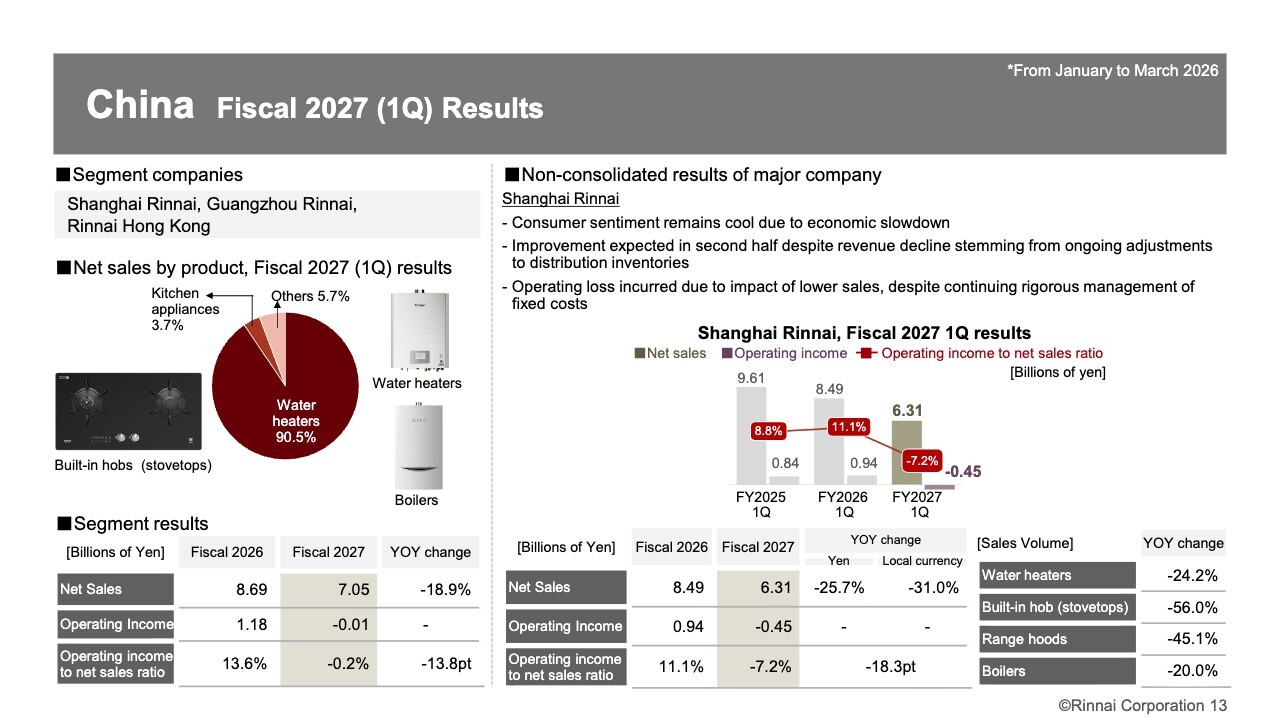
Turning to China, we had a very difficult start. Consumer sentiment remains weak. As shown on the slide, sales of our key products declined significantly.
Distribution inventories and dealer inventories increased substantially in the fourth quarter of fiscal 2026 and remain at high levels. Against this backdrop, and with a view to the longer-term risk of sales falling further, we deliberately restrained sales, which resulted in a difficult first quarter.
Moreover, with sales down 30% in local currency terms, measures such as reducing fixed costs and improving the product mix were not enough to prevent the business from falling well below the break-even point, resulting in an operating loss.
China started the year significantly below plan.
Australia Fiscal 2027 (1Q) Results
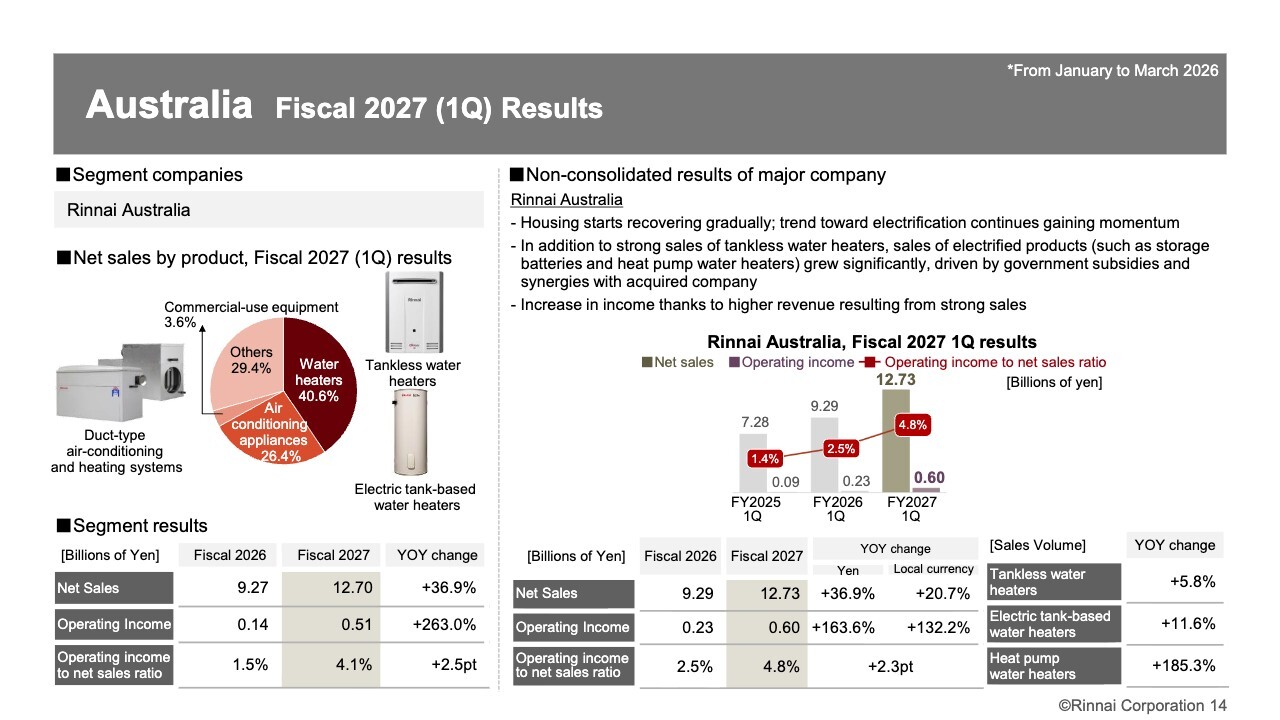
Turning to Australia, results were very strong, in contrast to China, with both sales and income increasing. As shown on the slide, the gas market remains challenging, but even so, demand for gas tankless water heaters is increasing. A key feature is the particularly strong growth in demand for electrified products.
Australia Topics
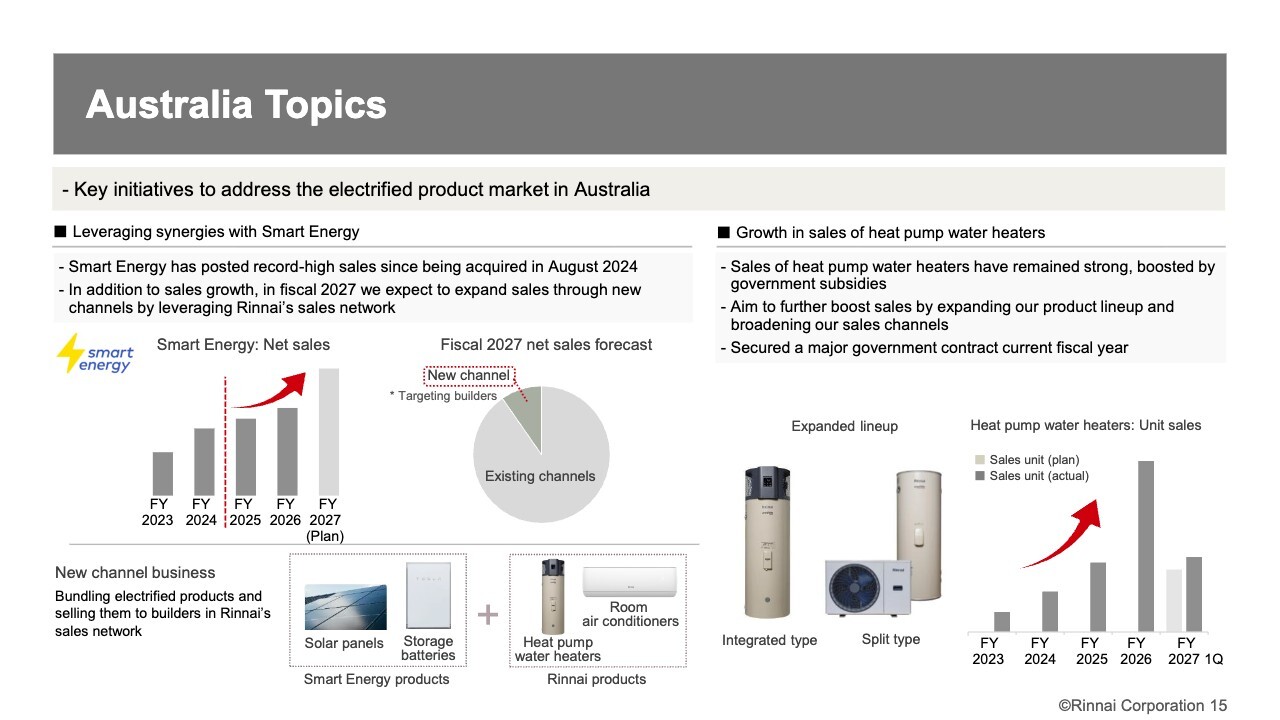
We are also beginning to see synergies with the company we acquired. As shown on this slide, we acquired a company called Smart Energy. The acquisition is not only contributing its sales and income; synergies with the existing Rinnai Australia business are also beginning to emerge in sales channels and products. Another noteworthy point is that Smart Energy has a very ambitious plan.
As for heat pump water heaters, growth has accelerated significantly, supported by tailwinds such as subsidies, as shown on the slide. Australia is ahead of plan and has posted better-than-expected results.
South Korea Fiscal 2027 (1Q) Results
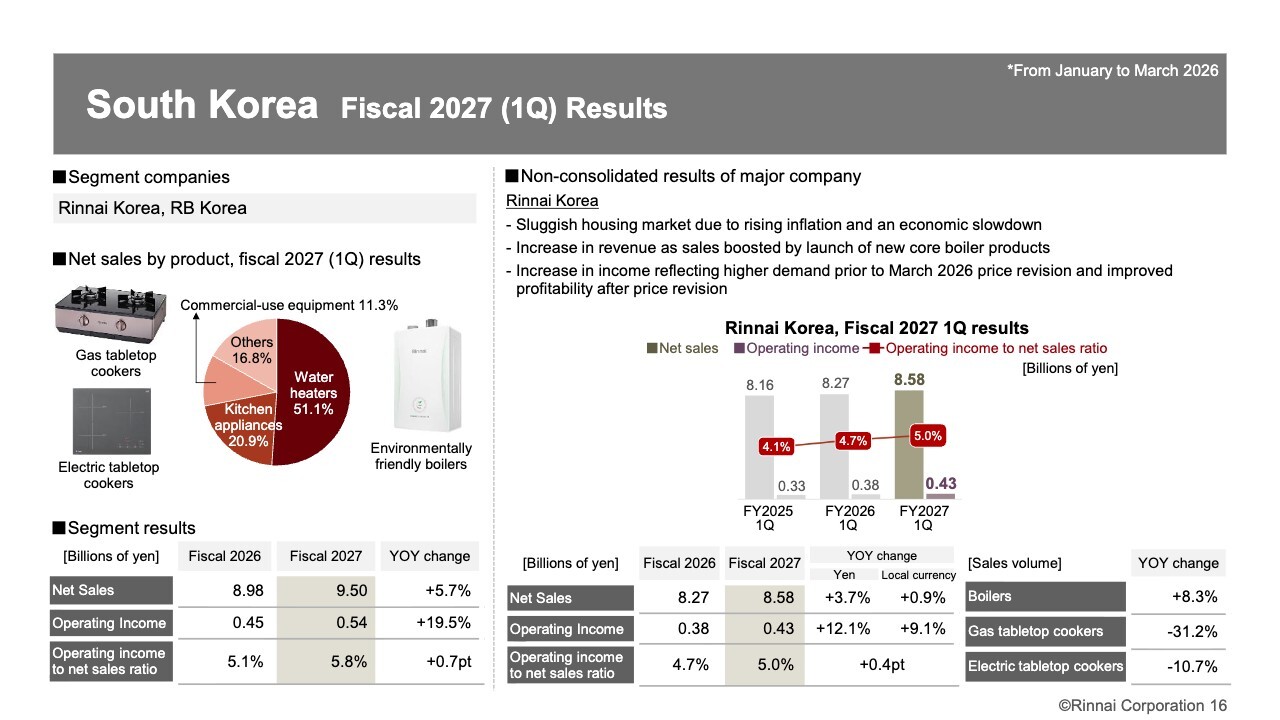
Turning to South Korea, market conditions have been challenging for some time, as expected. However, boiler sales increased, supported by the effect of new products.
Gas tabletop cookers, meanwhile, have also been affected by the transfer of a competitor’s business, and we are now competing with KD Navien Co., Ltd.’s kitchen appliance brand, Navien Magic. We temporarily increased our market share significantly, but KD Navien is now regaining ground.
Overall, sales and income increased. Given the difficult market conditions, I think South Korea has gotten off to a comparatively solid start. Performance is roughly neutral versus plan.
Indonesia Fiscal 2027 (1Q) Results
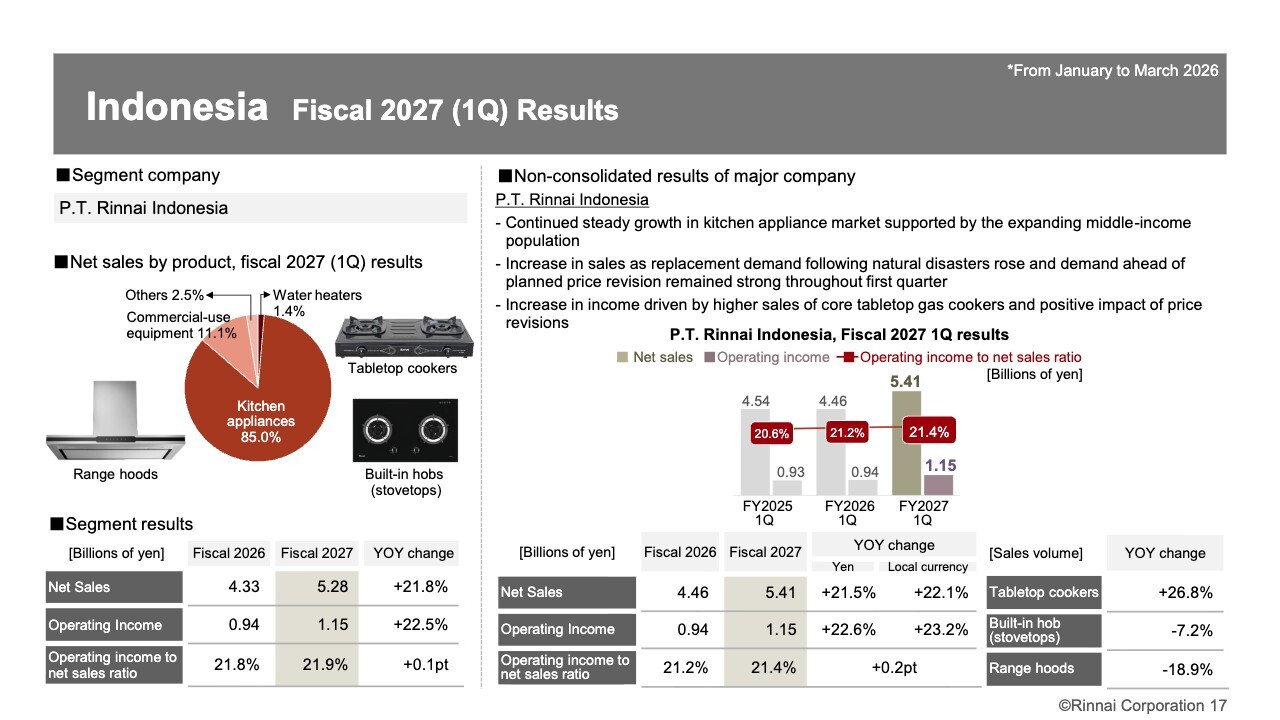
Indonesia posted increases in both sales and income, and the figures appear very strong. However, the 26.8% year-on-year increase in unit sales of tabletop cookers partly reflected flooding in the country and something akin to a temporary reconstruction-related demand boost in the first quarter. We therefore believe it would be better to view this result as temporary.
Indonesia is above plan.
Consolidated Performance Forecasts
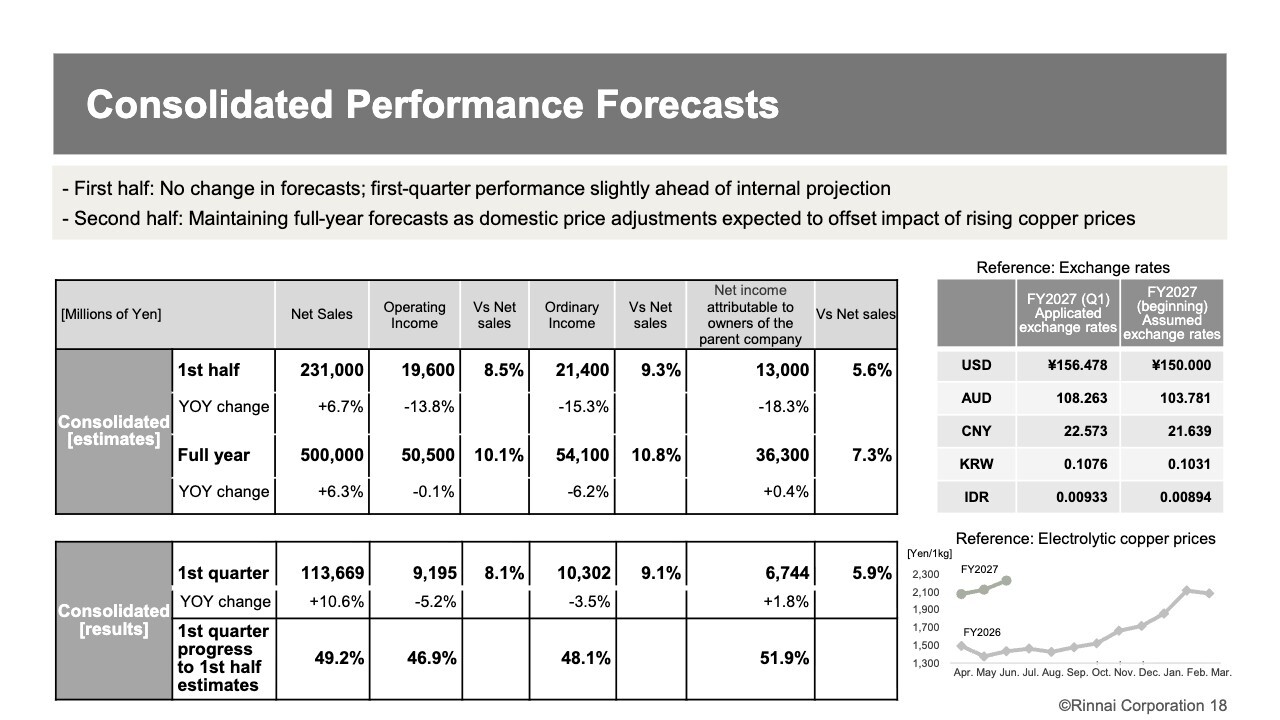
Let me now discuss our consolidated performance forecasts. As I mentioned at the outset, we believe the consolidated group got off to a slightly better-than-plan start. There is no change to our first-half forecasts.
For the second half, we expect the environment of persistently high material prices, particularly copper, to continue. Against this backdrop, we plan to implement a price increase in Japan from September 1.
Overseas, each local subsidiary is also implementing price increases as timing permits. Taking these factors into account, we believe the full-year forecasts remain achievable at this point, and there is no change to our full-year forecast.
Q&A: Likelihood of Achieving Profitability in China
Questioner: You are forecasting the China business to be profitable for the full year, but as you explained earlier, it posted a loss in the first quarter. You mentioned returning to profitability in the second half. At the same time, the penetration rate of PF2.0, your mainstay water heater model, has already reached around 80%, so I imagine there is fairly limited room left to reduce fixed costs. Could you comment on how confident you are in achieving profitability?
Ogawa: China got off to a difficult start with a loss in the first quarter. The volume swings from the first through fourth quarters in China have become extremely large due to the growth of online sales.
The first quarter is the quarter with the lowest volume. The second quarter includes the “6.18” online sales event, so volume rises sharply at this time every year.
Our conservative view is that the underlying weakness in the market will not change materially in the first quarter, second quarter, or beyond, and that a recovery will be difficult. However, it is also true that volume rises significantly in the second quarter because of the “6.18” sales event.
That is why we believe there is a possibility that sales could exceed the break-even level from the second quarter, allowing us to return to profitability.
Q&A: Market Inventory Levels Following the Impact of the Middle East Situation
Questioner: You said the situation in the Middle East has had little overall impact. However, there were developments such as TOTO suspending acceptance of orders for bathtubs, and I believe sales channels may also have increased orders for your products as a precaution against unforeseen events. In light of this, could you confirm whether market inventory levels have built up?
Ogawa: In April and May, we also had limited visibility on how the situation in the Middle East would develop. The market naturally shared that uncertainty, and as noted on the slide, I believe there were “some advance orders due to concerns over supply stability.”
However, since June, and more recently through July and August, the situation has become much more settled. We do not believe there is any particular buildup of inventory in the market.
Q&A: Overall Performance Outlook
Questioner: I would like to ask about your overall view. There may have been some puts and takes in the first quarter, but you said performance was running slightly above the internal plan. You now also have some visibility into overseas conditions in the second and third quarters, including developments since July, and I assume you have a reasonable grasp of the situation in Japan as well.
Given this, could you share your overall view on whether there is currently any upside potential versus the full-year plan?
Ogawa: Regarding the outlook for the consolidated group, we see both positive and negative factors. On the negative side in particular, material cost inflation has yet to settle, so we believe high material prices will persist.
With regard to China, as I mentioned earlier, there are quarter-to-quarter fluctuations. However, if the market does not recover, we believe we need to allow for the possibility of a significant decline in income or a substantial shortfall versus plan.
On the positive side, we expect the price increase in Japan to improve profitability from September onward. We also expect tariff refunds related to the Trump tariffs in the United States to have a positive impact on income in the second quarter.
Taking these various factors together, the outlook appears to contain both positives and negatives. At this point, we do not think we can say with confidence that full-year results will be materially above or below forecast.
Q&A: United States Segment Operating Income from the Second Quarter Onward and Outlook
Questioner: U.S. segment operating income got off to a slow start with a loss in the first quarter. How do you expect the segment to return to profitability from the second quarter onward, and what level of profit do you envision?
I would also like to ask about your view of profit trends in the United States from the second quarter onward and the sales levels associated with them.
Ogawa: First, both the new-housing and replacement markets remain very challenging. Persistently high interest rates and inflation are major factors, and the weakness of the tankless water heater market in the first quarter is one market-related factor.
Looking ahead, it is difficult to be optimistic, and we do not expect much improvement.
As shown in the second bullet from the top on the right side of the slide under Rinnai America, sales to Canada, sales of boilers (rather than tankless water heaters), and sales of large commercial-use water heaters all recorded growth rates of 20% to 30%.
We continue to see positive momentum in these areas from the second quarter onward, and even if the tankless water heater market does not recover, we believe net sales can maintain an upward trend.
We would also like to increase production volumes of non-condensing water heaters, although this will depend on demand trends in the tankless water heater market.
In any case, although we started the year in the red in the first quarter, we do not expect the loss to continue from the second quarter onward or the loss to widen.
Q&A: Timing of Recovery in Hybrid Water Heater Unit Sales and Market Strategy
Questioner: Regarding hybrid water heaters in the Japan business, unit sales turned negative year on year this time. You explained the background earlier, but when should we expect unit sales to return to a growth trend?
Based on your comments, I got the impression that you will lose some market share to competitors this fiscal year, but that your unit sales could begin growing again from next fiscal year onward. Could you clarify that point?
Ogawa: I said earlier that this would continue “until the impact runs its course.” Competitors made significant moves from autumn through winter last year. As a result, I expect competition over specifications to remain a back-and-forth contest, with each side overtaking the other at times.
At present, ECO ONE is not overwhelmingly superior to competing products in specifications such as efficiency, and it is also true that there are some areas where we now lag behind.
In addition, although we have a broad lineup, the new entrant has targeted gaps in that lineup. This is symbolic of the current competitive environment.
We take pride in having created this market. Looking to next year and beyond, we are carefully developing our product strategy this fiscal year in light of competitors’ moves. We intend to regain momentum with new products scheduled for launch from next year onward.
At the market level, subsidies are providing a tailwind and awareness of hybrid water heaters is expanding. We feel that our efforts to create this market are now bearing fruit. At the same time, the increase in market participants should further broaden awareness and support growth in the hybrid water heater market as a whole.
I believe there is room for further growth. As the market has moved into a very different stage, I expect our approach to competition will also change accordingly.
Questioner: So the strategy is not to sacrifice profit.
Ogawa: That’s right. As competitors enter the market, we naturally have to anticipate price competition. Even though our share has fallen from 80%, we still hold a share in the 70% range, and we believe we still retain the initiative in the market.
Accordingly, if we become drawn into price competition, the market could ultimately shrink and, even if volumes increase, become a low-profitability market. Our stance of protecting pricing and profitability will therefore remain unchanged.
Q&A: Details of Sales and Income in the “Others” Segment
Questioner: You discussed the major markets, but the Others segment also appears to have posted solid growth in sales and income. Could you explain the details?
Ogawa: Others also contributed positively. It was above plan, with the largest contribution coming from MT Industrial S.A.C. in Peru, which we acquired last year. Its results were not reflected in our income statement last fiscal year, but have been included since January 2026.
In the first quarter, MT Industrial S.A.C. alone added approximately ¥3.4 billion in net sales and approximately ¥460 million in income, making it the largest factor.
Other countries also recorded positive contributions to income of several tens of millions of yen, although the impact was not particularly large.