Contents
Akira Urakami (hereinafter, Urakami): Thank you very much for joining us today despite your busy schedules. I am Urakami, President and CEO of Ryobi Limited. I sincerely appreciate you taking the time to watch this presentation.
During the first six months of FY2026, the business environment remained uncertain due to fluctuations in the global economy and foreign exchange markets, as well as the impact of supply shortages and prices of resources and energy.
In particular, the large-scale military attack on Iran by the United States and Israel on February 28 this year has heightened international tensions and is having a significant impact on the global economy.
Under these circumstances, the Ryobi Group has steadily pursued marketing initiatives and productivity improvements. Looking at the financial results we announced, I believe there were areas in each business where we met your expectations, as well as areas where challenges remain.
Today, we will explain the details of our results, including the background behind them, our full-year outlook, and the progress of initiatives under the Medium-Term Management Plan. We hope today's presentation will give you a deeper understanding of our current position and future direction.
Hiromu Arihiro (hereinafter, Arihiro): I am Arihiro, Corporate Officer and General Manager of the Finance Department. Today, we will cover the four items shown here. I will begin by explaining items 1 and 2.
Results Summary
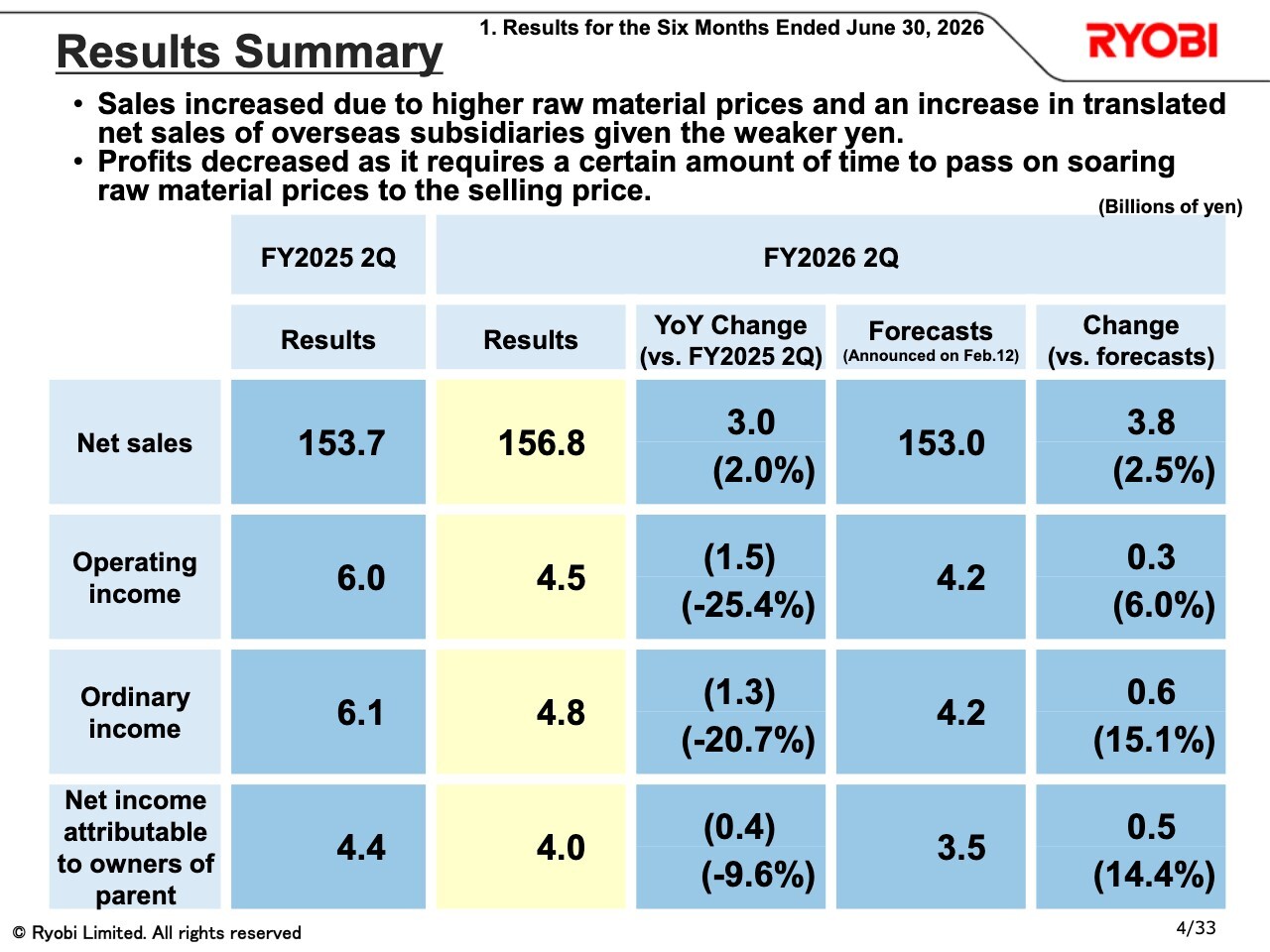
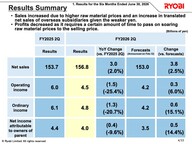
This slide summarizes the results for the first six months of FY2026.
For the first six months, net sales were ¥156.8 billion, an increase of ¥3.0 billion YoY. Operating income was ¥4.5 billion, down ¥1.5 billion YoY; ordinary income was ¥4.8 billion, down ¥1.3 billion YoY; and net income attributable to owners of parent was ¥4.0 billion, down ¥0.4 billion YoY. Overall, we recorded higher sales but lower profits.
Compared with the forecasts announced on February 12 this year, net sales were ¥3.8 billion above forecast, operating income was ¥0.3 billion above forecast, ordinary income was ¥0.6 billion above forecast, and net income attributable to owners of parent was ¥0.5 billion above forecast. As a result, both sales and profits exceeded our forecasts.
Analysis of Changes in Net Sales
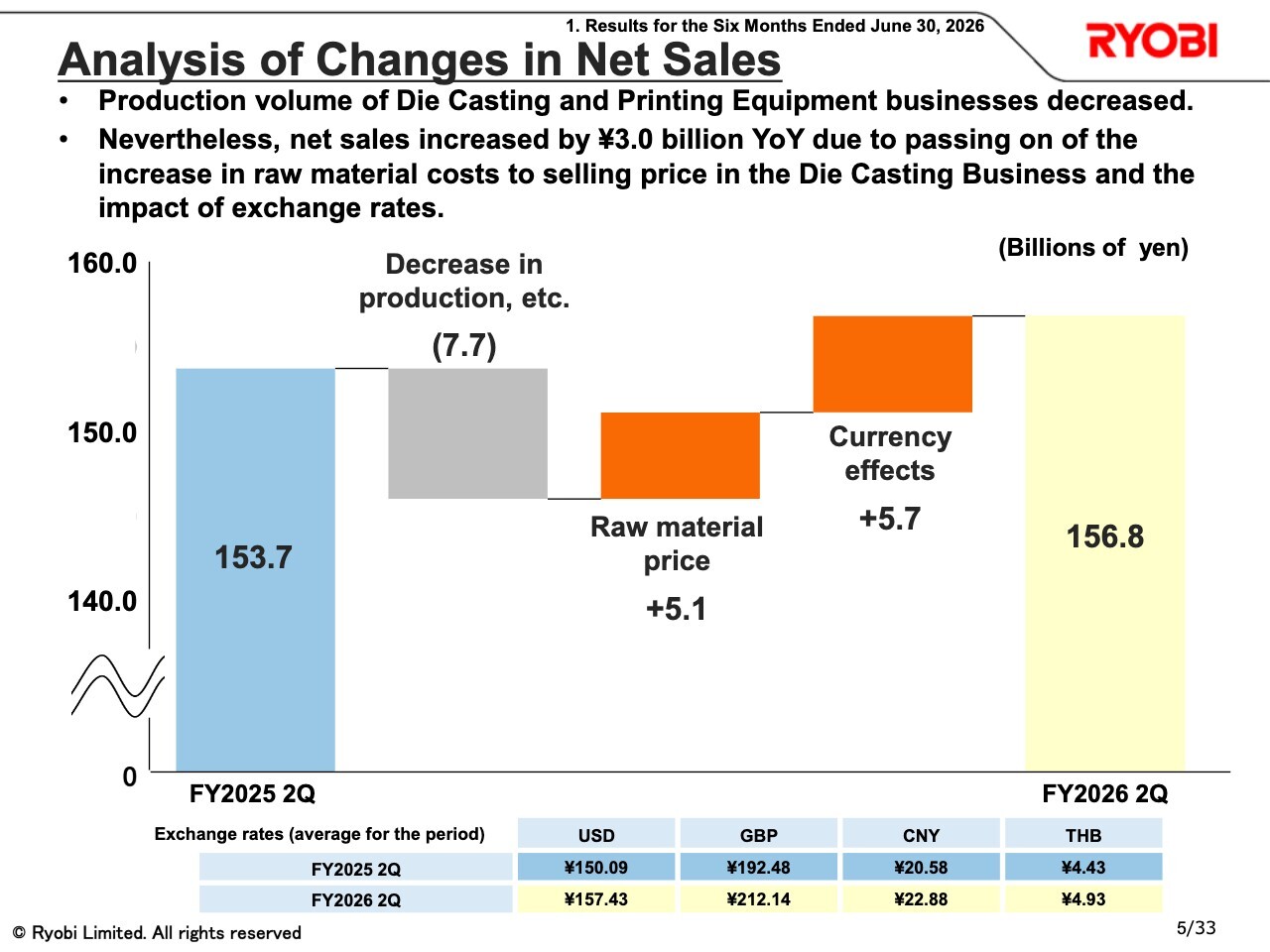
This slide shows the analysis of changes in net sales. The weaker yen had a positive impact of ¥5.7 billion, while higher raw material prices had a positive impact of ¥5.1 billion.
After excluding these factors, the underlying impact of changes in production volume and other factors was negative ¥7.7 billion. As a result, net sales for the first six months of FY2026 were ¥156.8 billion, an increase of ¥3.0 billion YoY.
Analysis of Changes in Operating Income
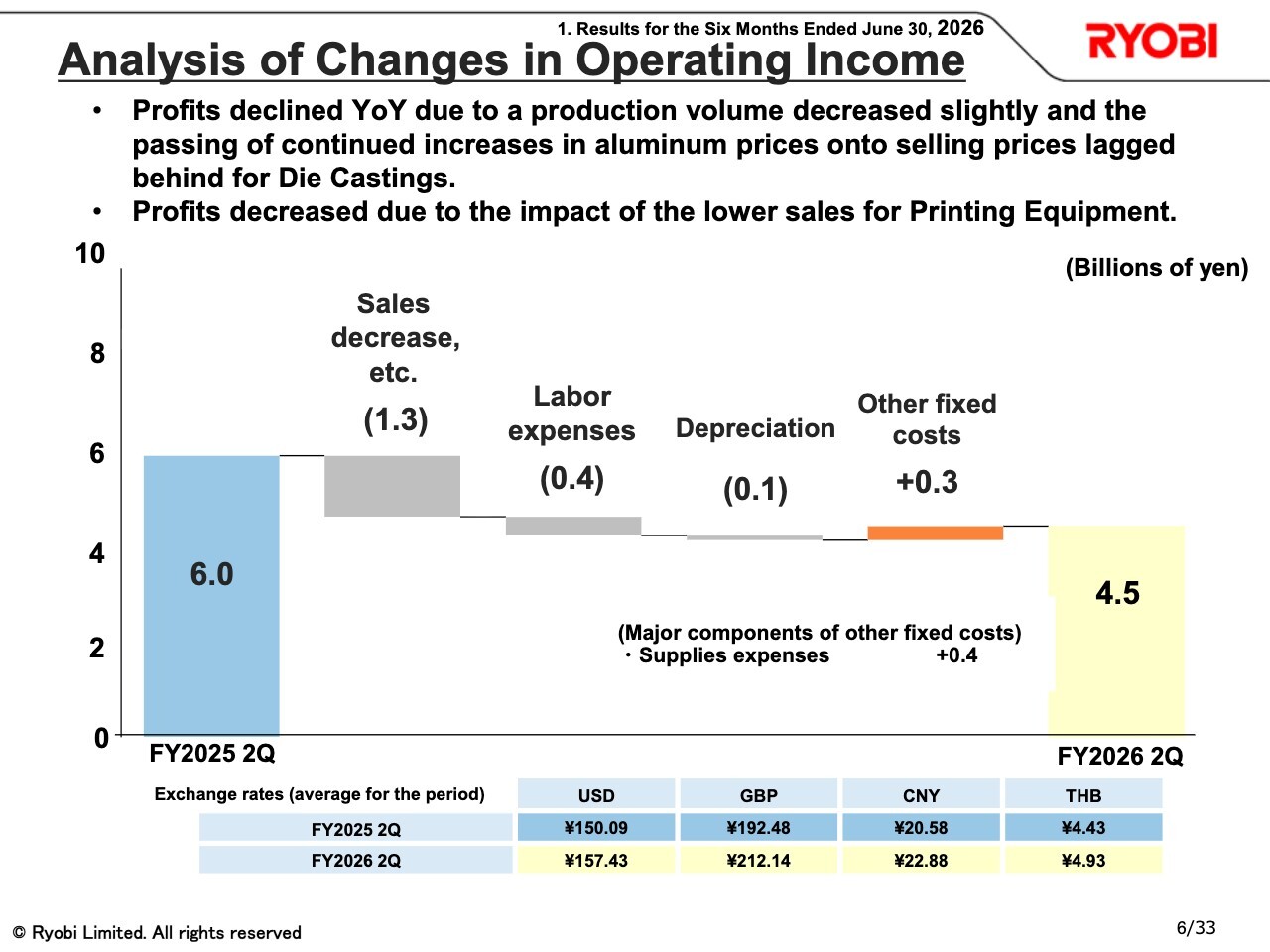
This slide shows the analysis of changes in operating income. In addition to increases in fixed costs such as labor expenses and depreciation, the main factors were a slight decrease in production volume in the Die Castings business and a significant YoY decline in net sales in the Printing Equipment business. As a result, operating income decreased by ¥1.5 billion from ¥6.0 billion in the first six months of the previous fiscal year to ¥4.5 billion.
Results by Business Segment
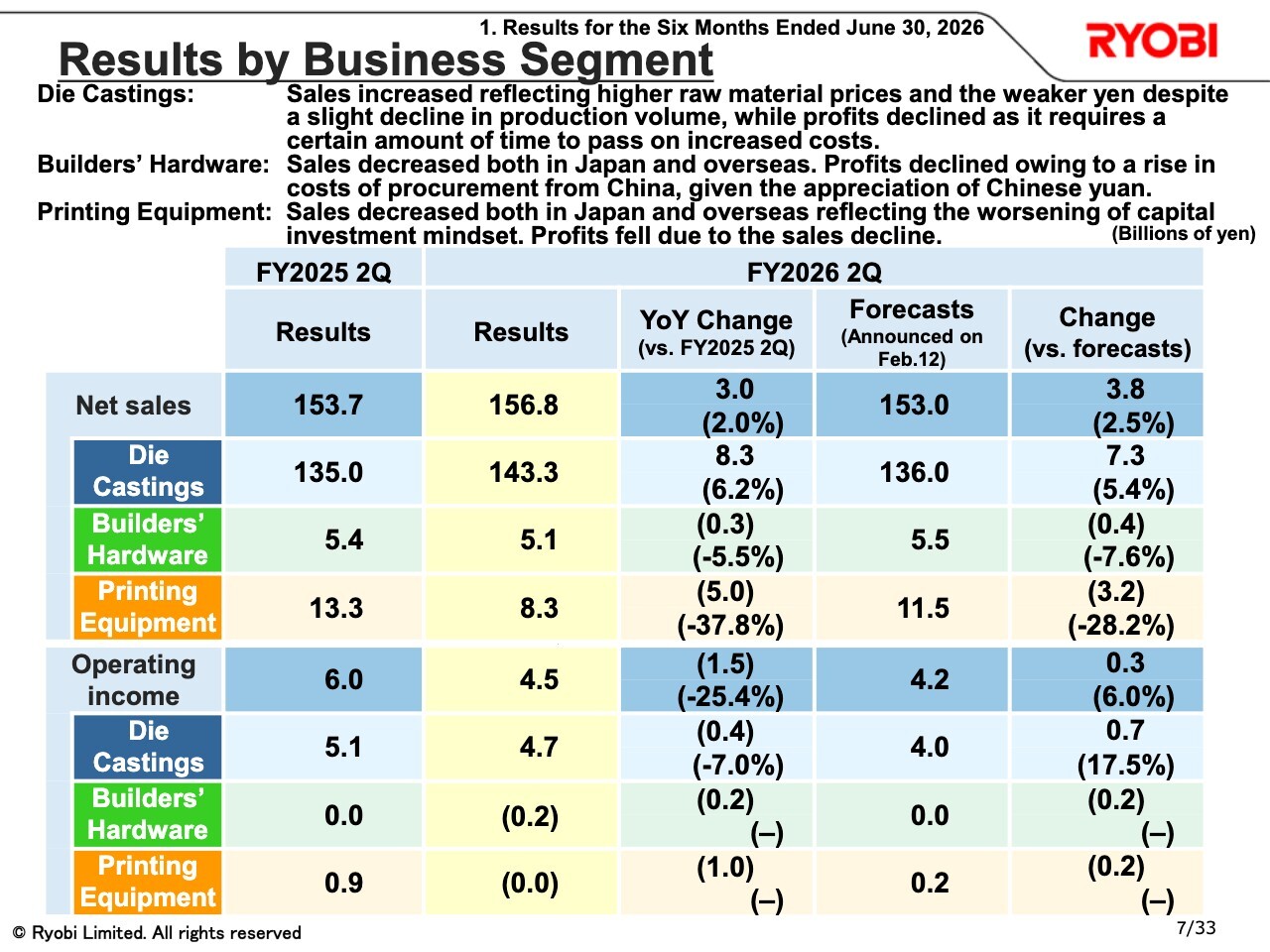
These are the results by business segment. For the first six months of FY2026, net sales in the Die Castings business were ¥143.3 billion, an increase of ¥8.3 billion YoY. Operating income was ¥4.7 billion, a decrease of ¥0.4 billion YoY.
Although production volume declined slightly, net sales increased due to higher raw material prices and the weaker yen. However, profit declined because it takes a certain amount of time to pass higher raw material costs on to selling prices.
Net sales in the Builders’ Hardware business were ¥5.1 billion, a decrease of ¥0.3 billion YoY. Operating income was negative ¥0.2 billion, a decrease of ¥0.2 billion YoY. Sales declined both in Japan and overseas, while the decrease in operating income was attributable to higher procurement costs from China due to the appreciation of the Chinese yuan.
Net sales in the Printing Equipment business were ¥8.3 billion, a decrease of ¥5.0 billion YoY. Operating income was zero, a decrease of ¥1.0 billion YoY.
Sales declined both in Japan and overseas as uncertainty about the outlook weakened capital investment sentiment. The impact of lower sales was significant, resulting in a substantial decline in profit.
Compared with the forecasts announced on February 12 this year, net sales in the Die Castings business were ¥7.3 billion above forecast and operating income was ¥0.7 billion above forecast, so both sales and profit exceeded our forecasts.
By contrast, in the Builders’ Hardware business, net sales were ¥0.4 billion below forecast and operating income was ¥0.2 billion below forecast, so both sales and profit fell short of our forecasts.
In the Printing Equipment business, net sales were ¥3.2 billion below forecast and operating income was ¥0.2 billion below forecast, so both sales and profit also fell short of our forecasts.
Balance Sheet
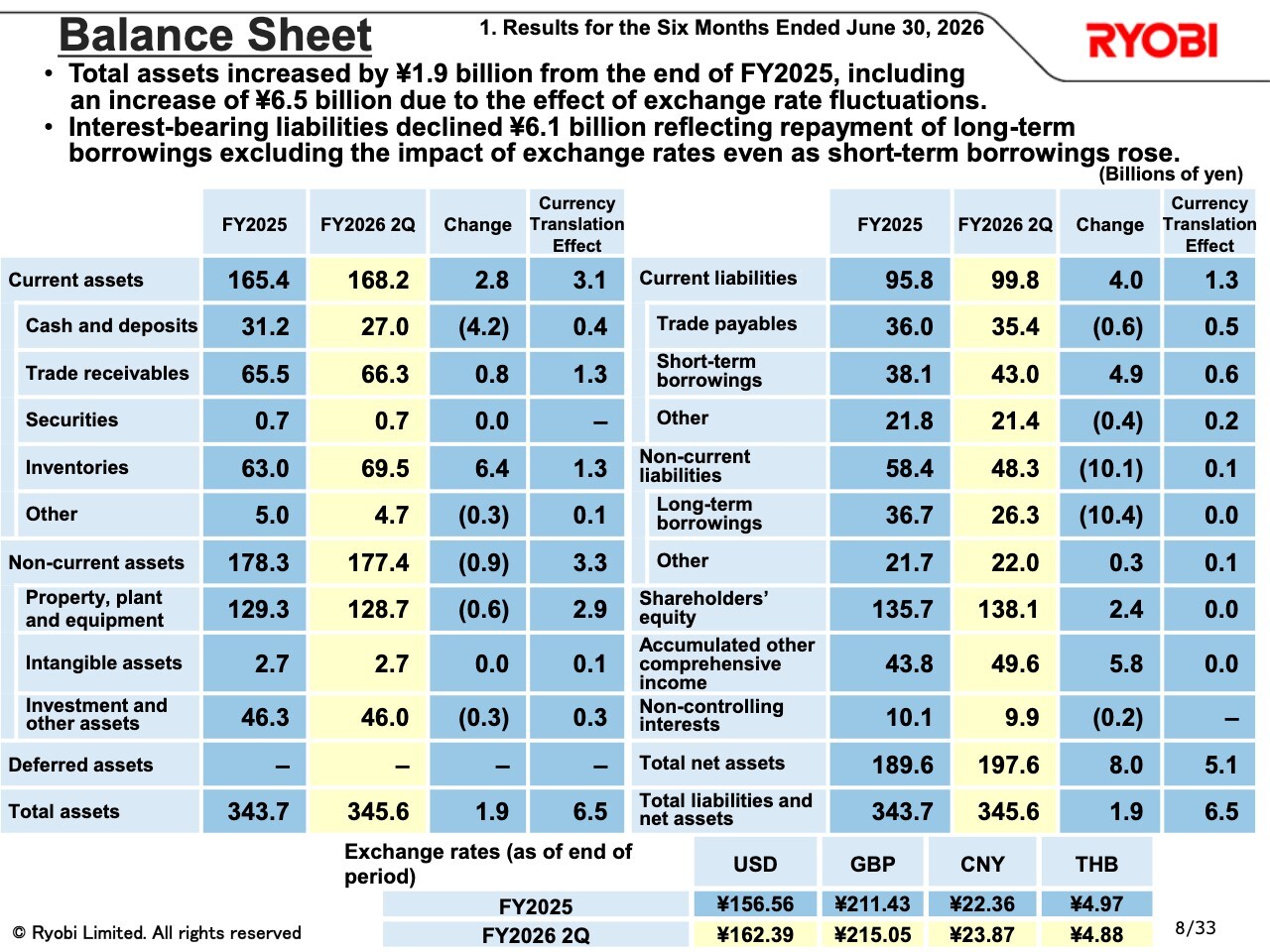
This slide shows the balance sheet. Total assets at the end of FY2026 2Q were ¥345.6 billion, an increase of ¥1.9 billion from the end of FY2025. This included an approximately ¥6.5 billion increase due to exchange rate fluctuations. On the asset side, inventories increased while cash and deposits decreased.
On the liabilities side, excluding the impact of exchange rates, interest-bearing debt —consisting of short-term and long-term borrowings— decreased by ¥6.1 billion due to repayment of borrowings.
Change in Cash Flows
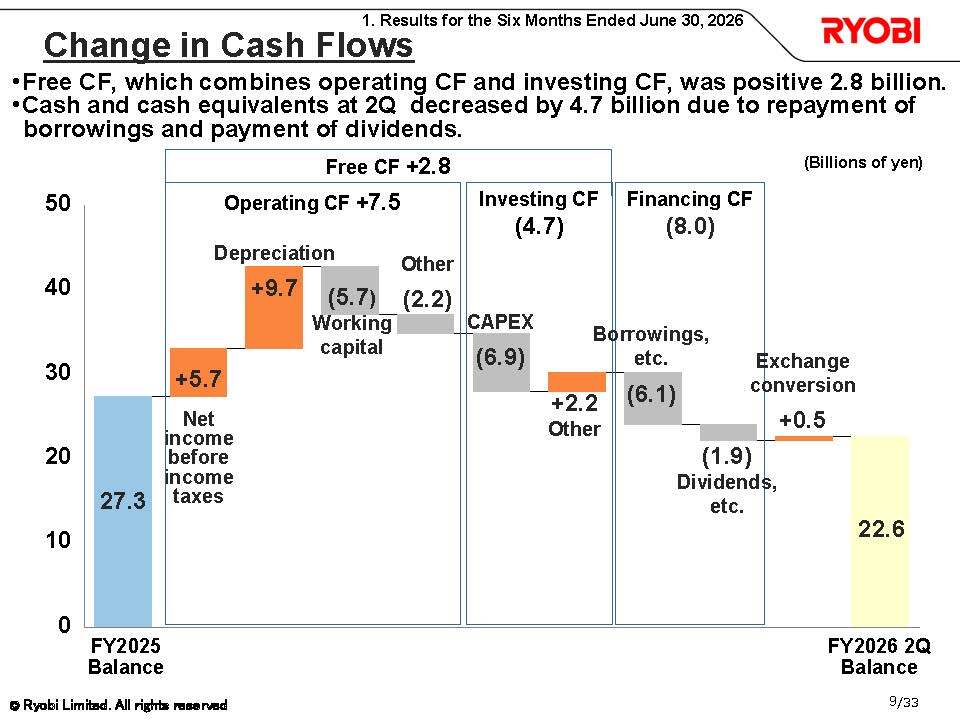
This slide shows the change in cash flows.
After adding depreciation to net income before income taxes and adjusting for working capital and other factors, operating cash flow was positive ¥7.5 billion.
Meanwhile, cash flow from investing activities, including capital expenditure payments, was negative ¥4.7 billion. Free cash flow, the sum of operating and investing cash flows, was positive ¥2.8 billion.
Financing cash flow was negative ¥8.0 billion due to repayment of borrowings and dividend payments. As a result, cash and cash equivalents at the end of FY2026 2Q were ¥22.6 billion, a decrease of ¥4.7 billion from the end of FY2025.
Trends in Production Weight of Die Castings
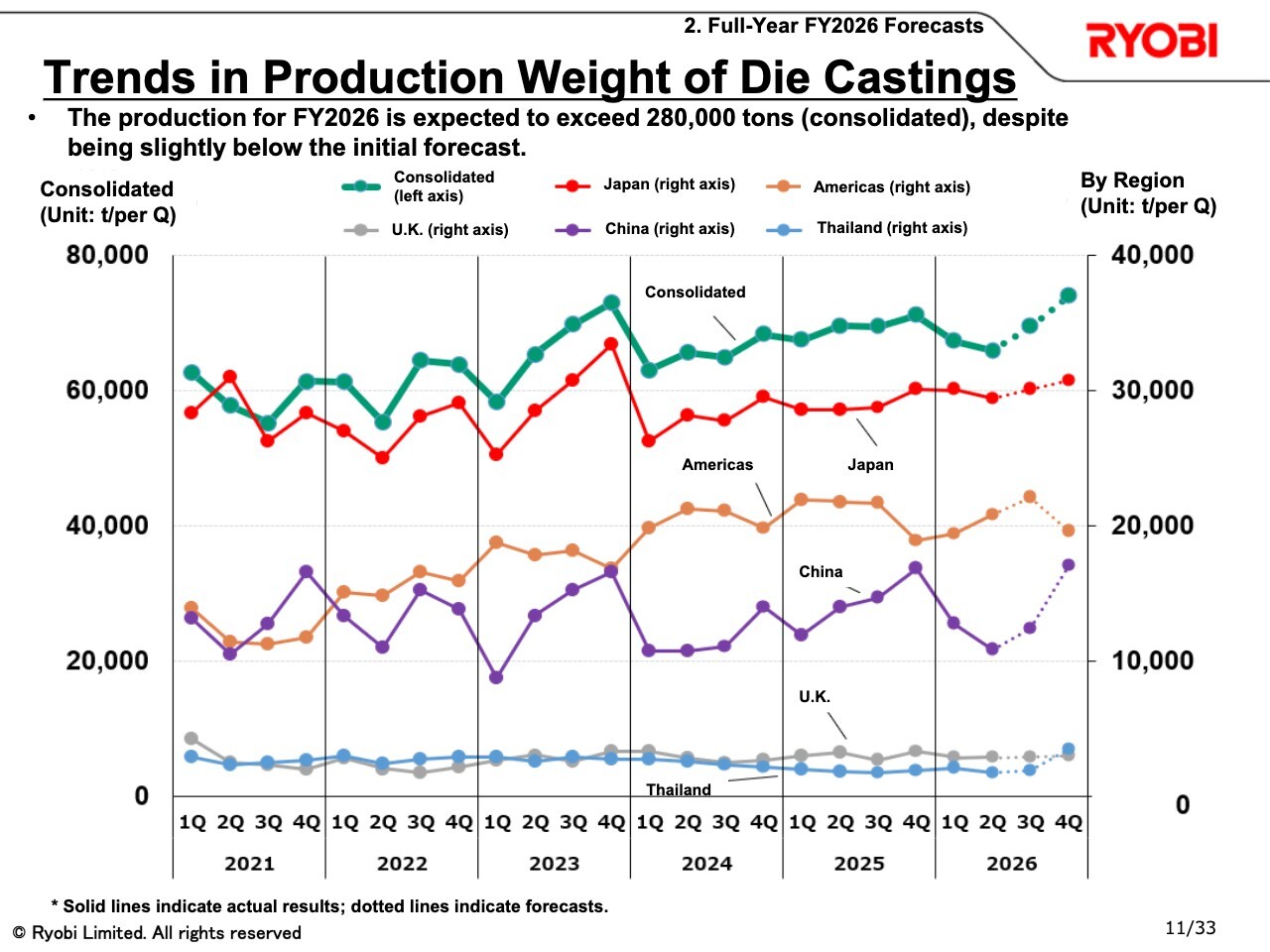
This graph shows the trends in production weight of die castings. Consolidated production weight is expected to be slightly below the initial forecast but remain roughly in line with the previous year.
Forecasts (Changes from the Feb. 12 forecasts)
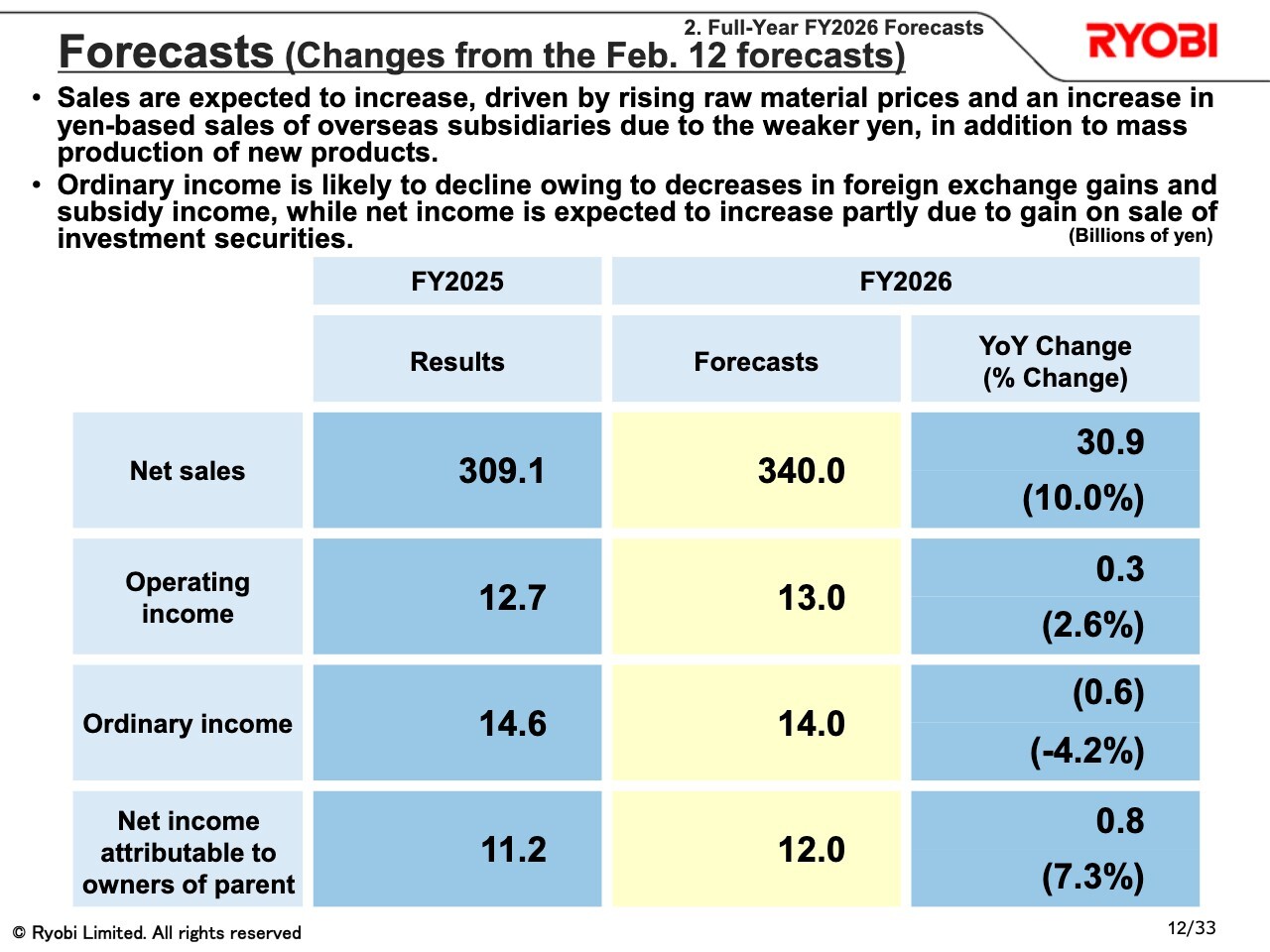
This slide shows our full-year forecasts for FY2026. Net sales are forecast at ¥340.0 billion, an increase of ¥30.9 billion YoY. Operating income is forecast at ¥13.0 billion, an increase of ¥0.3 billion YoY, while ordinary income is forecast at ¥14.0 billion, a decrease of ¥0.6 billion YoY.
Net income attributable to owners of parent is forecast at ¥12.0 billion, an increase of ¥0.8 billion YoY.
We expect net sales to increase due to mass production of new products, higher raw material prices, and an increase in yen-translated sales of overseas subsidiaries resulting from the weaker yen.
Regarding profit, ordinary income is expected to decline because foreign exchange gains, subsidy income, and other income recorded in the previous fiscal year are expected to decrease. On the other hand, net income attributable to owners of parent is expected to increase, as we anticipate gains on the sale of investment securities.
Forecasts by Business Segment
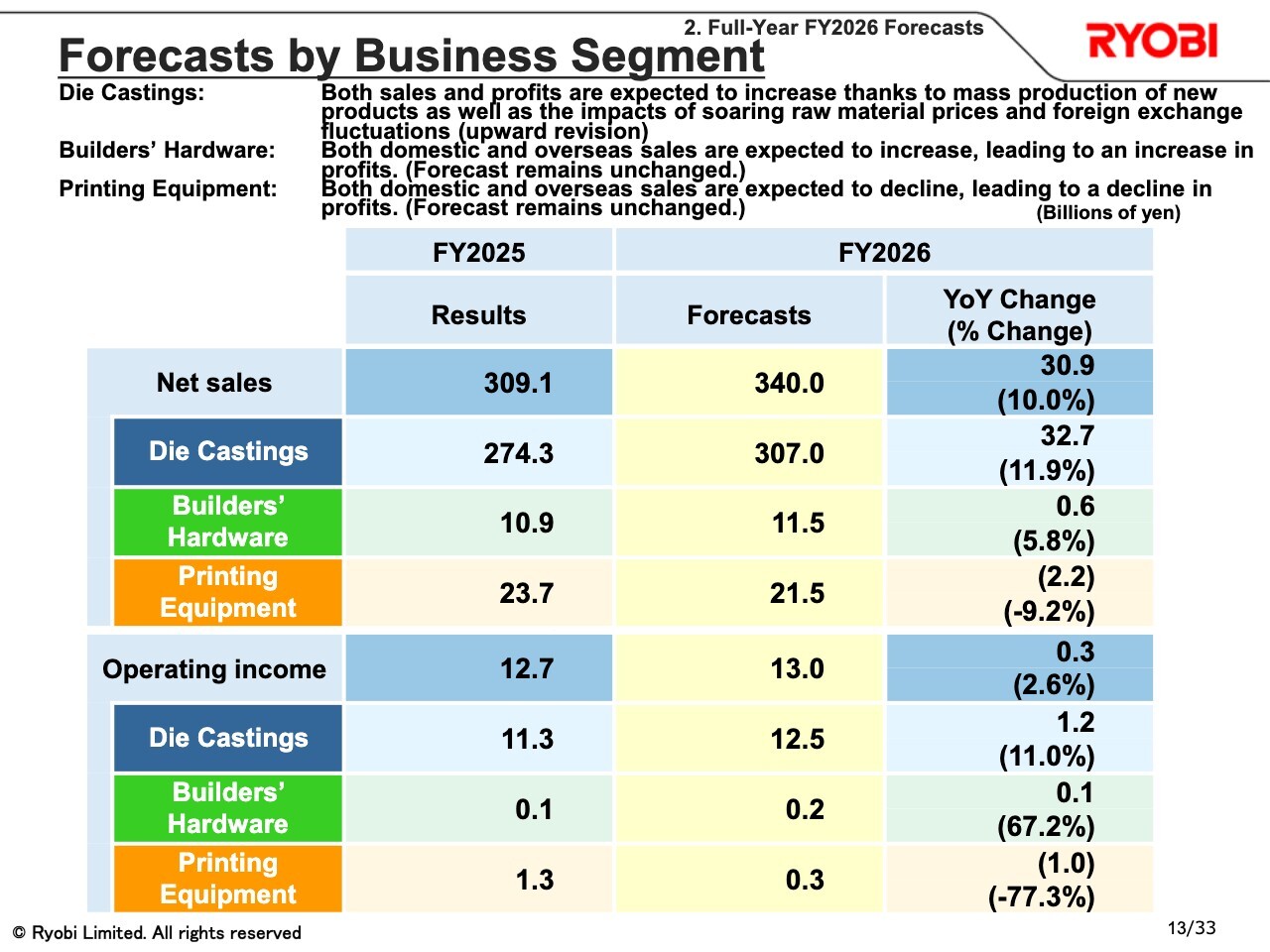
These are the full-year forecasts by business segment for FY2026.
In the Die Castings business, net sales are forecast at ¥307.0 billion, an increase of ¥32.7 billion YoY. Operating income is forecast at ¥12.5 billion, an increase of ¥1.2 billion YoY. We expect both sales and profit to increase due to mass production of new products, higher raw material prices, and exchange rate effects.
In the Builders’ Hardware business, net sales are forecast at ¥11.5 billion, an increase of ¥0.6 billion YoY. Operating income is forecast at ¥0.2 billion, an increase of ¥0.1 billion YoY. We expect higher sales both in Japan and overseas to lead to higher profit.
In the Printing Equipment business, net sales are forecast at ¥21.5 billion, a decrease of ¥2.2 billion YoY. Operating income is forecast at ¥0.3 billion, a decrease of ¥1.0 billion YoY. We expect sales to decline both in Japan and overseas, resulting in lower profit.
Analysis of Changes in Operating Income Forecast
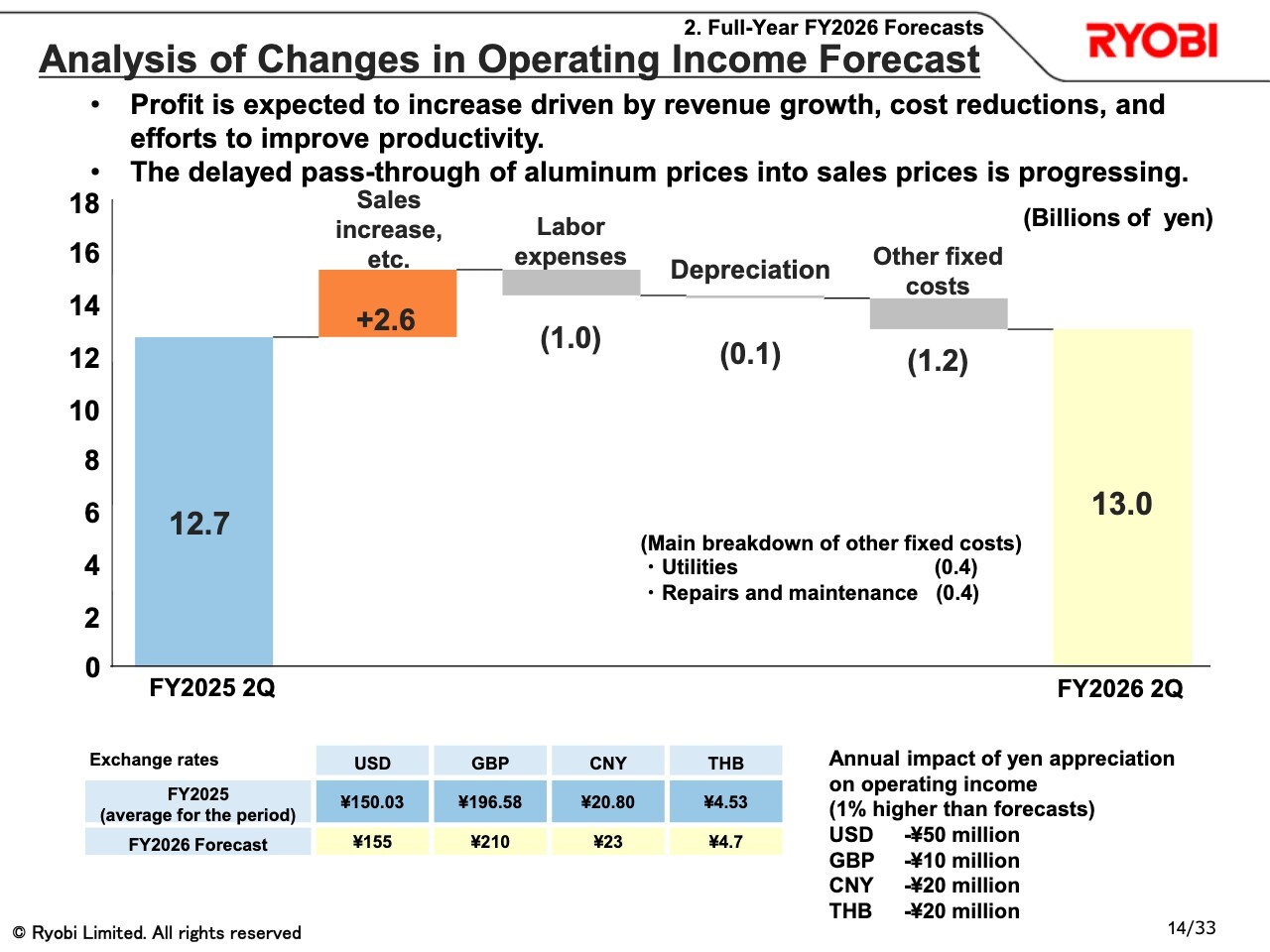
This slide shows the analysis of changes in the operating income forecast. Operating income is forecast to increase by ¥0.3 billion, from ¥12.7 billion in the previous fiscal year to ¥13.0 billion in FY2026.
Although fixed costs are expected to increase, we expect higher profit by capturing the benefit of higher sales from increased die casting production toward the second half, while also pursuing cost reductions and productivity improvements.
Trends in Capital Expenditures and Depreciation
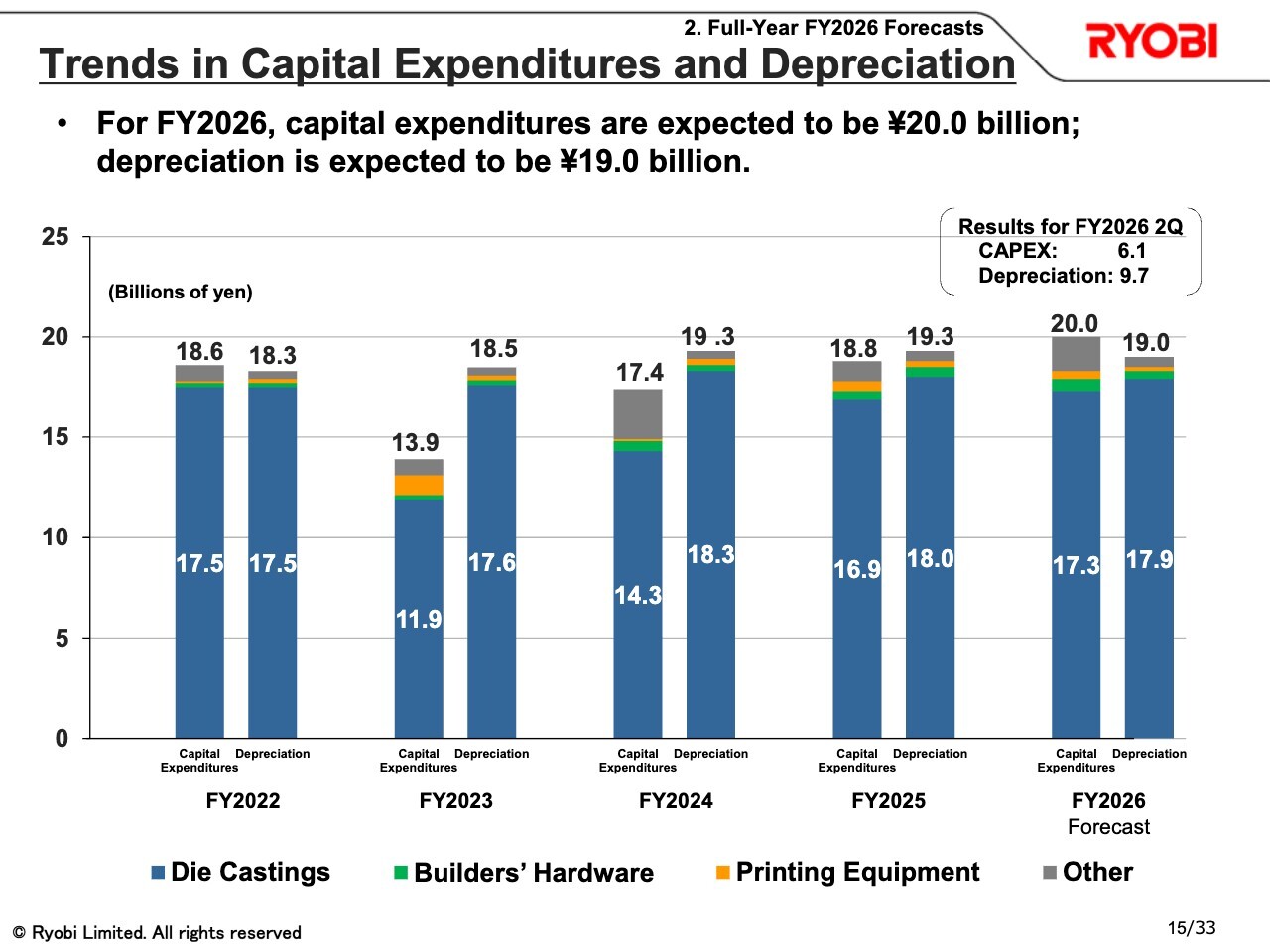
This slide shows the trends in capital expenditures and depreciation. Capital expenditures for FY2026 are forecast at ¥20.0 billion. We initially planned ¥22.0 billion, but reduced the plan by ¥2.0 billion to ¥20.0 billion due to reductions in certain investments and timing shifts. Depreciation is expected to be ¥19.0 billion, roughly unchanged from the previous fiscal year.
Trends in Interest-Bearing Debt and D/E Ratio
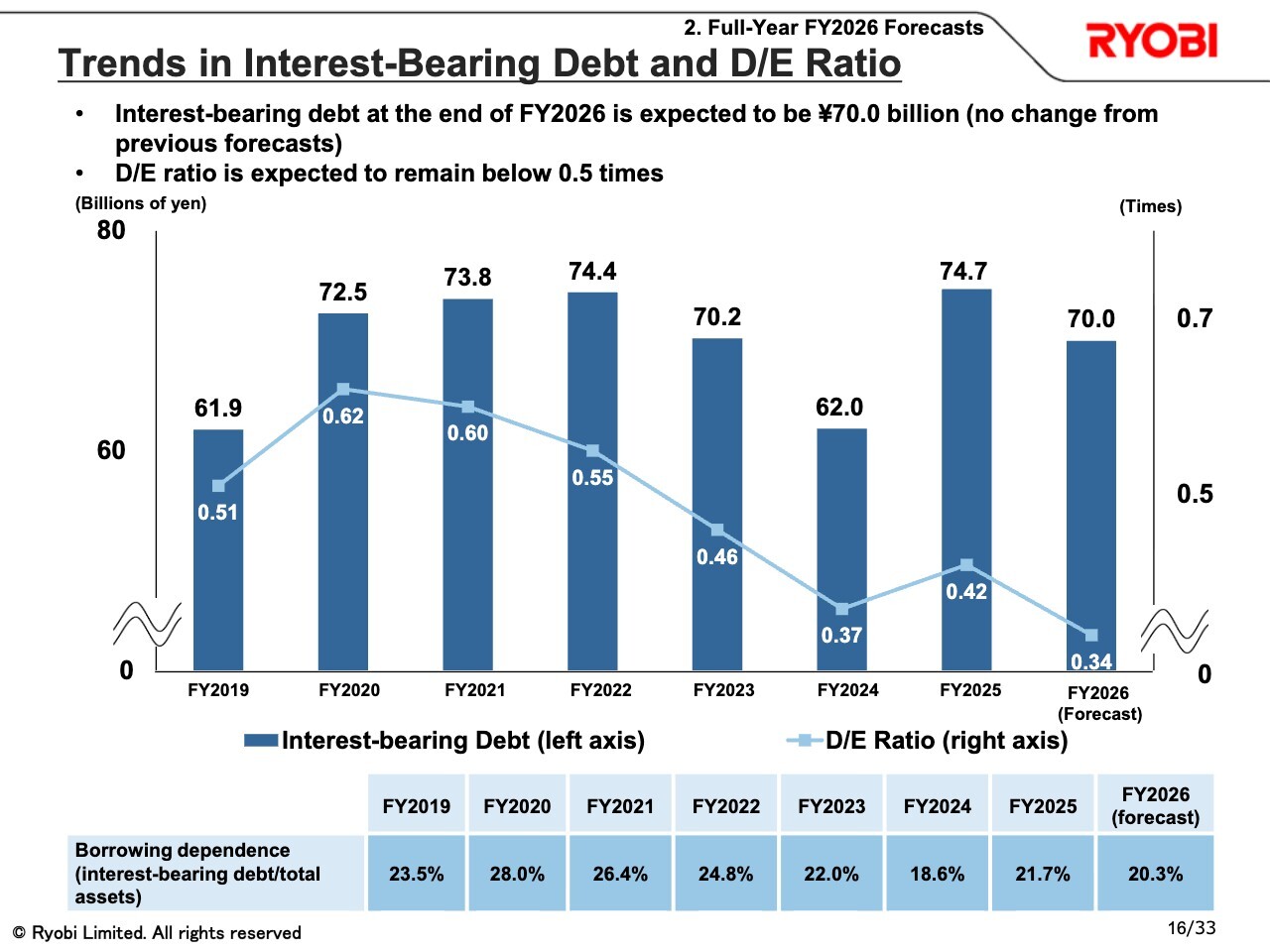
This slide shows the trends in interest-bearing debt and the D/E ratio. Interest-bearing debt at the end of FY2026 is forecast at ¥70.0 billion, a decrease of ¥4.7 billion from ¥74.7 billion at the end of FY2025. We plan to continue maintaining the D/E ratio below 0.5 times.
Positioning of MTMP (2025–2027)
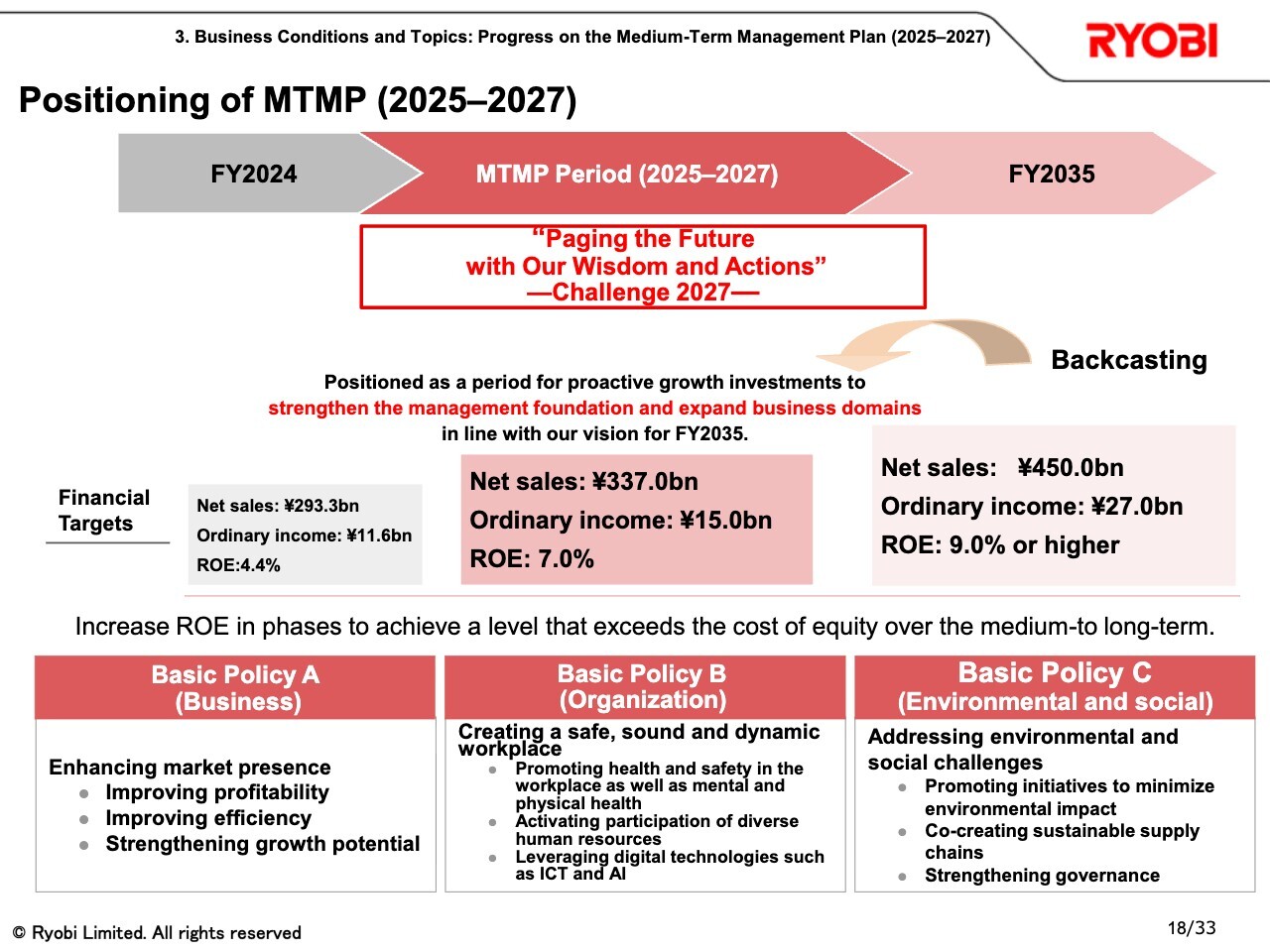
Urakami: From here, I will explain the status and key topics of each business, as well as our initiatives to enhance corporate value, focusing on progress in the first six months of FY2026 under our Medium-Term Management Plan.
First, I would like to reaffirm the positioning of the Medium-Term Management Plan. As our vision for FY2035, we have set targets of net sales of ¥450.0 billion, ordinary income of ¥27.0 billion, and ROE of 9.0% or higher.
To realize this vision, we used a backcasting approach to determine what we need to accomplish over the three years beginning in 2025. For FY2027, the final year of the current Medium-Term Management Plan, we are targeting net sales of ¥337.0 billion, ordinary income of ¥15.0 billion, and ROE of 7.0%.
MTMP (2025–2027): Basic Policies by Business Segment
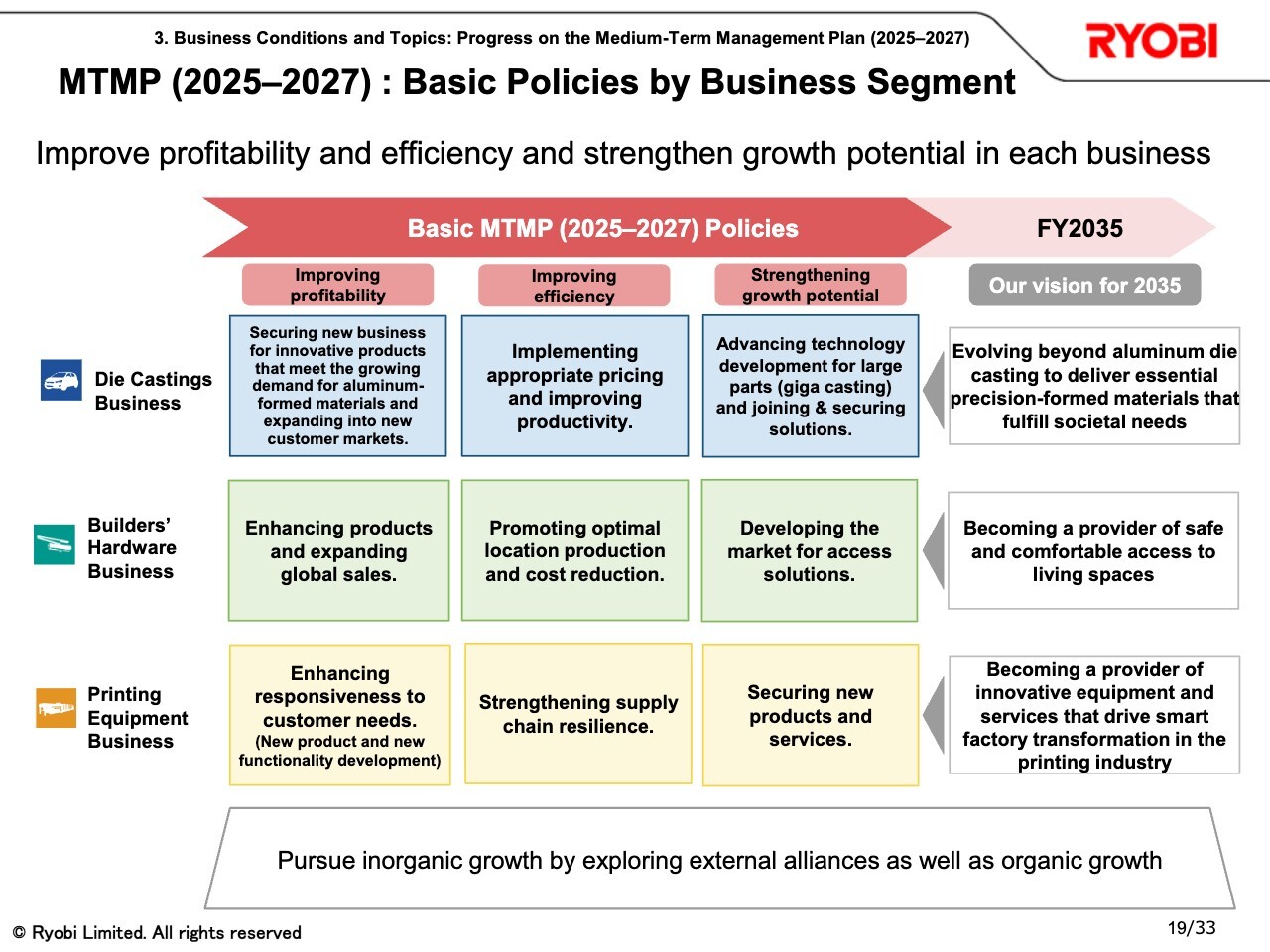
We have defined our vision for FY2035 for each business segment and established “Improving profitability,” “Improving efficiency,” and “Strengthening growth potential” as the basic policies common to all businesses for realizing that vision. The key issues for each business are set out as shown on the slide.
Progress to Six Months ended June 30, 2026 (Die Castings)
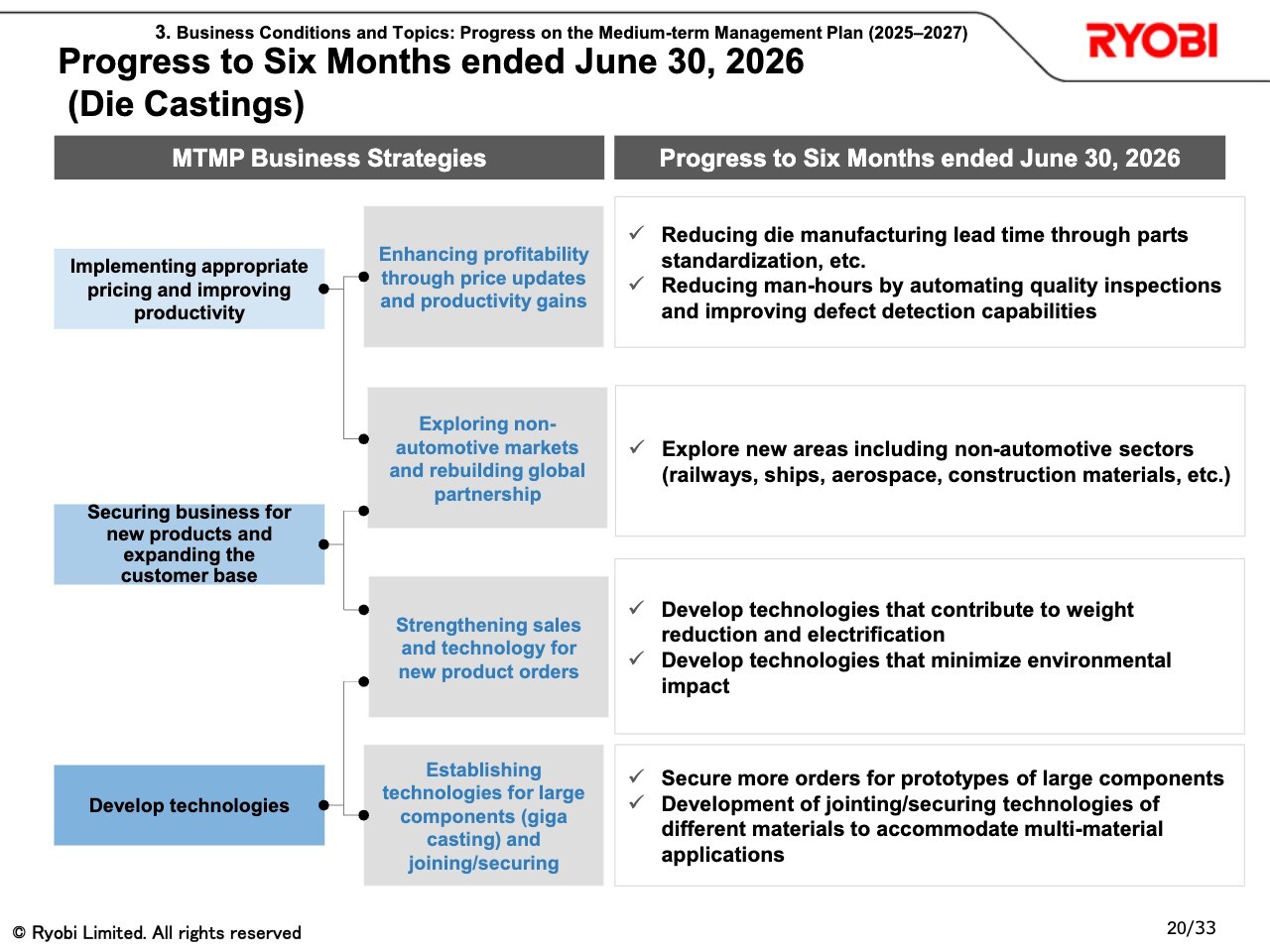
This slide shows the status of initiatives by business segment.
This slide shows the status of initiatives addressing the key issues in the Die Castings business. In 2026, we are advancing productivity improvement measures such as reducing die manufacturing lead time through parts standardization and reducing labor requirements in inspection processes.
On the sales side, we are also exploring new areas including non-automotive sectors; developing technologies that contribute to weight reduction, electrification, and lower environmental impact; securing more prototype orders for giga casting products; and developing technologies for joining different materials.
Die Castings: Key Topics in FY2026
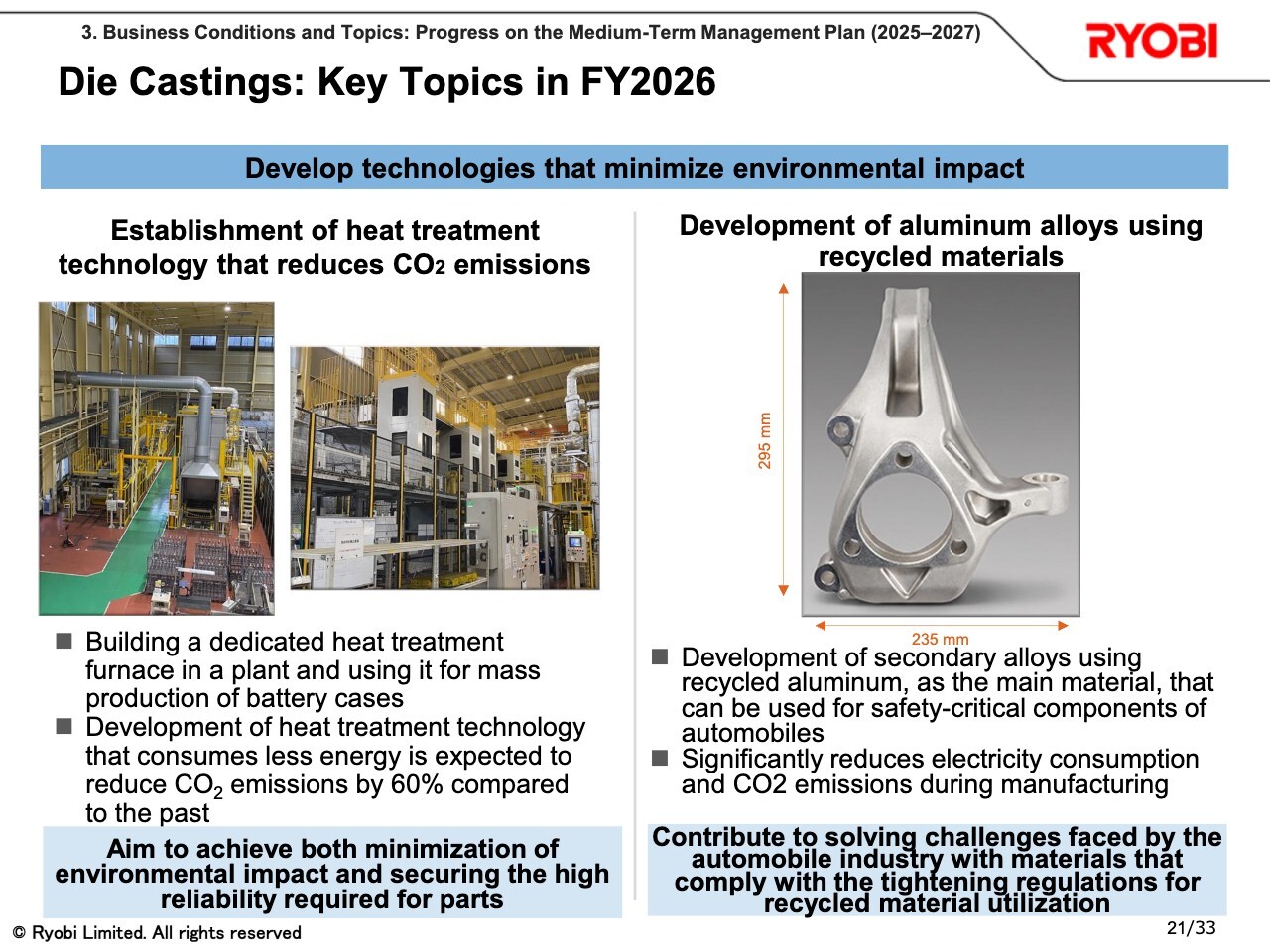
I will now introduce our technology development initiatives in the Die Castings business aimed at reducing environmental impact.
The example on the left side of the slide was also featured in the Nikkan Kogyo Shimbun on April 6 this year. We installed a dedicated heat treatment furnace at the plant and established a heat treatment technology that reduces energy consumption. This has enabled a 60% reduction in CO2 emissions compared with the conventional process in mass production of battery cases and other products.
The example on the right side of the slide was featured in the Nikkan Kogyo Shimbun on May 14 this year and the Sanyo Shimbun on July 14.
Traditionally, secondary aluminum alloys have been considered difficult to apply to automobile body parts that require high toughness. We addressed this issue and developed an aluminum alloy made from recycled material that can be used for safety-critical automotive components.
This makes it possible to manufacture parts using recycled aluminum rather than primary aluminum, significantly reducing electricity consumption and CO2 emissions during manufacturing. It also helps address increasingly stringent environmental regulations and contributes to solving challenges faced by the automobile industry.
The photo on the slide shows a steering knuckle made from the recycled-material aluminum alloy that has been adopted by one of our major customers.
Die Castings: Key Topics in FY2026
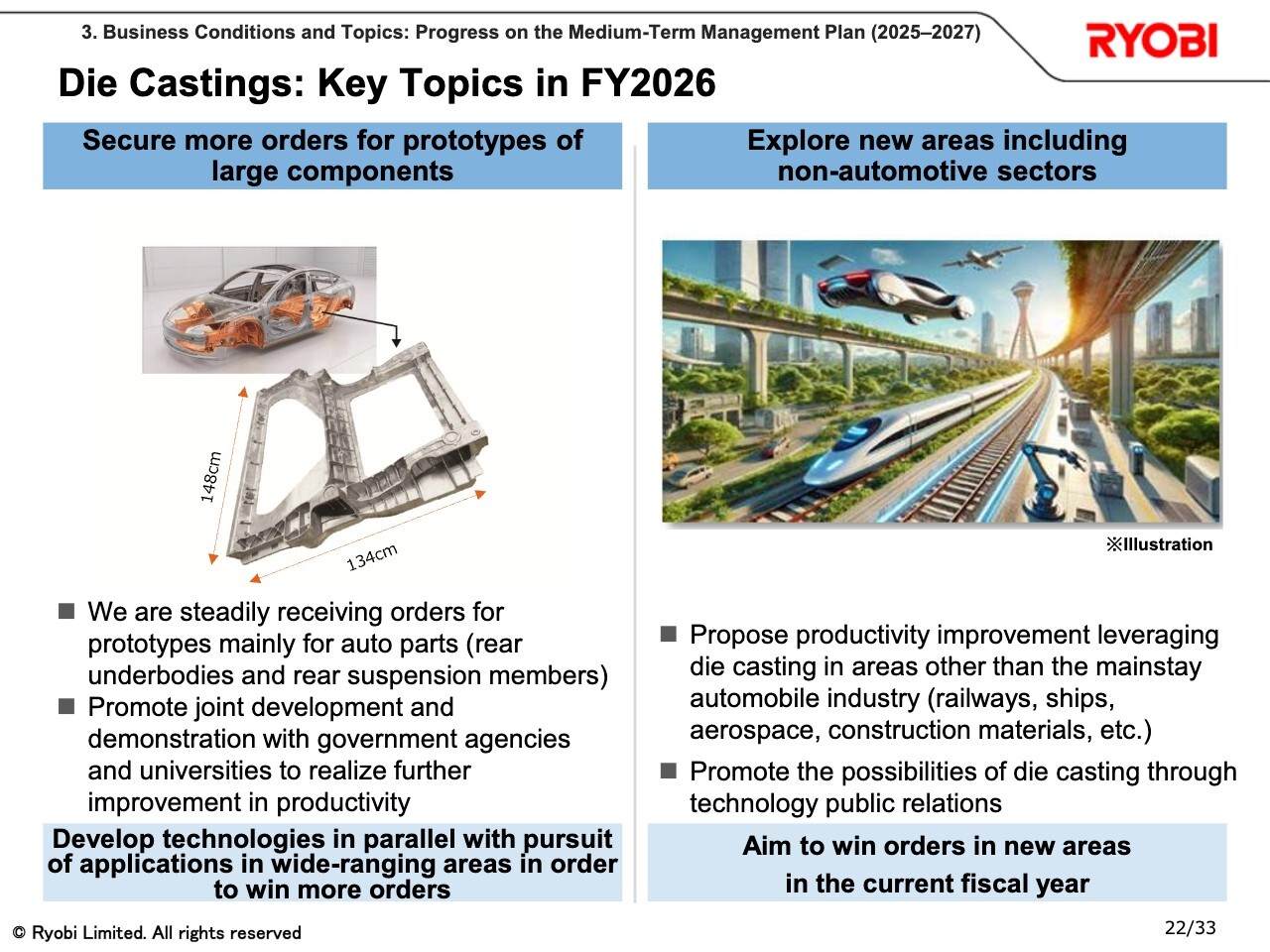
Next, I will explain the status of ultra-large die casting, commonly referred to as giga casting. At the large-scale prototype production facility at our Kikugawa Plant, which began operations last year, orders for prototypes have remained steady, mainly for large automotive parts such as rear underbodies and rear suspension members.
To further improve production efficiency, we are also conducting joint development and demonstration projects with government agencies and universities. At the same time, we are promoting the technology across a broad range of applications with the aim of securing more orders.
We are also proposing the use of die casting for a variety of products outside our mainstay automobile industry. Specifically, in non-automotive areas such as railways, ships, aerospace, and construction materials, we are actively communicating advances in die casting technology and the advantages of the process.
We conducted 103 technology presentations in the first half of FY2026. In FY2025, we conducted more than 140 technology presentations for customers and prospective customers in Japan and overseas, bringing the cumulative total to more than 250. We aim to win orders in new areas during the current fiscal year.
Status of Initiatives through 2Q/FY2026 (Builders’ Hardware and Printing Equipment)
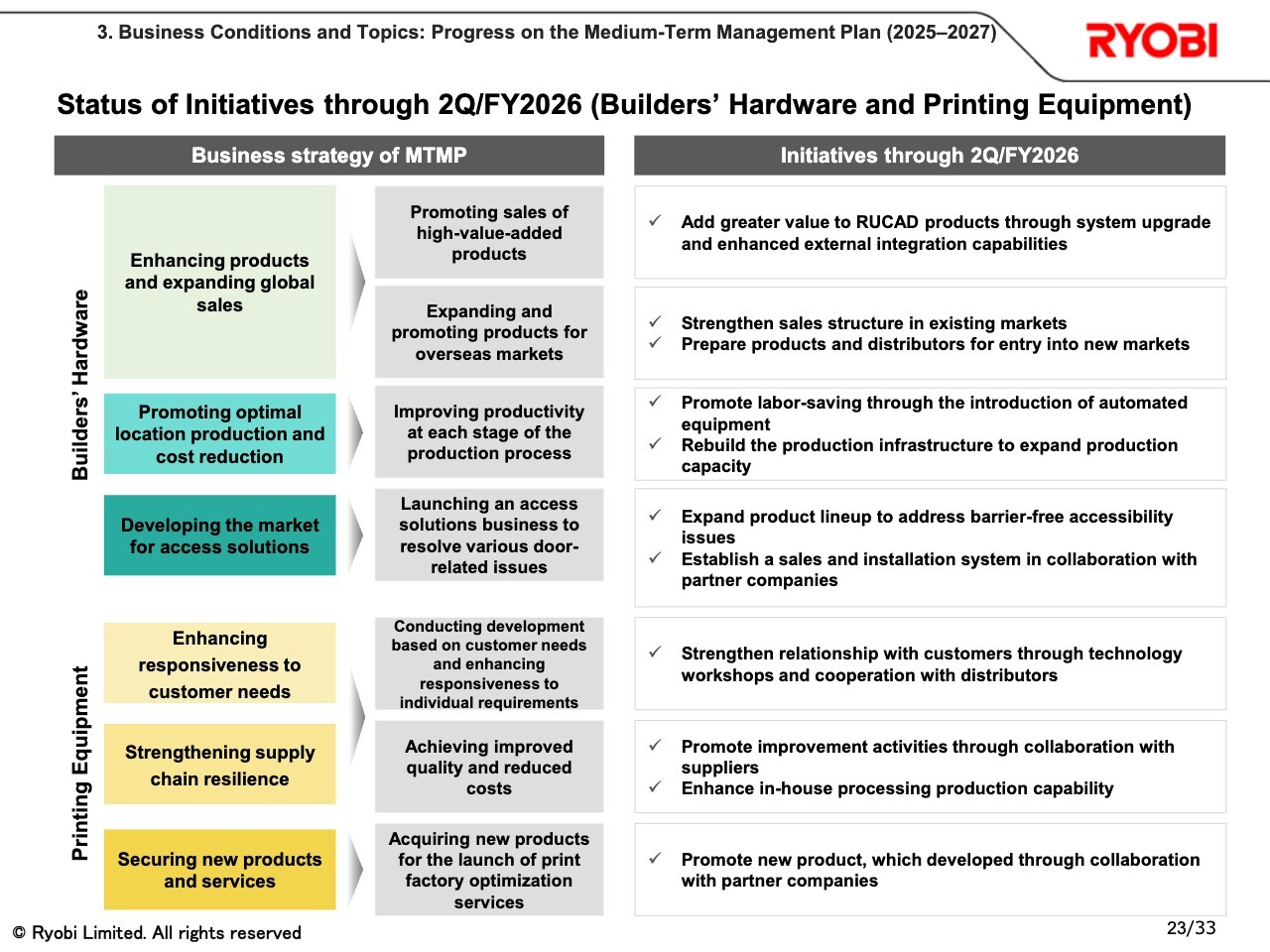
This slide shows the status of initiatives in the Builders’ Hardware and Printing Equipment businesses. In the Builders’ Hardware business, we are working to add greater value to the RUCAD automatic door controller by upgrading the system and enhancing integration with external devices.
In the Printing Equipment business, we are strengthening relationships with customers through technology workshops and collaboration with distributors.
Builders’ Hardware: Key Topics in FY2026
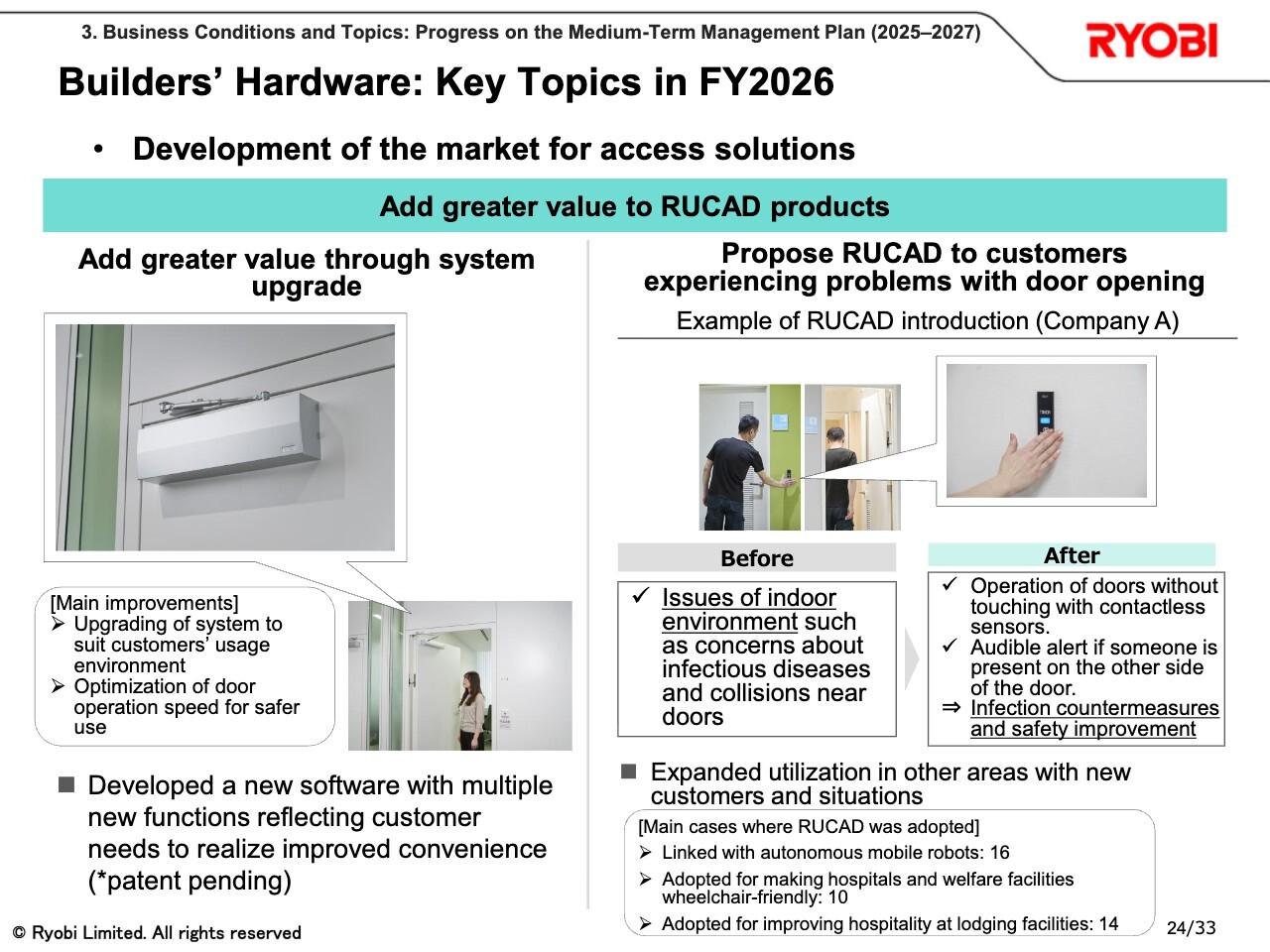
Here is a specific example from the Builders’ Hardware business.
To add greater value to the RUCAD automatic door controller, we made improvements including system upgrades tailored to customers’ usage environments and optimization of door operation speed for safer use.
Reflecting customer needs, we newly developed software with multiple new functions and further improved convenience.
We are also proposing RUCAD as a solution to customers’ problems with door openings, with the aim of expanding adoption.
The right side of the slide shows an example at a customer’s distribution center where the introduction of RUCAD helped resolve workplace-environment issues such as concerns about infectious diseases and collisions near doors.
We are also aiming to expand adoption by helping solve on-site issues for a variety of purposes, including linkage with autonomous mobile robots, barrier-free use at hospitals and welfare facilities, and improved hospitality at lodging facilities.
Printing Equipment: Key Topics in FY2026
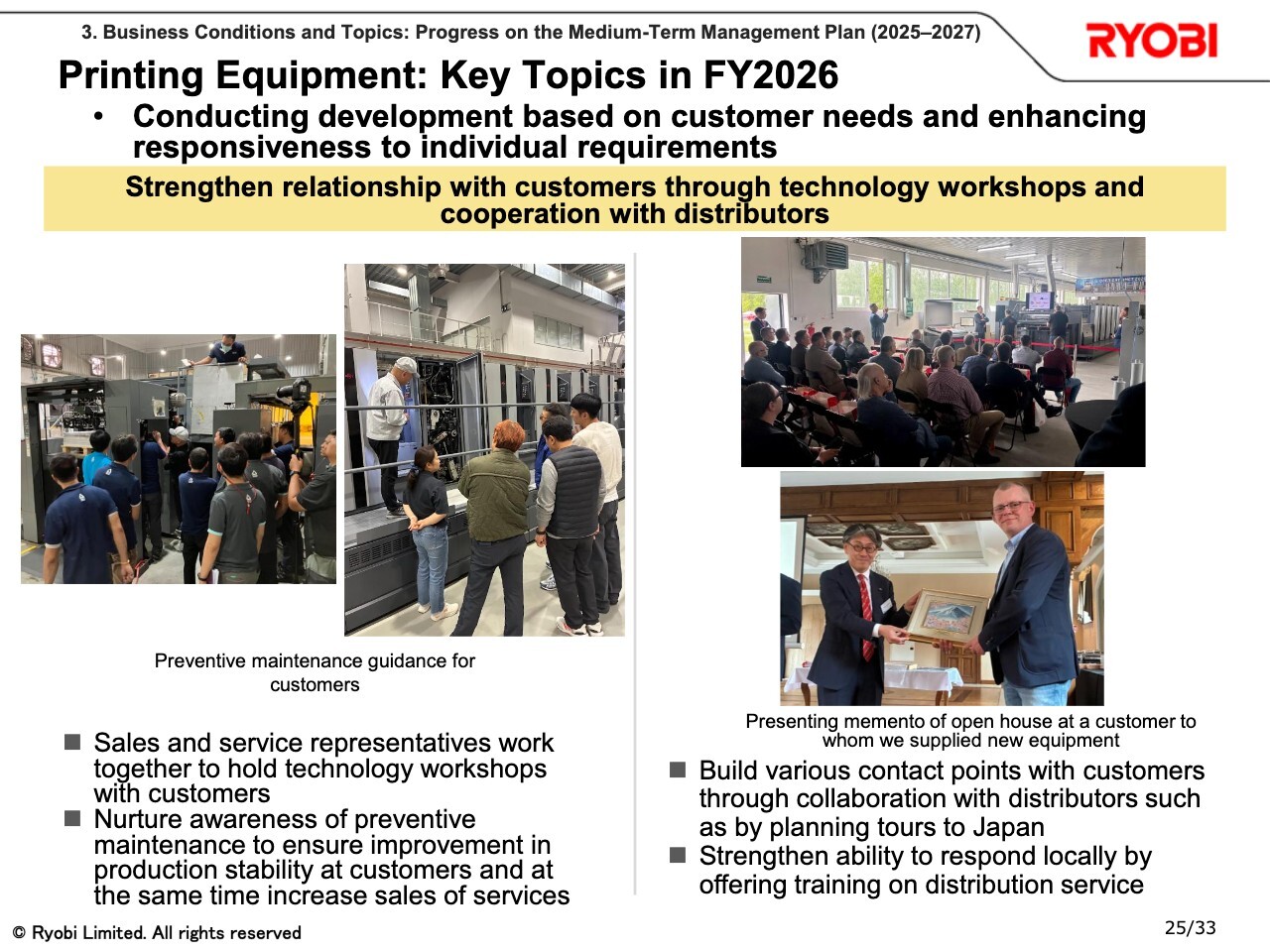
In the Printing Equipment business, we are advancing development based on customer needs and enhancing responsiveness to individual requirements. We are also strengthening customer relationships through technology workshops with customers and printing companies and through collaboration with distributors.
In overseas markets as well, sales and service teams are working together to improve the stability of customers’ production while also expanding sales.
We are also strengthening customer relationships by hosting tours to Japan for overseas customers and holding open houses in Japan and overseas, while promoting training for distributor service personnel.
Medium-Term Policy for Enhancing Corporate Value
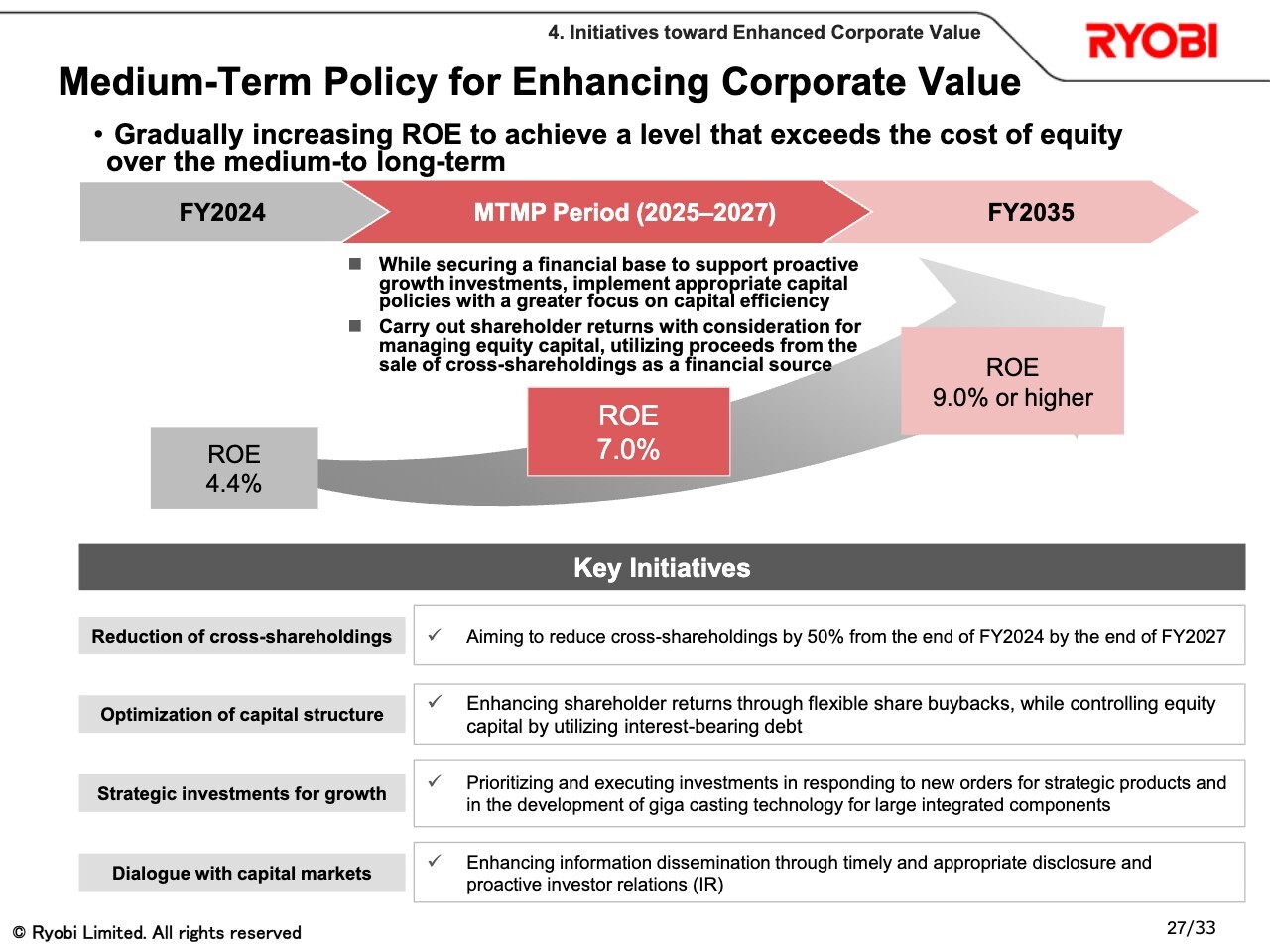
I will now explain the status of our initiatives to enhance corporate value.
To enhance corporate value, we aim to raise ROE in phases and achieve a level that exceeds the cost of equity.
We are targeting ROE of 7.0% in FY2027, the final year of the Medium-Term Management Plan, and 9.0% or higher in FY2035. To achieve these targets, we are working to reduce cross-shareholdings, optimize our capital structure, make strategic investments for growth, and strengthen dialogue with the capital markets.
Shareholder Returns (Share Buybacks and Dividend Policy)
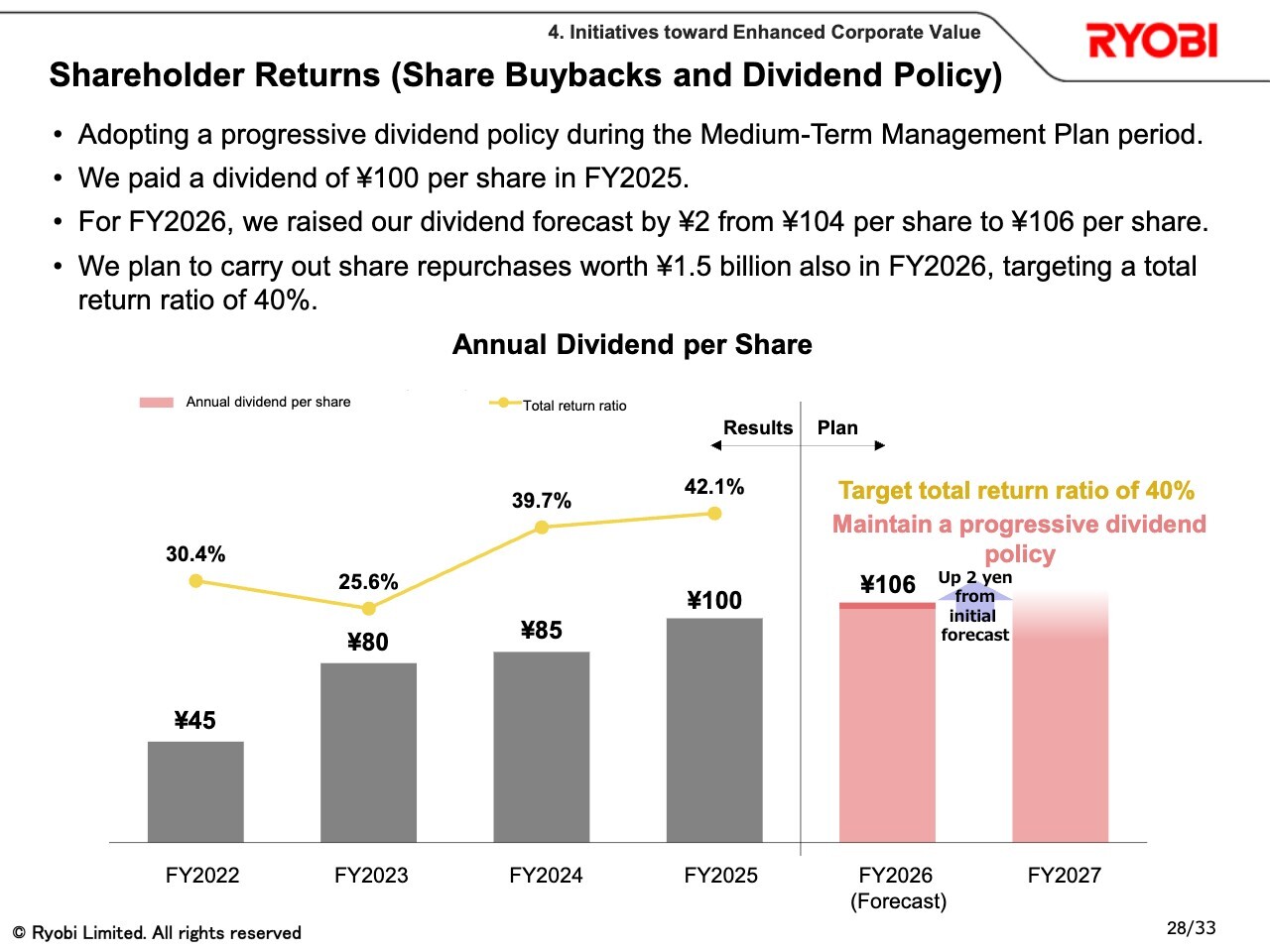
This slide covers shareholder returns. We have adopted a progressive dividend policy during the current Medium-Term Management Plan period.
As disclosed together with yesterday’s financial results announcement, we have revised our latest earnings forecast upward. To enhance shareholder returns, we also raised the year-end dividend forecast by ¥2 from the previous forecast and now plan an annual dividend of ¥106 per share.
We have also decided to carry out ¥1.5 billion of share buybacks, as we did in the previous fiscal year. Through these measures, we will continue to strengthen shareholder returns and improve capital efficiency.
Topics on Addressing Environmental and Social Challenges
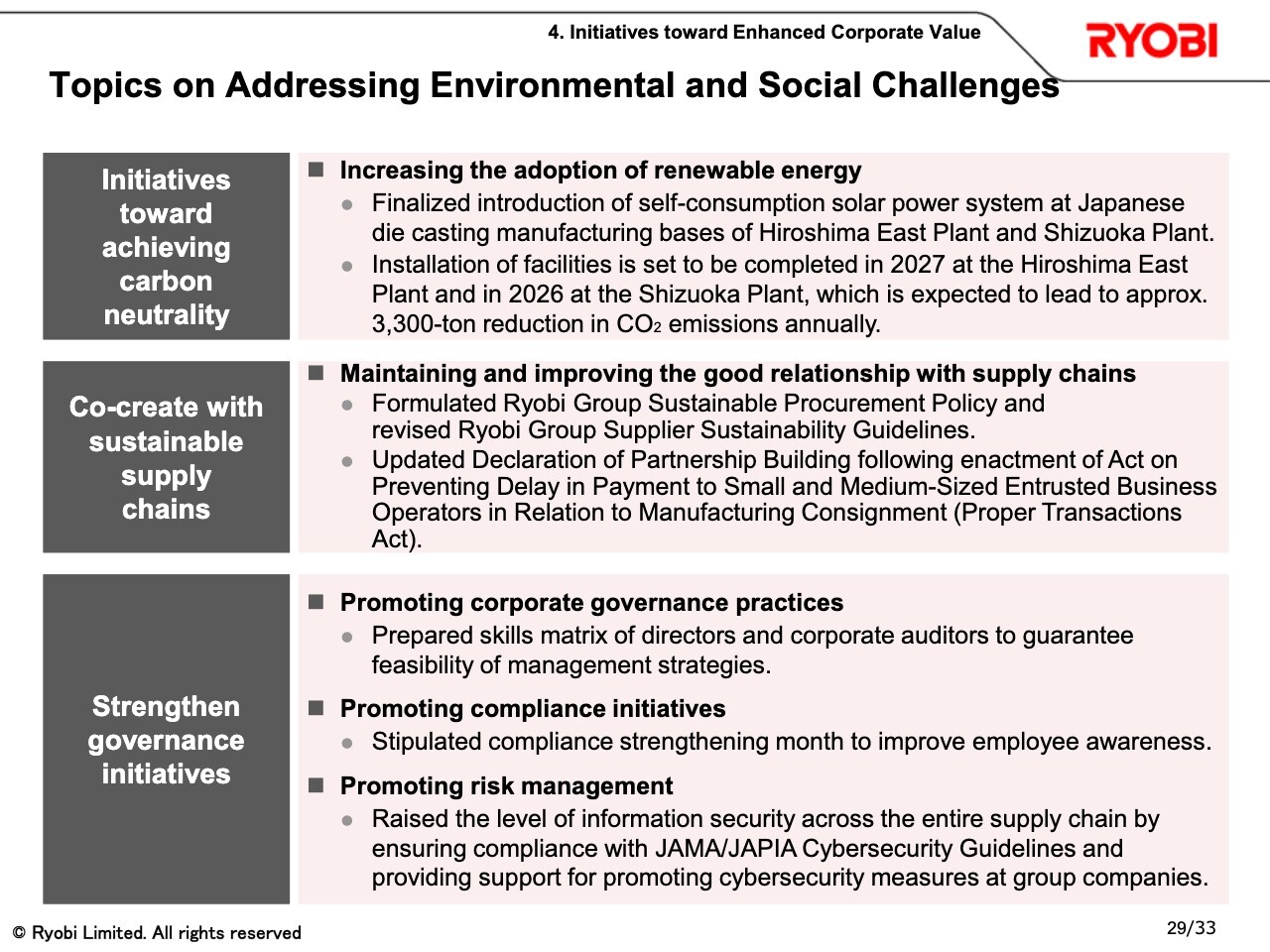
This slide covers our response to environmental and social challenges.
Under our “Initiatives toward achieving carbon neutrality,” we decided to introduce self-consumption solar power systems at the Hiroshima East Plant and Shizuoka Plant, our die casting manufacturing bases in Japan.
Installation is scheduled to be completed in 2027 at the Hiroshima East Plant and during 2026 at the Shizuoka Plant. Together, the two plants are expected to reduce CO2 emissions by approximately 3,300 tons annually. Their combined emissions in 2025 were 39,021 tons, so this represents a reduction of slightly less than 10%.
Under “Co-create with sustainable supply chains,” we formulated the Ryobi Group Sustainable Procurement Policy and revised the Ryobi Group Supplier Sustainability Guidelines.
Following the enforcement of the Act on Preventing Delay in Payment to Small and Medium-Sized Entrusted Business Operators in Relation to Manufacturing Consignment, or the Proper Transactions Act, we also updated our Declaration of Partnership Building. We added initiatives to work with suppliers on cybersecurity measures, greening initiatives, and education and information sharing related to BCP.
Under “Strengthen governance initiatives,” as part of our risk management efforts, we are working to raise the level of information security across the entire supply chain by ensuring compliance with the JAMA/JAPIA Cybersecurity Guidelines and supporting the promotion of cybersecurity measures at group companies.
Cash Allocation Status
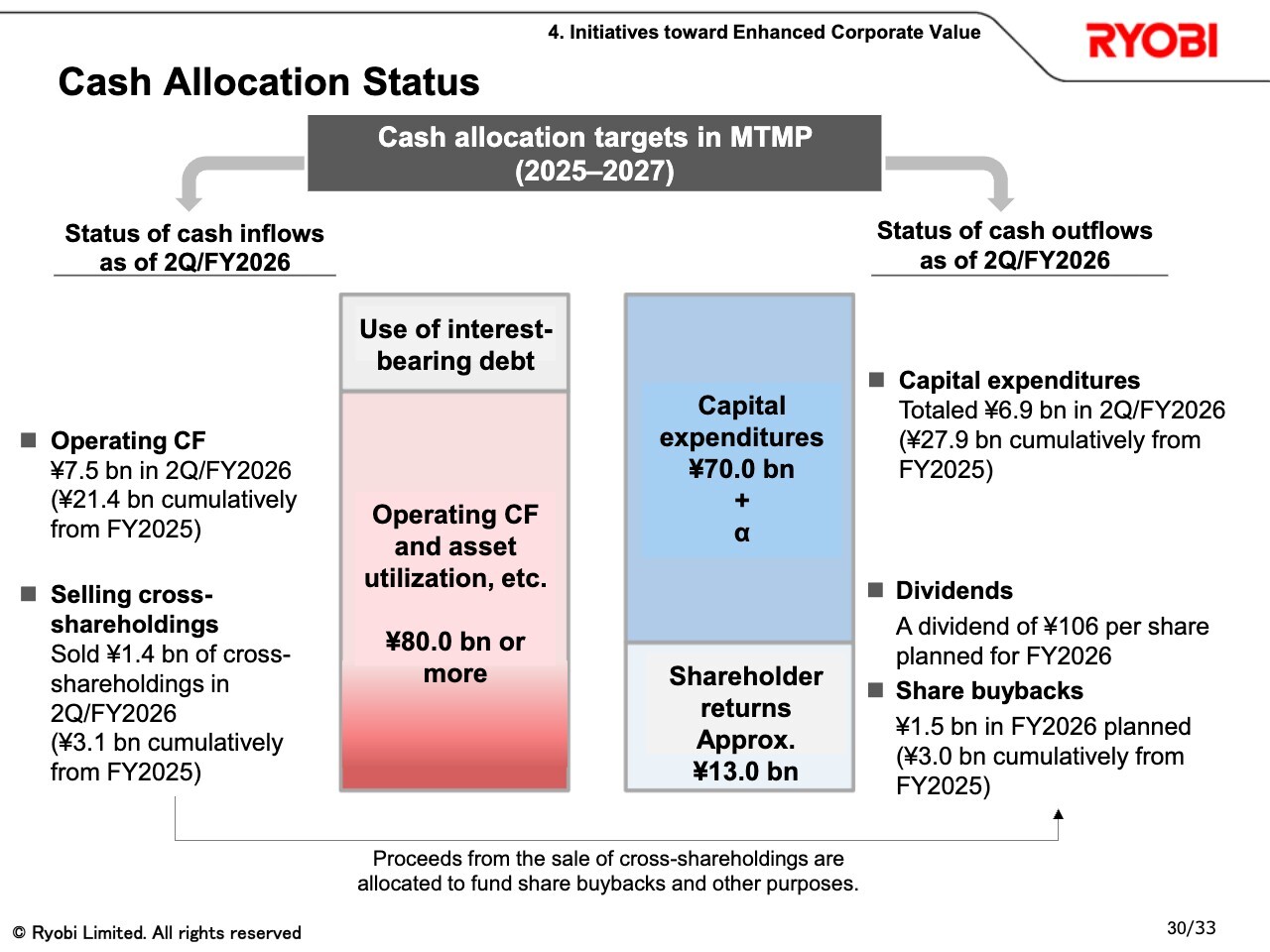
This slide shows the progress of our cash allocation.
Cumulative operating cash flow since FY2025 is ¥21.4 billion, while cumulative proceeds from sales of cross-shareholdings are ¥3.1 billion. Operating cash flow is below our assumptions due to the impact of accelerating payments to comply with the Proper Transactions Act, but we are proceeding with sales of cross-shareholdings as planned and working to generate cash.
On the cash-out side, cumulative capital expenditures since FY2025 are ¥27.9 billion, below the amount of capital expenditures initially planned.
As Arihiro explained earlier, the main reason is the slower pace of electrification among OEMs. We will continue to allocate funds to growth and strategic investments, including die casting technologies, while providing appropriate shareholder returns through dividends and share buybacks.
Disclosure Policy for Future MTMP
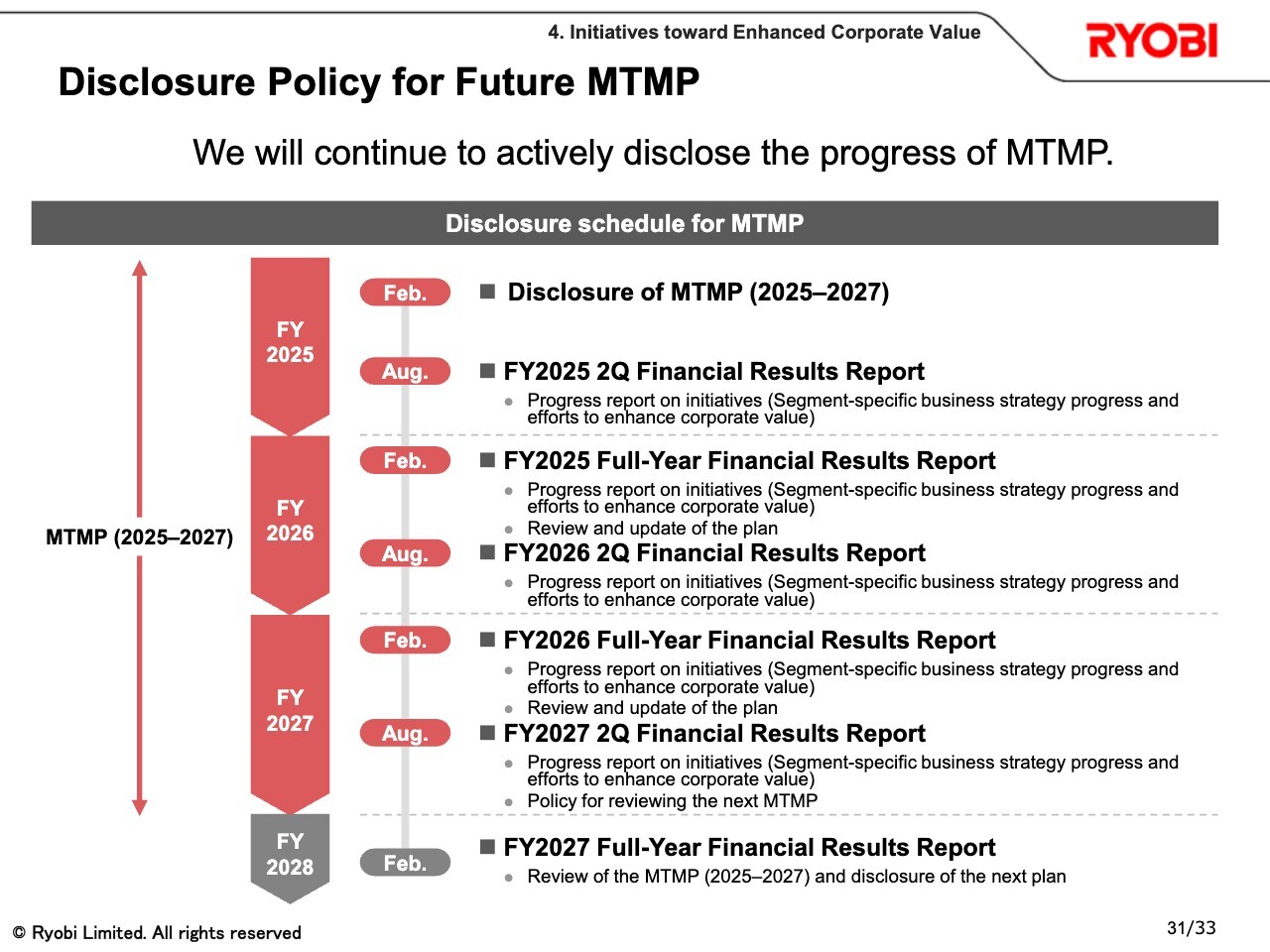
Finally, I will explain our disclosure policy for future Medium-Term Management Plans. We will continue to report progress on our initiatives every six months. After reviewing the results at the end of FY2027, the final year of the current Medium-Term Management Plan, we plan to disclose the next Medium-Term Management Plan in February 2028.
That concludes my presentation. Thank you for your attention.
Q&A: Trends in Production Weight of Die Castings
Question: Regarding the trends in production weight of die castings in the full-year forecasts, I believe there have been changes from the initial assumptions in each region.
For example, at the beginning of the fiscal year, you explained that Japan and Thailand were expected to grow toward the second half due to increases in new products, while the Americas and China were expected to remain at roughly the same levels as the previous fiscal year. China in particular appears somewhat weak in the first half when viewed on a weight basis. Could you explain the situation in each region?
Arihiro: For Japan, we had initially expected a somewhat steeper upward trend, but the pace of increase has become slightly more gradual. One factor is the order situation at our customers. However, the overall trend continues to rise gradually, and there has been no major change.
In China, production volume fell in 1Q and we had expected a recovery from 2Q. However, production volume in China declined slightly in 2Q due to the impact of production cuts by Japanese, U.S., and European automakers.
That said, our plan is based on information indicating that production will increase to some extent toward the second half, so we expect a recovery.
In Thailand, production volume is small but is generally in line with our expectations. The launch of new projects has begun, and we expect growth toward the second half.
Q&A: Outlook for Full-Year Forecasts
Question: I would like to ask about the FY2026 forecasts. The materials disclose forecasts by business segment, and you said that production volume in the Die Castings business is expected to be roughly in line with the previous fiscal year. The forecasts for the other two segments remain unchanged. Based on the first-half results, could you explain your view on the likelihood of achieving the forecasts?
Arihiro: I will explain by business segment. In the Die Castings business, we expect production volume to remain roughly in line with the previous year. However, raw material prices rose from 1Q to 2Q, and this held back results through 2Q.
For 3Q and 4Q, we expect raw material prices to remain at roughly their current elevated levels and selling-price revisions to catch up. We therefore expect profit in the Die Castings business to increase from the previous year.
By contrast, sales in the Printing Equipment business are struggling, and we expect profit in that business to remain weak as a result.
Question: The forecasts for the Builders’ Hardware and Printing Equipment businesses remain unchanged. Based on the current outlook, do you believe the targets are fully achievable, or would you characterize them as challenging?
Arihiro: We are currently implementing a range of measures to achieve the targets.
Q&A: Earnings Impact of Giga Casting Prototypes and New Areas
Question: You discussed giga casting prototypes and new areas as key topics. How should we think about their impact on earnings? For example, might they be incorporated into the next Medium-Term Management Plan? Could you share your current sense of the opportunity?
Urakami: Until now, we have handled machines with clamping forces of around 3,500 tons, while machines of around 4,000 tons also exist in Japan, including at other companies. These can be accommodated with conventional infrastructure, including supply chains and logistics.
However, when it comes to ultra-large 6,500-ton machines such as those used for giga casting, there are various challenges in mass production. Customers have asked us to produce prototypes for technical verification and with overseas production in mind, and we would like to continue actively winning such projects.
We are also exploring opportunities to expand the application of die casting beyond the automobile industry to products in other industries where an appropriate scale of mass production can be expected.
At present, rather than moving toward adding more large machines for giga casting, we are seeing encouraging potential for the use of large die castings in non-automotive industries where mass-production volumes are smaller.
We also believe that as more industry participants recognize that giga casting is becoming practical, this could stimulate demand for die cast products one size smaller than giga casting, which we have traditionally handled.
We expect these secondary effects as well to contribute to our earnings.
Q&A: Outlook for Cash Allocation and Capital Expenditure Plans
Question: I would like to confirm the status of cash allocation. You explained that operating cash flow is currently below expectations partly due to compliance with the Proper Transactions Act, and that there are challenges such as delays in capital expenditures and a slower pace at OEMs.
Is there a possibility that the cash allocation framework could be reviewed at the next full-year results briefing or at another point?
Also, I believe some of the net sales and profit targets under the Medium-Term Management Plan are already approaching the FY2027 targets. Could you also discuss whether there may be any revisions at the briefing six months from now?
Urakami: We formulated the Medium-Term Management Plan for 2025–2027 in the second half of 2024. One change since then has been the delay in electrification and the shift to EVs, particularly among OEMs. As a result, we believe investment may also be delayed.
In addition, the market prices of our cross-shareholdings have risen, so we believe that this area also needs to be reviewed.
Furthermore, with interest rates rising, we intend to be somewhat more cautious this year about the use of leverage that we had previously planned to employ in expanding the business.
For these reasons, although any adjustments would be relatively minor, I think there is a strong possibility that we will revise some of the figures.
Kazuhiko Fujii (hereinafter, Fujii): Regarding capital expenditures, there is now a question mark over the “¥70.0 billion plus alpha” portion of the plan, but I think we will probably get close to ¥70.0 billion.
Question: If capital expenditures for the current fiscal year progress as planned, I believe the cumulative amount will be around ¥40.0 billion. That would leave around ¥30.0 billion of capital expenditures for next year. Are the projects supporting that amount already visible at this point?
Fujii: This is the outlook after each business reconfirmed its plans at the end of June. If we assume ¥70.0 billion in total, cumulative progress including the current fiscal year forecast would be around 60%. We are running slightly behind, but we plan to build up investments from here.
Q&A: Giga Casting Production at the Kikugawa Plant and Expansion of Prototype Orders
Question: Regarding giga casting, I believe one of the challenges is establishing integrated production at the Kikugawa Plant starting from die manufacturing. What is the current status?
Urakami: As you noted, when we initially installed the giga casting equipment, machining and heat treatment for the first die we used were carried out in China.
We would like to gradually establish machining and heat treatment in Japan, but we have not yet been able to do so. We will continue working toward that goal.
There is an issue with the High Pressure Gas Safety Act when it comes to heat treatment. Initially, we hoped to have a Japanese furnace manufacturer build the equipment, but unfortunately demand in Japan is limited. We therefore hope to install equipment from an overseas furnace manufacturer in Japan in a manner that complies with the High Pressure Gas Safety Act. As for machining, we believe domestic machining should be achievable.
From the outset, we recognized that it would be difficult to perform every process on an integrated basis at the Kikugawa Plant. We intend to improve efficiency gradually while working to reduce die costs.
Question: What timeline do you have in mind?
Urakami: During the period of the current Medium-Term Management Plan through 2027, I believe we need to formulate a plan to shift at least part of the work to domestic and in-house production.
Q&A: Scale of Expansion in Giga Casting Orders
Question: You said that you are taking various measures to expand orders for giga casting prototypes. What scale of expansion are you envisioning?
Urakami: We are currently approaching a variety of parties. However, we have only one 6,500-ton die casting machine for giga casting at present, so I think our focus will basically be on prototype orders and low-volume mass-production orders that make maximum use of that machine’s capacity.
The plant infrastructure includes space for one more machine, but we would like to proceed with our consideration while carefully assessing customer response.
Q&A: Expansion of Giga Casting into Non-Automotive Areas and Expectations
Question: Earlier, there was a question about giga casting prototypes and new areas. My understanding is that you intend to develop applications for giga casting outside the automobile sector as well. Is that correct?
Urakami: Traditionally, many people have had the perception that aluminum die castings “leak oil or air” and “break or crack when subjected to impact.”
By producing various samples using giga casting and broadening awareness that structural components such as underbodies can also be manufactured this way, we believe products that have traditionally been made by machining could increasingly be converted to die castings. We would like to use giga casting as a flagship to uncover new demand for die casting.
However, the products we have in mind are not ultra-large components in the so-called giga casting class. Rather, we are envisioning products that can be manufactured on 2,000-ton or 3,000-ton die casting machines.
Question: So should we understand that you are still referring only to automotive parts?
Urakami: No, this includes non-automotive applications as well. In die casting, we have continued to promote our capabilities primarily to the automobile industry, and we have gradually been winning orders for body components. However, we believe there is still room for growth in this area.
In other industries, I think many customers assume that “you have to make around 100,000 units for a die casting die to pay for itself.” We would like customers to understand that die casting can be used even for small production volumes and that structural components can also be made by die casting, and ultimately to adopt the process.
Question: Are you referring to prototypes?
Urakami: No, this includes mass production as well.
Question: Then, when giga casting is used, would it mainly be for prototypes?
Urakami: As I mentioned earlier, we have only one 6,500-ton die casting machine. Given the capacity constraint, we are not currently pursuing high-volume mass-production projects aggressively.
Question: Incidentally, what non-automotive fields do you expect could use giga casting prototypes?
Urakami: For prototypes using a die casting machine of around 6,500 tons, as shown in the figure on page 22 of the materials, in the railway field, for example, we are considering panel components for railway vehicles.