Impact of the Middle East Conflict and Our Response
Takayuki Ueda (hereinafter, “Ueda”): I am Takayuki Ueda, Representative Director, President & CEO of INPEX CORPORATION. Thank you very much for taking the time to join us today, especially given this intense heat. I will provide an overview of our H1 financial results and the outlook going forward.
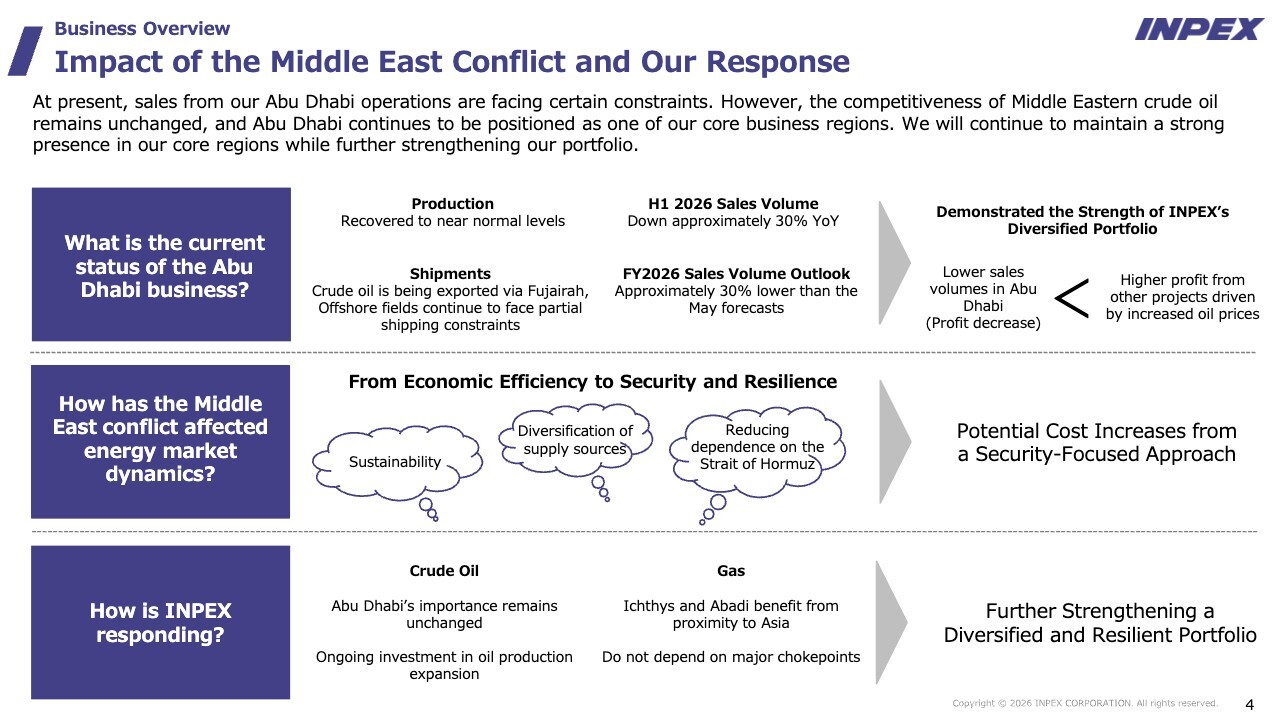
First, I would like to discuss how the Middle East conflict is affecting INPEX, how we view those impacts, and how we expect the situation to develop going forward.
It is true that the prolonged closure of the Strait of Hormuz has placed significant constraints on our sales from Abu Dhabi. However, given the strategic importance of the Middle East, we intend to continue our business operations in Abu Dhabi.
Let me first discuss the status of our Abu Dhabi business. As shown on the slide, production in Abu Dhabi has hardly declined. However, our sales volume is down by approximately 30% year on year.
The reason is that Abu Dhabi has access to Fujairah Port outside the Strait of Hormuz, and most crude oil produced from the onshore fields is exported through Fujairah. As a result, the onshore fields have not been materially affected.
By contrast, the Strait of Hormuz is the export route for the offshore fields, so production itself has been affected to some extent, and sales volume has also declined by approximately 30%.
For the full year, we expect sales volume to be approximately 30% lower than the outlook as of May 2026. This outlook assumes that the Strait of Hormuz will return to normal around October and conditions will revert to their previous state. Based on that assumption, full-year sales volume is expected to be approximately 30% below the May outlook.
As shown on the right side of the slide, from an earnings perspective, we believe profits from other projects can more than offset the decline in profit from Abu Dhabi. This demonstrates the strength of our diversified portfolio. While Abu Dhabi is one important component, our portfolio spans Australia, Asia, Europe, and our domestic operations.
Because of this diversification, the closure of the Strait of Hormuz has had only a limited impact on us. Strong operations at Ichthys LNG and relatively high oil prices amid the Middle East situation enabled profits from other projects to more than offset the expected decline in Abu Dhabi. H1 profit reached a record high, and full-year profit is also forecast to reach a record high.
Turning to the broader energy environment, in a word, energy systems have traditionally placed a very strong emphasis on efficiency. However, I believe they are gradually shifting toward systems that emphasize energy security and resilience in addition to efficiency.
There are several examples on the right side of the slide. One is reducing dependence on the Strait of Hormuz. With awareness of the risks associated with the Strait now so heightened, the UAE, for example, currently has one pipeline to Fujairah Port outside the Strait and has announced plans to increase this to three pipelines within the next several years.
With three pipelines, it would be possible to export almost all crude oil through ports outside the Strait of Hormuz. We are also seeing similar initiatives in Saudi Arabia involving Yanbu Port on the Red Sea.
Another trend is diversification of supply sources. Many companies are now focusing on crude oil imports from the United States and Mexico. However, transporting crude from these countries inevitably raises costs.
Crude oil from the Middle East reaches Japan in approximately 20 days aboard very large crude carriers (VLCCs). By contrast, shipments from the United States, Europe, or Africa take roughly three times as long, or around 50 to 60 days. The resulting increase in transportation costs is therefore an issue.
Another trend relates to sustainability. EVs, for example, have recently been attracting renewed attention, and the view that “gasoline alone may not be enough” is becoming more widespread.
What is particularly interesting is that, in addition to the renewed focus on EVs and gasoline, ammonia and renewable-energy-derived fuels—previously viewed primarily as clean alternatives to heavy fuel oil for ships—are now also being reassessed from an energy security perspective.
Looking at these developments as a whole, I feel that the energy sector is moving toward a greater emphasis on security. At the same time, there are challenges. In many cases, whether building pipelines or transporting energy from the United States, higher costs are unavoidable.
Security is not free, and measures to strengthen security and resilience come with costs. As a result, we expect overall energy costs to rise over the medium to long term.
I think many customers still say, “We want a more secure energy supply, but at current prices.” I believe this tension between energy security and affordability will become a global issue over the medium to long term.
INPEX’s response is shown at the bottom of the slide. For crude oil, the competitiveness and importance of Abu Dhabi remain unchanged, so we intend to continue actively investing in production expansion there.
As for gas, diversification is already well advanced, including projects such as Ichthys and the Abadi LNG Project (hereinafter, “Abadi”). These gas projects also do not rely on major chokepoints such as the Strait of Hormuz, so one direction for us is to further expand this highly secure portfolio. That is the overall picture at present.
FY2026 H1 Results and Full-year Forecasts
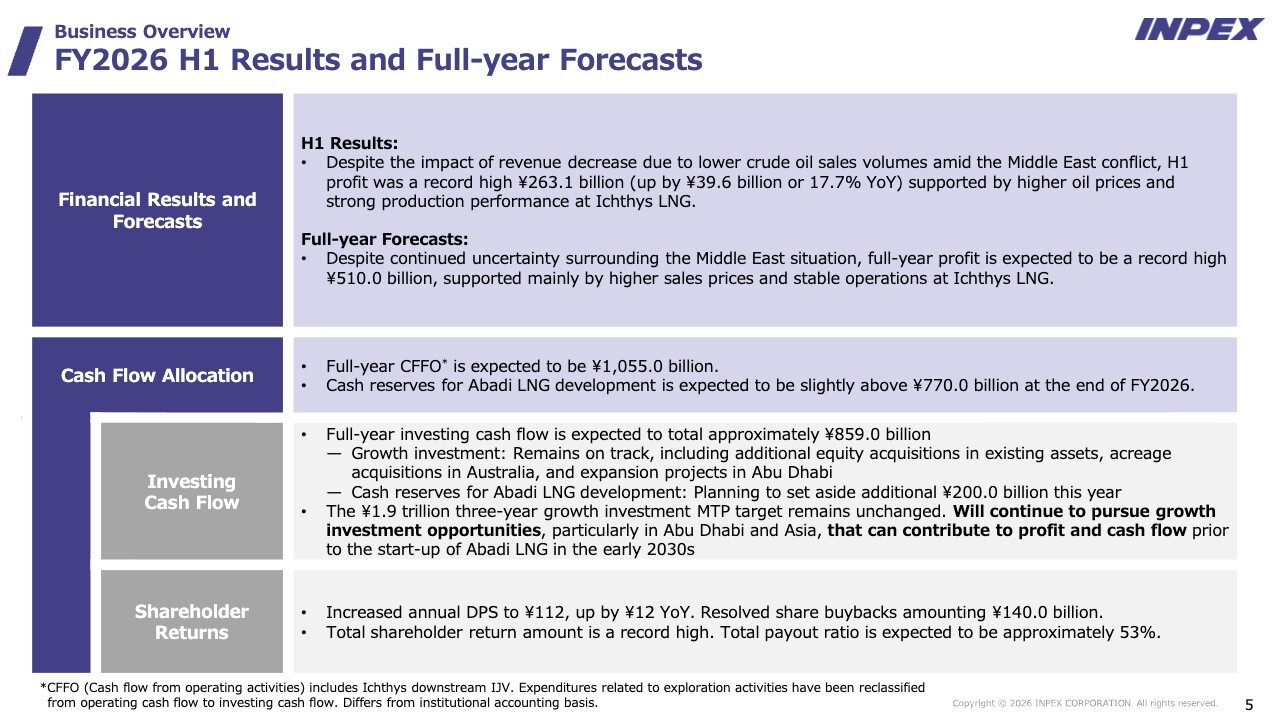
These are the H1 highlights. Yamada will provide the details later, but H1 profit reached a record high of ¥263.1 billion. For the full year, we expect profit to reach a record high of ¥510.0 billion.
CFFO is approximately ¥1 trillion. Abadi is targeting FID in 2027, and we have been building up cash reserves in preparation for its development. By the end of this fiscal year, we expect those reserves to exceed ¥770.0 billion.
Full-year investing cash flow is expected to be ¥859.0 billion. This includes a range of growth investments. I will discuss Abadi and Ichthys in more detail later, but we are also investing in projects that can contribute to earnings before Abadi starts production.
Specific examples include the acquisition of interests in Malaysia and the additional acquisition of shares in INPEX Southwest Caspian Sea, Ltd., which holds an interest in the ACG oil field. These are projects that are already in production or are expected to commence production in the near future.
By acquiring assets like these, we expect each asset to contribute several billion yen or more in profit annually. Through these initiatives, we intend to continue growing both before and after the start-up of Abadi.
I will discuss shareholder returns in more detail later, but annual DPS will be ¥112, up ¥12 year on year, and we plan share buybacks of ¥140.0 billion. The total payout ratio is expected to be approximately 53%.
Steady Growth Track Record and Outlook Compared with Peers
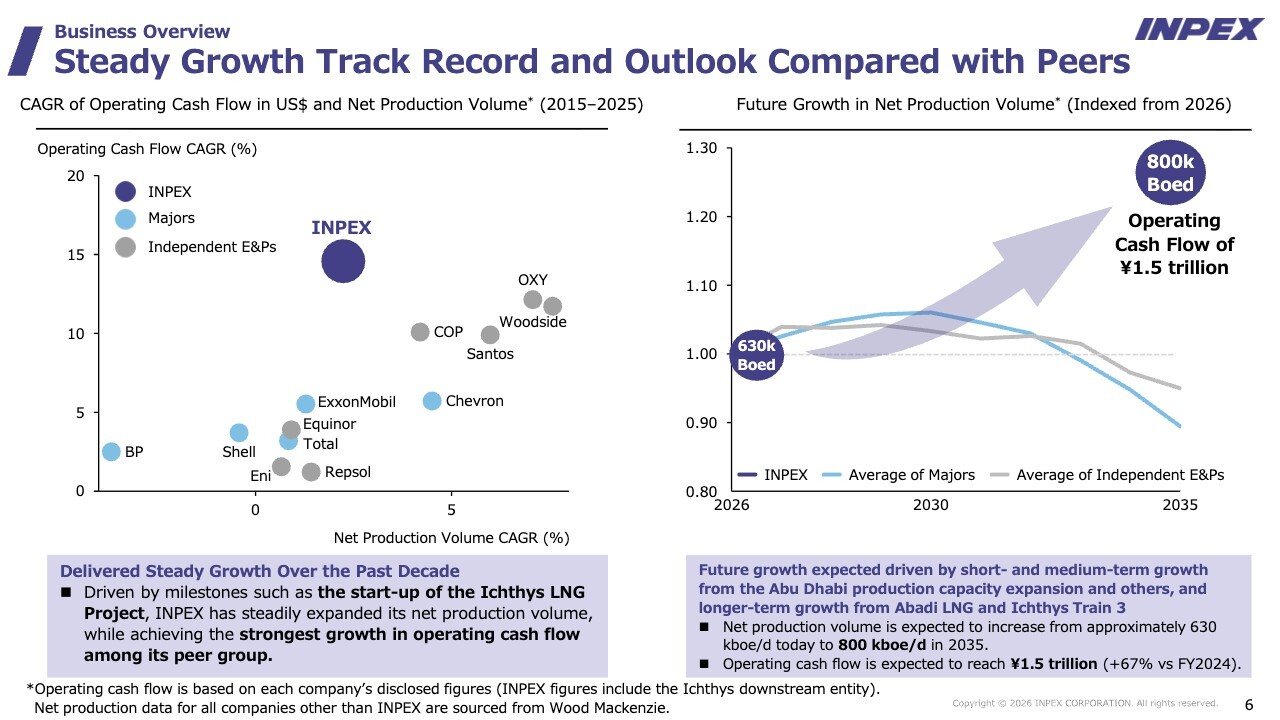
This slide takes a broader view of what kind of company INPEX is. It summarizes in a chart what we have accomplished over the past 10 years.
The left side of the slide shows the CAGR, or compound annual growth rate, of operating cash flow in U.S. dollars and net production volume. These CAGRs are calculated using data for the 10-year period from 2015 to 2025.
The vertical axis shows operating cash flow and the horizontal axis shows production volume, with comparisons against majors and independent E&Ps. As you can see, INPEX’s position is indicated on the chart.
What this position shows is that our average growth rate in operating cash flow over the past 10 years has significantly exceeded those of the majors and independent E&Ps.
The horizontal axis represents the CAGR of production volume. We are not at the very top, but we are positioned around the middle of the group and above the majors. I believe INPEX has continued to grow steadily over the past 10 years.
The chart on the right side of the slide shows the future outlook for production volume, starting from approximately 630 kboe/d today. We expect this figure to reach 800 kboe/d after Abadi starts production, while operating cash flow is expected to increase from approximately ¥1 trillion today to around ¥1.5 trillion.
Having delivered steady growth over the past decade, we remain focused in our day-to-day operations on sustaining that growth through 2035.
Significant progress toward a targeted Abadi LNG FID in 2027
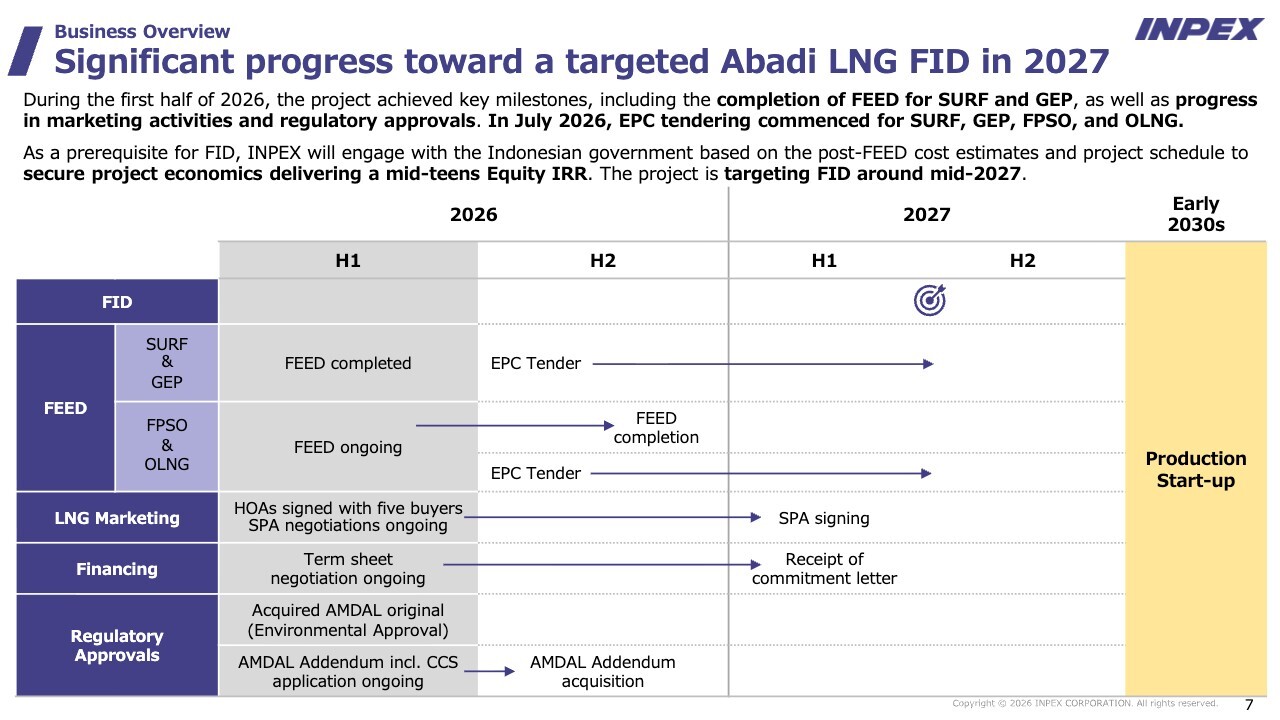
I will now explain the progress of individual projects, focusing in particular on Abadi and Ichthys. Starting with Abadi, in a word, the project is progressing very smoothly.
The front-end engineering and design (FEED) work that has been under way since 2025 is progressing smoothly and is scheduled for completion in fall 2026. In parallel, tendering for engineering, procurement, and construction (EPC) began in July 2026.
Some of you may already be familiar with this process. For the FPSO and OLNG packages, FEED is being conducted under a dual-FEED structure, with two contractor consortia competing. One of the two will ultimately be selected to carry out the construction work. This selection process is already under way as part of the EPC tender.
Marketing is also progressing very smoothly. The Abadi project is expected to produce 9.5 million tons of LNG annually.
We plan to leave a portion of that volume uncommitted under long-term contracts and sell it on the spot market. We plan to allocate approximately 8 million tons to long-term contracts, and for approximately 6 million tons of that volume, we have already agreed with buyers on key commercial terms, including price and volume, under what we call “Key Term Sheets.” Those agreements were reached in May 2026.
Specifically, we have agreed on Key Term Sheets that will form the basis of long-term contracts with supermajors bp and Shell, as well as Indonesia’s state-owned electricity and gas companies.
Many buyers are showing strong interest in the Abadi project. Against the backdrop of the Middle East conflict, interest in Asia in LNG that is not exposed to Middle East risk is particularly strong.
Market interest is therefore very high and the response has been very positive. We believe the marketing process should proceed without major difficulty.
Abadi LNG Groundbreaking Ceremony
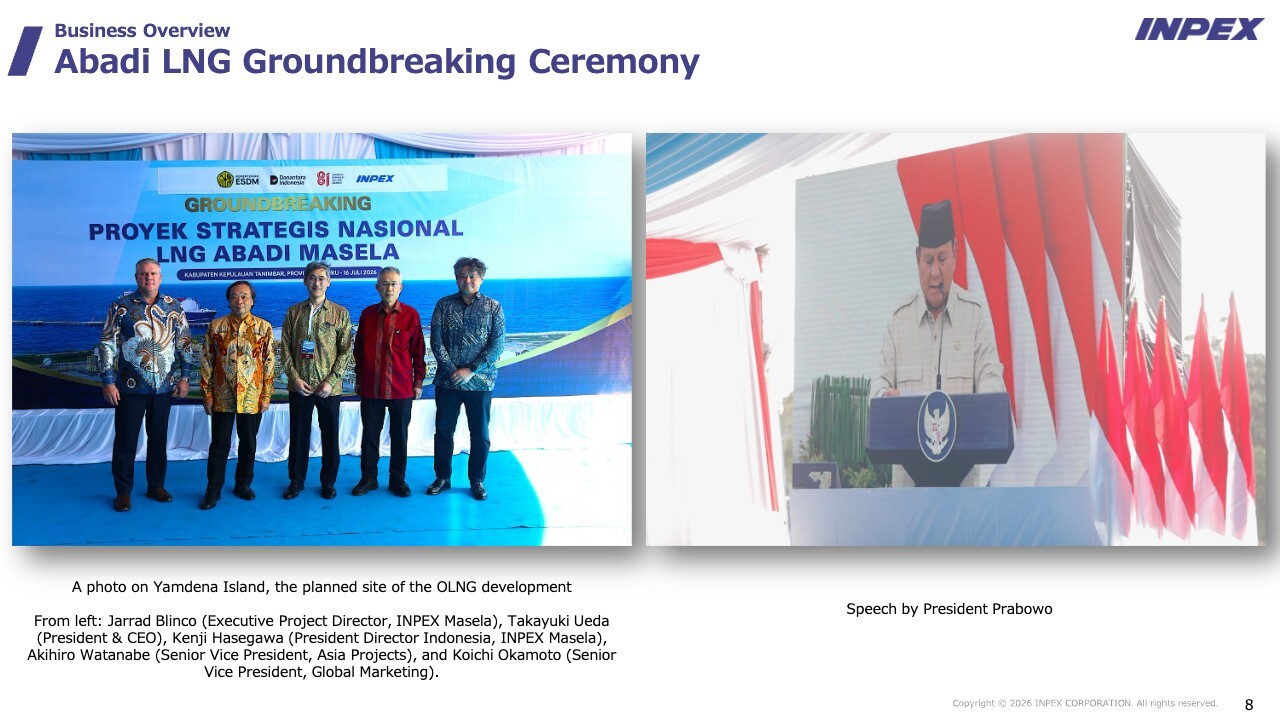
We now need to begin physical work this year. The Abadi LNG plant is planned to be built near Saumlaki on Yamdena Island, Indonesia.
We need to begin work immediately on activities such as installing fencing around the LNG plant site and constructing a diversion road. These activities absolutely require cooperation from the local community, so we approached the Indonesian government and decided to hold a Groundbreaking Ceremony.
About a month ago, we visited Yamdena Island to formally request the cooperation of the local community before physical work begins. Reaching Yamdena Island from Jakarta takes four hours each way by charter flight, or eight hours round trip, but we made the trip as a day visit.
The slide shows photographs from that visit. It was an excellent ceremony. On the Indonesian side, Energy Minister Bahlil and three or four other cabinet ministers attended, and President Prabowo also expressed a strong desire to participate. Because of the remote location, he ultimately joined online.
Even though President Prabowo participated online, he did not join only for his speech; he watched the entire ceremony from the presidential palace. This demonstrates the Indonesian government’s high expectations for and strong support of the project.
FEED and EPC tendering are currently under way, marketing is progressing smoothly, and we are receiving strong support from the Indonesian government, which has high expectations for the project.
Of course, the question of how we will secure the project’s economics once FEED is completed still remains. Even so, I believe the likelihood of Abadi reaching FID around mid-2027 has increased considerably.
Business Activities (1)
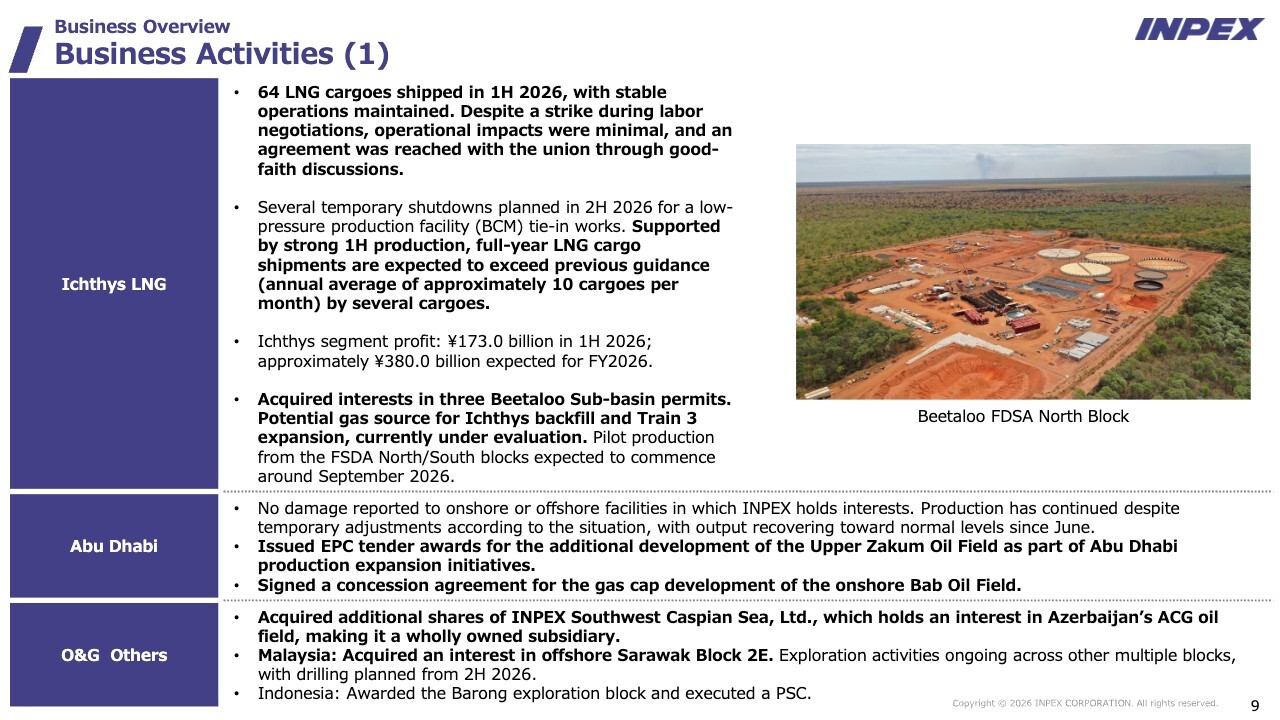
Turning to Ichthys, operations are currently progressing very smoothly, including cargo shipments. The strike caused some concern, but it was related to the revision, undertaken once every four years, of the labor agreement known as the Enterprise Agreement.
Labor laws were revised under the Labor government, and unions in Australia have become considerably stronger. Because this was the first revision of the agreement under the new framework, the union adopted a very assertive stance.
There were some strike actions as a result, but there was no major impact on operations, and we do not expect a material impact on our earnings. We have now concluded a labor agreement covering the next four years, and operations are therefore proceeding relatively smoothly.
In spring 2026, there was also an important development for Ichthys involving the onshore Beetaloo Sub-basin in Australia. The area is believed to contain very large shale gas resources, and we acquired interests in three permits in the sub-basin from Daly Waters Energy LP (DWE).
As shown in the photograph on the right side of the slide, this vast area of forest and flat land is currently the site of a pilot production project. Pilot production is expected to begin around September 2026, with some of the gas to be sold into the Northern Territory market.
Over roughly two years from 2027, we will continue exploration work to determine the scale of the resources in the area. Expectations for this project are very high, including from the Australian government. If development progresses smoothly, we believe it could become a gas source for a new third train at Ichthys. At present, progress is very smooth.
Production in Abu Dhabi is proceeding steadily, although sales continue to face challenges. We continue to view Abu Dhabi as an important region and will keep investing in the Upper Zakum Oil Field.
At the onshore Bab Oil Field, there is a gas layer above the oil known as a gas cap, and we recently reached an agreement for its development. In Azerbaijan, we also acquired from the Japanese government additional shares in INPEX Southwest Caspian Sea, Ltd., which holds an interest in ACG oil field. In addition, we acquired an interest in offshore Sarawak Block 2E in Malaysia and acquired an exploration block in Indonesia.
In this way, we intend to pursue businesses, particularly in Asia, that can contribute directly to earnings both before and after Abadi starts production.
Business Activities (2)
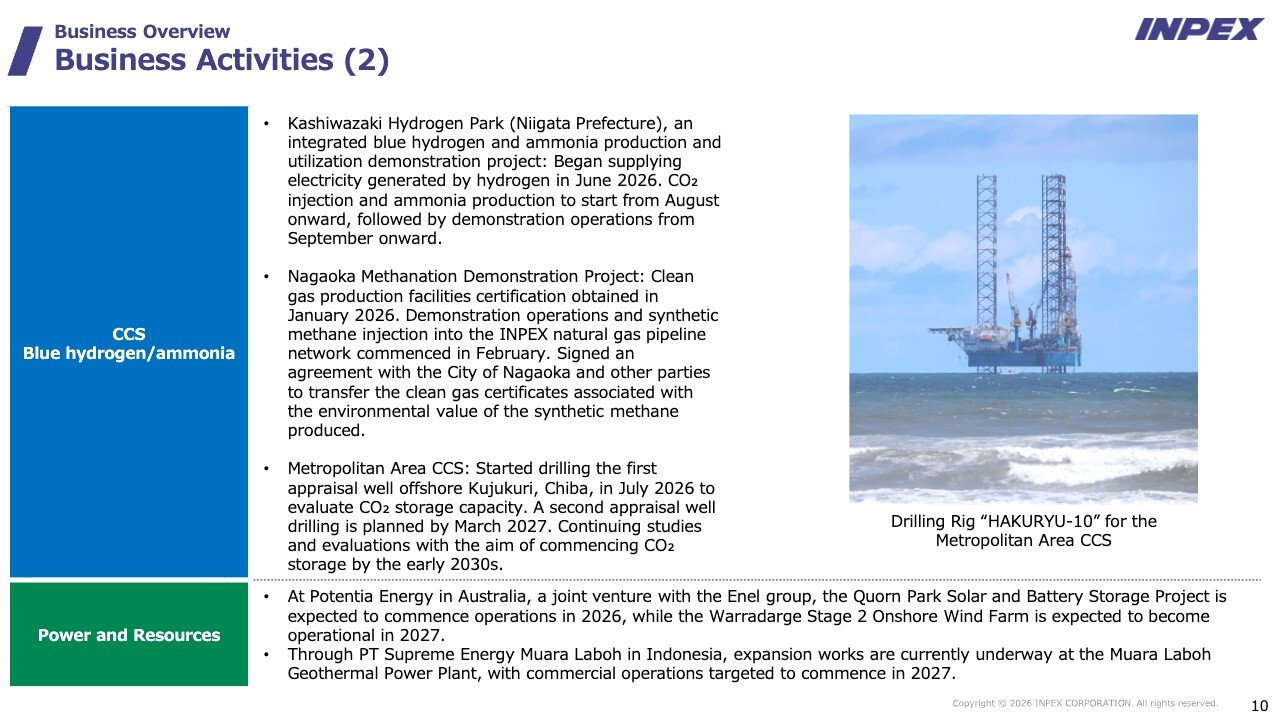
I will now discuss the areas commonly referred to as clean energy, including CCS, or carbon capture and storage, clean hydrogen, and ammonia.
With regard to hydrogen, the hydrogen plant in Kashiwazaki City, Niigata Prefecture, began operating in 2025 and is now moving into the full-scale demonstration phase. The methanation plant is also operating, and we have begun injecting some of the clean methane it produces into our pipeline network.
A recent major topic is the Metropolitan Area CCS Project. The plan is to collect CO2 emitted from the Tokyo Bay area and store it offshore Kujukuri in Chiba Prefecture. As part of the project, appraisal drilling began in July 2026 and a drilling rig was mobilized.
The photograph on the right side of the slide shows the offshore rig as viewed from land. We will drill two wells using this rig. The first well will be drilled to a depth of approximately 1,900 meters to assess injectivity for the CCS project offshore Kujukuri, Chiba Prefecture—in other words, to determine how much CO2 can be injected.
Shareholder Returns
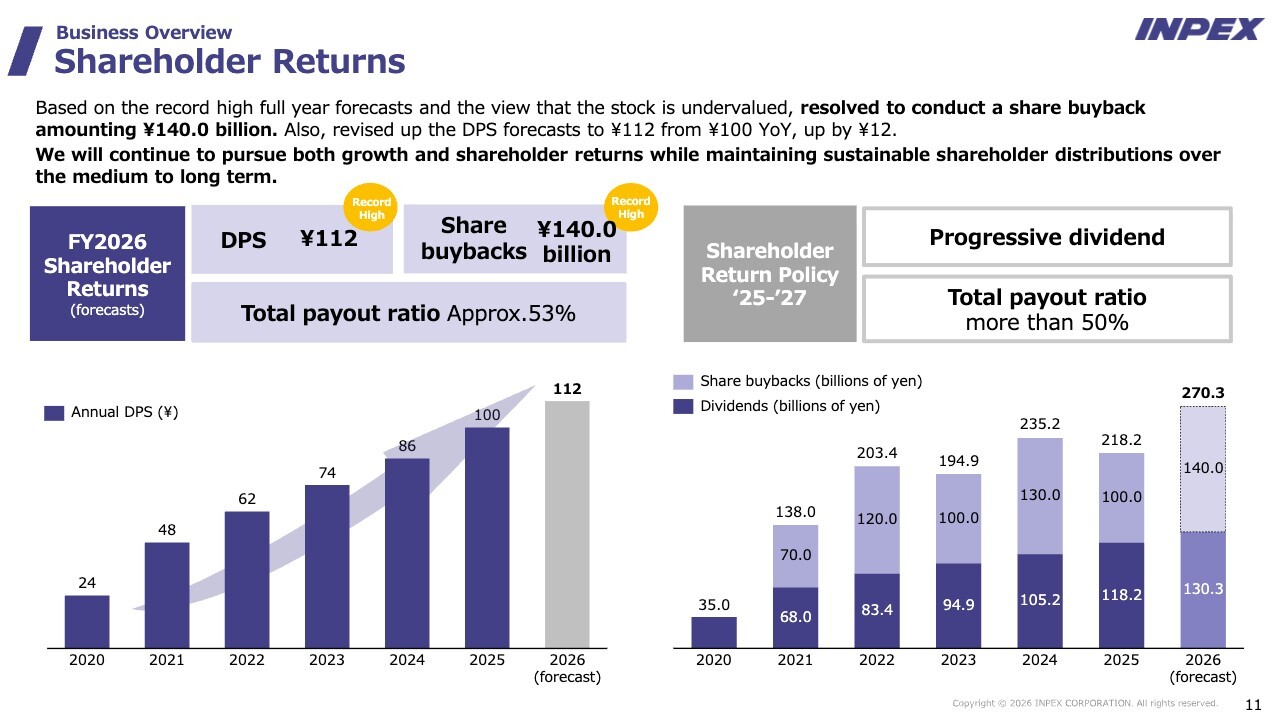
I will now discuss shareholder returns and explain our thinking. I mentioned the figures earlier : record-high annual DPS of ¥112, share buybacks of ¥140.0 billion, and a total payout ratio of approximately 53%, based on profit of ¥510.0 billion.
Since 2020, we have increased the annual dividend from ¥24 to ¥112, nearly fivefold. This year, total shareholder returns will be at a record-high level.
When we discussed shareholder returns for 2026 internally, one question was how INPEX should assess its current share price. My own view is that the market is not yet fully recognizing our growth potential. We judged the shares to be somewhat undervalued and therefore placed greater emphasis on share buybacks in this year’s shareholder returns.
The number of individual shareholders has also increased substantially, and I believe many of them look to dividends. We therefore set annual DPS at ¥112. At the same time, given the current share price, we formulated this year’s shareholder return policy with greater emphasis on share buybacks.
Valuation Does Not Fully Reflect Our Growth Prospects
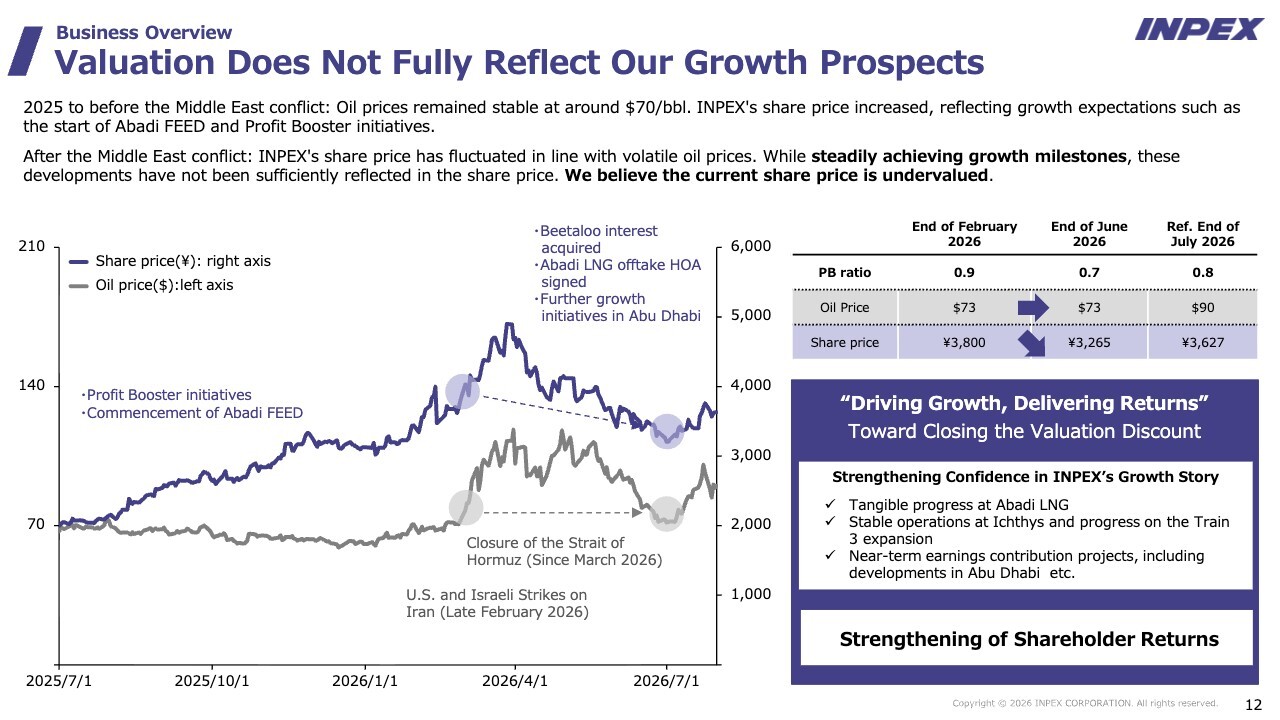
Let me explain why we reached that view. Please look at the chart on the slide. The gray line on the left shows the oil price, and the blue line shows our share price.
It has often been said that INPEX’s share price moves in line with oil prices. As you can see, however, until the Middle East conflict began, our share price had been outperforming the oil price, perhaps reflecting our growth strategy.
Once the Middle East conflict began, our share price again started moving in tandem with oil prices. When tensions intensified, oil prices rose and our share price rose with them, and the reverse was also true, resulting in substantial volatility.
Looking at where we are now, as the figures on the slide show, immediately before the conflict at the end of February, the oil price was $73 and our share price was ¥3,800. At the end of June, after the conflict had begun, the oil price was again $73, but our share price was ¥3,265.
Looking at today’s oil price and share price, the oil price has risen somewhat to approximately $83. That is roughly $10 above the $73 level at the end of February, while our share price is currently around ¥3,500.
If our growth strategy had stalled, I could understand that as one possible market assessment. However, we have been steadily executing our growth strategy. Abadi is a representative example, and we are also making steady progress on the Ichthys Train 3 expansion.
Oil prices have risen by $10, yet our share price has fallen from ¥3,800 at the end of February to around ¥3,500 today. I am not particularly pleased with that, but of course the market determines the share price, and it is not for us to dictate. There are also various views on the energy industry.
Our motto is to continue delivering steady growth and shareholder returns, and that is a principle I personally keep firmly in mind. Given today’s situation, I therefore feel that an oil price of $83 and a share price of ¥3,500 still indicate an undervalued stock. In fact, given how much more concrete our growth strategy has become, I would not find it surprising if our share price were higher than it was before the Middle East conflict.
Accordingly, our view is that INPEX’s share price may still be somewhat undervalued.
We also heard many views that “if the share price is low, the company should repurchase its own shares,” and that is why we decided to pursue share buybacks actively. That is the rationale behind this year’s shareholder return policy.
Financial Highlights
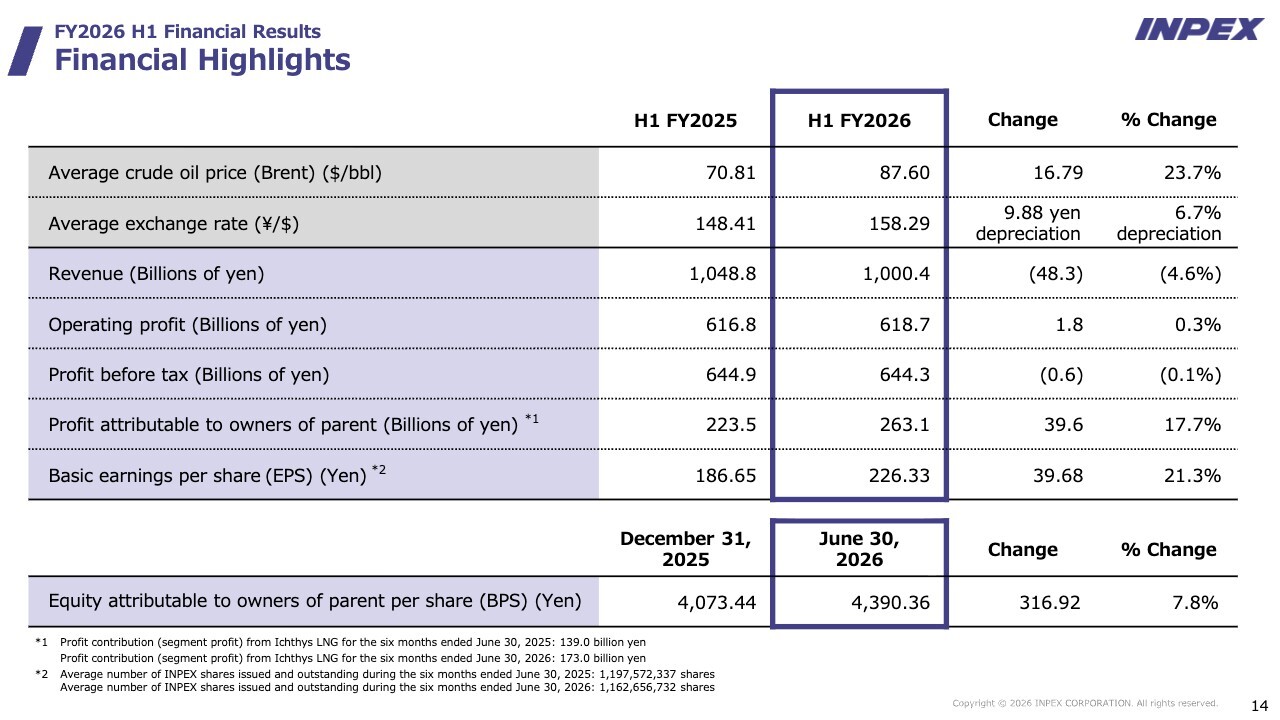
Daisuke Yamada (hereinafter, “Yamada”): I am Daisuke Yamada, Director, Executive Vice President, Finance & Accounting. I will explain our H1 financial results and full-year outlook. As President Ueda explained earlier, H1 profit reached a record high of ¥263.1 billion, and we also expect full-year profit to reach a record high of ¥510.0 billion. Shareholder returns are likewise expected to reach a record high. With record highs in all three, these results amount to a “triple crown.”
First, the H1 highlights. The average oil price during the period rose from around $70 to around $87, while the yen weakened on an average exchange-rate basis. Revenue declined slightly, but profit attributable to owners of parent reached a record high of ¥263.1 billion. These results clearly reflect the impact of the Middle East situation.
Crude oil sales volume declined significantly, but higher oil prices lifted the average overseas unit prices for crude oil and LNG. At Ichthys, strong production in H1 2026 also increased natural gas production and cash flow. This higher cash flow also enabled us to realize gains through TA recycling.
In Abu Dhabi, lower taxable income also resulted in a significant decrease in income tax expense. Taking the negative and positive effects of the Middle East situation together, the positive effects were larger, resulting in these financial results.
When we spoke in May 2026, we indicated that the Middle East situation could have a positive effect, and that possibility has now been borne out in these results.
Revenue by Major Products
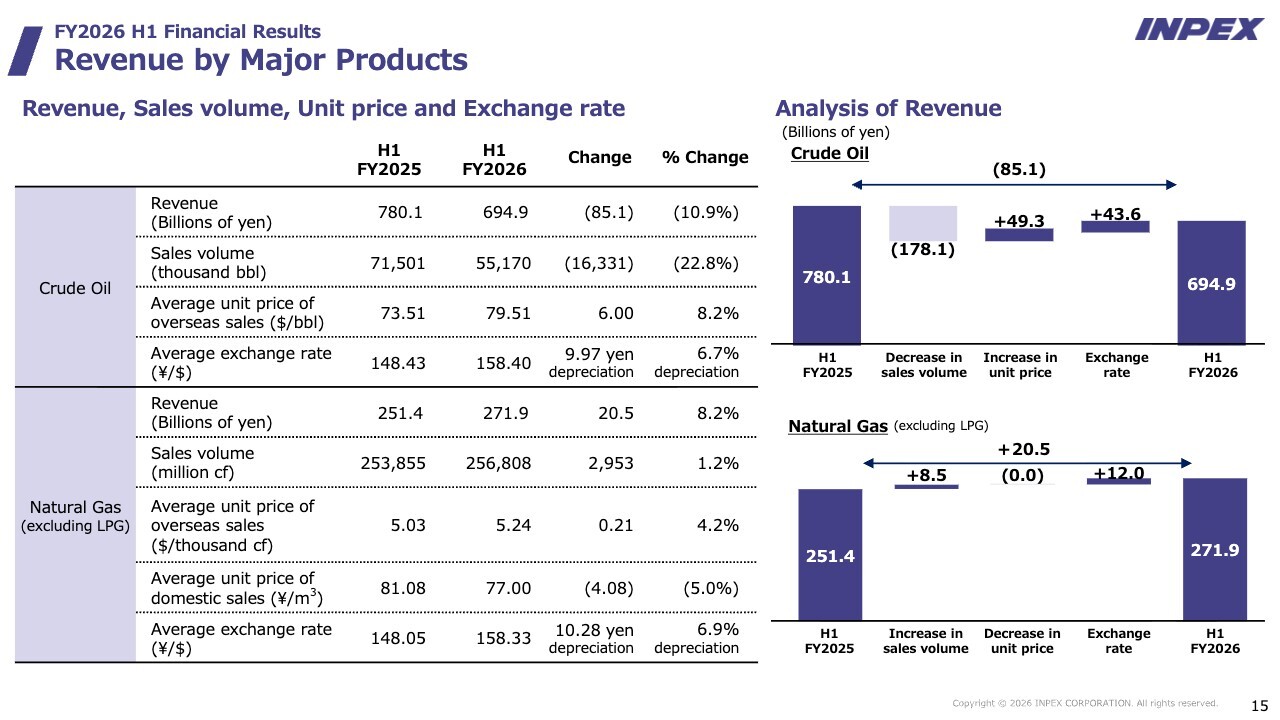
This slide shows revenue by major products. The upper section of the table shows crude oil and the lower section shows natural gas. Crude oil revenue decreased by ¥85.1 billion, from ¥780.1 billion in the previous period to ¥694.9 billion in the current period.
In terms of sales volume, lower sales of crude oil produced in Abu Dhabi reduced revenue by ¥178.1 billion. On the other hand, unit prices increased on the back of higher oil prices, and the weaker yen also had a positive impact.
Natural gas revenue increased by ¥20.5 billion, from ¥251.4 billion in the previous period to ¥271.9 billion in the current period. The sales-volume effect increased revenue by ¥8.5 billion, supported by strong production at Ichthys and, to a lesser extent, domestic gas sales.
The slide describes the unit-price effect as a “decrease,” but in fact it was almost flat. Average overseas unit prices increased, while domestic prices declined, resulting in a broadly flat overall unit-price effect. The weaker yen provided an additional positive impact, bringing natural gas revenue for H1 FY2026 to ¥271.9 billion.
Analysis of Profit (H1 FY2025 vs. H1 FY2026)
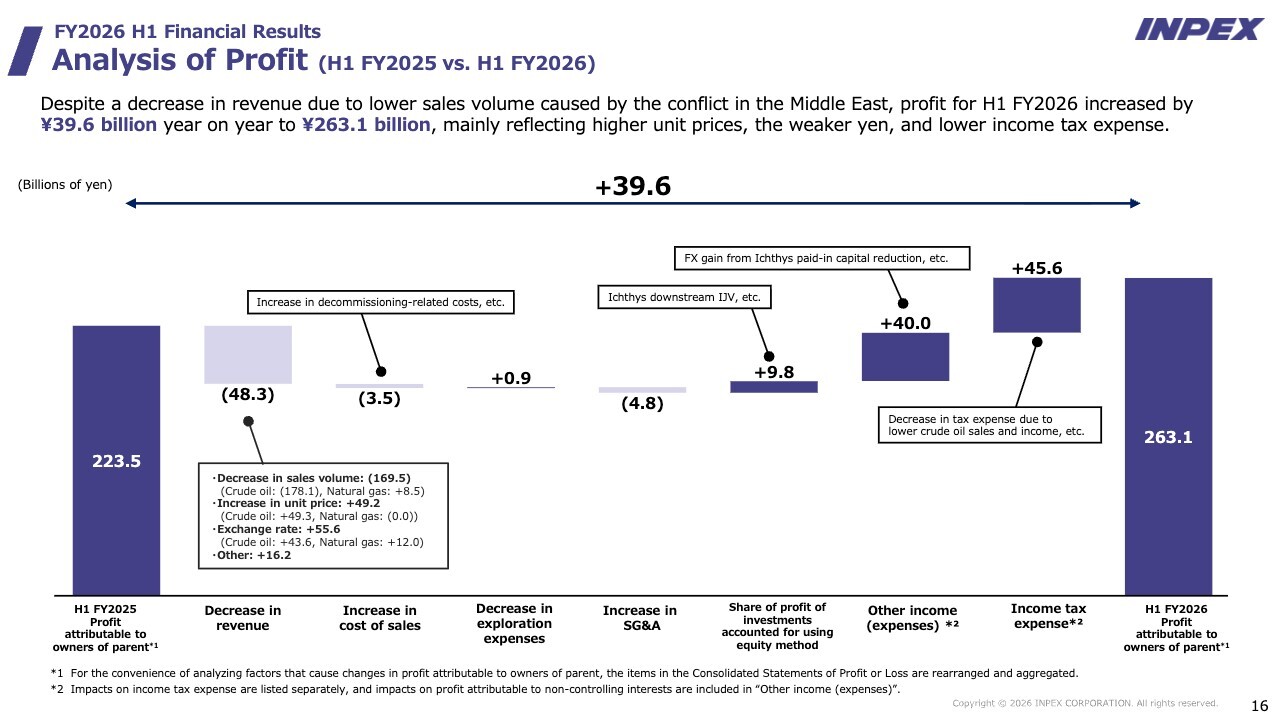
This slide is a waterfall chart. On the left is profit attributable to owners of parent for H1 FY2025 of ¥223.5 billion, and on the right is the figure for H1 FY2026. Overall, profit increased by approximately ¥40.0 billion.
The left side of the slide shows the impact from revenue. As I have mentioned several times, lower sales volume and other factors reduced revenue by ¥48.3 billion. Meanwhile, the third and fourth items from the right are share of profit of investments accounted for using the equity method and other income (expenses), both of which primarily relate to Ichthys.
Production at Ichthys was strong, and the oil prices to which LNG sales are linked rose later in the period. As a result, downstream profit increased by approximately ¥10.0 billion. Gains from TA recycling also contributed. Higher cash flow at Ichthys enabled us to carry out a substantial paid-in capital reduction, generating a further increase in profit. It is included in other income (expenses), which totaled approximately ¥40.0 billion.
On the right side of the slide, you can also see the reduction in income tax expense resulting from lower taxable income in Abu Dhabi. Under this earnings structure, revenue declined by approximately ¥50.0 billion, while Ichthys-related factors added approximately ¥50.0 billion and the reduction in income tax expense added another approximately ¥50.0 billion. Overall, profit increased by roughly ¥40.0 billion.
The Middle East situation has both negative and positive effects, but these results show that the positive effects have outweighed the negative ones.
Highlights of the Consolidated Financial Forecasts
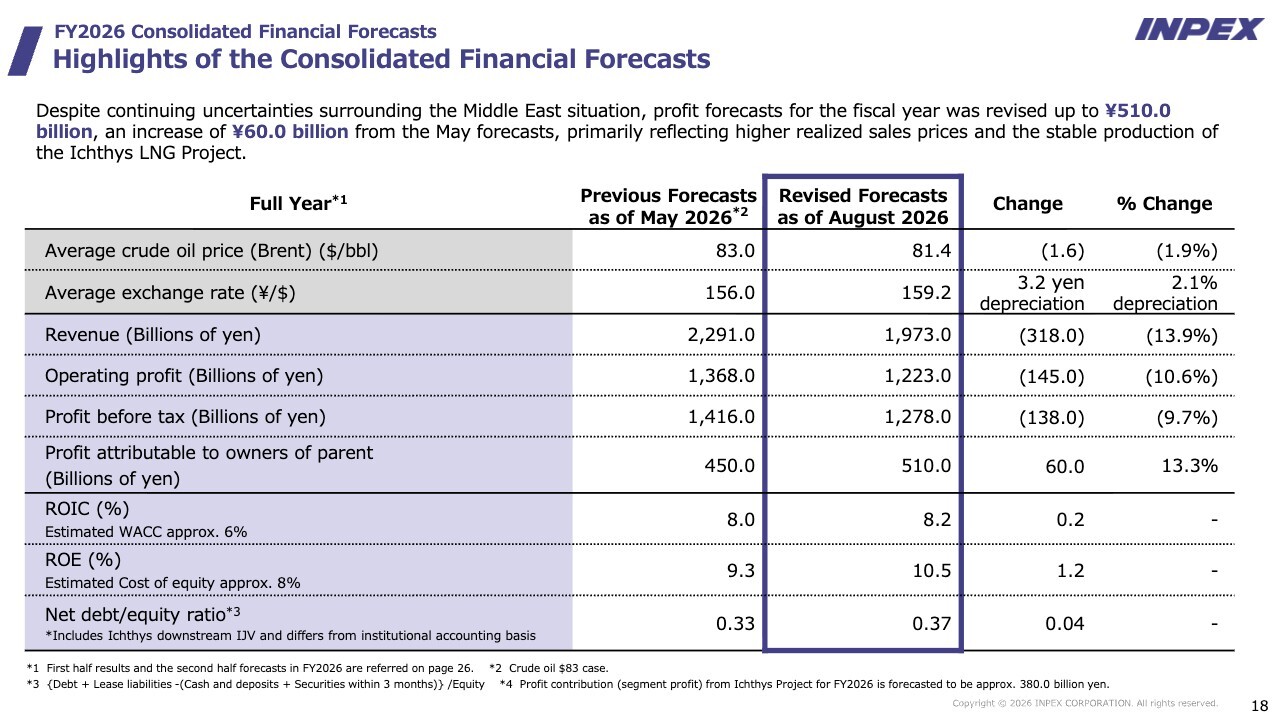
I will now explain our forecasts for FY2026. We assume a Brent oil price of around $80 in Q3 and around $70 in Q4, implying a modest decline in oil prices. Compared with the May forecasts, we are assuming an oil price approximately $2 lower. For foreign exchange, we assume ¥160 to the U.S. dollar in both Q3 and Q4, reflecting a somewhat weaker yen.
The full-year picture is broadly similar to the H1 results: although we expect lower revenue, we forecast higher profit, with profit attributable to owners of parent reaching ¥510.0 billion. Our profit forecast has now surpassed the ¥500.0 billion mark. ROE is also forecast to exceed 10%, and overall we expect strong results.
The net debt/equity ratio is somewhat higher, but as Ueda explained earlier, this is because we are substantially increasing cash reserves for Abadi LNG development.
Under our policy, when calculating the net debt/equity ratio we do not net the cash reserves for Abadi LNG development against interest-bearing debt. If we did net those reserves, the ratio would be around 0.2. We therefore see no particular issue with our financial position.
Analysis of Change in Profit Forecasts (Previous vs. Revised)
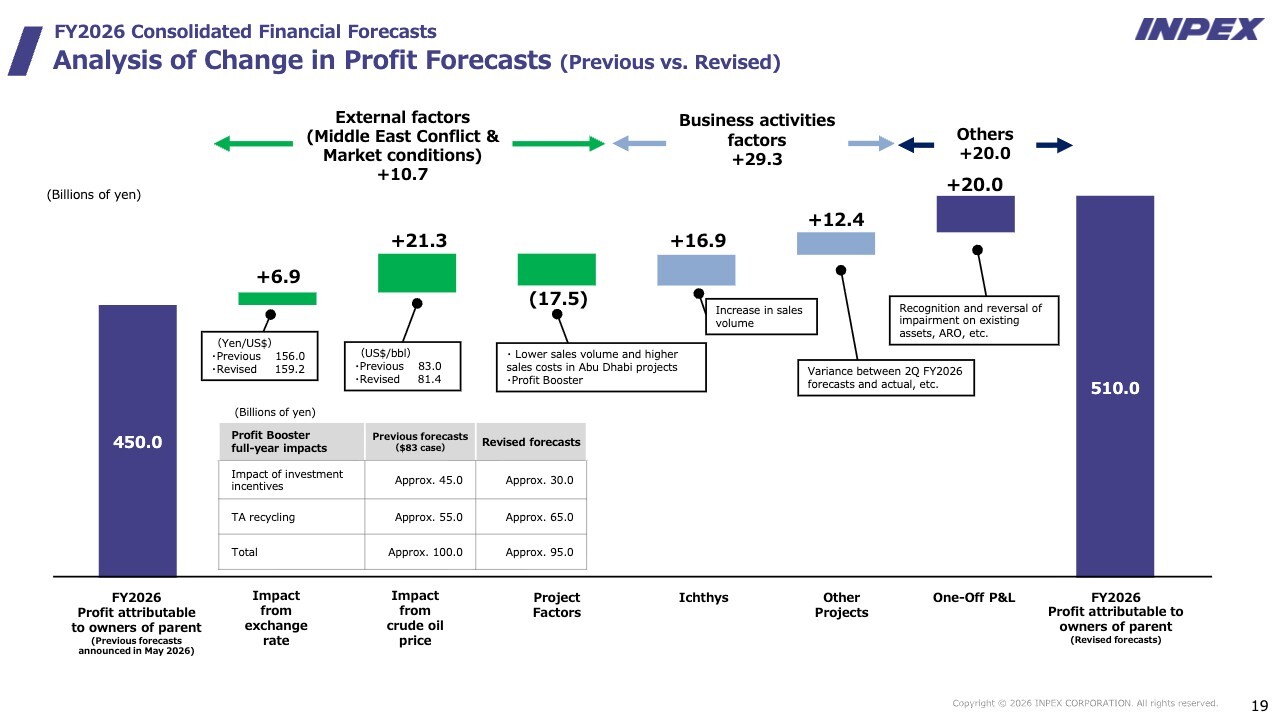
This slide is a waterfall chart. The ¥450.0 billion figure represents the upside case—the higher of the two cases—in our May 2026 outlook.
At that time, we assumed that sales from Abu Dhabi would normalize around July. Our current forecast is ¥510.0 billion, an increase of ¥60.0 billion. This forecast assumes that sales from Abu Dhabi will normalize around October.
The left half of the slide shows external factors. You can view these as primarily reflecting the Middle East situation. Foreign exchange has also moved somewhat toward a weaker yen, partly reflecting the Middle East situation.
The oil-price impact is somewhat unusual this time. In our previous full-year forecasts and financial results announcements, we generally calculated the impact using sensitivities. This time, although the oil price assumption is lower than in the May outlook, the oil-price impact is positive. This reflects larger premiums for LPG and other products, which have contributed positively to profit. In particular, the Middle East situation has produced movements that differ from the usual pattern.
The “negative ¥17.5 billion” shown on the slide represents project factors. As I have explained, this mainly reflects the decline in Abu Dhabi sales volume. The project-factor section also includes “Profit Booster,” which incorporates the positive earnings impact from TA recycling.
For Profit Booster, we estimate the full-year impact from TA recycling and investment incentives combined at approximately ¥95.0 billion. We group the foreign exchange, oil price, and project factors together as external factors. Although the negative factors increased this time, they were more than offset by positive effects.
As a result, these external factors contribute approximately ¥10.7 billion more than in our May outlook. It may sound incongruous to say that the Middle East situation had a positive effect, but that is ultimately how the impact is reflected in our earnings forecast.
Another point is Ichthys sales volume. Performance remains strong, and we now expect full-year LNG cargo shipments to exceed our previous guidance of an annual average of approximately 10 cargoes per month by several cargoes in total, contributing approximately ¥16.9 billion in additional profit.
The right side of the slide shows One-off P/L. We have incorporated a positive impact of approximately ¥20.0 billion from the recognition and reversal of impairment losses, ARO, and other items, resulting in the ¥510.0 billion profit forecast.
These figures assume that the Strait of Hormuz will return to normal in October. However, the situation remains completely uncertain, and we cannot say anything definitive. We are often asked what would happen if normalization did not occur by year-end, so we have also run that scenario.
If normalization were delayed until 2027, profit could decline by approximately ¥7.0 billion to ¥8.0 billion. However, assuming production volumes and oil prices remain at current levels, we do not expect the reduction to reach ¥10.0 billion. In that case, profit would still be around ¥500.0 billion.
Cash Flow
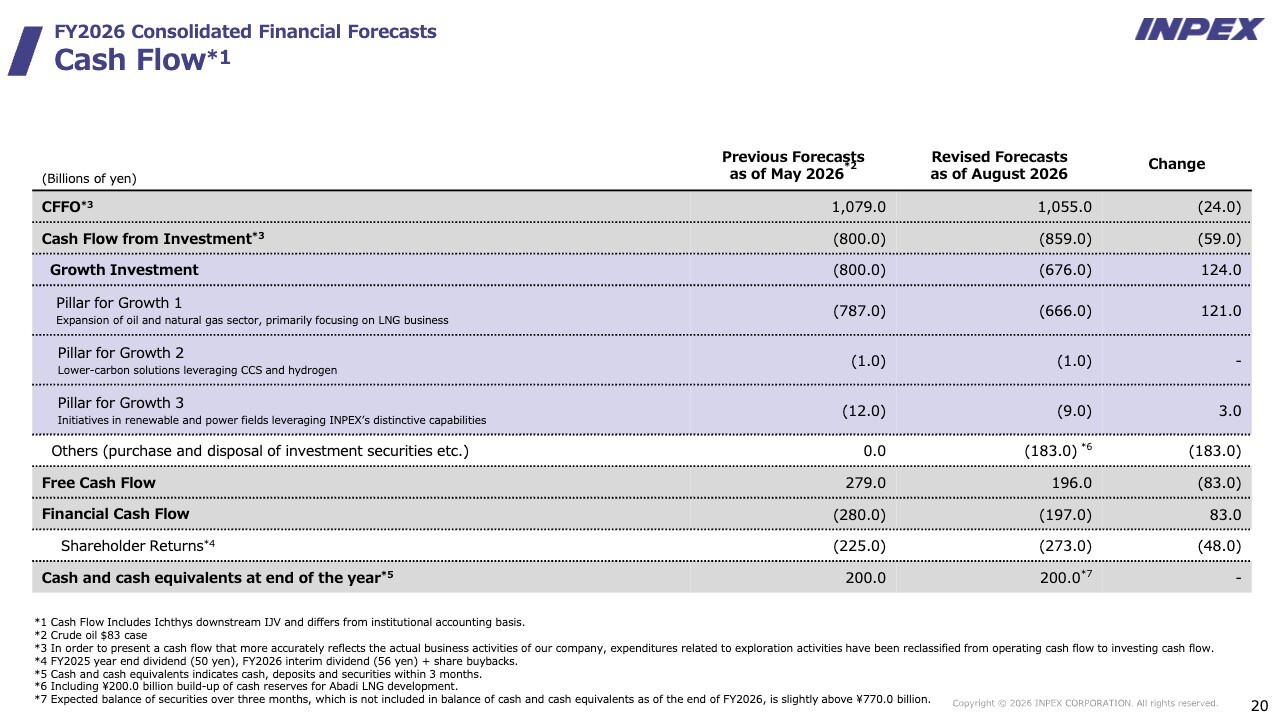
This slide shows cash flow. As shown at the top, CFFO exceeds ¥1 trillion. Investing cash flow is expected to be ¥859.0 billion, an increase of approximately ¥60.0 billion from our May forecasts. However, growth investment shown at the bottom of the slide has decreased.
The decrease reflects slightly lower investment in Abu Dhabi, although it remains broadly flat, and the deferral of one major investment of approximately ¥100.0 billion. The investment had originally been scheduled for completion by the end of December but is now expected to occur in January 2027 or later. Accordingly, there has been no change to the substance of the investment plan we have been presenting.
The reason investing cash flow has increased is shown under “Others.” The slide shows ¥183.0 billion, which reflects cash reserves for Abadi LNG development. We added approximately ¥200.0 billion to those reserves this time.
As Ueda mentioned earlier, we expect the balance to reach approximately ¥770.0 billion at the end of FY2026. In May 2026, we thought it would be difficult to make an additional allocation given the Middle East situation, but we have now added approximately ¥200.0 billion, bringing us to the current position.
Investing Cash Flow - Breakdown and Forecasts
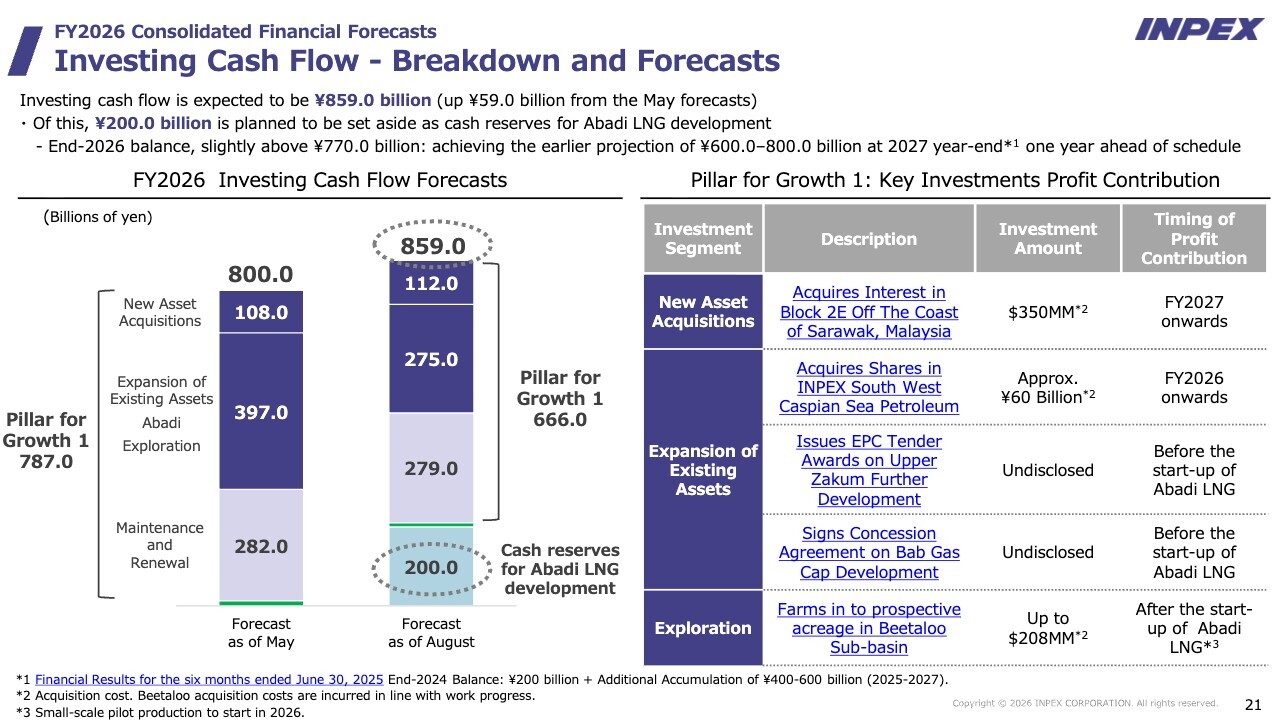
This slide shows investing cash flow. As indicated on the left side, investing cash flow is expected to be ¥859.0 billion.
In the May 2026 outlook, we had not factored in an additional allocation to cash reserves for Abadi LNG development. We have now incorporated that allocation, bringing the total to ¥859.0 billion.
As shown at the top of the slide, the ¥200.0 billion allocation to cash reserves for Abadi LNG development is expected to bring the balance to slightly above ¥770.0 billion at the end of December 2026. This means we expect to build up the cash reserves for the upstream development one year ahead of schedule.
We had assumed a balance of ¥600.0 billion to ¥800.0 billion at the end of December 2027, so we have effectively reached that level one year early. Growth investment also remains on track against the MTP target of ¥1.9 trillion over three years.
On the right side of the slide, we show the investment scale and timing of profit contribution for projects that have already been announced. As indicated, we are making investments designed to deliver growth before Abadi starts production.
ROIC by Segment
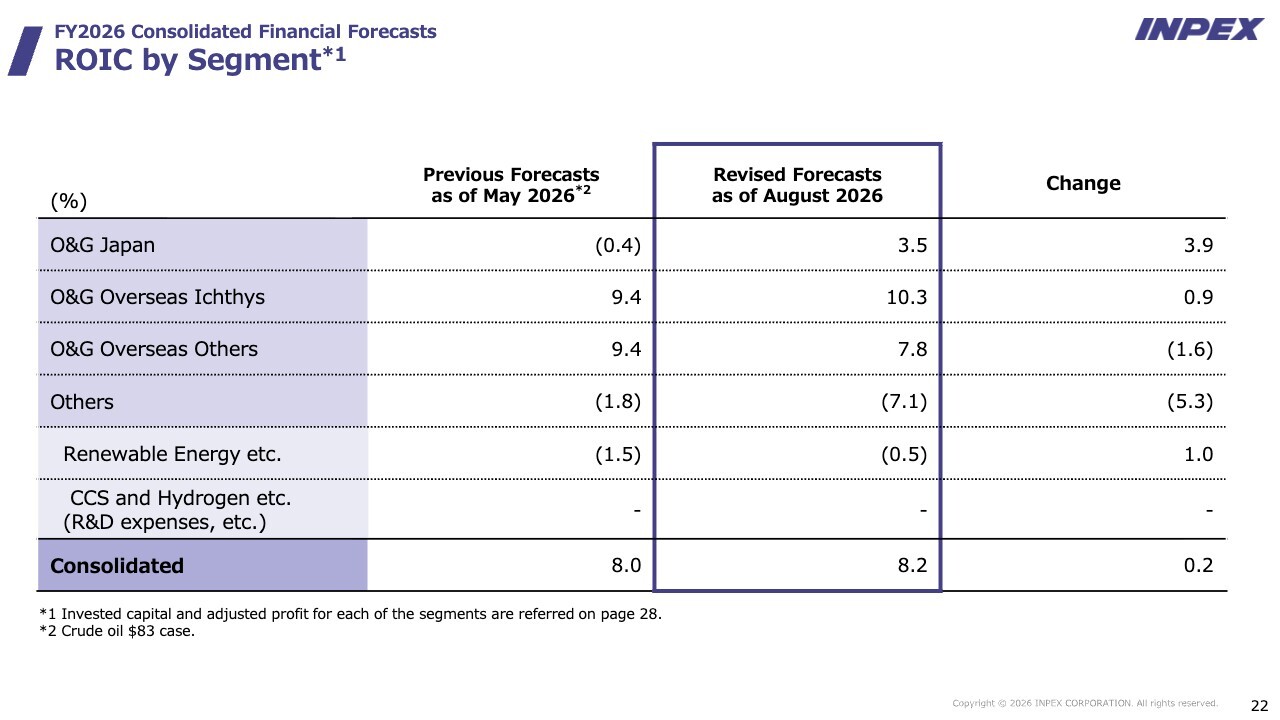
This slide shows ROIC by segment. I will leave it for your later reference.
That concludes my presentation.
Q&A: Hurdles and Progress of the Abadi LNG Project
Questioner: I have a question about Abadi. On slide 7, you explained the timeline and progress of each component, and I think the picture has become much clearer. As noted on the slide, you have previously explained that the project must secure economics delivering a “mid-teens Equity IRR.”
Based on today’s explanation, the project appears to be progressing very smoothly. Marketing in particular seems to be advancing rapidly, with substantial agreement already reached on commercial terms at an early stage, which I view very positively.
Against that backdrop, what do you see as the biggest hurdle to securing project economics that deliver a mid-teens Equity IRR? Could you explain how you view the current progress?
The slide says that INPEX will “engage with the Indonesian government.” I imagine that the terms and tax arrangements with the Indonesian government will ultimately be important. Could you explain again specifically what you see as the biggest hurdle to achieving the Equity IRR target?
You also mentioned that you have been able to build cash reserves to ¥770.0 billion one year ahead of schedule. Should we interpret this as meaning that you have now secured the funding required for the upstream portion of the project?
Ueda: On your first question about the biggest hurdle to securing a mid-teens Equity IRR for Abadi, I believe there are broadly two key factors.
The first is whether our negotiations with the Indonesian government on incentives proceed successfully. However, I believe the more important issue is how far we can reduce the project cost.
We are currently conducting FEED, but project cost is not simply presented once and then fixed. After that, various negotiations continue between us and the contractors, such as whether particular costs can be reduced further or whether the schedule can be changed in certain ways.
For example, costs may be reduced by lowering local content requirements somewhat. There are many different approaches even within the broad concept of cost reduction.
Project economics are essential to the success of the project. Before seeking incentives, therefore, we first need to pursue cost reductions rigorously through every available means.
Cost is not something that gets determined once and stays fixed; you might say it is a “living thing.” Maximizing cost reductions is therefore one of the major hurdles.
After that, if the economics are still insufficient, we would like to negotiate with the Indonesian government regarding some form of incentives. Those are the two major hurdles as I see them.
As for whether the cash reserves we have built to slightly above ¥770.0 billion are sufficient for the upstream investment in Abadi, I cannot give a definitive answer because it depends heavily on the total project cost, or CAPEX.
Looking back, when the POD was approved in 2019, Abadi CAPEX was estimated at approximately US$20 billion.
On top of that US$20 billion, we subsequently decided to introduce CCS, which will probably add around 5% to the cost. Those are 2019-based figures. We then need to restate them on a 2026 basis and account for the substantial cost increases from inflation and other factors. The resulting amount will be the final CAPEX.
The specific amount will be heavily affected by our cost-reduction efforts and other factors, so it is difficult to determine in detail at this stage. We expect it to become clearer gradually through FEED and the EPC tendering process.
Personally, I would not be particularly surprised if costs have increased by roughly 30% to 40% from the 2019 base.
That CAPEX figure includes both the upstream and downstream portions. INPEX currently holds a 65% participating interest.
The funding is then allocated between the upstream portion and the downstream LNG plant. For the downstream portion, or the LNG plant, we use a structure known as Trustee Borrowing, under which funds are borrowed and guaranteed. Cash is therefore required for the upstream portion.
We have built up approximately ¥770.0 billion for the upstream portion. Frankly, it is still not clear whether this will be sufficient, but I do not believe these reserves cover the full amount that will ultimately be required, so further efforts will be necessary.
Q&A: Earnings Contribution from Abu Dhabi Investments
Questioner: On slide 21, you explained the investment projects and the timing of their profit contribution. I would like to ask again about the production increase and earnings contribution from Abu Dhabi-related investments, which appear to account for a large portion of near-term investment in existing projects.
As shown on the slide, these investments can contribute before Abadi starts production. Abu Dhabi is an important profit-growth driver before the start-up of Abadi, so could you explain the timing of its earnings contribution? Within the limits of what you can disclose, even if only in line with the country’s overall policy, I would appreciate any specifics you can share.
Ueda: Regarding the impact of production expansion in Abu Dhabi, we are subject to a confidentiality agreement with Abu Dhabi, so I cannot discuss specific production volumes or similar details. I appreciate your understanding.
With that in mind, please look at the table on page 21. There are two items relating to Abu Dhabi. The first is the additional development of the Upper Zakum Oil Field. Abu Dhabi as a whole currently produces around 4 million barrels per day and plans to increase crude oil production capacity to around 5 million barrels per day by 2027. The additional development of Upper Zakum is one of the projects contributing to that capacity expansion. We plan to invest several hundred billion yen over the next several years and expect the project to make a meaningful earnings contribution a few years from now.
The second item is the gas cap development of the onshore Bab Oil Field. This project will develop the cap gas accumulated above the oil reservoir, and FEED is currently under way. We are targeting an investment decision during 2026, with production expected to start around 2029. We believe the project can begin contributing to profit from around that time, at a scale of several billion yen.
Q&A: Scope to Expand Long-Term Contracts for Abadi LNG
Questioner: I have a question about Abadi. In your presentation, you said that, of the approximately 8 million tons planned for long-term sales contracts, key commercial terms have been agreed for around 6 million tons.
You also said buyer interest has been very strong. To stabilize earnings over the medium to long term, is there any possibility or plan to increase the portion sold under long-term contracts?
Ueda: I understand your question to be whether we should increase the proportion of Abadi volumes covered by long-term contracts.
The answer is that it is basically possible, but we are not particularly looking to do so. Abadi is designed to produce 9.5 million tons of LNG and 150 mmscfd of pipeline gas.
We learned a lesson from the LNG contracting structure at Ichthys. At Ichthys, we initially contracted more than 90% of production capacity under long-term agreements. That was very beneficial from a financing perspective, but when operational issues occurred, we did not have enough buffer.
Based on that experience, our policy for Abadi is to maintain a certain buffer. Specifically, of the 9.5 million tons, we plan to keep approximately 1.5 million tons as a buffer and allocate the remaining approximately 8 million tons to long-term contracts.
We are negotiating with the aim of placing essentially all of that approximately 8 million tons under long-term contracts. Interest from buyers in Japan and overseas is extremely strong, so it would be possible to increase the contracted volume further. However, for the reason I just explained, we are not really considering increasing the long-term portion beyond that level.
Q&A: Further Enhancing Shareholder Returns
Questioner: I have a question about shareholder returns. I think the decision to place greater emphasis on share buybacks this time sends a very strong message.
At the same time, a total payout ratio of 53% appears to remain within the range of your policy of “50% or more.” If you have such a strong conviction, might you consider raising the total payout ratio further?
Also, given that you now expect to build the cash reserves one year ahead of schedule, I thought you might have room from a cash perspective to send an even stronger message. I would like to stress that I am not trying to pressure you to increase shareholder returns, but I would appreciate your view.
Ueda: I take your comment as a strong message: while you understand the intent behind our policy, you would like us to deliver shareholder returns that send an even stronger signal. We will take that point seriously.
Our basic policy is not to increase shareholder returns for their own sake, but rather to grow the business and return the fruits of that growth to shareholders. As you noted, we currently expect a total payout ratio of approximately 53%.
The current figures are the result of steadily implementing our policy of maintaining that level while achieving growth and providing appropriate shareholder returns. That said, we take your point seriously.
Q&A: Abadi Equity IRR
Questioner: Before my question, I would like to say that your share price, ROE, and profitability have improved significantly compared with five years ago, which I am personally very pleased to see. I hope you continue in this direction.
I understand that it is difficult to assess how much confidence we can place in Abadi’s profitability, but I would appreciate it if you could continue enhancing disclosure as much as possible at the current pace.
Investment amounts may increase and investment timing may be delayed because of inflation, but I hope you will continue working to improve profitability even under those circumstances.
My question is: what oil price assumption should we have in mind today when you refer to a mid-teens Equity IRR for Abadi?
I realize this is asking a lot, but it would make the discussion easier if you could say something like, “We can target a mid-teens Equity IRR even at Brent of $50.”
It may be difficult to answer at this stage, but I would appreciate it if you could discuss this when you make the final investment decision.
Ueda: Regarding how to think about the relationship between a mid-teens Equity IRR for Abadi and the oil price, this will be part of our discussions with the Indonesian government going forward, so it is difficult to give a definitive answer at this stage.
When we were discussing the project in 2019, we generally had an oil price of around $65 in mind. That said, this was the assumption at the time, and I think there was some divergence from reality in assuming that $65 would remain flat indefinitely. How we view the oil price will therefore be part of the discussions going forward.
Q&A: ROE Targets
Questioner: I have a question about ROE. In your MTP materials, the chart I pay particular attention to is the one on ROE and growth. I also think the growth chart presented today is excellent and something I would like to refer to myself.
ROE is currently around 10%, with equity of approximately ¥5 trillion and profit of ¥500.0 billion this year. I think these are very strong results.
What I would like to discuss is that your MTP materials explicitly identify, from the perspectives of growth and ROE, the challenge that your ROE is lower than that of the European majors. I highly appreciate the fact that you recognize this as a challenge and state it clearly in your materials.
I understand that your current 2035 target is ROE of 10% or more. Assuming you continue investing in Abadi and oil prices remain around current levels, can we expect a second and third round of Profit Booster initiatives?
Yamada: Our ROE is around 10%, which is somewhat lower than that of the majors, as you are aware.
If you look at our portfolio, its core regions are Australia, Abu Dhabi, and Japan, all of which have extremely low country risk. Among the U.S. majors, Chevron and ExxonMobil have portfolios with somewhat similar characteristics.
The European majors, by contrast, have portfolios that include somewhat higher-country-risk areas. If we were to consider the concept of risk-adjusted ROE, I do not believe our ROE is necessarily inferior to that of the European majors.
Achieving ROE of 10% while carrying relatively low risk is, in competitive terms, a reasonably strong level. This year, ROE happens to exceed 10% because profit is above ¥500.0 billion, but we have no intention of slowing our progress. We will continue moving forward.
Turning to Profit Booster, when we discussed it in 2025, we assumed that the yen would remain weak and considered it highly likely that conditions around that level could continue for roughly 10 years.
A second or third Profit Booster may not be easy to produce. However, our balance sheet exceeds ¥8 trillion, and because we apply IFRS, movements between the prior-period and current-period balance sheets are reflected in earnings.
With a balance sheet of this scale, even relatively small movements in oil prices, interest rates, and foreign exchange rates can cause large changes in unrealized gains and losses for accounting and tax purposes.
We monitor those movements carefully and manage them based on the IFRS concept that changes between the prior-period and current-period balance sheets are reflected in the P&L.
This does not mean that we can always generate results like Profit Booster, but we believe there is room to do so. That is why we focus closely on financial management every day.
Unfortunately, I cannot tell you today that we have a specific initiative ready to announce, but I believe the potential is certainly there. After all, we have a balance sheet of ¥8 trillion or more and a global portfolio, while oil prices and foreign exchange rates fluctuate significantly. Unrealized gains and losses on the balance sheet will inevitably arise.
We intend to keep a close eye on those movements and manage our financial and tax positions appropriately so that they can help support earnings.
Q&A: Country Risk of the Ichthys Business in Australia
Questioner: I have a question about Ichthys. Could you summarize again how you view country risk in Australia? In particular, there has recently been considerable discussion about domestic gas reservation requirements.
The recent strike may not be the best example, but are these issues relatively minor, or do we need to be mindful of more nationalistic factors? I would appreciate your view.
Ueda: Regarding Ichthys, country risk in Australia, domestic gas reservation requirements, and the impact of nationalism, my candid view is that there are reasons for concern.
About a month ago, I visited Canberra and met with the Treasurer and various other politicians for discussions. There are several specific issues, but one that is being discussed particularly actively is the possible introduction of a Domestic Gas Reservation Scheme.
The proposal under discussion would require an amount equivalent to 20% of LNG exports to be supplied to the domestic market. The background is a shortage of gas in Australia, particularly on the east coast. Political considerations are therefore also driving calls to “supply the domestic market properly rather than exporting the gas.”
From our perspective, however, the question is whether that is really the right approach. If such a policy were implemented and an amount equivalent to 20% of exports were redirected to the domestic market, Australia could end up with excess domestic supply and gas prices could fall sharply.
That would put energy companies that currently supply gas to the Australian domestic market in a very difficult position.
Exporters would also have to redirect an amount equivalent to 20% of their exports to the domestic market, creating various issues and concerns for them as well.
Our position is that the problem is not exports, but underinvestment. Australia has abundant gas resources, so the solution is to invest more and increase production. Imposing domestic supply obligations on exporters instead would reduce the predictability of the business environment and significantly weaken investor sentiment, which could lead to further underinvestment in the future. Rather than taking that approach, we believe the real solution is to ensure sufficient investment. We are continuing to discuss this point with the Australian government.
At the same time, the Australian government also has domestic circumstances to consider, so this is not an easy issue to resolve. Australia’s biggest challenge today is the cost of living, meaning the strain that higher prices are placing on households, and this is a major focus of domestic debate. We also hear many calls for higher taxes on foreign companies as a way to ease cost-of-living pressures.
Against this backdrop, the Australian government says that gas is important and that its relationship with Japan is also extremely important, while at the same time it must take domestic political considerations into account. Beyond the Domestic Gas Reservation Scheme, there are also various discussions in Australia, including proposals to raise tax rates on foreign companies.
In this environment, we have frankly expressed our concerns about the deterioration in Australia’s business environment, and we ourselves have a strong sense of urgency about the situation.
Q&A: Shareholder Return Policy and Earnings Outlook
Questioner: I have a question about shareholder returns. We are currently at the H1 results stage, and depending on oil-price movements, I assume full-year profit could deviate from the current forecast of ¥510.0 billion.
By announcing shareholder returns exceeding 50% of profit at this point, should we take this as a sign of confidence that profit will remain near the current forecast even if oil prices fluctuate somewhat? Or is the stronger rationale for this shareholder return policy the view that the current share price is undervalued, even though profit itself could fluctuate?
I would also like to ask how confident you are in the earnings plan after taking oil-price volatility into account.
Toshiaki Takimoto: I am Toshiaki Takimoto, Director, Senior Executive Vice President, Corporate Strategy & Planning. We have had various internal discussions about the appropriate level of shareholder returns. As President Ueda explained today, we placed relatively greater emphasis on share buybacks this time and announced a total payout ratio of 53% at the H1 stage.
I understand your question to be whether this policy could change by fiscal year-end. As you know, Ichthys accounts for roughly 70% of our net profit, and its LNG prices are determined with reference to oil prices from several months to around six months earlier.
Oil prices through the end of July are already known, so for LNG sold under long-term contracts, we now have reasonable visibility into sales prices through the end of December and the level of earnings those prices will generate.
If we have surplus cargoes, we can sell them on the spot market, creating some upside potential. On the other hand, if normalization of the Strait of Hormuz is delayed, there could be some negative impact in Abu Dhabi, so there is still a range of possible outcomes.
However, because we already have a reasonable degree of visibility as of August into LNG sales prices at Ichthys, a key earnings driver for us, we concluded that committing to a total payout ratio of 53% at this stage was a reasonable decision, and that is why we made the announcement now.
Q&A: Progress on Ichthys Train 3
Questioner: Continuing with Australia, I would like to ask how much visibility you currently have into the volume of gas available for Ichthys Train 3. You explained today that the Beetaloo Sub-basin has very significant potential.
On the other hand, unfortunately, the investment in Browse did not materialize. Could you explain how much visibility you currently have toward Train 3?
Ueda: As for the outlook for Ichthys Train 3, we cannot yet provide a clear estimate of the available gas volume at this stage.
For Ichthys, we are already considering the development of nearby gas resources such as AC/RL7 (Cash Maple). We have a certain degree of visibility on these resources for maintaining the Ichthys production plateau over the long term, but Train 3 will require us to secure an additional gas source of meaningful scale.
Regarding Beetaloo, some believe its resources could rival those of the Permian in the United States, while others think they may be considerably smaller. There are a range of views. We do have high expectations for the resource potential, but it is not yet at a stage where we can be definitive, and whether it can ultimately support Train 3 remains uncertain.
Over the next several years, we will conduct exploration work together with Daly Waters Energy LP (DWE) to determine the scale of the resources.
If the resources are sufficient, although Beetaloo is onshore, we are considering the possibility of building a pipeline from Beetaloo to Ichthys and connecting the gas to Train 3. This will depend entirely on the exploration work going forward.
Q&A: Outlook for Next Fiscal Year Earnings
Questioner: This may be a little early, but I have a question about earnings next fiscal year. This year benefited from factors such as a lower tax burden in Abu Dhabi, premium effects, and other positive impacts from the Middle East situation. I assume there may be some reversal of those benefits next year.
Could you also discuss any potential drivers of profit growth, such as higher volumes, assuming the negative factors you mentioned earlier do not need to be carried forward into next year?
Yamada: It is difficult to say anything definitive about 2027 at this stage, because the outcome could vary significantly depending on oil prices and foreign exchange rates.
Oil prices in 2026 are at a somewhat elevated level. If they remain around that level and we assume an exchange rate of around ¥160 to the U.S. dollar, we expect Ichthys to experience some shutdowns, but we do not see earnings falling dramatically.
Our FY2026 profit forecast has now exceeded ¥500.0 billion. While there are uncertainties, I believe it may be possible to continue targeting roughly the same level going forward and that our underlying earnings level has moved higher.
If we can sustain profit at around ¥500.0 billion, we should be able to pursue share buybacks while managing equity, potentially allowing us to maintain ROE at around 10%. That said, this assumes that nothing unexpected happens.