
Note: This document has been translated from the Japanese original for reference purposes only. In the event of any discrepancy between this translated document and the Japanese original, the original shall prevail.
Company Overview
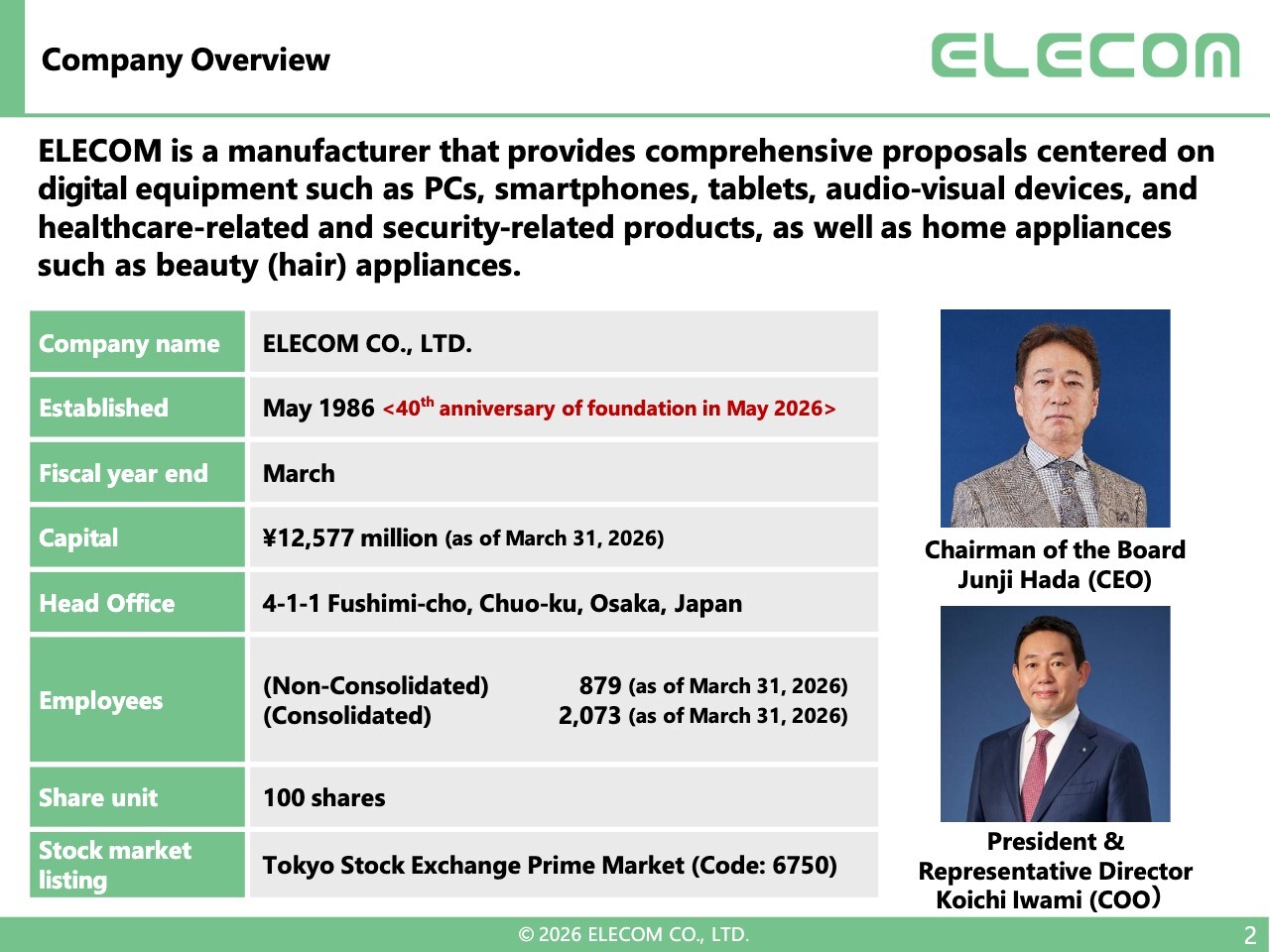
Koichi Iwami (hereinafter Iwami): I am Iwami, President & Representative Director of ELECOM Co., Ltd. Thank you very much for joining us today. I will now explain the results for the fiscal year ended March 31, 2026, for the ELECOM Group. Thank you for your time.
This slide provides a company overview. The number of employees on a consolidated basis has grown to a scale exceeding 2,000 people. In addition, on May 28 this year, we were able to mark our 40th anniversary since our founding. This is also thanks to all of you. Thank you.
Purpose
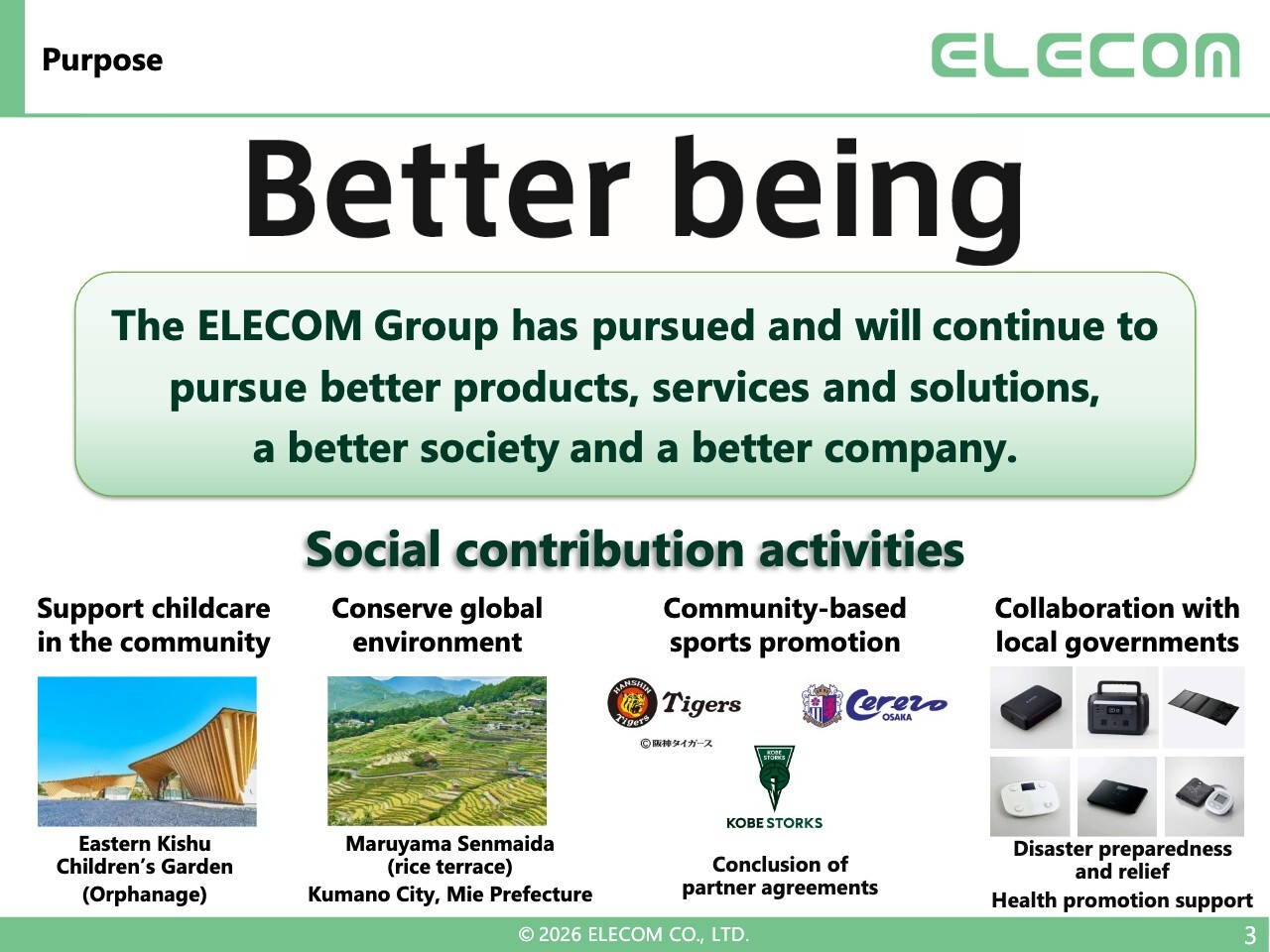
This is the purpose we established about two years ago.
With the slogan “Better being” and our commitment to pursuing better products, services and solutions, a better society, and a better company, we are promoting social contribution activities that include childcare support, global environmental conservation, community-based sports promotion, and collaboration with local governments.
Our social contribution initiatives continue to expand further.
Sales and Profit / Current Status of ELECOM
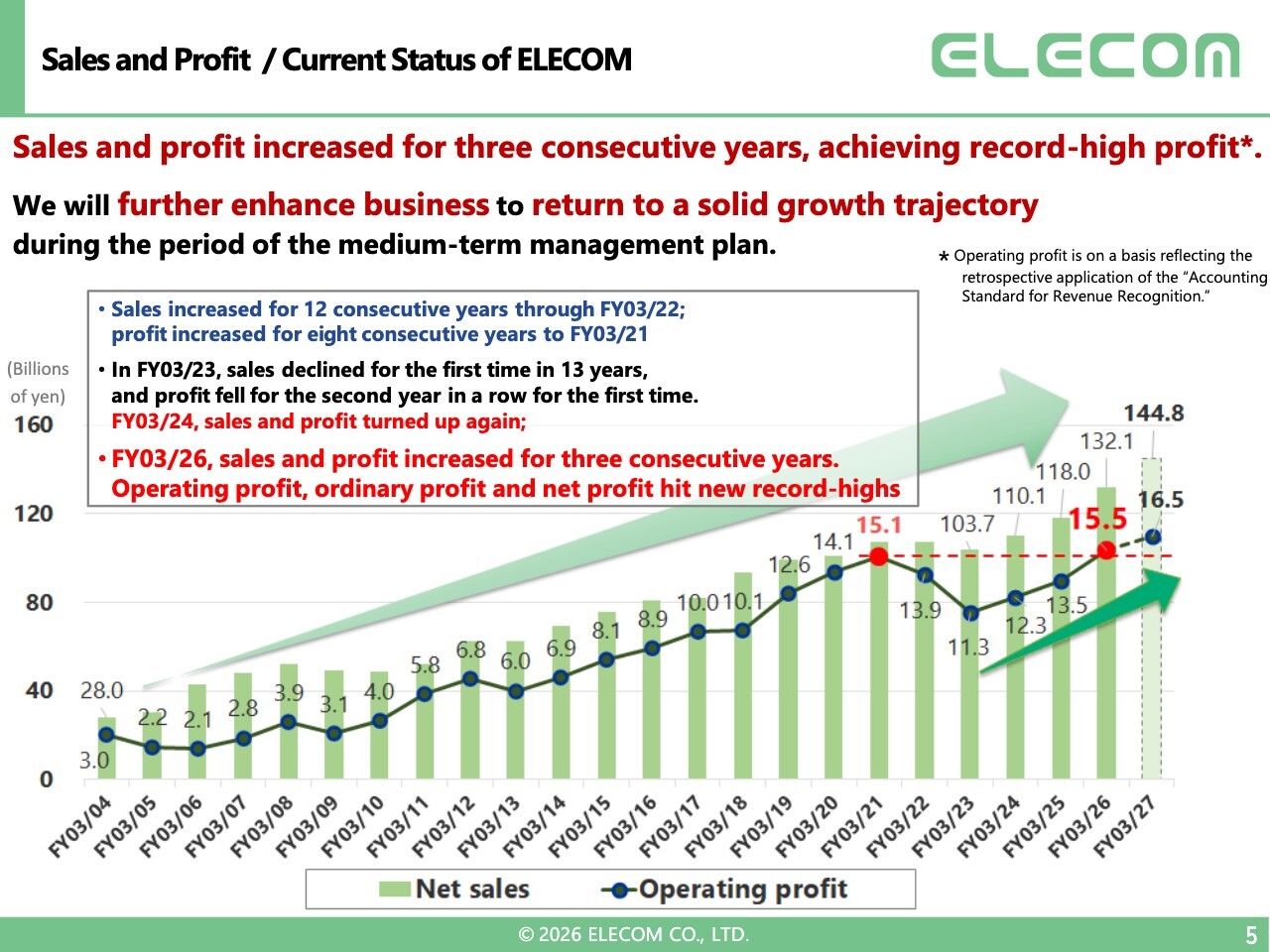
From here, I will talk about the financial results in detail. Ever since I assumed the role of president about two years ago, I have continued to say that I want to make us a company that grows—more specifically, a company that can continue to grow on an ongoing basis.
What I felt initially was that by steadily implementing initiatives one by one such as developing talent, putting systems in place, and visualizing the numbers, I wanted to create an organization and business model that can grow more steadily and continuously.
In the previous fiscal year, we moved forward with our initiatives based on that thinking. Also, this fiscal year is the third and final year of our medium-term management plan, and we are proceeding with that in mind.
In the previous fiscal year, we achieved a record high operating profit of 15,500 million yen. Net sales came to 132,100 million yen, and we achieved higher net sales and higher profits for the third consecutive year.
In particular, we are focused on profit, and we are working on how to increase operating profit, as we believe this will lead to enhancing the company’s value.
Progress of Numerical Targets in the Medium-term Management Plan ELECON
- Operating Profit Growth Rate
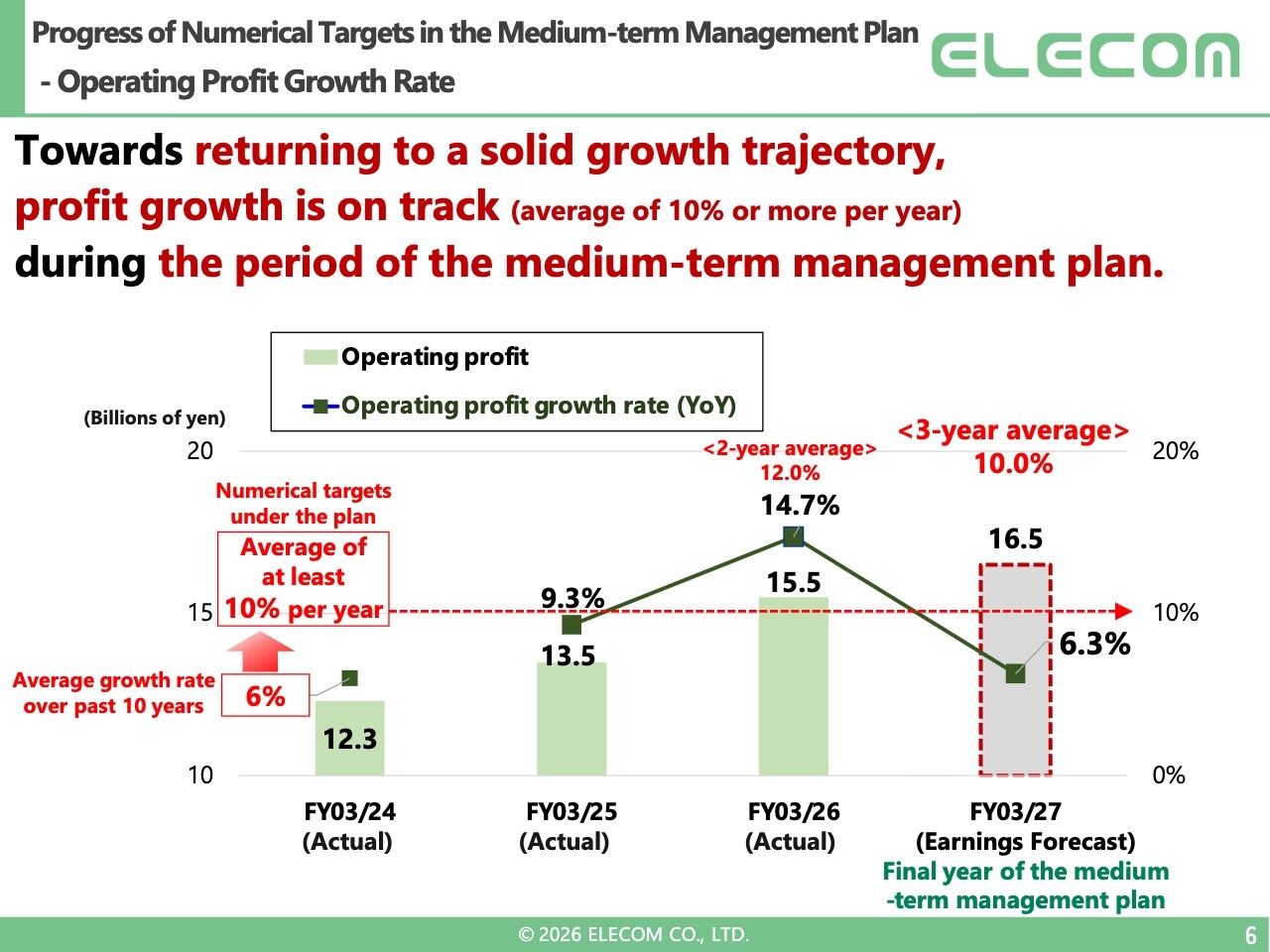
We believe that there is no point unless we can continue steady growth, and in our medium-term management plan, we are aiming for an average annual growth of operating profit of 10% or more.
In the previous period, it was 15,500 million yen, representing growth of 14.7%, but looking at it over three years, 16,500 million yen is the committed figure, so we will consider things based on this.
However, for internal operating profit, we have set an even higher level—10% YoY growth—as our internal budget for this fiscal year, and are moving forward accordingly, and the key issue as far as I'm concerned is how we will achieve that level. With this in mind, I will proceed.
Earnings Summary for FY03/26 (1H and 2H)
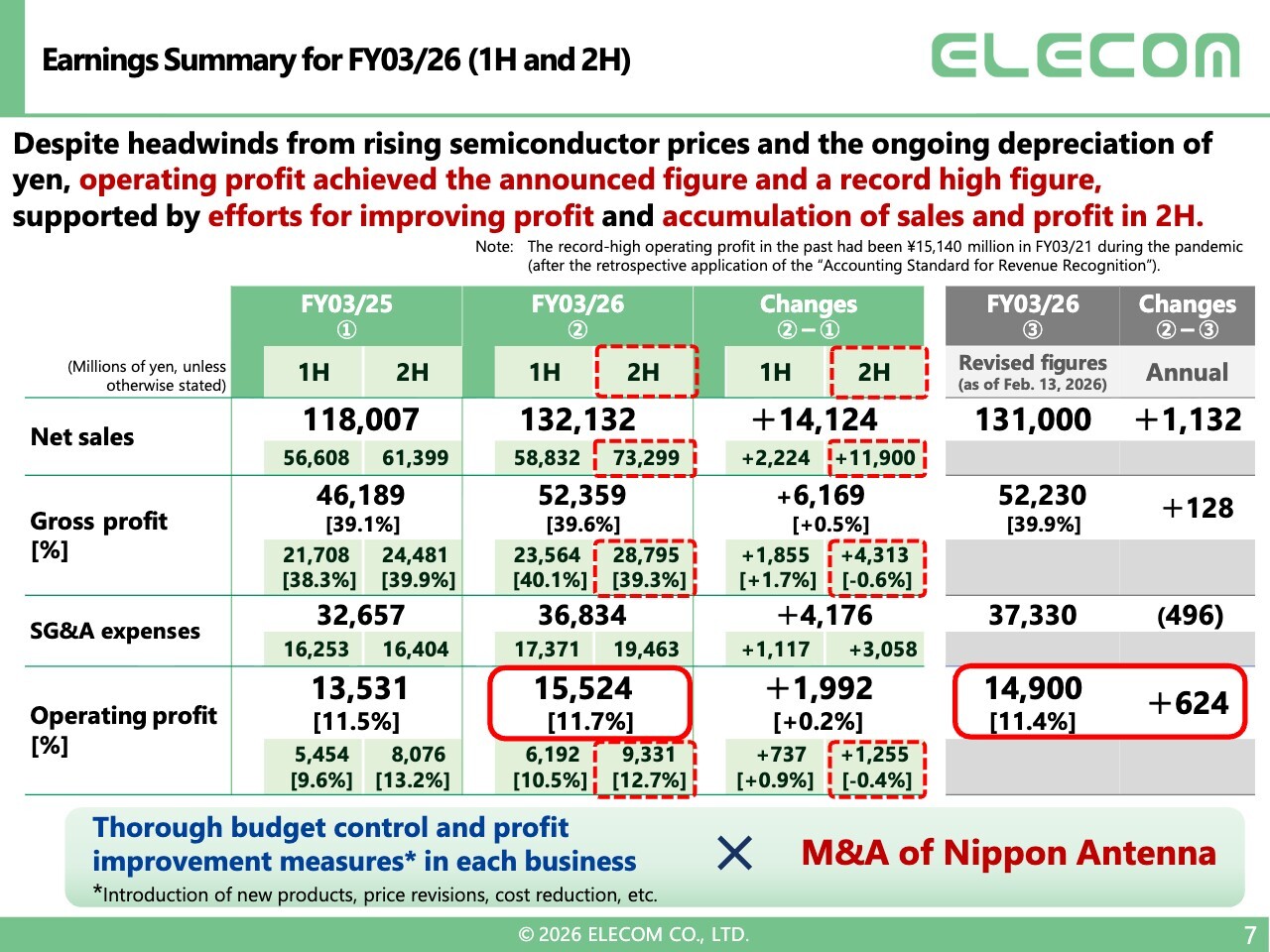
Under this context, as for net sales for the fiscal year ended March 2026, the figures include half a year’s contribution due to the M&A of Nippon Antenna and come to 132,130 million yen. Operating profit was 15,524 million yen.
In fact, because it includes a portion for Nippon Antenna of approximately 800 million yen, excluding Nippon Antenna brings it to slightly over 14,700 million yen, and compared with the disclosed operating profit of 14,900 million yen, it is short by about 200 million yen.
There are issues with this point. In addition to that, various other factors also had an impact, including the effect of the fiscal year-end sales that we had expected in the mass retail area and the corporate area being pushed back to early April this year due to the issue with PC demand.
However, overall, against the announced figure of an operating profit of 14,900 million yen, the result came to 15,524 million yen, settling at an improvement of 624 million yen from 14,900 million yen.
Earnings Summary for FY03/26 (Sales by Channel, Sales by Product, and Gross Profit)
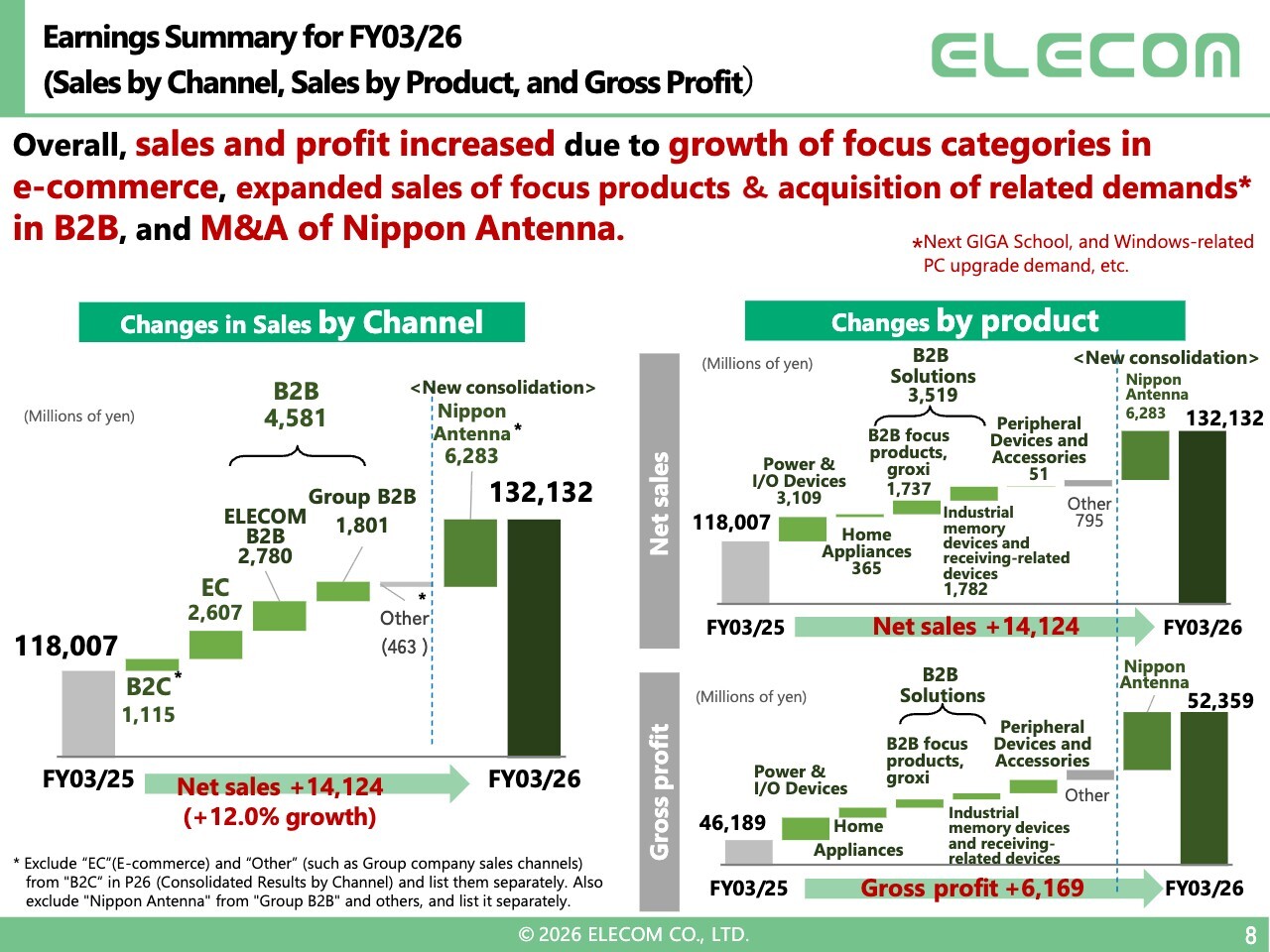
This is an overview of performance by channel and by item. For each category, we review every quarter how we will proceed, and up to now we have been moving forward under a policy of wanting to grow e-commerce and B2B. As a result, this has led to the current trend.
In addition, having brought Nippon Antenna into the group, we are rolling out ELECOM-style sales activities. We plan to complete the full integration this October, and since last December, we have started a management cycle toward that goal. As we responded to the integration in this way, overall we achieved higher net sales and higher profits.
As shown on the slide, net sales by channel increased by 2,607 million yen for e-commerce, and 4,581 million yen for B2B overall.
By product category, power & I/O devices and B2B solutions were the two core areas that posted strong growth. Power & I/O Devices also includes B2B products such as keyboards for the GIGA School program. We also secured gross profit in this area.
Overall, Nippon Antenna recorded sales of 6,283 million yen, and sales increased in that area.
Achievements for FY03/26 and Ongoing Issues
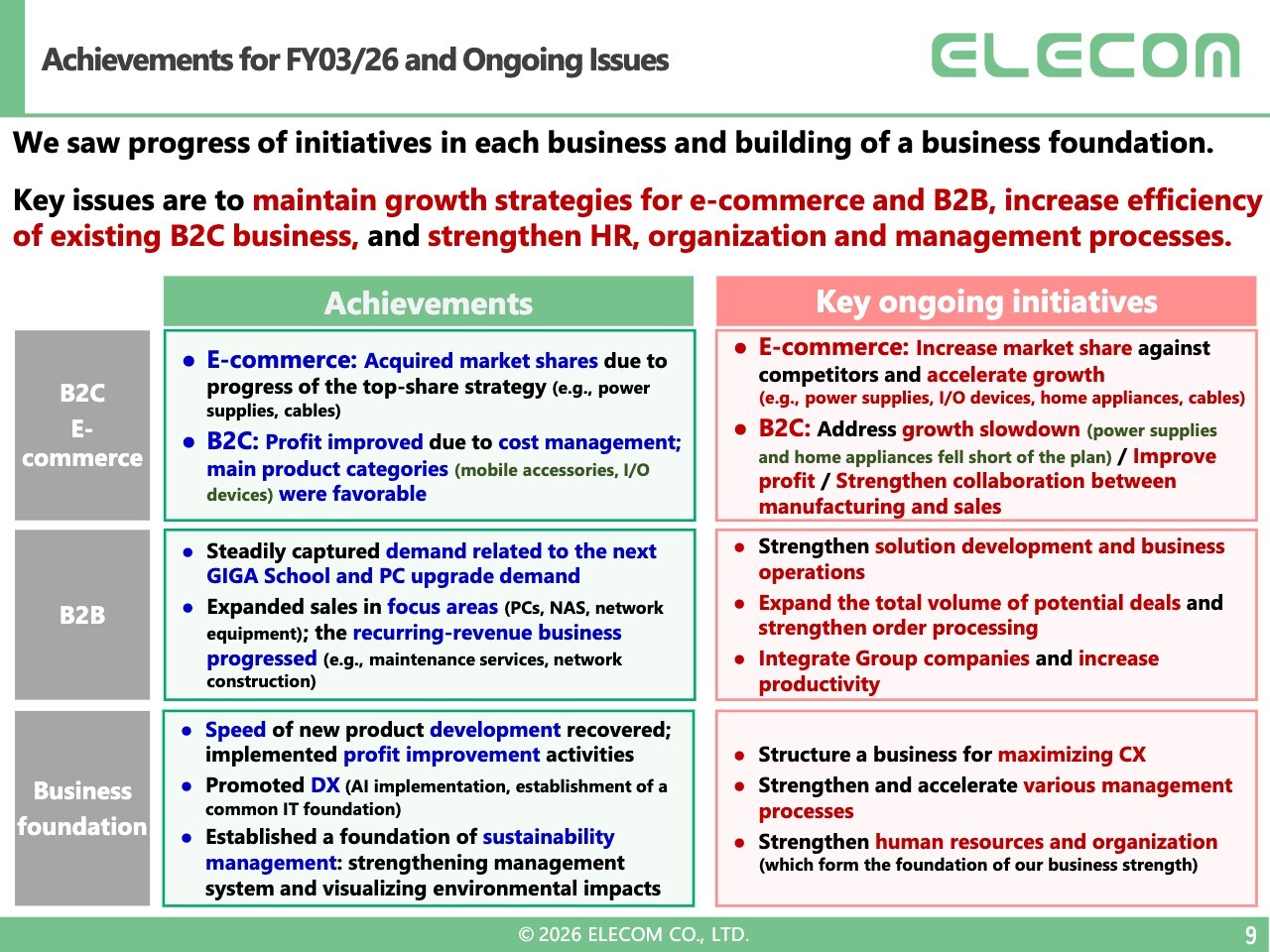
These are our achievements and ongoing issues. While the achievements themselves are good, there are several issues we need to address going forward.
As for e-commerce, under our top-share strategy, the product groups we have focused on—accessories, mice, power supplies, and cables, where we said, “Let’s grow these products”—are steadily delivering results.
However, we need to work going forward to win more share across a wide range of product groups, such as “we need to capture more share in power supplies,” “we need to increase our market share in I/O devices against competitors,” and “shouldn’t we put a bit more effort into home appliances?”
For B2C, this is our largest foundation and the underlying base platform. At present, some of the sales at mass retailers are shifting to e-commerce, and we are seeing ongoing changes.
Under such changes, improving the efficiency of processes, including the organization for mass retailers business, is extremely important. What I am particularly concerned about is reducing distribution inventory at their stores. We will appropriately reduce distribution inventory and build an efficient business structure.
Our goal is to establish a model where products are displayed at mass retailers and then sold via e-commerce. As the next step, we aim for mass retailers and e-commerce to work as one to pursue this cycle together with customers. We can obtain data in e-commerce, so we will combine that data with our sales methods. We believe it is necessary to move forward with these initiatives in a focused manner over the three-year period of the next medium-term plan.
Returning to the e-commerce topic, D2C, which Anker and others are currently rolling out, will also be a key point going forward. Sales through our website are currently over 2,000 million yen, and we recognize that it is important to grow this further, so we will move forward with the necessary measures.
In B2B, there was demand related to the GIGA School Program as well as PC upgrade driven by the migration due to the end of Windows 10 support, but it was not as large as in the previous time. Since a certain level of demand is still expected this fiscal year, we do not see the decline in this special demand as a factor that would hinder growth.
Accordingly, we will further advance our efforts to provide more solution-oriented offerings and to sell focus products. Some examples of the products we are focusing on include NAS, network products, and security cameras.
For security cameras, the product launch was delayed, and what was scheduled for September to October last year slipped to April to June this year. This was due to an error in our development process. Meanwhile, for PCs, our ability to capture spot demand led to positive results. The network products were also launched as planned, and performance is progressing steadily.
Based on this situation, we believe we need to further enhance the development of solutions in our focus areas and strengthen sales to end users.
Also, since new products are being launched at the usual pace, this year we will focus on appropriately narrowing down the specifications, designs, and products that sell, and then selling them properly. In addition, we will work to further strengthen sustainability management and to enhance the management layer for human resources.
FY03/27 Earnings Forecasts (Net Sales, Operating Profit)
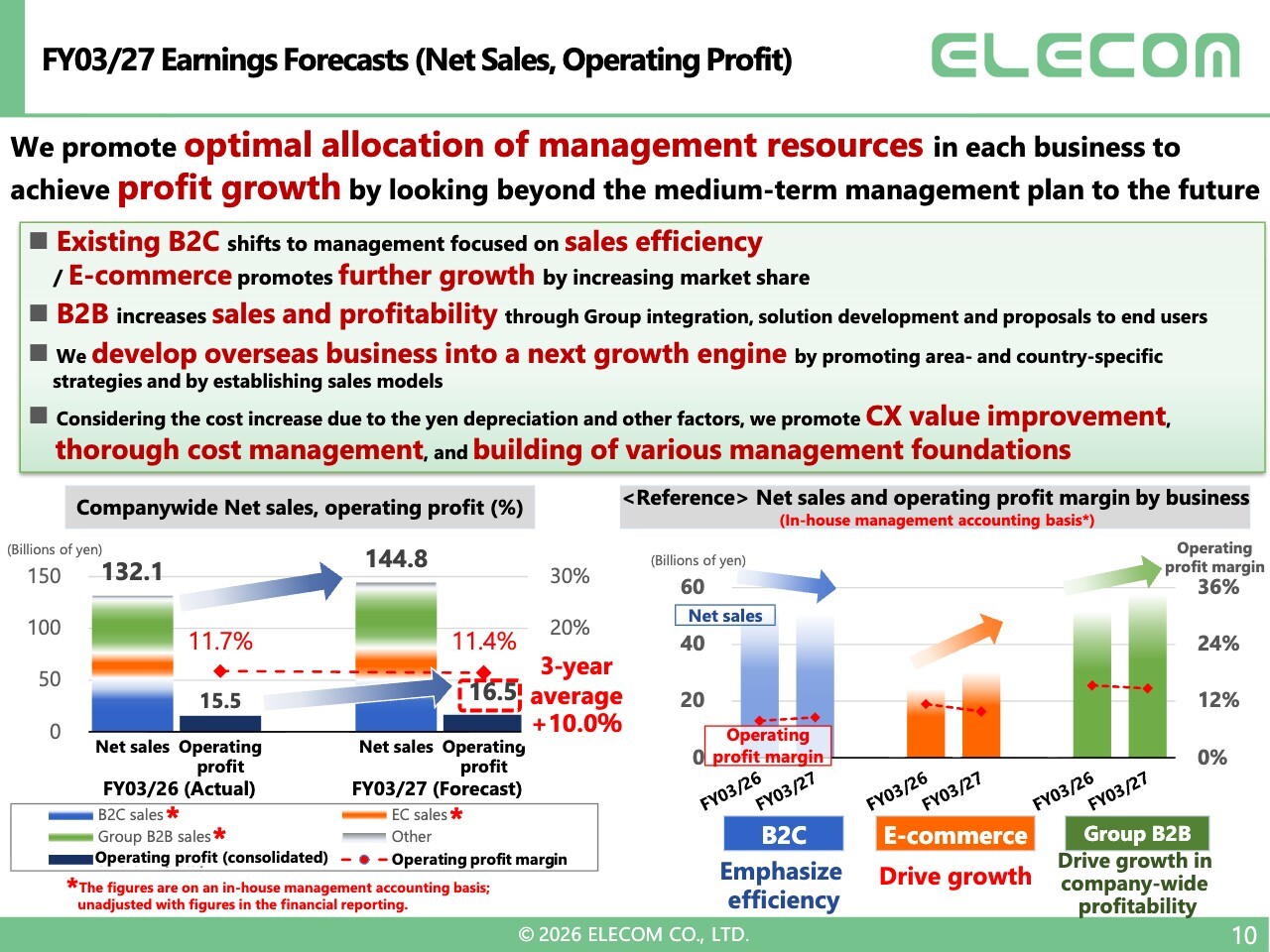
For the fiscal year ending March 2027, we expect company-wide net sales of 144,800 million yen, operating profit of 16,500 million yen, and an operating profit margin of 11.4%.
Looking at ELECOM on a non-consolidated basis, we have set an annual sales plan of just under 99% YoY for the mass retailers’ area, and around 125% YoY for the e-commerce area. In the B2B area, the group is planning an annual sales plan of approximately 113% YoY.
(Reference) FY03/27 Earnings Forecasts (YoY)
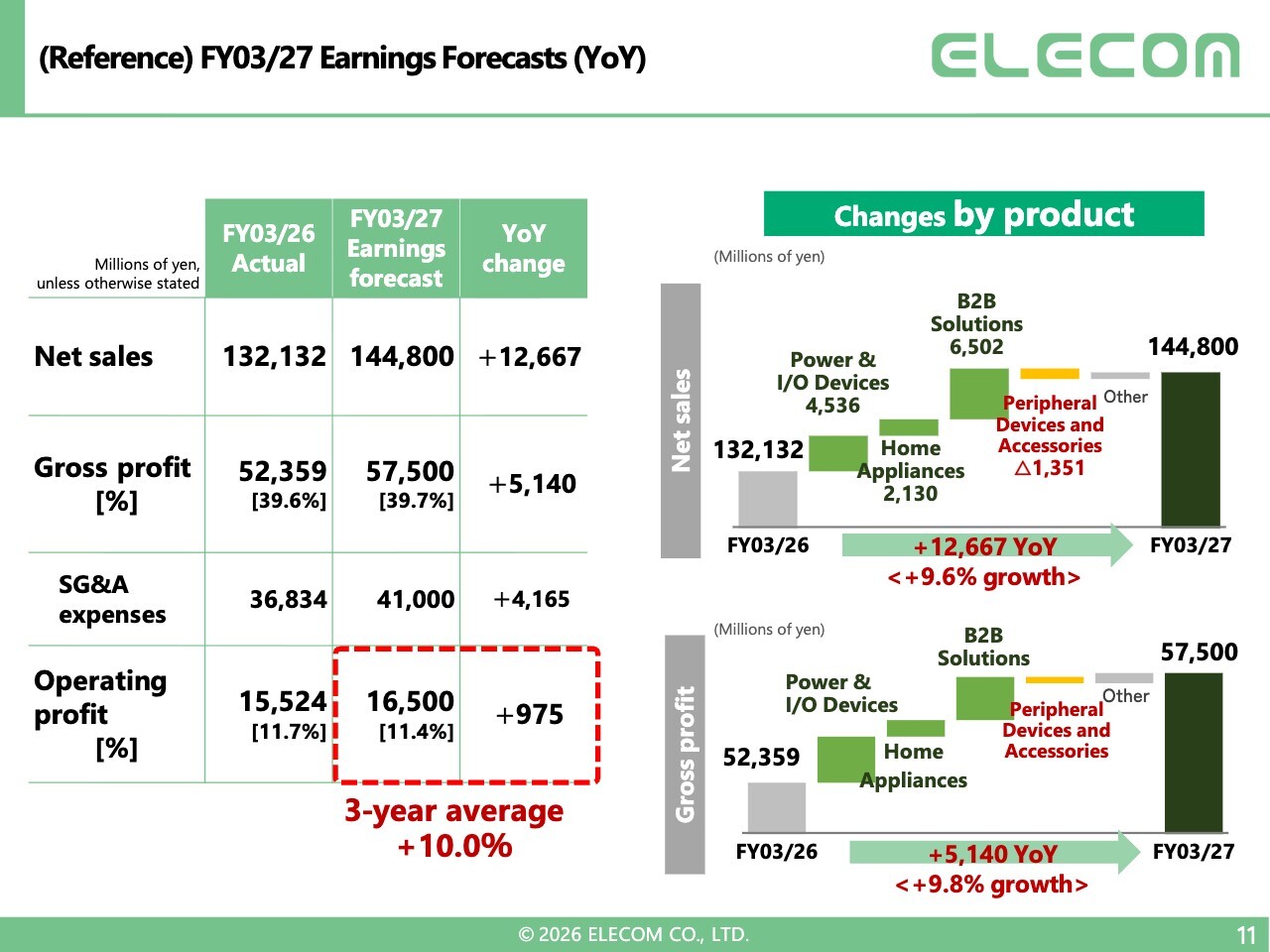
For reference, we have included the performance targets and the YoY changes. Yesterday, the M&A of TAMA ELECTRONICS INDUSTRY CORP. closed, but this earnings forecast does not include the company’s figures.
In terms of product categories, demand for power devices has grown very strongly, and competitors such as Anker also have a high share in the e-commerce field. Although our company has secured a large share in mass retailers, we want to aim for further expansion in the e-commerce field.
Also, as I have been saying, we are thoroughly working on turning B2B business into solution offerings, so it is important that we steadily deliver solid results in that area. In home appliances, we will continue, as we have up to now, to steadily expand the areas of hair beauty appliances and cooking appliances.
Through these initiatives, we aim for sales growth of 9.6% and believe we can maintain a level close to double-digit growth.
Key Initiatives for FY03/27 (1)
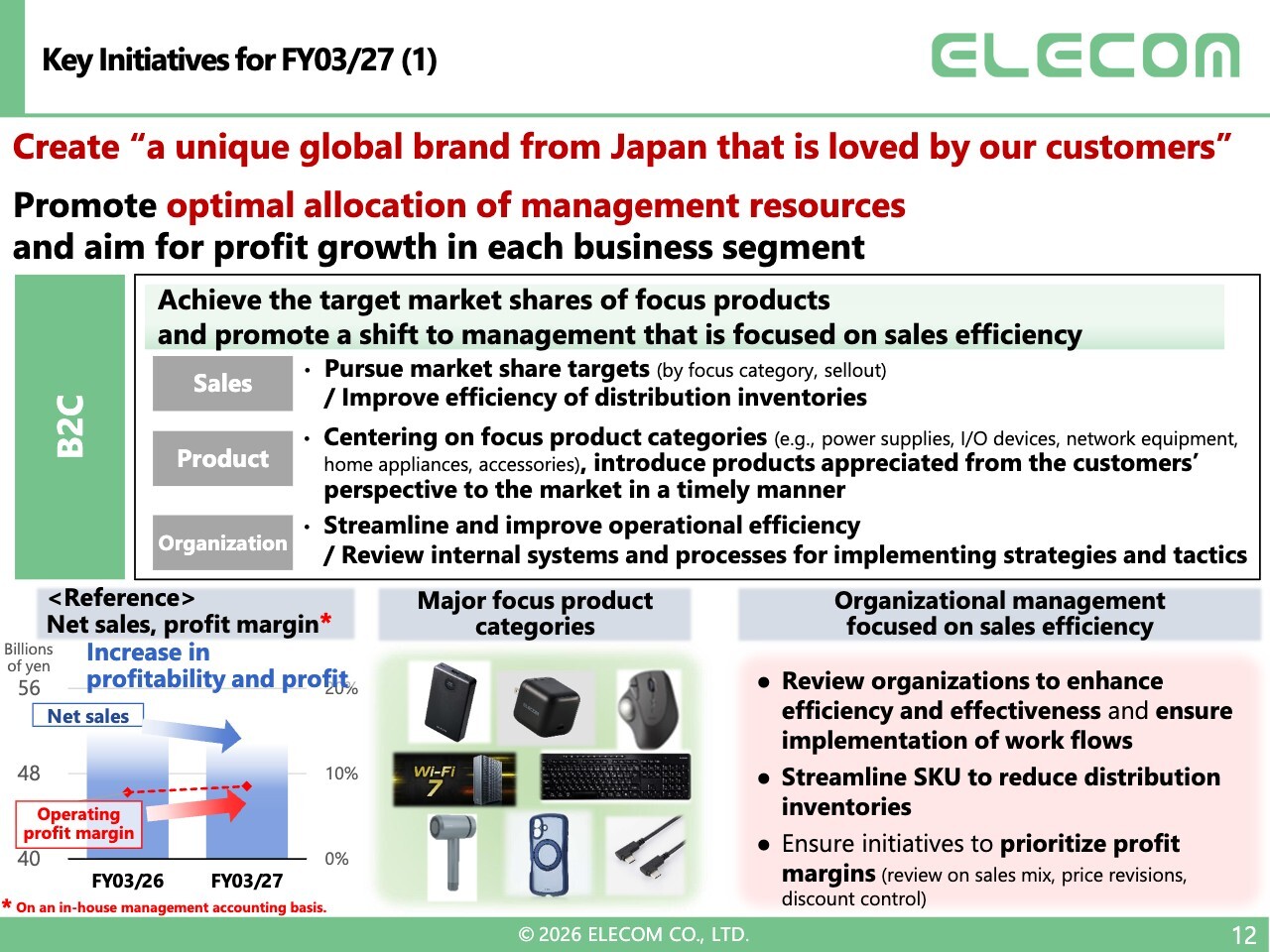
I will now explain our key initiatives for the fiscal year ending March 31, 2027. Some of them overlap with what I explained earlier, so I will focus on the key points.
It is true that B2C is our core business, and we will establish a business model that improves efficiency further and enhances profits.
And starting this year, we have finally been able to track operating profit for each business on a monthly basis. These figures are based on internal management accounting, but at this point, the expected operating profit margin is in the 8% range for mass retailers, the 9% range for e-commerce, and the 14% range for B2B.
Based on the figures visualized in this way, we can consider specific measures—for example, “How should the mass retail channel aim for an operating profit margin in the 9% range?”, “For e-commerce, let’s increase advertising investment further and go after share even if the operating profit margin is in the 8% range,” and “For B2B, let’s continue to deliver stable double-digit growth.” Based on these specific measures, we want to move the business forward.
Regarding mass retailers business, at present I am personally devoting about 60% to 70% of my resources and working on this thoroughly, and we will thoroughly scrutinize the sales processes and business processes, quantify them, and manage them accordingly. Also, because this is the area with the largest number of sales personnel, we will continue to promote efficiency improvements while aiming to steadily achieve our annual profit target.
Needless to say, while maintaining our existing share, we will proceed with tailored initiatives, particularly in areas where growth can be expected, such as power supplies, I/O devices that we are good at, and the network domain where we have not yet been able to gain share.
Key Initiatives for FY03/27 (2)
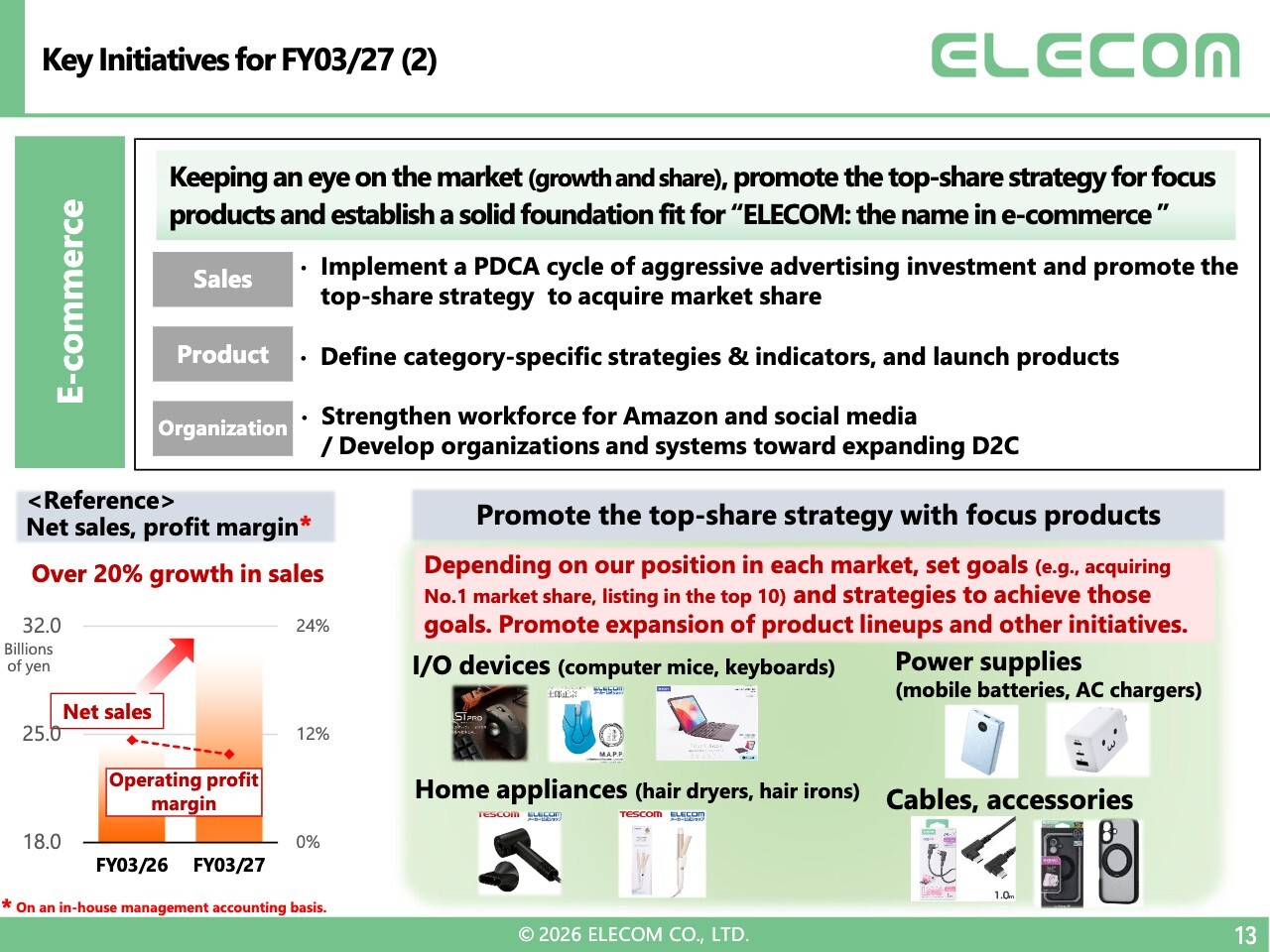
In e-commerce, approximately 65% of our e-commerce sales, and approximately 80% in sales to general consumers, come via Amazon. For that reason, we are placing particular emphasis on advertising initiatives on Amazon. We hold various meetings with Amazon and exchange a wide range of information with them.
Our current share in our major product categories is low overall, ranging from as low as 10%, and even in the higher categories, it has still not reached 30%.
Accordingly, in e-commerce, we plan to proactively roll out SNS initiatives and advertising on Amazon and also expand our D2C site.
Specifically, this includes I/O devices, power supplies, and cable accessories, and we are also taking a step further into the home appliances field, which is currently growing by more than 30%, and we will continue to strengthen our efforts in these areas.
Key Initiatives for FY03/27 (3)
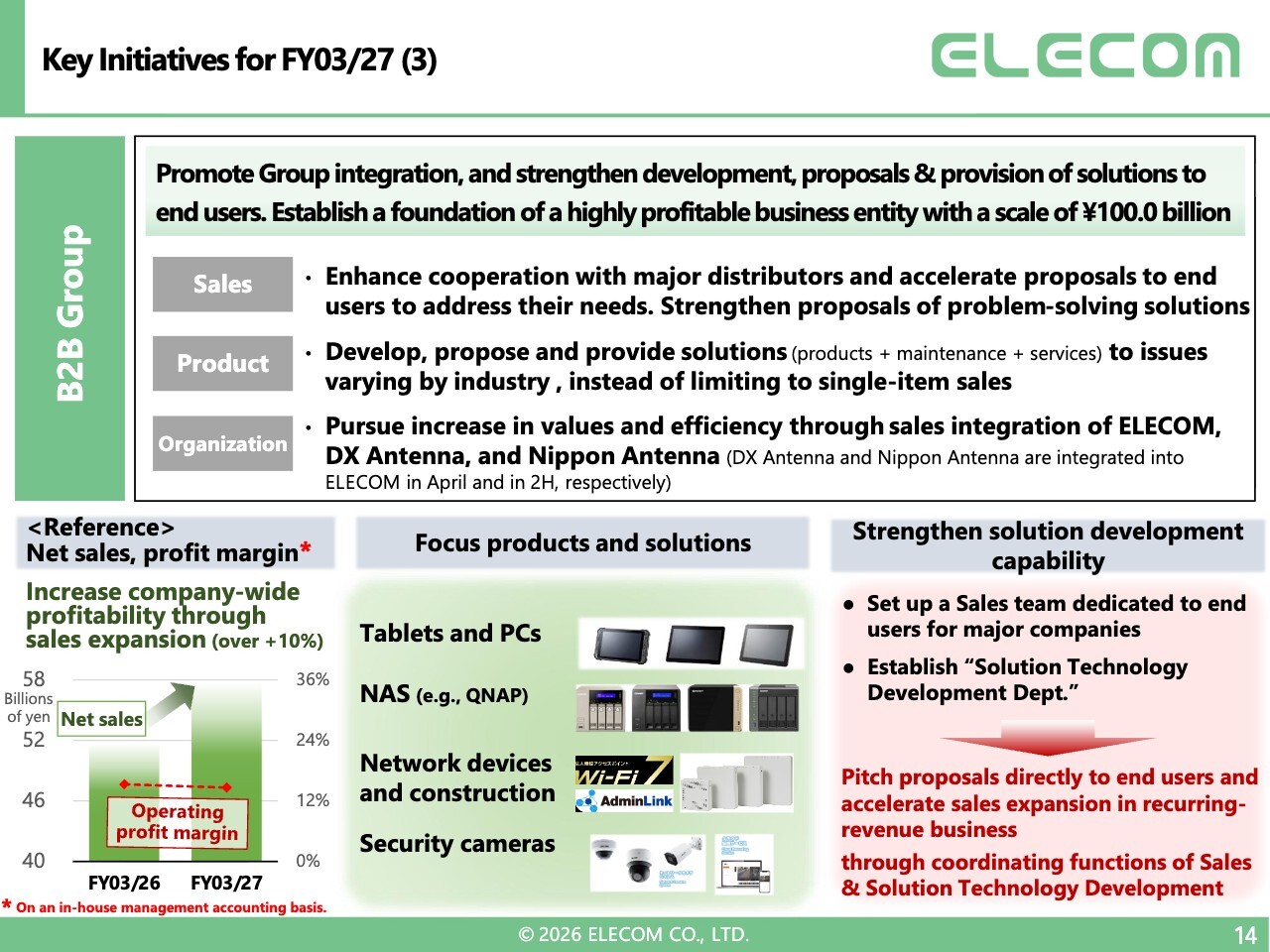
For the B2B group, including M&A, we plan to target 100,000 million yen over the three-year period of the next medium-term plan. This fiscal year’s sales budget for the group as a whole is on a scale of just under 60,000 million yen, but on a profit basis, more than half of ELECOM Group’s total is generated from B2B.
We believe that growing this area will lead to enhancing ELECOM’s value and to sustained growth. Our business structure and model are also steadily taking shape, and this business segment has become, along with e-commerce, the area where our direction is the easiest to see. Therefore, we aim to further strengthen this.
There have been no changes to the focus products and solutions since the last time. They are tablets, PCs, NAS, network installation work including the ‘groxi’ service, and security cameras. Because security cameras are sluggish, we will turn things around.
Also, as an important point, the DX Antenna sales organization was fully integrated into ELECOM effective April 1 of this year. Accordingly, we will work to consolidate our sales processes into a single process.
The productivity of ELECOM’s sales organization is 230 million yen sales per head, whereas the productivity of DX Antenna’s sales operations is currently 90 million yen per head. By bringing it closer to the level equivalent to ELECOM of 230 million yen over the next three years, we aim to translate this into higher net sales and profits.
In addition, we are currently overseeing Nippon Antenna’s sales organization within the same section, and we plan to fully integrate it in October of this year. After the integration, we plan to introduce ELECOM’s sales process.
At these two companies, we also obtained licenses for Salesforce and implemented it for our SFA (sales force automation), which has already been introduced at ELECOM. We will strengthen our response across the entire group, including the ELECOM sales team.
In addition, we have newly established one sales team, a branch office as a sales organization for end users. At this branch office, we plan to focus on end users and develop new accounts, and we will begin these activities from this fiscal year.
Key Initiatives for FY03/27 (4)
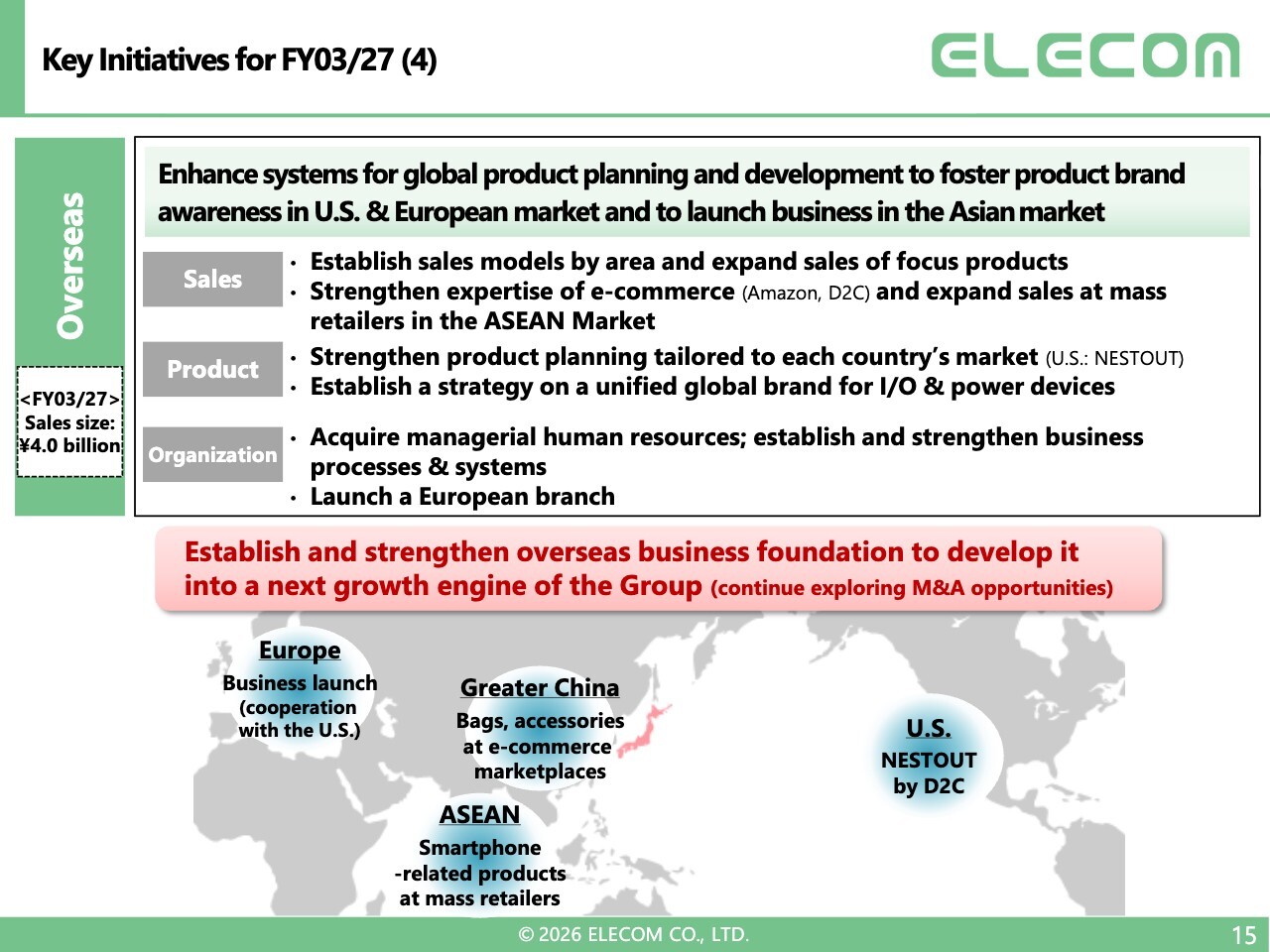
I will now explain our overseas business. The slide shows the overseas total sales budget, and our aim is for sales of 4,000 million yen, mainly in the European, U.S. and Asian markets.
In the United States, the NESTOUT brand has already been launched, and sales on the D2C site account for about 20% to 25% of the total. Our target for this fiscal year’s net sales in the U.S. is approximately 2,000 million yen. We will prioritize the expansion in the U.S and European markets and roll out the NESTOUT brand and I/O-related products such as the HUGE PLUS brand of high value-added mice, which are currently selling well.
Also, we plan to open the London branch by this August. From there, focusing primarily on Amazon, we will leverage our know-how from the U.S. to launch with the same content.
In the ASEAN region, with the cooperation of Nojima, Yamada Denki, and Best Denki, we will roll out in Malaysia, Singapore, and Indonesia—where we are currently conducting test marketing—using the mass retailers model.
In addition, we will focus on Greater China as a market where we can generate profits with relatively stable performance, and for overseas as a whole, we will increase sales by around 50%.
Overseas, we aim to achieve sales of 20,000 million yen to 30,000 million yen over the three-year period of the next medium-term plan. We are currently in the launch phase, but we have finally reached the stage where we have put in place the foundation—including the personnel needed to enter the market—that will enable us to move forward. Going forward, we will accelerate our efforts to develop products for overseas markets.
Key Initiatives for FY03/27 (5)
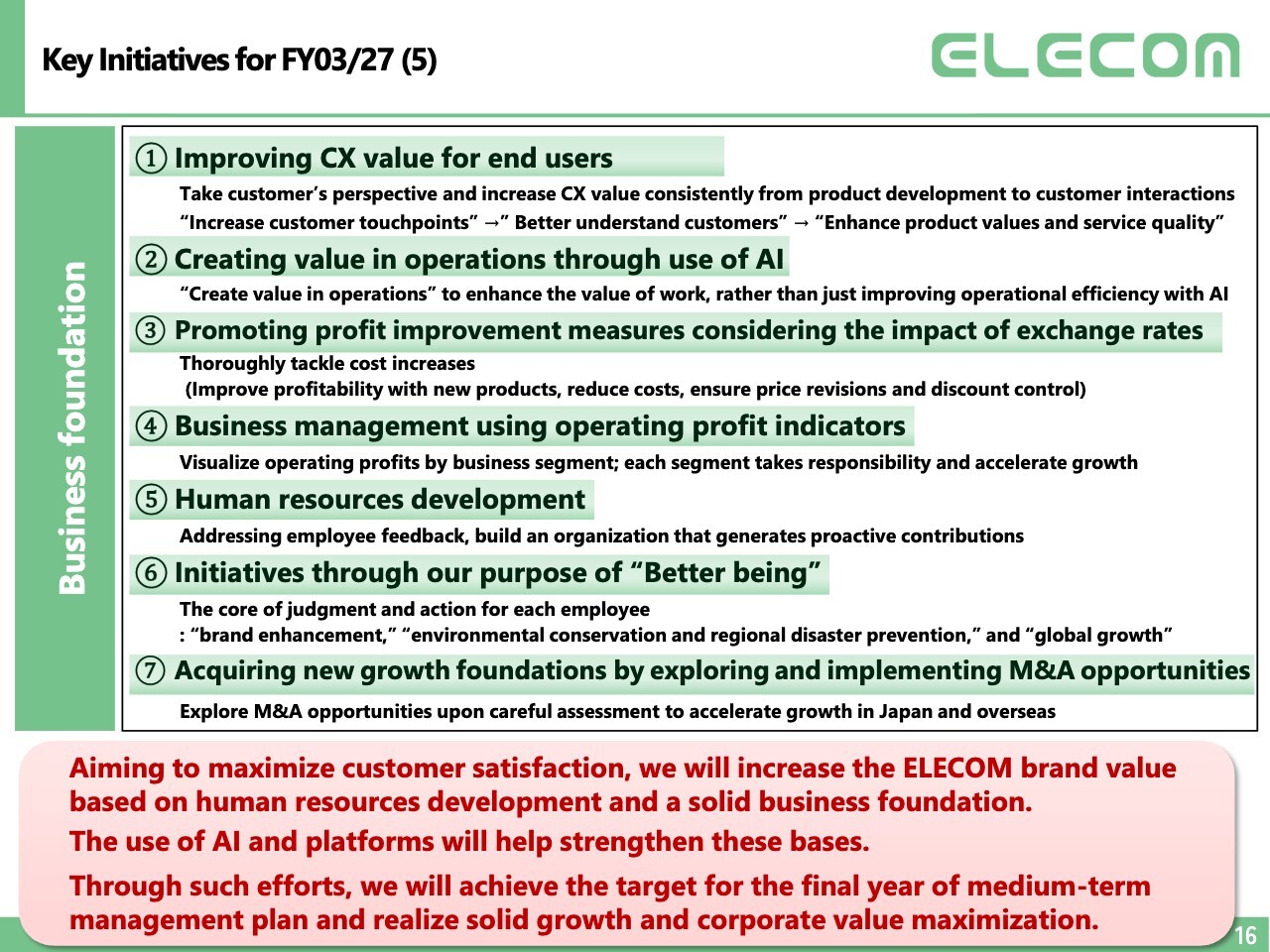
These are our key initiatives for strengthening our business foundation.
The first is to enhance the CX experience for end users. What I have continued to say is that, when our products reach end users, we need to properly quantify—point by point—the value of the customer experience and the lifetime value, and we need to enhance ELECOM’s brand value and the value of the product lifecycle.
Through quantifying those, we believe we must clearly identify exactly how much end users love our products and focus our efforts on the aspects they love most.
It may relate to the product’s design or quality, or it may relate to the quality of CS support after the product arrives. We address such matters as a whole by positioning them, in a broad sense, as the CX experience of customer touchpoints.
Second, this is about enhancing the value of our operations through the use of AI. With regard to AI, new employees are joining us one after another as we promote DX. What we are currently working on is to significantly reduce sales back-office operations and enhance value so that the sales team can focus more on sales activities. Because we have a particularly large number of sales departments, we are working to increase the value of our back-office operations.
Third, we will promote profit improvement measures while taking the foreign exchange impact into account. The foreign exchange impact for this fiscal year is 4,400 million yen. We have already allocated measures for the 4,400 million yen. This is based on an exchange rate of 160 yen per dollar.
Through measures such as price increases, price reductions, the launch of new products, and reductions in procurement costs, we were able to implement these initiatives appropriately in the previous fiscal year as well, and we were also able to generate profit. Taking these measures into account again this fiscal year, we plan to set an additional budget and respond accordingly.
The fourth item is management control using operating profit metrics. Up to now, the person in charge of each business has focused only on contribution margin and gross profit. However, I want to make operating profit by business segment visible, including the costs of quality control and development of new products which are directly tied to each person’s operations and SG&A expenses for the head office functions, and then provide training so that members of each business can view the business from that perspective.
The fifth item is human resources development. Here, developing management talent is particularly important. We are currently planning to strengthen management personnel for mass retailers business over a period of three to six months.
Also, starting around July this year, we plan to hold town hall meetings and, by deepening dialog with our employees, we aim to build momentum toward the next medium-term management plan.
The sixth item is our initiative carried out through our purpose, “Better being.” Through “Better being,” we want to reaffirm our company’s reason for being and increase the number of employees who can always keep that in mind, thereby enhancing our brand value.
The seventh item is the acquisition of a new growth platform through M&A evaluation and execution. Regarding M&A, we will continue to identify and evaluate targets on an opportunity basis, thereby building a foundation for growth.
We aim to reliably communicate ELECOM’s brand value while enhancing the satisfaction of customers, including end users, as well as our business partners’ customers.
I believe that systems are important in order to evolve the business. We will put in place systems to support our human resources and foster a culture that translates things into forms which can be analyzed quantitatively. Based on that, we intend to steadily achieve the target figures set for the third year of the current medium-term management plan. Thank you for your continued support.
FY03/26 Consolidated Results: Highlights
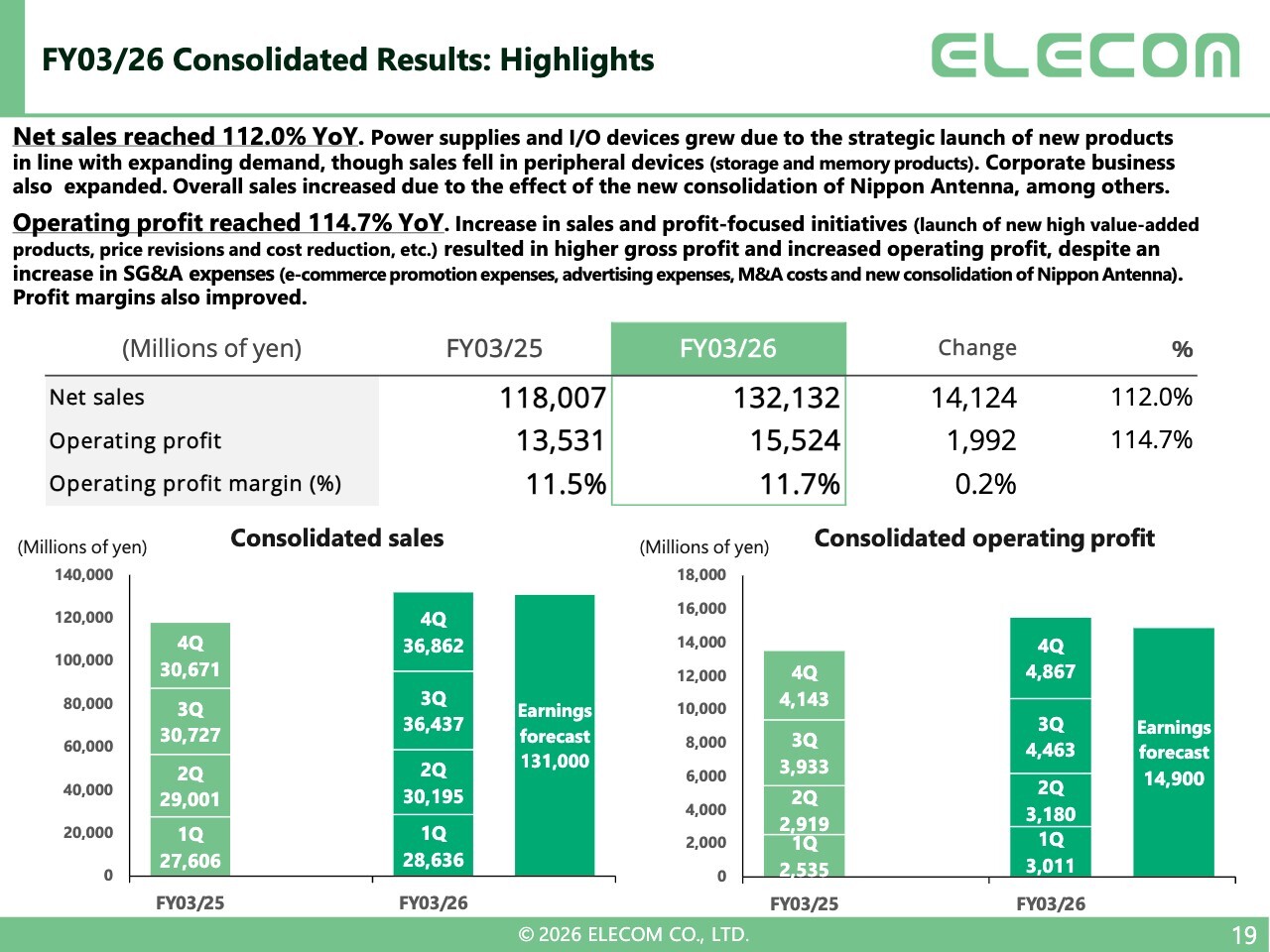
Masaki Tanaka (hereinafter, Tanaka): I am Tanaka, Director and Senior Managing Executive Officer. I will report on the results for the previous fiscal year and the forecasts for the current fiscal year.
As shown on the slide, net sales for the previous fiscal year were 132,132 million yen, up 12.0% YoY, marking growth of more than 10%.
Operating profit amounted to 15,524 million yen. This figure of 15,524 million yen exceeds 15,140 million yen for the fiscal year ended March 2021, which is the highest operating profit to date, and although it includes in part the impact of the change in accounting standards, we achieved the highest operating profit since our founding.
Meanwhile, net income for the period also exceeded 20,000 million yen due to the M&A of Nippon Antenna, and we believe the company achieved very strong results.
FY03/26 Consolidated Results: Earnings Summary
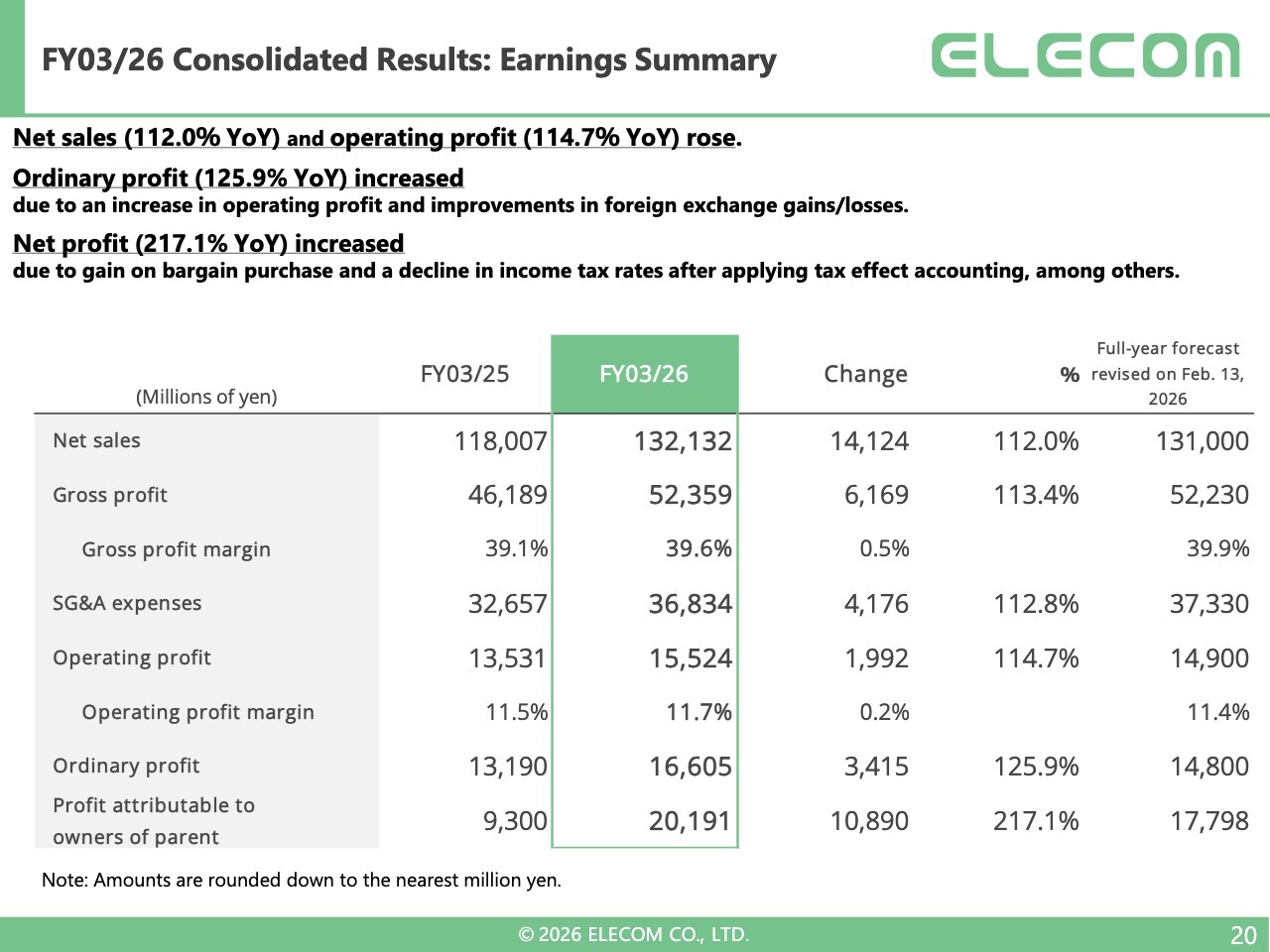
This is a breakdown of the financial results. In particular, since Nippon Antenna is included this time, I will briefly explain the impact.
On a sales basis, in the second half, sales of approximately 6,283 million yen from Nippon Antenna were added. On an operating profit basis as well, for the total of the second half, Nippon Antenna’s contribution to operating profit was approximately 810.14 million yen.
Compared with the previous fiscal year operating profit forecast of 14,900 million yen, excluding the impact of Nippon Antenna, we fell slightly short, but performance was generally in line with the forecast. For some of the figures in the corporate business that we had expected as of the end of March this year, there was a slight delay that shifted them to April and beyond in the current fiscal year, but we believe that, as results for the previous fiscal year, we were able to achieve them almost in full.
FY03/26 Consolidated Quarterly Trends
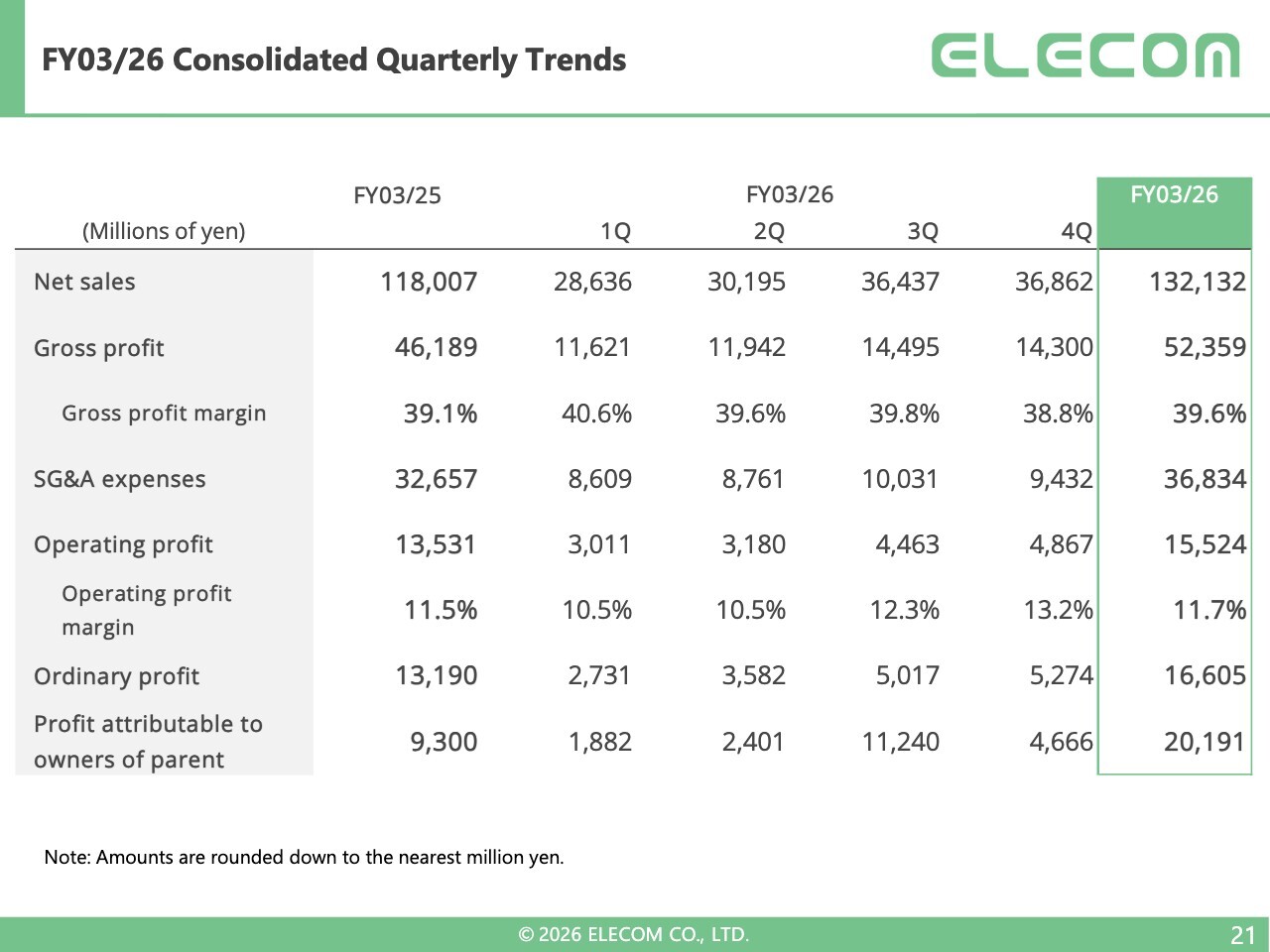
This shows the quarterly trend. Initially, when we disclosed the financial forecast, the figures were viewed as rather strong, and at one point the share price exceeded 2,000 yen. However, because the results for the first quarter and the second quarter fell short of expectations, there was apprehension as to whether we would really achieve an operating profit of 4,000 million yen or more in both the third and the fourth quarters, and the share price was sluggish for a period. However, the result was that in the third quarter we achieved figures that were very close to the plan, and for the fourth quarter we were able to finish with results that exceeded the plan.
FY03/26 Consolidated Results by Product (YoY)
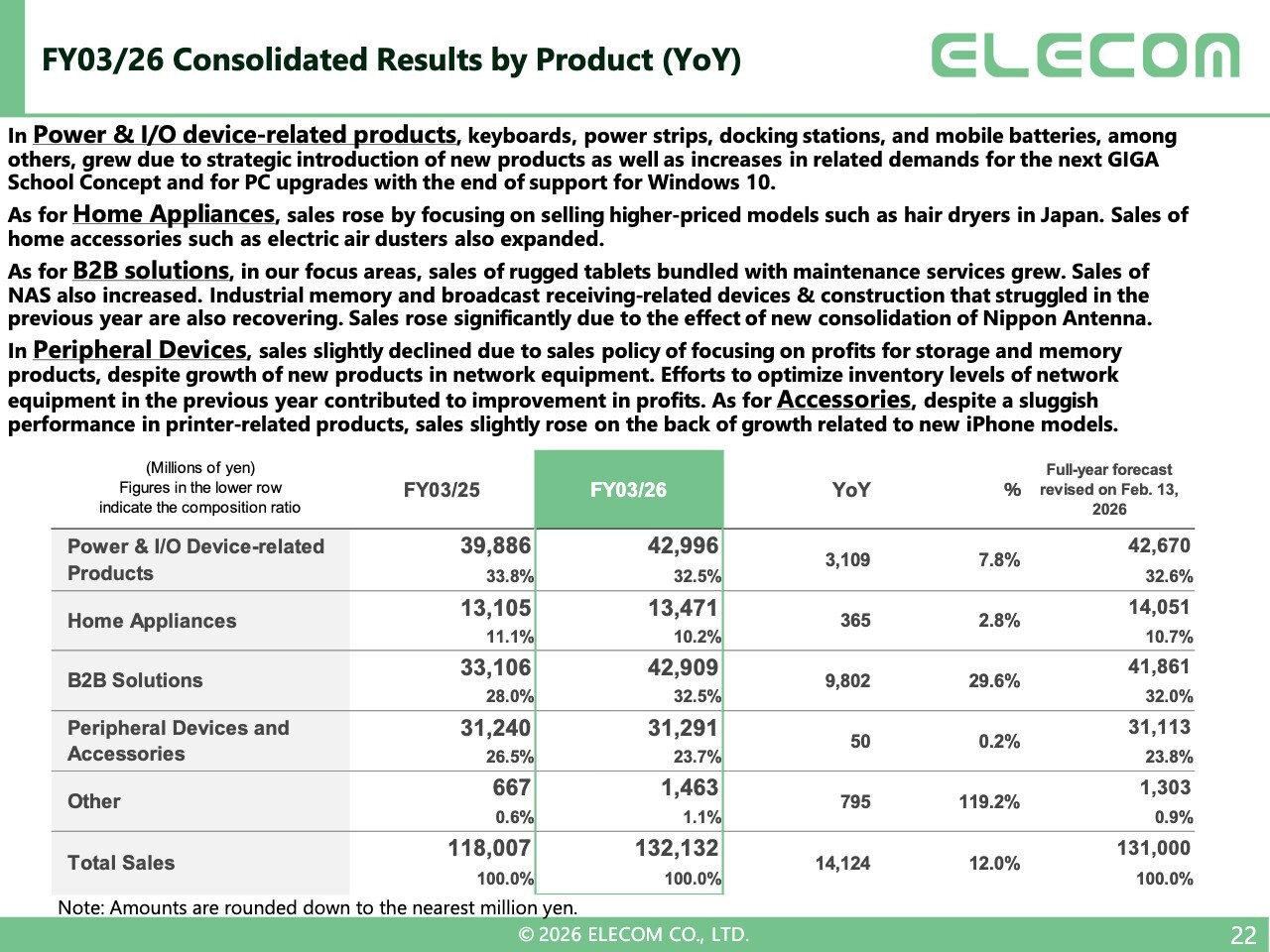
These are the results by product. In the previous period, we posted fairly strong results, but there were areas where we fell short of our initial targets.
In home appliances, we recognize that one major factor behind the sales shortfall was that, in Tescom’s area, very few new products related to cooking appliances were launched. In B2B solutions, although new surveillance camera products were released, issues such as defects had an impact, and we were unable to achieve the figures we had assumed, which we also recognize as a major factor behind the sales shortfall.
While each figure is higher YoY, we should reflect on the fact that we had set our initial targets considerably high. However, in each area, the figures are up YoY.
FY03/26 Consolidated Results Summary by Product
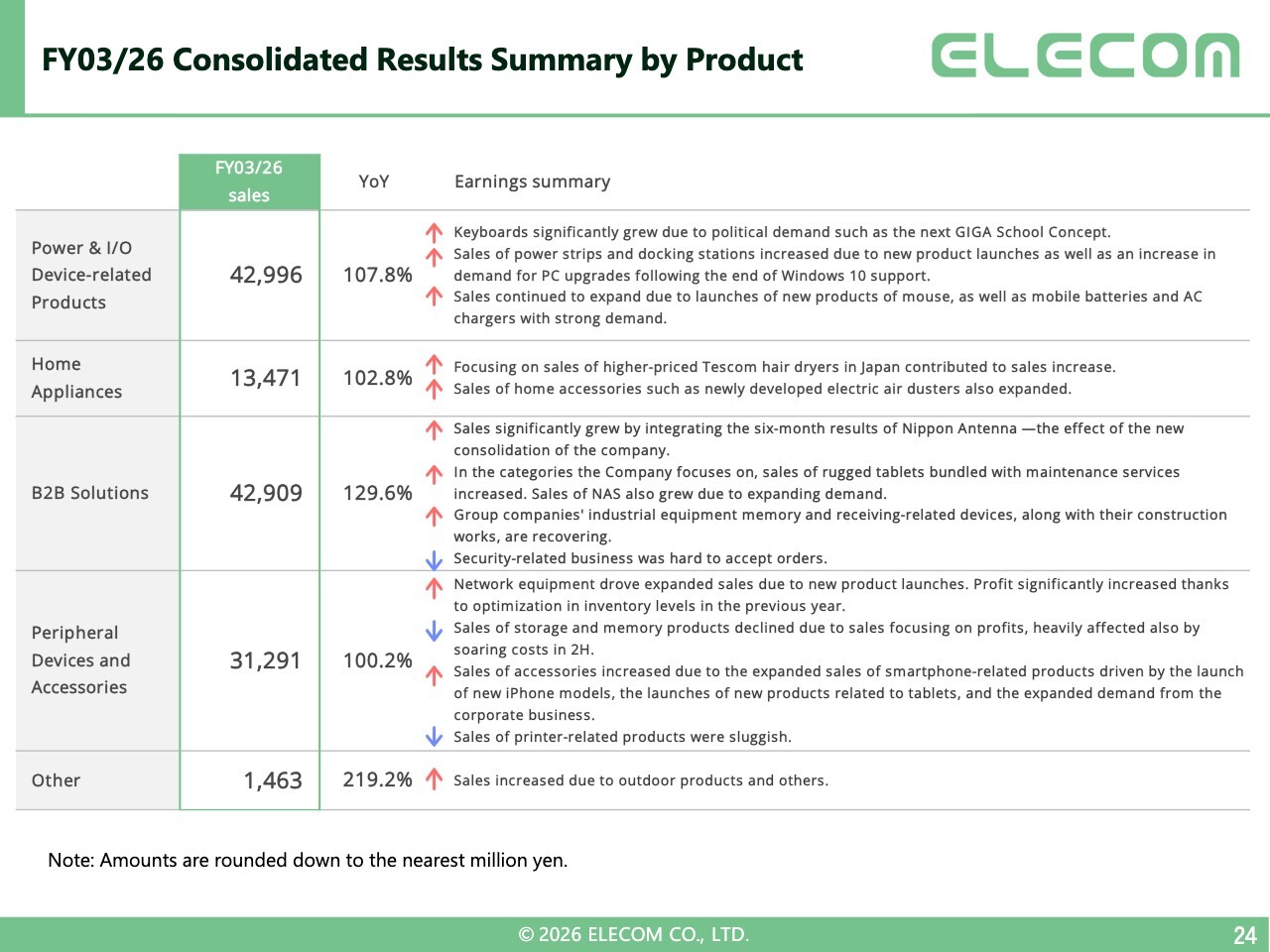
This is an overview of sales by product. Power & I/O devices increased by 7.8% YoY, but from a market perspective, I think it could have grown a bit more.
Although home appliances increased compared with the previous period, they fell short of the initial targets. This fiscal year, we plan to move forward with our response based on those lessons learned.
B2B solutions were impacted by factors such as GIGA School, but even excluding this, it grew steadily. The operating profit margin for B2B as a whole is higher than those of B2C and e-commerce.
From this fiscal year, on an internal management accounting basis, each business division—B2C of physical stores, e-commerce, and B2B—will manage performance through operating profit. For this reason, in the next medium-term management plan’s three-year plan, we want to be able to explain operating profit by these segments as well.
Looking ahead, as B2B expands, we expect changes in the operating profit margin, and ultimately, of course, EPS to rise. In addition, if in the future the PER returns to 20x or higher as it was in the past, we believe the corporate value will also change significantly.
FY03/26 Consolidated Results: Operating Profit (YoY)
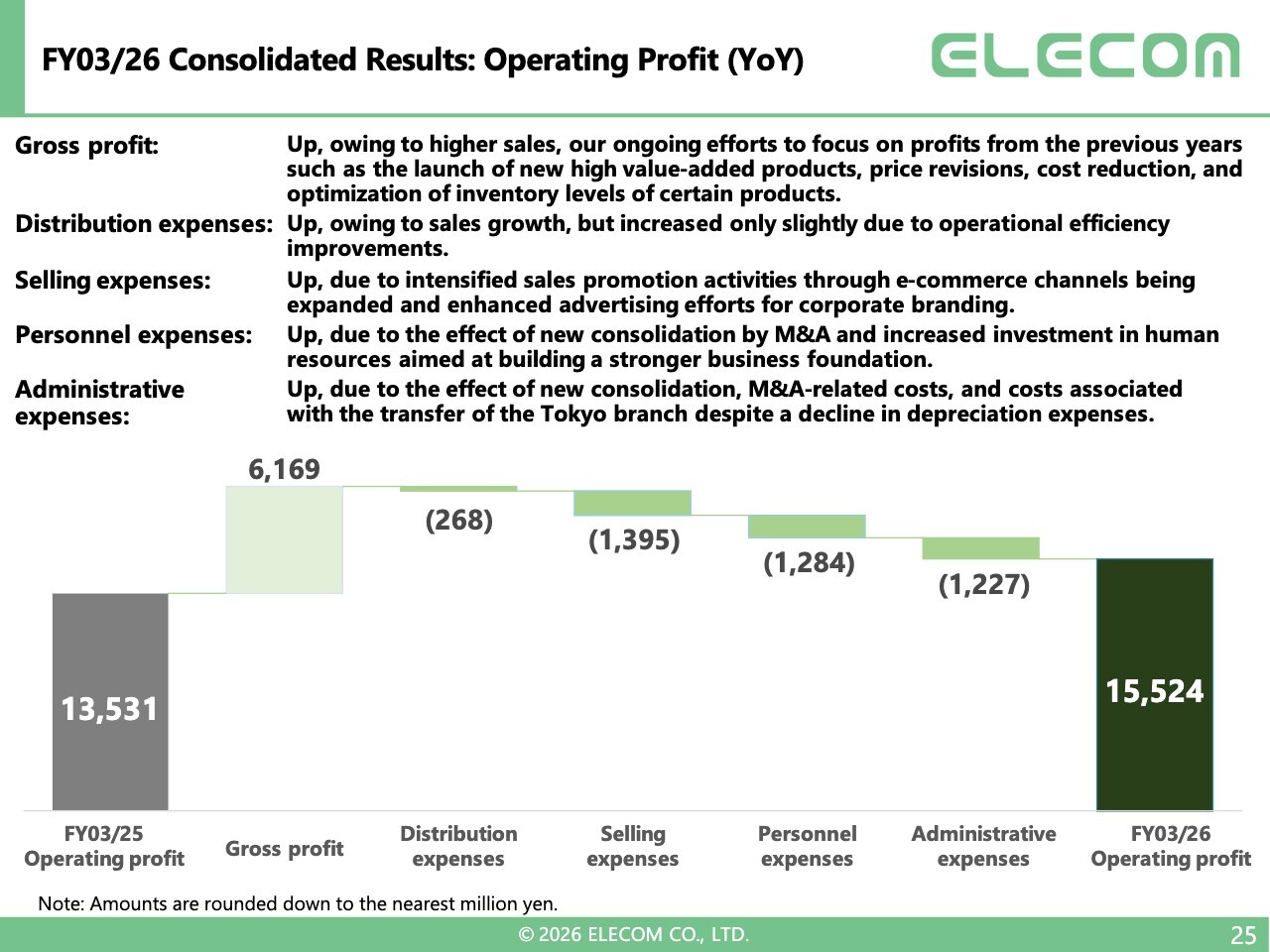
This slide shows the contributions to the increase in operating profit. This waterfall graph shows the change from 13,531 million yen in the period before last to 15,524 million yen in the previous period.
FY03/26 Consolidated Results by Channel
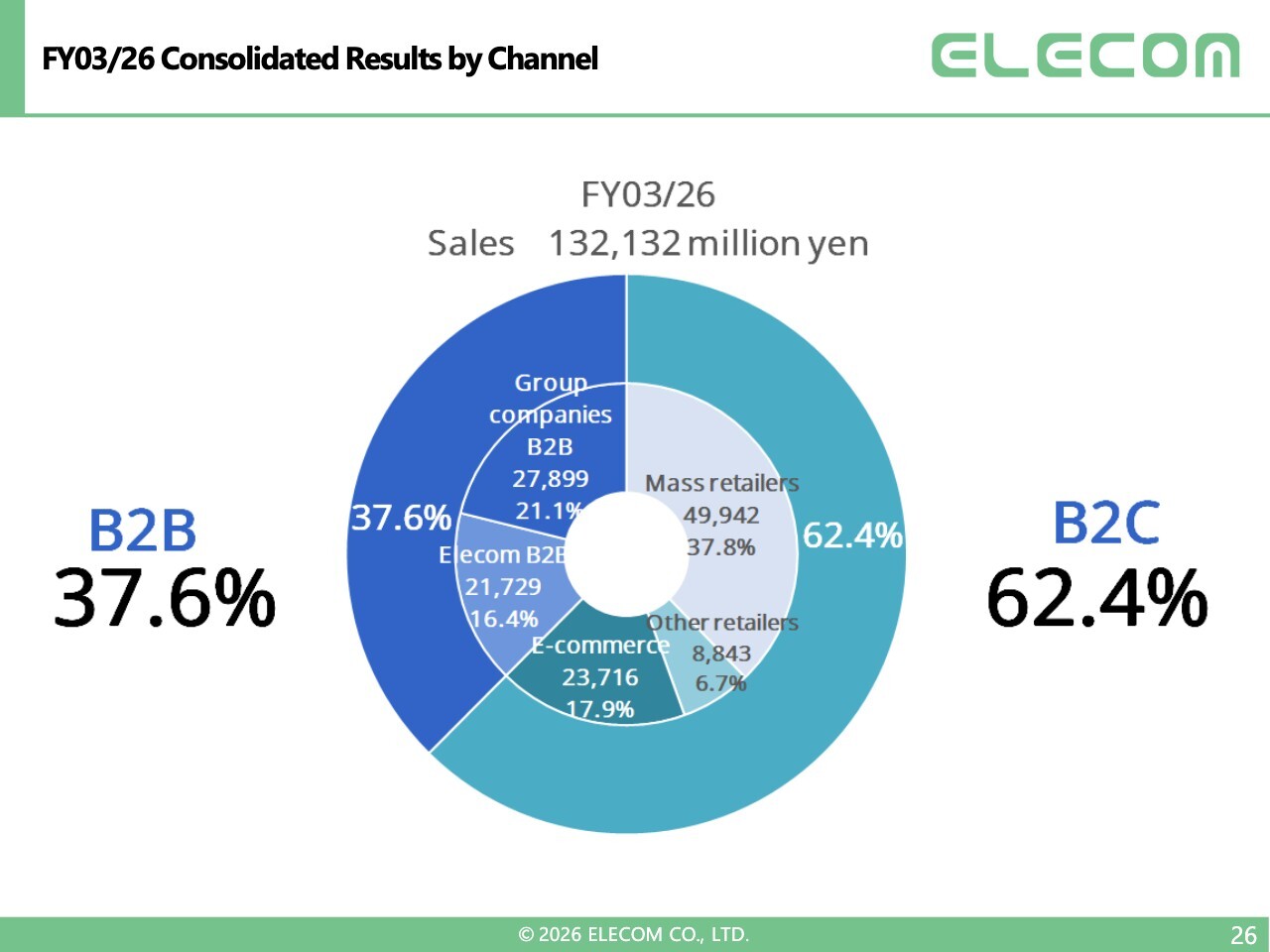
This is the status by channel. In the past, we sold PC-related and smartphone-related products through consumer electronics mass retailers, and there was a time when B2C accounted for 100%.
Looking ahead, we plan to increase our stock business. For that reason, we have been focusing on the B2B business, and while it has not yet reached 40%, it has grown to 37.6%. We expect that this ratio will reverse relative to B2C in the future, leading to an improvement in the profit margin.
Meanwhile, for e-commerce, although the figures used to be very small in the past, on a sales basis it has reached 23,716 million yen, and has risen to 17.9%.
There is some cannibalization between physical stores and e-commerce, but conversely, for e-commerce, we assume that the operating profit margin will exceed that of physical stores. This is related to the fact that labor costs are not required to the same extent.
Also, regarding this fiscal year’s figures, because some distinctive trends can be seen in profit margins, I will explain them later.
Consolidated Sales Trends by Channel
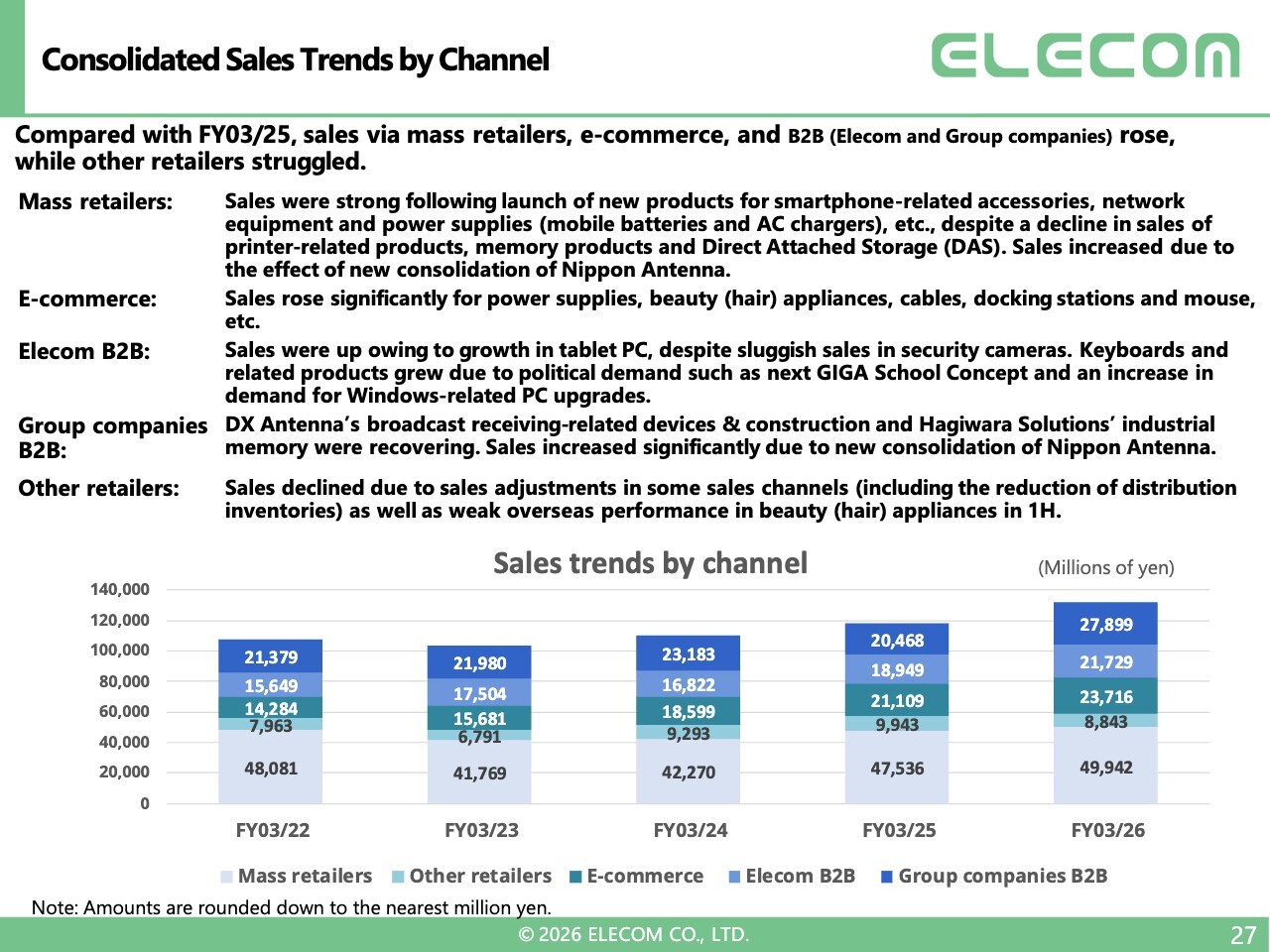
This shows the trends in sales by channel.
FY03/26 Consolidated Quarterly Sales Trends by Channel
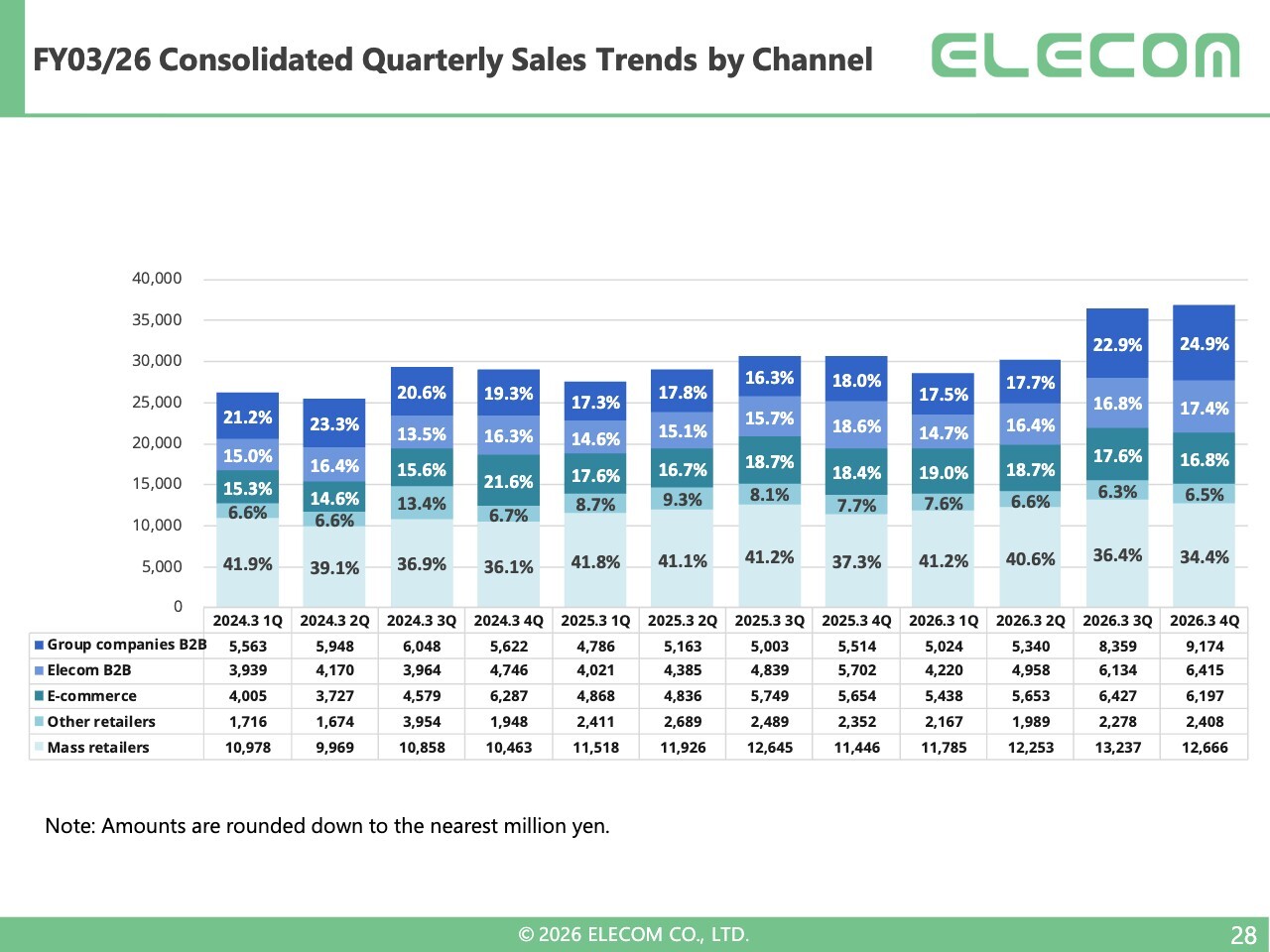
This shows the quarterly trends in sales by channel.
FY03/26 Consolidated Balance Sheet
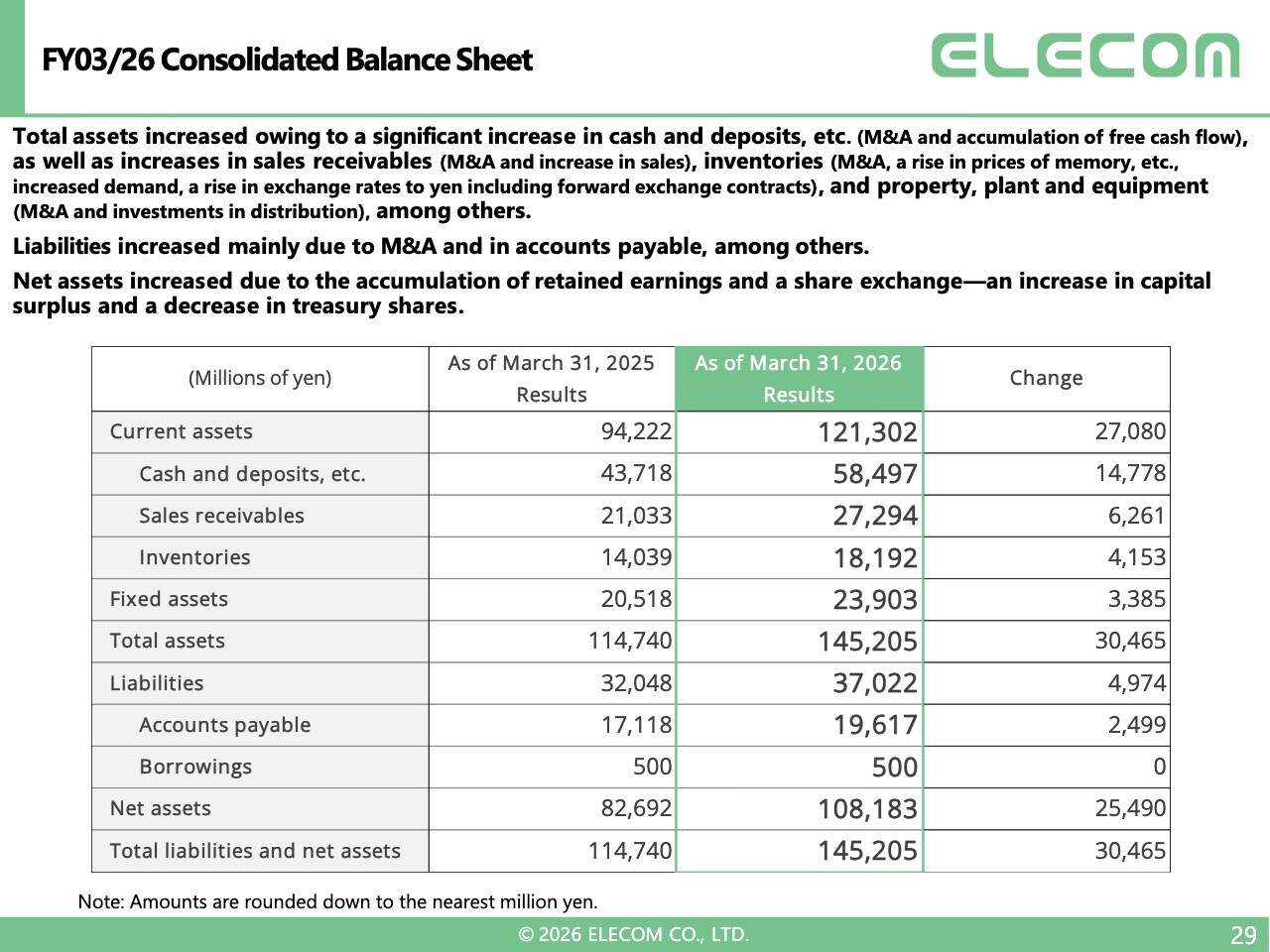
Regarding the balance sheet, total assets have increased due to M&A and other factors, but there have been no major changes. However, while ROE was once as high as 24 percent, it has been on a downward trend partly due to increases in cash on hand and shareholder equity. This time, ROE appears high due to the gain on bargain purchase related to Nippon Antenna, but excluding that impact, there is still room for improvement in ROE and capital efficiency.
We recognize that there are still areas where we have not been able to fully utilize our cash on hand for future investments, and we will continue to consider how to address this issue.
Looking at the specific figures, we have effective cash on hand of approximately 70,000 million yen. After allowing for some buffer, we estimate cash as the necessary working capital to be about 35,000 million yen.
We have surplus funds of approximately 35,000 million yen, and we expect a decrease of approximately 10,000 million yen, including TAMA ELECTRONICS INDUSTRY CORP. joining the group in the first quarter of this fiscal year. As a result, approximately 25,000 million yen has become funds available for use in future investments in development and human resources, as well as investments in M&A.
How we make use of these funds to drive higher net sales and profit in the future is a point that is attracting a great deal of attention from investors in Japan and overseas. I believe it would be good if we can put this into action.
At this point, there has been no specific progress. We are considering a range of potential M&A targets, but due to price negotiations with the other party and other circumstances, we have not yet reached the point of taking any concrete action at this time.
FY03/26 Consolidated Cash Flow
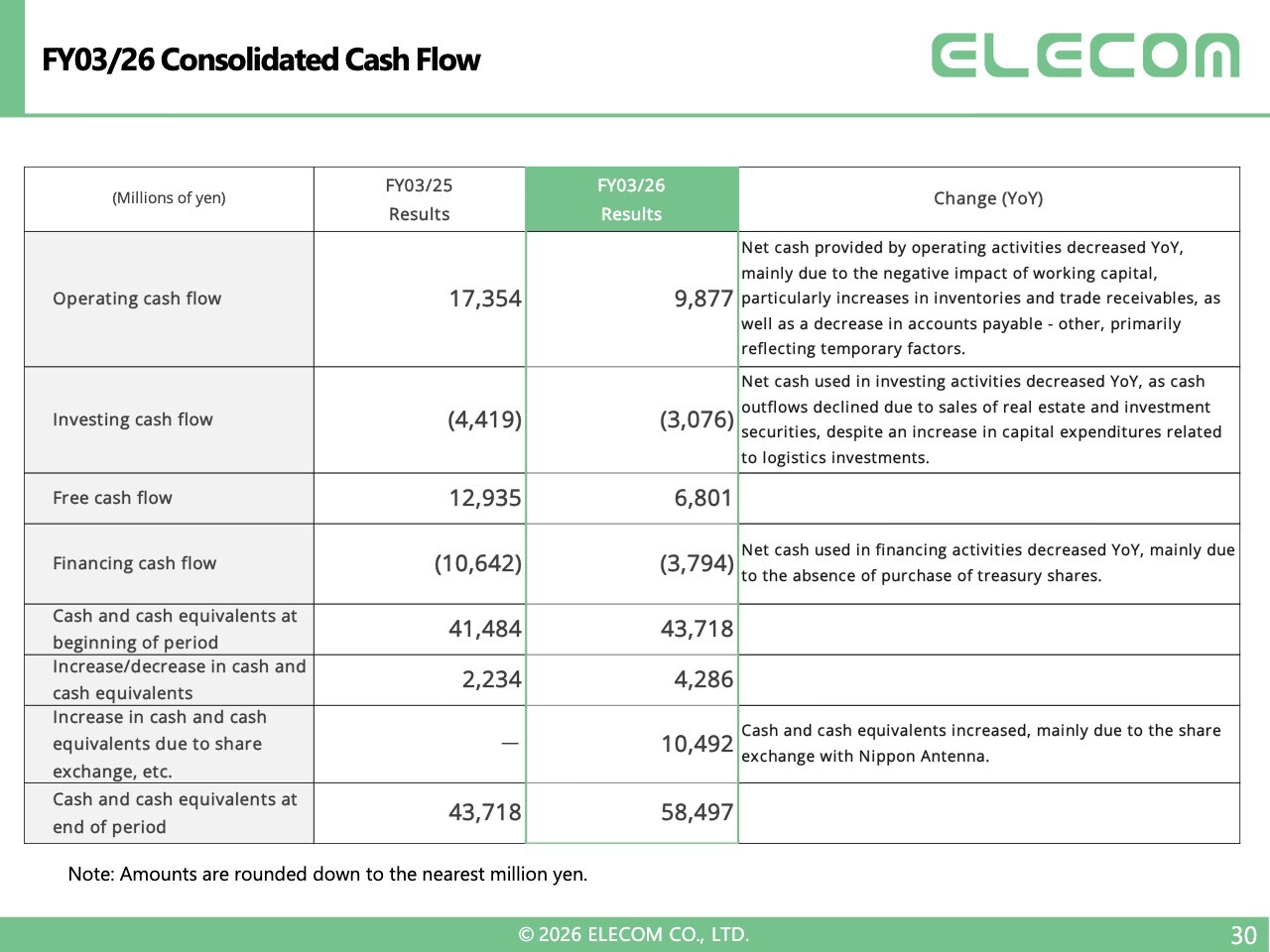
Regarding cash flow, the relationship between the turnover periods of accounts receivable and accounts payable has not changed significantly from before, and this remains the case. As sales continue to grow, that relationship also continues to result in an increase in cash on hand.
FY03/26 Consolidated Results:
Investment in Non-Current Assets and Depreciation
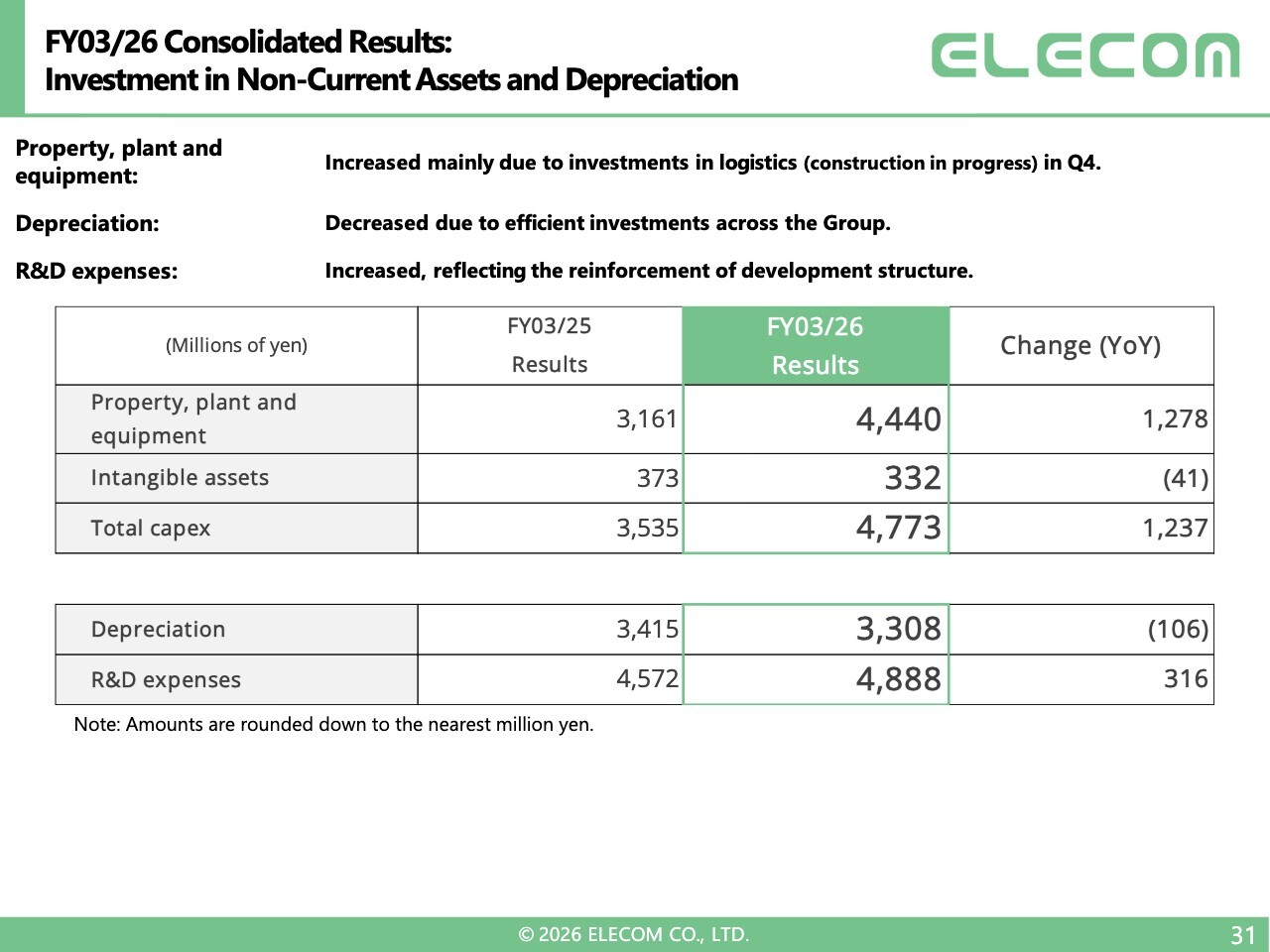
Regarding investment, there were no major investments other than M&A, but investment in tangible fixed assets increased due to investments including the Kanagawa logistics center. Meanwhile, depreciation expenses decreased compared with the previous period due to efficient investments across the entire group. Past investments related to logistics have also led to operational efficiency, and as a result, our logistics costs continue to be kept down.
FY03/26 Consolidated Results and Trends
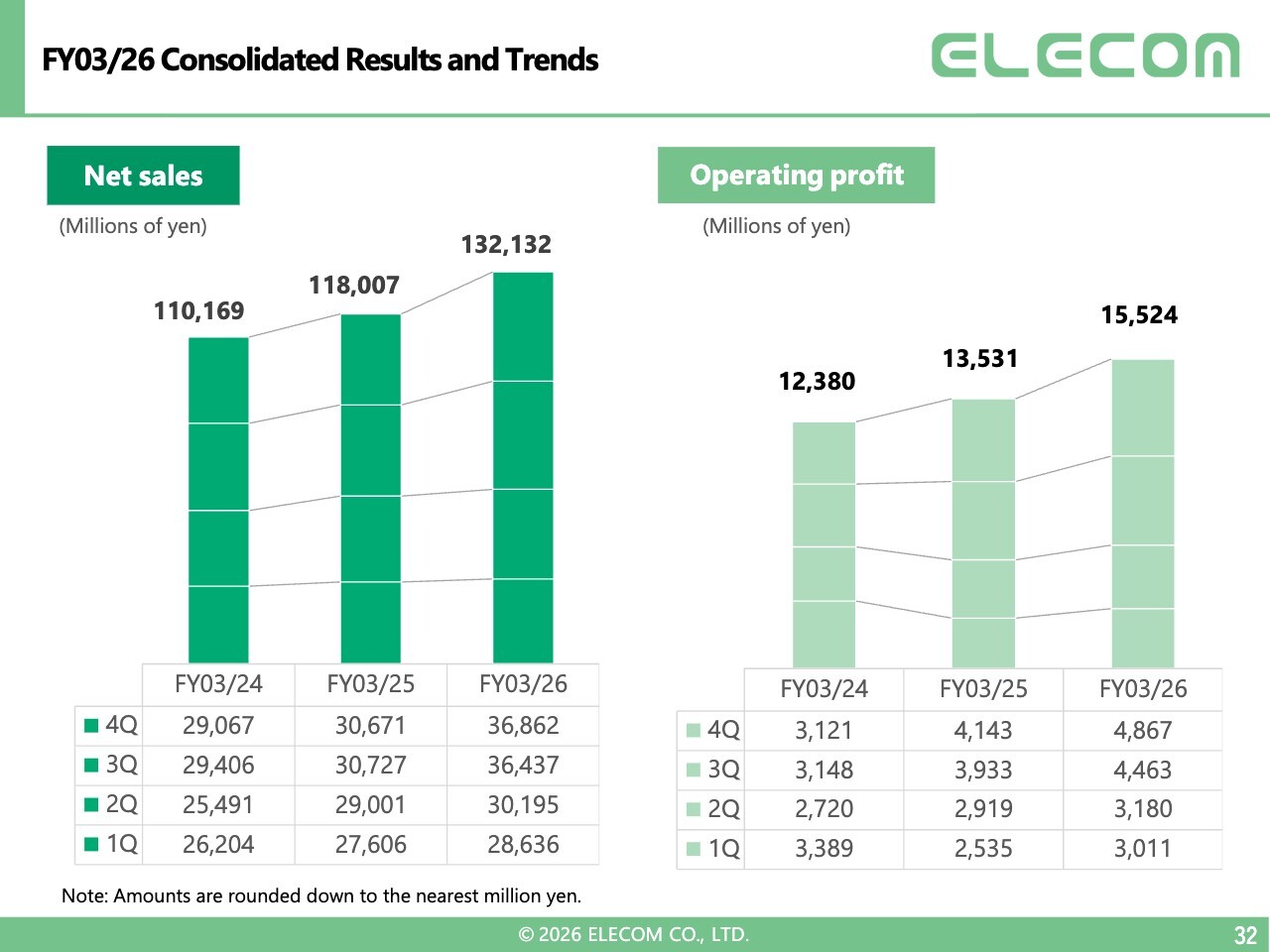
This shows the trends in the consolidated financial results.
FY03/27 Consolidated Earnings Forecast Summary
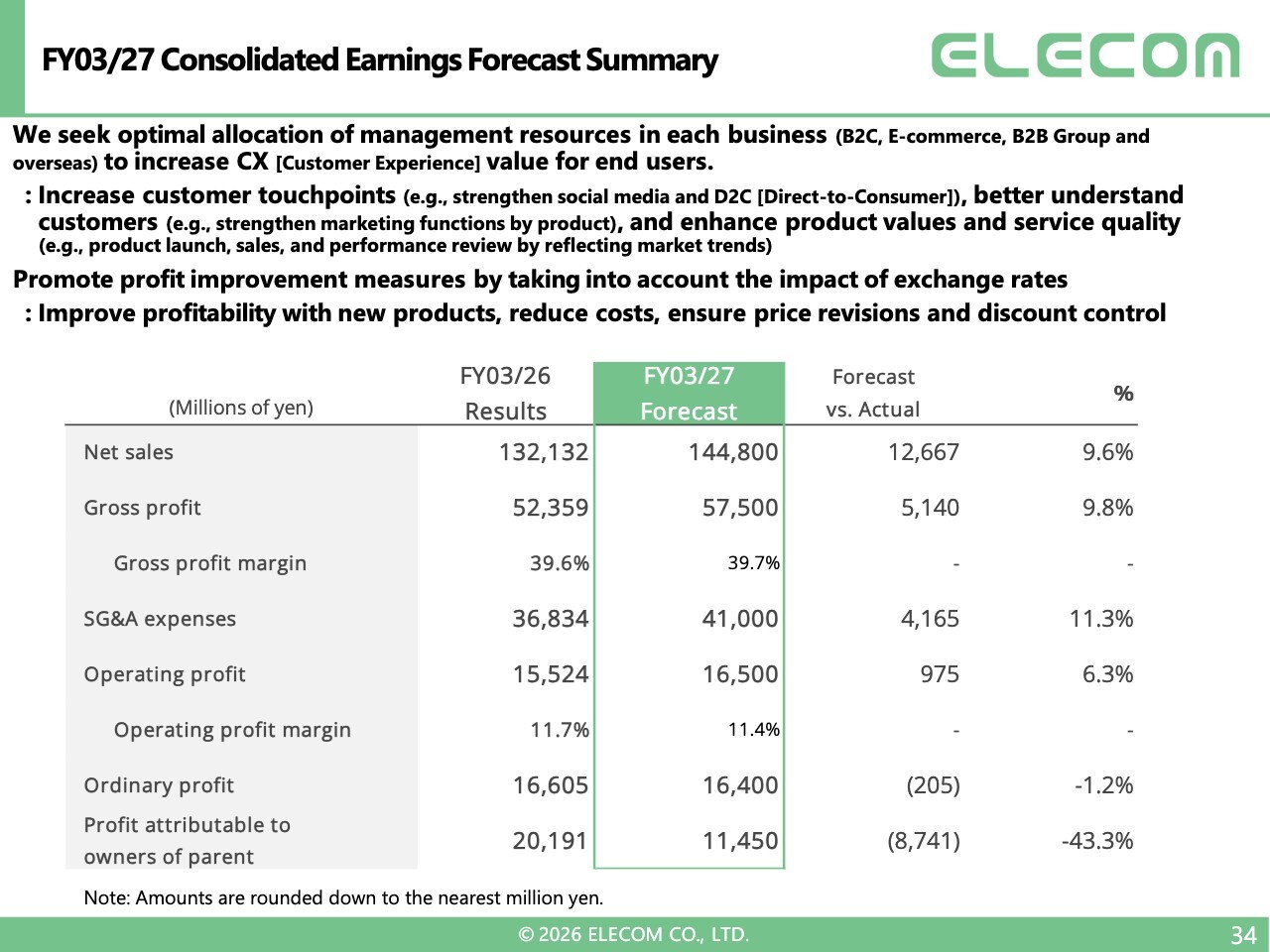
From here, I will talk about the earnings forecast for the fiscal year ending March 2027. We expect net sales of 144,800 million yen for this fiscal year, and we aim for an increase of 12,667 million yen YoY.
Our target of an operating profit is 16,500 million yen for this fiscal year. This 16,500 million yen was set using, as one benchmark, an operating profit growth rate with a three-year average of 10% or more as the target that we committed to all of you as investors in our medium-term management plan.
If we achieve this 16,500 million yen, it will also lead to realizing the numerical target for operating profit in the medium-term management plan. The figures here do not include those for TAMA ELECTRONICS INDUSTRY CORP.
For TAMA ELECTRONICS INDUSTRY CORP., no amounts were recorded in the first quarter, and for this fiscal year, we expect its contribution to net sales and profit to come from three quarters’ worth of results. The contribution for these three quarters is expected to be around 5,000 million yen to 6,000 million yen in sales.
As for operating profit, this M&A is not a business turnaround type. Rather, it is one in which we have made a company that is generating solid profits a group company. However, because there are impacts such as amortization of goodwill, we expect that, excluding synergy effects, it will not yet contribute to operating profit. We group it based on a price range that allows for the amortization of goodwill over a period of 4 to 5 years.
By adding our synergies to this, we believe it will further shorten the payback period and could potentially turn positive at the operating profit level even on a single-year basis.
With the inclusion of TAMA ELECTRONICS INDUSTRY CORP. into our group, we previously did not have a channel for convenience stores, but a key point of this integration is that it will newly allow us to acquire a convenience store channel.
In addition, TAMA ELECTRONICS INDUSTRY CORP. has two factories in China. By making use of our two plants in Suzhou and Dongguan, we also believe this could potentially help contribute to cost reductions.
In particular, in channels such as convenience stores and home improvement centers, we still have some weaker areas. With TAMA ELECTRONICS INDUSTRY CORP. joining us, there is the potential to strengthen channels such as convenience stores, home centers, and drugstores.
Looking ahead, while we do not yet have any specific plans, I hope we can aim for an approach like Fast Retailing’s, where brands such as GU and UNIQLO are used differently depending on the situation. This is my personal opinion.
We have not included TAMA ELECTRONICS INDUSTRY CORP.’s figures in our earnings forecast, but this portion is around 5,000 million yen to 6,000 million yen in net sales, and since it does not account for a large share of total net sales, we are considering not making an upward revision to our net sales forecast.
Based on those assumptions, we have built the earnings forecast as shown on the slide. Because the cable-related field has been becoming somewhat weaker for us, we believe that with TAMA ELECTRONICS INDUSTRY CORP. joining us, we will be able to reinforce this field.
In particular, I believe there are three key points in the budget for the next fiscal year.
First, I will address the foreign exchange issue that everyone is concerned about. Second, I will talk about semiconductors. Third, I will explain the increase in selling, general and administrative expenses. I believe you are particularly concerned about these three points.
Regarding semiconductor-related items, while future trends are unclear, in this fiscal year’s forecast we have reduced it by 3,000 million yen in terms of sales versus the previous fiscal year’s results. One factor is that, while purchase unit prices are rising, if we sell as is, we are in a situation where we cannot secure a sufficient profit margin. We plan to move forward while appropriately keeping this under control.
Next, I will go into a bit more detail about foreign exchange. Since I did not explain the exchange rates for the previous fiscal year, let me look back starting from the fiscal year before last.
The foreign exchange settlement rate including forward contracts in the fiscal year before the previous fiscal year was 136.20 yen. In the previous year, it was 142.92 yen, and a depreciation of the yen by 6.72 yen pushed up cost of sales. Total purchases were $455 million, and due to the weaker yen, approximately 3,059 million yen was added to cost of sales. After making these adjustments, we achieved the previous fiscal year’s figures.
For this fiscal year, we have formulated our plan based on the assumption that the exchange rate will remain at around 160 yen.
For this fiscal year, assuming a market rate of 160 yen, the expected settlement rate including forward contracts would be 152.13 yen, and we expect costs to rise by 9.21 yen compared with the previous fiscal year.
As for the expected payment amount, for this fiscal year we expect USD 435.9 million, and on a cash basis we expect an increase in cost of sales of approximately 4,016 million yen.
As of the time this plan was formulated for the current period, we have hedged 45.45% of the total, and the average rate of those hedged positions is 142.69 yen.
As of the end of March this year, the hedge ratio was 45.45%. However, due to the recent sharp move toward yen appreciation, we proceeded with a large amount of hedging, and as a result, the current hedge ratio has increased to around 55 to 56%. Therefore, regarding the foreign exchange-related cost increase, we believe we have a certain degree of leeway compared with the initial plan.
On an income statement basis for this fiscal year, we expect to see an impact of cost increase by 4,400 million yen caused by foreign exchange. We aim to boost profit by around 2,300 million yen through managing price increases and reducing discounts, around 1,300 million yen through reducing procurement costs, and around 1,100 million yen through new products; we also aim to offset the impact of exchange rate depreciation through these initiatives. We still do not know whether we will be able to deliver the numbers as planned, but we intend to focus our efforts.
The increase in SG&A expenses is partly due to higher costs attributable to Nippon Antenna. However, in the e-commerce field we are still at a disadvantage compared with Anker. The primary factor for the increase is that, to overcome this situation, the company has established a strategy to actively invest in advertising and sales promotion expenses, with the goal of expanding both sales and profits this fiscal year.
Ordinarily, one might assume that expanding e-commerce would reduce SG&A expenses and improve the operating profit margin. However, as a result of the policy I described, while the operating profit margin in e-commerce will temporarily decline, we aim to secure operating profit in absolute terms. Specifically, we plan to secure promotional expenses of approximately 1,300 million yen for e-commerce alone.
If we can deliver solid results here, we believe that the absolute amount of profit will also increase. We have a hypothesis that if our brand image improves through various initiatives, including SEO measures, then in the future we will be able to reduce costs, and our operating profit margin will also rise.
This fiscal year, while managing the impacts caused by foreign exchange as well as semiconductors and SG&A expenses, we aim to achieve operating profit of 16,500 million yen. This fiscal year is the final year of our medium-term plan, and we also aim to achieve the target we have committed to investors within the medium-term plan: an operating profit growth rate averaging at least 10% per year.
(Reference) Growth Trajectory and Utilization of M&A
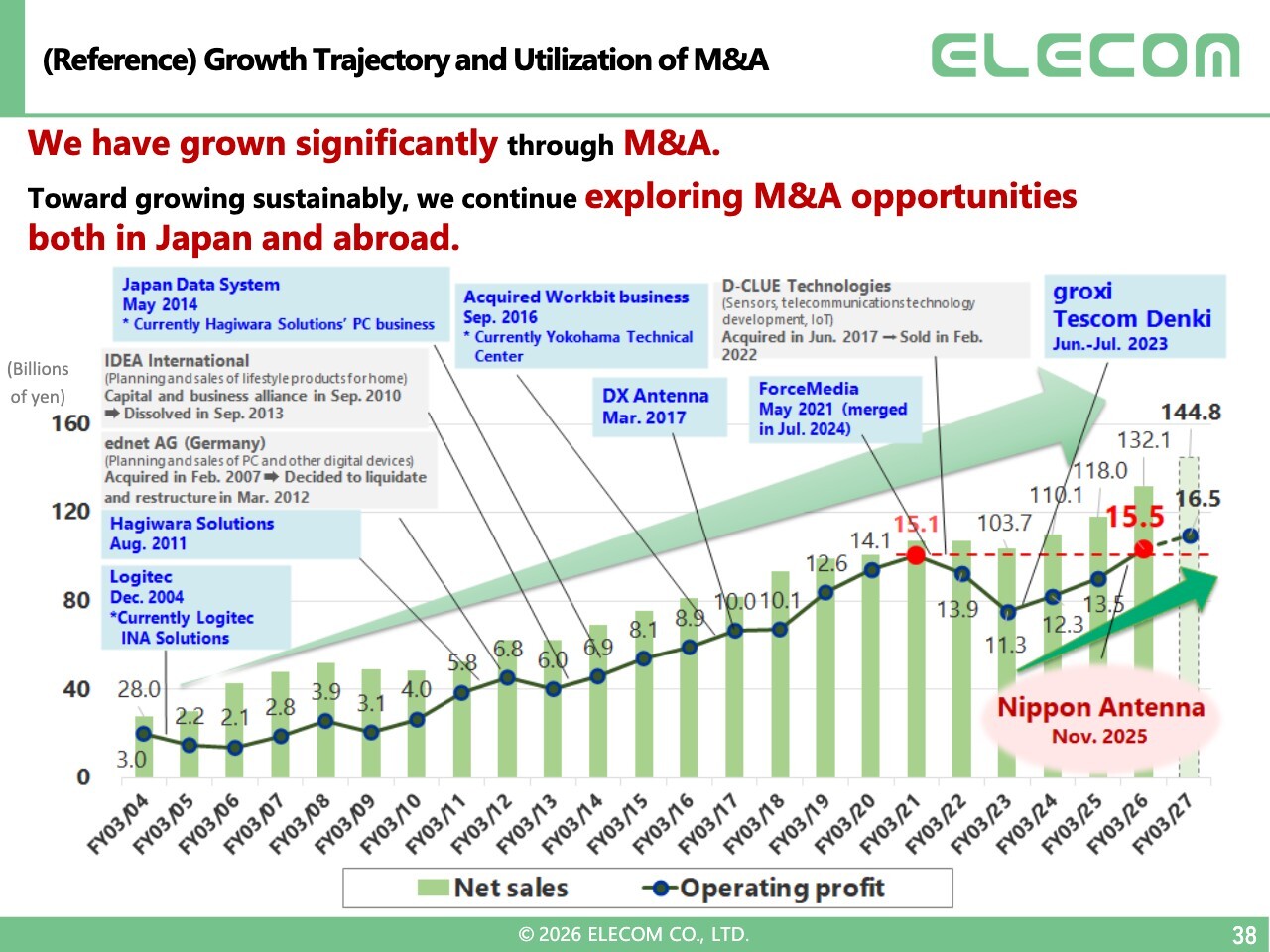
Looking at past trends, it temporarily declined due to the impact of COVID-19, but we believe it has since returned to an upward trend. If we can achieve 16,500 million yen on an operating profit basis this fiscal year, we believe we will be evaluated appropriately.
Dividend Policy, Results and Forecast
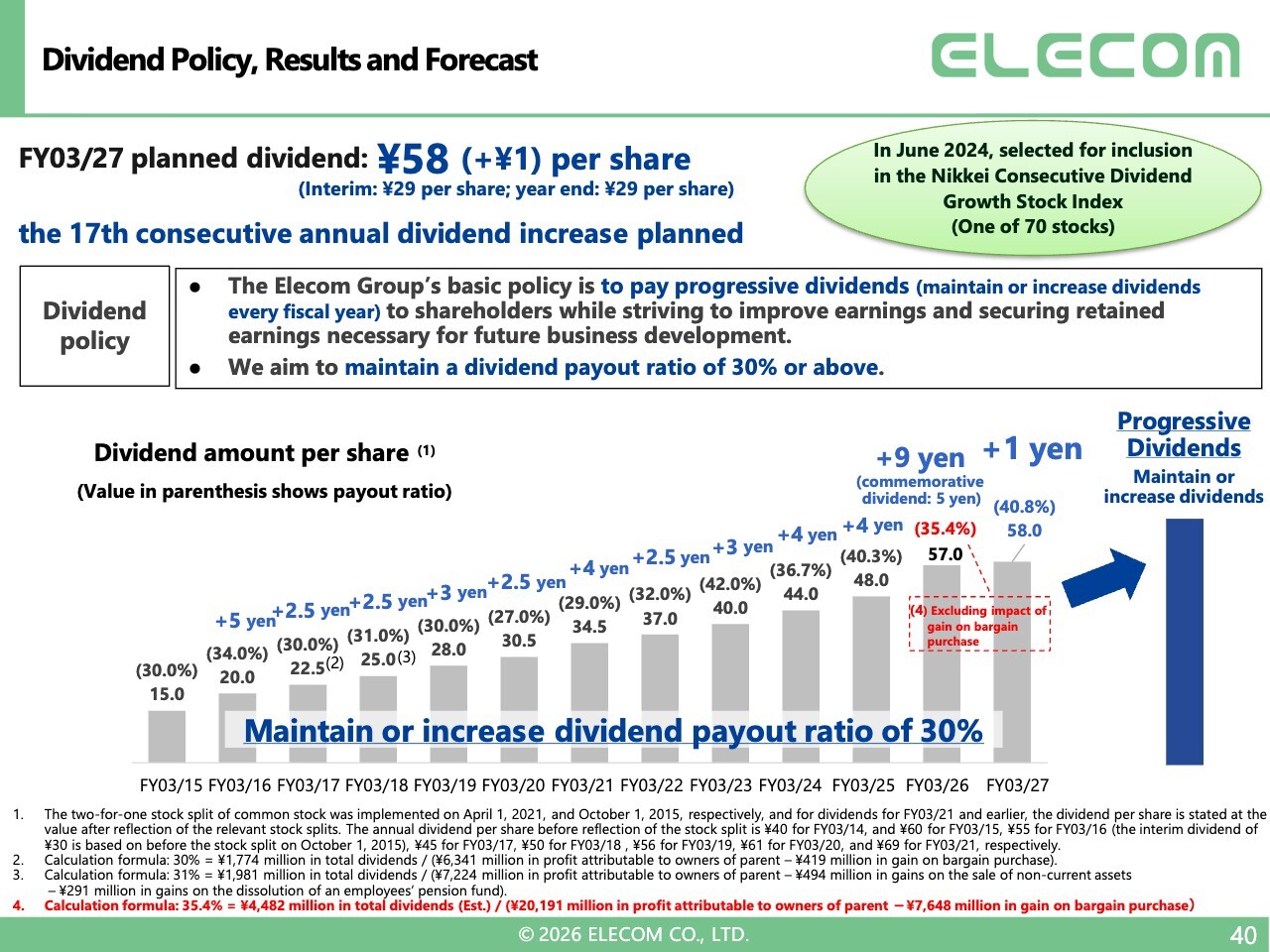
Regarding dividends, in the previous fiscal year we set 5 yen as a commemorative dividend. You may feel that the size of the dividend increase for this fiscal year is small, but we are planning a 1 yen increase, and we also aim to achieve a 17th consecutive fiscal year of dividend increases.
Financial Policy:
Establishing a positive cycle of investment and return
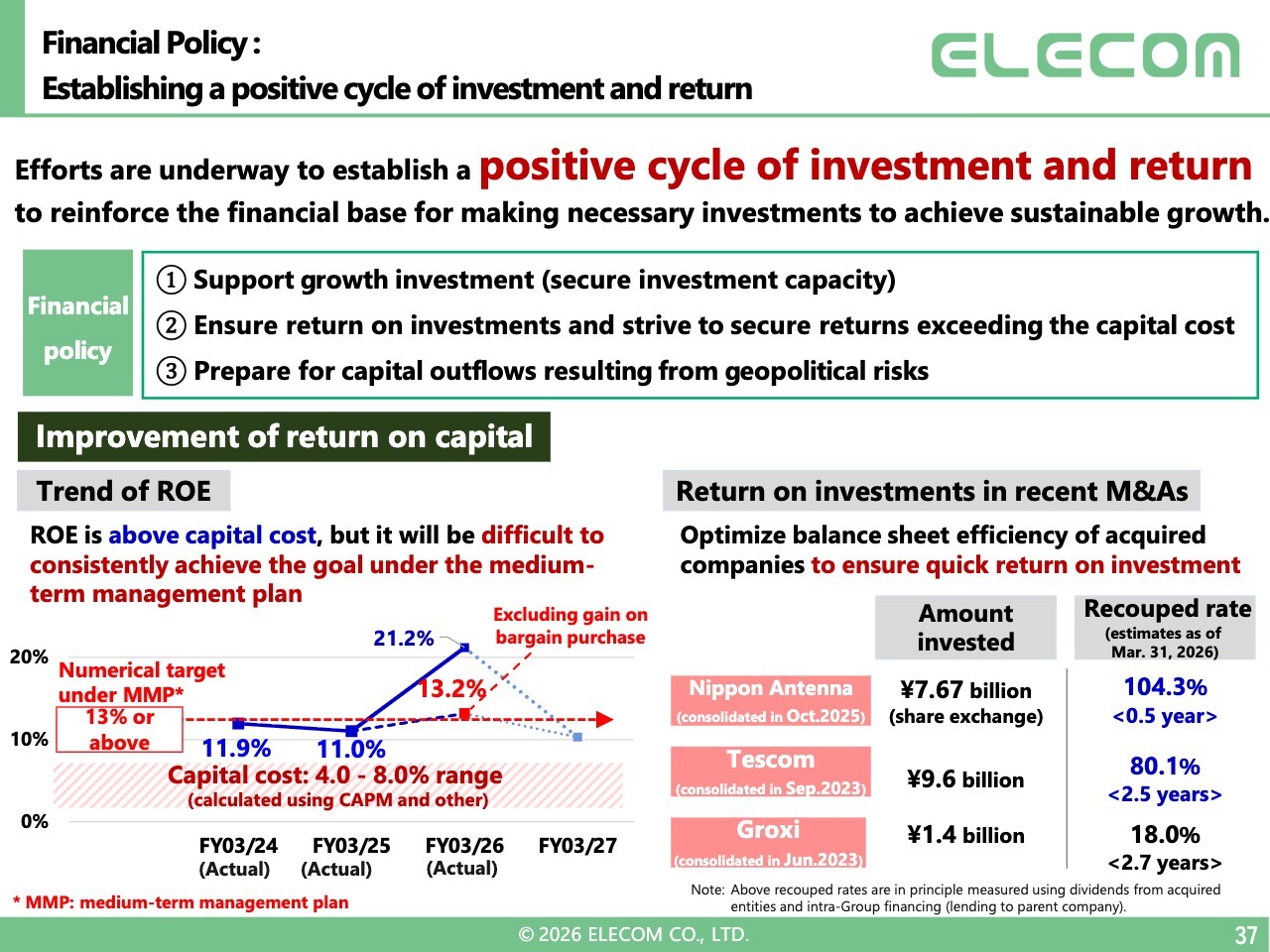
ROE has risen to 21.2% due to the acquisition of Nippon Antenna, but it is expected to decline this fiscal year.
We believe that a major challenge in the final year of the medium-term management plan will be how to bring this figure as close as possible to 13%.
Regarding M&A, the recovery of invested funds is progressing steadily. In particular, with regard to Nippon Antenna, given the element of a share exchange as well, the progress of recovery is steady in various respects. As one exception, although it is small in scale, only the portion related to groxi is still in a situation where recovery has not yet progressed.
On this point as well, we are working to recover the funds we invested. However, when it comes to M&A, we believe that a major challenge for ELECOM going forward will be how far we can grow the top line after bringing a company into the group, and whether we can generate synergies.
This concludes my explanation and report.
Q&A: Nippon Antenna’s Contribution to Earnings for FY03/27
Questioner: I have a question regarding Nippon Antenna. You explained its contribution to earnings in H2 FY03/26, but what are your expectations for this fiscal year?
Also, the integration with DX Antenna is scheduled for this October. Since Nippon Antenna was already posting significant profits in the previous year, even prior to consolidation, we frankly find it somewhat difficult to gauge its underlying performance excluding those synergy effects. How do you plan to factor its performance into this fiscal year’s forecast?
Tanaka: Nippon Antenna will merge with DX Antenna effective October 1 of this year. Therefore, while the figures are somewhat unclear, Nippon Antenna’s current plan for this fiscal year projects annual sales of approximately 8,500 million yen.
On the other hand, we project operating profit of Nippon Antenna to be just over 900 million yen. It contributed approximately 814 million yen in operating profit in the previous fiscal year. Considering this, we estimate that its contribution to the increase in this fiscal year’s operating profit will be just over 100 million yen.
Note that Nippon Antenna posted very high profits in the previous fiscal year thanks to a one-off demand from government agencies. We estimate the operating profit to be just over 900 million yen now that this one-off demand has reached saturation.
Yet, to be honest, even though the one-off demand has passed, I anticipate that remaining work and additional construction projects will still arise. Personally, I would like to see operating profit exceed 1,000 million yen; however, since the company has only recently joined the Group and we haven’t fully grasped the actual situation in some areas, the figures I just mentioned represent the current status at this stage.
Questioner: Is it correct to understand that sales in H1 are inherently lower due to seasonal factors?
Tanaka: Absolutely.
Questioner: In other words, while it’s uncertain whether the figure will be 800 million yen, 900 million yen, or 1,000 million yen, is it correct to understand that Nippon Antenna is expected to generate a certain level of profit primarily in H2?
Tanaka: Based on the trends in past reporting, Nippon Antenna has tended to present conservative figures and then exceed them. After joining the Group, I believe we need to step in and reevaluate these aspects.
Q&A: Update on the Development Structure for Tescom
Questioner: One of your management challenges was that new product development had not been progressing satisfactorily. Additionally, Tescom’s performance appeared to have fallen slightly short of expectations in the previous fiscal year.
I understand that you have made considerable improvements to your structure, but to be honest, I get the impression that this has not yet been fully reflected in the results. Could you please tell us about the progress in this area?
Iwami: Your point is well taken. Last year, Tescom’s figures fell significantly short of the budget, and the establishment of the development framework and progress on product development were behind schedule.
Kota Hada assumed leadership of product development in January of this year, and we are currently reviewing the entire development process. As part of this effort, we are establishing a system to quickly develop and market products which are more appealing to consumers and end users.
However, while we initially set a sales growth plan for Tescom of approximately 115% of the previous year’s actual results, we determined that our development structure was insufficient to support that target. Entering this fiscal year, I gave the directive to “adjust it to 105% YoY and establish a framework that allows us to achieve solid results with other products,” and we are currently reviewing this matter.
Overall figures remain unchanged, but your point on the development structure is correct. We are currently in the process of making improvements through repeated reviews.
Q&A: Outlook for the B2B Business Operating Profit Margin
Questioner: I have a question regarding B2B business. This may be the first time you have disclosed operating profit information.
The B2B segment encompasses various elements, such as focus products, areas expected to see top-line growth in the future, the broadcast receiving-related field, and the field related to Hagiwara Solutions.
Could you tell us about the current situation? If your focus products grow in the future, will the B2B operating profit margin increase or decrease?
Iwami: To give you a broad overview of the B2B sales mix, about half consists of what we call “daily sales.” “Daily sales” refer to daily sales made through distributors, specifically sales of Elecom products such as network equipment, I/O devices, cables, and accessories.
New products in this sales channel account for only about one-fifth to one-sixth of mass retailers’ new products. Also, a given product model is typically used for about two to three years and remains stable during that period. For those reasons, we believe the profit margin will not change significantly.
In contrast, categories like NAS, security cameras, and network equipment achieve higher profit margins through the integration of solutions. Consequently, the more we sell our focus products and the more we sell products bundled with solutions, the more our profit margins will improve.
While maintaining a growth rate of around 105% for the daily sales, I plan to further promote solution-based sales and the sale of focus products. Since we’ve reflected this plan on the budget, we aim to keep profit margins stable or on an upward trend.
Tanaka: One thing that has caught my attention for some time is the exceptionally high operating profit margin of Dodwell BMS Co., Ltd., a subsidiary of Ai Holdings Corporation.
Elecom’s current operating profit margin is in low double digits, but we aim to further improve it by raising the margin in our B2B and e-commerce to around 15% to 20%.
Additionally, the securities report scheduled for release next month highlights the steady progress of our B2B recurring-revenue business. Among the figures scheduled for disclosure, contract liabilities—which represent deferred revenue in the recurring-revenue business—stood at 1,814 million yen in the fiscal year before last and 2,356 million yen in the previous fiscal year. Based on this, we believe it is certain that monthly revenue from the recurring-revenue business is increasing.
In terms of changes in the operating profit margin, I believe the key will be the extent to which profitability improves as we manage each of the three business segments independently down to the operating profit level.
Q&A: Outlook for Operating Profit Improvement Following the Acquisition of TAMA ELECTRONICS INDUSTRY CORP. into the Group
Questioner: I would like to ask about the inclusion of Tama Electronics into your group. To what extent do you anticipate this acquisition will improve your operating profit? From a long-term perspective, please provide any updated information you can share, whether excluding or including goodwill.
Iwami: The company’s annual net sales are currently approximately 8,000 million yen. For this fiscal year, taking goodwill amortization into account, we expect its contribution to operating profit to be virtually zero.
Tanaka: As for the long-term picture, it remains unclear.
Q&A: Reasons for Falling Short of the Plan in Power & I/O Devices and Home Appliances
Questioner: Power & I/O Devices and Home Appliances fell short of the initial plan by 1,700 million yen and 2,900 million yen, respectively, according to my understanding.
I don’t recall seeing this kind of situation very often in the past. Could you explain what caused this discrepancy—was the planning overly ambitious, did your commitment waver, or was there a lack of follow-through in the final stages?
Iwami: It is true that for Power & I/O Devices, we set very ambitious targets driven solely by our desire to gain market share. In fact, while our Power & I/O Devices hold a market share of around 40% for major product categories at mass retailers, that figure remains at around 10% in e-commerce.
Going forward, our priority is to secure a market share of approximately 25% in e-commerce for Power & I/O Devices. To achieve this, we need to invest in advertising and other areas to grow our market share.
On the other hand, the situation for Home Appliances is entirely different. Starting around June and July of last year, the organization of the product development department became weakened, partly due to cost-cutting measures, and signs began to emerge that we were unable to deliver sufficient performance, including in the overall product development process. As a result of this impact, we ultimately fell short of our plan. This is a major point of reflection.
Questioner: Based on your just-provided response, the plan for this fiscal year calls for a 4,500 million yen increase in revenue for Power & I/O device, and a 2,100 million yen increase for Home Appliances. How do you view these projections?
Iwami: I have a reasonable degree of confidence in achieving the 4,500 million yen for Power & I/O Devices. I believe this is a realistic target, as Amazon-channel sales have been growing steadily in 1Q of this fiscal year.
As for Home Appliances, we are monitoring the situation to see if we can actually release new products. Since we still have a large amount of inventory remaining, our approach is to generate sales by utilizing that inventory.
The reason I am currently keeping a close eye on mass retailers is to manage these aspects through numerical data and flexibly adjust our tactics on a quarterly basis. While we are managing well in B2B, we still have areas where we are not performing sufficiently in Home Appliances, so we are addressing those issues through corrective measures.
Q&A: Strategy for Integrating Mass Retailers and E-Commerce
Questioner: You mentioned that you want to adopt a model where “products are showcased in mass retailers and sold via e-commerce.” What are your thoughts on this approach regarding mass retailers? Also, how do you plan to proceed with integrating e-commerce and mass retailers as the next step?
Iwami: Currently, mass retailers and e-commerce are operated under separate budgets. That said, looking ahead to the next three-year medium-term management plan, we believe there is potential to bring the organizations together as well. This is ultimately dependent on end user choice.
The flow where end users view products at mass retailers and then purchase them via e-commerce is not something we can control. We have no issue with this as long as end users like the products and purchase them via e-commerce. We will put the necessary systems in place to support this.
What I believe is most important is whether we can build a data platform.
This applies to e-commerce, that is, Amazon and D2C websites as well. When a product is sold, you can identify who is buying what and identify trends. Based on this, you can select appropriate products for mass retailer shelves and use messaging informed by social media reactions.
Presently, we rely on Excel spreadsheets, with proactive e-commerce staff merely relaying information to the respective product managers. However, over the next three years of the medium-term management plan, I would like to promote digitization of information such as “sales figures at mass retailers” or “the number of customers who see products in mass retailers and then purchase them via e-commerce,” and initiatives that link this data to the practice of customer lifecycle management.
To do this effectively, our D2C site will need to reach a certain level of development; otherwise, it will be difficult to obtain more precise data. For example, we recognize that companies like Anker Japan Co., Ltd. are putting significant effort into such approaches. We intend to respond to this as well.
Q&A: Future Targets for the Ratio of Net Sales and Operating Profit in E-Commerce
Questioner: I would like to ask President Iwami. You mentioned the vision of “ELECOM: the name in e-commerce,” but according to recent net sales figures, e-commerce accounts for only 18% of total net sales. How much do you plan to increase the e-commerce ratio in the future, both in terms of net sales and operating profit?
I would appreciate it if you could share whether you aim to reach a level that surpasses that of mass retailers, and if so, whether you plan to achieve that level within the next three-year plan.
Iwami: Regarding e-commerce, this question is similar to the one asked earlier. As the growth rate of e-commerce is high, I think we can formulate a hypothesis about how much advertising expenditure would be required to capture the remaining 80% to 85% of the market, while we have a market share of 10% to 15%.
We are currently actively developing products for e-commerce and will continue to thoroughly strengthen our e-commerce operations. For example, if we grow by 25% annually, we can expect to surpass the scale of mass retailers in four to five years. We intend to tackle these scenarios head-on.
Q&A: Lessons from Anker’s Sales Strategy and Our Own Initiatives
Questioner: I feel that Anker strikes an excellent balance between brick-and-mortar and e-commerce, not only by dedicating significant space to its products but also by operating cafes. Are there any lessons you can learn from this, or aspects you should emulate?
Iwami: Anker has built its business on e-commerce and social media, and this holds true in the U.S., Asia, and Japan alike. As a next step, they have expanded into brick-and-mortar stores and set up dedicated sections even within mass retailers.
By comparison, we possess overwhelming strength in mass retailers, particularly in regional areas. We place great trust in the sales power of mass retailers, so our strategy is to expand our e-commerce share while simultaneously building a solid foundation in mass retailers. For this reason, I believe our approach differs slightly from Anker’s.
One of Anker’s strengths, however, is its overwhelming appeal to young people.
Since our core customer base consists of people in their late 30s to 50s, we need to effectively reach the younger generation through social media. We have established a dedicated team for this purpose, and its activities are now underway. We plan to proceed with these efforts after allocating a sufficient budget.