Business Overview Briefing
Yoshifumi Taura: My name is Yoshifumi Taura, President and Representative Director of Taiheiyo Cement Corporation. Thank you very much for taking time out of your busy schedule to join us today.
Today's presentation is an overview of our business situation, and I think the primary concern for everyone is the future outlook for demand for cement. So, I will talk a little about my personal view as well as how the company should be, then move on to an explanation of the management overview.
So far, we have held three briefings: our U.S. Business briefing, a review of the "26 Medium-Term Management Plan," and the Financial Results briefing.
Therefore, I will focus today on what we are planning for next year, such as "What are our current thoughts for the next Medium-Term Management Plan?" and "What business strategy are we developing?" Let’s get into details now.
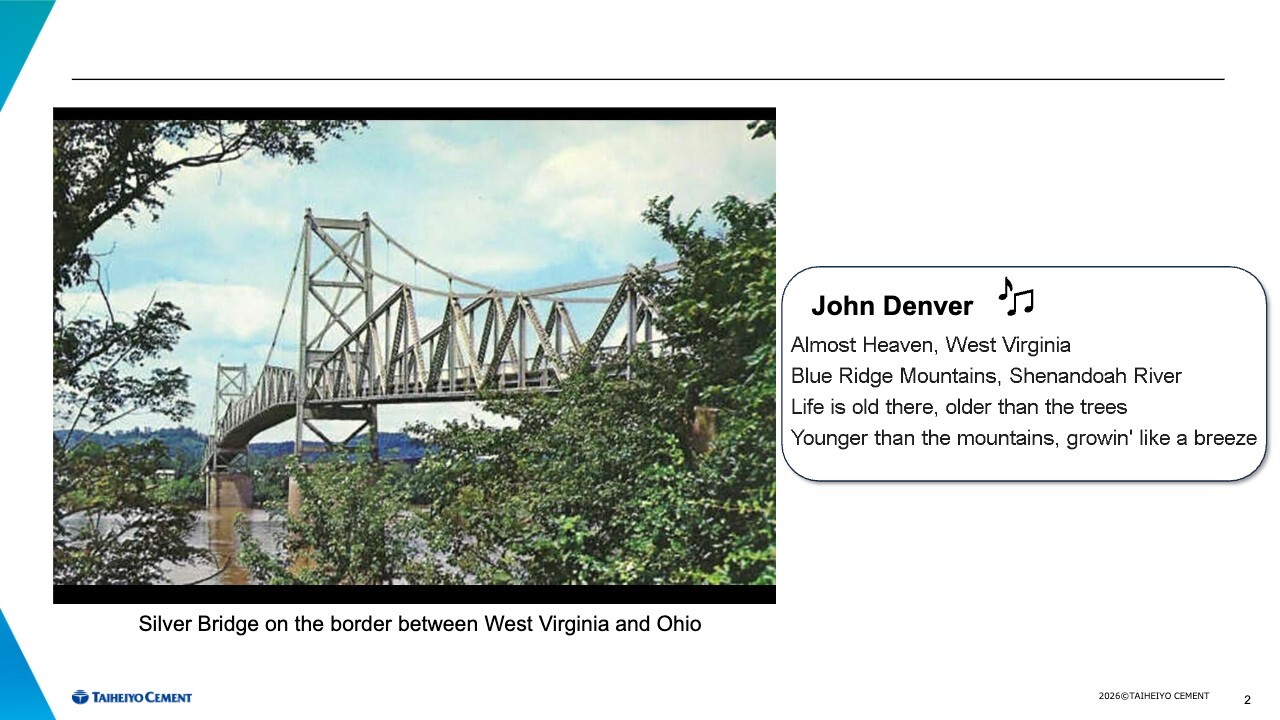
Silver Bridge on the border between West Virginia and Ohio
First, I would like to share my thoughts on the future demand for cement. Looking at the audience today, there do not seem to be many people my age, so you probably do not know a song called "Country Roads" which features in Studio Ghibli's movie "Whisper of the Heart.”
Originally released by John Denver in 1971, the song reached #2 on the Billboard chart. Just one year after the Beatles broke up in 1970, the song gained huge popularity.
Included in its lyrics is the significant line "Almost heaven.” The song is about West Virginia and begins with the lyrics, "West Virginia is the closest state to heaven," because of its beautiful mountains and rivers. The Silver Bridge, pictured in this slide, is an iconic bridge in a very scenic location, connecting West Virginia and Ohio.
● Collapse of the Silver Bridge (1967)
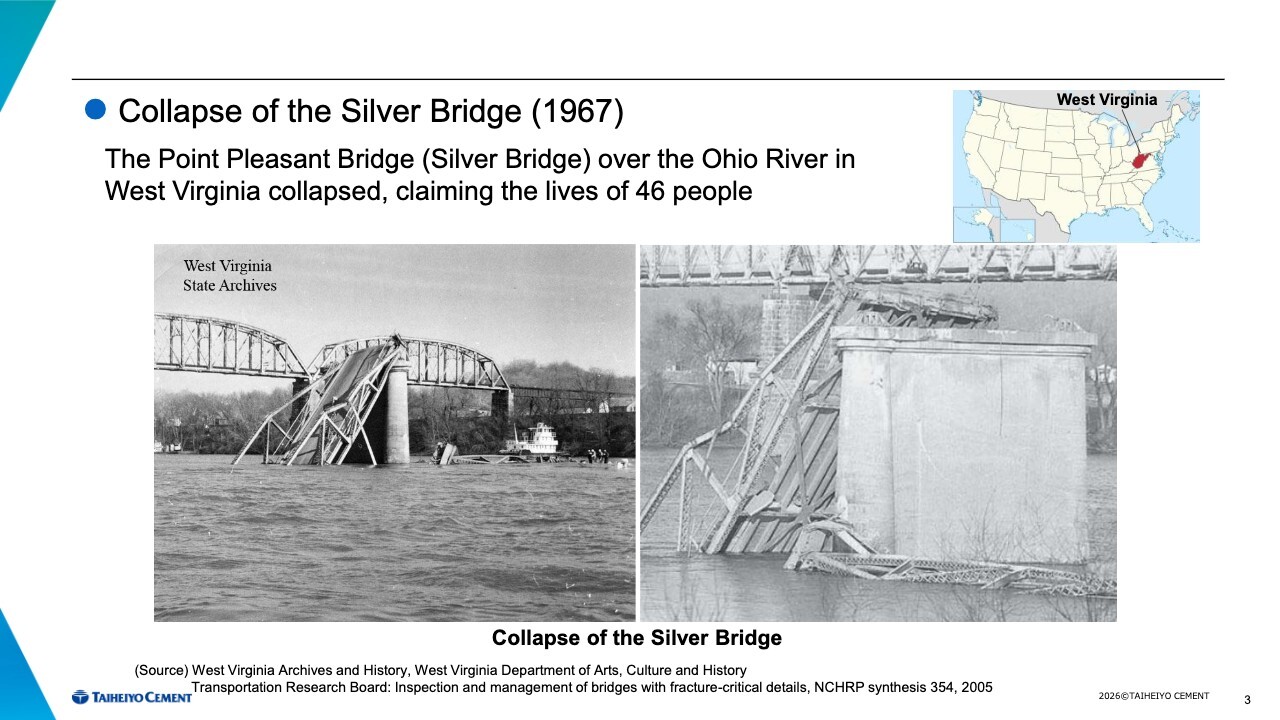
This bridge collapsed on December 15, 1967. The incident was caused by the excessive weight of a crowd crossing it in cars during the Christmas shopping season. 46 people died and two people were never found. It is said that the search was difficult because of very cold weather in the region.
Road Collapse in New York
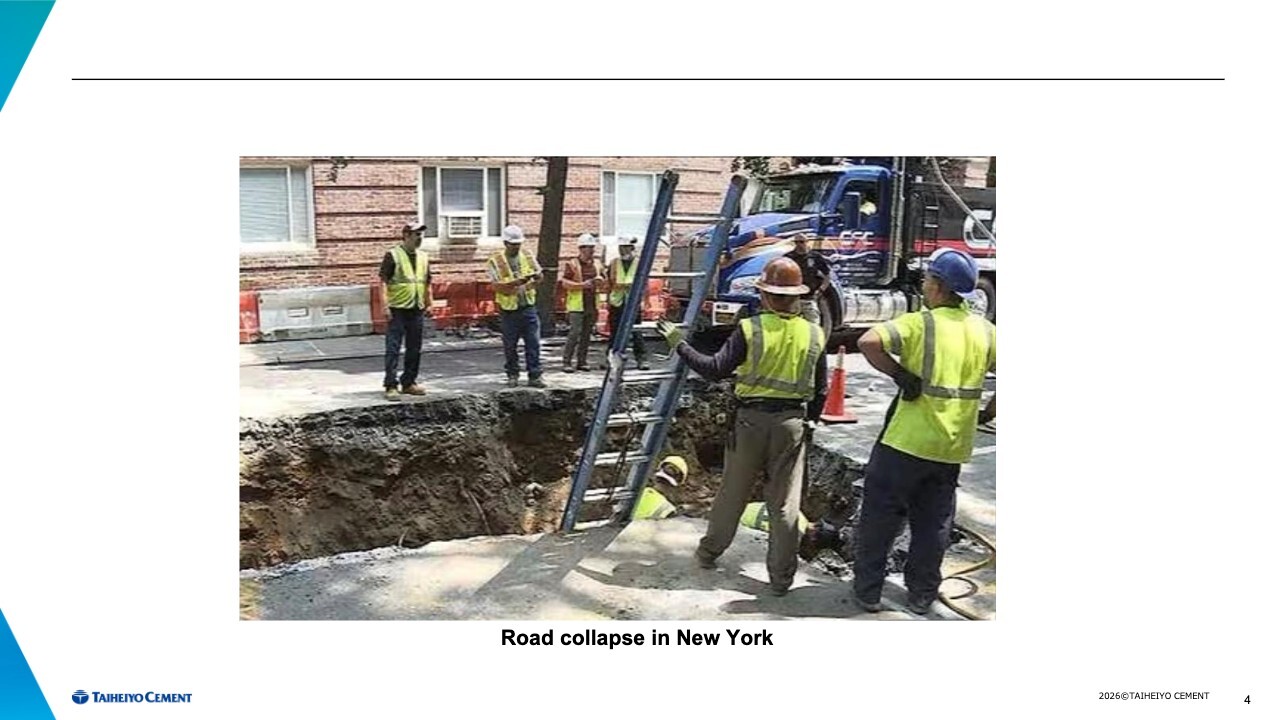
This is a photo of a road collapse in New York City. Between 1970 and 1980, such accidents occurred frequently in the United States.
● Decaying America in 1980s
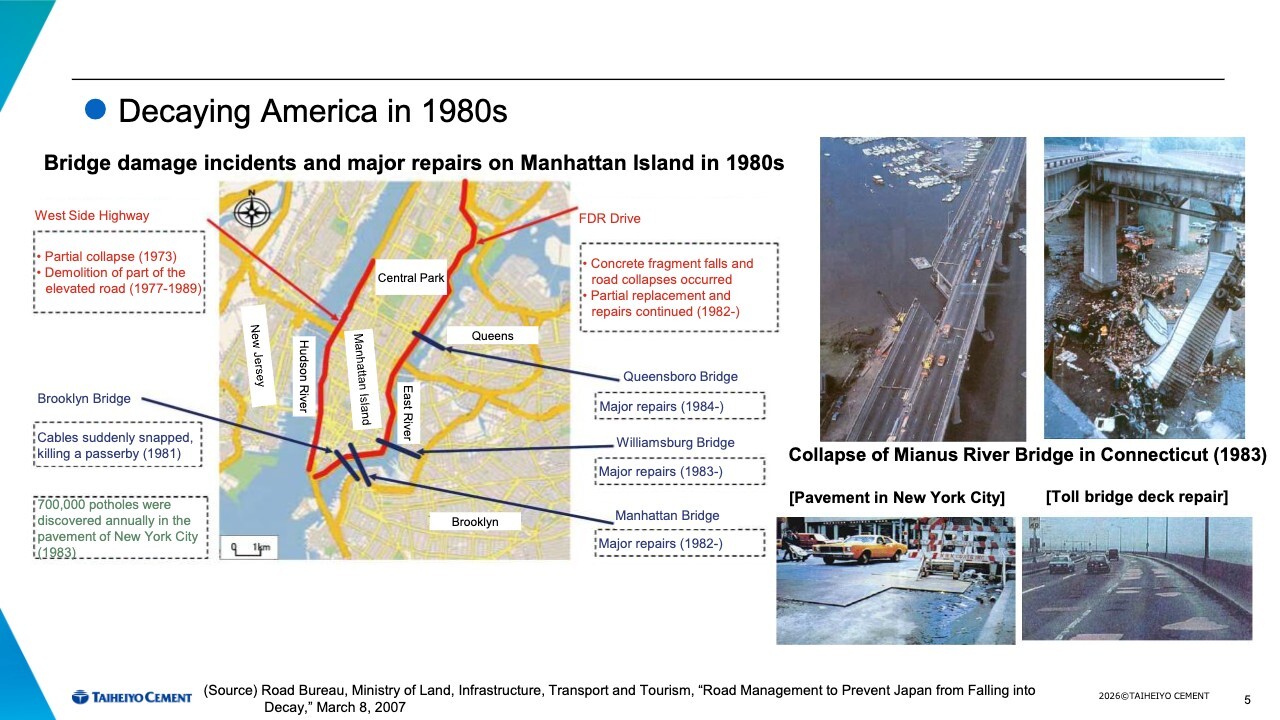
As you can see, many accidents occurred in Manhattan. Connecticut experienced a bridge collapse, and New York underwent a series of infrastructure improvements.
● Background to infrastructure decay
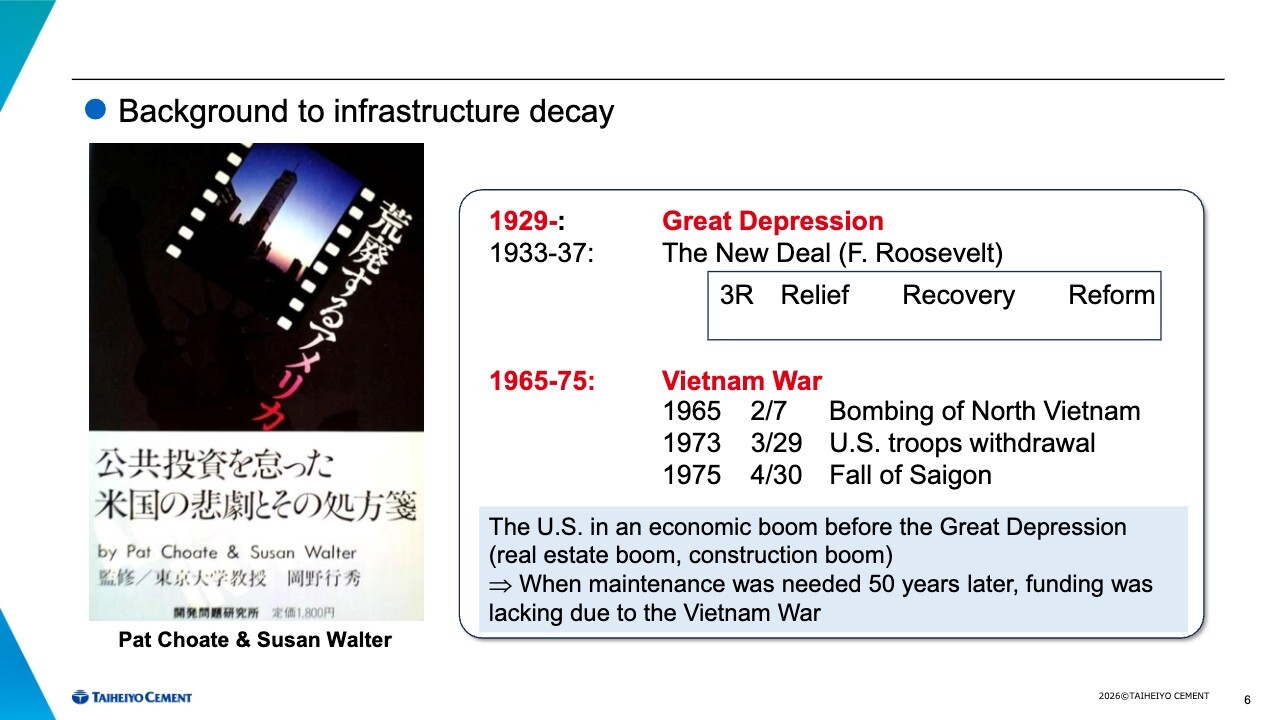
The book "America in Ruins" was published in 1981. It was co-written by Pat Choate and Susan Walter, and has been translated into Japanese under the title “Kohai Suru America.” The authors claim that “America will be destroyed if these problems are left unattended, and the country itself will be ruined.”
Let me describe a rough outline. The book first explains the booming economy before the Great Depression of 1929. Until that time, construction work was taking place in many places, and highways and other structures were being built at a considerable rate. Then the Great Depression had a devastating impact on the economy.
To recover the economy, Franklin Roosevelt launched the New Deal policy in 1933. Large infrastructure initiatives, notably the Hoover Dam and other major projects, were carried out throughout the 1920s and 1930s.
It was during the 1970s and 1980s that America faced a series of accidents, as I mentioned earlier. Why was no repair or other maintenance work done until then? The main factor was the Vietnam War, which began in earnest in 1965.
The U.S. military finally withdrew from Vietnam in 1973, but huge sums of money were poured into the war over those eight years, estimated at about 200 trillion yen in terms of current yen value. The immense war costs made it hard to set aside an adequate budget for infrastructure maintenance.
● BUILD America 250 Act
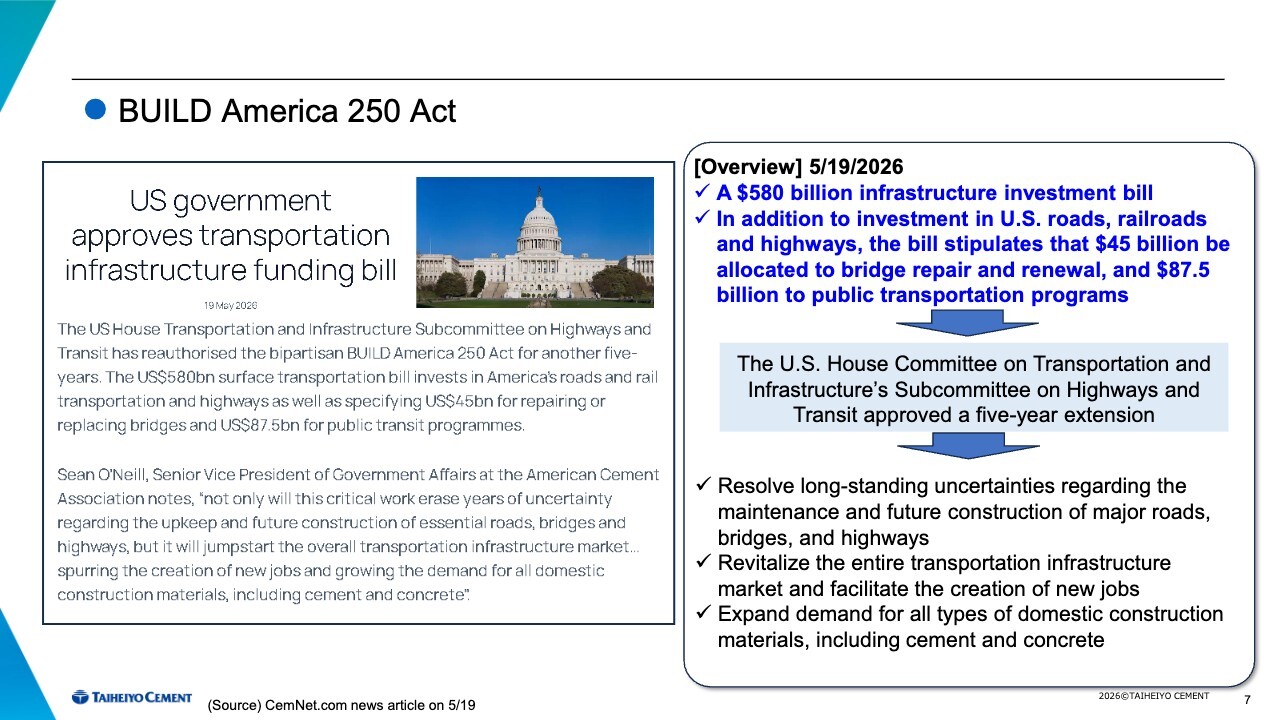
Following a series of incidents, the United States government shifted its strategy to increase infrastructure spending. One of the most significant moves was the 2021 enactment of the Infrastructure Investment and Jobs Act (IIJA) during the Biden era and in the midst of the global COVID-19 crisis.
The act included massive investments in telecommunications infrastructure and new energy, totaling about $1 trillion (about 150 trillion yen at current exchange rates).
What’s more, this act was enacted through a cross-party agreement. This highlights the importance of the act, as Republicans would typically oppose a bill proposed by Democrats, the ruling party under the Biden administration.
2026 marks the fifth and final year of this bill’s planning period. Furthermore, recently, on May 19, a $580 billion BUILD America 250 Act (Building Unrivaled Infrastructure and Long-term Development for America’s 250th) was approved, with $45 billion designated for infrastructure projects such as highways and bridges. That total amount is equivalent to nearly 100 trillion yen.
Following the Biden administration's 150 trillion yen IIJA outlay, the scale of the latest bill proposed during Trump's presidency remains noteworthy. Besides, there was absolutely no opposition from the Democrats. The reason for this is a shared belief among legislators that infrastructure spending is vital for the nation's survival and stability. The U.S. thus invests a lot of money in infrastructure.
Turning an eye to the recent situation in Japan, a particularly noteworthy incident was the Yashio City road sinkhole.
Prior to this, there was an accident involving the collapse of ceiling panels inside the Sasago Tunnel. As you may remember, nine people were killed in this collapse. In addition, a water pipe breakage occurred in Kita Ward, Tokyo, shutting off water services for about a week in the surrounding area. Those incidents were all due to aging facilities.
The Ministry of Land, Infrastructure, Transport and Tourism released statistics in March 2023 regarding the percentage of social infrastructure that has been in use for over 50 years. The blue areas in the graph on this slide represent those infrastructures still in use more than 50 years after construction as of March 2023. You can see how big the aging portion is.
37% of highway bridges will have been in use for over 50 years as of 2023, 54% in 2030, and 75% will have been in use for over 50 years as of 2040. This is the current situation in Japan.
● Missing links of expressways
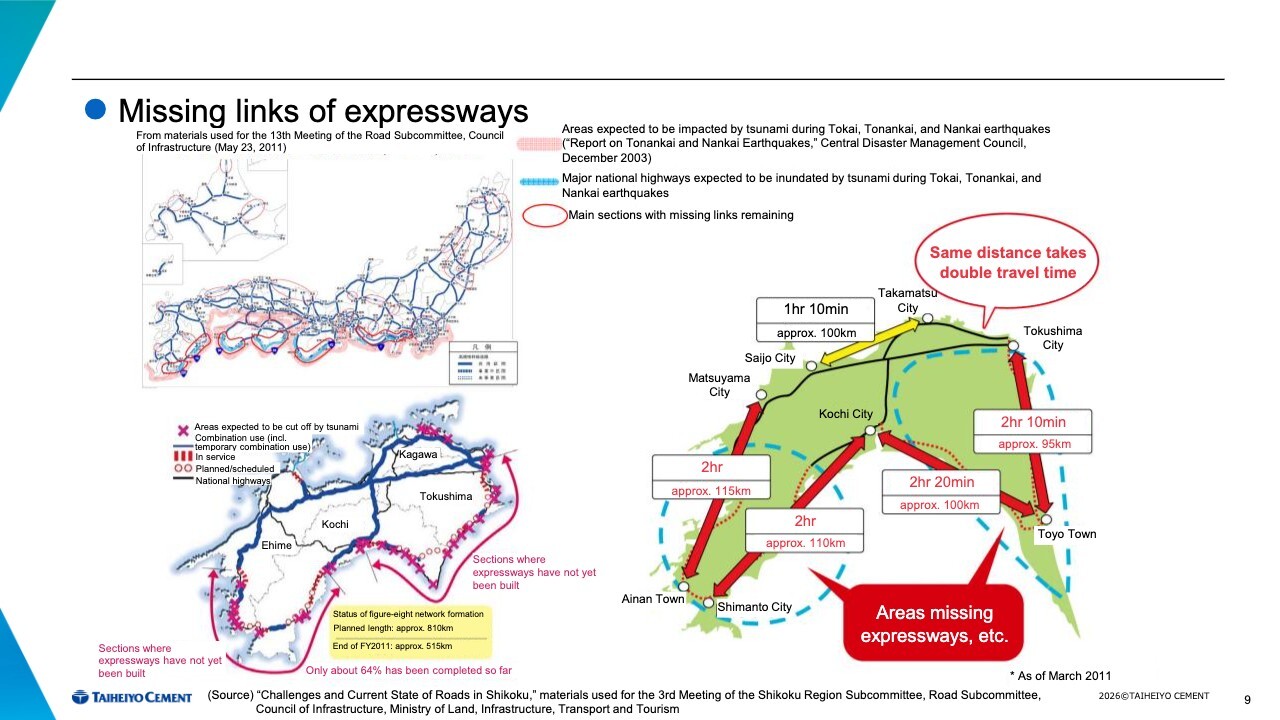
The next topic is the missing link in the highway system, with a focus on Kochi, a prefecture constantly threatened by the possibility of a Nankai Trough earthquake. There is a plan to build a highway network linking the four prefectures of Shikoku, known as “Hachino-ji (Figure 8)” because of its shape. However, a large part of the area remains underdeveloped, as shown by the “X” in the map on the lower left of the slide.
It is predicted that towns in Kochi could be hit by a tsunami within just three minutes of a Nankai Trough earthquake, as the expected epicenter is close to the coast and there are few mountains suitable for evacuation. Under such circumstances, when a Nankai Trough earthquake does occur, who in the world will be able to rush to the rescue? Rescue routes may also be damaged.
Since a highway sits above ground level, it might be shielded from some damage from a tsunami, but unfortunately, some routes remain in an undeveloped state today. Getting to a place 100 kilometers away would take two or three hours, while it would take just one hour if highways were in place.
Following the Noto Peninsula Earthquake, concepts such as “redundancy” and “lifelines” were emphasized. Yet I can't help but feel that little progress has been made to enhance these "lifelines."
Around 200 disconnected segments are reportedly present across the country's highway network. Circles in the top left section of this slide mark the regions with the least development. At the same time, these regions are expecting major earthquakes, such as Nankai Trough and Tokyo Inland earthquakes, to occur.
● Public fixed capital formation in G7 Countries
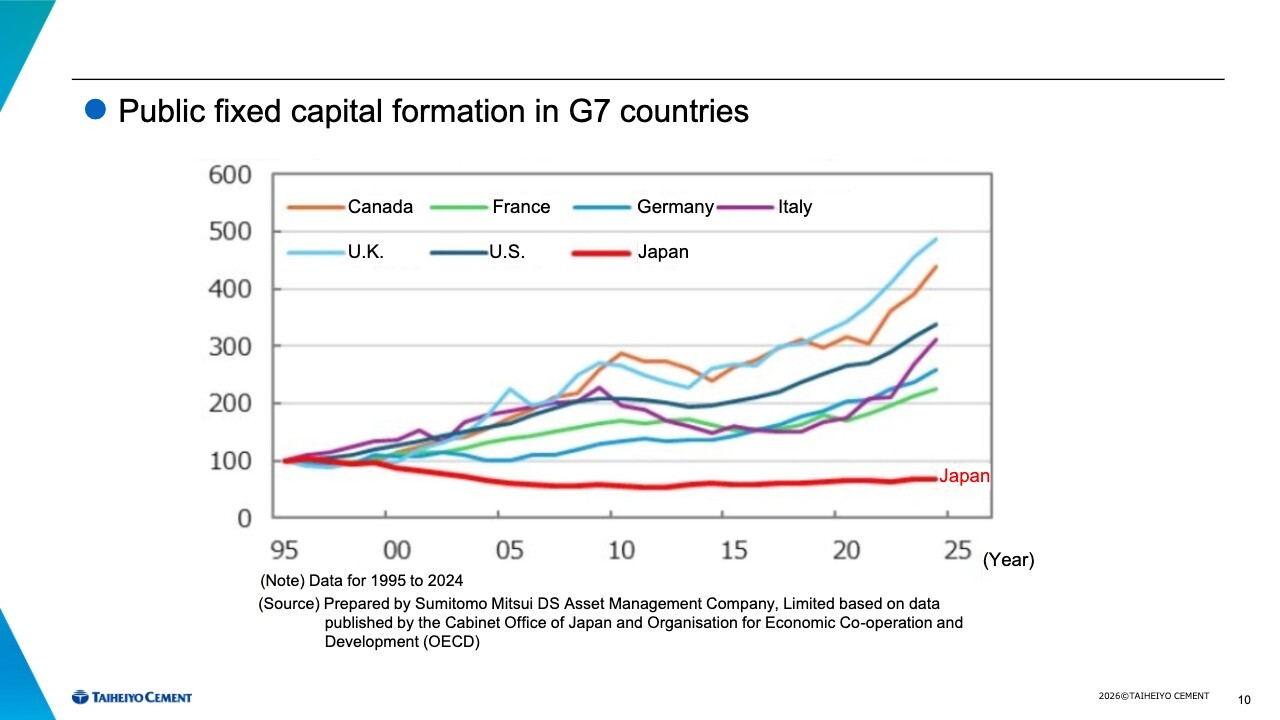
This chart shows the change in public fixed capital formation in seven major countries (G7). With 1995 serving as the baseline at 100, the United Kingdom leads the group, having grown its investment five-fold. The U.S. also increased investments about three-fold. On the other hand, Japan's investment fell to 60, down from 100 in the base year 1995.
The decrease could stem from the shift toward a social welfare state, but can we leave infrastructure as it is? Can Japan continue to function in its current state? I have very strong concerns about this point.
● Comparison of public fixed capital formation
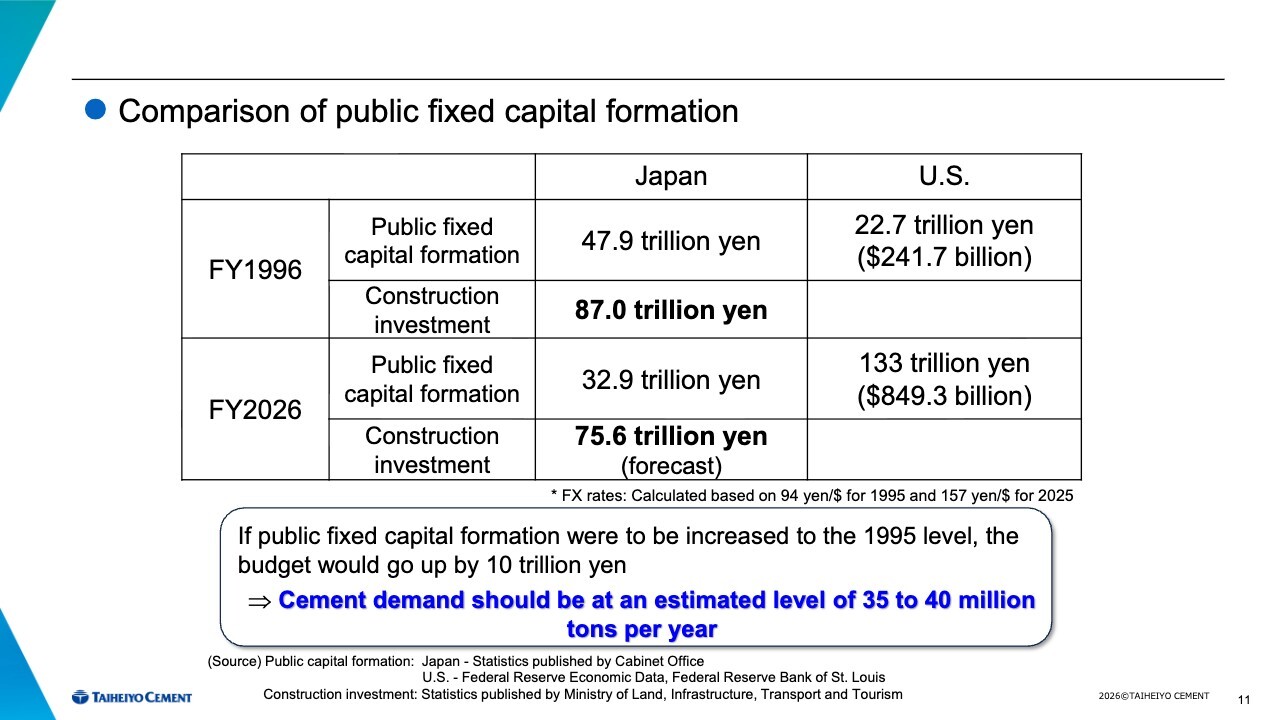
To be specific, let me explain with numbers. Japan's public fixed capital formation was about 48 trillion yen in FY1995, but fell to roughly 33 trillion yen in FY2025. By contrast, U.S. public fixed capital formation rose from around $240 billion to about $850 billion over the same period. These data make me anxious about Japan's future.
A similar trend can be seen in cement demand. In 1990, demand was 86 million tons per year, but it has now fallen to less than 30 million tons per year. This likely reflects the level of budget allocations.
While other countries have more than doubled public fixed capital formation since 1995, Japan is the only country where it has decreased (0.6 ×). Just to bring this back to the 1995 level would increase the demand by about 10 million tons.
I am often questioned about what lies ahead for cement since the demand for it keeps on falling. In my opinion, securing the adequate budget for infrastructure investments would address this issue.
40 million tons per year should be reasonable for cement demand, and the current level is very low. This has created a negative cycle in the industry. Budget cuts have further reduced cement demand.
Contractors across the country can no longer sustain their businesses, and as employers disappear, construction workers move into other fields. Indeed, the number of construction workers has declined from 6.8 million in 1995 to 4.8 million today.
Briefing session by the Preparatory Office for the Establishment of the Disaster Management Agency, Cabinet Secretariat
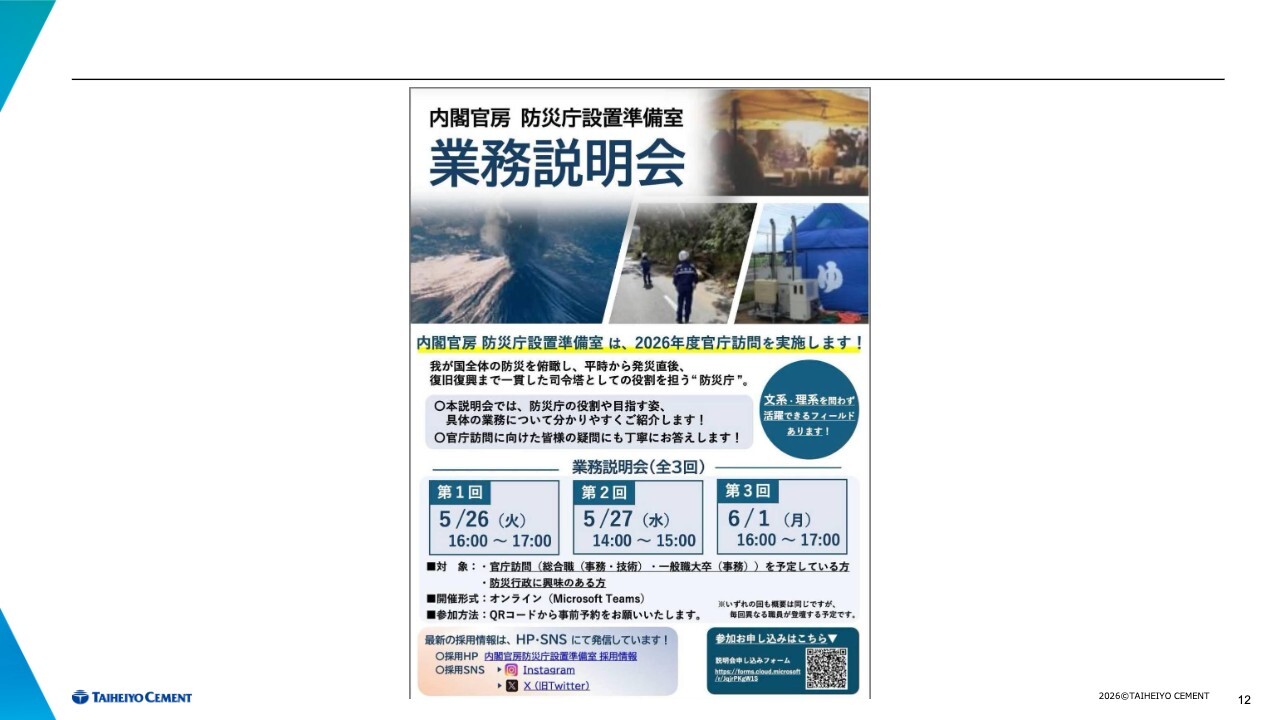
The industry looks to the Disaster Management Agency as a primary driver for transforming the existing circumstances. Business briefings have begun in preparation for the November launch and one of these will take place today at 2:00 pm. The bill for the establishment of the Disaster Management Agency has already passed the House of Representatives and is currently being debated in the House of Councillors.
Its operating budget will be 20 billion yen. The actual construction work is expected to total about 35 trillion yen annually, including about 30 trillion yen for public fixed capital formation and about 5 trillion yen for national resilience.
It is understandable that this budget will be used for various post-disaster rescue missions alongside the planning and administration of temporary housing. I also have an idea about the kind of sphere standards that will apply.
However, I believe what matters most is preventive measures, so would urge the government to aggressively promote investment to protect people's lives. I shared this information to clarify that it is essential to stop the downward trend in cement demand and return it to around 40 million tons in order to maintain the country's stability.
I was very impressed with this account, which I heard firsthand from Mr. Hisakazu Oishi, who previously served as a technical director for the Ministry of Land, Infrastructure, Transport and Tourism.
Environmental Business
Now let’s move to the management overview. First, I would like to talk about our secondary line of business, processing municipal and industrial waste. We have been committed to this business area for many years alongside our primary cement business, just like the two sides of a coin. This is something I would like to emphasize.
Environmental Business
● System to turn municipal waste into cement
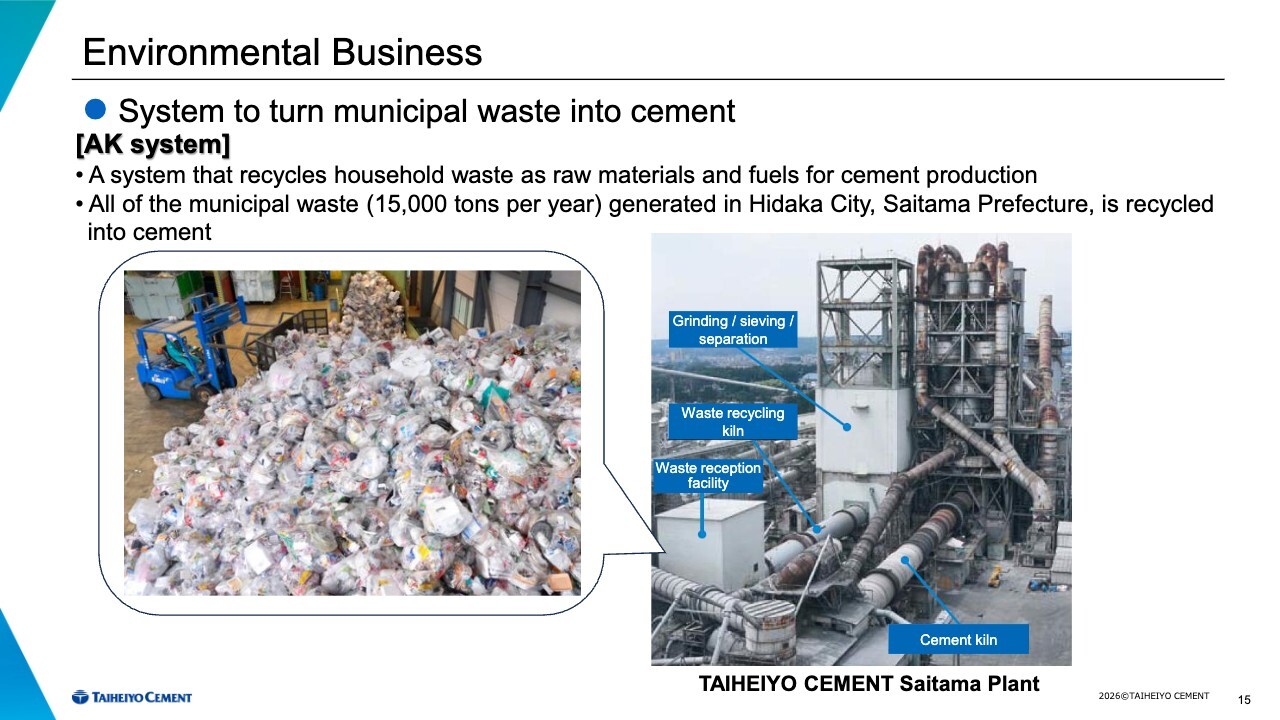
The photo on the left side of the slide shows municipal waste that is put out in bags on a daily basis. Each person in Japan generates about 1 kilogram of waste per day, equivalent to roughly 365 kilograms, or 0.3 to 0.4 tons, per year.
As such, multiplying the population by 0.3 tons gives an approximate annual amount of waste generated in Japan. Although there are differences by prefecture, in the case of Hidaka City, Saitama Prefecture, with a population of just over 50,000 people, multiplying by 0.3 tons results in approximately 15,000 tons of garbage being generated annually.
All this waste is processed at our Saitama Plant in Hidaka City. As a reminder, Hidaka City does not have an incineration plant.
A long time ago, a dioxin contamination problem occurred in the Kansai region. Dioxins are generated between 800 and 900 degrees Celsius, matching the temperature of a waste incinerator. In the wake of the Kansai incident, people at Hidaka City Hall were determined to prevent the same contamination problem in their area.
They consulted with our Saitama plant and a solution was developed, the AK system, which produces cement using waste as a substitute for raw fuel.
Environmental Business
● System to turn municipal waste into cement
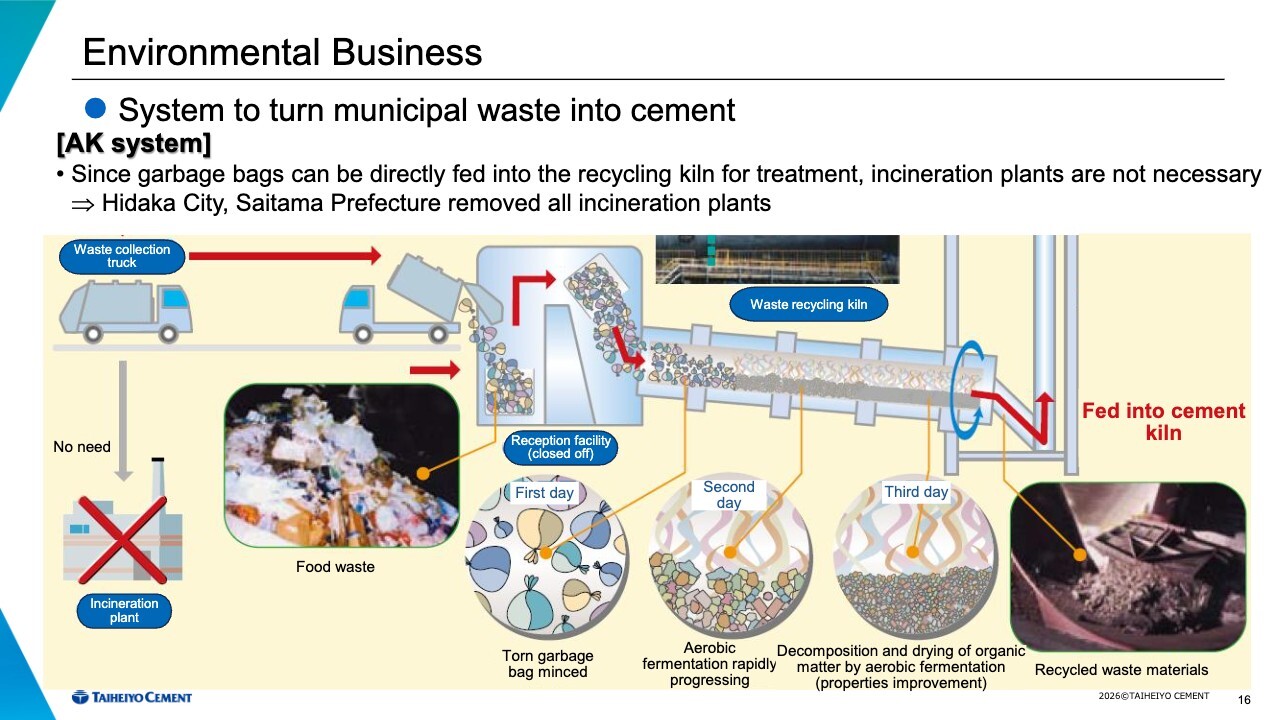
Here, we use old kilns renovated for this system. Garbage is put in and allowed to ferment for approximately three days. The garbage generates heat by itself, and is dehydrated by the third day, turning into a raw material for cement and fuel. The garbage is then used to produce cement. This is the "AK System" and is implemented at the Saitama Plant.
Environmental Business
● System to turn municipal waste into cement
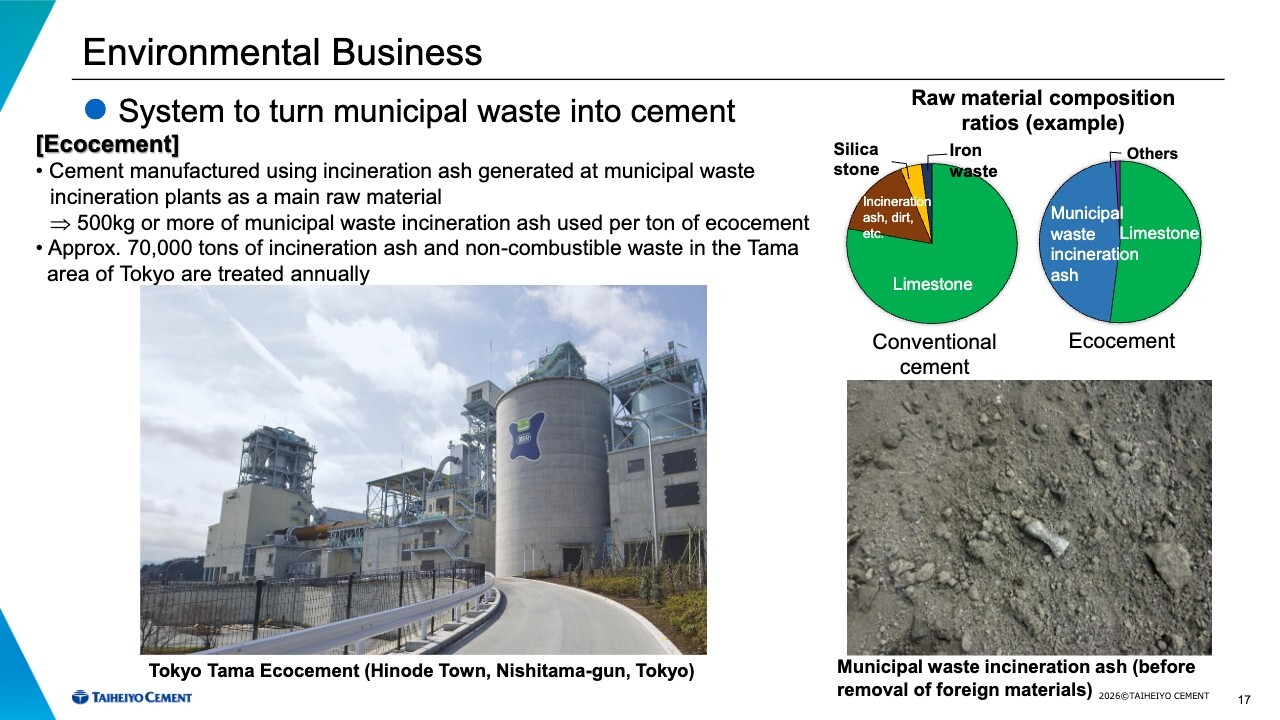
Many municipalities across the country have incinerators, and ashes are generated in the process of incinerating waste. It is inevitable that this ash is created as a residue.
As indicated in the upper-right text on this slide, “Ecocement” is made through the calcination of raw materials consisting of limestone and municipal waste incineration ash. Despite slightly different characteristics compared to standard cement, Ecocement remains completely functional, and has been used for many years in secondary concrete products.
The lower-left image on this slide shows an Ecocement plant in Nishitama-gun, Tokyo, which is currently undergoing renewal.
Environmental Business
● System to turn municipal waste into cement
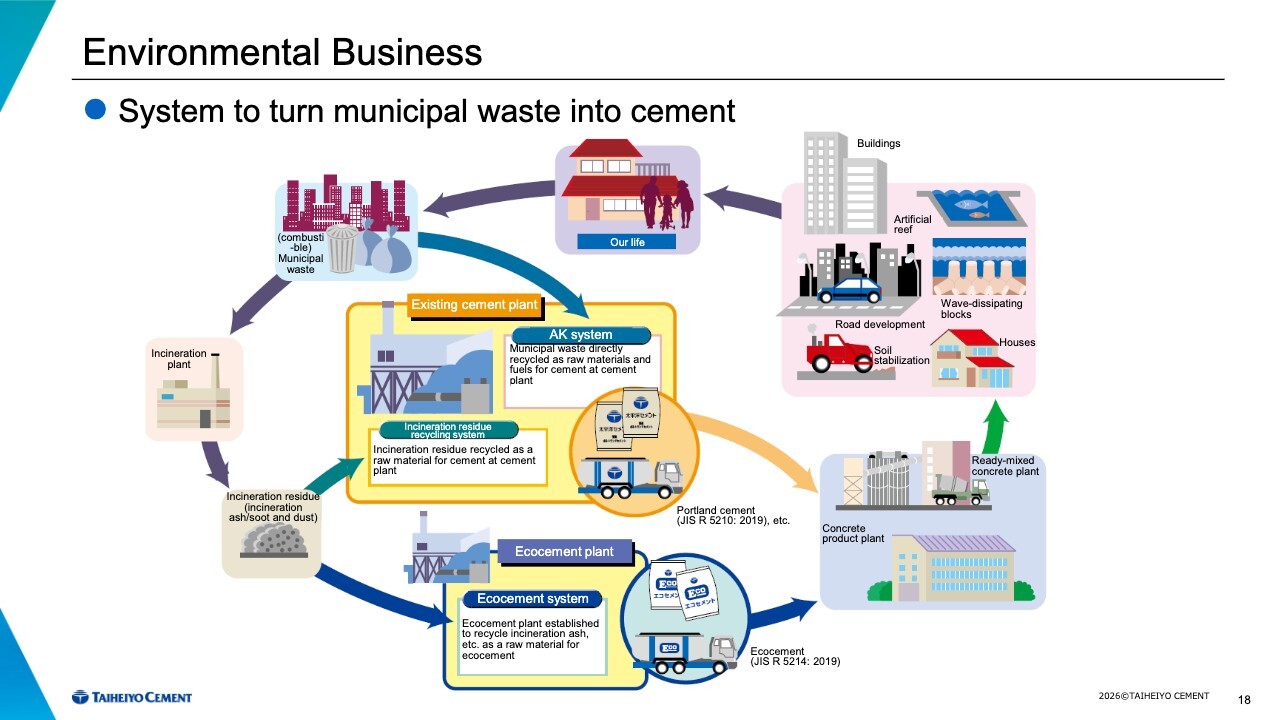
As I explained, we are mainly involved in the AK system, in which municipal waste generated from people’s daily lives is directly processed at our plants, and in producing Ecocement by recycling ash and dust from the incineration process. We work closely with municipalities to ensure smooth processing.
Environmental Business
● The volume of waste treated in our cement manufacturing process
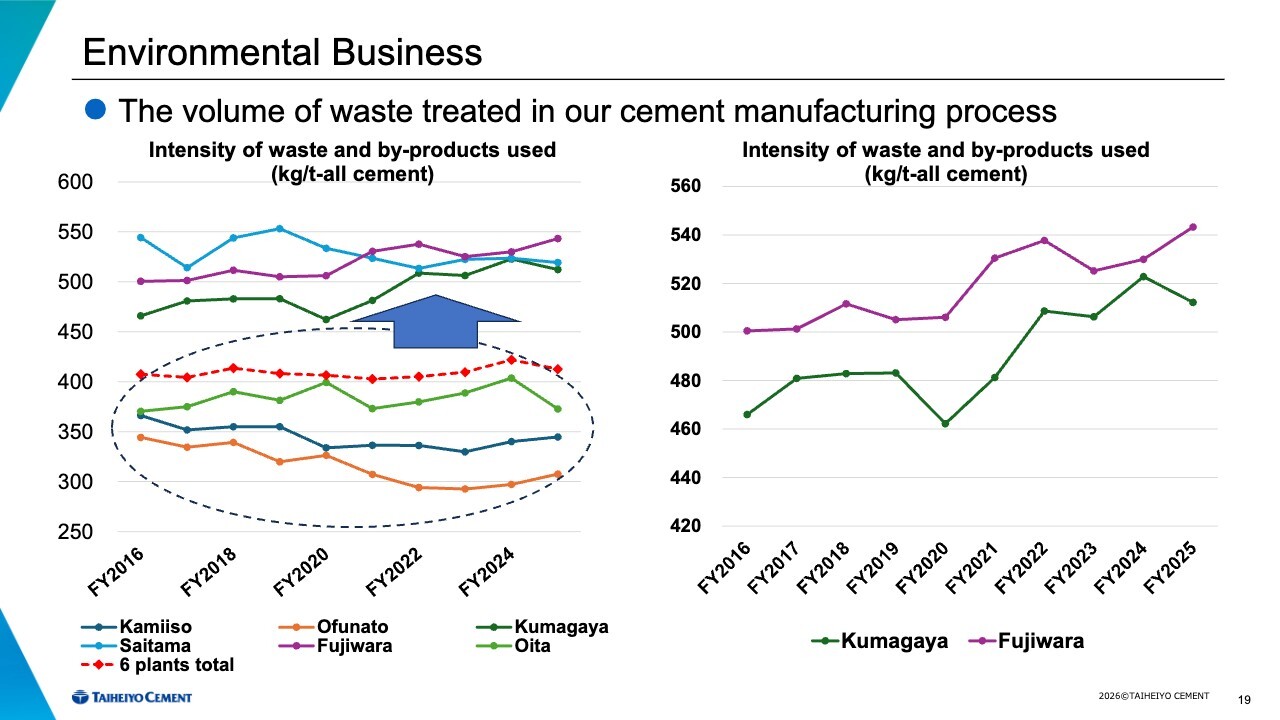
The amount of waste available for use in cement plants varies from plant to plant. This stems from the fact that the quantity of industrial waste gathered at each plant differs. Technically, producing one ton of cement requires 500 to 600 kilograms of waste.
However, some plants, such as the Ofunato Plant, still do not have a fully developed waste collection system. If we can work with local government agencies to establish such a system, we expect the volume of waste processed to increase, as demonstrated at the Fujiwara and Kumagaya plants shown on the right of this slide. Therefore, we expect that there is room for us to make a further contribution.
Environmental Business
● Treatment of disaster waste (following Great East Japan Earthquake)
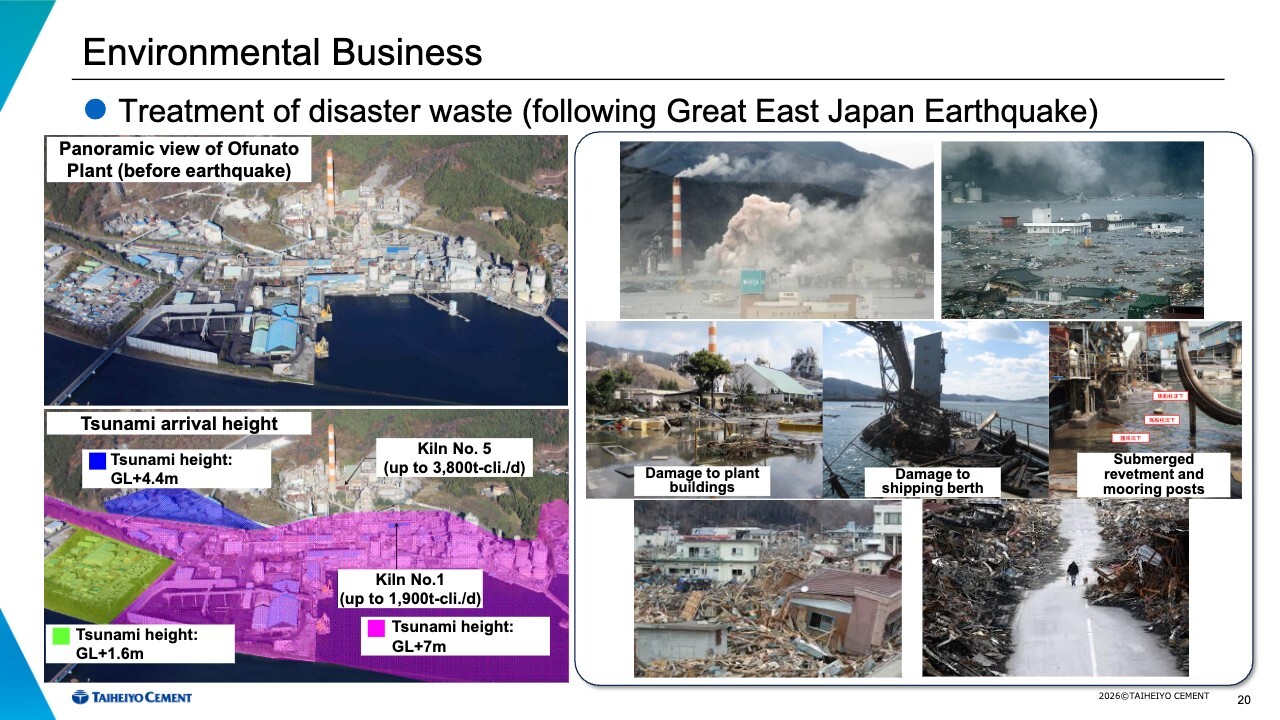
Next, I will explain disaster waste management. The Great East Japan Earthquake, which occurred on March 11, 2011, caused tsunami damage to the Ofunato Plant in Iwate Prefecture. The plant was seriously affected by a steam explosion, as you can see from the slide.
Fortunately, the plant had two kilns, and although the lower kiln was damaged, the kiln on higher ground survived. The city was in a devastating state, as shown in this slide, with piles of debris all around.
Environmental Business
● Treatment of disaster waste (following Great East Japan Earthquake)
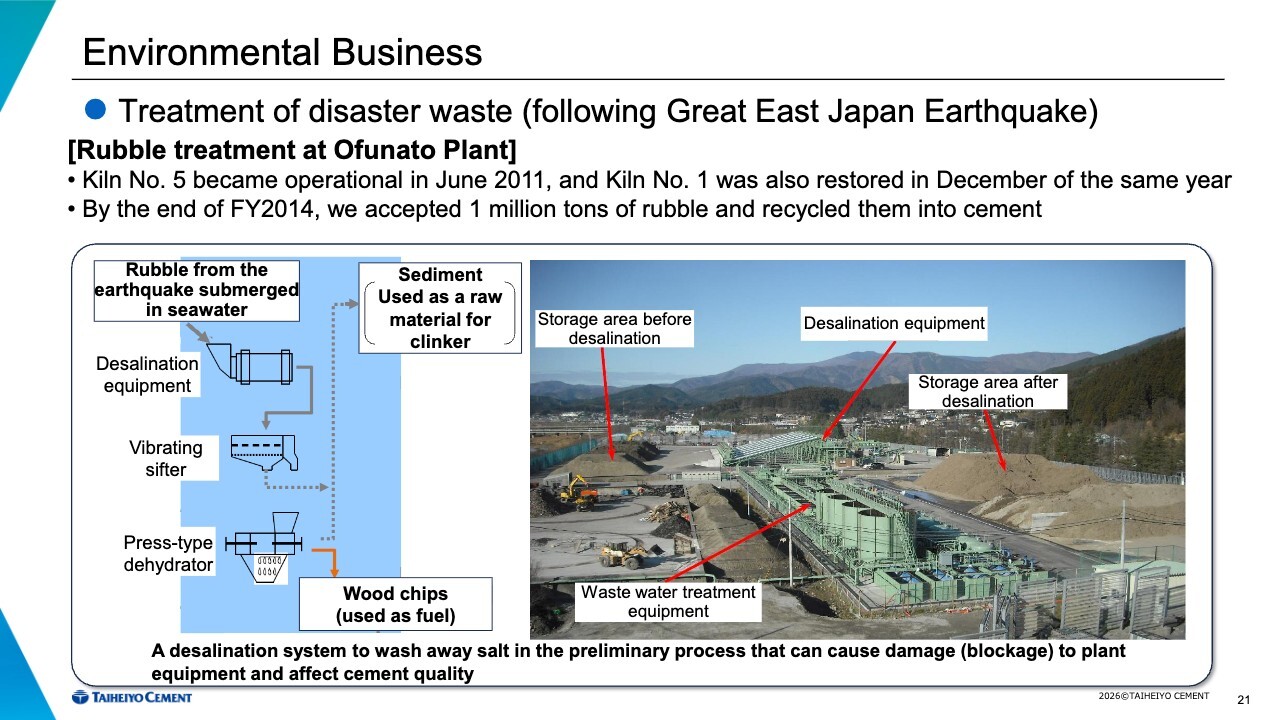
We started to work with REMATEC Holdings Corporation to process the debris. The debris contained large amounts of salt after being submerged in seawater by the tsunami. If used in the cement manufacturing process without proper treatment, this could cause problems in the process.
Therefore, we first washed the debris with water to remove the salt at a desalination facility, and then filtered and dehydrated it using a pressing machine. Subsequently, we sorted all materials into categories such as combustibles and non-combustibles, ferrous materials, other debris, and concrete, and processed it at the plant. In the two years through the end of fiscal 2013, the amount of debris processed at the plant amounted to 1 million tons.
Environmental Business
● Treatment of disaster waste
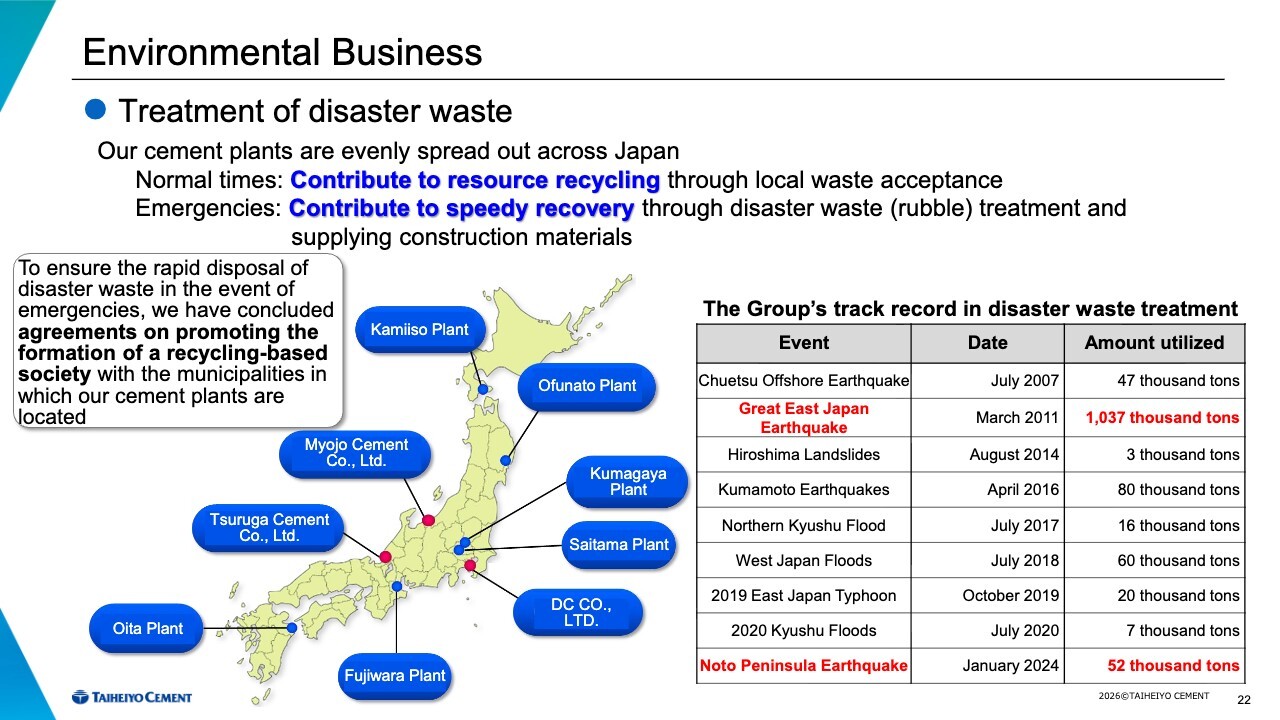
Our efforts extended beyond the Great East Japan Earthquake. We processed 52,000 tons of disaster waste in the Noto Peninsula earthquake and 80,000 tons in the Kumamoto earthquake as well.
This demonstrates a unique power of cement. I believe cement manufacturing is the only sector that can handle large amounts of waste by utilizing it as raw materials and fuel when there is not enough landfill space.
Environmental Business
● Waste treatment in the cement manufacturing process
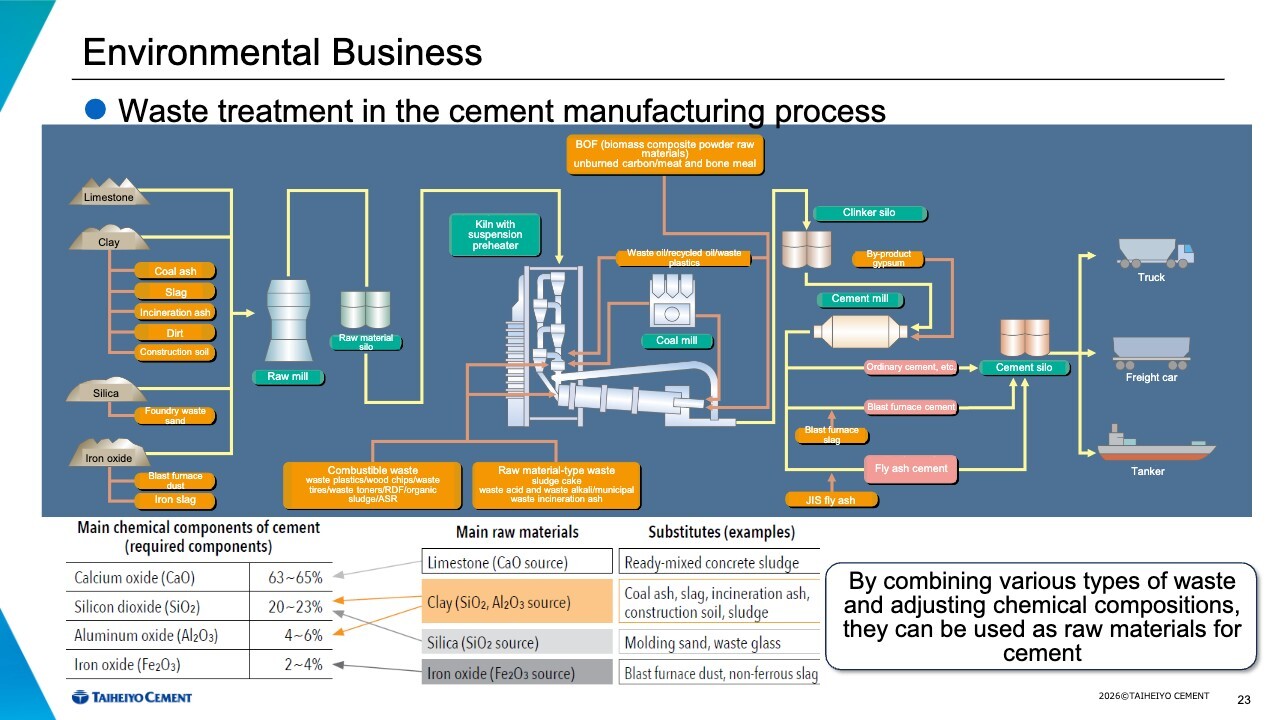
Now, I would like to talk about our waste disposal process in cement production. We use certain types of waste gathered from construction sites. For example, waste soil is mixed with other raw materials, while combustible waste is used as fuel in the high-temperature burning process.
We use two burners in the cement production process. In a section called the tower, the process of calcination takes place at a temperature of about 850 degrees Celsius, separating CaCO3 into CaO and CO2.
It is then baked and melted at 1,450°C to produce a variety of components. For your information, the temperature of volcanic lava is roughly 1,000 degrees Celsius. At 1,450 degrees, which is much higher than that, all organic matter is burned away.
What remains as ash are inorganic materials such as silica and alumina. These can be used as raw materials for cement without causing any harm. These materials are utilized in various processes in various places in cement plants.
Environmental Business
● Waste treatment in the cement manufacturing process
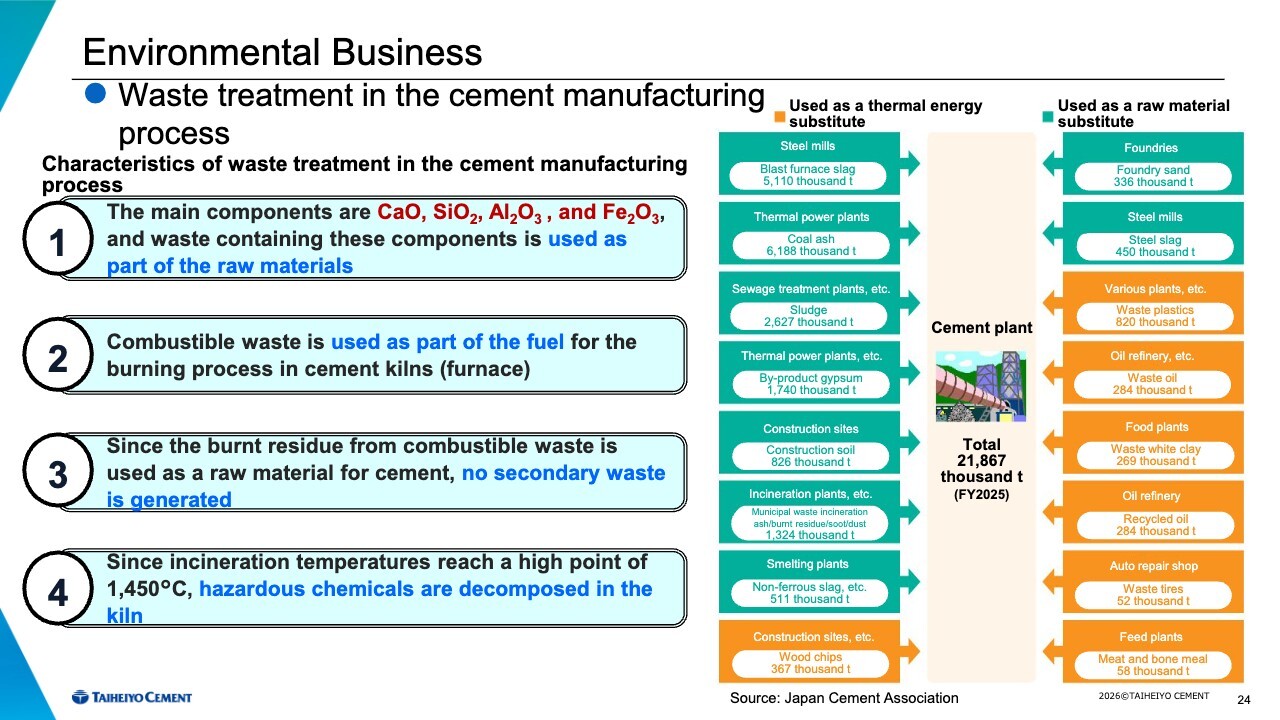
The information here is from a document prepared by the Japan Cement Association. You can see a variety of items that are treated in the industry, including waste plastics, construction soil, and waste tires.
Environmental Business (Growth Areas)
● Waste solar panel treatment business
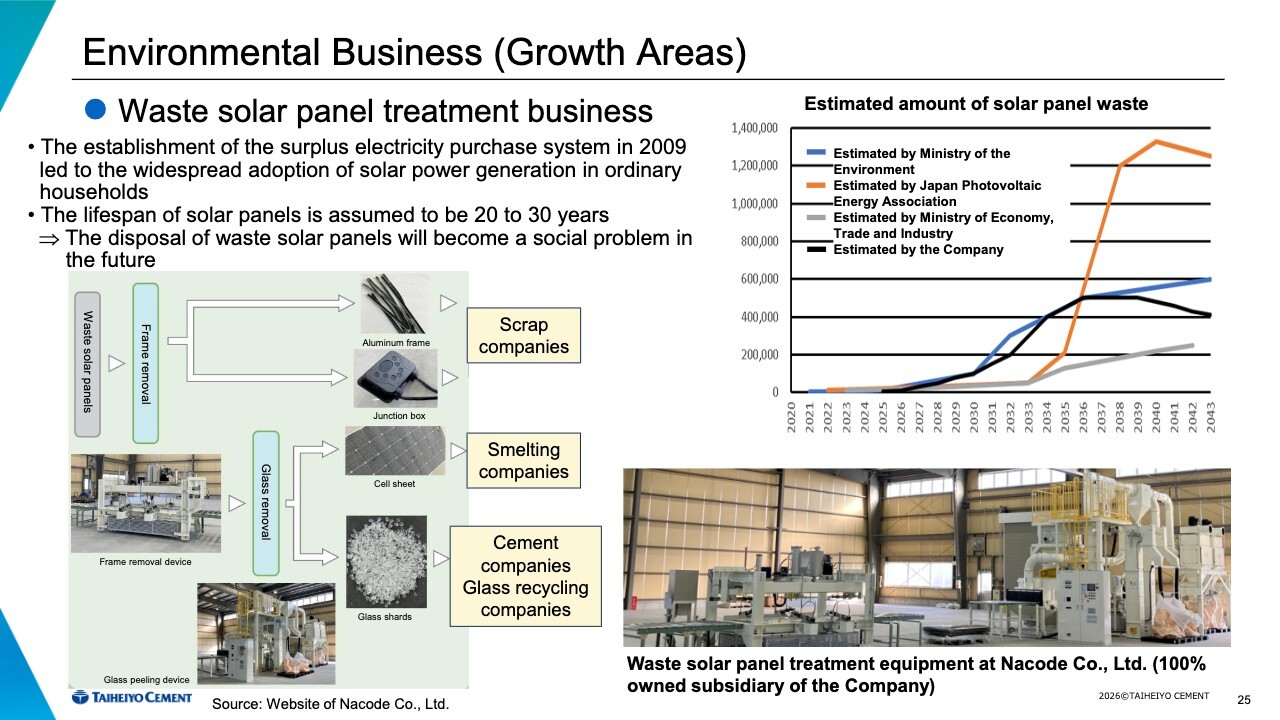
The environmental business not only uses cement kilns but also includes other business areas such as waste solar panel processing. When the feed-in tariff (FIT) program began in 2012, the government was buying electricity at 40 yen per kilowatt-hour, but now it has moved to the feed-in premium (FIP) system that grants a premium price, which is estimated at between 10 and 20 yen.
When the FIT program started, 40 yen per kilowatt-hour prompted the installation of solar panels in various places, including on residential roofs. As a result, there are currently a very large number of solar panels in Japan.
Solar panels become obsolete after roughly twenty years and require replacements. Otherwise, they will show a considerable drop in efficiency. The Japan Photovoltaic Energy Association (JPEA) estimates that solar panel waste will rise sharply around 2035, as shown in the yellow graph on this slide.
To address the expected increase, our wholly owned subsidiary, Nacode Co., Ltd., has built a used solar panel processing facility and begun sorting the recovered parts into categories for reuse as resources.
Environmental Business (Growth Areas)
● Urban mining
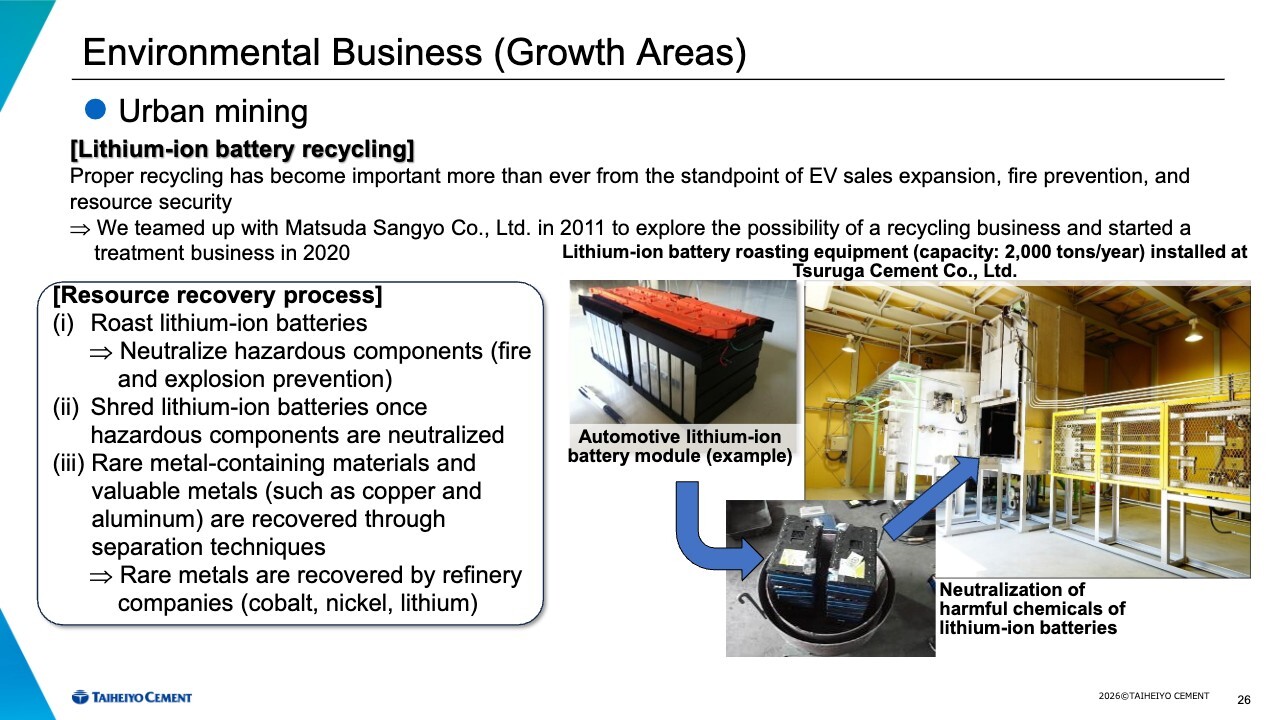
There have been several fire accidents caused by lithium-ion batteries, and this is creating major social concerns. We are actively tackling this issue, and have established a new process at the Tsuruga Cement plant in Fukui Prefecture. Lithium-ion batteries contain ignitable materials that can cause problems in airplanes.
However, such ignitable waste materials can be safely treated by detoxification and high-temperature treatment in an oxygen-free reducing atmosphere. After detoxification, each material is broken down in the next process and recycled. We work on this initiative together with Matsuda Sangyo Co., Ltd.
Environmental Business (Growth Areas)
● Urban mining
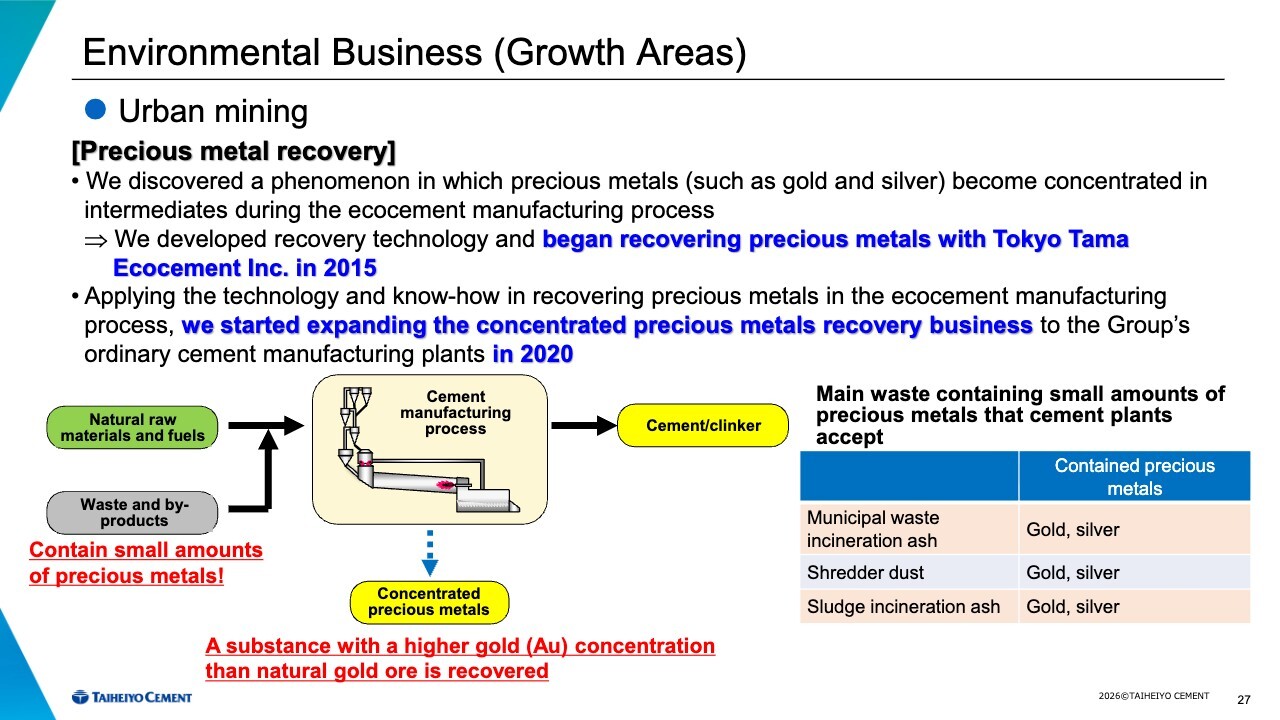
Let’s proceed further on the urban mining business. The supply of rare metals is currently becoming more restricted, so it is a good idea to recycle whatever can be recycled.
When ashes are injected during the production process for Ecocement, their dust also contains gold and silver. We have established a method to isolate and recover precious metals and are already utilizing it.
Environmental Business (Growth Areas)
● Fossil fuel substitute business (promotion of the use of waste plastics)
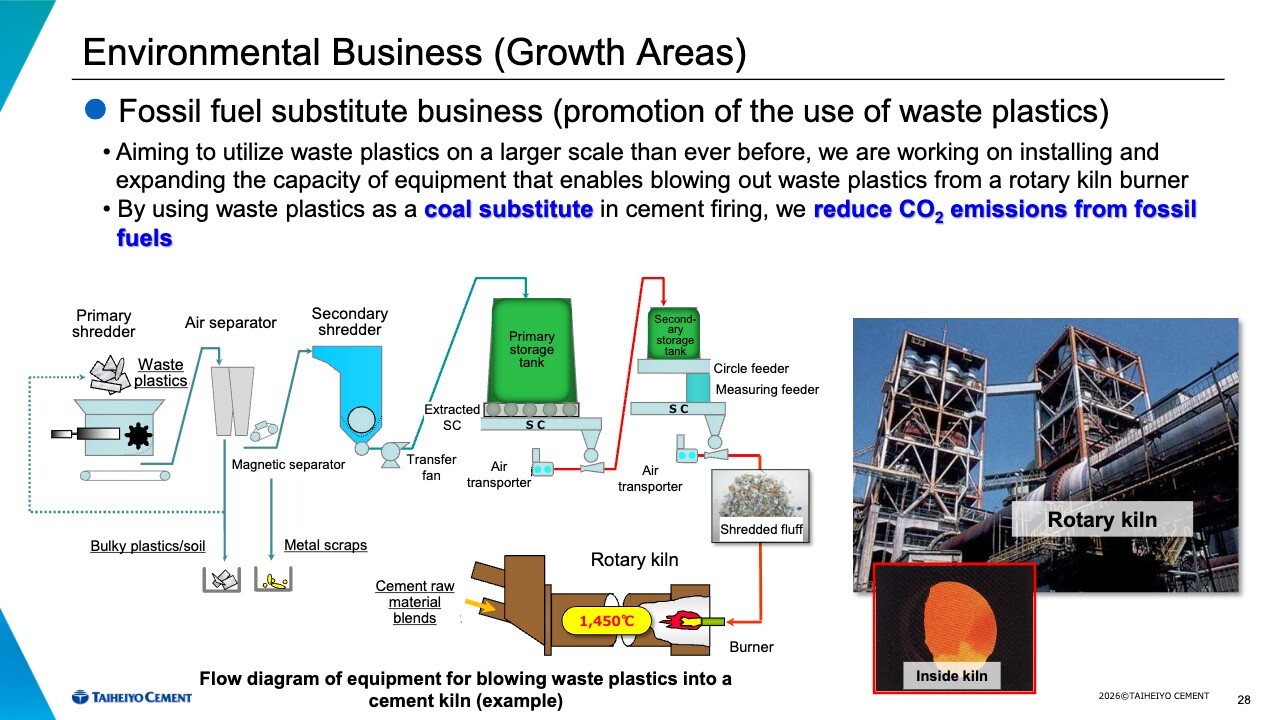
This is a slide about waste plastics. Microplastics pollute the oceans, so plastics that cannot be recycled must be properly incinerated. Otherwise, improper disposal into the sea can lead to problems, including fish ingesting the plastic.
To this end, we are working with municipalities and proposing that they entrust us with waste plastic disposal. By using waste plastic as an alternative to coal, we can reduce CO2 emissions and build a recyclable system.
Currently, coal is mainly used for cement calcination, but waste plastic can replace about 50% of this material. Ultimately, the goal is to replace 80% with waste plastic.
If we can push the coal ratio down to 20%, we can also reduce price volatility risks caused by geopolitical issues. We are working hard to promote this initiative, as it will be beneficial to us and to everyone who disposes of industrial waste, as well as to the government.
Environmental Business (Growth Areas)
● Eco-friendly hard blocks that make the maximum use of waste materials
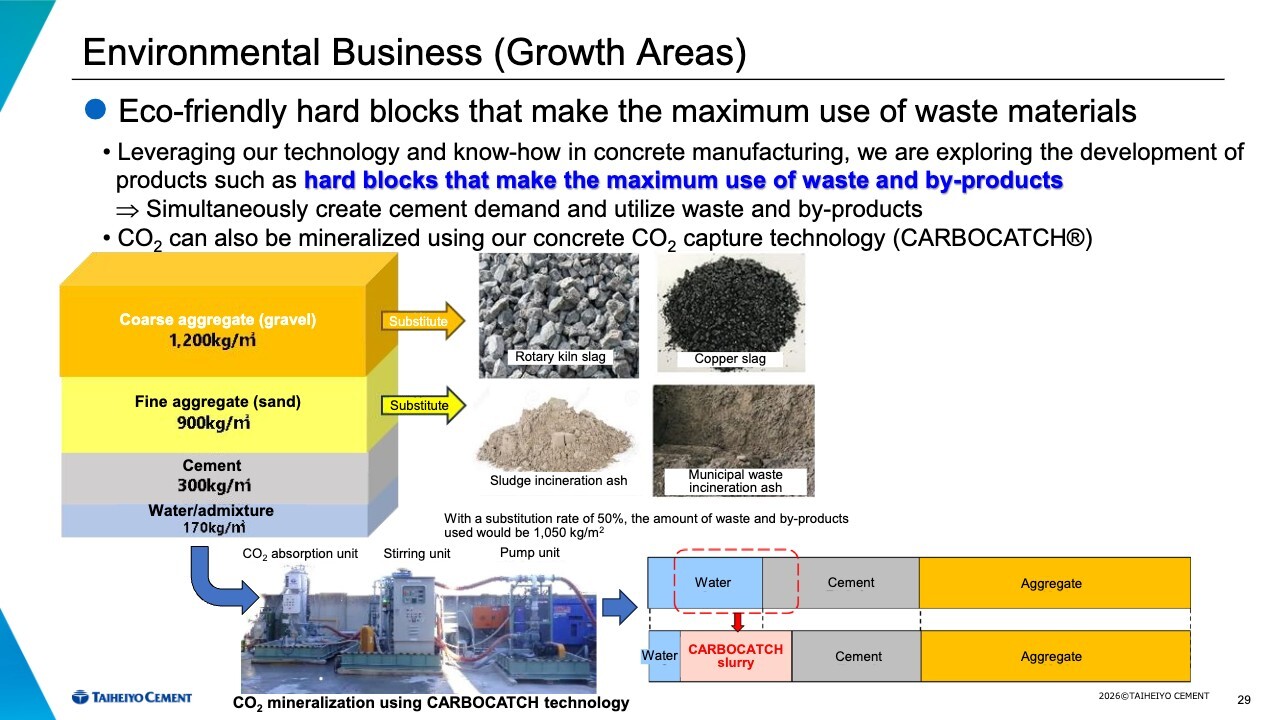
Let me explain about our CO2-absorbing CARBOFIX® cement. Ultimately, we are going to use this cement to make various blocks. Leveraging its CO2-absorbing characteristic, we are developing products in which the block itself has a mechanism to absorb carbon dioxide.
Environmental Business
● Market size of the environmental industry in Japan
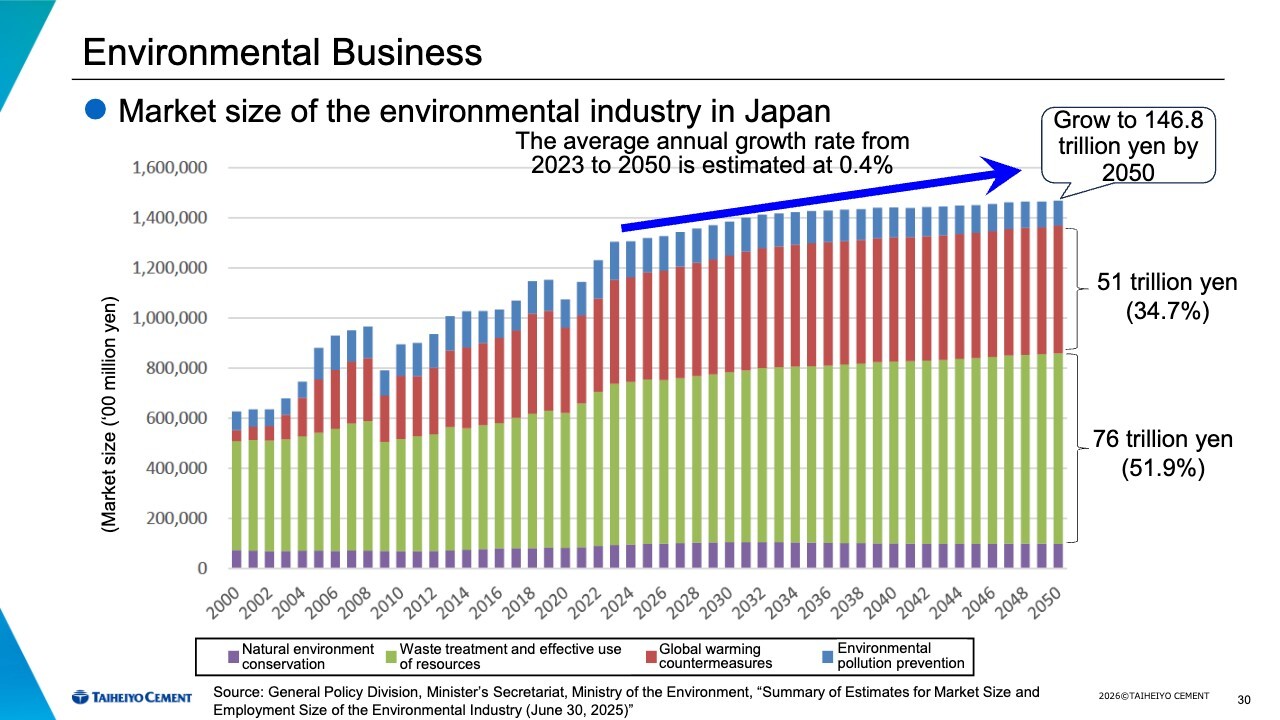
Based on figures from the Ministry of the Environment, this graph illustrates the scale of the local environmental industry, which is clearly expanding. The market does not appear to be growing, as a declining population is expected to reduce the volume of waste. Japan's population is anticipated to drop by nearly 20 million, reaching a total of roughly 100 million by the year 2050.
Contrary to that data, environmental market size is projected to grow. The reason for this may be the rising cost of processing waste, and it could also be evidence of backing from policy that ensures the proper disposal of complex industrial wastes.
Mineral Resources Business
Next, I would like to explain our Mineral Resources Business. As indicated in this slide, limestone is one of the few strategic resources that Japan can supply independently. Let me explain by taking coal as an example.
Japan used to produce a very large amount of coal. During the 1950s, the coal sector reached its height with an output of 50 million tons per year, a volume that would cover 50% of the current yearly demand of about 100 million tons.
At that time, I often heard the Japanese folk song “Tanko Bushi.” The lyrics "The moon is out, the moon is out" and "The chimney is so high, the moon above is likely becoming quite covered in smoke" were sung at a time when the Miike Coal Mine was very prosperous.
Nowadays, I think only a handful of coal mines continue to exist, such as in Yubari. The situation is such that very little is being produced. No matter how abundant resources are thought to be, they will one day be depleted. Therefore, we are implementing various measures to optimize limestone consumption.
Mineral Resources Business
● Business components
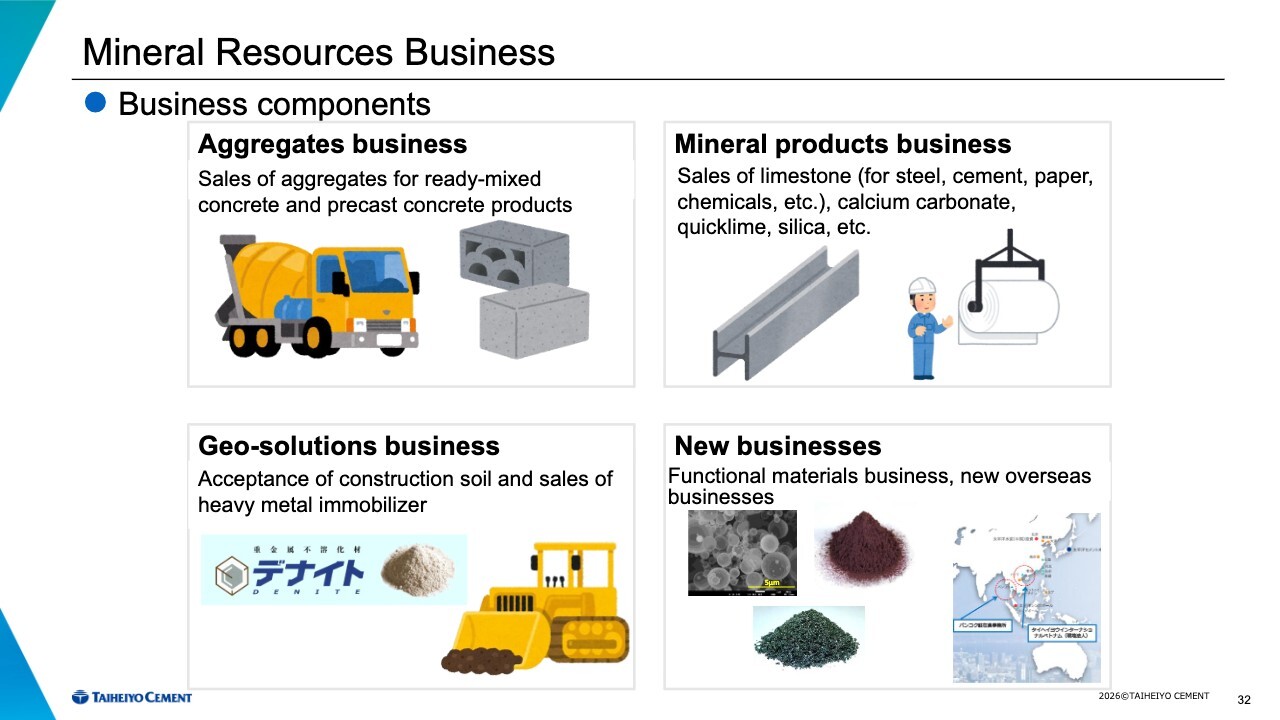
Limestone is used for a variety of applications, including ready-mixed concrete.
Mineral Resources Business
● Strategic securing of natural resources
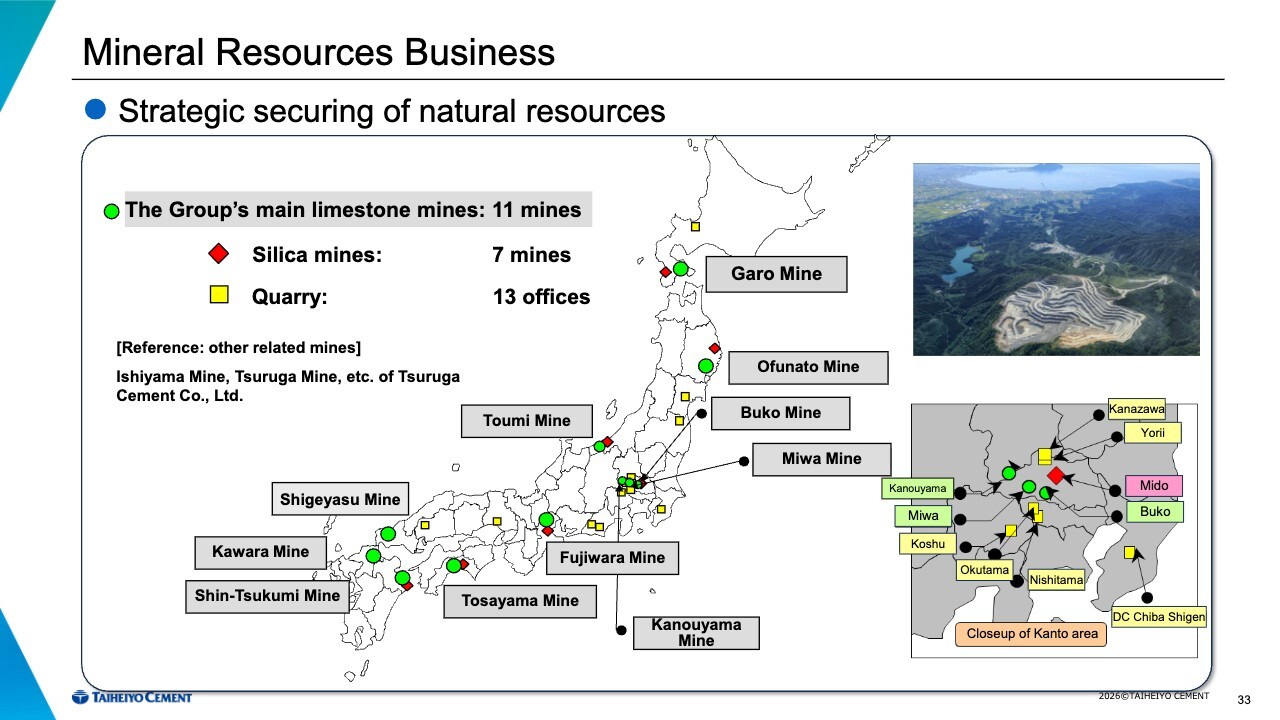
Our company owns eleven mines throughout Japan, including several in Tokyo and the Kanto area.
Mineral Resources Business
● Strategic securing of natural resources
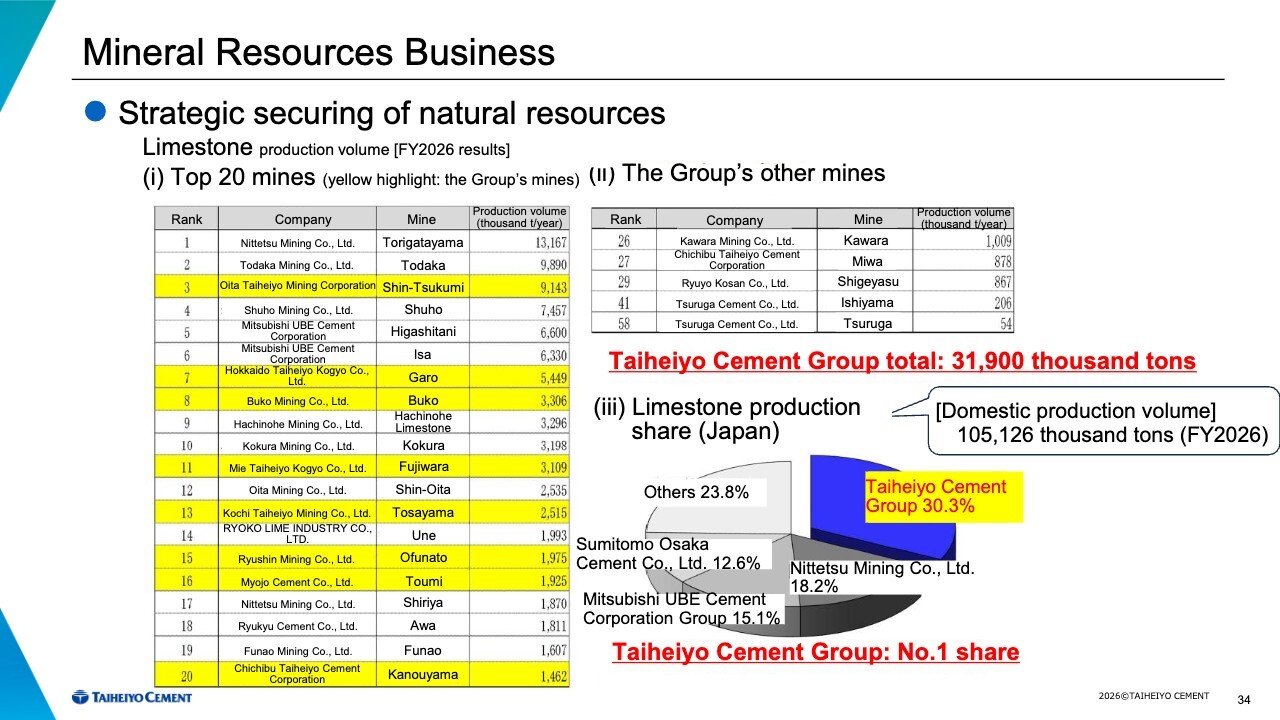
The slide shows production volumes. Of the top 20 mines, those in yellow are operated by TAIHEIYO CEMENT Group. Japan as a whole produces about 100 million tons of limestone annually, of which about 30% is produced by the Taiheiyo Cement Group.
Mineral Resources Business
● Limestone aggregate sales expansion strategy
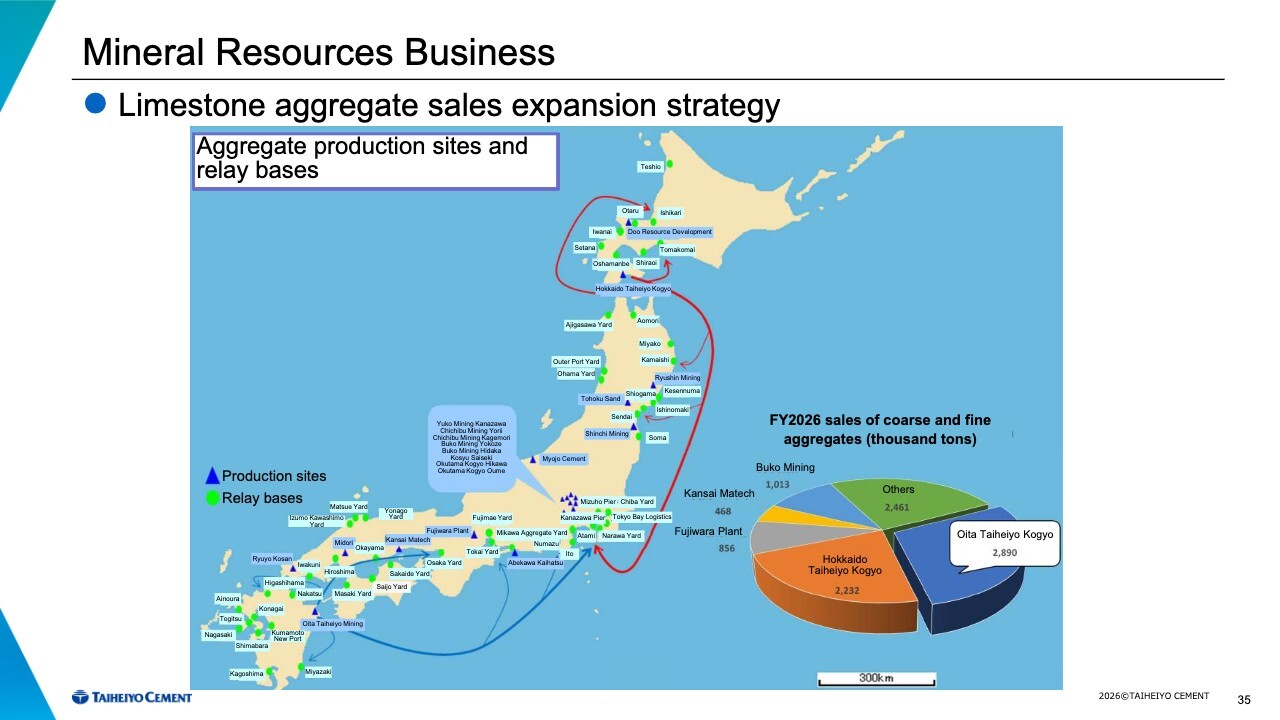
The Kanto area is a region with high demand for ready-mixed concrete. High demand also means limited supply, even from the Buko Mine in Saitama Prefecture. Reserves will not last 200 or 300 years. There is a possibility that digging will be forced to end even sooner than that.
In anticipation of this situation, we are already making preparations to transport aggregate from Hokkaido and Kyushu in order to prevent any disruptions in the Kanto region. In Tsukumi City, Oita Prefecture, we’re developing new mining areas steadily underway.
Mineral Resources Business
● Limestone aggregate sales expansion strategy
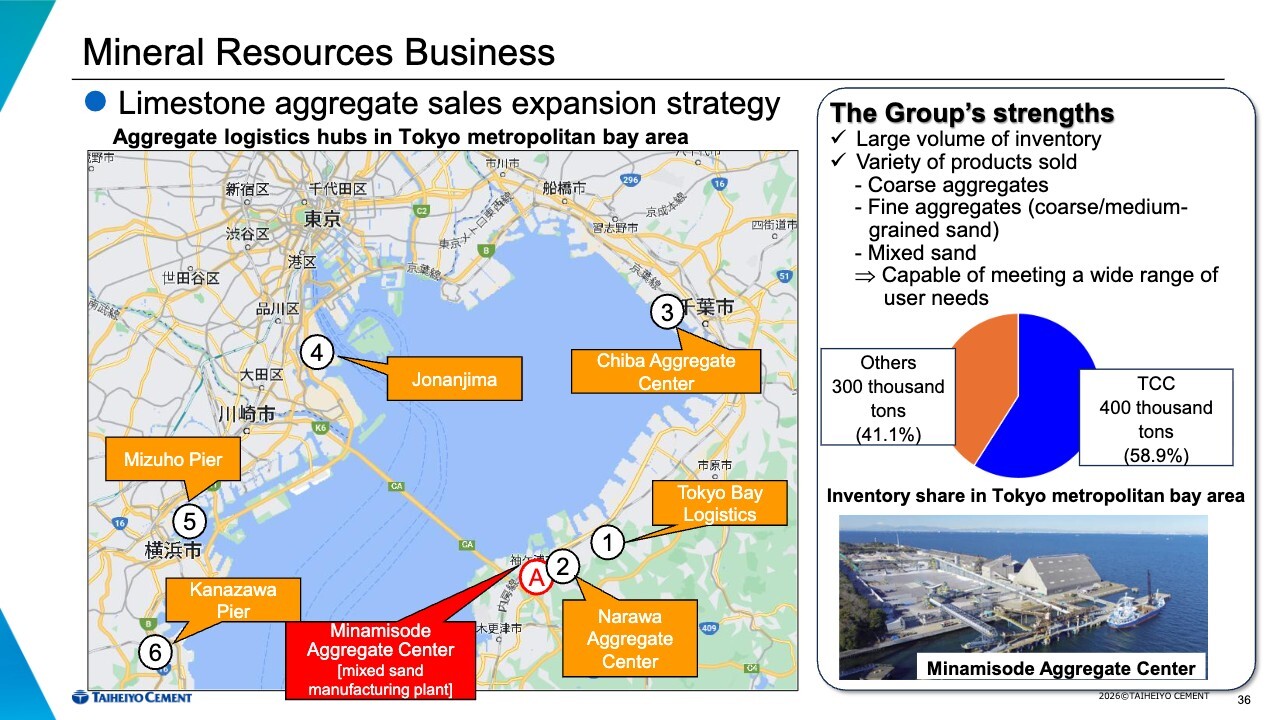
In the Tokyo Bay area, we have 400,000 tons or approximately 60% of inventory share. We are setting up aggregate distribution centers in various places such as Minamisode Aggregate Center, shown in the lower right corner of the slide. This also demonstrates our determination to avoid disruption in the southern Kanto region.
Mineral Resources Business (Growth Areas)
● Geo-solutions business
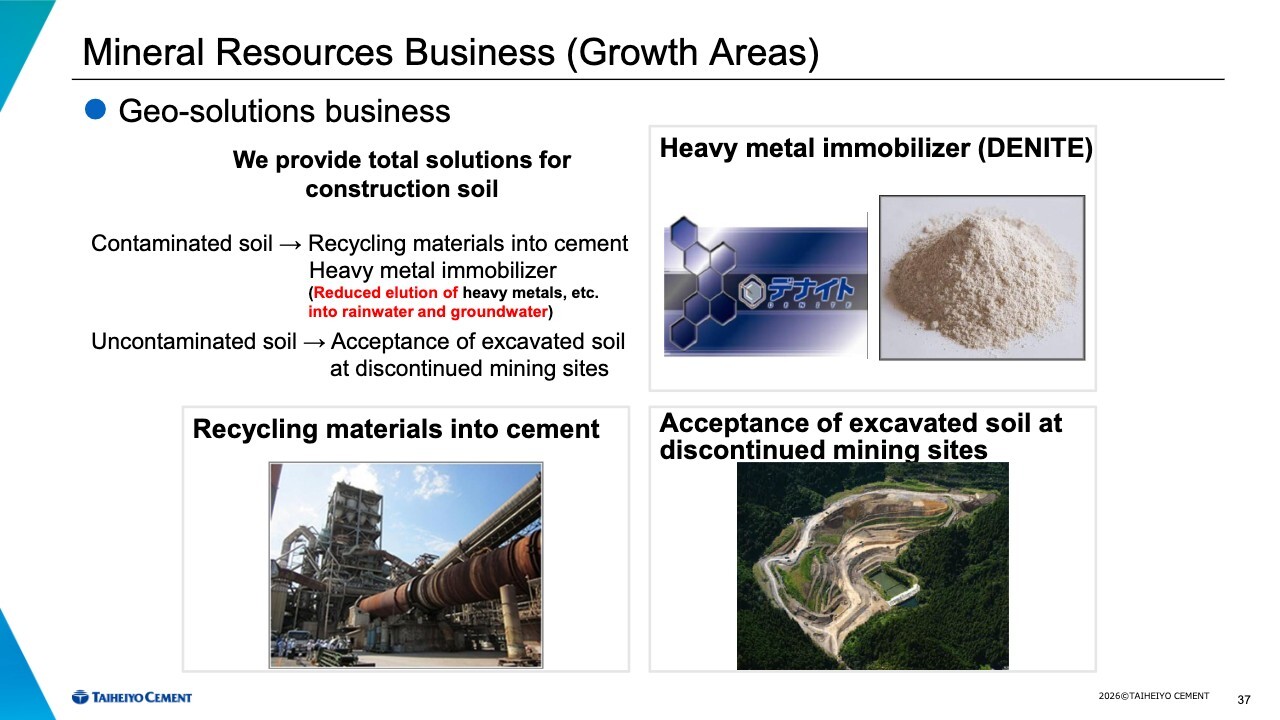
The next business is soil solutions. Soil containing heavy metals may be generated during the construction of roads and tunnels. We must not overlook the possibility of these soils dissolving into groundwater.
“DENITE”, a heavy metal immobilizer, is a material that limits that possibility. It is widely used today and is indispensable for the effective utilization of soil discharged during construction.
Mineral Resources Business (Growth Areas)
● Promotion of DX
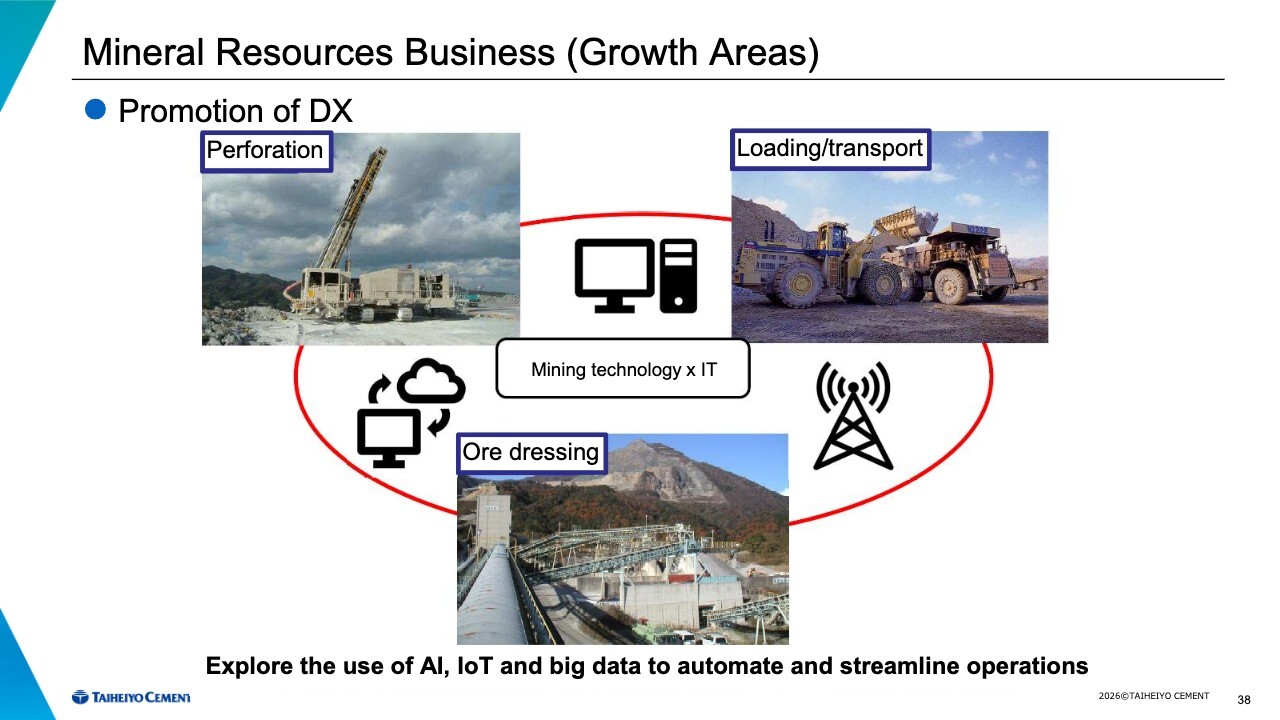
Our mining sites are transitioning to unmanned operations, and we are currently testing the autonomous use of heavy machinery.
Mineral Resources Business (Growth Areas)
● Functional hollow particles (CellSpheres®)
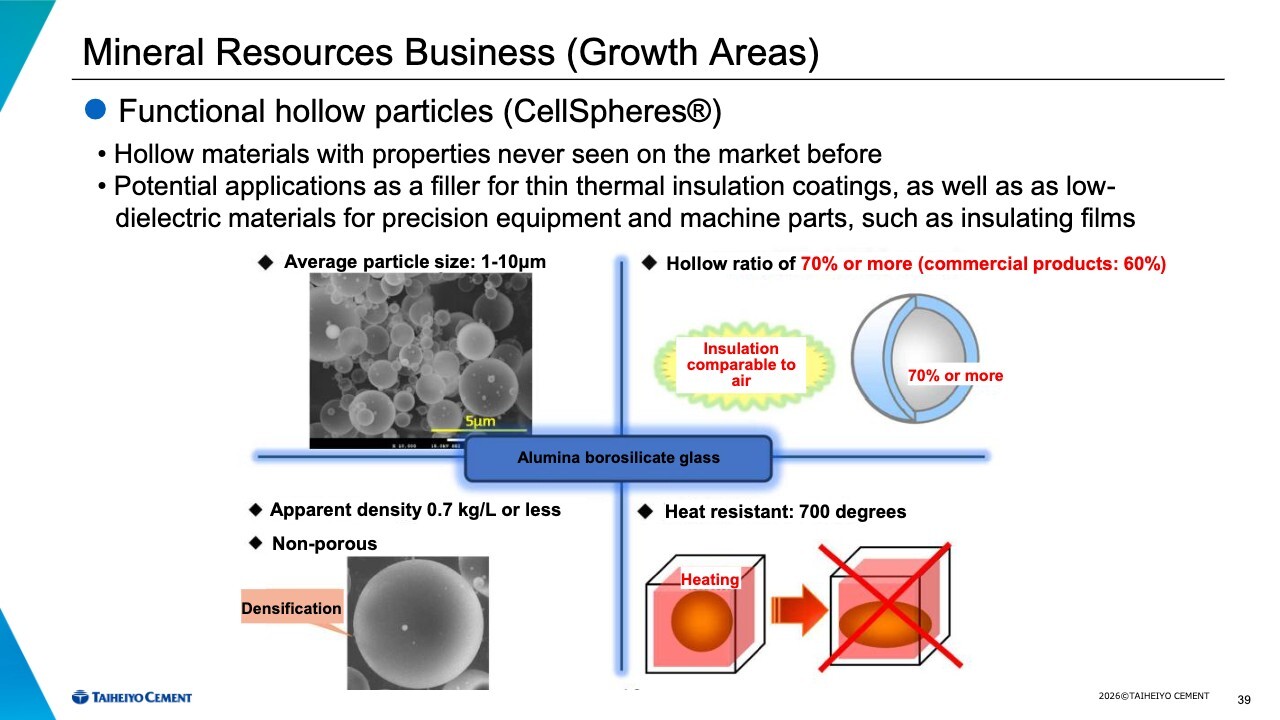
Now, I would like to present our functional materials. One example is a hollow particle with an empty center. As shown in the slide, its average size is one to ten microns, with one micron equaling one-thousandth of a millimeter.
These small particles are used for films and precision machine parts. For example, when used in precision equipment components, they help reduce radio wave signal loss due to their low-dielectric nature.
This highly sought-after product will be completed very soon. I will be sure to make a detailed introduction to you when it is completed.
● Focused investment in growth areas
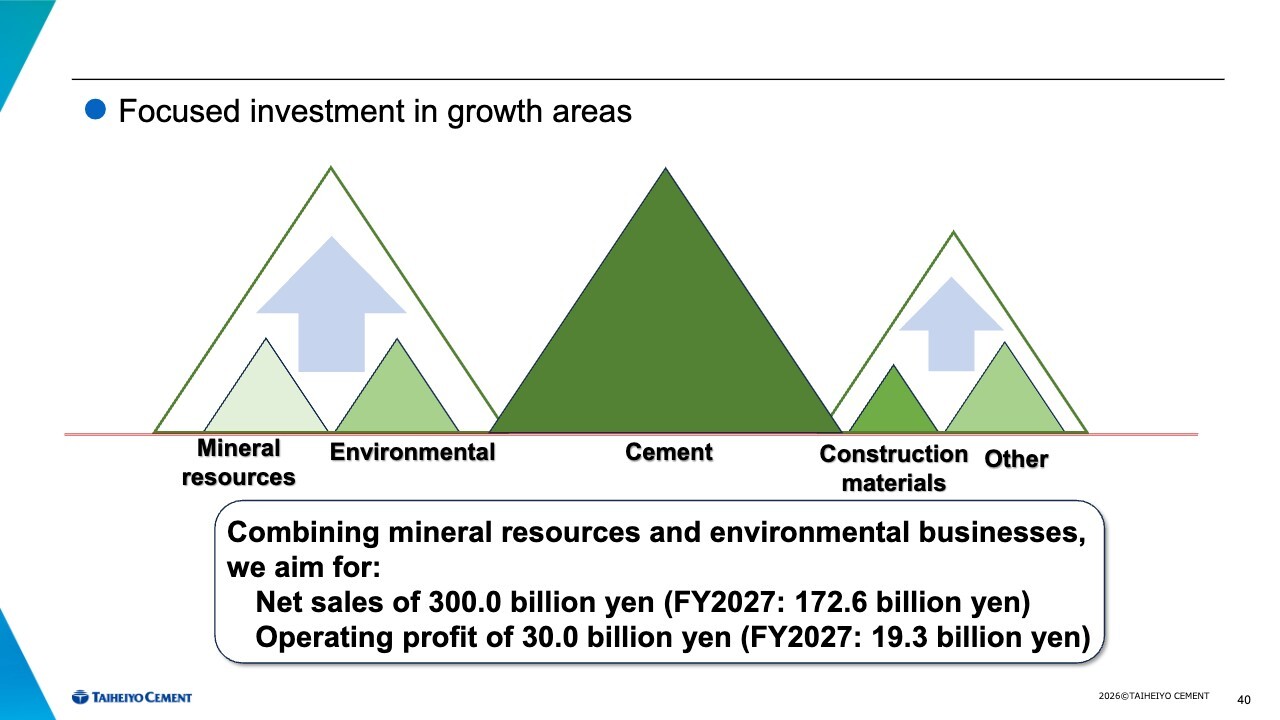
Until now, our focus has been on the cement industry and cement demand, but for the next Medium-Term Management Plan, we will strengthen our Mineral Resources and Environmental Businesses, which have great potential for growth. This will be one of the pillars of the next Medium-Term Management Plan.
In the ‘FY26 Medium-Term Management Plan’, the combined net sales and profits of the Mineral Resources and Environmental Businesses did not reach 200 billion yen and 20 billion yen, respectively. Our long-term target is to achieve 300 billion yen in net sales and 30 billion yen in profit, and we intend to establish a clear path forward throughout the upcoming Medium-Term Management cycles.
Regrowth of Domestic Business
Now, let me move on to the domestic business. It would be beneficial if the government could allocate a larger budget to infrastructure investments. Nevertheless, we remain committed to our growth target, regardless of whether these investments occur. We are transforming in line with a specific theme, shifting from a cement manufacturer to a company that supports sustainability and the resilience of society.
Regrowth of Domestic Business
● Cement business
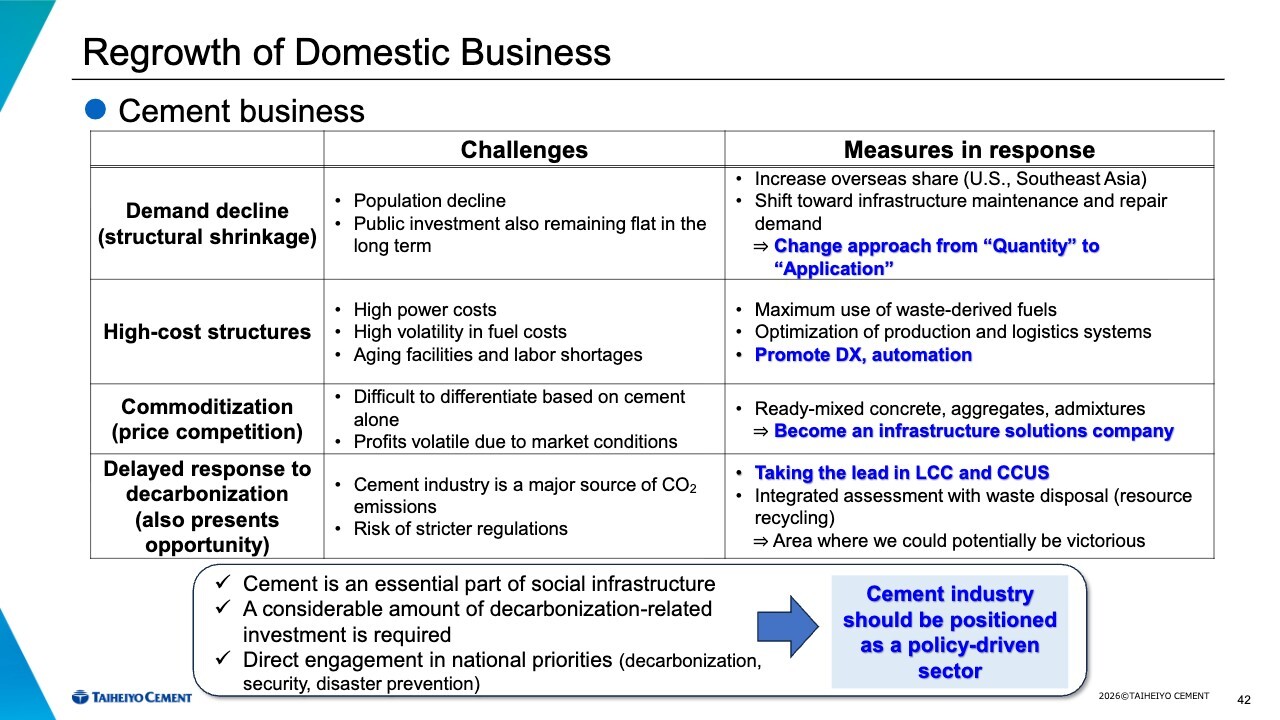
For the Cement Business, we will shift our focus from "volume" to "application" and drive DX so that the business can operate even with a reduced workforce. We also aim to ensure a stable supply of aggregates and evolve into an infrastructure solutions company. We see aggregate as a fundamental part of our Cement Business, so make every effort to accomplish this goal.
We are also making steady progress in our decarbonization efforts and aim to take the lead in this area.
Finally, we aim to "transform the cement industry into an industry that has strategic importance for government policy." As I have explained, the cement industry is indispensable in times of catastrophe and other difficult situations. Debris disposal is an essential part of the restoration and reconstruction process, and no other industry can contribute more to the disposal of industrial waste.
Consequently, we think the important role the cement industry plays in social infrastructure should be reflected in government policy, and we are currently engaging with the government to this effect.
Regrowth of Domestic Business
● Direction of technological development
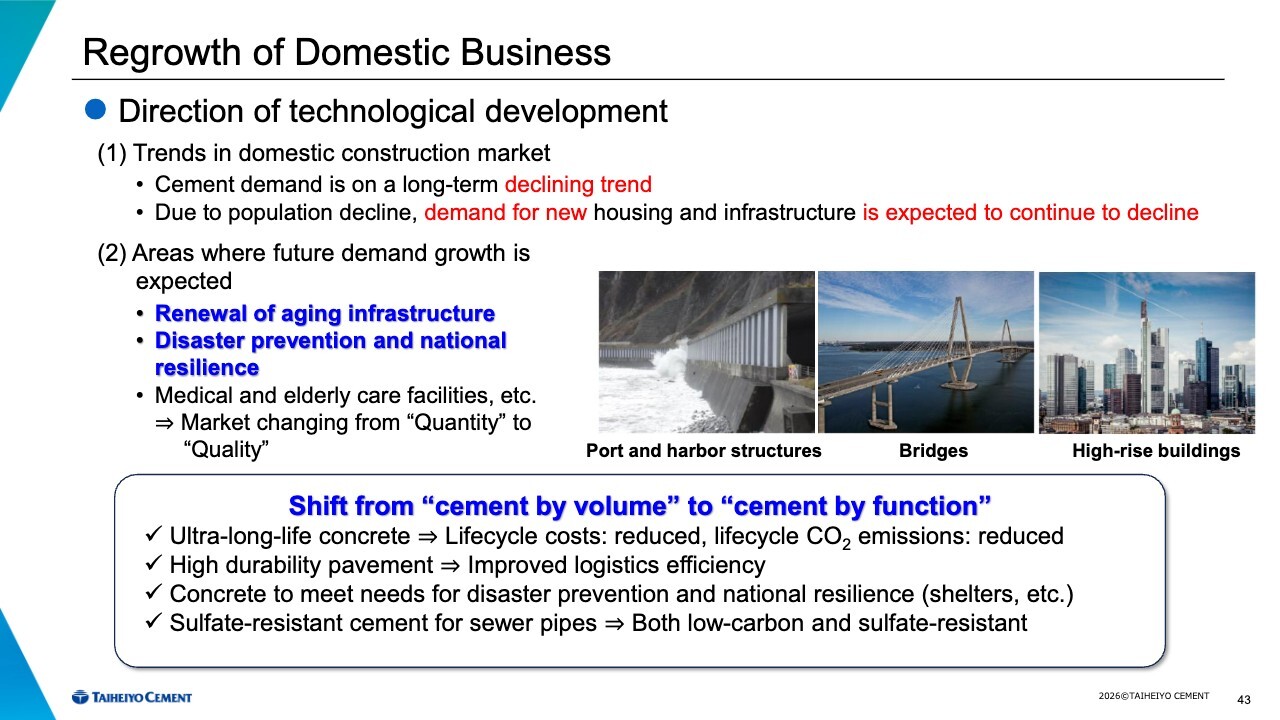
As for the direction of technological development, we are considering a shift from "cement of quantity" to "cement of function.” Typically, the expected longevity of infrastructure is 50 years. Yet, with a touch of innovation, it is possible to make cement that will last 100 to 200 years. We also have the technology to produce some of the strongest concrete in the world.
Until now, price has been the key factor in purchasing decisions, and our products have been rejected due to their higher pricing. However, I am starting to think that we can market our products by highlighting that they may be two or three times more expensive than other products on the market, but their lifespan is ten to twenty times longer, thereby justifying the higher price.
Regrowth of Domestic Business
● Renewal of aging infrastructure
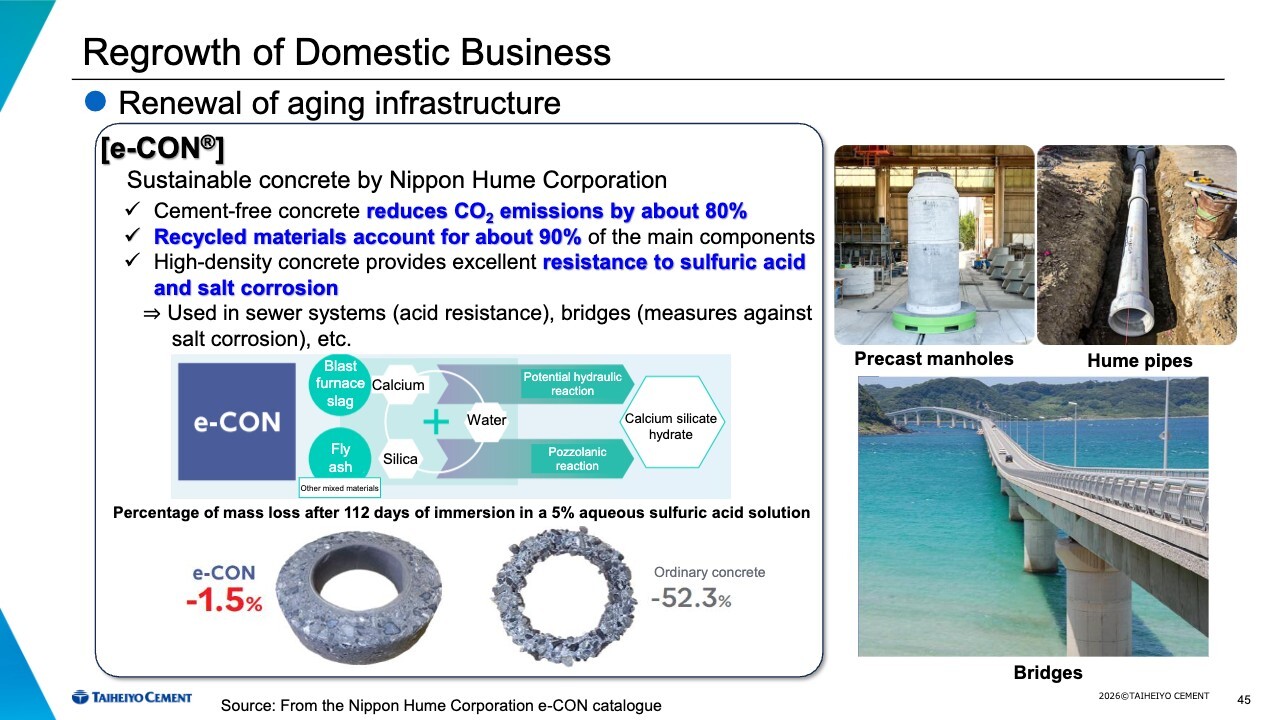
This slide describes a product manufactured by our group company, Nippon Hume Corporation. They manufacture so-called Hume pipes, which are clay pipes to be buried underground. These clay pipes can be eroded by hydrogen sulfide.
Please see the photo at the bottom center of this slide. You can see how badly the pipe is eroded. This erosion was the reason for the Yashio City road sinkhole. Nippon Hume’s new product “e-CON”, however, does not erode, unlike ordinary concrete. These are the kinds of materials we can supply.
As for cement, we used to manufacture a lot of sulfate-resistant cement. With the adoption of new material designs in the future, it will be possible to create Hume pipes with a durability of 100 or 200 years rather than 40 or 50 years. This is one of the initiatives we are currently undertaking.
Regrowth of Domestic Business
● Renewal of aging infrastructure
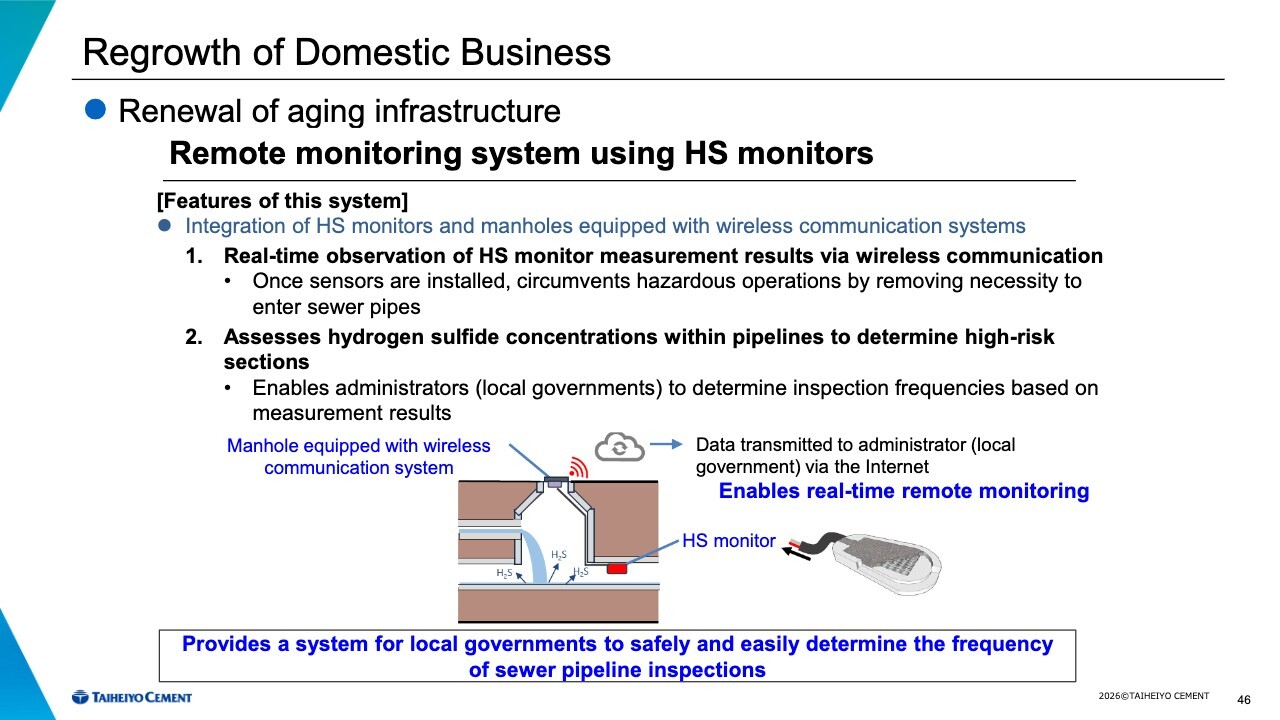
The HS Monitor is currently attracting considerable attention, so I want you to have a closer look at this product. HS refers to hydrogen sulfide (H2S). In total, there are approximately 500,000 kilometers of sewer pipes buried underground in Japan.
The other day, I was told by a government official that about 750 kilometers of sewer pipes need to be repaired urgently. Besides, there are about 40,000 kilometers of sewer pipes that appear to be more than 50 years old.
To decide how to handle this task, we first need to identify areas where hydrogen sulfide concentrations are high and erosion is progressing in order to set priorities. This will ensure those areas where the situation is serious or expected to get worse in the future are addressed first, rather than being tackled randomly. So we developed the monitor to evaluate the condition of pipes.
When a monitor is installed and a transmitter is attached to a manhole, the system sends out a signal based on the concentration levels. Installation is easy so it can be ready to use quickly.
We need to set standards and work on things like, "This area is pretty eroded" or "This area is still okay." Otherwise, accidents like the one in Yashio City could occur again.
About 30 accidents a day happen in Japan, including minor ones. If left unattended, the situation is likely to become more serious in 10 years’ time.
The "HS Monitor" is getting a lot of attention, and we will continue to focus our efforts on it.
Regrowth of Domestic Business
● Disaster prevention and national resilience
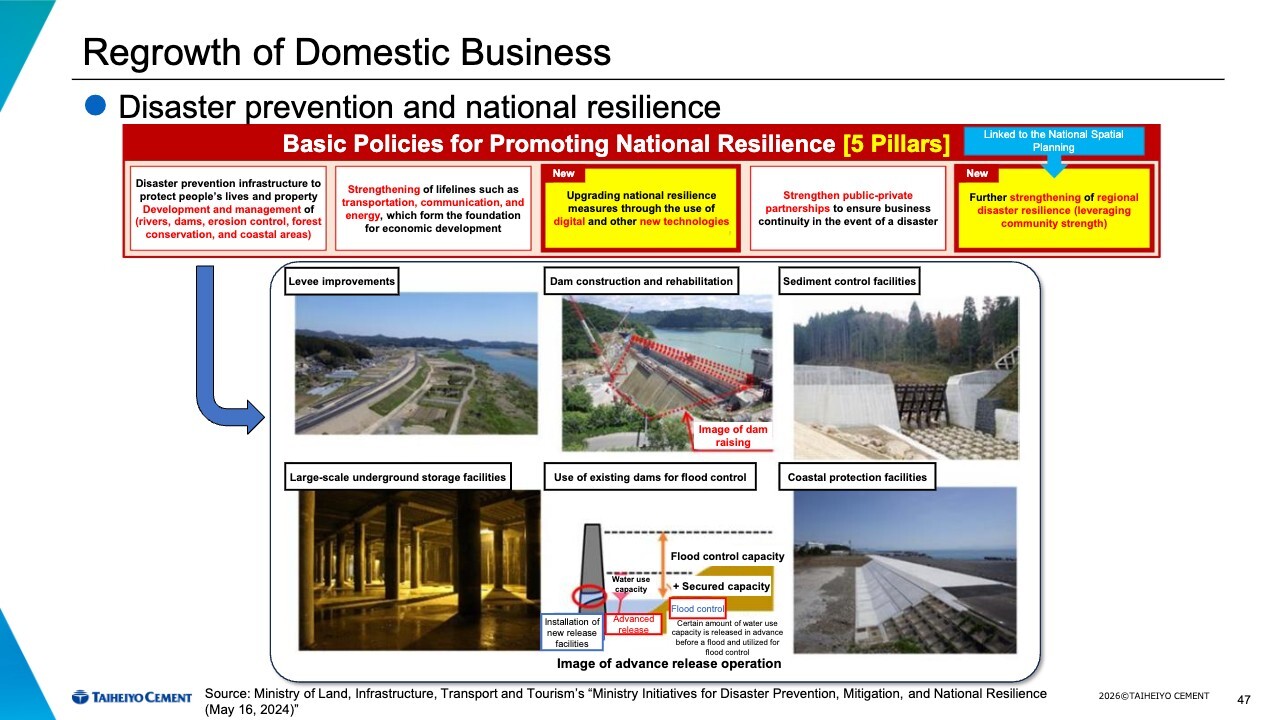
The slide describes the basic policy of the Ministry of Land, Infrastructure, Transport and Tourism. Projects include the setting up of sizable underground chambers to drain water during floods, as well as measures related to sand erosion control. These are part of the national resilience initiative, yet we are slightly disappointed to see so little progress has been made so far.
Regrowth of Domestic Business
● Building LCA system (Japan)
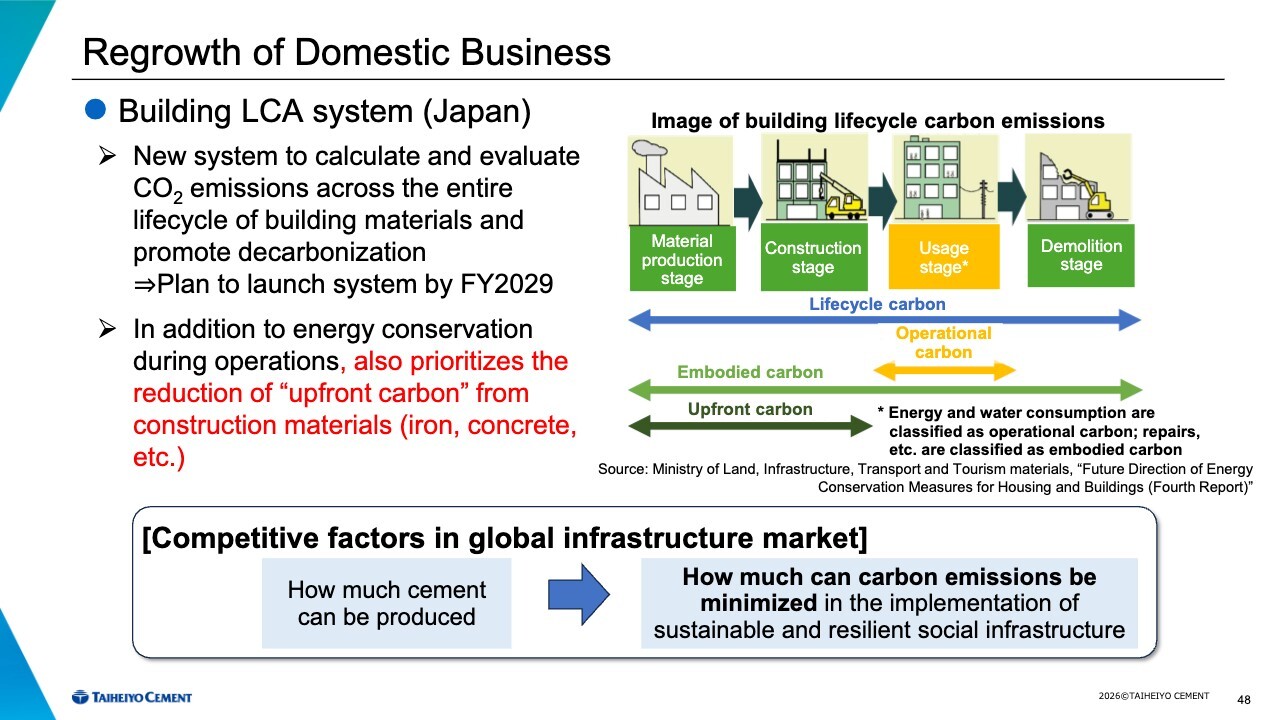
Soon the building Life Cycle Assessment (LCA) system will finally be launched. The project is scheduled to begin in FY2028. For example, the stage during which electricity is used in a building refers to operational carbon, or so-called carbon emissions. This shows how much greenhouse gases are emitted daily, including from electricity consumption by refrigerators and other appliances.
Another indicator, embodied carbon, indicates how much CO2 was emitted, for example, by all the materials used in the construction of a building. A system to strictly control this embodied carbon will be introduced in 2028.
General contractors will likely ask about the availability of low-CO2 cement options compared to standard cement as part of the preparations for this system. They will be obligated to report to the government the total amount of CO2 emissions and how much is emitted by the various components, including cement.
Thus, after FY2028, customers' efforts to become carbon neutral will be a very important factor for us. And we have about two years until this becomes a reality.
Carbon Neutrality
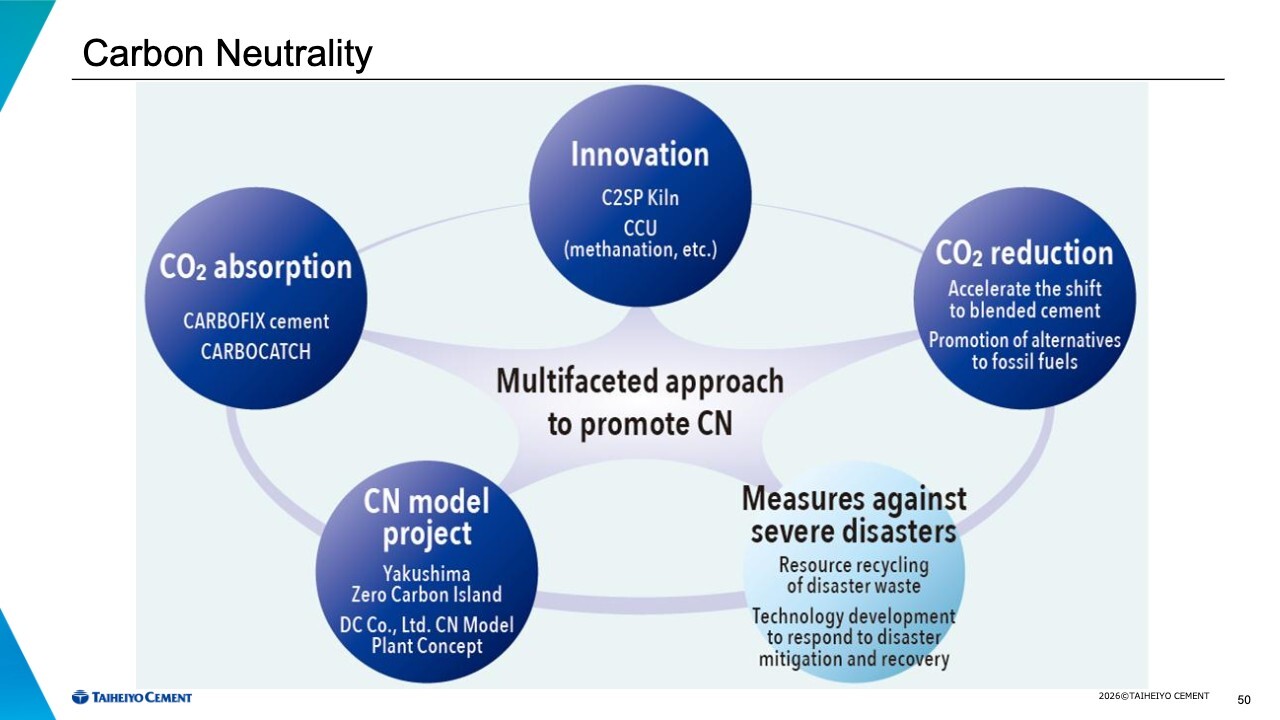
I will briefly discuss the five pillars of carbon neutrality moving forward.
We are making constant strides in the direction of carbon neutrality. However, it is very difficult to achieve a 100% reduction all at once. Nonetheless, we are making progress step by step so as not to give up or face allegations of greenwashing.
The first innovative approach, the C2SP Kiln, which is a CO2 capturing cement production facility, is almost complete and is just waiting to be installed in the plant itself.
However, we need to move forward with infrastructure investment first in order to liquefy the captured CO2 and bury it off the Akita coast. But until the infrastructure for the facility is in place, we will have to wait.
To reduce CO2 emissions, we are accelerating the shift to blended cement and Low-Carbon Cement (LCC). We aim to promote the use of CO2-absorbing CARBOFIX® cement.
As for the CN model project, we are cooperating with the “Yakushima Zero Carbon Island Declaration.” We generate hydroelectric power on Yakushima Island, which is known as one of the places that is coming closest to carbon neutrality.
We are supporting various initiatives in Yakushima, and believe that establishing a precedent as the first domestic or global carbon-neutral area will help demonstrate what the ultimate goal looks like. Please keep on watching our efforts that are currently underway in Yakushima.
Next, I would like to discuss intensifying disaster countermeasures. The IPCC report points out that by 2024, global temperatures were set to increase by 1.5 degrees Celsius compared to pre-industrial levels.
This date was originally 2050 instead of 2024. The Paris Agreement set a target of 1.5 degrees Celsius in order to limit the temperature rise to below 2 degrees Celsius by 2050, but we have already exceeded 1.5 degrees Celsius.
The current situation is characterized by an increasing number of previously unheard-of disasters, such as intensifying disasters, an increase in linear bands of rain, and frequent deep-level landslides.
Carbon Neutrality
● Innovation
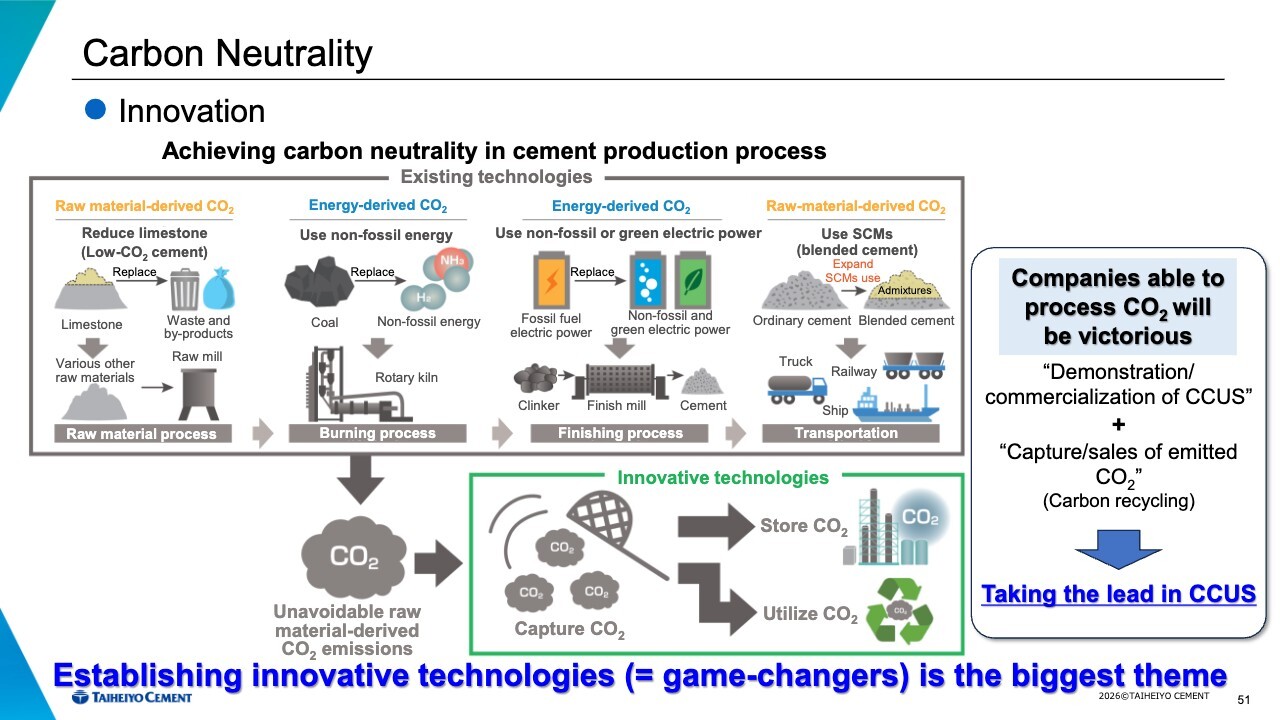
We are working to achieve carbon neutrality in a variety of areas.
Carbon Neutrality
● Innovation
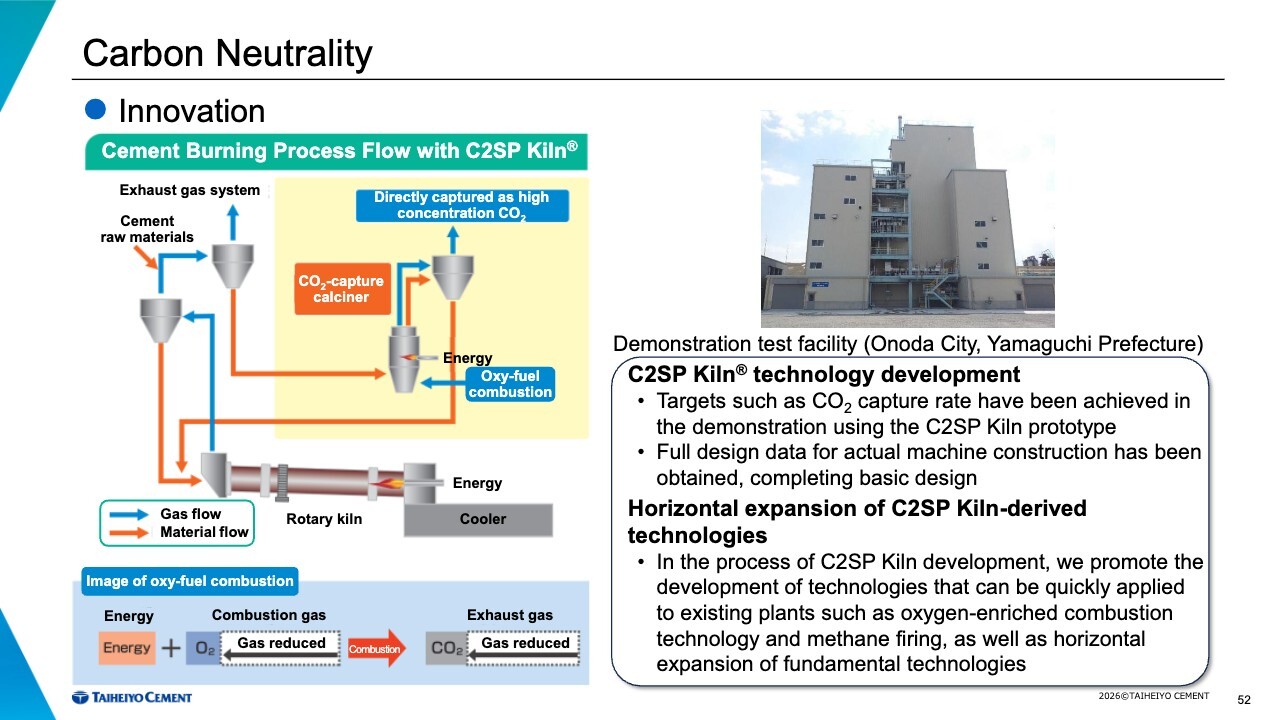
The photo on the right of this slide shows the "C2SP Kiln" demonstration test facility, which is housed in a massive nine-story building. We are conducting demonstration tests of the “C2SP Kiln” in the plant, have gathered the design data necessary for the construction of the production machine, and are designing the data acquisition for its construction; the basic design is almost complete.
Carbon Neutrality
● CO2 absorption
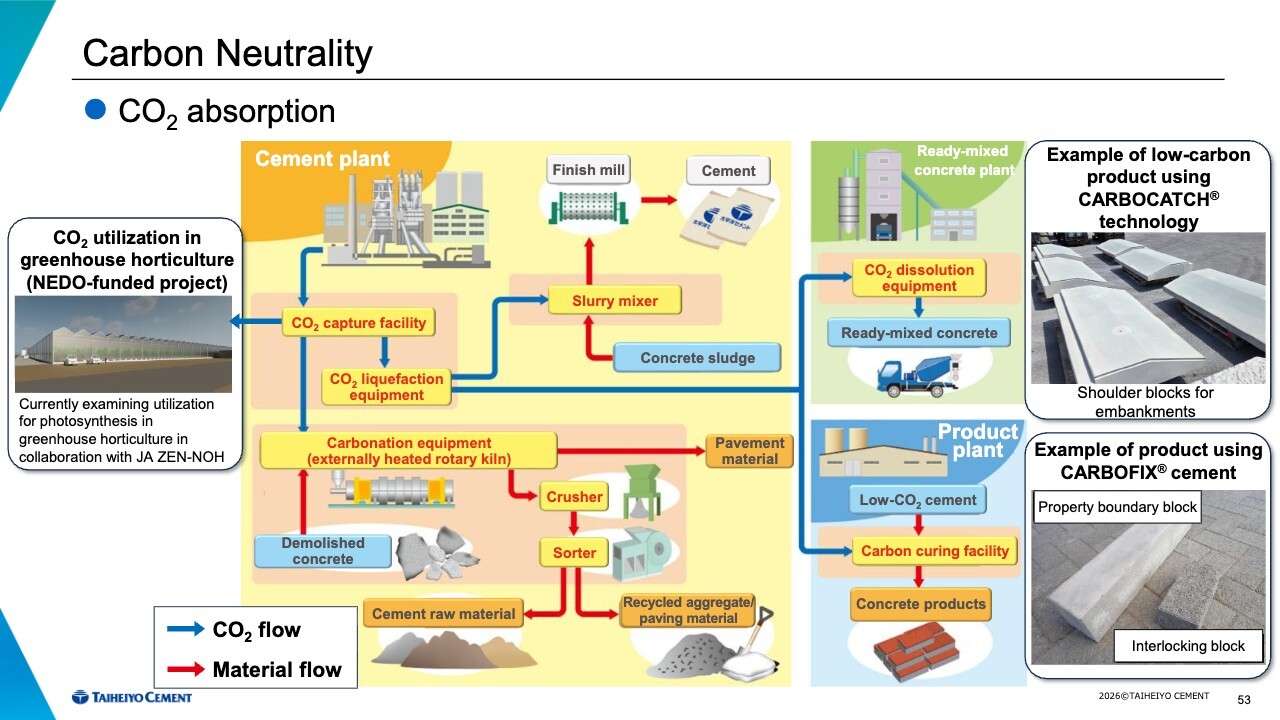
This slide shows the flow of CO2 absorption by CARBOCATCH® technology and CARBOFIX® cement.
Carbon Neutrality
● CN model business
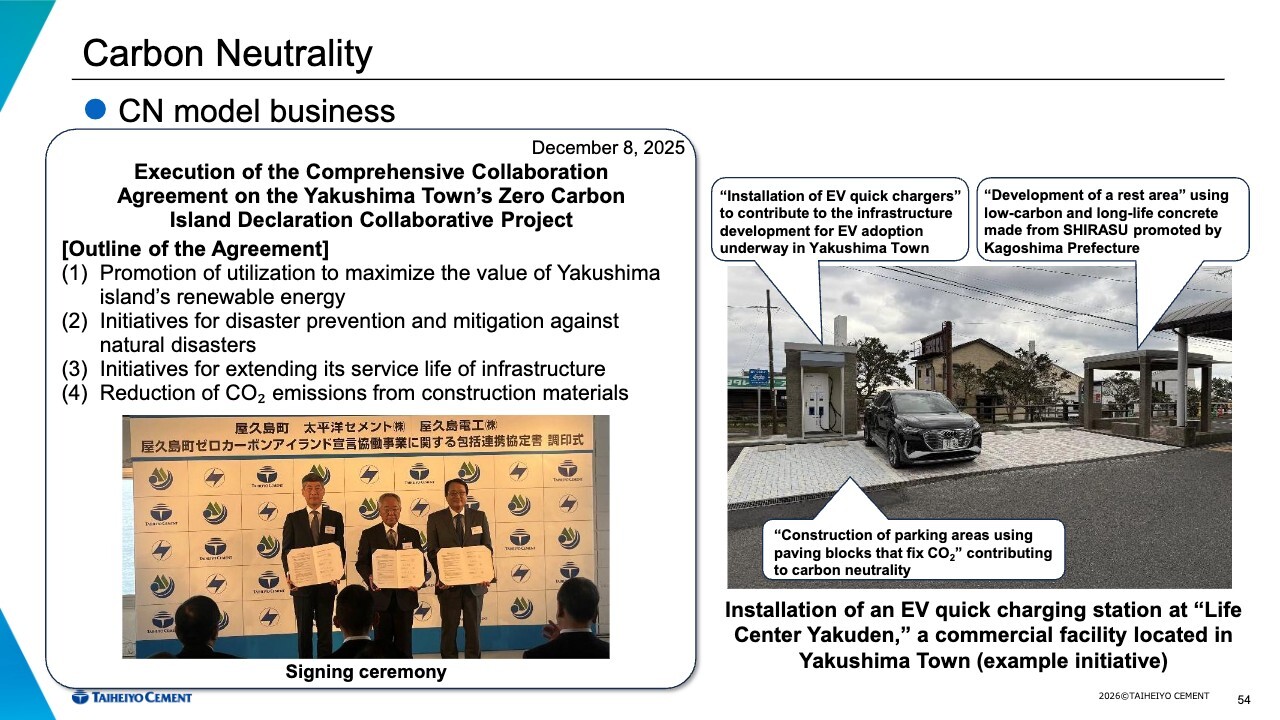
This slide shows the details of the agreement for the "Yakushima Zero Carbon Island Declaration" Collaborative Project. In collaboration with Yakushima Town, we have set up rapid EV charging stations and CO2-capturing paving blocks on the site of “Life Center Yakuden,” as shown in the photo on the right of this slide.
Carbon Neutrality
● Measures against severe disasters
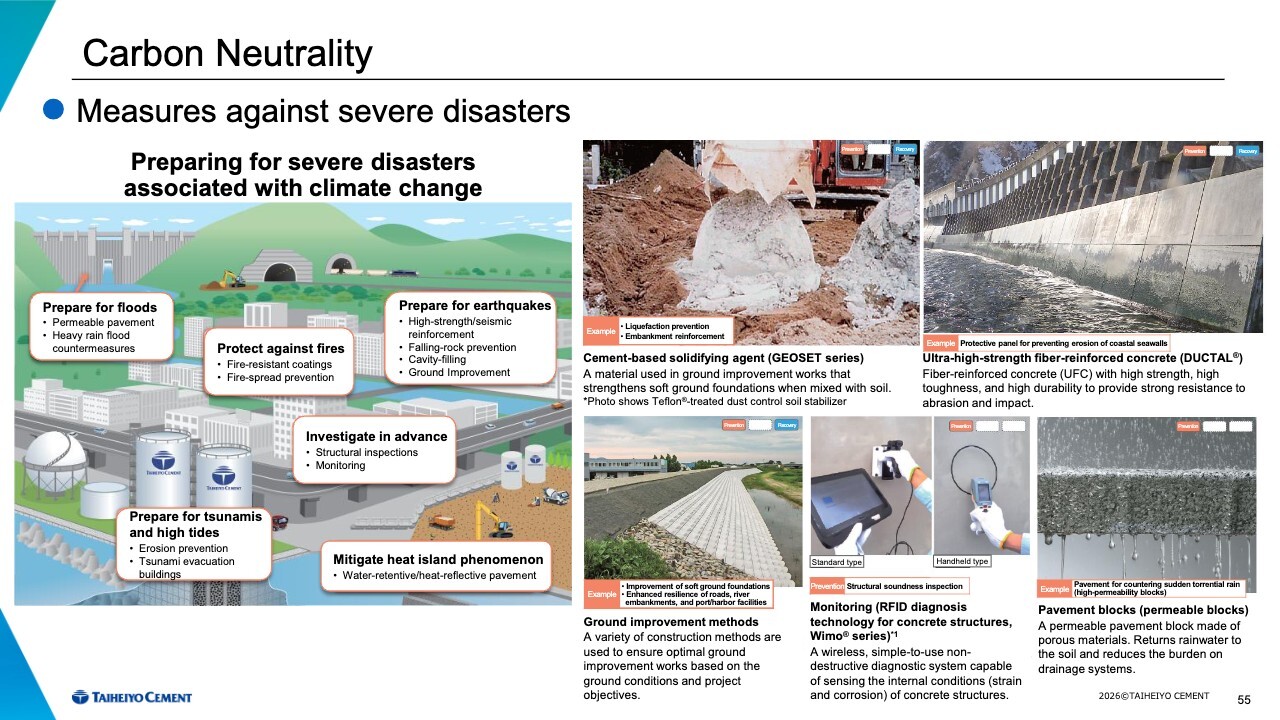
Across the Group, we are engaged in various initiatives to prepare for intensifying disasters.
Carbon Neutrality
● Measures against severe disasters
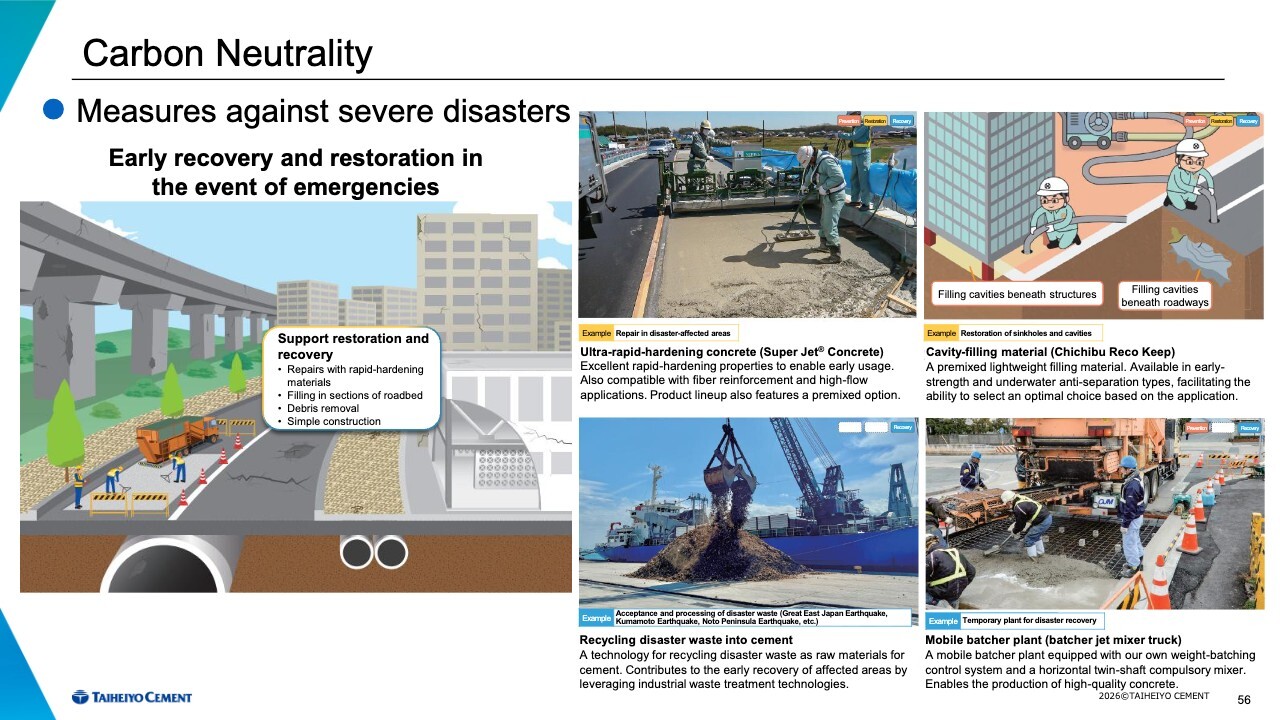
Across the Group, we are committed to carrying out countermeasures to combat intensifying disasters, including the replacement of Hume pipes.
Low-Carbon Cement (LCC)
● Positioning within the management strategy
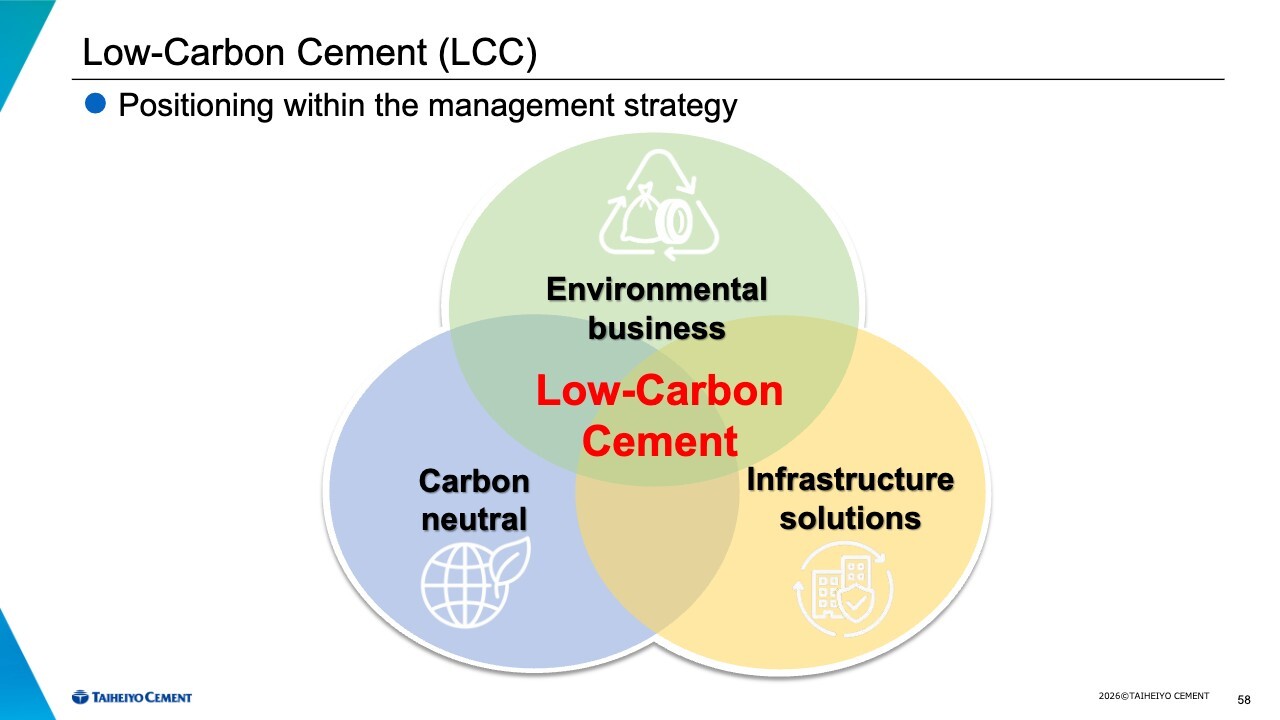
Low-carbon cement is positioned as central to the three areas of environmental business, carbon neutral, and infrastructure solutions. Blended cement, for example, uses fly ash generated at coal-fired thermal power plants as an admixture. Electric power companies take advantage of fly ash because they need to process large amounts.
Blended cement also reduces CO2 emissions. In addition, fly ash cement is very resistant to alkali, which makes it an infrastructure solution. These are the kinds of properties of low-carbon cement.
Low-Carbon Cement (LCC)
● Blended cement has gained attention as a decarbonization initiative
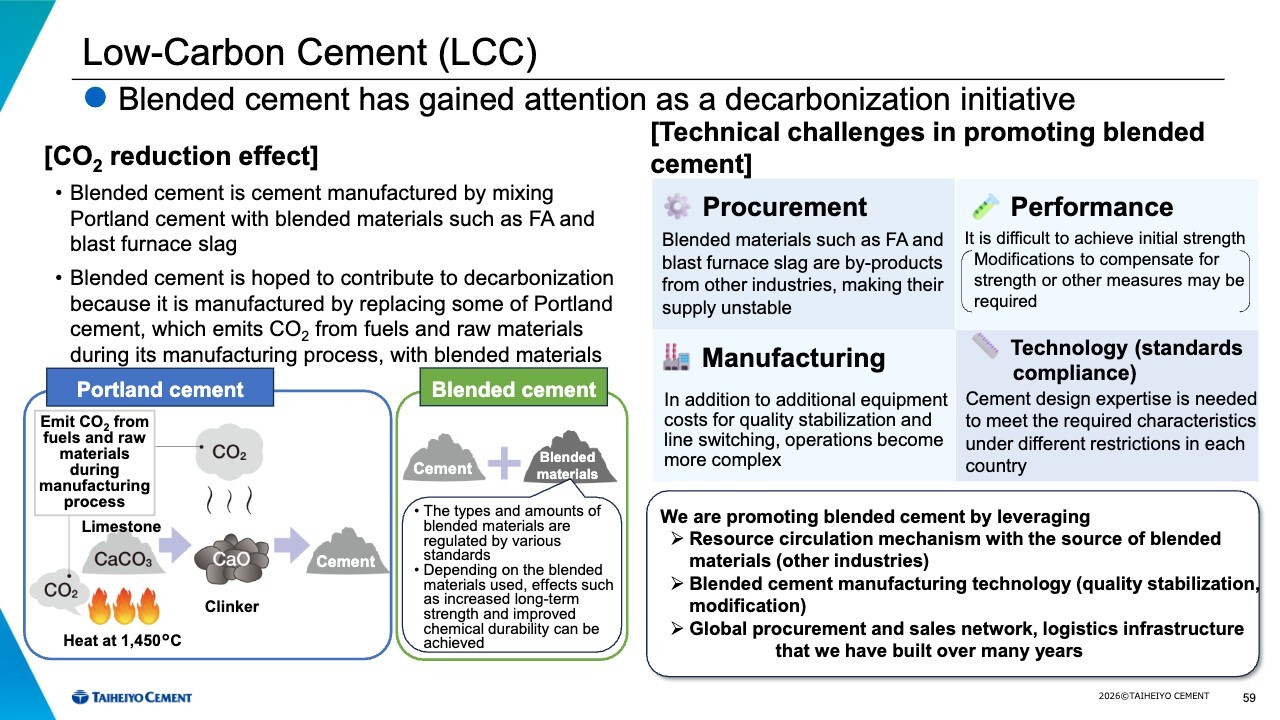
Blended cement requires a variety of technologies, some of which present difficulties. We have been working in this field since 2009, and over the past 16 years we have established technology to make fly ash very homogeneous and blend it with cement in a stable manner.
We used to export blended cement to China, but we now ship 400,000 tons to Singapore, where it is used in the construction of skyscrapers. This is one aspect of our track record.
Low-Carbon Cement (LCC)
● Measures against alkali-aggregate reactions
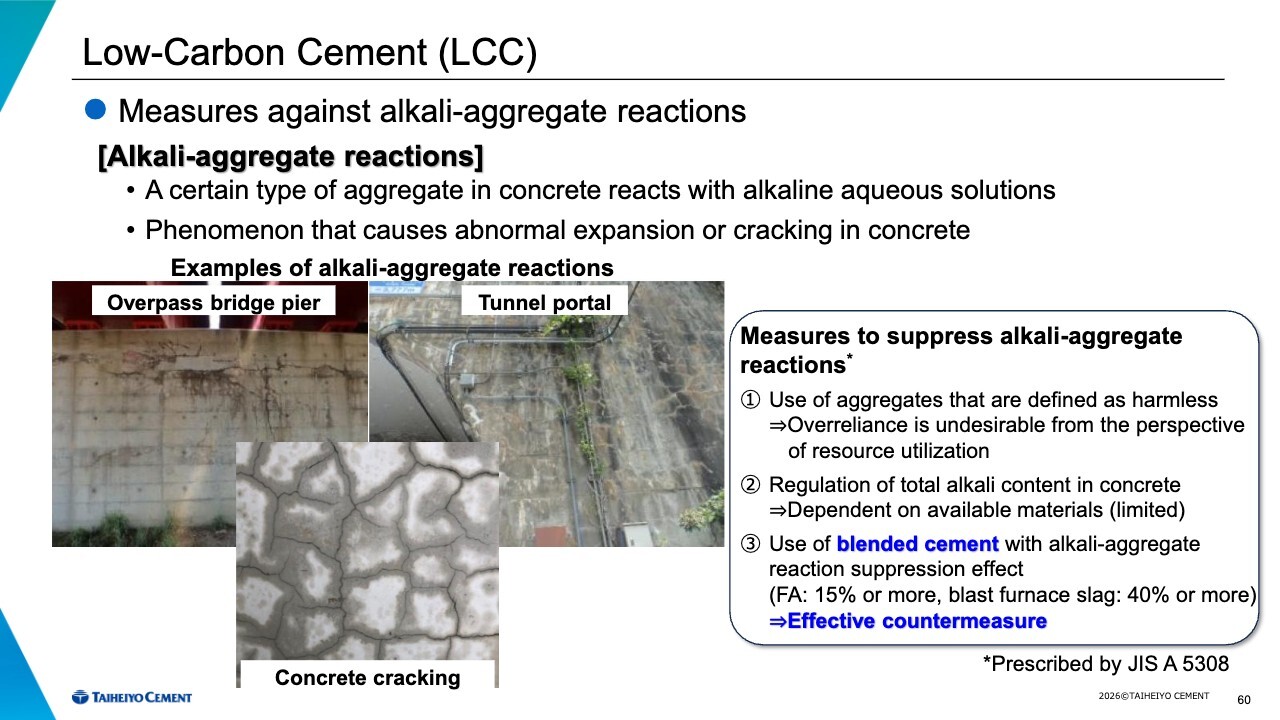
The photograph on the slide shows an example of cracking in a dam.
Cracks are appearing because of poor-quality aggregate. Very poor-quality aggregate causes cracking, as seen in all three photographs. However, the use of fly ash cement or low-carbon cement can prevent cracking.
Low-Carbon Cement (LCC)
● U.S. decarbonization policy
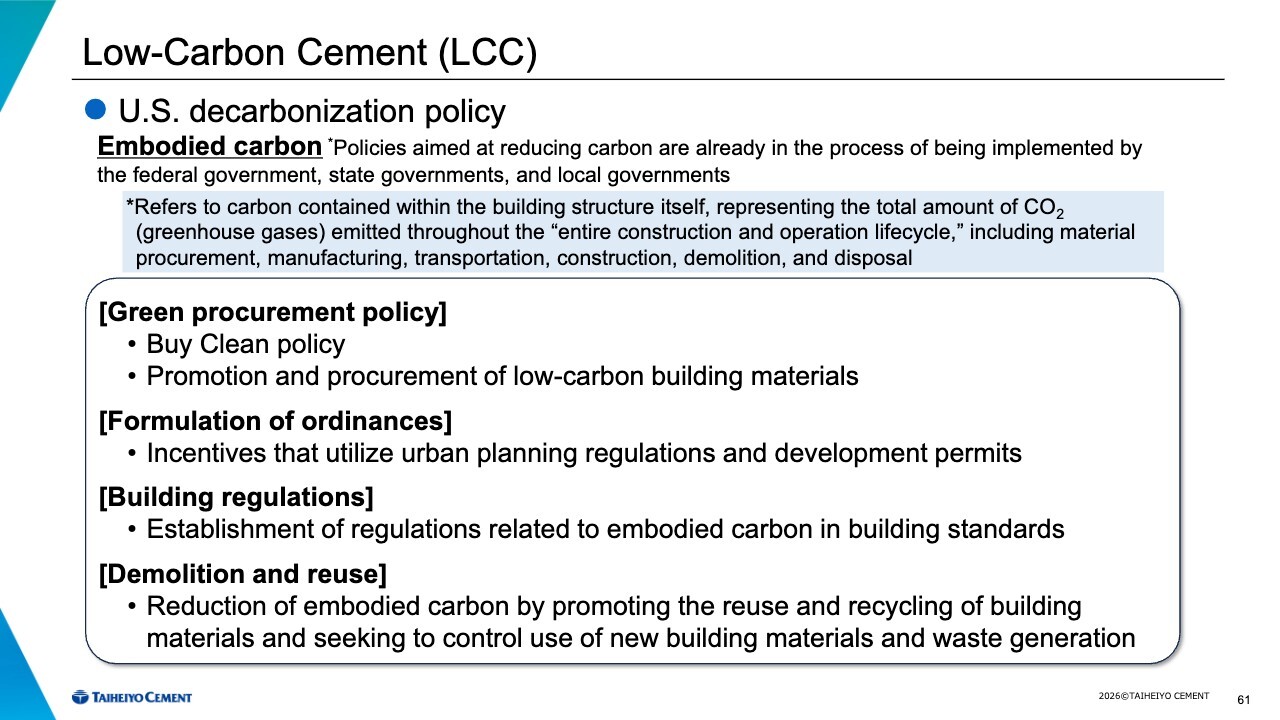
In the U.S., policies aimed at reducing embodied carbon are in the process of being implemented, and demand for cement with low CO2 emissions is increasing.
Low-Carbon Cement (LCC)
● Trend in the ratio of LCC by country/region
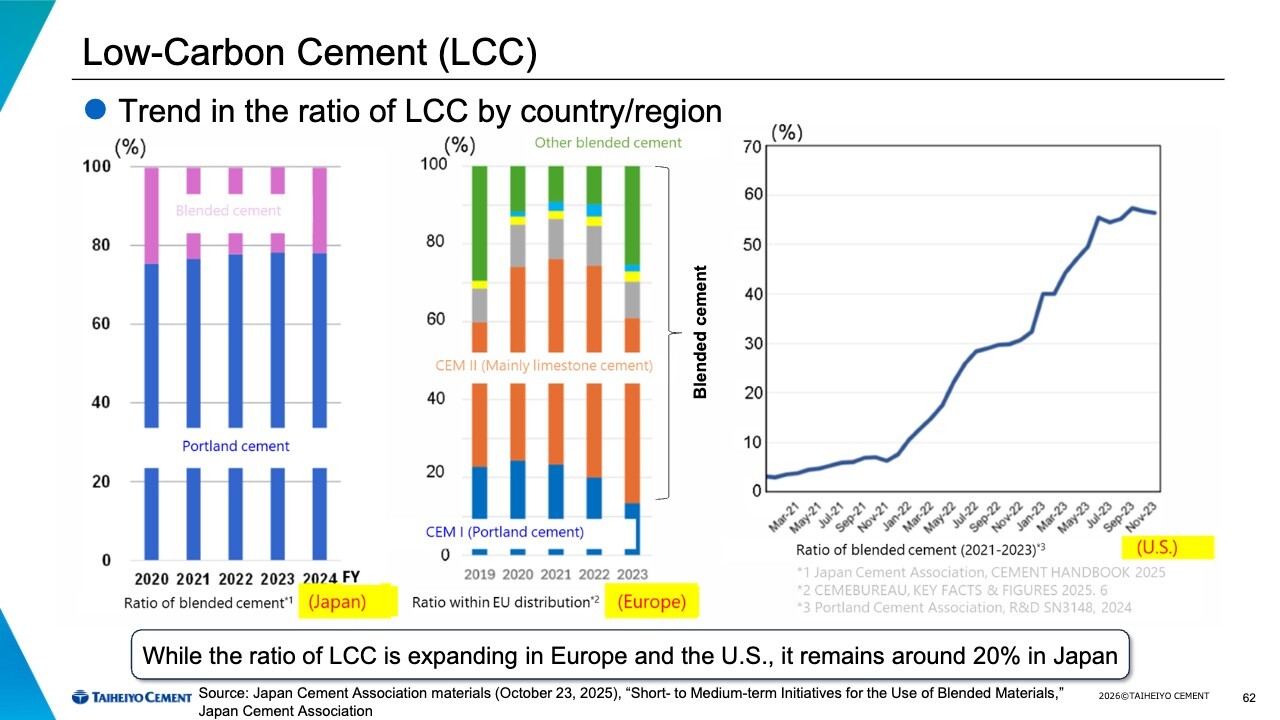
This slide shows the status of the global ratio of low-carbon cement. In Japan, blended cement still accounts for only about 20% of the total, most of which is slag cement. In Europe, on the other hand, ordinary cement accounts for about 10% of the cement, and all other cement is blended cement.
The ratio of blended cement is also increasing in the U.S. As such, demand is increasing significantly. That is the current global situation.
Low-Carbon Cement (LCC)
● Significance of promoting LCC
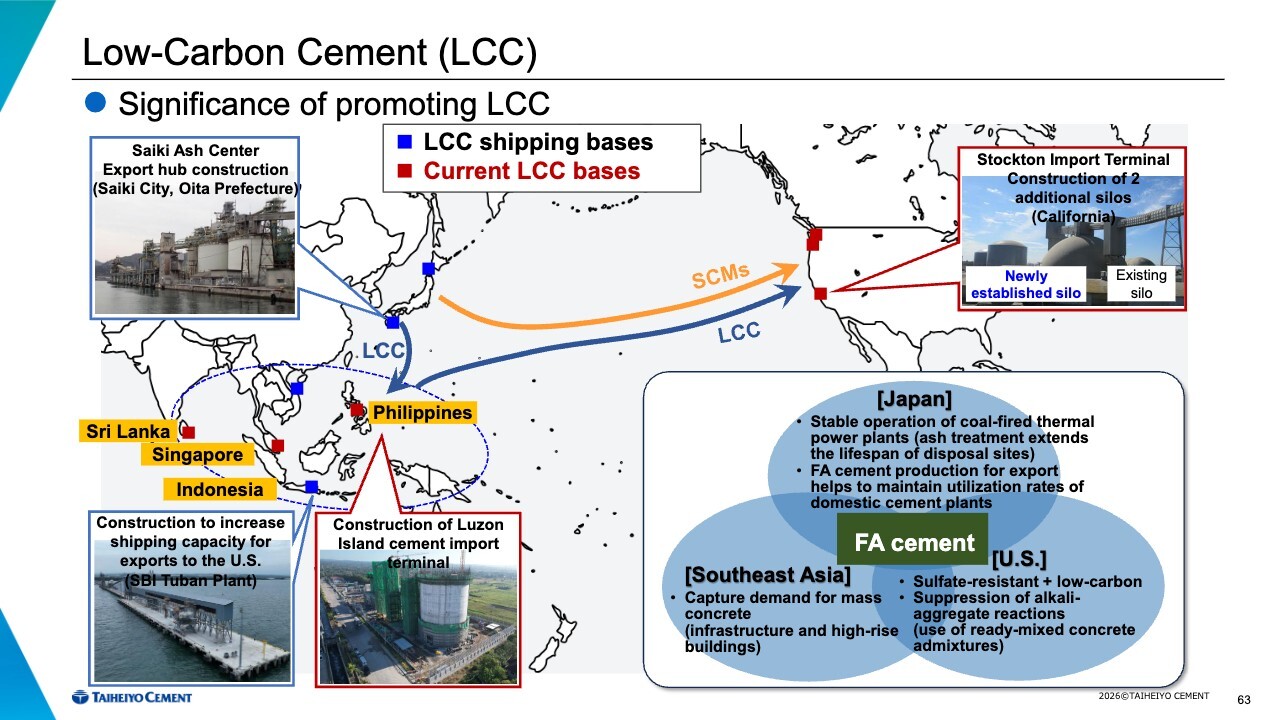
We are exporting low-carbon cement from Japan to Southeast Asia, and from Southeast Asia to the U.S. We supply low-carbon cement through our global logistics network, and we are expanding our activities globally to broaden the linear initiatives that we implemented previously to activities that encompass wider areas.
U.S. Business
● Challenges and countermeasures in the Southwest area
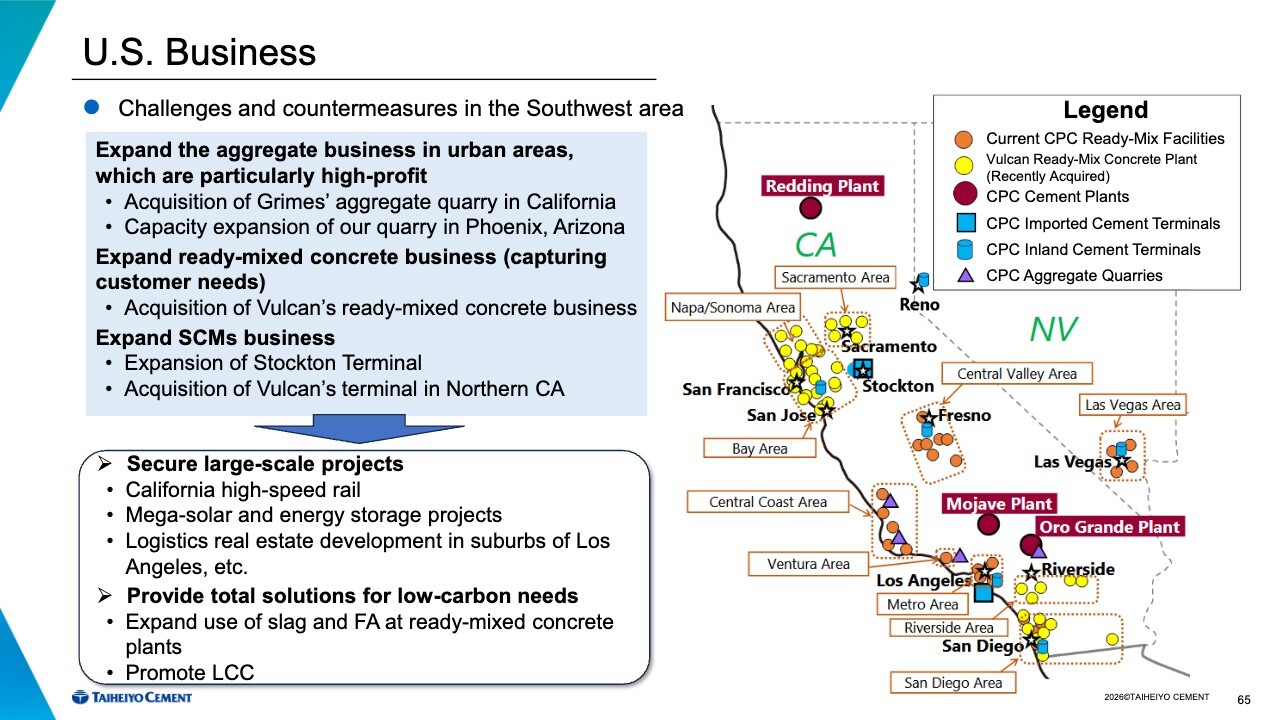
Let me briefly explain our U.S. business. We are currently planning to acquire plants in the San Francisco and San Diego areas. We originally owned plants only in the Los Angeles area, but now we are looking to acquire 41 ready-mixed concrete plants in the San Francisco and San Diego areas.
The San Francisco area has many data centers and other facilities, and the San Diego area is considered one of the most convenient and desirable cities to live in the U.S., with a large population that is still growing. In this way, it will be possible to develop ready-mixed concrete plants in areas where until now, our company has not had a presence.
This plan is now in its final phase and a deal is scheduled to be completed by the end of June. Therefore, we expect to be able to operate these ready-mixed concrete plants from July under our own policy.
U.S. Business
● Expansion of Stockton Terminal
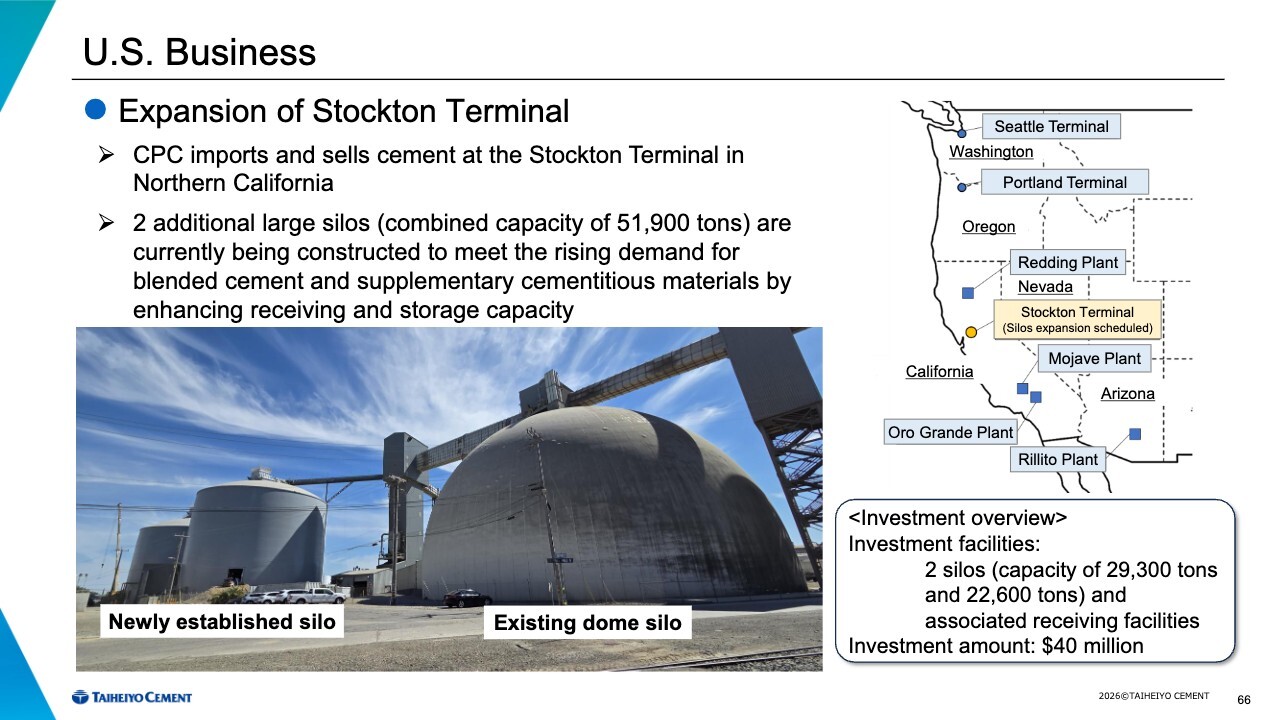
At the Stockton Terminal, two new silos (combined capacity of 51,900 tons) are currently being constructed. On the right of the photograph is the existing dome silo. These silos will be utilized when transporting and storing a variety of items from Japan.
Advantages of Vertical Integration: Leap from Flour Mill to High-End Pizzeria
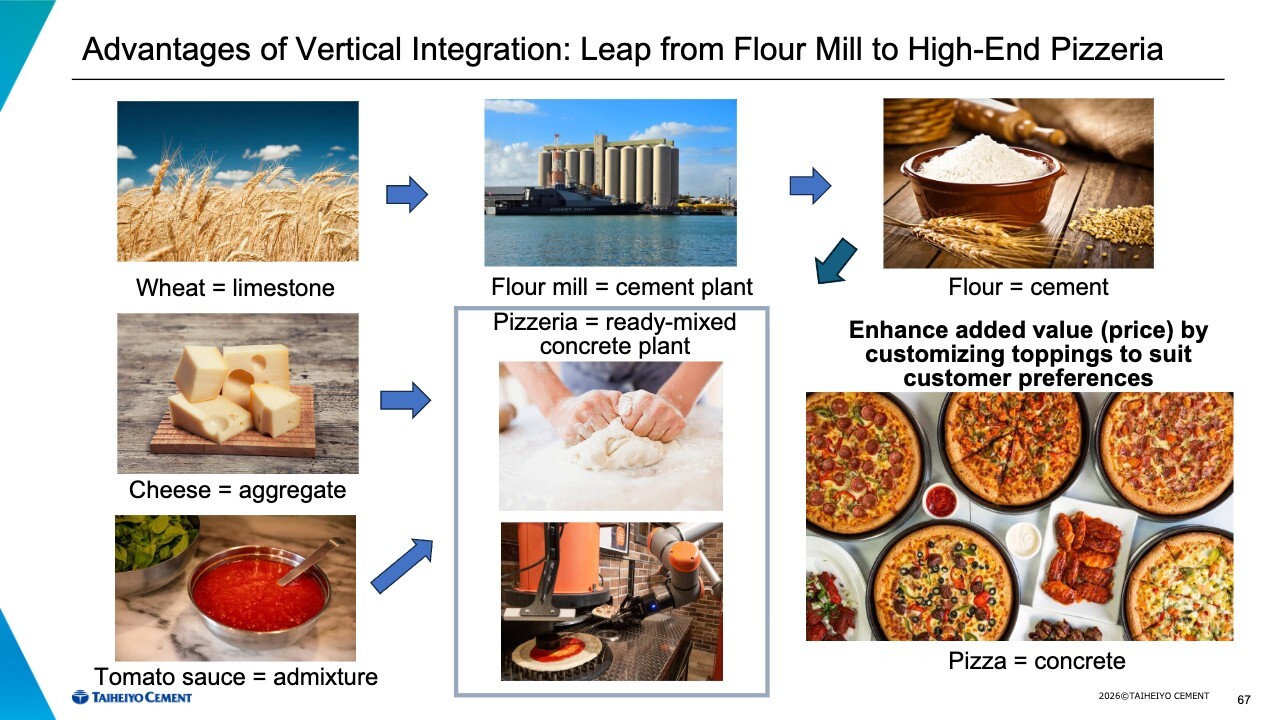
This slide was prepared to make it easier to understand the difference between cement and ready-mixed concrete. Here, limestone is compared to flour and cement plants are compared to flour mills.
We are currently a company that sells flour (cement), but with access to cheese (aggregate) and tomato sauce (admixture) we can open a pizza parlor (ready-mixed concrete plant).
A ready-mixed concrete plant allows us to deal directly with customers. We can communicate directly by saying, "This type of ready-mixed concrete is good for this type of construction," or "Let's use this type of cement in this instance.”
Doing so allows us to increase added value and gives rise to various benefits. If a customer says, "I want fish roe flavor," we can make a fish roe pizza, and if they say, "I want teriyaki flavor," we can make a teriyaki pizza. This cannot be achieved by supplying flour alone.
I am very excited to be able to contribute to a carbon neutral world in the future by dealing directly with our customers.
U.S. Business
● Further strengthen base through vertical integration
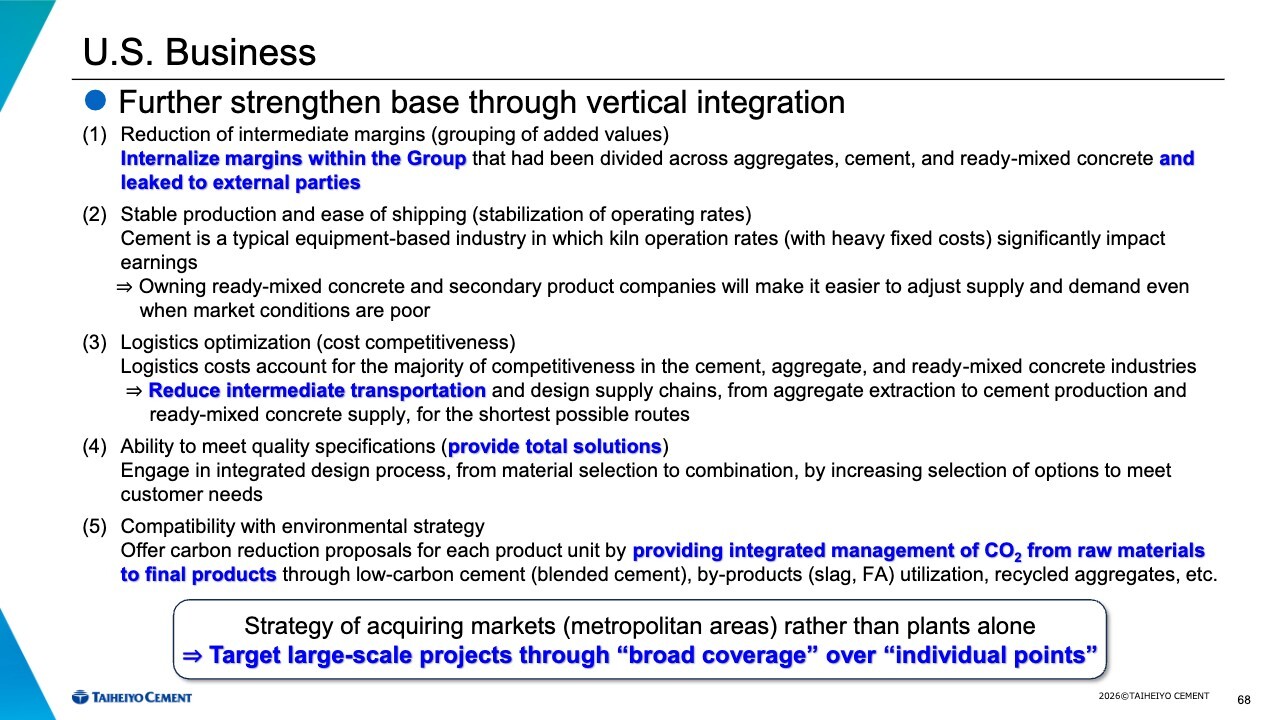
This slide summarizes the details of further strengthening our base through vertical integration. We believe that we can create significant added value by internalizing margins within the Group that had been leaked to external parties, reducing logistics costs, and integrating environmental strategies.
Southeast Asia Business
● Potential for growth in cement demand
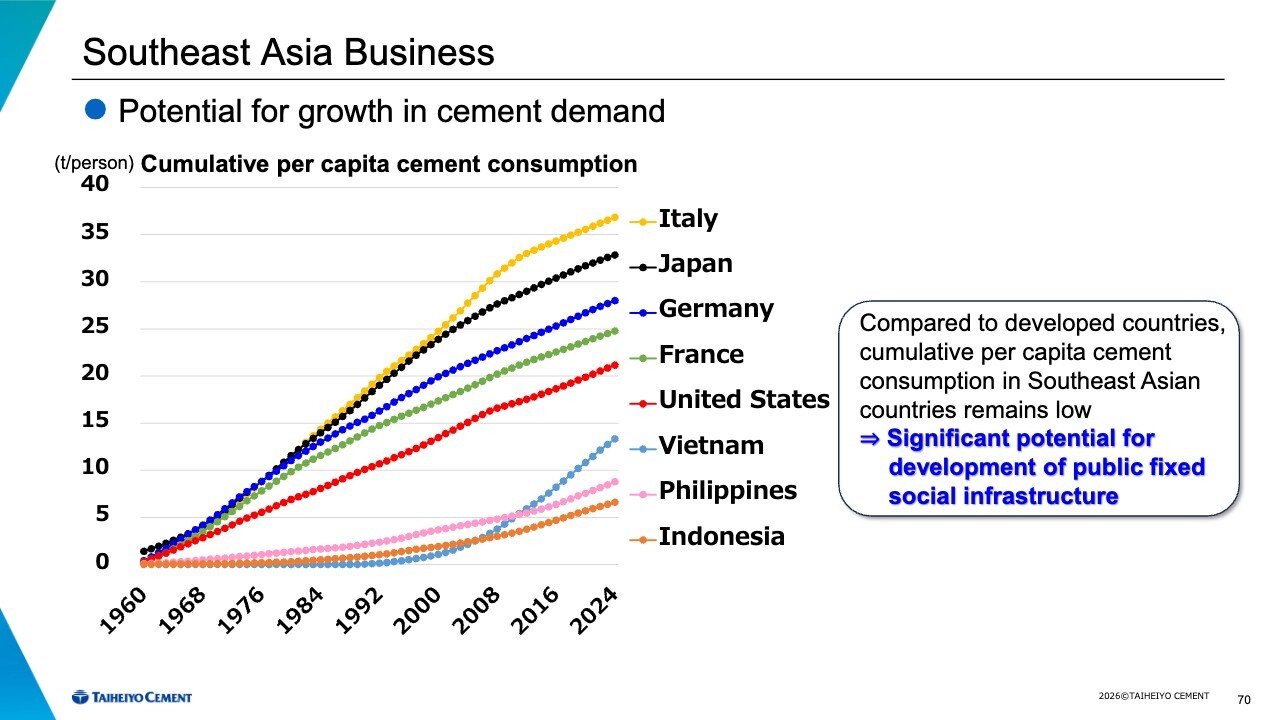
Cumulative per capita cement consumption in Southeast Asia remains low. In Japan, on the other hand, it has now reached more than 30 tons.
Since cement consumption statistics began, the cumulative per capita cement consumption has only increased to about 7 tons in the Philippines and Indonesia. We believe this is sure to double, and that the countries with the greatest potential for growth are those in Southeast Asia.
Southeast Asia Business
● Reduce price-based competition through development of high-value-added products
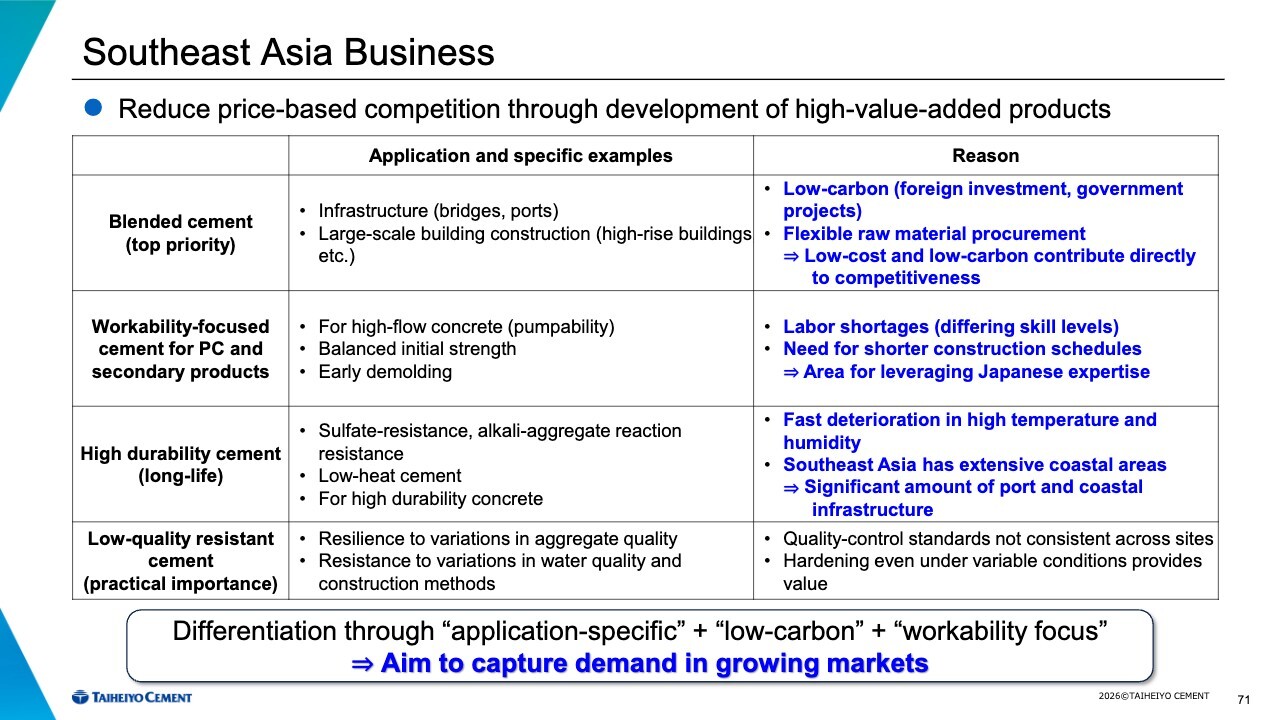
In Southeast Asia, governments have set CO2 reduction as a KPI, so low-carbon measures are being promoted. As a response to labor shortages, demand is also increasing for cement that is easier to work with and less prone to deterioration.
We are working to add various technologies with the aim of capturing demand in growing markets.
Southeast Asia Business
● Philippines
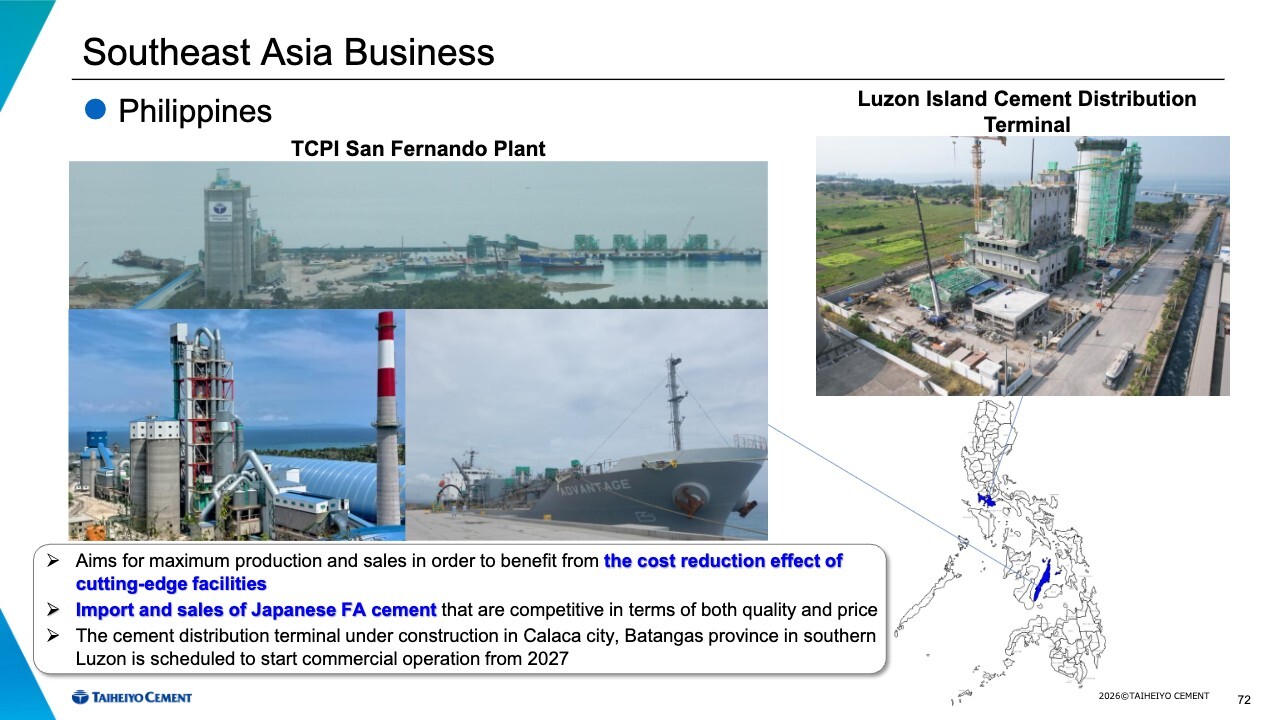
Please look at the photo on the right of this slide. A silo is currently under construction in Batangas Province in the south of Luzon Island, Philippines. The cement distribution terminal is scheduled to be completed next year and will begin supplying mainly low-carbon cement.
We have just heard that a large-scale ODA project will begin at the end of this year and into next year, and we believe that we will be able to capture the demand from this.
Southeast Asia Business
● Vietnam
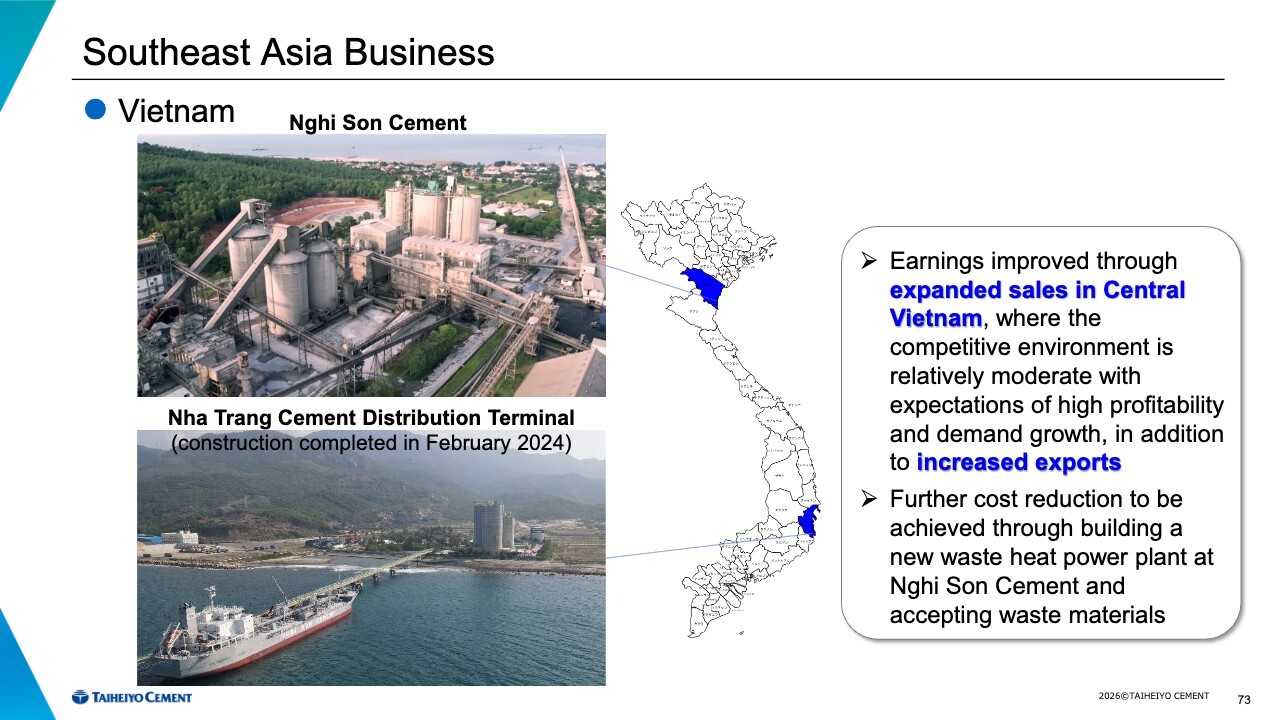
The situation in Vietnam was very difficult due to the COVID-19 pandemic, but is now very positive. The completion of the North-South Expressway has created a virtuous cycle, with industrial parks being built one after another in the surrounding area. Going forward, we believe that we can have high expectations in relation to this.
Southeast Asia Business
● Indonesia
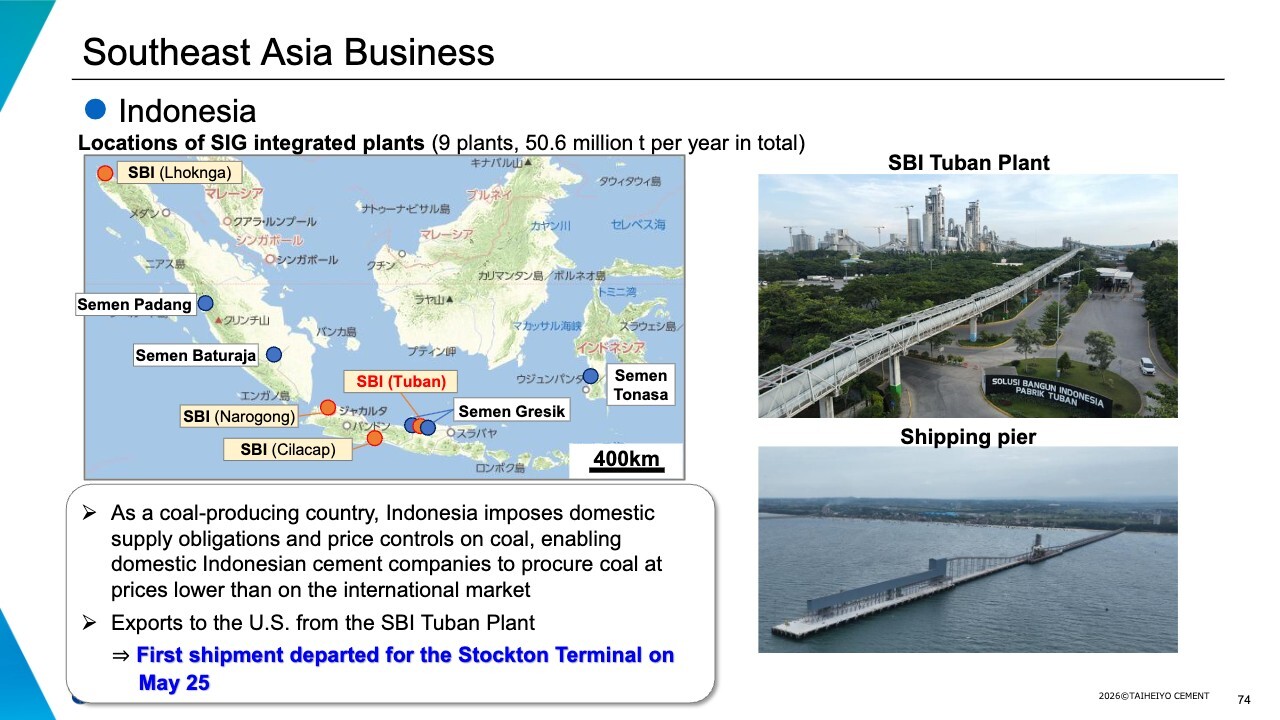
In Indonesia, we made a capital investment three years ago and the first shipment departed for the Stockton Terminal in the U.S. on May 25. A pier installed specifically for our company was used for the shipment.
At present, the U.S. needs to import about 1.8 million tons of cement. This is because production capacity has not kept pace with demand. By being able to import from South Korea, Vietnam, and Indonesia, we are establishing a position in the logistics environment that enables us to hedge against any problems that may arise.
Our Management Strategy
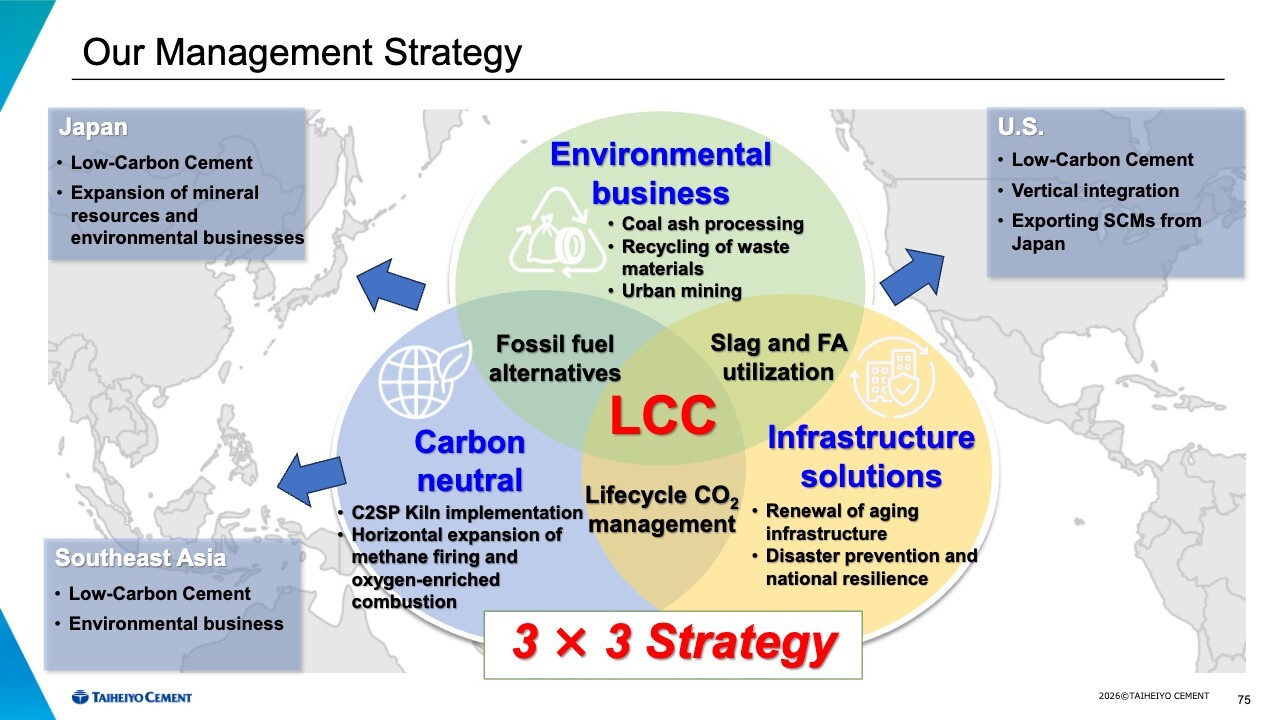
We have positioned carbon neutral, infrastructure solutions, and environmental business and mineral resources business as the new pillars of our domestic business, and will leverage these three areas to expand not only in Japan but also in the U.S. and Asia.
We would like to make this "3 × 3 Strategy" the theme of our next Medium-Term Management Plan, and our major policy is to develop not only our cement business but also our environmental business, mineral resources business, logistics business, and carbon neutral business in the U.S. and Southeast Asia.
Our Management Strategy
● Net sales and operating profit targets
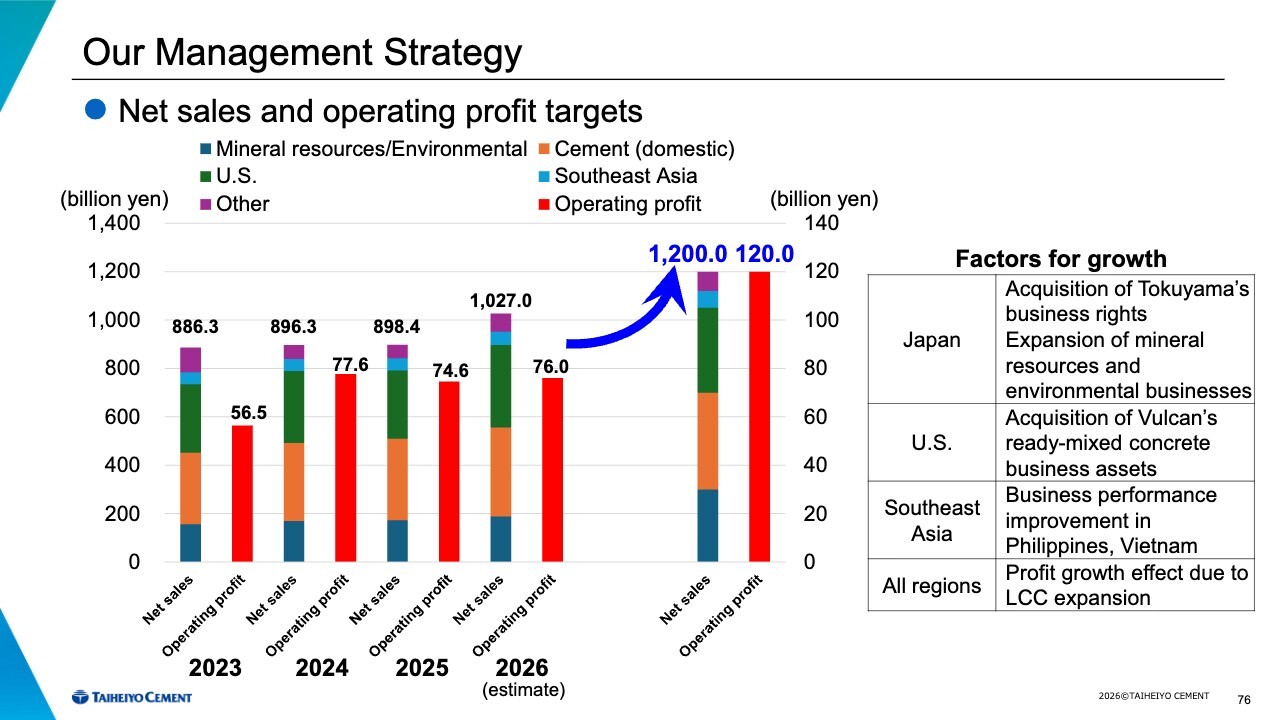
The net sales target for FY2026 is 1.27 trillion yen. In addition to the problems in the Middle East, the interest rate on the 10-year U.S. Treasury note is currently at 4.5%, and we believe that housing demand will not recover easily unless this rate falls. However, there are high expectations for infrastructure investment.
As such, our expectations for the U.S. will not be met until next year or later. There was also a time lag in Southeast Asia, but we expect a recovery in this region from next year onward.
Furthermore, if we expand our mineral resources and environmental businesses, we expect net sales to reach about 1.2 trillion yen and operating profit about 120 billion yen.
Today, I will only talk about the direction of the plan, but we will closely examine our strategy over the course of this year and incorporate it into our next Medium-Term Management Plan, the 29 Medium-Term Management Plan. Beyond that, we will also continue to closely examine the situation throughout this year.
Overall, we expect to achieve results on this scale, although we will continue to examine the situation with the intention of talking about it again next spring. Today, I have talked about the priority areas we will focus on as we weave our strategy together.
I will talk about any other relevant points as I answer your questions. Please go ahead.
Q&A: Signs of aging infrastructure renewal
Questioner: Your presentation included many interesting points and I learned a lot. I would like to ask about the company’s ideal in relation to demand for cement that President Taura mentioned at the beginning.
The need to invest in the renewal of aging infrastructure and national resilience has been pointed out for some time, but our impression is that there has been no concrete movement toward this. You presented a graph showing that the percentage of infrastructure that is 50 years old will increase in the meantime, but have you seen any specific signs of this type of renewal investment starting to take off?
Respondent 1: After the Great East Japan Earthquake in 2011, the Basic Act for National Resilience was enacted in 2013 under the Abe administration. At that time, a 20 trillion yen, five-year plan was launched, but unfortunately, it has not been fully implemented.
I think this may have impacted demand for cement, which has decreased from 47 million tons in 2013 to 30 million tons today.
At the same time, various natural disasters have occurred, and recently, the potential eruption of Mt. Fuji has been a talking point.
In addition, the government will establish a new Disaster Management Agency in November. We believe that the type of budget that will be applied here is a very important point.
We would like to see a little more focus on infrastructure development. I hope that more importance will be placed on infrastructure development.
With the expected establishment of the Disaster Management Agency in November, we have high expectations in relation to what kind of budget will be set.
Questioner: It would be shocking if a bridge collapsed in Japan, but rather than 50 years, how much time passes before renewal is a necessity? I think it depends on the structure in question, but what is your opinion?
Respondent 1: I mentioned the Silver Bridge as a very symbolic example, and that bridge collapsed 40 years after its construction. Apparently, the backdrop to this is that design in the 1920s was at a stage where it had not yet fully developed. Japanese bridges were constructed in later periods and with more developed technology, so I think they are less likely to collapse so easily. However, it is roads that are a concern.
Regarding the road sinkhole accident that occurred in Yashio City, hydrogen sulfide deteriorated Hume pipes, this deterioration progressed from underground and eventually reached the surface.
There are also concerns that asphalt deteriorates over time due to ultraviolet rays. The result in this case was a phenomenon in which a small hole formed and the ground gradually collapsed around it. We believe that problems such as these are occurring throughout Japan.
I don’t think it is unusual for problems with asphalt and road paving to occur frequently when 50 years have passed since they were put in place. Therefore, we believe that the 50-year service life indicator given by the Ministry of Land, Infrastructure, Transport and Tourism is a very important timescale, and one to which we should pay attention.
Q&A: Expansion of sales in the mineral resources and environmental businesses in the next Medium-Term Management Plan
Questioner: You explained that you plan to increase sales by more than 100 billion yen in the future. In the mineral resources and environmental businesses, specifically, how much do you expect sales to grow, and with what products and services?
Respondent 1: Up to now, our standard approach has been focused on using kilns for processing. However, there are still many issues for which solutions can be found in the environmental business or in relation to the various environmental issues surrounding us, for example, solar panels and lithium batteries.
Until now, we have focused on the environmental business, which we built up from scratch, but as you might expect, M&A is still important, including for our U.S. business. Although we are fully equipped with the technology, there are several areas where we lack financial resources. I cannot provide specific details at this time, but we would like to move forward in partnership with the kinds of companies that can assist in providing such resources.
We will spend this year sufficiently finalizing our plans and reliably incorporating them into future plans, in order to reach our target of 100 billion yen for the mineral resources and environmental businesses combined.
Respondent 2: Operating profit in the mineral resources and environmental businesses was limited to about 6 billion yen each until three to four years ago.
In the mineral resources business, we asked customers to raise prices in the form of promoting the optimization of prices for aggregates and limestone supplied to steel mills. As a result, price increases were realized as planned, and operating profit has increased to approximately 10 billion yen at this point. For the environmental business, just recently, we have also been working to optimize processing costs.
Operating profit was about 6 billion yen three to four years ago, but we are aiming for operating profit of 10 billion yen in each budget for the current fiscal year. If this target was raised to around ¥15 billion for each, operating profit would reach a combined level of ¥30 billion.
Of course, it is important to continue with the strategies that have been implemented to date, but in relation to aggregates in the mineral resources business, for example, which is a very competitive segment, an increasing number of companies are going out of business due to declining ore volumes at crushed stone mines in each region, and to business succession issues.
We have an overwhelming amount of limestone resources in Japan, and we own yard space and a fleet of vessels that ultimately delivers our products to customers. This is why our strategy is to expand our market share among these customers.
With regard to the environmental business, in the context of domestic demand for cement that is somewhat sluggish, we recognize that there will be some difficulties in achieving growth in a business that relies on cement kilns.
On the other hand, as a direction for technological development, we are also working to enable the processing at cement plants of materials for which processing has been difficult in the past, thereby increasing output levels. In addition, we are considering the possibility of conducting intermediate processing operations—which do not rely on cement kilns—away from cement plants.
Since some waste is difficult to process at cement plants, we believe there is ample room for expansion in this business field through M&A and other means.
Q&A: Discrepancy between the government's perception of infrastructure investment and companies' sense of crisis
Questioner: I learned a lot from your presentation about infrastructure and cement demand, including the missing links of expressways that you mentioned at the beginning. I think this may relate to slide number 42, but I feel there is a significant discrepancy between the sense of crisis your company has and the government’s perception of infrastructure investment, as many measures will be needed in the future.
Indeed, although disaster prevention and national resilience is now included as one of 17 strategic fields listed by the government, it has been pointed out before, and there doesn’t appear to have been any particular change in behavior.
What should we view as the backdrop to the apparent difference in the sense of urgency between your company and the government? I would appreciate it if you could provide as much information as possible.
Respondent 1: This is a very difficult question, and there are some points that are difficult to convey, but first of all, I think everyone understands very well the importance of infrastructure. It is particularly important to remember that many people died in the areas affected by the Great East Japan, Noto, and Kumamoto earthquakes.
I believe that we should be discussing the state of the nation from a more medium-term perspective. It seems to me that such discussions used to take place.
In many situations, it is often said that "infrastructure is important," but it is very frustrating that infrastructure is not always treated as the most important issue.
As has been pointed out since the time of the Ishiba administration, there will almost certainly be a Nankai Trough earthquake, and there are several major problems approaching in 2035.
We are at a major turning point: the Nankai Trough and other earthquakes that are predicted between 2030 and 2040, the problems with solar panels and their aging that were mentioned earlier, and the significant decline in the working population as the baby boom generation turns 85 years old.
We too find this very frustrating, but we are sure that it is recognized as an important issue.
We believe that the catalyst for this will be the Disaster Management Agency, which is scheduled to be established this November. I have high hopes that we will be able to properly advance the conversation regarding the 30 trillion yen in disaster management measures, and that this will lead to real disaster management measures.
Q&A: Cost savings from fossil fuel substitute business
Questioner: This is about the fossil fuel substitute business. Currently, coal is mainly used in the cement calcination process, but if we shift to 50% or 80% substitution with waste plastic in the future, how much cost reduction would be possible?
I also imagine that you would receive a portion of the fees involved for accepting waste plastic. What are your thoughts on the cost of coal fuel, and what are the implications for moving forward with alternatives?
Respondent 1: That is a very good point. First, let me talk about the price of coal, which until around 1980 was actually $20 on the basis of its arrival in Japan.
During each of the next two decades, coal prices doubled to an average of $40, then $80. I do not think it would be unusual if the price doubled again to $160 between 2020 and the coming years.
At this point, it is not that high at about $110 to $120. Even if the situation in the Middle East has an impact, I think it will be about $130 to $140, but we believe it will reach $200 in the future.
One of the reasons for this is that demand is growing a lot. Even though China was an exporter of coal until recently, it now imports 400 to 500 million tons. India also consumes 400 or 500 million tons, and this amount is expected to increase further. As such, it is true that consumption has increased a lot.
On the other hand, regarding supply, Indonesia currently produces 800 million tons a year, of which probably 200 to 300 million tons are consumed domestically and 500 million tons are exported. However, resources are being depleted rapidly.
Therefore, the Indonesian government, through its Domestic Market Obligation (DMO) policy, has established a large difference between export prices and domestic supply prices. Although we have a policy of ensuring coal for domestic use, we believe that export capping will occur in the future, which will reduce the amount of coal that is exported.
In addition, 150 million tons of coal is exported from the Port of Newcastle in New South Wales, Australia, which is the world's largest coal export port, and the state of New South Wales has announced a policy to ban new coal mine development by 2030.
Coal development is steadily decreasing against the backdrop of carbon neutrality issues, whereas demand is increasing. For this reason, we believe that coal prices will surely rise and will reach $200 by 2030.
It takes about 100 kilograms of coal to produce one ton of cement. In that case, if the price of coal was $200, one tenth of that amount, or $20, would be reflected in the cost price. Therefore, the cost price is steadily growing.
If 100% coal is used, a hypothetical increase in coal price from $200 to $300 would result in a $100 increase and a $10 increase in cost of goods sold. However, if 80% of coal is replaced with plastic, the impact would only be 20%. This is the first point I would like to make.
Currently, we do not receive any plastic that has a higher cost per calorie than coal. This is because economic rationality dictates that it is better to utilize cheap fuel as much as possible. But I have told the relevant departments internally, “Coal will be $200 in the future, so even if the cost is a little higher, you should take it in order to have a stable supply.”
We accept some plastics while receiving disposal fees, whereas others are purchased, and these days, we are purchasing a greater proportion.
Even so, at the very least, the cost of procuring plastic is less than the current price of coal, at the equivalent of less than $100 per ton compared to coal. We also believe this is unlikely to rise to $200 in the future. My view is that such price differences will contribute to lower cost prices in the future.
Respondent 2: In terms of processing waste plastics, we are not able to process 100% of the amount that we are actually asked to process due to various problems such as problems at the plant side and inventory issues.
For example, by combining the intermediate treatment I mentioned earlier, such as the pre-processing and inventory management of waste plastic outside of cement plants, and by utilizing the multiple plants that we own, we can further enhance our ability to substitute waste plastic for fuel by using one plant for processing when another is offline.
It was mentioned earlier that the price of coal will rise to $200, but we use more than 1 million tons of coal a year. So our coal costs are about 30 billion yen per year. Replacing only 10% of this amount would result in a savings of approximately 3 billion yen. As a general idea, you can think of it in this way.
Q&A: Setting domestic prices and pricing policies in the mineral resources business
QUESTION: I understand that the operating profit of the resource business and the environmental business are each in the 10 billion yen range, but the OP margin (operating profit margin) of your resource business is 10% to 11%. On the other hand, similar U.S. companies, such as Vulcan Materials Company, have secured 20%.
I have always felt that the only very valuable resource from Japan in which the country can be self-sufficient is being sold at something of a discount. Please give us your honest opinion on what you think about setting domestic prices and pricing policy in this regard.
Respondent 1: I think you are right. The reason why we wanted to promote vertical integration in the U.S. is because the companies that own aggregate are very influential, and if they are unable to produce aggregate, they cannot manufacture ready-mixed concrete.
This structure differs greatly between Japan and the United States. For example, Japan has only 20% of the total inhabitable area, or plains, in its land area, and while there are many mountains, supply is available in various areas, and transportation is not a problem because of the ability to transport by sea.
In the U.S., on the other hand, resources are scattered around the country and those who control them, such as Vulcan Materials Company, have an advantage. However, times are also changing in Japan, and the supply of aggregates is becoming increasingly difficult.
Therefore, with regard to setting prices, we will take these contextual factors into account while enhancing value as a total solution through the supply of various products such as cement, aggregates, sand, and admixtures.
Respondent 2: I feel that we have set our prices a little too low in the past. In fact, as a result of our price optimization efforts over the past three to four years, we have gone from operating profit of about 6 billion yen to over 10 billion yen.
As a concept, I believe that aggregates have been thought of as a means for selling cement in the past. However, for example, producing 1 cubic meter of ready-mixed concrete requires 1,800 kilograms of aggregate for every 300 kilograms of cement, which is about six times the amount.
For ready-mixed concrete companies, the biggest concern is actually aggregates. A particularly significant aspect of aggregates is that of local production for local consumption, and they cannot always be so easily replaced.
Given this backdrop, there is still plenty of room for optimizing prices. In addition, further collaboration between sales in the cement and mineral resources businesses could increase value for customers.
We will advocate for stable supplies, but we believe there is still plenty of room for value to be recognized. Therefore, we believe that the figures you mentioned just now are at a level that is well within our ability to achieve.