Blue Pride
Yuji Okada (hereafter, Okada): Hello everyone. I am Yuji Okada, President & Representative Director.
Thank you for taking the time to view our financial results briefing today. I would also like to thank everyone for their continued support.
To begin, let me introduce our newly formulated company tagline from April: “Blue Pride.”
The phrase “Blue Pride” reflects our group’s commitment that all employees take pride in wearing our corporate color, OKADA Blue, and in continuously delivering OKADA Blue products that customers can choose with confidence.
Under our new tagline, “Blue Pride,” all employees will unite as one to strive to enhance our corporate value, and we respectfully ask for your continued support.
Results Summary for FY3/26
This section presents the financial results summary for the fiscal year ended March 2026and explain the objectives and positioning of the new mid-term business plan “Onyx.” For the fiscal year ended March 2026, the domestic and global economies saw continued moderate growth, led mainly by domestic demand.
Meanwhile, heightened uncertainty around the U.S. tariff policy and protectionist moves, together with movements in resource and energy prices and geopolitical risks, also weighed on conditions, and overall business sentiment trended somewhat softer.
Our group, under these business conditions and in line with the long-term vision “VISION30,” worked to strengthen the production framework by focusing on increased output and improved productivity in the domestic market, supported by steady demand for demolition and infrastructure construction. In overseas markets, we worked to strengthen our sales framework mainly in the high-growth United States, Europe, and Asia, and strived for further sustainable growth and enhanced corporate value.
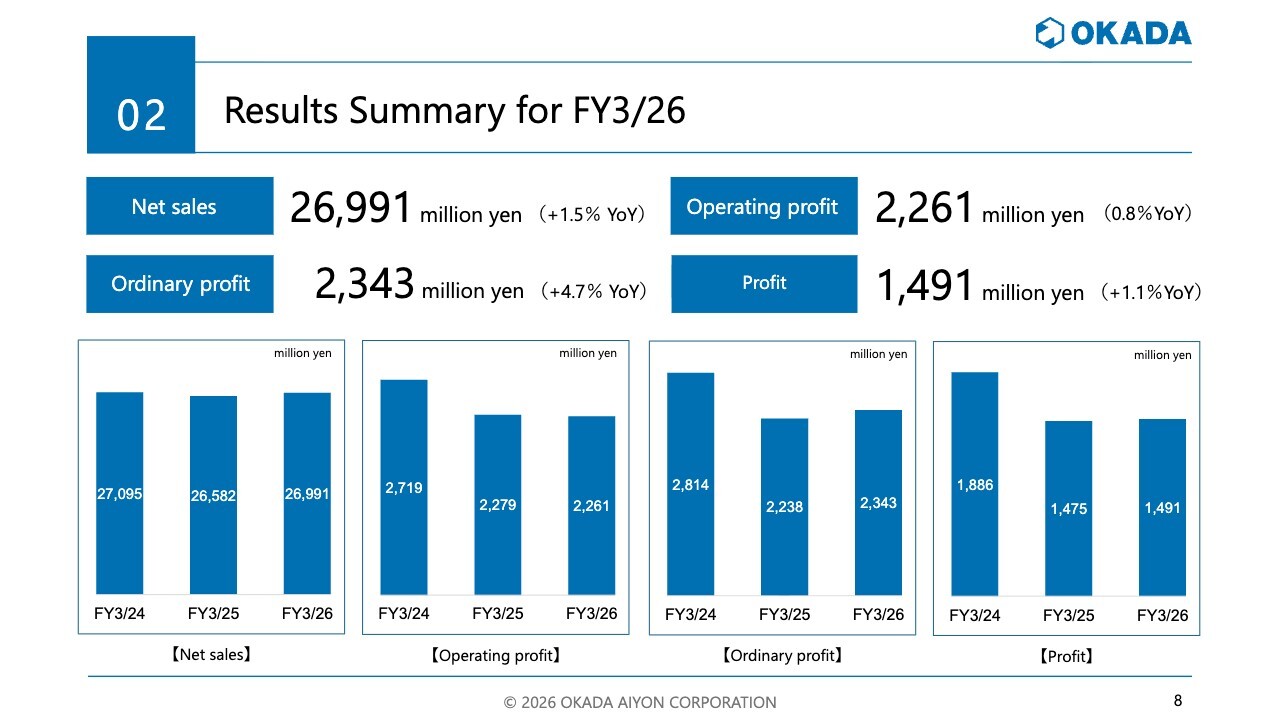
As a result, for the consolidated fiscal year, our operating results were as follows: net sales of 26,991 million yen, an increase of 1.5% YoY; operating profit of 2,261 million yen, down 0.8% YoY; ordinary profit of 2,343 million yen, an increase of 4.7% YoY; and profit of 1,491 million yen, an increase of 1.1% YoY.
Financial Results for FY3/26 and Full-Year Forecast
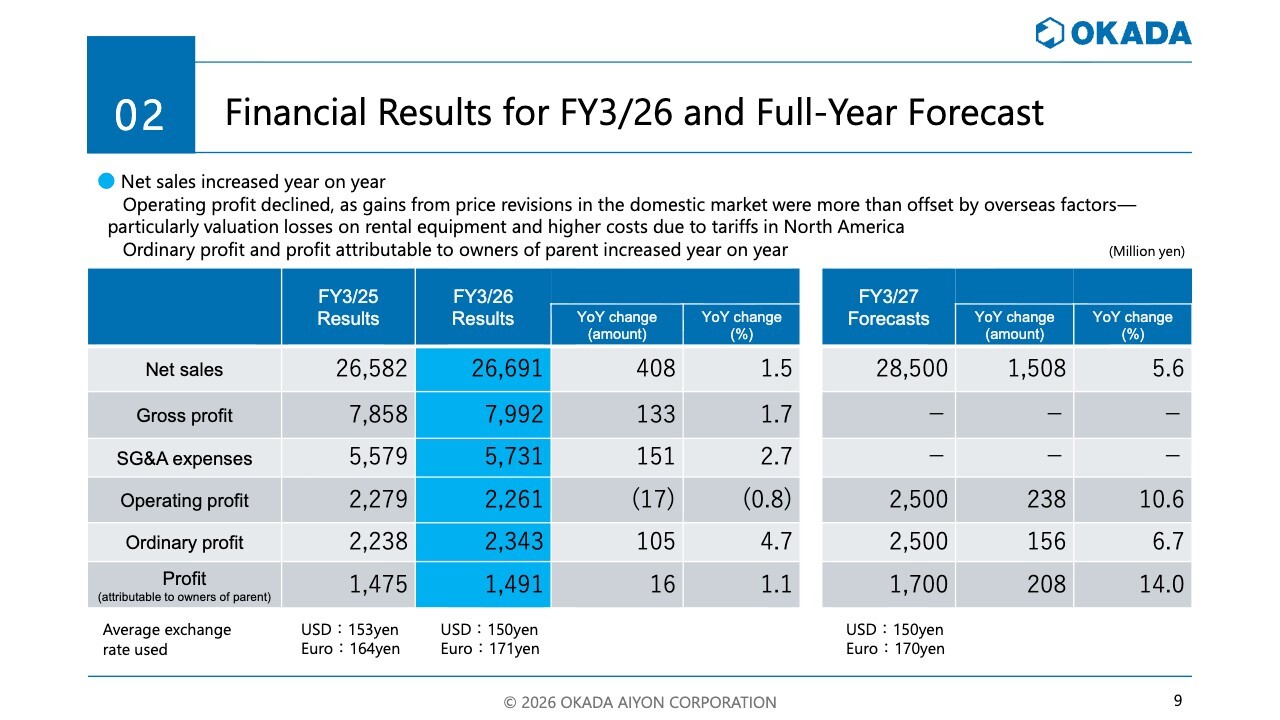
This is the full-year outlook. This section outlines the details later, but we expect net sales of 28,500 million yen, operating profit and ordinary profit of 2,500 million yen each, and profit of 1,700 million yen.
Factors for Changes in Net Sales for FY3/26
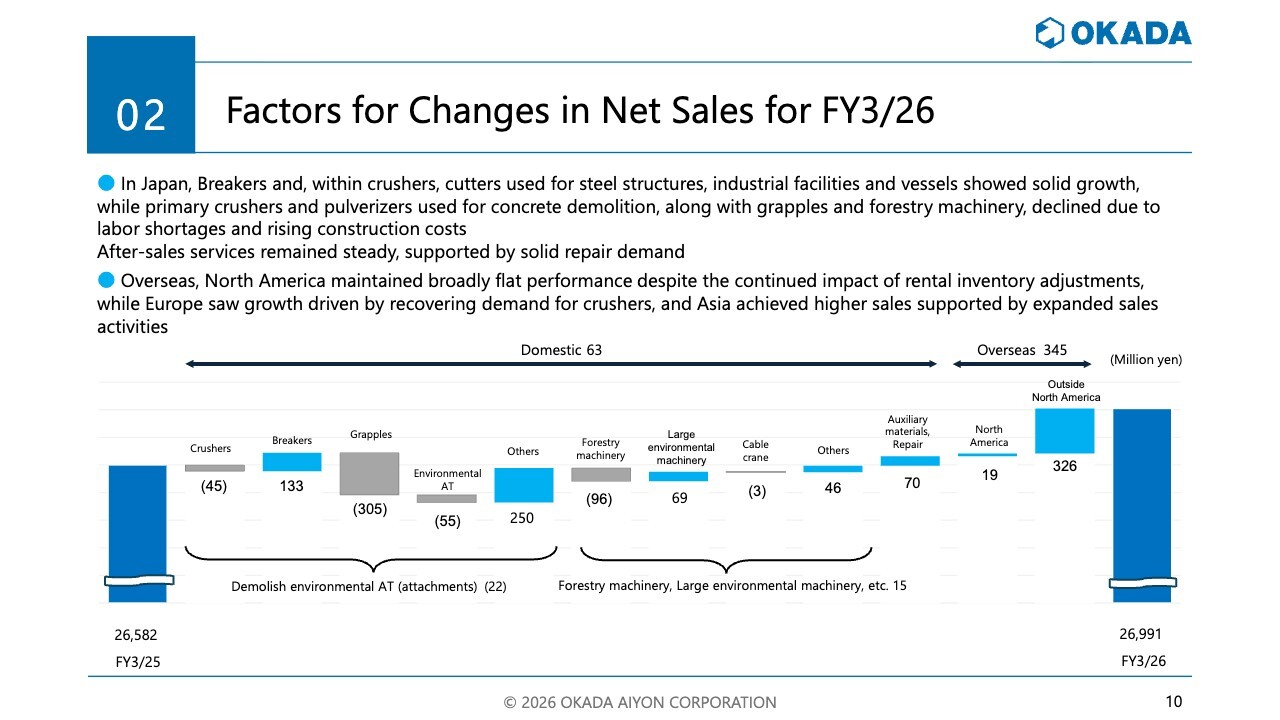
Here are the factors behind the change in net sales. In the domestic segment, among hydraulic breakers and crushers, cutters increased on the back of resilient demand. Meanwhile, due to labor shortages and rising construction costs, crushers—both primary crushers and pulverizers—declined.
Grapples declined as demand related to disaster recovery ran its course, and forestry machinery decreased due to factors such as lower sales of hydraulic excavators and a downturn in rental demand.
In the overseas segment, in North America, the impact of inventory adjustments at rental companies gradually decreased at our sales subsidiary Okada America. Meanwhile, at Okada Midwest, lower sales of commercial products to end users had an impact, but in total the result was roughly flat.
In Europe, the impact of the demand slowdown eased, and sales of crushers increased. In Asia, sales increased in India, Thailand, Taiwan, and other markets, resulting in overall revenue growth.
Sales Trends by Model for FY3/26
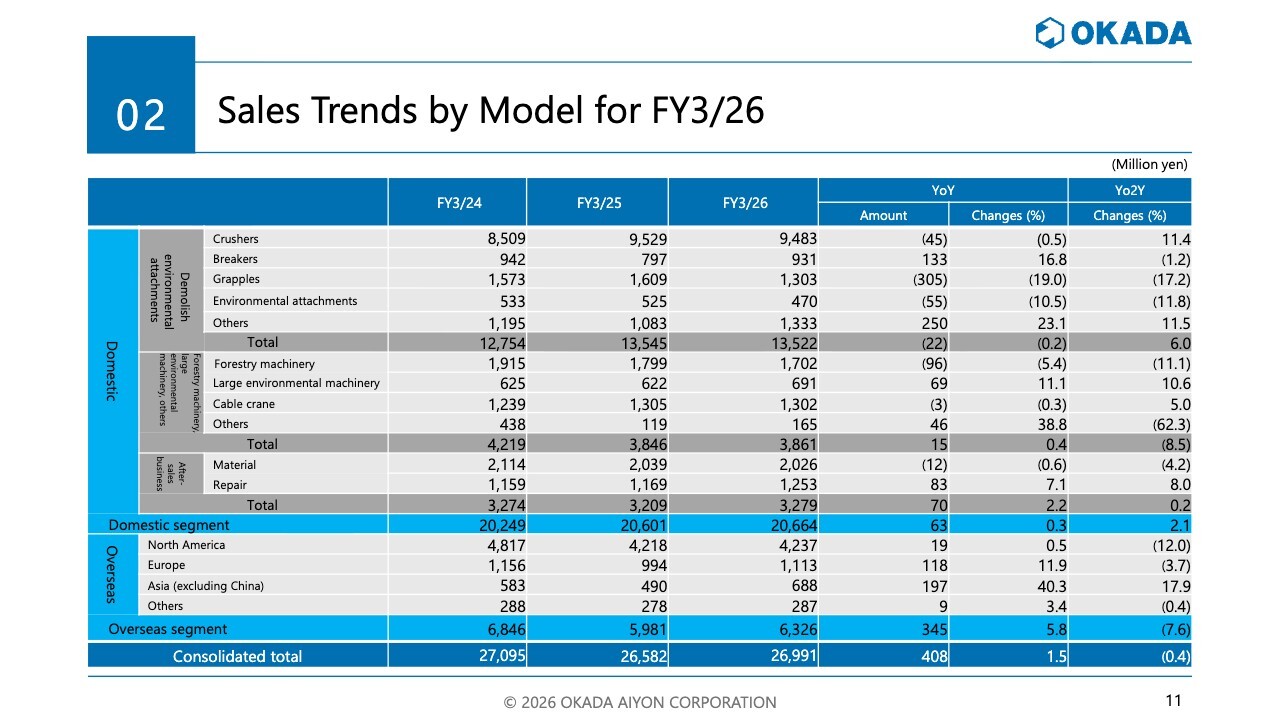
This slide shows sales trends by model.
Sales, Production, And Order Trends for Demolition Crushers and Key Products
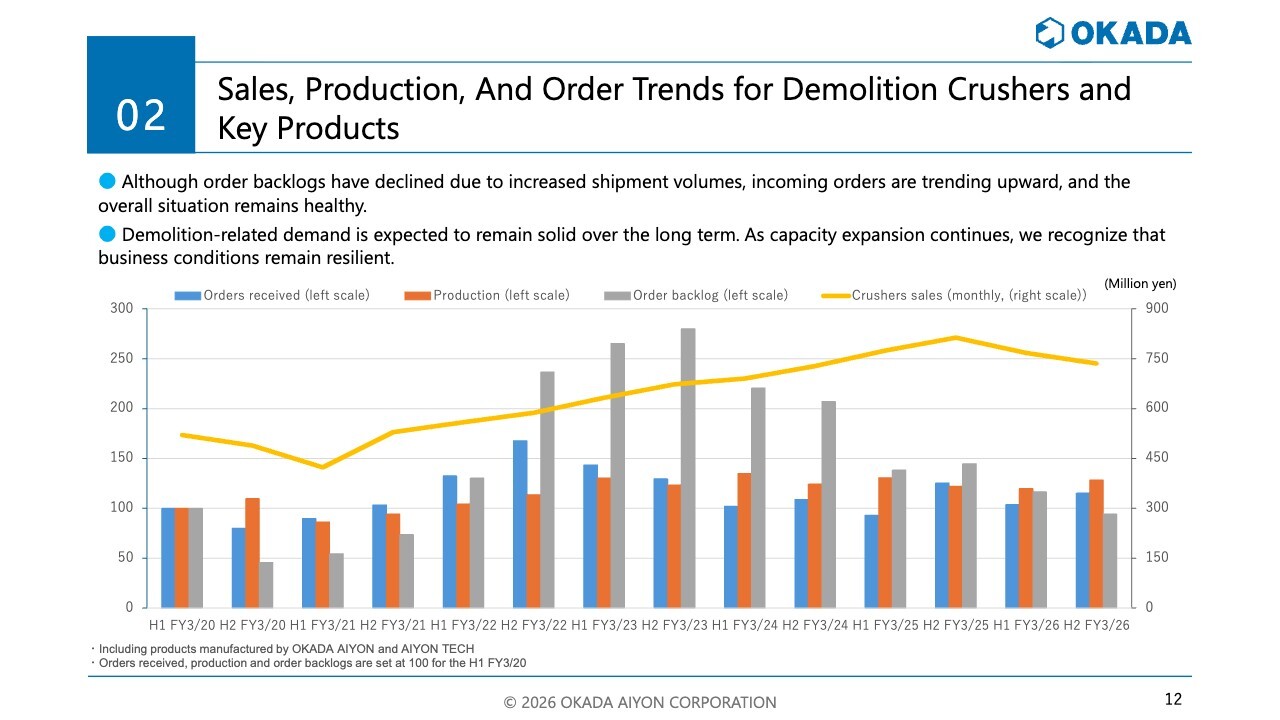
This slide shows the trends in sales, production, and order trends for our core products, including demolition crushers. With higher shipment volumes, the order backlog is declining; however, orders themselves are picking up, and overall, we are moving toward a normalized situation.
Demolition demand has been solid over the long term, and as we continue to expand production capacity, we recognize that conditions remain resilient.
Overseas Sales Breakdown by Region for FY3/26
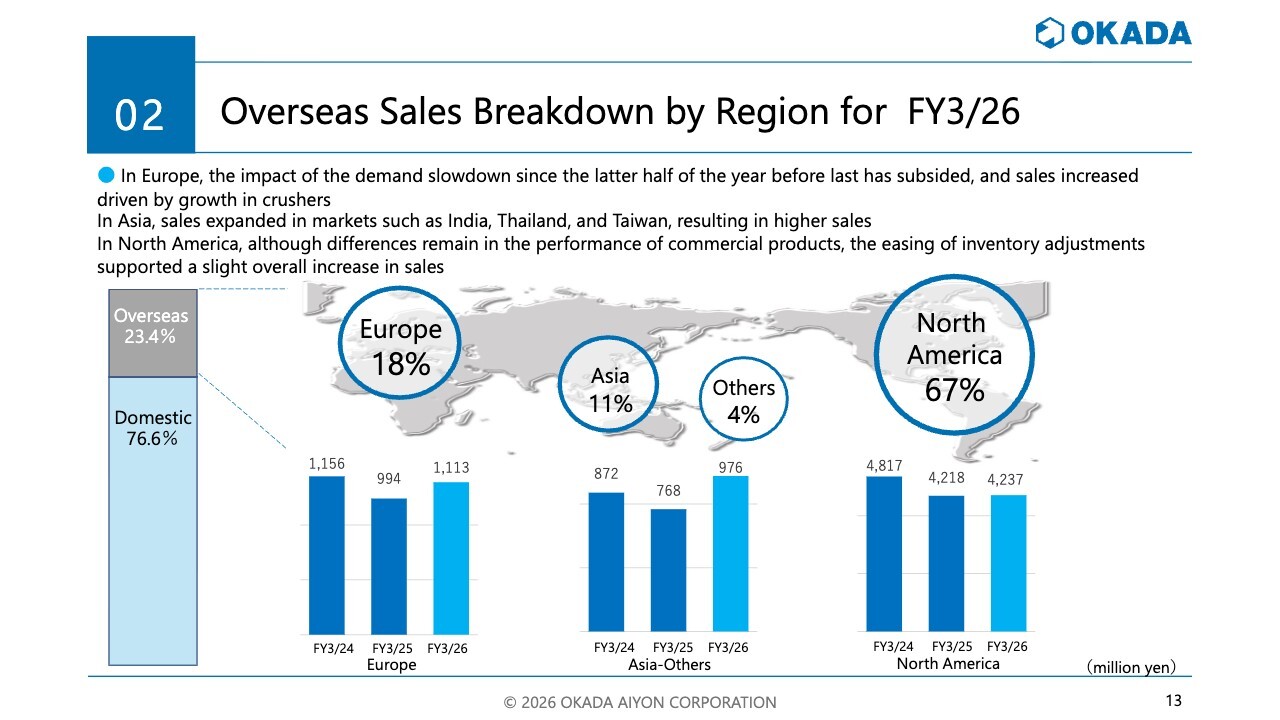
This is a breakdown of sales by overseas regions. As explained earlier under the factors behind changes in net sales, we secured higher net sales in the United States, Europe, Asia, and other regions.
Sales by Segment and Business for FY3/26
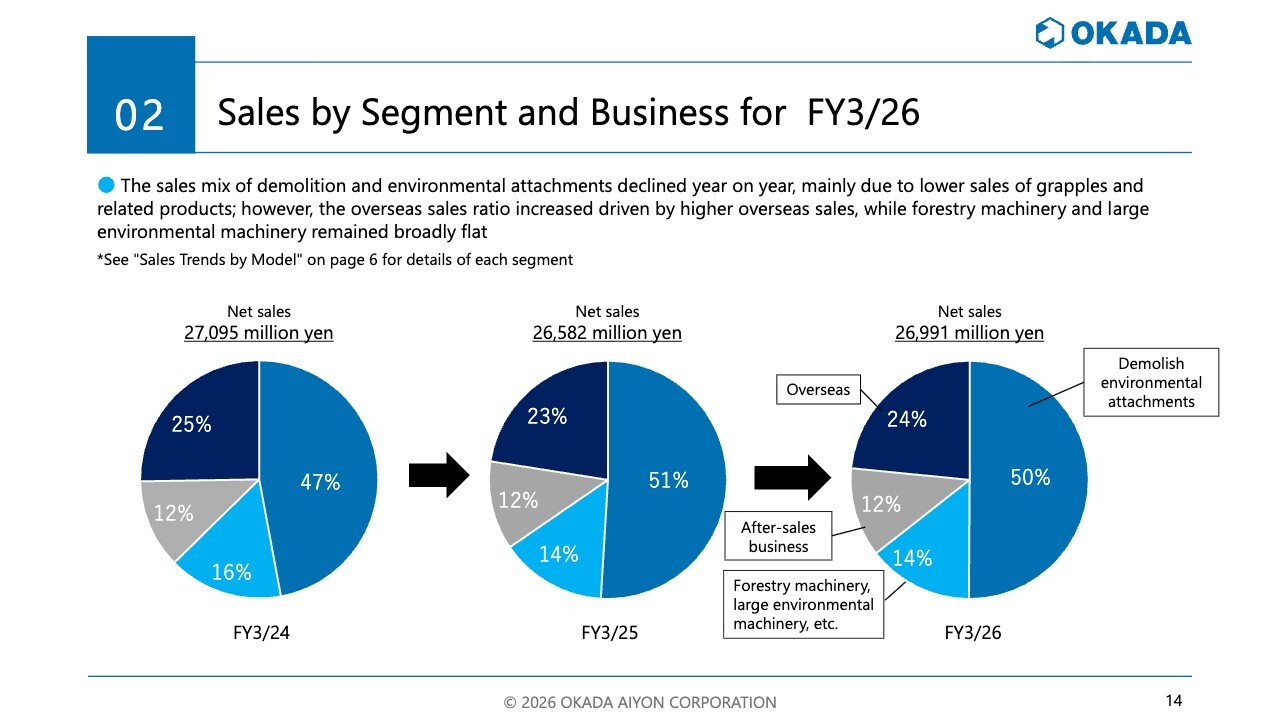
This is the transition in the sales mix by business within the segment. The mix for demolition environmental attachments declined due to decreases in grapples and other items, while the overseas mix rose on higher revenue, and the mix for forestry, large environmental machinery, and others was generally flat.
Factors for Changes in Operating Profit for FY3/26
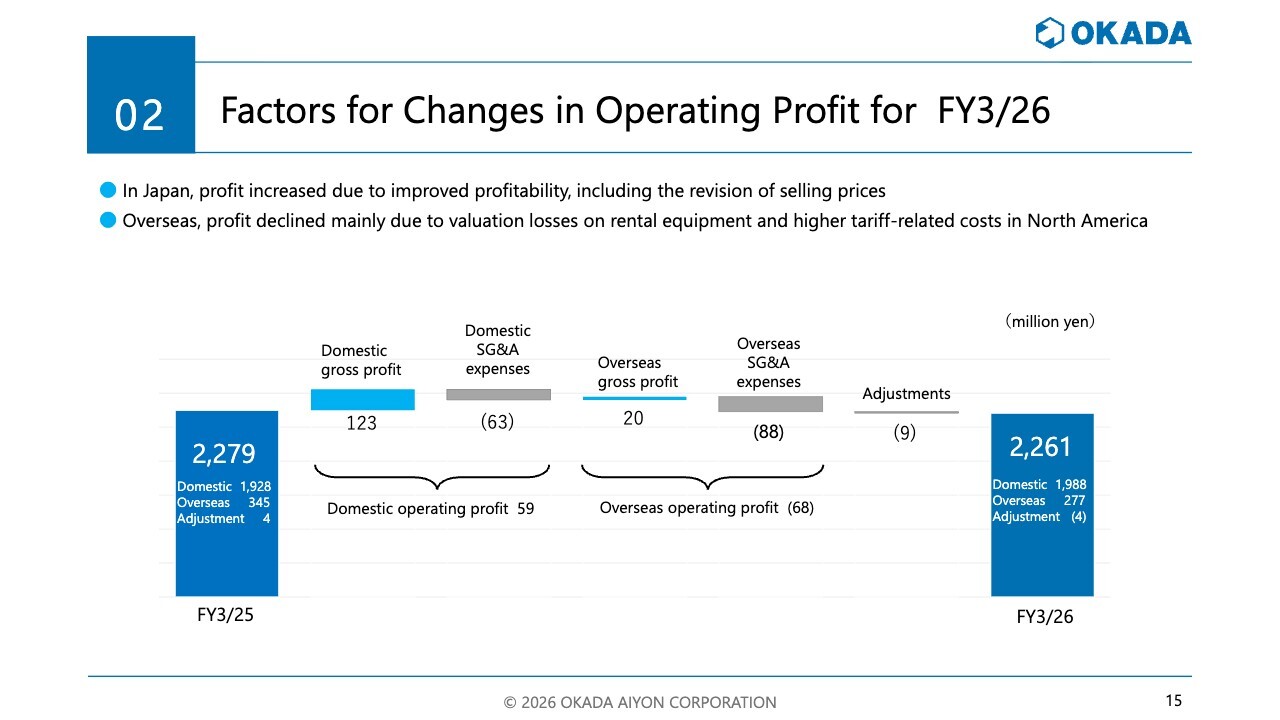
This is the change in operating profit. In the domestic market, profits increased, driven by measures such as improved margins through revisions to selling prices. Meanwhile, overseas, profits declined due to factors including impairment of rental equipment in North America and higher costs from the effect of tariffs.
Capital Expenditures and Depreciation (actuals)
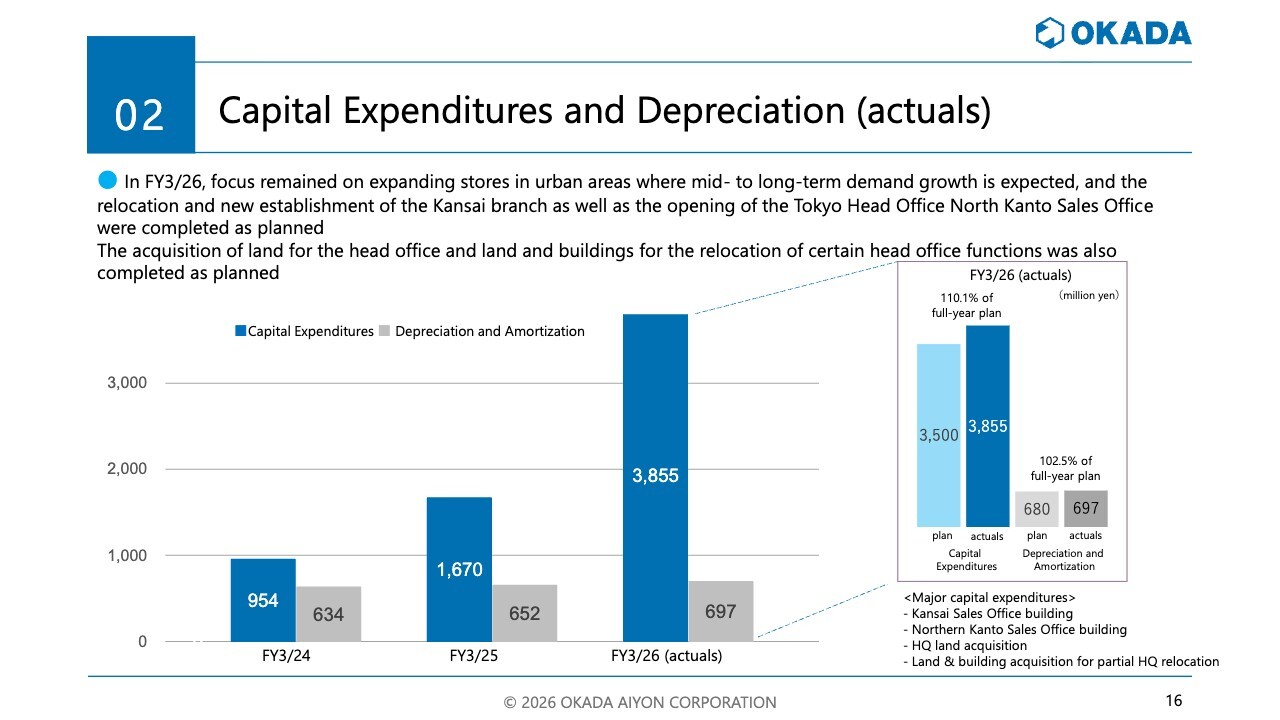
These are the results for capital expenditures and depreciation. In the fiscal year ended March 2026, we focused on expanding stores in urban areas where medium- to long-term demand is expected to grow, and we completed as planned the relocation and establishment of the Kansai branch, as well as the establishment of the Tokyo head office and the North Kanto sales office.
The acquisition of land for the headquarters and the acquisition of land and buildings for relocation of certain headquarters functions were also completed as planned.
Over the past 10 years, we have been upgrading our domestic sales offices and repair plants, and with that work now wrapping up, we plan to move forward with expanding the Hiroshima sales office and rebuilding the manufacturing department and training facilities at the current headquarters.
Shareholder Return: Dividend Results and Plan
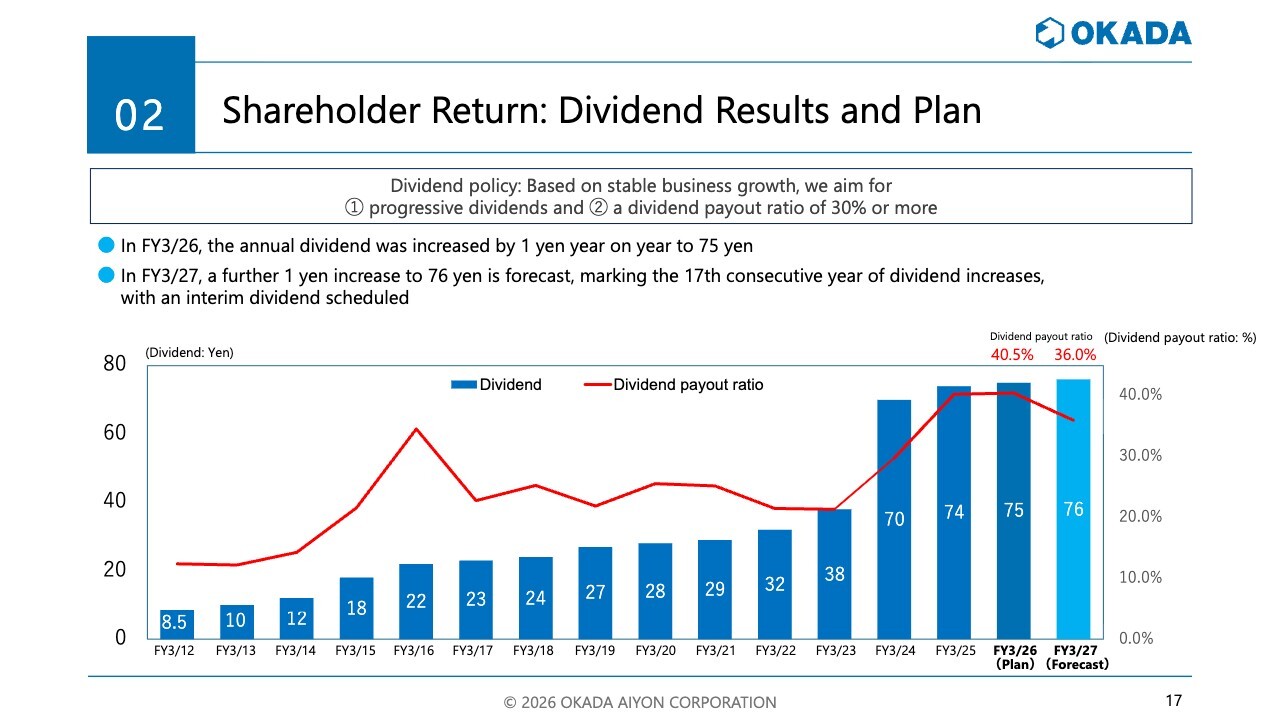
This slide shows the results and plan for dividends as shareholder returns. First, regarding our dividend policy, as before we base it on the stable growth of our business and aim for a progressive dividend and a dividend payout ratio of 30 percent or more.
For the fiscal year ended March 2026, we plan an annual dividend of 75 yen, an increase of 1 yen YoY, and for the fiscal year ending March 2027, we also forecast an increase of 1 yen YoY for an annual dividend of 76 yen. As a result, we expect this to mark the 17th consecutive year of dividend increases. Starting with the fiscal year ending March 2027, we plan to newly implement an interim dividend.
That concludes the financial results summary.
VISION30 Interim Progress: Achievements and Next Challenges
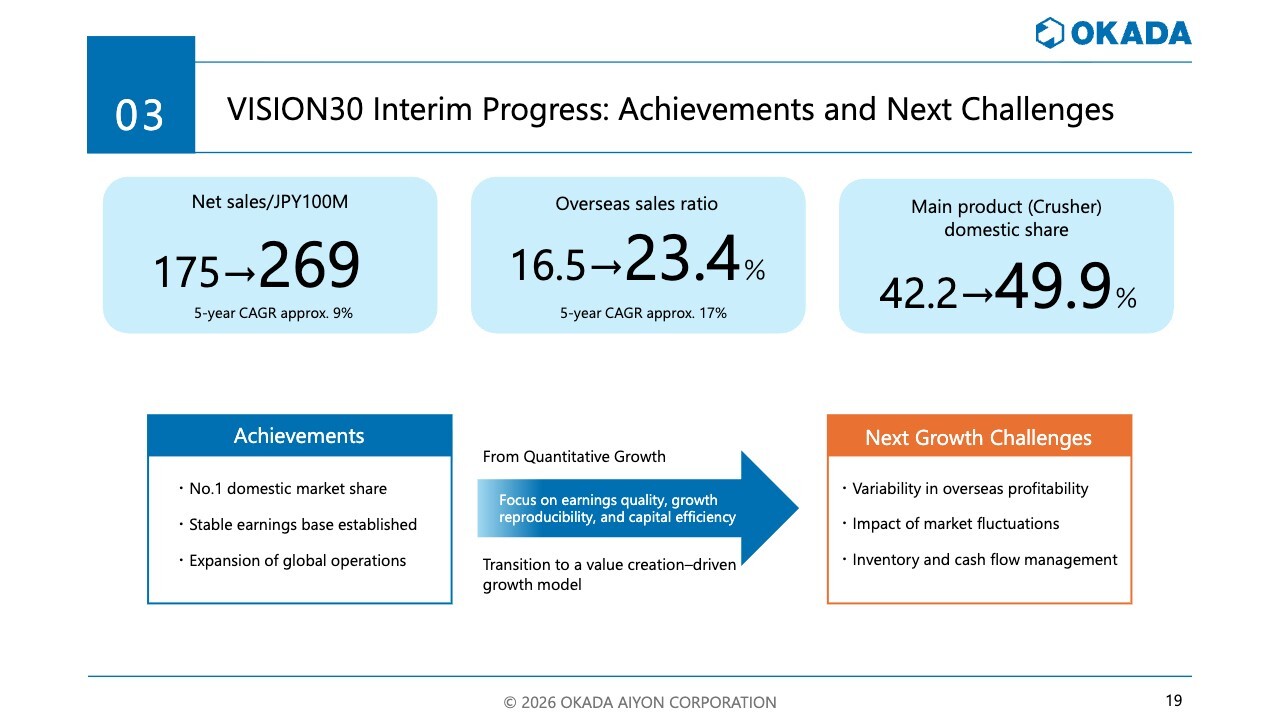
The following section turns to the mid-term business plan. First, as a preliminary step, this section outlines the progress and achievements over the past five years of “VISION30.”
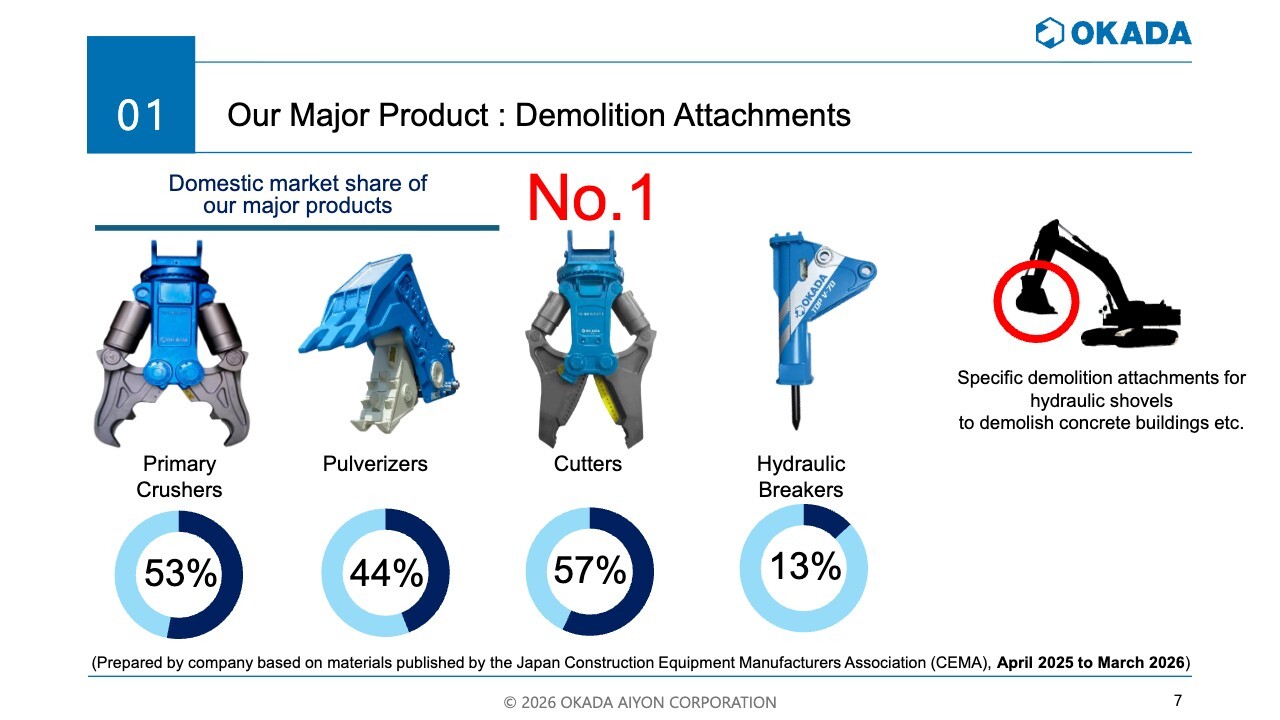
Over the past five years, consolidated net sales increased from 17,500 million yen to 26,900 million yen, and the overseas sales ratio expanded from 16.5% to 23.4%. The domestic share of our mainstay product, crushers, expanded from 42.2% to 49.9%, and we continue to hold the No. 1 domestic share as a construction equipment attachment manufacturer.
Looking ahead, our priorities include stabilizing the profitability of the overseas business and strengthening inventory and cash management.
We need to shift from quantitative growth to a growth model that emphasizes quality of profits, growth reproducibility, and capital efficiency.
New Mid-Term Business Plan "Onyx": Purpose and Positioning
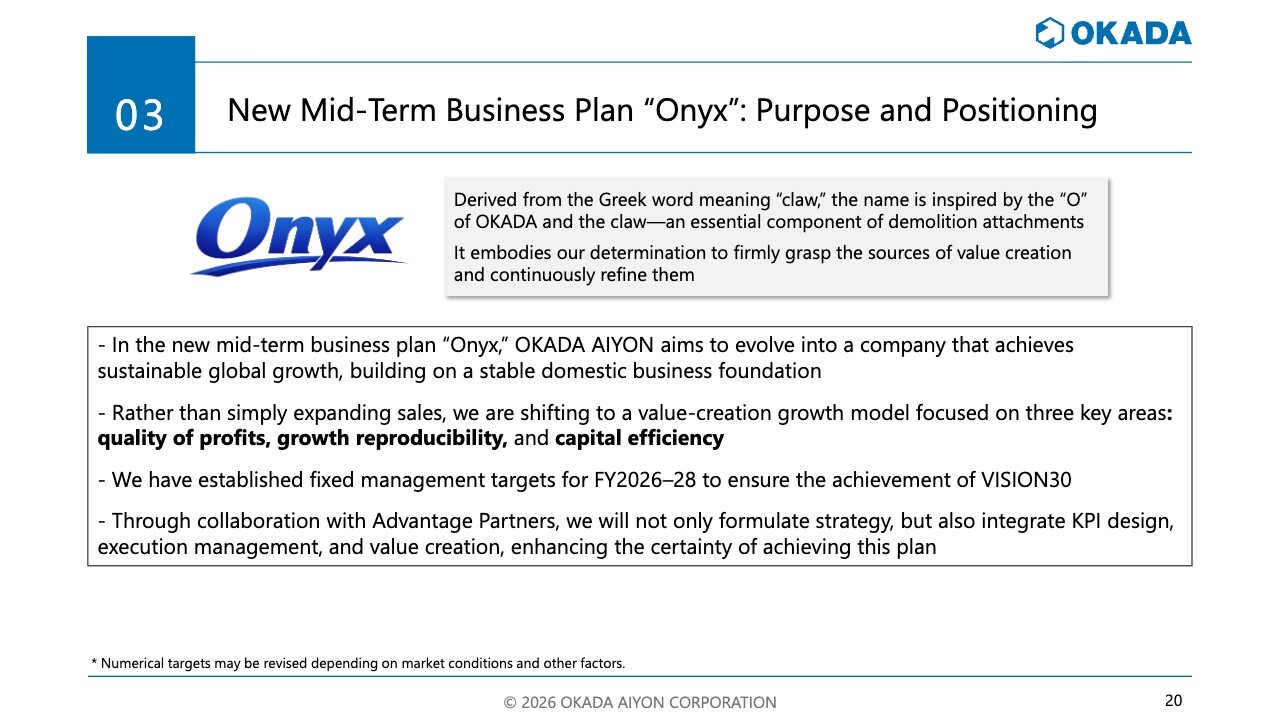
This section outlines the objectives and positioning of the mid-term business plan “Onyx.” “Onyx” means “claw” in Greek, and the name is inspired by the “claws,” a critical component of our flagship product, crushers. It also reflects our determination to firmly grasp the sources of value creation and to keep honing them.
Onyx is positioned to evolve into a company that achieves sustainable global growth, grounded in a stable domestic business base. Therefore, in this plan, rather than simply expanding sales, this plan shifts to a value-creation growth model that prioritizes three elements: “quality of profits,” “growth reproducibility,” and “capital efficiency.”
In addition, we have formulated fixed-type management targets for the three-year period including the current fiscal year, and we aim to achieve them with certainty.
Furthermore, through collaboration with Advantage Partners (hereafter, AP), An integrated approach will be driven that goes beyond strategy development to include KPI design, execution management, and value delivery, thereby increasing the likelihood of achieving this plan.
New Mid-Term Business Plan "Onyx" and New VlSlON30
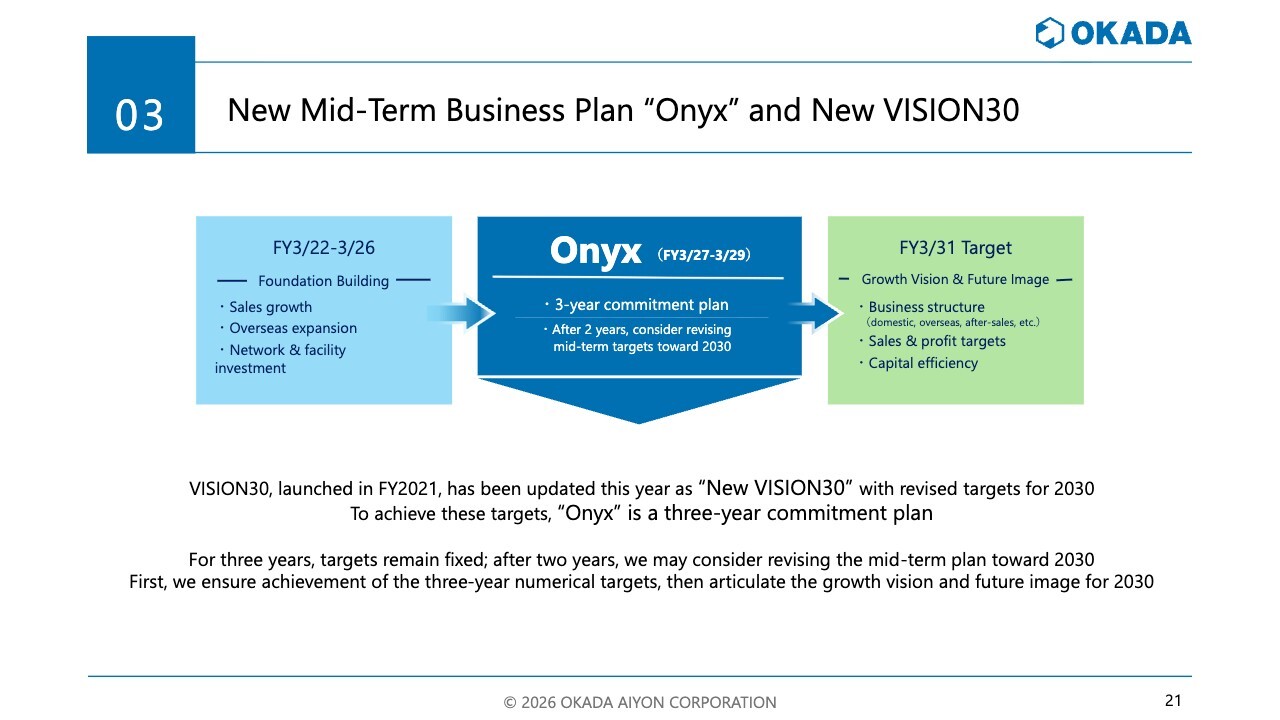
This section outlines the relationship between “Onyx” and “New VISION30.” First, from 2021 to 2025, we focused on building the foundation through sales growth, overseas expansion, and investments in sites and equipment.
With that in place, for the three years of “Onyx,” targets will be fixed and pursued as a three-year commitment. We are also considering, after two years have passed, reviewing and potentially revising the plan toward 2030.
Looking further ahead, the targets of “New VISION30” will be revised and clarify our growth targets and future outlook in terms of our business profile, sales and profit targets, and capital efficiency. To achieve this, “Onyx” is positioned as a “three-year commitment plan that we will see through to completion.”
New Mid-Term Business Plan "Onyx": Structure of Targeted Value Creation
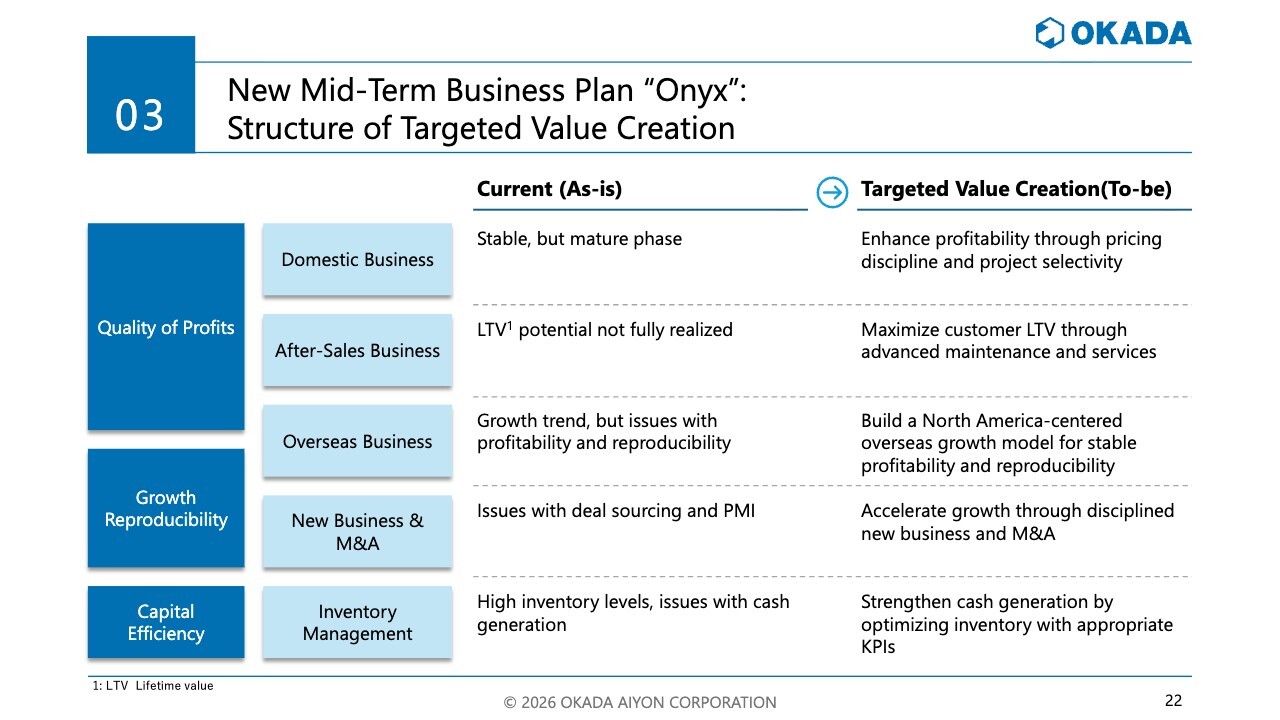
This section outlines the structure of value creation targeted with “Onyx” in terms of the current state and the direction going forward. Broadly, there are three perspectives: “quality of profits,” “growth reproducibility,” and “capital efficiency.”
First, “quality of profits.” The domestic business is stable, but it is entering a mature phase. Therefore, profitability will be strengthened by enhancing price discipline and our ability to select projects.
Also, in the aftermarket business, there is still room to grow from a customer LTV perspective. Therefore, customer LTV will be maximized by enhancing maintenance and after-sales services.
Next, “growth reproducibility.” The overseas business is on a growth trajectory but has challenges in profitability and stability. A growth model will be built on the North America business and shift to a structure for growth reproducibility.
Also, regarding new businesses and M&A, we face challenges in deal sourcing and the PMI framework, so these areas will be strengthened to help accelerate growth.
Lastly, “capital efficiency.” Inventory management: At present, elevated inventory levels are constraining cash generation, so appropriate KPIs will be introduced to optimize inventory and strengthen our cash generation.
By clearly identifying the current issues and executing measures for each, “Onyx” aims for high-quality growth.
VISION30: Long-term Targets (FY3/31)
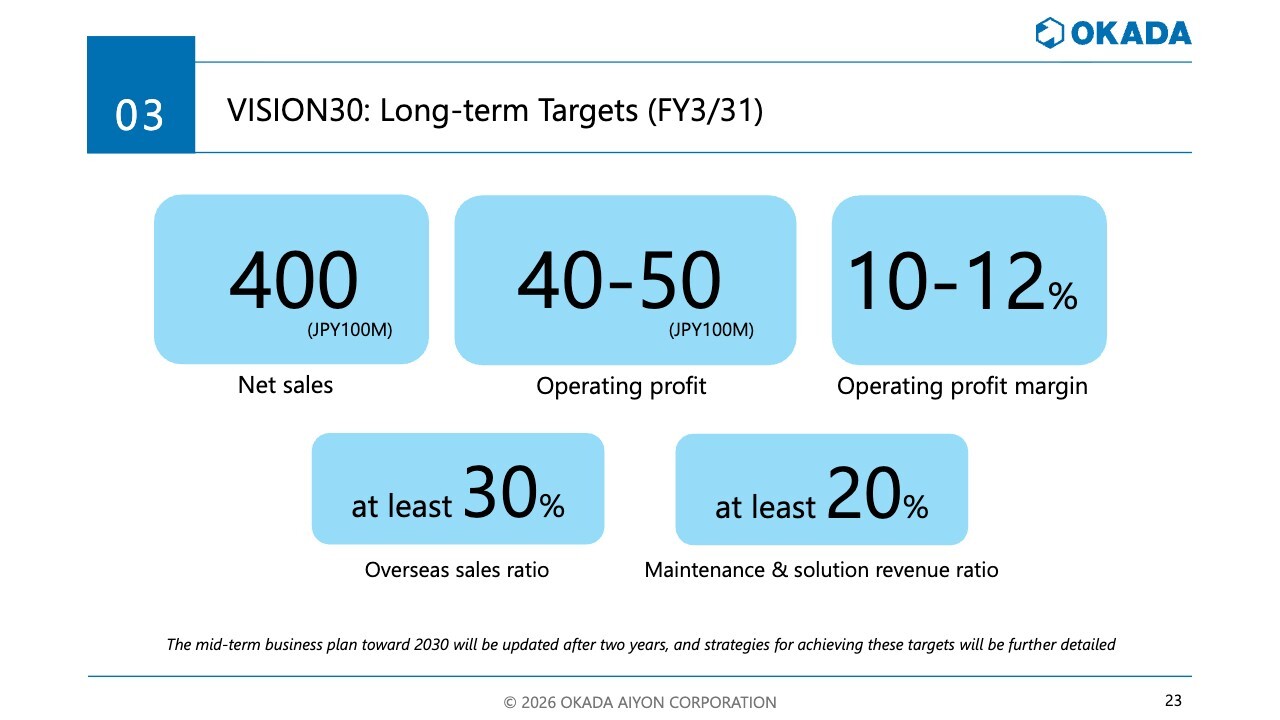
This section outlines the long-term targets of "New VISION30" that "Onyx" is committed to achieve. We have set long-term targets for the fiscal year ending March 2031 for net sales of 40,000 million yen, operating profit of 4,000 to 5,000 million yen, and an operating profit margin of 10 to 12%.
In terms of our business structure, the target is an overseas net sales ratio of 30% or higher and a maintenance solutions net sales ratio of 20% or higher.
“Onyx” represents a three-year commitment toward this long-term goal. First, by steadily delivering on this, this will support the next stage of growth.
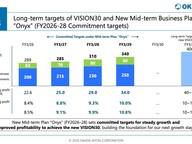
Long-term targets of VISION30 and New Mid-term Business Plan "Onyx" (FY2026-28 Commitment targets)
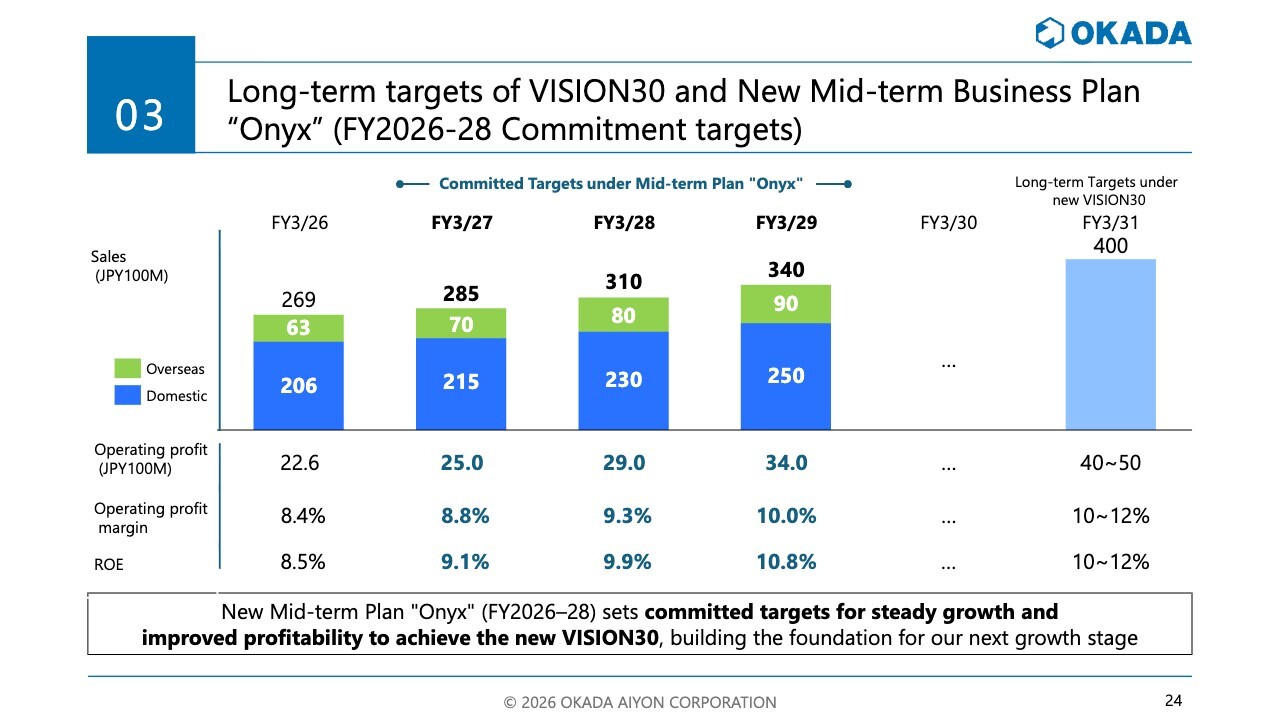
Under the long-term targets of "New VISION30," "Onyx" clearly lays outgrowth steps toward achieving them.
First, for net sales, net sales are projected to increase steadily from 26,900 million yen in the fiscal year ended March 2026, to 28,500 million yen in the fiscal year ending March 2027, 31,000 million yen in the fiscal year ending March 2028, and 34,000 million yen in the fiscal year ending March 2029, leading to further growth beyond that.
Operating profit will be increased in stages to 2,500 million yen for the fiscal year ending March 2027, 2,900 million yen for the fiscal year ending March 2028, and 3,400 million yen for the fiscal year ending March 2029, while the operating profit margin will also be improved. Steady improvement in ROE and continued enhancement of capital efficiency will be pursued.
In this way, by fully delivering on our commitment targets for steady growth and improved profitability under “Onyx,” this will build the foundation for achieving "New VISION30."
Business Strategy: Three Pillars for the Next Growth Engine
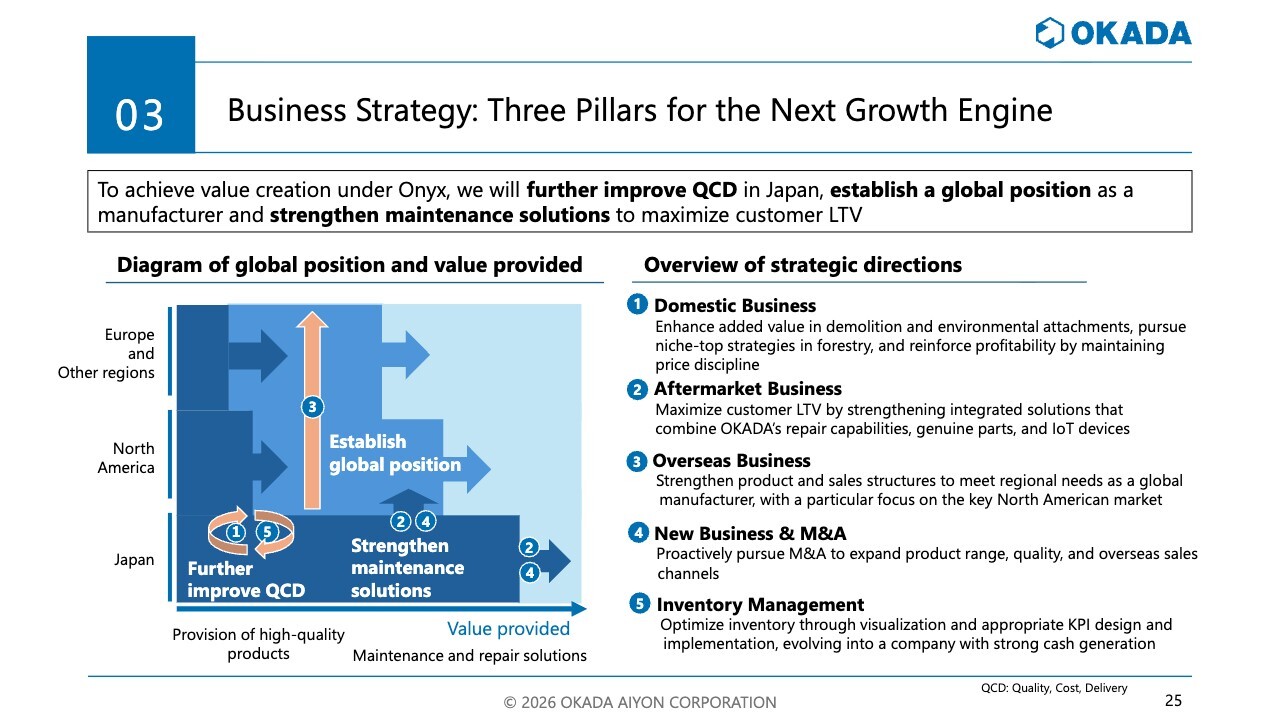
As outlined above, “Onyx” targets growth and improved profitability. This section explains the concrete business strategy to make that happen.
First, overall, focus will be placed on three pillars: further strengthening QCD in the domestic market, establishing our position as a “global manufacturer,” and maximizing customer LTV.
Specifically, we will drive this with three major growth engines. The first is the domestic business. Profitability will be strengthened by advancing higher value-added offerings in demolition and environmental attachments and by pursuing a niche strategy in forestry, while also enhancing price discipline.
The second is the aftermarket business. Customer LTV will be maximized by strengthening our solution capabilities through a combination of repair capabilities, genuine parts, and IoT devices.
The third is the overseas business. As a global manufacturer, our products and sales structure will be strengthened to meet each region’s needs, but first we will establish a growth foundation centered on the important North America business.
New business, M&A, and inventory management are positioned as key initiatives. Through these measures, we will drive both faster growth and improved capital efficiency at the same time. By combining multiple initiatives in this way, growth and profitability improvements will be delivered out in “Onyx.”
Business Strategy: Overview and Strategic Partnership with AP
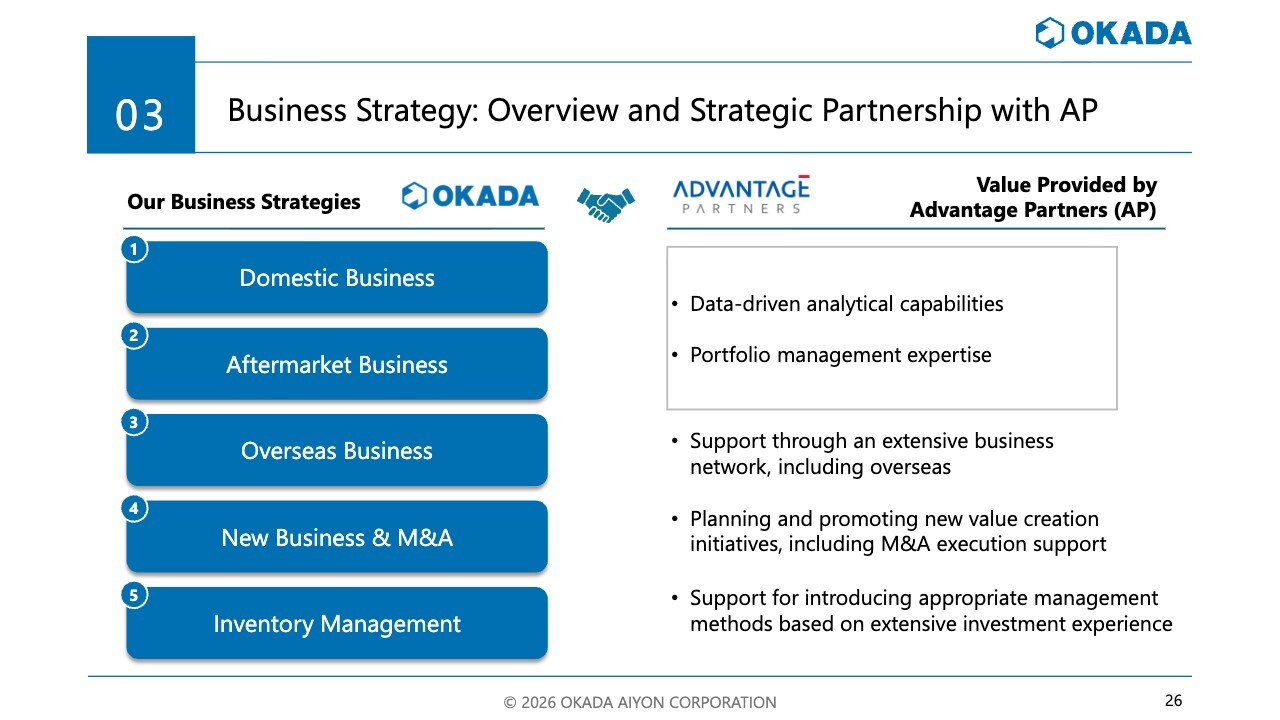
As we carry out these initiatives, execution will be strengthened by incorporating external expertise, rather than relying solely on our own resources.
The business strategy is driven across five areas: domestic business, aftermarket business, overseas business, new business and M&A, and inventory management. Amid this, AP will be strategically leveraged to data-driven analysis and portfolio management know-how, further improving the execution accuracy of each initiative.
The overseas network will be leveraged to strengthen the ability to plan and drive new value-enhancement initiatives and to further accelerate business creation, including through M&A. By combining our business foundation with the expertise of external partners, we will further increase the likelihood of achieving the mid-term business plan “Onyx.”
Business Strategy: (1) Domestic Business, (5) Inventory Management
Nobuo Maenishi (hereafter, Maenishi): I am Nobuo Maenishi, Executive Senior Managing Director. Thank you very much. This section outlines the concrete measures of our strategy.
As the President just explained, in our new mid-term management plan “Onyx,” we are not merely aiming to expand sales. We are committing to a shift toward a value-creation growth model, centered on “quality of profits,” “growth reproducibility,” and “capital efficiency.” This section explains the specific initiatives to achieve this.
As the President explained earlier, our strategy is organized into five themes. Based on our partnership with AP, we have formed project teams aligned with these themes, with our headquarters and general managers serving as project leaders, and AP also taking part, and these initiatives are being advanced.
At the management level, we review progress every month at the management meeting and the Board of Directors and make adjustments. These are individual initiatives, and they are tied to our management priorities of profitability, lifetime value (LTV), global growth, and capital efficiency, which these will be improved in an integrated manner.
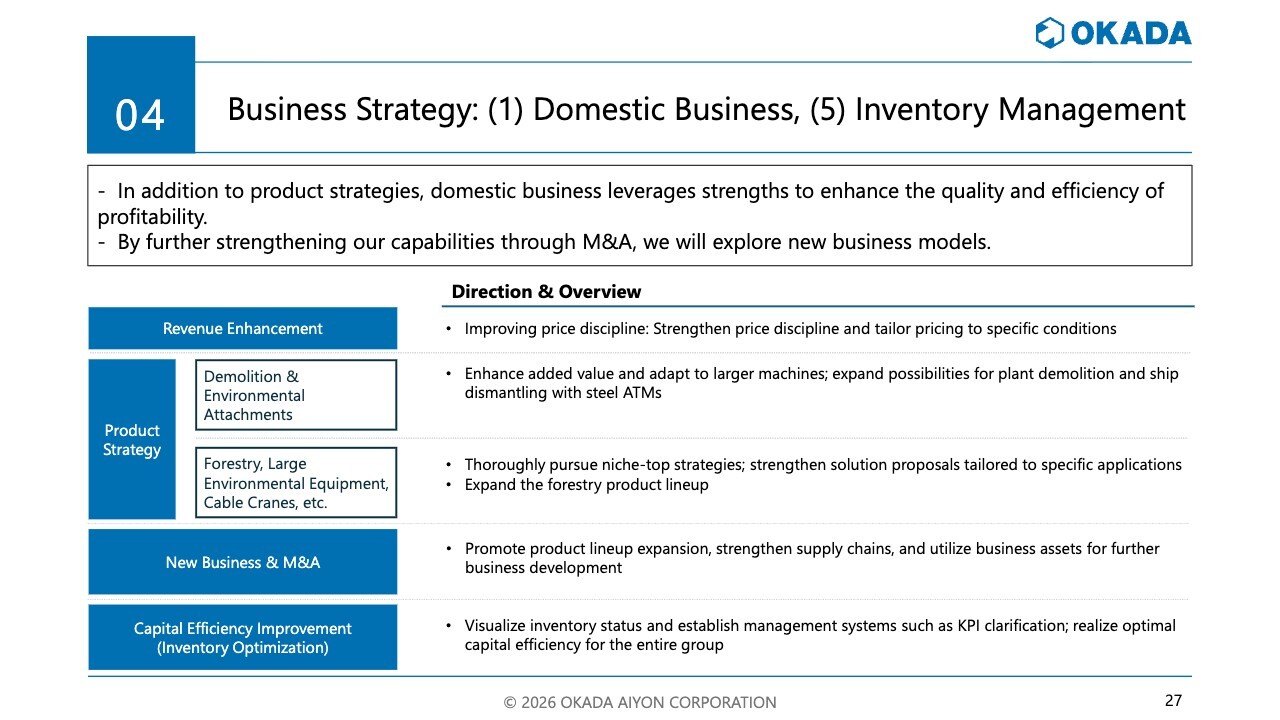
This section explains the domestic business. A high share has already been established in the domestic market. By encouraging our product strengths and after-sales maintenance framework, greater emphasis will be placed not only on volume but also on enhancing profitability going forward.
Specifically, there are three points. First, enhancing pricing discipline and project selection. In this project, the focus is on pricing and will reflect the strengths and added value of our products and after-sales services in our pricing.
Disciplined price negotiations will be conducted, taking into account regional characteristics, competitive conditions, and the status of other stores within the company. This will help lift our profit margin and improve gross profit.
Next, our product strategy. Products will be strengthened for steel-frame demolition and large-scale projects, where sustained demand is expected to continue going forward. Slides 42 to 43 provide detailed trends for large-scale plant demolition and ship demolition. Currently, demand for large cutters for steel frames is growing very strongly.
In addition to demolition machines, niche products such as forestry machinery, large environmental machinery like wood crushers and waste disposal machines, and cable cranes, which are transport machinery used in mountainous areas are also handled.In the forestry field in particular, the lineup will be expanded where we have fallen behind competitors and leverage our advantage as the only manufacturer with an after-sales maintenance framework.
Regarding “inventory management,” the current high inventory levels are a challenge for capital efficiency. Holding inventory is a positive from a sales perspective, and because our products are steel items, there is little concern about deterioration; however, we also need to consider holding costs and capital efficiency.
Going forward, management will be strengthened through inventory visibility and KPI setting, and, by enhancing collaboration between sales and manufacturing, advance inventory optimization across the group to improve operating cash flow. Ultimately, this is expected to lead to an improvement in ROIC.
Business Strategy: (2) Aftermarket Business
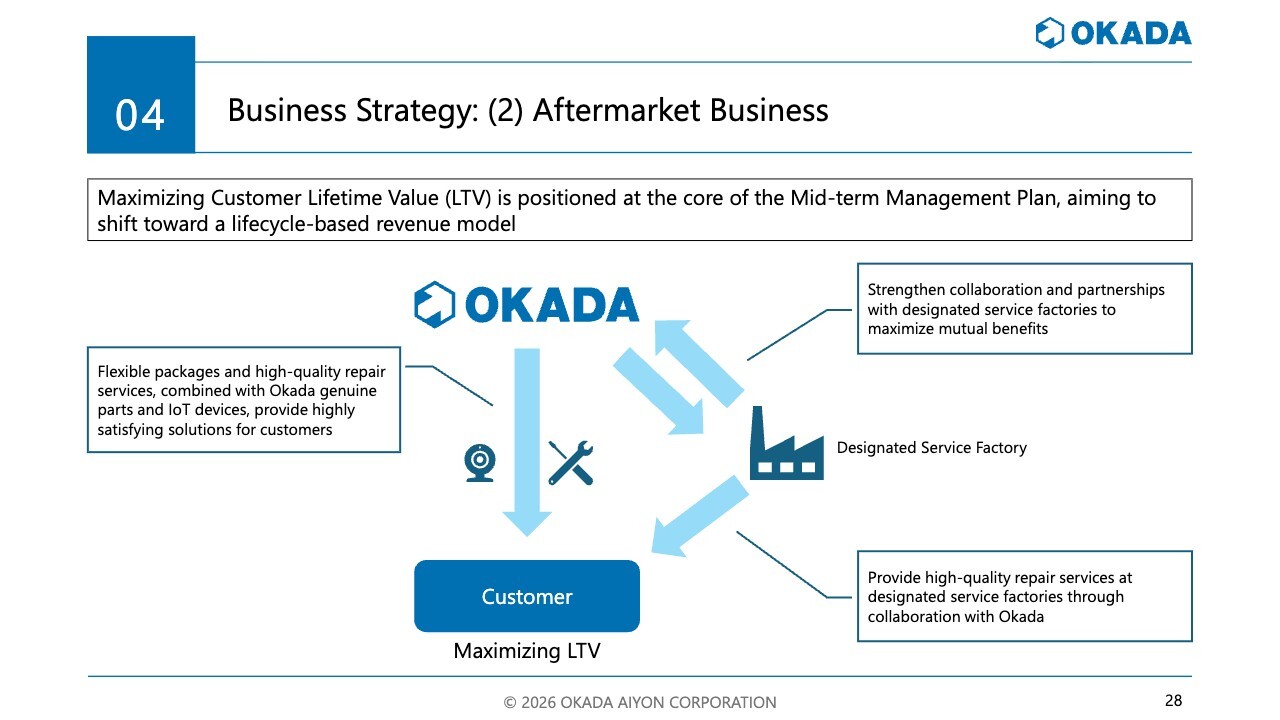
This section covers the “aftermarket business.” In this mid-term management plan, we position this as one of the most important revenue drivers. The aim is to maximize customer lifetime value (LTV). Our maintenance facilities have been made mostly fully robust through capital investments over the past 10 years. In the domestic market, there are hardly any other maintenance plants equipped with facilities comparable to the large cranes owned by the sales offices at our 13 locations.
Our strengths are particularly in large machines, and large machines are also necessary for demolishing large plants and ships, where demand is expected going forward. We will make full use of these large-machine products and, domestically, our unmatched maintenance technologies and technical service team.
Going forward, collaboration with designated service factories will be maximized, and involvement with products will be maintained from the time of sale until disposal. The business model will shift to one that generates recurring revenue even after product sales.
This will strengthen service revenue and recurring revenue business models in addition to our sales-centered business.
Business Strategy: (3) Overseas Business
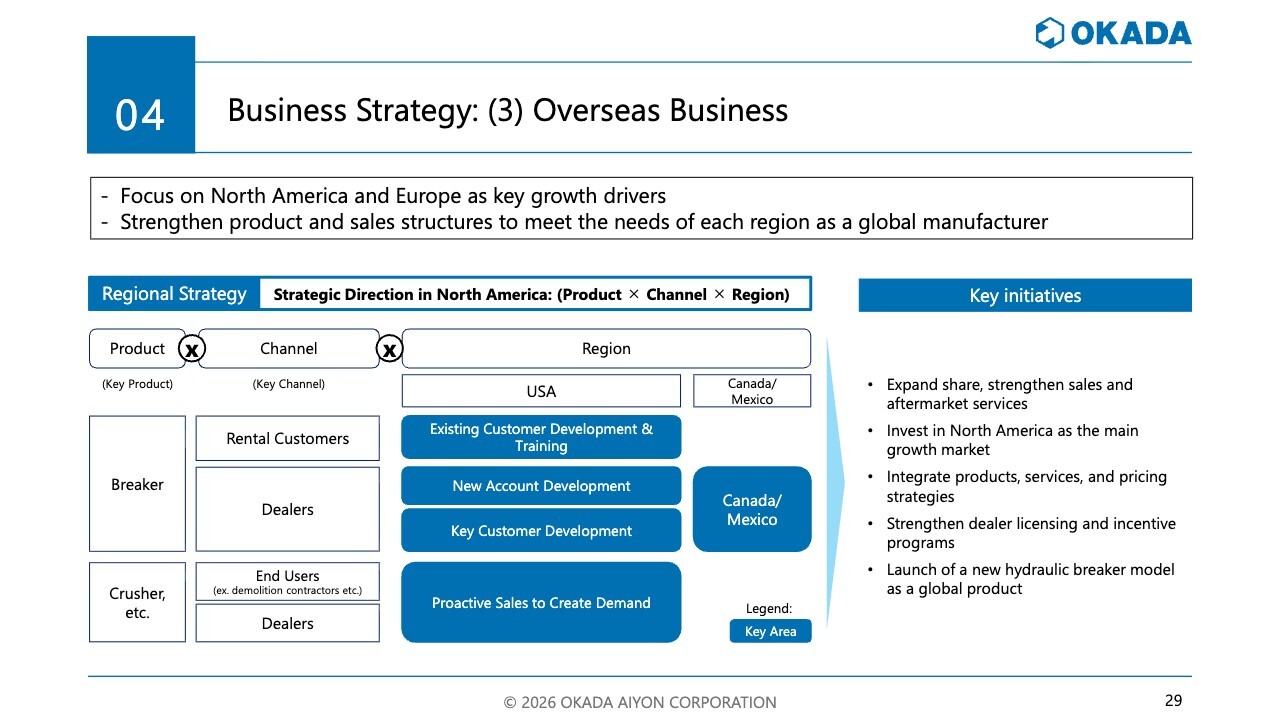
Next, this section outlines the “Overseas business.” The challenge is very clear: while we appear to be growing on the surface, we face issues with profitability and reproducibility. In contrast, under the new mid-term management plan, efforts will focus on establishing a model centered on North America.
As for our strategy in North America, we will continue to prioritize investment in this largest market. Currently, with support from AP, we are reviewing specific measures for each product, sales channel, and region.
In particular, our crushers, a core strength of ours, have hardly been brought to market so far. With improved production capacity, we will take the time to pursue share expansion in North America.
Therefore, starting from Okada Midwest in Chicago, which we added as a group company in 2022, we will expand our business for end users such as demolition contractors and scrap dealers. We also believe it would be ideal to strengthen OKADA’s strengths in Japan—sales and after-sales services—in North America as well.
We will strengthen incentive plans for dealers and focus on developing new accounts and uncovering prospective customers. Market penetration with major rental companies will be deepened, and OEM offerings to excavator manufacturers expanded.
While this may sound quite broad, we plan to begin with a pilot in the Midwest—where Okada America’s sales base, Okada Midwest, is located—and verify in North America the company’s unique reproducibility for global expansion.
And we believe that establishing reproducibility in North America will be the key to our overall global expansion.
Business Strategy: (3) Overseas Business
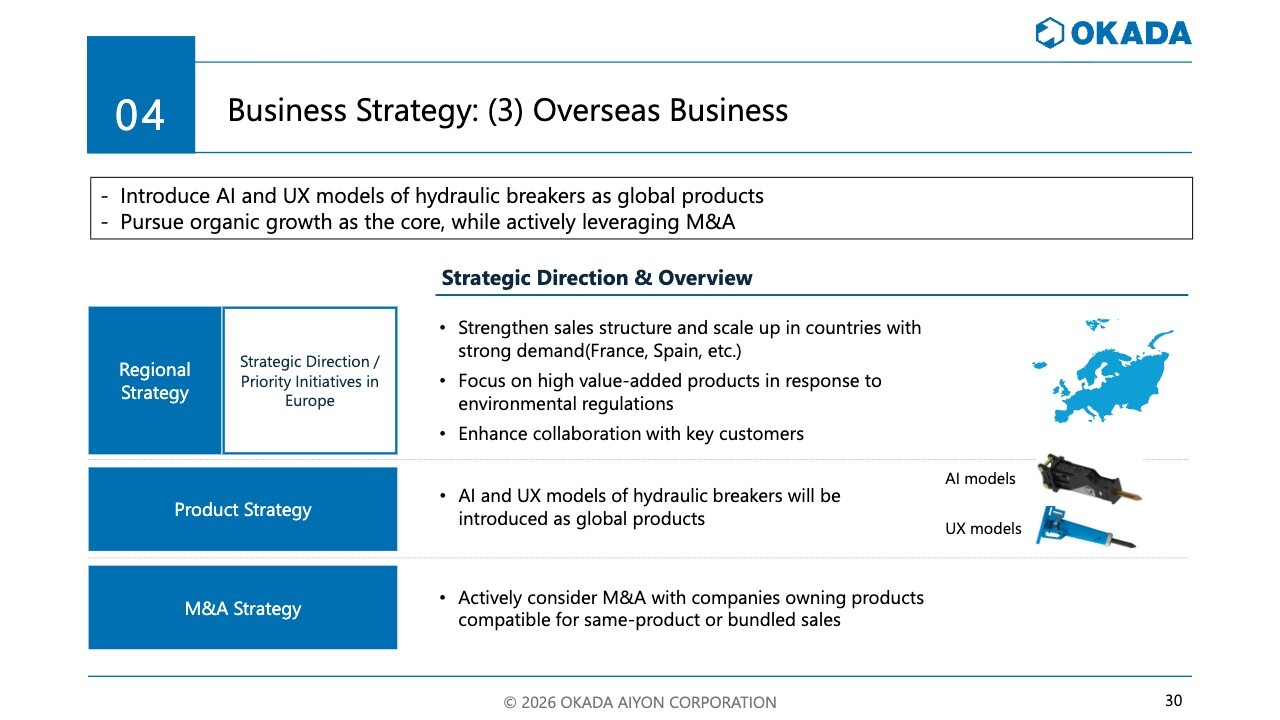
Regarding Europe, we plan to assign local sales representatives to the major countries. We are currently deployed only in France, but since Spain, Germany, Italy, and the United Kingdom are our main markets, we plan to focus on these countries.
The lineup of machines such as environmentally compliant models, Europe-spec crushers, and sorting grapples, which are very common in Europe will be expanded. As a common initiative overseas, for hydraulic breakers—which account for much of our current overseas sales—we will actively leverage entry models with strong price competitiveness, namely the “AI series” and the “UX model,” to drive further expansion.
We also believe that across overseas operations, acquiring and developing local talent will be the biggest challenge going forward. On this point, we plan to allocate a budget and proceed with adding personnel.
Business Strategy: (4) New Business & M&A
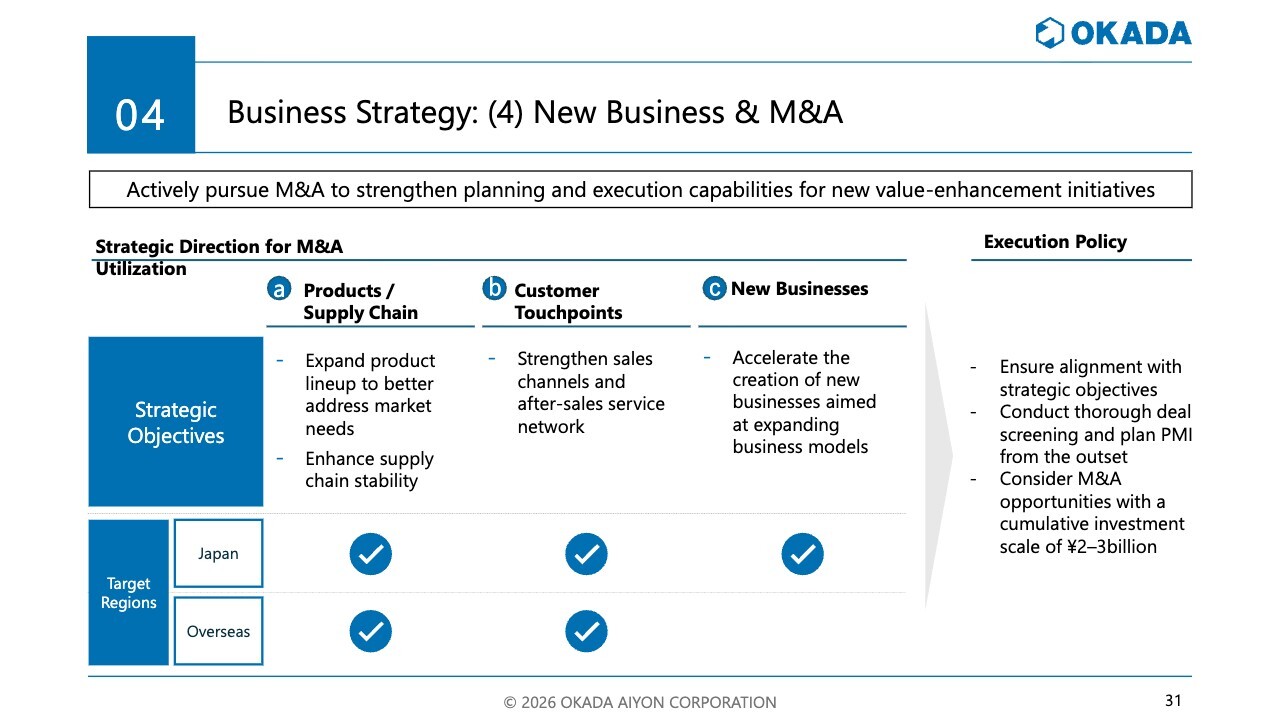
“New business and M&A.” Here, we will pursue disciplined M&A. We will pursue M&A not just to expand but to tie to clear strategic objectives such as strengthening our product lineup and supply chain, broadening our sales channels, and creating new business.
We expect a total investment scale in the range of 2 billion yen to 3 billion yen. We will not push ahead forciblyand instead will proceed with a policy of executing only on opportunities that are winnable with certainty.
Based on these clear strategic objectives, robust post-merger integration (PMI) will be carried out following execution. With support from AP, disciplined M&A will be pursued.
Strengthening Management Foundations: lnvestment
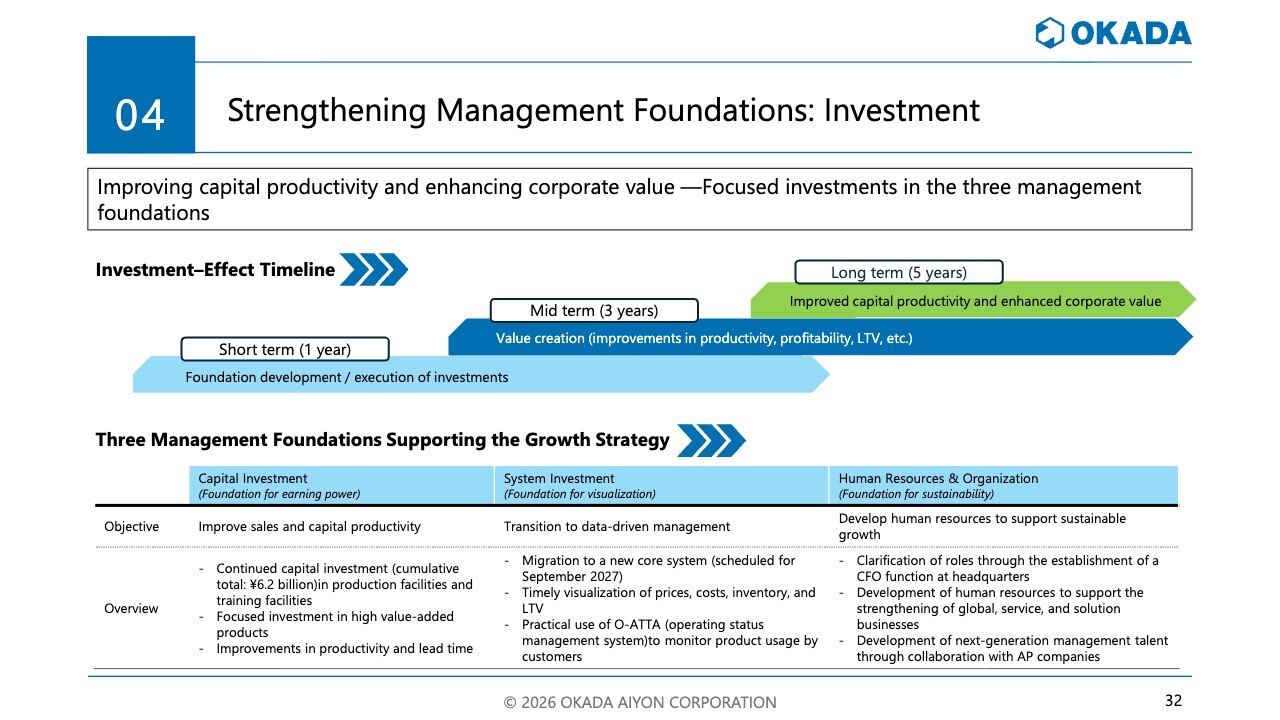
This section provides describe strengthening the management foundation that supports our execution capability. There are three priorities. As for capital expenditure, we invested a total of 6.2 billion yen over the past 10 years in branch office investments to accommodate the larger size of demolition machines. Over the past three years, we have largely completed our investments in sales offices, so apart from expanding the Hiroshima sales office, we will consider investments in the production department and training facilities at headquarters.
In terms of amounts, compared with 5.5 billion yen in capital expenditure over the previous three years, the next three years will be 2.2 billion yen, which is a considerable decrease; however, please understand that we are now entering a stage of recouping the investments made through the last fiscal year.
Regarding system investments, we plan to introduce a new core system responsible for sales management and production management in September 2027. We believe this system will help visualize inventory, pricing, and LTV, and also lead to greater operational efficiency.
Regarding human capital investment, we plan to invest in global talent, LTV technology service talent, and next-generation management talent, aiming to eliminate execution bottlenecks in our strategy in advance.
Strengthening Management Foundations: Human Resources Strategy
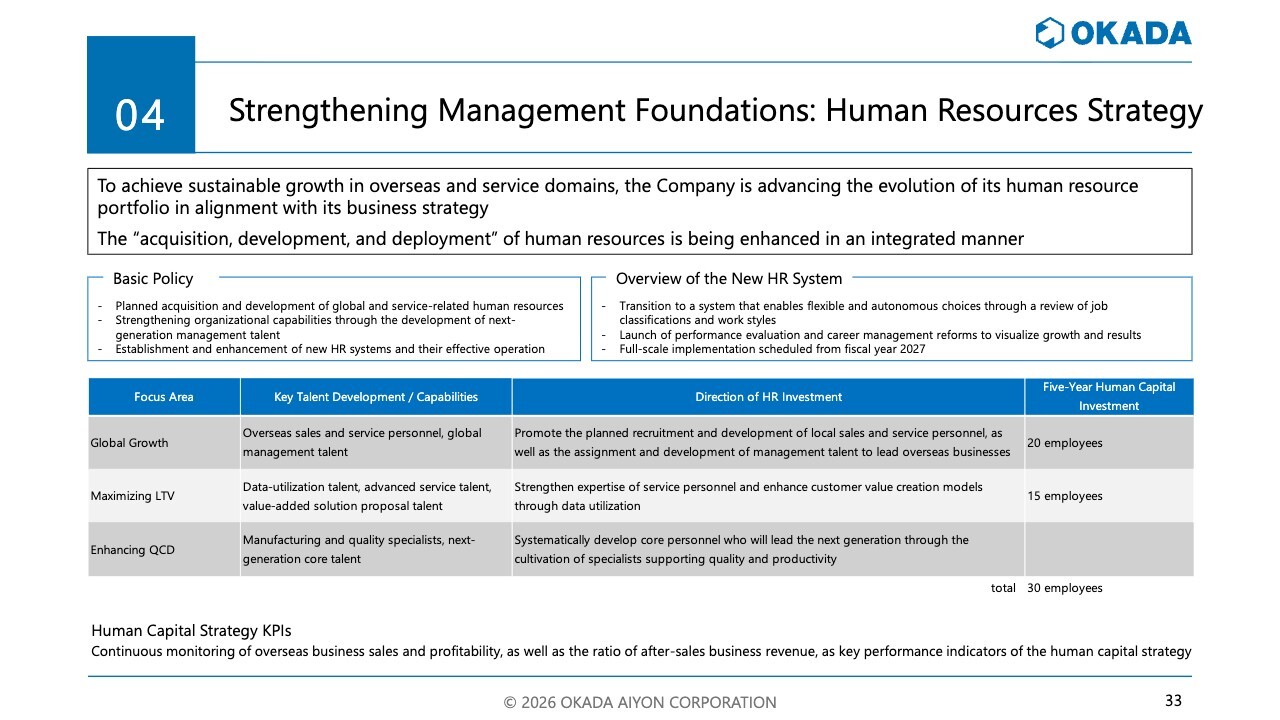
Regarding the personnel system, with the new personnel system scheduled to be introduced from next year, we are committed to promoting flexible and self-directed ways of working while also enhancing the transparency of evaluations. We will also firmly support employee career development and continue to make growth and achievements more visible.
Capital Policy: Cash Flow
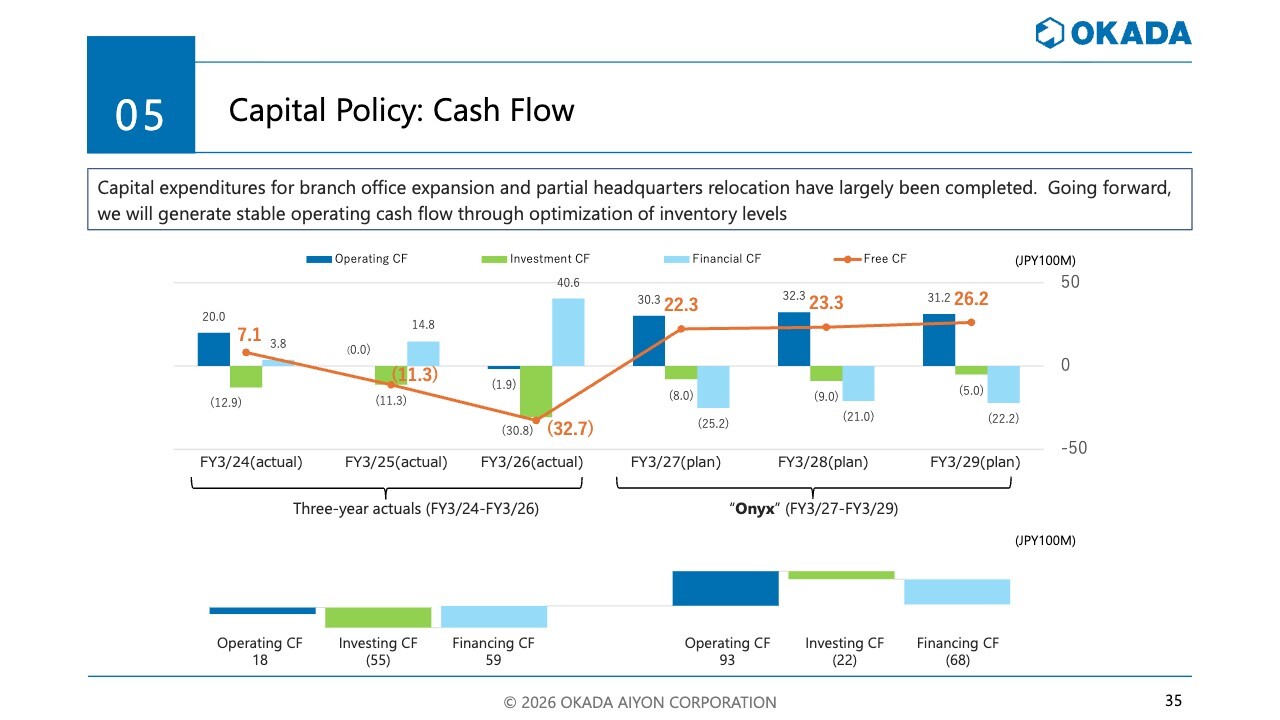
This section outlines our capital policy. Regarding cash flow, over the past three years free cash flow was negative due to the peak in investments and an increase in working capital. We want to make sure this reliably generates cash flow.
Capital Policy: Capital Allocation
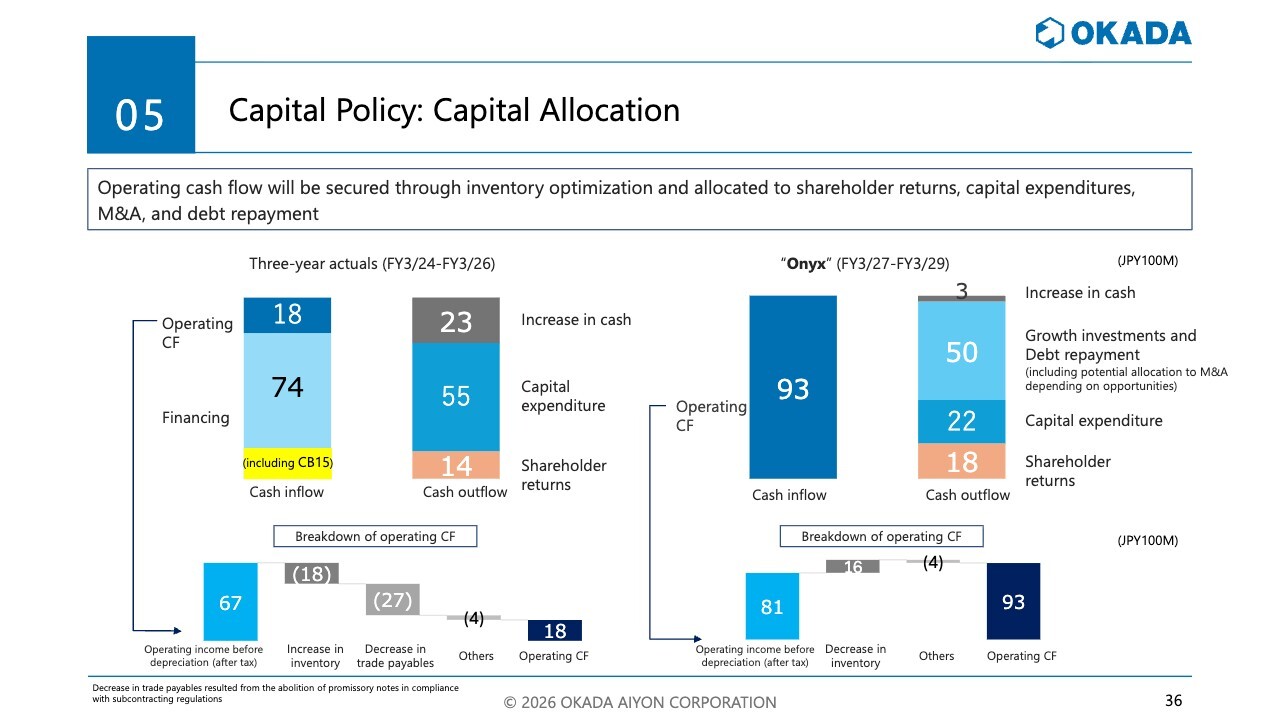
This section explains our capital allocation. The bottom of this section shows a breakdown of operating cash flow.
Over the past three years, operating income before depreciation (after tax) should have remained as cash, but it was absorbed by inventory increases and a decrease in trade payables, so we were not able to retain much as operating cash flow. This decrease in trade payables was driven by the elimination of promissory notes following the amendment of the Subcontractor Act.
Going forward, as the factor of the decrease in trade payables disappears, we plan to build a structure that can reliably retain operating income before depreciation (after tax) by optimizing inventory.
And we intend to allocate it to shareholder returns, capital expenditure, and growth investments including M&A.
Capital Policy: Improving Invested Capital Productivity
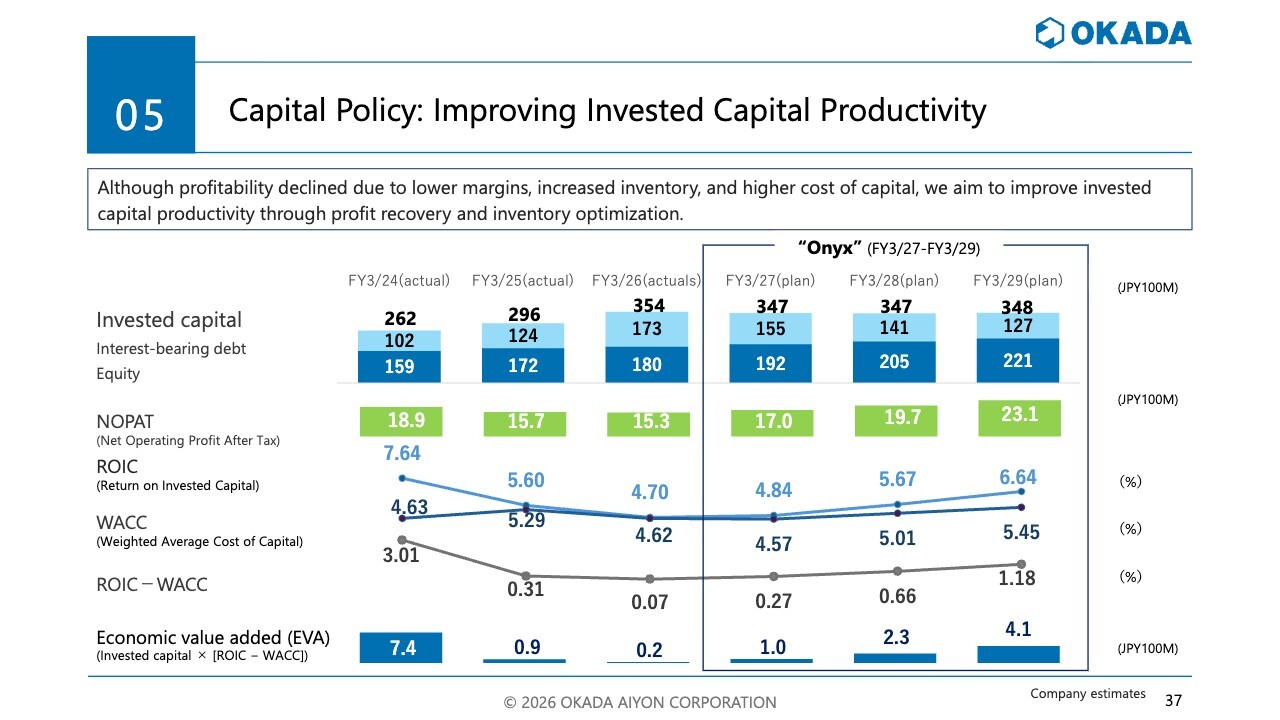
This section provides cover improving the productivity of invested capital. Over the past three years, the gap between ROIC and WACC has almost disappeared due to the impact of higher capital costs stemming from factors such as declining profit margins, rising inventories, and an increase in the risk-free rate, that is, government bond yields.
Going forward, we are committed to restoring our profit margin and correcting our inventory levels to drive improvement.
Plant Demolition (Steel Cutters)
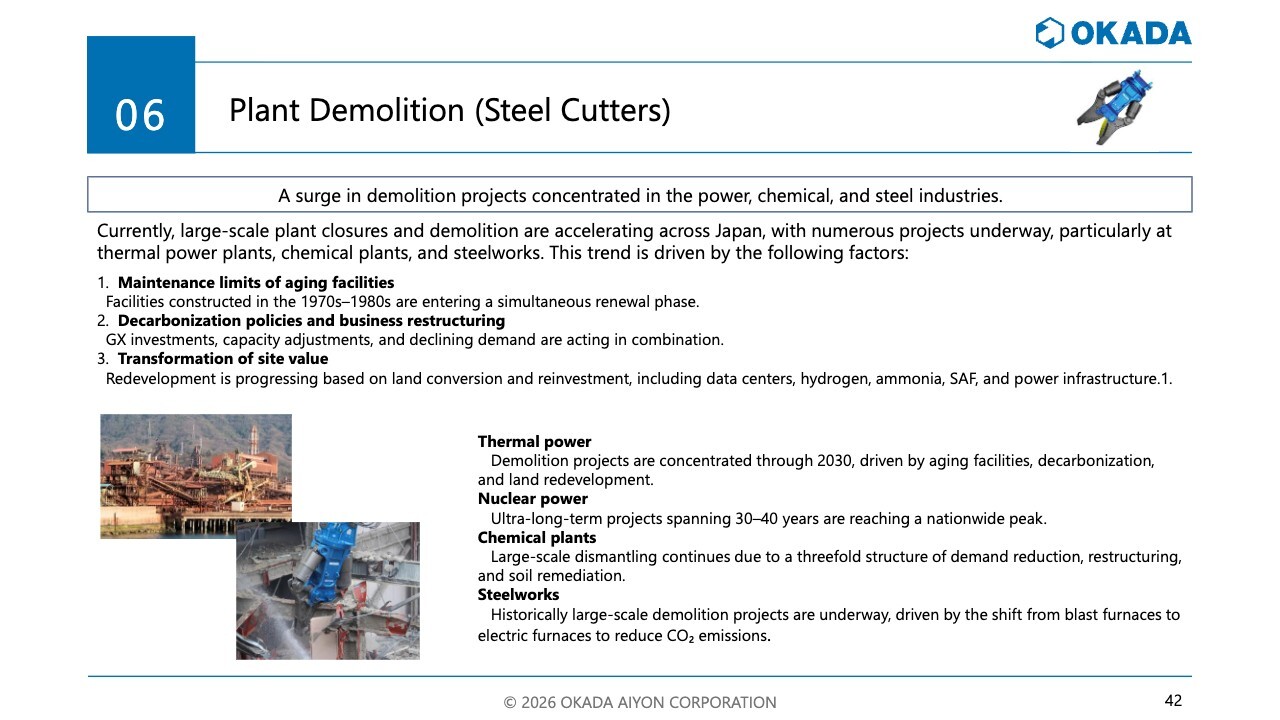
Additional comments are provided on trends where demand is expected to increase going forward. The first is plant demolition. This is the demolishing of large-scale plants such as thermal power stations, chemical plants, and steelworks.
Large-scale plant decommissioning and demolition are currently accelerating nationwide. Our large cutters are used for such demolition. In last year’s sales results, these cutters showed growth of over 20% YoY, and we expect further expansion of this business going forward.
Ship Demolition (Steel Cutters)
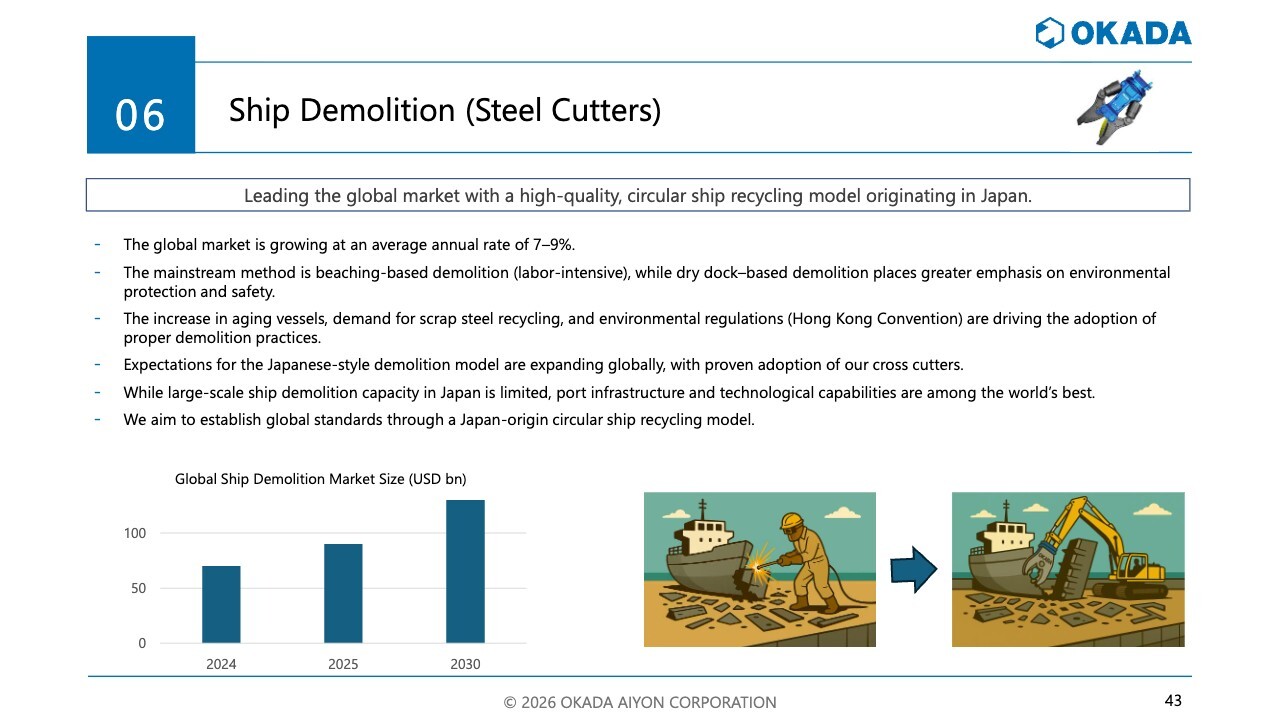
The second is ship demolition. At present, Nippon Yusen Kabushiki Kaisha has announced a plan to begin ship recycling in Japan from fiscal 2028.
They have also decided that our cutters will be used for this demolition. As is already known, Japanese vessels use very high‑quality steel, and steel scrap can be effectively utilized as electric arc furnace feedstock.
Currently, demolition is done manually in India and Bangladesh, but this process involves many accidents and has become a social issue. We also have high expectations for carrying this out safely in Japan and fully establishing a ship iron recycling model.
In the new mid-term business plan “Onyx,” we are committed to shifting to a sustainable and reproducible growth model by simultaneously executing the following: improving profitability in the domestic market, transitioning to an LTV-based business, driving global growth centered on North America, and enhancing capital efficiency through inventory optimization.
By executing these initiatives over the next three years without fail, we are committed to building the foundation for achieving “VISION30.”
We position this plan not only for growth but also as an initiative to change the quality of management. With that understanding, we appreciate for your continued support.
Q&A: Challenges and initiatives for the overseas business, centered on North America
Moderator: The first question is "Regarding the mid-term business plan, it is said that the overseas business, particularly North America, has issues with reproducibility. What are the reasons for that? Also, what specific initiatives will you pursue to establish reproducibility?
Maenishi: On the issue of reproducibility, as I mentioned earlier, the overseas business is showing very strong growth in numerical terms. However, looking closely at the details in North America in particular, that growth is due to M&A and the weak yen.
For example, over the past five years, the dollar/yen has fluctuated from about 106 yen to about 150 yen, roughly a 1.4x change. Therefore, it may appear to be increasing on the surface, but in reality, it has not grown much.
In that process, issues such as excess rental inventory caused growth to dip temporarily, and it is now gradually returning to normal. However, the reality is that the numbers still have not grown very much.
We believe there are limits to our current approach in further growing our business, and we recognize this as a challenge. Also, because roughly 70% of our sales depend on North America, we believe it is most important to first build a solid overseas model established in North America and then expand it horizontally to other regions.
Specifically, regarding what measures we are taking, we are currently running trials from a variety of perspectives. Based on those results, we plan to continue with our policy going forward.
Q&A: Initiatives to optimize inventory
Moderator: The next question is “Regarding inventory optimization, what specific KPIs will you set? If possible, please provide the figures as well.”
Maenishi: Regarding optimizing inventories, our manufacturing has three patterns. Products are fully outsourced, products for which only assembly is done in-house, and products manufactured from components. We set distinct KPI targets for appropriate inventory levels tailored to each of these three manufacturing approaches.
For example, among our products, there are items for which we must never run out of stock, and items that do not sell often, for which we can have customers wait to some extent. We are currently considering a KPI to manage inventory by properly classifying each product and setting appropriate inventory levels.
Also, in some cases the sales department holds inventory, while in other cases the manufacturing department holds inventory. Therefore, we are coordinating with each other and are now running a project that aims to bring inventory across the group down to appropriate levels.
Q&A: Outlook for demand in large steel frame demolition systems
Moderator: The next question is “At present, I believe demand is stronger for large steel-frame demolition—such as steel mills, thermal power plants, and chemical plants—than for concrete demolition. Do you see this demand as temporary, or as structural demand that will continue through around 2030? Please share the company’s view.”
Maenishi: Rather than only through around 2030, we expect this to keep increasing from here, with demand continuing going forward. We believe this demand will continue for the next 10 to 20 years.
Q&A: Excess rental inventory in overseas markets and its impact on performance
Moderator: The next question is “Against the company’s forecasts for the fiscal year ended March 2026 of net sales of 28,000 million yen and operating profit of 2,500 million yen, the actual results were net sales of 26,900 million yen and operating profit of 2,260 million yen, with both sales and profit coming in below expectations. Please explain the factors in detail.”
Maenishi: I will answer by separating domestic and overseas. Domestic results were mostly in line with the plan, but overseas, at the time of the initial plan we had expected a somewhat greater recovery in the rental excess inventory issue in North America.
Generally, it was believed that the industry as a whole would also trend toward a recovery as interest rates declined. However, interest rates did not decline that much, and geopolitical risks also emerged. As a result, the resolution of the overseas rental excess inventory issue was significantly slower than expected, causing a deviation from the plan. This is the main factor.
As a result, net sales decreased by approximately 1,000 million yen, and accordingly, operating profit also fell short of the plan.
Furthermore, regarding individual factors, as I mentioned earlier, our overseas subsidiary Okada Midwest recorded an inventory write-down, and we are currently proceeding with the replacement of sales inventory and rental inventory.
We are reviewing our product lineup amid a surge in orders and are shifting to a structure that will allow us to expand profits when the economy recovers; one factor in this has been sales conducted at low margins.
On this point, margins have also recovered this fiscal year, and we believe that effect is coming through. However, for the previous fiscal year, the impact was mainly due to overseas factors.
Q&A: Drivers of increased demand for cutters and the model shift
Moderator: The next question is “You mentioned strong demand for cutters. Are the projects currently increasing mainly at the level of replacing existing equipment, or is there a shift toward larger, higher value-added models compared with before?”
Okada: Regarding the current growing demand for cutters, we are seeing demand from both areas. First, for cutters used to demolish plant facilities, our existing conventional models are sufficient.
Meanwhile, regarding the cutters used for ship demolition and other applications starting in 2028, these are custom-designed models newly engineered for this purpose and high value-added models.
Q&A: Initiatives for high-margin areas
Moderator: The question is “In large-scale plant demolition and ship demolition, I believe your mid- to large-size attachments show particular strengths. Going forward, could this become an area with higher margins than general demolition?”
Okada: As noted, large-scale plant demolition and ship demolition are higher-margin areas than general demolition, so we plan to continue focusing on these fields.
Q&A: Current concerns and risks regarding the Iran issue
Moderator: The next question is “For this fiscal year, the outlook is net sales of 28,500 million yen and operating profit of 2,500 million yen, which are roughly in line with the initial forecast for the previous fiscal year. Could you discuss the downside risks?”
Maenishi: The most significant concern and risk at present is the Iran issue. In our case, we are having difficulty procuring thinner and hydraulic oil. At this point, it is not yet reflected in the numbers, but the outlook has become uncertain.
This issue may be common across all industries, but this is what we are most concerned about.
Q&A: On price pass-through and pricing optimization
Moderator: The next question is “You’ve been working on improving pricing. Is it correct to understand that, at this point, rather than passing costs through, you are reviewing your pricing structure to match your high market share and capacity to handle large-scale projects?”
Maenishi: Exactly as you understand, we treat price pass-through and pricing optimization as separate matters. Price pass-through means adding a small markup to prices to respond to various requests from suppliers.
What we are currently pursuing is offering prices that reflect the value, particularly in areas where we are highly competitive.
On the other hand, while we recognize that highly competitive areas can be quite challenging, we plan to implement pricing with clear differentiation in those areas.
Q&A: On demand shortfalls due to excess channel inventory in North America and the outlook ahead
Moderator: The next question is "In North America, rental inventory adjustments dragged on. At this point, do you see it more as a lack of demand, or as a distribution inventory adjustment? Which view is stronger for your company?"
Maenishi: The biggest point is that channel inventory has overflowed. This is a situation where rental companies ended up holding excessive inventory, which led to insufficient demand.
Here, “demand” refers more to sales demand than to construction demand. I hear that the construction work itself has not declined that much.
I expect demand to return as inventory adjustments progress in that area. Also, I hear rentals have recently started to pick up quite a bit, so we are hopeful.
Q&A: On the composition of the gross margin and the selling, general and administrative expense ratio in this fiscal year’s targets
Moderator: The next question is “If the target operating profit and operating margin are achieved this time, what would the composition ratios of the gross margin and the selling, general and administrative expense ratio look like?”
Maenishi: Here, we are aiming for roughly the same as current results, with a gross margin of about 30% and selling, general and administrative expenses of about 20%.
Q&A: Reproducibility of North America initiatives in other regions
Moderator: The next question is “If the initiatives in North America go well, is it really possible to roll them out horizontally to other countries where the culture and competitive landscape are different?”
Maenishi: As pointed out, we don’t believe the exact same approach will work, so we need to make adjustments tailored to each region.
There are commonalities in customer needs, and our strengths are largely the same as well. Therefore, taking those factors into account, we believe it is necessary to translate them into initiatives suited to each region.
Q&A: Outlook for depreciation expenses in the current fiscal year
Moderator: “You mentioned that capital expenditures are expected to have peaked at 3,855 million yen in the fiscal year ended March 2026. How much will depreciation be this fiscal year?” That is the question.
Maenishi: Depreciation was 697 million yen in the previous fiscal year and is expected to be 720 million yen this fiscal year, so it is not that large. Some amortization will end. Also, because our investments are set with a very long amortization period of over 20 years, they will not increase significantly.
Q&A: On the status of M&A sourcing
Moderator: The next question is “Please tell us about the status of M&A sourcing.”
Maenishi: At this point, for example, we have narrowed it down by machinery and by region and have just started to draw up the list. We plan to narrow it down further from here. At this time, we are not in a position to answer.
Greeting from President Okada
Okada: Thank you very much for taking the time to view our financial results briefing today. I hope today’s briefing helped deepen your understanding.
Going forward, we will continue to value communication with all our stakeholders and strive to further enhance corporate value. We appreciate your continued understanding and support.
Thank you very much for your time today.
Other questions and answers received on the day
We will share questions submitted on the day that we were unable to address due to time constraints.
<Question 1>
Question: Regarding the expansion of overseas sales, please share any thoughts you have on progress and challenges.
Answer: Overseas sales have been steadily expanding, mainly in Europe, the United States, and Asia. In Europe, sales of crushers are growing, and in Asia, sales are also expanding in markets such as India, Thailand, and Taiwan, so we have been able to secure overall revenue growth.
Meanwhile, in North America, we believe the impact of inventory adjustments at rental companies is continuing. While activity has been gradually picking up recently, we still see it as being in the midst of recovery. Overall, while we are growing, variability in profitability and reproducibility remains an issue. We believe we need to improve this by building a model centered on North America.
<Question 2>
Question: In the previous briefing, you mentioned that Okada America is recovering while Okada Midwest is weak. Is this due to differences between rental customers and end users, or is the market structure itself changing?
Answer: We believe this point is largely influenced by differences between channels. Okada America has a high weighting toward rentals, so it has been affected by inventory adjustments at rental companies. However, those adjustments have been easing recently, and signs of recovery are emerging.
On the other hand, Okada Midwest focuses mainly on sales to end users and has been affected by the decline in sales of commercial products. At this point, rather than a major change in market structure, we recognize that the difference in channel mix between rental and end users is directly showing up as a difference in performance.
<Question 3>
Question: Please tell us about the background that led to the partnership with AP.
Answer: Regarding the partnership with AP, we began discussions based on an introduction from a financial institution, against the backdrop of challenges such as expanding our overseas business, new businesses, and the pursuit of M&A.
As our discussions progressed, we received a proposal offering concrete support not only on the financing side but also in areas such as KPI-based management, the promotion of M&A, and strengthening execution. We also determined that this would contribute to enhancing corporate value and decided to work together as a strategic partner in conjunction with the capital alliance.
<Question 4>
Question: Regarding the North America market, I used to have the impression that the focus was on expanding the crushers market itself, but now it feels like the nuance has shifted to going after share. At this point, are we closer to a market-creation phase or to a phase of competing for existing share?
Answer: For North America, we see it as a phase where both market creation and share capture coexist. As for crushers, they have not yet gained sufficient traction, and we are still at the stage of developing the market by proposing use cases through demonstrations and other activities.
On the other hand, since breakers and similar products are already in a competitive market, we are now working to capture share by strengthening our sales channels and other measures. We are moving forward with measures tailored to each area, as the phase differs by product and channel.
<Question 5>
Question: How much was the impact of U.S. tariffs in FY2025? I don’t think it impacted the full year in FY2025 because there was local inventory. How much impact from U.S. tariffs are you expecting in FY2026?
Answer: Regarding the impact of tariffs, in FY2025 the impact was limited to around 60 million yen, partly because we had pre-tariff inventory. On the other hand, for FY2026, we expect the impact to materialize as those inventories cycle through. At this point, we expect an impact of a little over 100 million yen for the full year—about double. Going forward, we believe practical measures will be needed, including price actions and cost adjustments.
<Question 6>
Question: Please tell us what has changed at the company since Advantage Partners came in.
Answer: The biggest change is that by building plans based on data and market research and rigorously running the PDCA cycle, our execution accuracy and speed have improved.
KPI-based progress management and the visualization of indicators such as price, inventory, and profitability have advanced, accelerating the speed from considering actions to execution. We have reorganized our efforts into theme-based projects and shifted to a framework where they are monitored at the management level, which is also strengthening execution.
<Question 7>
Question: From the cover page and page design of the materials, I could sense your commitment to the company’s brand image.
(1) As you are also pushing ahead with management reforms, how are employees responding to the changes?
(2) When do you expect to monetize the ship demolition attachment? Please share your view on the timeline, including delivery dates.
(3) In the domestic market, construction costs continue to surge. If the extension of the construction period has had a negative impact, please tell us the impact amount and the current situation.
Answer: (1) As for employee reactions, overall, we believe they are being received positively. I feel there is a sense of satisfaction now that the company’s direction and what we intend to change have been clarified. On the other hand, once we move into the execution phase, the burden will increase. Going forward, we believe it will be important to deepen understanding through dialogue and link it to evaluations and roles, thereby increasing participants’ sense of ownership.
(2) As for ship demolition, the market has strong growth potential, and we are seeing adoption of our products. However, these deals tend to be large, and it generally takes time from negotiations to order intake and delivery. Therefore, rather than driving monetization all at once in the short term, we see this as an area that will gradually contribute over the medium term. At this stage, we are focused on building up the pipeline of projects.
(3) In the domestic market, rising construction costs and labor shortages have led in some cases to project delays and deferrals, which is also affecting demand for crushers and other equipment. However, we believe demolition demand itself remains solid over the long term, and rather than demand disappearing, our view is that the timing has been pushed back. At this point, it is difficult to clearly separate the impact amount, but we do not view this as a structural change.
<Question 8>
Question: Previously, you mentioned that some work is still flowing out to external repair shops. Through coordination of genuine parts, repair, and authorized service shops, how much room do you see to improve LTV?
Answer: At present, some sales for repair, maintenance, and parts are flowing to external parties, and we believe there is still room for improvement in this area. Going forward, we will shift to a model of continued involvement after sales by increasing the utilization rate of genuine parts through stronger collaboration with designated service factories and by introducing repair and maintenance packages. In that sense, we believe there is still room to raise customer LTV.
<Question 9>
Question: When do you expect demand for marine applications to fully materialize? What scale of demand are you envisioning?
Answer: Regarding demand for ship demolition, given factors such as the increase in aging vessels and the tightening of environmental regulations, we view this as an area that will expand over the medium to long term. We are also focusing on this as an area where we can leverage our strengths, and we position it as one of our new growth fields. We expect this to be a medium- to long-term theme that we will pursue, with an eye to expansion that includes overseas in the future.