Explanation of Full-Year Financial Results for the Fiscal Year 25
Takuya Kawasawa (hereinafter, Kawasawa): My name is Takuya Kawasawa, Executive Officer and CFO of SIGMAXYZ Holdings Inc. Today, I will explain the financial results for the Fiscal Year 25, drawing on excerpts from the supplementary materials.
This is my first time attending an earnings presentation as CFO, so I will briefly introduce myself.
During my previous position at Mitsubishi Corporation, I was involved in SIGMAXYS before its establishment in 2008. I was assigned to the company as a corporate planning manager for about two years starting in 2009. I then retired from Mitsubishi Corporation and joined the Company in July 2024. I have been primarily responsible for corporate planning.
I have served as assistant CFO since January 2026 and was appointed CFO in April, succeeding Mr. Tabata, who served as CFO for 18 years. I look forward to working with you in this capacity.
Outline of Financial Results for FY25
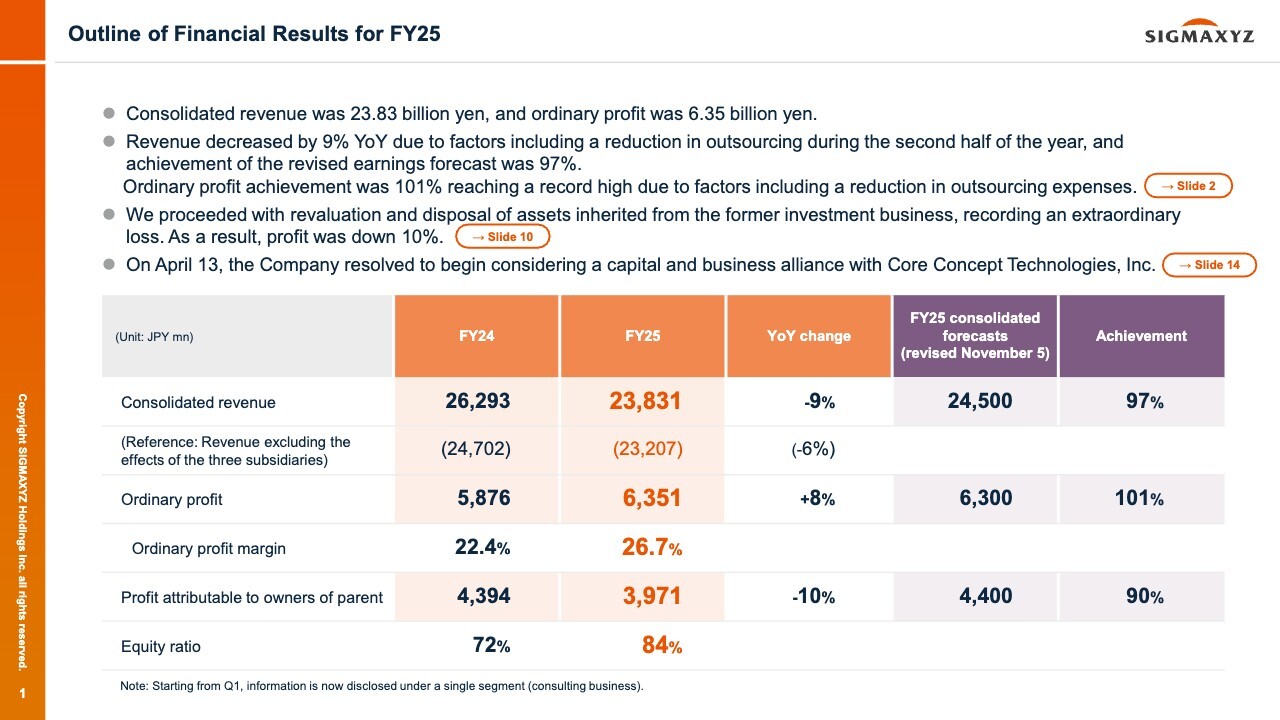
I will now present an overview of the financial results. Consolidated revenue for the current fiscal year decreased 9% year-on-year to 23,831 million yen, but ordinary profit increased 8% year-on-year to 6,351 million yen, reaching a new record high.
The decrease in revenue was mainly due to a decrease in outsourcing in the second half of the year.
On the other hand, ordinary profit increased, mainly due to the curbing of outsourcing expenses, resulting in a 101% achievement rate against the full-year forecast.
Profit attributable to owners of the parent company decreased 10% year-on-year to 3,971 million yen as a result of extraordinary losses incurred from the revaluation and disposal of assets inherited from the former investment business.
FY25 Consolidated Earnings Forecasts and Achievement / Annual Dividend
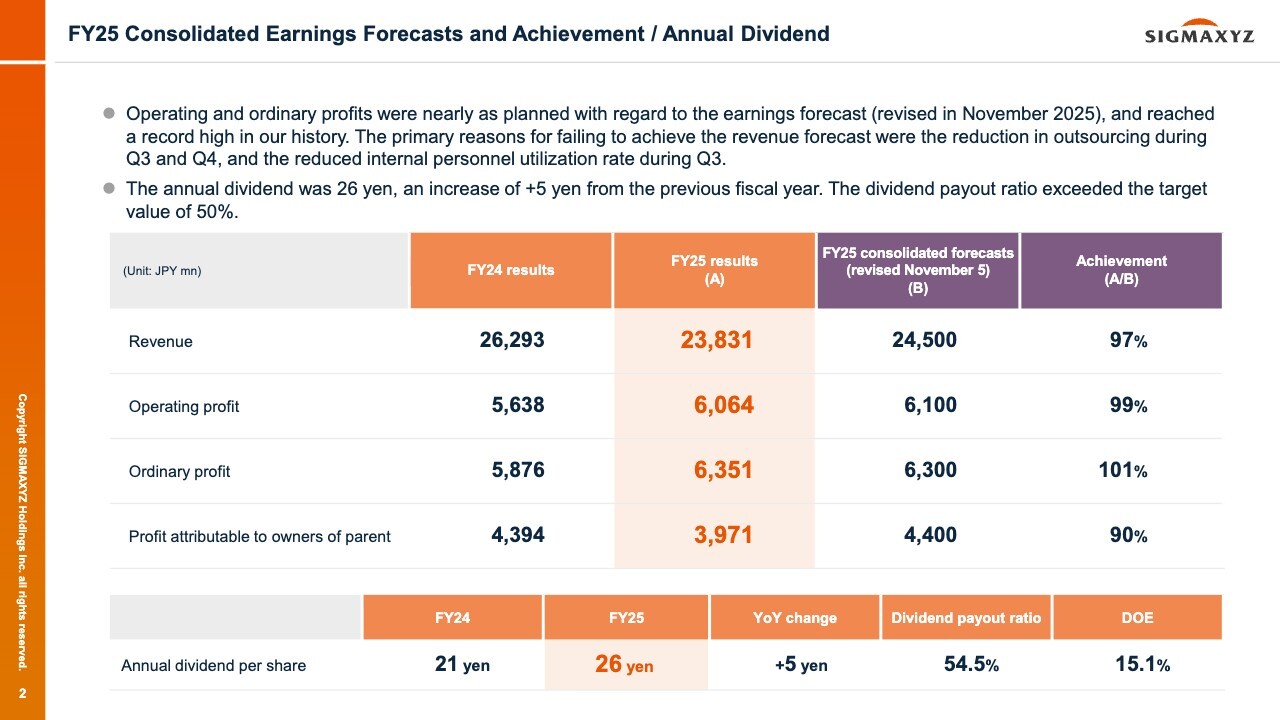
Although our revenue fell short of the full-year forecast, operating profit and ordinary profit were almost in line with plans.
The annual dividend is 26 yen per share, an increase of 5 yen from the previous year. This resulted in a payout ratio of 54.5%, exceeding the target payout ratio of 50%.
Strengthening Shareholder Return Measures
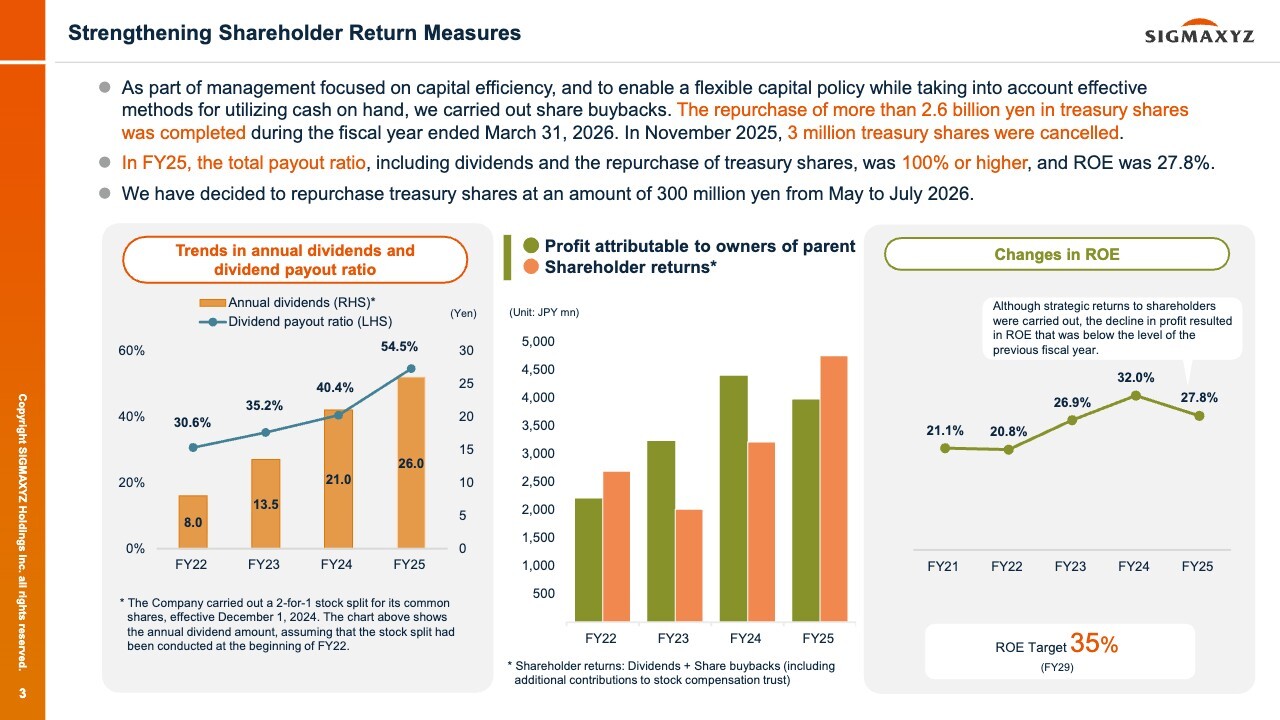
I will explain our shareholder return measures.
In the current fiscal year, the Company repurchased over 2.6 billion yen of treasury shares and cancelled 3 million treasury shares last November.
The total return ratio, including dividends and repurchase of treasury shares, exceeded 100%, and ROE was 27.8%.
Although ROE is below the previous year's level due to the decrease in profit, this number includes a temporary impact from the liquidation of former investment business assets, and the core business is performing well.
In the new fiscal year, we will continue to promote a flexible capital policy, as we have decided to repurchase 300 million yen of treasury shares from May to July 2026.
Business Performance Highlights: Consulting Service
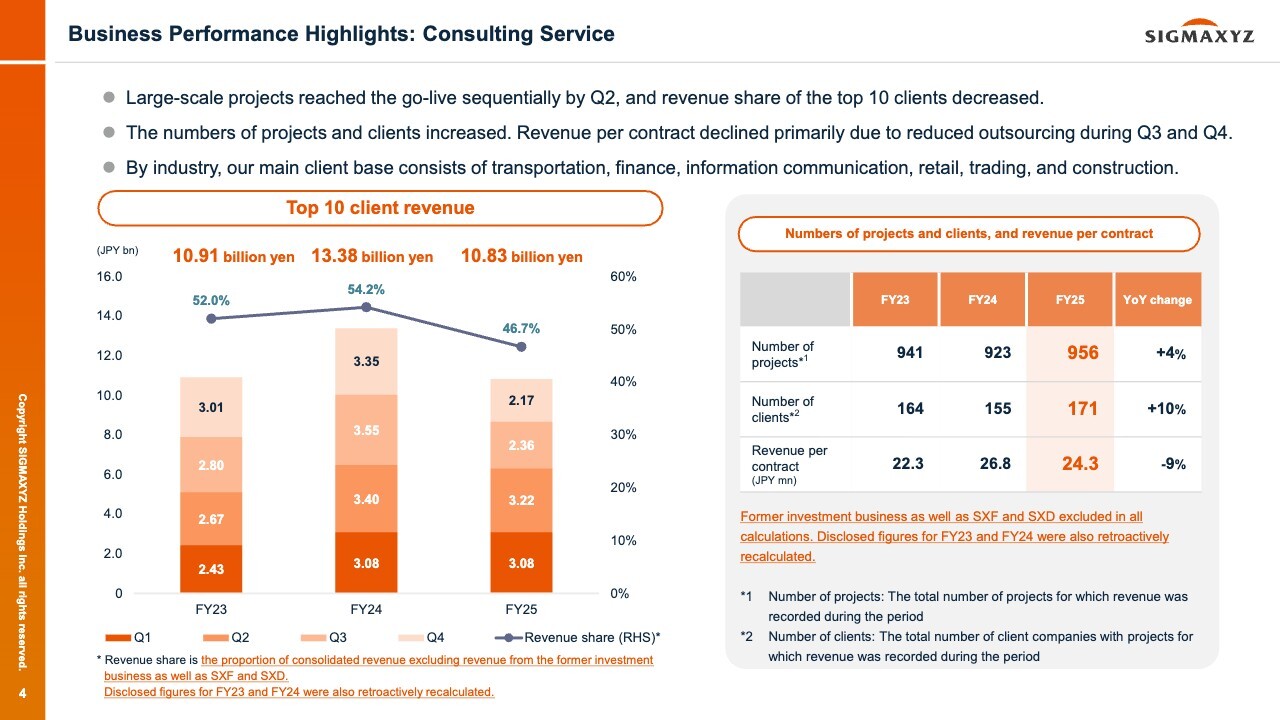
The slide shows our performance highlights.
The revenue share of the top 10 clients declined as large-scale projects sequentially went live by the second quarter. In this context, the number of projects and clients increased as a result of strategic review of the client portfolio and aggressive promotion of proposal activities to win new projects.
Revenue per contract has decreased due to a decline in outsourcing.
Consolidated Statement of Income for FY25
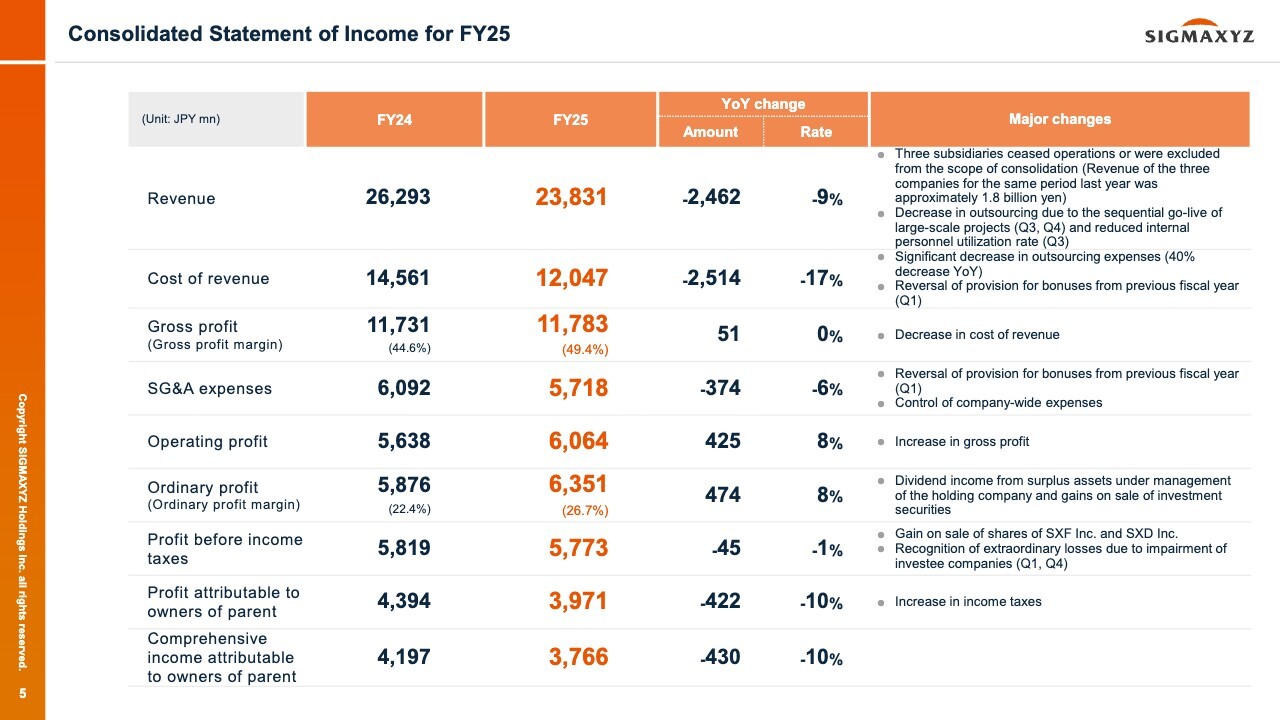
This slide shows our consolidated statement of income.
Revenue declined 9% from the previous year due to the suspension or deconsolidation of three subsidiaries and a decrease in outsourcing due to large-scale projects going live sequentially. The internal personnel utilization rate has achieved the target level on average for the full year and is on a recovery trend after bottoming out in the third quarter.
On the other hand, outsourcing expenses decreased 40% from the previous year, resulting in a significant decrease in cost of revenue, down 17% from the previous year.
In addition, SG&A expenses decreased due to control of company-wide expenses. As a result, operating profit reached a record high of 6,064 million yen.
In addition, non-operating income, such as dividends received and gains on sales of investment securities, resulted in record-high ordinary profit of 6,351 million yen.
As a result of the ongoing revaluation and sale of investment securities taken over from the former investment business, an extraordinary loss of 660 million yen was recorded, resulting in profit attributable to owners of the parent of 3,971 million yen, down 10% from the previous year.
The investment balance of the succeeding assets, including valuation differences, was approximately 2.9 billion yen as of the end of the fourth quarter. We intend to sell the assets as soon as possible, while keeping a close eye on market conditions.
Key Performance Indicators (KPIs)
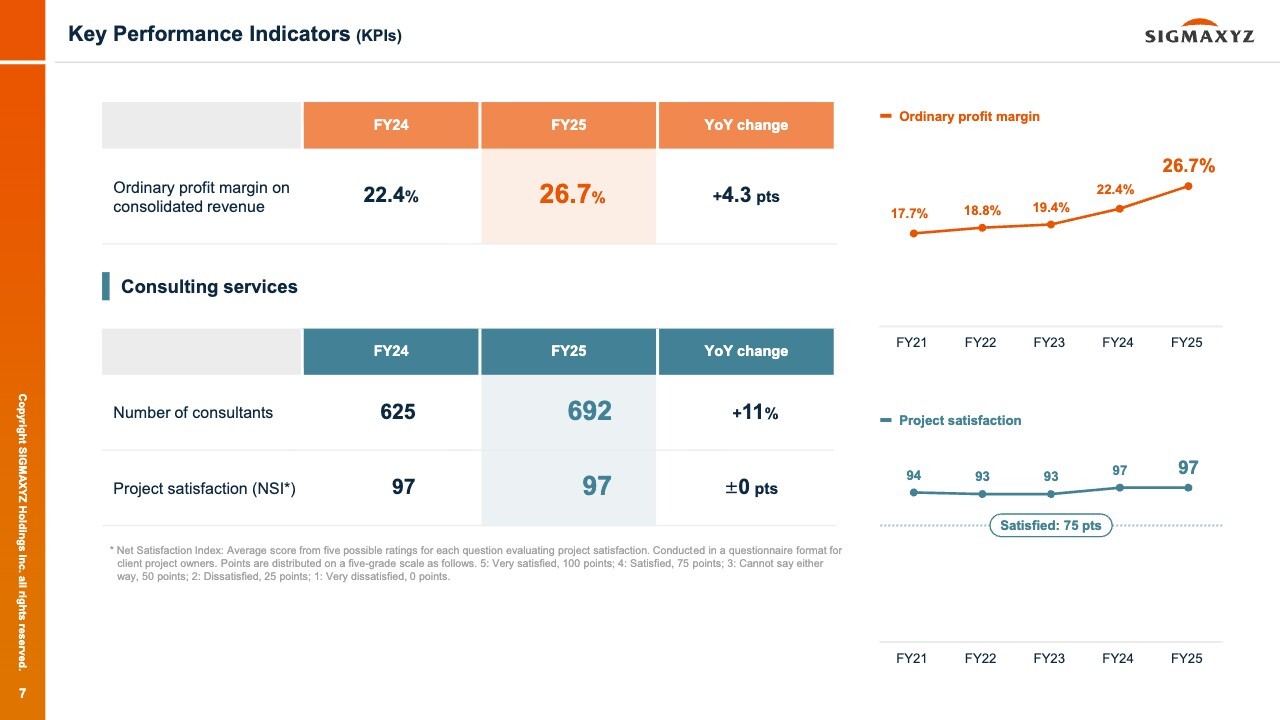
The slide shows the key performance indicators.
The ordinary profit margin on consolidated revenue increased 4.3 percentage points from the same period last year to 26.7%.
The number of consultants reached 692 as of March 31, 2026, an 11% increase over the same period last year.
In the new fiscal year, we will continue to emphasize quality in our selection process and plan to hire the same number of mid-career recruits as in the previous year.
In addition, we are targeting approximately 80 new graduates to be hired by the company in April 2027.
Project satisfaction, an indicator of delivery quality, remained high at 97 points.
Effects of Agentic AI and Generative AI on Our Business Model
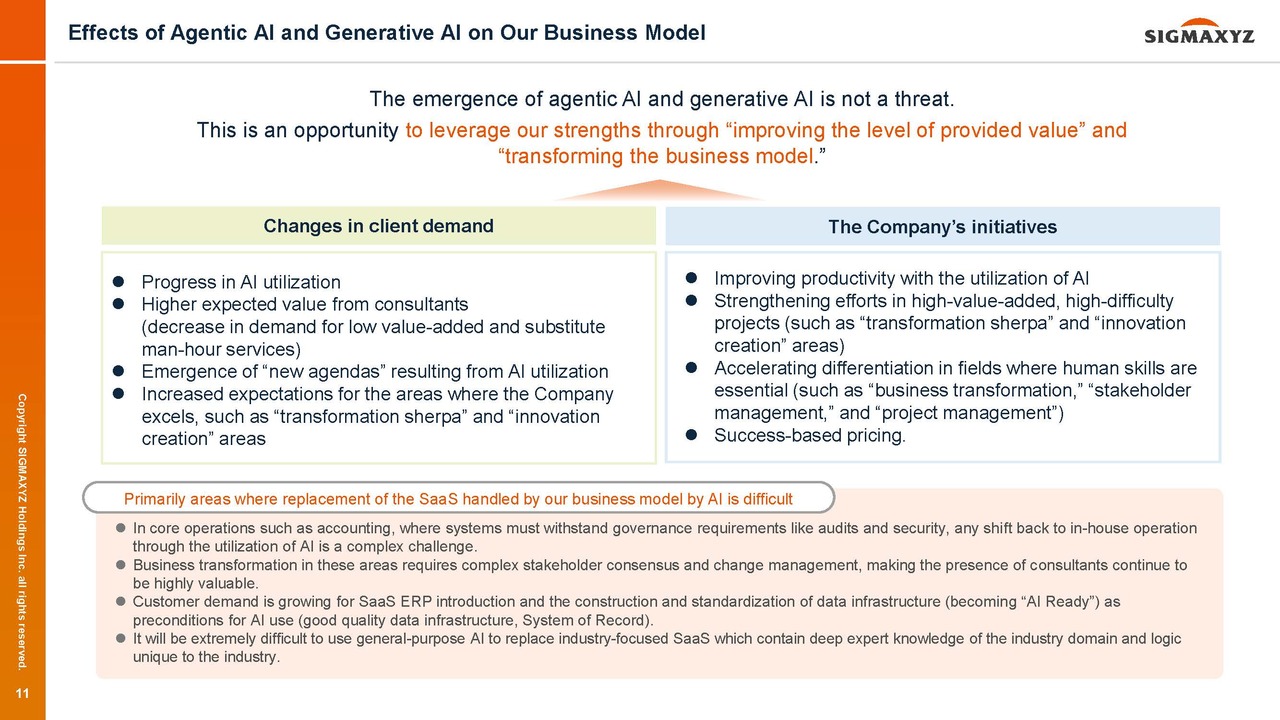
We have received many questions about the effects of agentic and generative AI on our business model, and we would like to explain our views.
We do not see the emergence of AI as a threat to our business, but rather as an opportunity to "improve the level of provided value" and "transform our business model.”
As clients' expectations of consultants rise due to changes in demand, the need for high value-added, high-difficulty projects is expected to increase.
We see these changes in the environment as an opportunity, and in addition to improving productivity through thorough utilization of AI, we will promote the evolution of a new business model, such as success fee-based pricing.
I will also explain the effects of AI in SaaS. The core SaaS operations we handle in our business model, such as accounting systems, require a high level of governance in terms of auditing and security, so we do not think it will be easy to bring these services in-house using AI.
This is also an area where consultants continue to be highly valued in supporting change, such as BPR and corporate stakeholder management.
As demand for SaaS implementation and data infrastructure development is increasing as a precondition for AI use within client companies, we recognize that the emergence of AI will further expand opportunities to leverage our strengths, and we will continue to work on this issue.
FY26 Business Policy
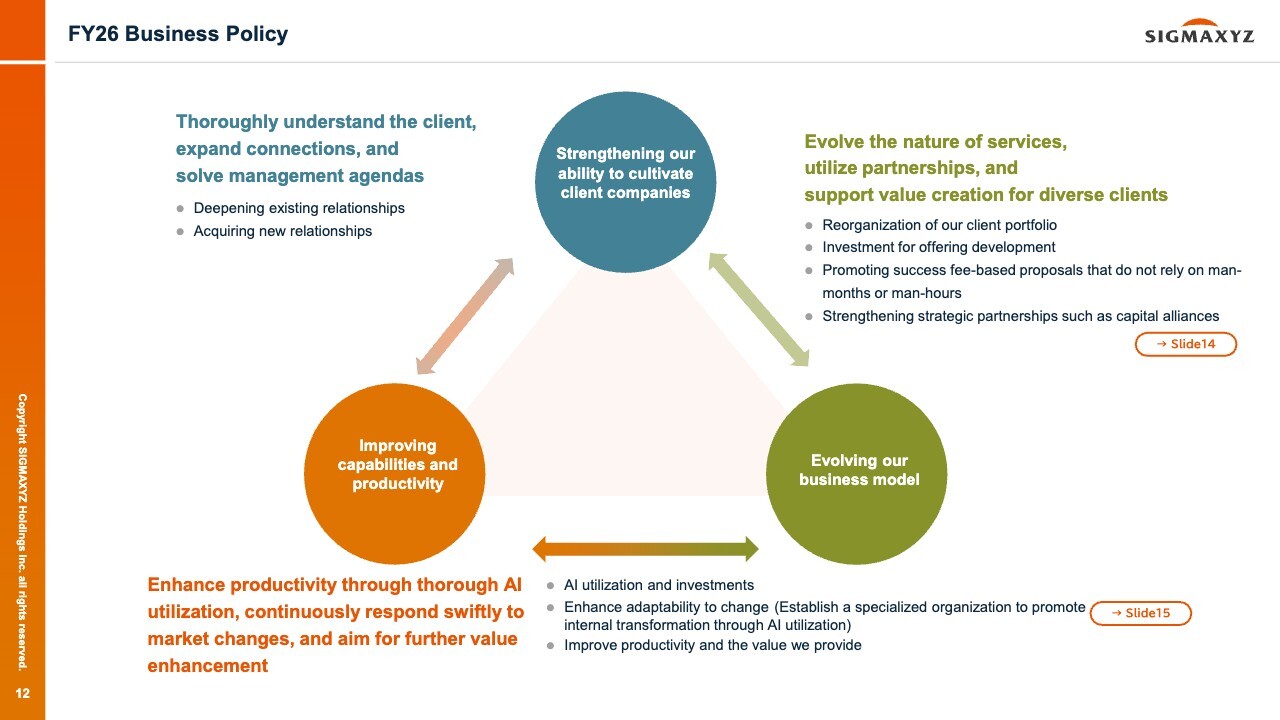
I will now talk about the business policy and consolidated earnings forecasts for the fiscal year ending on March 31, 2027.
First, with regard to our business policy, we will further strengthen our ability to cultivate client companies in depth, evolve our business model, and improve the capabilities and productivity of our internal human assets. We will then steadily implement and further evolve the value co-creation process.
FY26 Consolidated Earnings Forecasts
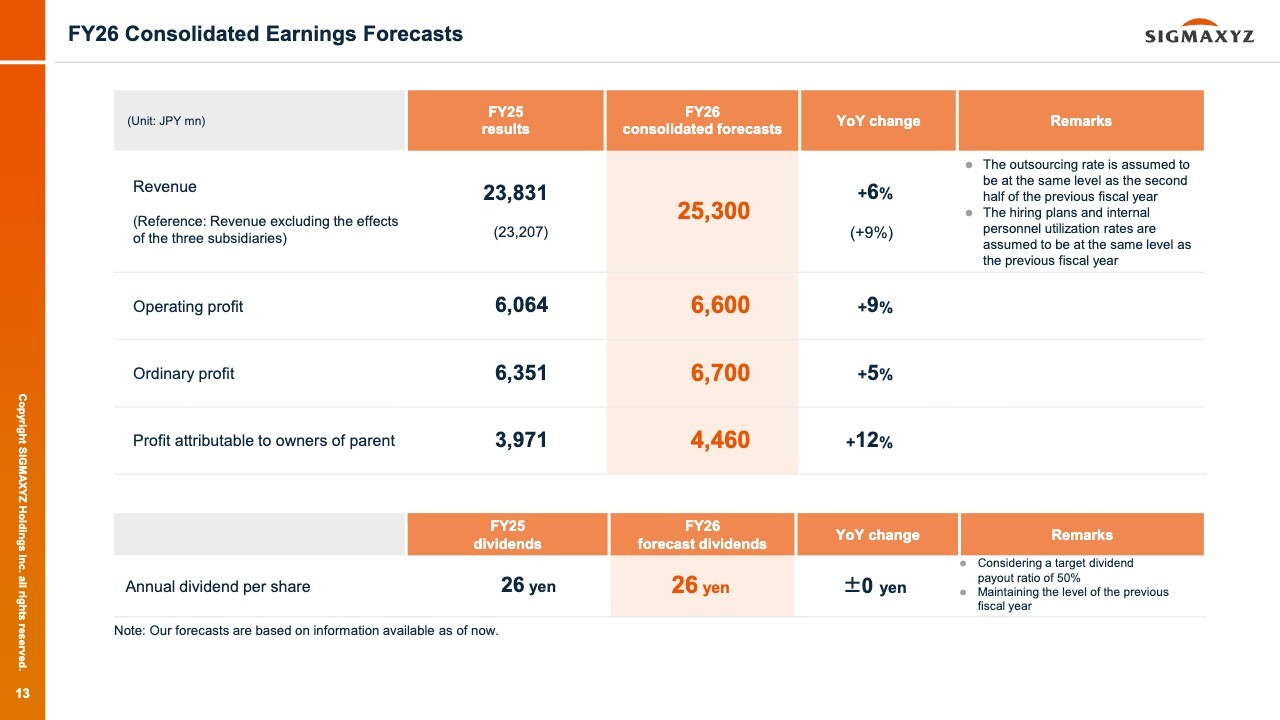
For the Fiscal Year 26, we forecast consolidated revenue of 25,300 million yen, operating profit of 6,600 million yen, ordinary profit of 6,700 million yen, and profit attributable to owners of the parent of 4,460 million yen.
This forecast is based on the assumption that we will promote the acquisition of medium-sized projects without overly relying on specific large-scale projects, and assumes that the outsourcing rate to revenue will be approximately 10%, the same level as in the second half of the previous fiscal year.
Personnel utilization rate and the number of mid-career hires are assumed to be the same as in the previous year.
In addition, as a milestone toward further growth, we plan to make aggressive investments of several hundred million yen to promote the use of AI and internal reforms. As a result, SG&A expenses are expected to increase, but we plan to maintain the ordinary profit ratio at the same level as the previous year.
Taking into consideration the dividend payout ratio target of 50%, we plan to maintain the dividend forecast at the previous year's level of 26 yen per share.
Strengthen Strategic Partnerships Through Capital Alliances
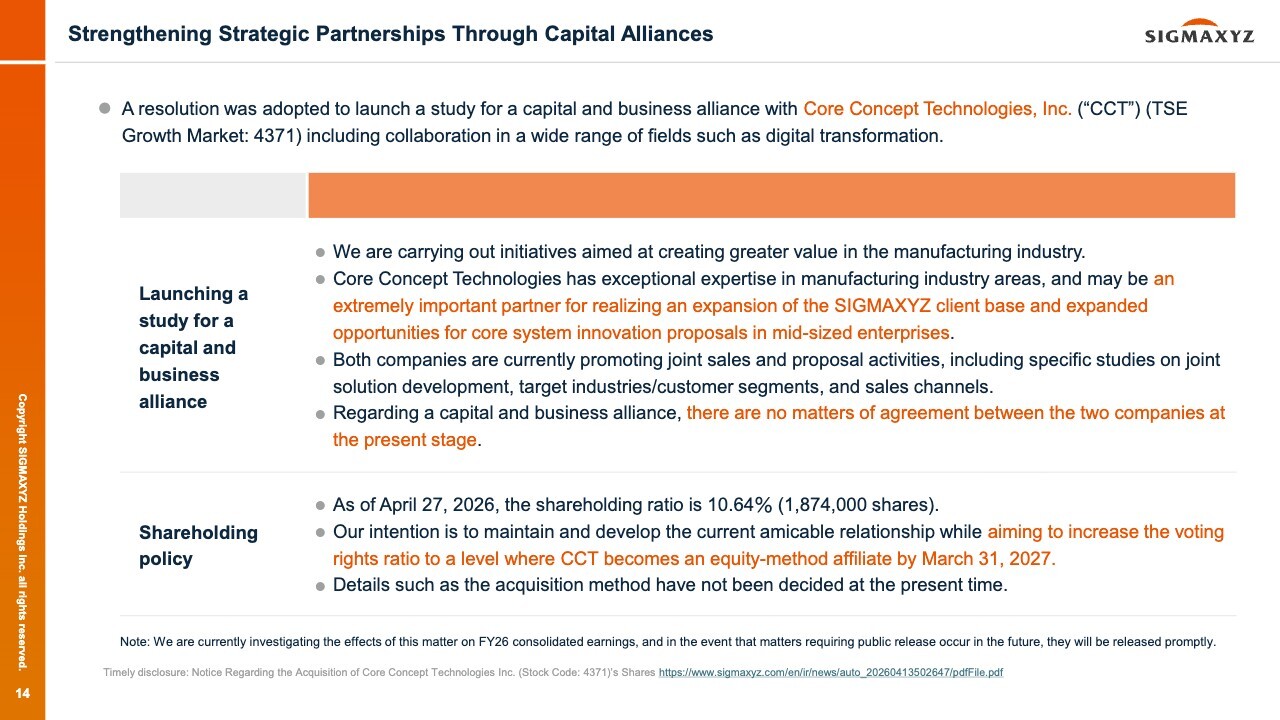
As part of efforts to strengthen strategic partnerships, including capital alliance, the Company's Board of Directors resolved on April 13 to begin considering a capital and business alliance, including collaboration with Core Concept Technologies, Inc. in a wide range of fields, including digital transformation.
We believe that the Core Concept Technologies’ outstanding expertise in the manufacturing sector will make them an extremely important partner in expanding our group's customer base and expanding opportunities to propose core system innovation to mid-sized companies.
Our intention is to maintain and develop our current amicable relationship with Core Concept Technologies, while raising the voting rights to the level where CCT becomes an equity method affiliate by the end of March 2027.
Currently, both companies are discussing the possibility of collaboration and are promoting activities such as joint sales and proposals, but as of today, there are no matters of agreement on a capital and business alliance.
In the latter half of the supplement, we present a number of recent project examples that Mitsui O.S.K. Lines Group, Sumitomo Mitsui Trust Bank, and other clients have consented to disclose.
Please take a look at these examples, as they all leverage our strengths in project management and knowledge of digital transformation.
That is all for my presentation. Thank you for your attention.
Q&A: Utilization rates and pipeline trends for FY26 [1.1].
Moderator: The question is, "Tell us about trends in utilization rates and the pipeline for the next fiscal year."
Hiroshi Ota (hereinafter, Ota): I am Ota, Representative Director and President. Utilization rates bottomed out in the third quarter of last fiscal year and have risen to about 70% in the fourth quarter.
Regarding the pipeline for FY26, we are steadily building up the pipeline as demand remains strong and clients' needs for DX, new business development, and the use of AI are solidly present.
Q&A: Utilization rates for last fiscal year and this fiscal year
Moderator: The question is, "You mentioned that there was a drop in the utilization rate during the last fiscal year, what are your assumptions for this year's utilization rate?"
Kawasawa: This slightly overlaps with what Ota just explained, but for the last fiscal year, the utilization rate for the full year on average met the target. However, there was a major project release in the third quarter, which resulted in a slight decline in utilization.
For the current fiscal year, we expect the utilization rate to be around 70%, the same level as last year when the target was achieved.
Q&A: Size of projects in the pipeline
Moderator: The question is, "You mentioned that the company's assumption is that it is formulating a plan for this fiscal year based on the assumption of 10% outsourcing, which is about the same as the second half of the fiscal year. Is it correct to understand that there are many medium-sized projects that do not involve outsourcing in the current pipeline?”
Ota: Basically, that is correct. Of course, we are also aiming for large-scale projects, but our plan is to receive multiple orders for medium-scale projects rather than large-scale projects for core system innovation and SaaS projects that require a relatively large amount of outsourcing.
Q&A: Outsourcing ratio to revenue in the fourth quarter
Moderator: The question is, "What was the outsourcing to revenue ratio for the fourth quarter only?"
Kawasawa: The ratio of outsourcing to revenue in the fourth quarter was slightly less than 10%.
Q&A: Hiring policies and the effects of AI Advances
Moderator: The question is, "You mentioned that the recruitment plan is on par with the current fiscal year, is it correct to understand that this means a net growth? Are there any changes in your hiring policies?"
Sono Uchiyama (hereinafter, Uchiyama): I am Uchiyama, Director. It is correct to understand this as a net increase. Our policy of growing by hiring new graduates has not changed either [2.1].
As we have explained in the past, we compensate for approximately 10% to 12% turnover throughout the year by hiring mid-career recruits. Since we expect to hire mid-career recruits at the same level as last year, this will replace more than half of the employees who leave. However, since we also expect to hire new graduates at a similar scale to this fiscal year, you can assume that the net increase trend will remain unchanged.
We are often asked if our hiring policy will change significantly with the development of AI. But, as long as we utilize AI, we do not intend to stop hiring and training young people who are digital natives.
We do not plan to hire an extremely large number of either mid-career recruits or new graduates, but we remain committed to our long-standing policy of conducting a steady, careful recruitment process that prioritizes quality.
Q&A: Securities subject to impairment loss accounting
Moderator: The question is, “Among the securities subject to impairment loss accounting, what securities incurred the largest loss?”
Kawasawa: I am very sorry, but I will refrain from disclosing individual stocks by name.
Q&A: Turnover rate
Moderator: The question is, "What is the turnover rate you are landing at?"
Uchiyama: As I explained earlier, we operate our business based on the assumption that the turnover rate is around 10% to 12%, and our actual turnover rates have fallen within that range.
Q&A: Recent trends in agent fees
Moderator: The question is, "Is there an upward trend in agent fee rates? Are there any developments leading to that?"
Uchiyama: We have not observed any recent trend in the extreme increase of agent fees at our company.
Q&A: Status of collaboration with ITOCHU Corporation
Moderator: The question is, "Has there been any change in the status of your collaboration with ITOCHU Corporation?"
Ota: We have been collaborating with the ITOCHU Group since ITOCHU invested in us, and recently our understanding of each other's strengths has deepened.
We are particularly deepening our collaboration with several companies in the ITOCHU Group, and now that we are gradually grasping each other's strengths and a sense of distance, we are deepening our cooperation and actually increasing the number of projects we collaborate on.
Q&A: Projected extraordinary losses for the Fiscal Year 26
Moderator: The question is, "You have indicated that your net income forecast for the Fiscal Year 26 is approximately 4.5 billion yen, which, excluding extraordinary losses, would be essentially unchanged from the previous year. On the other hand, with operating profit up about 9%, do you expect any extraordinary losses for the fiscal year 26 as well?"
Kawasawa: We expect certain extraordinary losses, but this impact is mainly due to taxes.
Q&A: Capital and business alliance with Core Concept Technologies
Moderator: The question is: "What synergies do you expect from the capital and business alliance with Core Concept Technologies?
Ota: In terms of the synergies we are looking forward to, first of all, Core Concept Technologies is a strong company in the field of systems for the manufacturing industry. So we are expecting value creation through collaboration between the two companies in system implementation projects for our manufacturing clients.
They have products in the MES and PLM areas, which are execution systems for product manufacturing systems, and are also strong in implementing manufacturing-centric packages. On the other hand, we are very strong in the area of implementation and project management through "Fit to Standard".
From this perspective, we believe that we can make a significant contribution by leveraging the strengths of both companies to offer our clients. I also believe that this will in turn contribute to the business of both companies.
Q&A: Views on stock prices
Moderator: The question is, "Your stock price has been falling. What are your thoughts on this?"
Ota: Regarding the stock price, we are aware that it has been falling, as you mentioned. For our part, we will first focus on improving our corporate value.
We will firmly deliver value to our clients and, as a result, improve the performance of the company. While we cannot directly comment on the share price itself, we believe that a steady buildup of business results will contribute to the enhancement of corporate value.
From this perspective, we believe that ensuring sales growth and profit growth, as indicated earlier, in the fiscal year 26, will have a positive impact on our stock price.
Q&A: Approach to the earnings forecast for the Fiscal Year 26
Moderator: The question is, "I would like to ask you about the approach to profit growth in your earnings forecast for the fiscal year 26. Although the sales growth rate is good, we have the impression that the outlook for operating profit is conservative. Can you give us some background?"
Kawasawa: As we have shared with you, we plan to grow our sales by 6% year on year for the fiscal year 26. However, there were several subsidiaries that were consolidated in the last fiscal year, and we expect 9% growth in the consulting business alone, excluding these subsidiaries.
Operating profit is similarly set to follow suit, increasing 9% over the last fiscal year and growing in tandem.
Q&A: Strengths and differentiation of the consulting business amid the rise of AI
Moderator: The question is, "With the rise of AI, how will your company differentiate itself from others?"
Ota: As Kawasawa mentioned earlier, we see the rise of AI as an opportunity to demonstrate our strengths. As AI evolves and its use expands, the need for stakeholder management and change management, which are our strengths, will become increasingly important. As a result, we believe that there will be more situations in which we can leverage human strengths.
Since our foundation, we have been committed to and practiced "Sherpa of Transformation.”
In this sense, we believe that we will have even more opportunities to realize and implement our founding principles. Rather than AI itself, we believe that our differentiation lies in our "Sherpa" approach to the transformative change it brings.
In addition, we ourselves will actively use AI to improve productivity by utilizing it thoroughly so that our consultants can focus on higher value-added initiatives. Furthermore, we believe that we can differentiate ourselves by utilizing the time created by the use of AI to clarify the issues faced by our clients' management through dialogue with them, and then make proposals to them as a "Sherpa" to help them achieve change.
Q&A: Outlook for utilization rates beyond the fiscal year 26
Moderator: The question is, "What are your assumptions for consultant utilization rate for the fiscal year 26? Do you anticipate a situation where this rate will rise further in the fiscal year 27 as in the past?”
Kawasawa: We expect the consultant utilization rate for the fiscal year 26 to be about 70%, the same as last year.
I assume your question regarding the utilization rate increase in the fiscal year 27 is about whether the utilization rate can improve to over mid-70% as it did in the Fiscal Year 24. We believe that the utilization rate around the mid-70% is a little too high, even taking into account the demographic impact of new employees joining the company each year. Therefore, we consider a utilization rate of around 70% to be an appropriate and sound operation.
Q&A: Recovery status of sales and proposal activities
Moderator: The question is, "Are there any changes in your current sales and order acquisition activities compared to the previous quarter? You mentioned there were issues with your proposal activities in the second half of the year. Could you tell us about the current status of the recovery?’”
Ota: Regarding sales activities, there was a period of somewhat slow sales activity due to the impact of large-scale projects. But we have regained momentum since the fourth quarter of last fiscal year, and sales activities have returned to a steady state. The pipeline is building up accordingly.
Q&A: Timeline and initiatives for returning to double-digit growth
Moderator: The question is, "How long will it take you to get back to double-digit growth again?"
Ota: The business environment is changing rapidly and the future is uncertain, and there is no doubt that the situation is becoming increasingly uncertain.
Not only our company, but also our clients' companies are facing the same situation. Under such uncertain circumstances, I believe that clients are now required to respond quickly to changes.
In this sense, as I mentioned earlier, I believe that the foundation for our growth in this uncertain business environment is for us to deepen our relationships through dialogue with our clients and their management, to thoroughly understand them, and to build a position that will support their rapid transformation. This will be the foundation for our growth in this uncertain business environment.
Although this is not a straight answer to your question, we want to continue to firmly position ourselves to support our clients' transformation in this uncertain environment, which will lead to our growth.
Q&A: Projections for the decline in large-scale projects this fiscal year
Moderator: The question is, “Is there no need to anticipate the loss of large-scale projects this fiscal year?”
Ota: That is not necessary. The current forecast does not include any orders or anticipated orders for large-scale projects.
Q&A: Policies and measures from this fiscal year
Moderator: The question is, "With regard to the business policy for this fiscal year, tell us about any new organizational changes that you are working on.”
Ota: There are several. First, we need to increase our ability to cultivate deeper client relationships, deepen our dialogue with their management, and establish a dedicated organization for this purpose, as well as assign senior human assets to focus on these activities.
In terms of improving our capabilities and productivity, we have included the use of AI in our policies and have established a specialized organization dedicated to creating such an environment.
Technologies other than AI will also be drivers of change in the world. With this in mind, we have established an organization called Robotics & AM Sherpa. This organization is dedicated to the transformation that physical AI and robotics, which are already beginning to be put to practical use, will bring in the business world. This is the change from the last fiscal year to the FY26.
Q&A: View on capital allocation
Moderator: The question is, "With regard to capital policy, what is your view on capital allocation? Are there any share buybacks like you did last year?"
Kawasawa: As we have been sharing with you, there is no change in our policy of allocating two-thirds of the generated cash flow to our own shares and dividends and one-third to growth. As a result of our aggressive share buyback program last year, the combined dividend and share buyback exceeded 100% shareholder return, but we are now returning to a steady level [3.1].
Although the share buyback program ended at the end of April, we plan to resume share buybacks in May.
As for dividends, we plan to pay 26 yen per share, the same as the previous year.
Q&A: Impact of AI utilization on profitability
Moderator: The question is, "Do you have any thoughts on the impact of AI utilization on the unit price to expand profit margins? Conversely, do clients request price reductions?"
Ota: I believe that the use of AI will lead to a reduction in the time previously required and more efficient output. We believe it will mean an increase in our productivity, which will also lead to an expansion of our profit margins.
On the other hand, we believe that clients may put pressure to lower prices as the use of AI progresses, although such voices are not prominent at this time. Because these issues will emerge with the man-hour-based approach we have used to date, as stated in our business policy, we are considering a success fee-based pricing model beginning in FY26, with the aim of maintaining and expanding profit margins.
Q&A: Definition of senior human assets and policy for increasing and strengthening the workforce
Moderator: The question is, "I believe that you have been working on the allocation of senior human assets to sales since the first half of the previous fiscal year, but is it correct to say that you will further increase and strengthen this area this fiscal year?
Uchiyama: The senior human assets mentioned by Ota earlier refer to experienced consultants who have a very high level of experience in establishing contacts with clients and making proposals, and who also have a wealth of service delivery experience. Our efforts are on having them focus as much as possible on the activity of proposing higher value-added projects and winning deals [4.1].
As for whether to further increase and strengthen such human assets, we do not have a “go-to-market strategy” based on the concept of securing a large number of salespeople to expand our client coverage. Because of this, we believe that it is difficult to easily increase and strengthen the number of high level experienced professionals. Therefore, we intend to prioritize improving the skills of our current staff and aim to revitalize our operations by encouraging mid-career and senior employees to contribute more to this area.
This is consistent with our policy of hiring experienced personnel, but if we have the right people, we are willing to carefully assess their quality and welcome them into our team, and we will do so carefully.