
FY2026/3 Q3 | Management Evaluation and Summary
Motoaki Tanigo (hereinafter “Tanigo”): I am Motoaki Tanigo, President and CEO. Thank you for joining our financial results briefing today. I will first present the overview of our financial results for FY2026/3 Q3, followed by the current status of business development by service, and finally the progress of our initiatives in the current fiscal year to achieve medium-term targets.
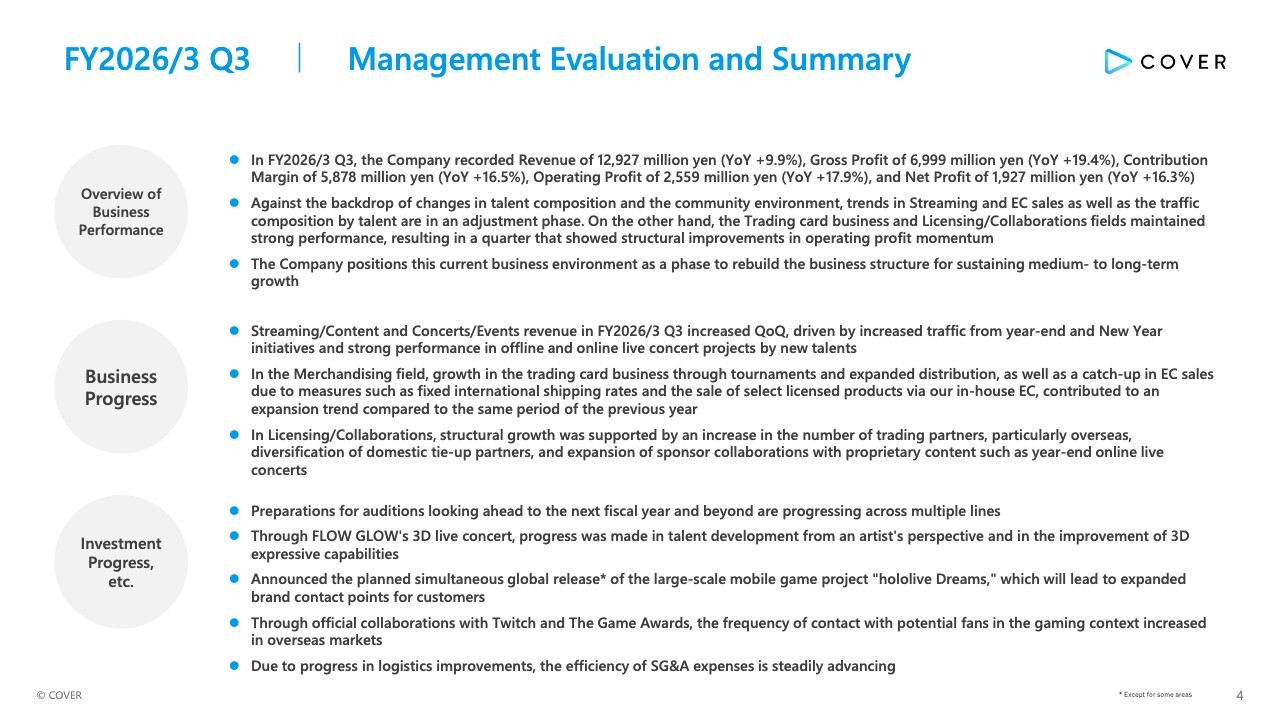
First, here is our management evaluation and summary. In FY2026/3 Q3, revenue increased 9.9% YoY to approximately ¥12.9 billion, gross profit rose by 19.4% to approximately ¥7.0 billion, operating profit grew by 17.9% to approximately ¥2.6 billion, and net profit increased by 16.3% to approximately ¥1.9 billion.
While revenue grew only by a single-digit percentage, profits continued to increase, supported by improvements in cost structure and SG&A efficiency. Against the backdrop of changes in talent composition and the community environment, trends in Streaming and EC sales as well as the traffic composition by talent continued to be in an adjustment phase.
On the other hand, the trading card business and Licensing/Collaborations fields maintained strong performance, and we recognize this quarter as a period of structural improvements in operating profit momentum. The Company positions the current business environment as a phase to rebuild the business structure for sustaining medium- to long-term growth.
Next, I will explain our business progress. Revenue from Streaming/Content and Concerts/Events in FY2026/3 Q3 increased QoQ, driven by increased traffic from year-end and new year initiatives and strong performance in offline and online live concert projects by new talents.
In Merchandising, growth in the trading card business through tournaments and expanded distribution, as well as a catch-up in EC sales due to measures such as fixed international shipping rates and the sale of select licensed products via our in-house EC. This has contributed to a significant upturn in revenue compared to the same period of the previous year.
In Licensing/Collaborations, the number of trading partners, particularly overseas, increased, and domestic and international tie-up partners diversified. In addition, expansion of sponsor collaborations with year-end online live concerts and large-scale events has supported structural growth.
Finally, I will provide an update on investment progress, etc. Preparations for auditions looking ahead to the next fiscal year and beyond are progressing across multiple lines. Furthermore, through FLOW GLOW’s 3D live concert, we made steady progress in talent development from an artist’s perspective and in the improvement of 3D expressive capabilities.
In addition, we have announced the planned simultaneous global release of the large-scale mobile game project “hololive Dreams,” which will lead to expanded brand contact points for customers.
Through official collaborations with Twitch and The Game Awards, the frequency of contact with potential fans in the gaming context increased in overseas markets. On the logistics front, the efficiency of SG&A expenses has been steadily advancing due to progress in logistics improvements. We remain committed to both strengthening our foundation for medium- to long-term growth and improving our revenue structure.
Financial Highlights | Summary for FY2026/3 Q3
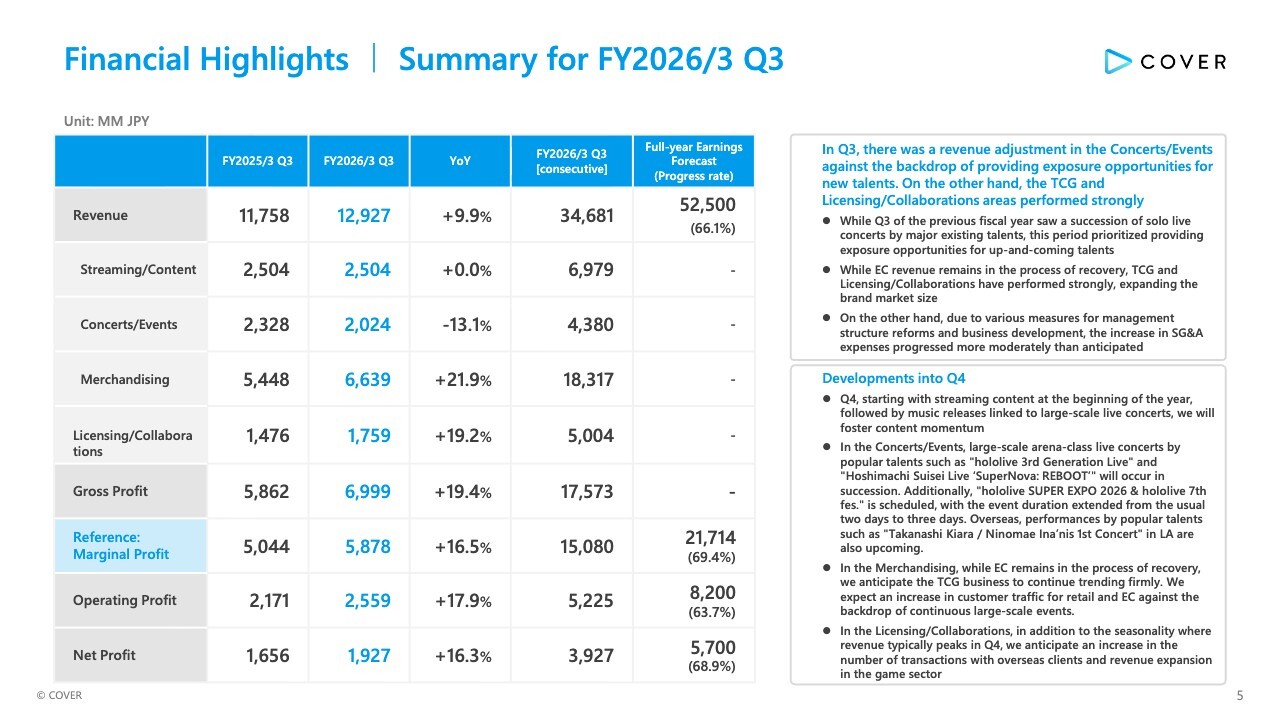
The financial results for Q3 are shown in the table on the slide. In Q3, there was a revenue adjustment in Concerts/Events as we prioritized providing exposure opportunities for up-and-coming talents. On the other hand, the trading card game (TCG) and Licensing/Collaborations continued to perform strongly, resulting in overall growth in both revenue and profit.
While EC revenue remains in the process of recovery, TCG and Licensing/Collaborations saw increased transactions primarily in overseas markets, supporting profit growth. Due to various measures for management structure reforms and business development, the increase in SG&A expenses progressed more moderately than anticipated.
Developments into Q4 are as outline on the right side of the slide. In Streaming/Content, we expect momentum to be fostered across all content, starting with streaming content at the beginning of the year, followed by music releases linked to large-scale live concerts.
In Concerts/Events, large-scale arena-class live concerts by popular talents such as “hololive3rd Generation Live” and “Hoshimachi Suisei Live ‘SuperNova: REBOOT’” will occur in succession. Additionally, “hololive SUPER EXPO 2026 & hololive7th fes.l" is scheduled, with the event duration extended than usual.
We will also expand our outreach to overseas markets, including holding the “Takanashi Kiara / Ninomae Ina’nis 1st Concert” in Los Angeles.
In Merchandising, while EC remains in the process of recovery, we anticipate the TCG business to continue trending firmly. We expect an increase in sales in both retail and EC channels, against the backdrop of continuous large-scale events, and aim to drive growth in customer traffic for EC.
In Licensing/Collaborations, in addition to the seasonality where revenue typically peaks in Q4, we anticipate an increase in the number of transactions with overseas clients and revenue expansion in the game sector.
Historical Trends in Revenue and Gross Profit
Yosuke Kaneko (hereinafter “Kaneko”): I am Yosuke Kaneko, Director and CFO. I will now provide a detailed explanation of the trends for each line item on the income statement.
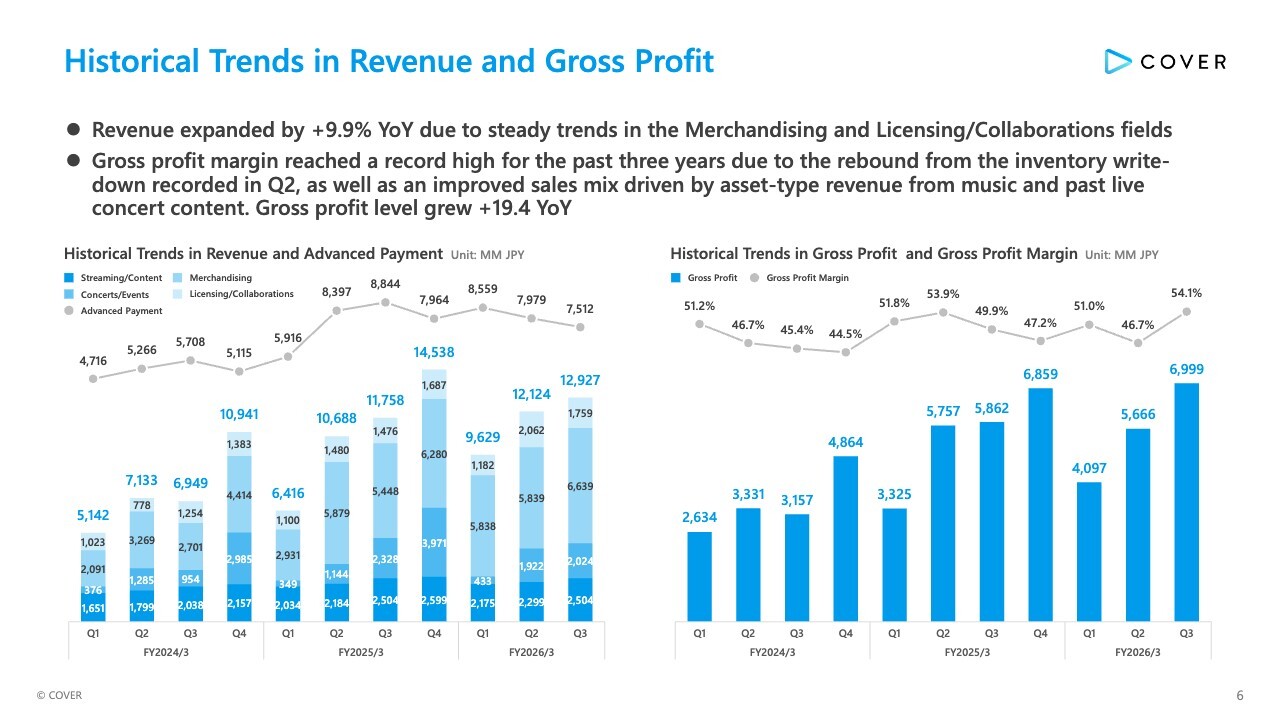
First, the historical trends in revenue and gross profit are as shown on the slide. Revenue for Q3 expanded by 9.9% YoY due to steady trends in Merchandising and Licensing/Collaborations.
In Concerts/Events, while we saw temporary revenue adjustments YoY due to operations prioritizing exposure opportunities for new talents, overall revenue has continued to grow.
Meanwhile, gross profit margin reached a record high for the past three years due to the rebound from the inventory write-down recorded in Q2, as well as an improved sales mix driven by asset-type revenue from music and past live concert content.
As a result, gross profit grew by 19.4% YoY, outpacing revenue growth.
Historical Trends in Cost of Sales and SG&A Expenses
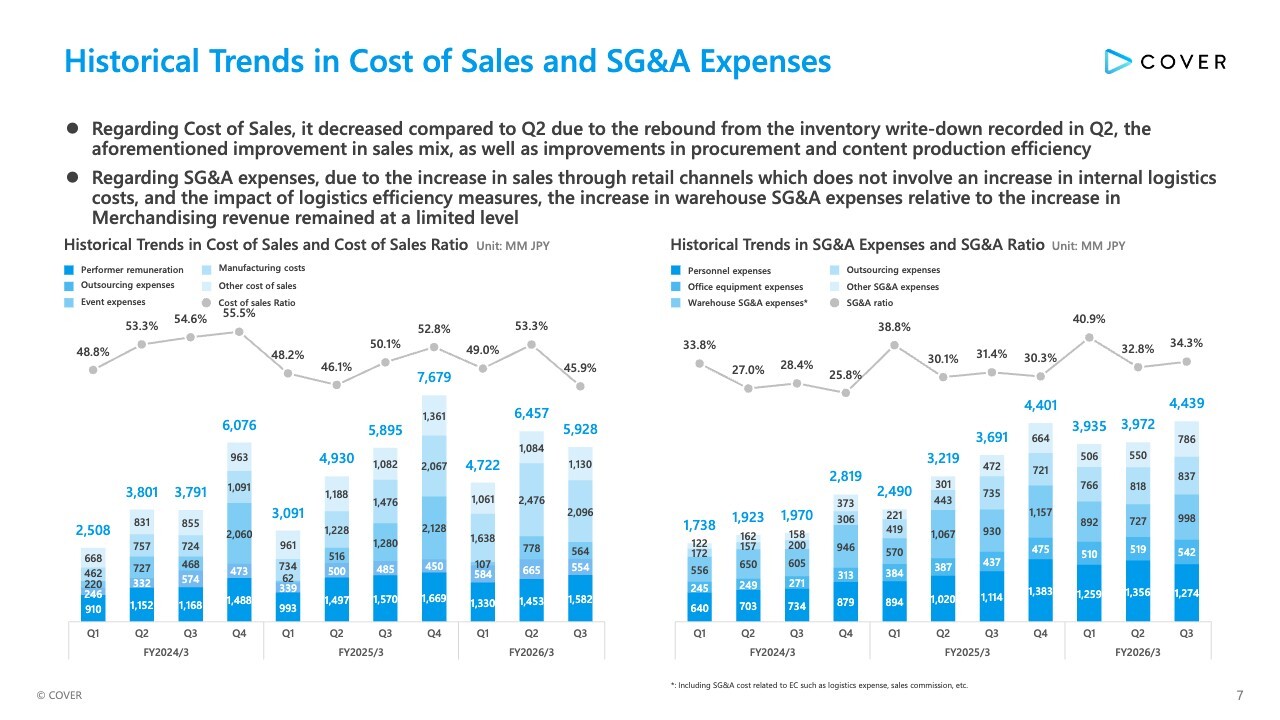
Here is the historical trends in cost of sales and SG&A expenses. Regarding cost of sales, it decreased compared to Q2 due to the rebound from the inventory write-down recorded in Q2, as well as the improvement in sales mix I explained earlier, improvements in procurement, and content production efficiency.
In particular, the cost of sales ratio has been improving, driven by the increased proportion of asset-type revenue from past live concert content and music, steadily making the cost structure more robust.
Regarding SG&A expenses, due to the increase in sales through retail channels which does not involve an increase in internal logistics costs, and ongoing implementation of logistics efficiency measures, the increase in warehouse SG&A expenses relative to the increase in Merchandising revenue remained at a limited level.
The SG&A ratio continued to remain under control, reflecting both sales expansion and improved cost efficiency.
Historical Trends in Contribution Margin and Operating Profit
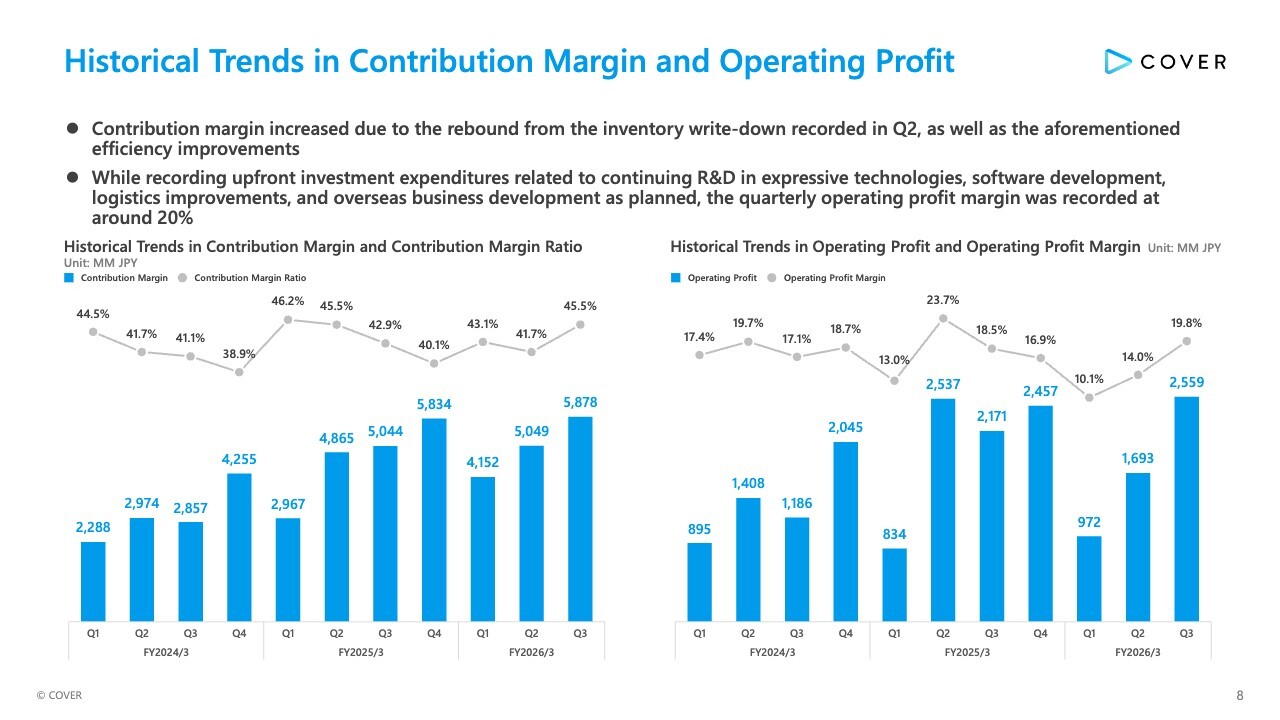
Here is the historical trends in contribution margin and operating profit. Contribution margin increased due to the rebound from the inventory write-down recorded in Q2, as well as the efficiency improvements I explained earlier.
This quarter demonstrated an improvement in our revenue structure, driven by revenue growth, as well as an increase in the proportion of asset-type revenue and improved procurement efficiency.
For operating profit, while continuously making upfront investment expenditures related to development of expressive technologies and software, logistics improvements, and overseas business development as planned, we have maintained the quarterly operating profit margin at around 20%.
Going forward, we will strive to achieve sustainable profitability improvements by realizing revenue in the Licensing and game fields, as well as through existing efficiency measures.
Progress of Current Fiscal Year Performance and Key Operational Issues at Present
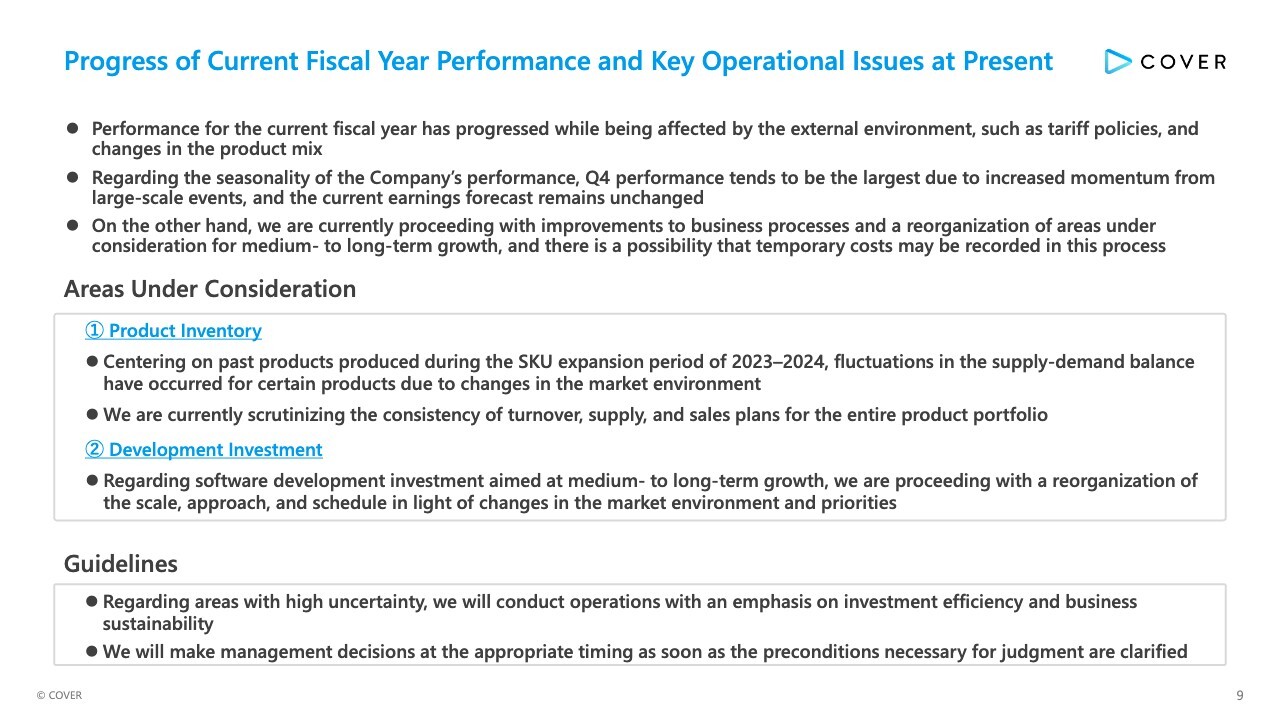
Performance for the current fiscal year has progressed while being affected by the external environment, such as tariff policies, and changes in the product mix. Due to the seasonality of the Company’s performance, Q4 performance tends to be the largest due to increased momentum from large-scale events.
At this point, our full-year earnings forecast remains unchanged, while considering this seasonality. On the other hand, we are currently proceeding with improvements to business processes and a reorganization of areas under consideration for medium- to long-term growth. While there is a possibility that temporary costs may be recorded in this process, we view this as a step toward future sustainable growth.
Let me discuss the specific areas under consideration. First, regarding product inventory, centering on past products produced during the SKU expansion period of 2023–2024, fluctuations in the supply-demand balance have occurred for certain products due to changes in the market environment. We are currently scrutinizing the consistency of turnover, supply, and sales plans for the entire product portfolio.
For development investment, we are proceeding with a reorganization of the scale of investment, approach, and schedule of software development investment aimed at medium-to long-term growth, in light of changes in the market environment and priorities.
As the management guidelines regarding areas with high uncertainty, we will conduct operations with an emphasis on investment efficiency and business sustainability, and make management decisions at the appropriate timing as soon as the preconditions necessary for judgment are clarified.
Business Development by Service | Streaming/Content
Tanigo: I will now explain the current status of business development by service, beginning with Streaming/Content.
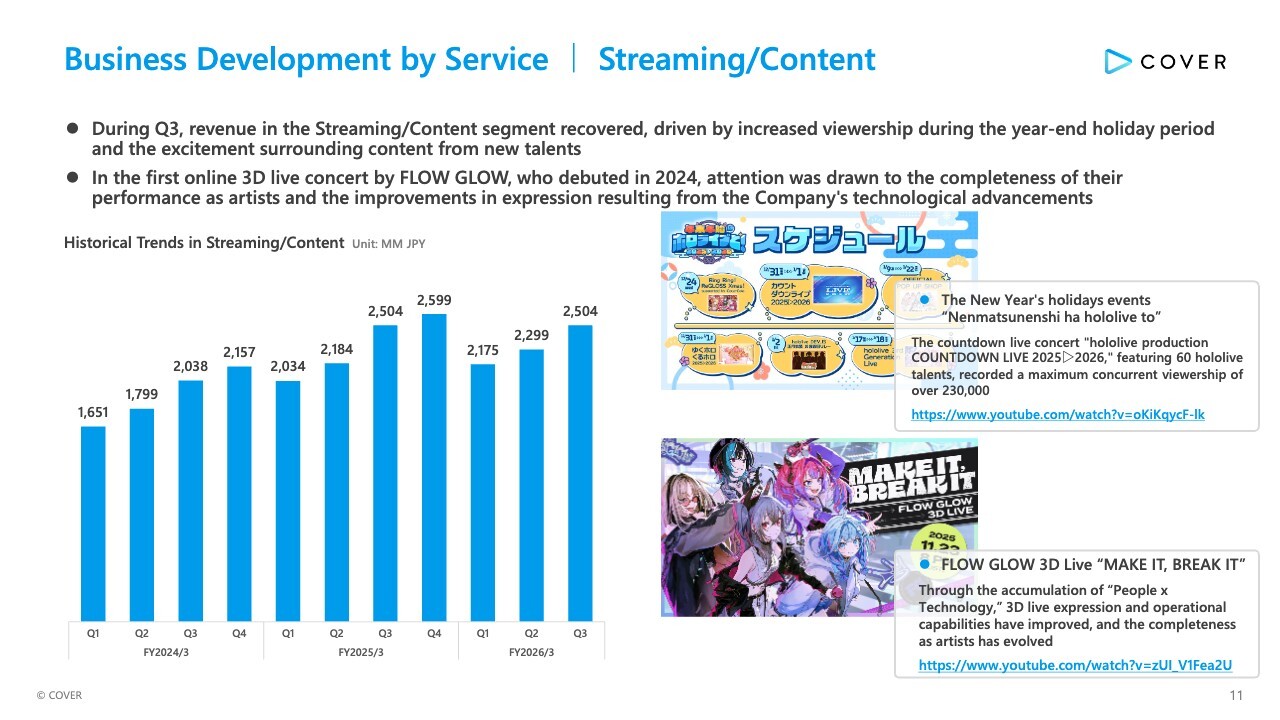
During Q3, revenue in the Streaming/Content segment recovered, driven by increased viewership during the year-end holiday period and the excitement surrounding content from new talents. In particular, large-scale streaming events such as the year-end countdown live concert attracted a large audience, contributing to the overall momentum of our content.
In the first online 3D live concert by FLOW GLOW, who debuted in 2024, attention was drawn to the completeness of their performance as artists and the improvements in the Company’s expression technologies and operational capabilities.
Through these efforts, we have been creating an environment that enables talents to deliver their artistic vision with higher levels of perfection.
Business Development by Service | Concerts/Events
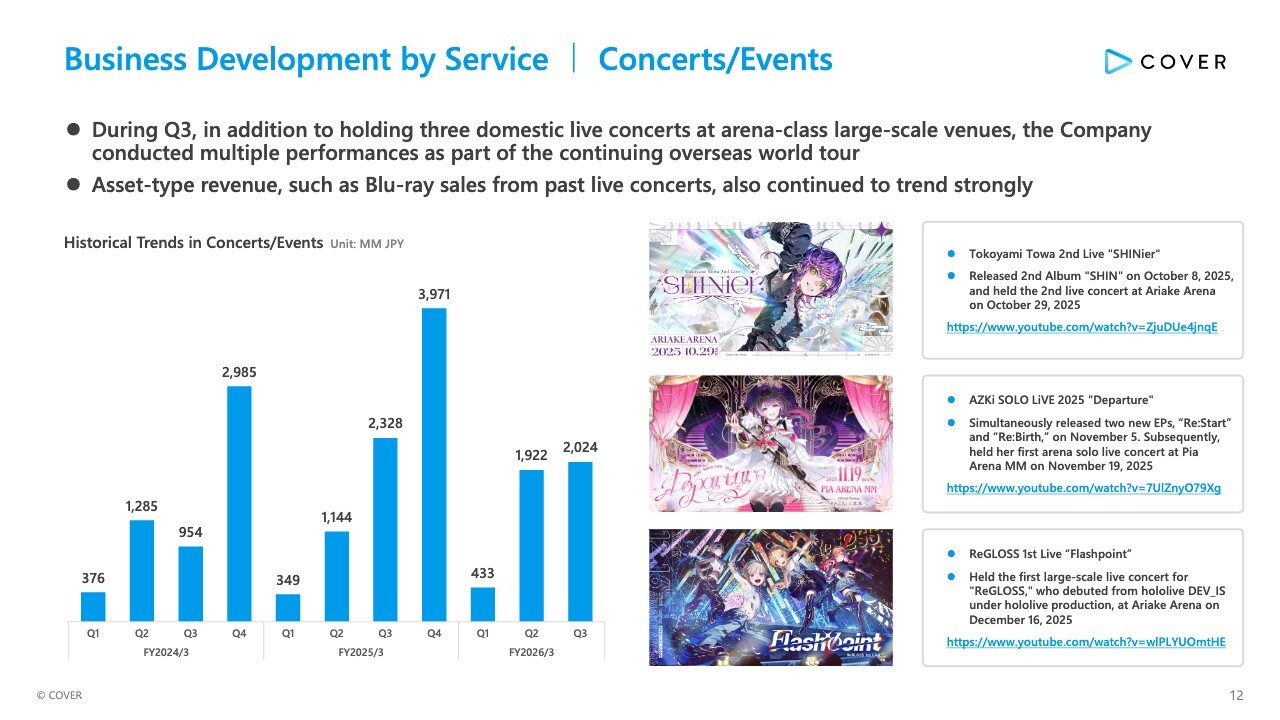
I will explain the business development of Concerts/Events. During Q3, in addition to holding three domestic live concerts at arena-class large-scale venues, the Company conducted multiple performances as part of the continuing overseas world tour. For each performance, we implemented production techniques focused on showcasing each talent’s unique expression and worldview, aiming to enhance the quality of the live experience.
In addition, asset-type revenue, such as Blu-ray sales from past live concerts, also continued to trend strongly, enabling us to provide value proposition through long-term enjoyment of the live experience.
We believe this quarter represented our ongoing efforts to thoughtfully convey each talent’s unique expression and worldview across the entire Concerts/Events service, not just through one-off events.
Business Development by Service | Merchandising
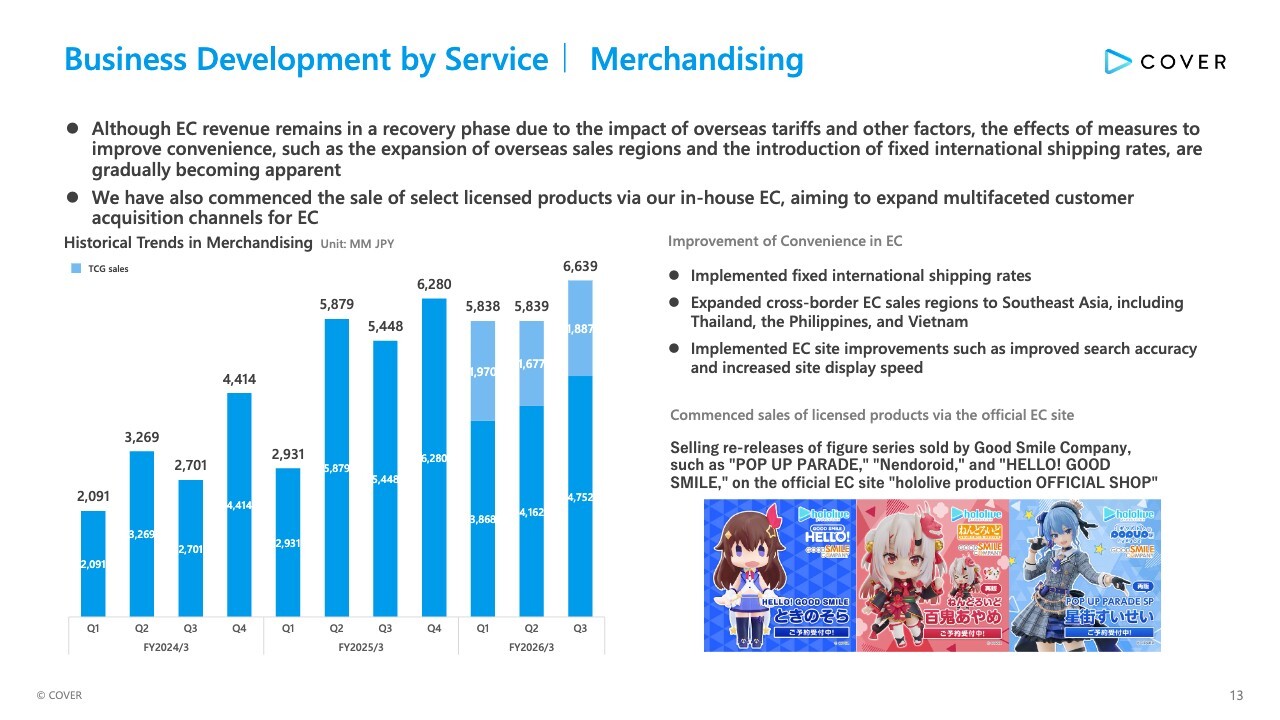
I will now explain the business development of Merchandising. In Q3, although EC revenue remains in a recovery phase due to the impact of overseas tariffs and other factors, the effects of measures to improve convenience, such as the expansion of overseas sales regions and the introduction of fixed international shipping rates, are gradually becoming apparent.
The TCG field continues to perform steadily, supporting overall revenue for Merchandising. We have also commenced the sale of select licensed products via our in-house EC, aiming to expand multifaceted customer acquisition channels starting from our official EC site.
Through these efforts, we are expanding opportunities for fans to engage with our products in accessible ways, complementing our existing sales channels. Moving forward, we will continue to enhance convenience and customer experience across both EC and retail to drive underlying demand growth, aiming for sustained growth in Merchandising.
Merchandising | TCG-Related Initiatives in Q3
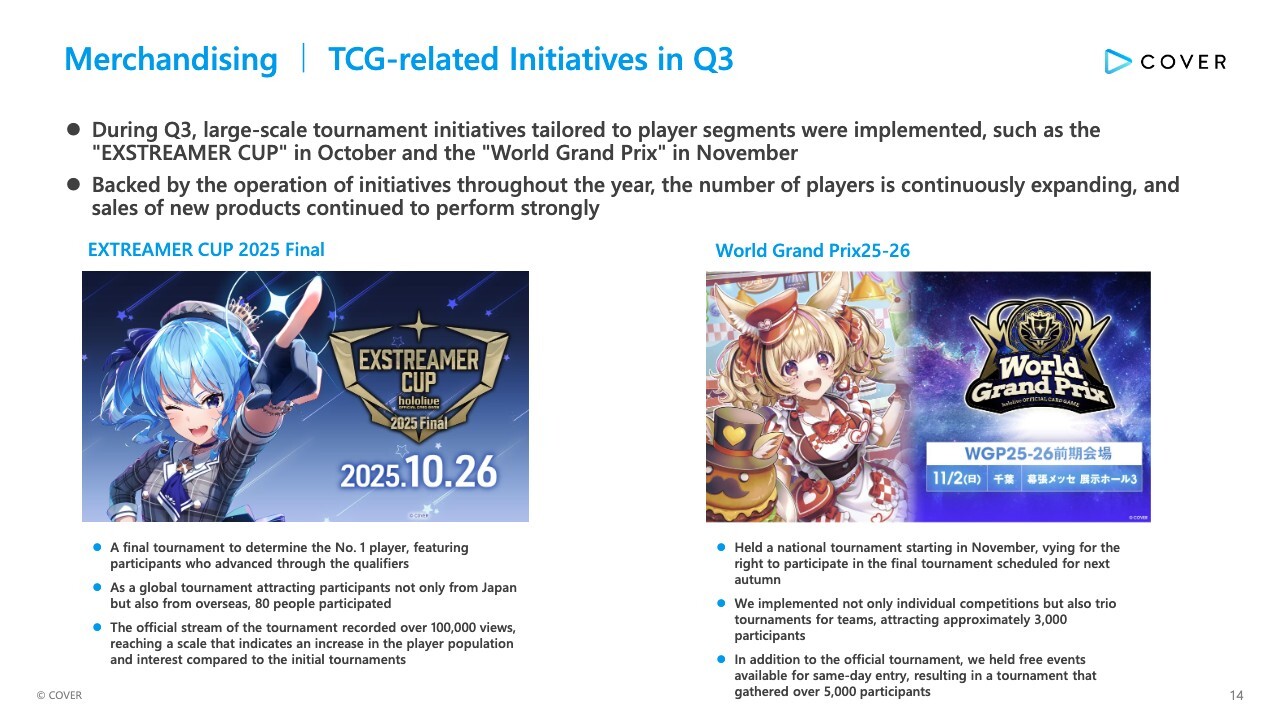
Let me explain our TCG-related initiatives. In Merchandising, the player base of trading card games has been continuously expanding backed by the operation of initiatives throughout the year.
During Q3, we implemented large-scale tournament initiatives tailored to tournament size and playstyle, such as the “EXSTREAMER CUP" in October and the "World Grand Prix" in November.
Through these efforts, we have been creating an environment that is accessible to a wide range of players, from competitive players to those who participate for the first time through events. Operating tournaments this way has helped foster excitement in the entire community and cultivate a continuous play experience.
As a result, sales of new products continued to perform strongly, and the overall TCG field remains on a stable growth path. Going forward, we will continue to pursue the sound expansion of our TCG business, centered on initiatives that prioritize the player experience.
Business Development by Service | Licensing/Collaborations
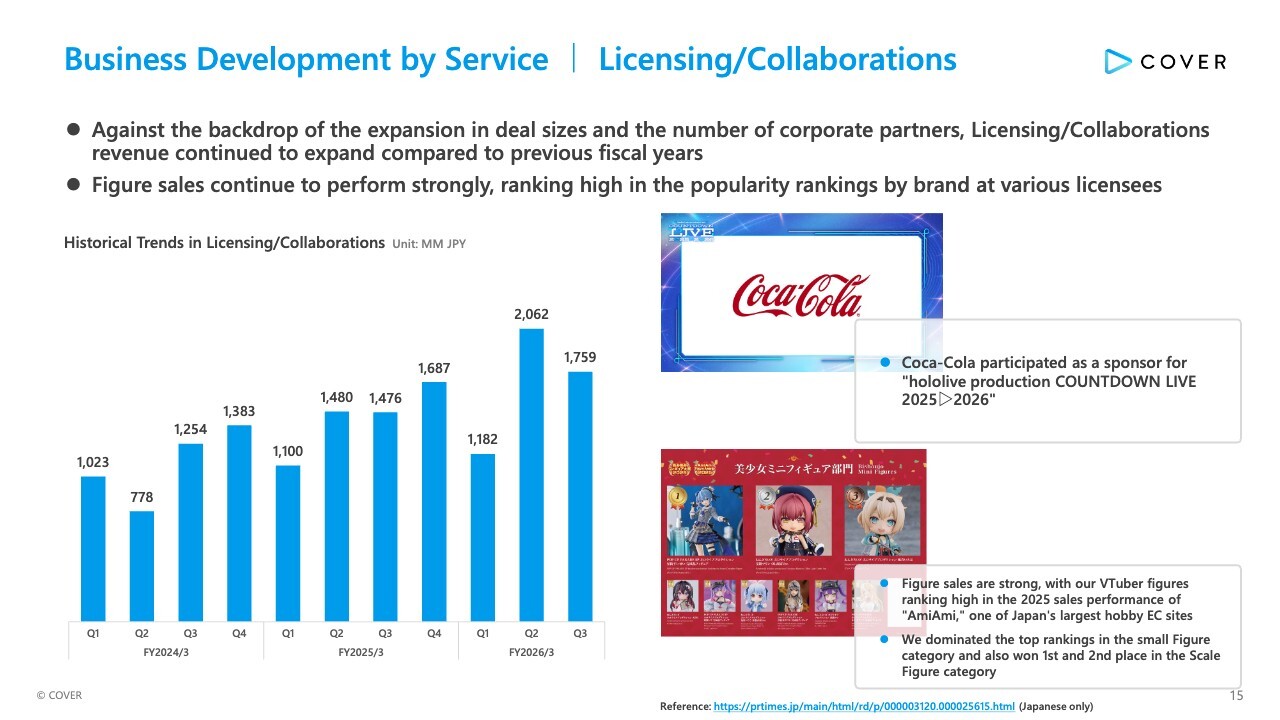
I will now explain the business development of Licensing/Collaborations. In Q3, revenue from Licensing/Collaborations continued to expand compared to previous fiscal years, against the backdrop of the expansion in deal sizes and the number of corporate partners. In particular, as our customer base has expanded both at home and abroad, we have achieved sustained, stable revenue growth, despite quarterly fluctuations.
As for specific initiatives, we saw progress in collaborations well-suited to large-scale content, such as securing sponsorship from global brands for the “hololive production COUNTDOWN LIVE.”
Sales of figures and other licensed products continue to perform strongly, ranking high in the popularity rankings by brand at various licensees. Overseas, initiatives through partnerships with local companies expanded, broadening the overall market base for Licensing/Collaborations during this quarter.
Status of Progress of Business Expansion to Achieve Medium-term Targets
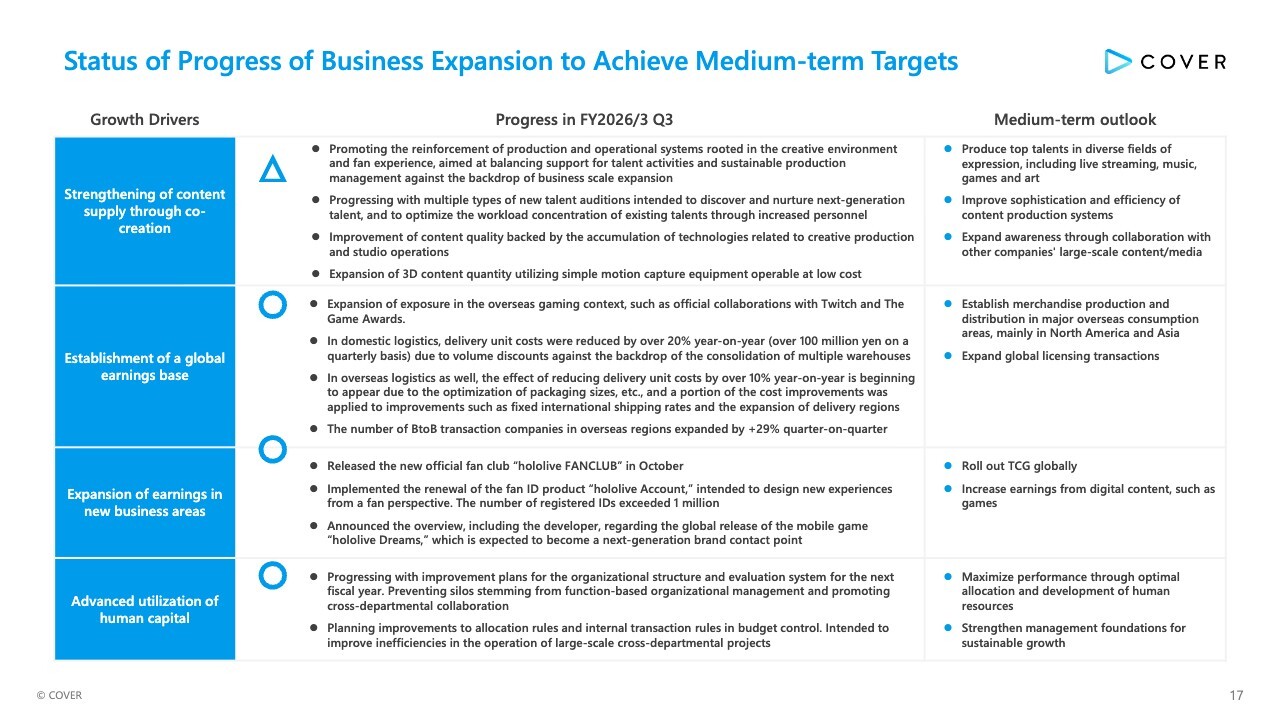
Here’s the progress of the current fiscal year’s initiatives toward achieving the medium-term targets. This slide summarizes key points of the progress of business expansion to achieve our medium-term targets.
In the first growth driver, “Strengthening of content supply through co-creation,” we have been promoting the reinforcement of production and operational systems rooted in the creative environment and fan experience, aimed at balancing support for talent activities and sustainable production management against the backdrop of business scale expansion.
Additionally, multiple types of new talent auditions are being conducted to discover and nurture the next- generation talent who will lead the industry, while also preventing the workload concentration of existing talents. Furthermore, improvements of content quality and production efficiency are progressing through enhancements in production techniques and studio operations.
With regard to “Establishment of a global earnings base,” our exposure has expanded in the overseas gaming context through official collaborations with Twitch and The Game Awards.
We are also working to improve the purchasing experience in EC by streamlining logistics operations both at home and abroad, and by implementing measures such as fixed international shipping rates. The number of BtoB transaction companies in overseas regions increased QoQ, demonstrating steady progress in expanding our global trading base.
For the “Expansion of earnings in new business areas,” we released the new official fan club “hololive FANCLUB” in October, and also implemented the renewal of the fan ID product “hololive Account.” The number of registered IDs exceeded 1 million.
We have also announced the development framework and overview for the global release of the mobile game “hololive Dreams,” which is expected to become a next-generation brand contact point.
Finally, with respect to “Advanced utilization of human capital,” we are reviewing structure and evaluation systems for the next fiscal year, while also working to build a mechanism to promote cross-departmental collaboration.
As described above, medium- to long-term foundational improvements are progressing as planned along with short-term measures.
Regarding Ongoing Auditions
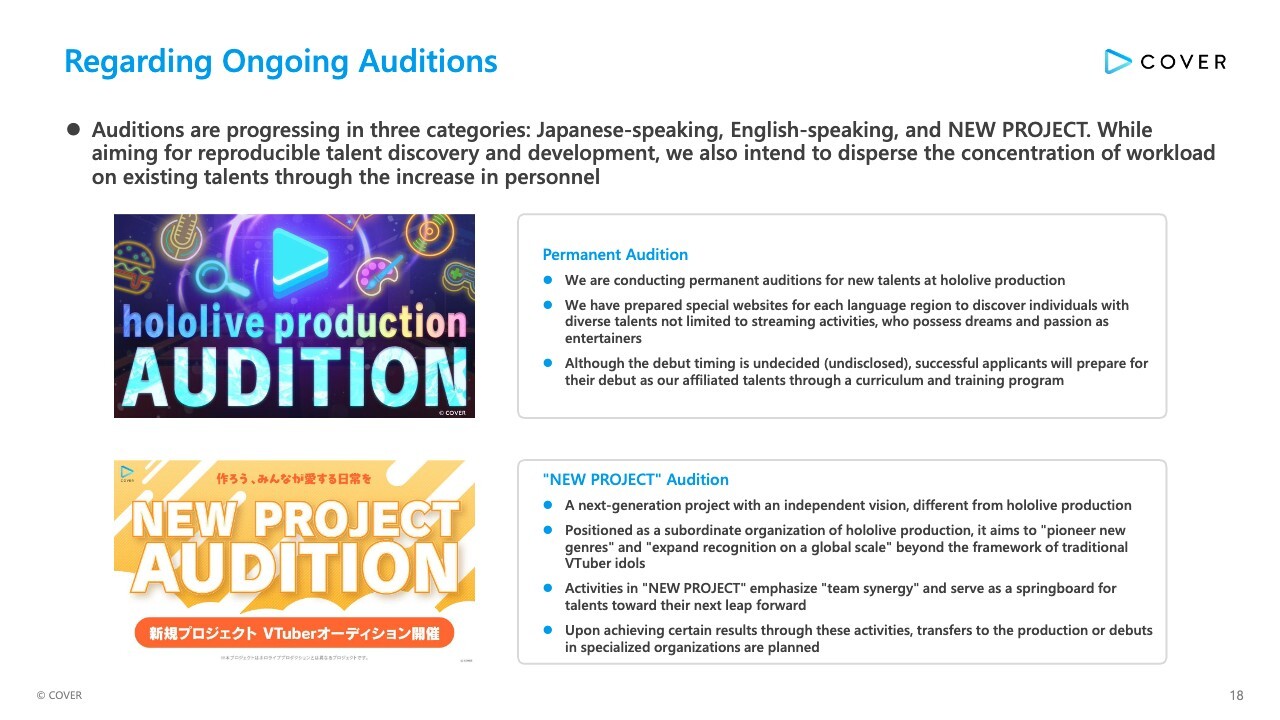
I will explain our ongoing audition initiatives. We conduct auditions in three categories: Japanese-speaking, English-speaking, and NEW PROJECT, aiming to discover and develop reproducible talent.
Through the increase in the number of talents, we also intend to mitigate the concentration of workloads on existing talents, contributing to sustainable production operation.
First, let’s look at permanent audition. At hololive production, our audition is designed to continuously discover new talent, inviting individuals with diverse creative aspirations, not limited to streaming activities, to take on challenges.
After the audition, successful applicants will prepare for their debut through a step-by-step development process, rather than making their debut immediately.
Next, let me explain the “NEW PROJECT” audition. This is positioned as a new project beyond conventional frameworks, initially focusing on accumulating experience through project activities.
Upon achieving certain results through these activities, participants may become affiliated with “hololive production” or debut in specialized organizations focused on specific fields.
In this way, we are systematically advancing our audition initiatives as efforts focused on medium-to-long-term talent development and business growth.
Regarding the Improvement of Brand Contact Frequency Overseas
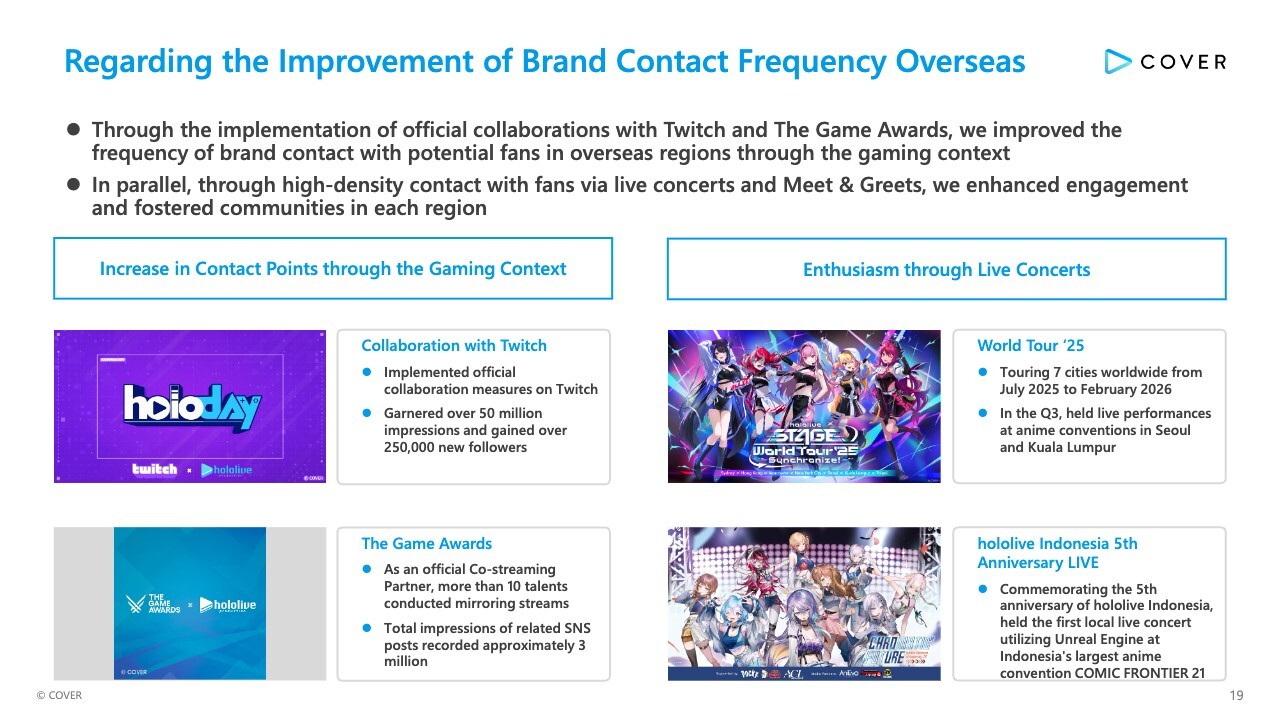
I will explain our efforts to improve brand contact frequency overseas. First initiative involves expanding contact points through the gaming context. We expanded opportunities to contact potential fans in overseas regions through the implementation of official collaborations with Twitch and The Game Awards, leveraging the gaming context as a starting point.
Collaboration with Twitch garnered over 50 million impressions, leading to acquisition of about 250,000 new followers.
At The Game Awards, we participated as an official Co-streaming Partner, and more than 10 talents conducted mirroring streams. Total impressions of related SNS posts reached approximately 3 million.
Next, I will explain our initiatives through live concerts. During the “World Tour '25” running from July 2025 to February 2026, we hold performances in seven cities worldwide, continuously creating direct contact with local fans.
Additionally, we held hololive Indonesia 5th Anniversary LIVE in Indonesia, fostering relationships with the local community through collaboration with on-site events.
By combining these online and offline initiatives, we are enhancing continuous brand contact and building relationships with fans in each region.
Progress Status of Upfront Expenditures | Game-related Business/Holoearth
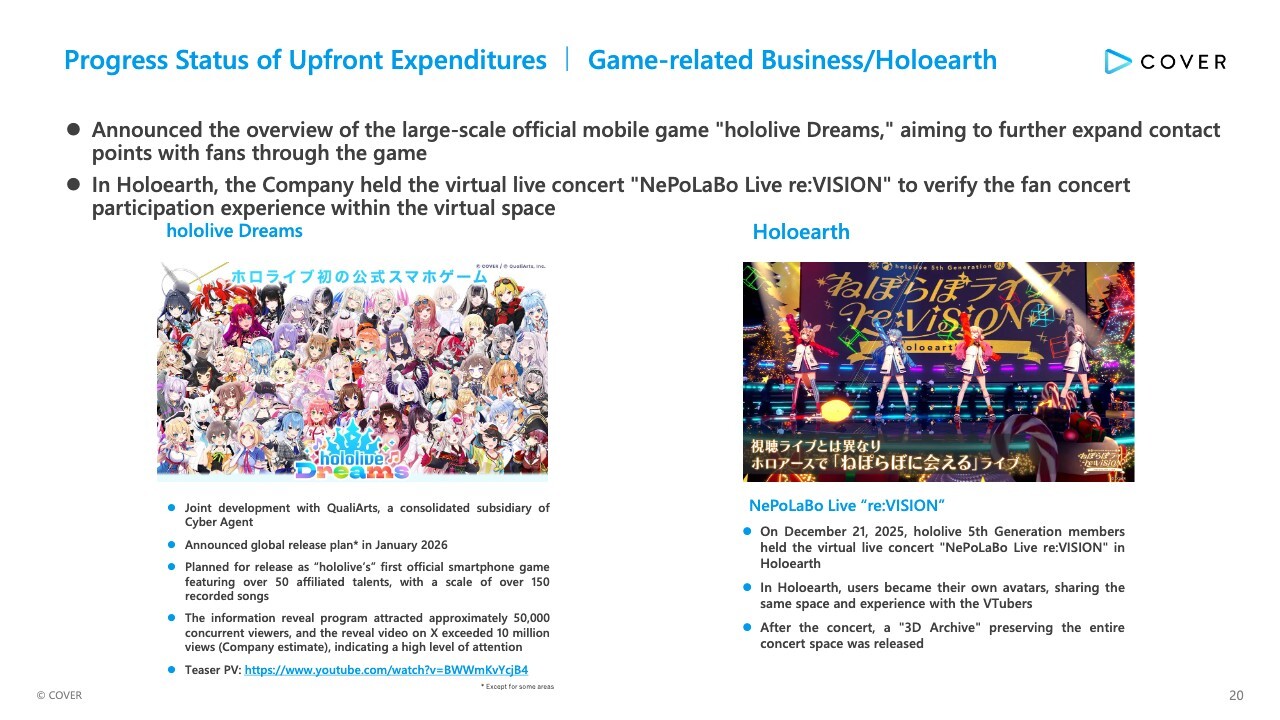
As part of our upfront expenditures, I will update you on the progress of our game initiatives and “Holoearth.”
First, let me address our game-related business. In Q3, we announced an overview of the large-scale official mobile game, “hololive Dreams.” With this title, we aim to further expand contact points with fans through the game.
We are co-developing the game with external partners and plan a global release in 2026. As the first official smartphone game under the “hololive” brand, the title will feature over 50 affiliated talents and is expected to include a scale of over 150 recorded songs.
When we unveiled the game, the announcement livestream drew approximately 50,000 concurrent viewers. The reveal video posted on X has since surpassed 10 million cumulative views. These metrics demonstrate strong response and engagement both in Japan and overseas.
On “Holoearth,” we held the virtual live concert “NePoRaBo Live re:VISION” and tested the live entertainment experience within a fully virtual environment.
For this event, users joined “Holoearth” as avatars and shared the same virtual space with our VTuber talents. This format delivered an interactive, participatory live experience that goes beyond traditional livestreaming.
We are also enabling the content to be repurposed as a “3D archive” after the live recording and are actively testing initiatives to expand the overall value of the experience.
Progress in Management Structure Reforms and Other Matters
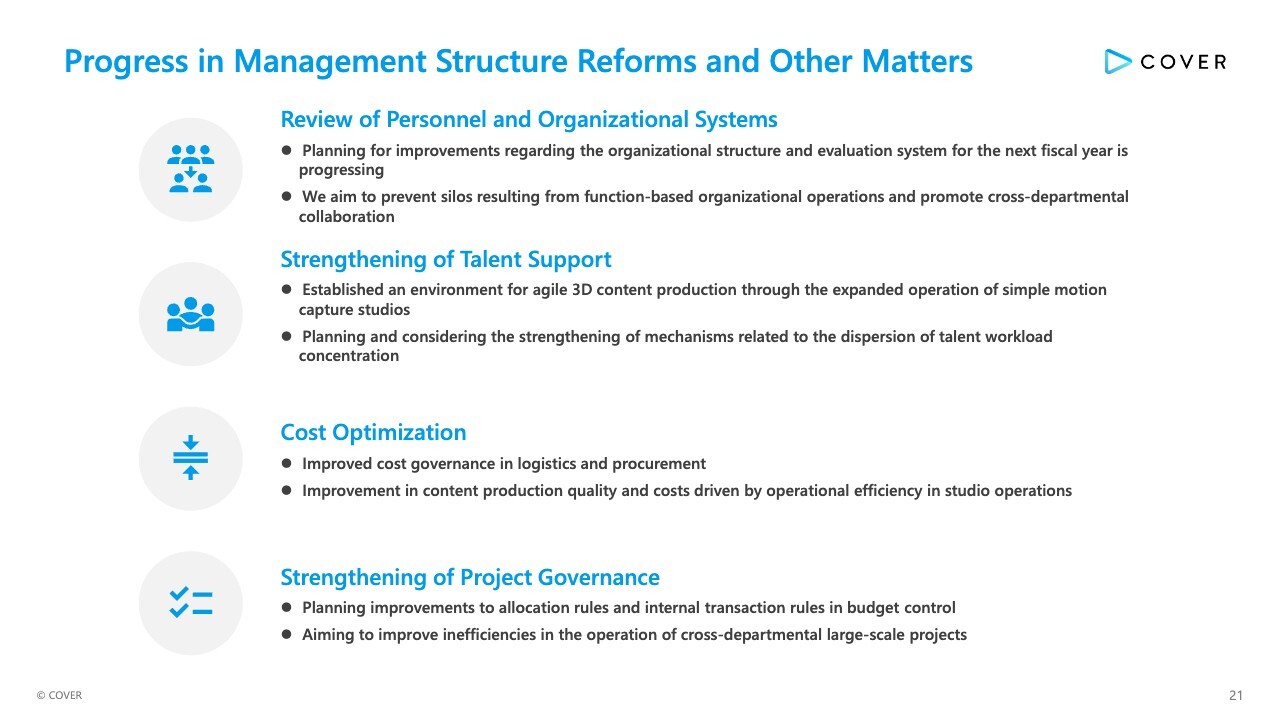
Let me report on our key initiatives related to management structure reforms and other matters as of the Q3-end. First, we are reviewing our personnel and organizational systems.
We are making steady progress on planning for improvements regarding the organizational structure and evaluation system for the next fiscal year. While maintaining a function-based organizational operations, we are building mechanisms to prevent silos within departments and to promote cross-departmental collaboration. Through these initiatives, we aim to strengthen the quality and speed of decision-making and coordination across the entire organization.
Next, we are strengthening talent support. We are expanding the operation of simple motion capture studios to establish an environment for agile 3D content production. In parallel, we are planning and considering the strengthening of mechanisms related to the dispersion of talent workload concentration.
Next, we are driving cost optimization. We have strengthened cost governance in logistics and procurement, and we are also improving operational efficiency in our studio operations. Through these initiatives, we are working to enhance content quality while simultaneously reducing costs.
Finally, we are strengthening project governance. We are revising our allocation rules and internal transaction rules in budget control, and we are tackling inefficiencies in the operation of cross-departmental large-scale projects.
Going forward, we will manage projects with tighter alignment to our overall strategy and optimize resource allocation across the organization.
In Q3, we made steady progress, in line with plan, in strengthening the management foundation that supports our business growth.
Q&A: Scale of potential impact of inventory write-down
Question: Your materials mention a risk of expense recognition in Q4.
I understand that this relates to a potential inventory write-down on products from 2023 to 2024, and that a write-down of ¥550 million was also recorded in Q2 for the same reasons.
Given current inventory levels, would any additional expenses have a significant impact? If possible, please quantify the scale of potential impact.
Kaneko: We are currently reviewing the details and assessing the scale of potential impact. We are assessing their alignment with our overall portfolio rotation and sales plan. However, the situation differs by SKU. Additional expenses may arise depending on the outcome. However, we are still conducting a detailed review, and no final determination has been made at this stage.
Q&A: Progress in “Strengthening of content supply through co-creation”
Question: Let me ask about the progress of business expansion. Regarding the first item on the slide, “Strengthening of content supply through co-creation,” the details suggest that progress is solid. However, it is marked as “Partially achieved.”
I believe this item was marked as “Achieved” in the previous materials. Could you explain what changes have occurred over the past three months?
Kaneko: As our business has expanded, we have worked to balance stronger talent support with sustainable production operations. In this process, we have received feedbacks regarding our operations, including talent-by-talent workload management and the diversification of the music production and live concert services we provide.
We take these feedbacks seriously and are committed to making the necessary improvements. For that reason, we have marked it as “partially achieved.” As you noted, we are making steady progress on the initiatives we set out at the start of the fiscal year. At the same time, we will reassess and refine these measures in light of the challenges we currently face.
Q&A: Status of our talent support initiatives
Question: Let me ask about the status of our talent support initiatives. Since last April, you have strengthened the management structure, and I understand that communication with talents has also improved.
However, when we look at comments from a VTuber who graduated in December, we see remarks such as “the workload did not improve as much as expected.” This makes it difficult to clearly assess the current situation. It has been nearly one year since you revised the management structure. Please share a clear review of the initiatives implemented during this period, including the progress achieved, areas where you see measurable traction, and the key challenges that remain.
Tanigo: This is difficult to explain in detail, but issues involving the graduated VTuber arose well before the public announcement of their graduation. As we have previously communicated, we are addressing these issues and working to resolve them during the current fiscal year.
If the graduation is presented as being caused by specific issues, it may give the impression that those issues remain unresolved. In reality, however, we are making steady and tangible progress in addressing them. At the same time, company-related errors still occur. We acknowledge these facts, take them seriously, and will continue implementing concrete measures to improve.
Q&A: Initial performance of the mobile app game and its expected impact on overall results
Question: How would you summarize the initial response to the upcoming mobile app game from your perspective? Additionally, we would also like to understand your current view, to the extent possible, on the game’s potential impact on future financial performance.
Kaneko: We are seeing a largely positive response on social media and from the public. However, because this is our first launch of a major mobile game and the project follows a joint development model, many variables remain. As a result, we cannot provide definitive guidance on its financial impact at this stage.
Furthermore, for next fiscal year’s budget, it is difficult to assume a significant contribution from this project at the start of the fiscal year, so we plan to incorporate its impact conservatively.
At the same time, we hope the game will attract more customers and fans to our brand, and we expect it to deliver meaningful benefits over the medium to long term.
Q&A: Progress on overall SG&A expenses and a summary assessment of their performance
Question: Let me ask about the overall SG&A expenses. How has progress compared with your planned targets? Looking at individual categories, warehouse-related SG&A expenses have been optimized, while other areas have increased YoY. Given this context, we would appreciate your comments on the overall assessment.
Kaneko: For the “other” category, it mainly consists of numerous technical, one-time expenses, which together form a relatively large consolidated category.
We are strategically reducing warehouse-related SG&A expenses, while improving efficiency in fixed personnel costs through internal reassignments and other measures. These deliberate structural reforms and changes are progressing, and we are seeing tangible results in the numbers.
Q&A: Background of inventory risks and planned measures to address them
Question: You mentioned earlier that inventory issues are creating a risk of future losses. Could you explain the underlying factors we should consider?
Generally, we understand that items with strong character appeal and high rarity carry minimal inventory risk. From your perspective, what factors are creating the inventory risks in this case? Could you provide more details?
Kaneko: In the past, our e-commerce shop primarily operated as a flash-sale site focused on made-to-order products. Around the time of our listing in 2023, we expanded the range of regularly stocked items so customers could purchase merchandise from their favorite talents whenever they wanted. However, in the early stages of this effort, our product planning and production system lacked sufficient demand forecasting capabilities. As a result, some items produced during this expansion phase now require careful review.
We have recently begun improving the accuracy of our demand forecasts. We also plan to strategically control SKU counts and transition to a system that delivers timely products aligned with seasonal items and events, while—most importantly—prioritizing the experience value for our fans and customers. Together with these initiatives, we will continue implementing measures to prevent inventory from stagnating.
Q&A: Progress on the medium-term management strategy and related operational improvements
Question: In the current materials, the “Strengthening of content supply through co-creation” item has been marked as “Partially achieved.” Based on the content shared by the talent who graduated at year-end and our review of these materials, it may appear externally that your operational improvements have not progressed effectively.
First, we would like to understand where the issues originated. Were they caused by reliance on individual personnel, or do they stem from systemic problems? We would appreciate your comments on this point.
You mentioned that the issues have been addressed and no problems currently remain. Could you provide details on the specific measures you implemented to achieve this?
Tanigo: In addition to my earlier remarks, I would first highlight the broad and diverse scope of our operations. For example, in the music sector, many companies collaborate with external labels for music production and often avoid handling production in-house. In contrast, our company conducts music production internally.
The same applies, for example, to commerce, particularly e-commerce sales. While we outsource the final stage of logistics to external providers, we handle the preceding operational steps in-house.
We believe it is crucial to address these challenges by implementing measures each time an error is detected, ensuring the same issue does not recur.
While not all issues have been fully resolved, we recognize that strengthening personnel in project management roles—our project managers—will remain critically important going forward.
Question: With operations becoming more diverse, is it correct to say that the division between in-house and outsourced work was incomplete, leading to increased workloads and a series of recurring issues?
Tanigo: That’s slightly different. Rather than struggling with a choice between in-house production and outsourcing, the reality is that we handle most functions internally. As a result, a relatively larger share of the issues that arise originate on our side.
As for why these issues occur, one factor is the structure of our e-commerce operations. A significant portion of our sales comes from overseas, yet we operate a single EC platform that serves both domestic and international customers. In addition, we handle a wide range of products with diverse characteristics. As we scale the business, some of these issues have emerged as a byproduct of that expansion.
Question: So, is it correct to say that your company pursued in-house operations for their advantages, but rapid scale expansion caused delays in your ability to respond?
Tanigo: Exactly. For that reason, we believe it is also important to narrow our focus more selectively.
Kaneko: As I mentioned earlier, our operations have expanded rapidly over the past few years. We have scaled up live concerts, increased operational sophistication, and diversified into new business areas we had not previously pursued.
In response, we are gradually strengthening our operations and governance to keep pace. We aim to address each issue individually, capture mistakes and areas for improvement as organizational learning, and share these insights across the organization. By doing so, we will raise the company’s overall operational quality.
Q&A: Impairment risk for software assets and the scope of items under review
Question: Regarding the areas for future review shown on the slide, you have explained the product inventory, but we would like to hear about the software side.
Could you clarify the extent of the impairment risk we should consider and which software assets are subject to review?
Kaneko: The development assets capitalized under software on our balance sheet include platform-related software such as “Holoearth,” as well as systems similar to ERP, including our internally developed revenue management system. We are currently conducting a comprehensive review of these assets.
“Holoearth” is not a single, standalone package but a multilayered platform. We will comprehensively reassess its overall priorities, scale, execution strategy, and timeline going forward.
We are currently reviewing these assets, and once the underlying assumptions are thoroughly reviewed, we will determine the scale and disclose it at the appropriate time.
Q&A: Review of personnel and organizational systems
Question: Although this overlaps with previous questions, could you provide an update on the review of personnel and organizational systems? Specifically, where do you see current challenges, and what measures are you implementing—or planning to implement—to address them?
Tanigo: As our businesses have diversified, cross–business unit activities have increased significantly. As a result, coordination costs between business units have risen materially.
To address this, we will streamline the organization of our business units and reduce inter-unit coordination costs. By doing so, we will create a structure that allows us to focus on our highest-priority initiatives.
Q&A: Positioning of “NEW PROJECT” and how it differs from the “hololive” brand
Question: Could you explain the positioning of the “NEW PROJECT” audition and the “NEW PROJECT” itself? I am not entirely clear on how it differs from the existing “hololive” brand or, personally, the “hololive DEV_IS” brand. Could you explain the differences, your thinking, and the objectives behind them?
Tanigo: As indicated by the term “subordinate organization,” we position this not as a traditional talent debut, but as a project that allows participants to challenge themselves and develop their skills before formally debuting as talents.
Q&A: Policy on in-house versus outsourced operations and the ERP system
Question: This question concerns the relationship between in-house and outsourced operations. While we understand the rationale for handling the music label in-house, is there ongoing discussion about whether it might be better to outsource some of this work in the future?
Regarding your earlier comments on software, you mentioned that the ERP system is being developed in-house. In this context, it seems there could be an option to clearly separate core and non-core operations, focus on the most critical areas, and outsource parts that can be handled externally.
For example, adopting external software packages or ERP solutions could potentially reduce costs. Could you provide your perspective on this?
Kaneko: The ERP system is outsourced. Given the high complexity of building an ERP from scratch, we have implemented a solution from a major external vendor.
Question: So, does this mean that some customization work is being handled in-house during the ERP implementation?
Kaneko: We are implementing the system in collaboration with the vendor, but each business unit necessarily manages its own operations in-house.
Tanigo: In other words, although the work is outsourced, it is simply recorded under software on the balance sheet.
Kaneko: Exactly. This discussion about the ERP system primarily relates to software.
Question: I understood. So, is it correct to say that there are no plans to shift in-house operations to outsourcing or vice versa, and that the policy on this is already well-defined?
Kaneko: We continuously review our approach based on the situation. For example, in studio operations, given the specialized nature of our work, we primarily advance processes by collaborating closely with external production companies.
We continuously evaluate where to draw those boundaries and whether to enter into long-term contracts. This applies not only to 3D content production through our studio operations, but across a wide range of functions. We believe we can further optimize our operations by striking the right balance between in-house operations and outsourcing.
Tanigo: For example, in commerce, some companies outsource operations like managing their e-commerce sites. While in-house operations may offer higher profit potential, outsourcing can be preferable when considering potential errors and risks. Accordingly, we may adjust the scope of outsourced operations as needed.
Q&A: Benefits of leveraging outsourced software development while maintaining in-house management
Question: I’d like to follow up on software. Your company likely has partner firms and contract staff on-site. Is the decision to outsource, rather than hire in-house program managers, driven by specific advantages?
Kaneko: In practice, we often use a hybrid model that combines project managers—who oversee both in-house development teams and external vendors—with external engineers. However, no matter how skilled the external engineers are, our in-house staff have the deepest understanding of internal operations, making a dedicated coordinator essential.
We are also considering outsourcing certain tasks where external support is feasible.
Question: So, is it correct to understand that the current challenges lie more in analog operations than in digital areas?
Kaneko: It is difficult to explain briefly, but please understand it that way.
Q&A: Expenditures on upfront investments
Question: Regarding upfront investment spending, you mentioned it is currently being managed conservatively. Can we assume that next fiscal year, the full-year plan of approximately ¥3.1 billion will largely be eliminated YoY?
Kaneko: For the upfront investment items identified at the start of the fiscal-year budget, personnel expenses account for the majority. For example, upfront hiring costs have been incurred for specialized BizDev talent in areas such as logistics development and international business expansion.
We expect profit contribution from these initiatives to strengthen over time, while the personnel supporting them will remain in place. Therefore, costs will not disappear after a single fiscal year like CAPEX, but are likely to remain relatively steady. We are continuing to review and refine the budget levels.
Q&A: Next fiscal year’s staffing plan
Question: Regarding staff increases, over the past three quarters, staffing has remained largely flat. With the upcoming mobile game launch and organizational changes, should we expect headcount to rise next fiscal year and beyond in line with top-line growth—modestly, even if not as significantly as in past expansions?
Kaneko: First, regarding the possibility of a sharp increase in headcount due to game development, we operate the development jointly with external partners. As a result, even if the game scales significantly, we do not expect a substantial increase in our internal staffing.
On the other hand, staff are needed to oversee multiple talents and numerous songs, and to link them to the game through supervision roles. While the overall headcount increase won’t be large, we do expect a modest rise in personnel.
The staffing plan for next fiscal year is still under budget review. From a business model perspective, higher sales do not necessarily require a proportional increase in personnel.
From the perspective of sustainable operations, challenges include business expansion, diversification, enhancing customer and talent experiences, and preserving the creative environment. Accordingly, we do not plan to significantly increase headcount overall. However, we will continue to add personnel selectively in areas where they are needed.
Overall, we are planning a more restrained headcount increase than in previous years.
Question: To confirm, can we understand that in this regard, the contribution margin will be more clearly reflected in operating profit?
Kaneko: While the budget is still under review and some details are hard to specify, it may become easier to explain once we consider factors such as structural improvements in logistics and the expansion of the product mix toward high-margin revenue sources, such as games and cards, that tend to drive strong improvements in labor productivity metrics.