Full-Year FY2025 Results Briefing
Akira Urakami (hereinafter, Urakami): Thank you very much for joining us today. I am Urakami, President and CEO. I would like to express my sincere appreciation for taking the time to watch this presentation.
During the consolidated fiscal year under review, the business environment remained uncertain due to factors such as the impact of trade policies in various countries, volatile foreign exchange rates, and persistently high resource and energy prices. Under these circumstances, in addition to proactive sales activities, the Ryobi Group worked to reduce costs and improve productivity.
Looking at the financial results announced yesterday by business segment, the Die Castings business—supported by a recovery in automobile production—as well as the Printing Equipment business for overseas markets recorded year-on-year increases in sales. On the other hand, sales declined in the Builders’ Hardware business and in Printing Equipment for the domestic market.
While there were areas where we believe we met expectations, there were also areas where challenges remain. Today, we will explain the details of our results and the outlook for the current fiscal year, including the background behind these results. We will also discuss the initiatives and progress of each business under the Medium-Term Management Plan announced in February last year.
Through today’s presentation, we hope to provide you with a clearer understanding of our current position and our future direction. With that, let us begin the presentation.
Contents
Hiromu Arihiro (hereinafter, Arihiro): I am Arihiro, Corporate Officer and General Manager of the Finance Department. Today, we will go through the four items listed in the table of contents. I will cover the first two items, Full-Year FY2025 Results and Full-Year FY2026 Forecasts.
Results Summary
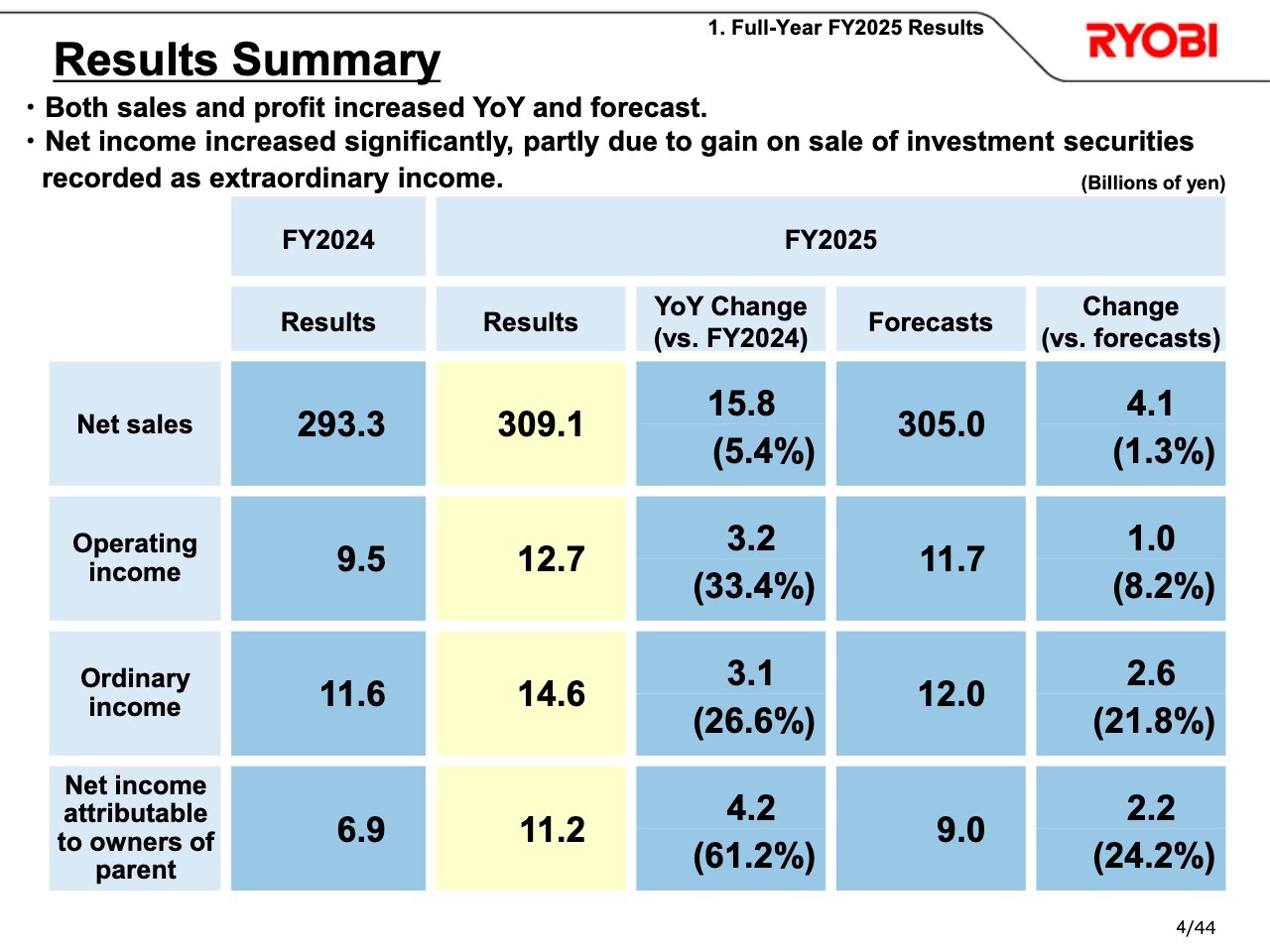
First, let me walk you through the Full-Year FY2025 Results. This slide provides a summary of the FY2025 results. Net sales amounted to ¥309.1 billion, a YoY increase of ¥15.8 billion. Compared with the forecast of ¥305.0 billion announced on February 13 last year, net sales exceeded the forecast by ¥4.1 billion.
Operating income totaled ¥12.7 billion, a YoY increase of ¥3.2 billion, and ¥1.0 billion above the forecast. Ordinary income amounted to ¥14.6 billion, a YoY increase of ¥3.1 billion, and ¥2.6 billion above the forecast. Net income attributable to owners of the parent was ¥11.2 billion, a YoY increase of ¥4.2 billion, and ¥2.2 billion above the forecast.
As a result, both sales and profit increased year on year and also exceeded the forecast.
Trends in Production Weight of Die Castings
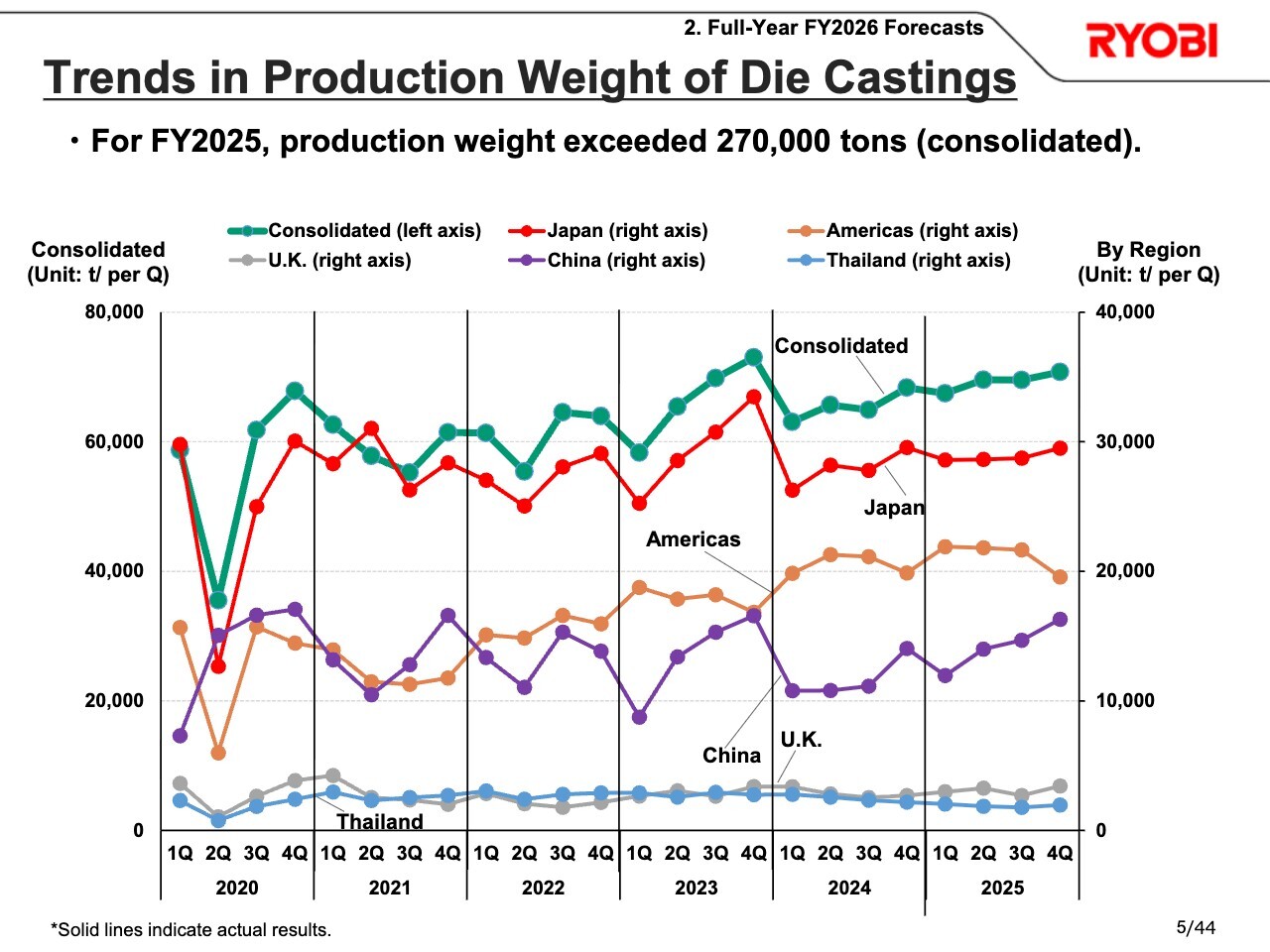
This slide shows the trends in production weight of die castings. In FY2025, Thailand, shown in light blue at the bottom of the graph, decreased compared with FY2024, while Japan (red), the Americas (orange), China (purple), and the U.K. (gray) all recorded increases in production weight year on year.
For FY2025, production weight exceeded 270,000 tons on a consolidated basis. This represents an increase of approximately 6% compared with the previous year.
Analysis of Changes in Net Sales
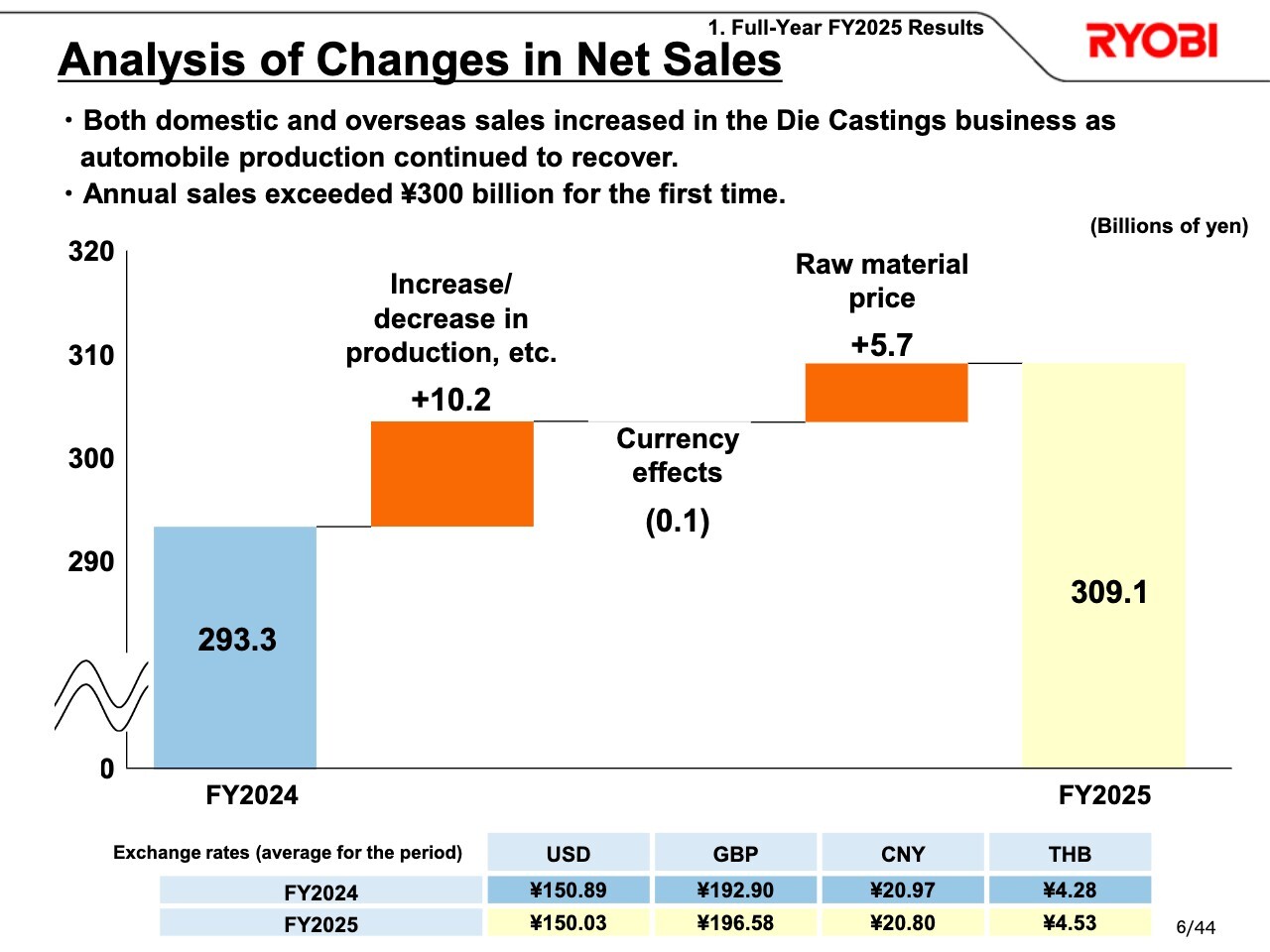
This slide shows the analysis of changes in net sales. Net sales increased by ¥15.8 billion, from ¥293.3 billion in FY2024 to ¥309.1 billion in FY2025.
Raw material prices, including aluminum alloy, had a positive impact of ¥5.7 billion. On the other hand, as shown in the comparison of the average exchange rates for the period at the bottom of the slide, there were no significant changes compared with the previous year, and therefore the impact of currency effects was negative ¥0.1 billion.
After taking these factors into account, the impact of increase/decrease in production, etc., was a positive ¥10.2 billion. As a result, net sales increased by ¥15.8 billion overall.
Analysis of Changes in Operating Income
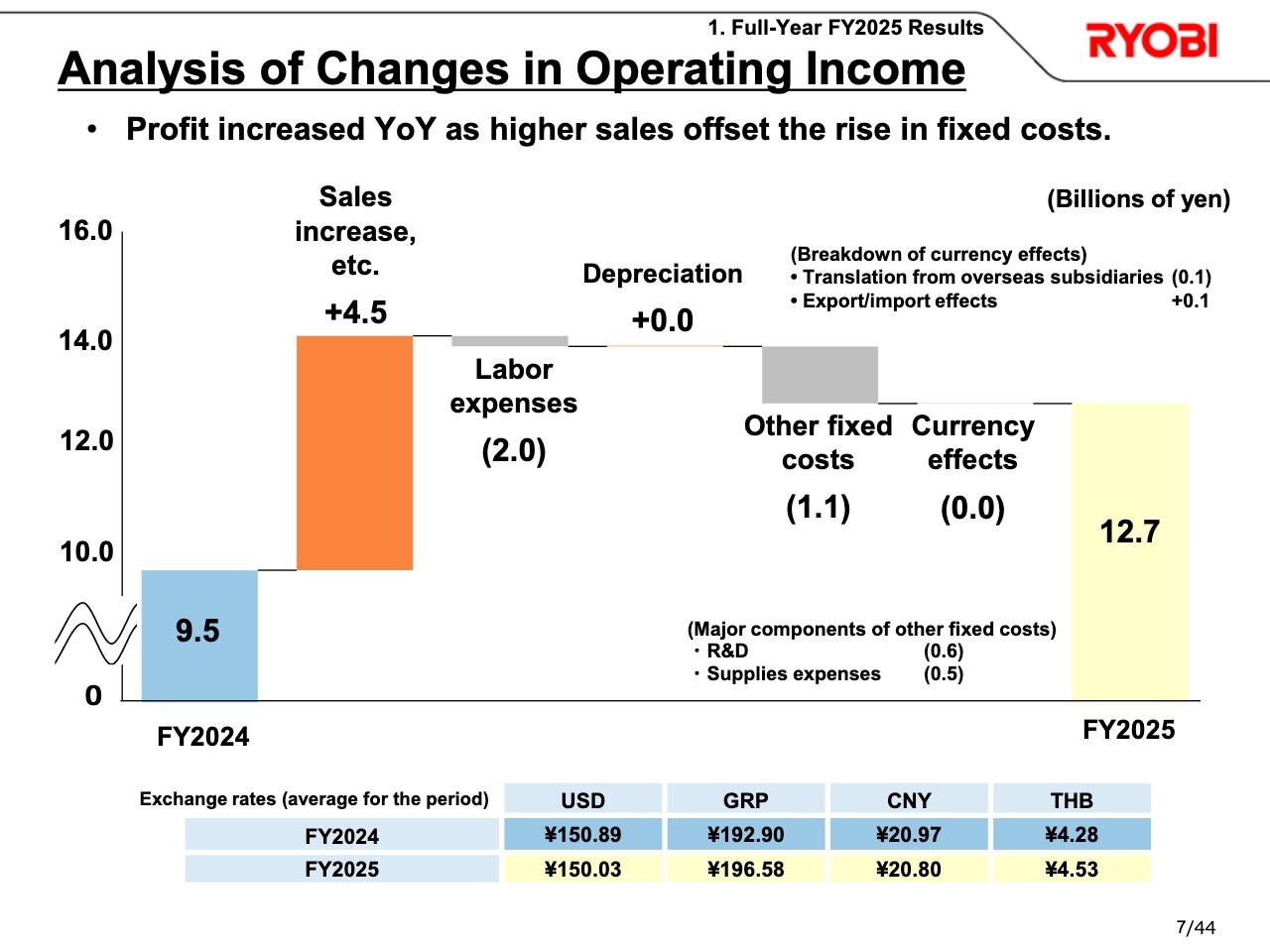
This slide shows an analysis of changes in operating income. Operating income increased by ¥3.2 billion, from ¥9.5 billion in FY2024 to ¥12.7 billion in FY2025. Although labor expenses and other fixed costs—including research and development expenses, particularly for giga casting-related R&D at the Kikugawa Plant—increased, these costs were offset by higher sales. As a result, operating income grew year on year.
Results by Business Segment
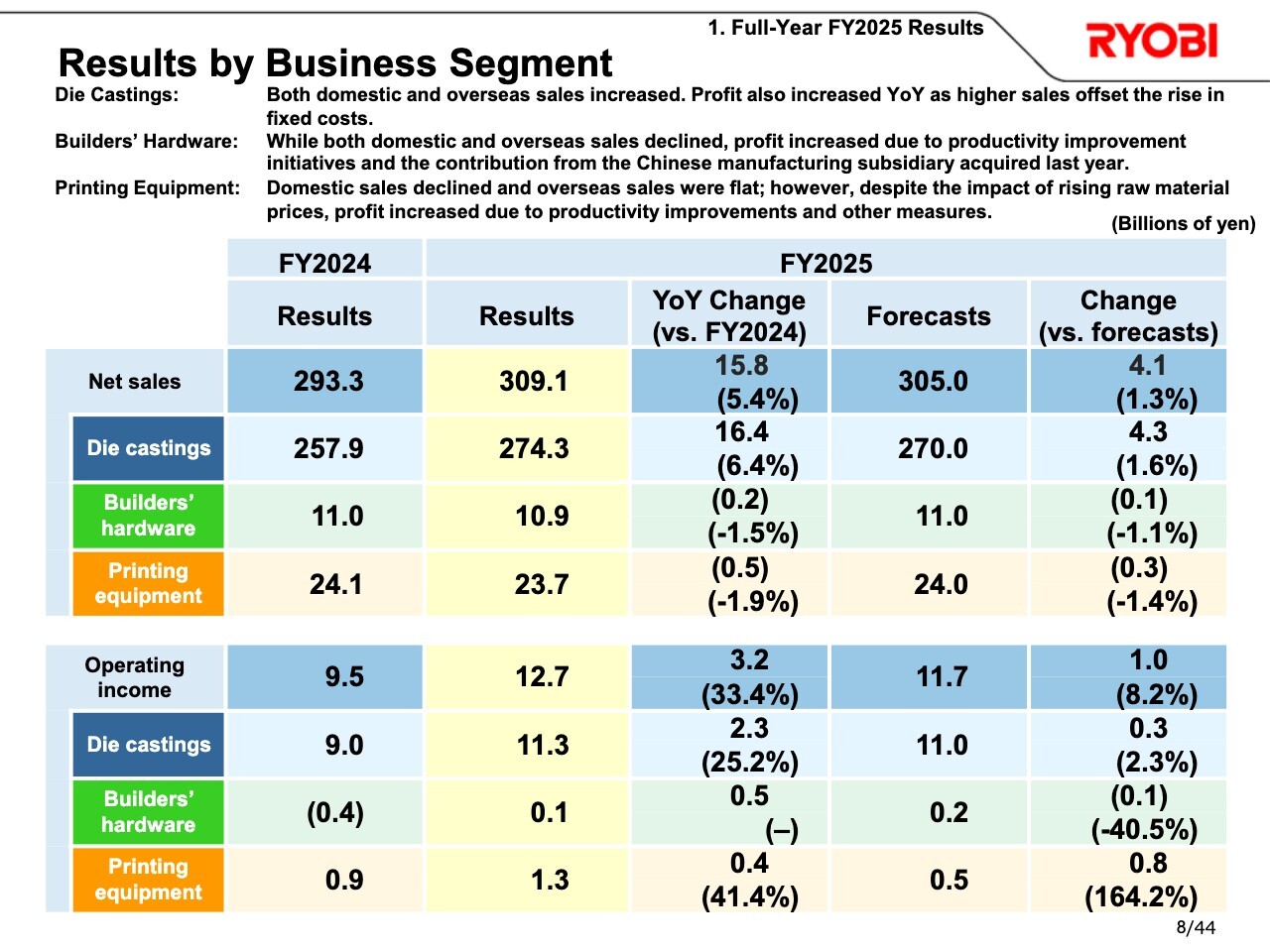
These are the results by business segment. Net sales in the Die Castings business were ¥274.3 billion, a YoY increase of ¥16.4 billion. Operating income was ¥11.3 billion, a YoY increase of ¥2.3 billion. Sales increased both domestically and overseas, and profit increased as higher sales offset the rise in fixed costs.
Net sales in the Builders’ Hardware business were ¥10.9 billion, a YoY decrease of approximately ¥0.2 billion. Operating income was ¥0.1 billion, marking a turnaround from a loss of ¥0.4 billion in the previous year.
While net sales in the Builders’ Hardware business declined both domestically and overseas, profit increased due to productivity improvement initiatives and the contribution from the Chinese manufacturing subsidiary acquired in the year before last.
Finally, net sales in the Printing Equipment business were ¥23.7 billion, a YoY decrease of ¥0.5 billion. Operating income was ¥1.3 billion, a YoY increase of ¥0.4 billion. Domestic sales declined and overseas sales were flat; however, despite the impact of rising raw material prices, profit increased due to productivity improvements.
Balance Sheet
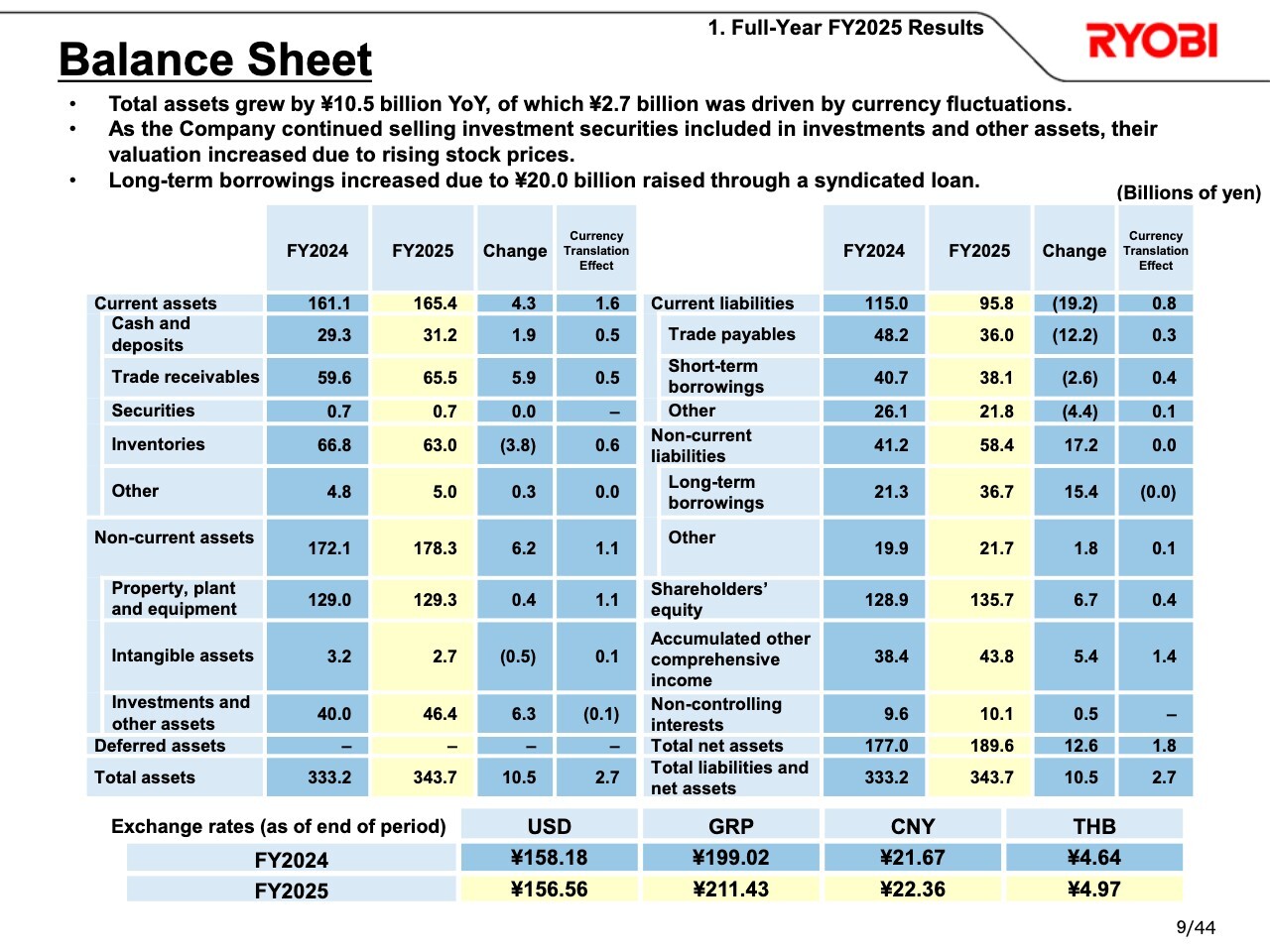
This slide shows the balance sheet. At the end of FY2025, total assets amounted to ¥343.7 billion, an increase of approximately ¥10.5 billion compared with the end of FY2024. Of this increase, ¥2.7 billion was driven by currency fluctuations. Excluding this impact, total assets increased by ¥7.8 billion in real terms.
The main factors behind the changes are as follows. Trade receivables within current assets increased in line with higher sales. In addition, within investments and other assets under non-current assets, although the Company continued to sell certain investment securities, their valuation increased due to rising stock prices.
With regard to liabilities, trade payables within current liabilities decreased significantly, mainly due to earlier payments, while long-term borrowings increased following the raising of ¥20.0 billion through a syndicated loan.
Change in Cash Flows
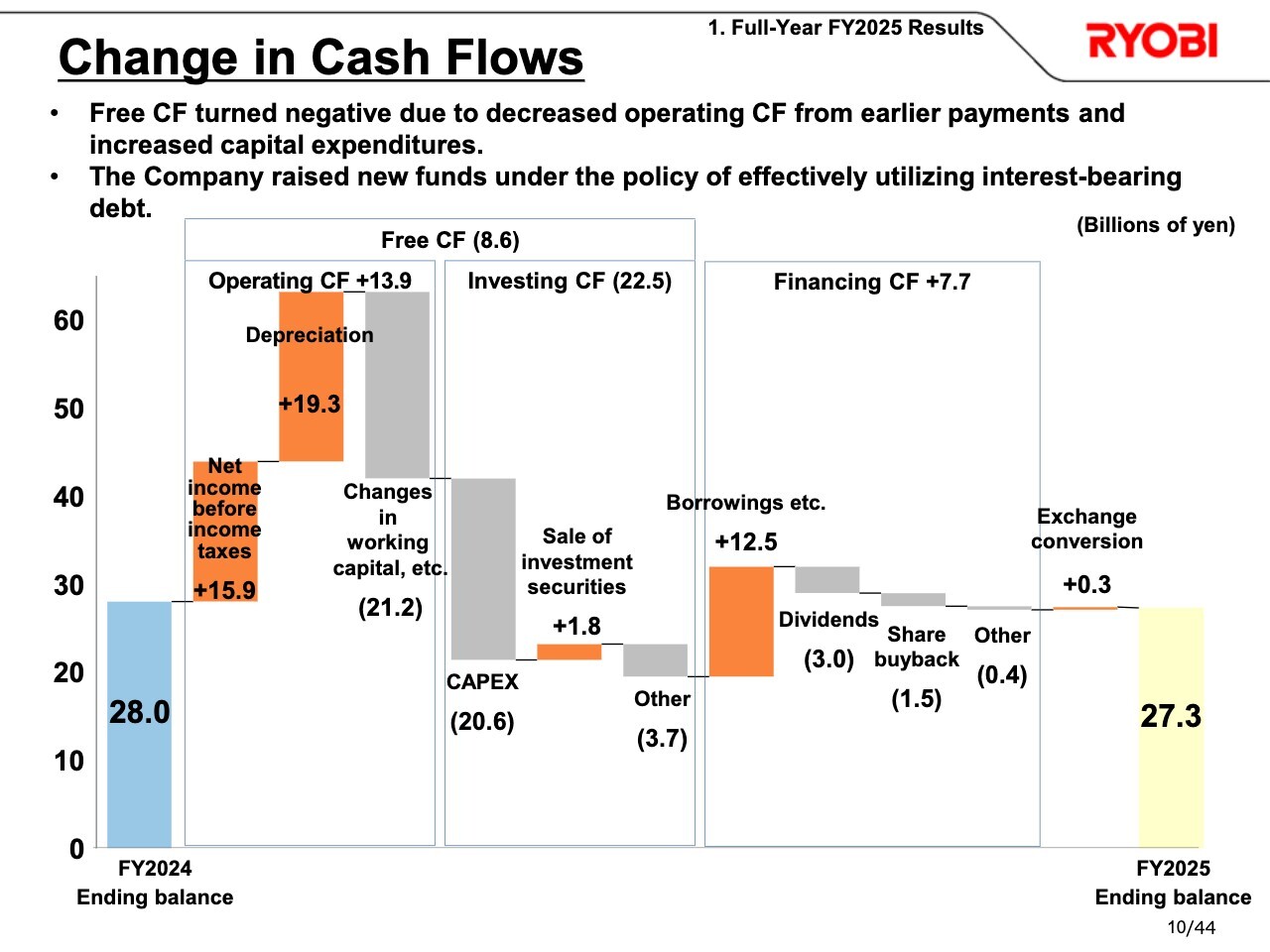
This slide shows the change in cash flows. Net income before income taxes amounted to ¥15.9 billion. After adding ¥19.3 billion in depreciation and reflecting changes in working capital and other factors, operating cash flow totaled ¥13.9 billion.
Capital expenditures were ¥20.6 billion, while sales of investment securities contributed ¥1.8 billion. As a result, investing cash flow was negative ¥22.5 billion.
Free cash flow, which is the sum of operating and investing cash flows, was negative ¥8.6 billion.
On the financing side, borrowings increased by ¥12.5 billion, while dividend payments amounted to ¥3.0 billion and share buybacks totaled ¥1.5 billion. As a result, financing cash flow was positive ¥7.7 billion.
Consequently, the FY2025 ending balance of cash and cash equivalents stood at ¥27.3 billion, a decrease of approximately ¥0.7 billion from ¥28.0 billion at the end of the previous fiscal year.
Forecasts
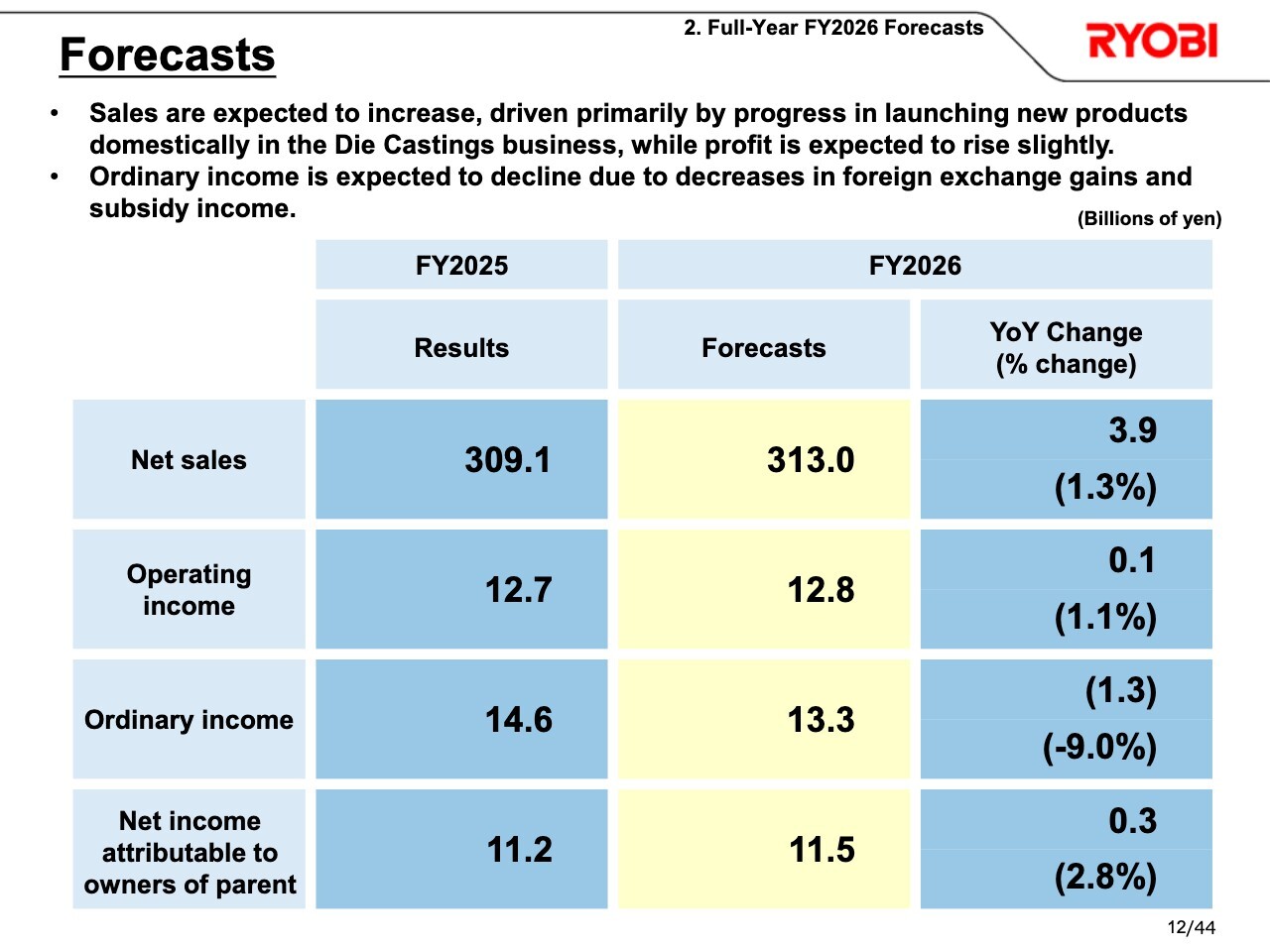
From here, I will explain the forecast for FY2026. Net sales for FY2026 are projected to be ¥313.0 billion, representing a YoY increase of ¥3.9 billion.
Operating income is expected to be ¥12.8 billion, a YoY increase of ¥0.1 billion.
Ordinary income is forecast to be ¥13.3 billion, a YoY decrease of ¥1.3 billion. This decline is expected due to decreases in foreign exchange gains and subsidy income that were recorded in the previous year.
Net income attributable to owners of the parent is expected to be ¥11.5 billion, a YoY increase of ¥0.3 billion.
As a result, operating income and net income are expected to increase, while ordinary income is expected to decline.
Trends in Production Weight of Die Castings (Forecast)
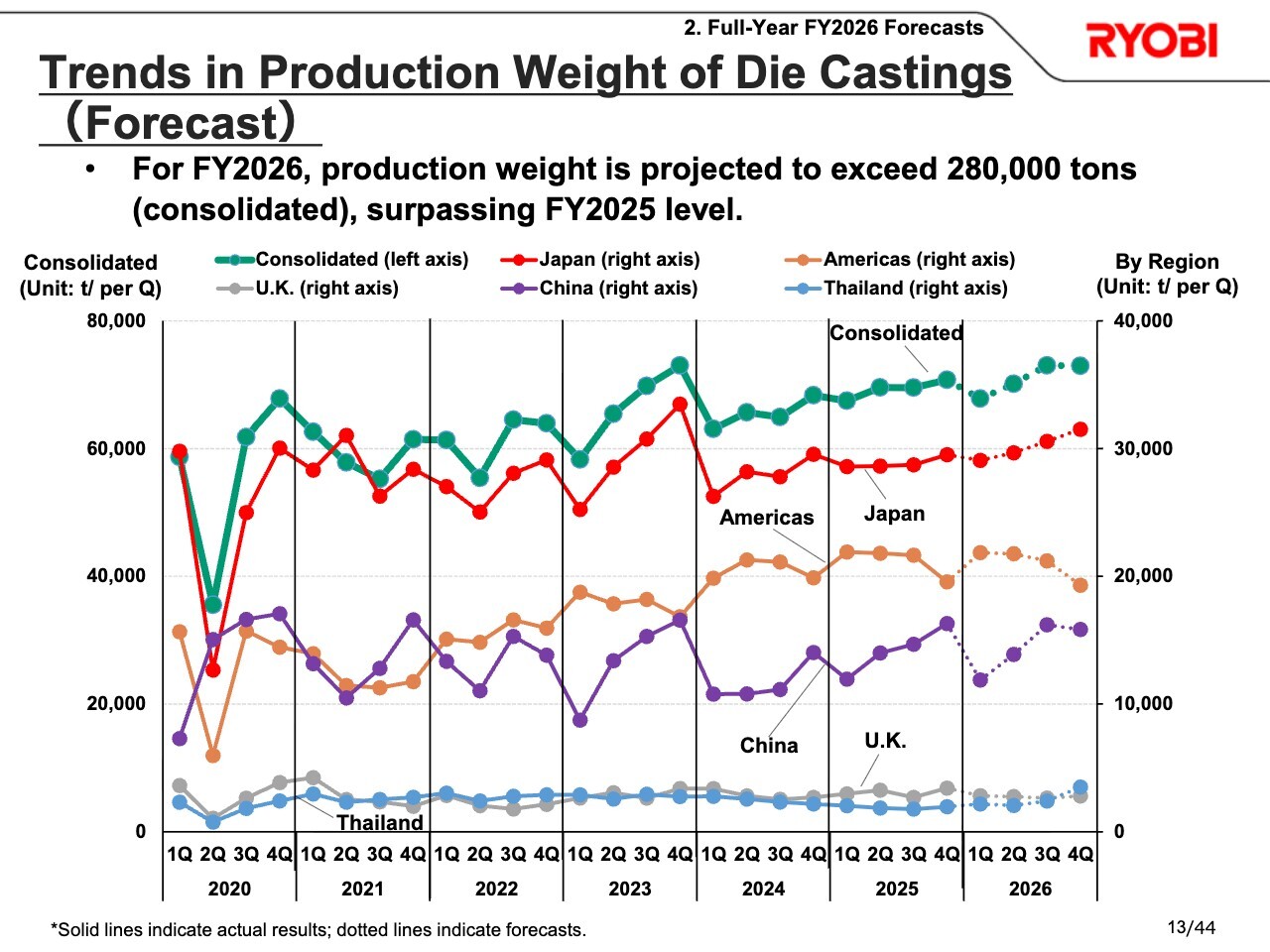
This chart shows the forecast for the production weight of die castings. For FY2026, production in Japan, shown in red, is expected to increase toward the second half of the year as mass production of newly awarded products begins in earnest.
Production weight in the Americas and China is expected to remain largely flat compared with the previous fiscal year. In the U.K., a slight decrease in production weight is expected. Thailand, shown in light blue, is expected to see an increase in production weight toward the second half of the year, partly due to the start of mass production of new products from FY2026.
Overall, for FY2026, production weight is projected to exceed 280,000 tons on a consolidated basis, surpassing the FY2025 level. This represents an increase of approximately 2% year on year.
Forecasts by Business Segment
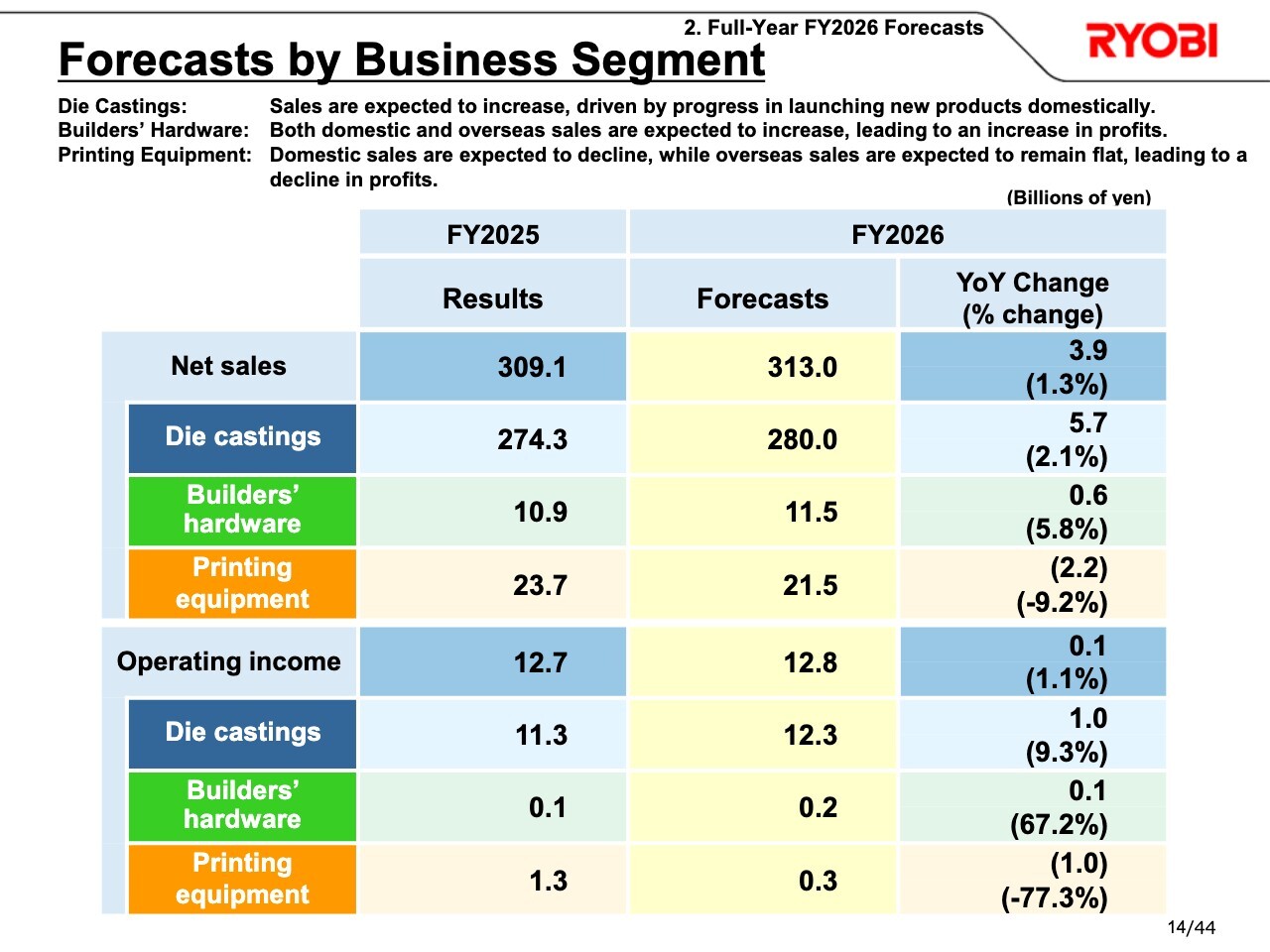
This section outlines the forecasts by business segment. In the Die Castings business, net sales are expected to be ¥280.0 billion, a YoY increase of ¥5.7 billion. Operating income is expected to be ¥12.3 billion, a YoY increase of ¥1.0 billion. Overall, both sales and profits are expected to increase.
In the Builders’ Hardware business, net sales are forecast at ¥11.5 billion, representing a YoY increase of ¥0.6 billion. Operating income is expected to be ¥0.2 billion, a YoY increase of ¥0.1 billion. Both domestic and overseas sales are expected to increase, leading to an increase in profits.
In contrast, in the Printing Equipment business, net sales are expected to be ¥21.5 billion, a YoY decrease of ¥2.2 billion. Operating income is also expected to decline to ¥0.3 billion, representing a YoY decrease of ¥1.0 billion. This decline is mainly attributable to lower domestic sales, resulting in declines in both sales and profits.
Analysis of Changes in Operating Income Forecast
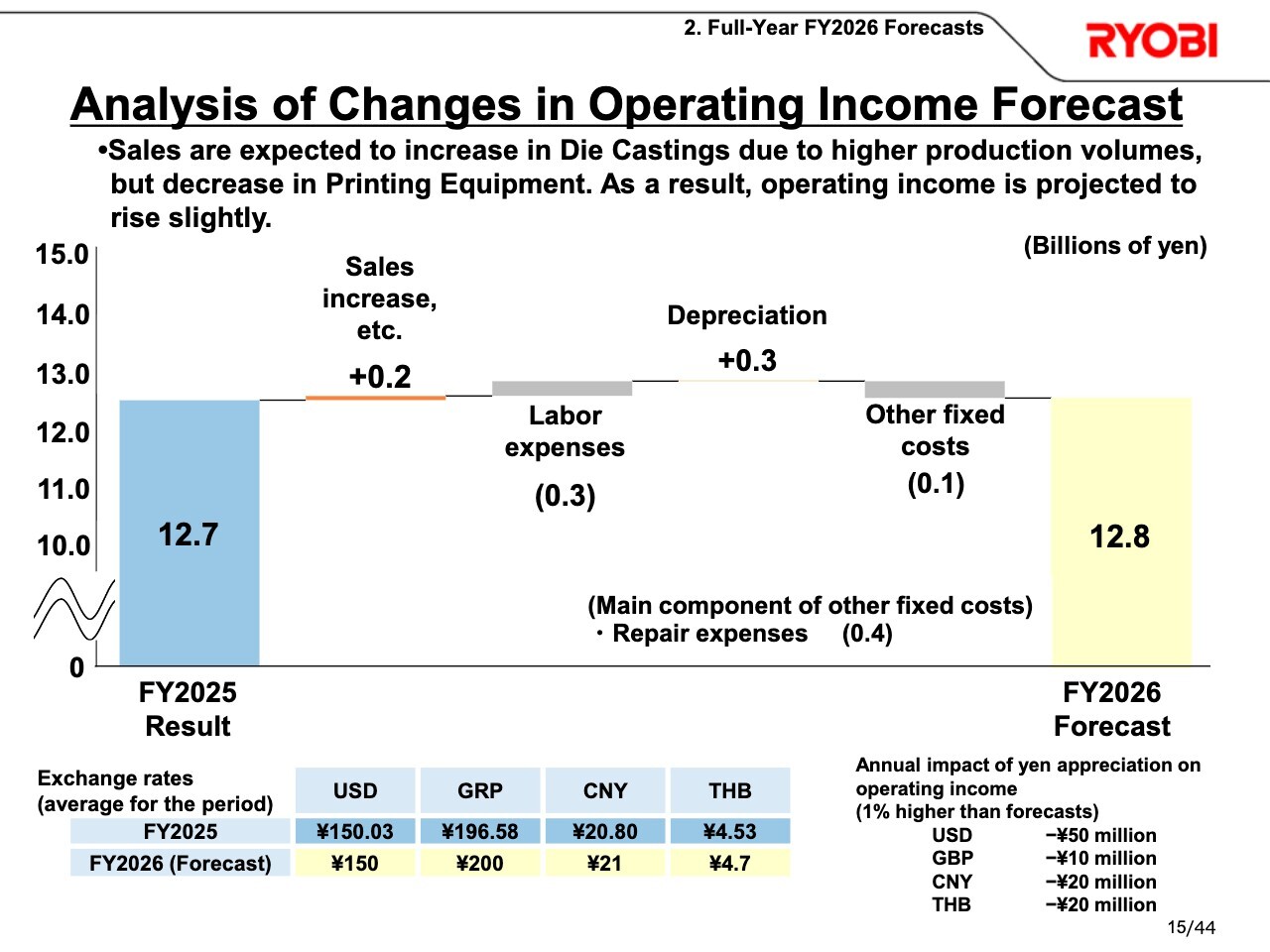
This slide shows the analysis of changes in the operating income forecast. Operating income is expected to increase from ¥12.7 billion in FY2025 to ¥12.8 billion in FY2026, representing an increase of ¥0.1 billion. Although labor expenses and other fixed costs are expected to increase, these increases are expected to be offset by lower depreciation expenses and higher sales, resulting in an increase in operating income of ¥0.1 billion, which we view as largely flat.
Trends in Capital Expenditures and Depreciation
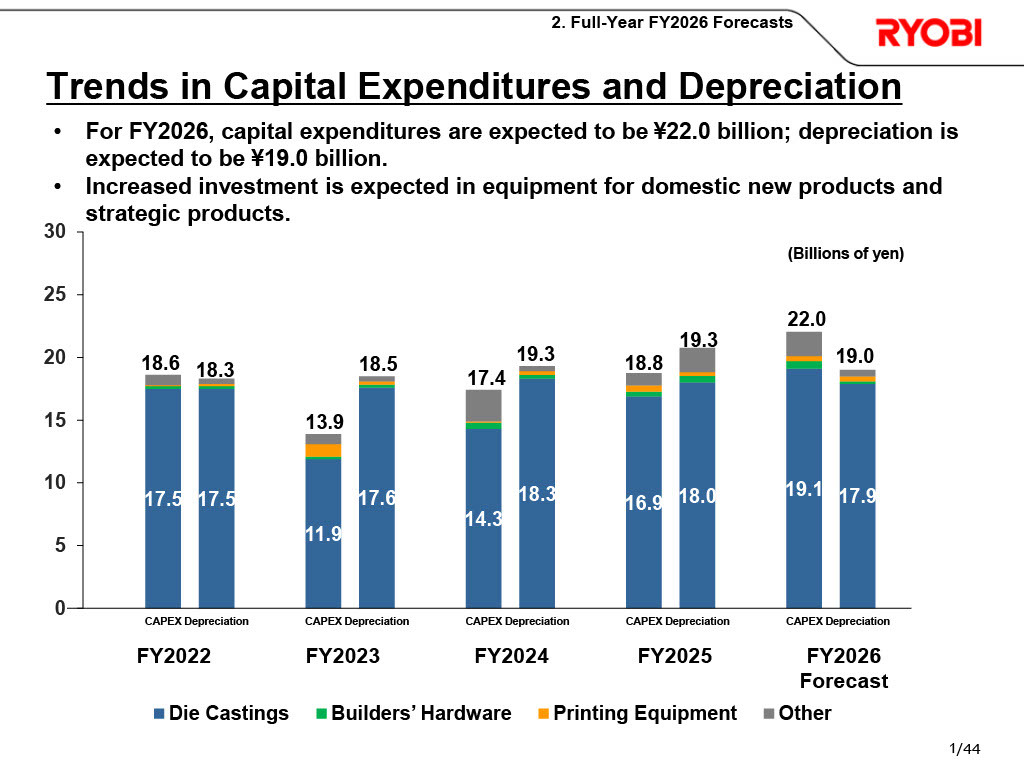
This slide shows the trends in capital expenditures and depreciation. For FY2026, capital expenditures are expected to be ¥22.0 billion, reflecting increased investment in equipment to support new products. Depreciation is expected to be ¥19.0 billion, remaining almost unchanged from the previous fiscal year.
Trends in Interest-Bearing Debt and D/E Ratio
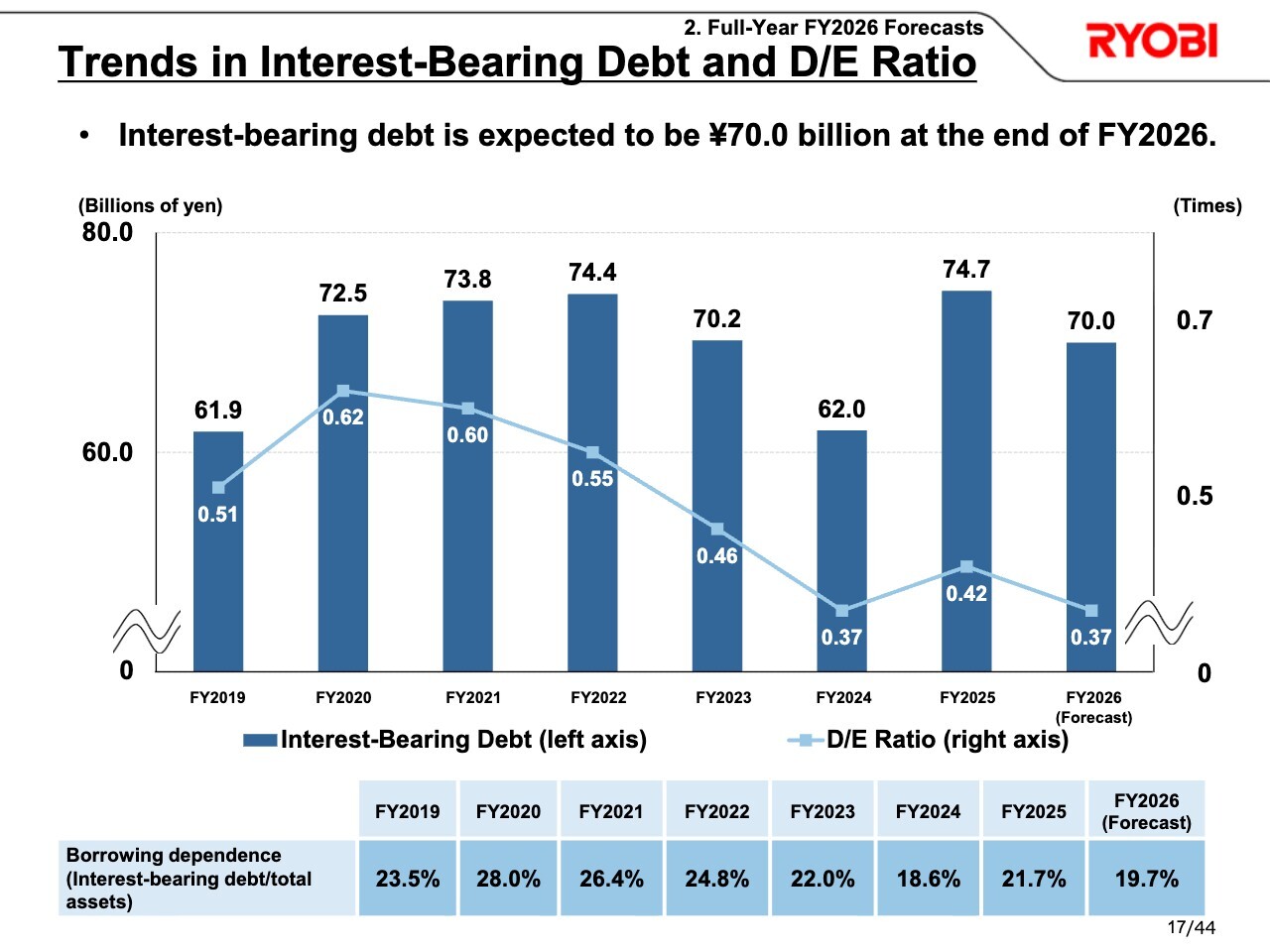
This slide shows the trends in interest-bearing debt and the D/E ratio. Interest-bearing debt at the end of FY2025 was ¥74.7 billion, an increase of ¥12.7 billion from ¥62.0 billion at the end of FY2024. This increase was mainly due to the impact of the ¥20.0 billion syndicated loan raised last September.
For FY2026, interest-bearing debt is expected to be ¥70.0 billion. We plan to continue strategic capital investments and shareholder returns while making effective use of interest-bearing debt.
Positioning of MTMP (2025–2027)
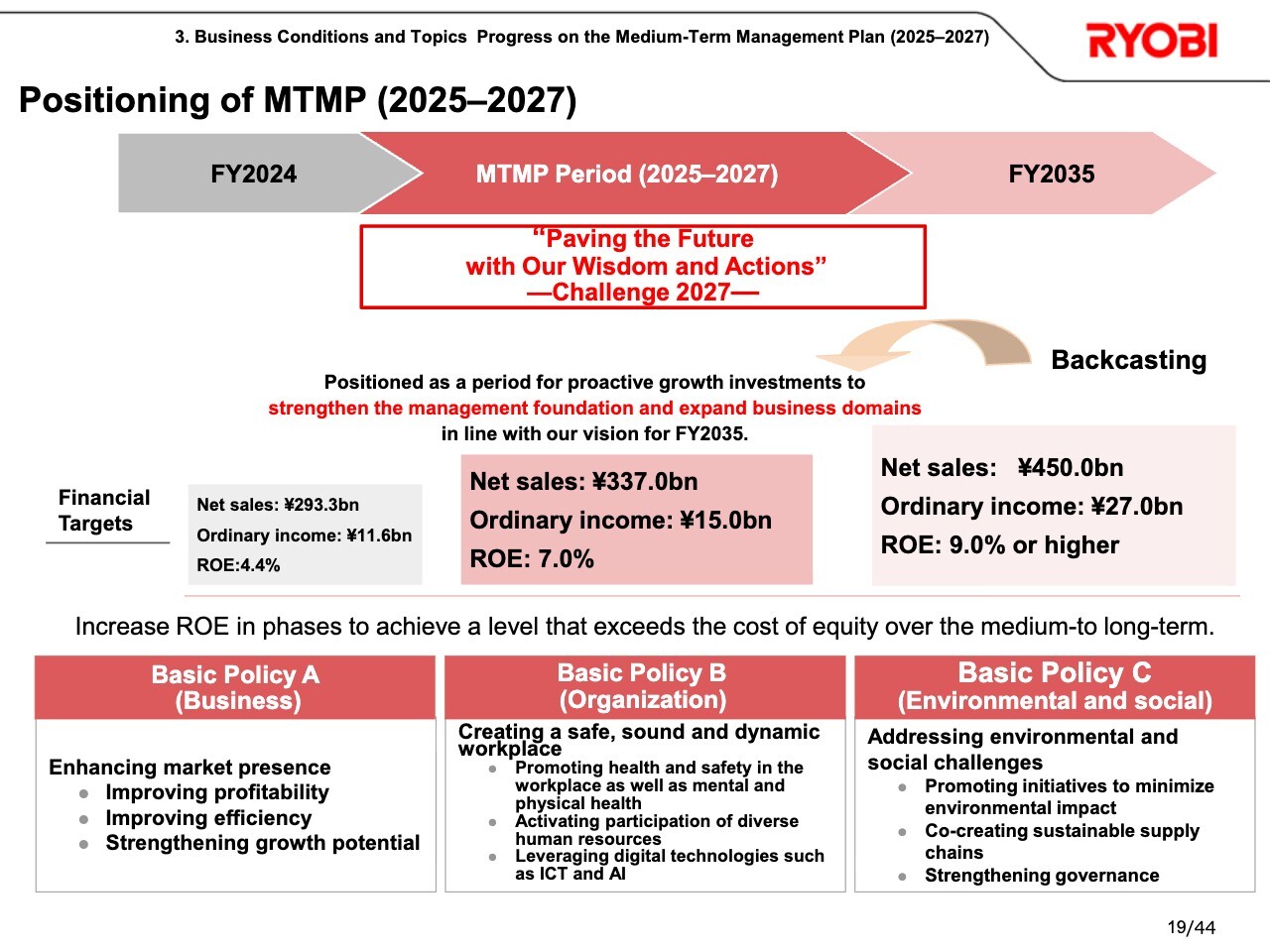
Urakami: Next, I will explain the business conditions, key topics, and our initiatives to enhance corporate value, focusing on the progress of the Medium-Term Management Plan. First, I would like to reaffirm the positioning of our Medium-Term Management Plan.
As our vision for FY2035, or our “ideal state,” we have defined the economic value we aim to deliver as net sales of ¥450.0 billion, ordinary income of ¥27.0 billion, and ROE of 9.0% or higher.
To realize this vision, we adopted a backcasting approach to identify the key initiatives to be undertaken over the three-year period starting in 2025, and formulated this Medium-Term Management Plan accordingly.
In the final year of the plan, FY2027, we are targeting net sales of ¥337.0 billion, ordinary income of ¥15.0 billion, and an ROE of 7.0%.
Medium-Term Management Plan (2025–2027): Basic Policies by Business Segment
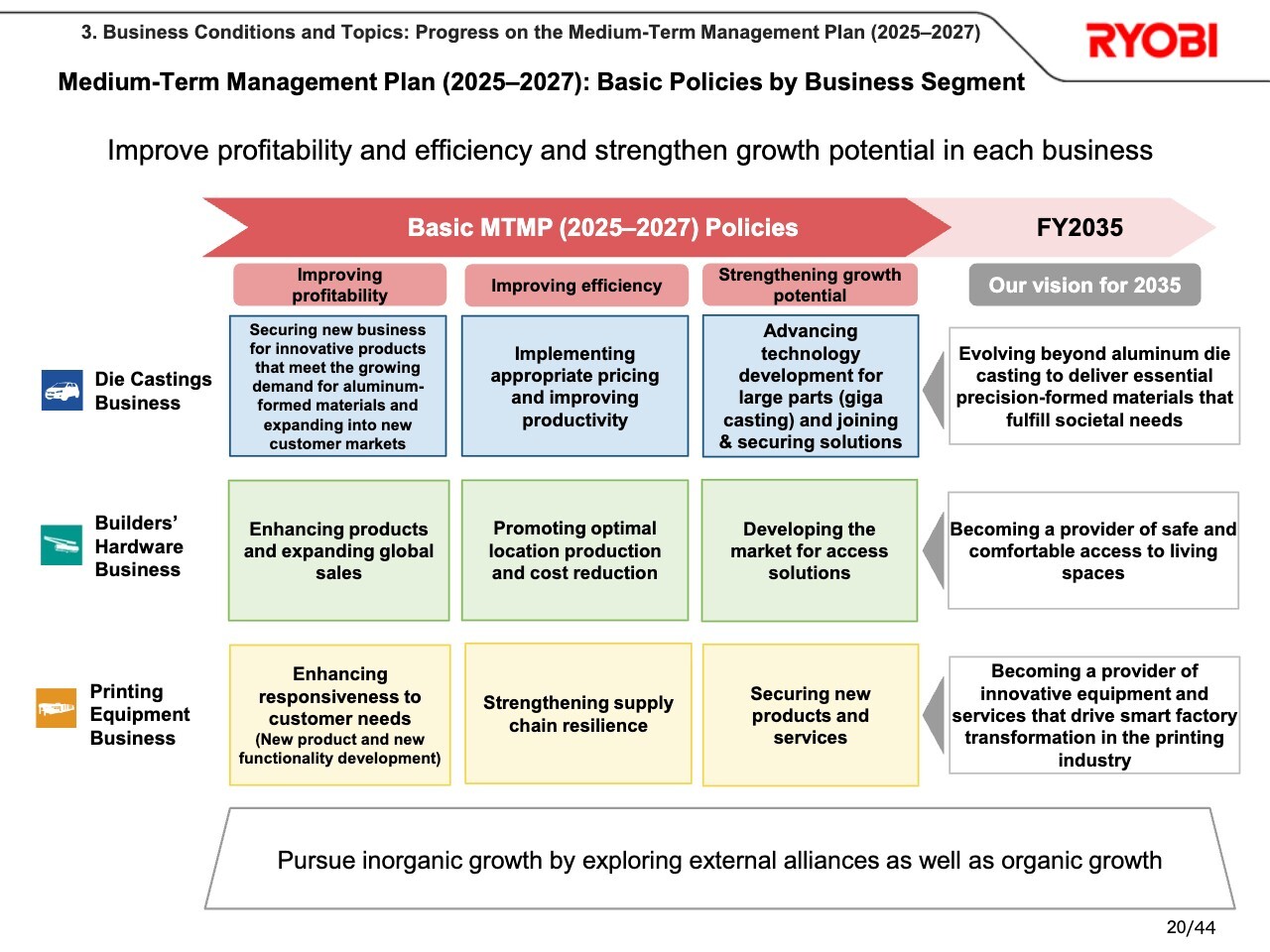
We have defined our vision for 2035 for each business segment and established “Improving profitability,” “Improving efficiency,” and “Strengthening growth potential” as the basic policies common to all businesses to realize this vision. Based on these common policies, we have also set out the key initiatives for each business segment, as shown on the slide.
Progress of the MTMP (Financial Targets)
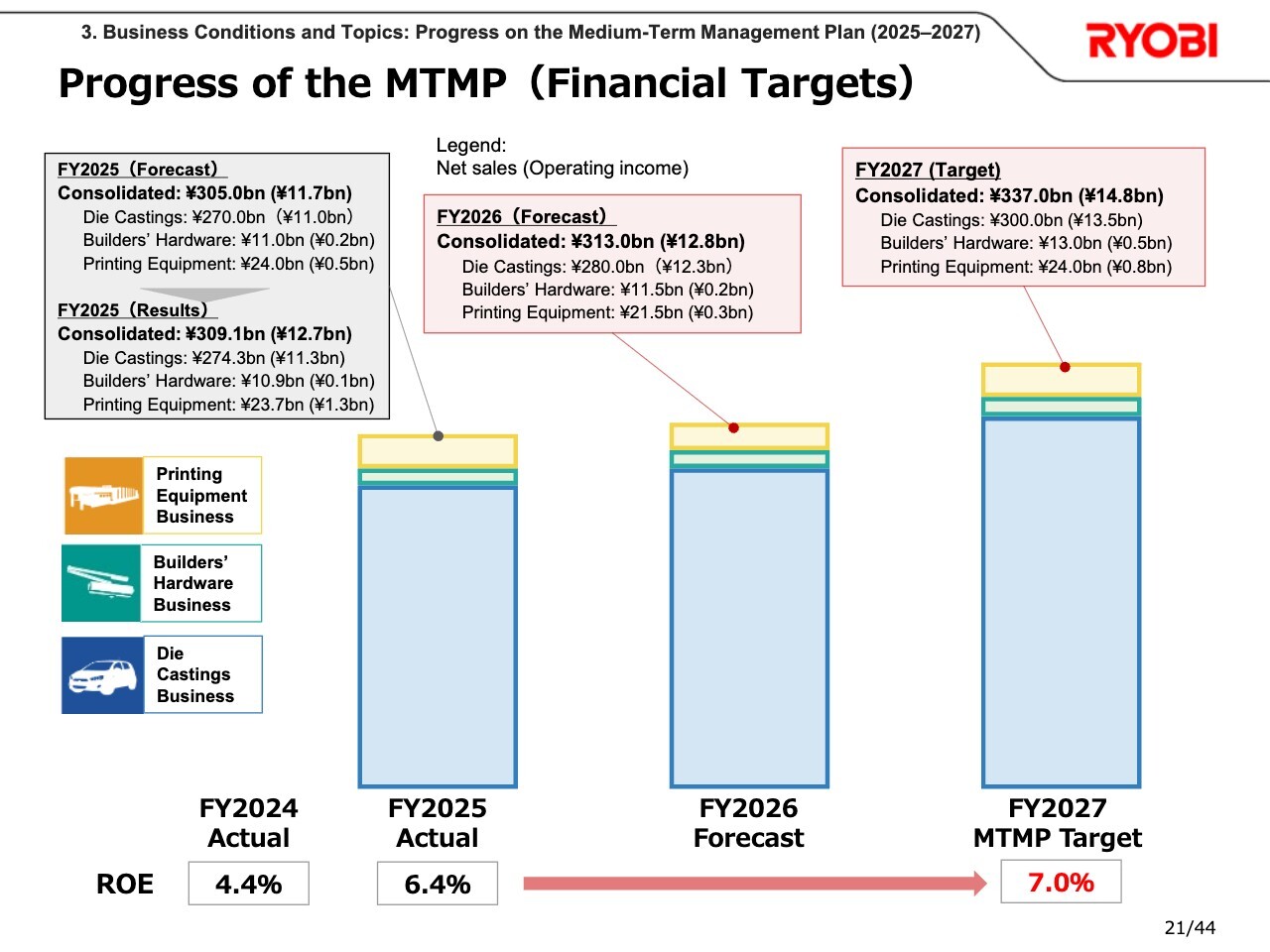
This slide shows the progress on our financial targets. In FY2025, the first year of the Medium-Term Management Plan, both consolidated net sales and consolidated operating income exceeded our initial targets. ROE improved by approximately 2 percentage points from the previous fiscal year, reaching 6.4%.
For FY2026, we aim to achieve consolidated net sales of ¥313.0 billion and operating income of ¥12.8 billion, and will work to deliver growth in both sales and profits.
Recognition of Current Business Environment
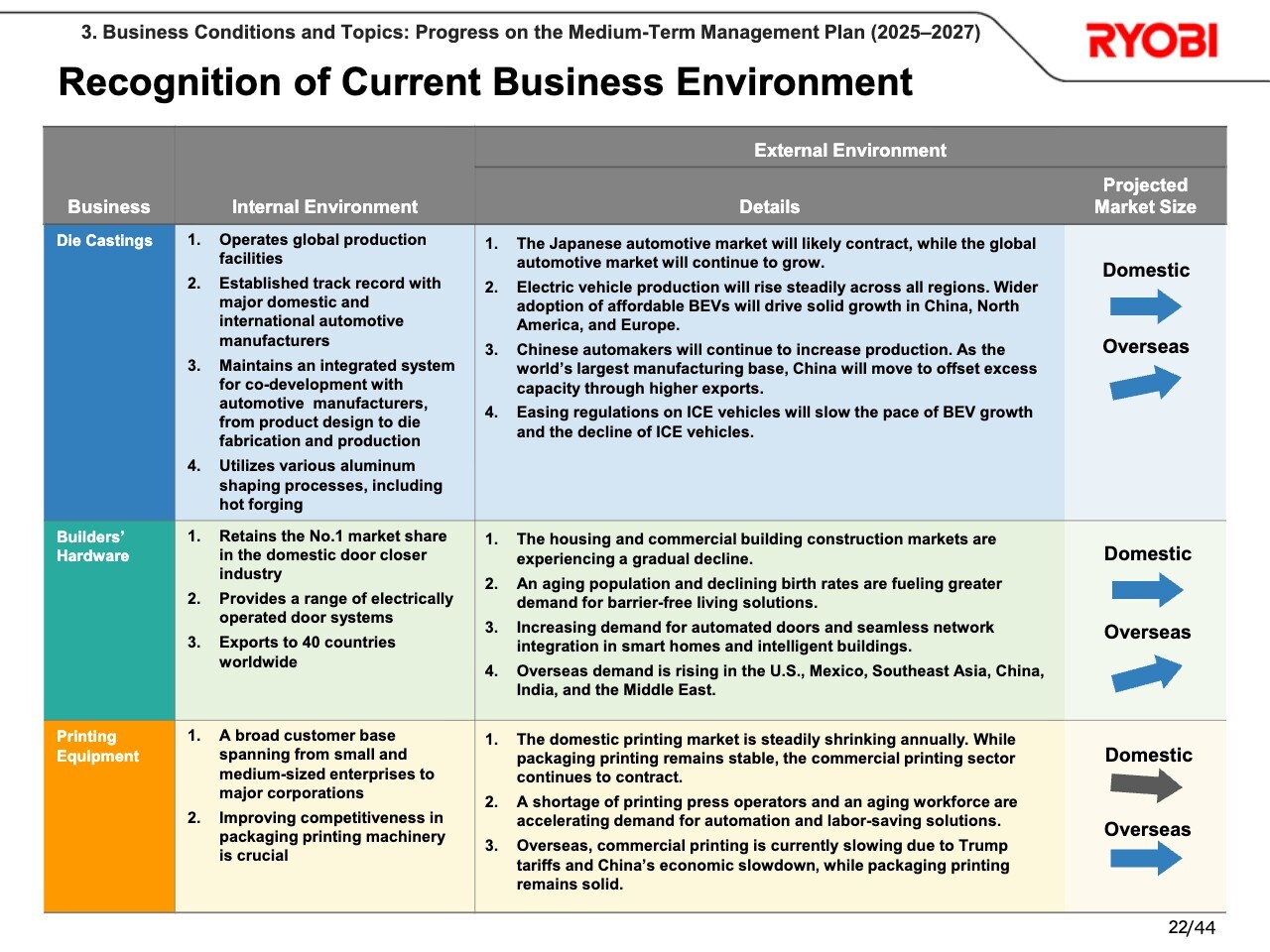
This slide outlines our recognition of the current business environment. Compared with the time of the Medium-Term Management Plan announcement one year ago, our outlook for overseas markets in the Die Castings business has been revised to be somewhat more conservative, reflecting the slowing pace of growth in electric vehicles (BEVs).
For the Builders’ Hardware business, we are maintaining the assumptions made one year ago. For the Printing Equipment business, business conditions are currently sluggish, reflecting the impact of U.S. tariffs and China’s economic slowdown.
(Reference) Initiatives to achieve weight reductions and electrification –External environment of the Die Castings business–
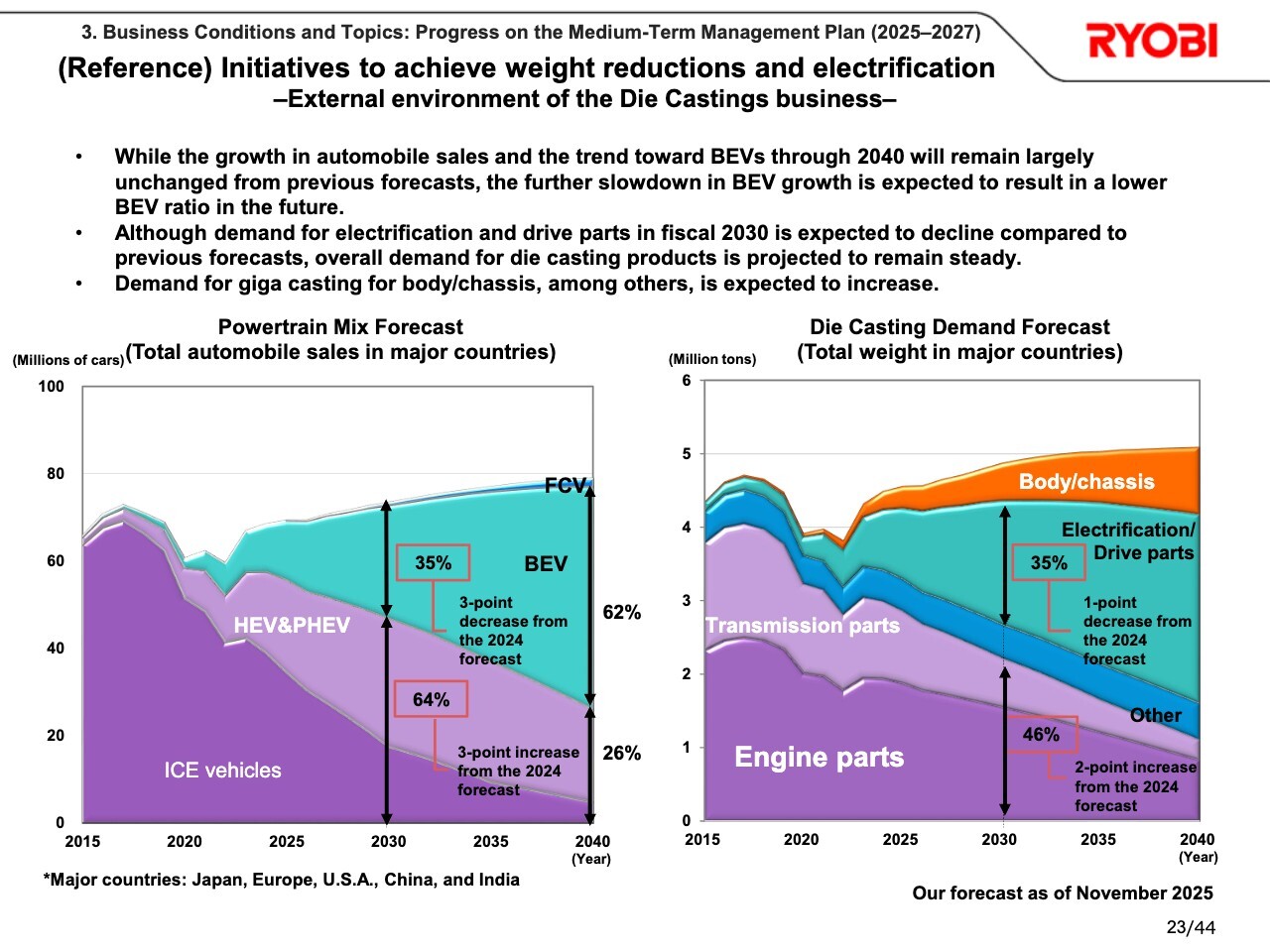
We believe that automobile sales in major countries will continue to grow through 2040.
While growth in automobile sales and the trend toward BEVs remain largely unchanged from our previous forecasts, reflecting the current slowdown in BEV growth, we have revised the BEV ratio for 2030 downward by 3 percentage points compared with our previous outlook six months ago.
Regarding the die casting demand forecast shown on the right side of the slide, the share of electrification and drive parts in 2030 has been revised downward by 1 percentage point from our previous forecast.
Although the shift toward BEVs is currently slowing, the shift toward hybrid vehicles is accelerating. As a result, we expect overall demand for die casting products to remain steady.
Aluminum die casting products are used not only in automotive powertrains. They are currently applied across four areas: engine parts, transmission parts, electrification and drive parts, and body and chassis components. Because hybrid vehicles utilize aluminum die castings across all of these areas, we believe that the expansion of the hybrid vehicle market will translate into expanded business opportunities for us.
(Reference) Initiatives to achieve weight reductions and electrification –Sales and share of strategic products–
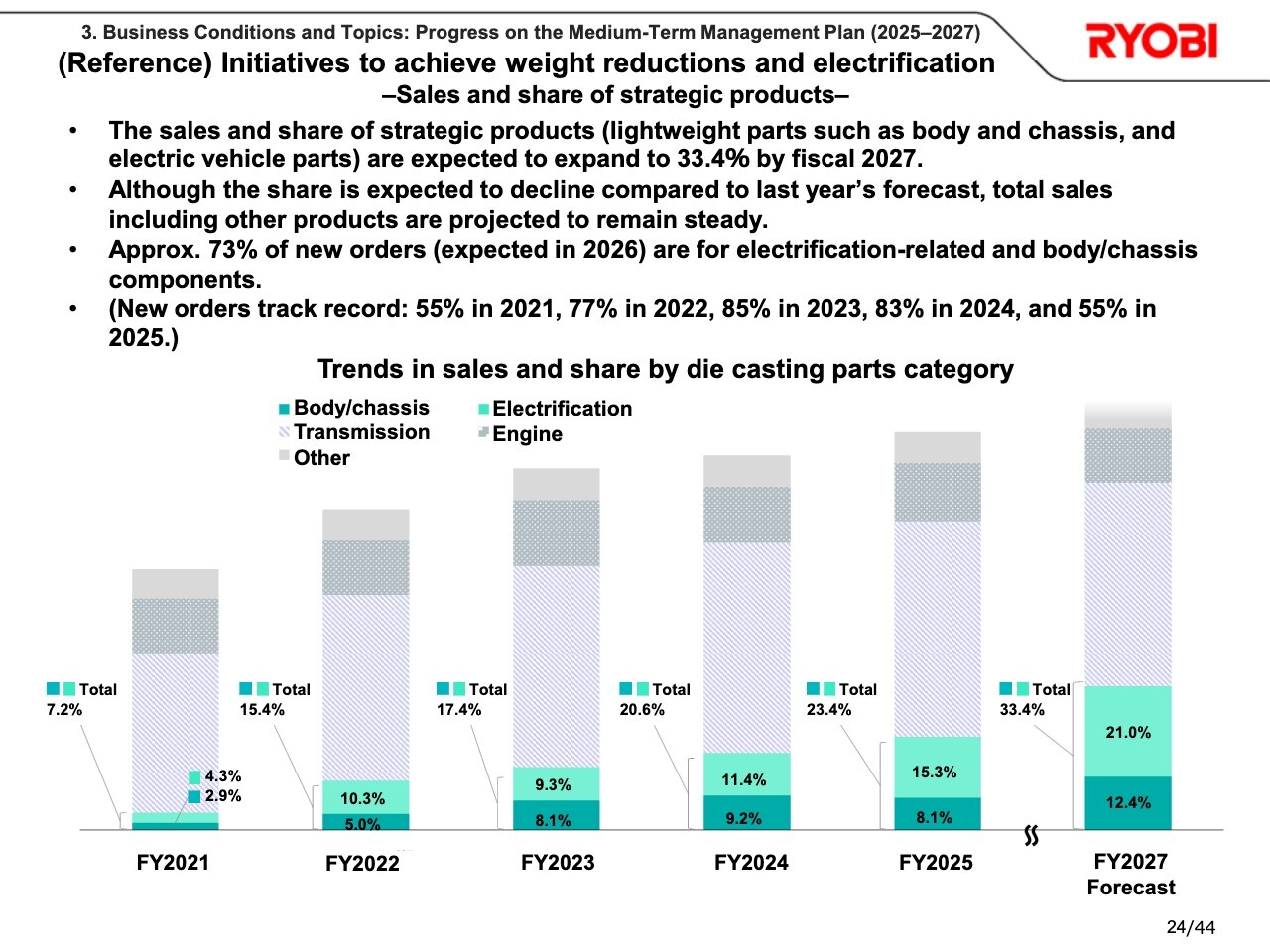
This slide shows the sales and share of lightweight parts and electrification-related parts, which we position as strategic products.
In FY2025, sales of strategic products accounted for 23.4% of total sales. Due to the slowdown in the shift toward BEVs in the U.S., this figure was 1.5 percentage points below our previous forecast; however, it represents a year-on-year increase of 2.8 percentage points.
With respect to new orders, strategic products accounted for 55% of total orders in 2025. New orders were also significantly affected by the slowdown in the shift toward BEVs in the U.S., resulting in a year-on-year decline of approximately 30 percentage points. However, we expect this ratio to recover to around 73% in 2026, driven by an increase in orders for hybrid-related case components.
Although the share of strategic products has declined compared with our previous forecast, total sales and orders, including other products, are both projected to remain in line with our forecasts, and overall demand for die casting products remains steady.
Die Castings: Key Topics in FY2025
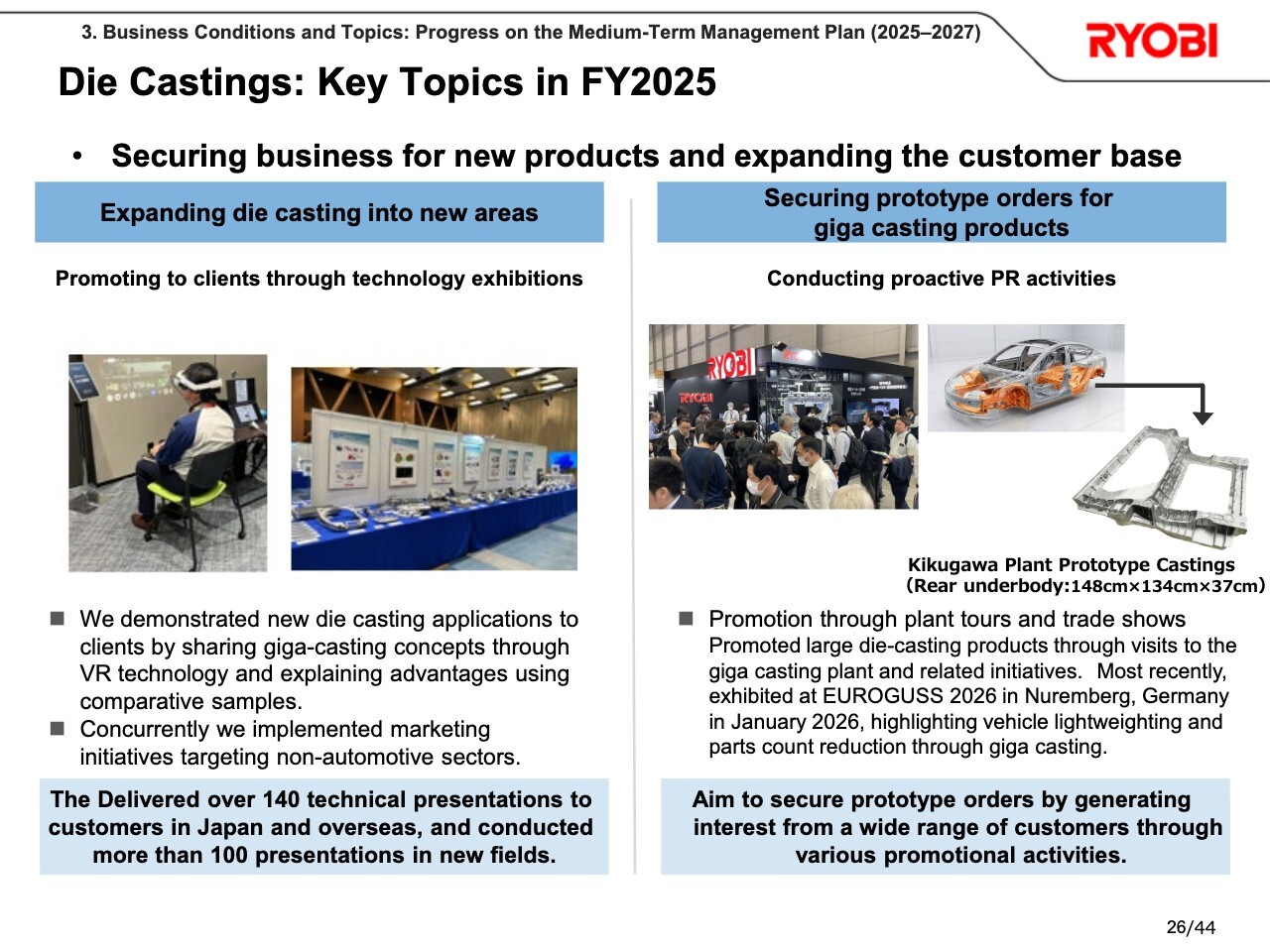
This slide shows concrete examples of our initiatives. In order to secure business for new products and expand our customer base, we conduct technology exhibitions for customers, including those in non-automotive sectors. By sharing visual concepts through VR technology and other tools, we promote new potential applications for die casting, as well as the comparative advantages of die casting products. During FY2025, we delivered more than 140 technical presentations to customers in Japan and overseas, and conducted over 100 presentations in new fields.
In addition, to support further growth in the automotive field, a large-scale prototype casting facility has been in operation at our Kikugawa Plant since March 2025. By offering plant tours, we promote large die-casting products, which has led to the securing of prototype orders.
We also exhibited at EUROGUSS 2026, held in January 2026 in Nuremberg, Germany, where we actively highlighted vehicle lightweighting and parts count reduction through giga casting.
Die Castings: Key Topics in FY2025
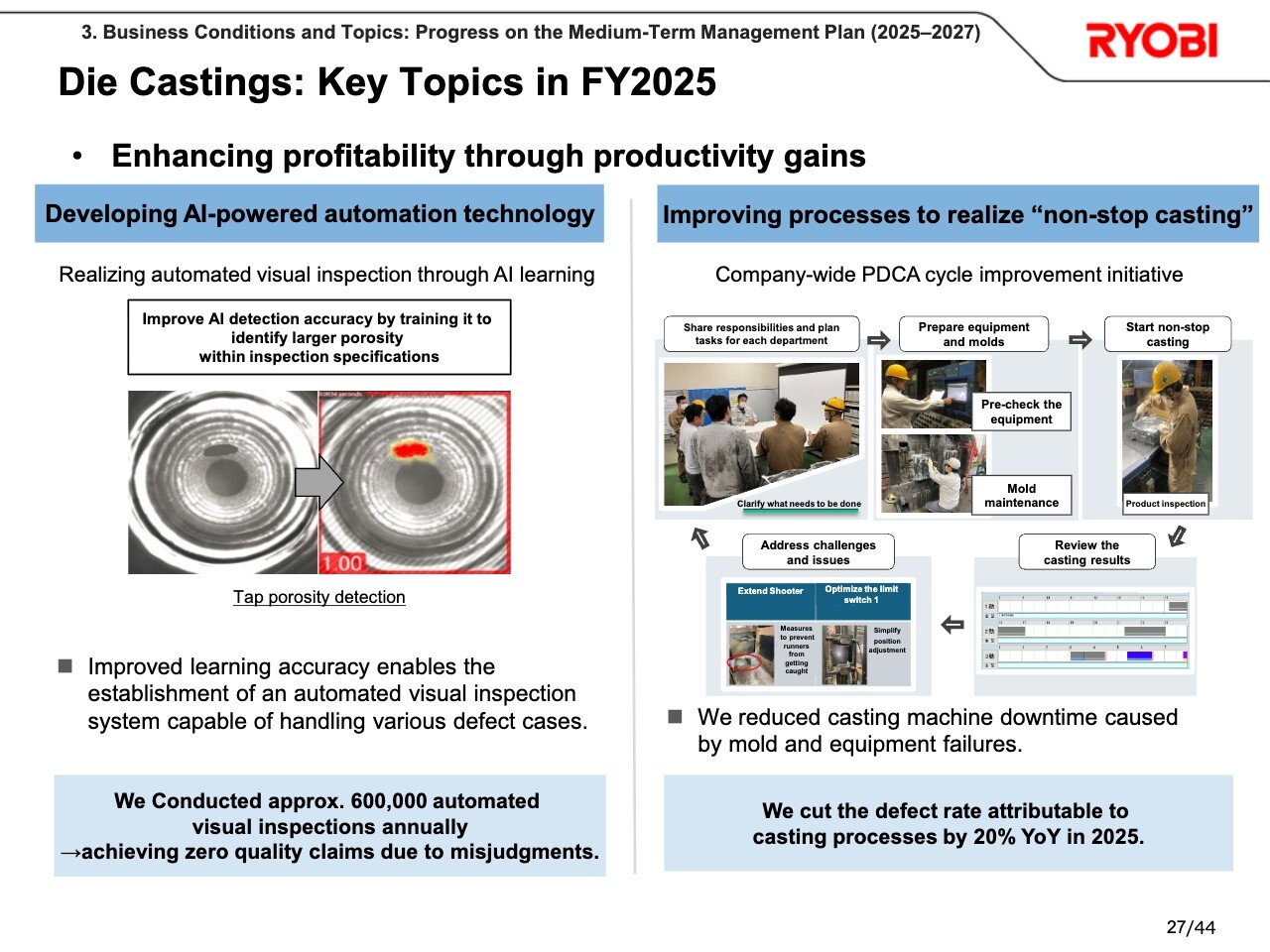
Regarding enhancing profitability through productivity gains, we are advancing AI-based automated visual inspection. As shown on the left side of the slide, by improving AI learning accuracy, we have established an automated visual inspection system capable of handling various defect cases. In FY2025, we conducted approximately 600,000 automated visual inspections annually, achieving zero quality claims due to misjudgments.
In addition, at our casting sites, we operate a company-wide PDCA cycle improvement initiative with the participation of all employees. Through process improvements aimed at realizing “non-stop casting,” we are working to reduce downtime caused by troubles during casting.
Die Castings: Key Initiatives in FY2026
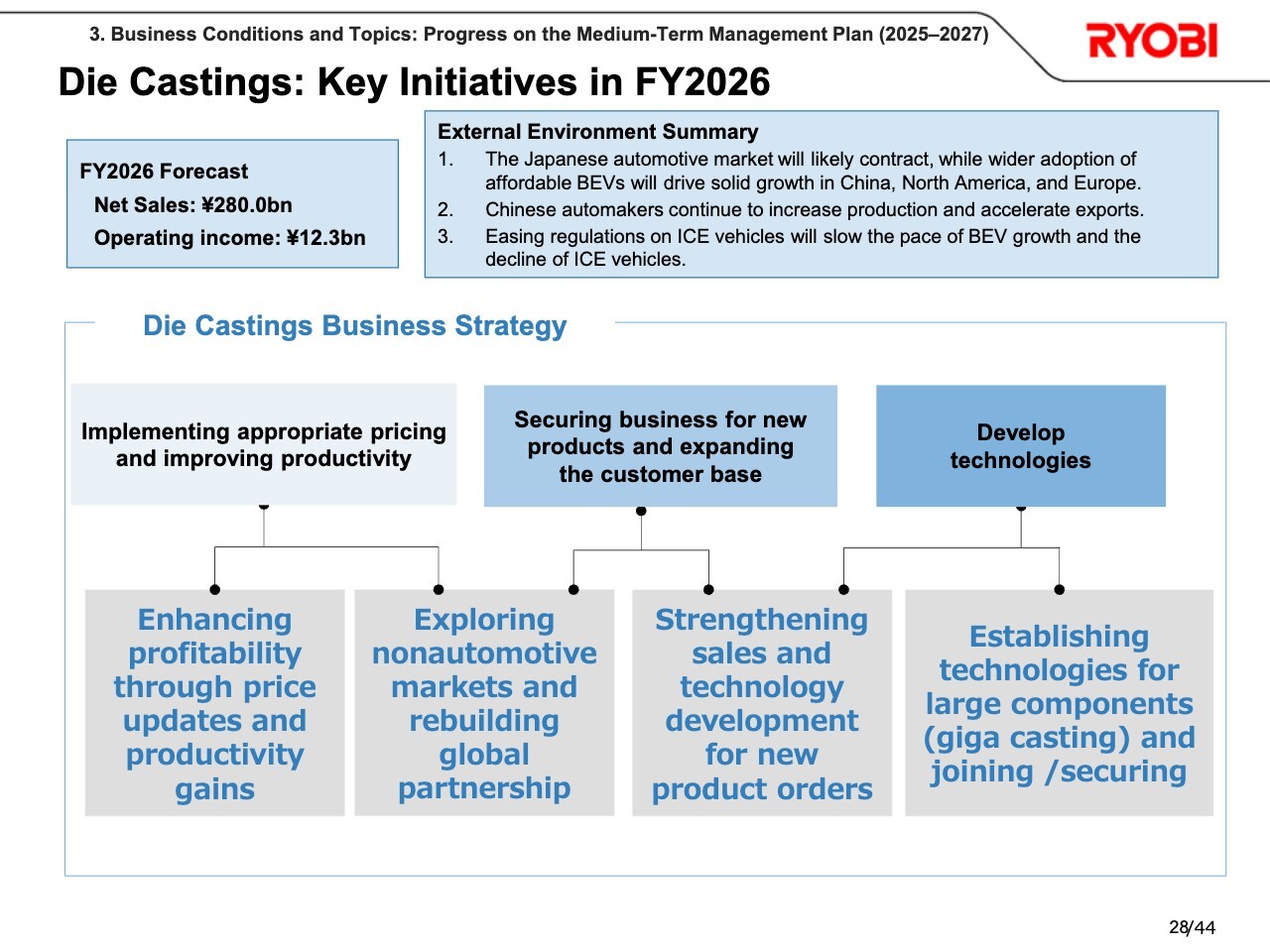
Regarding the key initiatives for FY2026, we will continue to focus on implementing appropriate pricing and improving productivity, securing business for new products and expanding our customer base, and developing technologies.
Die Castings: Key Initiatives in FY2026
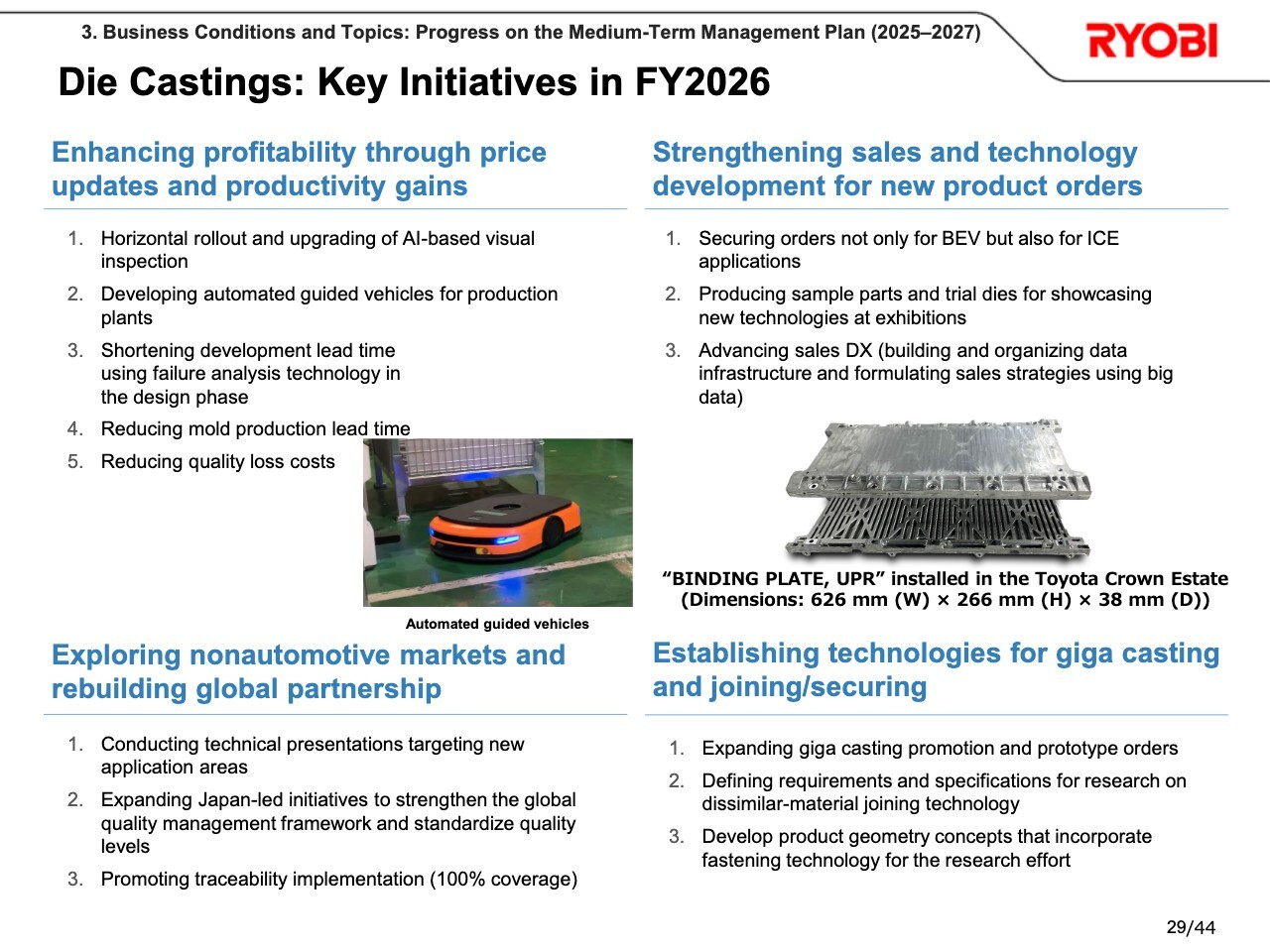
The initiatives shown here are continuations from FY2025. One specific example is productivity improvement through the use of automated guided vehicles, as shown on the slide. The photo on the right shows a strategic product for hybrid vehicles, and we are strengthening sales and technology development for new product orders targeting such products. We will continue these initiatives toward achieving the targets of the Medium-Term Management Plan.
Builders’ Hardware and Printing Equipment: Status of Initiatives in FY2025
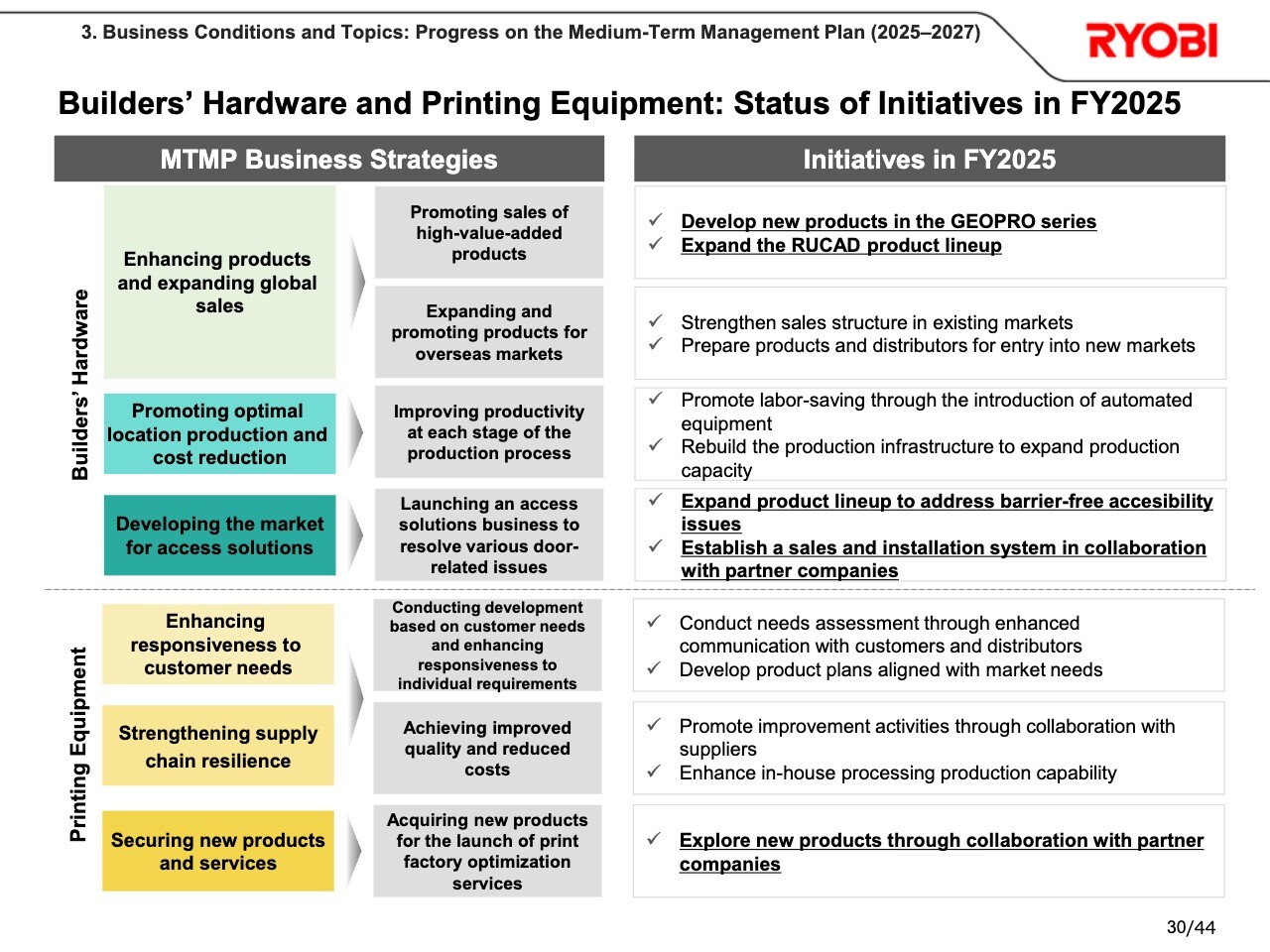
I will explain the status of initiatives in our Builders’ Hardware and Printing Equipment businesses.
In the Builders’ Hardware business, we are focusing on enhancing products, promoting optimal location production and cost reduction, and developing the market for access solutions. In the Printing Equipment business, our business strategies include enhancing responsiveness to customer needs, strengthening supply chain resilience, and securing new products and services, and the initiatives to address these strategies are shown on the right side of the slide.
Builders’ Hardware: FY2025 Major Topics
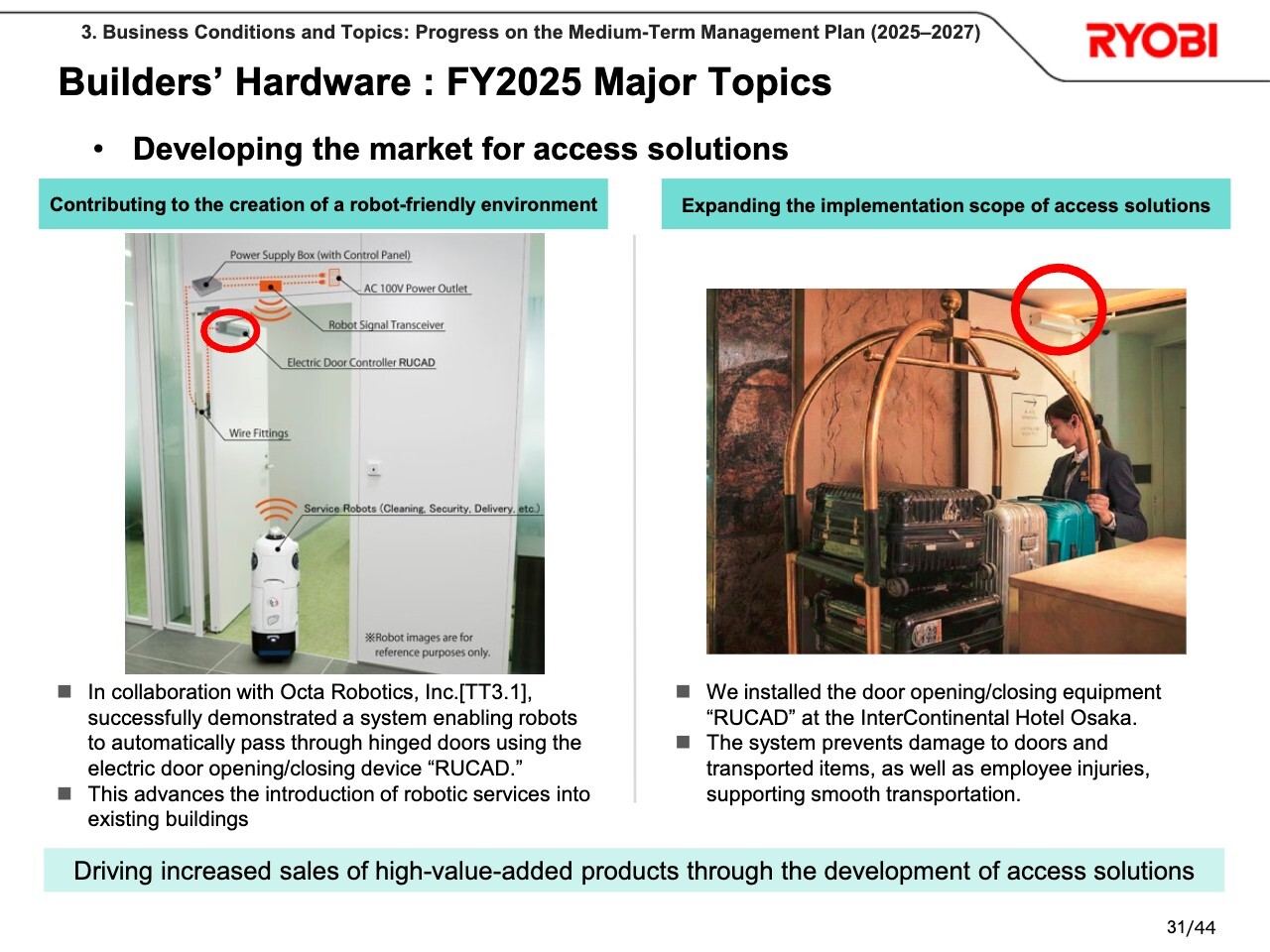
As a concrete example, in the Builders’ Hardware business, we are working to develop the access solutions market to drive increased sales of high-value-added products. As shown on the left side of the slide, to contribute to creating a robot-friendly environment, we successfully demonstrated a system in collaboration with Octa Robotics, Inc., enabling a robot to automatically pass through a hinged door using our RUCAD electric door opening/closing device.
In this way, by supporting the introduction of robotic services into existing buildings and structures, we are creating further opportunities for the use of our RUCAD electric door opening/closing device.
As shown on the right side of the slide, in July 2025, RUCAD was installed at the guest service counter entrance of the InterContinental Hotel Osaka. This solution has been highly praised, as it enables smooth transportation of heavy wagons while helping prevent injuries.
Printing Equipment: FY2025 Major Topics
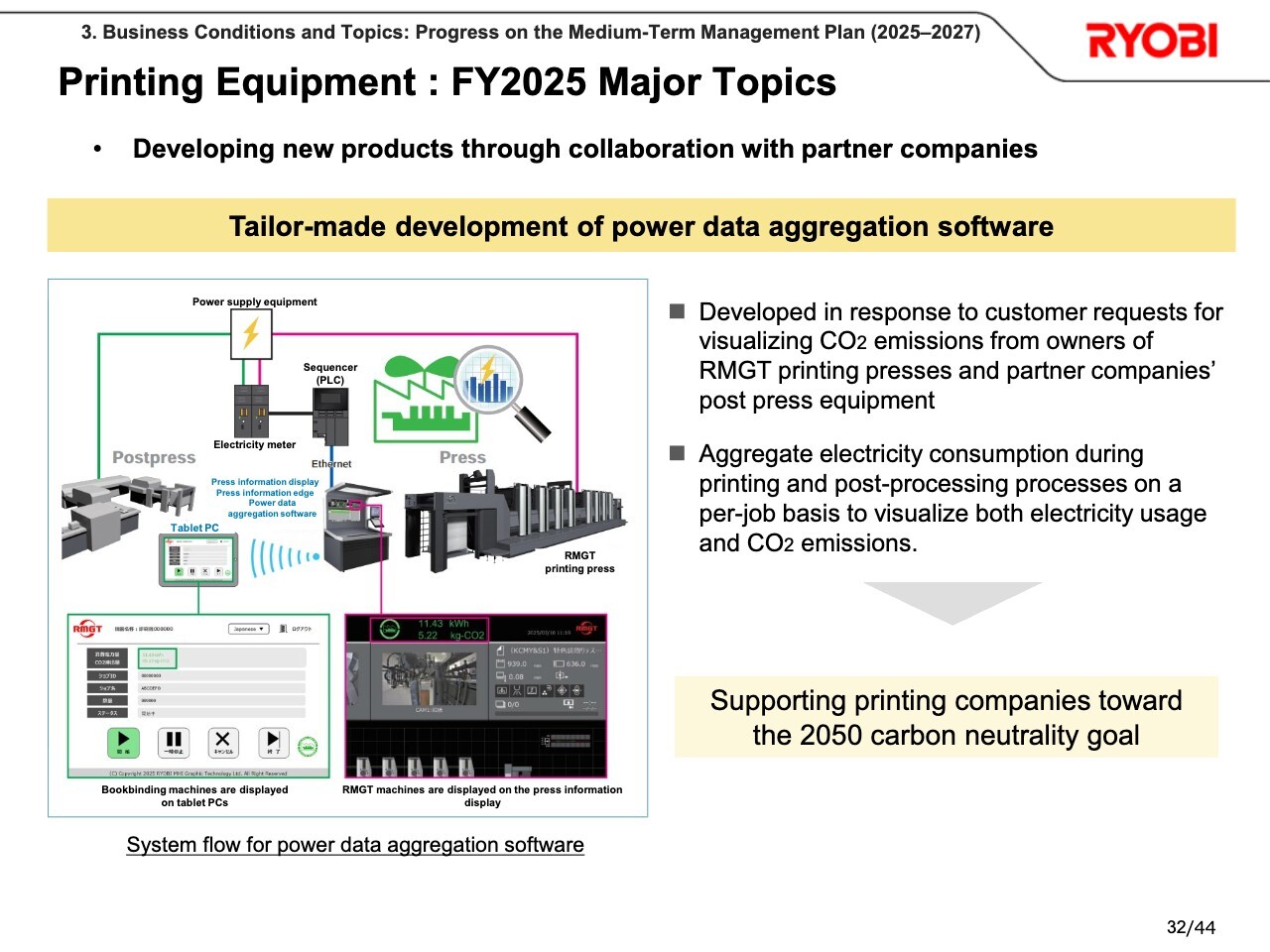
In the Printing Equipment business, we are collaborating with partner companies to develop new products.
In response to requests from users of our printing equipment to visualize CO2 emissions, we have developed tailor-made power data aggregation software that enables visualization of electricity consumption and CO2 emissions by process. We believe that supporting printing companies in their efforts toward the 2050 carbon neutrality goal will contribute to acquiring and providing new products and services, in line with our business strategy.
Builders’ Hardware: Key Initiatives in FY2026
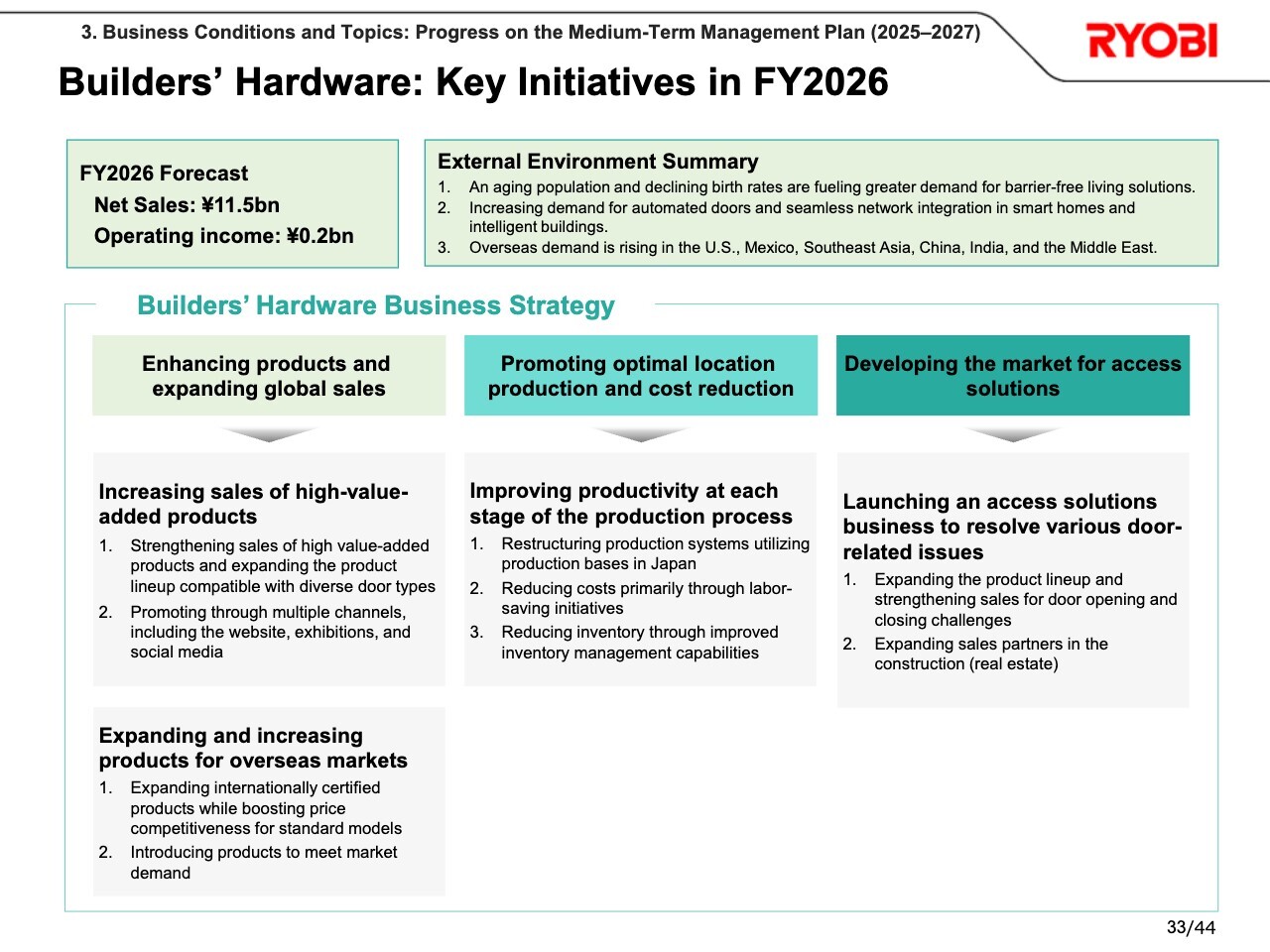
These are the key initiatives for the Builders’ Hardware business in FY2026. Continuing from 2025, we will advance the three business strategies and promote the specific initiatives presented on the slide. In particular, we have positioned cost reduction and the expansion of overseas markets as our two main themes. We will also focus on expanding the product lineup and applications of the RUCAD electric door opening/closing device.
Printing Equipment: Key Initiatives in FY2026
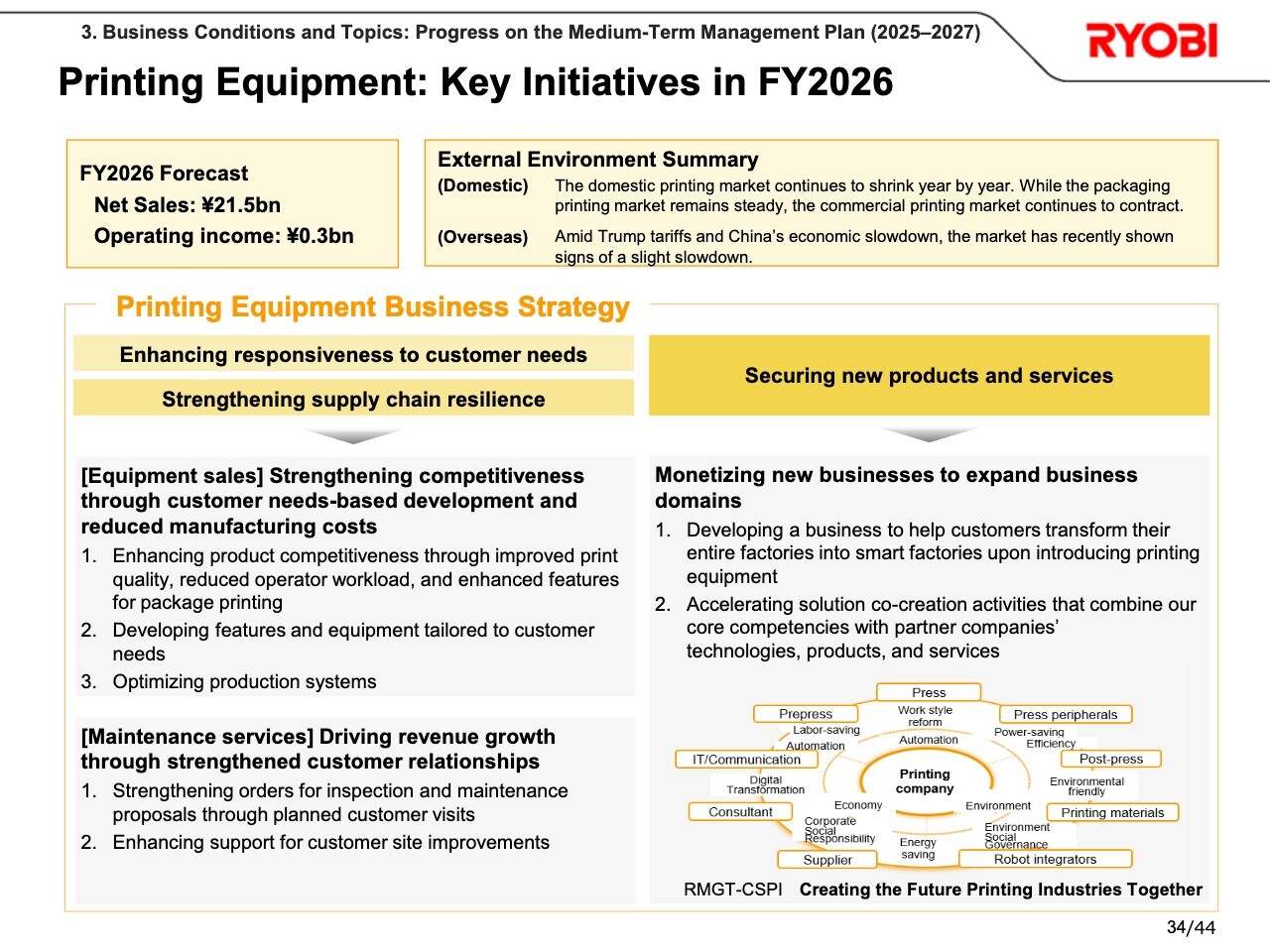
In the Printing Equipment business as well, we will continue to work on concrete initiatives based on the three business strategies, as we did in FY2025.
In particular, customer needs-based product development and the reduction of manufacturing costs will remain our top priorities in the Printing Equipment business.
Medium-Term Policy for Enhancing Corporate Value
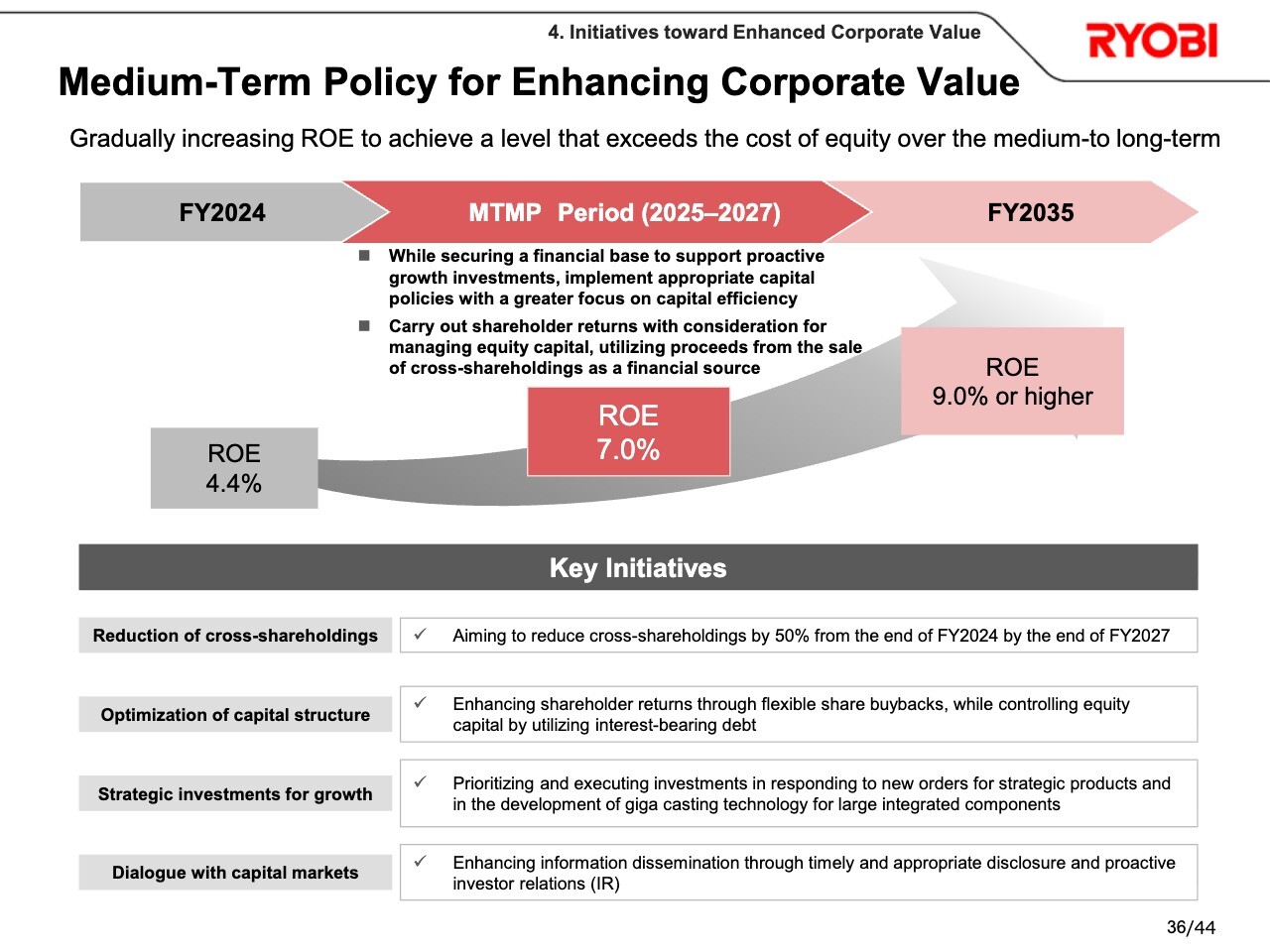
I will now explain our initiatives to enhance corporate value.
As part of our policy to enhance corporate value, we aim to gradually increase ROE and achieve a level that exceeds the cost of equity over the medium to long term. In terms of progress, ROE was 4.4% in FY2024 and improved by 2.0 percentage points to 6.4% in FY2025 compared with the previous year, driven by a significant increase in net income.
In FY2027, the final year of the Medium-Term Management Plan, we aim to achieve an ROE of over 7%. Looking further ahead, by FY2035, we are targeting an ROE of 9% or higher. We will continue to advance the four key initiatives shown on the slide to achieve these targets.
Status of Strategic Investments
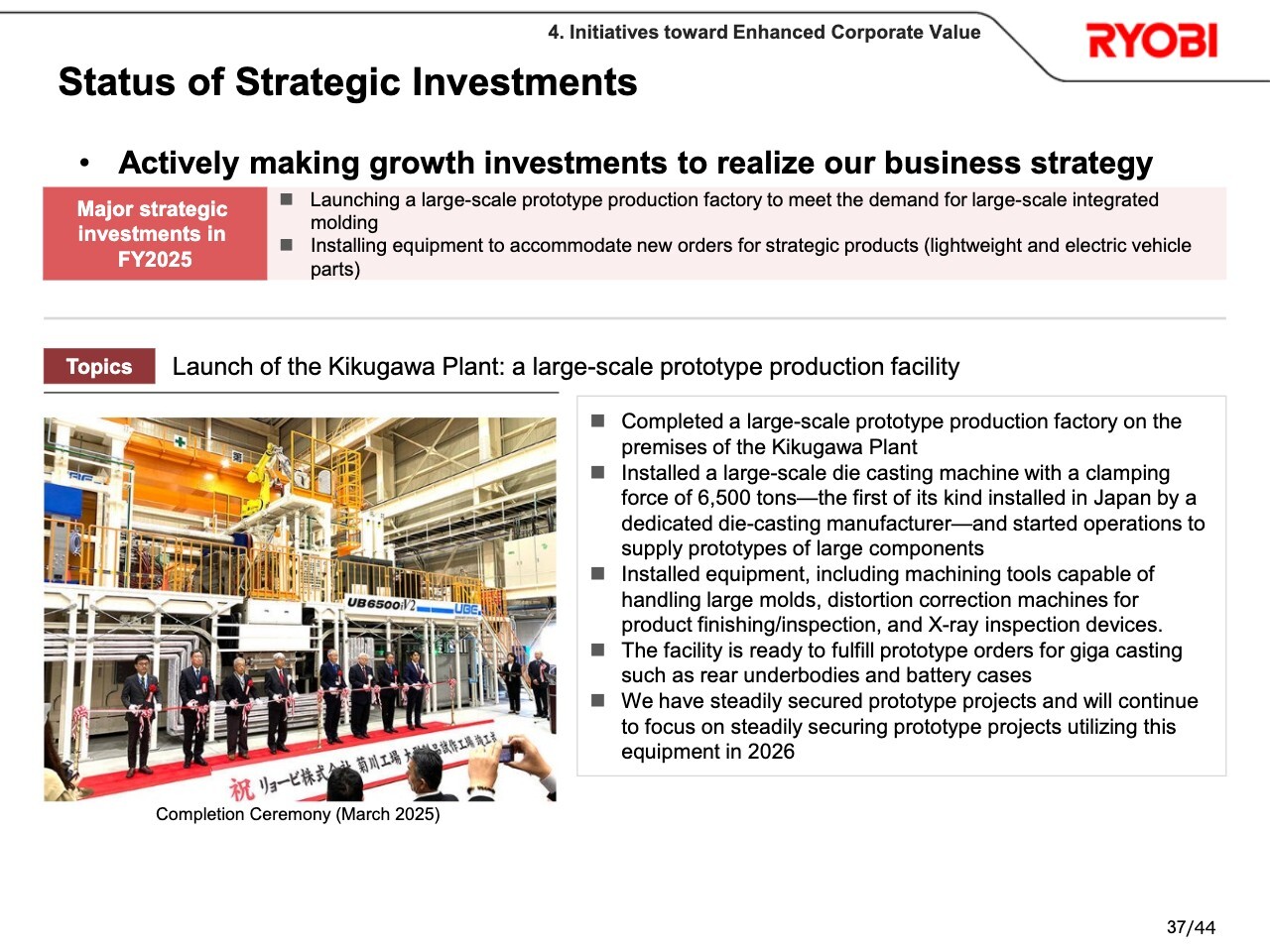
Here is the status of our strategic investments. A large-scale prototype production facility was constructed on the premises of the Kikugawa Plant to meet the demand for large-scale integrated molding, and it has commenced operations. This strategic investment has led to the securing of prototype orders. In addition, we have made capital investments to accommodate new orders for strategic products. In the current fiscal year, we will continue to make strategic investments to steadily expand orders.
Status of Reduction of Cross-Shareholdings
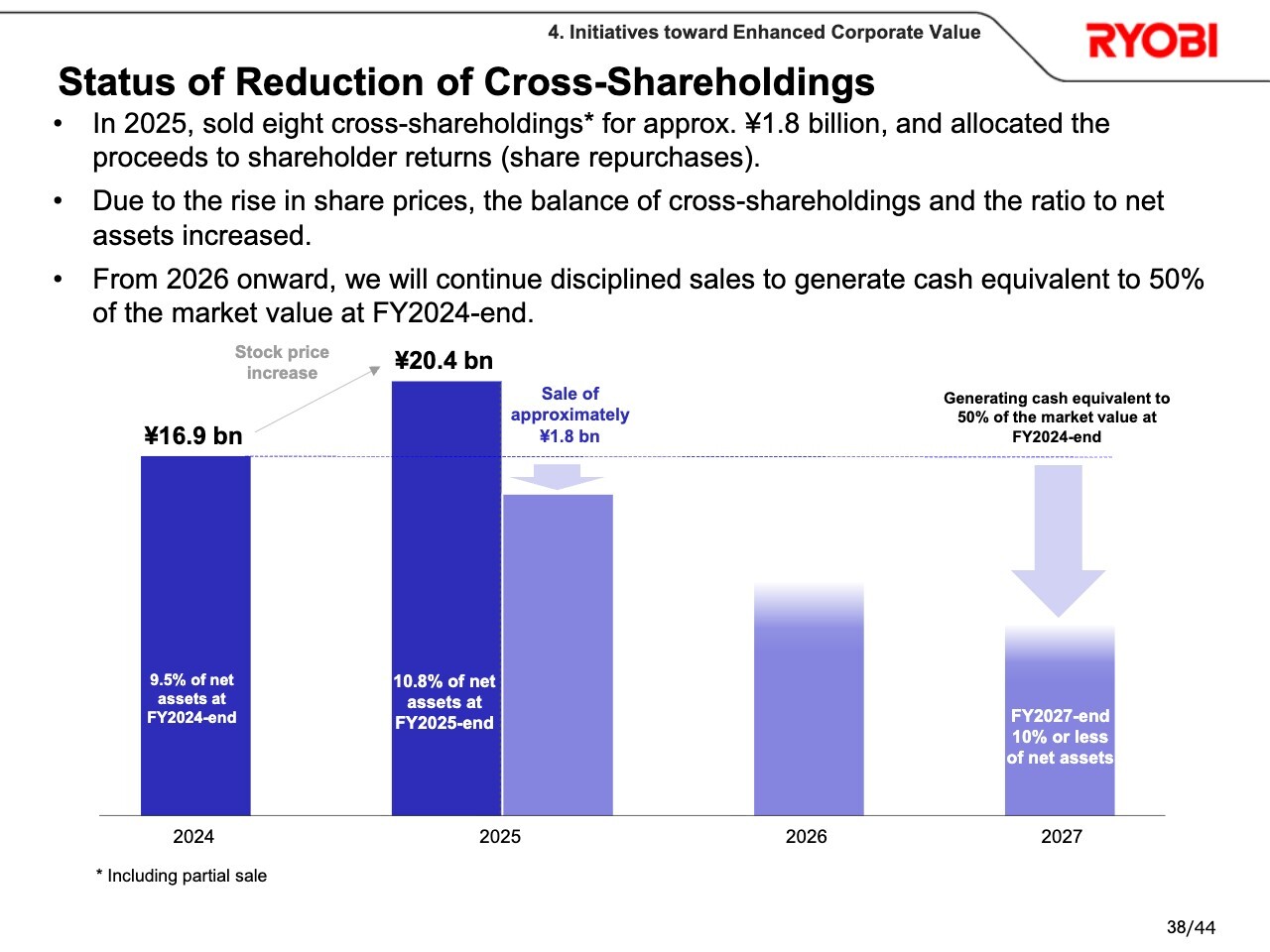
This is the status of the reduction of policy shareholdings. In 2025, we sold approximately ¥1.8 billion across eight issues, mainly in financial institutions. The proceeds from these sales were allocated to share repurchases as part of our shareholder return program. On the other hand, due in part to the recent rise in stock prices, the balance of policy shareholdings increased to ¥20.4 billion. From 2026 onward, we will continue disciplined sales of policy shareholdings.
We plan to generate approximately ¥9.0 billion in cash, equivalent to 50% of the market value at FY2024-end, which will be used for strategic investments to enhance corporate value and for shareholder returns, ensuring effective utilization of our assets.
Shareholder Returns (Share Buybacks and Dividend Policy)
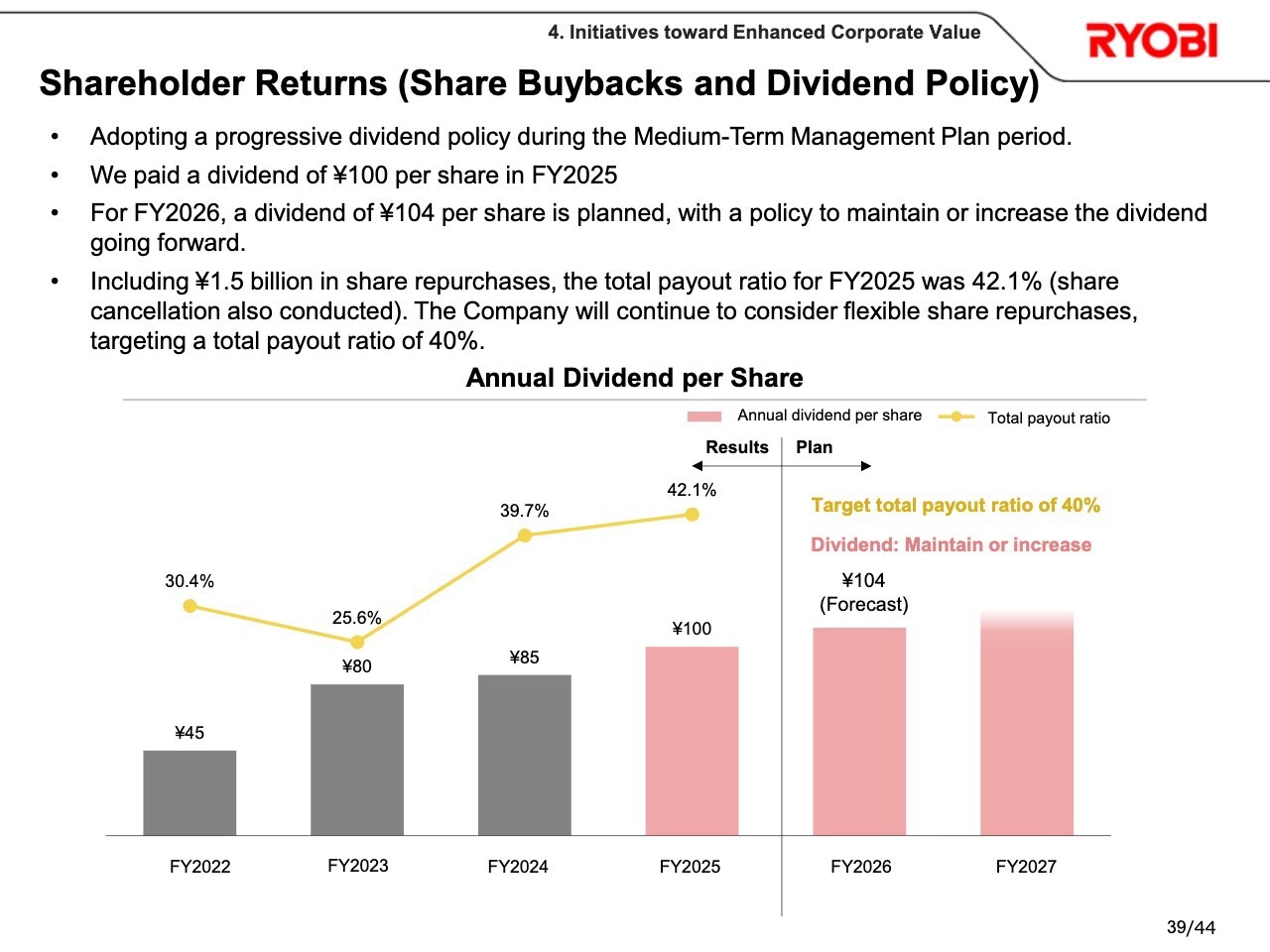
Let me now turn to shareholder returns. The Company has revised its existing shareholder return policy and adopted a progressive dividend policy during the period of the Medium-Term Management Plan, targeting a total payout ratio of 40%. In FY2025, the first year of the plan, we paid a dividend of ¥100 per share, up ¥15 from the previous year. For the current fiscal year, FY2026, we plan to increase the annual dividend per share by ¥4 to ¥104.
In addition, in FY2025, the Company conducted ¥1.5 billion in share repurchases, resulting in a total payout ratio of 42.1%. We will continue to consider flexible share repurchases to manage shareholders’ equity and enhance shareholder returns.
Cash Allocation Status
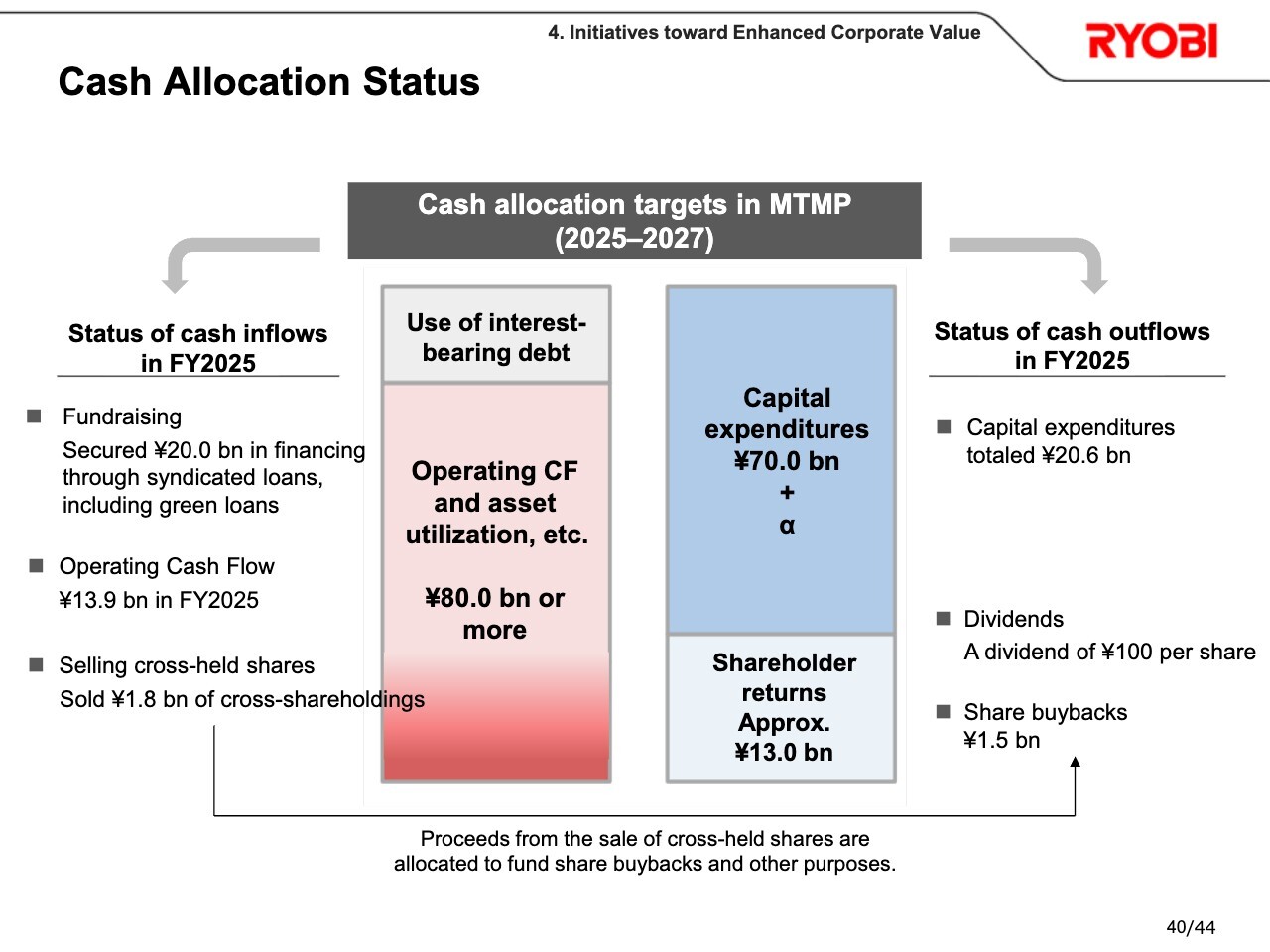
This slide shows the status of cash allocation. Regarding cash inflows, in line with our policy of effectively utilizing interest-bearing debt, the Company executed ¥20.0 billion in long-term borrowings in September 2025. Operating cash flow amounted to ¥13.9 billion, and the Company also sold ¥1.8 billion of cross-shareholdings to enhance asset efficiency.
Although net income and depreciation for FY2025 totaled ¥35.1 billion, operating cash flow was constrained by a ¥12.4 billion decrease in accounts payable, mainly due to accelerated payments to certain suppliers as part of trade optimization initiatives. We will continue to strengthen our earning capacity and improve working capital to maximize operating cash flow.
Regarding cash outflows, the Company made capital expenditures, mainly for technology development investments in large components, and carried out shareholder returns through dividends and share buybacks. Going forward, we will continue to prioritize the allocation of funds for growth investments while strengthening shareholder returns.
Strengthening Dialogue with the Capital Markets
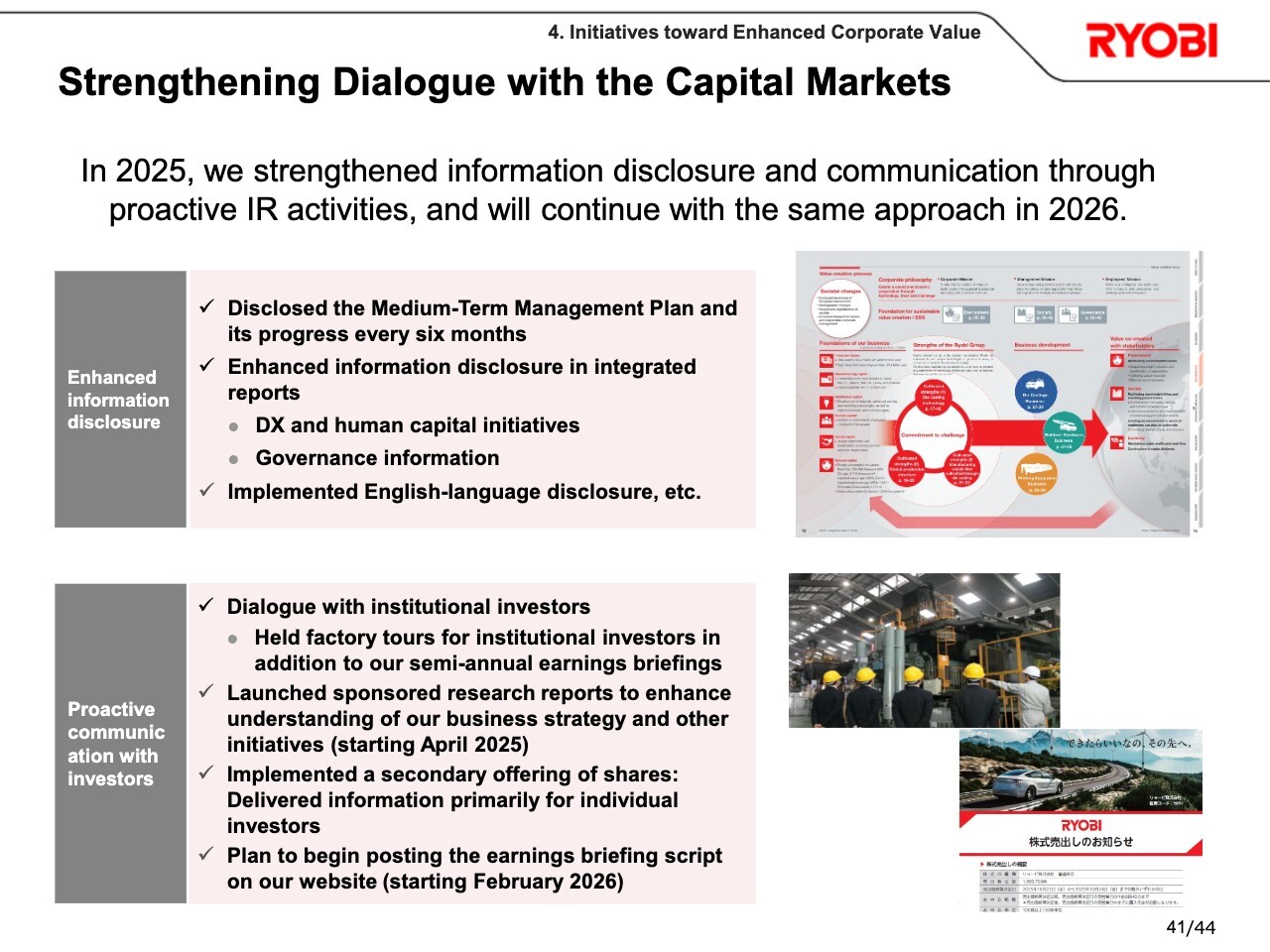
Regarding dialogue with the capital markets, we are proactively strengthening our information disclosure to investors. Specifically, we have already held factory tours for investors and launched sponsored research reports for new investors. In addition, we plan to begin posting earnings presentation scripts on our website starting this February.
To enhance understanding of our company's future potential and growth prospects, we will further strengthen information dissemination through proactive IR activities.
Topics on Addressing Environmental and Social Challenges
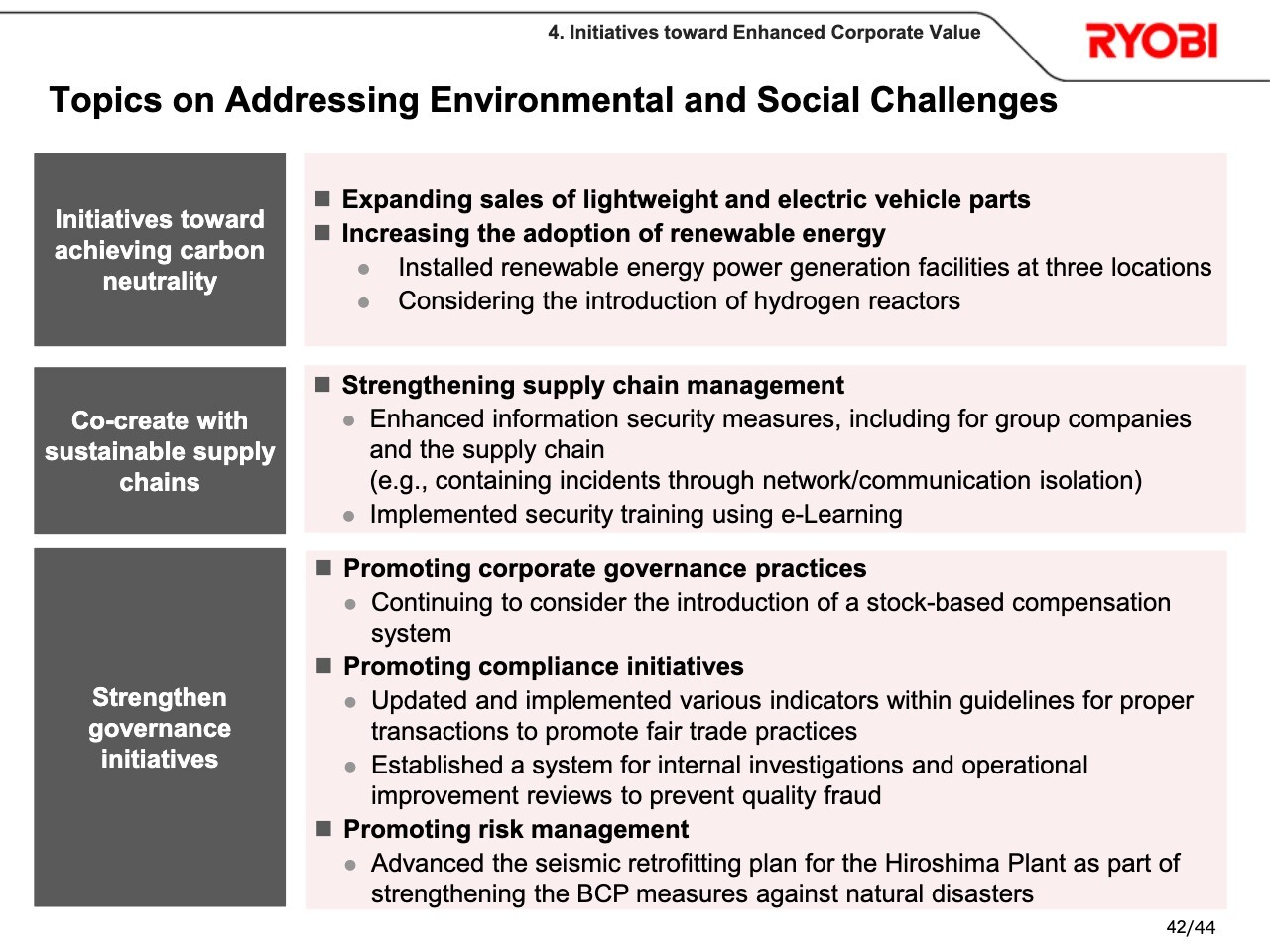
This section covers our initiatives to address environmental and social challenges. As a key measure toward achieving carbon neutrality, we have decided to install renewable energy power generation facilities at three new locations and are actively implementing this initiative. In addition, as part of strengthening supply chain management, we are prioritizing information security measures as a critical focus area.
We believe that proactively addressing these environmental and social challenges is essential for enhancing corporate value.
Disclosure Policy for Future MTMP
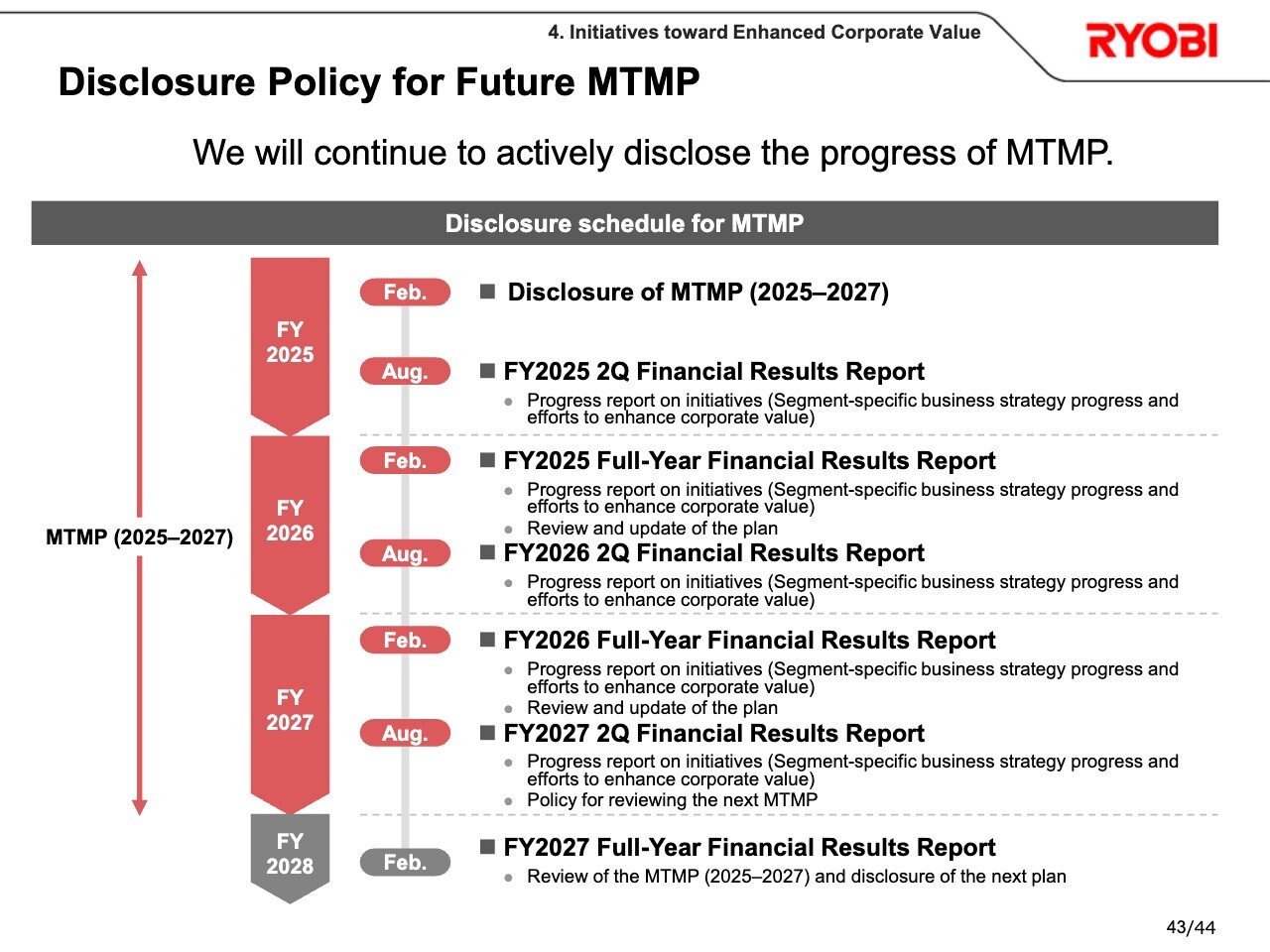
Finally, regarding our disclosure policy for future Medium-Term Management Plans, we will report on the progress of our initiatives and review and update the plans on a semiannual basis. In February 2028, we plan to review the current Medium-Term Management Plan and disclose the next plan.
Q&A: Trends in Production Weight of Die Castings and New Projects
Question: Regarding the trends in production weight of die castings on page 13 of the document, it is mentioned that production in Japan will rise significantly in the latter half of this year and exceed 30,000 tons in the fourth quarter. Could you explain the factors driving this growth and which projects are contributing to it?
You also mentioned that there are new projects in Thailand. Could you provide, to the extent possible, some details about these projects?
Kazuhiko Fujii (hereinafter, Fujii): I am Fujii from the Corporate Planning Division. I will respond to your question. Overall production weight is expected to increase, with growth in Japan driven by new products and in Thailand by additional production of products that are already in production.
Question: Regarding the increase in Japan in the second half of this year, is it due to the growth of a single project, or is it the result of contributions from multiple projects?
Fujii: The increase in Japan is the result of multiple projects. In Thailand, it is mainly driven by increased production of a single project.
Q&A: Printing Equipment Profit Outlook and Declining Order Backlog
Question: You mentioned that profits for the Printing Equipment business are expected to decline significantly this year. However, looking at past performance, I don’t think annual profits have ever fallen to this level. Is it likely to actually drop this much this year, or is this a relatively conservative estimate?
Urakami: Subsidies for capital investment, particularly in Japan, have been very generous, but we expect these subsidies to decrease going forward. While we also anticipate some sales overseas, profit margins abroad are lower than in Japan, so overall profits are expected to decline.
Question: Is it correct to understand that the current order backlog has also declined significantly?
Urakami: The order backlog has decreased compared with the same period last year.
Q&A: Background and Progress on Trade Optimization and Payment Term Shortening
Question: I have a question regarding trade optimization. My understanding is that this refers to shortening payment terms. Could you explain the background behind this initiative?
Also, are your customers making similar adjustments to their payment terms?
Urakami: First, regarding our payables. A relatively large number of our suppliers are covered by the traditional Subcontract Act, so we are actively promoting the shortening of existing payment terms.
Regarding our receivables, the pace of reduction is not as fast because we are not considered a subcontractor under the Subcontract Act. However, as part of the overall trend toward trade optimization, major customers are also shortening their payment terms.
Question: Will this initiative to shorten payables continue in the new fiscal year, or is it correct to understand that one cycle has largely been completed?
Urakami: We plan to continue expanding the number of suppliers eligible for accelerated payments, so this initiative is expected to continue for several more years.
Q&A: Capital Expenditure Plans and Investment Projects for FY2026
Question: Regarding capital expenditures for FY2026, the plan is ¥22.0 billion. Last year, there was a major new investment at the Kikugawa Plant for "Giga casting." Could you explain what projects are planned this year and why the investment level is even higher?
Fujii: We are mainly focusing on processing equipment for new products and earthquake-proofing work at the head office. While the main building has already been rebuilt, several other buildings also require seismic reinforcement.
In addition to equipment for new product production, partial facility upgrades are included. There are no large-scale projects like Giga casting, but a number of smaller projects are being implemented cumulatively.
Question: You have operations in many regions globally. Which regions are expected to receive relatively more investment?
Fujii: At this stage, Japan is still expected to account for the largest share of investment.
Question: As indicated in the document, is it correct to interpret these strategic products as electrification parts and body parts, which have been our focus for some time?
Fujii: Yes, that interpretation is correct.
Q&A: Impact of DRAM and Rare Metals at OEMs
Question: Various concerns have been raised, including DRAM and rare metals at OEMs. To what extent do you expect these effects to be felt in the current fiscal year?
Urakami: For this fiscal year, we have not factored in any elements that could have a major impact—such as the certification-related issues we saw last year and the year before, or the semiconductor-related issues from earlier periods—at this stage, because there is currently no information suggesting that such impacts will occur.
Q&A: Cost Sharing of Tariff Burden with OEMs and Future Outlook
Question: I have a question about customs duties. In the previous fiscal year, I understand that OEMs bore a significant portion of the tariff costs. How do you view the sharing of customs duties in the current fiscal year?
Urakami: Regarding the sharing of customs duties, as you noted, we recognize that OEMs are bearing the cost this fiscal year, similar to many companies with a fiscal year ending in March.
Looking ahead to the next fiscal year and beyond, there are no price negotiations specifically related to tariffs at this stage, but we expect cooperation on cost reductions to intensify.
Question: Do you anticipate that the burden will increase, or could it shift in other ways?
Urakami: We believe that the burden will continue to be borne by the OEMs themselves or by consumers at the import or export destinations.
Currently, U.S. market prices have not changed, and OEMs are assuming the burden. We expect this situation to continue. However, we anticipate that requests to suppliers for cost reductions may increase.
Q&A: Impact of Increased Chinese Suppliers and Market Trends
Question: Let me ask about China. Recently, it seems that Japanese OEMs are significantly increasing the ratio of Chinese suppliers. How do you see the impact on your company?
Urakami: Currently, there is no indication that our customers in Japan or the U.S. are shifting their sourcing from us to Chinese die casters.
In the Chinese market, we have long supplied mainly U.S., European, and Japanese customers with operations in China. While some local Chinese manufacturers are involved, the major players are struggling, and production is generally declining.
At the same time, some automotive manufacturers are producing units in China and exporting them to Europe for assembly into finished vehicles. Demand for die castings for these units has remained steady.
Although we may lose some business to Chinese suppliers, we also work directly with local customers in China, and we expect our business there to continue growing steadily.
Q&A: Outlook for Operating Cash Flow and Policy on Investments and Shareholder Returns
Moderator: "Let me ask about operating cash flow. Earlier, you mentioned that the shortening of payment terms will continue for several years. Do you expect to secure operating cash flow in line with the Medium-Term Management Plan shown on page 40 of the document? If not, is there a possibility of revising your investment or shareholder return policies?"
Arihiro: We expect operating cash flow to be somewhat constrained. Therefore, we plan to maintain a balance between capital expenditures and shareholder returns.
Q&A: Results of Productivity Improvement Initiatives
Moderator: "You introduced your productivity improvement initiatives. Could you share quantitative results to illustrate the progress made?"
Urakami: Regarding the defect rate attributable to casting processes, page 27 of the document shows that a 20% reduction has been achieved, with the rate decreasing from around 13% to approximately 10%.
In addition, as mentioned earlier, we are working to reduce labor input and increase the number of good products per hour, i.e., improving takt time. We are also promoting efficiency through production line reviews and automation. However, we will refrain from providing more detailed quantitative figures beyond this.
Q&A: Changes in Profitability of the Die Castings Business by Country
Moderator: "Regarding the Die Castings business, are there any changes in profitability by country?"
Urakami: First, we recognize that profitability in Japan remains stable. In the U.S., the business is generally strong, but profitability is expected to decline in the current fiscal year due to the recent slowdown in electrification.
In the U.K., the situation remains challenging. Meanwhile, China is relatively stable, and we expect further growth there.