CONTENTS
Hiroshi Kanda (hereafter, Kanda): Thank you very much for joining MEDIA DO Co., Ltd.’s financial results briefing for Q3 FYE 2/26. I am Kanda, Vice President and CFO. Thank you for your continued support this year.
Today, I will explain financial highlights and earnings trends, and Fujita will explain our growth strategy.
Executive Summary
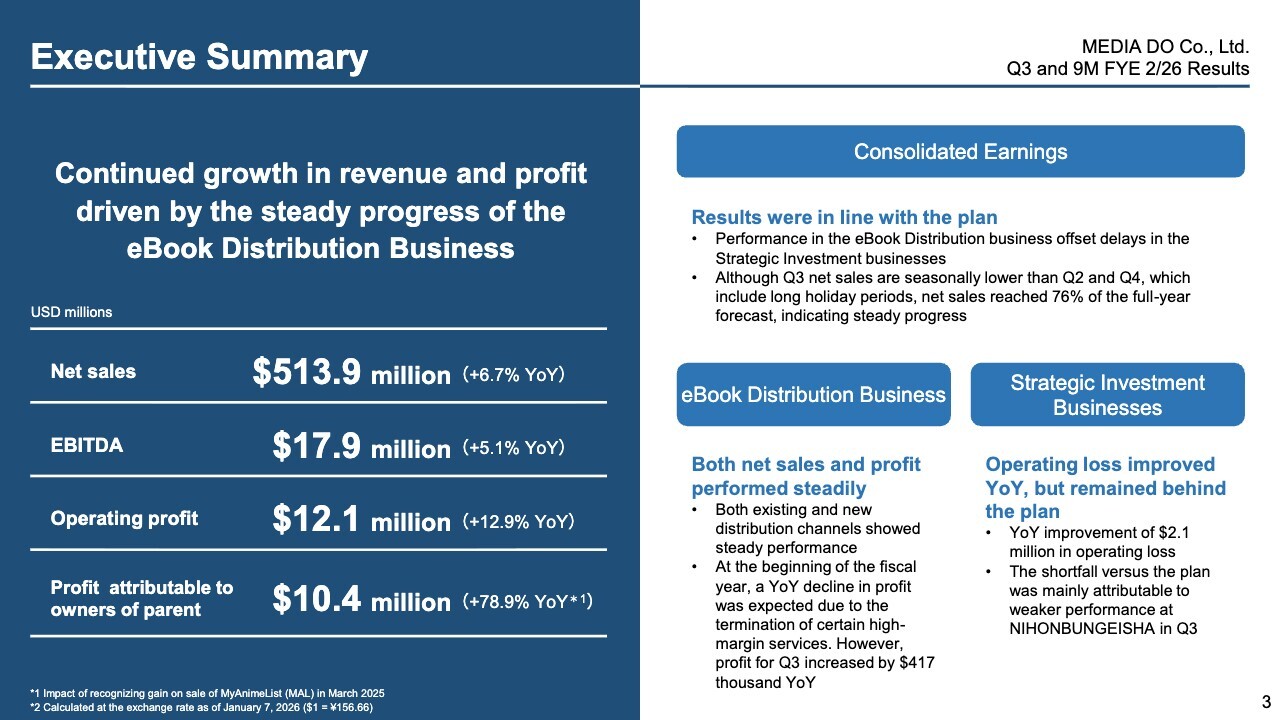
Please refer to the slide for the Executive Summary.
Consolidated Performance Highlights
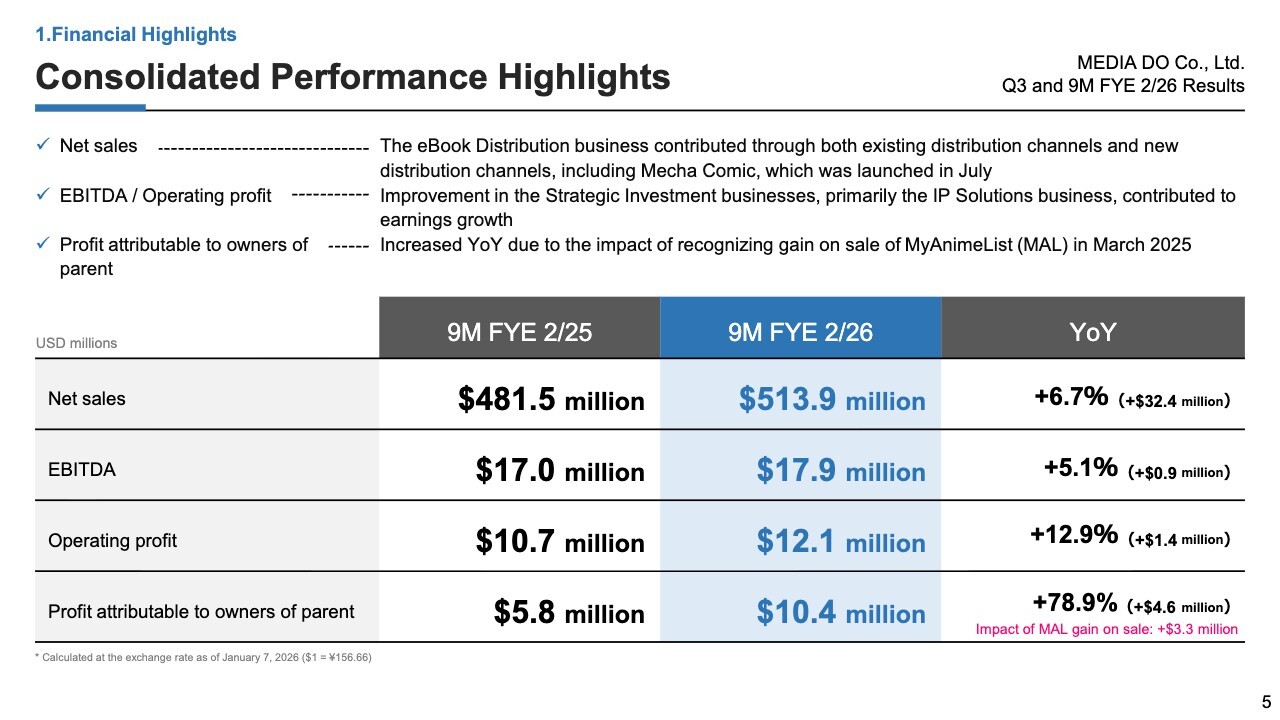
Let me begin with the consolidated performance highlights. For 9M FYE 2/26, net sales totaled $513.9 million, 6.7% growth YoY and an increase of $32.4 million. This was the result of the eBook Distribution business contributing to growth through both existing distribution channels and new distribution channels.
EBITDA increased by $0.9 million to $17.9 million, and operating profit increased by $1.4 million to $12.1 million. Improvement in losses in the Strategic Investment businesses, primarily in the IP Solution business, contributed to earnings growth.
Profit attributable to owners of parent increased by $4.6 million YoY to $10.4 million. This significant YoY increase is due to the impact of recognizing gain on the sale of MyAnimeList (MAL), a former equity-method affiliate of the Company, in March 2025.
Achievement Rate Against Full-Year Performance
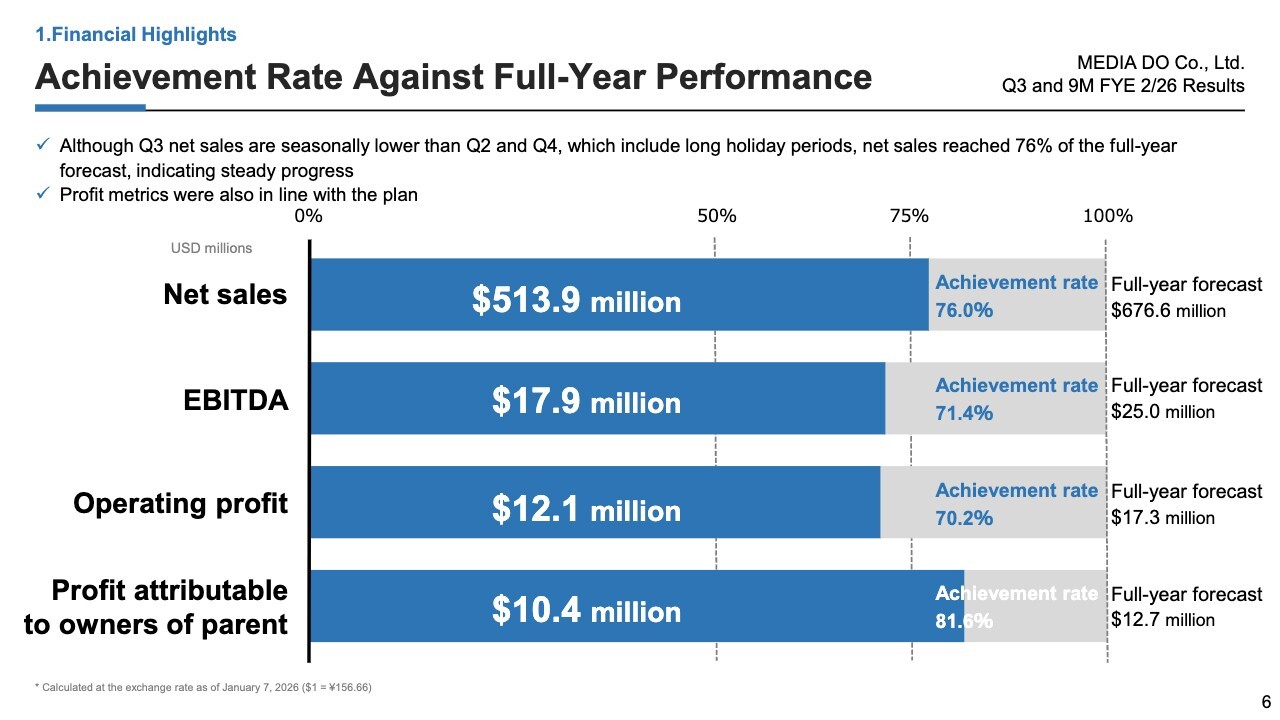
I will explain the performance achievement rate. Net sales are $513.9 million, and the achievement rate against the full-year forecast is 76.0%. The achievement rates for EBITDA and operating profit are 71.4% and 70.2%, respectively, and the achievement rate for profit attributable to owners of parent is 81.6%.
Q3 net sales and profits tend to be lower than Q2 and Q4. Therefore, we consider the current net sales achievement rate of 76.0% to be a good figure.
As for EBITDA and operating profit, Q1 through Q3 last year, the achievement rate for EBITDA was 71.4% and the achievement rate for operating profit was 68.3%. In light of this, achievement rate through Q3 against the full-year forecast for this fiscal year is the same level as last year.
Net sales by Segment
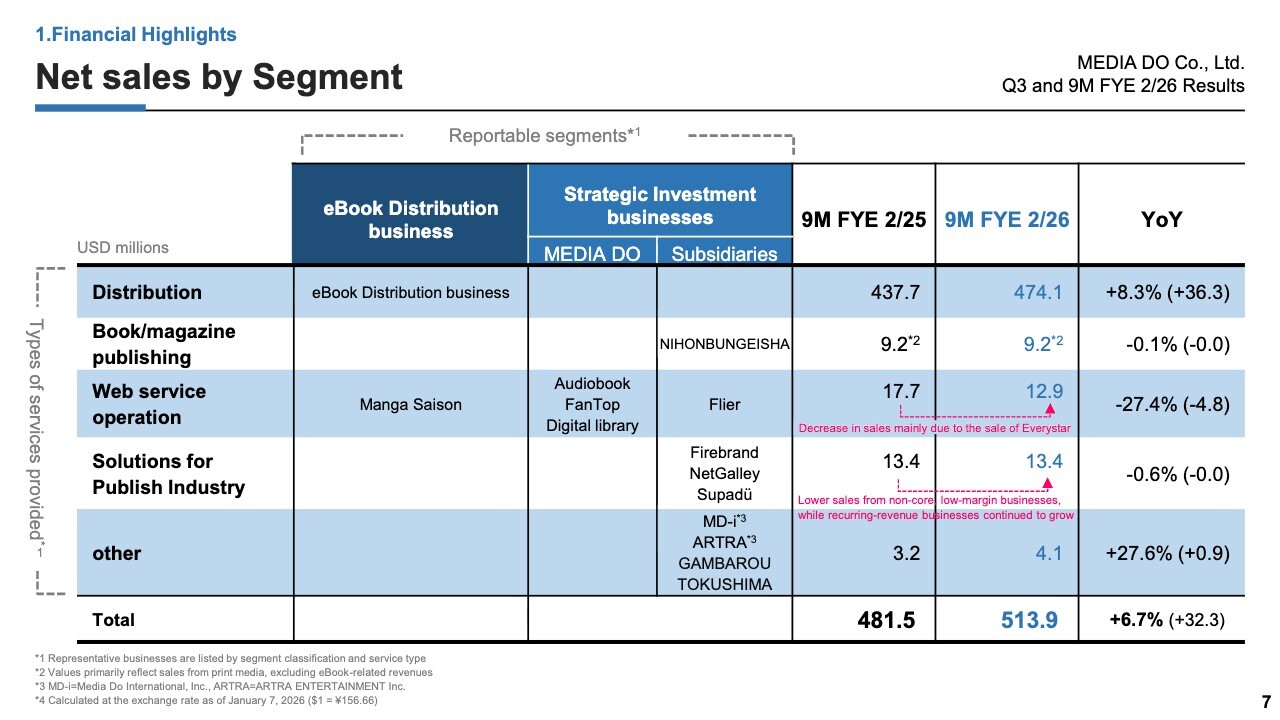
Next, I will explain net sales by segment. The Company reports and discloses results in two segments: the eBook Distribution business and the Strategic Investment businesses.
In the web service operation, sales decreased YoY. It is mainly due to the sale of Everystar at the end of the previous fiscal year. Each of the other businesses continues to grow YoY.
Overview
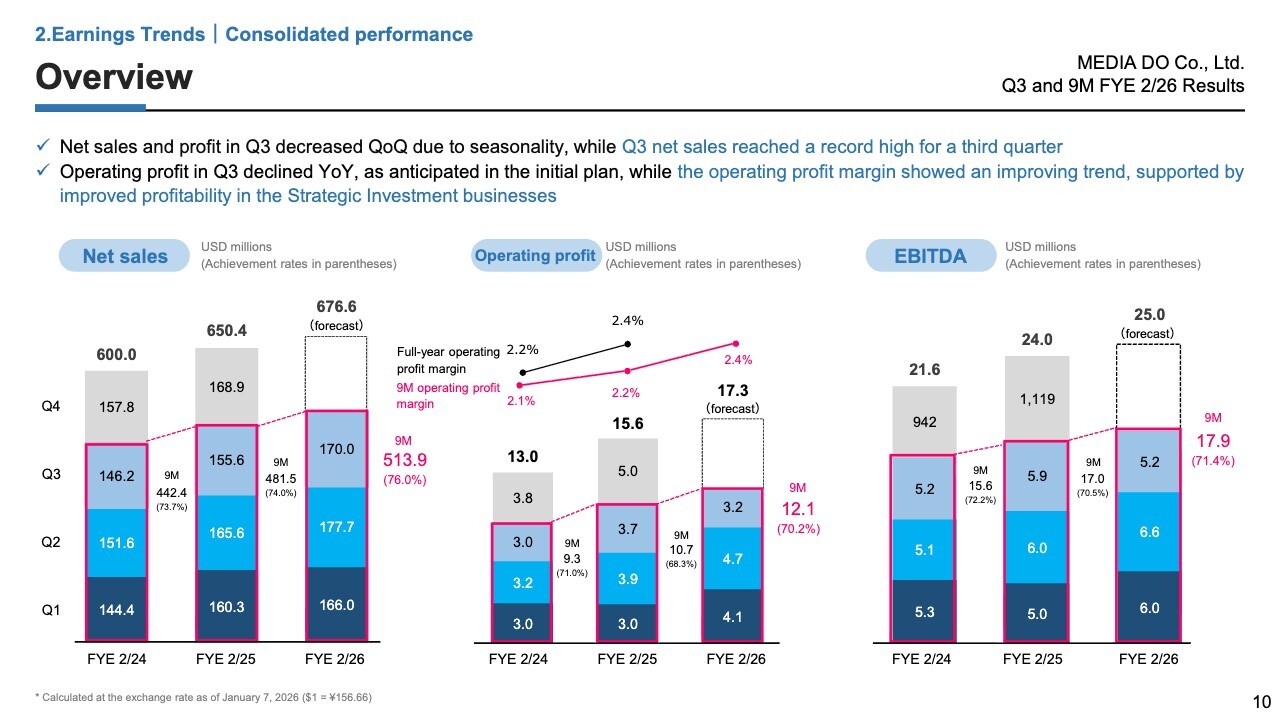
Now, I will explain the earnings trends. First, I would like to begin with the consolidated performance. Net sales for 9M totaled $513.9 million. For Q1 through Q3 this fiscal year, each quarter has been higher YoY.
Operating profit increased YoY in Q1 and Q2, but decreased YoY in Q3. On the other hand, as I explained earlier, the achievement rate was 68.3% in the previous fiscal year, but it has exceeded that rate in the current fiscal year.
The operating profit margin has gradually improved from 2.2% through Q3 of the previous fiscal year to 2.4% this fiscal year, supported by improved profitability in the Strategic Investment businesses.
Sales Trends (by Segment)
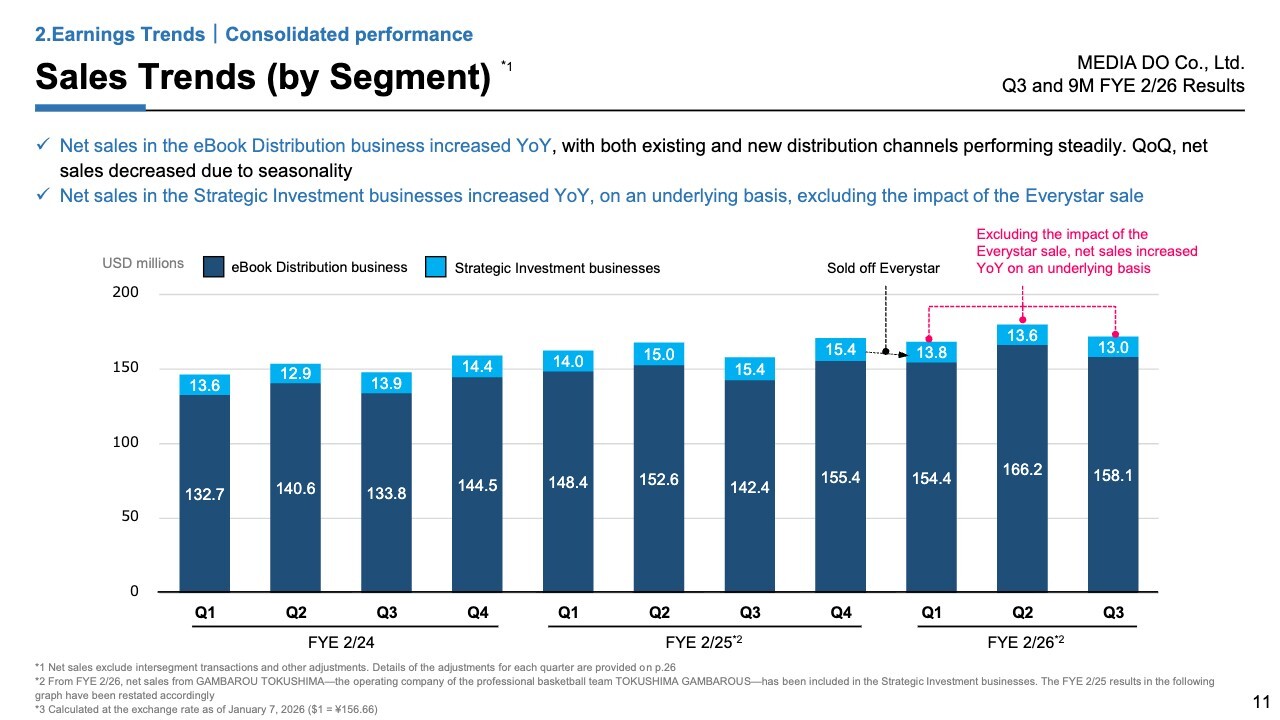
The slide shows the graph breaking down net sales by segment. The dark blue bars show sales from the eBook Distribution business, and the light blue bars show sales from the Strategic Investment businesses, respectively. The eBook Distribution business for the current fiscal year has been higher in each quarter YoY.
The Strategic Investment businesses decreased YoY, but as I explained earlier, this was due to the impact of the Everystar sales. Excluding this, net sales increased YoY in all quarters.
Operating Profit Trends (by Segment)
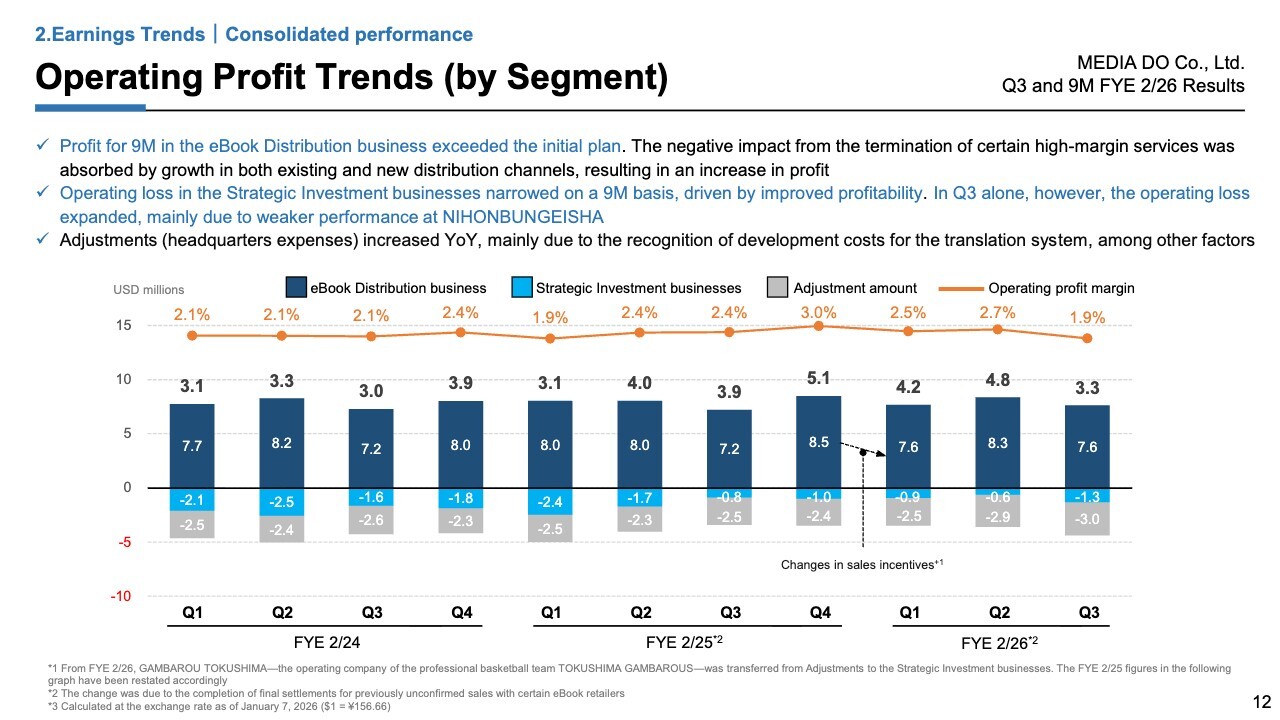
I will explain the changes in operating profit by segment. The operating profit in Q3 alone is $3.3 million. As for the breakdown, the eBook Distribution business shows a YoY increase in profit of $7.6 million.
On the other hand, the operating loss in the Strategic Investment businesses was $1.3 million in Q3, and furthermore, the operating loss in adjustments (headquarters expenses) totaled $3.0 million. The operating loss expanded YoY for both.
In the Strategic Investment businesses, the operating loss expanded in Q3 mainly due to weaker performance at NIHONBUNGEISHA. The operating loss in adjustments (headquarters expenses) increased YoY mainly due to the recognition of development costs.
Trends in Royalties and Other Costs
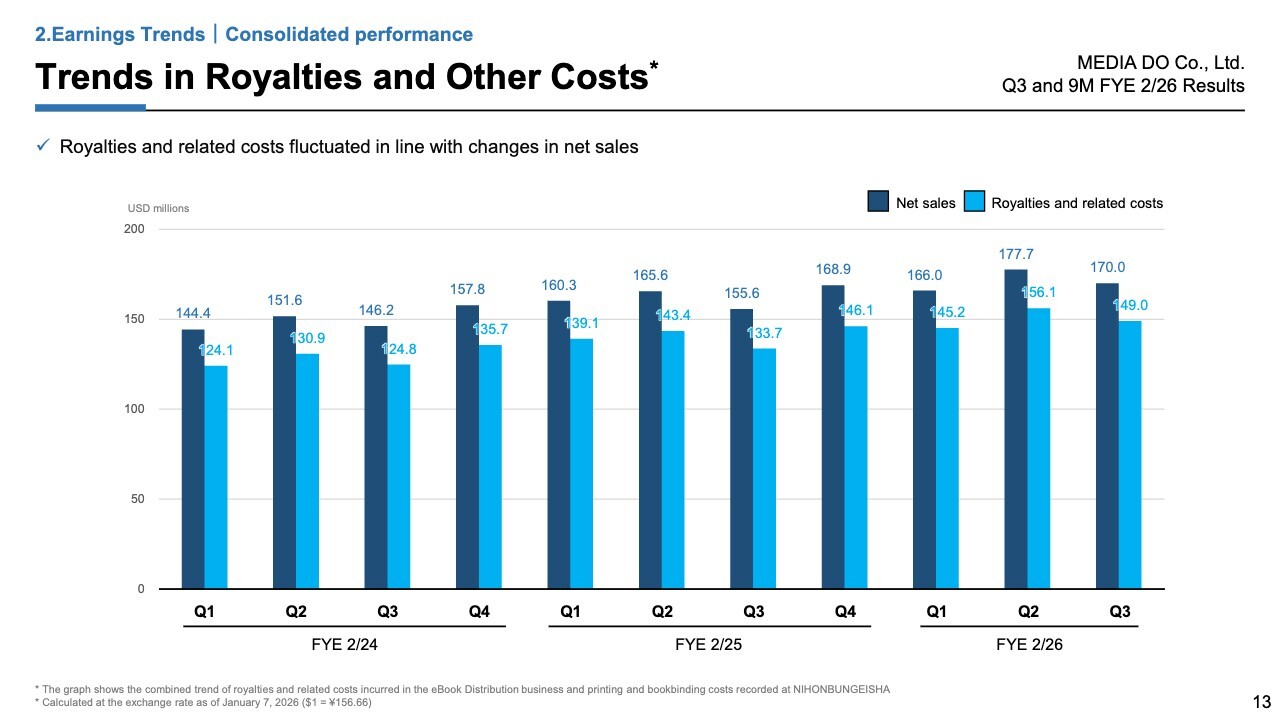
Royalties and related costs fluctuated in line with changes in net sales.
Trends in Cost of Sales/SG&A Expenses (Excluding Royalties)
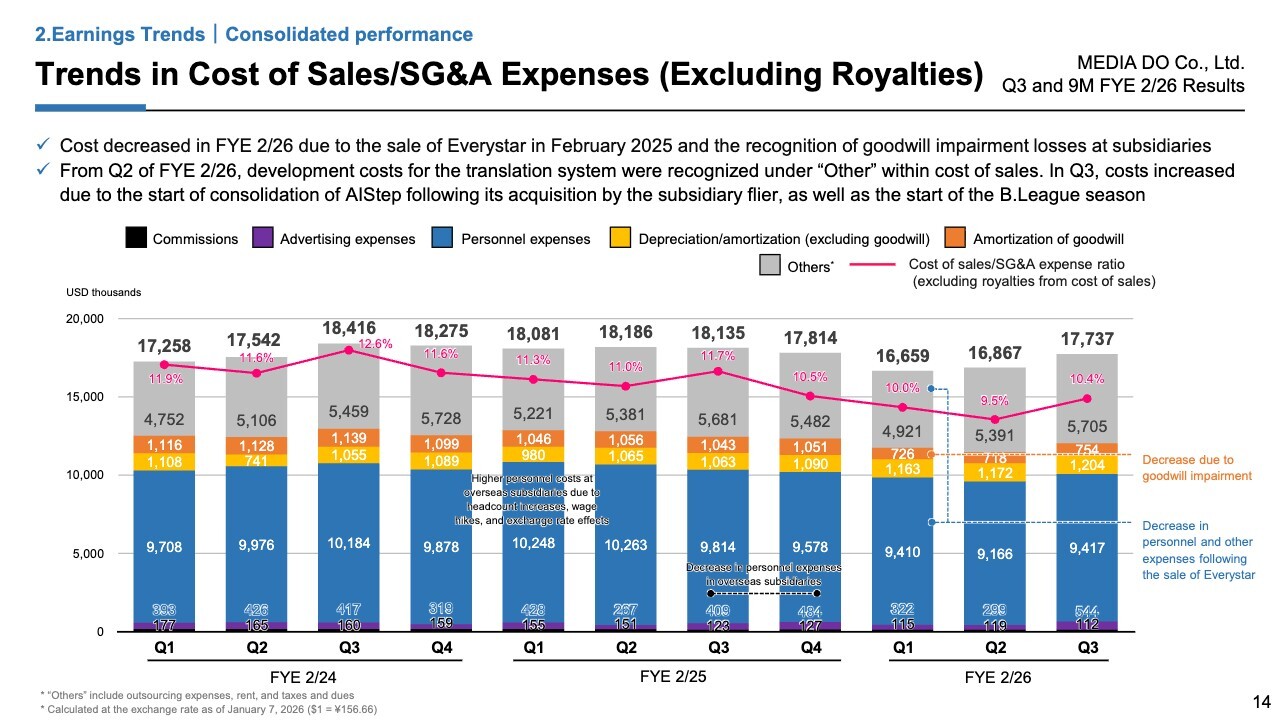
This section explains the changes in SG&A expenses other than royalties. In Q1 and Q2 this fiscal year, SG&A expenses were relatively controlled.
In Q3, costs increased due to the consolidation of AIStep following its acquisition by the subsidiary Flier. In addition, expenses increased due to the start of the B.LEAGUE season at the end of September.
YoY Sales Growth Rate
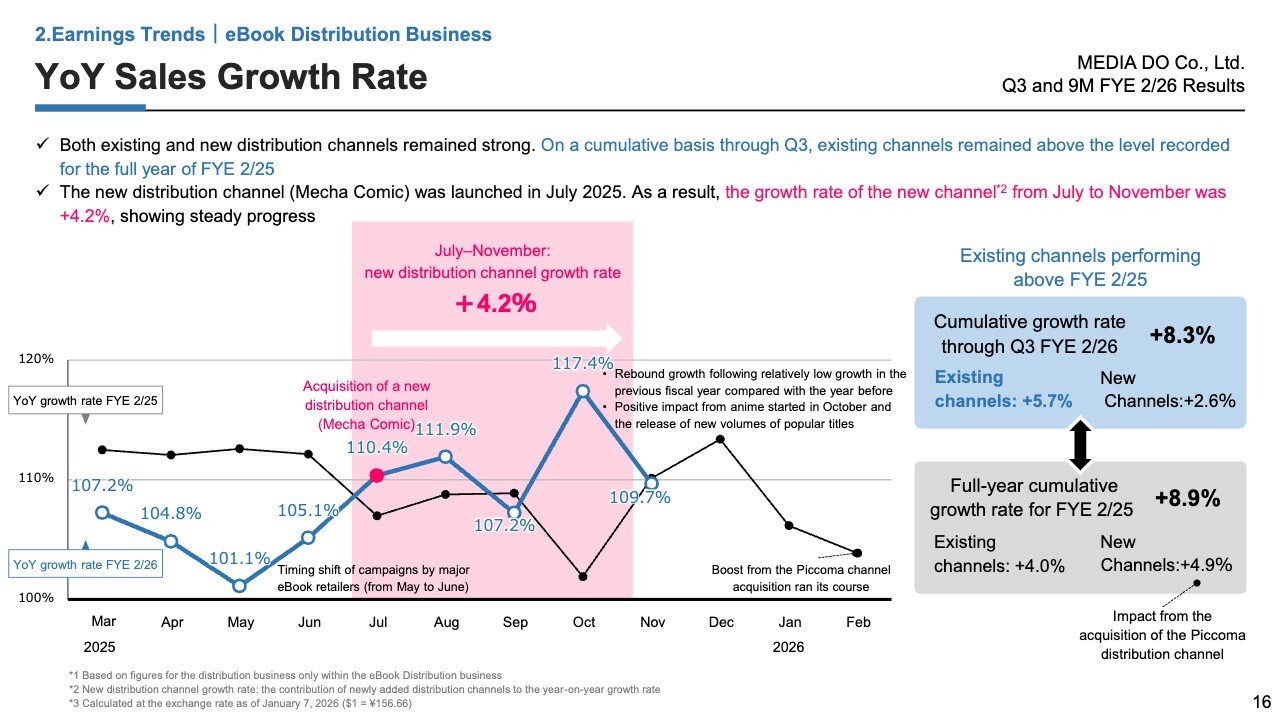
Let me explain the performance of the eBook Distribution business. The graph on the slide shows the YoY growth rate of sales. The blue line graph shows the results for the current period, and the black line graph shows the results for the previous period.
The cumulative growth rate through Q3 FYE 2/26 is +8.3% compared to FYE 2/25. As for the breakdown, the growth rate for existing distribution channels is +5.7%, and that for new channels is +2.6%.
The full-year cumulative growth rate for FYE 2/25 was +8.9%. The growth rate for existing distribution channels was +4.0%, and that for new channels was +4.9% due to the impact from the acquisition of the Piccoma distribution channel. The growth rate for existing distribution channels in FYE 2/26 is +5.7%, performing above +4.0% in FYE 2/25.
In addition, due to the acquisition of a new distribution channel, Mecha Comic (Amutus Corporation) in July FYE 2/26, the growth rate of the new channel from July to November was +4.2%. As in the previous year, growth from existing distribution channels as well as the acquisition of new distribution channels contributed to +8.3% YoY growth this fiscal year.
Trends in Net Sales and Operating Profit
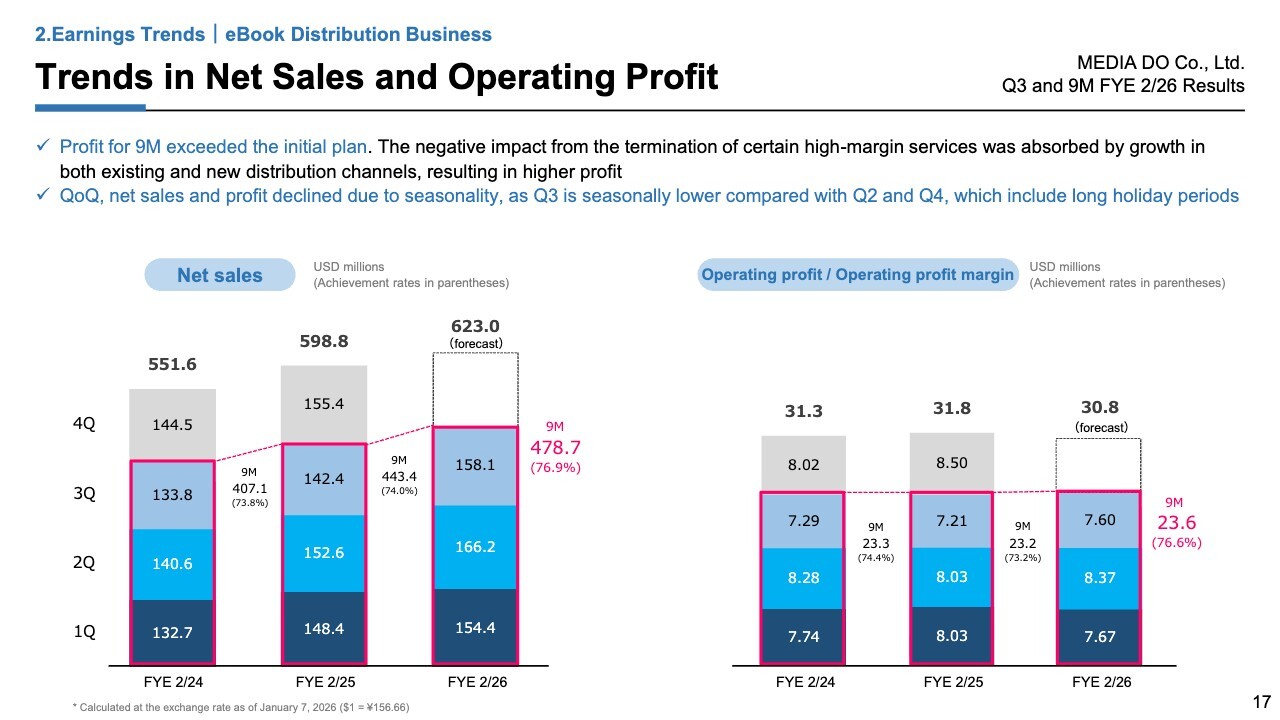
Please refer to the slide for quarterly net sales and operating profit.
Cost Structure (Cost of Sales/SG&A Expenses Excluding Royalties)
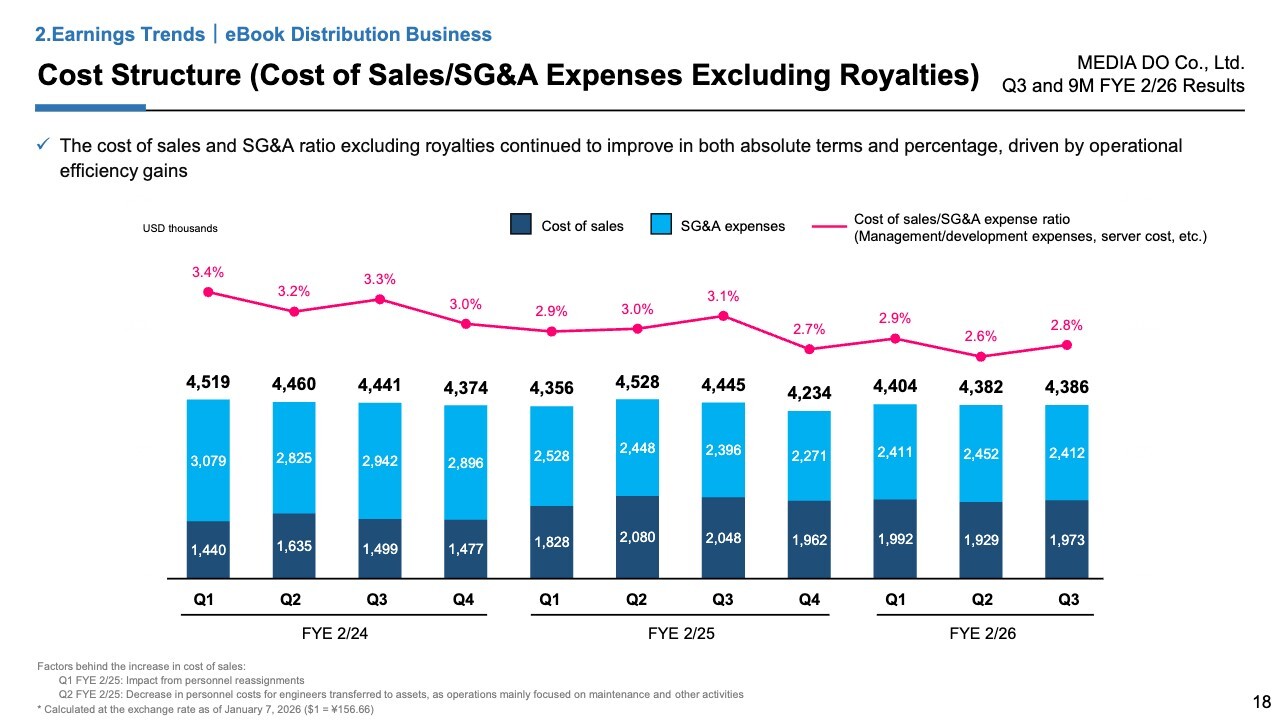
I will explain the cost structure. Since sales tend to decrease in Q3 due to seasonality, the SG&A expense rate increased from Q2. However, SG&A expenses in absolute terms can be controlled at about the same level as in Q2.
Overview of main service in the Strategic Investment Businesses
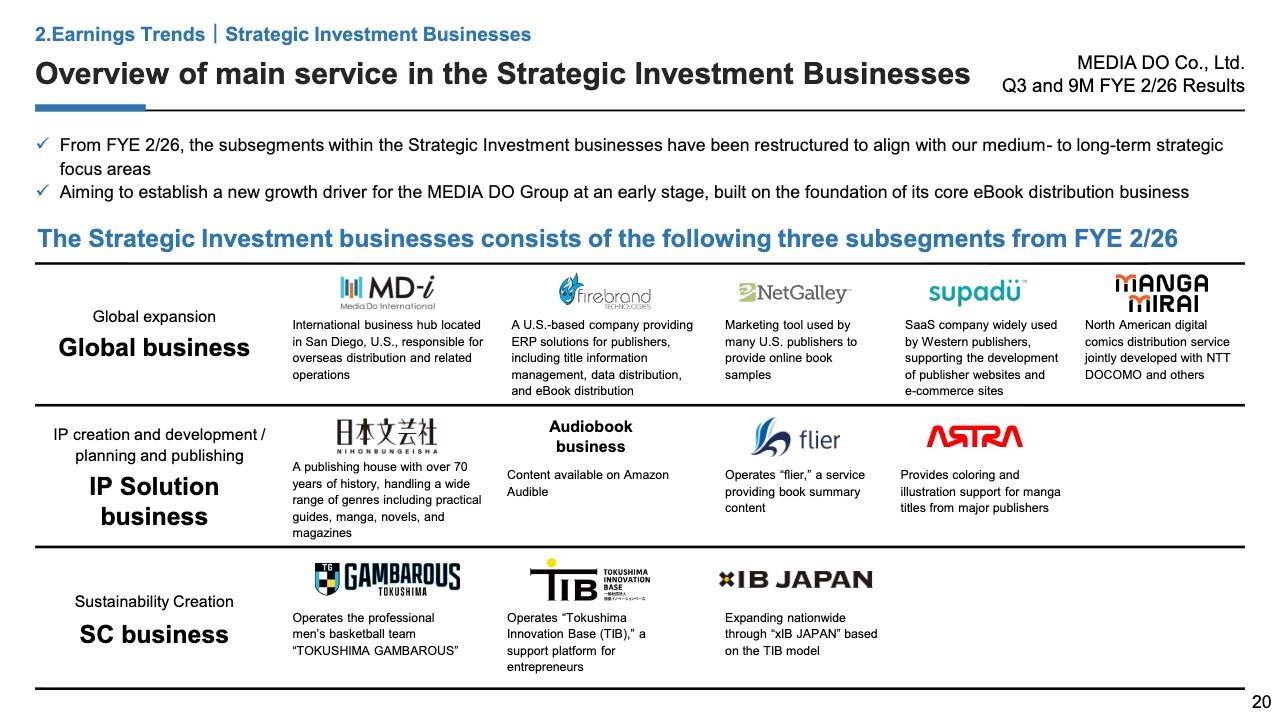
Next, I will explain the Strategic Investment businesses. The Strategic Investment businesses comprise three sections: Global business, IP Solution business, and SC (Sustainability Creation) business, from the current fiscal year.
Trends in Net Sales and Operating Profit
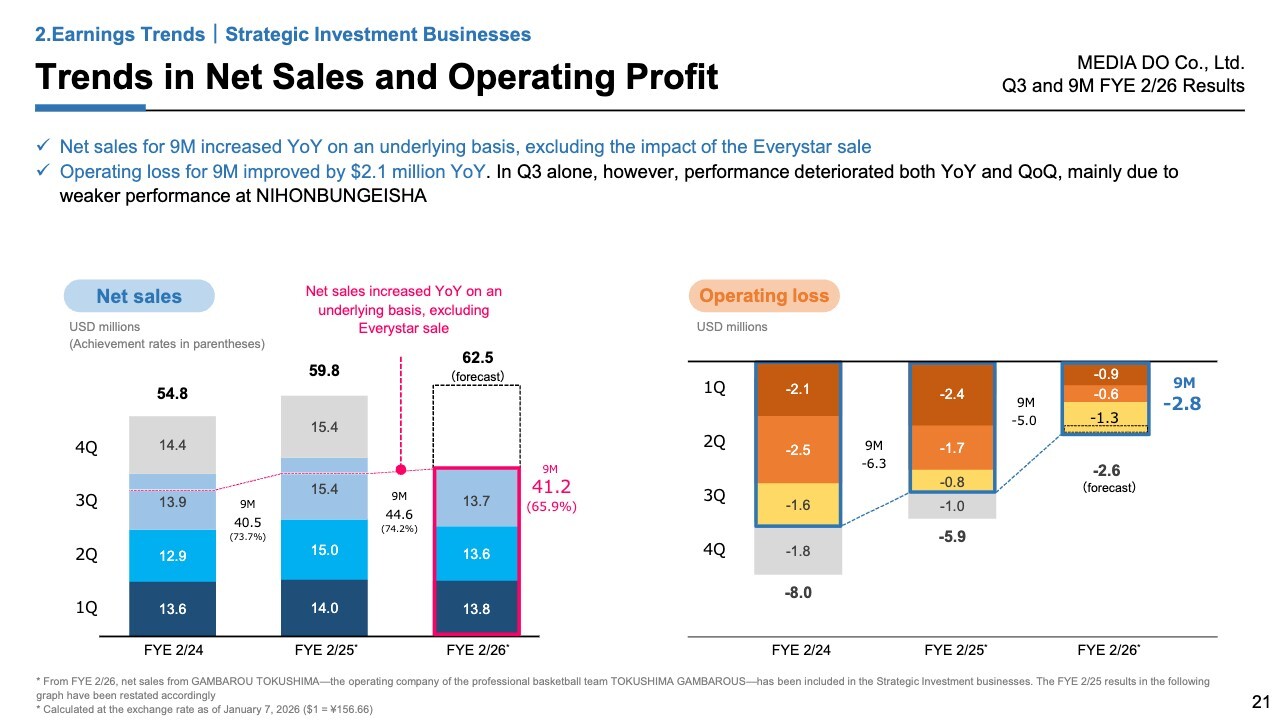
In the current fiscal year, we have been aiming for YoY revenue growth and a narrowing of the deficit in operating loss.
The operating loss was expected to improve by about $3.3 million, from $5.9 million in the previous full year to $2.6 million in the current fiscal year. However, the deficit increased in Q3 alone, resulting in an operating loss for 9M of $2.8 million.
Since we expect the deficit to continue in Q4, we believe it will be difficult to control the operating loss to $2.6 million as in our initial forecast. On the other hand, the eBook Distribution business is performing well, so we have not made any changes to our full-year forecasts at this time.
Cost Structure
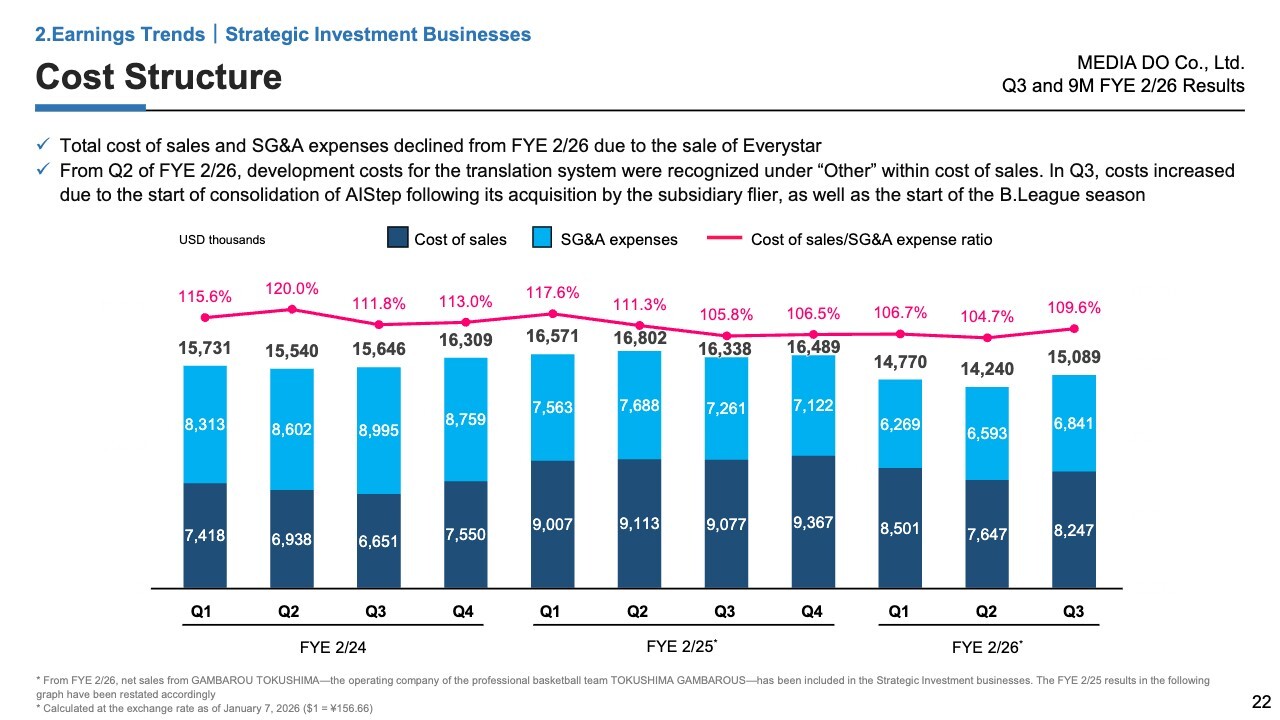
As explained earlier, costs for the Strategic Investment businesses increased in Q3 due to the start of consolidation of AIStep following its acquisition by Flier, as well as the start of the B.LEAGUE season.
Analysis of YoY Change in Operating Profit
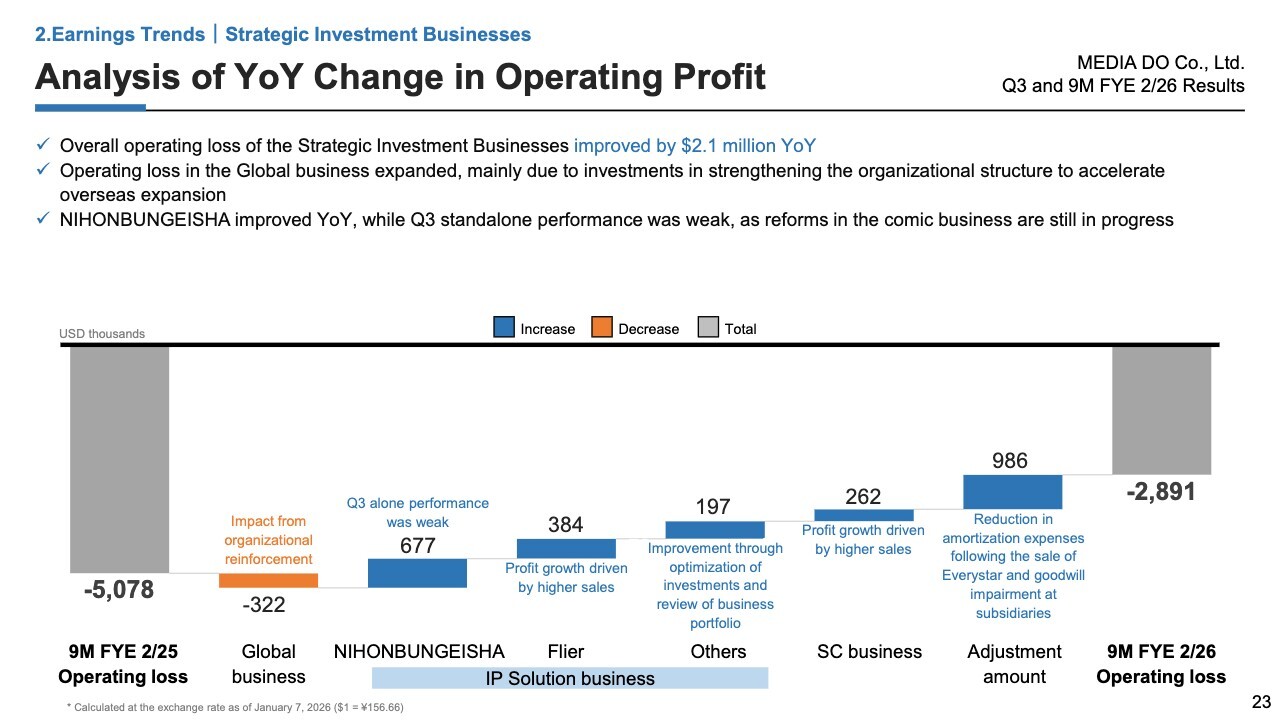
The slide shows the graph of YoY change in operating profit for the Strategic Investment businesses. 9M FYE 2/25 operating loss was $5,078 thousand.
On the other hand, 9M FYE 2/26 operating loss is $2,891 thousand, an improvement of $2,187 thousand. The main driver of this improvement was the IP Solution business. Operating loss improved by about $1,258 thousand, driven by increases across NIHONBUNGEISHA, Flier and others.
In addition, the adjustment amount improved by $986 thousand. This was due to a reduction in goodwill amortization in the current period following an impairment in the previous period.
As for the IP Solution business, NIHONBUNGEISHA realized an improvement of $1,110 thousand through Q2. However, as the operating loss in Q3 expanded YoY, the 9M improvement was only $677 thousand.
NIHONBUNGEISHA: Strengthening Comic Business Following Success in Practical Books
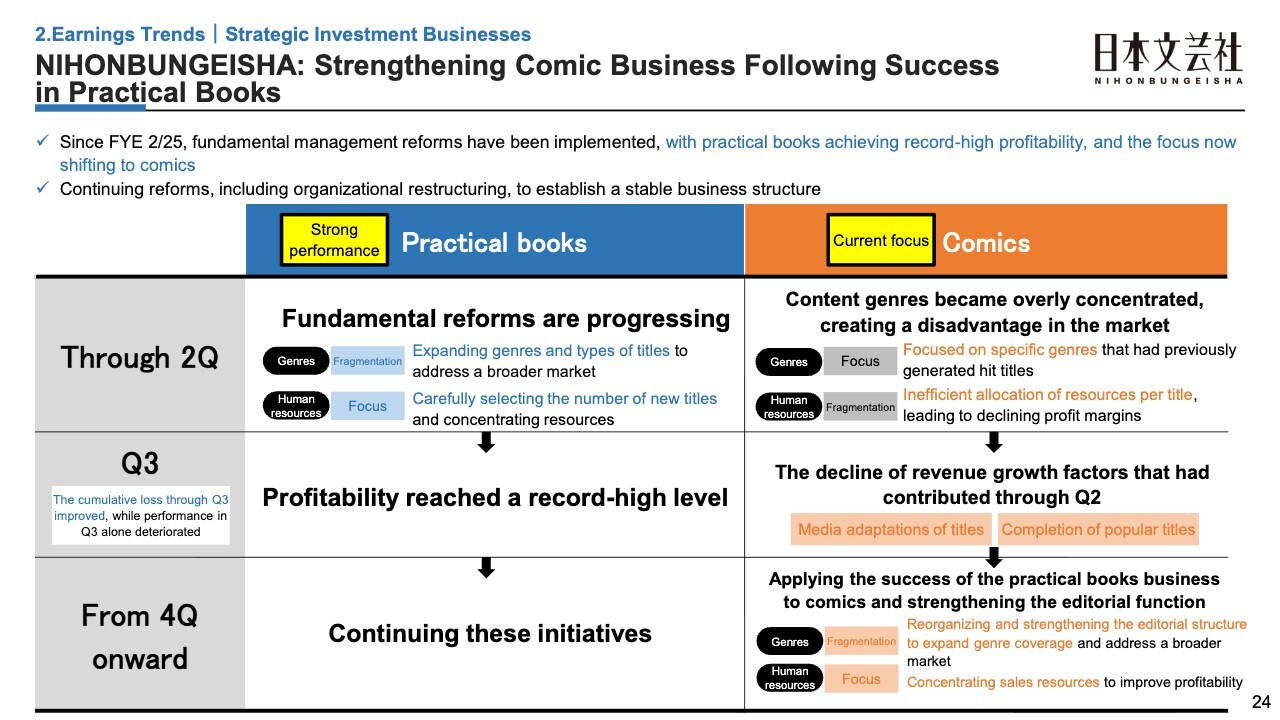
Regarding NIHONBUNGEISHA, fundamental reforms are progressing through Q2, especially in practical books. In addition to expanding genres and types of titles to address a broader market, we concentrated resources on each work and carefully selected the number of new titles.
As a result, after the acquisition, profitability reached a record-high level in Q3. We will continue these initiatives from Q4 onward.
On the other hand, regarding comics, we saw a focus on specific genres that had previously generated hit titles and an inefficient allocation of resources per title.
Although we could not adequately address these medium- and long-term issues, the deterioration of our business performance was not noticeable until Q2, thanks to media adaptations of titles and popular titles. However, due to the impact of the completion of popular titles and other factors, performance in Q3 deteriorated YoY.
We aim for fundamental reforms by applying the success of the practical books business to comics. In particular, we have been working since last fall to strengthen the editorial function.
Although the effects will not be seen immediately, we will continue reforms from Q4 onward, and hope to return NIHONBUNGEISHA to the performance level at the time of acquisition as soon as possible.
Flier: Revenue base expanded through a recovery in growth of existing businesses and M&A
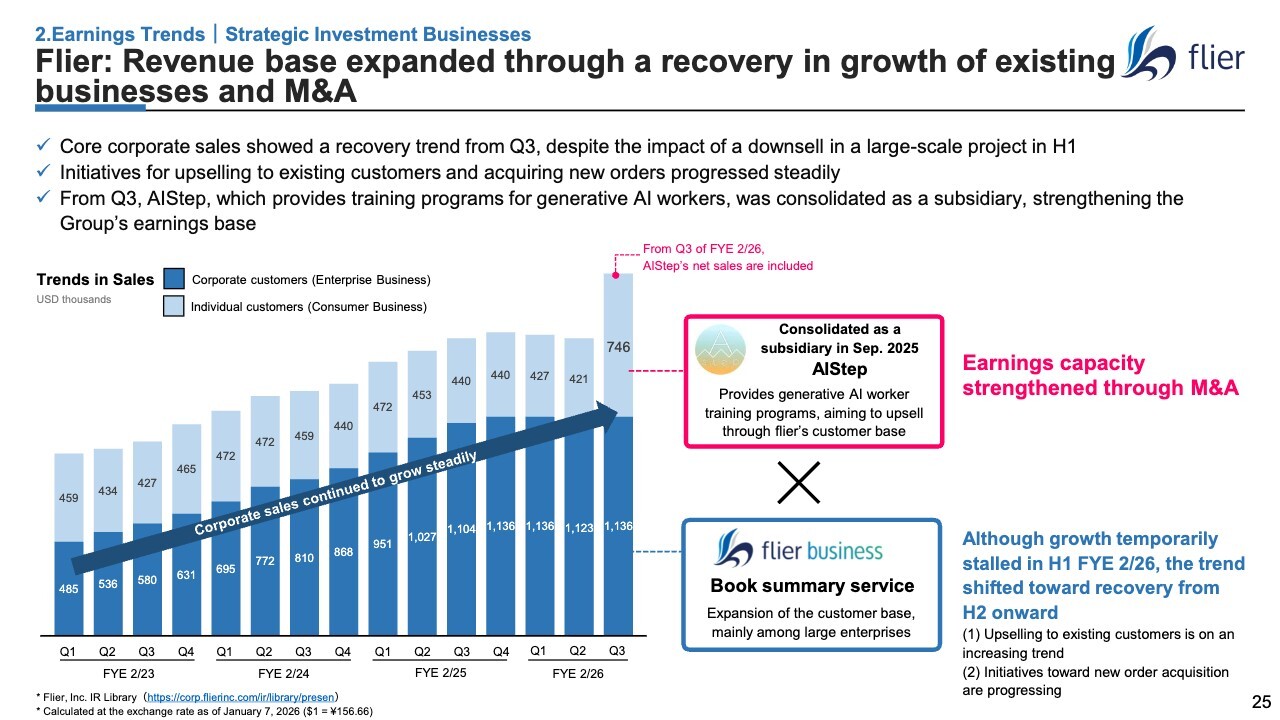
For more information about Flier, please refer to the documents it has disclosed.
Flier’s business is supported by growth in sales of corporate customers and individual customers. Although the business for corporate customers temporarily stalled in H1 FYE 2/26, it showed a recovery trend from Q3.
The business for individual customers has been sluggish since last year, but AIStep (which provides training programs for generated AI workers), acquired in September, has contributed to both sales and profits since Q3.
In this way, we intend to expand Flier’s business performance through both business growth and M&A.
P/L Actuals
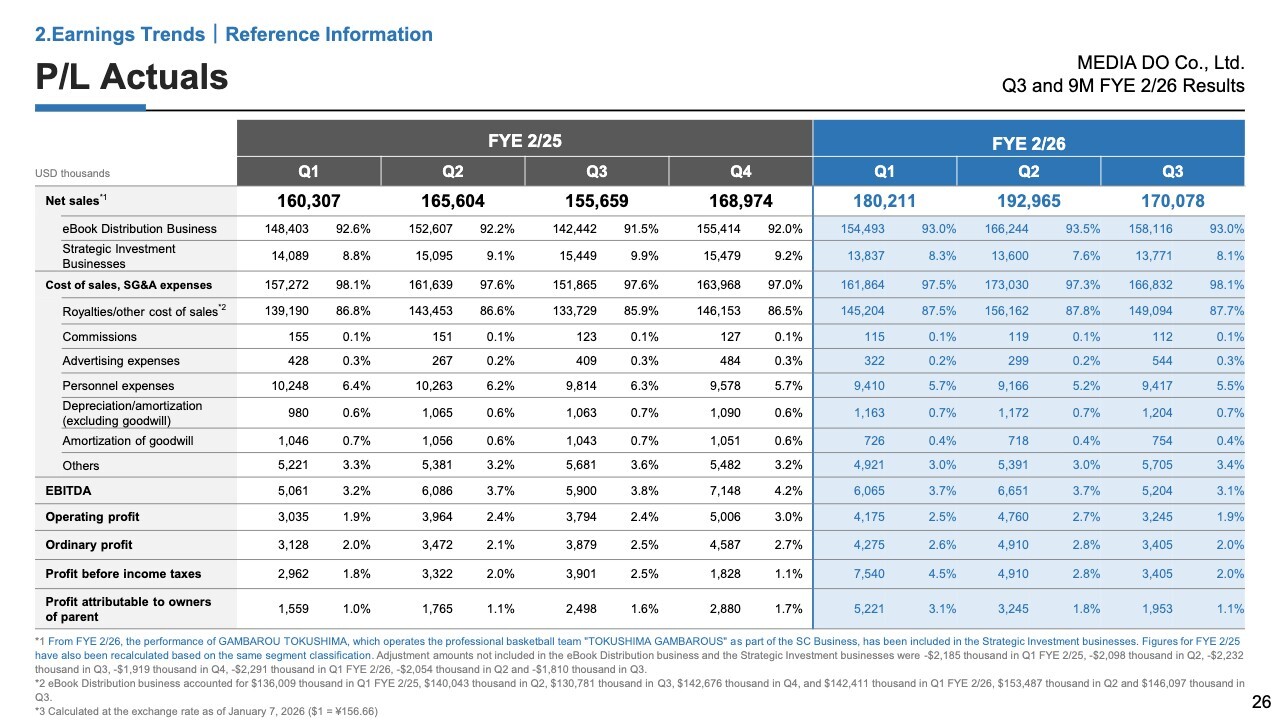
Please refer to the slide for details on the P/L.
B/S Actuals
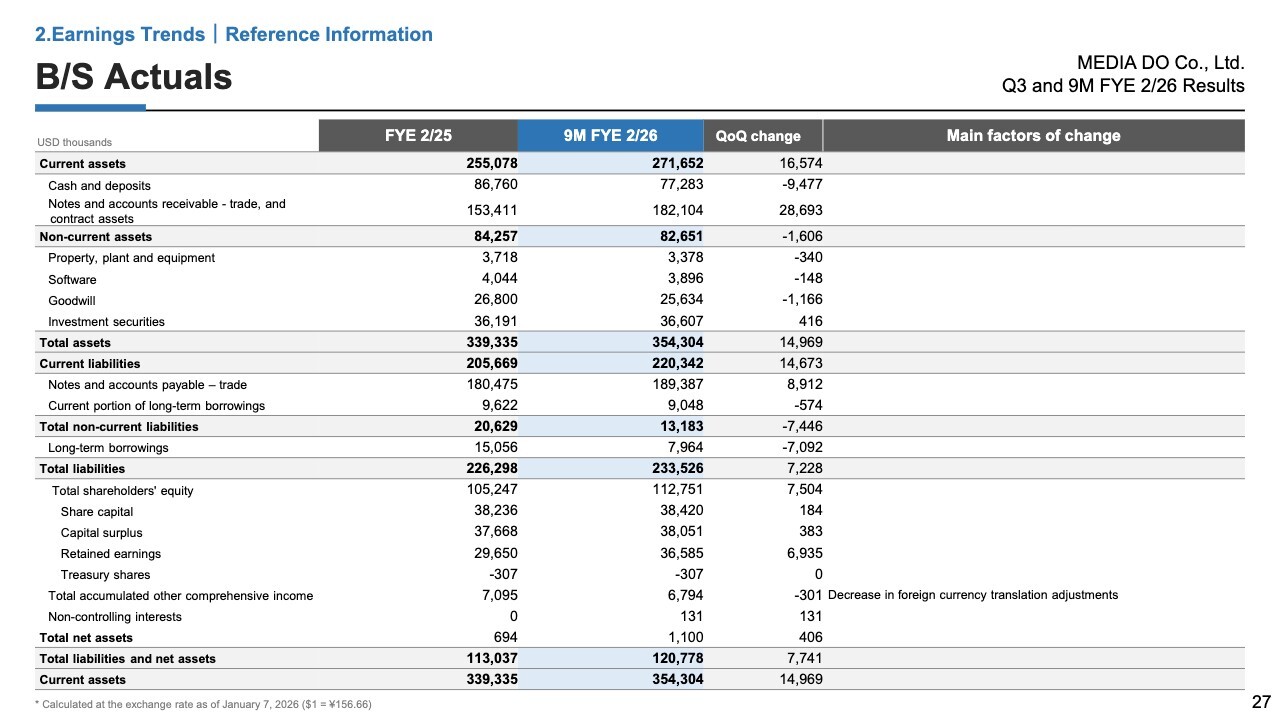
Please refer to the slide for details on the B/S. Next, we will explain our Growth Strategy.
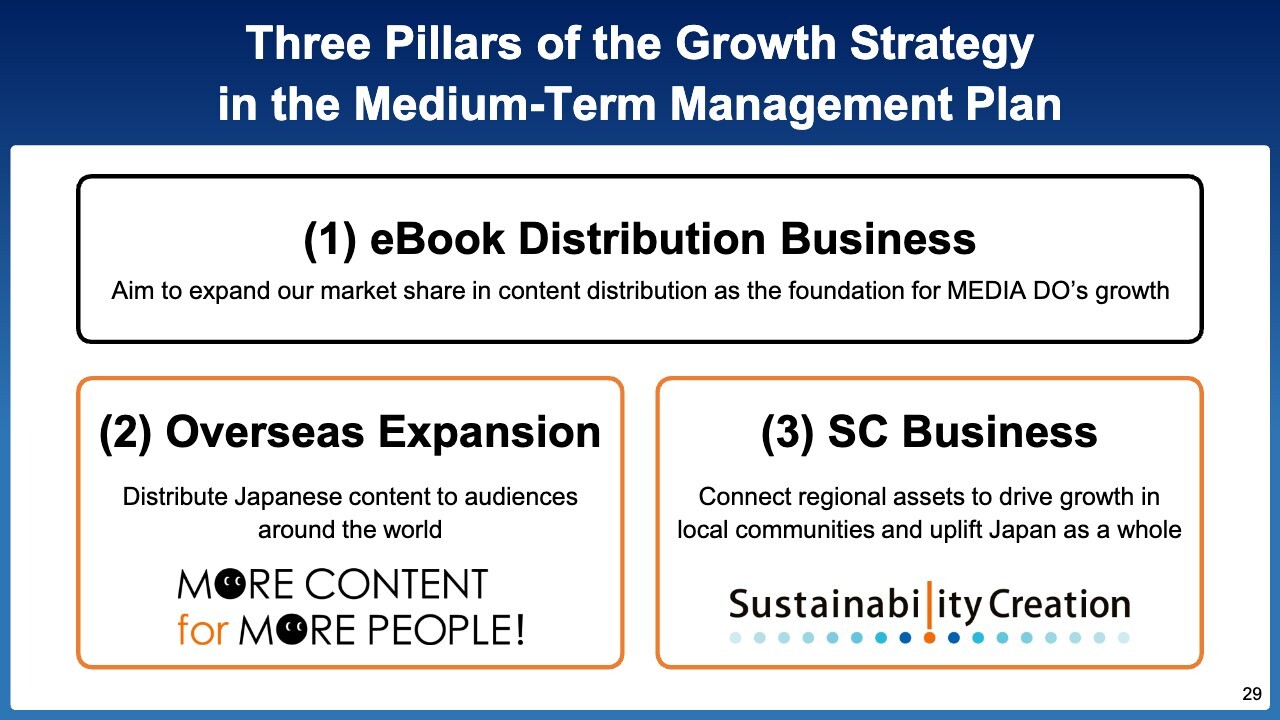
Three Pillars of the Growth Strategy in the Medium-Term Management Plan
Yasushi Fujita (hereafter, Fujita): I am Yasushi Fujita, President and CEO. Thank you for your continued support this year. I will talk about our Growth Strategy.
In April last year, we announced our five-year Medium-Term Management Plan and set forth three pillars of our growth strategy. We will continue to establish a firm position in the domestic eBook Distribution business as our growth platform while also working to establish new positions.
As Japan’s population declines, there is a risk that the number and sales of content will decline as well. To prevent this, we need to enhance the value of the wonderful content that Japan has produced, such as manga and other text-based books and magazines, which we have created together with creators and publishers.
Furthermore, recent inbound demand and the depreciation of the yen have expanded opportunities for Japanese content to reach out to the rest of the world. We intend to take advantage of this opportunity to vigorously promote overseas expansion, leveraging AI technology and other means.
Our vision is “MORE CONTENT FOR MORE PEOPLE!” In the past, this English slogan appeared below the Japanese statement, expressing the idea of distributing as much content as possible to as many people as possible. In our Medium-Term Management Plan, we reversed the order of the Japanese and English versions of our vision. Building on this, we are promoting overseas expansion and the SC (Sustainability Creation) business, which represents our regional revitalization initiative aimed at distributing Japanese content to audiences around the world, beginning with the English-speaking world. In particular, regarding the SC business, we are working from the perspective of what is necessary for Japan to remain sustainable, not merely to conduct regional revitalization. There are hidden assets in local communities, and by combining them with business and technology, new value can be created. We are convinced that if these assets can be utilized nationwide, it will help uplift Japan as a whole.
We hope to continue to be a leader by developing our business in this approach. For this reason, we dare not call this a “regional revitalization business” but rather develop it as a “Sustainability Creation business.”
MEDIA DO Has Established an Overwhelming Position in the Publishing Industry as Japan’s Largest eBook Distributor
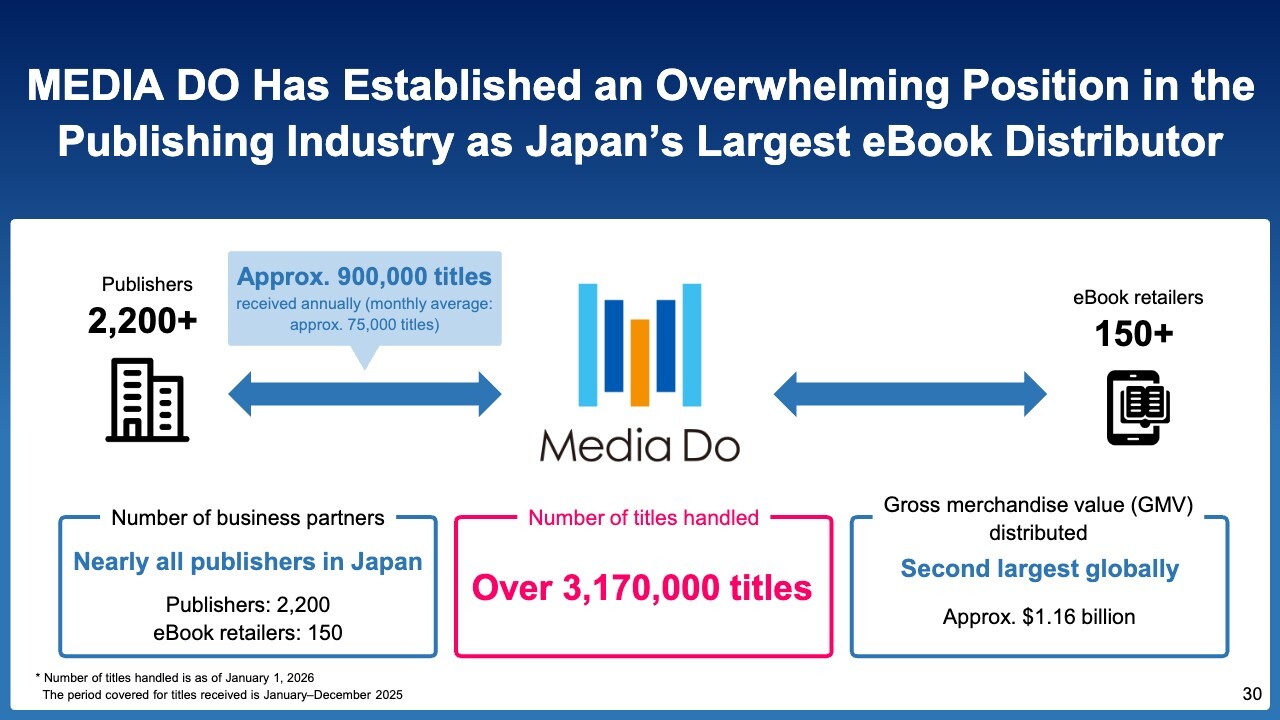
As the largest eBook distributor in Japan, we will continue to contribute to Japanese publishers and readers.
We are responsible for receiving approximately900,000 titles annually from various publishers.
In addition, we differ significantly from our competitors by having direct contracts with almost all publishers engaged in eBook distribution and business in Japan.
Direct contracting makes it easy to make new proposals. For example, overseas expansion may require new contracts, and a typical company would need to develop new businesses by making proposals to publishers from scratch.
However, in our case, since we already have a trading account based on monthly transactions, we are in a very easy position to make new proposals based on that account.
To date, we have received over 3,170,000 titles and have provided titles to over 150 eBook retailers in Japan.
Gross merchandise value (GMV) distributed was approximately $1.16 billion in the last fiscal year and is expected to approach $1.27 billion this fiscal year. After Amazon’s Kindle, we maintain the position of the second-largest globally in GMV.
MEDIA DO Has Updated Its Vision to Distribute Japanese Content Worldwide
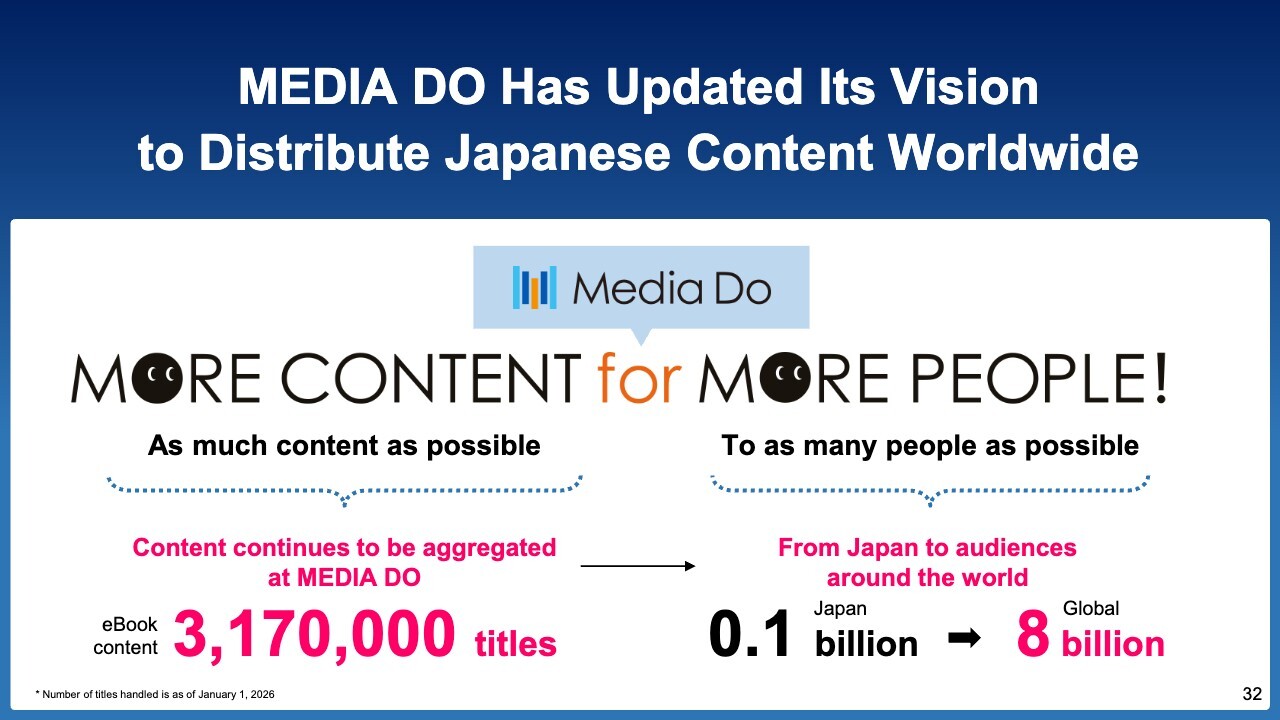
In this context, we intend to promote Japanese content to audiences around the world in earnest. We believe that our purpose is to become a company truly appreciated by Japanese publishers writers and creators not only in Japan but also internationally as we expand overseas, and to be a presence that makes them feel “glad to have MEDIA DO.”
For this reason, for the content for which we have obtained the necessary rights from the publishers for translation and overseas distribution, we will translate it and make it available not only to 0.1 billion people in Japan but also to 8 billion people around the world.
Establishing an Irreplaceable Position as the Gateway for Distributing Japanese “Books” Worldwide
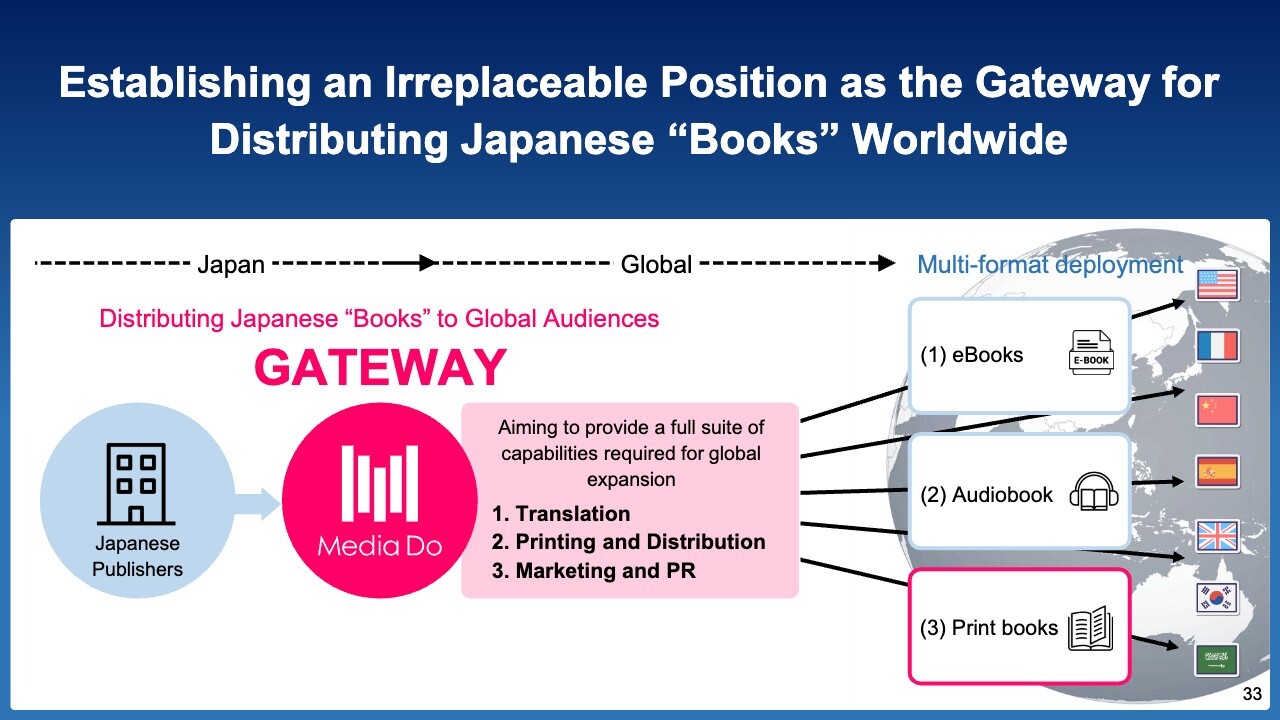
As a gateway for distributing Japanese content worldwide, we handle translation, printing and distribution, and marketing and PR for content received from various publishers. eBooks and audiobooks, in particular, are our strong area.
As for print books, we have not developed our business in Japan until now. However, overseas, the market for print books is far larger than that for eBooks. So, we intend to take on new challenges in print books as well.
Print Books Still Dominate Major Publishing Markets Worldwide Making Print Market Access Essential for Global Expansion
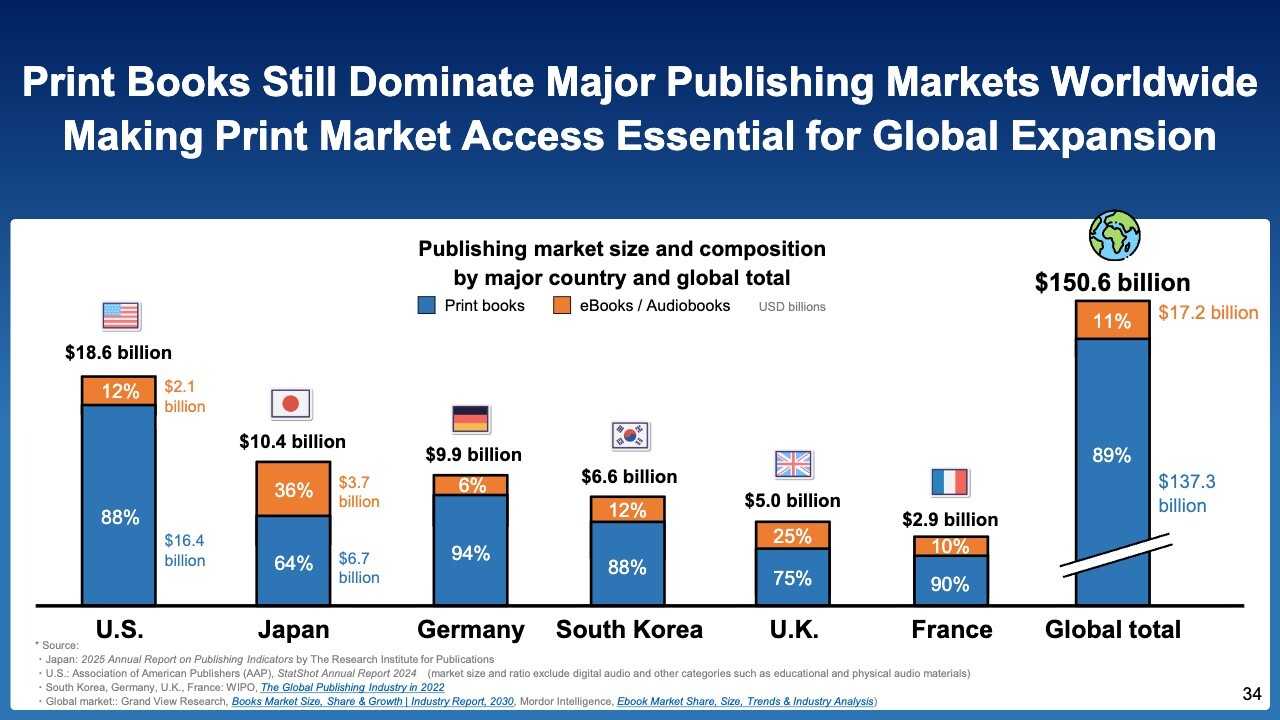
I will explain the overseas publishing industry and print book market. As you can see on the slide, Japan is second from the left, with a publishing market size of $10.4 billion for print books and eBooks. eBooks account for 36% of this total, while print books account for 64%.
In the U.S., on the other hand, print books account for 88%, while eBooks account for only 12%. For the global total, eBooks account for only 11%, and print books still dominate distribution, which is a major difference from Japan.
For our global expansion under these circumstances, we believe it is important to challenge not only the eBook and audiobook markets but also the print book market in order to handle, translate, and distribute the works we receive from Japanese publishers and earn and return foreign currency.
In Japan, for example, major publishers such as Kodansha, Shogakukan, Shueisha, and KADOKAWA have established local subsidiaries in the U. S. and established their own distribution systems. However, for smaller publishers and bookstores, global expansion is yet to come.
Even major publishers have yet to fully distribute all content produced in Japan overseas by utilizing current distribution channels. In this regard, we believe there is room for us to support major publishers in their global expansion as well.
We are conducting research and marketing to promote the global expansion of mainly print books so that each publisher will feel “glad to have MEDIA DO.”
Focusing on Securing Overseas Print Distribution Networks Essential for the Global Expansion of Japanese Content
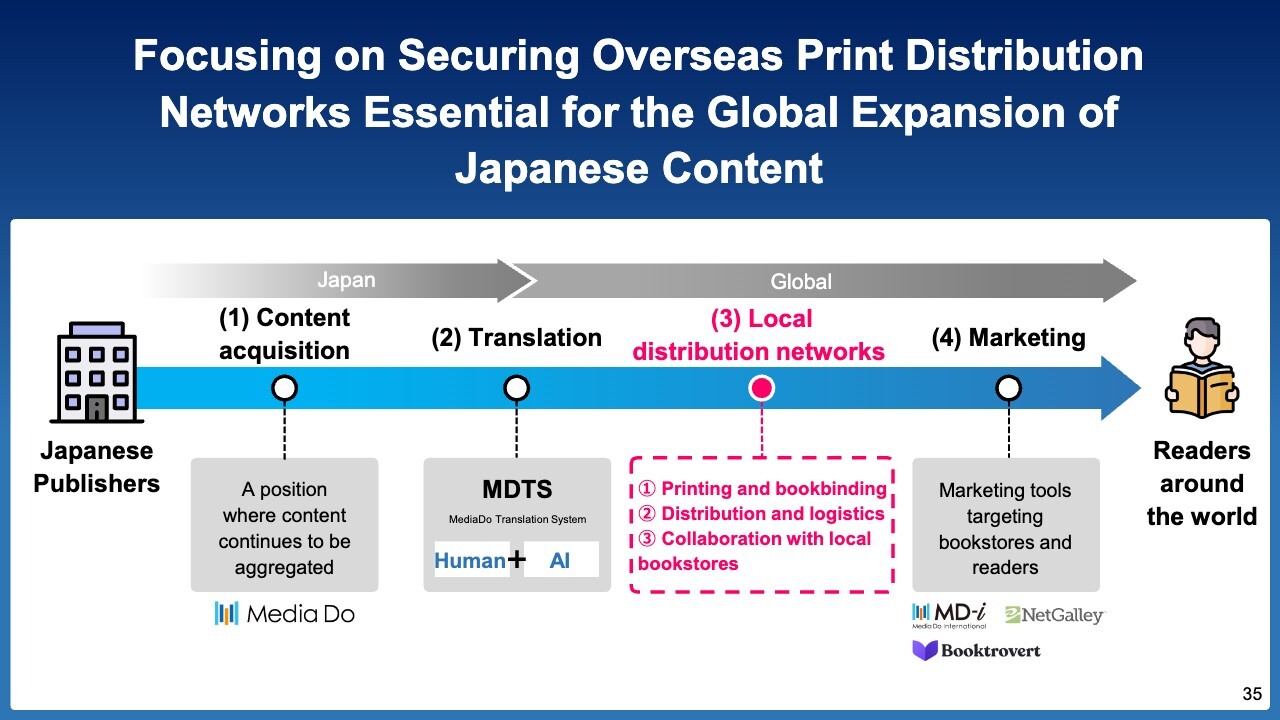
Acquisition and contracting of content are critical in the global expansion of Japanese content. This will be based on our existing contracts with publishers, and we will obtain the necessary rights from publishers and authors.
In addition, if the translation has already been done, we will assist with distribution; if not, we will proceed with the translation as quickly and cost-effectively as possible.
We intend to utilize the AI technology we are developing in this area. We call this system “MDTS (MediaDo Translation System).”
Of particular importance to our efforts is our “local distribution networks.” Specifically, these include printing, distribution, and logistics, as well as collaboration with local bookstores that serve as points of contact with customers.
In this regard, we leverage our full-time director, Sekiya’s know-how, based on his more than 30 years of experience working with bookstores thoroughly at KADOKAWA.
The work produced must then be marketed. We intend to develop this point by utilizing our overseas base, Media Do International, Inc., established in 2016, and marketing tools such as “NetGalley” and “Booktrovert.”
Developing MDTS to Support Translators With the Aim of Significantly Reducing Production Time and Costs
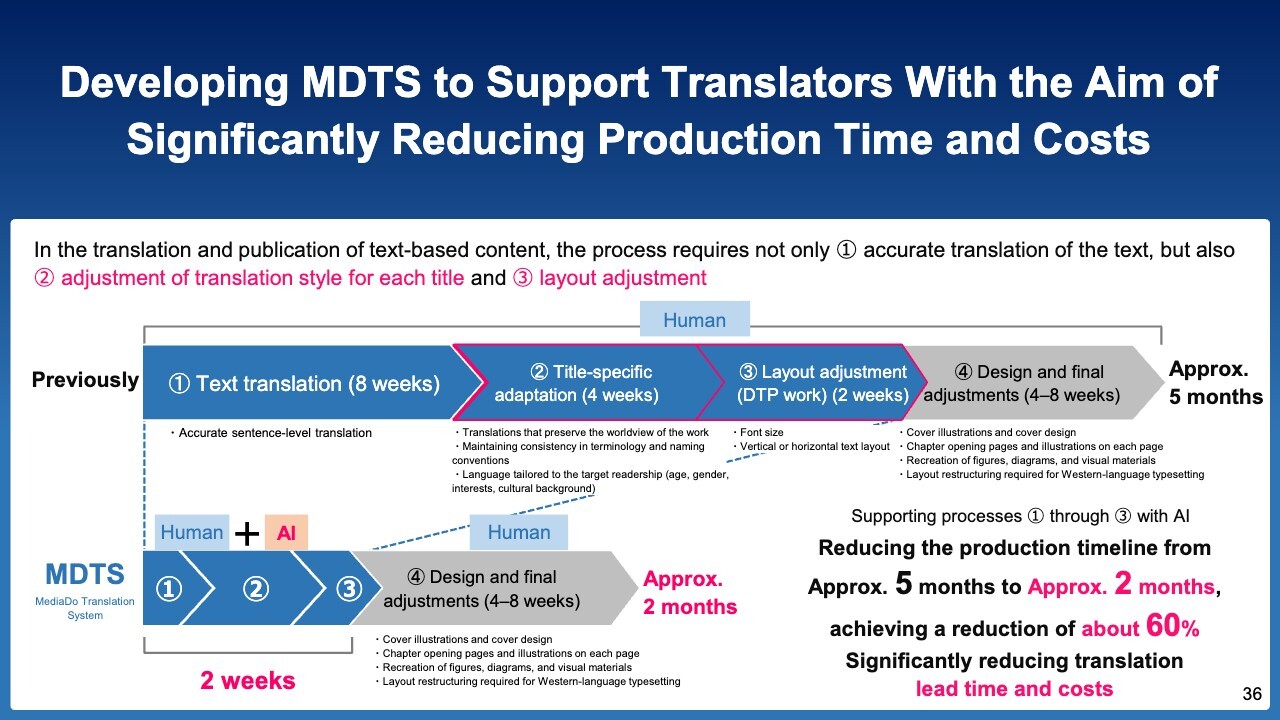
As for the AI-based translation system called “MDTS,” we believe that it is practically difficult for AI to translate everything, and that we can only handle a portion of the translation.
However, even a portion of this process requires a lot of time and man-hours when handled by a person, as it involves text translation, title-specific adaptation, layout adjustments, and final adjustments, including design confirmation.
Normally, the process from translation to distribution takes approximately 5 months, but with MDTS, we have significantly reduced the production timeline and aim to complete it in approximately 2 months.
Establish Local Distribution Networks for Print Books and Aim to Launch Full-Scale Distribution in 2026
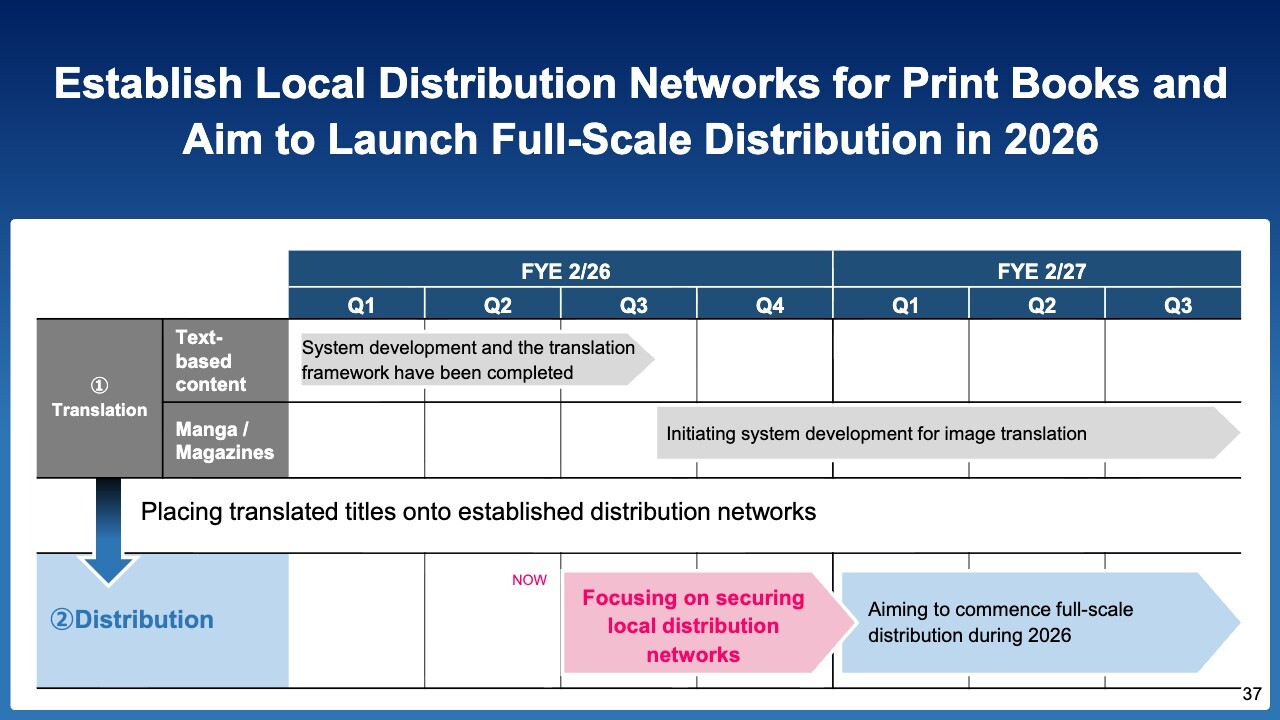
Currently, the AI translation system called “MDTS” has been completed at translating text-based book. Meanwhile, we are also developing image recognition for manga and magazines.
Once these are used to reduce the translation timeline, it is essential to secure distribution networks. We would like to be proactive in this area as well.
The Current SC Business Has Two Main Pillars, Promoting Initiatives Based on Trust With Local Communities
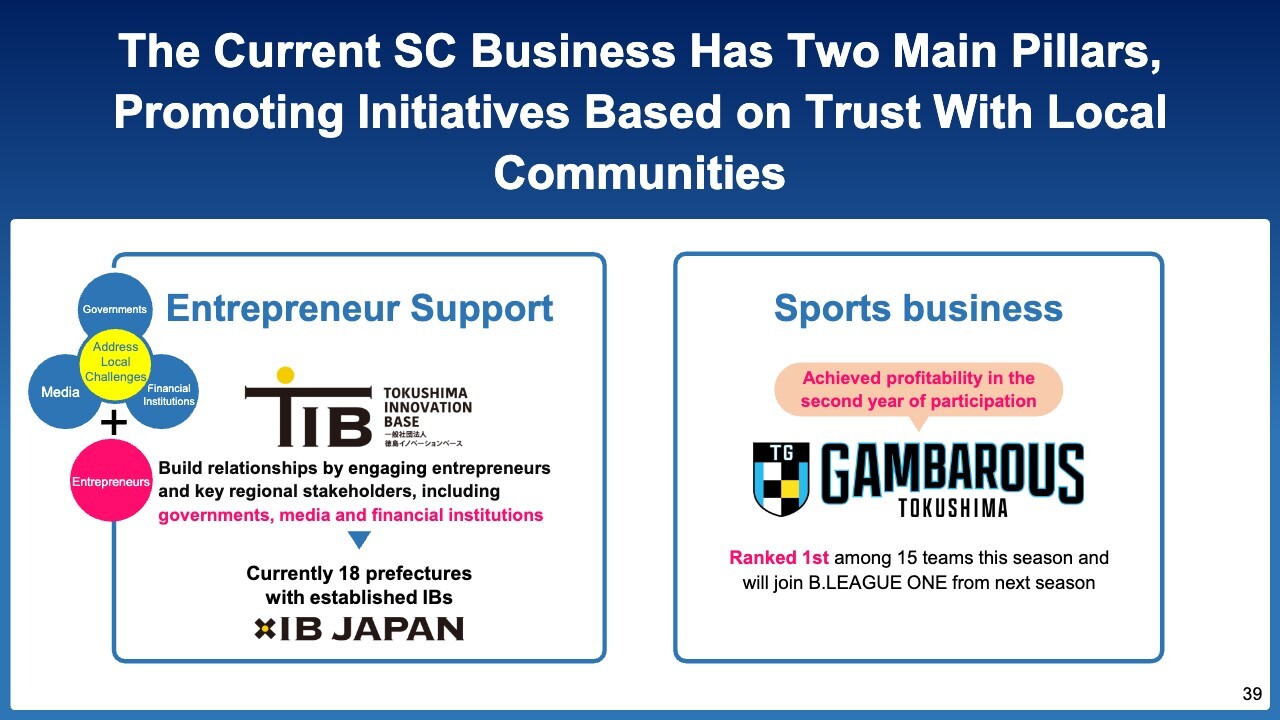
I will explain the SC business (regional revitalization business). Our current SC business has two main pillars.
One is entrepreneur support. This entrepreneur support is not a product sold by the Company, and no sales are generated directly by it. Intrinsically, considering regional revitalization, however, the challenges are population decline and rural decline. It can be expressed in numbers, for example, 100 becomes 99, 99 becomes 98, and so on.
It is important to work not only to “bring this back to 100 (restore)” but also to “bring 100 to 101 (increase added value).” What is needed for this is the ability of entrepreneurs to “create 1 from 0.” We believe that the key to regional revitalization is to create a mechanism that will continue to produce entrepreneurs throughout Japan.
Governments, media, and financial institutions are responsible for local management. We believe that various types of information are gathered in these three areas. Therefore, we believe it is necessary to establish a system in which governments, media, financial institutions, and the entrepreneurs we support work together to continue producing entrepreneurs and people with entrepreneurial spirit for future generations.
The other is the sports business. TOKUSHIMA GAMBAROUS, which competes in the B.LEAGUE, is a professional basketball club based in Tokushima.
Scaling Nationwide Using Tokushima as a Model Case Expanding the Business While Contributing to the Development of Local Communities Across Japan
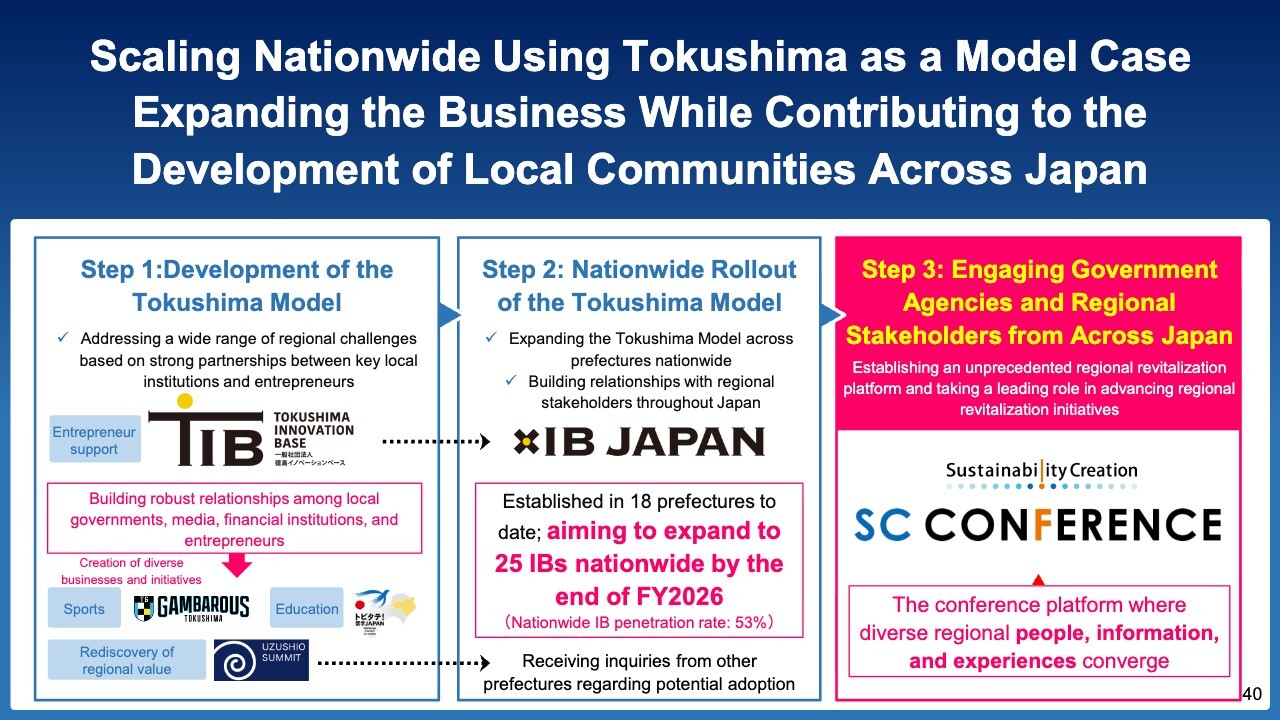
This is about the model we are currently considering for our SC business. The theme of regional revitalization is too broad, and circumstances and backgrounds differ from region to region.
Meanwhile, regional revitalization is becoming increasingly important as a common issue throughout Japan. In this context, I am conducting various trials with many people in Tokushima Prefecture, my hometown. We believe that the results obtained there could be packaged and applied to other prefectures.
We hope to expand the “Tokushima Model” created in Tokushima Prefecture across prefectures nationwide and further worldwide.
One such example, in the area of entrepreneur support I mentioned earlier, is the system we led in creating in 2020, which is now established in 18 prefectures across Japan. This initiative is expected to be expanded to 25 prefectures by the end of FY2026, and to 46 prefectures (excluding Tokyo) within another 5 years.
We believe it is important to expand the model we have developed with people in Tokushima Prefecture to the rest of Japan and eventually to the world.
We believe that concrete proposals make our initiatives easier for everyone to understand when they are based on successful models and demonstration experiments conducted in certain regions and localities, rather than suddenly rolling them out across Japan, , because we have precedents to draw on. We would like to promote and expand our business in this way.
Under these circumstances, I consider the core of the SC business to be “leading the way in regional revitalization business.” Companies or organizations might be listed as leading one, such as “When it comes to agriculture, it’s this company” or “When it comes to fisheries, it’s this organization.”
Which companies are leading the way with the big idea of “regional revitalization,” which encompasses all of the above? We believe it would be ideal if our company were one of them, and if we were to develop our business, we would aim for first prize. One specific initiative that represents this idea is the SC Conference.
The First SC Conference to Be Held at a Scale of 1,500 Participants, with Plans to Expand and Host Annually Going Forward
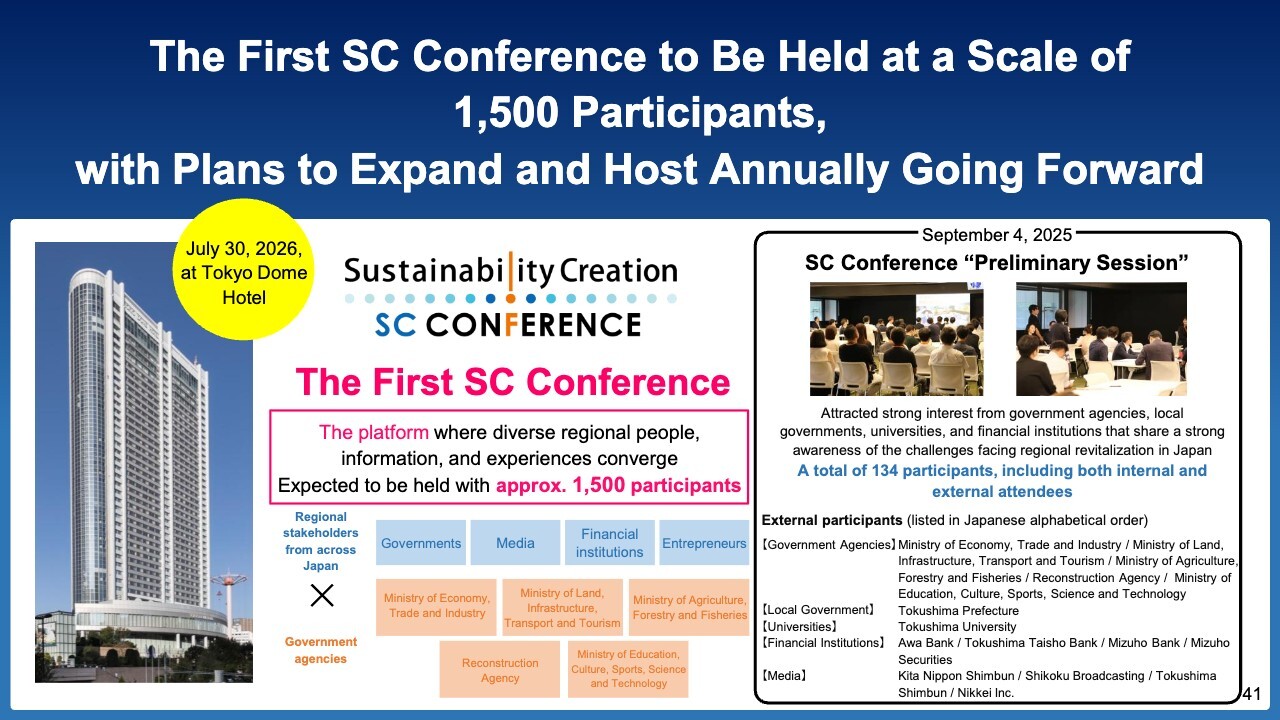
On July 30, 2026, a regional revitalization event is expected to be held with approximately 1,500 participants from all over Japan. We will proceed with this event in cooperation with regional stakeholders from across Japan and government agencies.
We would like to invite all “regional stakeholders” to participate, including local governments, media, local financial institutions, and entrepreneurs who have grown up on the platform, which began with TIB and xIB Japan and has now been established in 18 prefectures. As for government agencies, we cooperate extensively with the Ministry of Economy, Trade and Industry, the Ministry of Land, Infrastructure, Transport and Tourism, the Ministry of Agriculture, Forestry and Fisheries, and so on.
As part of this initiative’s marketing effort, an event titled “SC Business 1DAY Conference ‘Preliminary Session’” was held on September 4, 2025. We had a total of 134 participants, and we received strong interest and cooperation from all stakeholders regarding our company’s concept of regional revitalization.
We hope to further expand the event’s scale to 1,500 people this year, 10,000 next year, and 100,000 within a few years.
Not only holding events in Tokyo, but we also intend to create a platform to expand into other regions across Japan and turn it into a business.
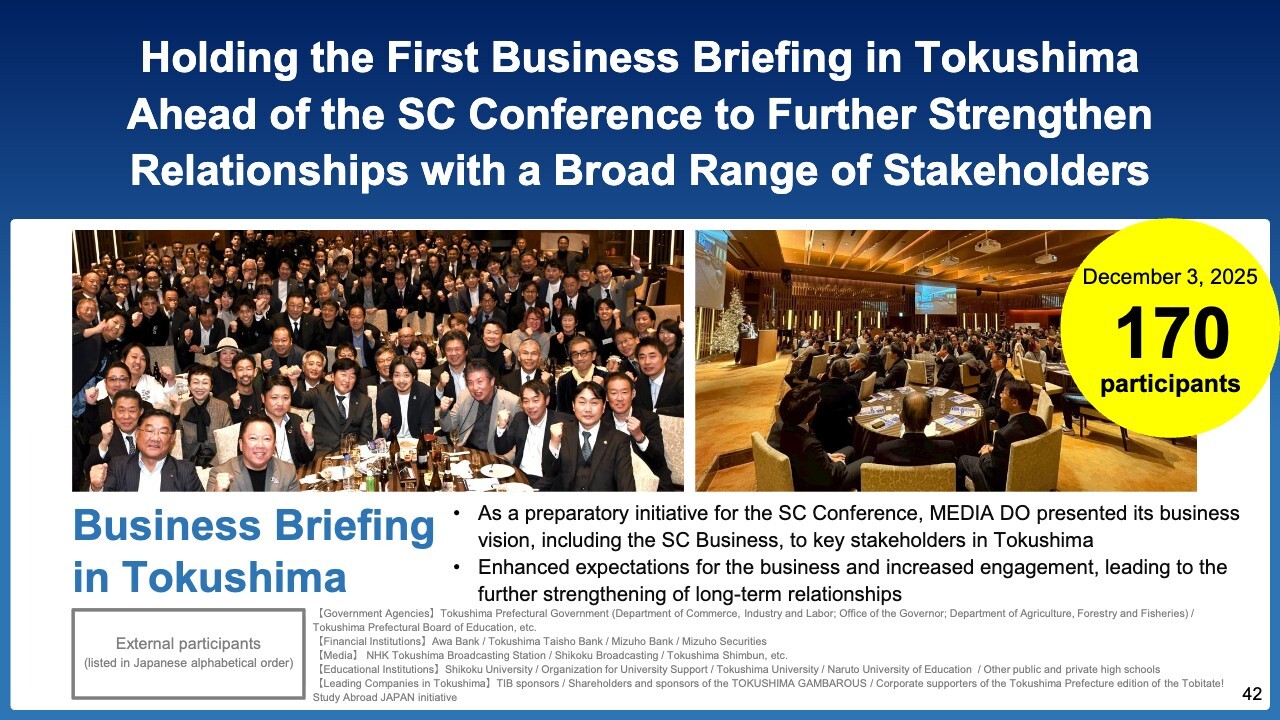
Holding the First Business Briefing in Tokushima Ahead of the SC Conference to Further Strengthen Relationships with a Broad Range of Stakeholders
Regarding this “SC Conference,” we will discuss where and how to start, how to explain it, and how to ask for cooperation.
We are currently promoting cooperation with government agencies, and we held MEDIA DO’s business briefing in Tokushima Prefecture on December 3, last year, in the hope that people in Tokushima would also cooperate with us.
We explained at the briefing for participants to understand our eBook Distribution business using MEDIA DO’s technology and our global expansion.
Not only that, but we also held the briefing as a project to introduce our SC business to key stakeholders in Tokushima, which MEDIA DO launched last April, and to discuss the possibilities for regional revitalization.
As a result, the event was a great success, with 170 participants from the media, financial institutions, government agencies, and local autonomy heads, including Gotoda, the governor of Tokushima prefecture. We intend to actively utilize this experience and learning at the “SC Conference” as well.
Hosting the Tokushima Version of the “Davos Meeting,” the Uzushio Summit Rediscovering the Value of Local Communities from a Global Perspective
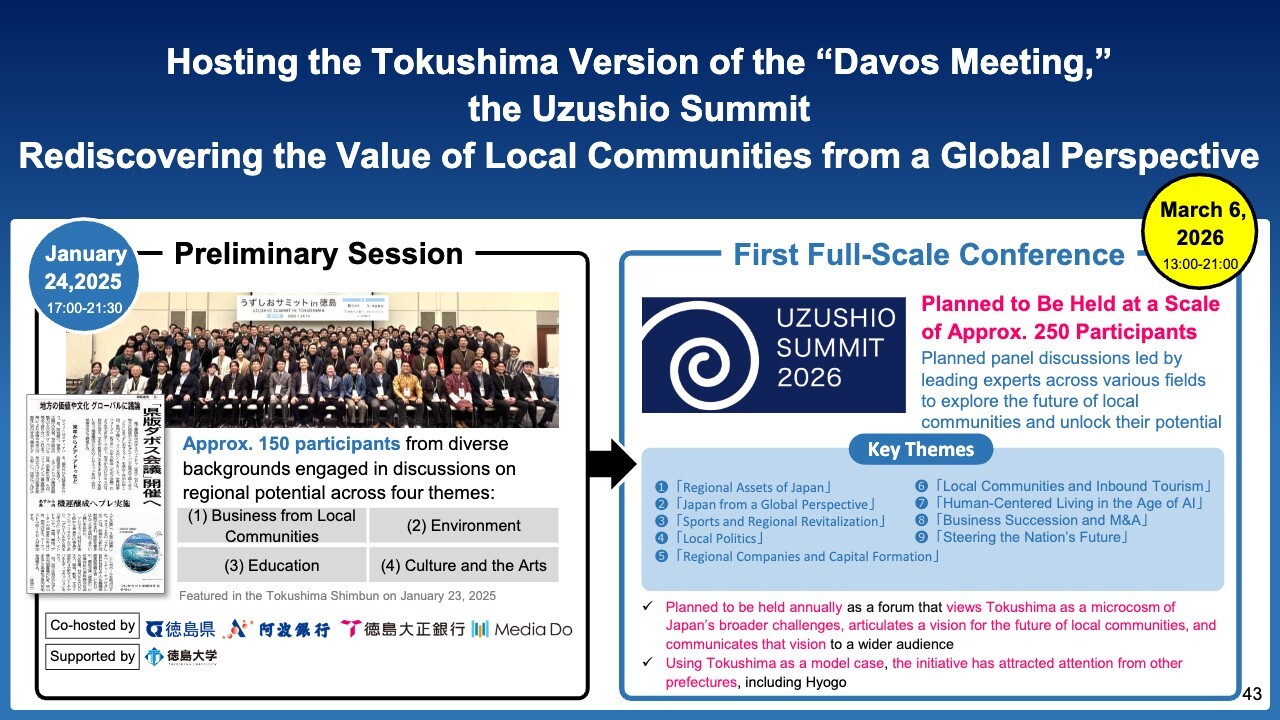
The major opportunity for promoting the launch of the SC business was the “Uzushio Summit,” the Tokushima version of the Davos Meeting held last January. This meeting was held on January 24, 2025, as a preliminary session for a marketing opportunity.
The session started with four themes: “Business from Local Communities,” “Environment,” “Education,” and “Culture and the Arts.” The session was so successful that we are planning to hold the first full-scale conference on March 6 this year. We will hold this event focusing on the key themes listed on the slide.
We believe that by repeating these events, we will be able to reflect the opinions of participating experts on “what regional revitalization should be” and increase the resolution and certainty of our business.
In addition, we believe that by setting up a series of events of this scale, we can also accumulate experiences to know “how to design an event and how to make the event itself a success.”
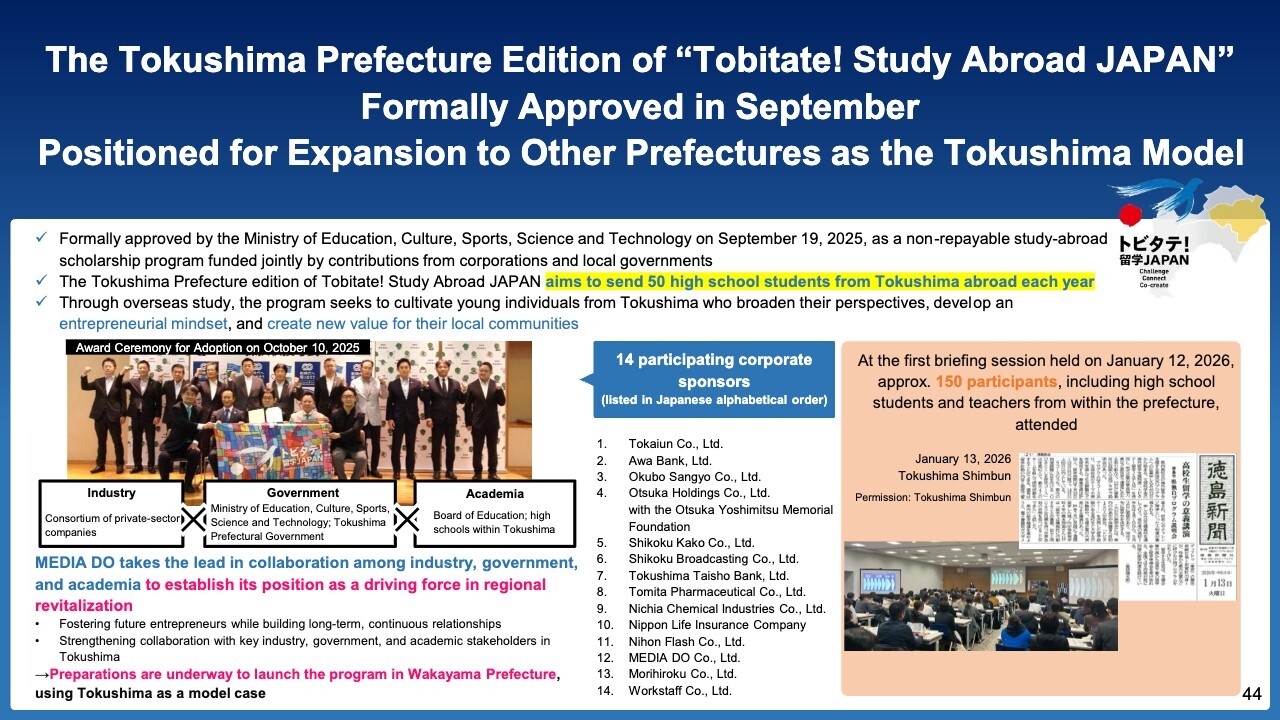
The Tokushima Prefecture Edition of “Tobitate! Study Abroad Japan” Formally Approved in September Positioned for Expansion to Other Prefectures as the Tokushima Model
There is an initiative called the Tokushima prefecture edition of “Tobitate! Study Abroad Japan,” derived from the “Uzushio Summit.” This is not MEDIA DO’s business, but in promoting regional revitalization, it is necessary to view things from various perspectives and angles.
As the greatest common divisor, we believe that the most important thing is to get local people interested, concerned, and on our side.
We also believe that regional revitalization will be largely determined by how future adults, i.e., current children, grow up.
Since 2013, the Ministry of Education, Culture, Sports, Science and Technology has been offering a national version of “Tobitate! Study Abroad Japan.” This initiative is a wonderful program for Japanese high school and university students to study abroad on a non-repayable scholarship. And, as the Tokushima prefecture edition of this model, the “Tokushima Prefecture Edition of Tobitate! Study Abroad Japan” began last year.
In this initiative, with the cooperation of Tokushima Prefecture and the support of 14 companies in Tokushima Prefecture, a total of 30 million yen was contributed to the fund. Using this fund, we aim to send 50 high school students from Tokushima abroad each year.
We held the first briefing session on January 12, 2026. The slide shows the briefing that was also published in the newspaper. While only 50 students are allowed to study abroad, approximately 150 participants, including parents, attended the first briefing session.
In Tokushima Prefecture, high school students can study abroad for 2 weeks to 2 months through a non-repayable study-abroad scholarship. Although the study abroad period is limited due to academic responsibilities, we believe that by utilizing this program, which is formally approved by the Ministry of Education, Culture, Sports, Science and Technology, our company has been recognized for making a solid contribution to the local community.
I believe that there are issues involved in such an initiative, such as “what is the right answer” and “to what extent is it a business?” However, to promote our regional revitalization business, we believe it is important to steadily build trust among local and regional stakeholders, and we are implementing these initiatives.
TOKUSHIMA GAMBAROUS Continue to Lead the League, Maintaining an Occupancy Rate Above the B1 League Average
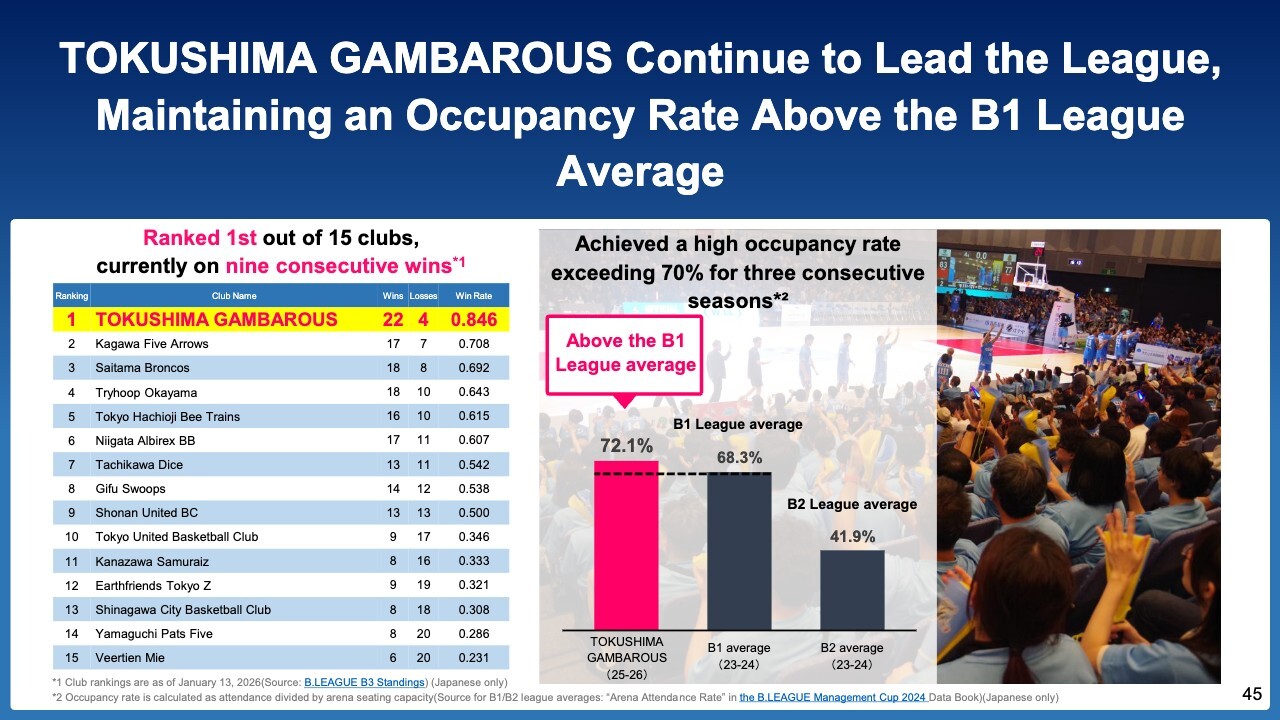
Next, I will explain our Sports business. TOKUSHIMA GAMBAROUS, a men’s professional basketball club in its third year in the league, is currently ranked 1st out of 15 clubs in the B3 category and has nine consecutive wins, although it is the lowest of the three B1, B2, and B3 categories in the B.LEAGUE.
In Tokushima Prefecture, the club has achieved an occupancy rate exceeding the B1 and B2 League averages, even though it competes in B3. This helps illustrate the strong support TOKUSHIMA GAMBAROUS receives from people across the region.
The “GAMBAROUS SEVEN” App Creates Fan Stickiness and Contributes to Stronger Club Management, With the Aim of Expanding the Tokushima Model to Clubs Nationwide
Our company participates in the B.LEAGUE and is working to energize Tokushima Prefecture and other regions. In addition, as I have become a B.LEAGUE board member, I am now in a position to think not only about Tokushima but also about how to help further energize communities across Japan.
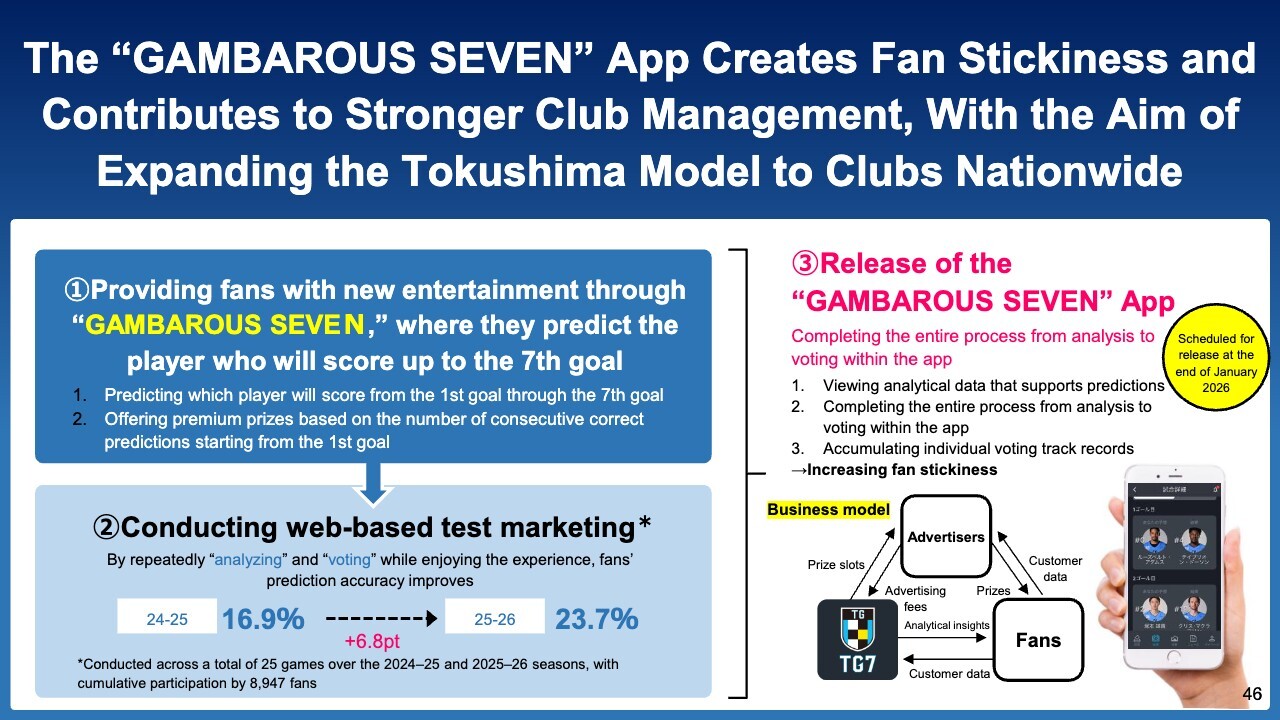
Against this backdrop, we launched a new initiative called “GAMBAROUS SEVEN” the year before last. This initiative has been very well received by fans who have come to TOKUSHIMA GAMBAROUS games.
What was previously available on the web will be released as an app this month for fans of TOKUSHIMA GAMBAROUS. Based on the results of these efforts, next season we will conduct media adaptation of efforts utilizing our app in earnest for TOKUSHIMA GAMBAROUS and provide it to our sponsors. We would like to license this offered package to all of Japan (currently 55 clubs).
Currently, the business scale of the B.LEAGUE, up to B3, is approximately 81 billion yen in the previous year’s results. On the other hand, J.LEAGUE has nearly doubled that figure, reaching approximately 190 billion yen.
B.LEAGUE aims to expand to 190 billion yen in size, the same as J.LEAGUE, around 2030. This “GAMBAROUS SEVEN” will be renamed “B SEVEN (tentative name)” when it is rolled out nationwide.
To explain what kind of app it is, basketball is a sport where scoring is very intense, and the average score is often around 80-80. In such a game, fans predict which TOKUSHIMA GAMBAROUS player will score from the 1st goal through the 7th goal and vote before the game starts.
The difficulty level increases based on the number of consecutive correct predictions starting from the 1st goal. The prize should be open and in a form that does not violate the Act against Unjustifiable Premiums and Misleading Representations. For example, the model is: if you win “7 in a row,” you will receive an automobile. This is the model in which being sponsored by the automaker becomes an advertisement.
We will start this kind of initiative with TOKUSHIMA GAMBAROUS. We aim not simply to help clubs win, but to build a system that allows fans to enjoy the game on a deeper level and to deliver an app that provides new entertainment and generates revenue for the clubs.
Through “B. Revolution,” B.LEAGUE Is Transforming Its League Structure Into a Full-Fledged Regional Revitalization League
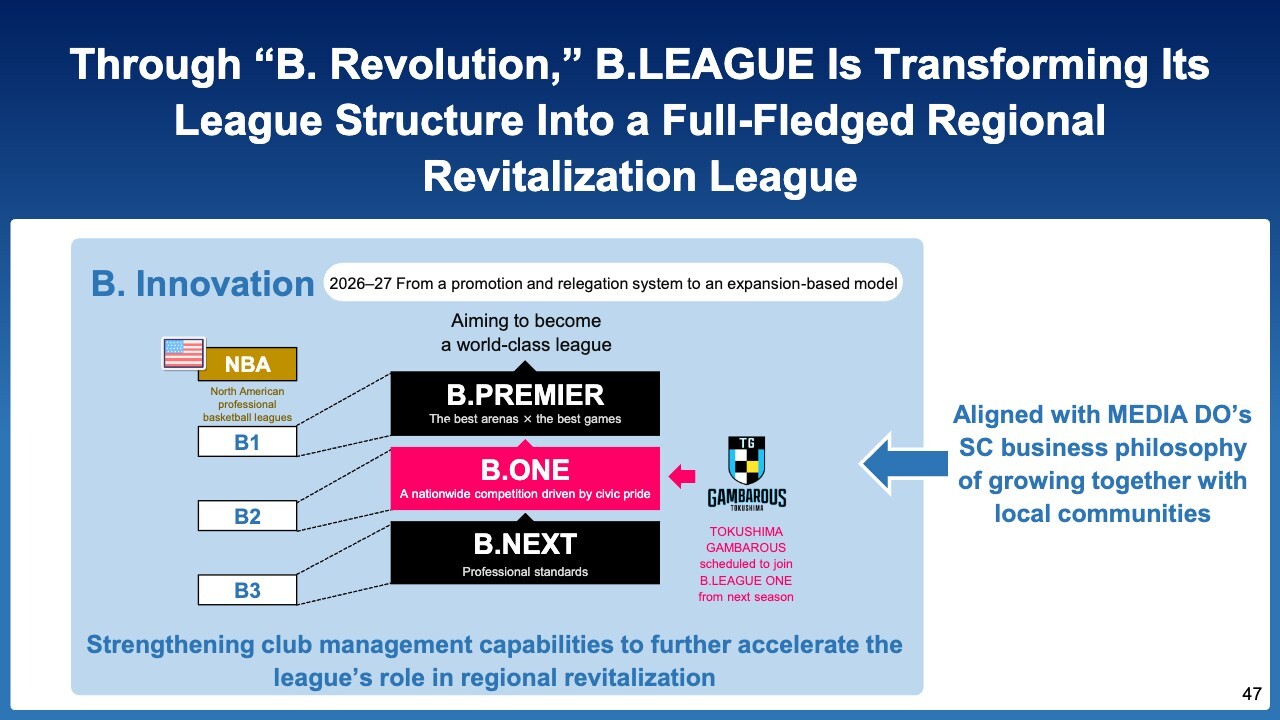
B.LEAGUE operates under the existing rules for B1, B2, and B3 until this season, but from next season, scheduled to start at the end of September or October, it will be divided into three categories: B.PREMIER, B.ONE, and B.NEXT.
B.PREMIER requires a high level of quality; for example, installing an arena is mandatory. B1 will not simply be renamed “B.PREMIER,” but will be established as an upgraded stage between the NBA and B1, based on the idea that the B League aims to become a world-class league like the NBA of America.
Currently, TOKUSHIMA GAMBAROUS is in B3, but it is scheduled to join “B.LEAGUE ONE” from next season. B.LEAGUE ONE is positioned between B1 and B2. Therefore, we see the level rising all at once from next season onward.
Considering the timing of the league structure change, the fact that TOKUSHIMA GAMBAROUS is currently in its third season and is scheduled to join “B.LEAGUE ONE” in its fourth season, and also, as I have become a B.LEAGUE board member, our company would like to move forward with this project by steadily using this momentum.
TOKUSHIMA GAMBAROUS to Enter B.LEAGUE ONE from the Next Season, Aiming for Further Growth Supported by the Arena Development Plan
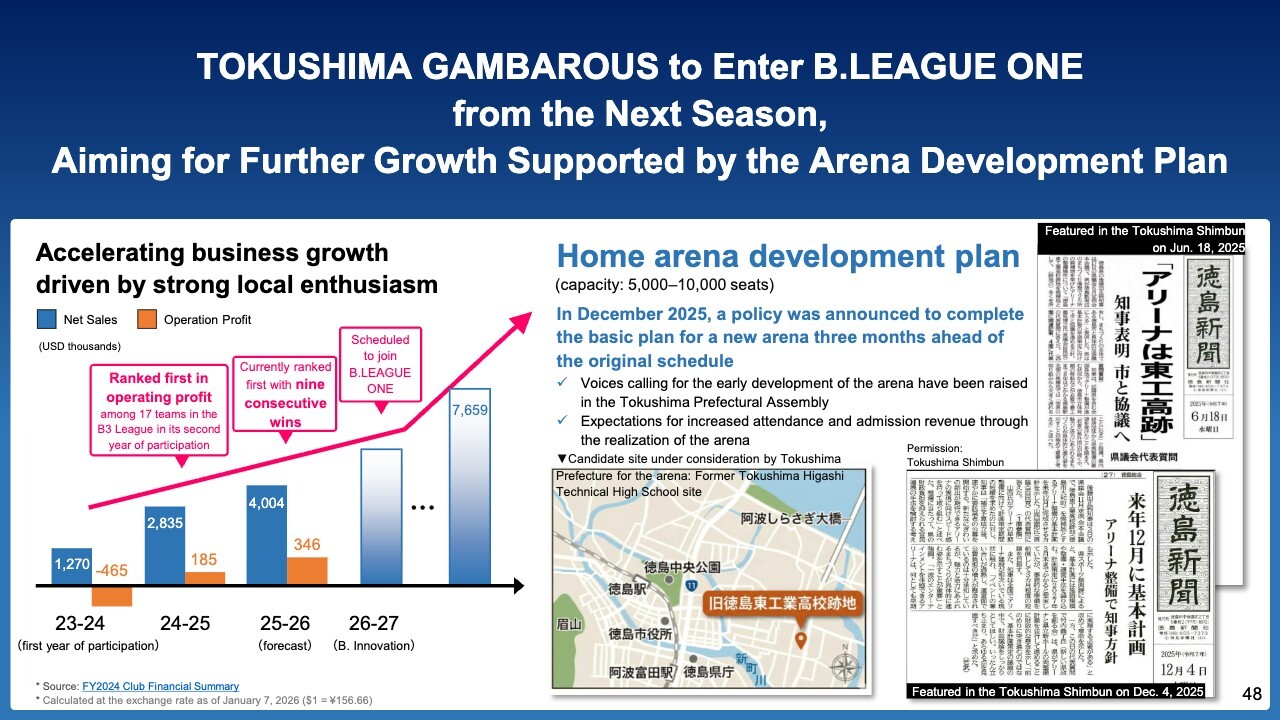
With the foundation of TOKUSHIMA GAMBAROUS, a home arena development plan has been underway in Tokushima Prefecture.
Currently, an arena is required for the club to promote to “B.LEAGUE PREMIER.” In other words, once the arena is completed, the business scale is expected to expand.
We would like to work with Tokushima Prefecture to realize the arena construction while building a solid track record in “B.LEAGUE ONE.”
Although we are not directly funding the project, with the help of the prefecture, the national government, and all stakeholders, we would like to further develop our business and make it into content that will help boost Tokushima Prefecture once the arena is completed.
Introduction of a Fundamental Policy on Large-Scale Purchases to Safeguard Share Liquidity and the Publishing Distribution Infrastructure
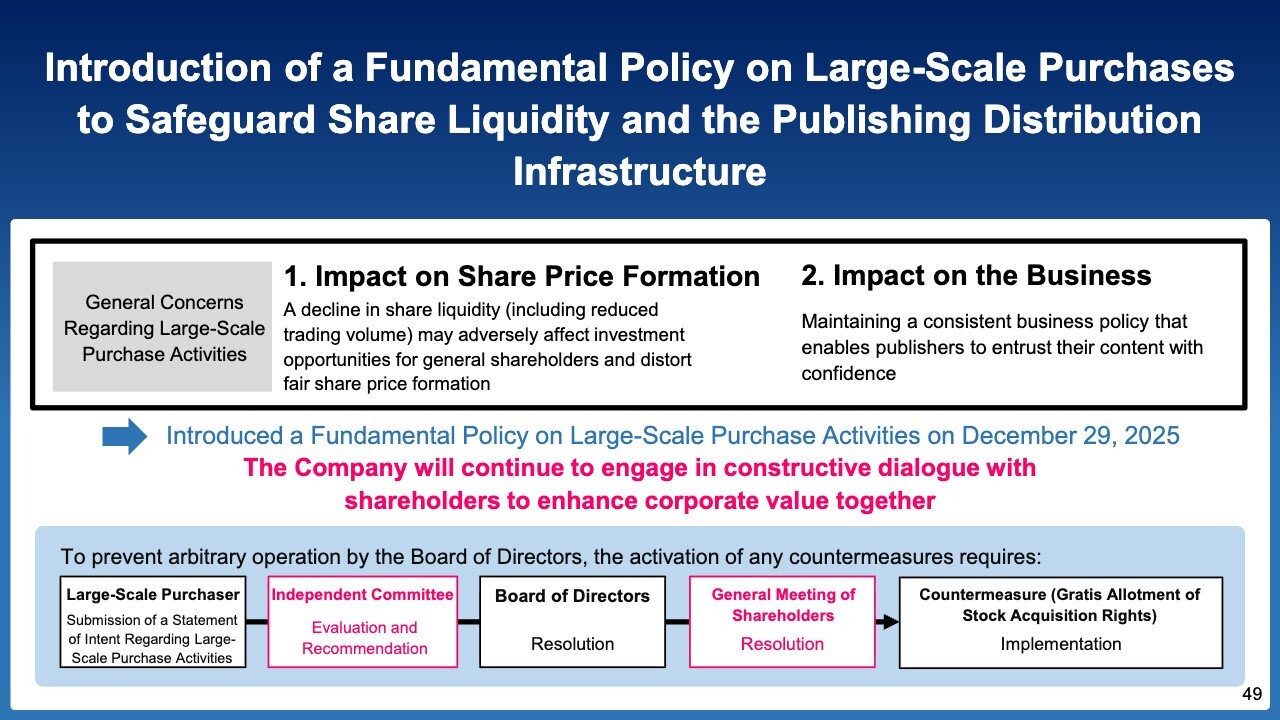
On December 29, 2025, the Company announced the introduction of a takeover defense plan. This anti-takeover measure is designed to respond to contingencies.
Although no specific takeover offer was made to us, an institutional investor, Hikari Tsushin K.K., evaluated our company’s business potential highly and acquired up to 20% of our shares as a net investment.
However, because of the nature of the net investment, the shares may be sold in the future. Therefore, there is a risk of significant impact on management if any more shares are acquired and then sold in large quantities at once.
In response to this situation, we decided to introduce anti-takeover measures and spoke directly with shareholders on January 6. We have received very gratifying feedback that, “As a shareholder, we find your company fundamentally attractive from an investment standpoint, and we plan to hold it for the long term.” As we have introduced an initiative that is not usually seen, we explained it to shareholders.
That is all for my explanation. Thank you very much.
Q&A: Focusing on securing local distribution networks for the global expansion
Questioner: Regarding the part about “focusing on securing local distribution networks” for global expansion. For example, will you set up a local subsidiary, or will you use the existing local distribution networks for distribution and logistics? Please show us your specific form.
Fujita: We are considering various possibilities. We are considering a wide range of options, including having our existing distributors carry our printed materials, partnering with existing publishers to move forward, and further forming a joint venture with an existing publisher.
We are not yet at the stage where we can make a concrete announcement, but we expect to be able to formally announce our direction by the end of the year. At that time, we will explain again.
Q&A: Progress of the Medium-Term Management Plan and future outlook
Questioner: In terms of performance progress, it appears that you expect to clear the first year, the first year of the Medium-Term Management Plan, but as far as you can tell us about the second and third years, how do you plan to show progress?
Fujita: The Medium-Term Management Plan was prepared mainly for existing businesses and does not include new businesses such as overseas distribution.
As the new business progresses, investment costs may be incurred, but sales may also be generated. With this in mind, we are building our business to achieve our plan for both next year and the year after.
Q&A: Evaluation of Japanese content overseas and progress in Tokushima regional revitalization
Questioner: This is about the popularity of Japanese content overseas. I feel there is more news about award-winning text-based books and others than last year, when the Medium-Term Management Plan was issued. Therefore, I see that the evaluation has changed for the better compared to your assumptions. I would like to hear your opinion, including how it feels. In addition, compared with the time of the announcement of the Medium-Term Management Plan, I believe there has been greater progress in regional revitalization in Tokushima. Please tell us the difference between your initial assumptions and the current situation.
Fujita: First, I would like to discuss how Japanese content is evaluated overseas. Japanese content has always had a high reputation, but, as you asked, after we announced our Medium-Term Management Plan, we feel it is in even greater demand.
The Japanese government, especially the Ministry of Economy, Trade and Industry, the Ministry of Education, Culture, Sports, Science and Technology, and other related agencies, is increasingly focusing on promoting Japanese content worldwide. As a result, budgets such as grants and subsidies have been enhanced.
First, a specific example is subsidies for translation. On the other hand, one thing we feel is still not enough is subsidies for distribution. Therefore, we would greatly appreciate the availability of such subsidies for content distribution. We will continue to negotiate to receive such support.
The Japanese government has made its intention even clearer to promote “Japan Contents” to the world through a national effort, including manga, text-based books, and animation. We would like to develop in close cooperation with this.
As I explained earlier, the opportunity for promoting the launch of the SC business (regional revitalization) was the “Uzushio Summit,” Tokushima Prefecture’s version of the Davos Meeting, held in January last year. The event gave us a clear picture of the possibilities and the fact that many people would love to do it.
On the other hand, when we announced our Medium-Term Management Plan last April, we talked about two businesses, entrepreneur support and sports business, but we did not have a clear view at that time of the platform that would be built to accept these businesses.
At the event held on September 4 last year, we gathered opinions from many participants, including government officials, and it was very successful. We received many requests for similar events since they are not available anywhere else in the world.
Thus, we believe the original purpose of the SC business is to build a platform that engages people and provides them with the opportunity to meet, exchange information, and learn. We are now proceeding with our business based on this premise, and what we could not see as of last April is now clear. We believe we have made significant progress.
Questioner: With regard to overseas content distribution, I imagine a model where you get a distribution fee. Can you tell us about new ways to generate revenue, to the extent possible? Are you considering incorporating new elements into your business model in the future?
Fujita: First of all, as a basic premise, I believe that the market is becoming established and growing in terms of the fact that Japanese content is increasingly sought after around the world.
Under such circumstances, it is important to know how to proceed with translation in a cost-effective and efficient manner. On the other hand, as translation incurs costs, we believe it is an issue that should be discussed with each publisher to determine how those costs should be divided.
In addition, until now, agents have been involved when Japanese publishers, especially smaller publishers, seek to expand overseas, but agents are only intermediaries and are not in charge of distribution itself. We recognize that we are in a very different position, as we are responsible for distribution.
It is also necessary to adapt to the differences in business practices between Japan and the U. S. From this perspective, rather than a new business model, we can view the field of “print book” itself, which we had not previously engaged in, as a new business model. Therefore, we believe that establishing a solid distribution system will be a new business for us.
Q&A: Global expansion and future investment plans
Moderator: “Let me confirm the scale of your upfront investment for global expansion in 2026. Are you going to start developing on a small scale or on a scale above a certain level?” This is a question.
Fujita: This may overlap with the first question, but we are currently exploring all possible ways. We believe we should be working on a distribution operation, not an agency, which will require deep alliances with local companies.
Therefore, in some cases, it may be possible to develop the system using B/S, while in others it may be necessary to develop a costly system in terms of P/L. In addition, we believe that, rather than using AI in digital, investments must be made in the area of “what to do with print books distribution.”
At this time, we have not reached the stage where we can provide specifics. We are still in the research and coordination phase.
Q&A: Measures to improve performance of text-based book and manga businesses
Moderator: The question is, “What is the outlook for NIHONBUNGEISHA, which has hampered the strategic investment businesses in Q3?”
Kanda: As I explained earlier, in the area of text-based books, especially practical books, performance has been improving as reforms have progressed since the appointment of President Takemura in May of the year before last.
Regarding manga, although there has been some support for performance from media adaptations, medium-term issues emerged in Q3.
We are already working to expand the editorial department and review the structure, but this will not have an immediate effect and will ultimately focus on the production of the work. Therefore, I believe we will be able to show signs of improvement in the next fiscal year and beyond.
In Q4 and beyond, we are also pursuing various initiatives and organizational reviews, including cost reductions. Regarding this, we believe some effects can be foreseen at an early stage.
Q&A: New business partners in the distributor business
Moderator: The question is, “Regarding the distributor business, please let us know if there are any new business partners moving forward.”
Kanda: It is difficult for me to give you the name of a major new customer we are “likely” to acquire in the current situation. However, the industry as a whole has seen a significant increase in the number of campaigns and files in the eBook Distribution business, and the distributor’s presence is being reevaluated and growing in importance.
For this reason, we intend to continue acquiring distribution channels with various eBook retailers, such as “Piccoma” and “Mecha Comic.”
Q&A: Audiobook market expansion potential
Moderator: “Are audiobooks likely to be a growth driver?” This is a question.
Kanda: Compared to overseas markets, we believe that there is still much room for expansion in the Japanese audiobook market.
We are working with Amazon’s Audible and continue to see its strong growth potential. On the other hand, for audiobooks, there seems to be almost no media other than “Audible” in Japan.
In other countries, the market is growing through mutual improvement among many players, such as “Spotify” and “Audible,” but such a major movement has not yet been seen in Japan.
The expansion of the eBook market for manga in Japan has been driven by new entrants from a variety of players. We believe this has revitalized the market and led to significant growth.
We hope to see further market revitalization in the audiobook market as well.
Q&A: The superiority of MEDIA DO’s business model
Moderator: “What is your company’s superiority, which is a prerequisite for the growth of an eBook distributor? Is there a difference in pricing, such as ‘Using MEDIA DO enables higher commission than competitors because of getting distribution scale’? Also, please let us know if there is any price competition with other companies.” This is a question.
Kanda: We believe the eBook distributor business model in Japan is not often seen in other countries. This is due to the market structure and the situation of the various players.
For example, compared with the U.S., the market share of major publishers is lower in Japan, and the structure is characterized by a large number of small- and medium-sized players. There is also a wide variety of players in the eBook retailer platform. We do business with more than 2,200 publishers and over 150 eBook retailers.
In other words, if you are a new entrant, you will need to communicate with more than 2,200 publishers if you are an eBook retailer. In order for publishers to distribute content to various eBook retailers, they also need to sign contracts with each player, update files monthly, manage sales, and manage campaigns.
We work with a wide variety of players, and publishers can distribute content across multiple eBook retailers by simply signing a contract with us. We have established a system that allows eBook retailers to obtain content from a variety of publishers by signing a contract with us. We believe this allows our trading partners to reduce transaction friction and increase distribution speed.
We see our growth rate to be in line with the overall eBook market growth rate. We believe the growth rate of our existing distribution channels will closely match that of the overall market.