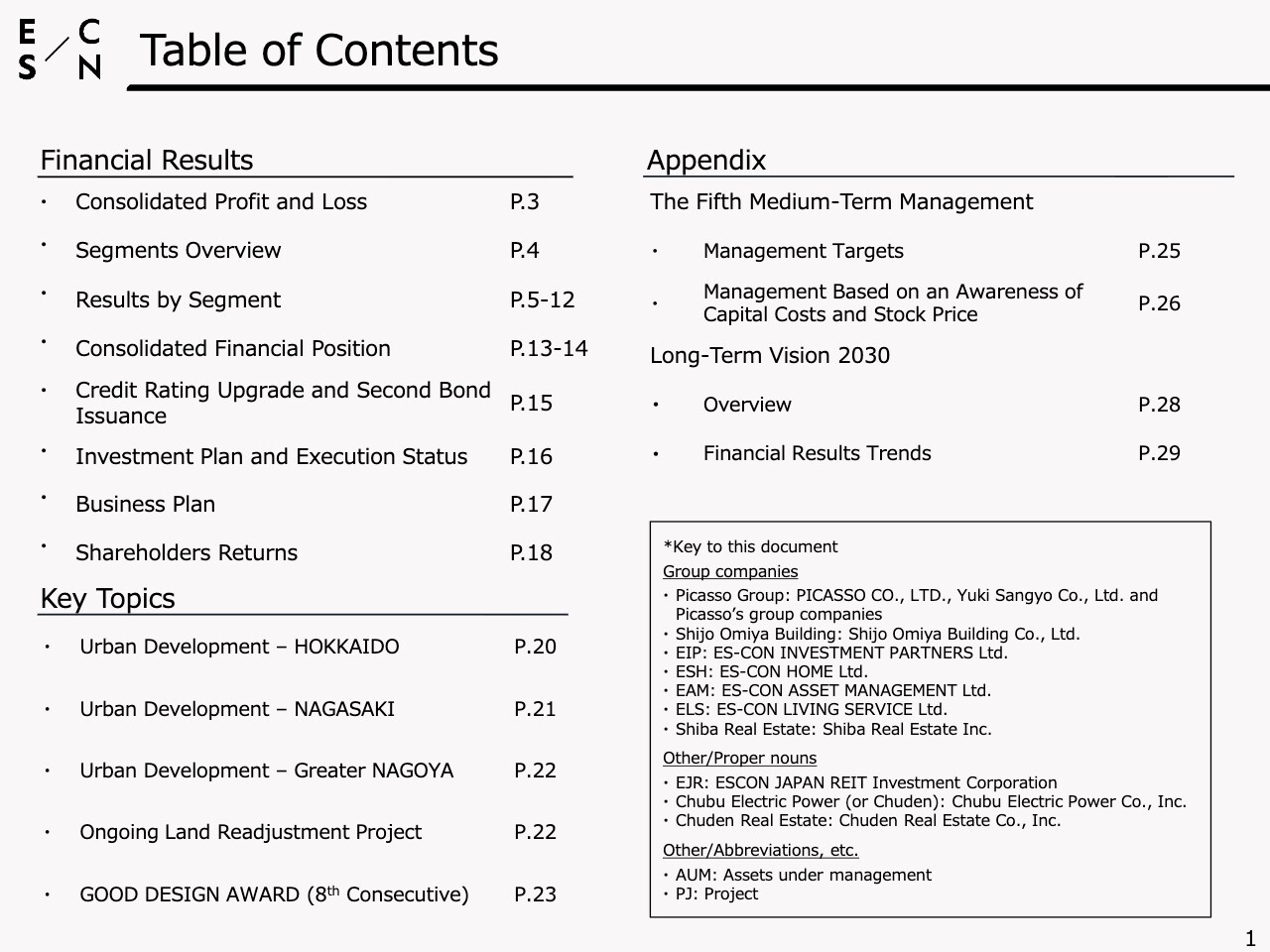
Table of Contents
Takatoshi Ito (hereinafter, Ito): Good afternoon, everyone. I am Takatoshi Ito, President and Representative Director of ES-CON JAPAN Ltd. Thank you very much for taking the time out of your busy schedules to attend and view our financial results briefing for the second quarter. We will now begin the briefing for the first half of the fiscal year ending March 2026.
Today, I will provide an overview of our financial results, key updates on the projects we are currently advancing, our Medium-Term Management Plan, and the progress of our Long-Term Vision 2030.
Consolidated Profit and Loss
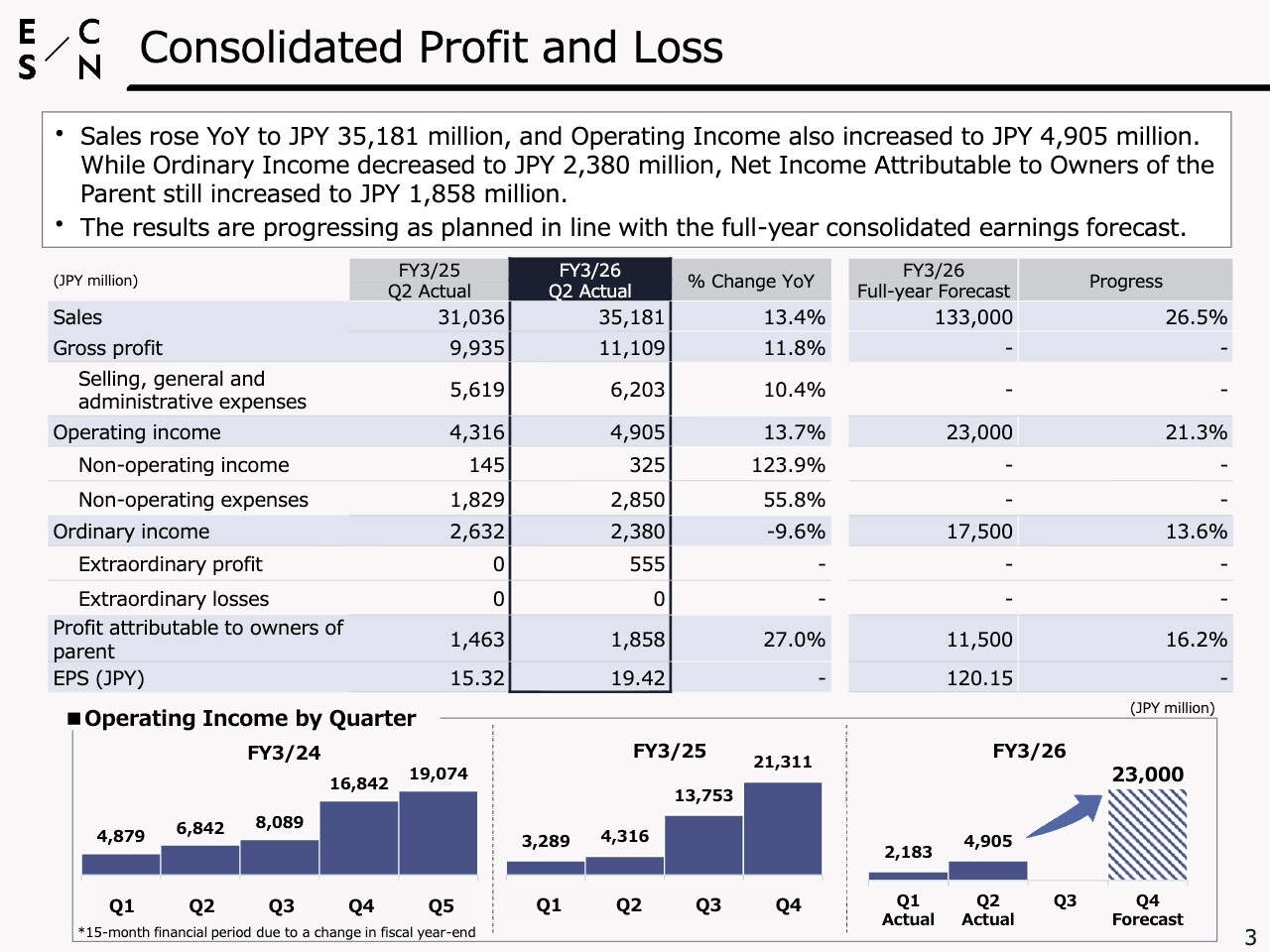
First, I will explain the overview of the financial results. This is the consolidated profit and loss statement for the first half of the fiscal year ending March 2026. Net sales amounted to JPY35,181 million, and ordinary income was JPY2,380 million. Net sales and operating income increased YoY, while ordinary income decreased. The results are progressing steadily in line with the full-year forecast.
Segments Overview
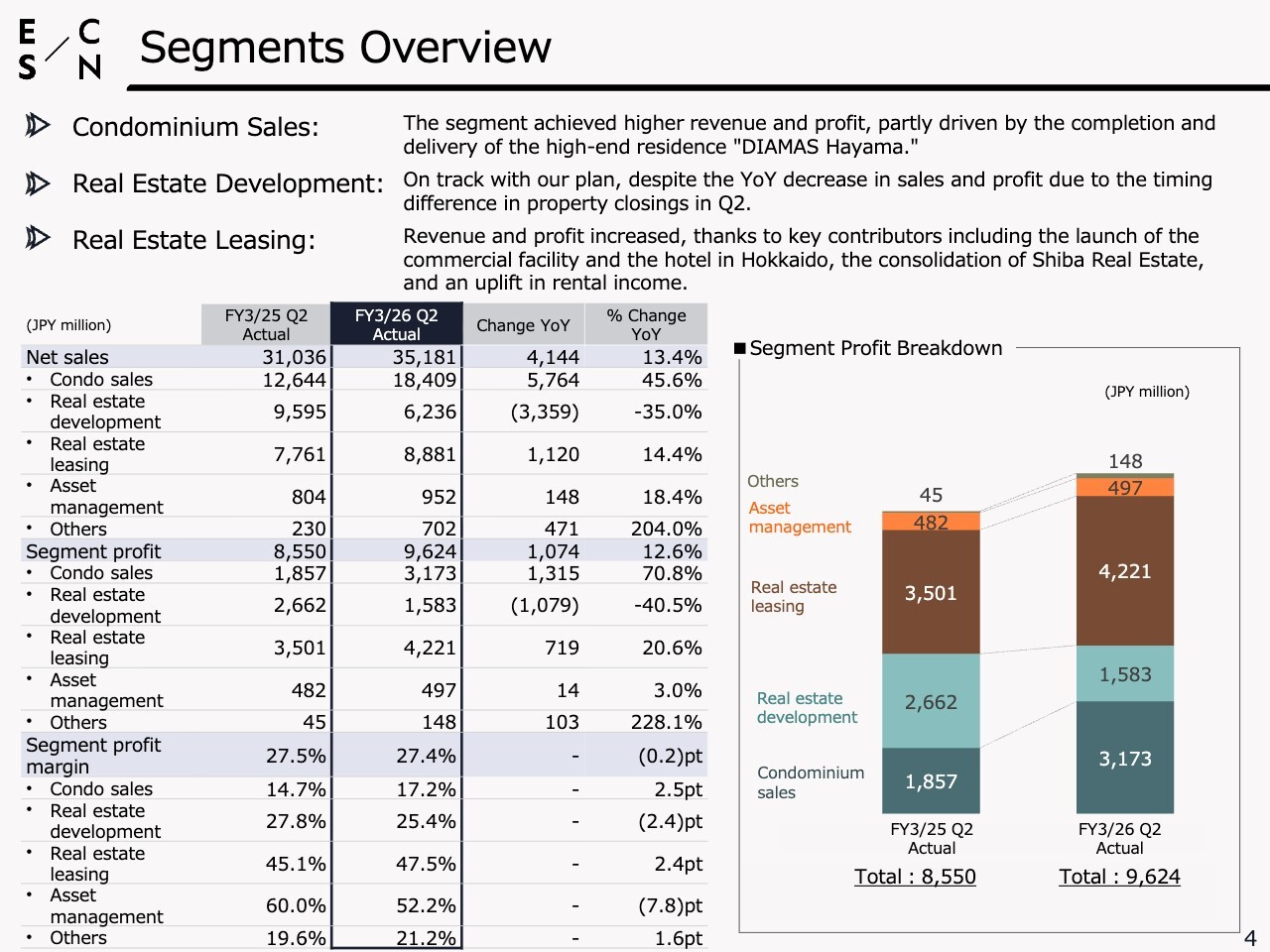
I will now explain the segment overview. In the Condominium Sales segment, revenue and profit increased, driven in part by the handover of the high-end residence DIAMAS Hayama in Hayama-cho, Miura-gun, Kanagawa Prefecture.
The Real Estate Development segment is also progressing as planned. In the Real Estate Leasing segment, rental revenue and other income increased as a result of the acquisition of Shiba Real Estate, a subsidiary of Mitsubishi Chemical Group Corporation, on April 1, leading to higher revenue and profit.
Condominium Sales -1
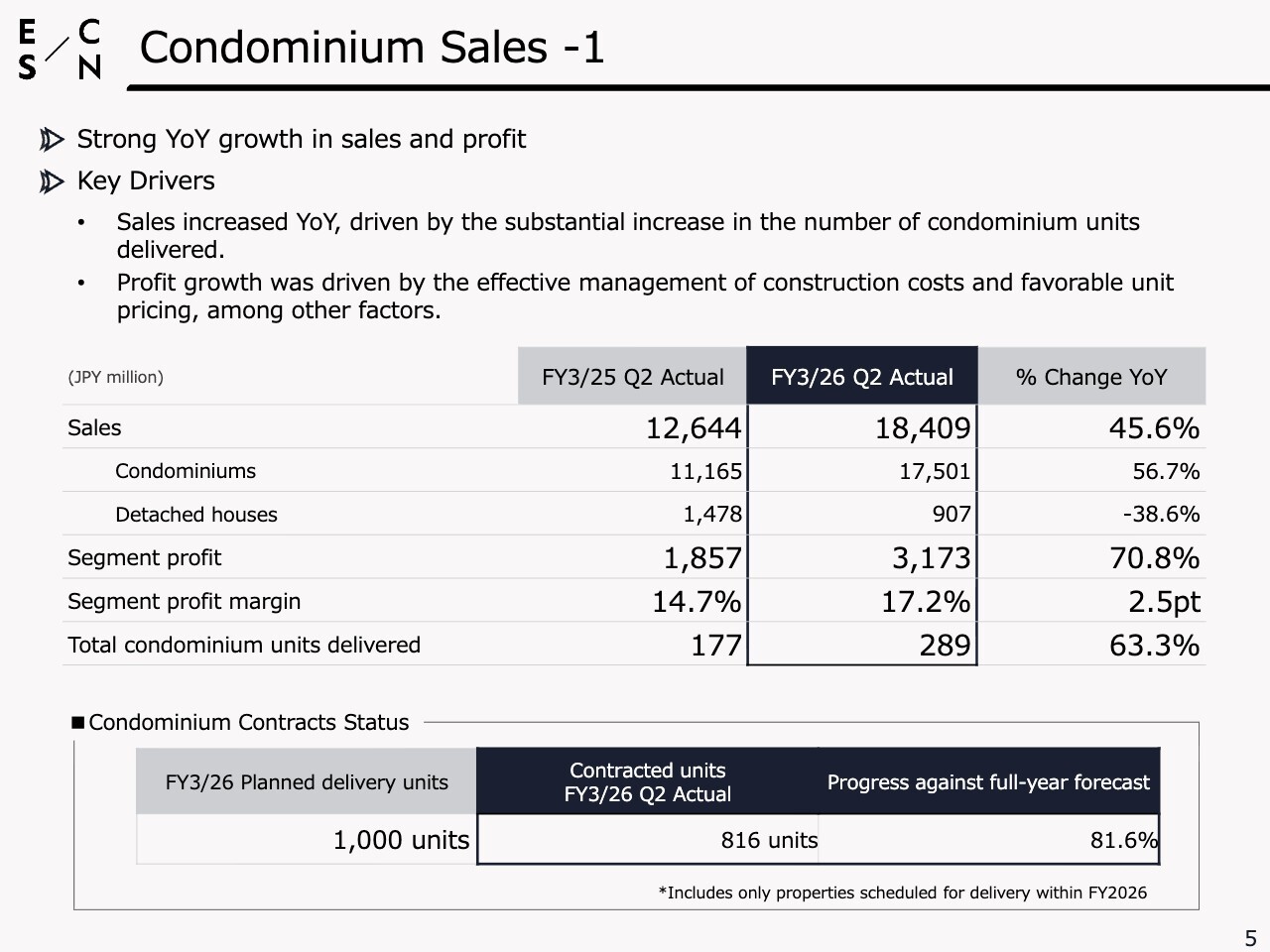
I will now explain the details of the Condominium Sales segment. Net sales for the first half of the fiscal year ending March 2026 were JPY18,409 million, and segment profit was JPY3,173 million. With the completion and handover of a highly profitable project, the segment recorded significant increases in both revenue and profit YoY.
As shown in the lower section of the slide, full-year handovers for the current fiscal year are planned at 1,000 units. As of the end of the second quarter, 816 units had already been contracted, and recent sales conditions have remained solid.
Condominium Sales -2
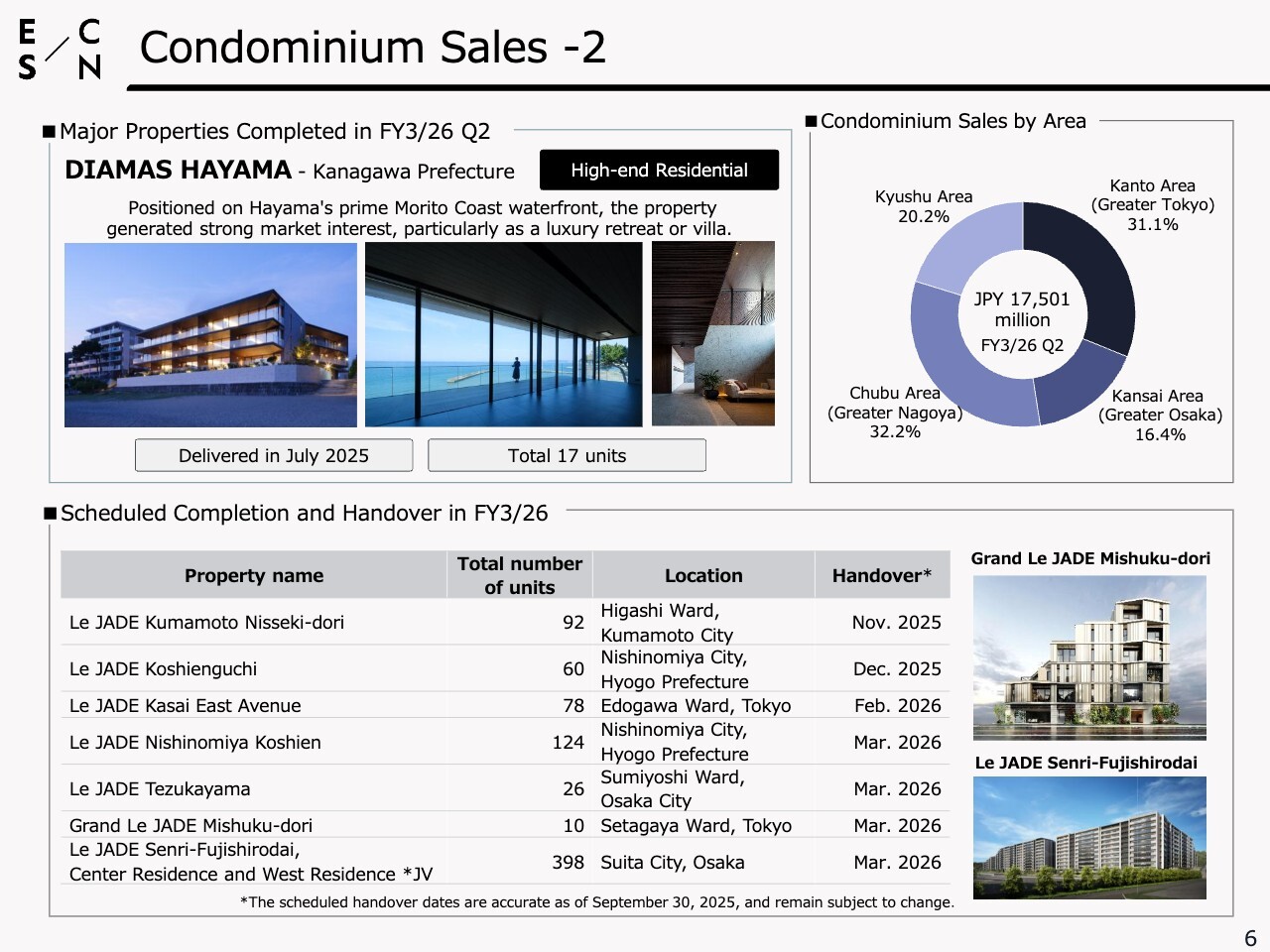
Next, I will explain the details of the properties. DIAMAS Hayama is located right in front of Morito Coast in Hayama, Kanagawa Prefecture. This project fully leveraged its exceptionally rare location and achieved an early sellout at a high price point.
While the property is situated in an area with a 12-meter height restriction that would typically allow the construction of a four-story building, we intentionally limited it to three stories to ensure sufficient ceiling height. We designed the product with exceptionally high specifications, including full-height windows extending from floor to ceiling.
We have received comments from our buyers that this is exactly the kind of product they wanted. We recognize that this as a project that will further accelerate our high-end product lineup.
The pie chart shown on the right side of the slide presents sales by area. Both the Kanto greater Tokyo area and the Chubu region each account for more than 30%. Kyushu accounts for 20.2%, and Kansai accounts for 16.4%, resulting in a well-balanced revenue structure across four regions.
Looking ahead, deliveries for our Hokkaido project are scheduled for next year, allowing us to develop a well-balanced condominium sales business across five regions.
The lower section of the slide lists the lineup of condominiums scheduled for handover during the current fiscal year. Grand Le JADE Mishuku-dori is a small-scale project with 10 units, but as a high-value property, it achieved early sellout.
At the end of March, we plan to hand over Le JADE Senri-Fujishirodai, Center Residence and West Residence (JV), shown at the bottom of the list. This is a large-scale project with a total of 398 units, and sales have been progressing ahead of plan. Customers have highly evaluated pricing. We intend to continue our sales activities through the end of March to ensure not only early sales but also higher profitability.
Condominium Sales -3
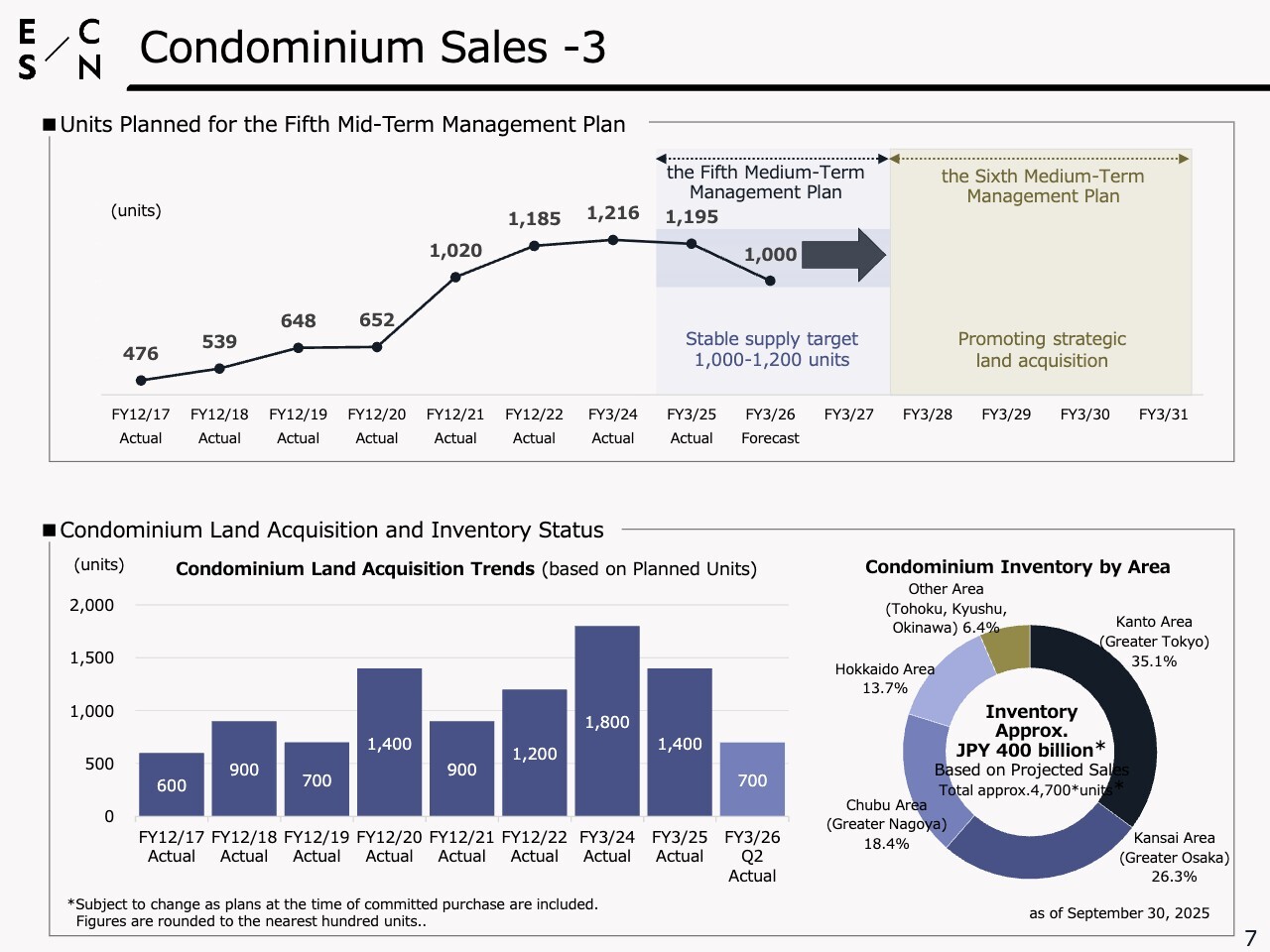
In the Condominium Sales segment, we expect to supply approximately 1,000 units per fiscal year during the period of the Fifth Medium-Term Management Plan. In the previous fiscal year, we achieved the handover of 1,195 units, and for the current fiscal year, we expect around 1,000 units, with a similar level anticipated for the next fiscal year as well.
In recent years, rising construction costs have become a major challenge in advancing this business. However, rather than simply focusing on supplying volume, our basic policy has long been to deliver high-quality products. We intend to continue promoting a stable supply of condominium units going forward.
The pie chart at the lower right of the slide shows the regional composition of our condominium inventory. Sales plans for projects for which land has already been acquired amount to approximately JPY400 billion, exceeding 4,700 units.
As for the distribution of supply areas, the Kanto region accounts for 35.1%, Kansai region for 26.3%, Chubu for 18.4%, and Hokkaido for 13.7%. We believe this demonstrates that we have built a well-balanced condominium inventory portfolio across all business regions. This concludes the results for the Condominium Sales segment.
Real Estate Development -1
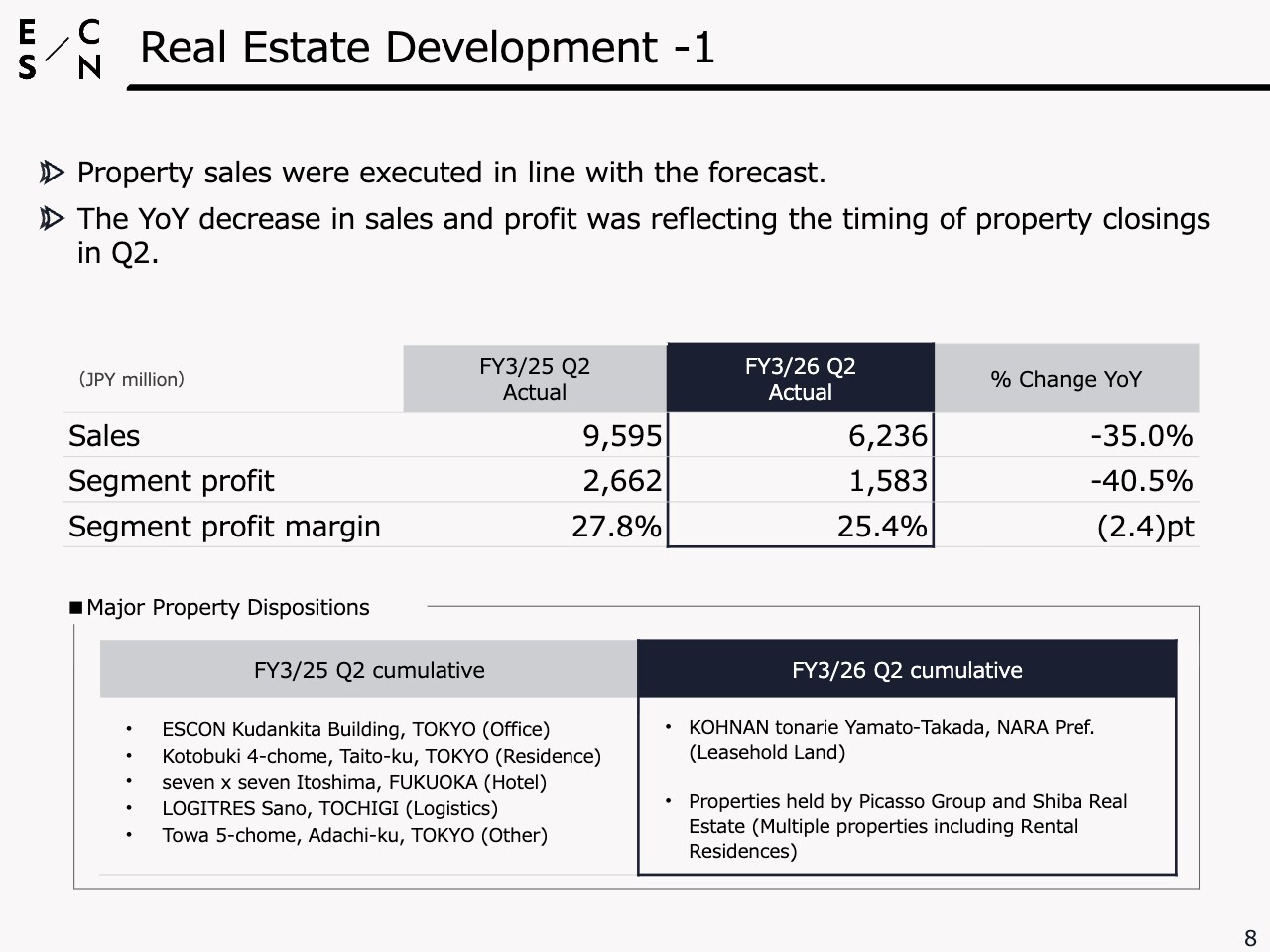
Next is the Real Estate Development segment. Net sales for the current fiscal year amounted to JPY6,236 million, resulting in a decrease in both revenue and profit YoY.
During the first half, as shown in the lower section of the slide, we sold the leasehold land of KOHNAN tonarie Yamato-Takada to our subsidiary, ESCON JAPAN REIT Investment Corporation. In addition, several properties held by the Picasso Group and Shiba Real Estate were partially sold, resulting in sales of approximately JPY6.2 billion for this segment.
Real Estate Development -2
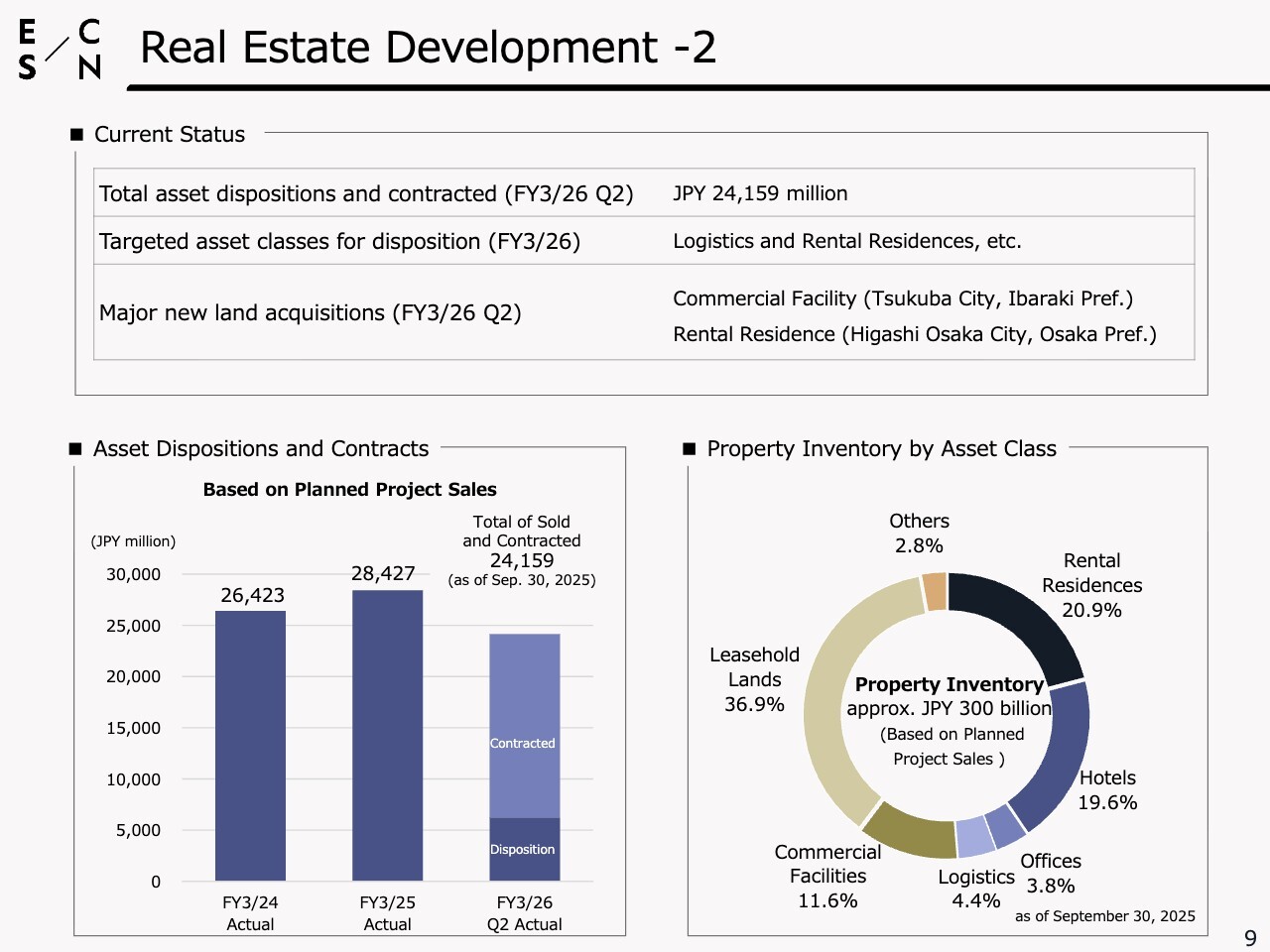
The Real Estate Development segment is one in which we leverage our multifaceted development capabilities as a core strength and continue to further reinforce business expansion.
As of the end of September, the total asset dispositions and contracts reached JPY24,159 million, and as of the end of October, contracts totaling approximately JPY32.0 billion have been concluded. We plan to sell logistics facilities and rental residences in the second half.
As shown in the pie chart at the bottom of the slide, the Real Estate Development segment currently holds approximately JPY300 billion in property inventory. Together with the Condominium Sales segment referenced earlier, we have achieved around JPY700 billion in acquisitions, and we believe this demonstrates our steady progress in building a robust asset base to support sustainable growth from the next fiscal year onward.
Breaking down this inventory by asset type, rental residences account for 20.9%, hotels for 19.6%, offices for 3.8%, logistics for 4.4%, commercial facilities for 11.6%, and leasehold lands for 36.9%.
In particular, leasehold lands are development assets that are relatively unaffected by the recent rise in construction costs. By maintaining an appropriate balance of these asset types, we aim to enhance added value and realize high-quality commercial development capable of generating greater rental income from tenants.
With respect to hotels, leveraging the significant increase in our brand recognition in Hokkaido resulting from obtaining the naming rights for ES-CON Field HOKKAIDO, we are advancing hotel development, logistics development, and office development. This concludes the overview of the Real Estate Development segment.
Real Estate Leasing -1
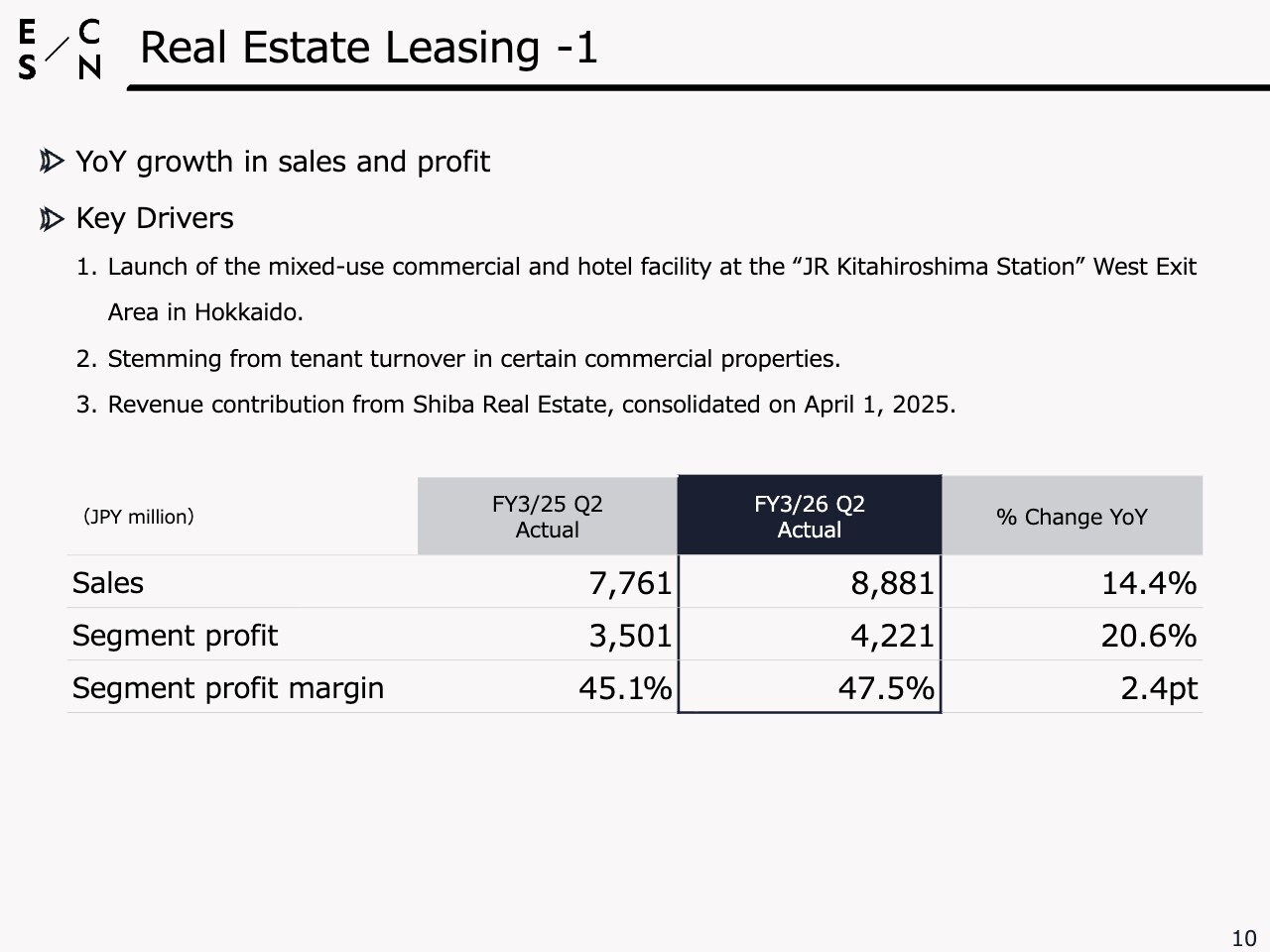
Next is the Real Estate Leasing segment. For the first half, net sales were JPY8,881 million, and segment profit was JPY4,221 million, resulting in higher revenue and profit YoY. Regarding the segment profit margin, through continued value enhancement of properties, rent increase negotiations, and disciplined cost control, we achieved an improvement of 2.4 percentage points.
At the end of March of the current fiscal year, the mixed-use community hub tonarie Kitahiroshima (commercial facility) + ES-CON Field HOKKAIDO Hotel Kitahiroshimaekimae opened as part of the JR Kita-Hiroshima Station West Exit Area Revitalization Project, which serves the nearest station to ES-CON Field HOKKAIDO. Floors 1 through 3 comprise the commercial facility, while floors 4 through 13 comprise the hotel with 158 rooms.
For the hotel, supported in part by the strong performance of the Hokkaido Nippon-Ham Fighters, we secured lodging demand exceeding our plan. ADR (average daily rate) also exceeded expectations, contributing positively to rental income.
In addition, earnings from Shiba Real Estate, acquired on April 1, also contributed to higher revenue and profit in the Real Estate Leasing segment.
Real Estate Leasing -2
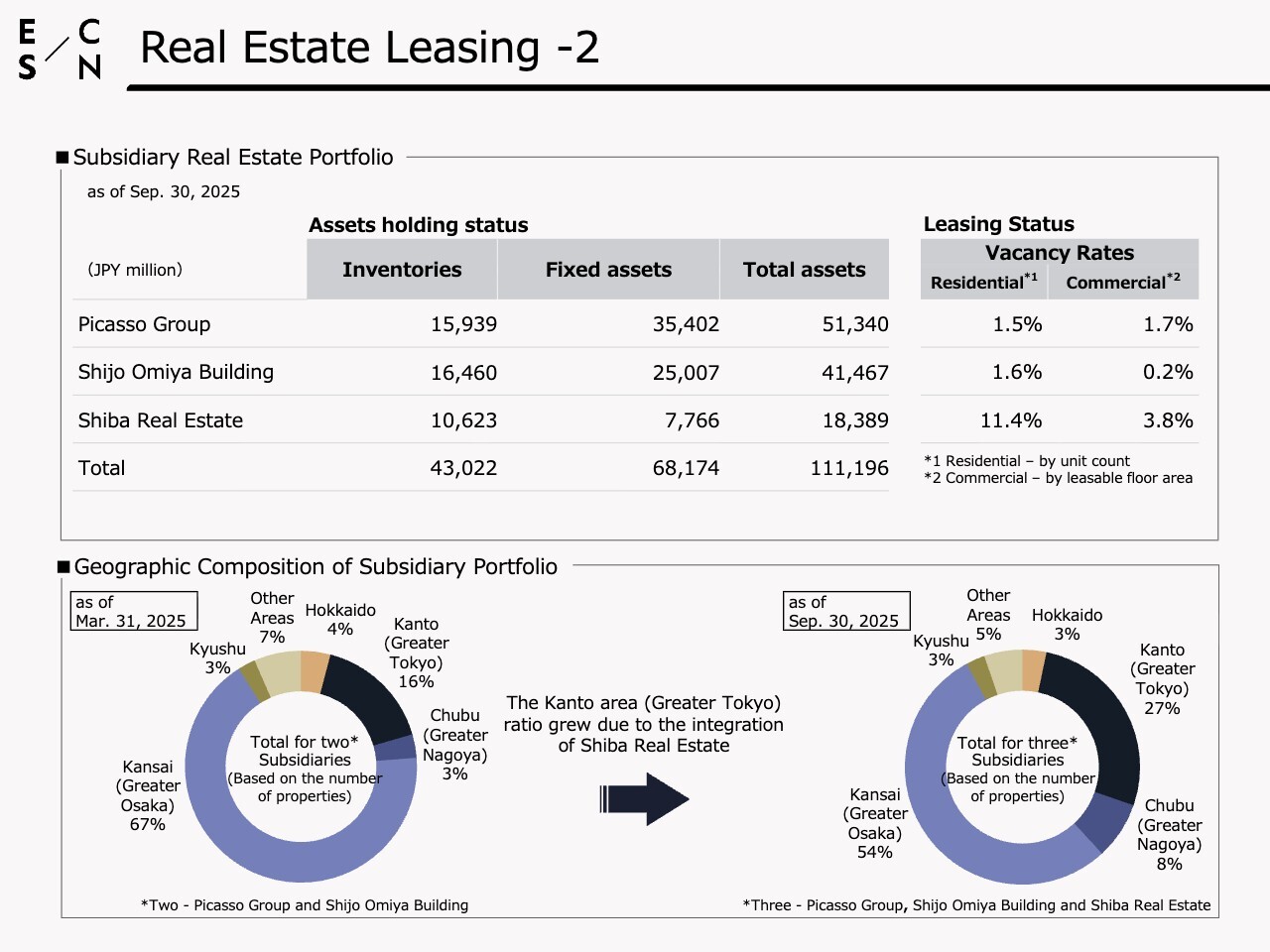
I will now explain the detailed results of the Real Estate Leasing segment. Under the Fifth Medium-Term Management Plan, we aim to transition from a revenue structure centered on flow-type businesses to a hybrid model that combines stable rental income with the flow-type businesses in which we excel.
As shown in the asset status at the top of the slide, our strategy to secure stable profitability while building a robust revenue base has produced results. The combined leased assets of the three subsidiaries Picasso Group acquired in 2021, Shijo Omiya Building acquired in 2023, and Shiba Real Estate acquired in 2025 now total approximately JPY111.0 billion.
Operating status is shown on the right side of the slide, and occupancy rates remain high. For Shiba Real Estate, we expect to further increase occupancy going forward as we shift to full ownership, allowing additional upside potential.
The pie chart at the bottom of the slide shows the major regional composition of properties held by our leasing subsidiaries. Picasso Group is centered in the Kansai region, and the Shijo Omiya Building is similarly focused on Kyoto in Kansai. With the addition of Shiba Real Estate’s portfolio, the ratio of properties in the greater Tokyo area has increased.
In the Real Estate Leasing segment, we will continue to pursue value-enhancing initiatives that raise asset value while maintaining appropriate regional balance across business bases, thereby connecting these efforts to future earnings growth.
Asset Management and Others
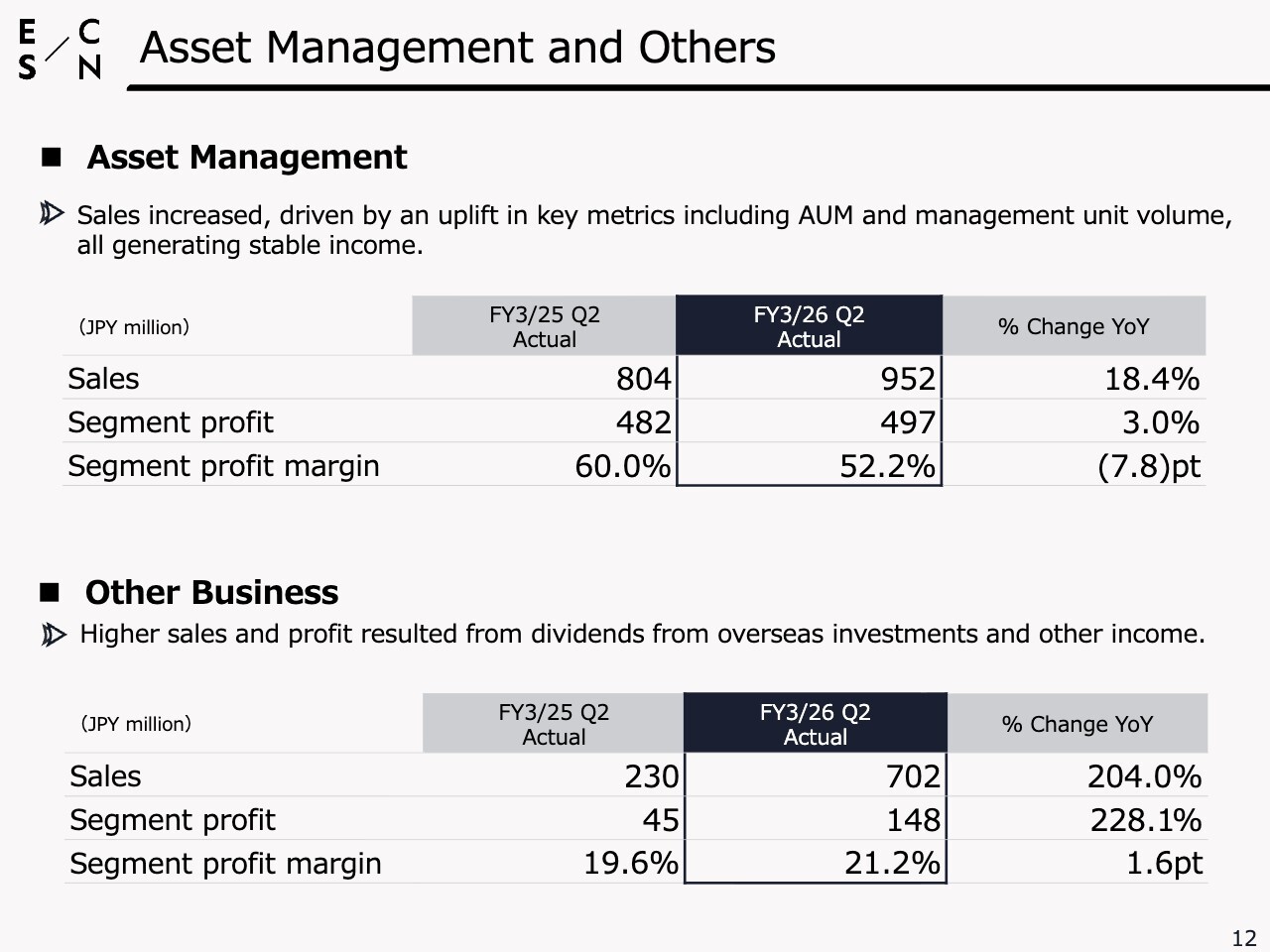
Looking ahead from the current Medium-Term Management Plan toward the next plan, the Asset Management business is positioned as a key growth engine. For the first half, the Asset Management business recorded net sales of JPY952 million and segment profit of JPY497 million, resulting in higher revenue and profit YoY.
Rather than limiting ourselves to external sales of the approximately JPY300 billion in assets accumulated within the Real Estate Development segment, we intend to expand by having our listed REIT, ESCON JAPAN REIT Investment Corporation, hold these assets in the future, as well as by considering the formation of private funds.
By having REITs and private funds hold assets developed by our company, we aim to accumulate AM fees, PM fees, and other related income, thereby further enhancing asset management revenues in addition to rental income.
In the Other Business segment, net sales for the first half were JPY702 million, and segment profit was JPY148 million. In particular, in our overseas business, we have invested in condominium development in Hawaii, and the returns are expected to contribute beginning in the fiscal year after next. We will continue to advance the strengthening of our overseas business in a steady manner.
Consolidated Financial Position - Assets
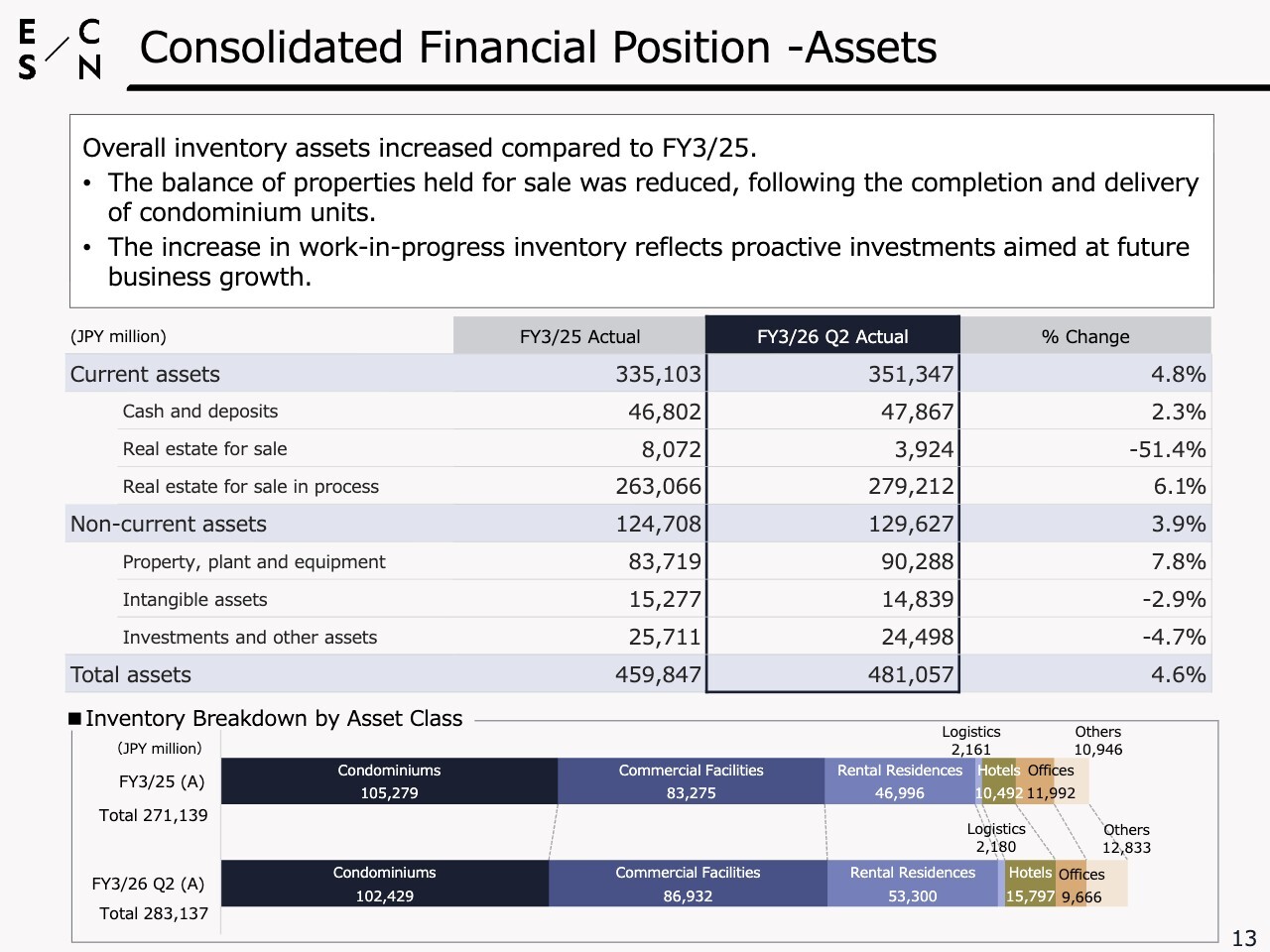
I will now report on the balance sheet. Total assets at the end of the previous fiscal year were approximately JPY459 billion, and they currently stand at approximately JPY481 billion, indicating continued accumulation of assets. Investments have been progressing extremely steadily.
The lower section of the slide shows the breakdown of inventory by asset type. Condominiums have accumulated to approximately JPY100 billion, and commercial facilities and rental residences remain key asset types. Hotels have also increased during the second quarter.
Consolidated Financial Position - Liabilities
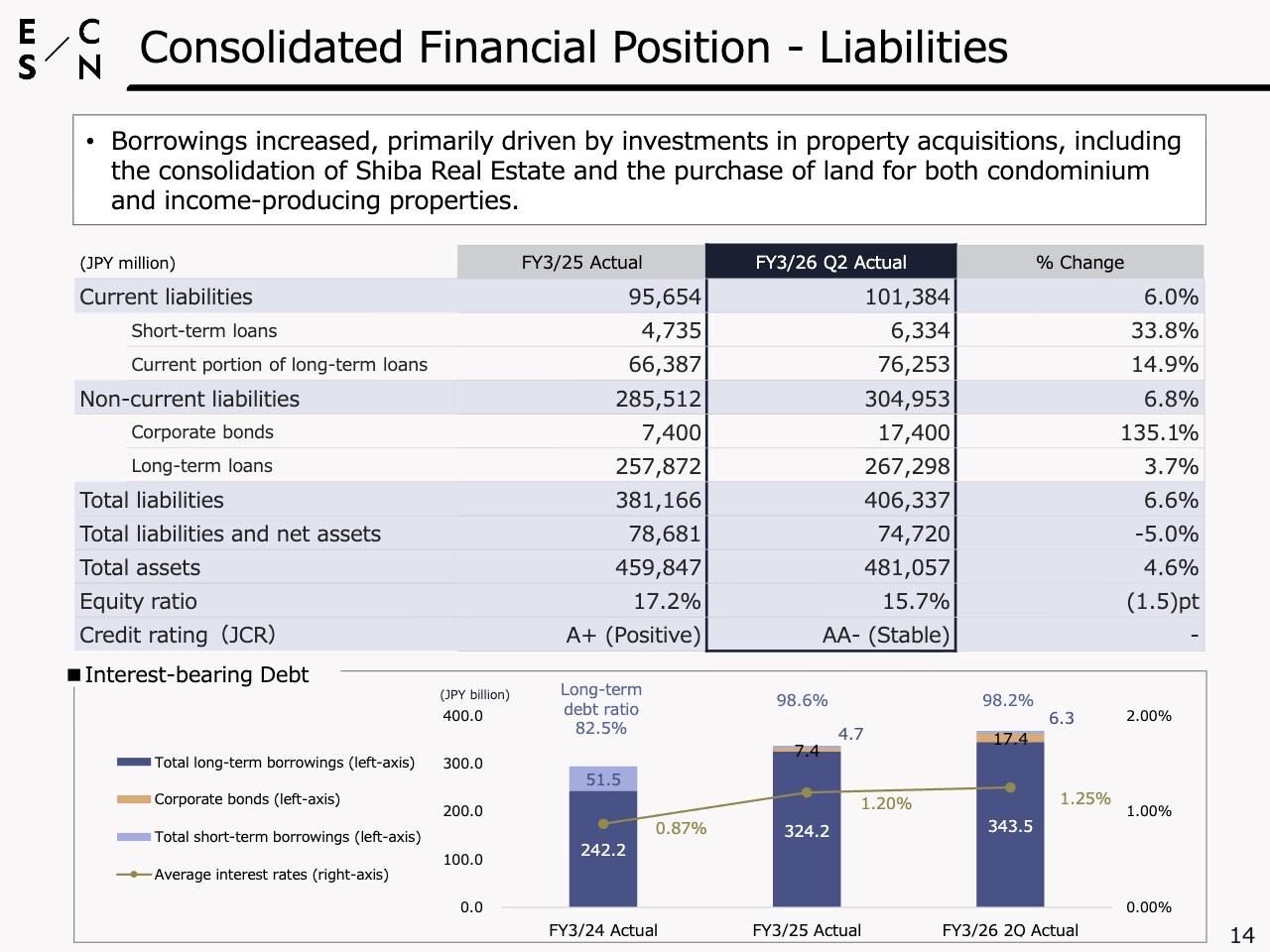
Next is the liabilities section. As property acquisitions have increased, borrowings have also risen. The equity ratio is 15.7%, a decline of 1.5 percentage points compared with the end of the previous fiscal year, however we are proceeding with the expectation of ending the fiscal year in the 17% to 18% range.
Regarding the credit rating by Japan Credit Rating Agency JCR, the rating has been raised by one notch, from A+ (Positive) to AA- (Stable). Through steady property acquisitions and securing future earnings, we aim to further strengthen our foundation for sustainable growth.
Credit Rating Upgrade and Second Bond Issuance
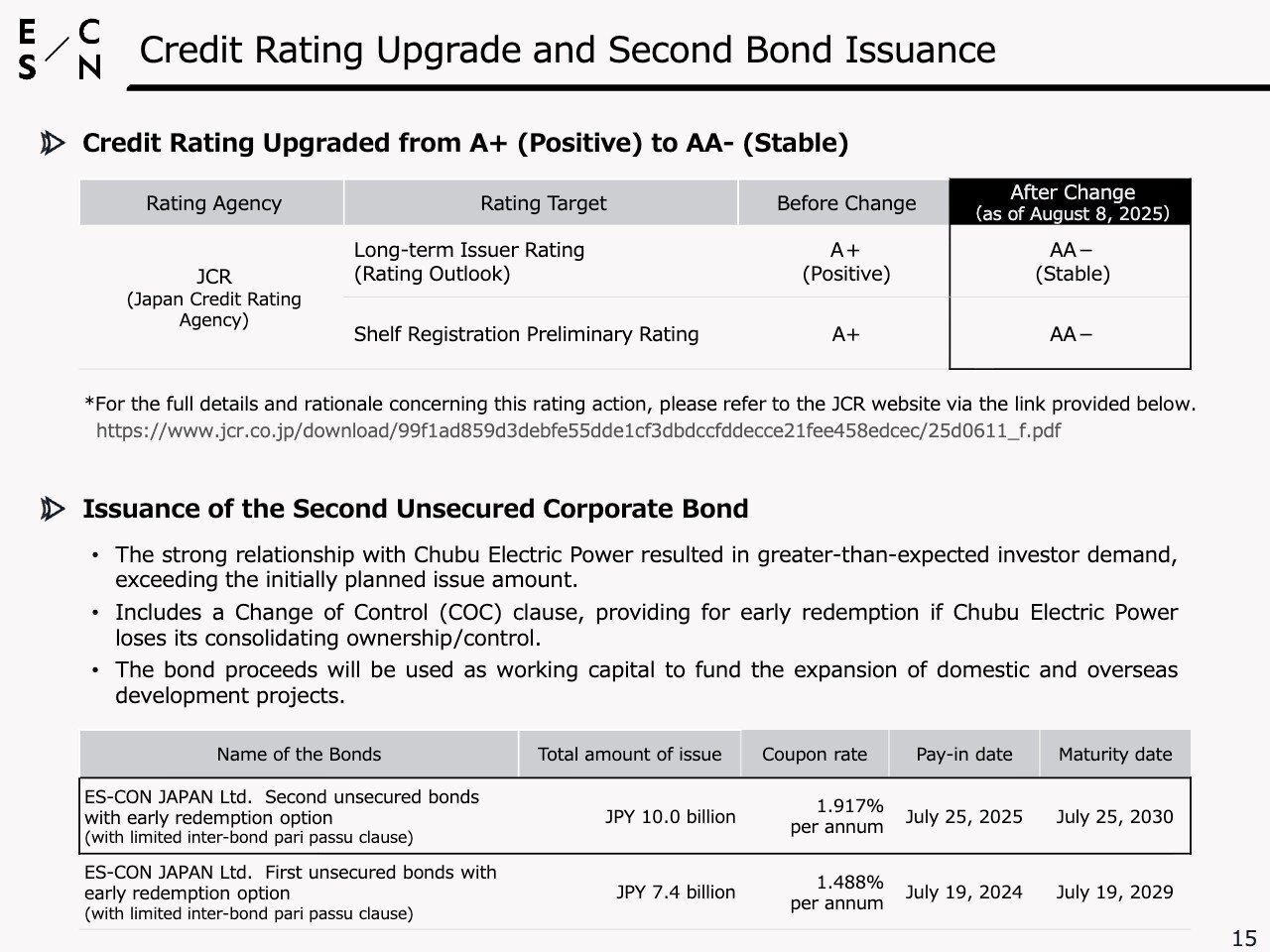
In addition to the rating upgrade, we completed the issuance of our second unsecured corporate bond during the first half. As our second unsecured corporate bond with an early redemption clause, we raised JPY10.0 billion in July. We intend to utilize the funds raised effectively to further enhance earnings and generate results.
Investment Plan and Execution Status
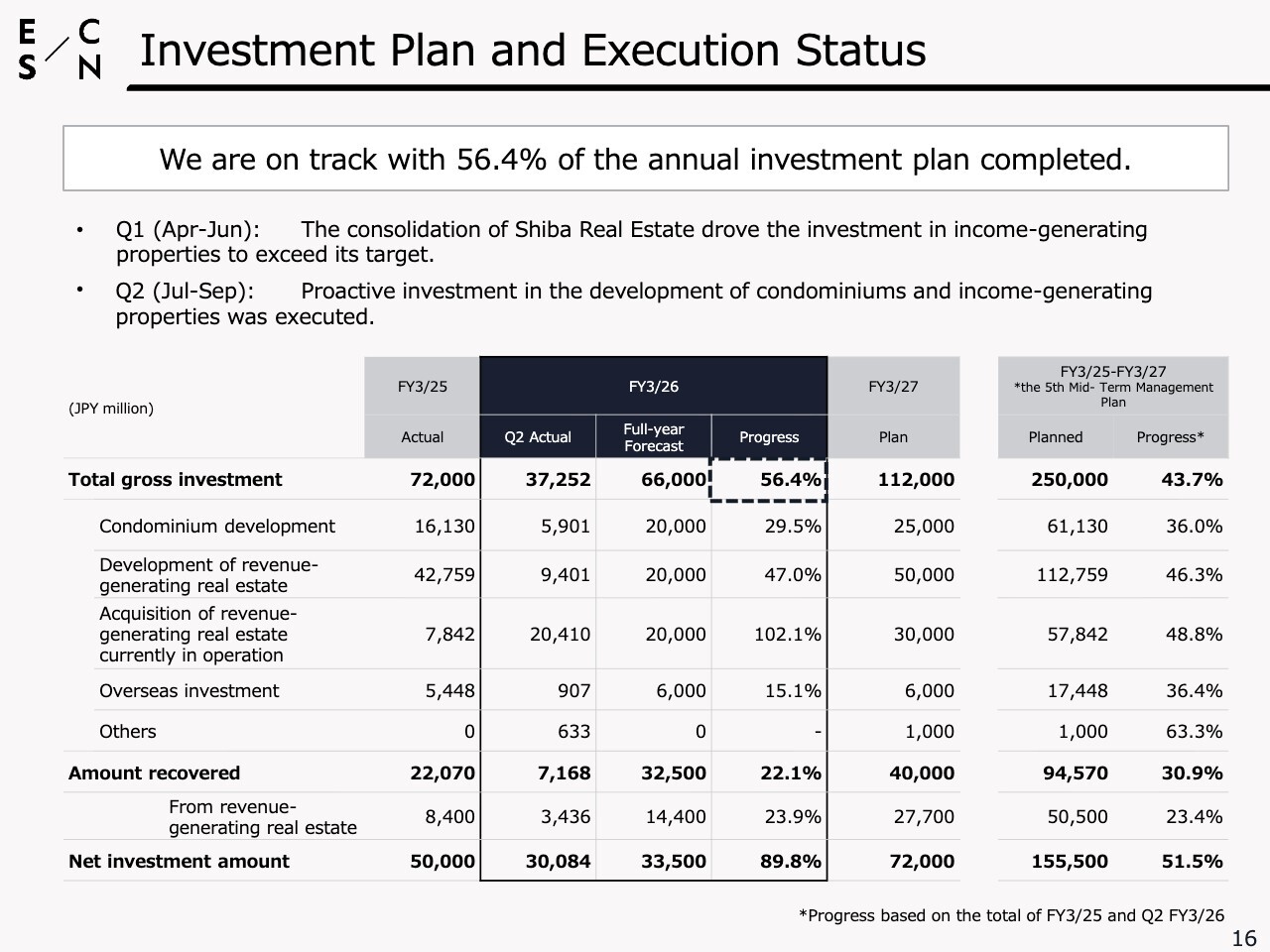
I will now explain the progress of our investment plan. The Fifth Medium-Term Management Plan is now in its second year. As shown in the second column from the right in the table on the slide, the three-year gross investment amount is planned at JPY25,000 million. Currently, we have completed one and a half years out of the three-year period, and the progress rate against the single-year plan for the fiscal year ending March 2026 stands at 56.4%, which indicates steady advancement.
In the second half of the year and into next year, while continuing to accumulate carefully selected property acquisitions, we aim to advance the formulation of the next Sixth Medium-Term Management Plan and further strengthen the earnings foundation toward 2030 through a more certain and solid plan.
Business Plan
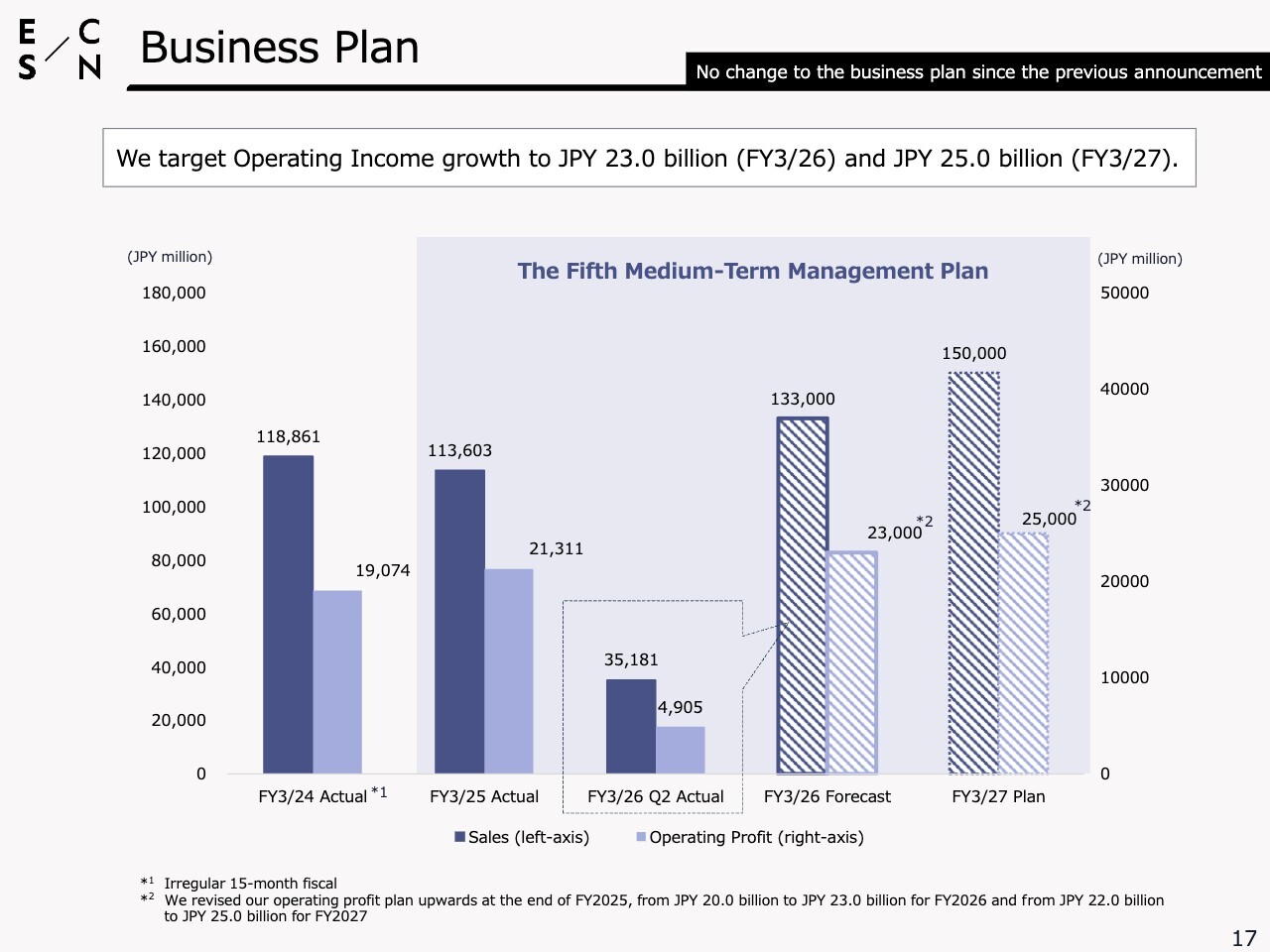
This is our business plan. We plan to achieve an operating income of JPY23.0 billion for the current fiscal year, and for the next fiscal year, we aim to further increase this and achieve JPY25.0 billion.
At the time of the previous fiscal year-end earnings announcement, we revised our operating income targets upward from the Medium-Term Management Plan. Previously, the targets were JPY20.0 billion for the current fiscal year and JPY22.0 billion for the following fiscal year, but these have been revised upward, placing us in a position to raise our earnings base. We intend to deliver solid results.
Shareholders Returns
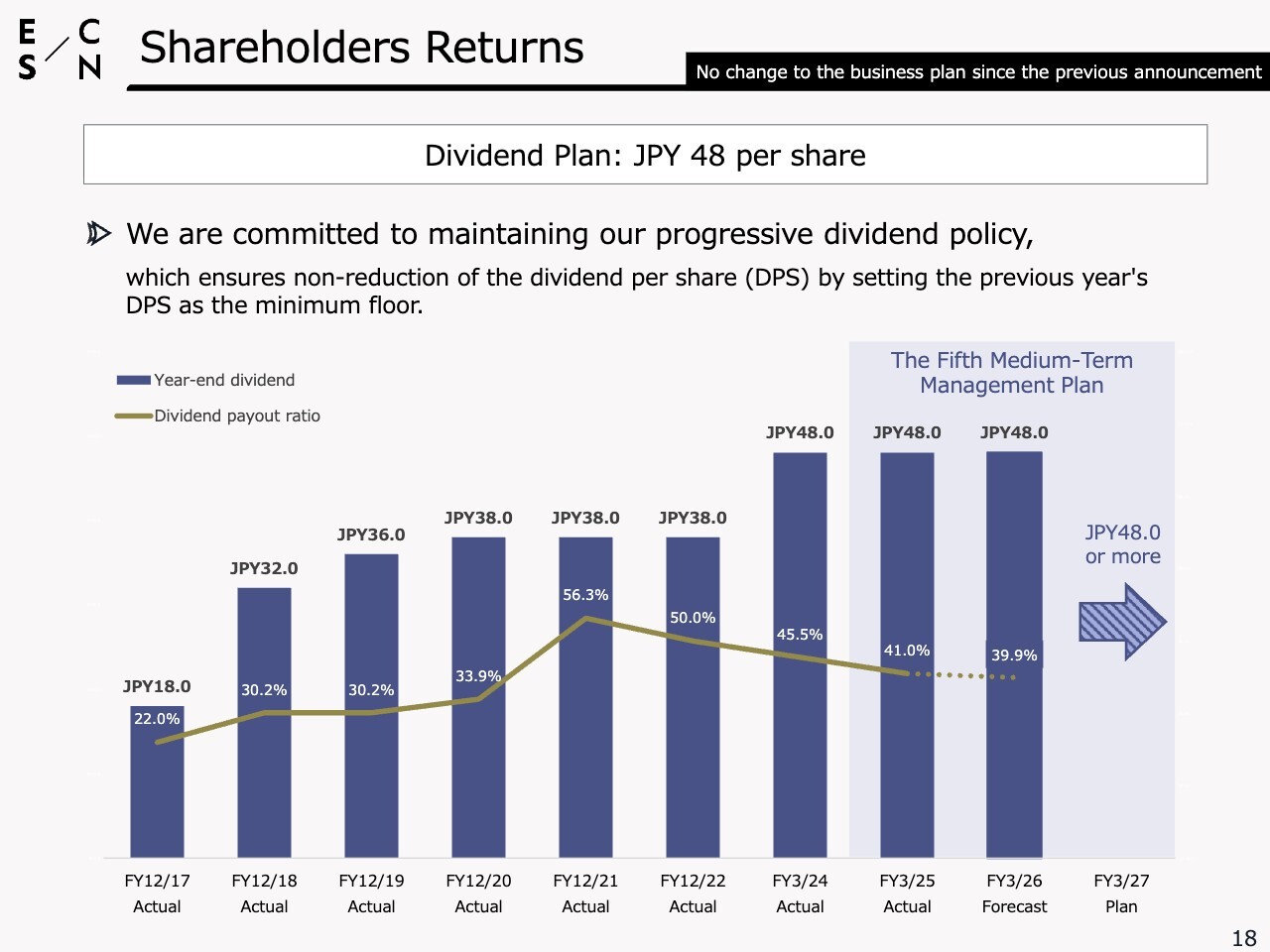
This is our shareholder return policy. We are committed to maintaining our progressive dividend policy, under which we pledge not to reduce dividends. In the previous fiscal year, we delivered a dividend of ¥48 per share. For the current fiscal year, we intend to provide a dividend of at least ¥48 per share.
Urban Development -1
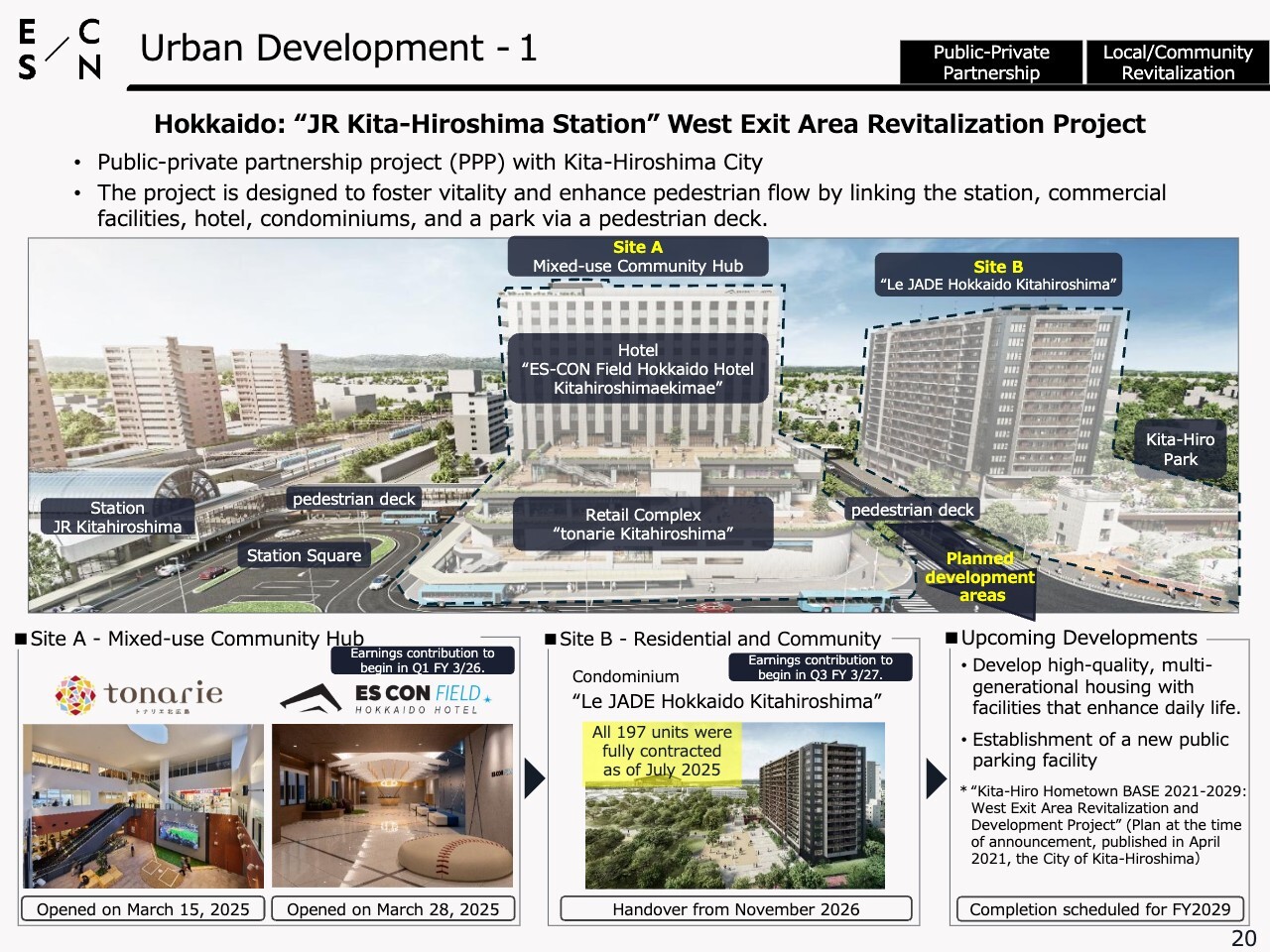
These are the key topics. From here, I will explain the content and progress of the projects we are currently pursuing.
First, I will discuss the development of our urban revitalization initiatives. Through the JR Kita-Hiroshima Station West Exit Area Revitalization Project in Kitahiroshima City, Hokkaido, which we are currently placing great emphasis on, the community development centered around ES-CON Field HOKKAIDO is accelerating further.
The stadium opened in 2023 and has now entered its third year. We are involved in the redevelopment of the west exit in front of the station and in the revitalization of the surrounding area. As a first step, we developed and improved the station-front rotary. In close proximity to the rotary, we opened the commercial facility tonarie Kitahiroshima and the ES-CON Field HOKKAIDO Hotel Kitahiroshimaekimae on the upper floors earlier this year.
Furthermore, as shown in the upper right of the slide, there is a project on Site B called Le JADE Hokkaido Kitahiroshima.
In this project, nursery facilities and assisted-living services are planned for the lower floors. All of these facilities will connect from the station through a pedestrian deck that links the commercial facility and the condominium. Kita-Hiro Park extends beyond this area, and all 197 units of the condominium have already been sold.
In collaboration with Kita-Hiroshima City, we aim to further invigorate the station-front area and continue promoting initiatives that create greater vibrancy.
Urban Development -2
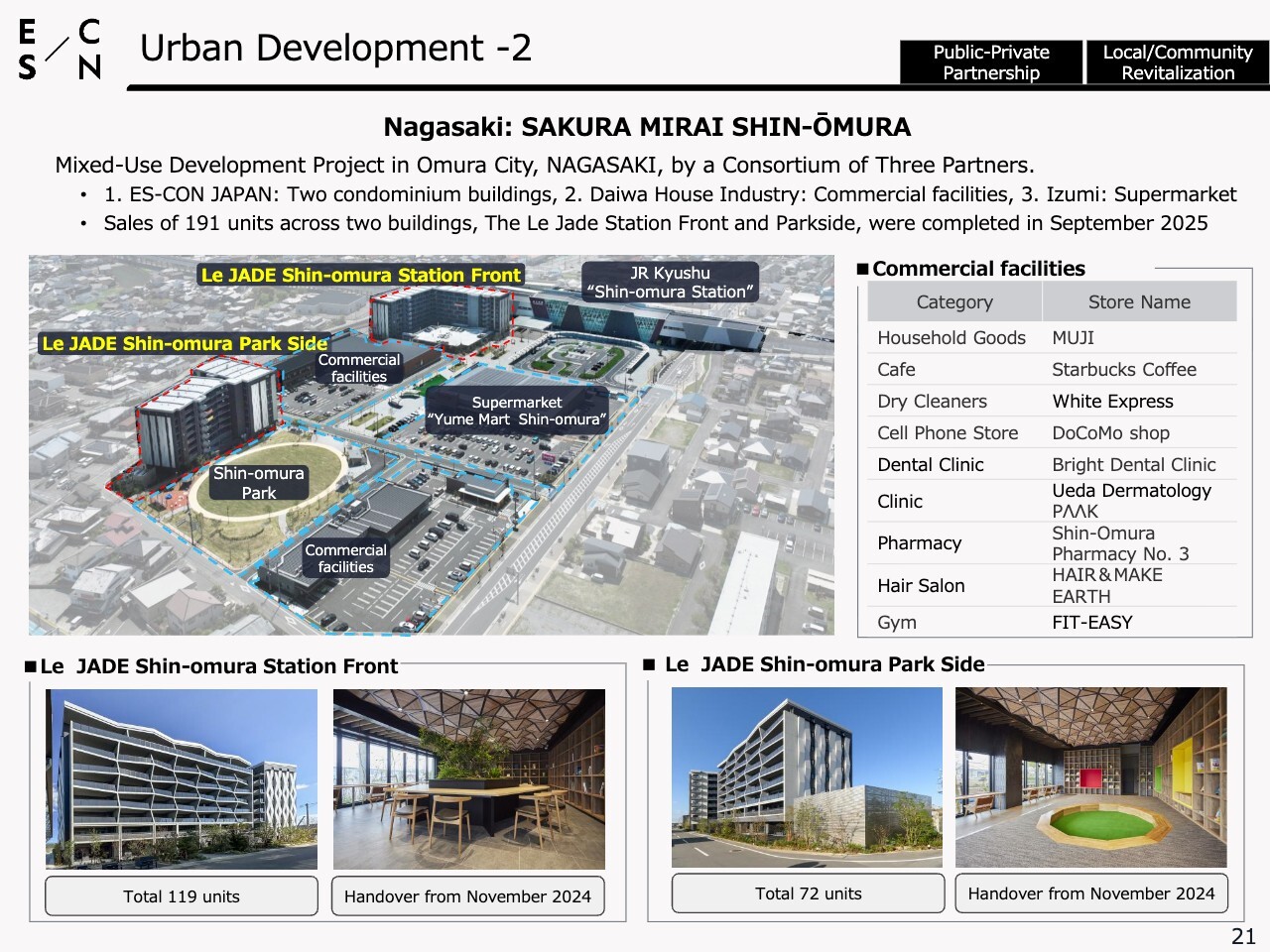
This is our project in Omura City, Nagasaki Prefecture. With the opening of the Nishi Kyushu Shinkansen, we are participating in the urban development project in front of JR Shin-Omura Station.
Together with Daiwa House Industry and the supermarket operator Izumi, we participated in the proposal competition, and all facilities in the station-front development have now opened. We developed two condominium buildings, Le JADE Shin-Omura Station Front and Le JADE Shin-Omura Park Side, and all 191 units were sold out.
Local residents have given us very high evaluations for the creation of new vibrancy in front of the station and for the design quality of the buildings.
Urban Development -3
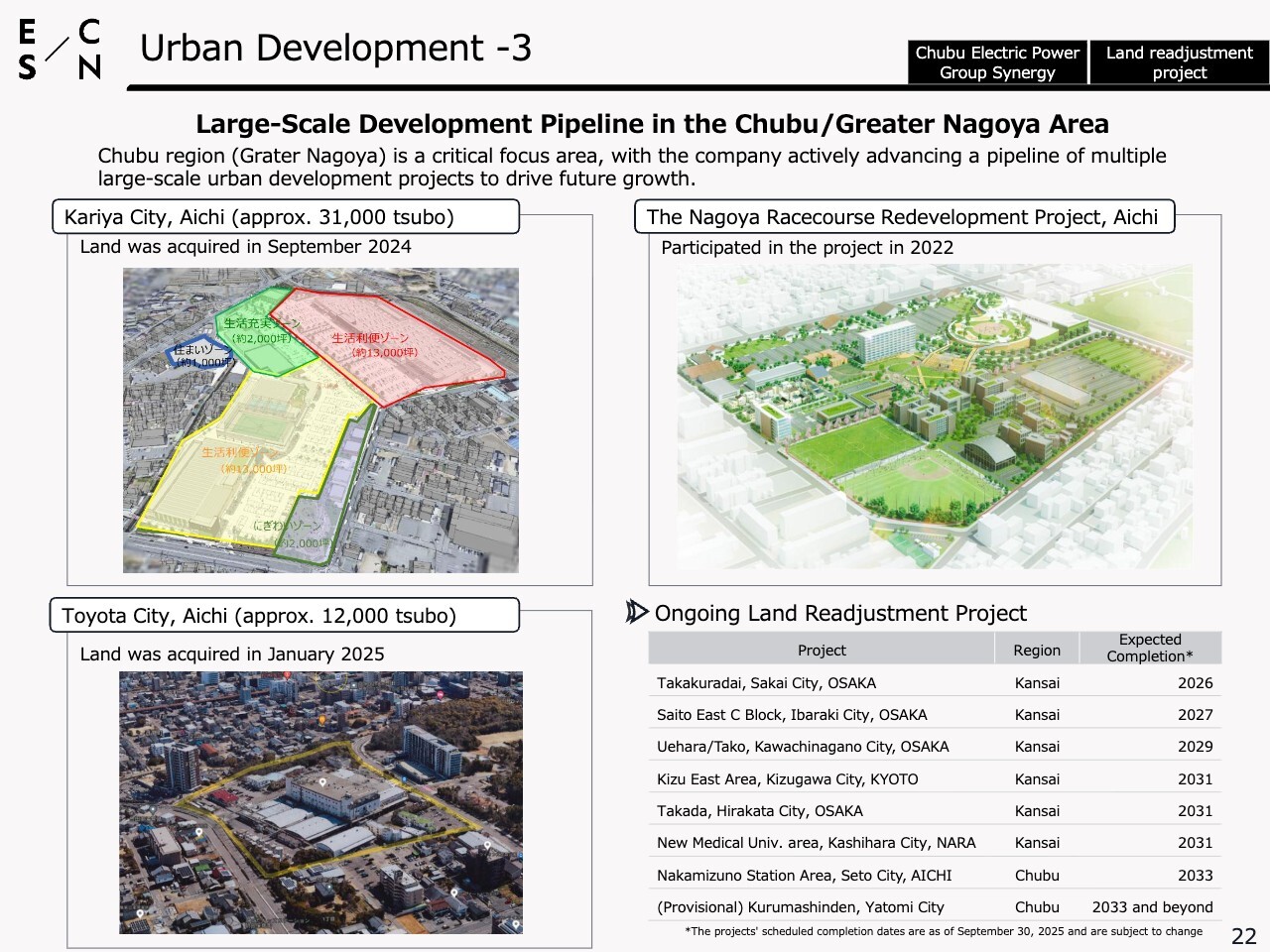
This section covers our initiatives in Aichi Prefecture. As a subsidiary of Chubu Electric Power, we are focusing on urban development and property development projects in the Chubu region.
As a major project, we acquired the former DENSO Ikeda Plant site in Kariya City, Aichi Prefecture, with a development area of approximately 31,000 tsubo (equivalent to 102,479 sqm). We are currently in discussions with the relevant authorities and aim to obtain development approval to realize a multi-purpose commercial facility.
Furthermore, the former Kewpie Koromo Plant site in Toyota City, Aichi Prefecture, has a site area of approximately 12,000 tsubo (equivalent to 39,669 sqm), where we plan to develop commercial facilities and residential condominiums.
In addition, for the large-scale Nagoya Racecourse Redevelopment Project, the site area is approximately 62,000 tsubo (equivalent to 204,959 sqm). Chubu Electric Power serves as the lead company for the group, and we plan to focus primarily on commercial development and condominium sales.
These initiatives represent important projects that will contribute to our future earnings. We will continue refining the project concepts, enhancing their value, and delivering developments that the surrounding community will welcome.
On the lower right side of the slide is an explanation of our land readjustment projects. Multiple projects are currently underway. Generally, it takes five to seven years from the establishment of a preparatory association to the formation of the official association.
The land readjustment projects include Takakuradai, Sakai City, Osaka Prefecture; Saito East C Block in Ibaraki City, Osaka Prefecture; Uehara/Tako in Kawachinagano City, Osaka Prefecture; Kizu East Area in Kizugawa City, Kyoto Prefecture; Takada in Hirakata City, Osaka Prefecture, New Medical University Area in Kashihara City, Nara Prefecture; Nakamizuno Station Area in Seto City, Aichi Prefecture; and Kurumashinden in Yatomi City, Aichi Prefecture.
For these projects, we continue to coordinate closely with local landowners and administrative bodies to realize the land readjustment initiatives required by each area.
GOOD DESIGN AWARD (8th Consecutive)
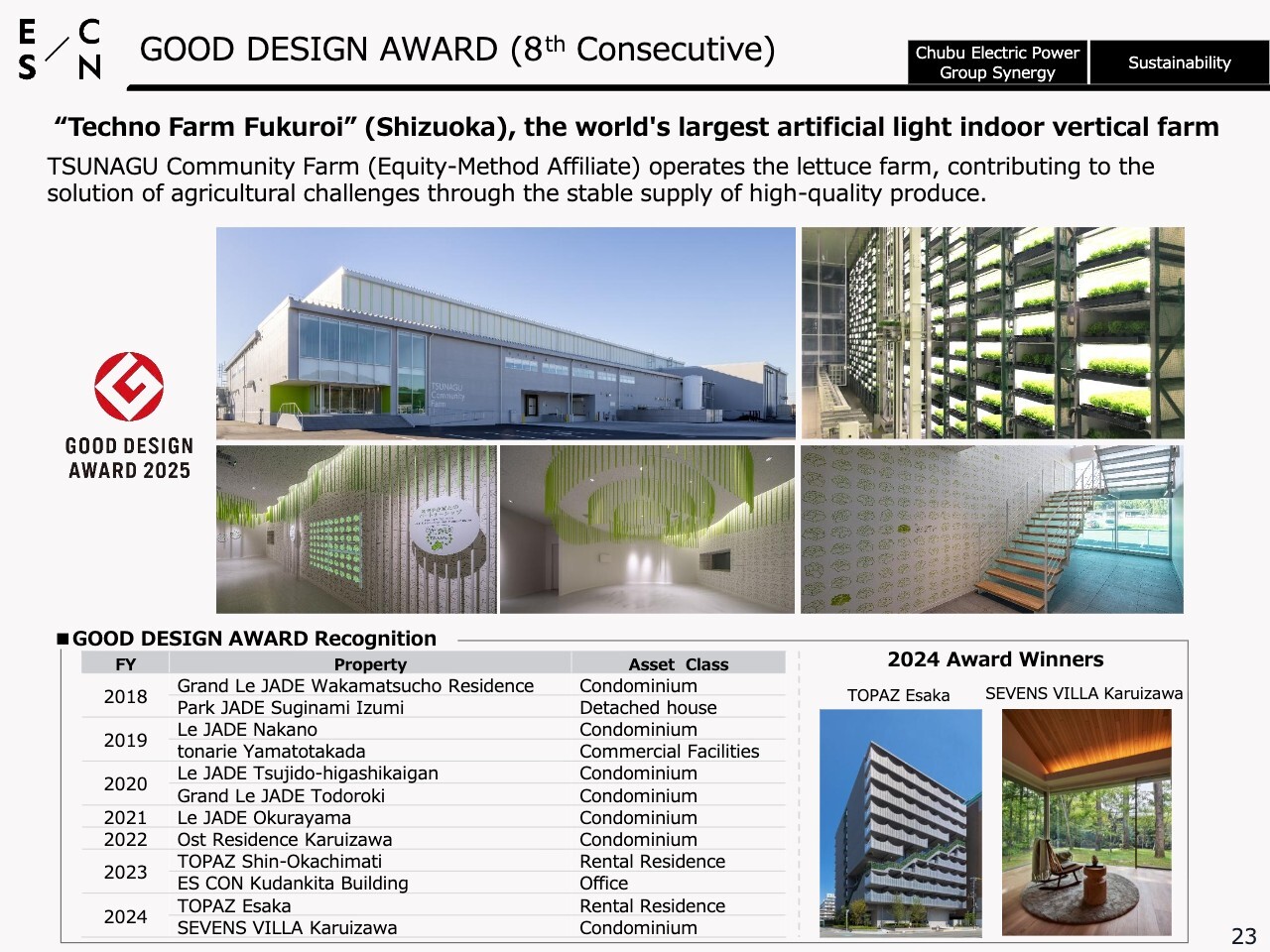
We received the Good Design Award for the eighth consecutive year. This year, the award was not for a residential project, but for Techno Farm Fukuroi, an indoor hydroponic lettuce cultivation facility jointly established with Chubu Electric Power. The award recognized the high-quality working environment and design features. These are the key topics for the first half of the fiscal year.
Management Targets
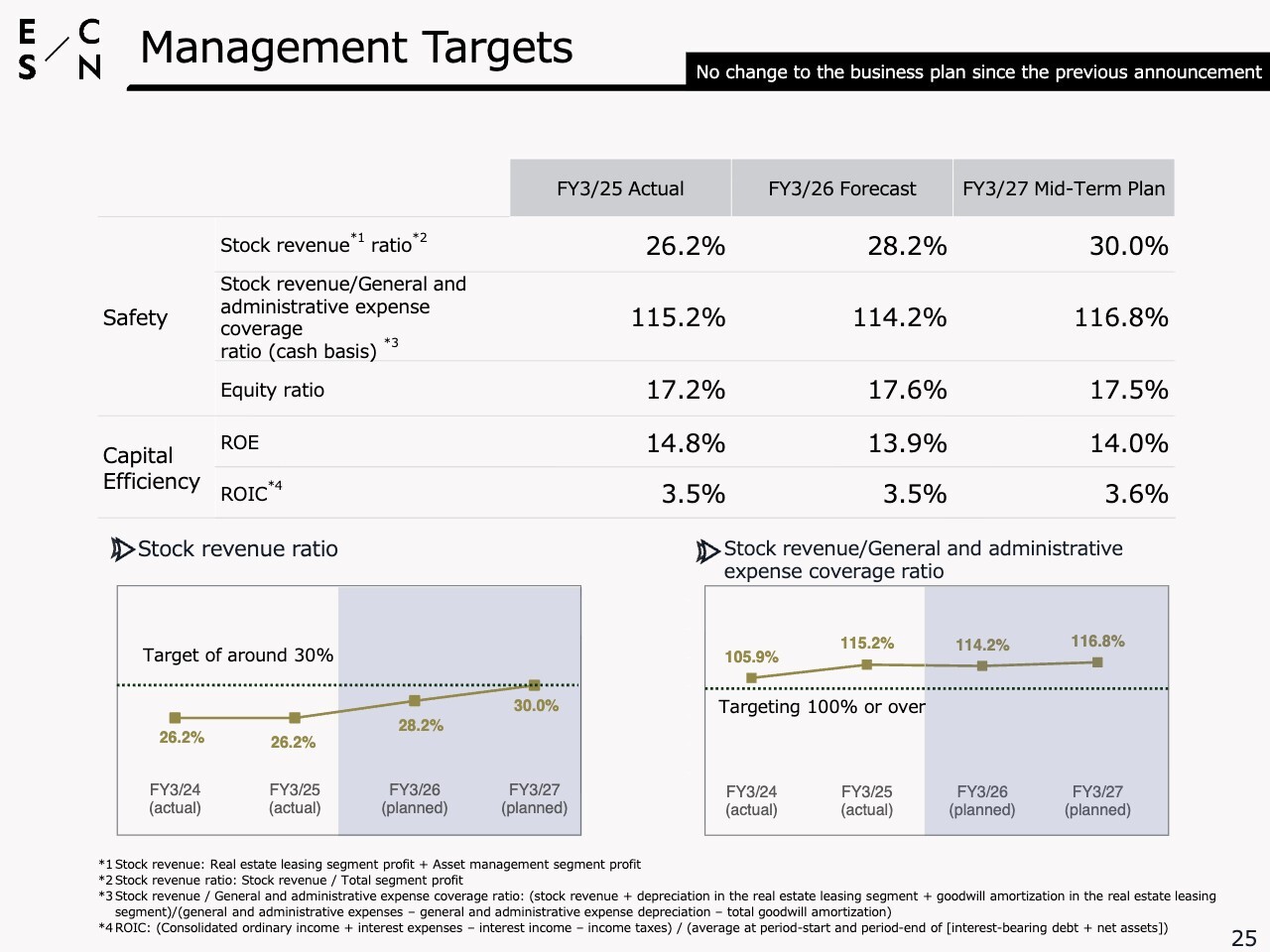
I will now explain the management targets and KPIs under the Fifth Medium-Term Management Plan. Since the previous fiscal year, we have been advancing the proactive acquisition and development of properties, as well as the accumulation of stable rental assets. As a result, we have achieved a structure in which selling, general, and administrative expenses are covered by stock, or recuring, revenue.
The coverage ratio of general administrative expenses by stock, or recurring, revenue is approximately 115%, ensuring a high level of financial soundness. In addition, ROE, which reflects our earnings capability and growth potential as a company, is planned to remain around 14%.
By maintaining this balance, we aim to continue building a business structure that achieves both stability and growth.
Management Based on an Awareness of Capital Costs and Stock Price
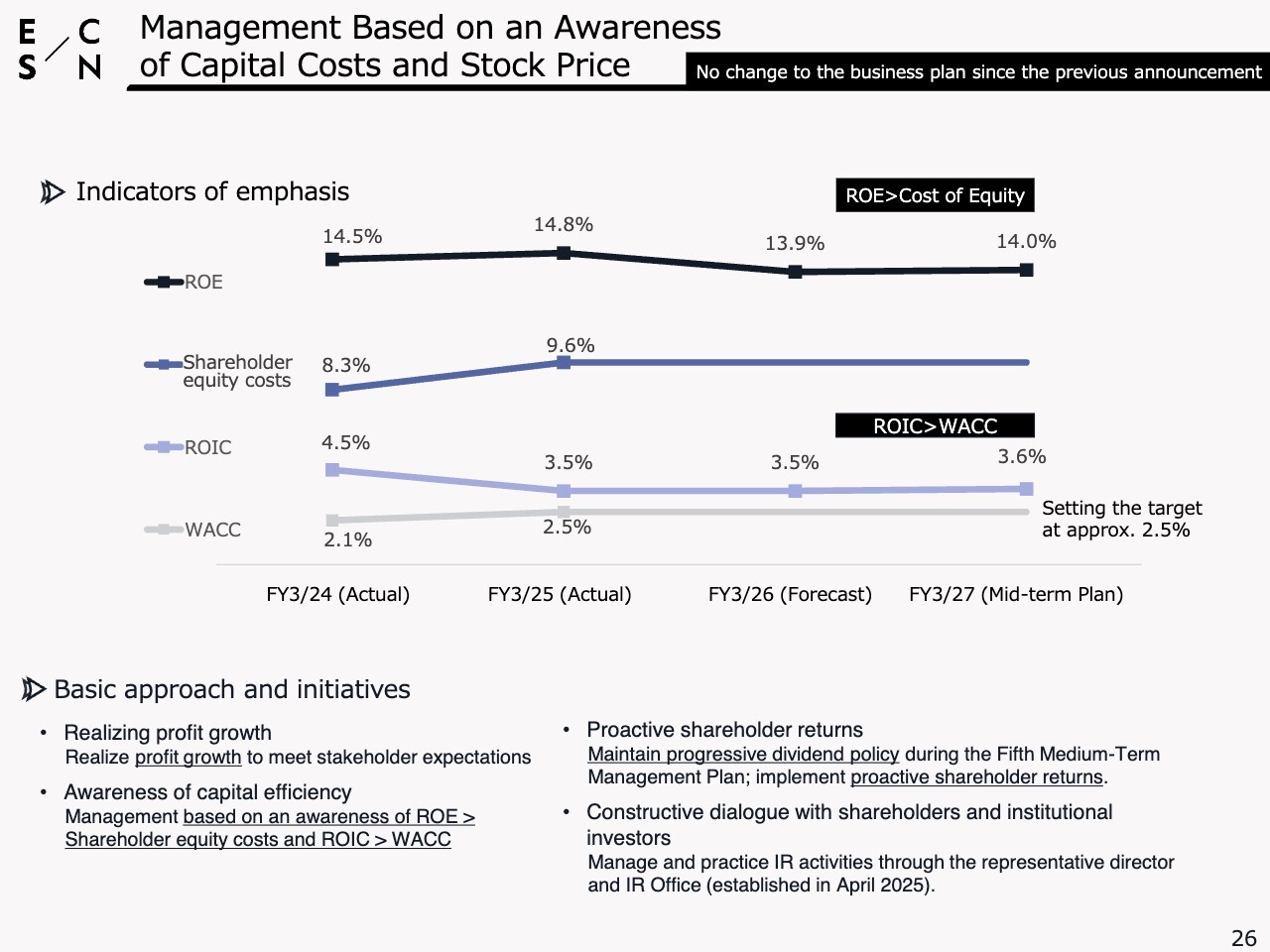
This section covers management with an awareness of capital costs and stock prices. As noted earlier, we have set an ROE target of 14% as one guideline. Our capital cost over the past ten years has been approximately 7.5%. By avoiding inefficient use of capital and maintaining profitability, we aim to continue achieving sustainable growth.
Overview
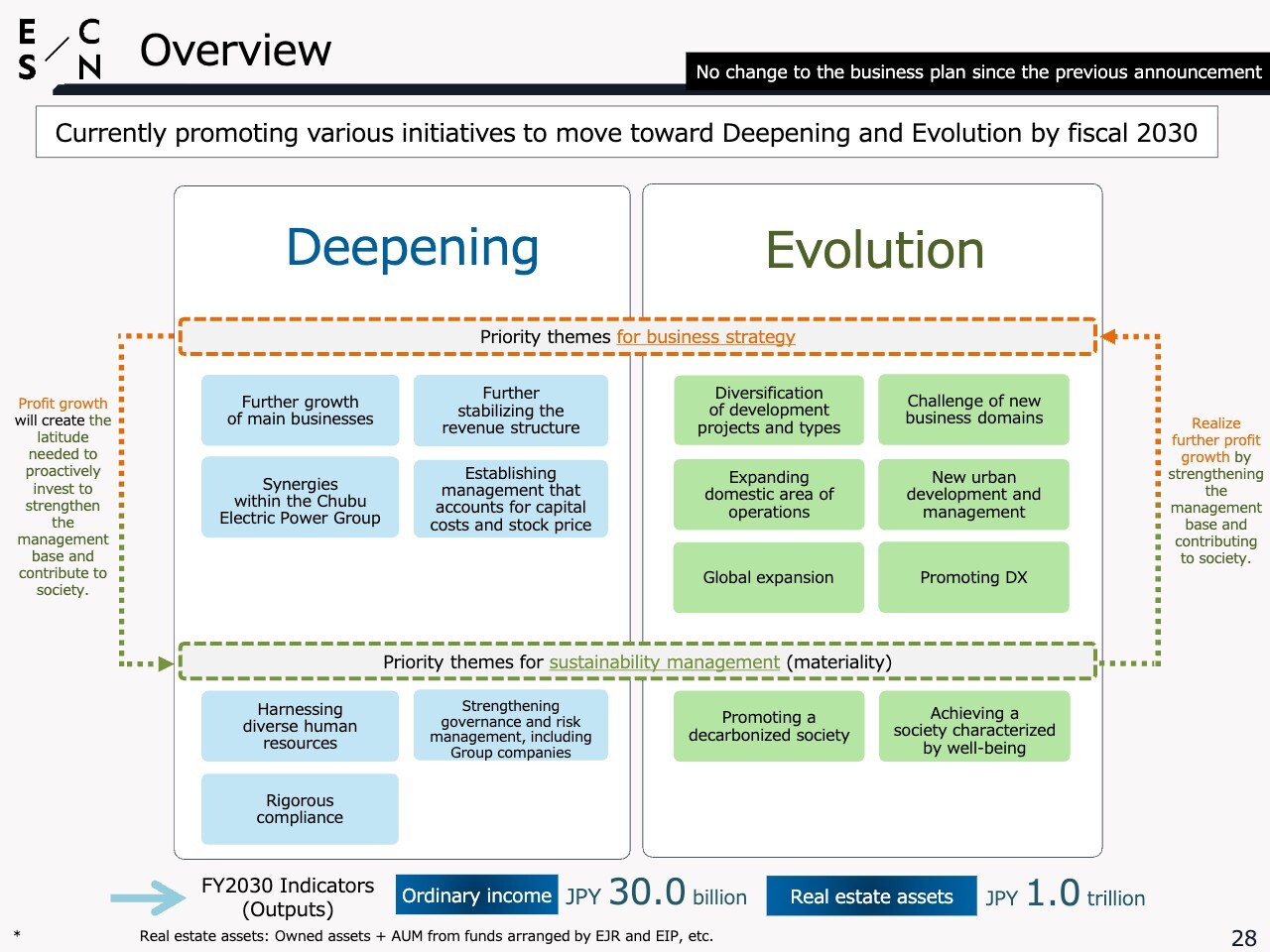
Finally, I will explain the progress of our Long-Term Vision 2030. First, I will outline the basic concept of the Long-Term Vision 2030.
Including the current Fifth Medium-Term Management Plan, we are advancing our initiatives under the two guiding themes of “Deepening” and “Evolution.” To deepen the initiatives we have built over time and enhance their substance, we have identified the following areas: “Further growth of main businesses,” “Further stabilizing the revenue structure,” “Synergies within the Chubu Electric Power Group,” and “Establishing management that accounts for capital costs and stock price.”
We aim to further advance our sustainability efforts by “Harnessing diverse human resources,” ensuring “Rigorous compliance,” and “Strengthening governance and risk management, including Group companies.”
At the same time, under “Evolution,” we are advancing the “Diversification of development projects and types,” “Expanding the domestic area of operations,” “Global expansion,” “Challenge of new business domains,” “New urban development and management,” and “Promoting DX.”
In sustainability, we have set “Promoting a decarbonized society” and “Achieving a society characterized by well-being” as key goals. Beyond numerical targets alone, we aim to further enhance and evolve ES-CON’s quality and value.
As for quantitative targets for fiscal 2030, we aim to achieve ordinary income of JPY30.0 billion and real estate assets of JPY1 trillion.
Financial Results Trends
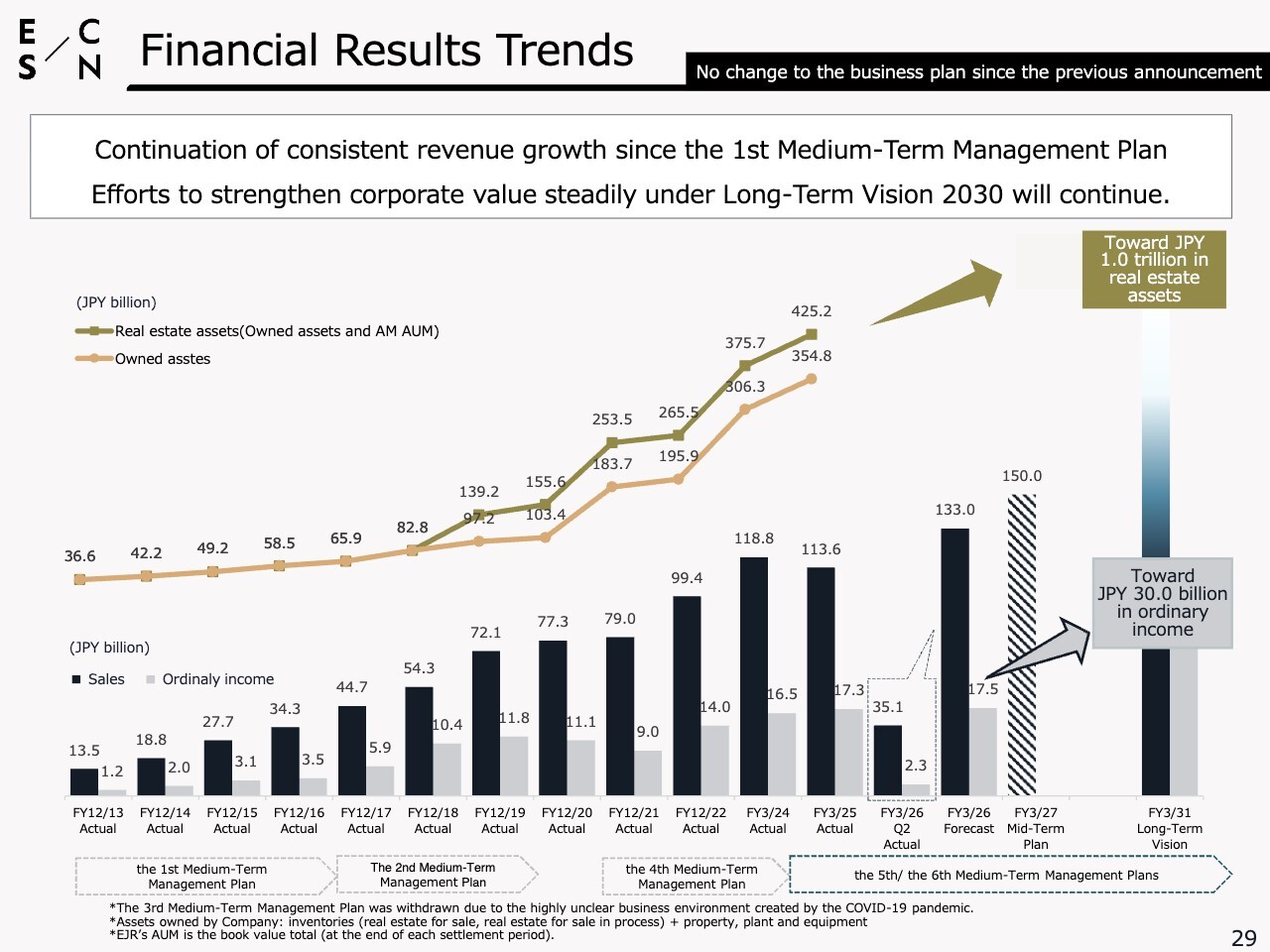
I will now explain the performance trends and the plan for the Long-Term Vision 2030. For the fiscal year ending March 2026, we are targeting ordinary income of JPY17.5 billion, and by 2030, we aim to grow this to JPY30.0 billion.
To achieve real estate assets of JPY1 trillion, we plan for JPY600 billion to be held on ES-CON’s balance sheet, while the remaining JPY400 billion will be developed through ESCON JAPAN REIT, private funds, STOs, and small-lot sales initiatives with Co-ownership utilizing the Act on Specified Joint Real Estate Ventures.
By combining the portion held on the balance sheet with the portion developed off the balance sheet, we aim to achieve ordinary income of JPY30 billion, with the entire company working together toward this goal.
This concludes ES-CON JAPAN’s financial results briefing for the first half of the fiscal year ending March 2026. Thank you very much for your attention.
Q&A: Evaluation of the Stock Price
Questioner: Thank you very much for your thorough explanation. This is my first time attending the event in person since before the COVID-19 pandemic, and it was truly meaningful to hear your remarks directly again. Having followed the company’s development since its initial listing, I feel that things have been progressing very smoothly. I also believe that the strengths of your business and the characteristics of your balance sheet remain unchanged.
I would like to ask President Ito about your intuitive perspective based on the company’s progress to date. As a real estate company, it may be understandable that your PER is not particularly high. However, when looking at your share price and market capitalization as indicators of how the market values and expects your business performance, my impression is that the company has consistently been undervalued.
What aspects of your business or future development do you believe should be more highly recognized by the market? In addition, could you share any areas that you feel are difficult for external stakeholders, including investors, to fully understand?
Ito: Regarding the question of whether our share price is undervalued, we believe it is important for us to strengthen our IR activities so that all of you can gain a deeper understanding of Es-Con’s business and, ultimately, develop greater expectations for our future.
As for the market’s current perception, I sense that, across the real estate development sector as a whole, there is a view that rising construction costs—combined with the continued surge in real estate prices—may make cost control and profit management increasingly challenging going forward.
In addition to the flow earnings we generate as a developer, joining the Chubu Electric Power Group has enabled us to secure a stable level of rental income. This fiscal year marks my 15th year in management, and I believe that further strengthening our asset management business will be critical.
At present, our REIT’s AUM is approximately ¥70 billion. By increasing this to the ¥400–500 billion range and expanding asset management fees to around ¥5–6 billion, I believe investor perceptions of our company will meaningfully shift.
Once we achieve a well-balanced structure between our flow, or non-recurring, business and our leasing business, building up the asset management segment will be essential in order to earn even stronger recognition from investors.
Q&A: Overseas Business Development
Questioner: You may respond by saying, “As part of the Chubu Electric Power Group, that’s not something we would pursue,” but I have personally been interested for some time in how your strengths—especially in the area of development—might translate into overseas expansion.
Your medium- to long-term outlook does not include references to overseas development, and given your affiliation with the Chubu Electric Power Group, perhaps expectations in that area are intentionally low. Could you share your thoughts on the potential or opportunities in fields you have not yet entered, particularly in terms of leveraging your development capabilities in overseas markets?
Ito: We are currently investing in a large-scale condominium development project in Hawaii. To succeed in overseas business, we believe it is essential to collaborate with strong local partners in each region.
At this point, we have already launched several projects, including ones in Los Angeles and Bangkok, and it is crucial that we build relationships and strengthen our partnerships with local companies through these initiatives. In Hawaii in particular, we are working with an excellent partner, and the project is progressing steadily.
In addition to simply investing in the Hawaii project, we also serve as a gateway for Japanese investors and high-net-worth individuals by introducing real estate opportunities to them. Through these activities, we aim to build up earnings, and under our Long-Term Vision 2030, we are working toward generating roughly 10 percent of total profit from our overseas business.
Q&A: Timing for Incorporating Recurring Revenue
Questioner: Regarding the incorporation of more recurring revenue-type elements into your business, I personally feel that you could have taken a more proactive approach even before the COVID-19 pandemic. How do you view the pace at which this transition is happening today?
Ito: In the real estate business, if you buy and sell properties, you can quickly boost both revenue and profit, and it is possible to achieve earnings in large leaps. However, what matters is being able to do so sustainably. Our management approach is focused on generating stable, recurring earnings rather than relying on one-off gains. In that process, joining the Chubu Electric Power Group has enabled us to retain assets on our balance sheet.
There is a risk that holding too many rental-income assets can strain a company’s balance sheet, its financial strength, and its ability to procure funds, ultimately reducing the liquidity needed for flow-type investments. For that reason, independent real estate developers traditionally need to secure a certain level of flow-based income.
We believe we are now entering a phase where we have strengthened our capabilities to generate stable earnings and build up our asset management business. Naturally, our company’s history differs from that of the major developers.
As we steadily move forward, our earnings structure will grow in line with the expansion of our equity base—such as in terms of ROE, which I mentioned earlier.
In that sense, we view our Fifth Medium-Term Management Plan and our “Long-Term Vision 2030” as marking the beginning of a new phase aimed at delivering stronger, more sustainable growth. By achieving the targets set for 2030, we believe we can elevate the company to the next stage.
With regard to the share price, which you also mentioned earlier, we believe that reaching these goals will lead to greater recognition from investors. To that end, we intend to continue executing our strategy with a focus on steadily building results.
Q&A: Future Hiring and Talent Development Plan
Questioner: Your progress in terms of assets and capital appears solid, and the pace of growth on the personnel side also seems steady. However, should we understand that you are now entering a phase where you intend to accelerate the expansion of your workforce? I felt that there was relatively little explanation regarding human resources. Could you elaborate?
Ito: Regarding human resources, one of our challenges is that we have a very small number of employees in the mid-30s to early-40s age group.
This year, we hired more than 30 new graduates, and our retention rate remains high. As a result, we expect this younger generation to become a major driving force for the company over the next five to ten years. We are continuing to secure future talent by providing education and development programs on an ongoing basis.
Across our business bases—including Nagoya and Hokkaido, and particularly Tokyo and Osaka, where our head-office functions are located—we have highly capable employees. These members have supported the company through difficult periods, and in terms of age, they are well-positioned to remain active on the front lines for the next five to ten years, sustaining our operations.
Over the next five to ten years, our current leadership team will continue to steer the organization, while we cultivate the next generation. In doing so, we are working to optimize our talent structure to support the execution of our business plans.
In addition, several members from Chubu Electric Power have joined us through secondments to strengthen our management and governance functions. By promoting personnel exchange and collaboration with our parent company, we are reinforcing our organizational capabilities and believe we are well positioned to achieve our medium- to long-term vision. Furthermore, by linking talent development with enhancements in profitability and organizational strength, we are confident that the realization of our long-term vision will become even more certain.
Q&A: Market Conditions for Condominium Sales and Approach to the Acquisition Portfolio
Questioner: This question concerns condominium sales. The projects currently being recorded continue to show high profit margins, but I believe the acquisition of land for condominium development is progressing slightly behind plan. Could you share your view on the current market conditions for condominium sales and your acquisition policy going forward?
In addition, your current condominium inventory amounts to JPY400 billion, which corresponds to 4,700 units. This puts the average unit price at approximately JPY85 million, which appears to be about JPY20 million higher than current levels. Should we interpret this as meaning that the ratio of high-unit-price projects, such as DIAMAS Hayama, is increasing?
Ito: First, let me address the market conditions for condominium sales and our stance on acquisitions. As mentioned earlier, the greatest challenge in the condominium sales business today is the rise in construction costs. Furthermore, construction periods, or the time to completion, have been lengthening, which inevitably results in lower capital efficiency than before.
For the projects scheduled for handover this fiscal year, many contracts have already been secured, as I mentioned. All projects scheduled for next year have already started construction, and sales have begun for some of them. All of these projects are seeing steady sales.
Therefore, we expect to maintain a certain level of profit margins from next year to the year after. However, for the condominium sales business beyond fiscal 2028, we still see uncertainties regarding the ability to maintain profitability.
We have long followed an acquisition policy that emphasizes quality over quantity. As a result, while the number of units sold may decrease, the sales price per unit has been rising.
For example, we began construction last month on a high-rise condominium project in Takagicho, Nishiazabu, Minato Ward, Tokyo. Sales will commence from next year onward, and with high-unit-price projects such as this, we will continue to secure revenue and profit.
In the condominium sales business, rather than simply increasing the numbers, we view this segment as one that secures the revenue and profit base of our company. Therefore, we expect the proportion of revenue-generating development properties to increase going forward, as you pointed out.
Questioner: Regarding the underperformance in the acquisition of condominium development sites within the portfolio, we see that the proportion of land readjustment projects is increasing, and the pipeline appears strong. Under these circumstances, will the ratio of income-producing property development increase? Could you explain your overall thinking regarding the acquisition portfolio?
Ito: With respect to value enhancement of existing income-producing properties, several properties have contributed to earnings through post-acquisition value enhancement conducted by our property management subsidiary for commercial facilities. Furthermore, rather than simply constructing buildings, we are also considering combining land leasehold and buildings to strike a balance and firmly secure earnings.
For this reason, we recognize that earnings three to four years from now can vary greatly depending on the management capabilities of the developer, and this is why we have been advancing initiatives such as land readjustment projects for several years. By appropriately combining these types of revenue sources, we intend to continue building stable revenue through future development.
We also assume that an adjustment phase may emerge in the near future. When that happens, we aim to ensure that, as part of the Chubu Electric Power Group, we do not miss out on business opportunities, and we intend to strengthen our business foundation accordingly.
Q&A: Outlook for Future M&A Opportunities
Questioner: Regarding subsidiary acquisitions, you mentioned Mitsubishi Chemical earlier, and recently, there was also news that Sapporo Holdings will sell its real estate business for JPY400 billion. We are starting to see several interesting opportunities. Do you expect favorable deals like these to continue increasing?
Until now, most examples have been centered in Osaka, Kyoto, and Tokyo. However, including the earlier discussion about Chubu Electric Power, there is growing attention in the Chubu region, especially in combination with listed REITs such as Yoshicon and Tokaido REIT. Recently, there have also been cases pursued by groups such as Nagoya Railroad, XYMAX Group Corporation, and TOSEI Corporation.
There also seems to be an increasing number of CRE opportunities, such as former manufacturing plant sites. From the standpoint of improving ROE, I believe we can continue to expect moves by operating companies to carve out their real estate businesses. What are your thoughts?
Ito: Recently, we have acquired three real estate companies in transactions that were close to real estate M&A, and we receive many such opportunities. Information from so-called M&A firms often leads to price competition, and we decide whether to proceed after comprehensively considering factors such as the relationship with the employees who remain after acquisition.
We also receive consultations where a company is struggling to find a successor. In such cases, when we can take over the company as a comprehensive developer and enhance its value to create synergies, we intend to continue proactively pursuing those types of M&A opportunities.
Q&A: Development of Urban Revitalization Projects in Hokkaido
Questioner: You mentioned the revitalization project around Kita-Hiroshima Station, including the ES-CON Field HOKKAIDO Hotel. Previously, you also mentioned that when you developed a condominium that included viewing rights for the stadium, it sold extremely well among buyers from Honshu, and my understanding is that the project got off to a strong start.
I have also heard that the ES-CON Field HOKKAIDO Hotel Kitahiroshimaekimae is performing exceptionally well. I assume development in this area will continue, but is it reasonable to maintain strong expectations?
On the other hand, as mentioned earlier, construction costs have been rising, and the official land price increase in Kitahiroshima is among the highest in Japan, which suggests that land prices may continue to rise.
I imagine there are various possibilities, for example, appealing to customers from Honshu or overseas, or to individuals connected with Rapidus, by emphasizing a premium feel. In doing so, do you think it will be possible to continue advancing highly profitable projects while successfully passing on the necessary price increases?
Ito: I did not go into detail today, but development of a new station is underway near ES-CON Field HOKKAIDO. This new station will be located only a four-minute walk from the stadium, which is extremely convenient, and based on currently published plans, it is scheduled to open around the summer of 2028.
Regarding the potential of Hokkaido and Kita-Hiroshima City, particularly in community development centered around the stadium, we recognize that there is significant demand among customers who, due to rising summer temperatures in Honshu and other regions, want to maintain a residence in Hokkaido and live across two locations during the summer season.
Developing products and housing that meet the expectations of such customers is part of our mission. We are committed to capturing these business opportunities and strengthening our earnings base in Hokkaido, and we intend to meet the expectations of everyone watching our progress.
Q&A: Outlook for Profit Contribution from Shiba Real Estate
Moderator: The question is: “Please tell us about the outlook for profit contribution from Shiba Real Estate. Also, are you considering any further sales of non-core assets?”
Ito: Regarding Shiba Real Estate, we acquired properties this April, including multiple small apartment buildings and similar assets, and we plan to sell those sequentially.
Q&A: Role and Profit Targets Within the Chubu Electric Power Group
Moderator: The question is: “Please explain what it means for your company, as part of the Chubu Electric Power Group, to aim for ordinary income of JPY30.0 billion. How does this compare within the overall Chubu Electric Power Group? How does it compare with the profits of real estate-related businesses of other energy companies? Is it possible for you to increase your profit contribution further?”
Ito: It has been seven years since we became part of the Chubu Electric Power Group in 2018. Compared with that time, our profit level has increased significantly. Regarding our proportion within the entire parent group, it is difficult to comment because it ultimately depends on the overall balance of the parent company, but we intend to contribute solidly toward the profit targets we have set for the medium to long term.
As you noted, we are sometimes compared with the real estate businesses of other energy companies. However, when combining ES-CON with the other real estate companies within the Chubu Electric Power Group, the scale of the real estate business reaches a certain size. Within the Chubu Electric Power Group, we believe ES-CON’s role is to engage in development projects that address community and regional challenges through urban development and to steadily generate profit. We aim to further strengthen our position as a developer capable of creating value for society.
Q&A: Real Estate Security Tokens
Moderator: The question is: “Do you have an interest in issuing real estate security tokens?”
Ito: We are currently studying real estate security tokens. We believe the most important factors are what type of real estate to fractionalize and whether the product has sufficient liquidity. Therefore, if we are able to create a product that customers would feel glad to have acquired, we would certainly like to pursue real estate security tokens.