Company Overview and Shareholders Status
Totaro Ichikawa (“Ichikawa”): I am Ichikawa, Representative Director, President and Executive Officer of Central Security Patrols Co., Ltd. Thank you very much for joining us today for our first-half financial results presentation. We will now go through the presentation material.
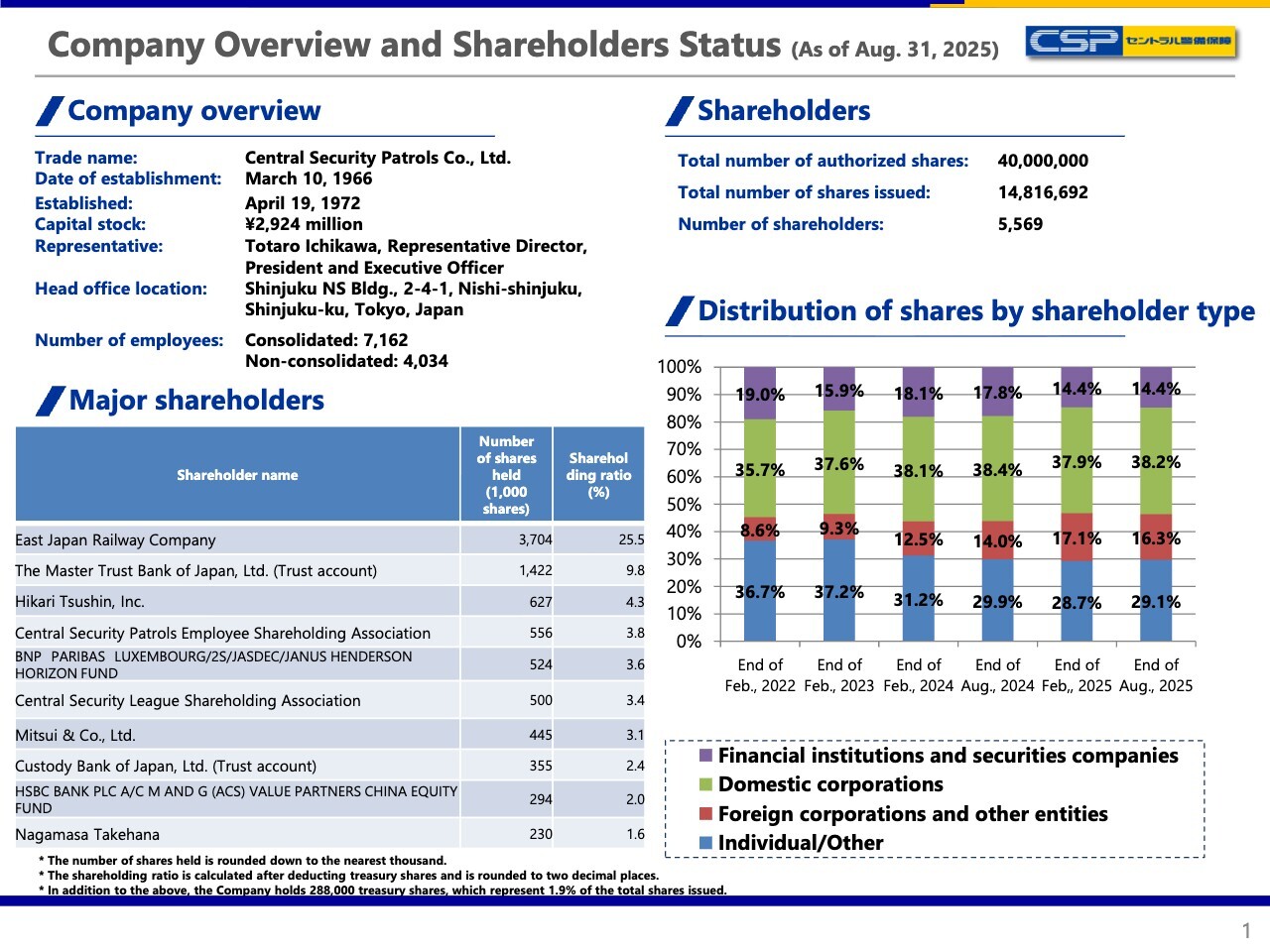
First, this is an overview of the Company and the status of our major shareholders. As shown on the slide, there were no significant changes in major shareholders or the distribution of shares by shareholder type during the first half.
Consolidated Results for H1 (Year-on-year Comparison)
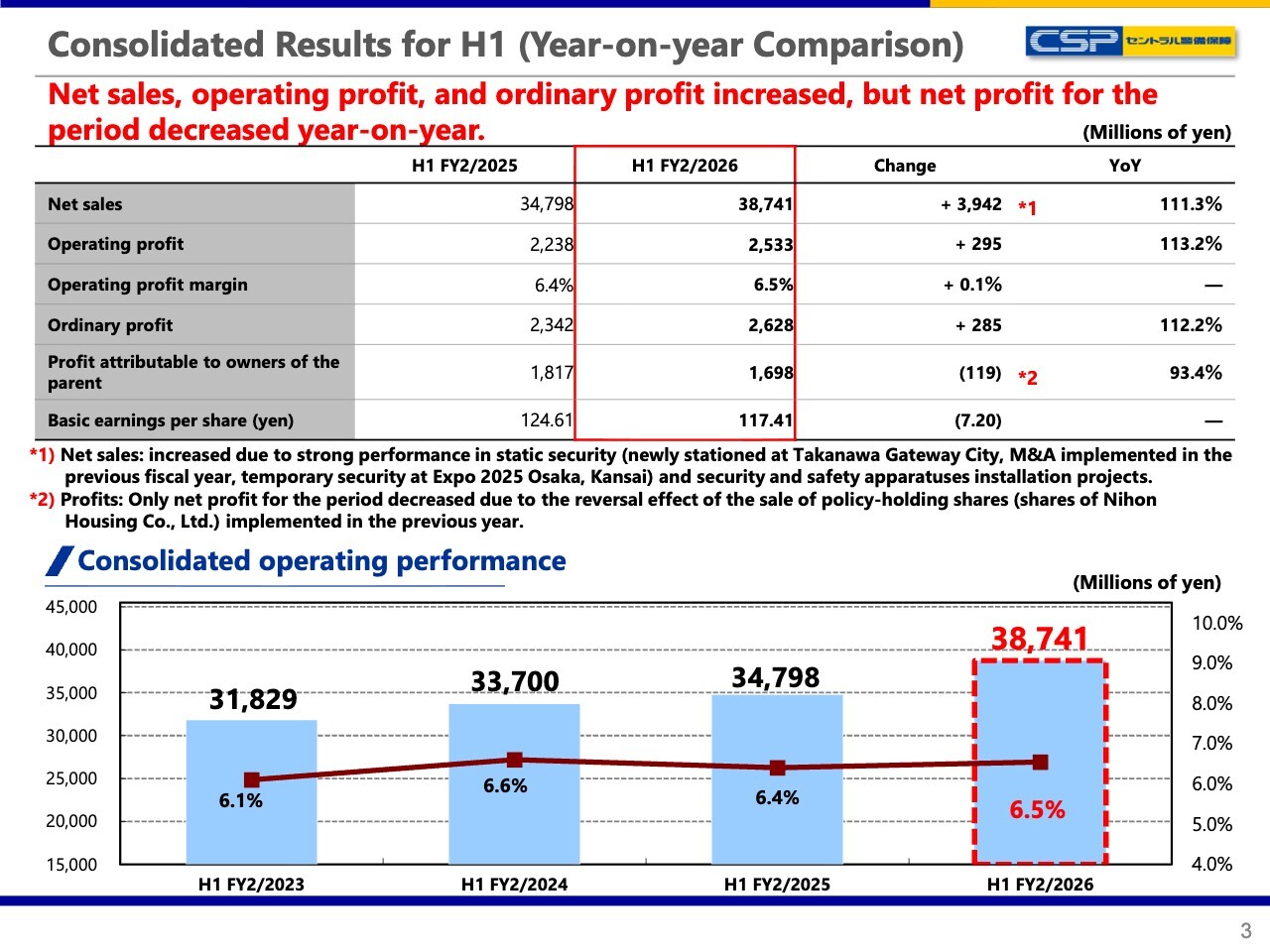
Let me present the highlights of our consolidated results. I will begin with a year-on-year comparison for the first half. As stated in the red text on the slide, net sales increased, as did operating profit and ordinary profit. However, we saw a decline in profit attributable to owners of the parent.
In the table on the slide, the results for H1 FY2/2026 are outlined in red, with the column to the right indicating the changes. The change in net sales at the top shows a significant year-on-year increase of 3,942 million yen. As stated in Note 1, this strong growth was mainly due to the launch of static security at Takanawa Gateway City, M&A activity implemented in the previous fiscal year, and temporary security at Expo 2025 Osaka, Kansai. In addition, strong performance in security and safety apparatuses installation projects was also a major contributing factor.
Operating profit increased at the same rate as net sales.
It is worth noting that the second row from the bottom indicates that profit attributable to owners of the parent decreased by 119 million yen from a year earlier. As explained in Note 2, this was because net profit declined due to the reversal effect of the sale of policy-holding shares (shares of Nihon Housing Co., Ltd.) implemented in the previous year.
The graph at the bottom of the slide illustrates the above table.
Comparison of Consolidated Results Forecast Against Results (Announced Figures)
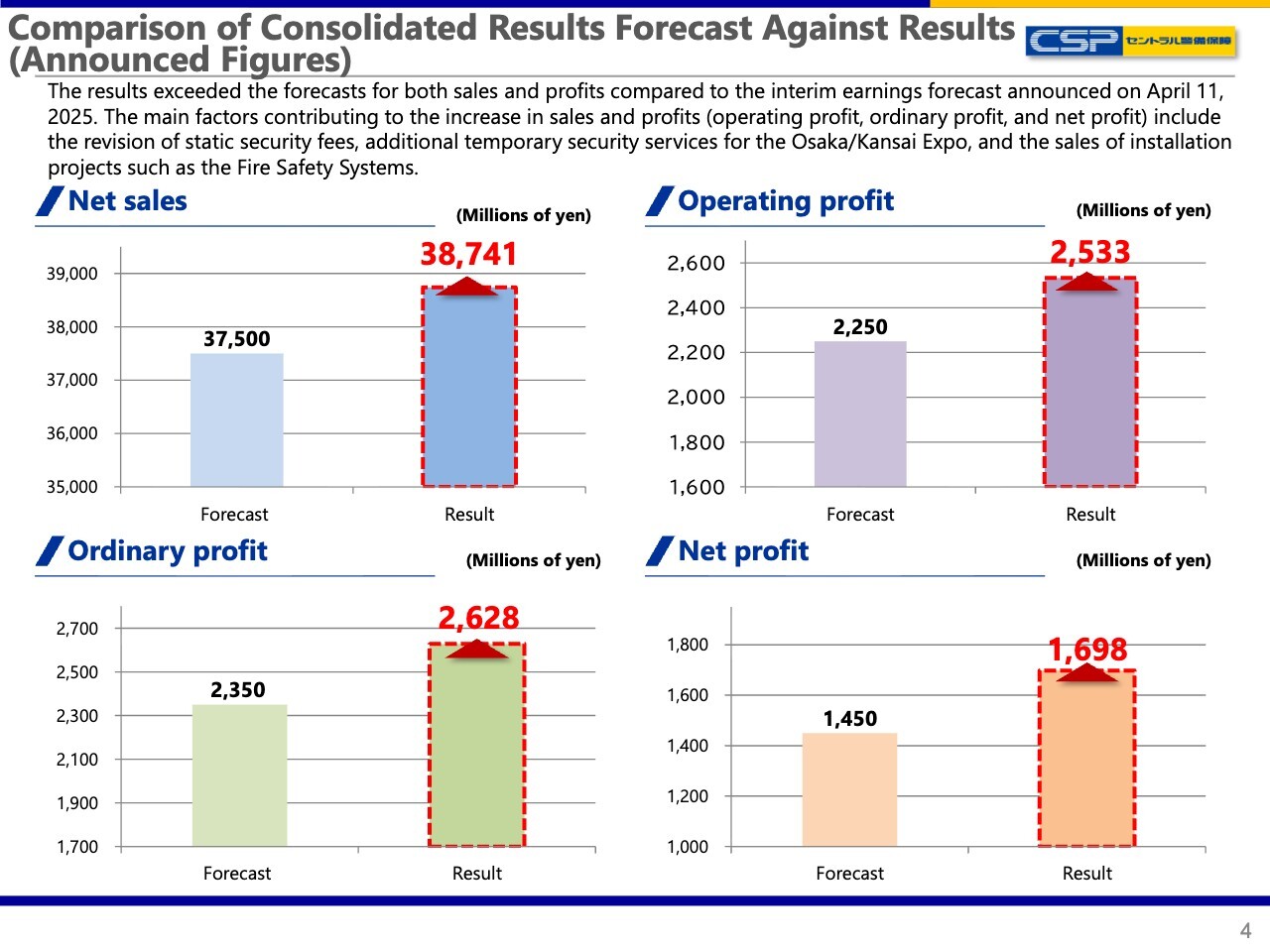
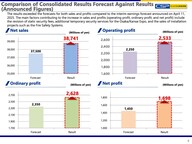
This slide compares the consolidated results forecast against results. The results exceeded the forecasts for both sales and profits compared to the interim earnings forecast. This was due to an increase in net sales, operating profit, ordinary profit, and profit attributable to owners of the parent.
We had assumed that customers would accept the fee revisions for static security to some extent. However, it turned out that their acceptance was greater than expected, and this had a positive impact. Another factor was that the Osaka/Kansai Expo required more temporary security than expected. An additional key factor was the growth in sales of installation projects driven by products that use cameras and AI to help solve customer challenges, such as the Fire Safety Systems.
Sales Trend to East Japan Railway Company and Its Group
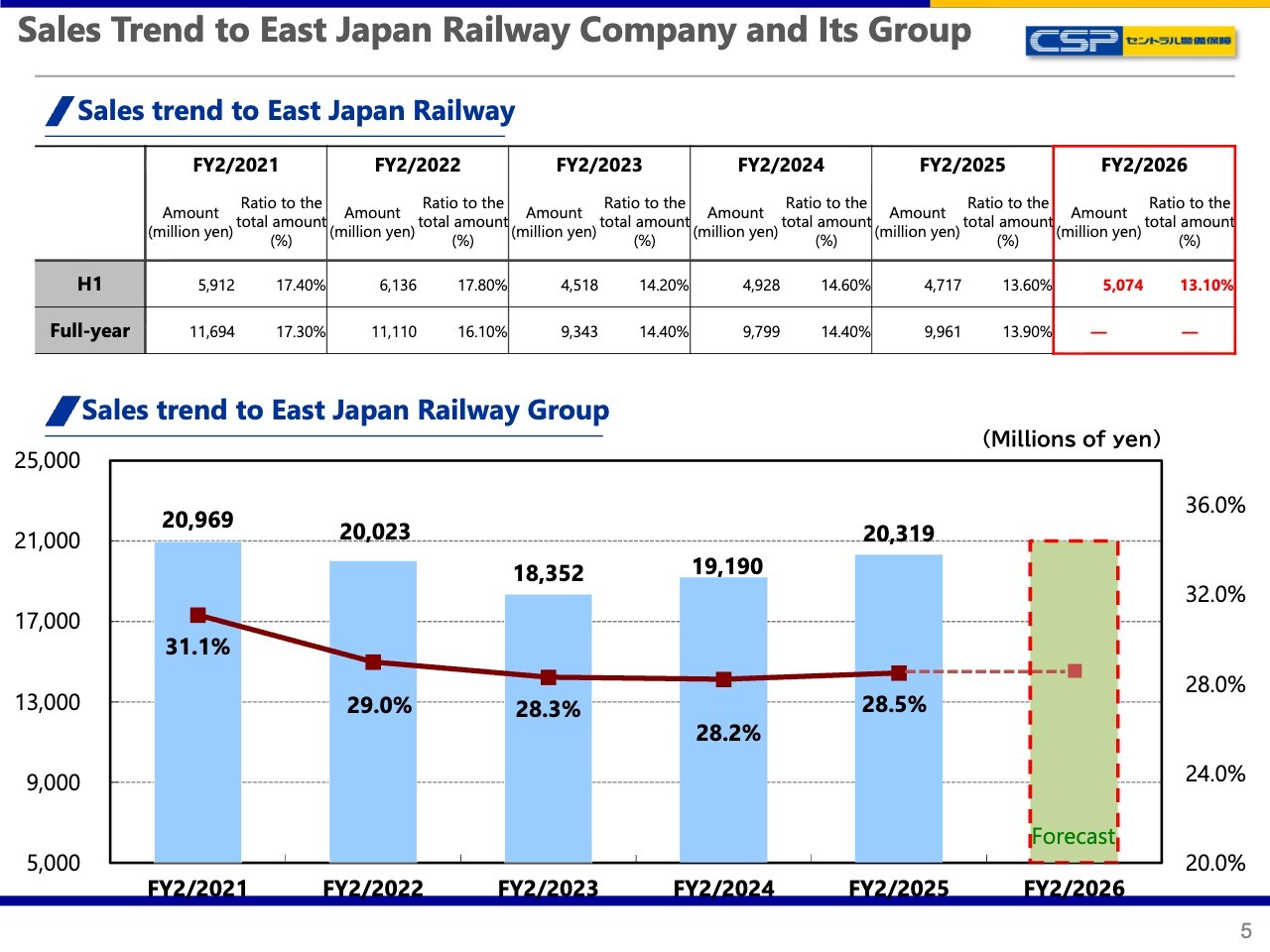
This slide outlines changes in sales to East Japan Railway Company (JR East) and its group companies. As shown in the far-right column of the slide, first-half sales increased from a year earlier. This growth was due to strong performance in static security at Takanawa Gateway City and security and safety apparatuses installation projects.
The graph at the bottom of the slide shows that sales to group companies have been increasing at a steady volume, and overall growth is also expected for FY2/2026.
Segment Information (Year-on-year Comparison)
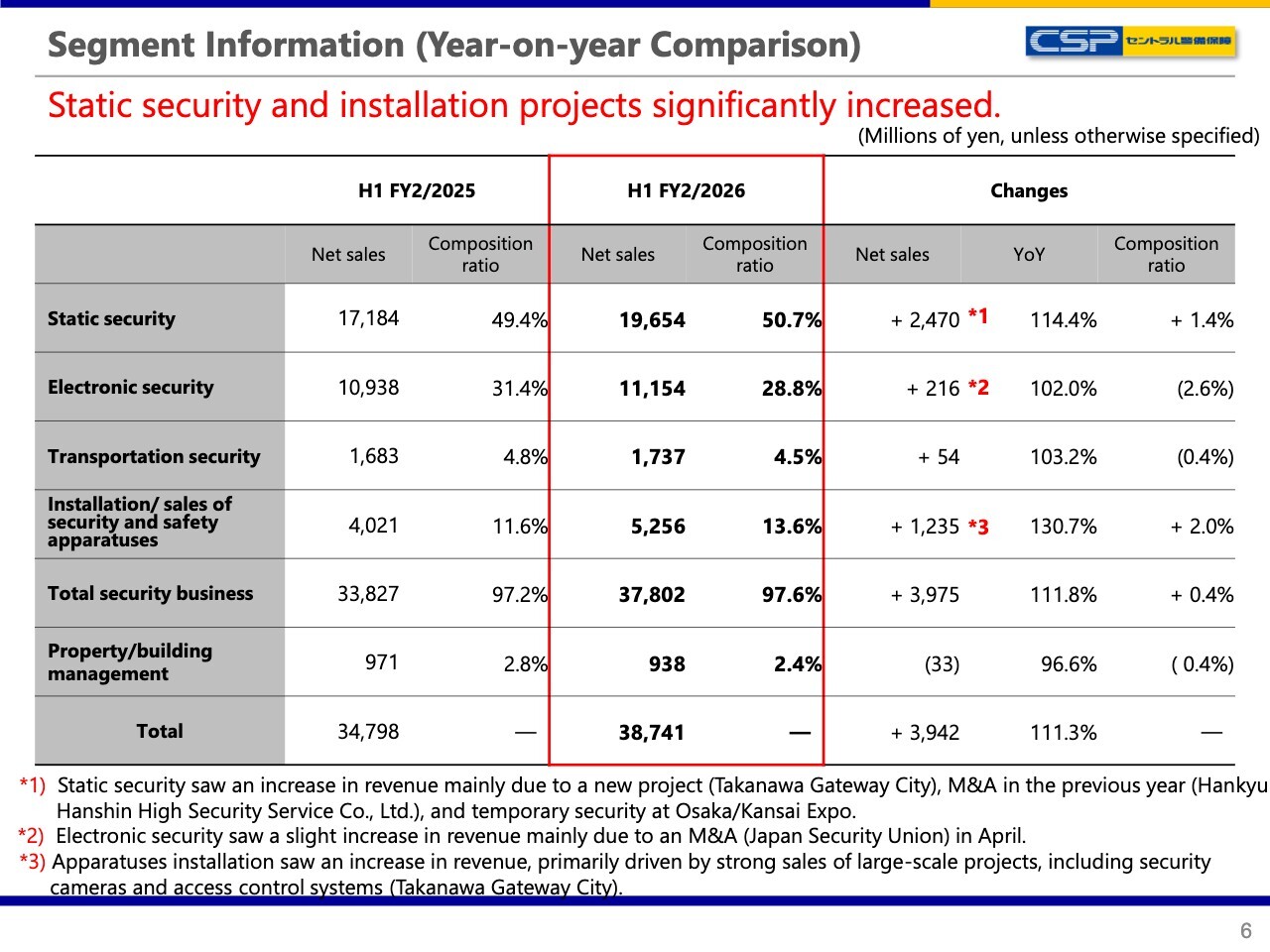
The segment information here compares performance with that of a year earlier. We saw significant growth in static security and apparatuses installation. As shown at the top of the table, net sales for static security increased by 2,470 million yen from a year earlier. As stated in Note 1, this increase was mainly due to the Takanawa Gateway City project, the full-year contribution from Hankyu Hanshin High Security Service Co., Ltd. following last year’s M&A, and temporary security services at the Osaka/Kansai Expo.
In the second row, electronic security saw an increase in net sales of approximately 200 million yen from a year earlier. As indicated in Note 2, this growth was due to the M&A of Japan Security Union, based in Kofu City, Yamanashi Prefecture, in April.
In the fourth row, net sales of installation/sales of security and safety apparatuses increased by approximately 1,200 million yen from a year earlier. As stated in Note 3, this was due to strong sales of security cameras and access control systems. In particular, sales related to Takanawa Gateway City were very strong, resulting in performance that significantly exceeded the same period of the previous year.
Changes in Segment Composition Ratio
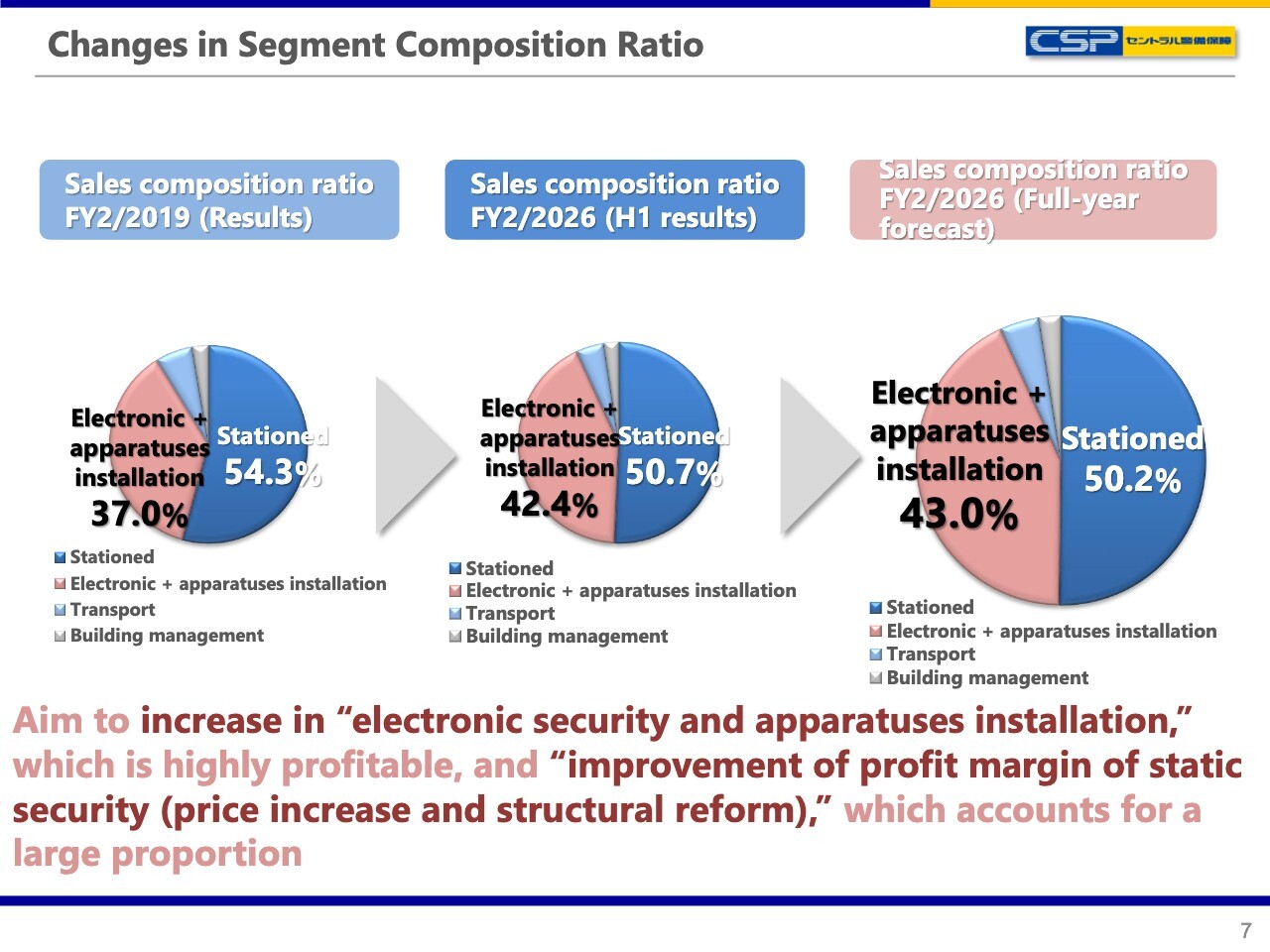
This shows changes in the composition ratio for each segment. From FY2/2019 to FY2/2026, the sales composition ratio of static security on the right side of the pie charts has been on a declining trend, but the ratio of electronic security and apparatuses installation has been increasing.
As the volume of electronic security and apparatuses installation increases, we consider the sales from these businesses and the associated profits, in particular, to be extremely profitable. Therefore, as stated at the bottom of the slide, we will continue to adhere to the policy of further expanding electronic security and apparatuses installation, which is highly profitable.
In addition, since the sales composition ratio of static security is very large, we believe that even a slight improvement in its profit margin would lead to a significant increase in overall profit. Therefore, as stated at the bottom of the slide, we will focus on improving the profit margin of static security through a price increase and structural reform.
The term “nemashi” refers to what is generally called “neage,” meaning a price increase. Specifically, with property costs and personnel expenses rising sharply, we are considering asking customers to bear at least the portion corresponding to the increase in personnel expenses. On this point, we will continue to make proactive efforts while gaining customers’ understanding. We are already beginning to see some results. This situation is not temporary and is expected to continue. Therefore, our policy is to persist in these efforts.
With regard to structural reform, as stated in the next medium-term management plan, we are promoting initiatives to improve profitability by replacing tasks that had previously been performed solely by people with machines, systems, or AI-driven analysis, thereby combining human resources with machines and systems.
Medium-term Basic Policy and Basic Strategy
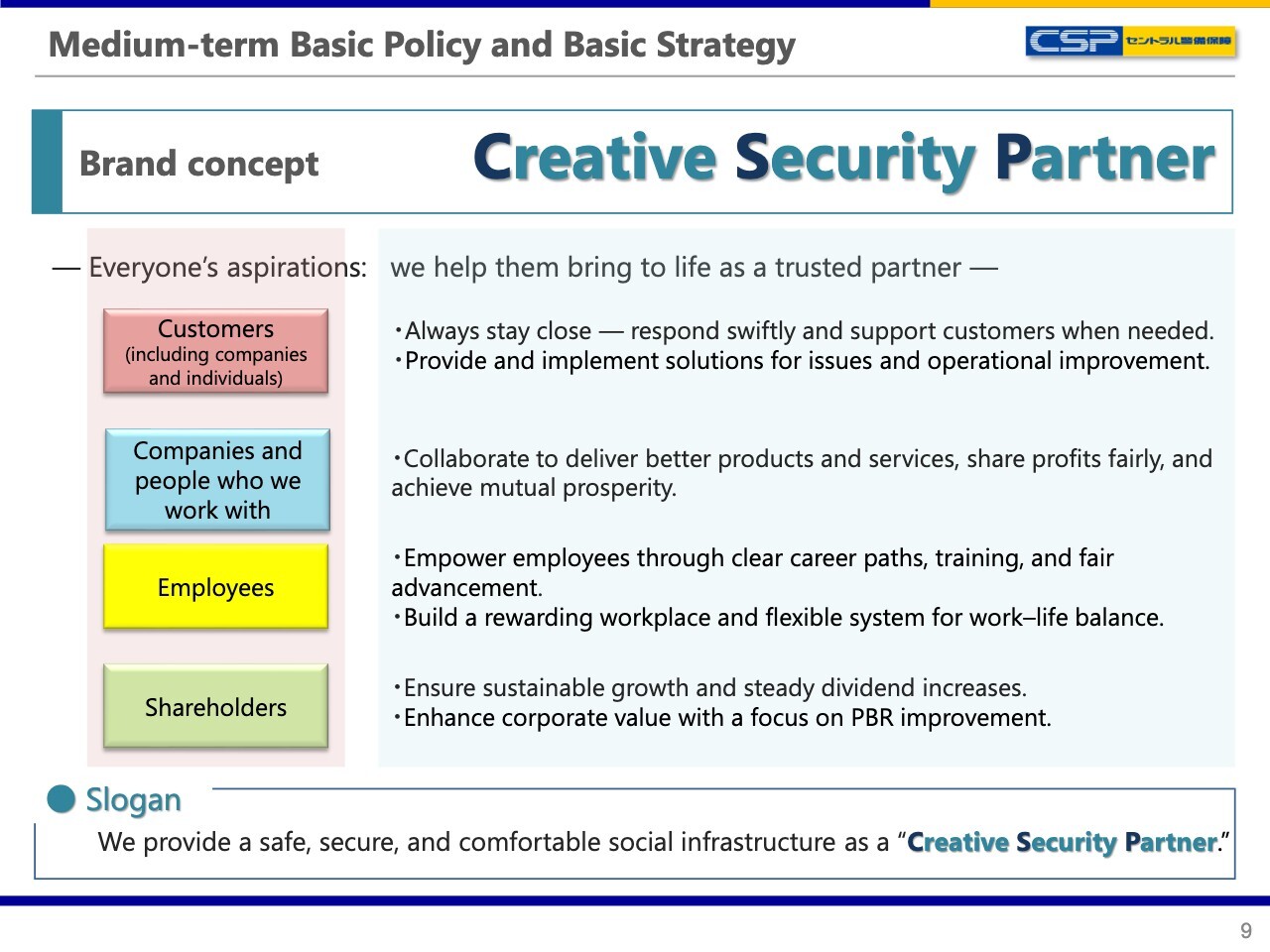
Let me now discuss our current basic policy and key priorities, including initiatives for the future. When formulating our medium-term management plan, we establish the basic policy and strategy for the medium term. We uphold “Creative Security Partner” as a brand concept as we continue to adhere firmly to this commitment.
To express this policy in concrete terms, we present our corporate purpose as shown on the slide: “Everyone’s aspirations: we help them bring to life as a trusted partner,” together with one of our founding principles: “Pursuing happiness for all people connected to the Company.”
The term “all people” includes our customers, companies, individuals, as well as the companies and partners working with us. Furthermore, our foundation is to unite the aspirations of all people, including, of course, our employees and shareholders, and bring them to realization.
We intend to place even greater emphasis on our slogan, “We provide a safe, secure, and comfortable social infrastructure as a `Creative Security Partner,’” and to pursue it with conscious effort.
Medium-term Management Plan: Aspirations 2030 — Achieve Through Collaboration
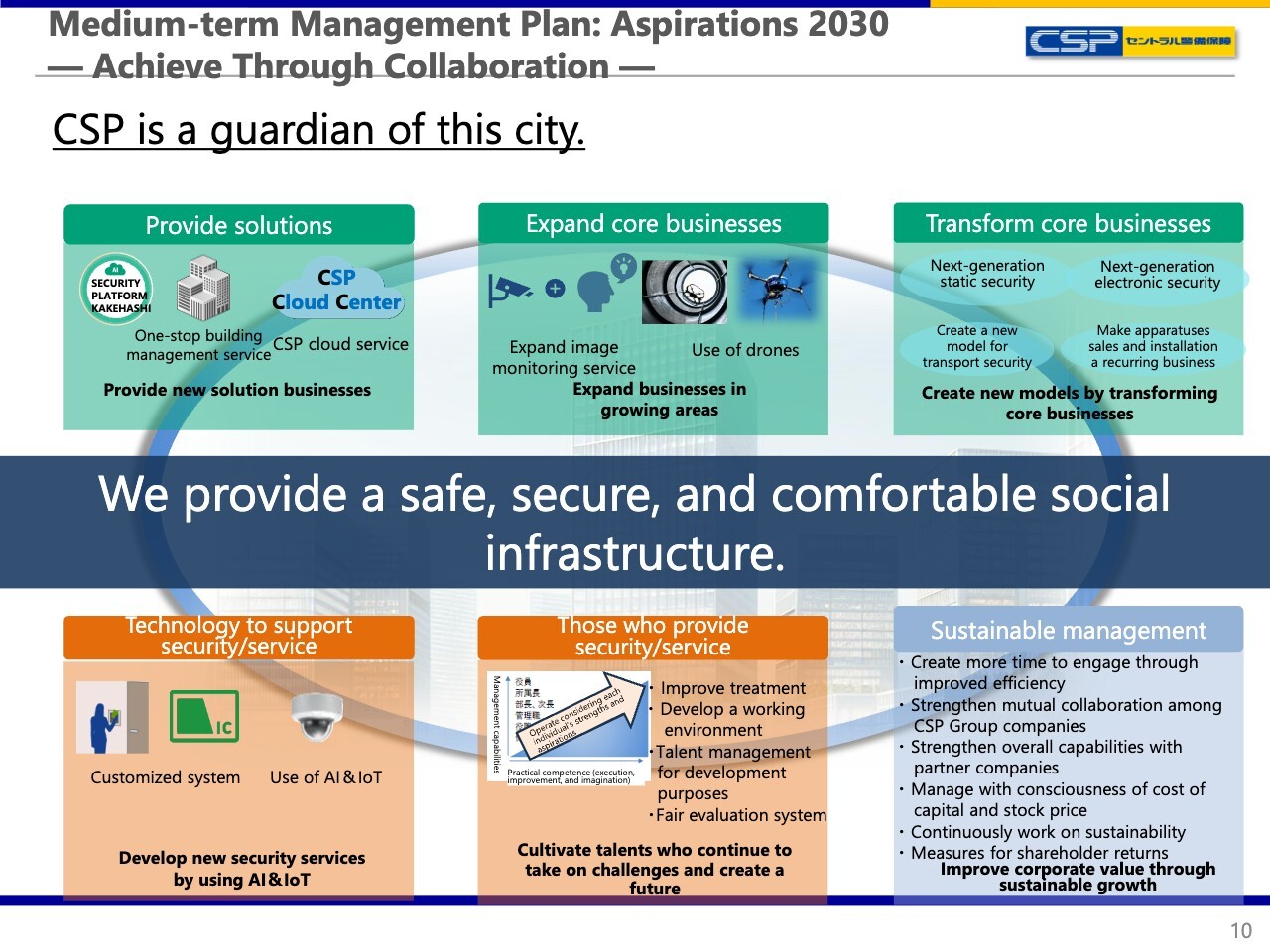
We have established the Medium-term Management Plan: Aspirations 2030 — Achieve Through Collaboration — and adopted “CPS is a guardian of this city” as a key phrase. This reflects our aspiration to become a familiar and reassuring presence, dedicated to safeguarding the entire city.
Based on the statement in the center of the slide, “We provide a safe, secure, and comfortable social infrastructure,” the three items at the top show how we aim to realize that vision.
The upper-left item “provide solutions” shows our commitment to achieving one-stop building management through the security platform KAKEHASHI. In addition, we position the CSP Cloud Center (CCC) as a new solution offering and promote its use by other companies as well.
In the central item, “expand core businesses,” our policy is to actively promote the expansion of our image monitoring service and the use of drones as tools.
On the right, under “transform core businesses,” we are advancing next-generation static security, which introduces a new style of static security. In addition, we are focusing on developing a system that deploys personnel only when needed, aiming to realize next-generation electronic security that allows people to concentrate on tasks that truly require human involvement.
Furthermore, since we believe it will be difficult to respond to future needs using the same transportation security methods as in the past, we are working to create a new model for transportation security by adjusting existing approaches and incorporating new elements.
In addition, while apparatuses sales often end as one‑time transactions, apparatuses and systems need to be replaced after a certain period. For this reason, we aim to maintain ongoing relationships with our customers and promote the shift toward a recurring business model under the concept of making apparatuses sales and installation a recurring business.
As the guiding principles that support these initiatives, we place importance on the three items shown at the bottom of the slide: “technology to support security/service,” “those who provide security/service,” and “sustainable management.” Through these three elements, we aim to build the foundation for a recurring business.
In the lower-left item, “technology to support security/service,” we emphasize customized systems. Specifically, rather than creating technology from scratch, our approach is to combine existing technologies to build better solutions and deliver them to our customers. In addition, we are committed to making full use of tools such as AI and IoT.
In the item “those who provide security/service,” the focus is on cultivating talents who continue to take on challenges and create a future. Although this is a labor‑intensive industry, we want to develop people who can think independently and generate better solutions. In addition to improving basic treatment, we will enable employees to envision their future career by imagining, for example, “this is what I can do” or “this is how I want to grow.”
In the item “sustainable management,” “improved efficiency” is defined not as a reduction in personnel, but as enabling more value‑adding activities with the use of surplus time.
Through these initiatives, we aim to foster a positive mindset and create an environment that supports sustainable growth and enhances corporate value.
Progress of the Medium-term Management Plan
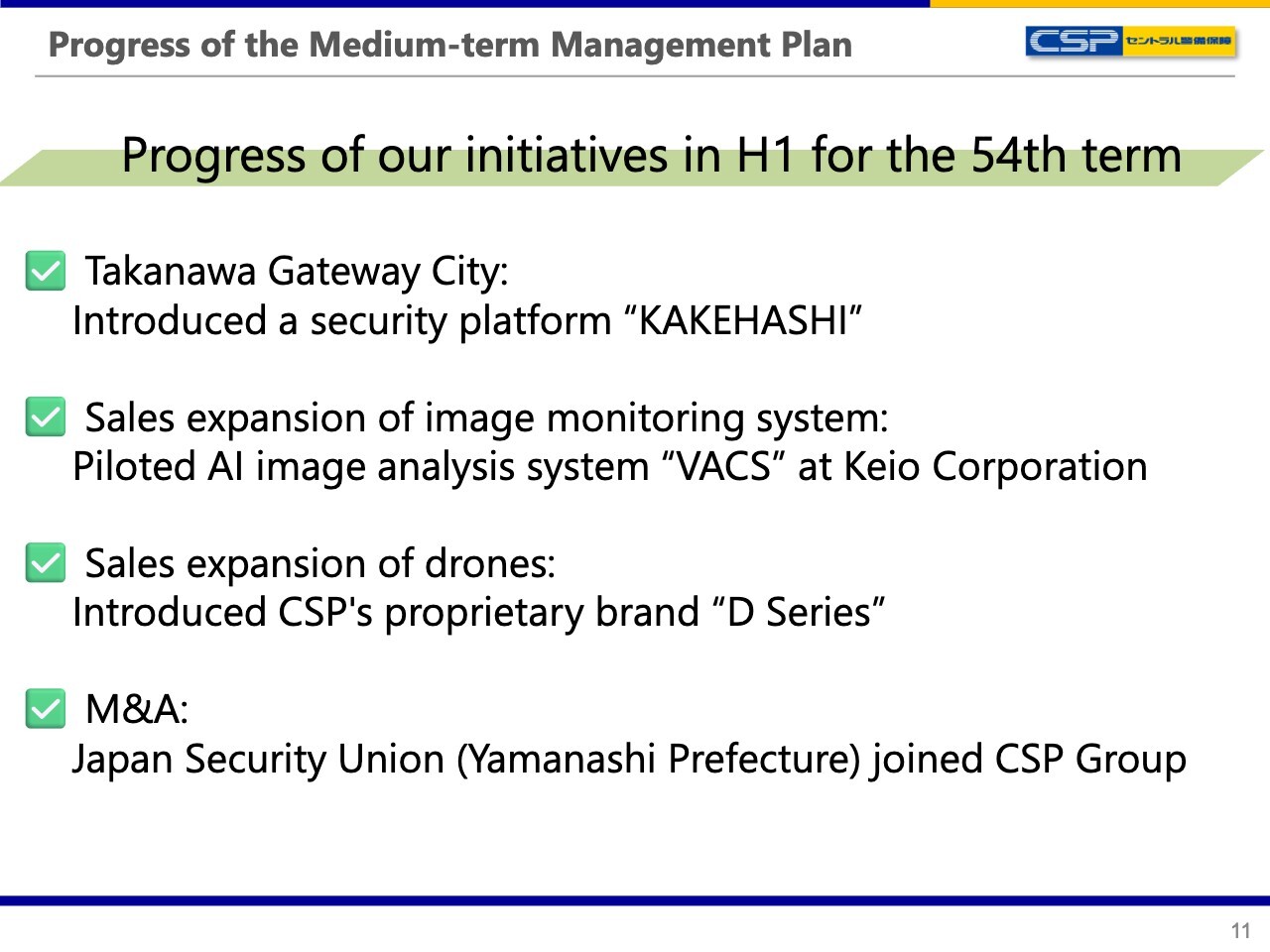
Based on this foundation, we have established the Medium‑term Management Plan: Aspirations 2030. I would like to highlight four achievements from the first half.
The first is the introduction of the security platform KAKEHASHI at Takanawa Gateway City. The second is the sales expansion of the image monitoring system. The third is the sales expansion of drones. The fourth is M&A.
Security Platform KAKEHASHI
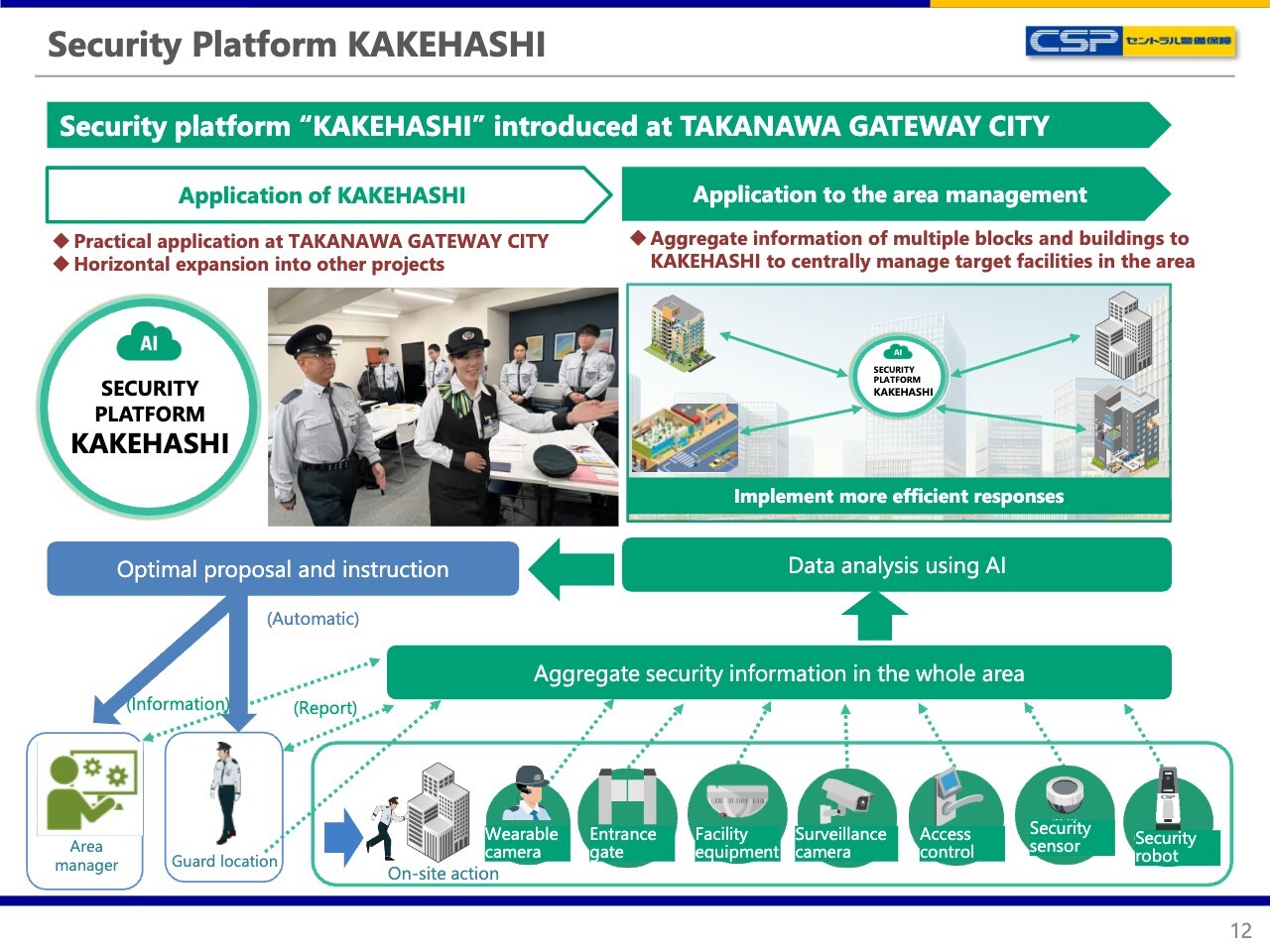
I will explain each of these in turn. The first is KAKEHASHI. With the opening of Takanawa Gateway City, we have been entrusted with overall security operations, and we are utilizing a security platform called “KAKEHASHI.”
The lower part of the slide illustrates how KAKEHASHI works. KAKEHASHI aggregates security information from the entire area and automatically generates optimal proposals and instructions by analyzing the data using AI. Security personnel and administrators then take concrete actions based on that information.
By employing this system, we can achieve what is described on the right side of the slide as “application to the area management.” KAKEHASHI aggregates information from multiple blocks and buildings, to centrally manage target facilities in the area.
Takanawa Gateway City is an area with multiple buildings. The first phase of the opening includes only one building. However, the plan is to increase the number to four next year. When that happens, we will be able to manage multiple buildings in an integrated fashion. Our current objective is to steadily turn this new vision into reality.
VACS System
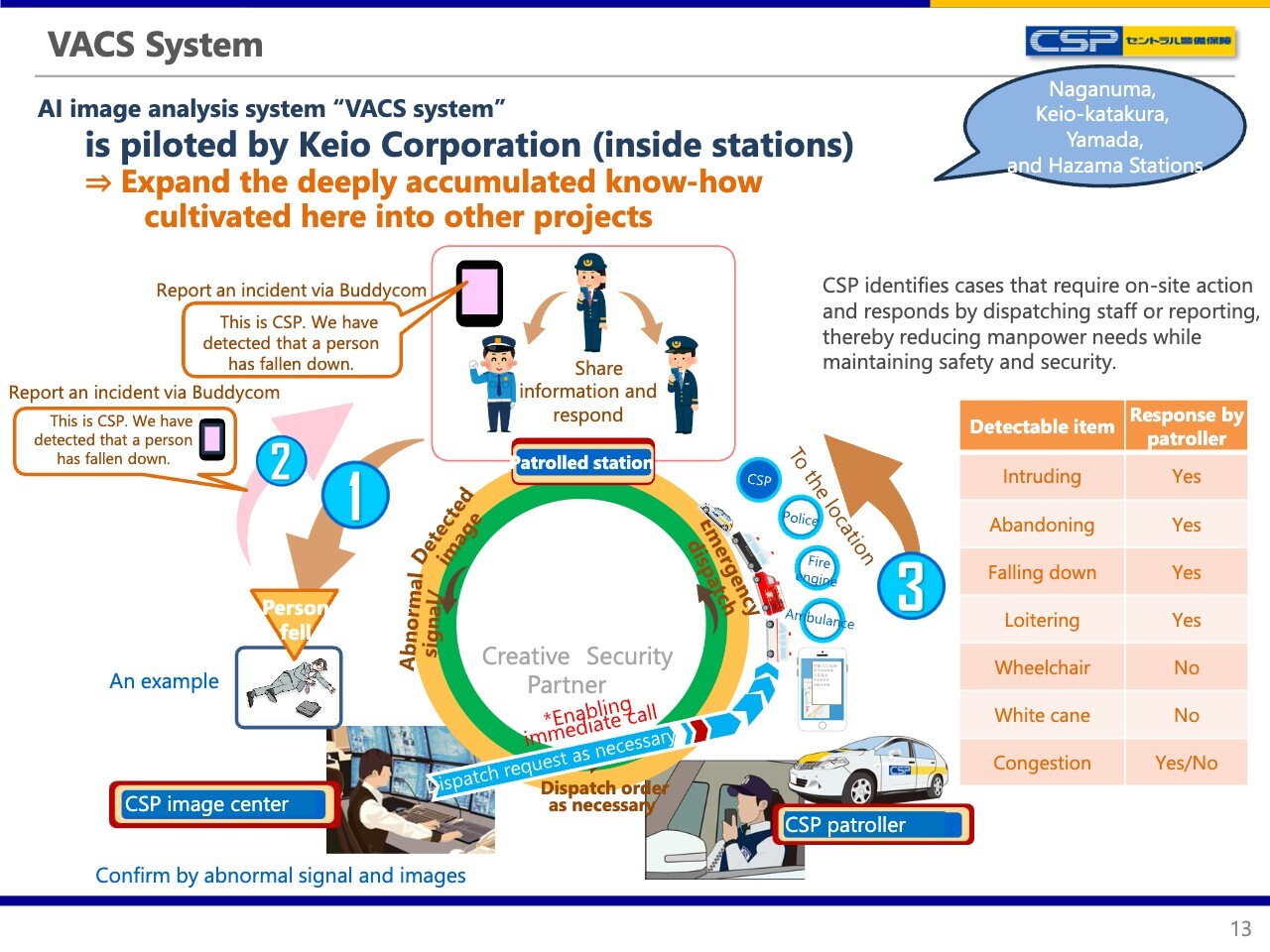
The second is our image analysis system. At present, the VACS system, one of our products, is being piloted inside Keio Corporation stations. Through this pilot program, we aim to further enhance our expertise and expand deployment to additional locations.
The VACS system uses image recognition to detect passenger-related incidents, such as tripping and falling, and enables CSP to automatically report them. As shown in the center of the slide, information is shared between our security division and the staff at the train station managed by the operator (in this case, Keio Corporation) as they respond to various situations.
The table on the right shows detectable items and responses by the patroller. We share information with station staff. For the top four items, we, as a security company, dispatch patrol staff immediately. Wheelchairs and white canes, however, will be handled by station personnel. If a hazard arises due to crowding, we will, of course, deploy our own personnel.
We believe that by introducing the VACS System, we will be able to support railway operators and help improve the quality of services and the level of security for passengers.
Expanded Sales of Drones
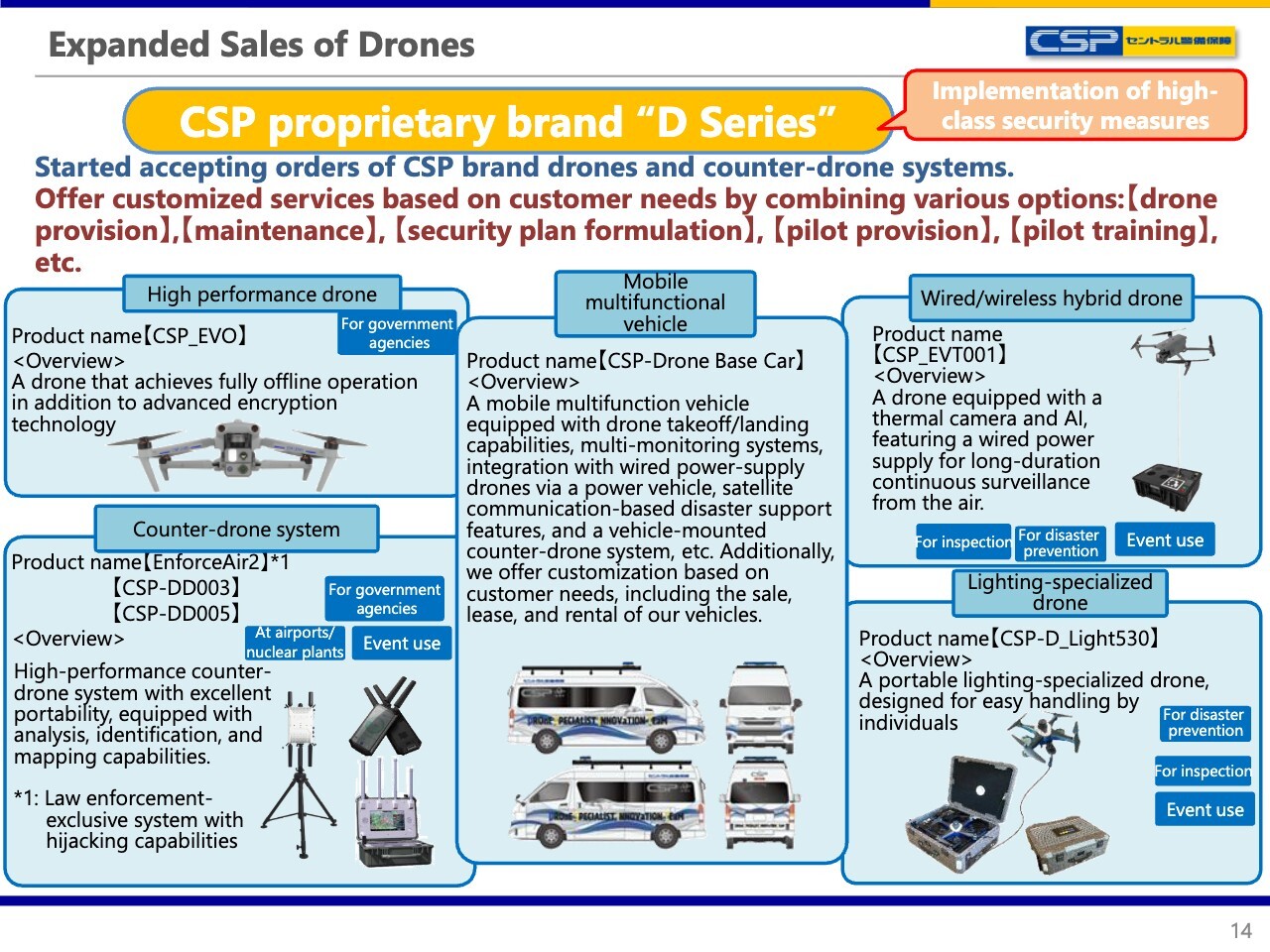
The third is the expansion of drone sales. This fiscal year, we established the Drone Utilization Promotion Department. Since drones are being used in a wide variety of situations, we are working to expand sales by identifying the most suitable applications for each customer and then proposing and delivering those solutions.
The “high-performance drone,” shown on the left side of the slide, is primarily targeted at government agencies. The “counter-drone system,” presented in the lower left of the slide, is designed to prevent the intrusion of unauthorized drones, which have been increasing in recent years. This product is in demand among government agencies, as well as at event venues, airports, and nuclear power plants.
The “wired/wireless hybrid drone,” shown on the right side of the slide, is a drone that uses wired power supply to enable extended flight times. This product is intended for customers with specific needs such as inspections, disaster prevention, and events. The “lighting-specialized drone,” presented in the lower right, is highly effective during disasters or work operations, and is being utilized for disaster prevention, inspections, and events.
In the center, the “mobile multifunctional vehicle” features a model called the “CSP-Drone Base Car.” It is designed to carry drones and move them to various locations and is useful in a wide range of situations such as disasters and events.
We have launched these products under CSP’s own brand to offer them to customers. We will strengthen our efforts and pursue further growth in this field.
Introduction of New Consolidated Subsidiary
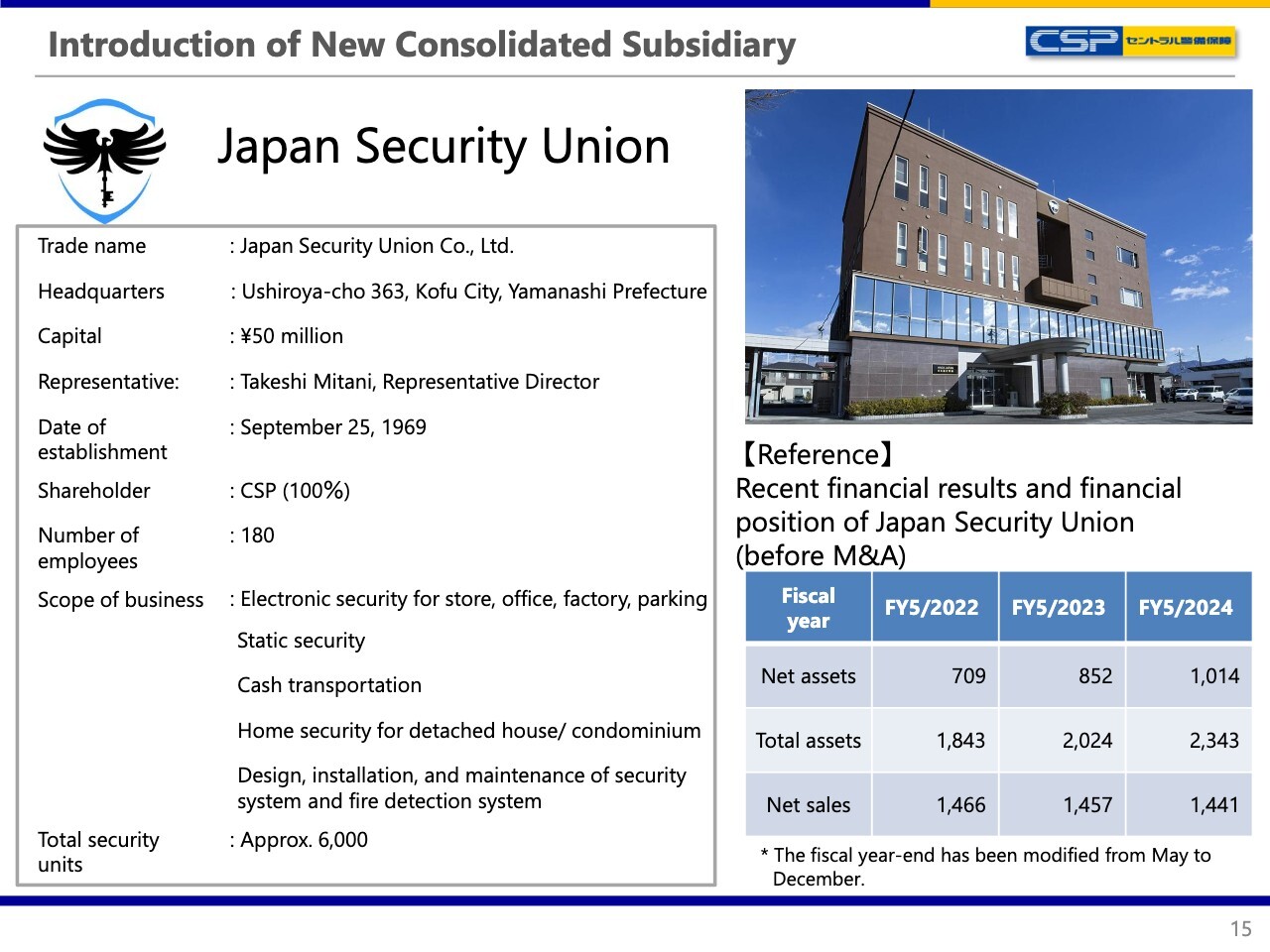
Let me discuss our M&A activities. In April of this year, we added Japan Security Union to the group. The company is headquartered in Kofu City, Yamanashi Prefecture. Its electronic security business is substantial. As I mentioned earlier, the primary driver behind the increase in our electronic security sales was the addition of this company to the group. We intend to further strengthen our sales efforts as the CSP Group.
This concludes my discussion regarding the initiatives implemented for the first half.
Measures of the Medium-term Management Plan
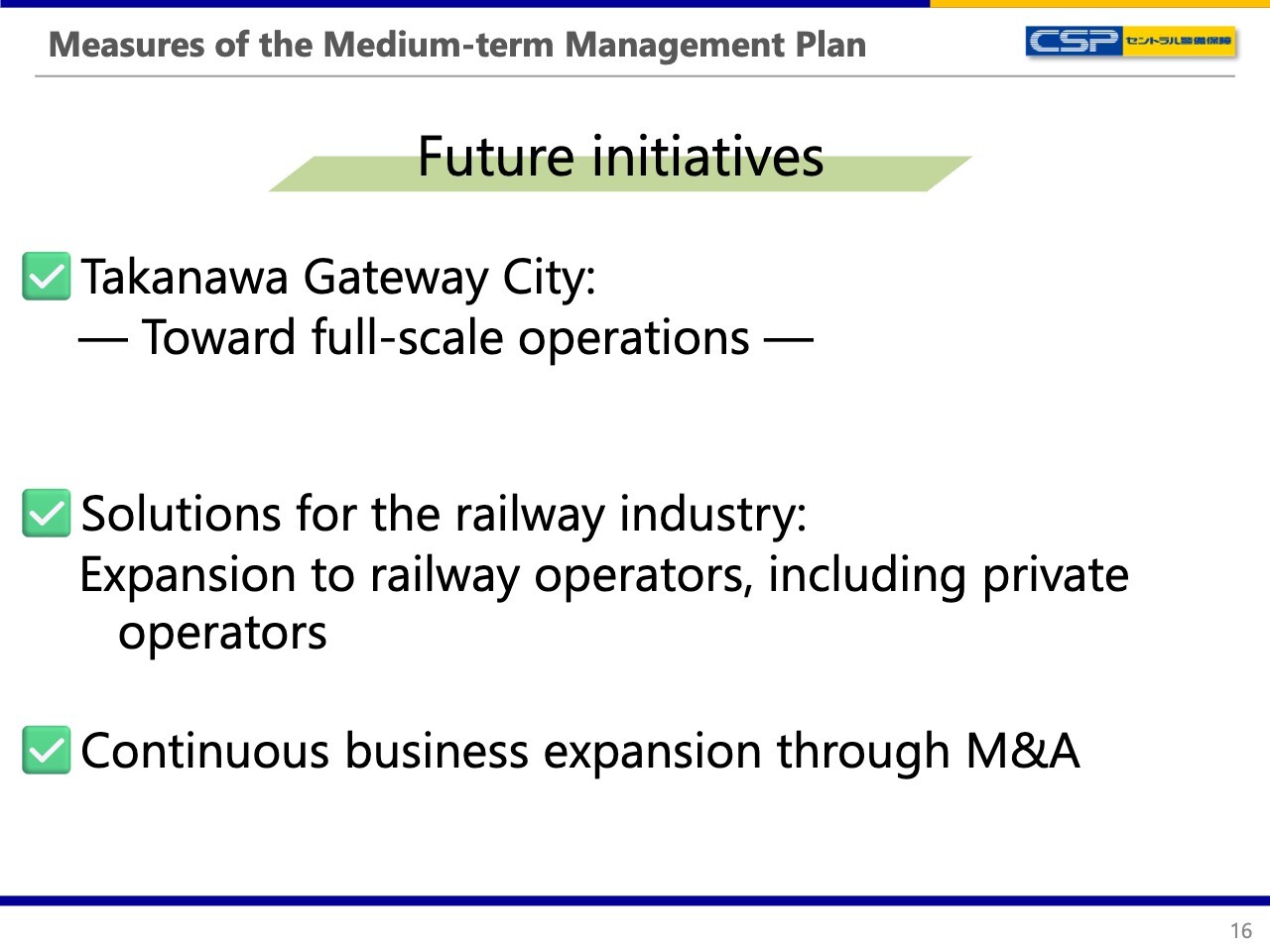
Next, I will discuss our future initiatives. We will cover three areas: initiatives related to Takanawa Gateway City, solutions for the railway industry, and our approach to M&A.
Horizontal Expansion of the Security Platform KAKEHASHI into the Area Management
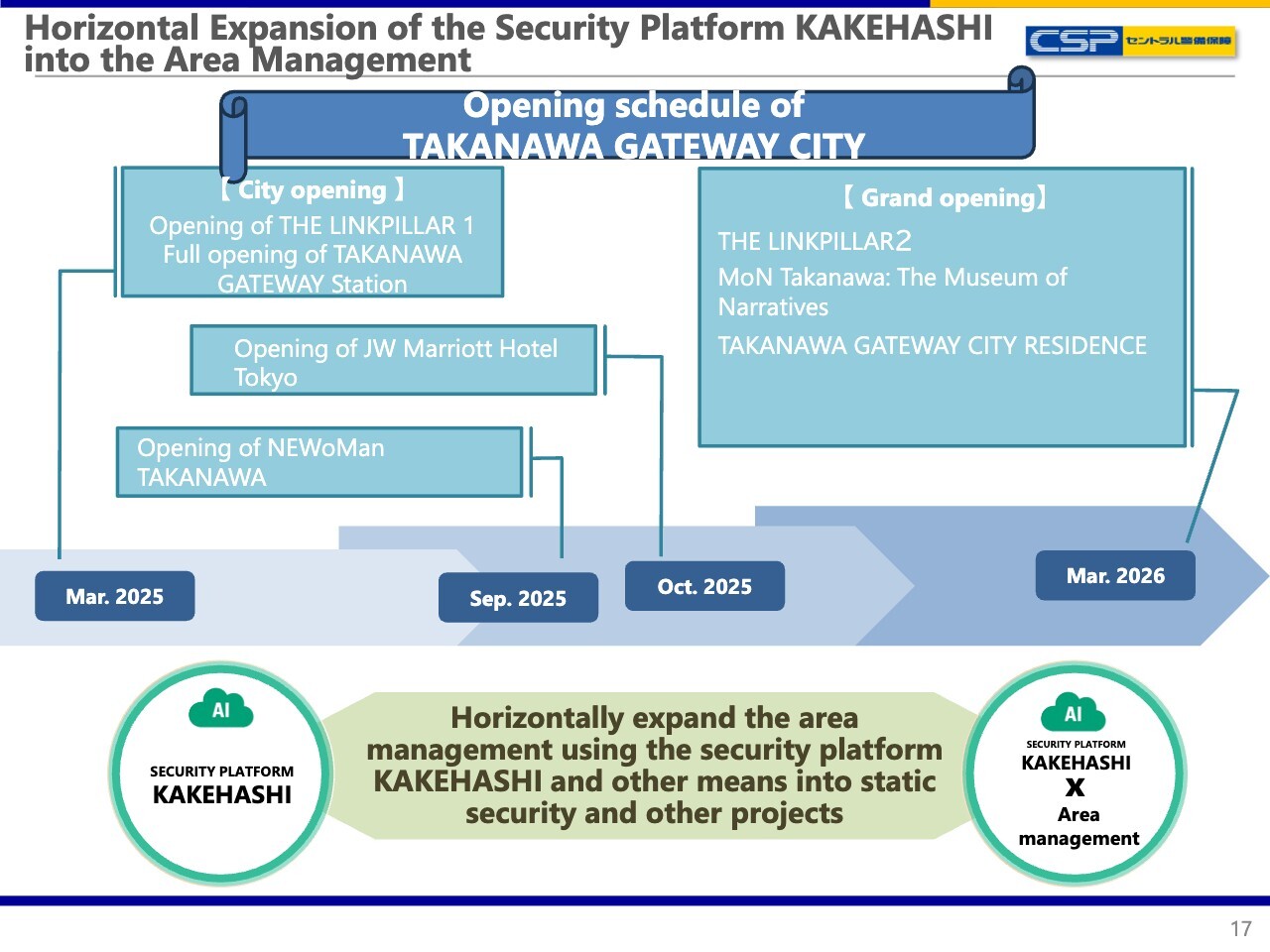
First, let me address Takanawa Gateway City. As shown in the timeline at the center of the slide, the JW Marriott Hotel Tokyo is scheduled to open by October 2025, with the grand opening planned for next spring.
At this site, we will introduce the security platform KAKEHASHI, which functions effectively in managing multiple buildings and the entire area. Through this initiative, the KAKEHASHI × Area management framework shown at the lower right of the slide is scheduled to be fully implemented. We are preparing to extend our product expertise to other similar locations.
Sales Expansion of Solutions for the Railway Industry
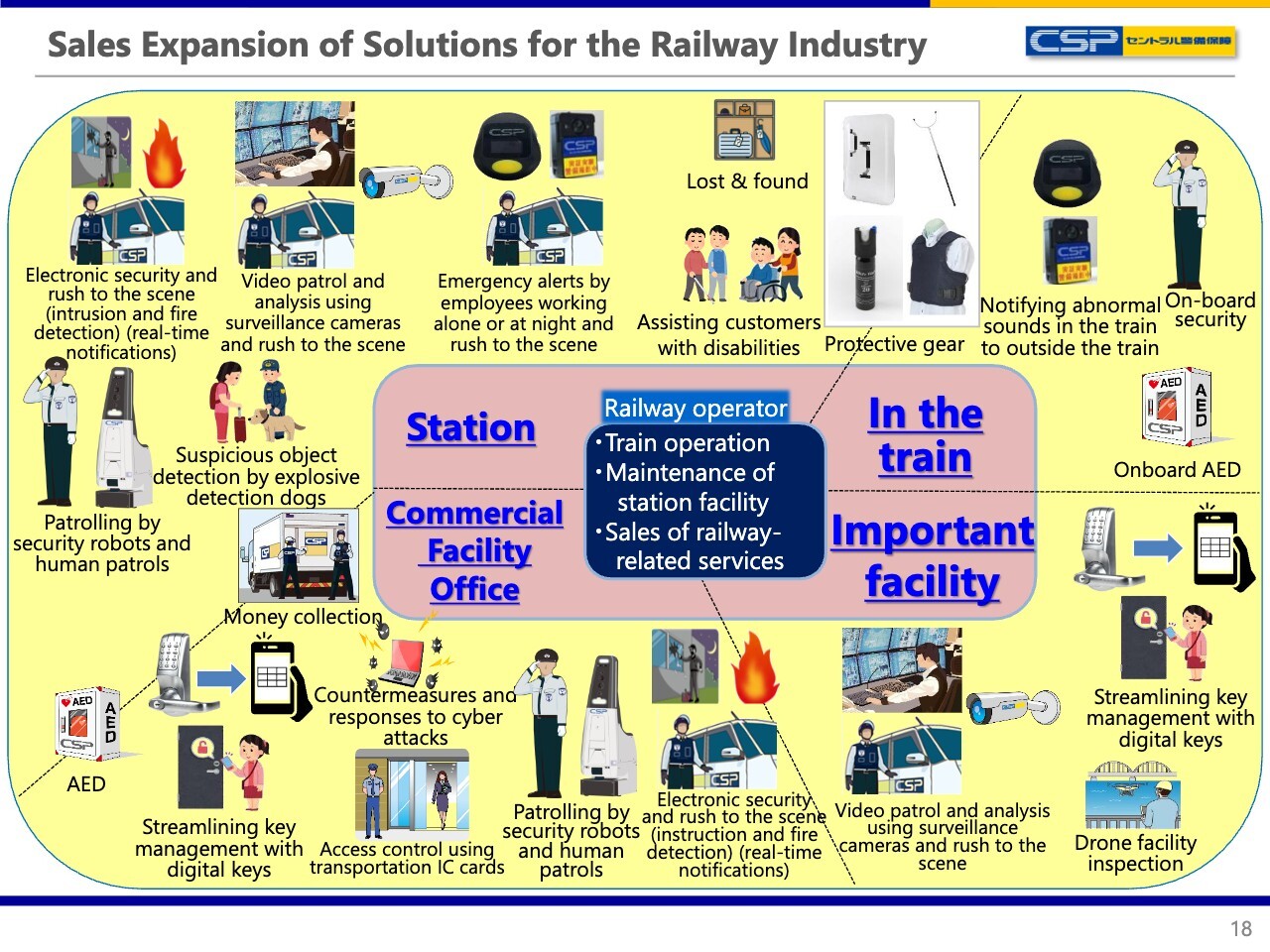
The second is the expansion of solutions for the railway industry. As shown in the center of the slide, the core businesses of railway operators include train operations, maintenance of station facilities, and sales of railway‑related services. We can handle work outside these areas, and we are already engaged in many projects. We intend to further expand these services and focus on strengthening our contribution to railway operators.
We have received a large volume of work from JR East, and through projects such as those shown on the slide, we have been steadily accumulating expertise, technology, and knowledge. We are actively working to share these capabilities with other railway operators as well. In addition, we plan to participate in events such as railway technology exhibitions, and we intend to actively promote our strengths to railway operators.
Business Expansion Through M&A
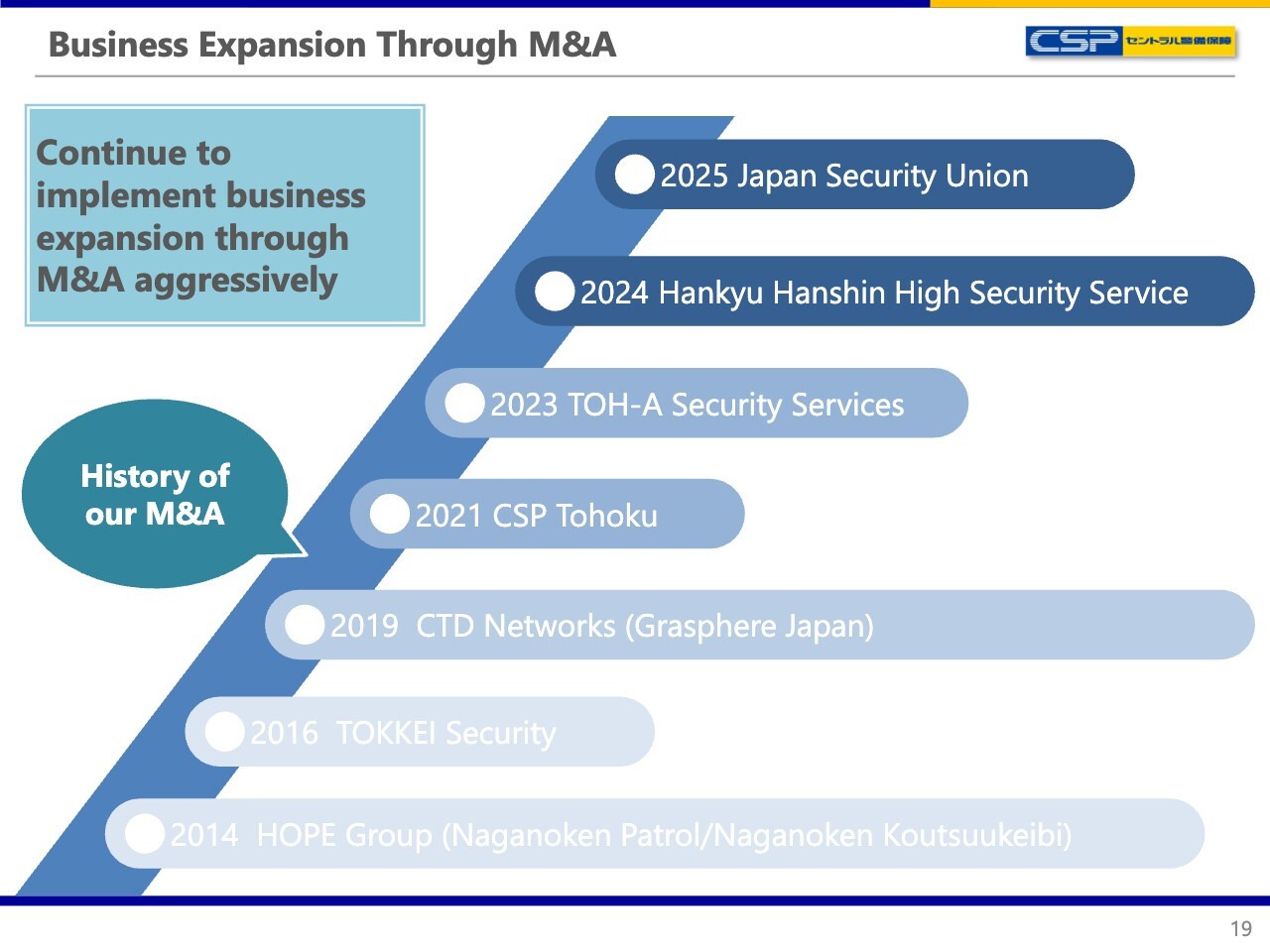
The third is business expansion through M&A. The table on the slide shows our track record. At the bottom, you can see the acquisition of HOPE Group in Nagano Prefecture in 2014, followed by TOKKEI Security in Kanagawa Prefecture; CTD Networks, a company handling cameras and related equipment; CSP Tohoku in Sendai, Miyagi Prefecture; TOH‑A Security Services in Tochigi Prefecture; Hanshin Hankyu High Security Service in the Kansai region; and finally, Japan Security Union in Yamanashi Prefecture.
We have been actively expanding our business by acquiring companies through M&A every year or two. Going forward, we will continue to actively pursue M&A with companies that are highly compatible with our business, not only security companies but also building maintenance, machinery, systems, and other related companies whenever promising opportunities arise.
Next Fiscal Year Onward in the Medium-term Management Plan
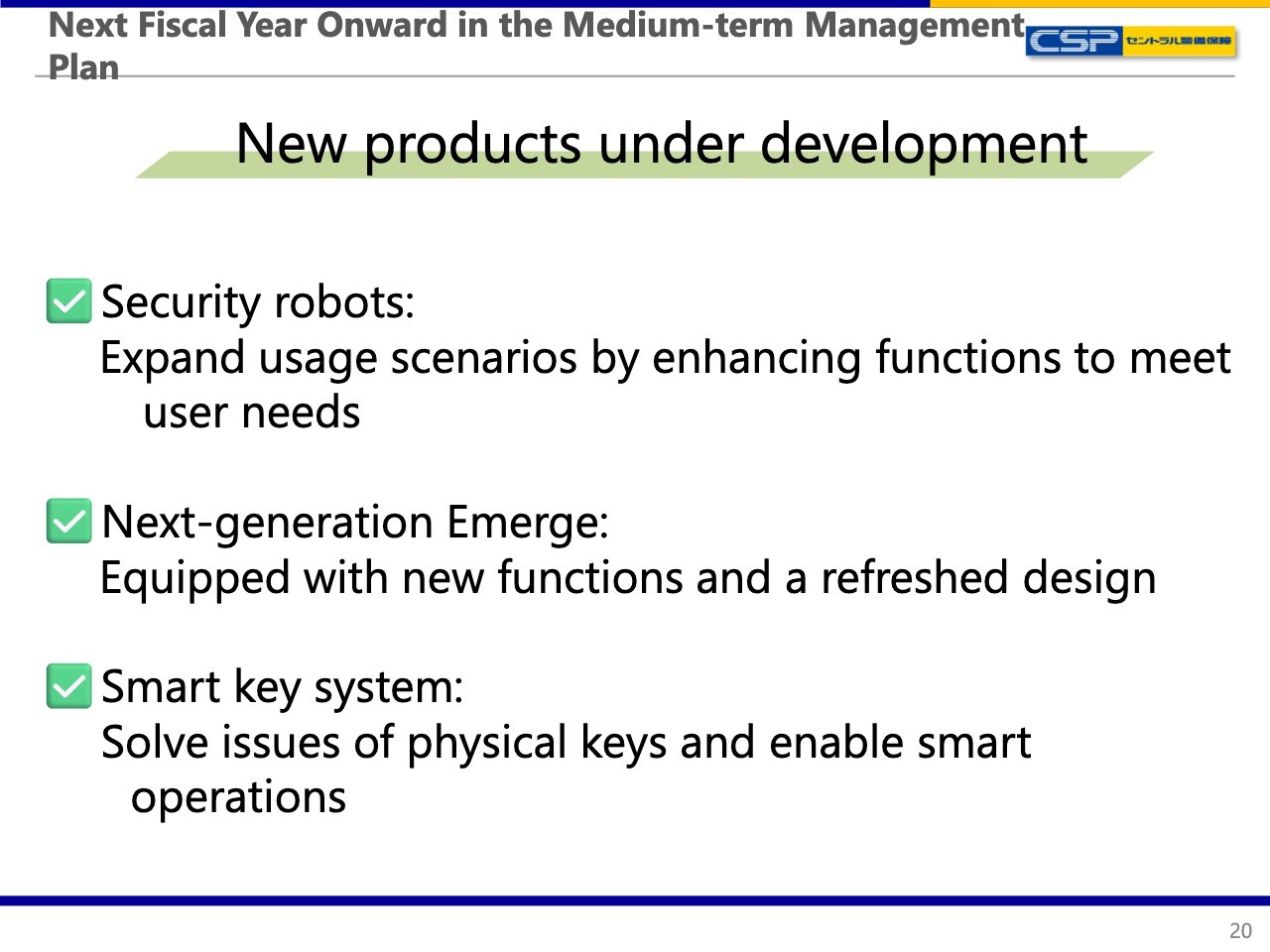
We are developing new products for the future. Today, I would like to introduce three of them: security robots, the next‑generation Emerge, and the smart key system.
Application of Security Robots
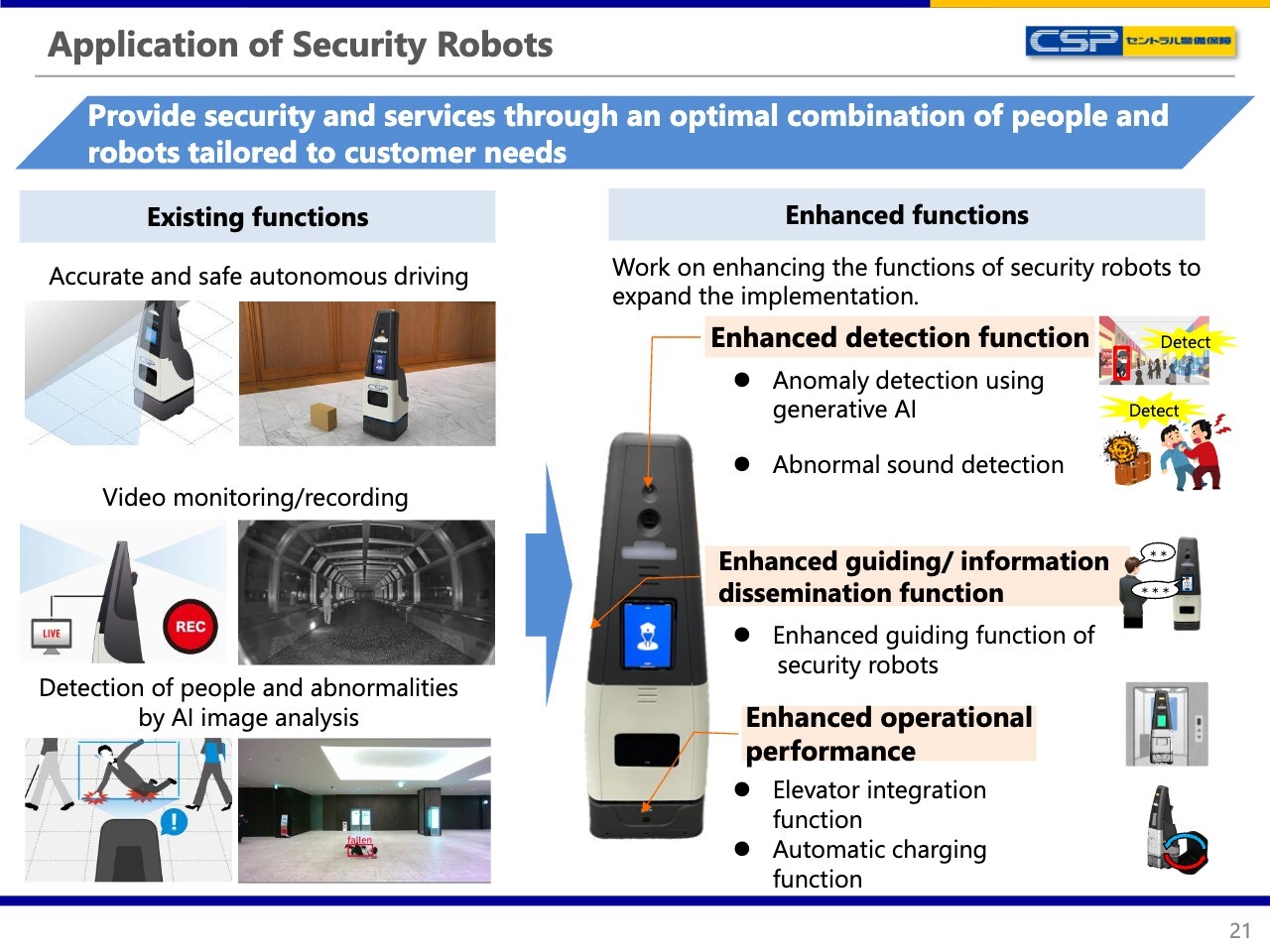
Our first product is a security robot. In line with our policy of developing and maintaining security robots in‑house, we are working on the model shown on the slide, called “C‑SParX.”
On the left side, we have listed the existing basic functions: autonomous driving, video monitoring/recording, and AI image analysis. On the right side, we have outlined further plans to improve functions, including enhanced detection capabilities with AI and improved accuracy of anomaly detection using generative AI. We also plan to add guiding and information dissemination functions for customers when needed. In addition, to strengthen operational performance, we are integrating our products with elevators and improving automatic charging functions, enabling the robot to operate more effectively in both security and service roles.
Mobile-type Emergency Alert System “Emerge”
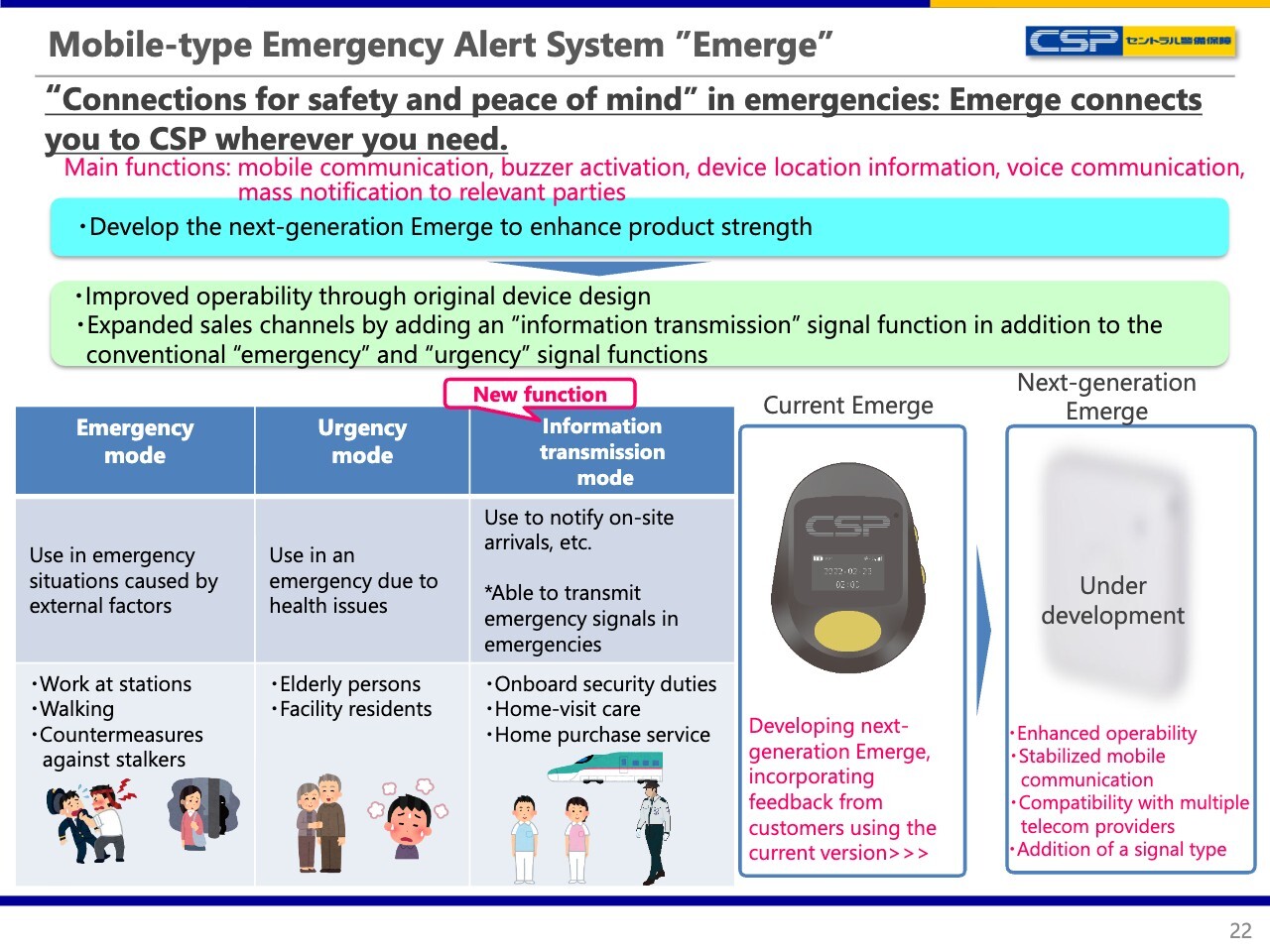
Our second product is a mobile‑type emergency alert system called “Emerge.” At the bottom right of the slide, you can see the current version of Emerge. In an emergency, pressing the yellow button connects the user to one of our command center operators. The operator assesses the situation and may dispatch security personnel or notify the police if anything appears to be abnormal.
The current functions are “emergency mode” and “urgency mode,” as shown in the table. Emergency mode, as mentioned earlier, enables immediate reporting in an emergency, with our command center operator dispatching security personnel or contacting the police through a live call. Urgency mode is used in situations such as health issues. The operator assesses the situation and sends security personnel or contacts relevant parties as needed.
We believe that we will be able to apply this system to a wider range of situations by adding new functions. We also envision using it as a service, in line with what is noted on the slide as “notify on‑site arrivals, etc.” In addition, we are considering creating functions that would allow operators to easily check the location and activities of security personnel while they are on duty aboard the Shinkansen or other trains.
In this way, we are developing new functions with a variety of use cases in mind. These functions are currently under development, and we are preparing to introduce them in a new format in the next fiscal year.
Smart Key System
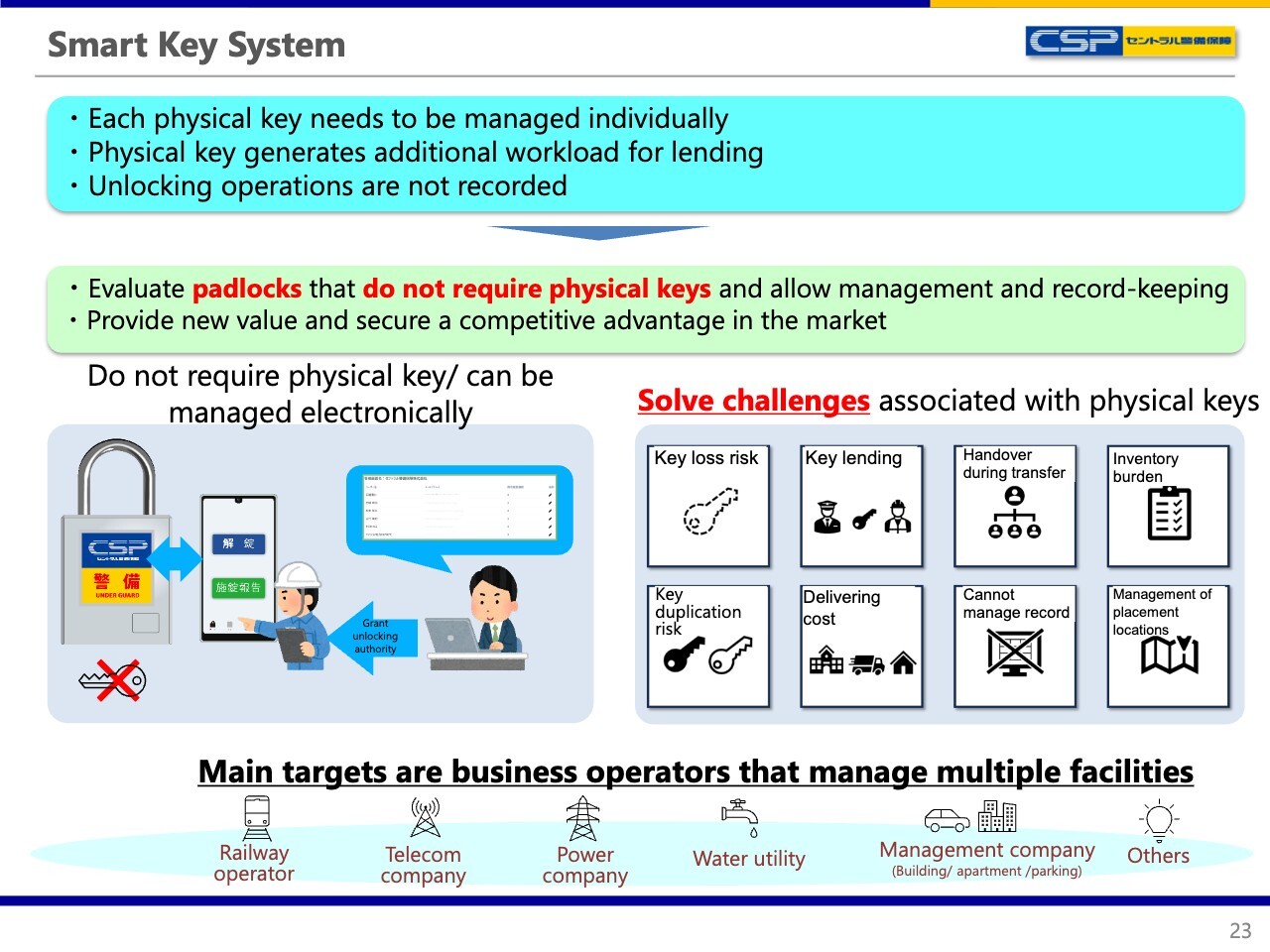
Our third product is a smart key system. For us as a security company, as well as for our customers, using physical keys and locks to open and close each door requires considerable effort in key management, and the task becomes very difficult when keys must be lent out. There is an added challenge of keeping track of who has borrowed them.
For this reason, smart key products have already appeared on the market. We also plan to provide smart keys customized to the needs of our customers, adding features that reflect specific requirements and necessary functions.
We have already identified customer needs and are conducting research on customizations to meet such needs. We therefore expect to offer this smart key system to our customers in the near future.
Medium-term Management Plan >> From “Creative2025” to “Aspirations 2030”
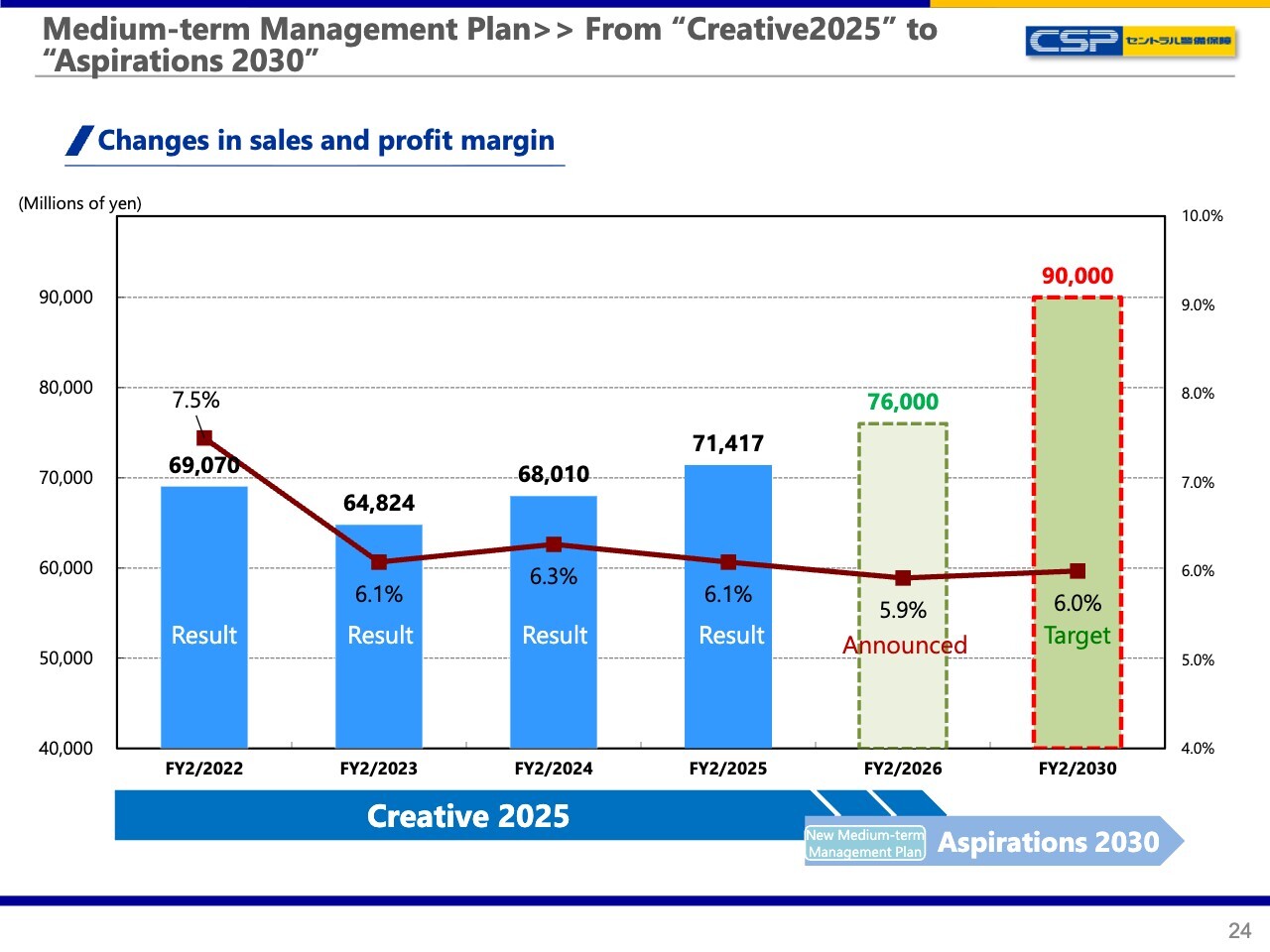
We will continue to make steady efforts in light of our current situation. With regard to the medium‑term management plan, we will incorporate new approaches and ideas while further advancing our initiatives during the period from “Creative 2025” to “Aspirations 2030,” as shown directly beneath the table. Our target is to achieve net sales of 90,000 million yen and an operating profit margin of 6.0% for FY2/2030.
Shareholder Returns
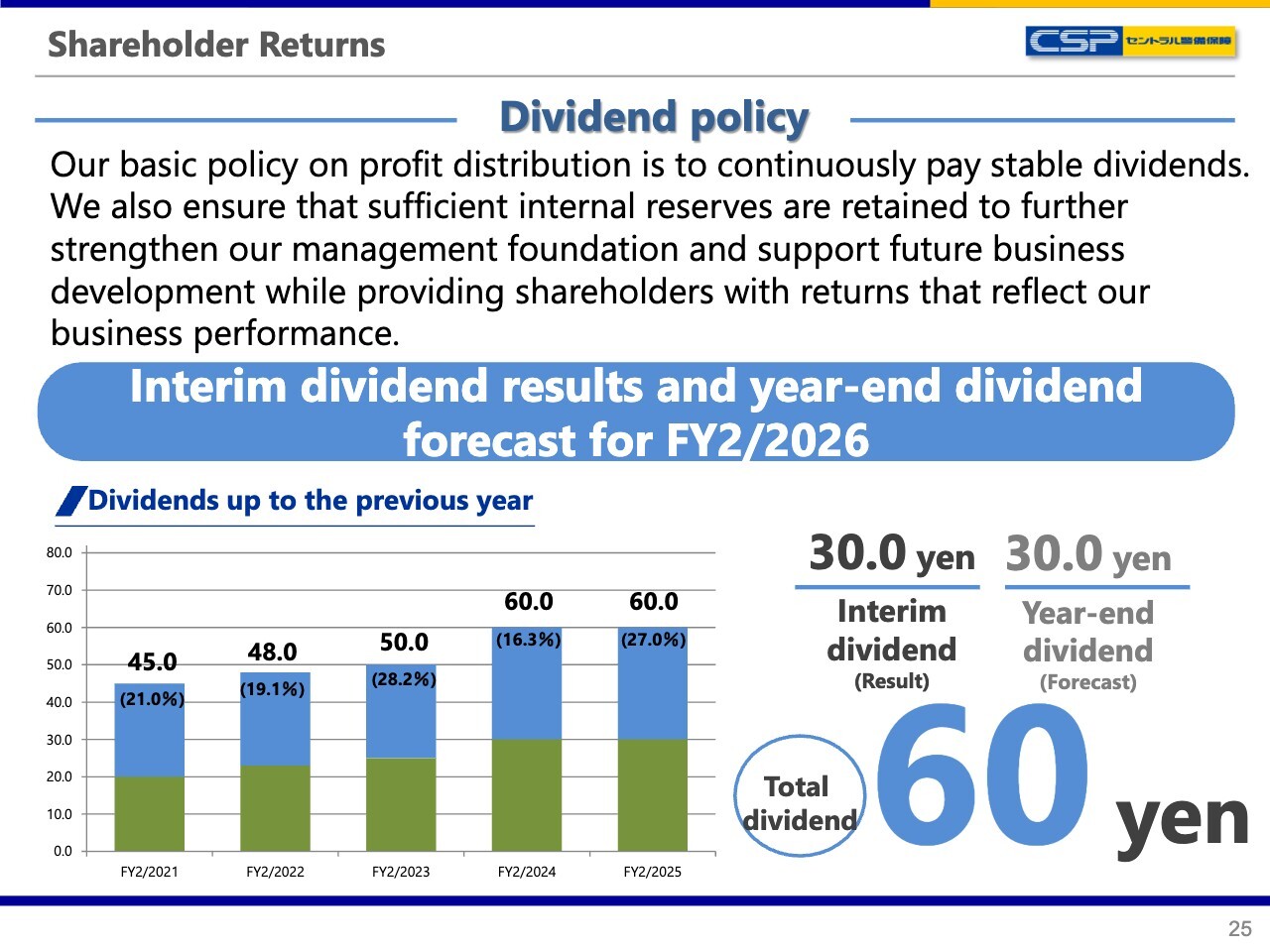
Finally, I would like to address shareholder returns. Our dividend policy is to ensure that sufficient internal reserves are retained to further strengthen our management foundation and support future business development, and provide shareholders with returns that reflect our business performance. In particular, our basic policy is to continuously pay stable dividends.
For the interim dividend for F2/2026, we paid 30 yen. We also plan to pay 30 yen as the year‑end dividend, bringing the annual total to 60 yen.
This concludes our financial results presentation and review of the accompanying material.
Q&A: Impact of the absence of special demand for temporary security services related to the Osaka/Kansai Expo
Moderator: We have a question from a viewer: “Could you tell us about the profit margin for static security in the first half? There are concerns that the margin may decline in the second half due to the end of temporary security assignments for the Osaka/Kansai Expo. What is your outlook?”
Ichikawa: Static security included temporary security assignments for the Osaka/Kansai Expo. I believe this question assumes that, since the Osaka/Kansai Expo created special demand, the profit margin in the first half was higher as a result.
In terms of total sales for static security, the Osaka/Kansai Expo does not account for a volume large enough to significantly affect overall results. Therefore, we do not believe it has such a major impact on the profit margin. Accordingly, although the temporary security assignments for the Osaka/Kansai Expo will end in the second half, we do not expect this to greatly influence the profit margin of static security.
Q&A: Measures to offset the reactionary impact of large projects in FY2/2026 and outlook for new projects
Moderator: We have a question regarding sales from FY2/2026 to FY2/2027. “In FY2/2026, there are large projects such as temporary security assignments for the Osaka/Kansai Expo and the installation work for Takanawa Gateway City. For FY2/2027, are there any projects that could offset the reactionary impact of such large projects? In addition, is it possible to aim for sales growth on a consolidated basis?”
Ichikawa: Regarding the temporary static security for the Osaka/Kansai Expo, I addressed this matter in my answer to the previous question. For static security fees, we will continue to negotiate a price increase with our customers in a steady and consistent manner. In addition, as part of our response measures, we are considering structural reforms in static security.
With respect to the question as to whether there are larger projects in the area of security and safety apparatuses, we do see some opportunities and expect to generate a certain level of earnings, although we cannot disclose specific projects by name. Overall, we believe we will be able to generate solid earnings again in the next fiscal year.
Q&A: Approach to shareholder returns
Moderator: We have a question: “Please tell us about your approach to shareholder returns. In addition, since your P/B ratio and ROE are not particularly high and you hold substantial cash and deposits, please describe the measures you will take regarding these issues.”
Ichikawa: Concerns have been raised by shareholders that we may be holding an excessive amount of cash and deposits. However, our investing cash flow demonstrates that we are carefully considering how to deploy funds while maintaining balance.
Specifically, we are allocating cash to business investments and M&A, and we intend to sustain these investments at a steady, disciplined level. We are aware that shareholders have expressed concerns since such initiatives do not produce immediate results.
Regarding dividends, we believe they have steadily increased over time. Our basic stance is to gradually and stably increase dividends as we enhance corporate value and achieve sustainable growth.
Q&A: Challenges and growth drivers in the security market
Moderator: We have a question: “Please describe your outlook for the increase in demand for security services, explain the challenges related to the competitive environment and your competitive advantage, and identify any factors that will drive future growth.”
Ichikawa: We believe that the security services market is fairly mature. Nevertheless, we aim to focus on underexplored categories and pursue new challenges.
Specifically, we intend to target emerging retail formats that emphasize labor reduction and unmanned operation. In collaboration with our partners, we plan to provide services that integrate machinery, systems, and personnel, and these initiatives are already underway. We will continue to concentrate our efforts on such areas.
We recognize that we are in competition with other companies engaged in electronic security. As we develop our business, we will proceed with an awareness of what differentiates us from industry peers, including distinctions generally regarded as competitive advantages. Specifically, we aim to compete with a strong emphasis on pricing. The key challenges are labor shortages and rising personnel costs.
Q&A: Changes in the proportion of sales to the JR East Group
Moderator: We have a question: “As transactions with private railways and other customers expand, will sales to the JR East Group decrease as a percentage of total sales? Also, please share your views on JR East’s current equity stake.”
Ichikawa: At present, we have nothing to share regarding whether there will be any changes in our relationship with JR East. As for the sales composition ratio and related matters, our work with JR East is such that we are not in a position to take on all the projects presented earlier, and our work does not extend to every area.
We will conduct sales activities targeting JR East and actively pursue sales with others, including private railways, various companies, and railway operators. Rather than focusing on the ratio itself, our approach is to increase the volume of work from each customer. The proportions will naturally reflect the results of these efforts.
Business Expansion Through M&A
Moderator: We have a question: “I believe that M&A often lowers profit margins initially, although this may vary from case to case. In such situations, how many years does it typically take to improve profitability? Also, how many M&A deals are you anticipating? Is there such demand in the market?”
Ichikawa: Of course, we believe that pursuing M&A would be difficult unless a certain level can be achieved. However, it is possible that profitability may fall slightly below the current profit margin of the entire group. In such cases, we operate the business with the aim of improving profitability and matching the group’s overall profit margin within a few years.
Since we are a publicly traded company, our group companies must maintain a certain level of operations. This inevitably involves costs and effort, which temporarily lower profit margins. However, as a security company, we already have a certain base of customers. By properly maintaining and expanding that level of business, we believe we can bring profitability in line with that of the overall group. Ideally, we aim to reach that level within the next few years.
Q&A: Dividends
Moderator: We have a question: “The dividend has remained unchanged for the past three years. Do you have any guidelines for a possible dividend increase?”
Ichikawa: As I mentioned earlier, we intend to increase dividends in a stable manner. Since we have consistently raised them in the past up to the present, we will maintain that stance.
Q&A: Possibility of adopting a dividend payout ratio or DOE
Moderator: We have a question: “Is there any possibility that you will adopt a dividend payout ratio or DOE?”
Ichikawa: We are aware that, in addition to the dividend payout ratio, there is also an approach known as DOE. We will thoroughly study which form would be most appropriate, and once we reach a stage where we are able to share our findings, we will make an announcement.
As an infrastructure company that grows steadily and sustainably, we question whether relying solely on the dividend payout ratio is sufficient. Once we have established a metric that truly reflects our operations, we will share it and proceed accordingly.
Q&A: Goals to achieve during tenure
Moderator: We have a question: “The president seems very sincere and reliable. Is there something you are determined to accomplish during your term?”
Ichikawa: Thank you very much for your kind words. The current medium‑term management plan, Aspirations 2030, was developed with my tenure in mind. Therefore, it fully reflects my vision and aspirations.
I am deeply committed to ensuring the full realization of the goals outlined in Aspirations 2030. Since it would be extremely difficult to accomplish everything all at once, I intend to move forward step by step, with a well-structured plan.
The specific initiatives are outlined in Aspirations 2030. I encourage you to take a look. I will work diligently to achieve each item in Aspirations 2030 so that we can meet everyone’s expectations and steadily enhance our corporate value.
・For more information, please visit Central Security Patrols Co., Ltd.’s IR page on IR Street:
https://www.irstreet.com/new/en/brand/index.php?brand=57&contents=brand_briefnote