CONTENTS
Hiroshi Kanda (hereafter, Kanda): I am Hiroshi Kanda, Vice President and CFO of MEDIA DO Co., Ltd. Thank you very much for taking the time out of your busy schedules to join our financial results briefing today. I would now like to begin presenting our financial results for Q2 FYE 2/26.
Today’s agenda covers financial highlights, earnings trends, and our growth strategy.
Executive Summary
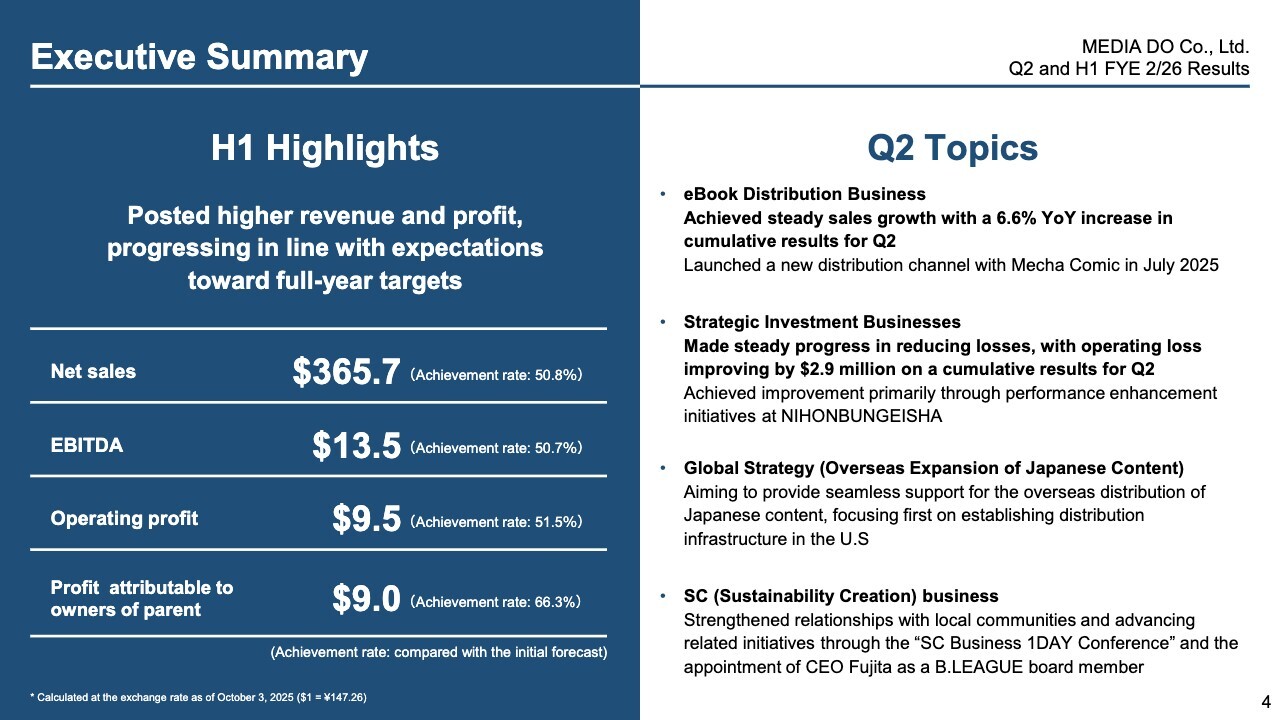
Please refer to the Executive Summary later.
Consolidated Performance Highlights
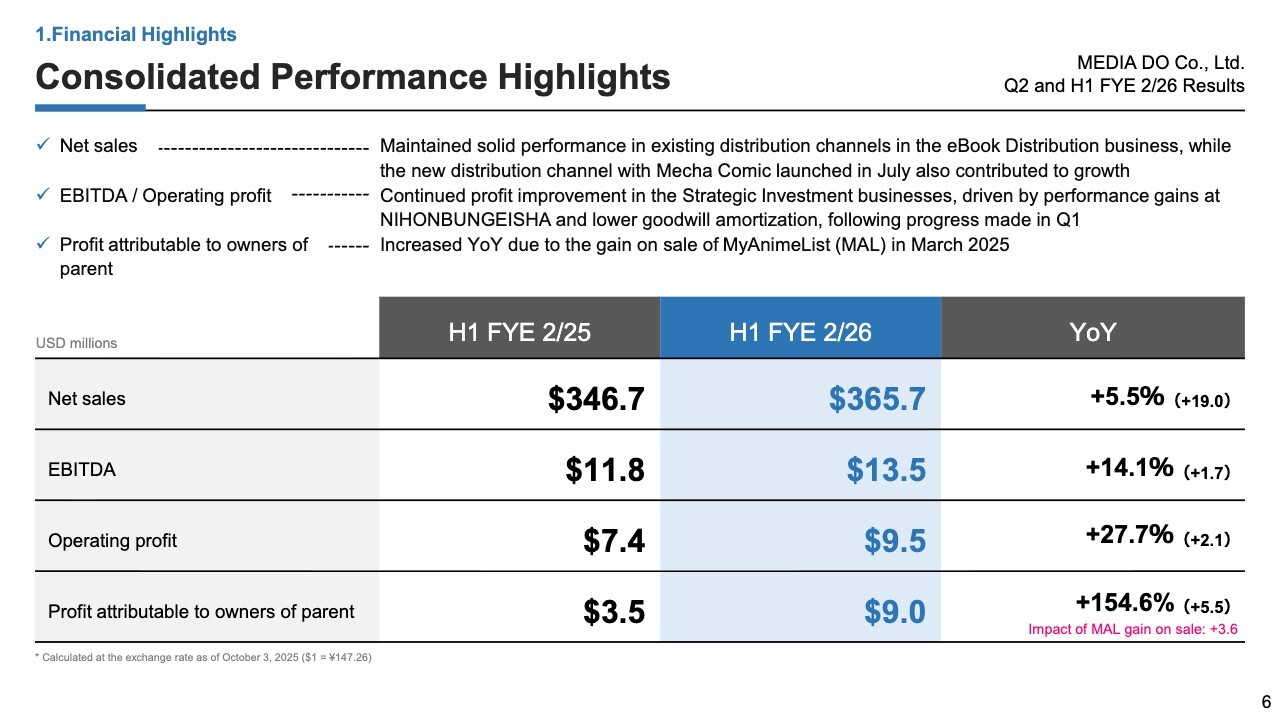
Let me begin with the financial highlights. This is about our performance in 2Q FYE 2/26. Please look at the center of the slide. Consolidated net sales were approximately $365.7 million, an increase of $19.0 million or 5.5% year on year.
EBITDA came to $13.5 million, up $1.7 million year on year. Operating profit was $9.5 million, a year-on-year increase of $2.1 million, and profit attributable to owners of parent was $9.0 million, up $5.5 million year on year.
As for net sales, growth was driven by the continued solid performance in existing distribution channels in the eBook Distribution business, while the new distribution channel with Mecha Comic launched in July also contributed to growth.
Regarding EBITDA and operating profit, the Strategic Investment businesses significantly improved profitability, driven by factors such as the performance gains at NIHONBUNGEISHA and lower goodwill amortization, following progress in Q1.
Profit attributable to owners of parent includes an impact of $3.6 million due to the gain on sale of MyAnimeList (MAL) recorded in Q1.
Achievement Rate Against Full-Year Performance
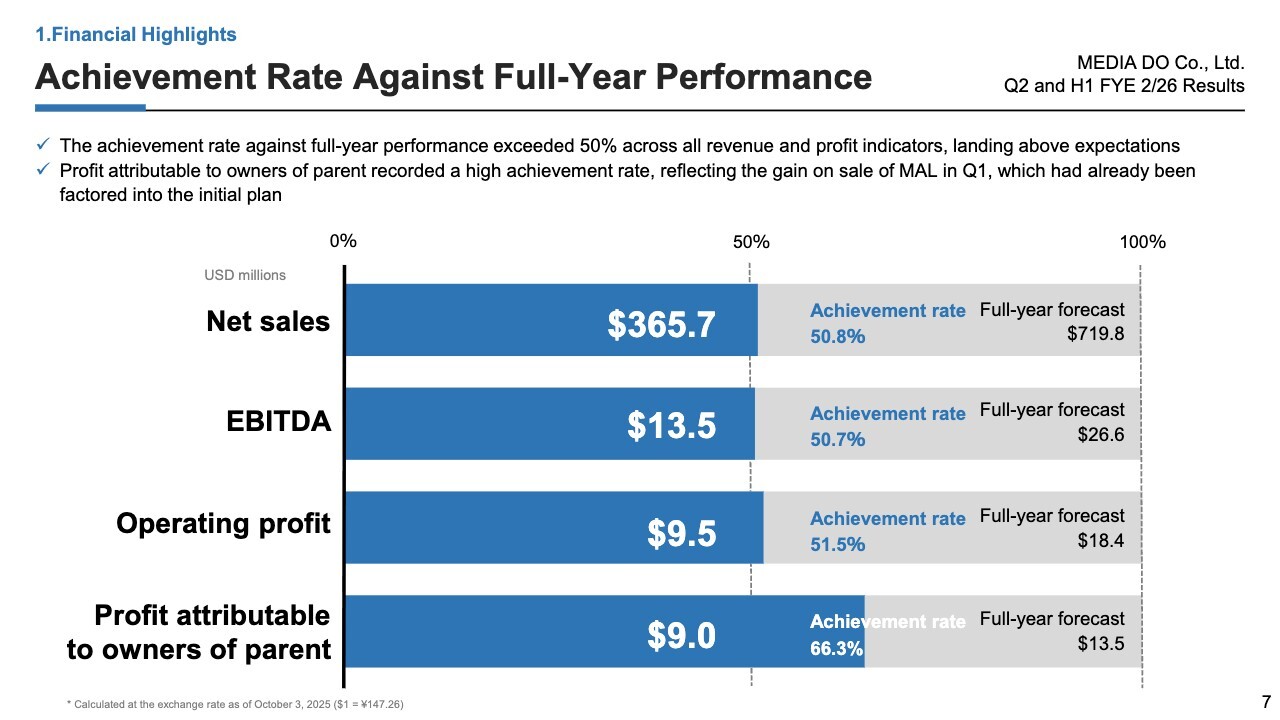
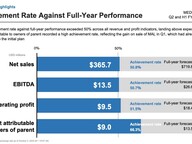
As a result, achievement rate against the full-year forecast for the current fiscal year exceeded 50% for net sales, EBITDA, and operating profit.
Regarding profit attributable to owners of parent, as mentioned earlier, the recording of the gain on sale of MyAnimeList in Q1 resulted in a higher achievement rate compared to other items. However, this gain had already been factored into our initial plan, and we believe overall performance is progressing smoothly in line with expectations.
Net sales by Segment
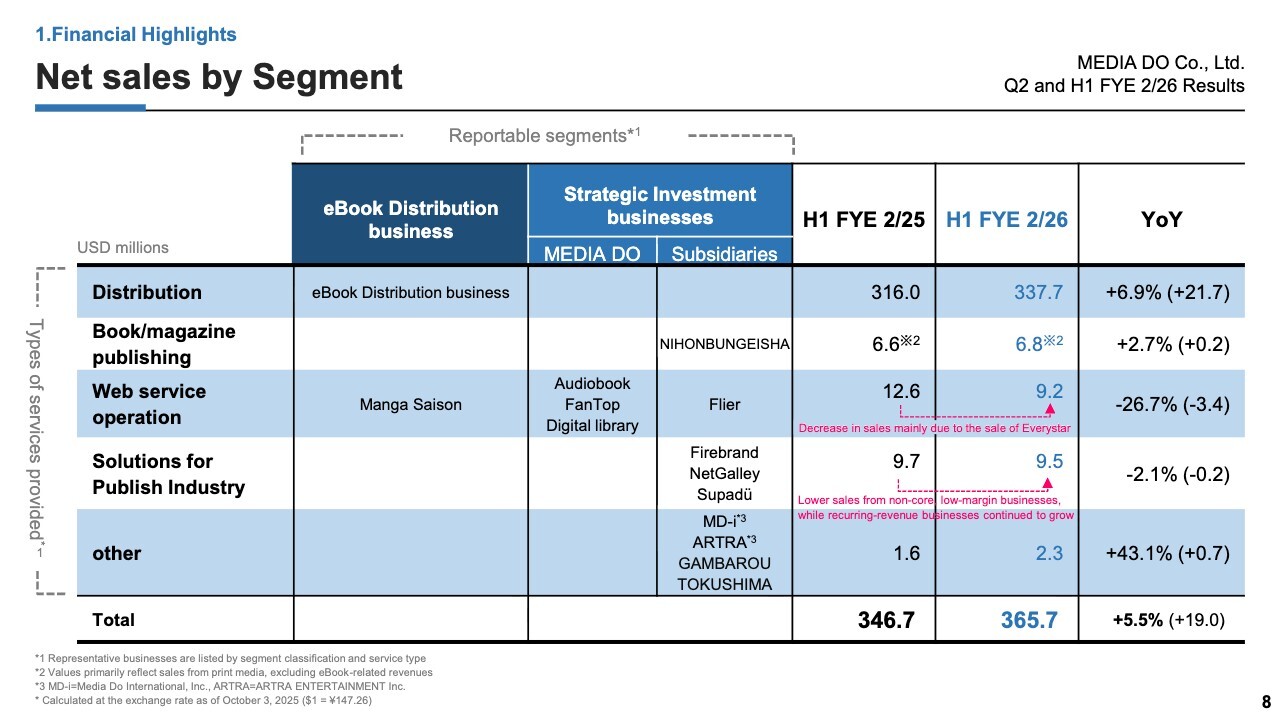
Next, I will explain net sales by segment. The Company discloses results in two segments: the eBook Distribution business and the Strategic Investment businesses.
Let me also touch on the breakdown of net sales by service category. Sales from web service operations decreased by approximately $3.4 million year on year. This was due to the sale of Everystar in the previous fiscal year.
All other businesses have been performing steadily.
Overview
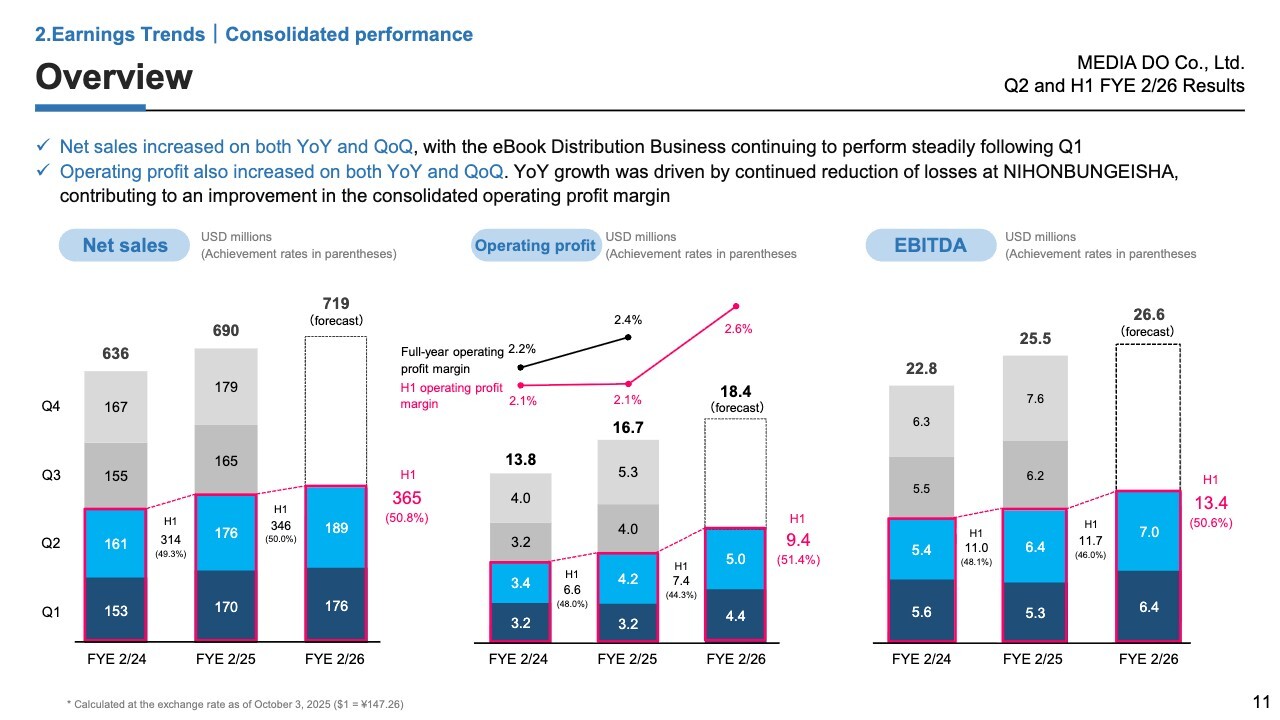
Now, I will explain the earnings trends. I will explain consolidated performance, starting from the left side.
Cumulative sales in H1 totaled approximately $365.7 million. Figures for the previous two fiscal years are also shown. As you can see, we have continued to achieve steady increases in revenue and profit over the past two fiscal years.
In the middle is operating profit, and on the right is EBITDA. Cumulative operating profit in H1 was $9.4 million, and EBITDA was $13.4 million.
In particular, with regard to operating profit, the operating profit margin improved from 2.1% in Q2 FYE 2/25 (2.4% for the full year) to 2.6% in Q2 FYE 2/26. This improvement was driven by profit recovery in the Strategic Investment businesses, mainly due to the reduction of losses at NIHONBUNGEISHA, which led to an overall improvement in operating profit margin.
Sales Trends (by Segment)
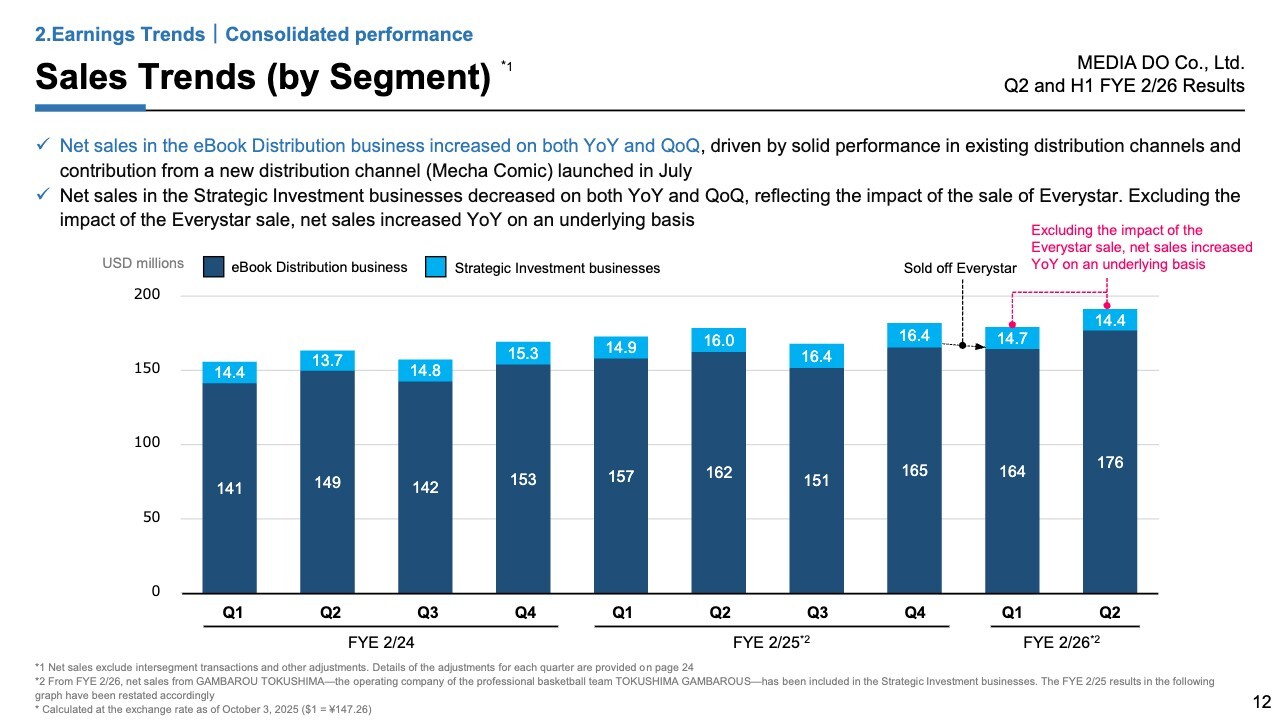
The slide shows a graph breaking down net sales by segment.
The light blue bars represent net sales from the Strategic Investment businesses, which have declined since Q4 of the previous fiscal year. This decrease was due to the sale of Everystar. Excluding that impact, net sales from other operations within the Strategic Investment businesses have continued to trend positively.
The navy blue bars represent net sales from the eBook Distribution business. In Q2, net sales reached approximately $176.8 million. Since the distribution agreement for LINE Manga transitioned from an exclusive to a non-exclusive arrangement, net sales have improved to a level close to the historical peak.
Operating Profit Trends (by Segment)
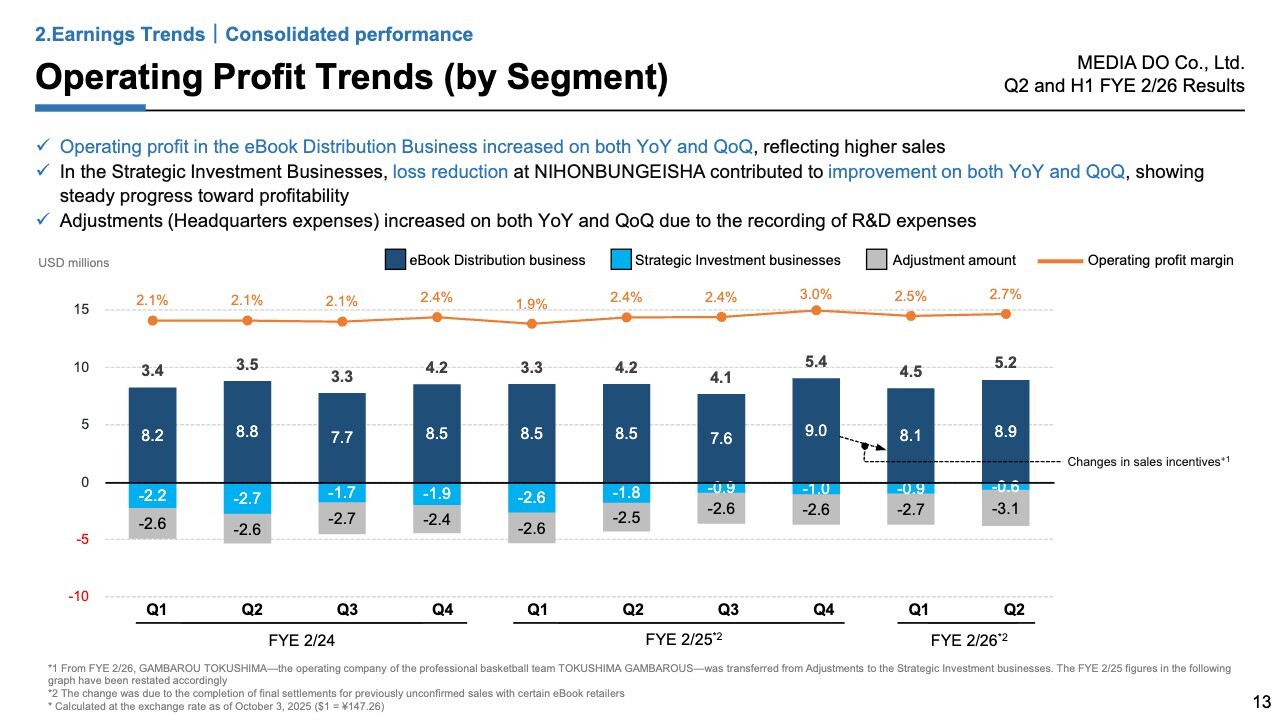
This slide shows operating profit broken down by segment. For Q2 FYE 2/26, operating profit totaled $5.2 million.
By segment, the eBook Distribution business recorded a profit of $8.9 million, while the Strategic Investment businesses recorded a loss of $0.6 million, and adjustments, including headquarters expenses, amounted to a loss of $3.1 million.
Strategic Investment businesses represent the smallest operating loss recorded to date. As for the adjustments, R&D expenses were recorded in Q2, resulting in a slight increase compared to the previous fiscal year.
Trends in Royalties and Other Costs
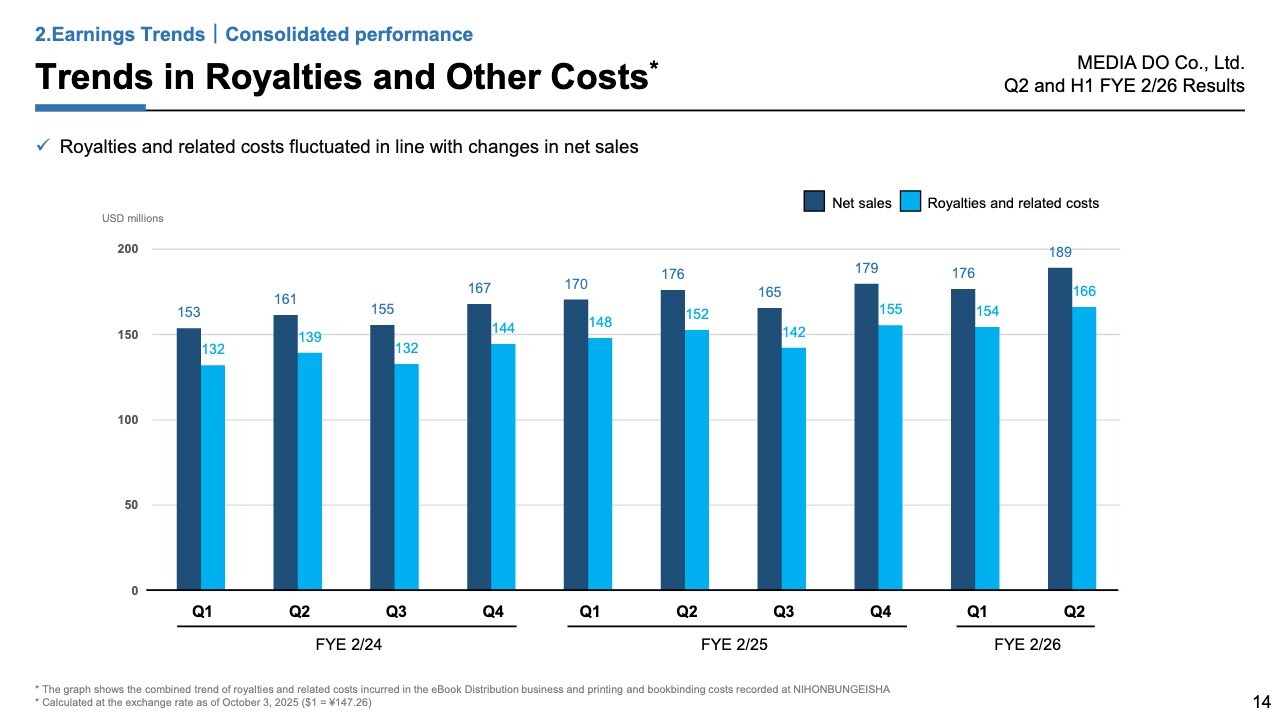
Royalties and related costs tend to rise in line with an increase in net sales.
Trends in Cost of Sales/SG&A Expenses (Excluding Royalties)
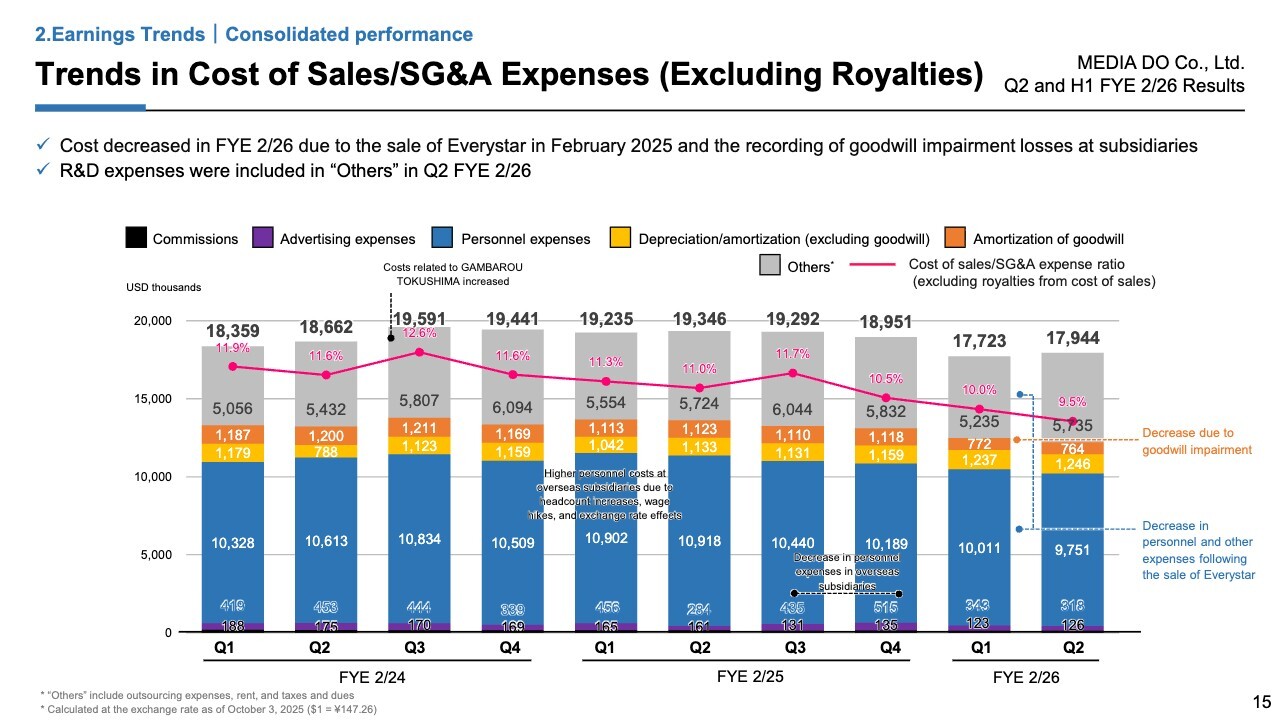
This graph shows the trends in cost of sales and SG&A expenses, excluding royalties. Costs decreased in FYE 2/26, due to the sale of Everystar at the end of the previous fiscal year and the resulting change in performance.
Due to the goodwill impairment recorded at the end of the previous fiscal year, goodwill amortization in the current fiscal year remains at a low level. Overall, we believe we have been able to effectively control costs, including other expense items.
Trends in Net Sales and Operating Profit
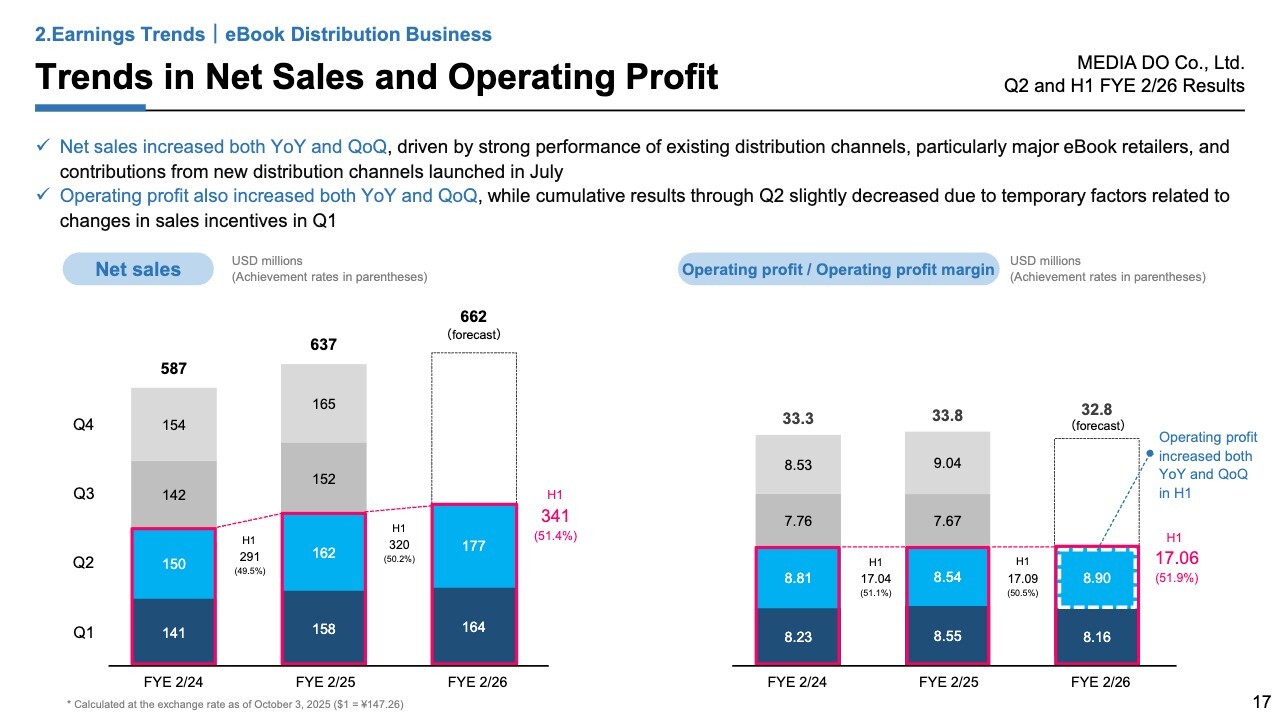
Let me explain the performance of the eBook Distribution business. Cumulative sales through Q2 totaled $341.1 million.
Supported in particular by the strong performance of existing distribution channels, progress cumulative through Q2 reached 51.4% against our initial forecast. Compared to the past two fiscal years, we believe this represents a high level of progress.
As for operating profit, Q1 saw a slight decrease year on year due to temporary factors related to changes in sales incentives. However, in Q2, operating profit exceeded that of both the previous and the year-before-last fiscal years.
Cost Structure (Cost of Sales/SG&A Expenses Excluding Royalties)
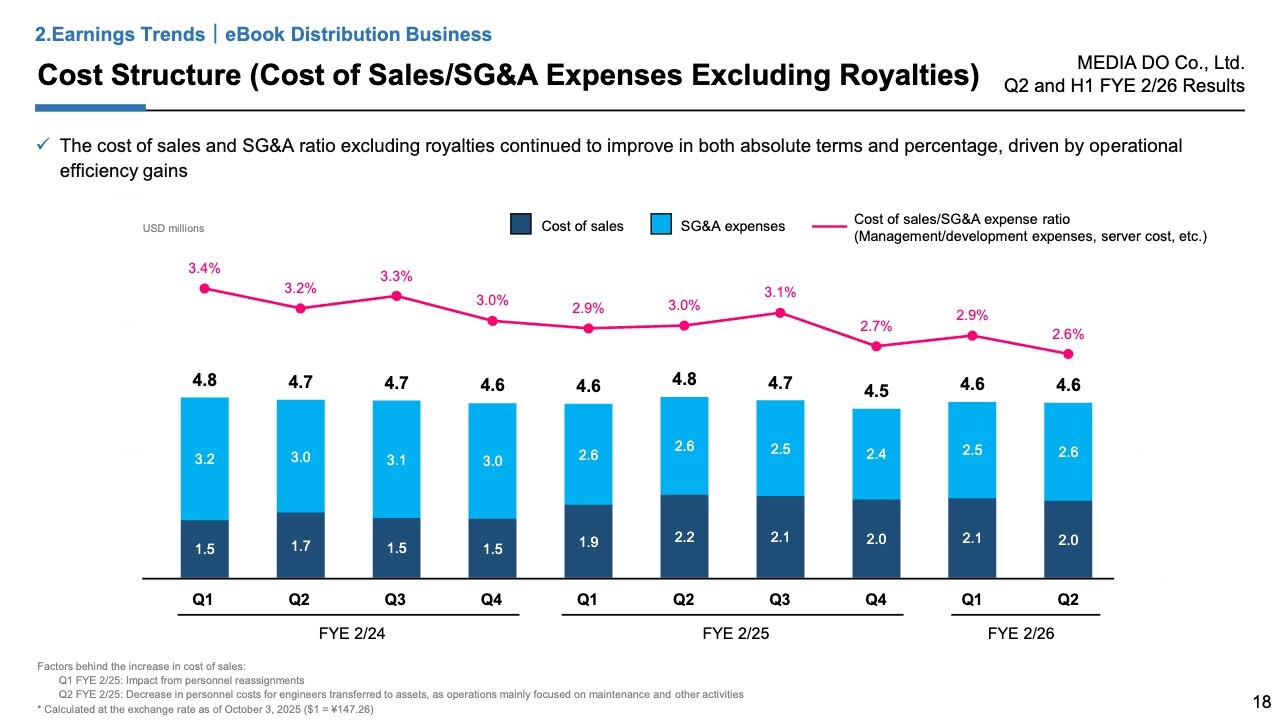
This slide shows trends in the cost of sales and SG&A expenses excluding royalties. Costs continue to be effectively controlled.
YoY Sales Growth Rate
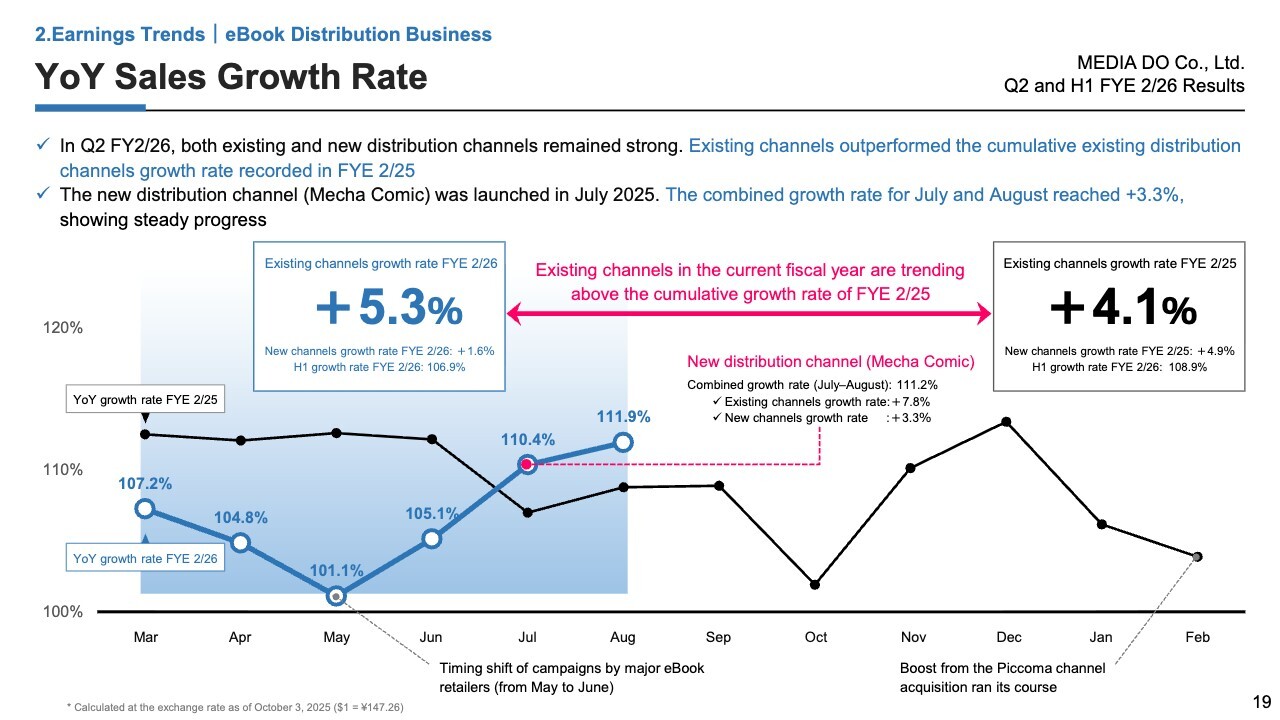
This graph shows the year-on-year trend in net sales for eBook distribution operations. The black line represents the YoY growth rate FYE 2/25, while the blue line represents the YoY growth rate FYE 2/26.
One key point to note is that the growth rate of existing distribution channels was 4.1% in the previous fiscal year, but has risen to 5.3% for the first half of FYE 2/26.
Net sales in the eBook distribution operations tend to be strongly influenced by trends in the overall eBook market. In the first half of the current fiscal year, the growth rate of existing distribution channels exceeded that of the previous year, contributing significantly to increased revenue.
Furthermore, in July of this year, we began handling transactions for new distribution channel of Mecha Comic, following the business partnership agreement signed in February 2025.
In particular, the average monthly growth rate for July and August reached 111.2%. We believe this high growth rate reflects both the robust performance of existing channels and the contribution from the newly added distribution channel.
Overview of each service in the Strategic Investment Businesses
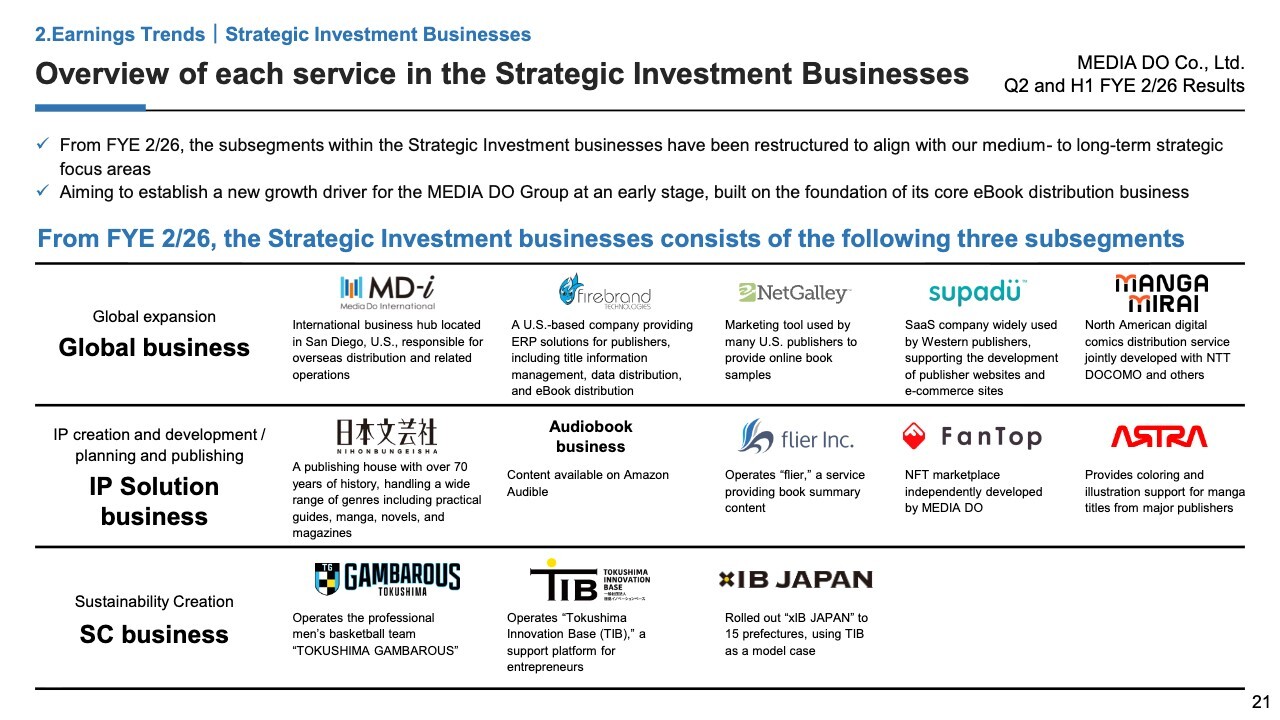
Next, I will explain the Strategic Investment businesses. In addition to the Global business and the IP Solution business, we have newly established the SC (Sustainability Creation) business as part of this segment from the current fiscal year.
Within the SC business, the largest contributor to financial performance is the profit and loss of the organization operating the B3 League basketball team, TOKUSHIMA GAMBAROUS.
Trends in Net Sales and Operating Profit
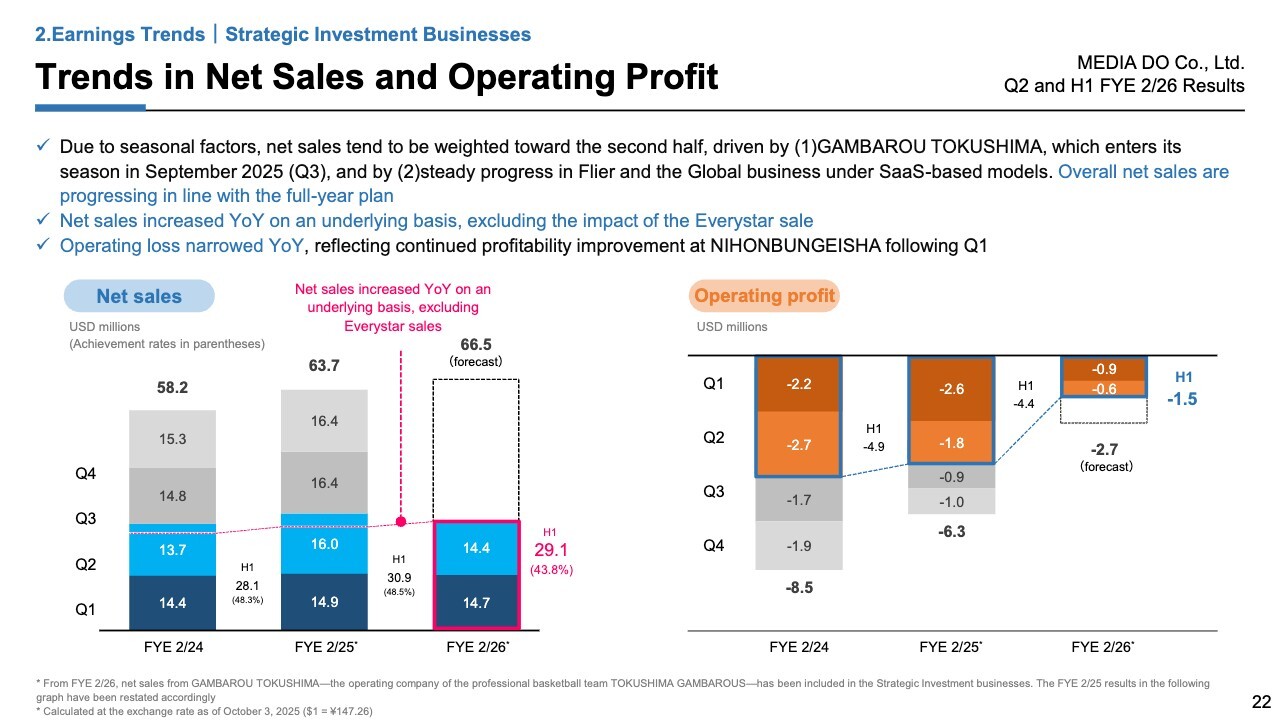
Now, let me discuss the business performance. Cumulative sales in H1 totaled $29.1 million. Although this represents a slight decrease from the previous year, last year’s results included the sales of Everystar. Excluding that factor, net sales increased year on year on an underlying basis.
Progress toward the full-year sales forecast of $66.5 million is currently below the level of the eBook Distribution business. However, in the second half, we expect higher sales driven by contributions from GAMBAROU TOKUSHIMA Co., Ltd., the operating entity of the TOKUSHIMA GAMBAROUS basketball club, which enters its season during the second half, and from the SaaS-based “flier” business, which is steadily growing.
Therefore, we believe that the current progress rate is within a reasonable range.
Regarding operating profit, we project a full-year operating loss of $2.7 million. As of Q2, the cumulative operating loss stood at $1.5 million. This marks not only an improvement on a cumulative basis but also the smallest quarterly loss to date. We will continue to work toward achieving profitability in the Strategic Investment businesses as soon as possible.
Cost Structure
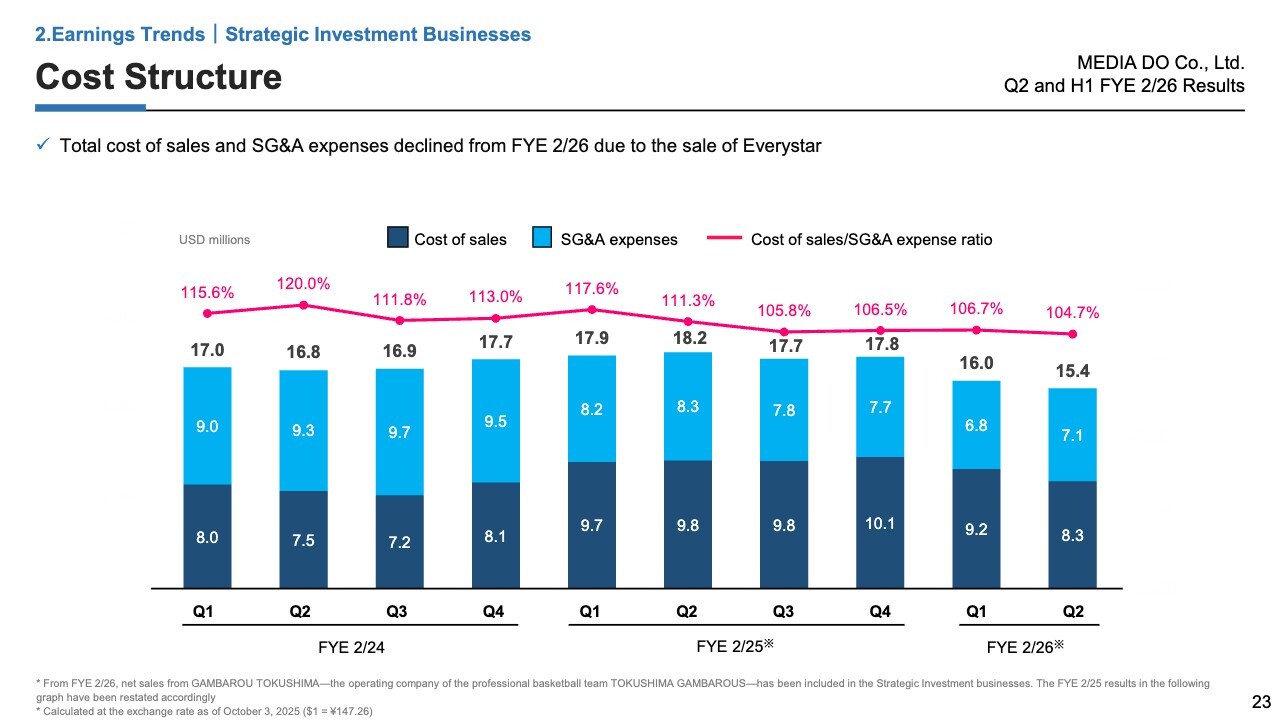
Details on costs are shown on the slide.
Analysis of YoY Change in Operating Profit
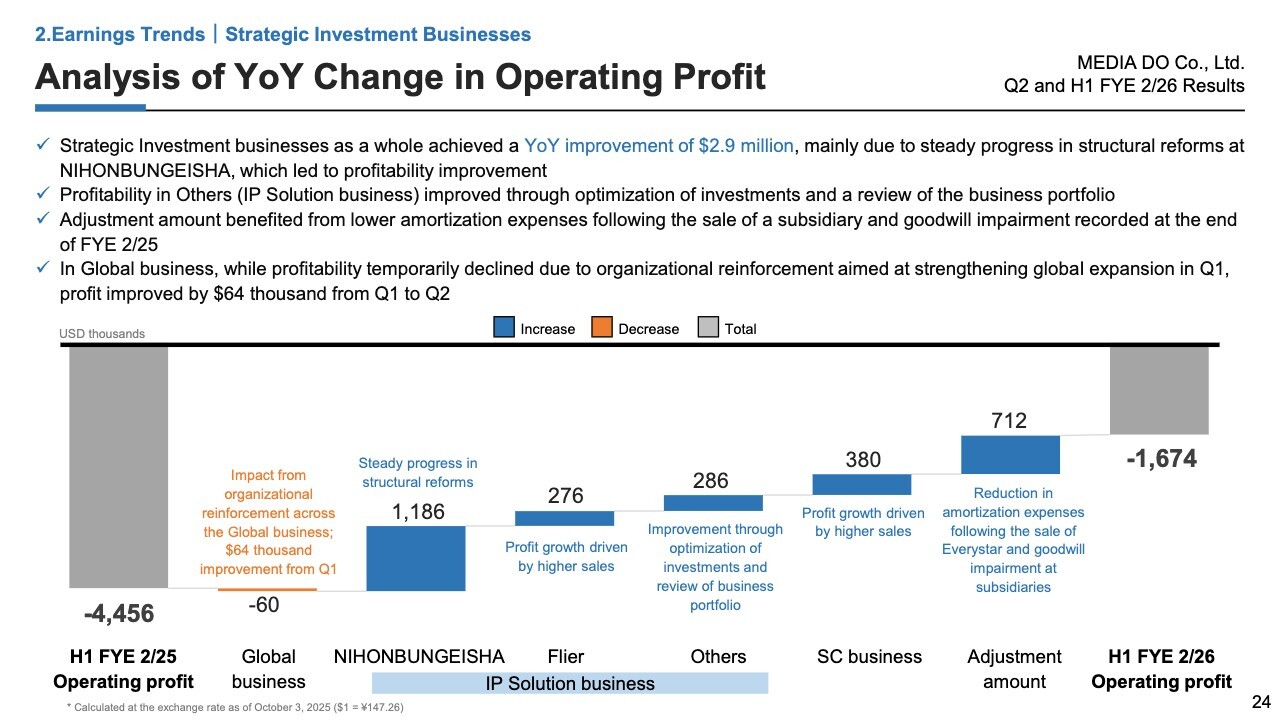
The slide shows a graph representing YoY change in operating profit in the Strategic Investment businesses.
Cumulative operating loss for H1 FYE 2/25 was $4,456 thousand, while for H1 FYE 2/26 it was $1,674 thousand, a profitability improvement of $2,782 thousand year on year.
The most significant improvement was seen in NIHONBUNGEISHA, the second item from the left on the slide. Under the leadership of President Takemura, who was appointed in May last year, structural reforms were executed and performance improved substantially.
For the current fiscal year, the adjustment amount also contributed significantly to profit improvement. This reflects the impact of the sale of Everystar and goodwill impairment related to other subsidiaries, as of the end of FYE 2/25, recorded in the previous fiscal year, which reduced amortization expenses this year.
All other businesses have also improved year on year. However, in the Global business, profit decreased by $60 thousand year on year, due to the impact of organizational reinforcement, which expanded the operating loss. However, profit improved by $64 thousand from Q1 to Q2. We aim for further improvement going forward.
P/L Actuals
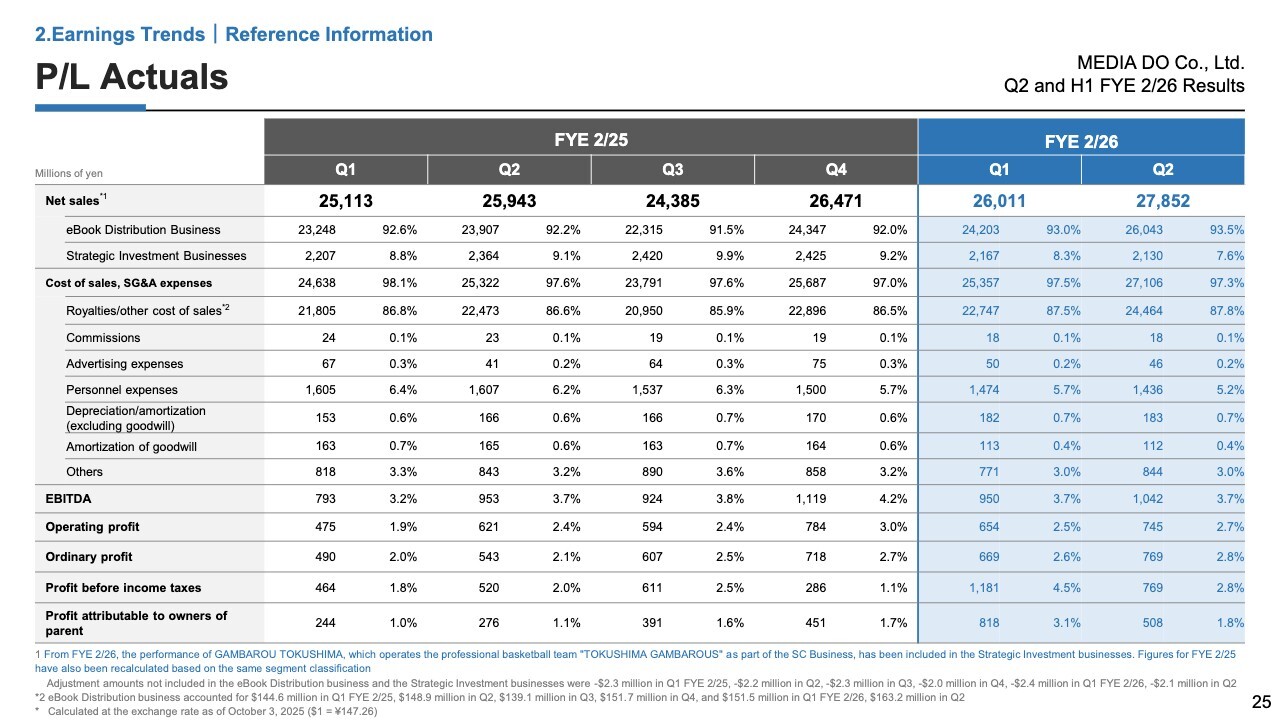
Please refer to the slide for details on the P/L and B/S. Next, Fujita will explain our growth strategy.
Three Pillars of the Growth Strategy in the Medium-Term Management Plan
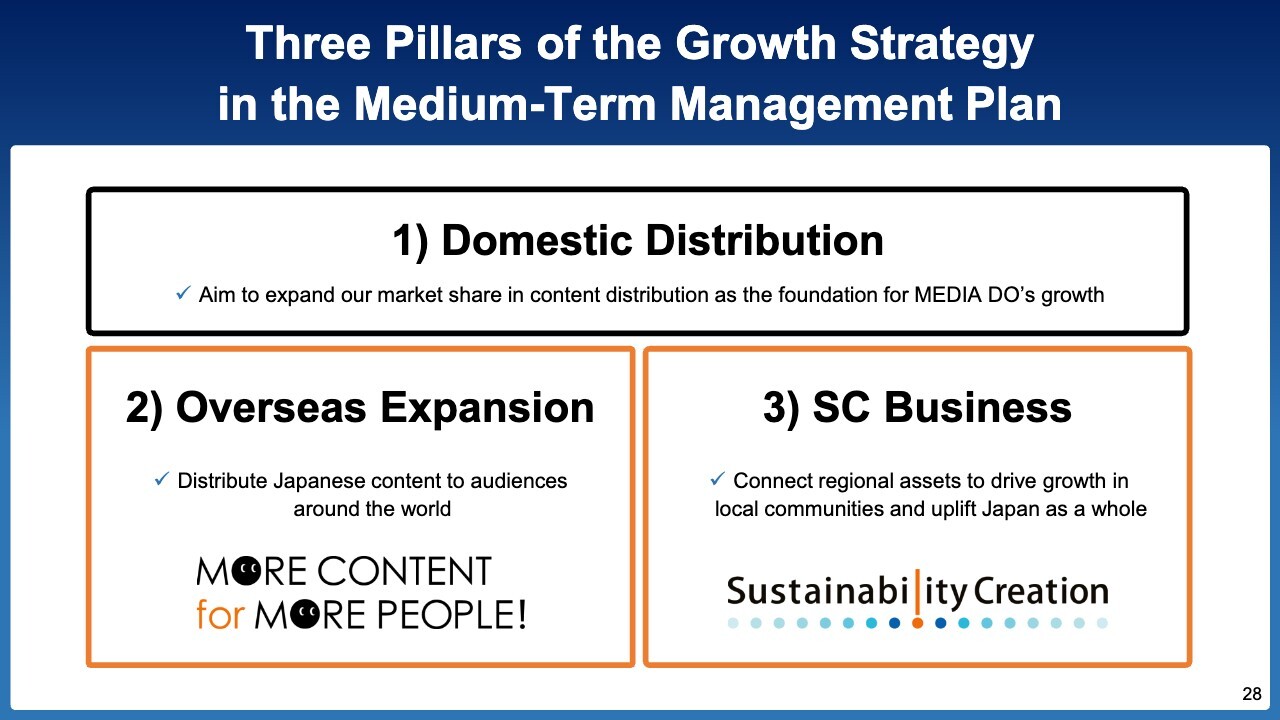
Yasushi Fujita (hereafter, Fujita): I am Yasushi Fujita, President and CEO. From here, I will explain our growth strategy. In the Medium-Term Management Plan announced this April, we have identified three key focus areas.
The first is how to further expand our market share in domestic eBook distribution.
The second is how to promote the overseas expansion of Japanese books, not only digital but also print books.
The third is the transformation of what had previously been our regional revitalization efforts under CSR into the SC (Sustainability Creation ) business. We recognize that Japan’s most valuable assets exist in regional areas, and by fostering further creation based on those assets, we aim to help make Japan a more sustainable society.
These three points form the pillars of our business development going forward.
While the Number of eBook Titles Handled Continues to Increase, System Integration Has Improved Content Delivery Speed
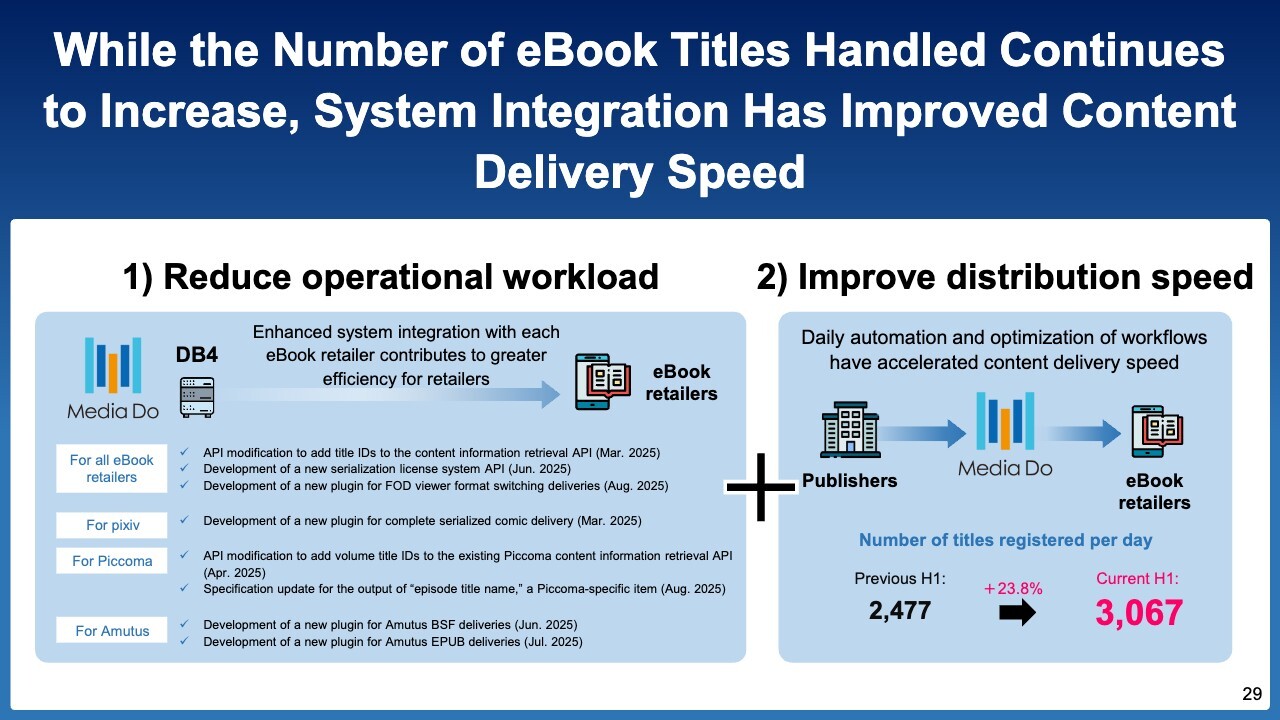
Regarding the first focus area, the domestic eBook Distribution business, we are emphasizing two key aspects internally.
The first is how to reduce operational workload. The second is how to improve distribution speed. These two ideas are central keywords within our organization.
Reducing operational workload refers to how quickly and efficiently we can deliver content received from publishers to eBook retailers.
System integration plays a critical role in improving efficiency for both publishers and eBook retailers. During the current fiscal year, we have advanced system integrations with various eBook retailers, including pixiv, Piccoma, and Mecha Comic.
As a result, our distribution speed has improved. In the first half of the previous fiscal year, the average number of titles registered per day was 2,477, while in the first half of the current fiscal year, it rose to 3,067, an increase of 23.8%.
The increase in registrations was driven by several factors: publishers have been actively releasing new titles, and our expanded system integrations have accelerated the registration process, enabling eBook retailers to handle a greater number of titles. Consequently, eBook retailers’ sales are also on an upward trend.
Going forward, we will continue striving to deliver more content, more quickly, to eBook retailers. By providing a wider range of content, we aim to expand sales and create a positive cycle in which new works are produced by authors and publishers in response to growing demand.
MEDIA DO’s Greatest Strength: A Unique Position Where Content Continues to Gather
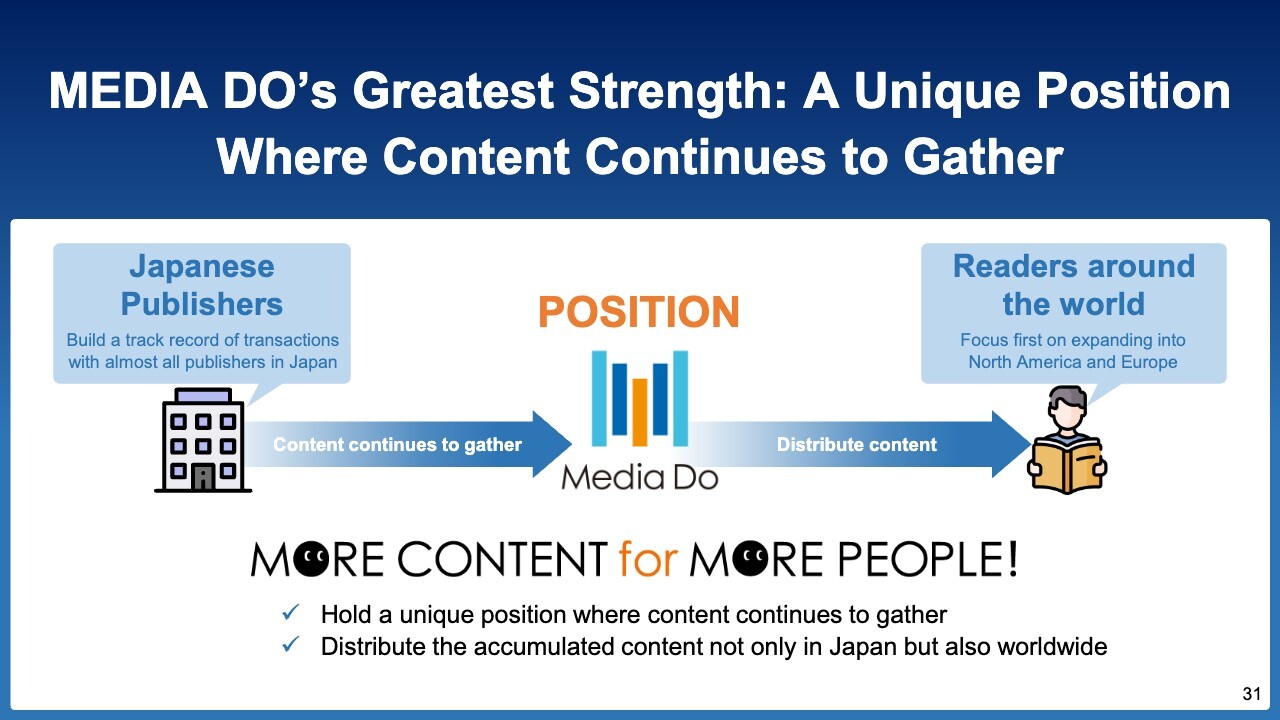
The second point concerns our global strategy. We believe MEDIA DO’s greatest strength lies in its unique position where book content continues to gather. This is made possible because we have direct contracts with almost all publishers engaged in the eBook business in Japan and consistently return revenue to them every month.
Thanks to these relationships, content has continued to flow to us organically, and we expect this to remain the case in the future. This unique position, where content continues to gather, is a key competitive advantage for MEDIA DO. Importantly, the content we handle is not from overseas; it is Japanese content.
With the rapid development of technology in recent years, especially AI, we see it as our mission to leverage these advancements to distribute Japanese books globally and deliver them to readers around the world.
MEDIA DO Engages with Nearly All Japanese Publishers and Promotes Multi-Use of Content to Distribute It Worldwide
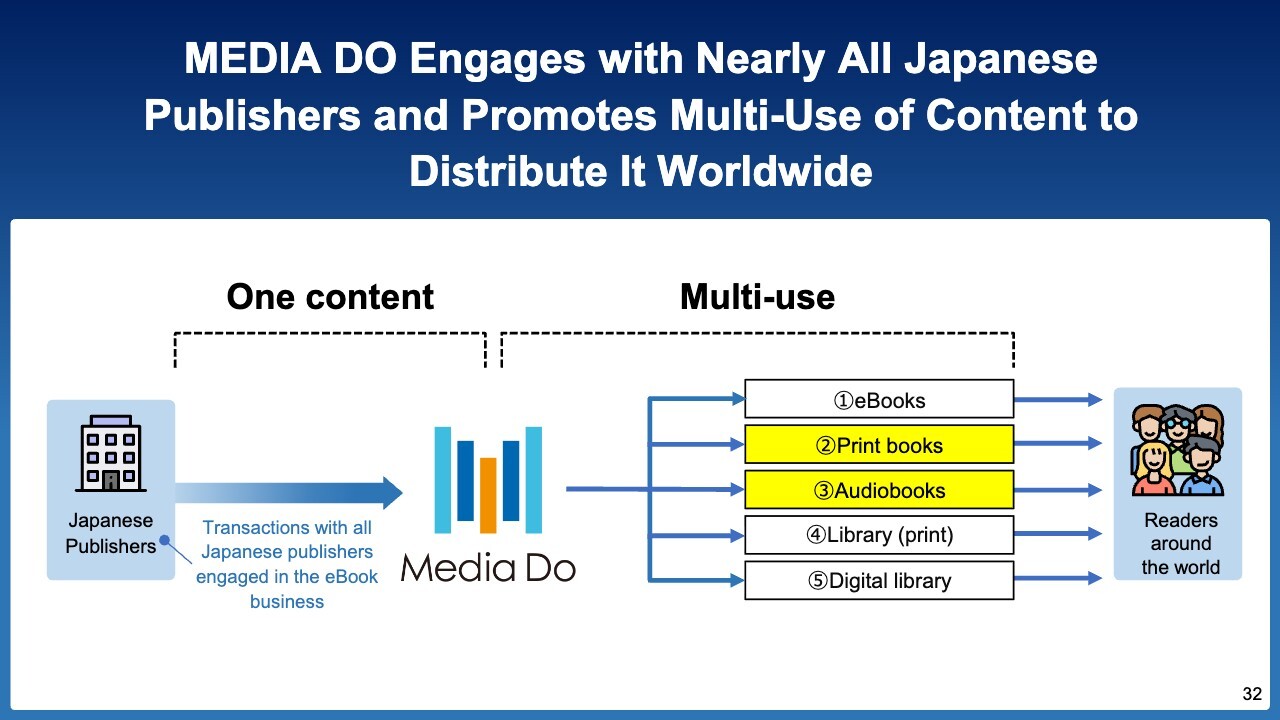
Our basic policy is to take books delivered in Japanese, translate them into various languages, and distribute them globally. In addition to eBooks, we will also focus on the distribution of print books, a field we have not prioritized in the past.
Beyond translation, we plan to convert these works into audio format, enabling them to be enjoyed not only visually but also aurally. We intend to actively advance this business as books you can listen to, as well as read.
Furthermore, we will not limit ourselves to commercial distribution channels. We also plan to focus on distribution through libraries. This includes both print media and digital libraries. Through these five forms of distribution, we aim to develop our business globally.
While MEDIA DO is widely recognized as “an eBook company,” we intend to expand our efforts beyond digital to include the distribution of print books and share Japanese content with the world.
Print Books Still Dominate in Major Publishing Markets Worldwide
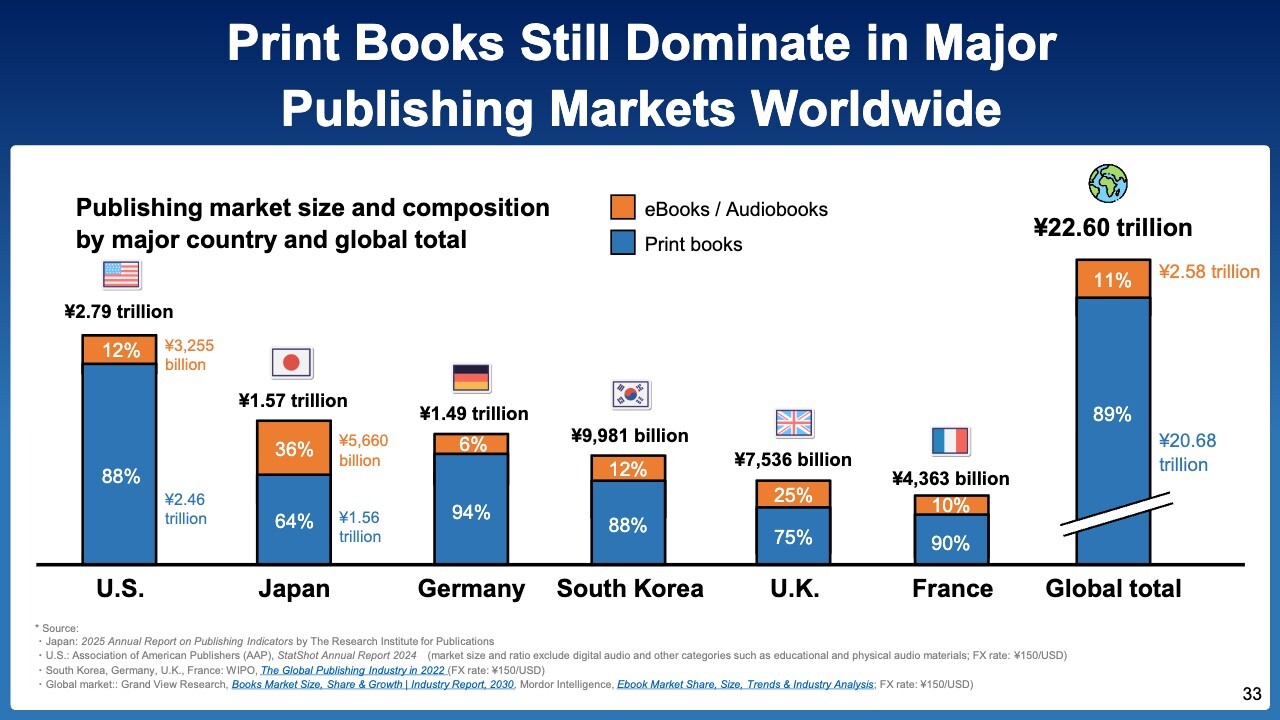
Why focus on print books? In Japan, the overall book market is worth $104 billion, of which eBooks, namely digital formats, account for 36%.
Thanks to the efforts of MEDIA DO and domestic eBook retailers, the share of eBooks in Japan has grown considerably. However, on a global scale, eBooks make up only about 10% of the total market, with print books still representing the overwhelming majority.
Therefore, if we limit ourselves to eBooks when distributing Japanese content worldwide, we can only reach around 10% of the potential market. We believe it is essential to expand our business beyond eBooks to include audiobooks and the distribution of print books.
Print Books Remain Mainstream Overseas, and Securing Distribution Networks Is Essential for Overseas Expansion of Japanese Content
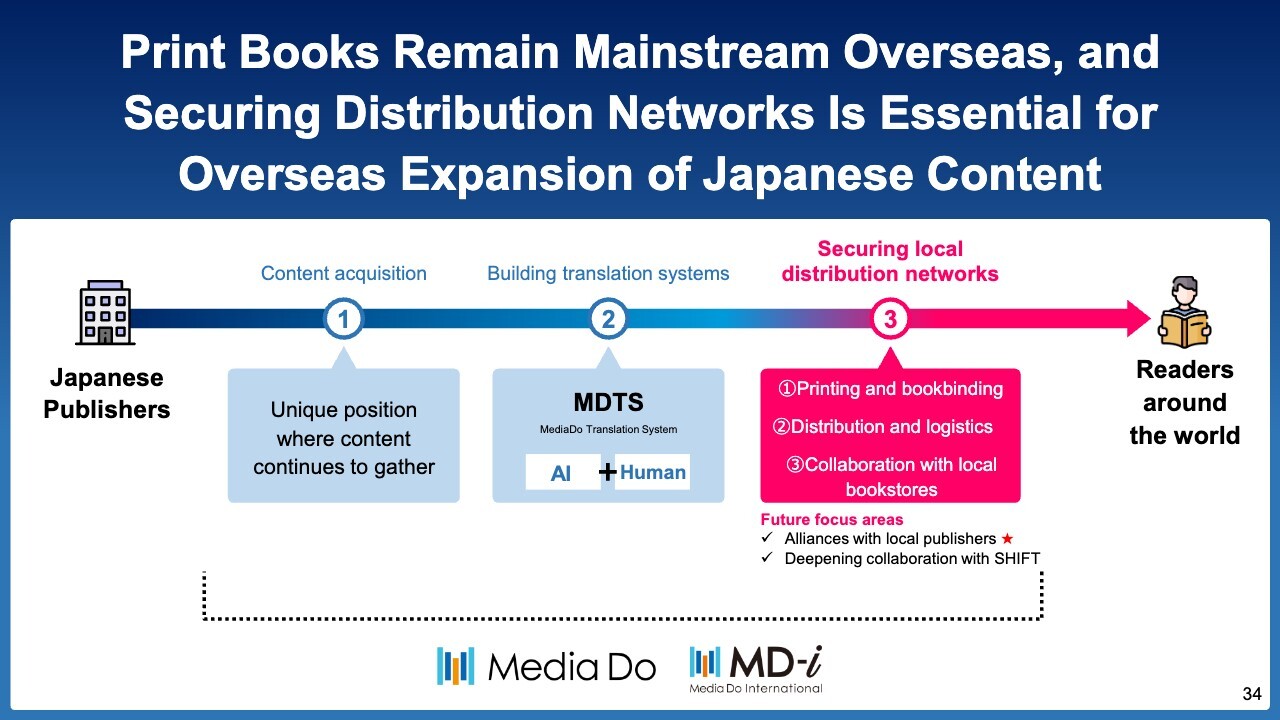
In the Japanese market, MEDIA DO has established a unique position where content continues to gather.
By combining this position with technology, we enable translators who utilize our technology to dramatically shorten the translation timeline from the conventional two to six months down to just a few days. This reduction allows us to translate an unprecedented volume of content.
Japanese content has historically seen limited translation and global distribution. However, by leveraging technology to shorten translation periods and reduce translation costs, MEDIA DO believes it can solve this challenge and accelerate the worldwide dissemination of Japanese works.
MEDIA DO has not previously focused on the distribution of print books, and since the methods of book production and distribution differ from country to country, our first step will be to form alliances with local publishers in each region.
Let me explain why we believe MEDIA DO is well-positioned to take on this challenge. Typically, when a publisher expands its content overseas, it can only handle its own titles.
However, because MEDIA DO works directly with virtually all publishers in Japan, we are able to distribute a substantial portion of Japan’s book content, within the scope of rights granted by publishers and authors, through our platform by increasing the number of licensed works.
With this, rather than each publisher having to independently produce books for overseas markets, works can be licensed collectively through MEDIA DO, significantly expanding the number of titles available for publication abroad.
By partnering with MEDIA DO, local publishers can efficiently acquire a broad range of Japanese titles without having to negotiate separately with each individual publisher. We believe this will allow us to advance alliances with local publishers smoothly through MEDIA DO’s platform.
MEDIA DO’s Global Solutions to Maximize the Sales of Distributed Content
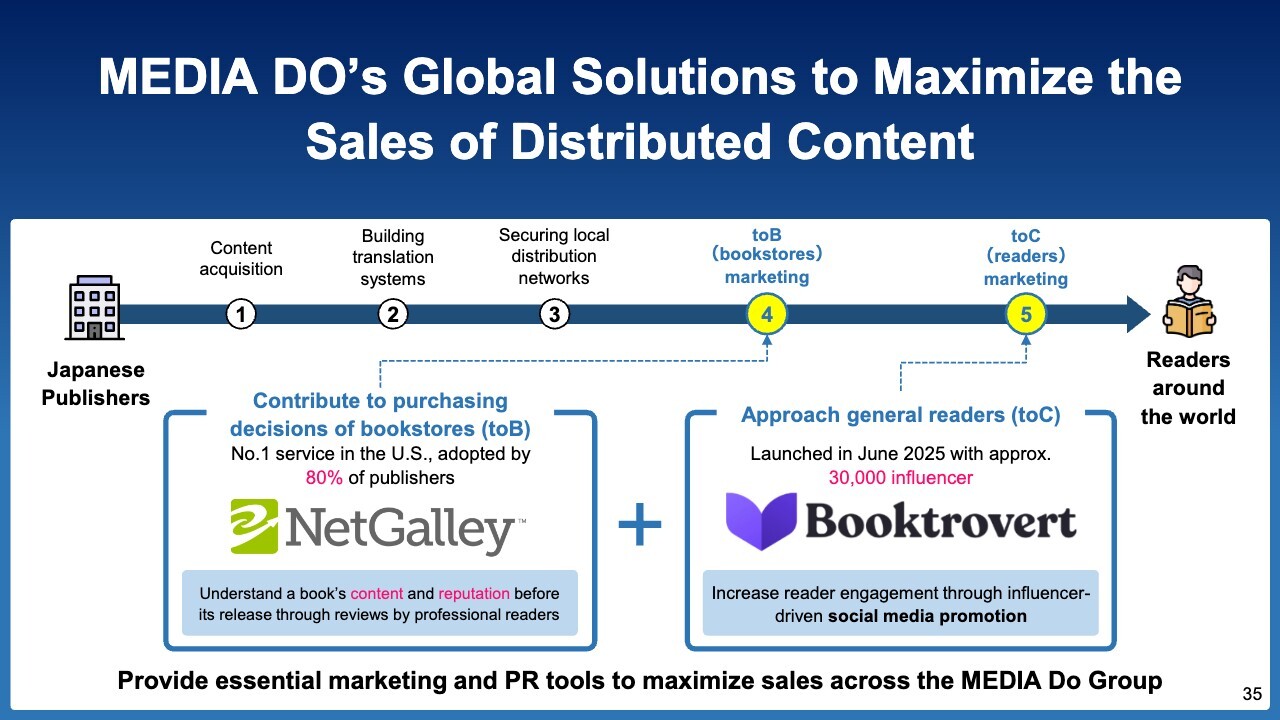
Against this backdrop, our initial focus for business expansion will be the United States, the largest market. If we are to translate content, it makes sense to begin with the world’s most widely used language, which is English.
The U.S. market, where English is the dominant language, represents the most significant opportunity, and we aim to establish a strong foothold there first.
In fact, MEDIA DO established a U.S. branch, MEDIA DO International, in 2016, and nearly ten years have passed since. During that time, we have built a strong network with local publishers and authors.
In 2021, MEDIA DO acquired the Firebrand Group, which operates the service NetGalley.
NetGalley is the No. 1 U.S. Marketing Platform for Publishers and Bookstores
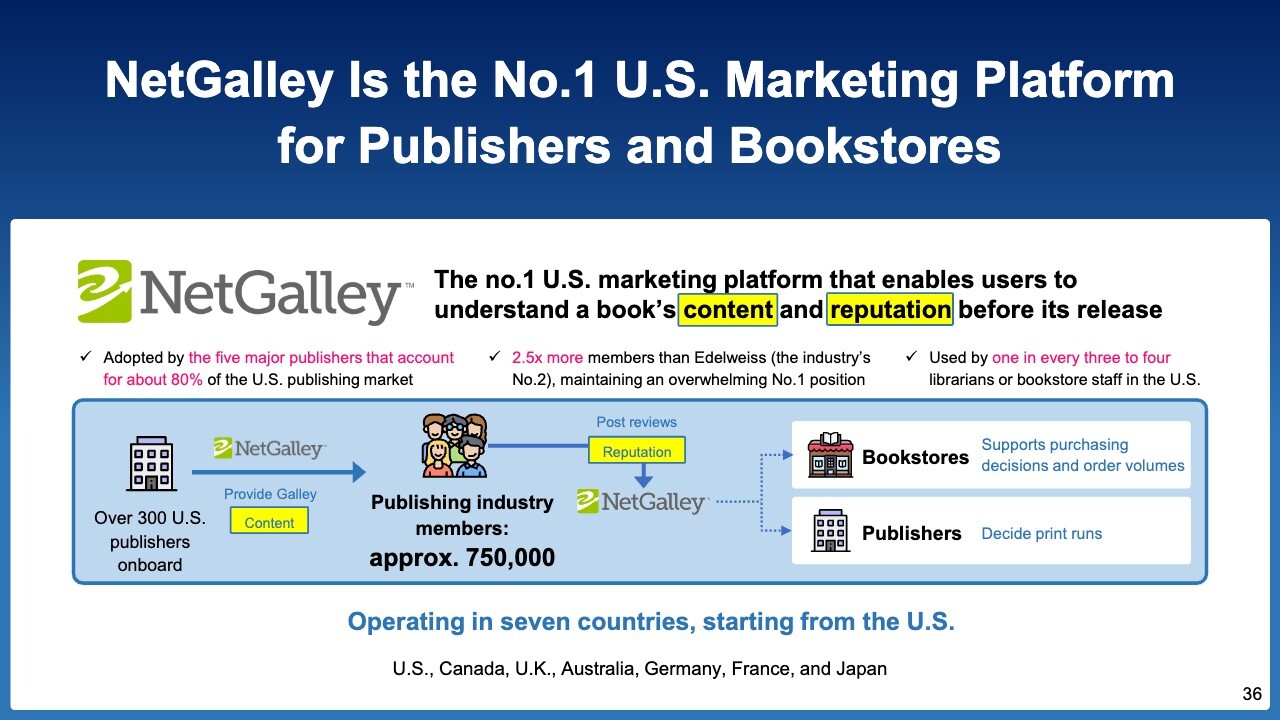
Let me explain the business of NetGalley. In the U.S., publishers have a system that allows bookstores to read advance copies (galleys) of books before purchasing them.
In the past, these galleys were distributed in print form to bookstores, but NetGalley digitized this process. Today, using a PC or smartphone, users can easily access summaries and previews of upcoming titles before publication.
Many readers are invited to read these digital galleys and post reviews sharing their impressions, such as “This book will likely sell well among this type of audience in the U.S.”
NetGalley provides a solution that combines these galleys with reader reviews. It is the leading service of its kind in the U.S. and Europe, holding the No. 1 market share.
Compared to the second-largest platform in the industry, NetGalley boasts 2.5 times more registered members, maintaining an overwhelmingly No.1 position as an information and marketing service to promote book sales across Western markets.
Looking ahead, we aim to register a large number of Japanese titles on the NetGalley platform so that readers and bookstores throughout the United States can discover and purchase Japanese books.
Furthermore, by encouraging many influencers to read and review these books, we expect that as the number of reviews increases, more bookstores will begin handling translated Japanese titles.
We believe that NetGalley will serve as a highly powerful “killer tool” for promoting Japanese books in the U.S. and other Western markets.
MEDIA DO’s Global Solutions to Maximize the Sales of Distributed Content
Let me go back one slide and introduce another example. In June 2025, NetGalley launched a new service called Booktrovert. This service allows information to be shared via platforms such as YouTube and TikTok, and viewers of these videos can then be led to purchase books or other products, creating a range of consumer engagement opportunities.
Originally, the NetGalley platform had 750,000 registered reviewers, including influencers. To make it easier for these individuals to operate as influencers, we carefully adjusted the way books are provided, leading to the launch of Booktrovert.
Within about three months of its launch, the service attracted 30,000 influencers who handle books, demonstrating its potential as a major marketing solution.
Until now, MEDIA DO has not been fully engaged in translating and globally distributing Japanese books. Moving forward, we plan to actively translate Japanese books and expand them as print books, eBooks, and audiobooks. We believe Booktrovert will serve as a highly effective “killer solution” in this endeavor.
MEDIA DO Distributes Audiobooks, a Rapidly Growing Segment in the North American Market
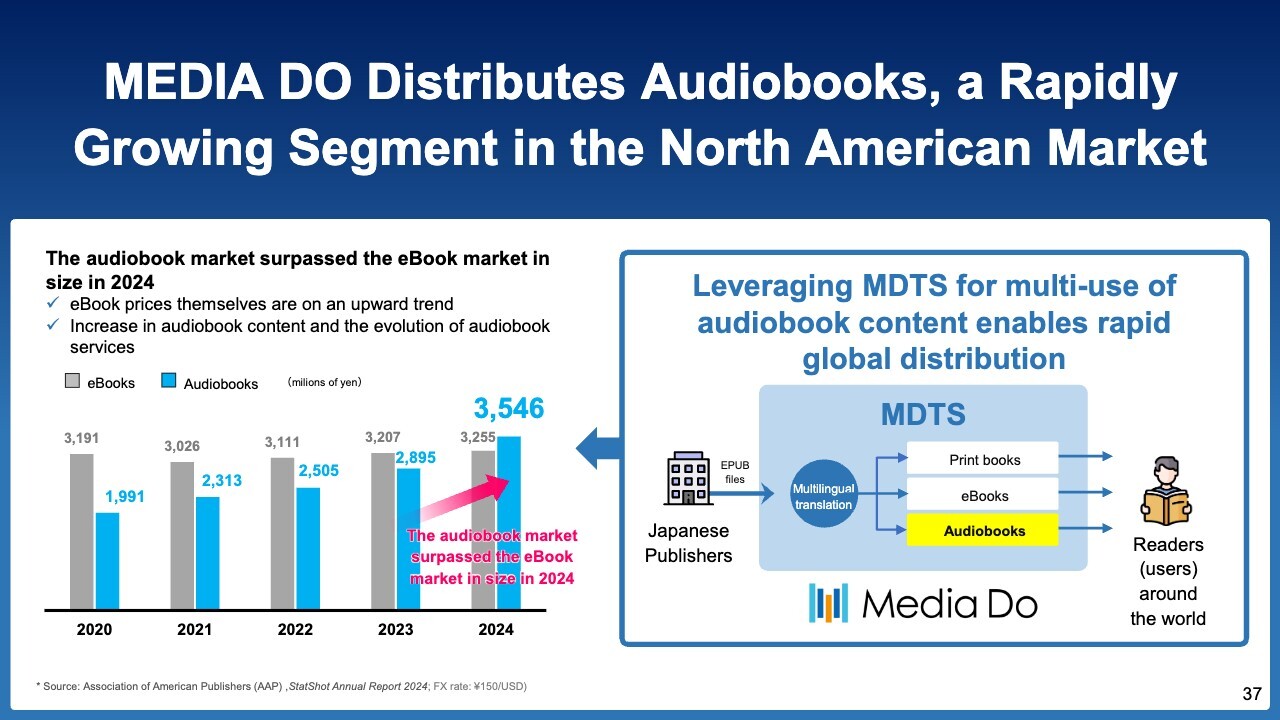
In addition to print books and eBooks, MEDIA DO aims to further expand our business into audiobooks. The graph on the left side of the slide shows data indicating that the audiobook market surpassed the eBook market in size in 2024, in the U.S. publishing market.
Given this trend, while converting manga into audiobooks remains challenging, we plan to produce audiobooks for novels and other text-based works, allowing readers to enjoy books aurally.
Furthermore, we are developing a service that reads digitized books aloud using our AI technology. We hope everyone will have the opportunity to experience this. You will be able to hear the reading performed by our translation system, MDTS (MediaDo Translation System), which we developed in-house.
First, in Japanese:
(Japanese audio plays)
As you can hear, the system does not simply read text aloud. It can render human dialogue as if it were spoken naturally by a person. This is not a human voice, but is entirely generated by our AI system, which has been finely tuned for this purpose.
Next, in English. We had native speakers in the U.S. listen to this version, and they evaluated it as perfectly native.
(English audio plays)
As you can see, our system is capable not only of translating from Japanese to English, but also of translating and reading aloud in virtually any language. Here is an example in French:
(French audio plays)
Over the past 20 years, MEDIA DO has built a position where books continue to gather. By combining this strength with our technology and business development capabilities, we are addressing the challenge of “how to distribute Japanese books to the world.”
In this effort, killer solutions such as NetGalley and Booktrovert provide tools that enable bookstores to purchase these books.
We are placing many previously unavailable Japanese books on these platforms and working to make them available to numerous bookstores. In this initiative, our tools are ranked No. 1 in the industry. We hope you will look forward to the results.
The Current SC Business Has Two Main Pillars, Promoting Initiatives Based on Trust With Local Communities
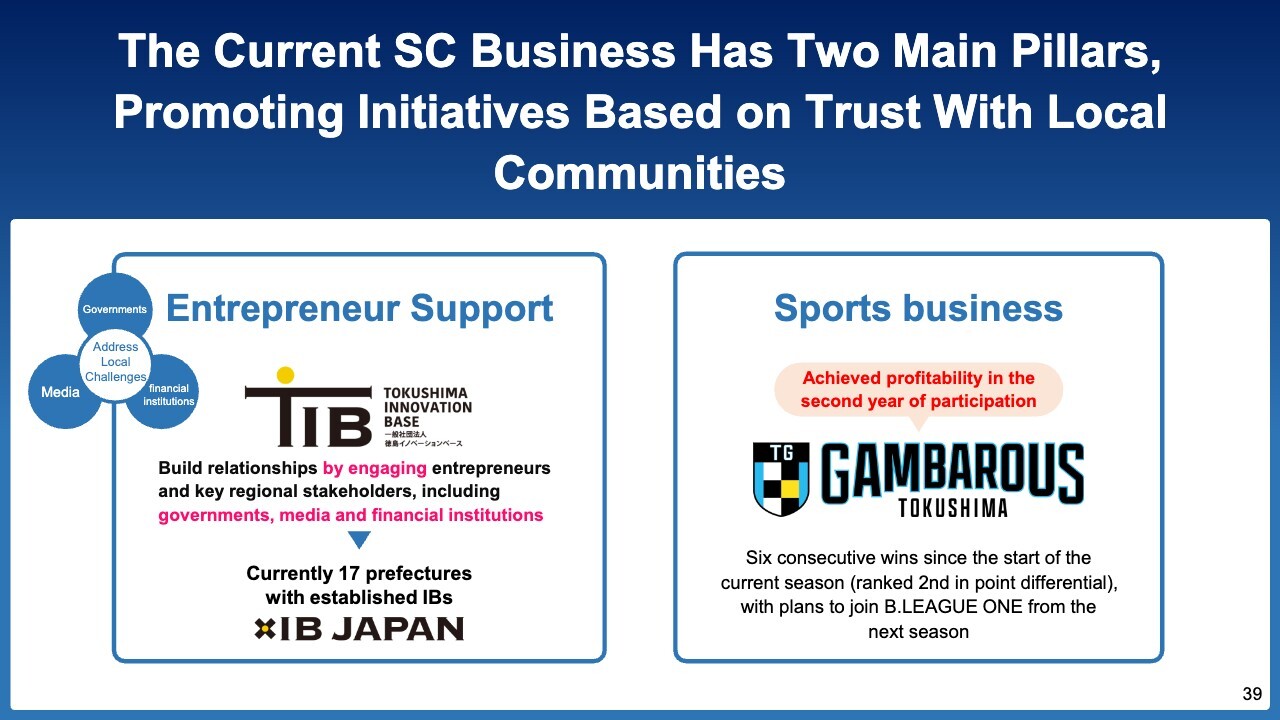
The third point is the SC business. Currently, our regional revitalization initiatives are divided into two main pillars.
To revitalize local regions, we believe in leveraging the power of entrepreneurs. Our goal is to increase the number of entrepreneurs and help entrepreneurs and business leaders expand their perspective and strengthen their management capabilities.
As part of this effort, we established the TOKUSHIMA INNOVATION BASE in 2020. The second initiative is a B.LEAGUE basketball team, TOKUSHIMA GAMBAROUS, a sports business in which we have been participating for the past two years. These two initiatives form the core of our SC business.
Innovation-Based Initiatives That Began in Tokushima in 2020 have Expanded to Over 50% of Prefectures Nationwide
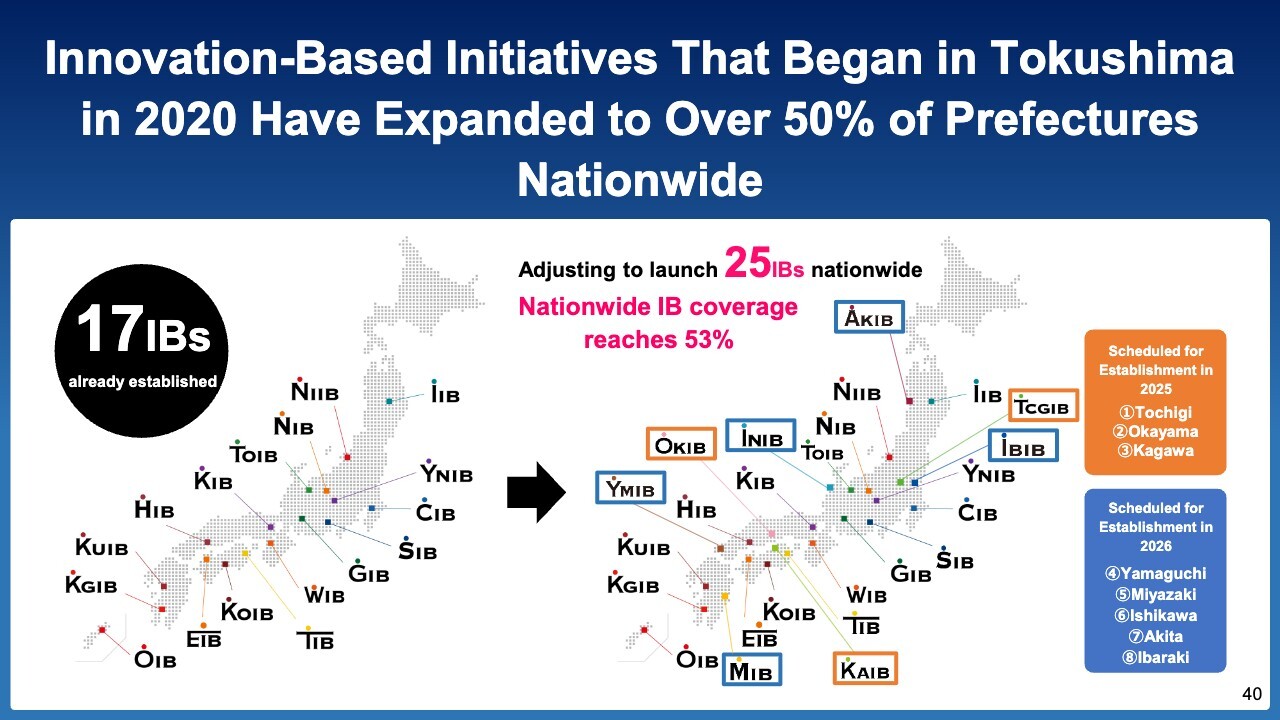
This is about our entrepreneurship support business. In 2020, we launched the Tokushima Innovation Base. Currently, the entrepreneurship support package created in Tokushima has become a solution in which local governments, financial institutions, and media come together every month to support entrepreneurs.
This system has now spread to 17 prefectures. Including areas that have already been decided or are planned, the number is expected to expand to 25 prefectures by the next fiscal year. Out of the 47 prefectures in Japan, the initiatives are spreading to 25 of the 46 prefectures (excluding Tokyo) in such a short period, which is extremely rare.
In order to promote regional revitalization, it is important for local entrepreneurs to work closely with local governments, media, and financial institutions to invigorate their regions. That's why the Company aims to build such a platform.
National Business Conference “LEC Kumamoto” to Be Held in November with Over 1,000 Participants
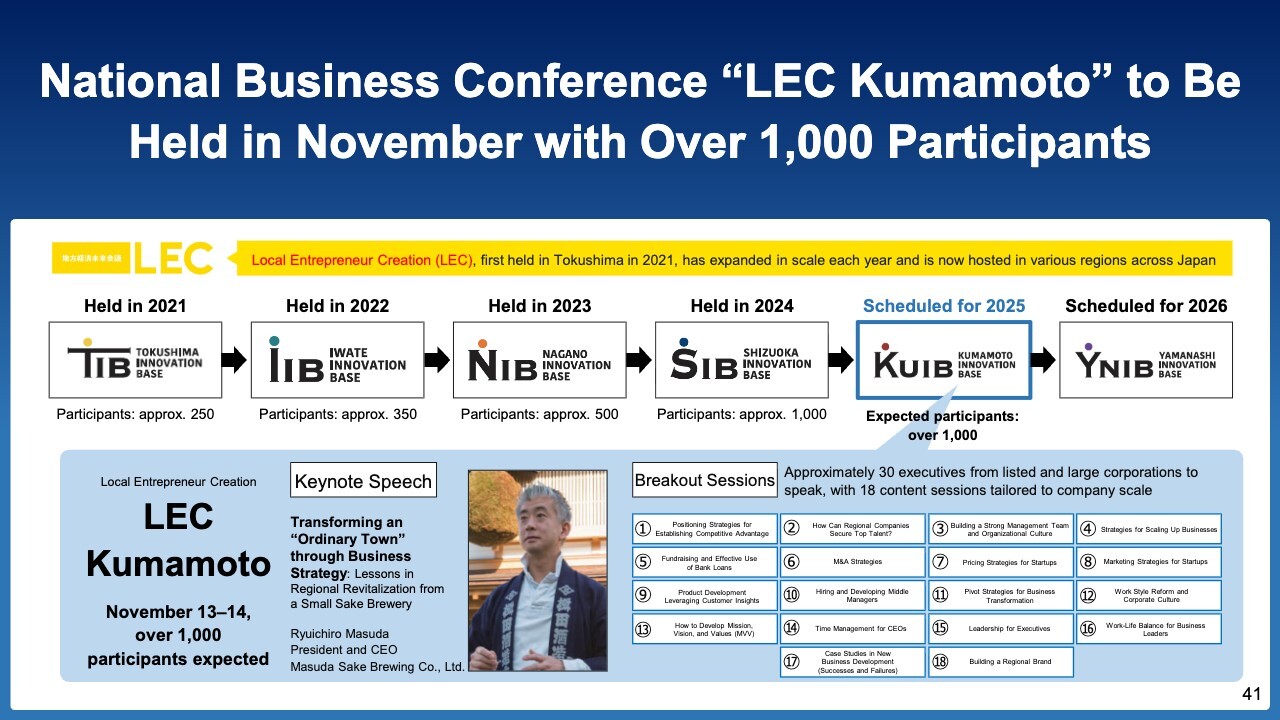
An event hosted by the Kumamoto Innovation Base will be held in Kumamoto Prefecture on November 13th and 14th. The event will bring together managers of listed companies and entrepreneurs from across the country, and 18 content sessions are planned for breakout sessions to study management.
Starting with the establishment of the Tokushima Innovation Base in 2020, the event was held as the LEC in 2021 with the aim of promoting interaction with listed company executives in local areas, and the following year, it was held in Iwate Prefecture. In the third year, the event was held in Nagano Prefecture. Last year, the event was held in Shizuoka Prefecture, expanding its scale to attract 1,000 people.
This year, the event will be held in Kumamoto Prefecture with approximately 1,000 participants, and next year it is planned to be held in Yamanashi Prefecture.
SC Business Held 1DAY Conference “Preliminary Session” and Plans to Expand to an Annual Event
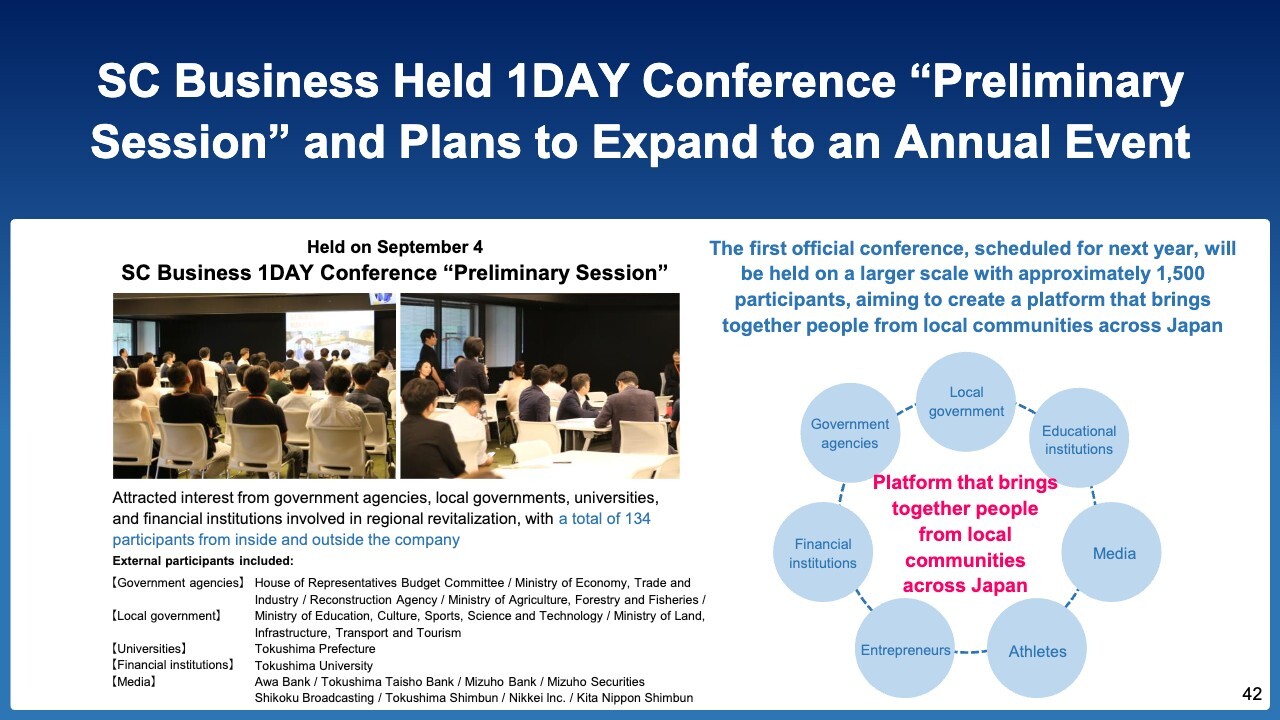
In April of this year, the Company announced that it would fully promote regional revitalization projects in the form of the SC business. As part of this, we first held, on a trial basis, the Preliminary Session of “SC Business 1Day Conference” on September 4th.
The conference was attended by many people from government agencies, local governments, universities, financial institutions, and media representatives.
As the event was not widely publicized, 134 people participated, including those from both inside and outside the company, but we were particularly pleased to see participation from government agencies such as the Ministry of Economy, Trade and Industry, the Reconstruction Agency, the Ministry of Agriculture, Forestry and Fisheries, the Ministry of Education, Culture, Sports, Science and Technology, and the Ministry of Land, Infrastructure, Transport and Tourism.
Although this preliminary session was a trial run for marketing purposes, it went extremely well, and we believe it was a great success.
The first official conference, scheduled for next year, will be held in Tokyo on a larger scale with approximately 1,500 participants, more than ten times the 134 participants.
In addition to the government agencies and local governments I mentioned earlier, we would like to involve a variety of people, including entrepreneurs and athletes, to create a platform that brings together people from local communities across Japan. We will continue to build this platform, utilizing both digital and real sessions.
B.LEAGUE Implements Structural Reform through “B. Innovation” to Strengthen Management Capabilities
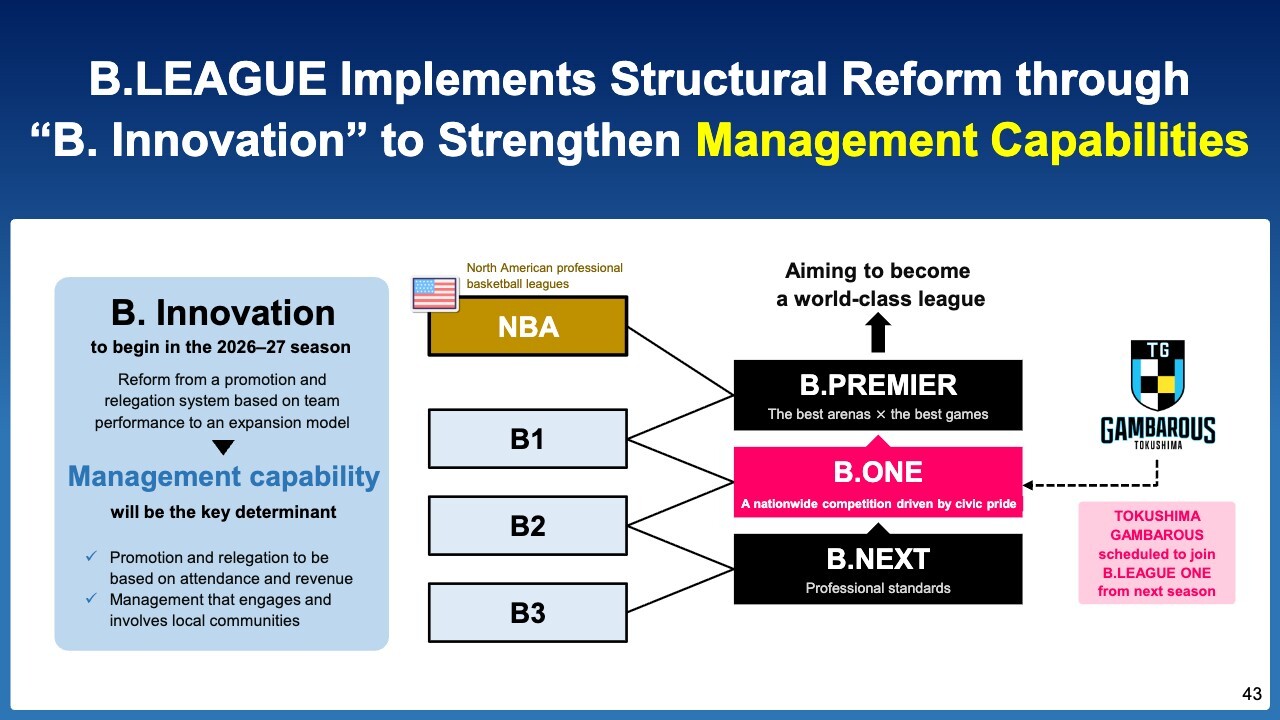
It's about B.LEAGUE. Recently, management skills have become important in the sports industry, and B.LEAGUE will also shift its focus to place greater emphasis on management capabilities.
Currently, a promotion and relegation system is adopted, in which stronger teams are promoted and weaker teams are demoted. For example, only the two strongest teams in B2 are promoted to B1, and the two teams that lost in B1 are relegated to B2.
However, this approach does not lead to regional revitalization, and as a result, the losing regional teams lose momentum. Therefore, under the slogan “B. Innovation,” B.LEAGUE plans to implement a major reform, aiming to empower clubs with management capabilities.
Starting next year, the names B1, B2, and B3 will also be changed. “B.LEAGUE NEXT” will be established between B2 and B3, and “B.LEAGUE ONE” will be established between B1 and B2. Between B1 and NBA, the name “B.LEAGUE PREMIER” will be established, and the scale and other aspects will change.
Strengthen Cooperation with Local Communities Through “B. Innovation” and Expand Business Scale
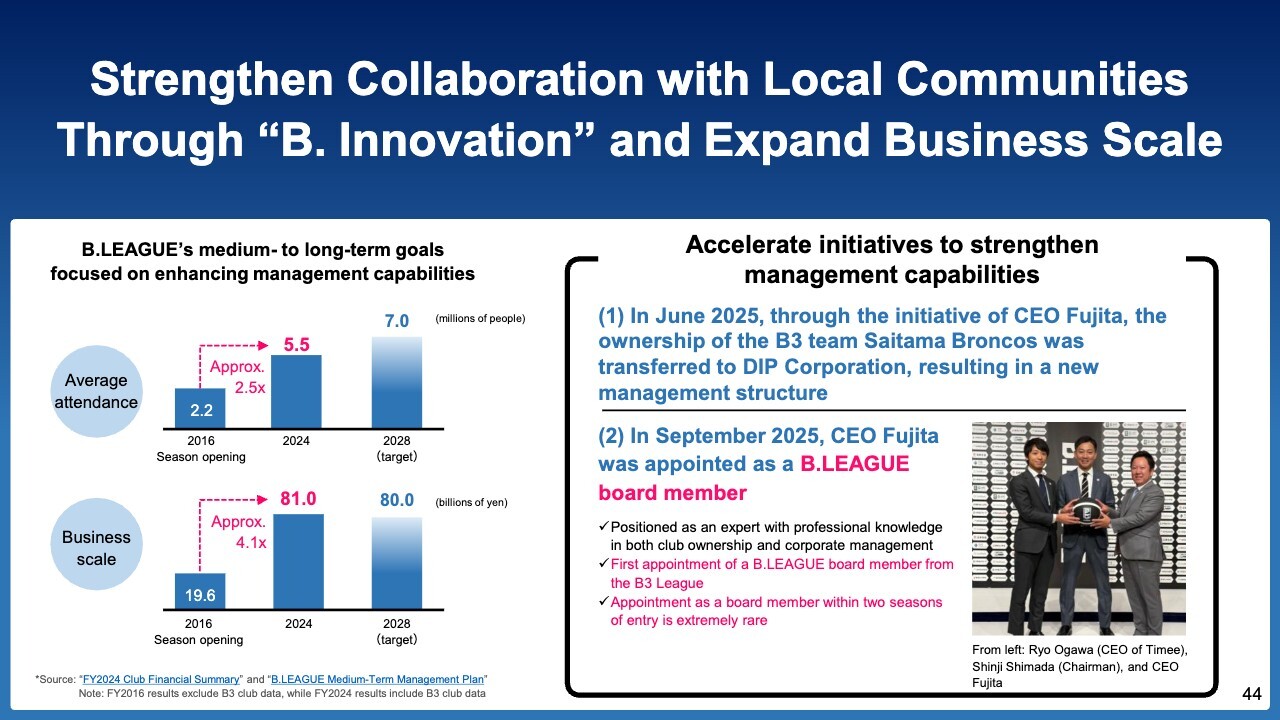
I will talk about the progress of the B.LEAGUE since its launch in 2016 through last year, as well as the goals we have set for 2028. When the B.LEAGUE first began, total attendance was 2.2 million, but over the past eight years it has increased by 2.5 times to 5.5 million. Furthermore, we aim to reach 7.0 million people by 2028.
In terms of business scale, it was $1.3 billion in 2016, and although we were aiming for $5.3 billion by 2028, last year it already exceeded $5.4 billion. Looking at these figures, you can see how popular the B.LEAGUE is and how it revitalizes local areas.
In this context, I was recently appointed as one of 14 board members of B.LEAGUE. I currently manage a team called TOKUSHIMA GAMBAROUS in the B3 League, and this is the first time that a B.LEAGUE board member has been appointed from the B3 League.
Such a case of appointment as a board member, based on an evaluation received within just two seasons after our participation, is almost unprecedented.
I would like to talk about the SAITAMA BRONCOS, which was struggling with management, as an example of progress already being made in our initiatives to promote B.LEAGUE and its clubs further, although this was before I became a director.
In this case, we proposed a change in ownership to dip Corporation's president, Tomita. Actually, the owner changed, and as a result, the club is now booming.
In cases where a club is struggling with management and the current management has determined that it is necessary to strengthen management, we are taking steps to address this by inviting a new manager. Through this initiative, we aim to boost each club and overall the clubs across the country.
TOKUSHIMA GAMBAROUS Uplifting the Local Community with Six Consecutive Wins Since the Season Opener on September 27-28
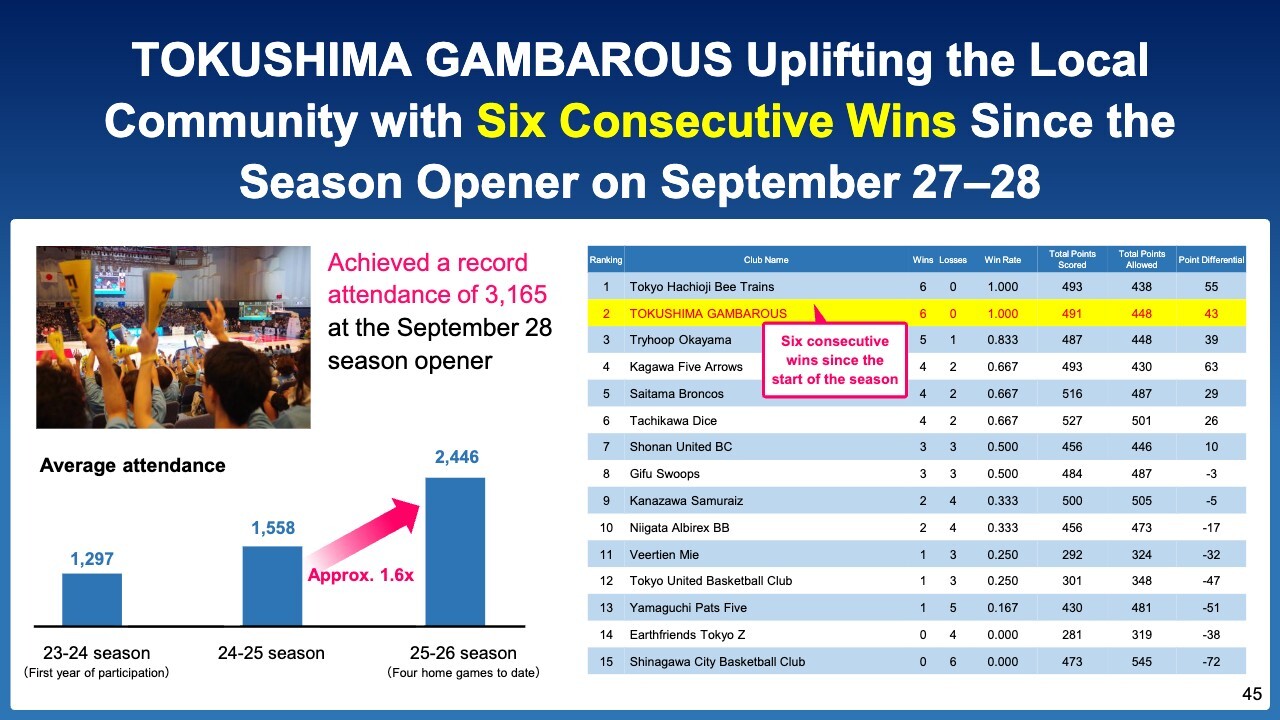
I would like to explain about TOKUSHIMA GAMBAROUS, which the Company is working on in this context. This year marks TOKUSHIMA GAMBAROUS's third year of participation, and since the season opener on September 27-28, the club has won six consecutive wins. In Tokushima Prefecture, TOKUSHIMA GAMBAROUS is experiencing a lot of excitement.
In the first year of participation, the average attendance was 1,297 people. In last year's 2024-25 season, it was 1,558 people. And this year, currently 2,446 people (approximately 1.6 times that number) have come to support TOKUSHIMA GAMBAROUS at the game venue.
TOKUSHIMA GAMBAROUS Scheduled to Join B.LEAGUE ONE Next Season, Aiming for Both Business Growth and a B3 Championship This Season
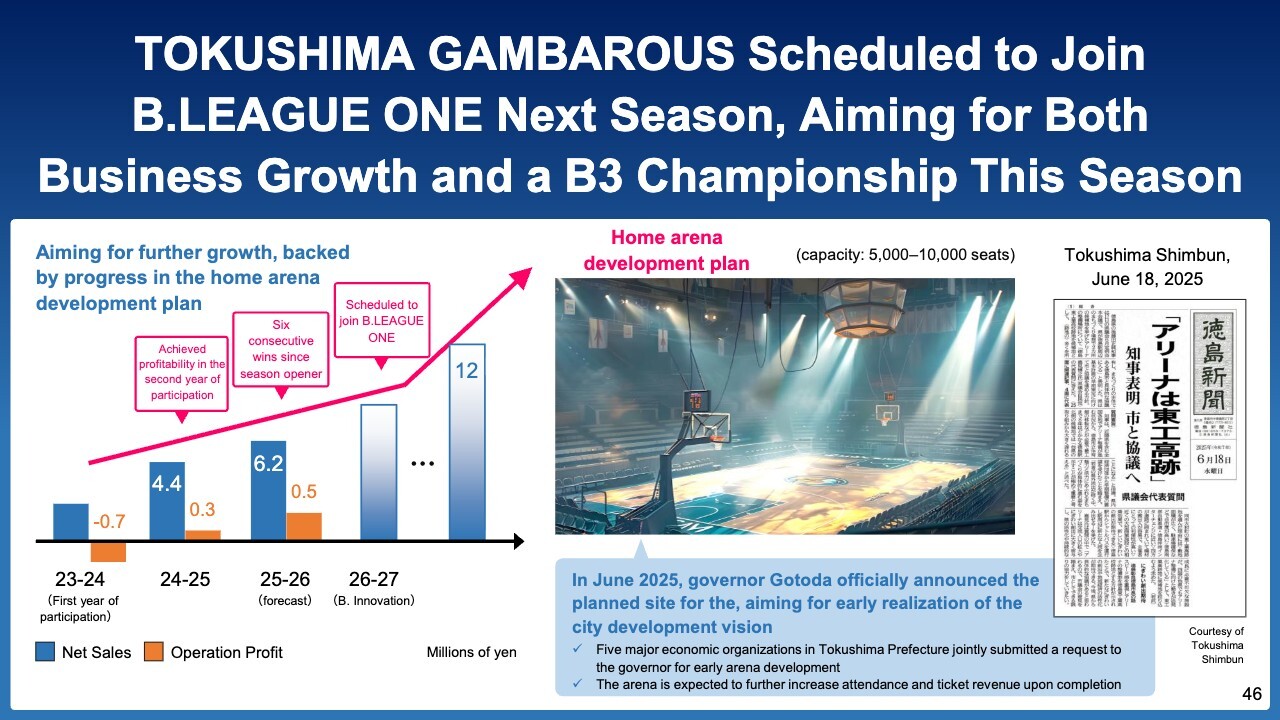
In the 2023-24 season, our first year of participation, we were not fully prepared and ended up with a loss of around $466 thousand . Last year, in our second year, we achieved net sales of $2,933 thousand and an operating profit of approximately $200 thousand, turning a profit.
Probably, it is extremely rare in sports club management to make a professional team profitable in such a short period of time.
Our business plan for this fiscal year is to achieve net sales of $4,133 thousand and operating profit of $333 thousand. With six consecutive wins since the season opener, we believe the feasibility of this plan is very high. Next fiscal year, the team is scheduled to join B.LEAGUE ONE, which will be newly established between B2 and B1.
The Governor of Tokushima Prefecture announced the construction of an arena in Tokushima Prefecture, mentioning how TOKUSHIMA GAMBAROUS is a popular team that many people are excited about. The arena is expected to be completed around 2030.
If this comes to fruition, I believe that TOKUSHIMA GAMBAROUS will become even stronger and gain even more popularity, which will enable it to make a significant contribution to Media Do in terms of sales and profits.
This has been a long explanation, but that's all I have to say.
Q&A: Overseas distribution scheme and progress
Questioner: Regarding the distribution of print books overseas, what stage has it reached in the targeted area currently?
Fujita: In the U.S., there are companies such as Ingram that are equivalent to Japanese distributors, and I will refer to their distribution as A distribution.
The main distribution channel is B Distribution. B Distribution is a system centered on Big Five publishers, such as Penguin Random House and Macmillan, which distribute their own books together with those of smaller publishers. We are considering expanding through both A and B distribution, and I myself have traveled to the U.S. to speak directly with publishers.
Kinokuniya Company Ltd., a Japanese company, directly operates 22 stores in the United States. Another feature is that the company has developed 42 stores worldwide.
There is room for consideration as to whether we should bring books printed in Japan overseas or print them locally and deliver them, but given the significance of a Japanese company promoting Japanese books to the world, we would like to discuss dealing directly with Kinokuniya regarding distribution.
Q&A: Progress of Strategic Investment businesses
Moderator: The question is: “This fiscal year, in addition to increased sales in the eBook distribution business, improvements in profitability at NIHONBUNGEISHA and the restructure of non-core businesses give the impression of a clear improvement in profits.
Is it fair to say that the restructuring of Strategic Investment businesses has entered a phase where it can be expected to continue contributing to profits going forward? Or do you recognize that there is still a part of the investment phase remaining?”
Kanda: As you pointed out, we believe the Company has made considerable progress in restructuring its Strategic Investment businesses.
On the other hand, as the name strategic investment suggests, even after achieving profitability in the future, a certain portion of profits will need to be allocated to investment. We recognize that these issues remain as challenges.
These issues differ from business to business, but for example, NIHONBUNGEISHA has reached a stage where it can see a level at which it can generate stable profits without implementing any special measures.
In order to expand our business in the future, we believe that we will need to expand into other genres, further advance digitalization, and even promote video production. In that sense, we recognize that a certain investment phase is still ongoing.
Regarding our overseas business, our existing businesses are growing steadily, but the development of new services such as “Booktrovert,” which I mentioned earlier, is expected to take some time before they reach the revenue phase, especially before they start making a full-scale contribution.
In our Medium-Term Management Plan, we have committed to quickly achieving profitability in our Strategic Investment businesses, particularly by fiscal 2027. Until then, we would like to operate the business while considering the balance between investment and revenue recovery.
Q&A: Sales from overseas expansion
Moderator: The question is: “In order to expand overseas, you are working on improving your infrastructure, including the translation systems MDTS and NetGalley. On the other hand, in terms of sales contribution, when do you envision this being reflected in the figures? In particular, please tell us about your business model in the North American market and your estimation of distribution revenue and SaaS revenue.”
Fujita: The development of the AI-based translation system “MDTS” will not require a large investment, but we believe a certain amount of investment will be necessary. We expect revenues to start to increase from next year.
Q&A: Outlook for the full-year plant
Moderator: The question is: “In relation to your full-year plan, I feel that progress in both sales and profits in the first half of the year generally exceeded your expectations. On the other hand, what assumptions do you have for progress in the second half?
Please provide additional details regarding the growth trends in eBook distribution and the outlook for profitability in Strategic Investment businesses, taking into account seasonality and temporary factors.”
Kanda: Regarding the growth trend of eBook distribution, the growth rate of existing distribution channels is higher this fiscal year compared to the previous fiscal year, and we believe that the level in the first half will not change significantly in the second half. Therefore, I think we can look at sales growth with a certain degree of confidence.
Regarding our Strategic Investment businesses, we are assuming that both sales and profits will improve in the second half. Going forward, we believe it will be necessary to carefully assess whether the investment recovery for various businesses in our Strategic Investment businesses will proceed smoothly.
Initially, we anticipated that the profit growth in our eBook distribution business this fiscal year would not be as significant as in the previous fiscal year. One reason for this is that some profitable services will be terminated in the second half.
Therefore, we do not expect any major changes in the sales trend of eBook distribution in the second half, but we believe that we must continue to carefully monitor its contribution to profits. At this point, although first-half results are exceeding expectations, we are still taking a conservative view.
Q&A: NIHONBUNGEISHA's improving profitability of eBooks and print books
Moderator: The question is: “Let me confirm the growth story of NIHONBUNGEISHA. The materials for the briefing session mainly focus on sales of print books. Could you please tell us, even if it's just a rough estimate, the sales composition ratio between print books and eBooks, the degree of improvement in the return rate of print books, and the growth rate of eBooks?”
Kanda: NIHONBUNGEISHA is a company with sales revenue of approximately 3 billion yen. Please understand that eBooks account for a little over half of this total.
To continue increasing the growth rate of eBooks, we believe it is important to increase the number of works in a format suitable for digital.
Starting in March of this year, NIHONBUNGEISHA launched a new eBook service, “Goraku Web!,” on its portal site. In addition to distributing the contents of past works, we are also actively posting newly created works with the cooperation of writers.
Until now, we have been limited to authors who can serialize their works in the paper magazine Weekly Manga Goraku, which has meant that the supply of works has been limited. By digitizing these works, the number of works is rapidly increasing. We hope that this will lead to further growth in eBook sales.
The return rate for print books has improved significantly compared to the previous period. However, we do not necessarily believe that it is correct to evaluate the return rate as a KPI.
As a publisher, it is extremely important to increase sales through book publication and promotion. Therefore, rather than focusing on improving the return rate, it is necessary to build a structure that can generate profits even if the current return rate is accepted.
We also consider that marketing functions are important for selling high-quality works. We are making steady progress in such functions compared to last year, and we believe this is leading to improved profits, including from print books.