Agenda
Satoshi Ichikawa (hereafter, “Ichikawa”): I am Satoshi Ichikawa, Representative Director and President, Executive Officer. I will now explain the financial results for FY6/25.
Today, following the agenda, I will provide the financial report for FY6/25, the business forecasts for FY6/26, and the vision for 2030 and update of the Medium-Term Management Plan targets, in that order.
FY6/25 Overview of Financial Results
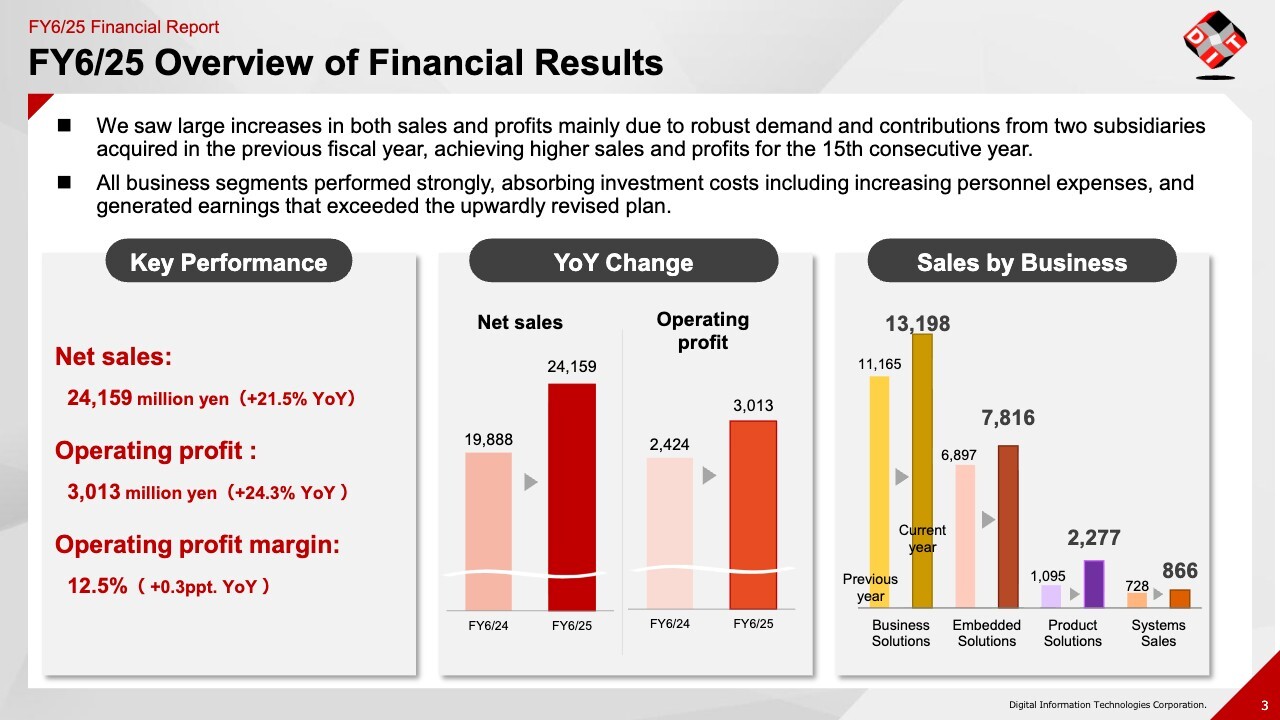
These are the financial results for FY6/25. Overall, we saw significant year on year (YoY) increases in both sales and profits mainly due to robust demand and contributions from two subsidiaries acquired in the previous fiscal year, achieving record-high sales and profits for the 15th consecutive year.
All business segments performed strongly, absorbing investment costs, and generated earnings that exceeded the upward revised plan.
Net sales reached 24,159 million yen, up 21.5% YoY. Operating profit was 3,013 million yen, up 24.3% YoY, and operating profit margin was 12.5%, an improvement of 0.3 pts YoY.
As shown in the graph on the far right of the slide, sales by business segment show steady growth across all segments YoY. In particular, Production Solutions doubled.
FY6/25 Financial Highlights
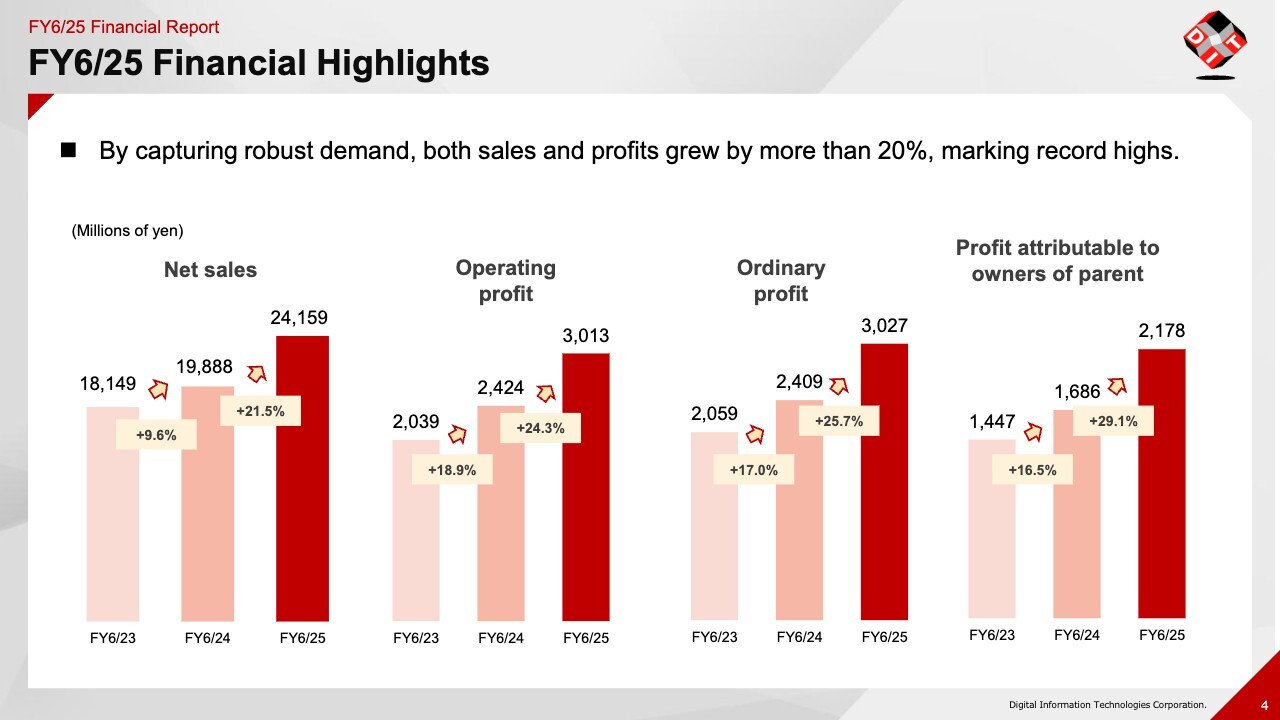
Here are the financial highlights. By capturing robust demand, both sales and profits grew by more than 20%, marking record highs.
Changes in Quarterly Net Sales & Operating Profit
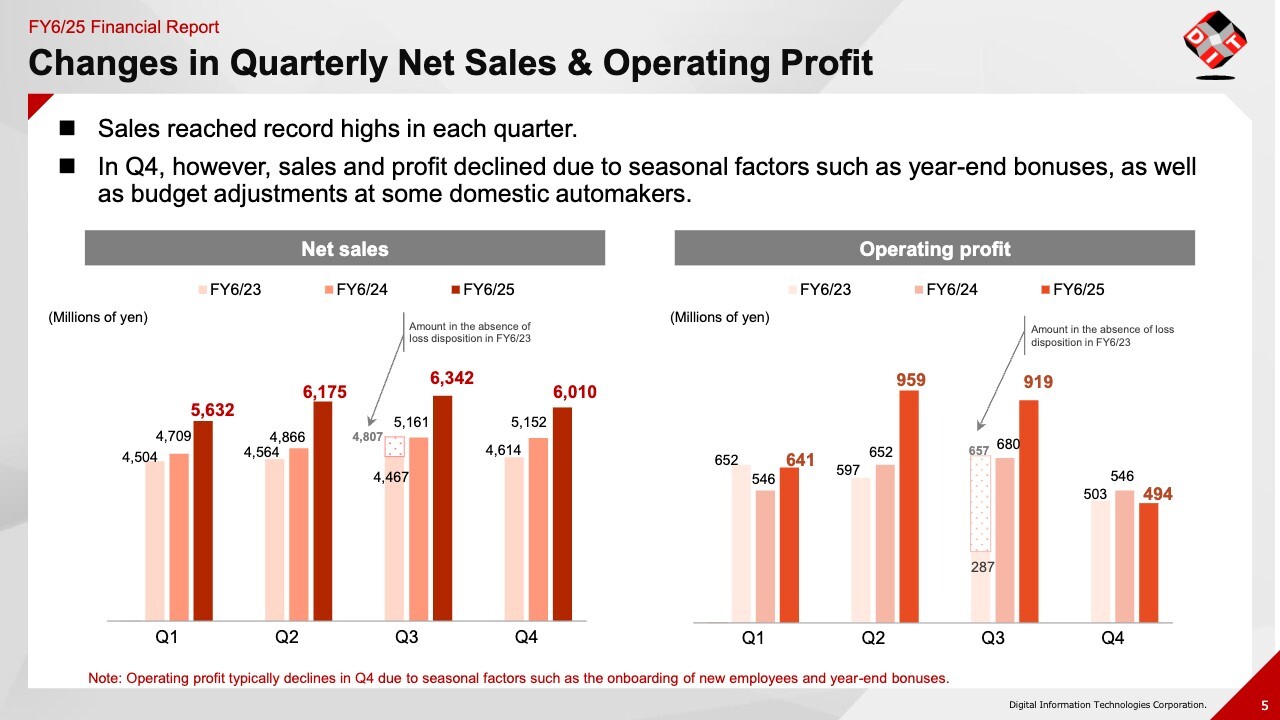
This slide shows changes in quarterly net sales and operating profit. Quarterly net sales set new records in every quarter. However, Q4 performance showed a slight decline due to seasonal factors such as year-end bonuses, as well as budget adjustments at some domestic automakers.
Notably, operating profit for Q4 fell below last year’s level, which is a point of concern. We could have added about 100 million yen more, but we used up about 70 million yen of the annual budget all at once in Q4. Additionally, approximately 30 million yen was paid out as a special bonus at year-end, reflecting the strong performance.
Therefore, we essentially view the Q4 profit as being about 100 million yen higher than reported.
Changes in Gross Margin/SG&A Expenses/Operating Profit Margin
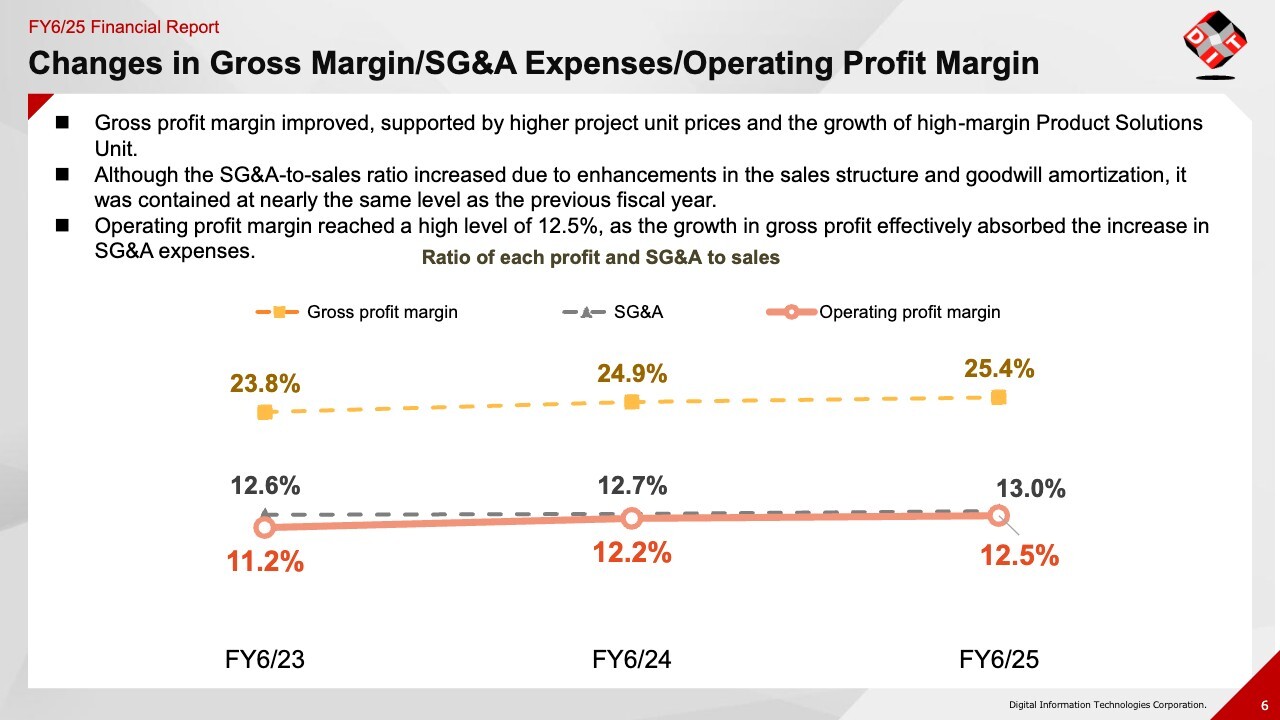
This slide shows changes in gross profit margin, SG&A expenses and operating profit margin. Gross profit margin improved, supported by higher project unit prices and the growth of high-margin Product Solutions Unit.
Although SG&A expenses increased, we were able to keep them under control as a percentage of sales, resulting in the operating profit margin of 12.5%.
FY6/25 Summary of Financial Results
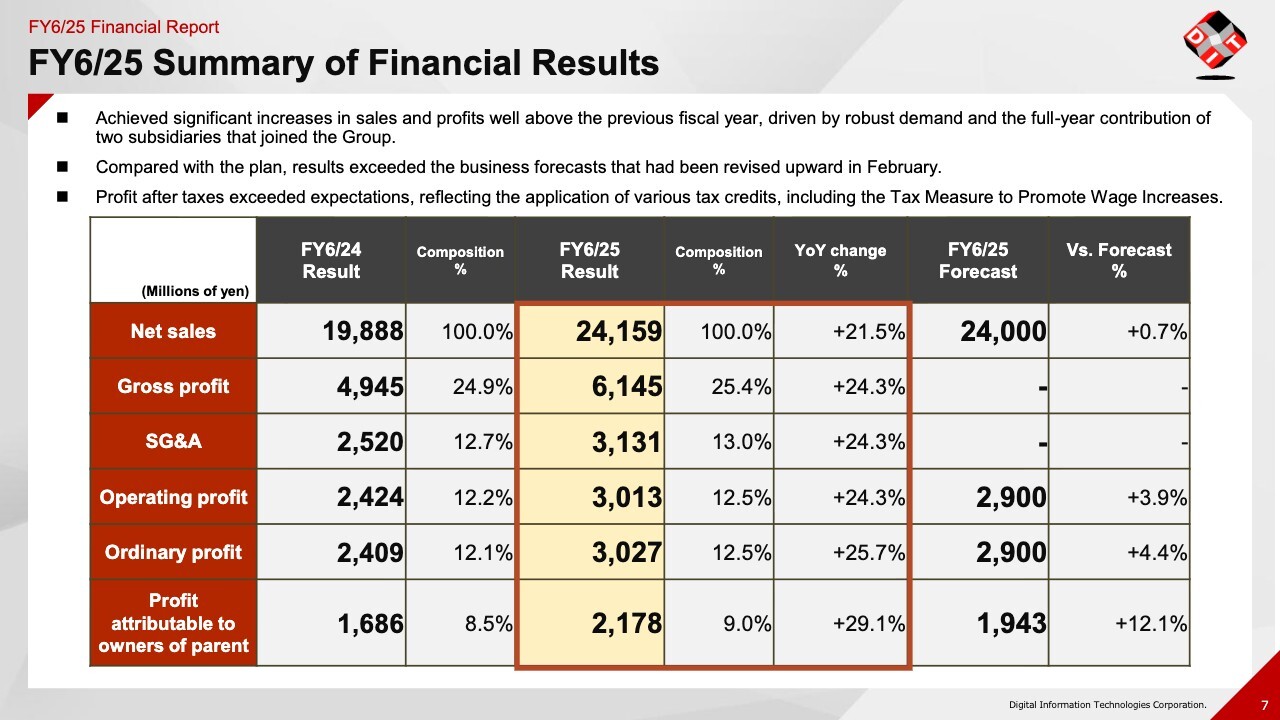
Here is the summary of financial results. As shown on the slide, we achieved results well above our previously disclosed forecast of 24,000 million yen in net sales and 2,900 million yen in operating profit.
In particular, profit attributable to owners of parent increased by 12.1% versus the forecast. Profit after taxes exceeded expectations, reflecting the application of various tax credits, including the Tax Measure to Promote Wage Increases.
Factors behind Changes in Net Sales and Operating Profit (YoY)
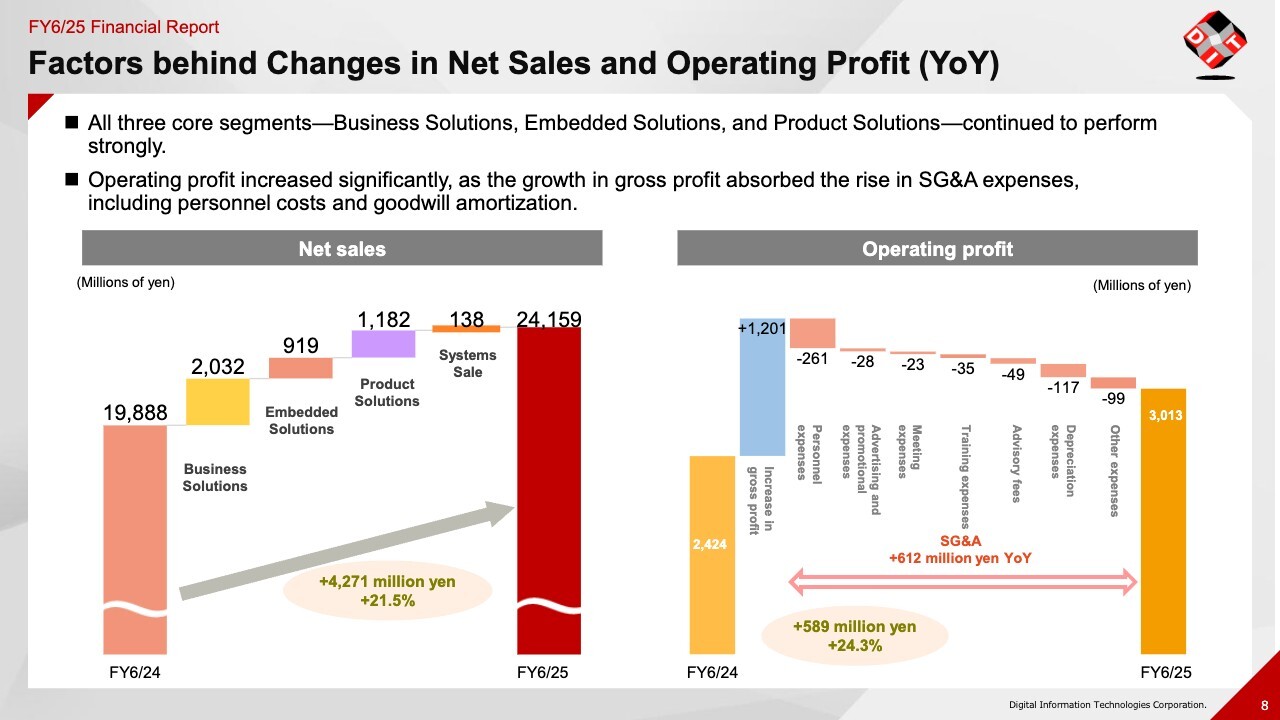
This slide shows the factors behind changes in net sales and operating profit (YoY). All segments achieved steady growth in net sales.
Operating profit increased significantly, as the growth in gross profit absorbed the rise in SG&A expenses, including investment costs, personnel costs, and goodwill amortization due to M&A.
Business Segments and Composition of Sales
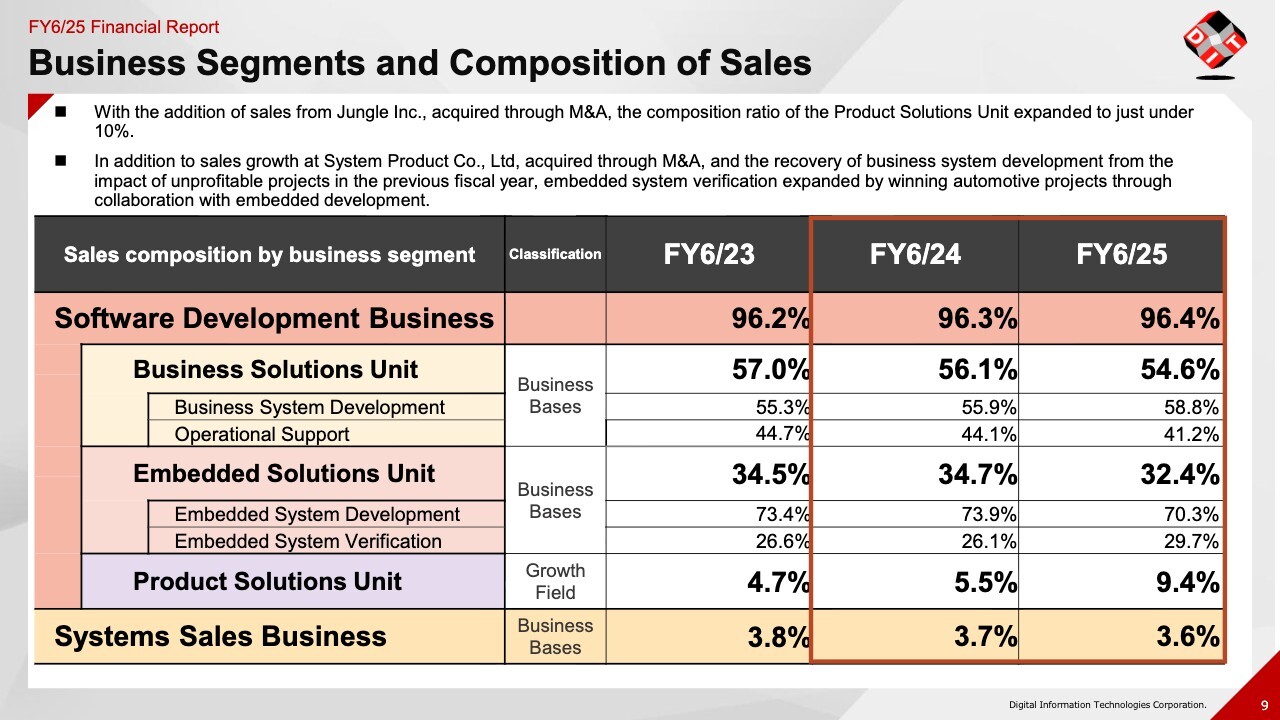
Our business segments and composition of sales have not changed significantly since the previous fiscal year.
However, Jungle Inc.’s sales figures were added to the Product Solutions Unit in FY6/25. Consequently, the composition ratio of the Product Solutions Unit increased from 5% to just under 10%.
In the Business Solutions Unit, Business System Development has grown since the previous fiscal year. This growth includes sales from System Product Co., Ltd, acquired through M&A.
In the Embedded Solutions Unit, Embedded System Verification has seen significant growth since the previous fiscal year. This growth stems from advancements in the verification of major automotive projects through collaboration with embedded development.
Sales by Business Segment
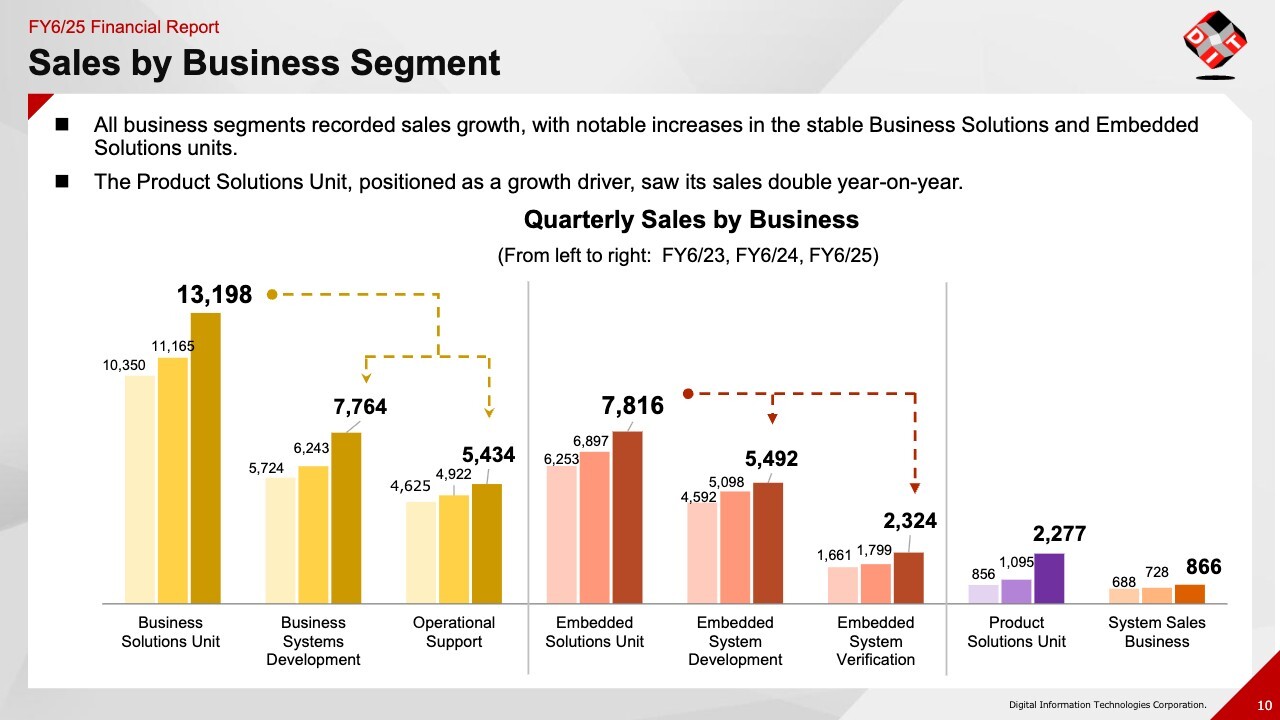
This shows changes in sales by business segment, including sub-segments, from previous fiscal years.
Notable increases in sales were seen in Business Systems Development in the Business Solutions Unit and Embedded System Verification in the Embedded Solutions Unit. Additionally, the Product Solutions Unit saw its sales double YoY.
Sales by Segment: Business Solutions Unit
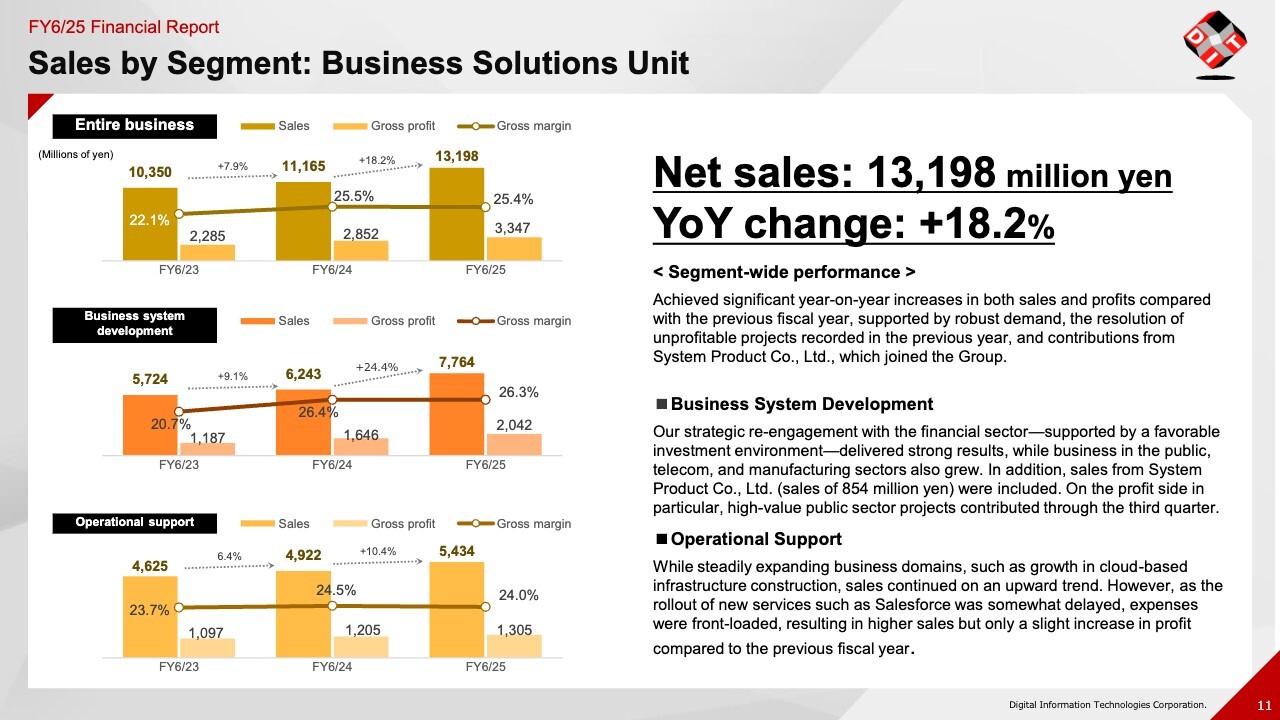
I will now explain sales by segment in detail. First, the Business Solutions Unit.
Its segment-wide net sales were 13,198 million yen, up 18.2% YoY. The segment achieved significant YoY increases in both sales and profits by capturing robust demand and receiving contributions from System Product Co., Ltd., which joined the DIT Group (hereinafter, the “Group”).
The Business System Development sub-segment generally won project contracts in all sectors, particularly in the financial sector. Additionally, 854 million yen in sales were added from System Product Co., Ltd.
On the profit side in particular, high-value public sector projects contributed through the third quarter.
The Operational Support sub-segment experienced worldwide growth in the demand for cloud-based infrastructure construction. We successfully captured the demand.
On the other hand, we were unable to convert inquiries into orders for operational support services for industry-standard platforms like Salesforce during FY6/25. In the new fiscal year, we aim to secure these inquires and translate them into tangible business results.
Sales by Segment: Embedded Solutions Unit
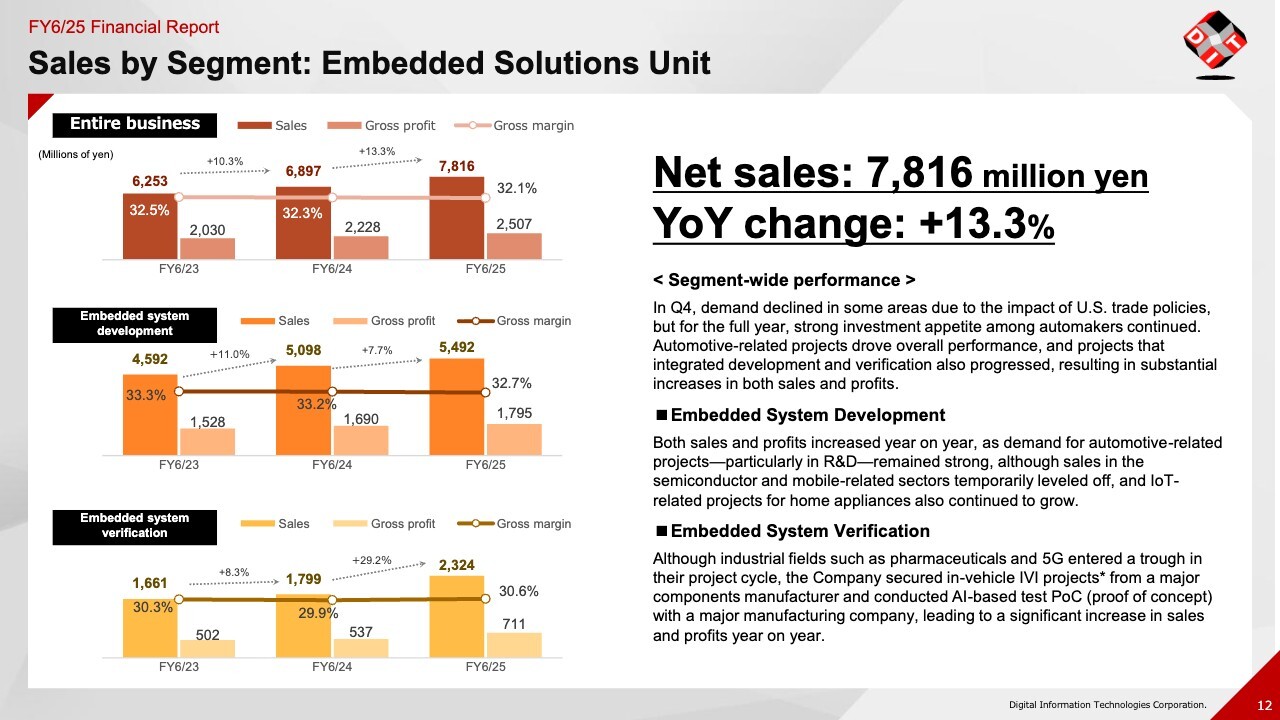
Next is the Embedded Solutions Unit. Its segment-wide net sales were 7,816 million yen, up 13.3% YoY.
The segment-wide performance remained very strong through Q3. In Q4, demand declined due to the impact of U.S. trade policies, but for the full year, we captured strong investment appetite among automakers. Also, projects that integrated development and verification also progressed, resulting in substantial increases in both sales and profits.
In the Embedded System Development sub-segment, demand for automotive-related projects—particularly in R&D—remained strong, although sales in the semiconductor and mobile-related sectors temporarily leveled off.
For FY6/26, we aim for further growth. We have secured numerous key clients, primarily in the Kansai region, for IoT-related projects for home appliances. With our focus on automotive alternatives for FY6/26, we believe we successfully laid the groundwork in FY6/25.
For Embedded System Verification, the Company was particularly pleased to secure in-vehicle IVI verification projects from a major automotive manufacturer. These projects successfully filled the gaps in project cycles within the pharmaceutical and telecommunications sectors, leading to a favorable performance exceeding the previous fiscal year’s levels.
In test automation, we conducted AI-based test PoC (proof of concept) with a major manufacturing company. We believe this will be a key highlight of the new fiscal year. I consider that we successfully built this framework and mechanism during FY6/25.
Sales by Segment: Product Solutions Unit
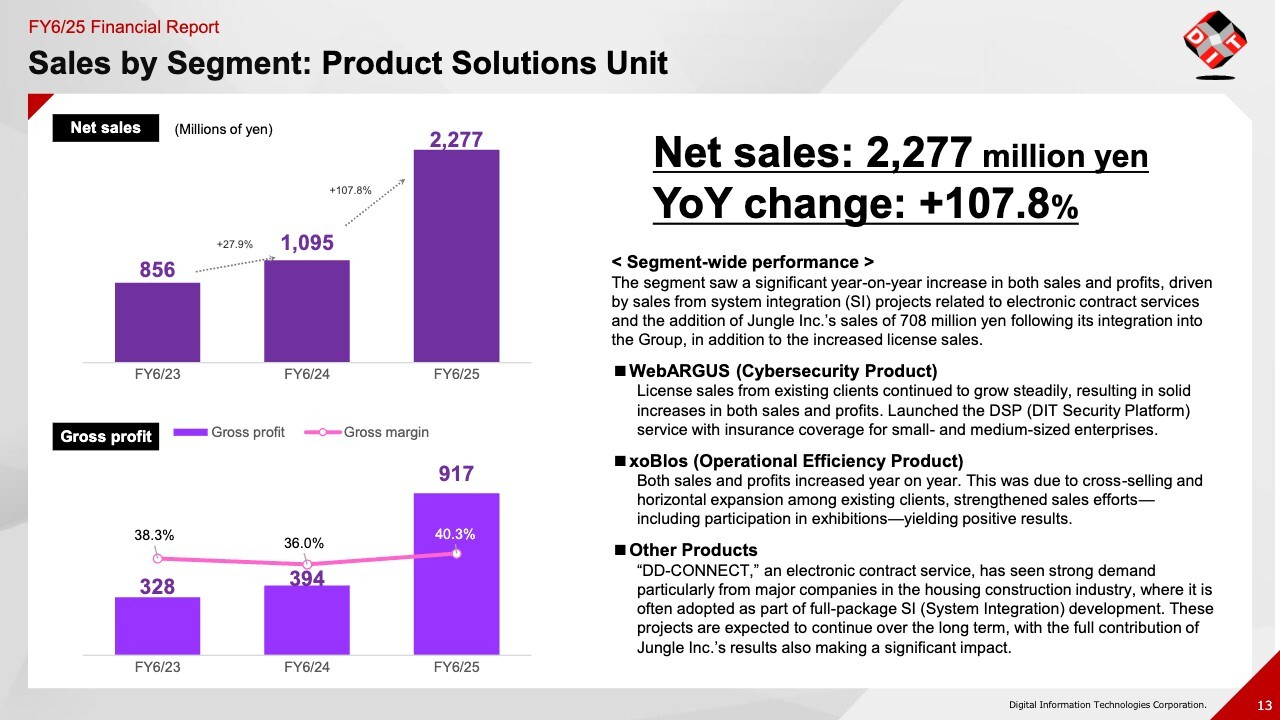
This is the Product Solutions Unit. Its segment-wide net sales were 2,277 million yen, up 107.8% YoY.
The segment saw a significant YoY increase in both sales and profits, driven by sales from system integration (SI) projects related to electronic contract services and the addition of Jungle Inc.’s sales of 708 million yen following its integration into the Group, in addition to the increased license sales.
Regarding security, license sales from existing client continued to grow steadily. We also launched the DSP (DIT Security Platform) service with insurance coverage for small- and medium-sized enterprises. While it has not yet fully translated into tangible results, we plan to prominently feature this offering in FY6/26 and aim to drive its contribution to our financial performance.
This concerns xoBlos (Operational Efficiency Product). Both sales and profits increased YoY. This was due to numerous inquiries generated through cross-selling and horizontal expansion among existing clients, and participation in exhibitions. Additionally, strengthened sales efforts continued to yield positive results.
Among other products, DD-CONNECT, an electronic contract service, has seen strong demand particularly from major companies in the housing construction industry, where it is often adopted as part of full-package SI (System Integration) development. These projects are expected to continue over the long term. We will continue to capture this demand.
Furthermore, Jungle Inc.’s results significantly contributed to the Product Solutions Unit’s overall results. Overall, the entire Product Solutions Unit achieved good results.
Sales by Segment: Systems Sales Business
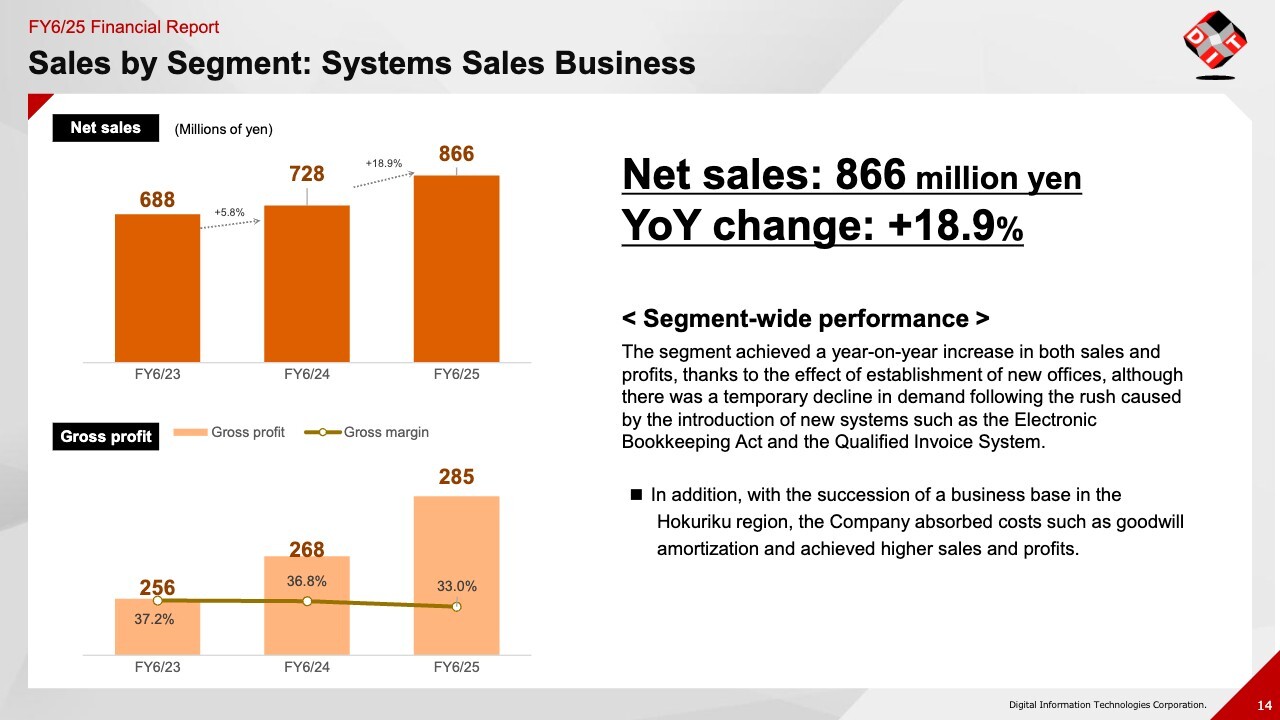
This is the Systems Sales Business segment. Its segment-wide net sales were 866 million yen, up 18.9% YoY.
The overall segment achieved a YoY increase in both sales and profits, thanks to the effect of establishment of new offices, although there was a slight decline in demand following the rush caused by the introduction of the Electronic Bookkeeping Act and the Qualified Invoice System.
We established the new offices through our succession of a major agency in the Hokuriku region after it ceased operations. Despite costs such as goodwill amortization, these offices contributed to the Company’s performance.
Balance Sheet
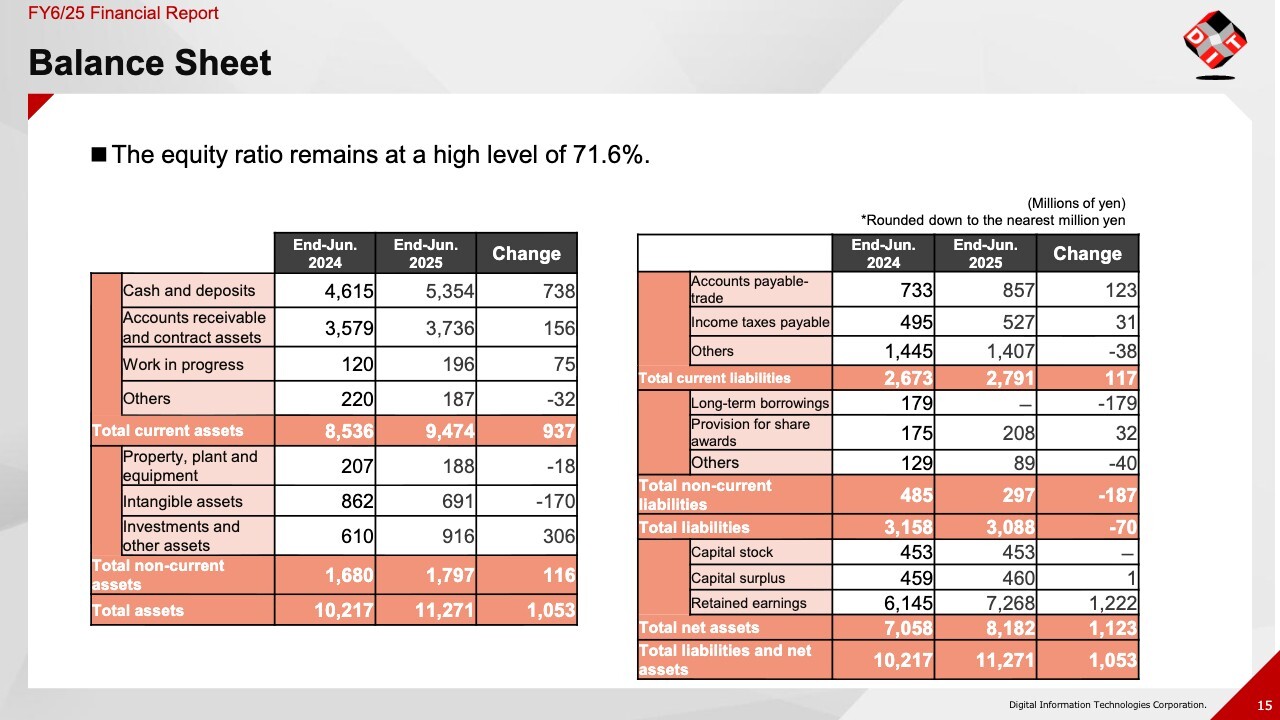
This is the balance sheet. The equity ratio remains as high as 71.6%.
Cash Flows
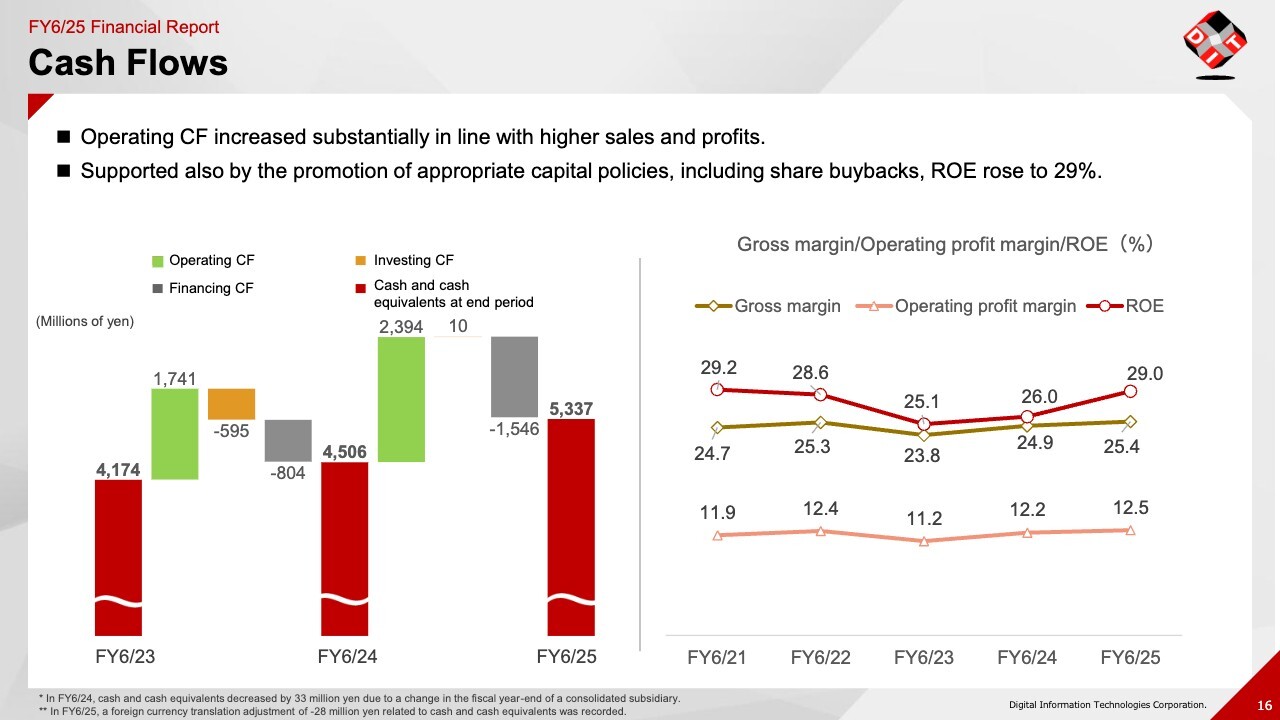
This slide shows cash flows. Operating CF increased substantially in line with higher sales and profits. Supported also by the promotion of appropriate capital policies, including share buybacks, ROE rose to 29%.
Topics: Initiatives to Strengthen Nearshore (Domestic) Bases
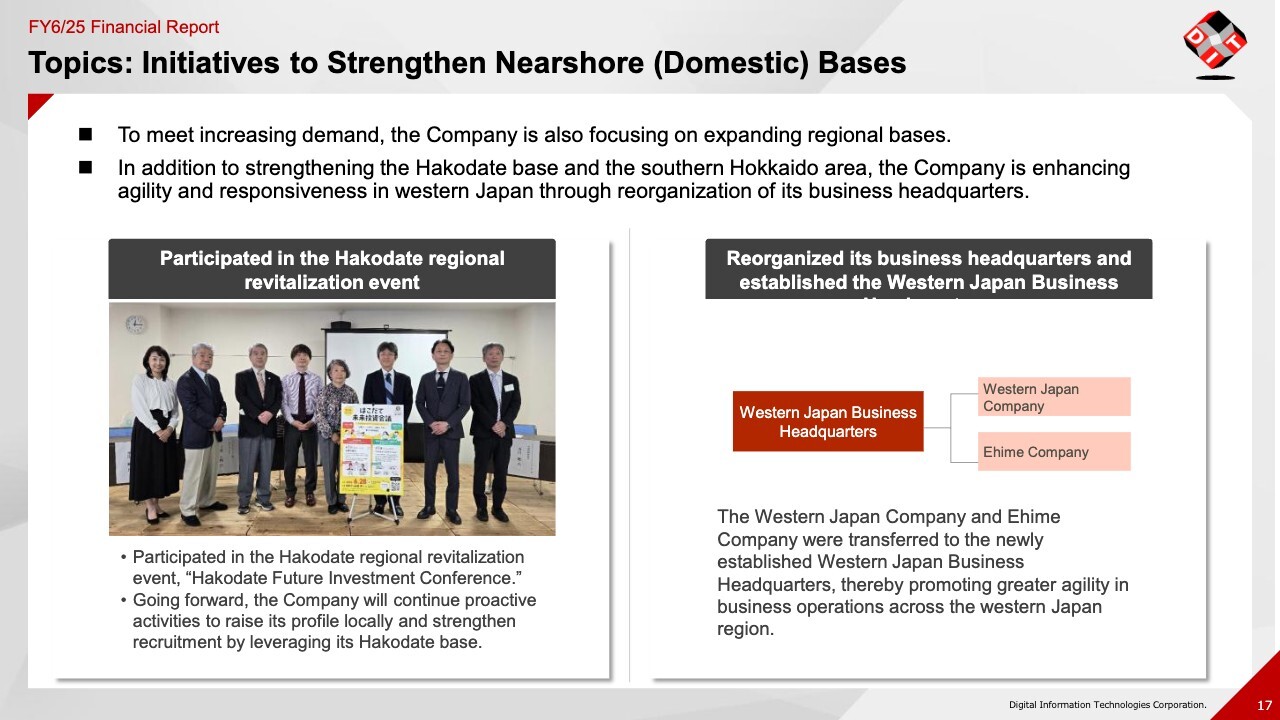
First topic: The Company has consistently focused on establishing robust nearshore (domestic) bases to address talent shortages.
Twelve years ago, we established a base in Matsuyama City, Ehime Prefecture, which currently employs 80 people. We have also newly established a similar-sized base in Hakodate in the southern Hokkaido area. Going forward, we will collaborate closely with local communities to advance various initiatives and focus on resolving resource shortages through recruitment activities.
The right side of the slide shows the Western Japan Business Headquarters. Taking the Western Japan base and the Ehime base as respective companies, they collaborate even more closely with each other. We will promote business with local customers in Ehime Prefecture who have not yet been fully developed.
Building on these success stories, we will expand our development efforts to include new customers, targeting the Chubu region, the Kyushu region, and across the western Japan region. We plan to vigorously advance these initiatives starting FY6/26.
Topics: Launch of a New Security Solution
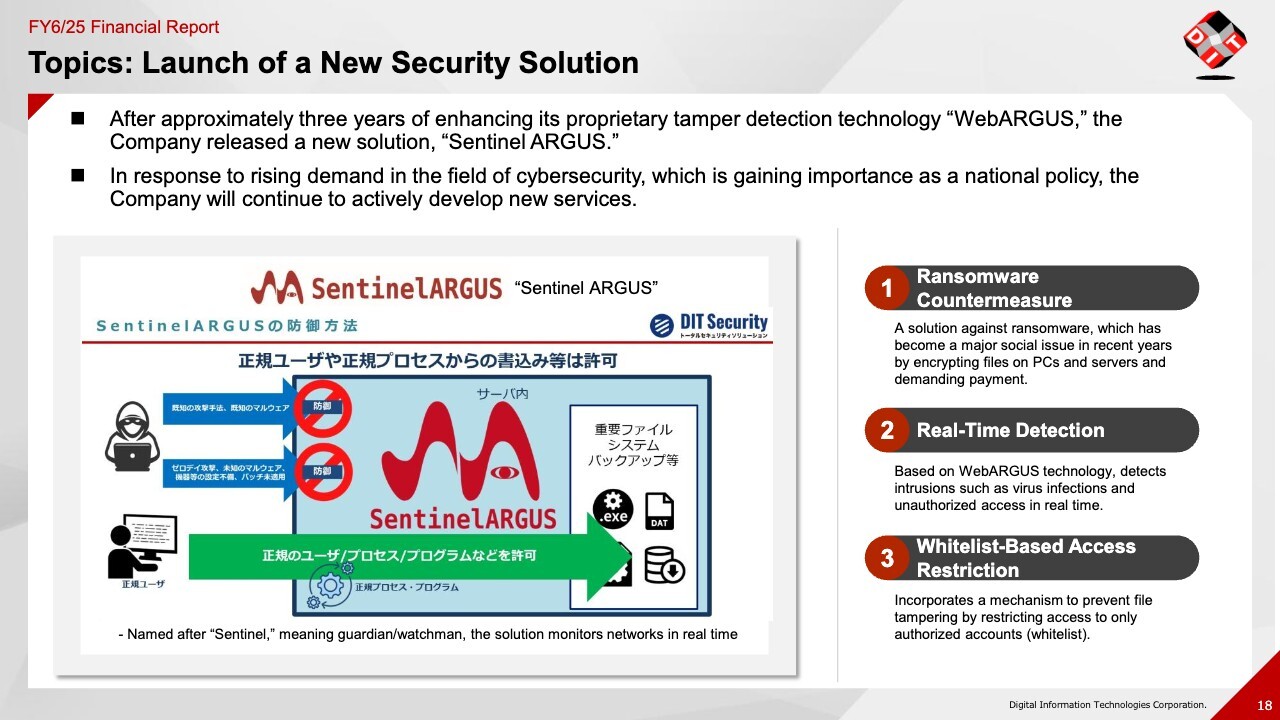
This is the second topic. We have released SentinelARGUS as a new security solution.
Building on the technology of our existing WebARGUS, which restores critical data completely, we have incorporated an additional feature that “absolutely prevents any unauthorized action.”
This feature enables SentinelARGUS to freeze data completely, providing reliable protection against ransomware attacks, a major concern in today’s world. We have released a solution equipped with this capability.
FY6/26 Full-year Business Forecasts
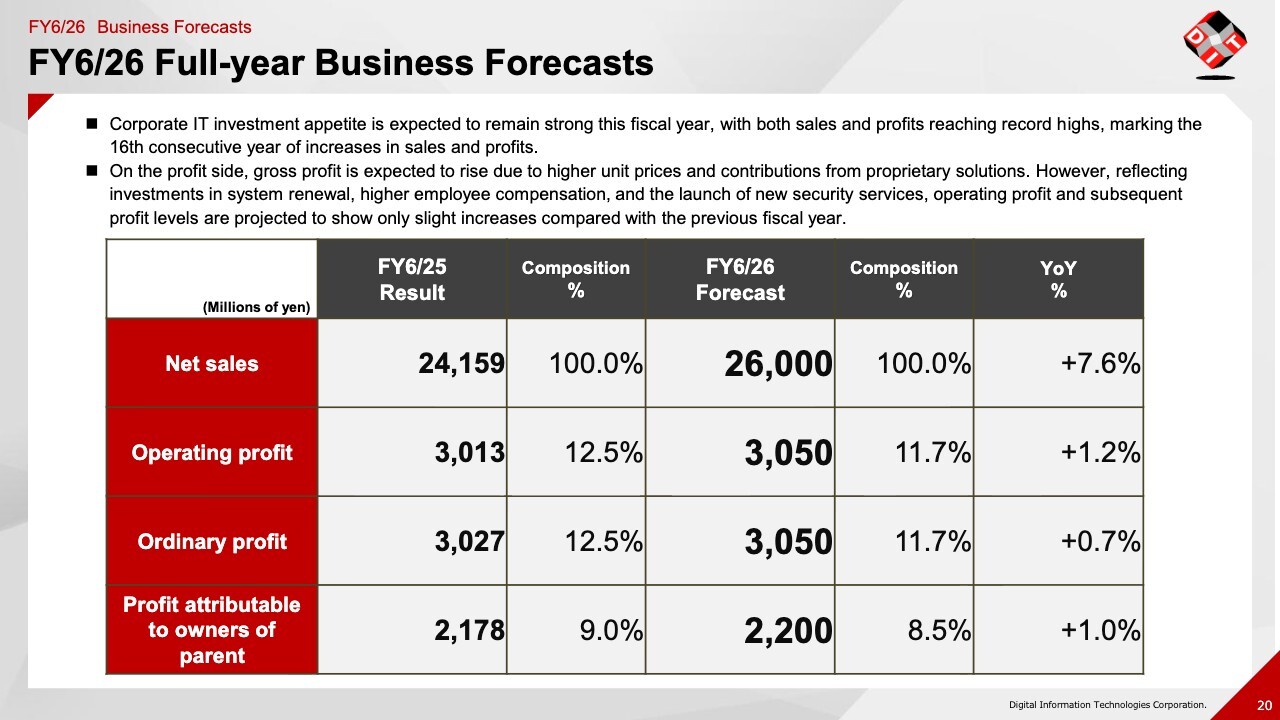
Here are the full-year business forecasts for FY6/26. At first glance, you may wonder why net sales appear somewhat conservative and why operating profit looks flat. Let me begin by providing some additional explanation of the background.
Although profits appear flat, approximately 300 million yen has been allocated for investment costs. The main breakdown includes about 100 million yen earmarked for developing a new product line focused on embedded security systems throughout the year.
Furthermore, leveraging AI is crucial in our industry. We believe it is essential to build this capability into our core strength in order to survive. Regarding AI utilization, we have allocated approximately 100 million yen this time. Furthermore, we are investing substantially in strengthening our internal systems and facilitating skill transitions for our employees to higher-level competencies, which is also projected to cost around 100 million yen.
Taken together, these amount to an investment plan of approximately 300 million yen, which makes our overall earnings appear flat. However, in terms of the business environment, while the embedded solutions business for automobile manufacturers is temporarily soft, in substance our performance is not flat but steadily improving.
Although modest, our plan is to achieve increases in both sales and profit for the 16th consecutive year.
FY6/26 First-Half Business Forecasts
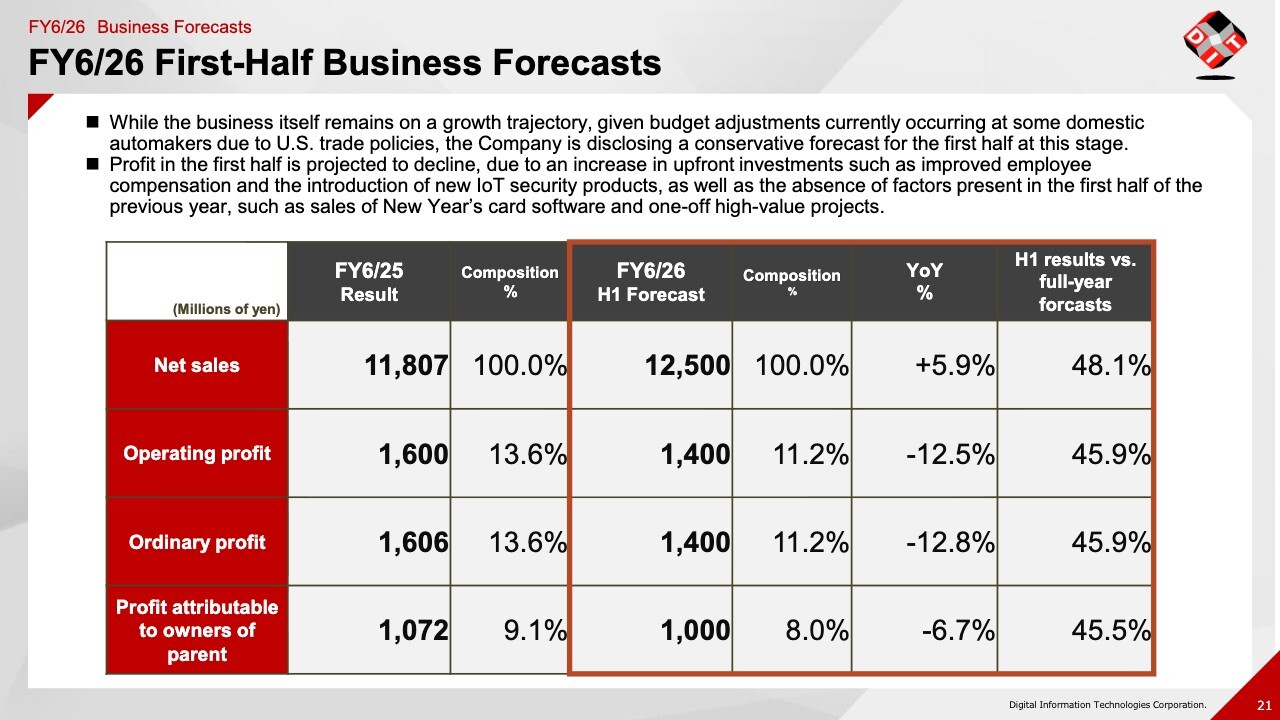
Regarding the first half in particular, profits are projected to be lower than the same period last year. I believe this is a point of concern, so I will address it.
Jungle Inc. traditionally generated significant sales and profit growth in Q2 through its Fudegurume product, concentrating approximately 100 million yen in profits during that quarter. However, this year’s profits are being spread evenly across the first and second halves. Of the 200 million yen decrease in profits, approximately 100 million yen is attributable to Jungle Inc.
Additionally, last fiscal year saw a lump-sum investment of 70 million yen in Q4, whereas this fiscal year involves investments of 150 million yen each in the first and second halves. This results in an increase of approximately 150 million yen in investment compared with the last fiscal year’s first half. The total impact amounts to 200 million yen.
Last year, a one-off bubble-like project boosted first-half profit by about 50 million yen, but no such factor exists this year.
While this breakdown may appear as a profit decline, please understand that we plan to generate solid earnings even amid challenging external conditions.
Business Forecasts by Segment
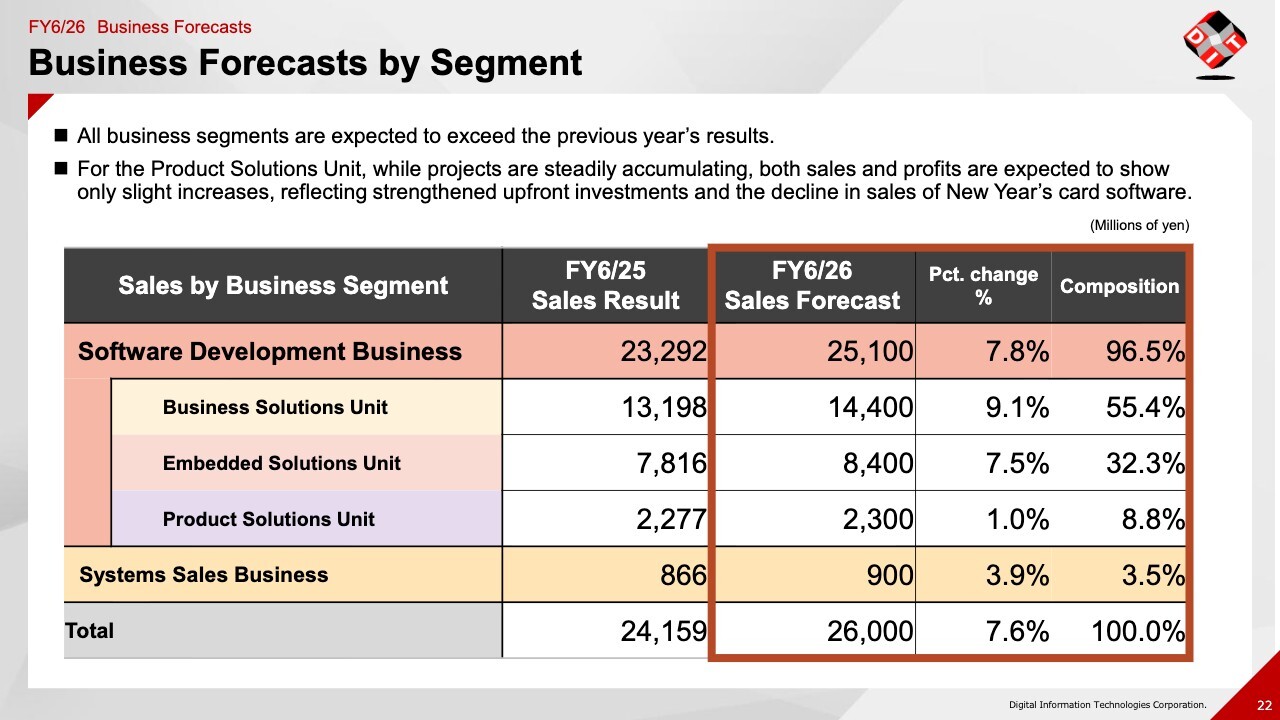
Here is the business forecast by segment. The year-on-year growth rates are shown in the table on this slide. I will explain the details on the following slides.
Sales by Segment: Business Solutions Unit
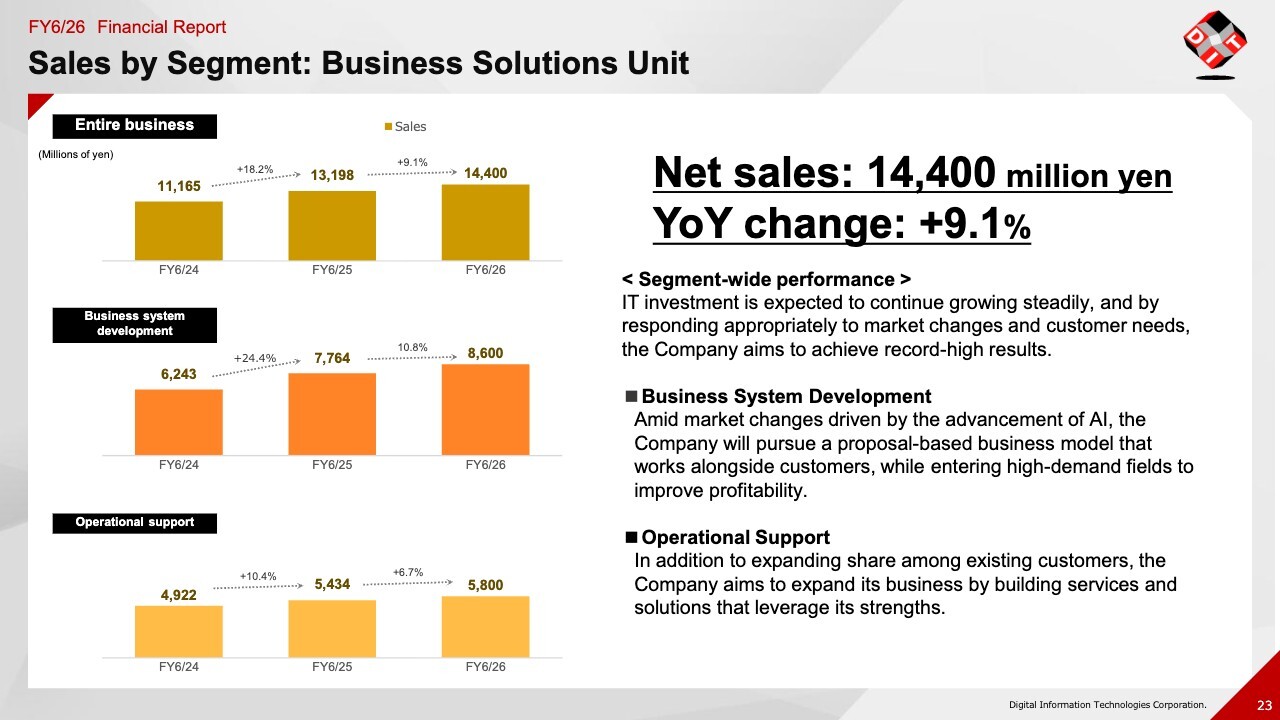
Segment-wide net sales of the Business Solutions Unit are projected to reach 14,400 million yen, up 9.1% YoY. Details of the measures will be explained starting on the next slide.
As shown in the graphs on the left side of the slide, the Business System Development sub-segment is projected to grow by 10.8% YoY. For the Operational Support sub-segment, we plan for a 6.7% increase YoY.
Segment Priority Measures: Business Solutions Unit
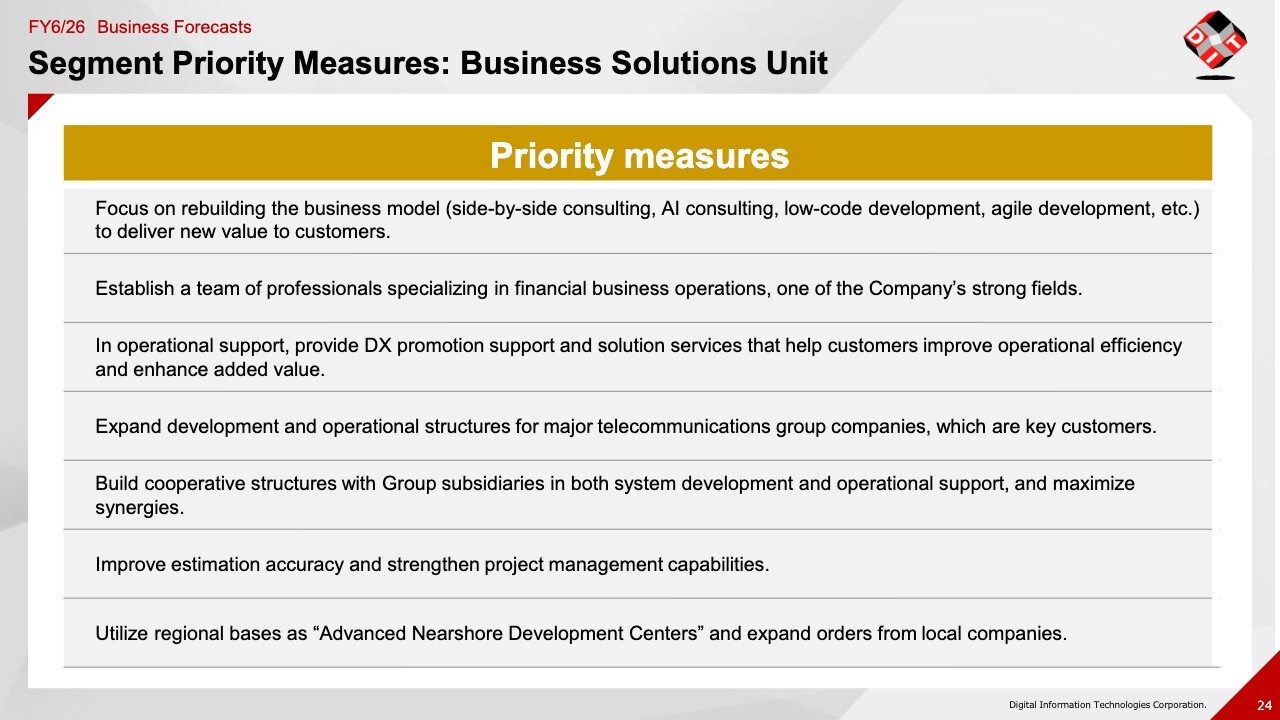
The priority measures for the Business Solutions Unit are the following seven. First: While our main business is dispatching staff to client sites, we will rebuild this business model.
We will develop “side-by-side consulting” to maintain direct contact with end clients and secure continuous work orders. This consulting approach supports clients in achieving their goals and responds swiftly to their needs within short cycles. To this end, we will leverage AI to achieve short lead times and low costs.
Manual processes require an enormous time investment, particularly for core systems. By adopting low-code and agile development, we will build a new business model that allows us to align closely with clients and respond flexibly. Rebuilding this business model will enable us to deliver new value to our clients.
Second: We will establish a team of professionals specializing in financial business operations, one of the Company’s strong fields. We believe the financial sector will be the last to adopt AI. Leveraging our strengths to build this professional team will establish a stable foundation.
Third: In operational support, we will propose solutions that utilize various IT products to help customers improve operational efficiency and enhance added value, providing robust support.
Fourth: As a key focus area, we will expand development and operational structures for major telecommunications group companies, who are key customers.
Fifth: We will build cooperative structures with the Group subsidiaries in both system development and operational support, and maximize synergies.
Following the M&A of System Product Co., Ltd., each company operated separately. Starting this fiscal year, however, we will circulate resources efficiently to leverage greater synergies for customers and end-users with strengths in securities, finance, and other areas. These initiatives will further enhance our profitability.
Sixth: As an ongoing commitment, we will improve estimation accuracy and strengthen project management capabilities, addressing past failures in contract work.
Seventh: We will utilize regional bases as Advanced Nearshore Development Centers and expand orders from local companies. We will also firmly capture areas that cannot be fully covered by resources in Tokyo or Osaka alone.
Sales by Segment: Embedded Solutions Unit
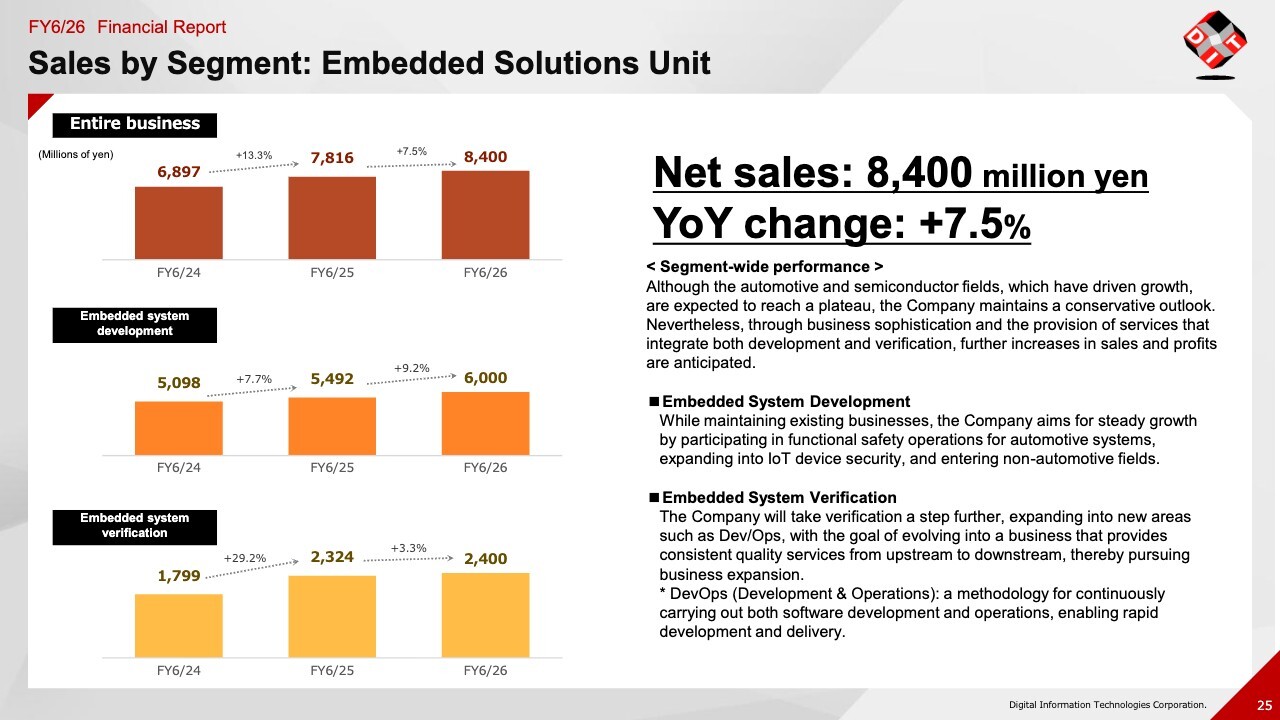
Segment-wide net sales for the Embedded Solutions Unit are projected to reach 8,400 million yen, up 7.5% YoY.
As shown in the graph on the left side of the slide, the Embedded System Development sub-segment plans to grow 9.2% YoY. The Embedded System Verification sub-segment is planning for 3.3% YoY growth.
Regarding Embedded System Development, we have customers in fields beyond automotive, such as home appliances and IoT. We aim to effectively develop these areas while maintaining a certain level of growth potential.
Our projections for the Embedded System Verification area are somewhat conservative, mainly due to its high dependence on the automotive sector. However, we intend to steadily build up actual performance in this area.
Priority Measures by Segment: Embedded Solutions Unit
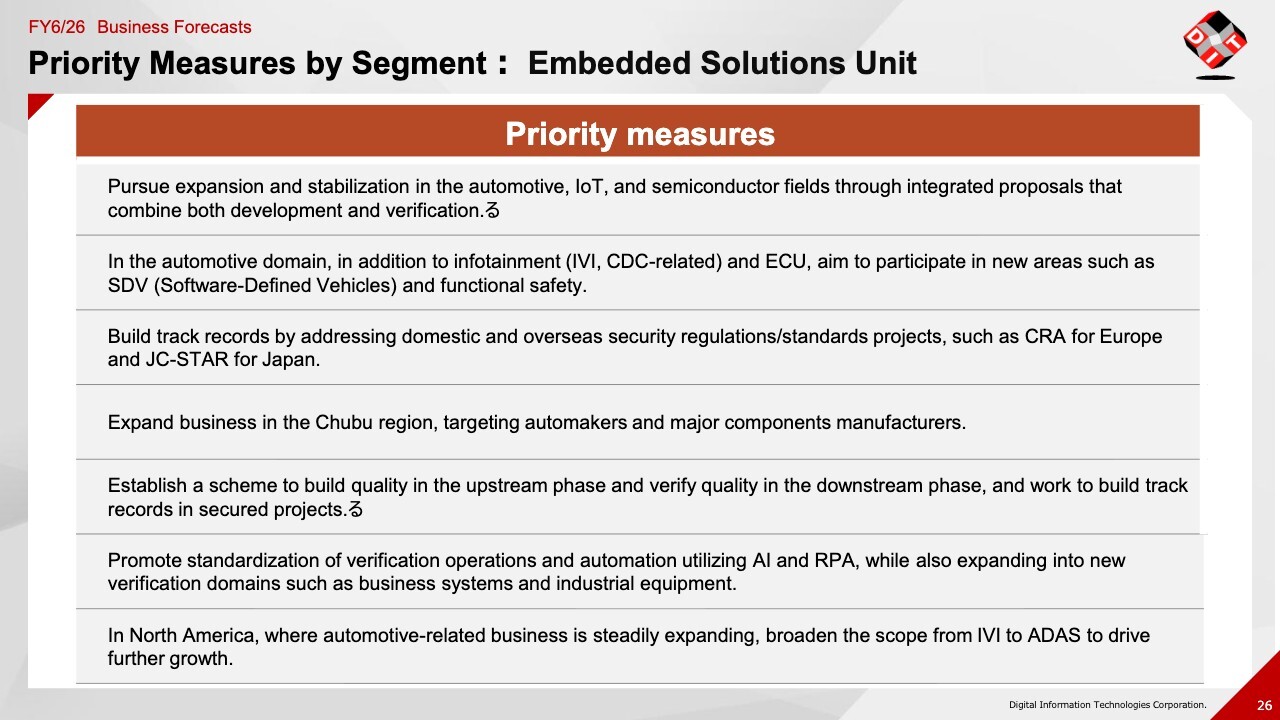
The priority measures for the Embedded Solutions Unit are the following seven:
First: Although we have traditionally focused on the automotive sector, we are now expanding our efforts to include the IoT field. Furthermore, the semiconductor field is expected to recover after the new year begins. We aim to maintain and expand sales and profits by advancing integrated proposals that combine both development and verification.
Second: In the automotive domain, we are focusing on infotainment (IVI, CDC-related), ECU (which we have worked on for many years), and most recently, SDV, a mechanism that enables various functions to be driven by software. Furthermore, we are also partially involved in the functional safety field, which is a long-term area. We aim to participate in and grown within these domains.
Third: In Europe, the CRA was enacted to ensure the security of internet-connected devices. Following this legislation, Japan revised its laws and established the related domestic framework, JC-STAR.
Manufacturers are expressing needs related to these domestic and overseas security regulations/standards, generating various projects. By accurately capturing these needs, we will first build track records and then expand our project portfolio.
Fourth: We will expand business in the Chubu region, targeting automakers and major components manufacturers.
While we have secured sufficient work volume by horizontally expanding with existing customers and deepening relationships, the current environment requires us to enter areas handled by other companies to acquire projects. Therefore, we intend to actively pursue new customer development, focusing on the Chubu region.
Fifth: The Company conducts development and verification within the embedded systems domain. We have established a track record of creating high-quality products by integrating upstream and downstream processes, with our verification team involved from the initial stages.
We plan to further expand this approach horizontally to gain recognition for our value and thereby receive more orders.
Sixth: We will promote standardization of verification operations and automation utilizing AI and RPA, while expanding our automotive-focused capabilities into business systems and industrial equipment. We intend to further advance these initiatives this fiscal year.
Seventh: In North America, we have a subsidiary called DIT America, LLC. In the automotive domain, we conduct local verification activities in the U.S. for automakers and parts manufacturers while deploying our own products.
By further expanding into areas expected to grow, such as IVI and ADAS, we aim to drive further growth across the entire Group.
Sales by Segment: Product Solutions Unit
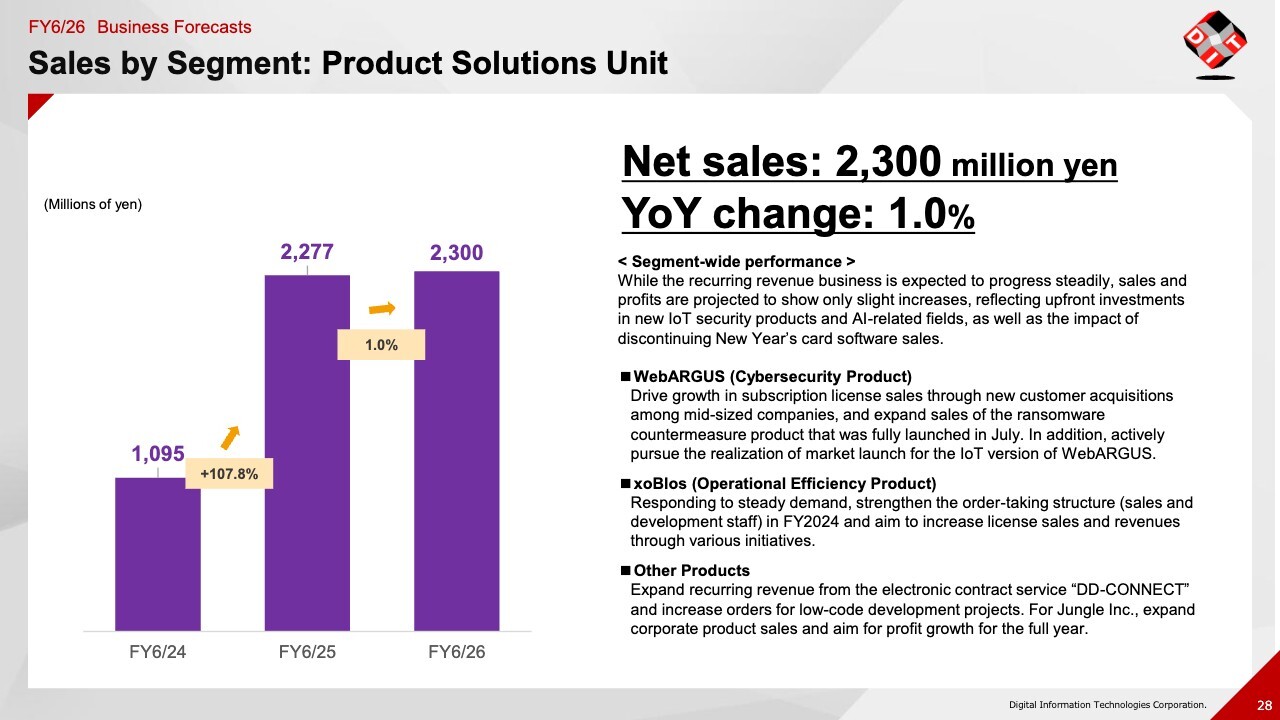
The Product Solutions Unit generated net sales of 2,300 million yen, up 1.0% year on year. I would like to add a few comments on this point.
Fude-gurume has a high sales volume, but its gross profit margin is actually low. Our current business plan assumes that this product will be discontinued after the current fiscal year.
For this reason, we are focusing on business-to-business (BtoB) products to ensure sufficient gross profit even if sales decline. We handle a wide range of products for corporate clients, and we will actively expand sales of such products.
As a result, Jungle Inc.’s sales will decline slightly year on year. However, we plan to achieve solid profit growth. You may be surprised that we project a sales increase of 1% in this segment, but the structure is in place to make a significant profit contribution.
Priority Measures by Segment: Product Solutions Unit
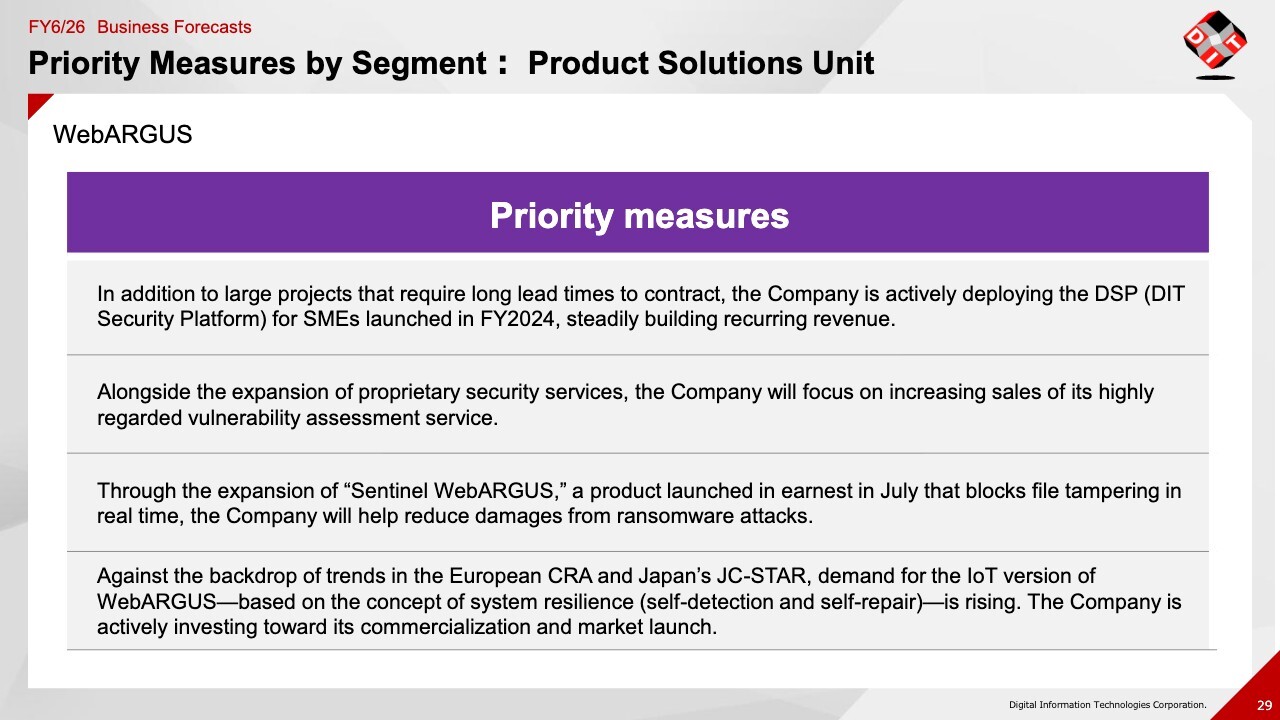
The slide outlines the key initiatives of the Product Solutions Unit for each product.
Regarding our cybersecurity product, WebARGUS, the first initiative is to actively roll out DSP, which we launched in the previous fiscal year, and steadily build up recurring revenue.
Second, in addition to enhancing our proprietary security services, we will further incorporate vulnerability assessment services, which are in high demand from various companies, to expand sales.
Third, we will expand sales of SentinelARGUS, which we have released recently, to reach out to customers affected by ransomware, as we seek to increase sales.
Fourth, we will make a major investment of 100 million yen in a new product. In light of the recent developments surrounding Europe’s Cyber Resilience Act (CRA) and Japan’s Cyber-Security Technical Assessment Requirements (JC-STAR), the concept of system resilience, the ability to restore embedded and IoT products to their original condition, is becoming increasingly important. In response to this growing demand, we will make an active investment of approximately 100 million yen to create an IoT version of WebARGUS.
We are observing a gradual rise in customer interest in the product. Accordingly, we will make every effort to bring it to market.
Priority Measures by Segment: Product Solutions Unit
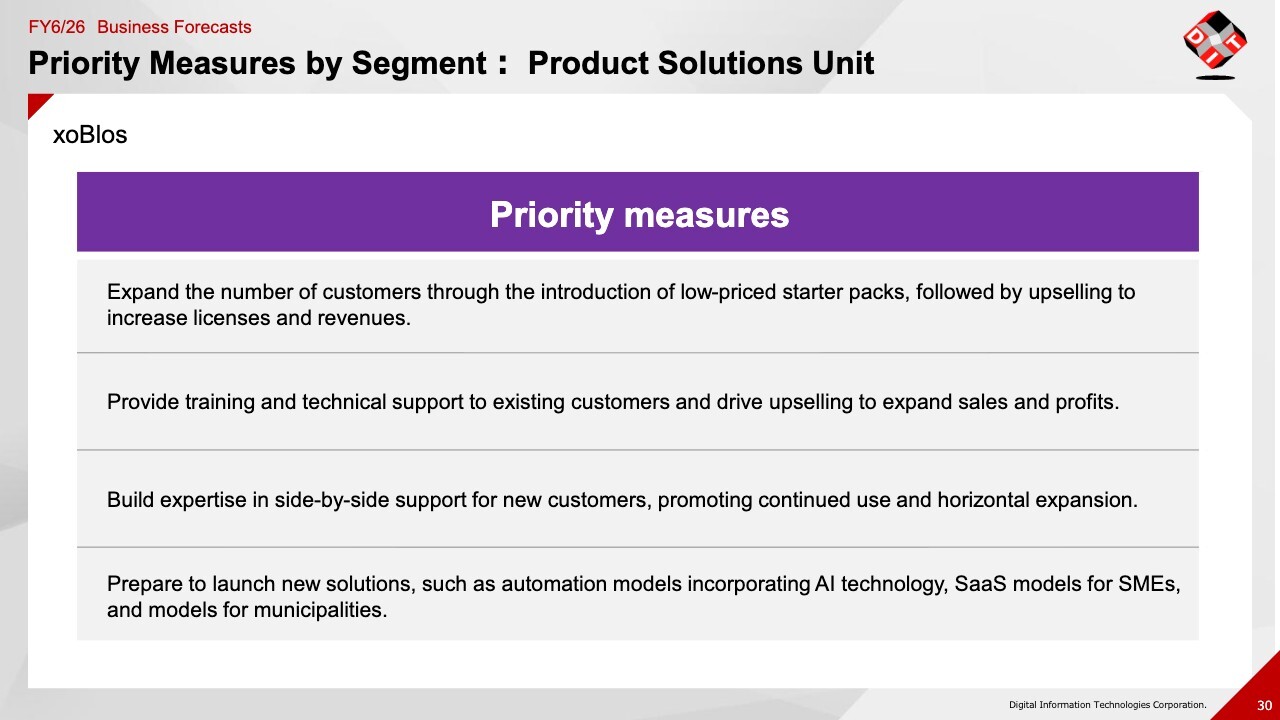
We have four key initiatives for xoBlos. First, we will expand sales of low-priced starter packs to make it easier for customers to adopt the product and increase the number of companies using it. Then, we will increase license volume and sales through upselling.
Second, we will strengthen educational and technical support for existing customers to facilitate their understanding of xoBlos and advance initiatives that lead to upselling.
Third, we will provide side-by-side support to new customers by incorporating some consulting elements to secure orders. Then, we will pursue horizontal expansion. Fourth, we will use various AI technologies to automate multiple processes in developing xoBlos, which has relatively high adoption barriers. We believe this will broaden our customer base. For this reason, we will proceed with preparations to offer such new solutions.
Priority Measures by Segment: Product Solutions Unit
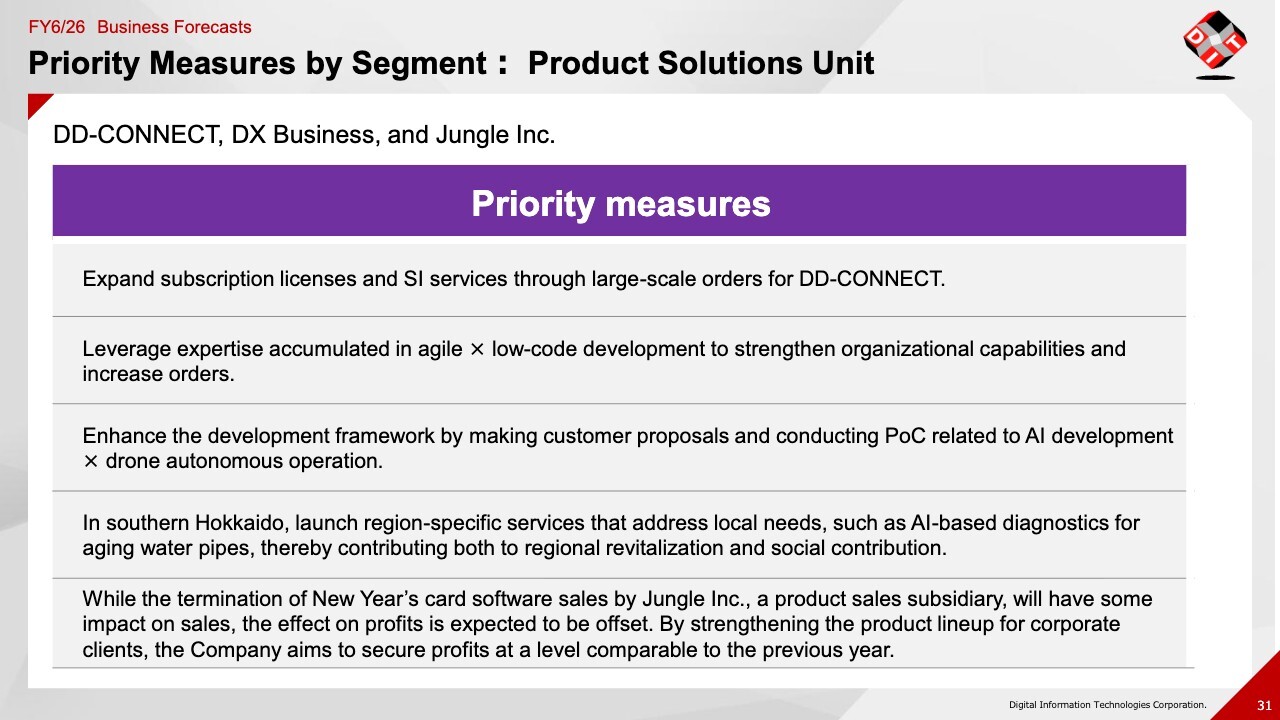
We have five key initiatives for DD-CONNECT and Jungle Inc.
First, regarding DD-CONNECT, we have secured many large-scale projects and high-quality customers. We will seek to secure more business from such customers, thereby earning not only subscription revenue but also capturing related system integration (SI) business.
Second, in connection with DD-CONNECT, there is relatively strong demand for core system replacement. Therefore, by incorporating needs related to agile development and low-code solutions, we aim to increase order volume.
Third, while we have recently been advancing initiatives in the field of artificial intelligence, we also intend to focus on societal changes that may be brought about by autonomous drone operations in the future. Through proposals to customers in these areas, as well as proof-of-concept projects and experimental development, we will build a solid track record and strengthen our development framework to capture customer needs centered on development.
Fourth, we have established bases in Southern Hokkaido—specifically in Hakodate and Hokuto City—to actively engage in initiatives for regional revitalization and social contribution.
For example, in response to incidents such as ground subsidence caused by aging water pipes in Saitama Prefecture, we are working with local governments to launch initiatives that utilize AI for thorough inspections. We will pursue these efforts from the perspective of future business development and regional contribution.
Fifth, regarding initiatives related to Jungle Inc., although the sale of the New Year’s card software is scheduled to end, we will make up for its absence with other products and aim to ensure that profit exceeds that of the previous fiscal year.
Sales by Segment: Systems Sales Business
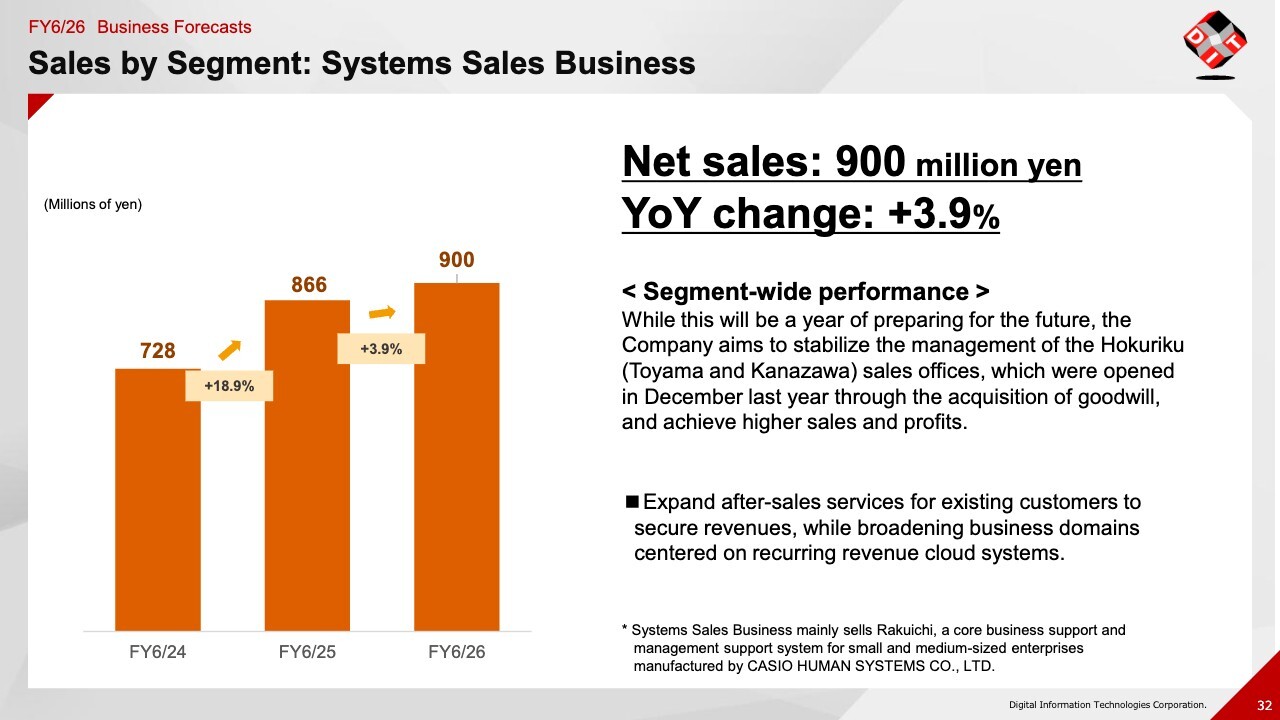
Systems Sales Business targets net sales of 900 million yen, up 3.9% year on year.
Priority Measures by Segment: Systems Sales Business
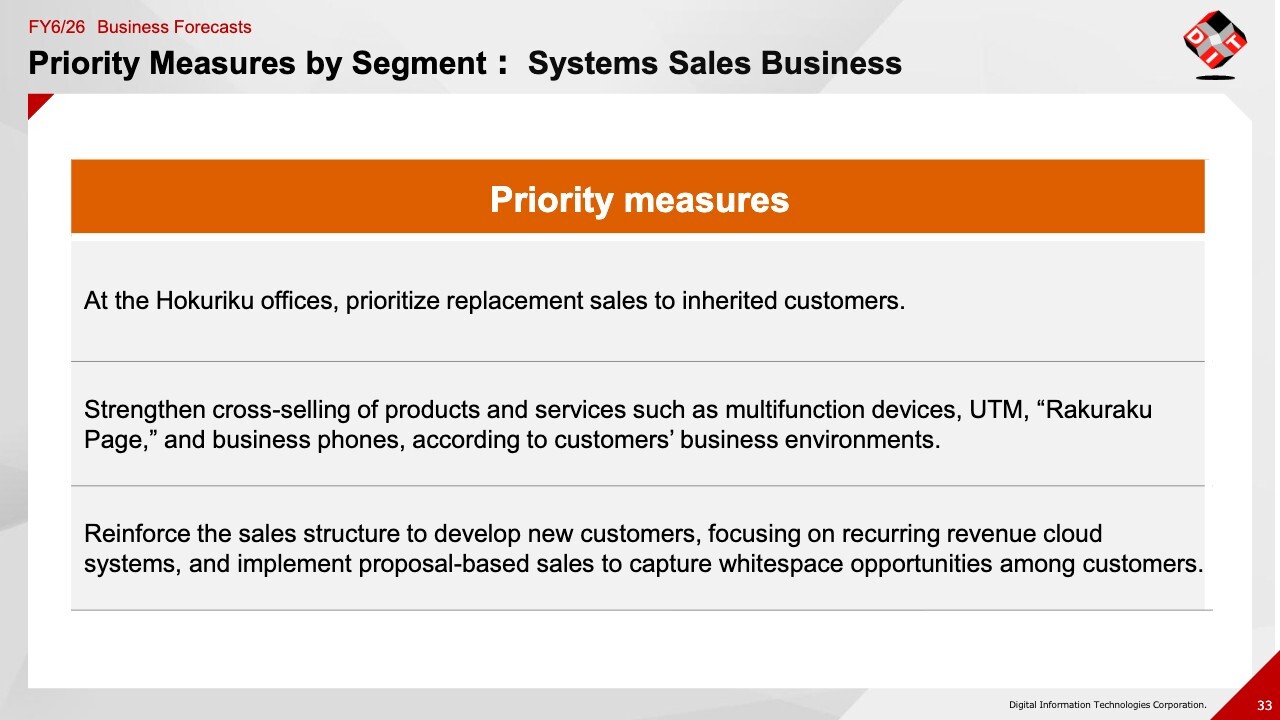
There are three key initiatives in the Systems Sales Business. First, at the Hokuriku sales office, we will prioritize replacement sales to inherited customers in order to achieve results.
Second, we will strengthen cross-selling of products other than Rakuichi, such as multifunction devices, UTM, Rakuraku Page, and business phones, according to customers’ business environments.
Third, we will address our heavy reliance on Rakuichi sales. While strengthening our sales structure, we will advance various initiatives with the aim of building a framework centered on the sale of new products that come after Rakuichi.
Key KPIs (Net Sales/Operating Profit/Margin)
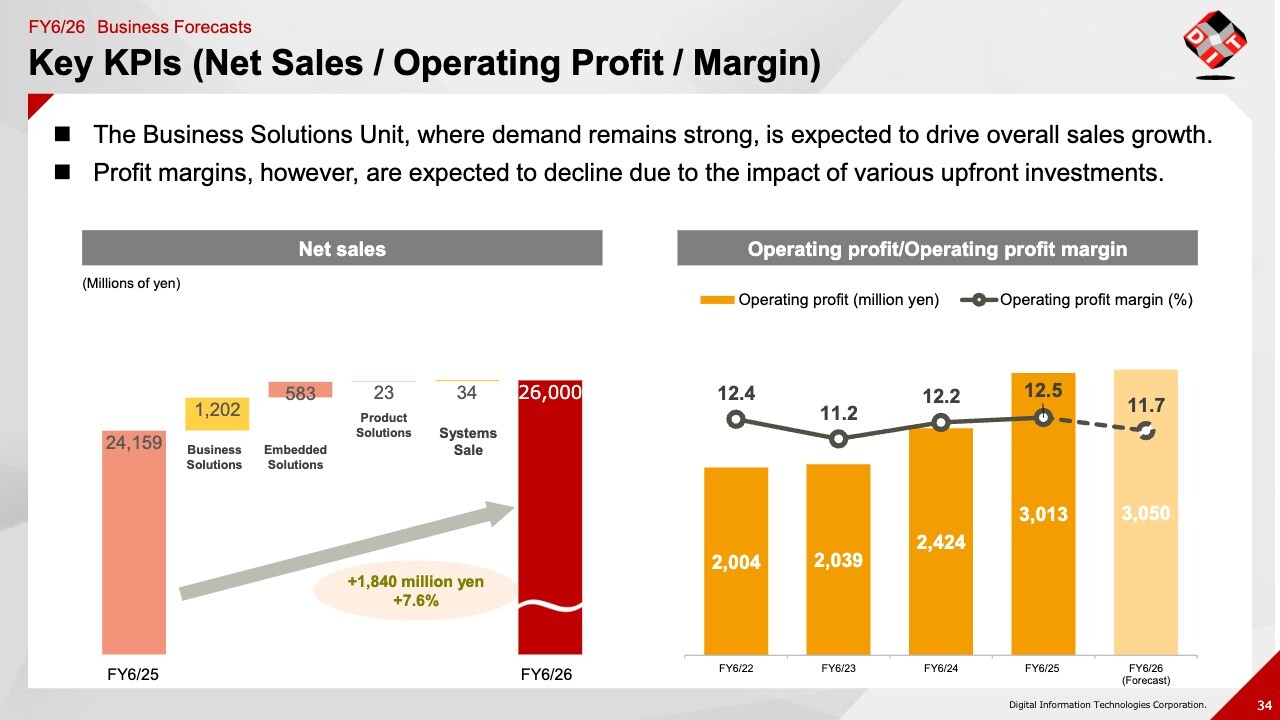
These are our key KPIs. In terms of net sales, the Business Solutions Unit is showing steady growth, while the Embedded Solutions Unit is trending slightly weaker.
For operating profit, we are currently making upfront investments. As a result, we projected a lower operating profit margin, but actual results show steady improvement. We will maintain our efforts to achieve stable performance.
Shareholder Returns
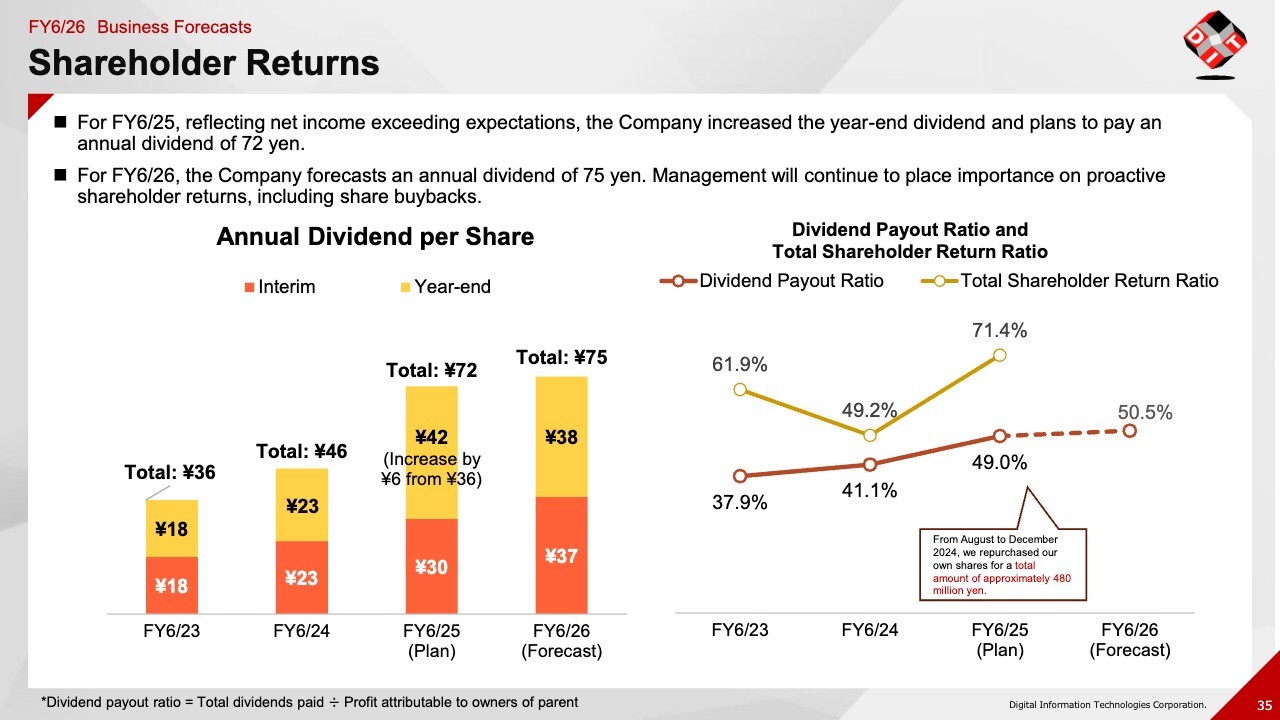
Regarding shareholder returns, we plan to increase the year-end dividend for the fiscal year ended June 30, 2025, and bring the annual total to 72 yen, after profit attributable to owners of parent exceeded our forecast.
For the fiscal year ending June 30, 2026, we plan to pay an annual dividend of 75 yen. We will continue to emphasize active shareholder returns through share buybacks and other measures as we carry out our operations.
Update of Medium-Term Plan Targets
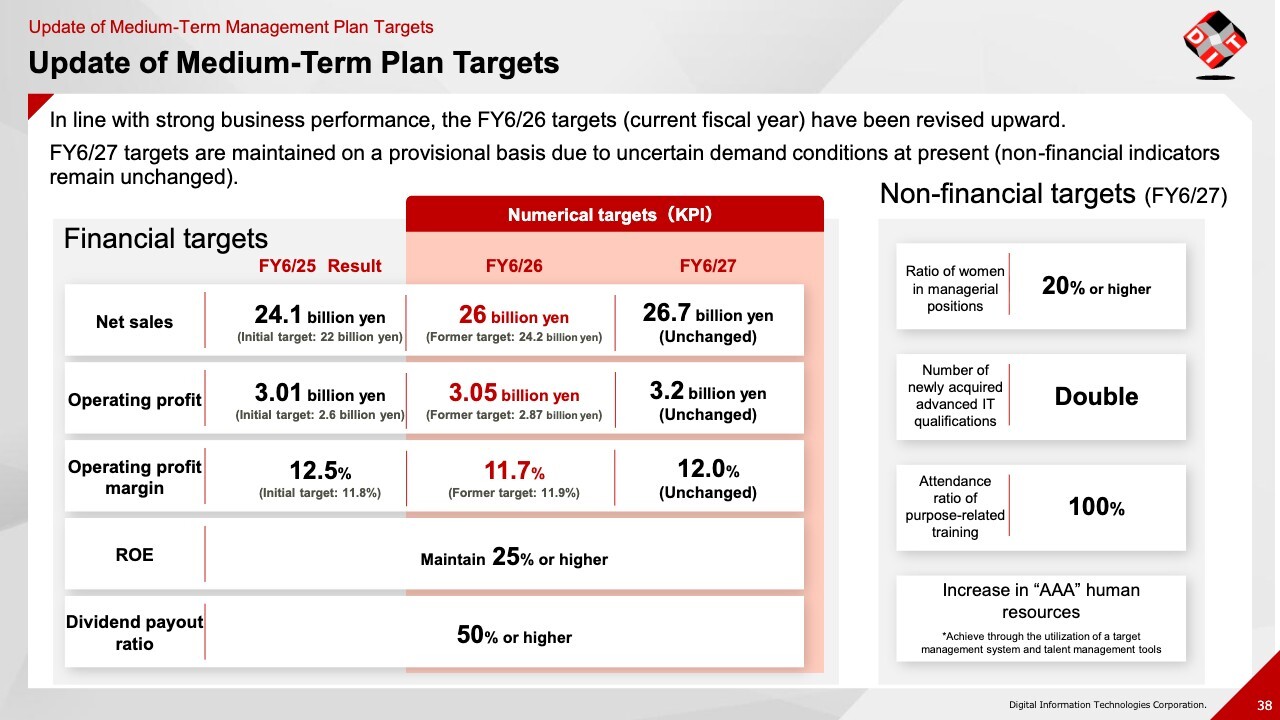
This shows an update to our Vision for 2030 and Medium-Term Management Plan. For the fiscal year ending June 30, 2027, the final year of the Medium-Term Management Plan, we have kept our targets unchanged because we expect that profit for this fiscal year will be little changed from the previous fiscal year, when we had strong results.
This does not mean that these are the only numbers we can achieve. We are currently making various investments aimed at generating future profit, and we are now at the stage of determining when and how much we can recover.
Additionally, the Embedded Solutions Unit has been affected by tariffs. Automakers are currently evaluating how significant that impact is and limiting their involvement in that area. Despite such a situation, we are receiving more offers from automakers. These offers are focused on new domains that differ from our traditional initiatives.
For this reason, we believe that the worst is over. Companies that have secured their annual IT budgets are beginning to move forward with project execution.
We will carefully assess the results of the first half. Once we have a clear outlook for the second half and beyond, we plan to revisit the figures that have been kept unchanged.
Medium-to-Long-term Growth Model
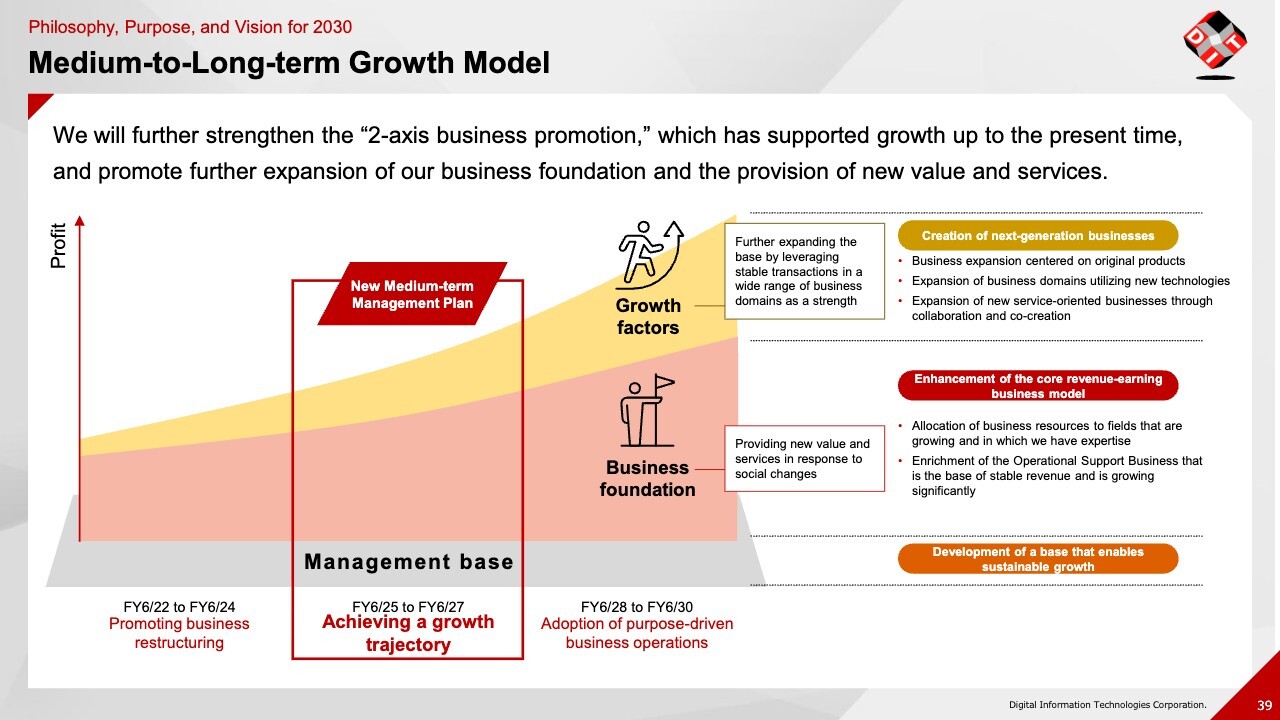
We will continue to advance our Vision for 2030 and the associated growth model without any changes.
We will steadily expand our business foundation and pursue growth in our proprietary product lines. By maintaining these efforts, we aim to further enhance our profitability going forward.
As for the efforts described on pages 40 through 45, we will also proceed without making any changes.
The Company will continue to pursue its 2030 Vision under the slogan: “Aiming to Break 50, 50, and 50!”
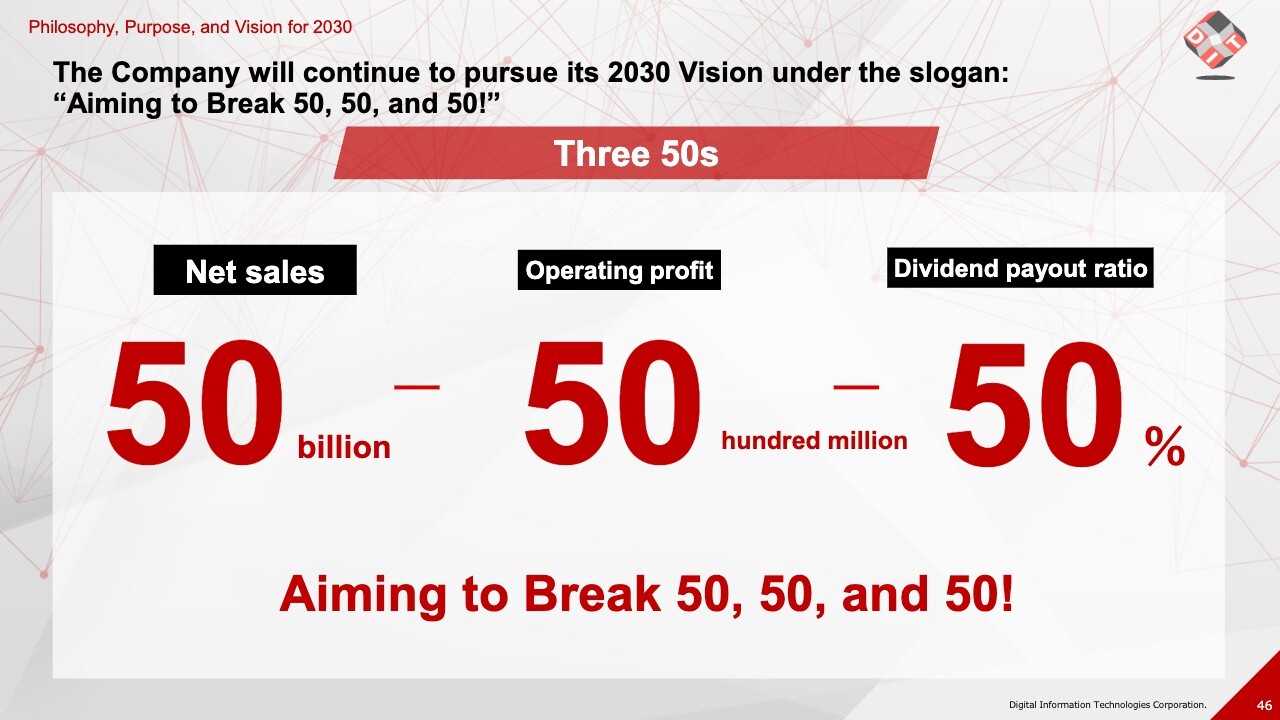
We will continue to pursue our “50–50–50” targets set forth in the Vision for 2030. We will keep the 2030 Vision in view as we continue to do so.
That concludes my presentation. Thank you so much for your attention.
Q&A: Investment Plans and Salary Increases for Fiscal 2026
Moderator: We have a question. “I believe that there is an expectation for your company to achieve at least double-digit growth in both net sales and profit. Last year, the president mentioned that there would be a significant salary increase—of 9%—only for the fiscal year ending June 30, 2025, that no major increase would follow in the fiscal year ending June 30, 2026, and beyond, and that growth would accelerate as a result.
However, the forecast for the fiscal year ending June 30, 2026, indicates zero growth. Why do you expect that there will be no profit growth? You explained that this is due to investments in internal system upgrades, an increase in salary levels, and the launch of new security services. Please provide more details on the cost of each of these initiatives.
In addition, there is a mention of improved employee compensation. Please explain the background behind the change in thinking that led to a significant increase not only in the fiscal year ended June 30, 2025, but also in the fiscal year ending June 30, 2026.”
Ichikawa: We project little change in profit to begin with. However, our forecast reflects an investment budget of approximately 300 million yen. This consists of 100 million yen for the development of IoT security products, 100 million yen for the AI-related field, and another 100 million yen for internal systems and human capital investment.
Regarding employee salaries, we increased salaries by slightly more than 9% and slightly less than 10% in the previous fiscal year. This time, the increase has been normalized to slightly more than 4%. Therefore, the impact is minor, and the breakdown shows that a significant amount—300 million yen—has been allocated to investments.
Q&A: Discontinuation of Jungle Inc.’s Fude-gurume
Moderator: We have a question. “Regarding Jungle Inc.’s Fude-gurume, were you aware at the time of the M&A that it would no longer be available after the 2025 edition? Furthermore, with respect to Fude-gurume’s sales and profit, you mentioned that you could not cover sales but would make efforts to cover profit. Does this mean that profit can be covered by Jungle Inc. itself?”
Ichikawa: Regarding the discontinuation of Fude-gurume, I believe it is necessary to assess how much demand will remain for New Year’s greeting cards. Since this product requires procurement, it will inevitably fall below the break-even point someday as procurement costs rise and demand for New Year’s cards and their sales decline. We have been trying to determine when that will happen.
We did not expect this product to end in 2025. However, our supplier warned that it could fall below the break even point and that costs might increase sharply. Therefore, we decided to use this opportunity to shift Jungle Inc.’s focus to B2B and redirect our sales resources to other products.
Jungle Inc. plans to increase profit by at least 10% year on year. Therefore, while sales are expected to fall slightly, we believe that this will not pose a problem in terms of profitability.
Q&A: Delays in financial projects at other companies
Moderator: We have a question. “Other companies’ financial results indicate delays in projects involving multiple megabanks. How does your company view this situation?”
Ichikawa: In the financial industry, once a problem occurs, it can exert a far-reaching impact. We handle various types of work and pay close attention to every detail.
We have never experienced any serious system failures. However, we sometimes hear about incidents that occur at other companies. Therefore, we will continue to manage our projects with the utmost care to prevent such incidents.
Q&A: Initiatives to address changes in AI technology
Moderator: We have a question. “Last time, I was informed that about 20 people at your company were trying out AI. What is the current situation? Also, in both the short and long term, what kind of changes do you feel AI is bringing to your company?”
Ichikawa: AI is changing very rapidly. It is completely uncertain whether what is currently available will remain as the de facto standard.
That is why our R&D team constantly monitors new technologies and tests them. Through this process, we gather solid information on how they differ from existing technologies and consider which is superior as we gain new insights.
Our R&D team identifies what we believe to be the best approach based on a certain working assumption. We combine the language called “Python” with AI to build expertise in managing projects on a regular basis. We use a wide variety of AI tools, including Python, and leverage many different kinds of technology.
Furthermore, we are fortunate to have an internal company system, which allows each company to implement different technologies. Because of this, even if a particular technology becomes the de facto standard, we can adapt and align ourselves with it as needed.
We are gathering and applying information on a wide range of technologies, while diversifying risks at the same time. By having each internal company use different technologies, we further strengthen our risk hedging. Ultimately, through these efforts, we aim to accumulate AI expertise and offer development capabilities to our clients. We are implementing these initiatives toward this end.
Q&A: Upward revision to earnings forecast during the fiscal year
Moderator: We have a question. “You have raised your earnings forecast in the middle of the fiscal year. Some people point out that your projections were overly conservative. What are your thoughts?”
Ichikawa: I believe that your observation is correct. However, at the risk of sounding presumptuous, it is our motto never to fall short of the figures we present
We undertook initiatives we had never tried before, such as raising employee salaries by 9% and acquiring a company without fully knowing its potential. Because of that, we may have taken a more cautious view.
However, an excessive gap can also be a problem. Therefore, we aim not only to remain conservative but also to identify and pursue growth opportunities more effectively, as you have pointed out.
Q&A: Share buyback
Moderator: We have a question. “Are you currently considering a share buyback? Given that operating profit is forecast to decline due to investment, if the environment allows for significant future growth, I believe that buying back shares while the stock price is low could be useful for future M&A.”
Ichikawa: We will continue to buy back shares at the right times. This is in line with our initiative to promote employee stock ownership. Moreover, in a situation where our market capitalization rises significantly above its current level, we believe it could also serve as a useful tool for M&A.
It is difficult to determine whether now is the right time, but our policy is to continue to buy back shares at appropriate times.
Q&A: Earnings impact of automakers’ budget cuts
Moderator: We have a question. “Please explain in more detail the impact that automakers’ budget cuts may have on your company’s performance for the fiscal year ending June 30, 2026, breaking it down into the first half and the second half.”
Ichikawa: To put it simply, the impact is more pronounced in the first half. The closer we are to the present, the stronger the effect. Automakers have set clear IT budgets for the full year, but whether they will actually execute these budgets remains uncertain. For now, their stance is to tighten spending as much as possible.
Regarding how long this situation will continue, whether it will last three months or six months, there is still no clear outlook. Therefore, the first half of the fiscal year is expected to be particularly challenging.
In the second half, conditions are expected to improve. Automakers will sense that the impact of tariffs will be milder than initially expected. They will also have a somewhat clearer outlook on earnings, and they will move forward with new investments.
Therefore, we expect to be heavily affected in the first half and see improvement in the second half.
Q&A: Investment plan for the year ending June 30, 2027, and beyond
Moderator: We have a question. “Regarding the 300 million yen in investment planned for the fiscal year ending June 30, 2026, your explanation suggests that this level of spending may continue into the fiscal year ending June 30, 2027, and beyond. It does not appear to be a one-time expense. Does this mean that an annual investment of approximately 300 million yen will be required in the next fiscal year and thereafter?”
Ichikawa: Regarding AI, we are considering various initiatives for the near term. We do not expect that spending will stay at the current level of 100 million yen in the next fiscal year. We expect it to be somewhat lower.
Regarding IoT security, during the first half of this fiscal year, we will rewrite WebARGUS, which was originally developed in Java, into native and embedded languages. After that, we will proceed with various customizations for the manufacturers that plan to adopt it.
We plan to complete product creation in the first half and focus on manufacturer-specific customizations in the second half. The major investment will conclude in the first half, and once the customizations for each manufacturer are implemented, we expect that they can be adapted for use by other manufacturers in a horizontal fashion.
Therefore, we do not expect large-scale investment in IoT security to continue beyond the next fiscal year. Rather, we believe that the investment will shift toward the cost of sales (tied to sales) as demand expands.
Q&A: SentinelARGUS delivery date
Moderator: We have a question. “You have released SentinelARGUS. How has the response been so far? Also, how long does it typically take from order placement to delivery?”
Ichikawa: It often takes a while for security products to be adopted after their release, sometimes as long as six months to a year. However, when adopted by a major or high-profile company, they often spread quickly.
Therefore, while initial adoption may take time, once a prominent company adopts a product, it has the potential to spread, much like the Othello game. With this in mind, we plan to continue pursuing our efforts proactively.
Q&A: Recruitment plan and implementation
Moderator: We have a question. “Regarding recruitment, tell us about your company’s current hiring practices and overall approach.”
Ichikawa: We plan to hire roughly 100 new graduates. At the same time, we expect about 50 employees to leave. To offset those departures, we will recruit approximately 50 experienced professionals through mid career and career track hiring.
In other words, the hiring of new graduates will result in a net increase in staff. Taking the number of departing employees into account, we plan to hire mid‑career employees on a similar scale to offset the expected departures.
Q&A: Sharp drop in stock price the day after the earnings release
Moderator: We have a question. “How do you feel about the sharp drop in stock price on the day following the earnings announcement?”
Ichikawa: We released a forecast indicating that earnings would remain largely unchanged. Consequently, we expected the stock price to decline, but the actual drop was greater than we had anticipated. In the past, we have also issued a conservative forecast for the following year. We assumed the outcome would be similar this time, but the stock fell more than it did then.
However, we will diligently pursue shareholder returns and seek out investors willing to repurchase our stock. Furthermore, we intend to advance initiatives aimed at restoring the stock price by consistently delivering results that far exceed expectations. We are grateful for your support.
Closing Remarks from Ichikawa
Thank you for staying with us until the very end. We achieved relatively solid results in the previous fiscal year. For the current fiscal year, we forecast earnings that are largely unchanged from the previous year. However, we are in a growth phase, and it is precisely at times like this that we must invest for the next stage.
We are forecasting earnings that are largely unchanged year on year. This provides us with an opportunity to invest in our next phase of growth. We will make full use of this opportunity and steadily prepare for the future.
Furthermore, we will accelerate investment recovery as much as possible to eliminate any concerns you may have. We will devote our full efforts throughout this fiscal year. We appreciate your continued support.